

Everything you need to know to keep trading cards — raw or graded — in the condition you bought them in.
Cards lose value in ways you can usually avoid. A corner ding from a loose stack. A soft edge from a plastic sleeve that was never acid-free. Sunlight that fades a foil over one summer. Or a hairline scratch across the front of a graded case that turns a “10” into a hard conversation at resale.
None of that is bad luck. It is storage and handling, and it is fixable. This guide covers the whole chain: what to put your cards in, in what order, and where to keep them.
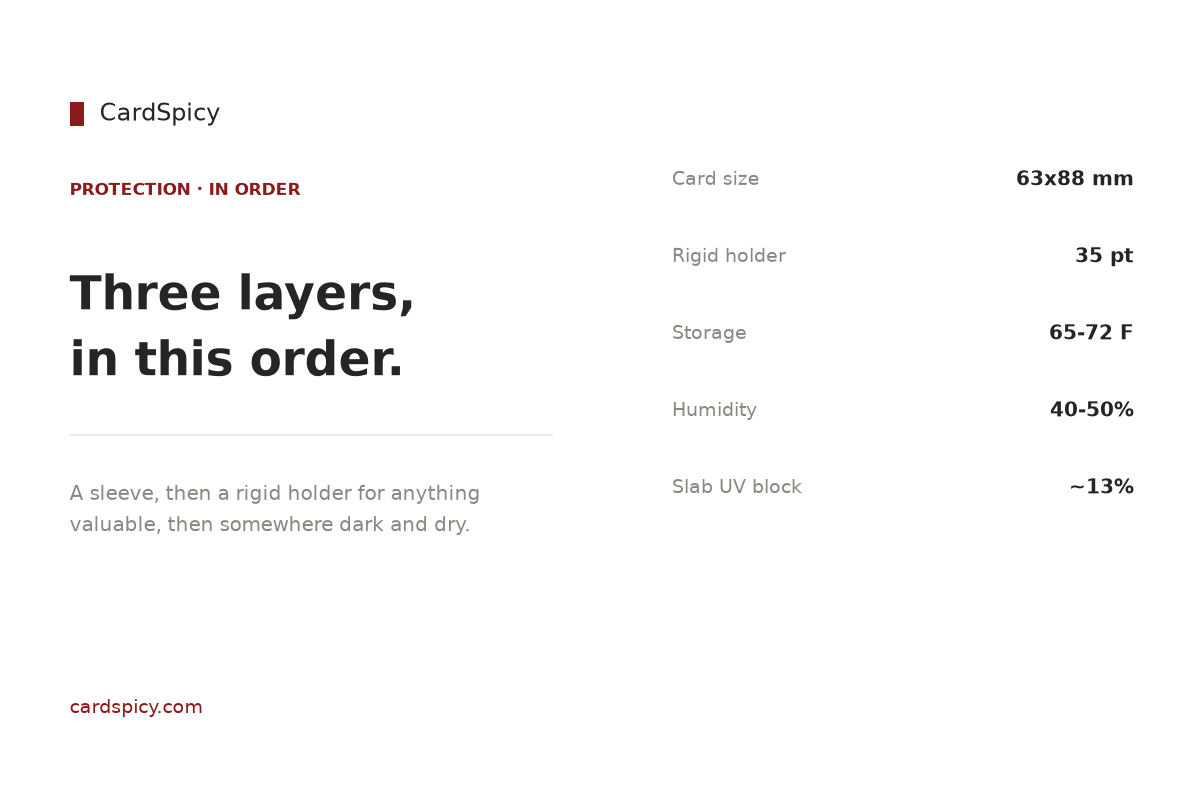
The three layers of card protection
Think of protection as three layers, each solving a different problem. You do not need all three for every card — but you should know which layer you are skipping.
- Soft protection — sleeves. Stops surface scratches, edge wear and dust from everyday handling. Your first line of defence for anything you touch.
- Rigid protection — toploaders, semi-rigids, magnetic holders, slabs. Stops bending, corner crushing and pressure. Essential for anything worth more than the cost of the holder.
- Storage and display — binders, boxes, frames. Stops long-term damage: light fading, humidity, warping from uneven pressure, and loss.
Layer 1: Sleeves
Sleeves are cheap insurance. Two things actually matter when choosing them:
- Chemistry. Look for acid-free and PVC-free (polypropylene or polyethylene) materials. PVC sleeves are the classic mistake — they look fine for years, then the plasticiser migrates and dulls the card surface. It is not reversible.
- Fit. A soft sleeve (also called a penny sleeve) is a loose, flexible sleeve for standard 63 × 88 mm TCG cards. An exact-fit sleeve hugs the card for a second layer of protection inside a binder pocket or a rigid holder.
Sleeve your card before it goes anywhere else — into a binder, a box, or a toploader. Going straight into a binder pocket without a sleeve is how corner whitening starts.
Double sleeving (exact-fit inner, soft or matte outer) is worth it for anything you intend to keep or resell. The inner sleeve seals the card; the outer takes the handling.
Layer 2: Rigid holders and thickness (the “pt” number)
Once a card leaves your hands and goes into storage, bending is the main risk. That is what rigid holders are for. The one number you need to understand is “pt” — the thickness of the card, in points of an inch.
| Thickness | Typical use |
|---|---|
| 35pt | Standard cards — Pokémon, Magic: The Gathering, Yu-Gi-Oh!, most TCGs and base sports cards |
| 55pt | Thicker stock, some premium and foil-heavy printings |
| 75pt | Memorabilia and patch cards, some inserts |
| 100pt | Thick patch/auto cards, relic cards |
| 130pt | The thickest printed cards and small booklets |
Buy the holder that matches the card. Putting a 130pt card in a 35pt holder bends it. Putting a 35pt card in a 130pt holder lets it slide and rattle.
Three rigid options, in increasing order of permanence:
- Toploaders — rigid, cheap, reusable, and the everyday standard. Always put the card in a sleeve first; a bare card in a toploader will scratch.
- Semi-rigid holders — flexible but crush-resistant. Use these specifically when posting cards to a grading service, because they survive the postal system without pressing marks. Most graders specify semi-rigid.
- Magnetic holders — two rigid halves with magnets. The ideal option when you want to display a card, because you can open and re-seat it without sliding it in and out. Choose the correct pt size and never use force on the seam.
Layer 3: Storage and display
- Binders. Choose side-loading pockets so cards cannot slide out, and archival-safe, acid-free, PVC-free pages. Store binders upright on a shelf like a book. Stacking binders flat puts pressure on the pages and can bow the cards at the edges.
- Deck boxes and card boxes. For sleeved play decks and bulk. A good box has a soft, lint-free lining and a closure that does not rely on friction alone — strong magnets or a proper zip.
- Display frames. For showing a card off on a wall. Keep them out of direct sunlight; UV is the single fastest way to fade a foil or a signature.
Protecting graded cards (PSA, BGS, CGC slabs)
A graded slab already solves the two biggest problems: the card is sealed, and its grade is documented. What a slab does not protect against is damage to the slab itself — and a scuffed, crazed or cracked case is a real problem at resale, especially on a PSA 10 where the whole premium sits on the case staying presentable.
- Use an outer slab sleeve. A clear, snug sleeve over the whole case keeps scuffs, fingerprints and shelf rash off the plastic. It is the least expensive protection you will ever buy relative to the value it guards.
- Store slabs upright, not flat, and not stacked. Long-term weight on a case can leave marks or stress the seal.
- Keep them out of sunlight and out of the garage. UV fades the label; heat and humidity cycling can cloud the case.
- Handle by the edges. Fingerprints etch into polycarbonate over time.
- Keep the original grading paperwork or reference. The certification number on the label is the proof of authenticity — screenshot or note it when you buy or sell.
Seven mistakes that cost real money
- Storing cards in a shoebox or a rubber-banded stack. Pressure plus movement equals edge wear.
- Cheap PVC sleeves or PVC binder pages — chemical damage that shows up years later.
- Displaying in direct sunlight or under a hot lamp.
- Leaving cards in a hot car, a loft, or a damp basement. Heat warps; humidity cockles.
- Putting a bare card straight into a toploader or binder pocket without a sleeve.
- Using the wrong thickness holder, then forcing the card in.
- Handling by the face instead of the edges, and stacking slabs face-to-face on a hard shelf.
Quick reference
| Situation | What to use |
|---|---|
| Playing with a deck | Sleeves (exact-fit inner + matte outer), then a deck box |
| Collecting a set | Sleeve, then a side-loading binder with archival-safe pages |
| A card worth $20+ that you keep | Sleeve, then a 35pt toploader or magnetic holder |
| Posting to a grader | Sleeve, then a semi-rigid holder, then rigid packaging |
| Displaying a card | Sleeve, then a magnetic holder or wall frame — out of sunlight |
| A graded PSA / BGS / CGC slab | Outer slab sleeve, stored upright, out of light and heat |
Frequently asked questions
Are penny sleeves enough for an expensive card?
For handling, yes. For storage and shipping, no. Add a rigid layer — a toploader, semi-rigid or magnetic holder — for anything you would be unhappy to lose.
Do I need to double sleeve?
Not for bulk. Double sleeving is worth it for cards you intend to keep long-term, display, or resell, because the inner exact-fit sleeve seals the card against dust and moisture while the outer sleeve absorbs the handling.
What is the difference between a card slab and a graded case?
A slab is the rigid plastic holder itself — it protects the card and makes tampering obvious. A graded case is a slab plus an official grade from a recognised grading service, which is what adds resale value. You can buy protection without grading; you cannot get the resale premium without it.
Can I keep graded slabs in a binder?
No. Slabs are thicker and heavier than the pockets in a standard binder, and forcing them in stresses both the case and the pages. Store graded cards in a card box sized for slabs, and display them in frames designed for slab thickness.
How should I store cards for the long term?
Sleeved, in an acid-free and PVC-free holder, inside a binder or box, standing upright, in a cool, dry, dark place at a stable temperature. Consistency matters more than any single product.
Related reading
- How to protect your trading cards with card sleeves
- Grading guide: how to read a PSA, BGS or CGC card — and what a 10 actually measures
- Card slabs vs graded cases: which one to choose
- 5 tips to prevent card bending and fading
Shop the layers
Protection is a system, not a single purchase. Start with sleeves, add a rigid layer for anything valuable, and give the whole collection a home that keeps light, dust and pressure away.
- Card Sleeves — first layer, every card
- Graded Card Protection — holders and frames for slabs
- Binders & Albums — long-term storage for sets
- Storage Boxes — deck boxes and card boxes
Graded cards are a separate problem from raw cards: a slab is roughly 3.25 in by 5.25 in and will not go into a standard page pocket. What a slab does and does not fit covers the sizes, and what to buy instead.
Questions about what will fit a specific card? Get in touch — we would rather answer a question than ship you the wrong size.
Sources
Show all 11 sources
- GradingMetric — PSA 10 Success Rates by Sport, 2024–2026 (24,000 Cards Analyzed). Downgrade reasons by share. gradingmetric.com
- CardShellz — How to Store Your Trading Card Collection. Layer absorption, bowing, 65–72°F and 40–50% relative humidity. cardshellz.com
- TFG Cards — How Card Grading Works. Corner wear developing through handling and sleeve insertion; surface as the 9-versus-10 factor. tfg.cards
- eathealthy365 — A Custom Trading Card Sleeve Material Guide. Re-sleeving every 6–12 months; PVC plasticizer migration and its effects. eathealthy365.com
- TCG Protectors — The Ultimate Trading Card Sleeves Guide. Inspect binders and long-term storage sleeves every 6–12 months; 60–75°F and 40–50% humidity. tcgprotectors.com
- EVORETRO — Do protective sleeves degrade over the long term? Annual or biannual spot checks; yellowing, tackiness and brittleness as the signs. evoretro.ca
- Hotmelt Adhesive Film — What is the difference between cast and blown polypropylene thermoplastic film? Blown film: matte finish, higher tensile strength and elongation, better puncture resistance. hotmeltadhesive-film.com
- Sohu (搜狐) — How to choose card sleeve thickness in 2026: industry standards and scenario guide. Published thickness tiers from 10 丝 to 20 丝 (100–200 μm). sohu.com
- PSA — Reholder Service. The service removes a card from its current holder and re-encapsulates it in PSA’s latest holder; the named categories of limited holder wear (superficial scuffs and scratches, exterior plastic discoloration, edge and corner dulling, label fading); the inspection performed on every reholder submission; and the reasons a straightforward reholder may not be completed, including a fractured case and fading from sunlight exposure since grading. psacard.com
- Slab Saver Comics — Do Acrylic Cases Yellow? What Collectors Need. Cleaning practice for acrylic cases: microfibre first, water for fingerprints, never spray onto the case, avoid paper towels and glass cleaner, store away from hot, humid, smoky or greasy environments, and check discoloration against white paper under neutral light. slabsavercomics.com
- Acrydis — Acrylic Premium Case for PSA Slabs. A display-case maker’s statement that a PSA slab gives around 13% protection against UV rays, and that acrylic scratches easily and should be cleaned with a microfibre cloth. acrydis.com
- CardSpicy — Does a PSA 10 slab fit in a binder? Slab dimensions, and why a short-edge load is the failure that cracks a holder. cardspicy.com
Every figure here comes from the sources above or from our own packing practice. Protection preserves a card; it does not repair one. A crease that is already in the cardboard stays in the cardboard.