
🛒0
CardSpicy

Author: csadmin

  • Top 10 Most Popular Simplified Chinese-Exclusive Pokémon Cards

    Top 10 Most Popular Simplified Chinese-Exclusive Pokémon Cards

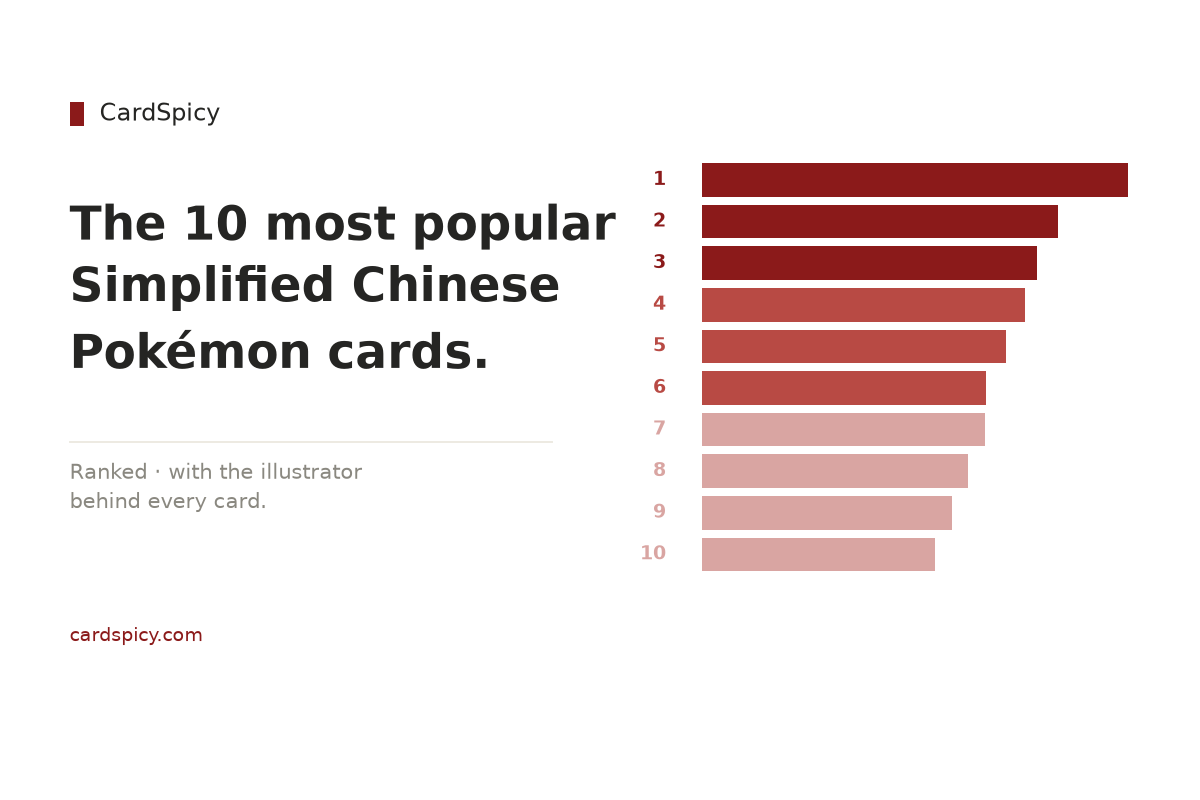
    Simplified Chinese sets print artwork that appears in no other language. These are the ten cards collectors chase hardest — ranked, with the illustrator credited on each one.

    Simplified Chinese Pokémon cards launched in 2022 as a catch-up release, printing Japanese and English set lists a year or more behind the originals. That changed in 2025. Since Collect 151 arrived in January, the Simplified Chinese line has been the source of the most distinctive artwork in the hobby — four exclusive Pikachu Art Rares, an all-foil Gem Pack series, and a run of special illustration rares that have never been printed in Japanese or English.

    This is the third guide in our series on Simplified Chinese cards. It ranks the ten exclusive cards with the strongest collector demand right now. Not the ten rarest, and not the ten most expensive: demand, measured three ways.

    How this list was ranked

    Three signals, weighted in this order:

    • Secondary-market prices. Completed sales and live asking prices for raw and graded copies.
    • Collector discussion volume. Which artworks get pulled, posted and chased in collector communities rather than merely listed for sale.
    • How the card was distributed. A lottery prize with 1,510 copies behaves nothing like a Gem Rare that lands one per box, and the ranking reflects that gap.

    One scope rule, applied strictly: the artwork has to be exclusive to Simplified Chinese product. That is why Victini ex 114/SV-P does not appear. It is a Simplified Chinese promo and its graded copies sell for four figures, but the same Special Art Rare also ran as a tournament prize in Traditional Chinese, Thai, Indonesian and Korean — it is a Chinese card, not a Chinese-exclusive one. The Traditional Chinese 5th-anniversary Pikachu (153/SV-P) is out for the same reason.
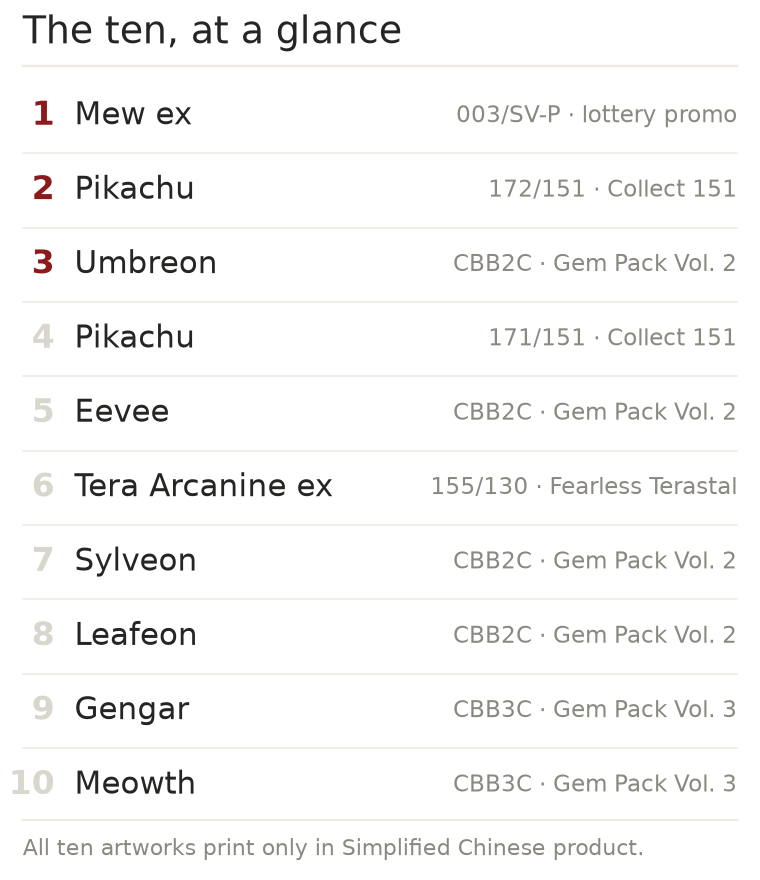
    Ranked list chart: the ten most popular Simplified Chinese exclusive Pokemon cards, 1 Mew ex 003/SV-P through 10 Meowth from Gem Pack Vol. 3
    The ten Simplified Chinese-exclusive cards ranked in this guide. Set codes: CBB2C is Gem Pack Vol. 2, CBB3C is Gem Pack Vol. 3, CSV3AC is Fearless Terastal.

    10. Meowth — Gem Pack Vol. 3 (CBB3C)
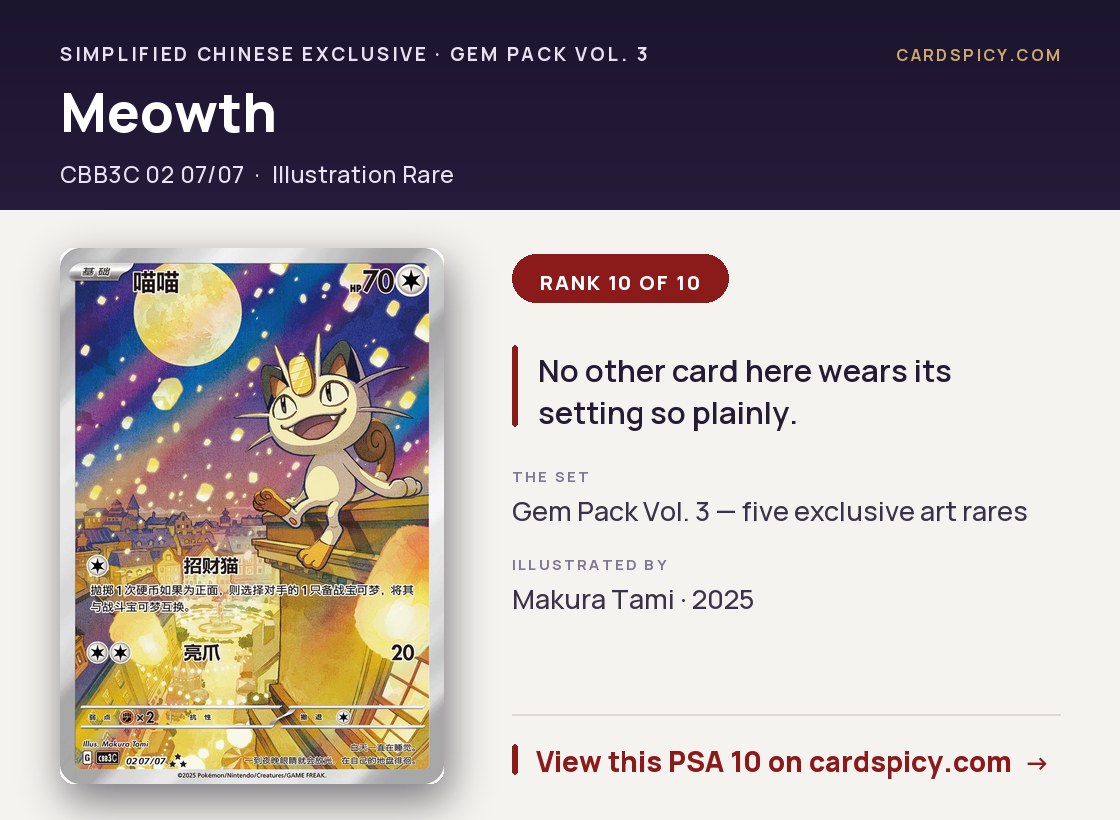
    Meowth — Gem Pack Vol. 3 illustration rare, Simplified Chinese exclusive, illustrated by Makura Tami
    Meowth — Gem Pack Vol. 3 (CBB3C 02 07/07), illustrated by Makura Tami.

    The card. One of five Simplified Chinese-exclusive illustration rares in Gem Pack Vol. 3, the all-foil, night-themed volume released in mainland China on 26 September 2025. Meowth is card 02/07 — second group, illustration-rare slot — and the scene shows it caught in a drift of glowing lanterns above a town after dark.

    The artist. Makura Tami came into the TCG through the 2022 Illustration Contest, where a Bulbasaur submission — credited then as TamiMakura — reached the semi-finals. The first card under the current name was Azumarill in Temporal Forces, and the portfolio now runs to roughly a dozen TCG cards plus three for TCG Pocket.

    Why it ranks here. No other card in the top ten wears its setting so plainly. The lantern-festival scene is the clearest case of a Simplified Chinese exclusive using imagery that would not read the same way in a Japanese or English set, and that specificity is precisely what international collectors are buying. It ranks tenth because supply is the deepest of the ten — every Gem Pack box guarantees at least one three-star card.

    9. Gengar — Gem Pack Vol. 3 (CBB3C)
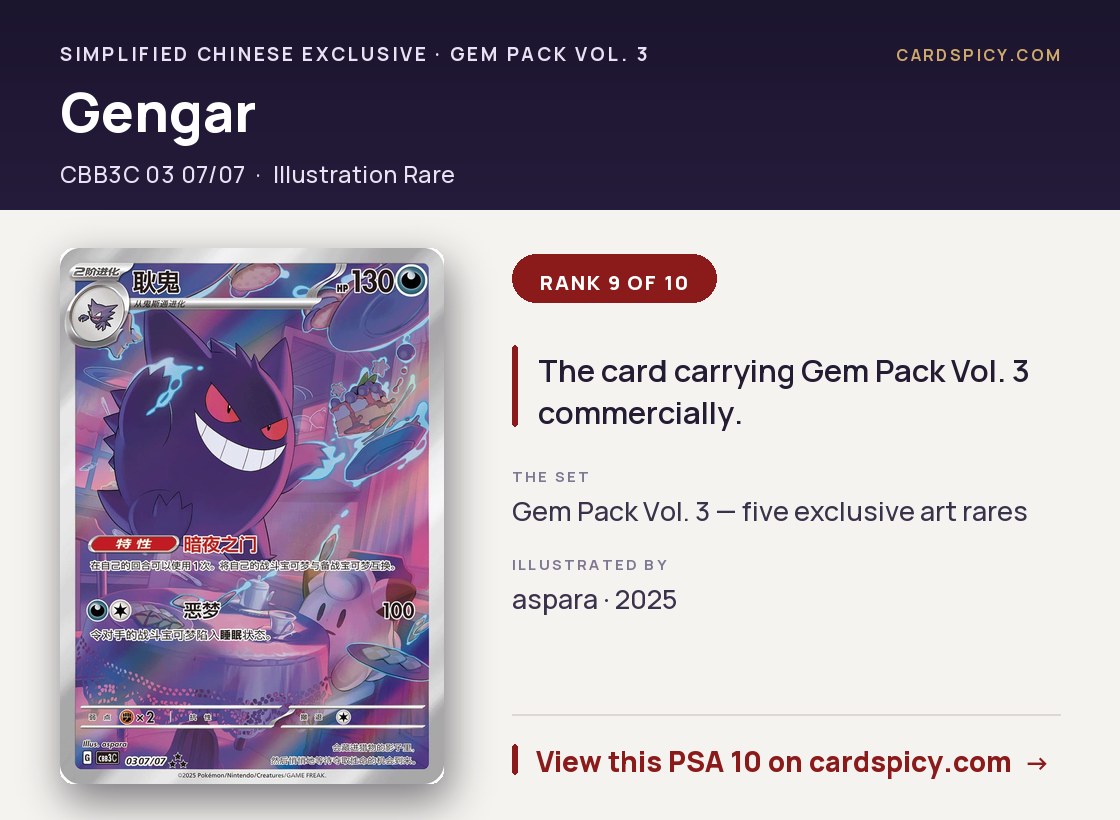
    Gengar — Gem Pack Vol. 3 illustration rare, Simplified Chinese exclusive, illustrated by aspara
    Gengar — Gem Pack Vol. 3 (CBB3C 03 07/07), illustrated by aspara.

    The card. Card 03/07 in the same volume, and the character the set leads with: Gengar is the face of Volume 3 across its packaging and product photography. The exclusive art is an indoor haunting — Gengar mid-prank at a tea table, with a Clefairy Doll in frame.

    The artist. aspara started on Horsea and Seadra in the 151 expansion and has since illustrated around twenty TCG cards plus one for TCG Pocket, mostly in the Scarlet & Violet era.

    Why it ranks here. Gengar is one of the few Pokémon whose alternate arts reliably outprice their playability, and this is the card carrying Volume 3 commercially. It sits ninth rather than higher because the volume’s five exclusives occupy the same tier — Gengar leads the group, but none of the five commands the individual following that Umbreon or the Collect 151 Pikachus do.

    8. Leafeon — Gem Pack Vol. 2 (CBB2C)
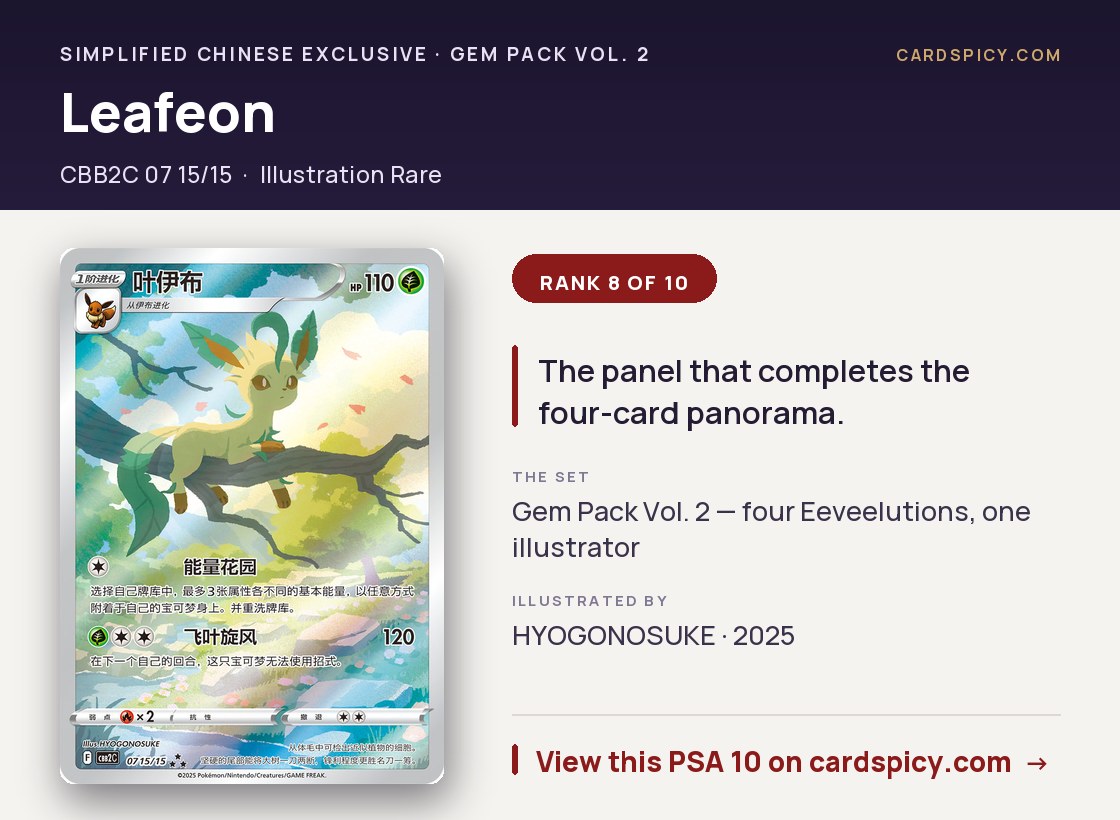
    Leafeon — Gem Pack Vol. 2 illustration rare, one panel of the four-card Eeveelution panorama by HYOGONOSUKE
    Leafeon — Gem Pack Vol. 2 (CBB2C 07 15/15), illustrated by HYOGONOSUKE.

    The card. Card 07/15 — the far-left panel of the four-card forest panorama that made Gem Pack Vol. 2 the most discussed Chinese product of 2025. Leafeon lies along a branch with its legs hanging loose, and that branch sets the horizontal line the other three panels build from.

    The artist. HYOGONOSUKE (ヒョーゴノスケ) is the reason this set is famous, and the illustrator behind all four panels. The artist debuted in the Team Up expansion in 2018 with Jirachi and has since drawn more than ninety TCG cards, building a reputation on blocky textures, dense colour and picture-book composition. The signature move is the connected scene — one illustration split across two or more cards that assembles into a single image. Outside Pokémon, the same style runs through picture books (a Kirby title published by Shogakukan), a published drawing manual, and illustration work for Love Live! and Doraemon.

    Why it ranks here. Leafeon is the least individually chased of the four panels, and that is the point — the panorama is bought as a set, and Leafeon is the piece collectors add to complete it. Its demand tracks the group rather than leading it, which is why it opens the Eeveelution run at eighth.

    7. Sylveon — Gem Pack Vol. 2 (CBB2C)
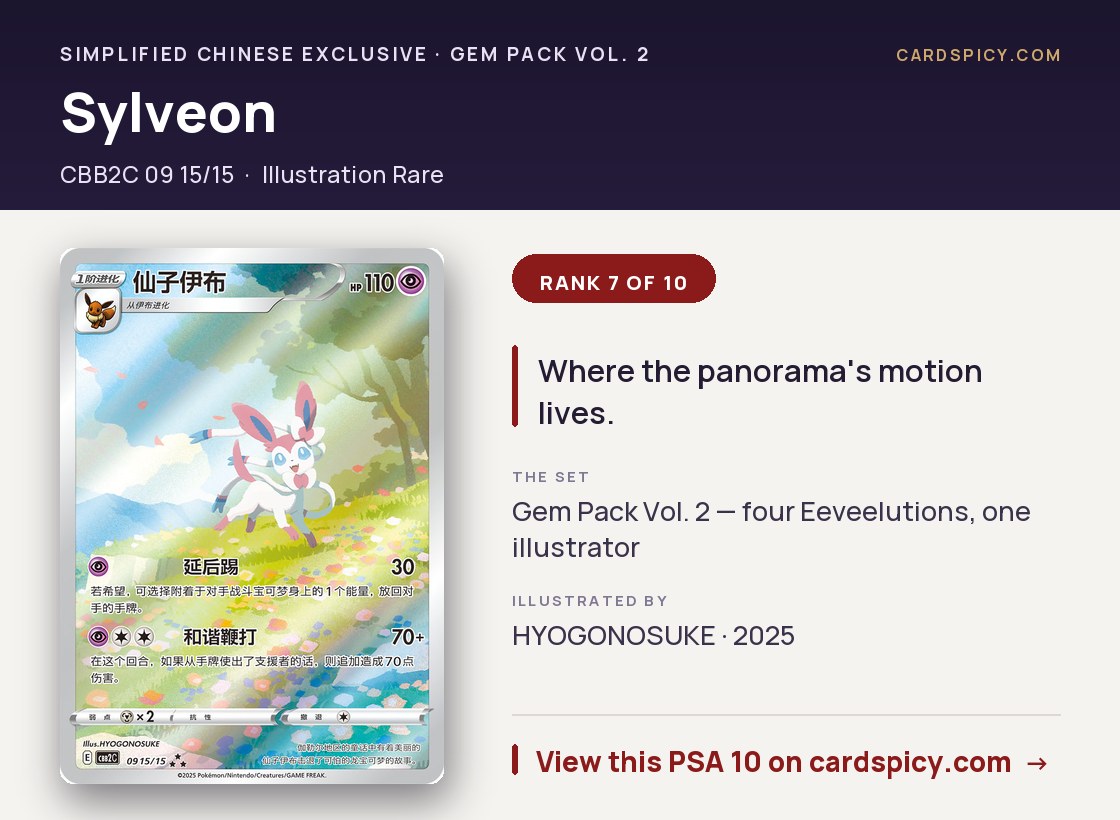
    Sylveon — Gem Pack Vol. 2 illustration rare, one panel of the four-card Eeveelution panorama by HYOGONOSUKE
    Sylveon — Gem Pack Vol. 2 (CBB2C 09 15/15), illustrated by HYOGONOSUKE.

    The card. Card 09/15, second panel from the left. Sylveon moves through a flower-filled clearing with its ribbons trailing, and the pink accents are what carry your eye from Leafeon’s branch into the body of the scene.

    The artist. HYOGONOSUKE — the same hand as the other three panels, and the reason the four read as one image rather than four separate cards.

    Why it ranks here. Sylveon is the most popular of the newer Eeveelutions and this is the panel where the panorama’s motion lives. It ranks above Leafeon on individual demand while still being bought mostly as part of the set.

    6. Tera Arcanine ex — Fearless Terastal (CSV3AC)
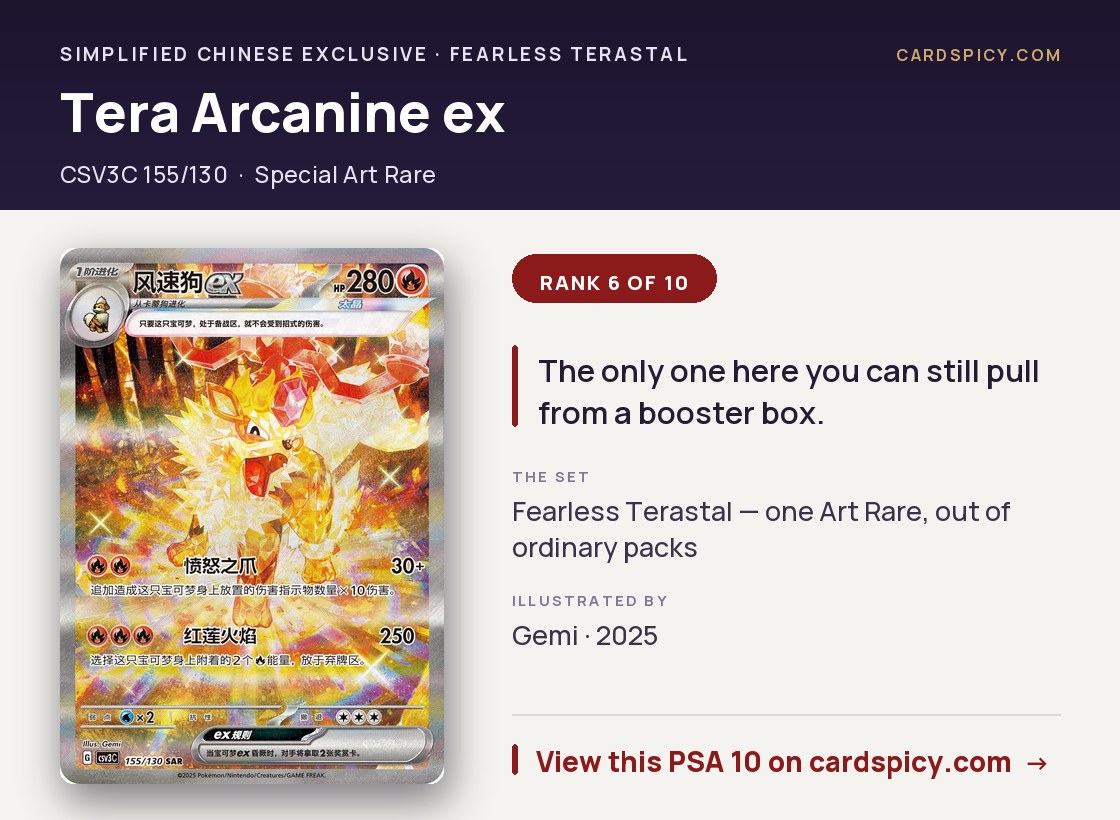
    Tera Arcanine ex — Fearless Terastal Special Art Rare 155/130, Simplified Chinese exclusive, illustrated by Gemi
    Tera Arcanine ex — Fearless Terastal (CSV3C 155/130), illustrated by Gemi.

    The card. The Special Art Rare print numbered 155/130 in the Simplified Chinese Fearless Terastal expansion, released on 16 May 2025. It is a Terastallised Arcanine — crystallised crown, gem-lit body — and the print does not exist in the Japanese or English versions of the same card, which used different artwork.

    The artist. Gemi (げみ) has illustrated around twenty-six TCG cards since debuting on Glaceon VSTAR in Crown Zenith, plus four for TCG Pocket.

    Why it ranks here. Every other card in the top five was either a lottery prize or an exclusive product line. Arcanine ex is the exception: it comes out of ordinary booster boxes, which makes it the most accessible card here and the one most collectors actually own. The resonance is not accidental either — Arcanine’s Pokédex entries have called it “a Pokémon that is described in Chinese legends” since the first generation, later softened to “the East” in localisation, which makes a Chinese-exclusive Arcanine Special Art Rare land a little differently.

    5. Eevee — Gem Pack Vol. 2 (CBB2C)
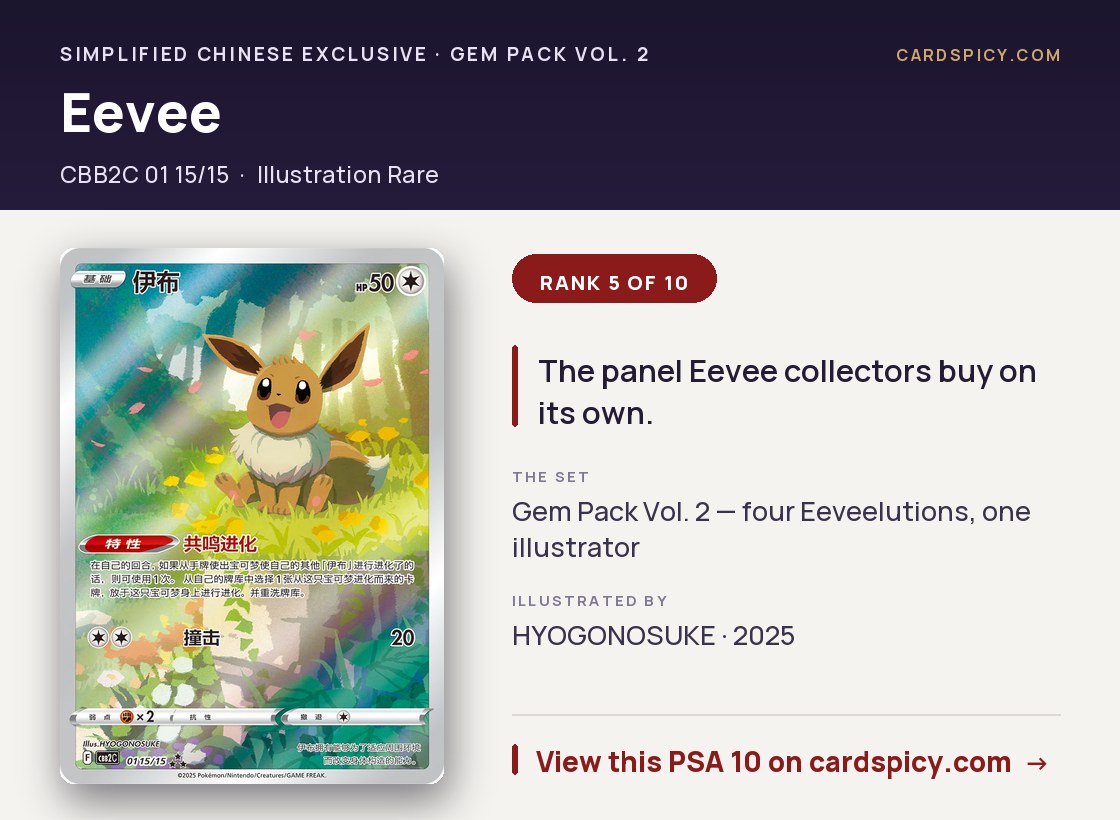
    Eevee — Gem Pack Vol. 2 illustration rare, one panel of the four-card Eeveelution panorama by HYOGONOSUKE
    Eevee — Gem Pack Vol. 2 (CBB2C 01 15/15), illustrated by HYOGONOSUKE.

    The card. Card 01/15, the far-right panel: Eevee sitting among yellow flowers, facing the viewer, the only panel where a Pokémon looks straight out at you.

    The artist. HYOGONOSUKE again — Eevee is the punchline of a composition that only works because one illustrator drew all four panels in one sitting.

    Why it ranks here. It closes the most collected connected art China’s TCG has produced, and it is also the card most often bought on its own by Eevee collectors who never intend to complete the panorama. That second group is what lifts it above the two panels beneath it.
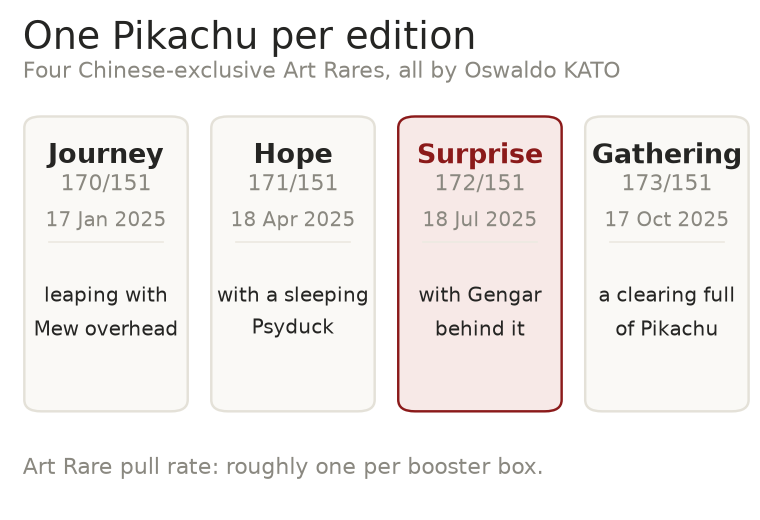
    Chart: the four Collect 151 Chinese-exclusive Pikachu Art Rares by Oswaldo KATO - 170/151 Journey, 171/151 Hope, 172/151 Surprise, 173/151 Gathering
    Collect 151 ran across four editions in 2025, each with its own Chinese-exclusive Pikachu Art Rare by Oswaldo KATO. Card numbers follow the series’ 15x/151 numbering.

    4. Pikachu AR 171/151 — Collect 151: Hope
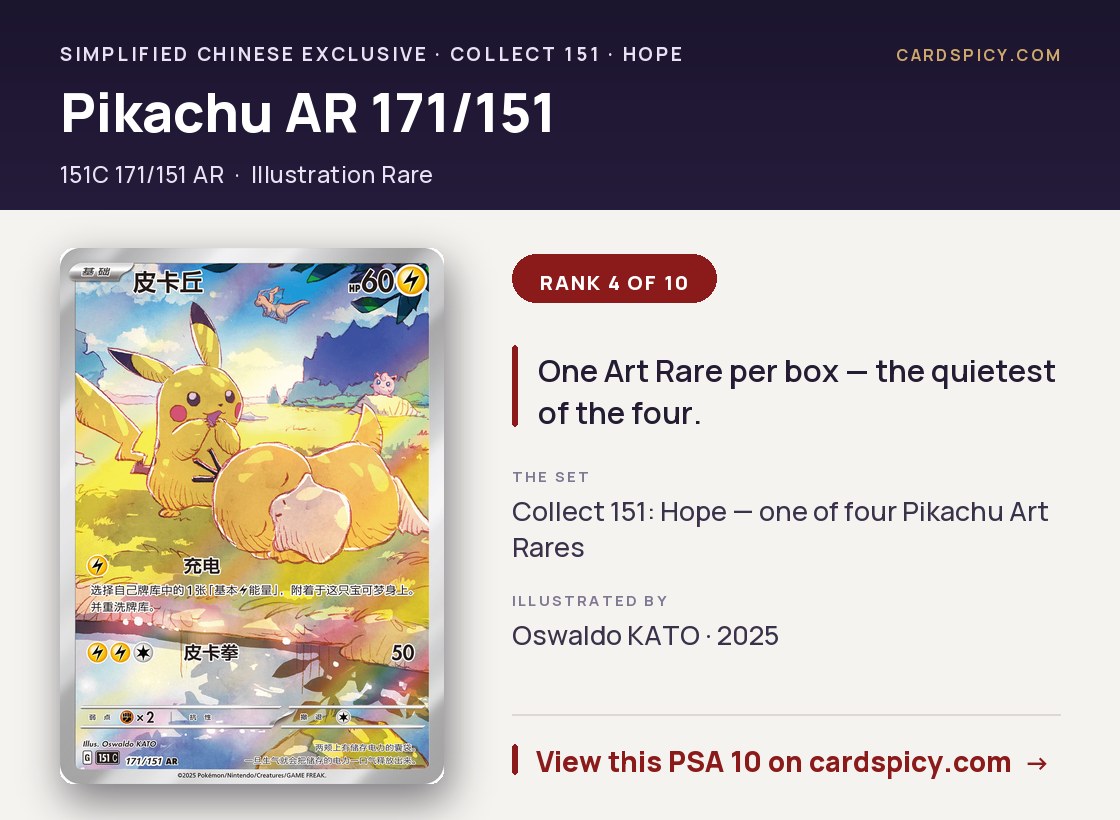
    Pikachu Art Rare 171/151 from Collect 151: Hope, Simplified Chinese exclusive, illustrated by Oswaldo KATO
    Pikachu AR 171/151 — Collect 151: Hope (151C 171/151 AR), illustrated by Oswaldo KATO.

    The card. The second of four Pikachu Art Rares in the Simplified Chinese Collect 151 series, released on 18 April 2025 in the Hope edition. The scene is a sunlit grassland with Pikachu standing hands clasped beside a sleeping Psyduck — the gentlest of the four illustrations.

    The artist. Oswaldo KATO, the Brazilian-Japanese illustrator behind all four Collect 151 Pikachu Art Rares. The series amounts to a single sustained commission — the same Pokémon in four different moods, four different settings — and it is the work this illustrator is now best known for in the Chinese market.

    Why it ranks here. The four Pikachu Art Rares are the most talked-about illustrations in the Simplified Chinese TCG, and the chase sits behind a hard gate: roughly one Art Rare per booster box. When Collect 151 first landed, singles offers on the collectors’ market opened between €500 and €900. The Psyduck panel is the quieter of the four, which is why it sits below Surprise while still outranking everything that is not a Pikachu, an Umbreon or the Mew ex promo.

    3. Umbreon — Gem Pack Vol. 2 (CBB2C)
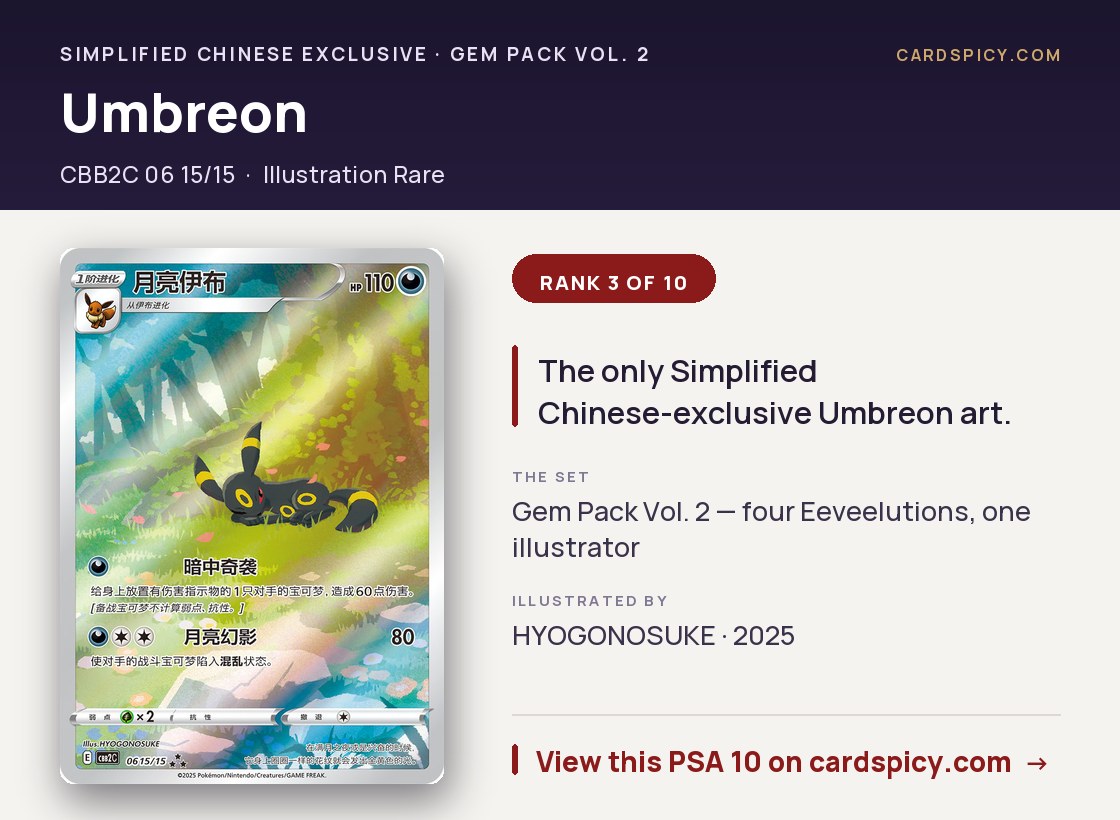
    Umbreon — Gem Pack Vol. 2 illustration rare, one panel of the four-card Eeveelution panorama by HYOGONOSUKE
    Umbreon — Gem Pack Vol. 2 (CBB2C 06 15/15), illustrated by HYOGONOSUKE.

    The card. Card 06/15, third panel from the left: Umbreon curled at the base of a large tree, tucked into a pool of warm light with the forest behind it. It is the darkest object in the composition and the anchor the whole panorama rests on.

    The artist. HYOGONOSUKE.

    Why it ranks here. Umbreon is the most expensive Eeveelution in the hobby by a wide margin — its alternate arts routinely top Eeveelution pricing — and this is the only Simplified Chinese-exclusive Umbreon illustration that exists. That combination makes it the flagship of Gem Pack Vol. 2, and it is the single panel collectors name first when they buy one card from the set instead of four.

    2. Pikachu AR 172/151 — Collect 151: Surprise
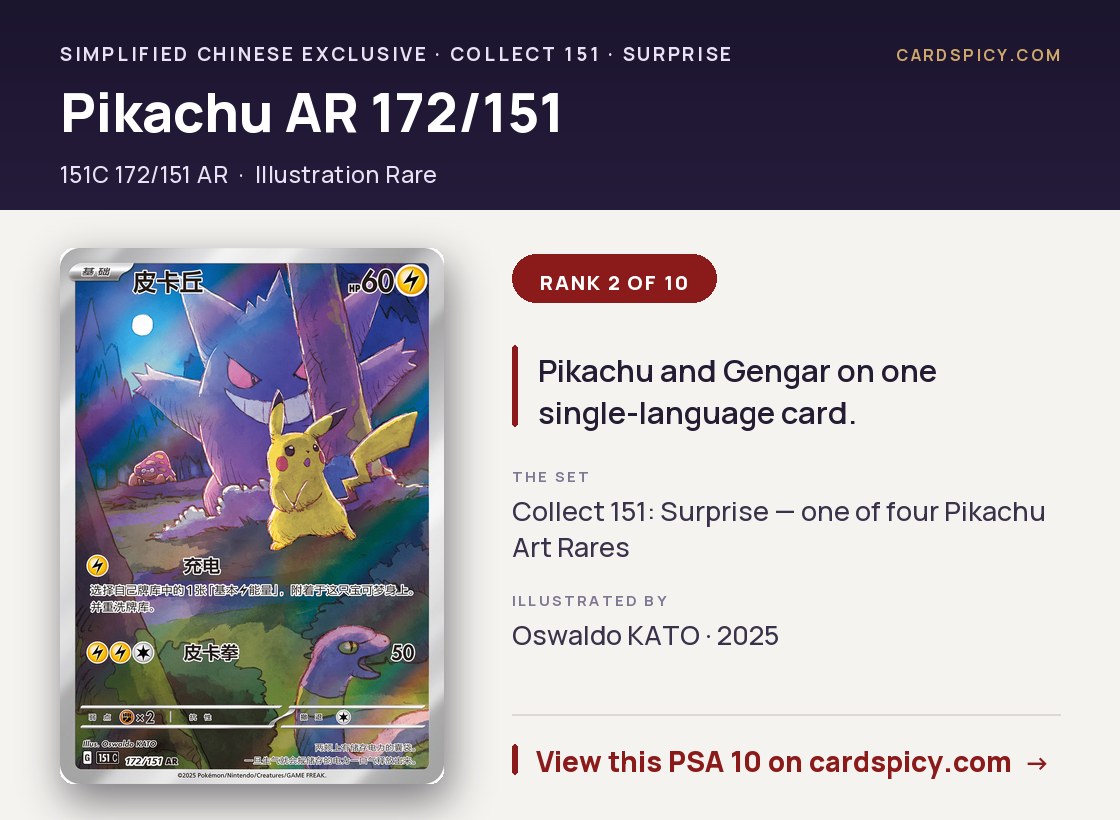
    Pikachu Art Rare 172/151 from Collect 151: Surprise, Simplified Chinese exclusive, illustrated by Oswaldo KATO
    Pikachu AR 172/151 — Collect 151: Surprise (151C 172/151 AR), illustrated by Oswaldo KATO.

    The card. The third Pikachu Art Rare, and the one collectors argue about. Pikachu stands in a moonlit forest while Gengar fills most of the frame behind it — arms spread, eyes lit — with an Ekans curling through the grass at the bottom and a Parasect settled into the undergrowth. Card 172/151, from the Surprise edition released on 18 July 2025.

    The artist. Oswaldo KATO, working in the same soft, painterly register as the other three panels, but this is the one with a full supporting cast.

    Why it ranks here. It pairs the two most collected Pokémon in the game on a card that exists in a single language. Pikachu is the franchise mascot; Gengar is the perennial dark-horse favourite. Graded copies have traded in the low four figures, and of the four Pikachus it is the one most lists name first.

    1. Mew ex 003/SV-P — the lottery promo
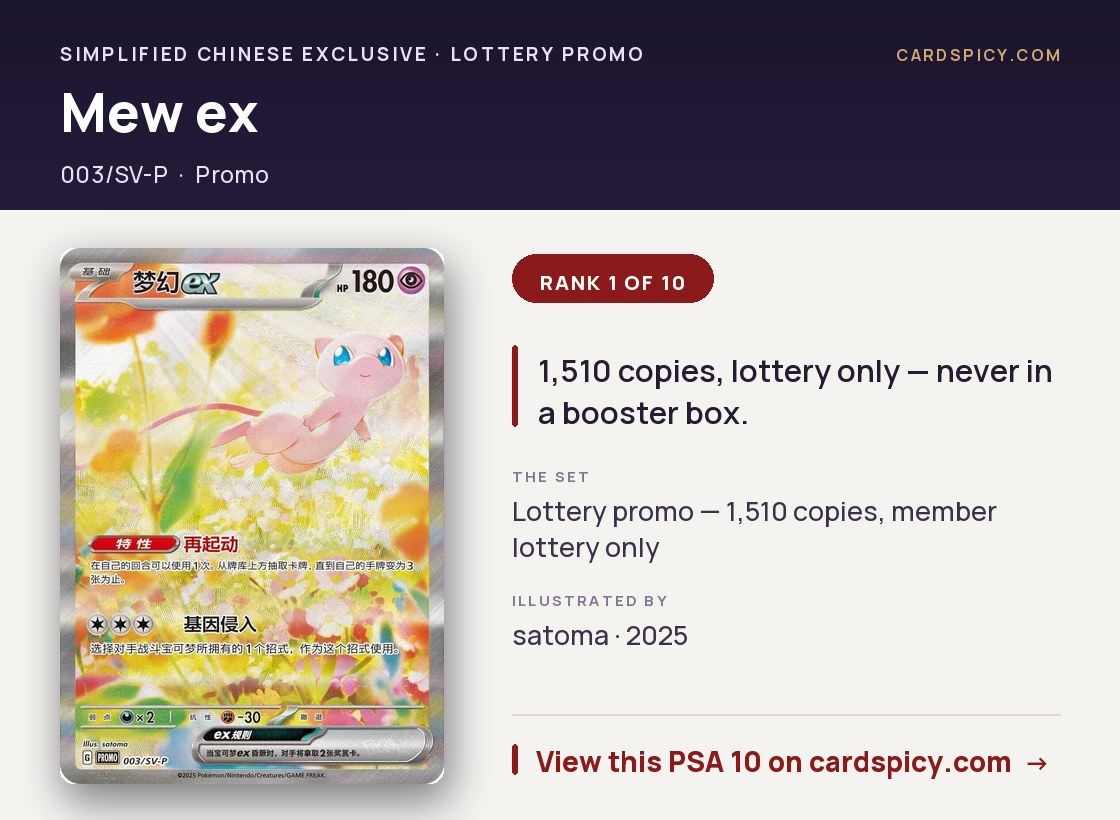
    Mew ex — Simplified Chinese lottery promo 003/SV-P, 1,510 copies, illustrated by satoma
    Mew ex — Lottery Promo (003/SV-P), illustrated by satoma.

    The card. Not a pull. To qualify for this Mew ex, players in mainland China had to complete fifteen activities — gym battles among them — at a minimum of three official tournament venues, then enter a membership lottery run across 2025. Only 151 winners were selected on the 15th of each month, and ten monthly draws give a total print run of exactly 1,510 copies. The card has never appeared in a booster box in any language.

    The artist. satoma (さとま) is a Tokyo-based illustrator who came up through the 2022 Illustration Contest, where a Cramorant piece reached the quarter-finals. Dratini from Obsidian Flames was the first official card, and the portfolio now runs to about thirty TCG cards. The Mew ex promo is the most valuable thing in it — satoma also illustrated one of the five exclusives in Gem Pack Vol. 3, which is why the same hand turns up at both ends of the Simplified Chinese lineup.

    Why it ranks here. Rarity here is decided rather than printed: 1,510 copies is a small fraction of a normal chase card’s print run, the card cannot be bought in a shop, and it cannot be pulled from sealed product. Copies surface rarely — a PSA 10 sold for $50,000 in May 2026, and one Chinese marketplace listing has asked around $22,600 for a single raw card. That second figure is an asking price rather than a completed sale, but it is a fair signal of how thin the supply is. The artwork itself is deliberately quiet, Mew drifting over a bed of flowers, and that contrast between a gentle image and the hardest card in the Simplified Chinese TCG to acquire is most of why it sits at number one.

    Every card on this list arrives raw, and most of them arrive having been through a mailer. If the plan is to grade rather than flip, the thing that decides the grade happens in the ten seconds after the envelope opens — which is where a correctly sized sleeve does more work than anything you can buy afterwards.

    If you would rather skip the hunt, our graded Chinese-exclusive PSA 10 stock is listed card by card, with the wider Simplified Chinese selection alongside it. For raw cards, start with our 50 μm matte penny sleeves — a PVC-free polypropylene contact layer that folds instead of creasing — and put a rigid holder outside it.

    Frequently asked questions

    What is the rarest Simplified Chinese Pokémon card?

    Mew ex 003/SV-P. It was distributed only through a 2025 membership lottery in mainland China: complete fifteen activities across at least three official tournament venues, then enter a draw in which 151 winners were selected on the 15th of each month. Ten monthly draws give a total print run of exactly 1,510 copies, and it has never been included in a booster box in any language — so unlike every other card on this list there is no sealed product you can buy that might contain one.

    Can these cards be pulled from booster boxes?

    Most of them can. The Collect 151 Pikachu Art Rares come roughly one per booster box, Gem Pack volumes guarantee at least one three-star card per box, and the Tera Arcanine ex Special Art Rare comes from ordinary Fearless Terastal packs. The Mew ex lottery promo is the exception — it cannot be pulled at all.

    Why are Simplified Chinese exclusive cards worth more than the Japanese or English versions?

    Because the artwork is not available anywhere else. A Japanese or English print of the same Pokémon uses different art, and there has been no announcement of any of these illustrations appearing outside Simplified Chinese product. Scarcity does the rest in the case of the Mew ex promo, where the entire print run is 1,510 copies. Not every Simplified Chinese exclusive is expensive, though — a Gem Pack three-star is guaranteed one per box, so supply there is far deeper than for the Pikachu Art Rares or the lottery promo.

    How many Simplified Chinese-exclusive cards are in Gem Pack Vol. 3?

    Five — Meowth 02/07, Gengar 03/07, Cubone 04/07, Chandelure 11/07 and Ceruledge 15/07 — the largest exclusive count in the Gem Pack series at the time of release. Three of the five appear in this guide; Cubone and Ceruledge did not make the top ten.

    Sources

    Show all 22 sources
    1. Kabuto Cards — Top 5 Chinese-exclusive Pokémon Cards You Might Not Know About. Mew ex lottery promo requirements, 1,510 print run and Satoma credit; Pikachu AR 172/151; the Eeveelution connected art; Tera Arcanine ex 155/130. kabutocards.co.uk
    2. Collector Station — Top 15 Chinese Exclusive Pokémon Cards. Cross-reference ranking for the Gem Pack artworks, the Collect 151 Pikachus, Arcanine ex and Mew ex 003. collectorstation.com
    3. Cardmarket — Collect 151 expansion page. Four 2025 editions, one Chinese-exclusive Pikachu illustration rare per edition, opening singles offers between €500 and €900. cardmarket.com
    4. Bulbapedia — Pikachu (151 25). Collect 151 numbering: 170/151 Journey, 171/151 Hope, 172/151 Surprise, all illustrated by Oswaldo KATO. bulbapedia.bulbagarden.net
    5. Bulbapedia — Arcanine ex (Scarlet & Violet 32). Chinese-exclusive special illustration rare print in the Simplified Chinese Fearless Terastal expansion, artwork by Gemi. bulbapedia.bulbagarden.net
    6. 52poke wiki — 风速狗ex(SV1V). Fearless Terastal release date of 16 May 2025 and the 155/130 SAR credited to Gemi. wiki.52poke.com
    7. PokéAri — Gem Pack Vol. 2 Eevee Cards: The Forest Panorama. CBB2C release date, the four HYOGONOSUKE panels and their left-to-right order. pokeari.com
    8. Red Cat Collectibles — Pokémon Gem Pack Vol. 2 Guide. Full CBB2C checklist and the Gem Rare positions. redcatcollectibles.com
    9. PlayVault — Gem Pack Vol.3 Booster Box (Simplified Chinese). CBB3C released 26 September 2025, the five exclusive three-star cards, and the artist credits for Meowth, Gengar, Cubone and Chandelure. playvault.ae
    10. Red Cat Collectibles — Pokémon Gem Pack Vol. 3 Guide. CBB3C card identifiers: Meowth 02-07, Gengar 03-07, Chandelure 11-07. redcatcollectibles.com
    11. Aquitaz — Collect 151: Journey – Everything you need to know. Release date, one Art Rare per box, and the 1,510-copy Mew EX promo. aquitaz.se
    12. Kai’s Castle — Unique Pikachu Pokémon cards revealed for China’s version of 151. Oswaldo KATO credited with all four Pikachu Art Rares and described as a Brazilian-Japanese illustrator working in a soft, painterly style. blog.kaiscastle.com
    13. Bulbapedia — satoma. Tokyo-based illustrator, 2022 Illustration Contest quarter-finalist, first card Dratini from Obsidian Flames. bulbapedia.bulbagarden.net
    14. Bulbapedia — Gemi. Debut on Glaceon VSTAR in Crown Zenith; illustration counts for the TCG and TCG Pocket. bulbapedia.bulbagarden.net
    15. Bulbapedia — aspara. First cards Horsea and Seadra in the 151 expansion; illustration counts. bulbapedia.bulbagarden.net
    16. Bulbapedia — Makura Tami. 2022 Illustration Contest semi-finalist with Bulbasaur; first official card Azumarill from Temporal Forces. bulbapedia.bulbagarden.net
    17. Bulbapedia — HYOGONOSUKE. Debut in Team Up, blocky textures and dense colour, connected-card scenes, and work outside the TCG. bulbapedia.bulbagarden.net
    18. Elite Fourum — Raging Surf Sealed Battle Tournament Promos. Confirms the Victini ex 114/SV-P SAR also ran in Traditional Chinese, Thai, Indonesian and Korean. elitefourum.com
    19. PriceCharting — Victini Ex [Winner] #114/SV-P. Recorded sales for the multi-language Victini promo. pricecharting.com
    20. Pokémon TCG S-Chinese Collection — Mew ex Promo 003/SV-P listing. First lottery round on 15 March with 151 cards drawn, and the print run stated as 1,510. pokemoncard.com.cn
    21. PokeBeach — Rarest Ever Mew Card to Release in China, Limited to Only 1,510 Copies, January 2025. The membership lottery structure and the confirmed 1,510-copy print run. pokebeach.com
    22. Bang For Your Buck TCG — Simplified Chinese Pokemon: The Third Option Most Collectors Have Not Priced Out, May 2026. The 1,510-copy print run restated, and the $50,000 PSA 10 sale of the Mew ex 003/SV-P on 27 May 2026. bangforyourbucktcg.com

    Set names, card numbers and illustrator credits are transcribed from the sources listed above. Prices are secondary-market observations at the dates cited and move quickly; nothing here is a valuation or an investment recommendation. CardSpicy is not affiliated with The Pokémon Company. Pokémon and Pokémon character names are trademarks of Nintendo, Creatures and GAME FREAK.
  • Notched Card Sleeves: Why Cut Corners Protect a Card Better

    Notched Card Sleeves: Why Cut Corners Protect a Card Better

    Corner wear is the largest preventable cause of grade loss — and most of it happens in the second a card goes into a sleeve.

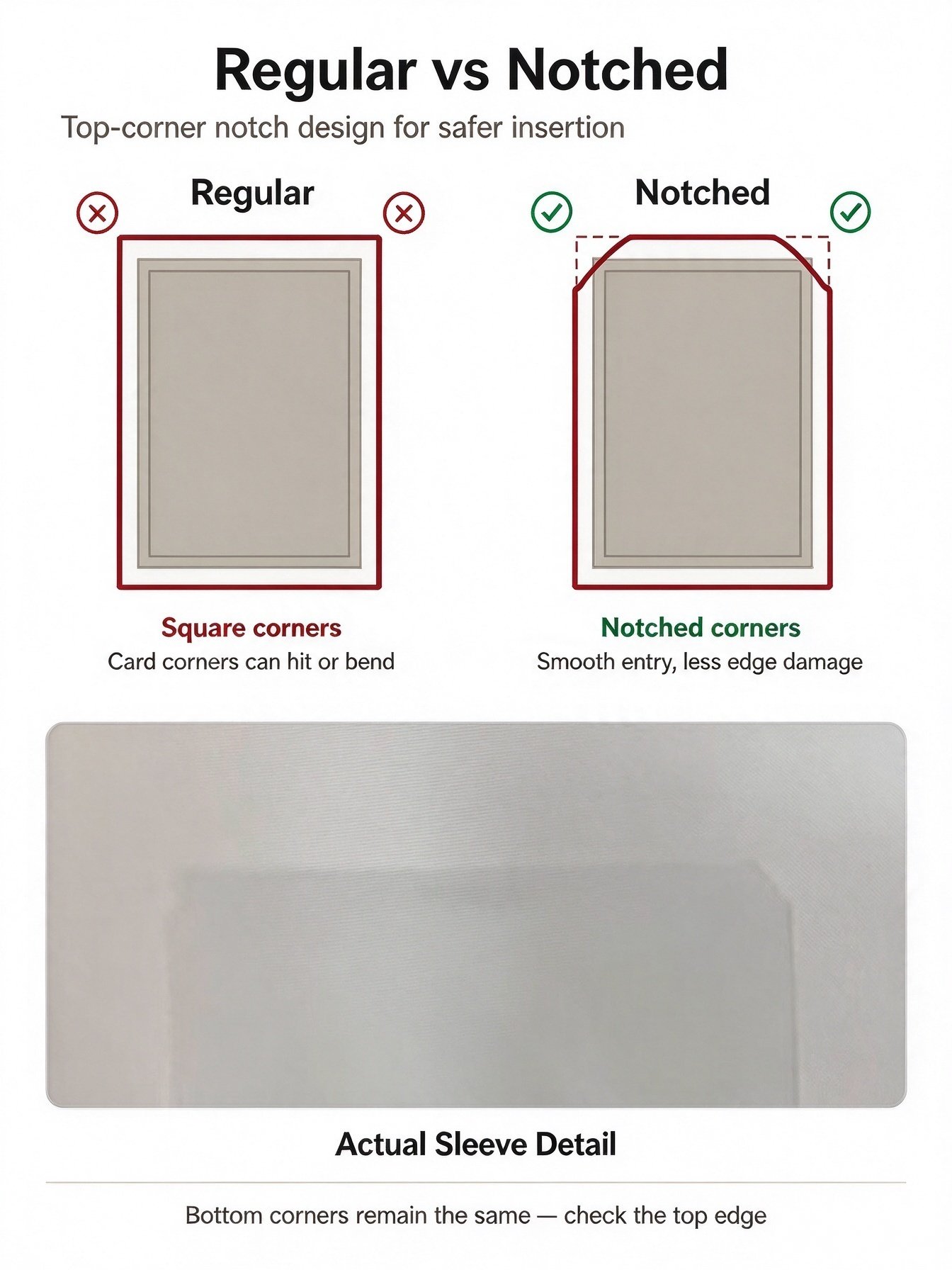
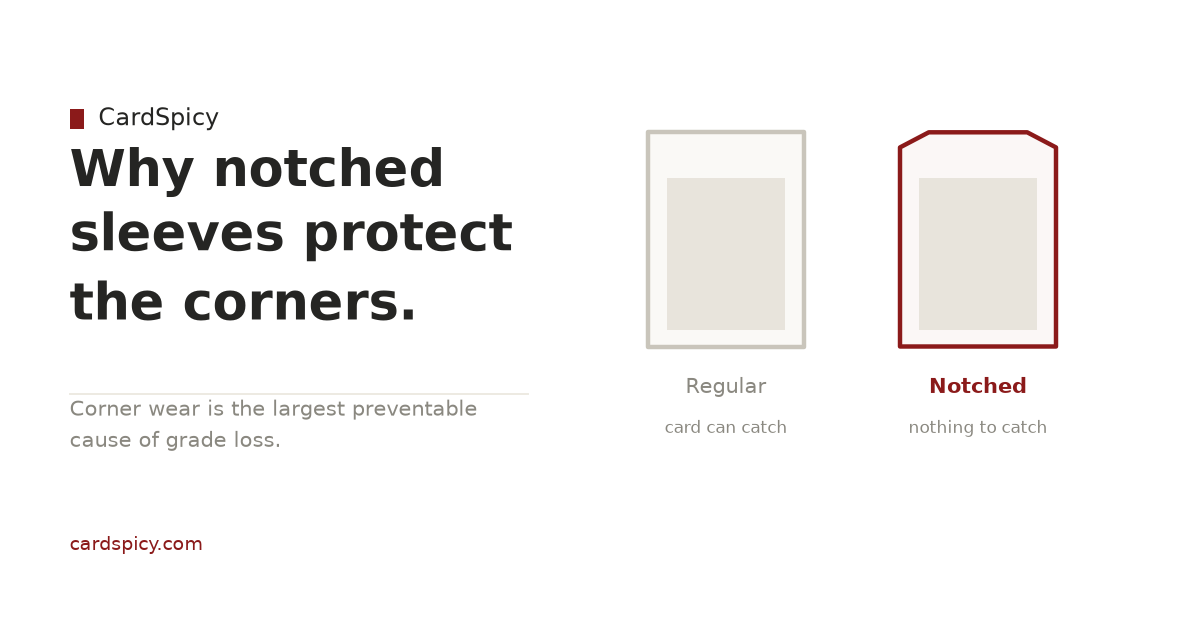
    A sleeve has four square corners. So does a card. Push one in at any angle and the card’s top corner meets the film’s: film folds, card stock doesn’t. That is the case for a notched sleeve.

    1. Where the damage actually comes from

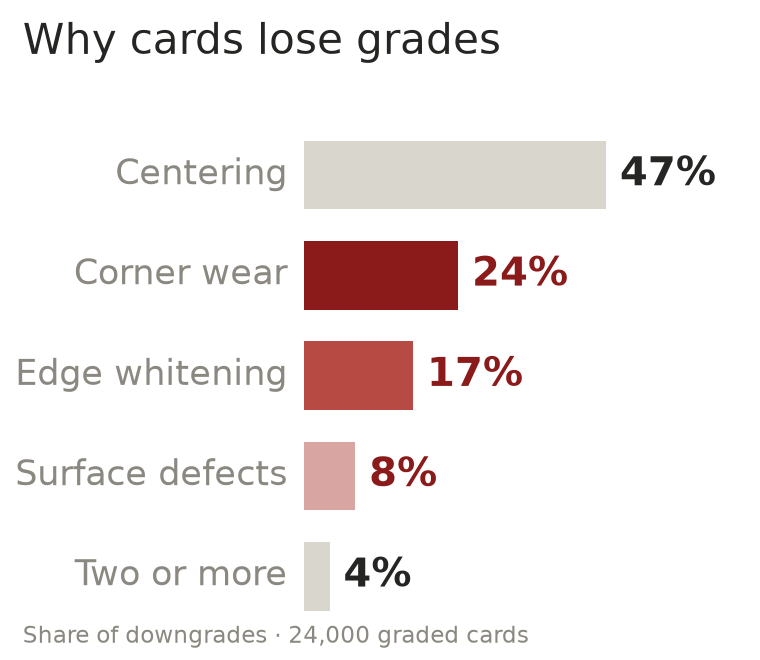
    Grading data is the closest thing to a damage census we have. Across 24,000 cards, the most common reason a card misses its target grade is centering, at 47% — printed in at the factory and impossible to correct. Nobody sleeves a card into better centering. [1]

    Bar chart: share of PSA downgrades caused by centering 47%, corner wear 24%, edge whitening 17%, surface defects 8% and two or more factors 4%
    Share of downgrades by cause, across 24,000 graded cards. Centering (grey) is fixed at the factory; the red bars are wear. Source: GradingMetric, 2026.

    Remove centering and the picture gets useful. Corner wear 24%. Edge whitening 17%. Surface defects 8%. All of it is wear, and all of it happens outside the factory. Corner wear alone is just under half that total; edges about a third. [1]

    Creases are missing because they are rare — but a crease does not shave a grade, it floors one: PSA caps a visible crease at 6 or below. [2] Moisture is slower and just as permanent. Card stock is layered paper, and when humidity swings the layers absorb at different rates until the card bows. [3]

    2. The corner usually dies on the way in

    Collectors blame the drop. The evidence points at the sleeve: corner wear develops through ordinary handling, and even sliding a card in and out of a sleeve blunts the corners over time. [4]

    Regular versus notched card sleeve opening compared: square top corners versus cut-away top corners, with a close-up of the actual sleeve
    Regular (square corners) versus Notched (top corners cut). The two bottom corners are identical on both.

    The complaint repeats on PSA’s own collector forum, and so does the fix — one collector arrives at notched sleeves specifically to avoid “accidentally dinging a corner” on the way in. [5] The two corners a card passes first are simply not there, and you can pinch the sleeve at the opening without touching the card face.

    3. How often to replace a sleeve

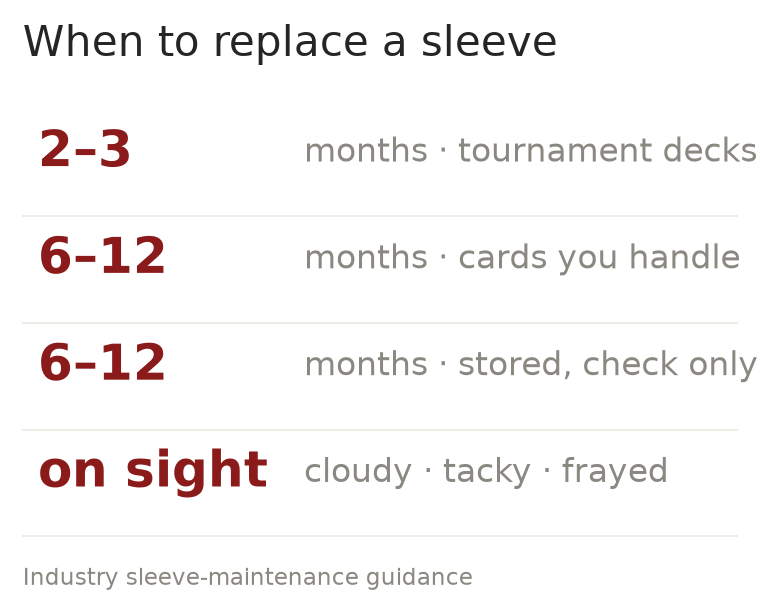
    A sleeve is a consumable, and the schedule follows how much the card is handled. [6][7][8][9]

    Chart: replacement cycle — 2 to 3 months for tournament decks, 6 to 12 months for cards you handle, 6 to 12 months inspection for stored cards, and replacement on sight for cloudy, tacky or frayed sleeves
    Sleeve replacement guidance by how the card is used. Sources: BoardGamesGuide; eathealthy365; TCG Protectors; EVORETRO.

    Actively played decks — 2 to 3 months for tournament play, 6 to 12 for casual. Sleeves fray and pick up hand oils, which is also what gets a deck ruled “marked”. [6][7]

    Stored cards — inspect every 6 to 12 months. Look for cloudiness rather than wear; good polypropylene can sit for years in stable conditions. [8][9]

    Any sleeve — replace on sight at yellowing, tackiness or brittleness. Those are signs the plastic itself is breaking down, and a degraded sleeve is abrasive. [9]

    One material rule outranks the schedule: PVC sleeves release plasticizers as they age, clouding foils and lifting ink. Polypropylene does not. [7]

    4. Why our film is 50 μm — and blown

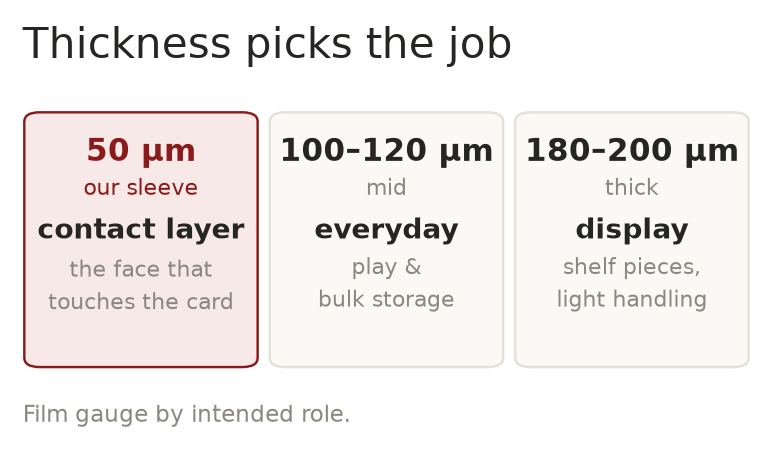
    Thickness is sold as a ranking, where thicker reads as better. It is really a job description. A 200 μm sleeve is a good display case and a poor contact layer; a thin film is the reverse. [7][12]

    Chart: film gauge by role — 50 micron for a contact layer, 100 to 120 micron for everyday use, 180 to 200 micron for display pieces
    Film gauge by intended role. Sources: Sohu industry guide; TCG Protectors.

    The layer touching the card face has one job: not to damage it. That argues for thin and soft. A thin film conforms to the card; a stiff one resists it, holds creases of its own, and presses them into the surface when a stack compresses.

    Our penny sleeves are blown-film polypropylene at 50 μm — 0.05 mm, or 5 丝 in the trade shorthand. The film is extruded as a tube and inflated into a bubble, so it stretches in both directions at once — softer and more compliant than cast film, and it folds instead of creasing. [10][11]

    The trade-off is a slightly less glossy surface than cast film produces. For a sleeve that sits against a holo card, we will take the softness. Acid-free, PVC-free, no fog — full specification on the penny sleeve listing. What 50 μm is not is structural: it will not stop a bend. That is the next layer’s job.

    5. Two layers, two jobs

    Thickness debates go in circles because one layer is asked to do two jobs. Split them and the choices get easy.

    Layer What it stops What it does not
    Soft sleeve
    (50 μm, against the card)
    Surface friction and micro-scratches, fingerprints, dust, corner catch on insertion Bending, impact, moisture
    Rigid holder
    (35–360 PT toploader)
    Bending, corner impact, pressure in transit Moisture, long-term light exposure
    Storage box, stable room Dust, humidity swings, light Anything about impacts

    Soft inside, rigid outside. Our 3″ × 4″ rigid holders run eight options from 35 PT to 360 PT — that PT is the card thickness the holder accepts, not the holder’s own gauge. Both layers sit in Card Protectors.

    6. Three things we see most often

    • Sleeving a dusty card. The sleeve seals the grit in, and grit is what scratches. Check the face against light first.
    • Forcing a stack into a full box. Pressure whitens corners and edges whether or not a sleeve is on the card.
    • Keeping a sleeve past its life. A cloudy sleeve is an abrasive sleeve.

    For the wider picture — the three layers, storage, and the mistakes that cost real money — start with Protection Tips, our sleeve guide, and whether a slab fits in a binder.

    Frequently asked questions

    Do penny sleeves damage cards?

    No — a clean, correctly sized polypropylene sleeve does not scratch a card by itself. Wear comes from two places: grit already on the card face gets sealed in against it, and square sleeve corners catch the card’s own corners on the way in. Check the face against light before sleeving.

    How often should I replace card sleeves?

    It follows handling rather than a fixed calendar. Tournament decks need new sleeves every 2 to 3 months, casual play every 6 to 12, and stored cards need only an inspection every 6 to 12 months. Replace on sight at yellowing, tackiness or brittleness — a degraded sleeve is abrasive. PVC sleeves should be replaced regardless of condition, because they release plasticizers as they age.

    Are notched sleeves actually better than regular ones?

    For corner protection, yes. The two top corners of a notched sleeve are cut away, so a card pushed in at an angle has nothing to catch on. Corner wear is the second-largest cause of grade loss at 24% of graded cards, behind only centering at 47%, and it develops through ordinary handling rather than drops.

    Should I use a sleeve and a toploader, or just one?

    Both — they do different jobs. A 50 μm sleeve protects the card face from friction, dust and fingerprints, but it will not stop a bend. A rigid holder resists bending and impact, but not moisture. Soft inside, rigid outside is the arrangement that covers both.

    Sources

    Show all 12 sources
    1. GradingMetric — PSA 10 Success Rates by Sport, 2024–2026 (24,000 Cards Analyzed). Downgrade reasons by share. gradingmetric.com
    2. PreGradeCards — Pokémon Card Centering & Surface Defects: The Visual Grading Guide 2026. Creases cap the grade at PSA 6 or below. pregradecards.com
    3. CardShellz — How to Store Your Trading Card Collection. Layer absorption, bowing, 65–72°F and 40–50% relative humidity. cardshellz.com
    4. TFG Cards — How Card Grading Works. Corner wear developing through handling and sleeve insertion; surface as the 9-versus-10 factor. tfg.cards
    5. Collectors Universe message boards — Are Semi-Rigid Card Holders Always Such a Pain?!, January 2025. Collectors on tight sleeves, dinging corners on insertion, and notched sleeves. forums.collectors.com
    6. BoardGamesGuide — 2026’s Top 10 Standard Size Card Sleeves for Collectible Card Games. Replacement cadence: 2–3 months tournament, 6–12 months casual; replace at the first sign of wear. boardgamesguide.com
    7. eathealthy365 — A Custom Trading Card Sleeve Material Guide. Re-sleeving every 6–12 months; PVC plasticizer migration and its effects. eathealthy365.com
    8. TCG Protectors — The Ultimate Trading Card Sleeves Guide. Inspect binders and long-term storage sleeves every 6–12 months; 60–75°F and 40–50% humidity. tcgprotectors.com
    9. EVORETRO — Do protective sleeves degrade over the long term? Annual or biannual spot checks; yellowing, tackiness and brittleness as the signs. evoretro.ca
    10. Hotmelt Adhesive Film — What is the difference between cast and blown polypropylene thermoplastic film? Blown film: matte finish, higher tensile strength and elongation, better puncture resistance. hotmeltadhesive-film.com
    11. Jingwei Machinery — What Is the Difference Between Cast Film and Blown Film in Packaging Production? Balanced machine- and transverse-direction orientation in blown film. jingweimachinery.com
    12. Sohu (搜狐) — How to choose card sleeve thickness in 2026: industry standards and scenario guide. Published thickness tiers from 10 丝 to 20 丝 (100–200 μm). sohu.com

    Film gauge and material specifications describe CardSpicy’s own penny sleeves. Damage shares are grading-industry observations on graded-card populations, not measurements of any single collection, and they describe how grades are lost rather than how often cards are physically damaged.

  • Why Simplified Chinese Pokémon Cards Are Worth Collecting Right Now

    Why Simplified Chinese Pokémon Cards Are Worth Collecting Right Now

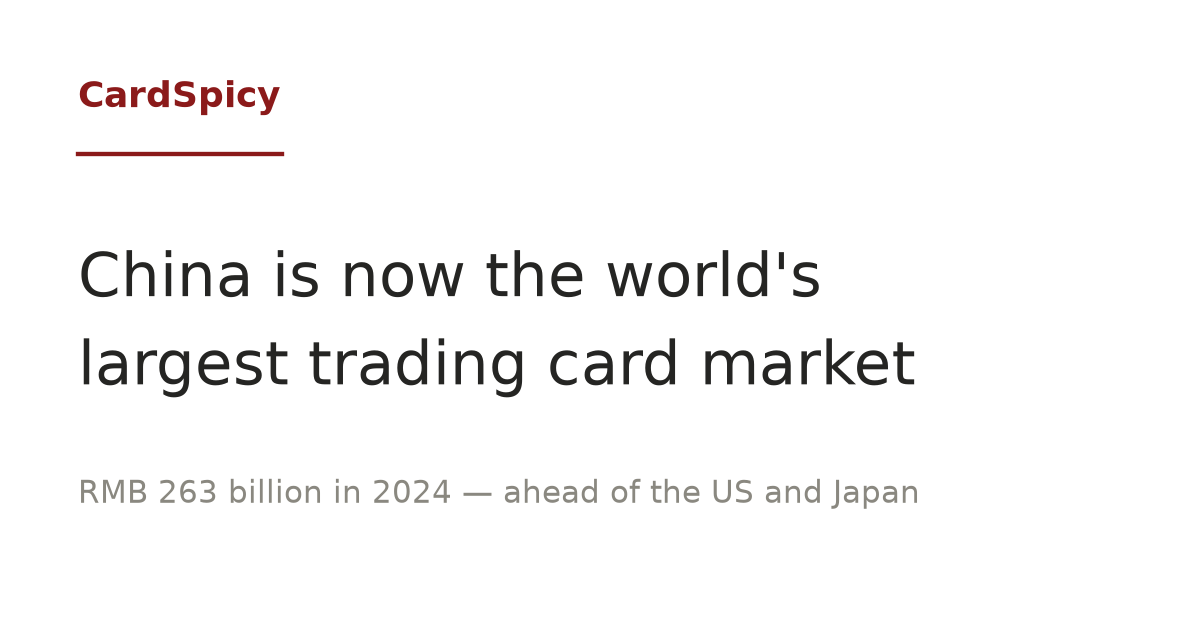
    China now buys more trading cards than any other country on earth. Its cards still cost a fraction of what English and Japanese printings cost.

    Four points for. One against — and the counter-case matters as much, because it is what separates a market from a hype cycle.

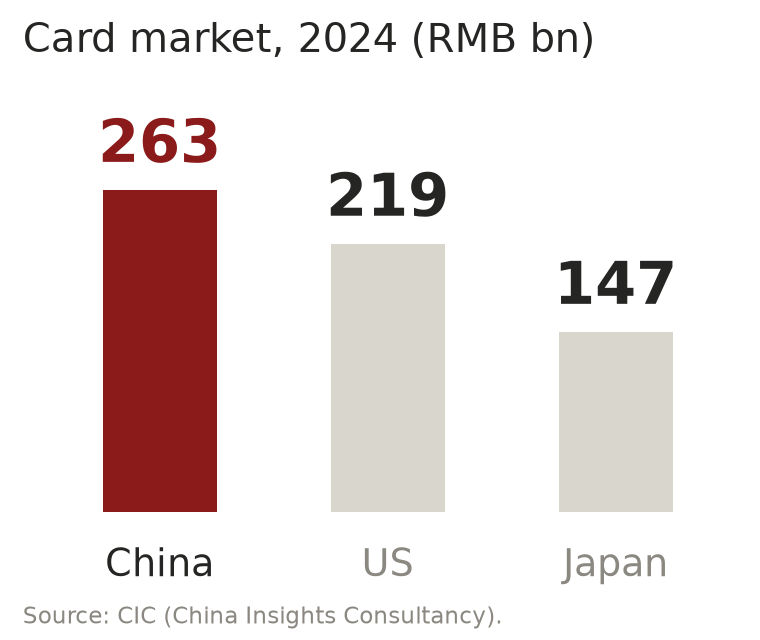
    Bar chart: China's trading card market reached RMB 263 billion in 2024, ahead of the United States at 219 and Japan at 147
    Trading card market size, 2024. RMB billion, by gross merchandise value. Source: CIC (China Insights Consultancy).

    1. The biggest card market on earth

    China passed Japan in 2022, then passed the United States in 2024. Trading card GMV ran from RMB 2.8 billion in 2019 to RMB 26.3 billion in 2024 — 56.6% a year. The buyer side agrees: 237,000 unique buyers on Jihuanshe in 2024, up 24%. [1][2][4]

    The caveat. Chinese industry reporting lumps Pokémon in with celebrity and cartoon cards, a far larger and more volatile category. Split them apart and the sub-RMB-10 bulk tier fell about 40% in 2025, while the collectible tier above RMB 10 grew 29%. Premium expanding as bulk contracts — that is what a maturing market looks like. [3]

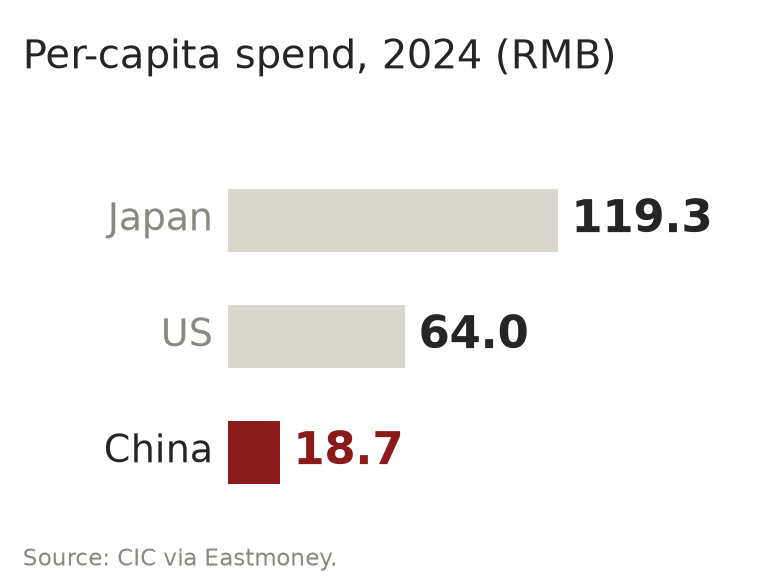
    Bar chart: per-capita trading card spending in 2024 was RMB 119.3 in Japan, 64.0 in the United States and 18.7 in China
    Per-capita trading card spending, 2024, in RMB per person per year. Source: CIC via Eastmoney.

    The headroom: RMB 18.7 per Chinese collector per year, against RMB 119.3 in Japan. [2] That is not a valuation — but it tells you which way the demand curve is likely to travel.

    2. The price gap is structural

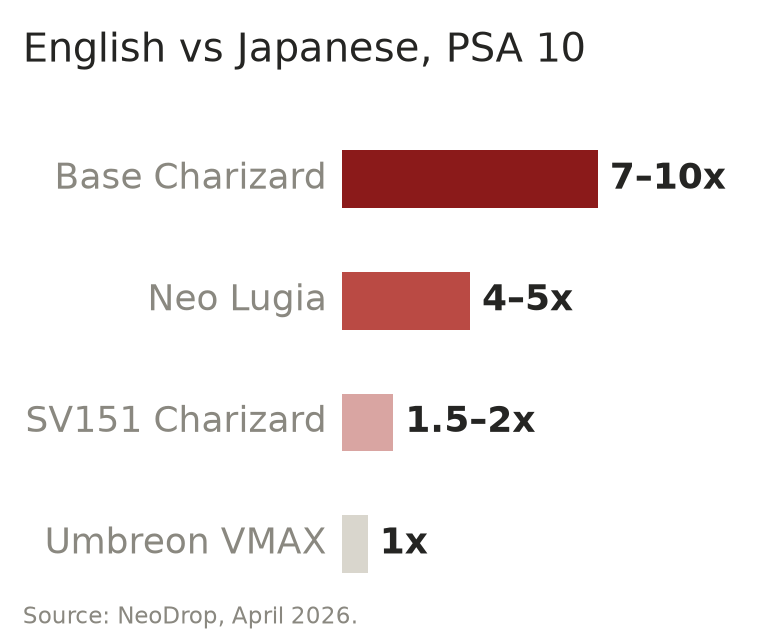
    Language printings differ in price across the whole hobby. The English premium over Japanese runs 7–10× on vintage and compresses toward parity on modern cards. Simplified Chinese is early in that same compression. [16]

    Chart: English PSA 10 prices over Japanese, falling from 7–10 times on Base Set Charizard to parity on Umbreon VMAX
    English PSA 10 prices as a multiple of the Japanese printing, by era — from Base Set Charizard (7–10×) down to Umbreon VMAX alt art (parity). Indicative ranges. Source: NeoDrop, April 2026.

    At the source the gap is wider still: a Simplified Chinese booster box starts near $35, where a Japanese box regularly clears $100. [5] The cleanest same-day test came with the September 2026 30th Anniversary release [6]:

    • Simplified Chinese — RMB 360 a box, channel margin around RMB 25. No speculative markup.
    • Japanese — RMB 2,688, paid by a collector who broke a box early.
    • English — one blue RGB Mew reported sold on eBay for $20,000 on day one.

    One limit worth stating. Card-for-card comparison mostly does not work: every set except the 30th Anniversary has a different Simplified Chinese card list, so most cards exist in one language only. [7]

    3. What “exclusive” actually means

    Collectors treat “Chinese exclusive” as one thing. It is three, and they behave nothing alike. [8]

    Exclusive artwork, ordinary print run. Only in Simplified Chinese, printed in accessible quantities. The four Collect 151 Pikachu Art Rares run about $200–$400 in PSA 10. [8][9]

    Limited releases. Anniversary boxes, gift sets, festival product. Smaller than the first group, larger than the next.

    Lottery distribution with a documented cap. The Mew ex 003/SV-P promo required 15 activities across three or more official gyms, drawn monthly: 1,510 copies. A PSA 10 sold for $50,000 in May 2026, population near 452. For scale, the Traditional Chinese 5th Anniversary Pikachu promo has passed $1,500 in PSA 10. [9][10]

    Two reasons the region still looks cheap. Grading pays: 129 of 472 cards in Simplified Chinese Collect 151 clear positive expected value after fees. [11] And nobody publishes print runs — The Pokémon Company and Pokémon Shanghai disclose none for main sets, which makes that 1,510 the only confirmed figure in the language’s history. [9]

    4. The infrastructure is already built

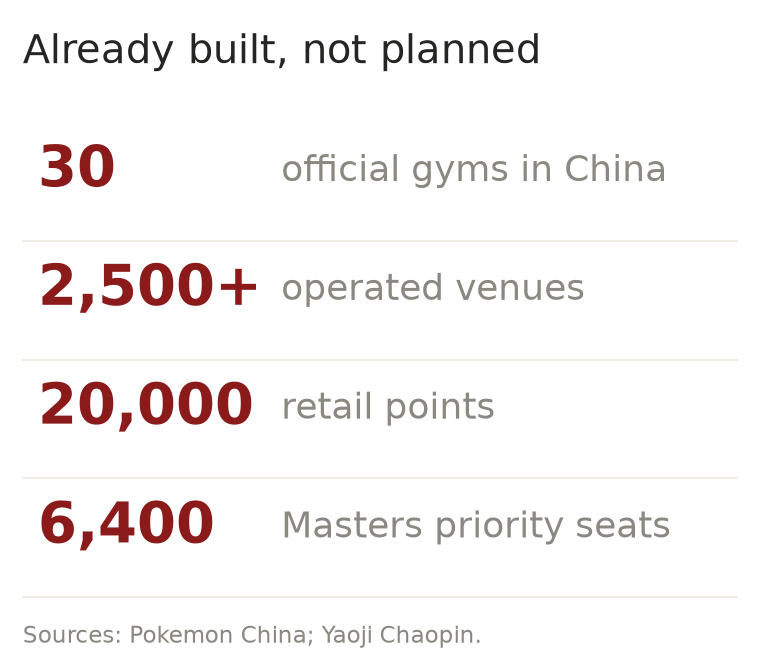
    Infographic: 30 official gyms in China, 2,500+ operated venues, 20,000 retail points and 6,400 Masters priority seats
    Official gyms in mainland China; operated venues and retail points per Yaoji Chaopin corporate data; 2025 Beijing Masters priority-entry seats. Sources: Pokémon China; Yaoji Chaopin; event listings.

    The publisher is the publisher. Simplified Chinese product is imported and run by Pokémon Shanghai Toy Limited, a wholly owned subsidiary of The Pokémon Company registered in Shanghai in 2020 — not a licensee. Distribution runs through three named agents. [1][7]

    Mainland China reaches 30 official gyms by autumn 2026, and Yaoji Chaopin alone reports over 2,500 venues across 98% of tier-one to tier-three cities. [17][18] The 2023 Guangzhou Masters drew nearly 2,000 players; by 2025, Guangzhou allocated 6,000 priority-entry slots and Beijing 6,400. Since 2024 Simplified Chinese players qualify for the World Championships — and in 2025 a Chinese player won it. [13][14]

    The region also carries a security feature no other language has: an embossed Pokémon logo bottom-left on holofoils from V-tier up, plus a lenticular logo bottom-right on SR, SAR and UR cards. [15]

    The other side

    Most of these cards will not appreciate. “Exclusive to China” is not “investment grade.” That Collect 151 Pikachu AR at $200–$400 is a lovely card; it is not the Mew ex promo and will not behave like one. [8]

    Counterfeiting is more active here than in English or Japanese. In March 2026 CGC flagged a counterfeit Umbreon Gem Pack alternate art on several signals at once — missing eyelid line art, flat shading, a holofoil layer reflecting fewer bars, no security stamp. No single check is sufficient. [9]

    And the wider Chinese card market contracted in 2025. In one brand’s survey, 31% of collectors doubted authenticity on resale platforms and 26% of buyers had cut spending over it. [12]

    What to do with this

    Buy graded. Prefer exclusives with a documented print run or distribution mechanism, and learn the security stamp before you learn the price. Treat it as what it is: an early entry into the largest collector market in the world — bought before that market’s own collectors start bidding against you.

    Our Simplified Chinese PSA 10 inventory is here; the wider Chinese-language listings are here.

    Frequently asked questions

    Why are Simplified Chinese Pokémon cards cheaper than English or Japanese printings?

    Because the language is early on the same price-compression curve English and Japanese already went through. A Simplified Chinese booster box starts near $35 where a Japanese box regularly clears $100, and the English premium over Japanese has run 7 to 10 times on vintage printings. Simplified Chinese is at the start of that curve, not the end.

    Are Simplified Chinese cards legal to play in official Pokémon tournaments?

    Yes — Simplified Chinese is an official Pokémon TCG language. Since 2024 its players have qualified for the World Championships, and in 2025 a Chinese player won it. The product is run by Pokémon Shanghai Toy Limited, a wholly owned subsidiary of The Pokémon Company, and mainland China had 30 official gyms by autumn 2026.

    Will Simplified Chinese exclusive cards hold their value?

    It depends which kind of exclusive it is, because the three types behave nothing alike. Exclusive artwork on an ordinary print run sits around $200–$400 in PSA 10. The Mew ex 003/SV-P promo had a documented 1,510-copy print run, and a PSA 10 sold for $50,000 in May 2026. Most Simplified Chinese cards will not appreciate.

    How do I tell a genuine Simplified Chinese card from a counterfeit?

    Check the security features first. Simplified Chinese holofoils from V-tier up carry an embossed Pokémon logo in the bottom-left, and SR, SAR and UR cards add a lenticular logo bottom-right — a feature no other language printing carries. No single check is sufficient: a March 2026 CGC counterfeit example showed missing eyelid line art, flat shading and no security stamp at once.

    Sources

    Show all 18 sources
    1. Xinhua (新华网) — Shanghai has become the “card capital”, 2025-04-09. 2022 market sizing via CIC; Pokémon Shanghai’s 2020 registration. news.cn
    2. Eastmoney (东方财富) — Cards remain the most promising direction in China’s toy market, 2025-06-25. 2024 sizing, per-capita spend, Jihuanshe data and the 2019–2024 CAGR, all via CIC. caifuhao.eastmoney.com
    3. Tencent News / Leihbao (腾讯网 / 雷报) — Magic: The Gathering earned nearly RMB 7bn in six months, 2026-08-03. 2025 tier split via Frost & Sullivan. new.qq.com
    4. Qilu Evening News (齐鲁晚报) — 2025 Xianyu Card Annual Report. qlwb.com.cn
    5. Danireon Cards & Games — Japanese Pokémon Cards vs Chinese Pokémon Cards. Booster box pricing. danireon.com
    6. SMZDM (什么值得买) — 30th Anniversary release: Simplified Chinese, Japanese and English boxes compared, September 2026. smzdm.com
    7. Bulbapedia ZH (神奇宝贝百科) — Pokémon Trading Card Game · Mainland China. Launch date, authorised distributors, divergent card list. wiki.52poke.com
    8. Pokemon Pricing — Why Chinese Pokémon Cards Are Gaining Collector Attention. The three exclusivity tiers; Collect 151 pricing. pokemonpricing.com
    9. Bang For Your Buck TCG — Simplified Chinese Pokemon: The Third Option Most Collectors Have Not Priced Out, 2026. Mew ex 003/SV-P print run and sale, PSA population, security features, CGC counterfeit finding. bangforyourbucktcg.com
    10. CardTrack — Are Korean & Chinese Pokémon Cards Worth Anything? Traditional Chinese 5th Anniversary promo. cardtrack.com
    11. Should You Grade — Pokemon Chinese 151 Collect Card List & Grading Guide, drawing on PriceCharting prices and GemRate population data. shouldyougrade.com
    12. Zhonghong Net (中宏网) — The hundred-billion card market. 31% authenticity survey; 2025 sizing. zhonghongwang.com
    13. NetEase (网易) — Thirty years on, the ways to open Pokémon keep multiplying. Masters attendance, gym expansion, World Championship qualification. 163.com
    14. Securities Times (证券时报) — A single card sold for over a million yuan. 2025 World Championship result. stcn.com
    15. Pixel TCG — How to Spot Fake Pokémon Cards. Embossed and lenticular security features. pixeltcg.net
    16. NeoDrop — Pokémon card market intelligence, 2026-04-29. English-versus-Japanese premium by era. neodrop.ai
    17. Yaoji Chaopin (姚记潮品) — company profile. Venue and retail coverage. yaopinwenhua.com
    18. Pokémon China official site — New official Pokémon card gyms. Autumn 2026 gym openings. pokemon.cn

    RMB figures are quoted at source values. Statistics drawn from Chinese industry reporting are cited as published by the outlet named; where a figure is a market estimate rather than an official disclosure, this is stated in the text.

  • Does a PSA 10 Slab Fit in a Binder? The Honest Answer

    No — a PSA 10 slab does not fit in a standard 9-pocket binder page. A PSA slab measures roughly 3.25 in by 5.25 in; a standard page pocket is 2.5 in by 3.5 in. The slab is about three quarters of an inch too wide and an inch and three quarters too tall. If you want graded cards in an album, you need pages built for slabs, not pages built for raw cards.

    Everything below follows from that, and two numbers do most of the work. Knowing them in advance is what stops you from buying storage twice.

    The measurements, side by side

    Grading companies do not publish one shared specification, so treat these as the commonly measured external dimensions of standard holders. Depth is the column people forget, and the one that causes the expensive mistakes.

    Holder Width Height Depth
    Raw trading card 2.5 in / 63 mm 3.5 in / 88 mm under 0.02 in
    One pocket, standard 9-pocket page 2.5 in / 63 mm 3.5 in / 88 mm fits a card, not a case
    PSA slab ~3.25 in / 82 mm ~5.25–5.375 in / 133–136 mm ~0.25 in / 6 mm
    CGC slab ~3.125–3.25 in / 82 mm ~5.25 in / 136 mm ~0.20–0.31 in / 5–8 mm
    BGS slab ~3.20 in / 87 mm ~5.125 in / 133 mm ~0.375 in / 9 mm
    SGC slab ~3.39 in / 89 mm ~5.46 in / 138 mm ~0.32 in / 7 mm

    Read the first two rows together: a raw card and a binder pocket are the same size. A slab is not close. The three dimensions fail independently of each other, which is why “it almost fits” is the normal experience rather than a sign that you bought the wrong page.

    Why it fails in three separate ways

    1. Width. 3.25 in against a 2.5 in pocket is 19 mm of interference. A pocket that accepts the slab at all can only do it by stretching the weld along the whole column.
    2. Height. At 5.25 in the slab overhangs a 3.5 in pocket by roughly 45 mm, so the top of the case sits outside the page — exposed to the rings and to whatever is stacked on top of it.
    3. Depth. A page pocket is made for a card plus a thin sleeve. A 6 mm case is a different category of object: forcing one in bows the page and presses the slab against the pocket above.

    The damage is rarely dramatic, and that is what makes it easy to live with for months. Slightly stretched welds. A page that no longer lies flat. Scuffed case corners. The card inside is almost certainly fine — the case is the thing you are paying for, and it is the thing that takes the wear.

    What actually works

    1. Album pages and albums built for slabs

    Slab albums use fewer, larger pockets — four to a page instead of nine. The only specification that matters is the stated internal pocket size, not the brand name and not the word “graded” on the packaging. If you own slabs from more than one company, size the album around the largest: 3.39 in wide and 5.46 in tall covers an SGC slab, which is the widest and tallest of the four standard holders.

    2. Foam-lined cases and storage boxes

    Past a handful of slabs, a closed case is the better tool: no load on the case edges, no light, no dust, no stacking pressure. Depth is the design constraint. A case cut for 6 mm PSA slabs will close on PSA, CGC and SGC, and will not close on BGS at 9 mm, which is half again as thick. Plan for the deepest slab you might own, not the one you own today.

    3. Slab sleeves

    A sleeve protects a slab; it does not change where a slab fits. Buy one for the scuffs, fingerprints and shelf rash that accumulate on the plastic, and expect it to add well under a millimetre. It will not make an album pocket accept a case.

    4. Wall displays and frames

    Display frames are the one category where depth tolerance is usually generous, because the slab is held near its edges. Check two things: that the opening clears 0.375 in, and that the mounting does not press on the short edge. A slab stored upright and squeezed on its short edge is the failure that cracks holders over years.

    The mistake almost everyone makes

    Buying storage sized for PSA, and then buying a BGS slab. Twenty BGS slabs take about 2.5 inches more depth than twenty PSA slabs — two and a half inches, from a difference of 3 mm per case. That is the gap between a case that closes and a case you keep meaning to replace.

    The reverse direction costs money too. A case built around BGS depth leaves PSA slabs loose in channels cut 3 mm too deep, and a loose slab in a hard case is exactly the situation the case was bought to prevent.

    What we sell, and what it is actually for

    Our binders and albums are for raw cards and penny-sleeved cards. They are not slab storage and we do not list them as slab storage.

    Our graded card protection range is sized for slabs, and each listing states the case dimensions it is made for. If a product page does not answer your question about fit, that is a gap in our listing — tell us and we will correct it rather than leave you to guess.

    Graded cards themselves live in the PSA 10 collection. Each one is a card we hold, photographed as it is, and sold once.

    Frequently asked questions

    Do 9-pocket pages exist that fit slabs?

    Not in the standard format. A 9-pocket page is defined by a 2.5 × 3.5 in pocket. What is sometimes sold as a “graded page” is a page with fewer, larger pockets — four is common — and it is a different product, not a 9-pocket page that happens to fit.

    Can I put a PSA 10 slab in a top loader?

    No, and there is no reason to. A top loader is sized for a raw card, and a slab is already a rigid case. The sleeve that goes over a slab is a different product from the sleeve that goes over a card.

    Should graded cards be stored flat or upright?

    Either, with one rule: never store a slab on its short edge under the weight of other slabs. Pressure on the short edge is what cracks holders over time. Flat, or upright in individual channels, both avoid it.

    Does a BGS slab fit in a case made for PSA?

    Face dimensions, usually yes. Depth, usually no. BGS runs about 9 mm against PSA’s 6 mm, so a PSA-sized channel leaves the lid unable to close or forces it. Measure the inside depth before buying, and leave a millimetre of clearance.

    Is a 9-pocket binder still worth buying?

    Yes, if it is for raw or sleeved cards, which is what it was designed for. The problem is only ever using it for something it was not sized to hold.

    Related reading

    While you wait


    Last updated: September 17, 2026

  • 5 Tips to Prevent Card Bending and Fading

    Bending and fading are two different problems with two different causes, and both are cumulative. A card does not warp in a day or fade in a week. It takes a set from pressure it has been under for a year, and it fades on the side you never look at.

    These five habits are the whole of it. None of them costs much, and all five are about the environment rather than the card.

    1. Store flat, and never on the short edge under load

    A trading card is a laminate: a printed layer bonded to a core, with a coating on top. Sustained pressure that is not spread evenly across the whole face is what bows a laminate, and it does not need to be heavy — it needs to be constant.

    Two situations cause almost all of it:

    • A leaning stack. Cards or slabs stored at an angle push against each other at one edge. Over months the bottom of the pile takes a curve.
    • A slab or a card standing on its short edge with weight above it. The short edge is the narrowest face, so the same load concentrates on a much smaller area. On a graded slab this is also the way cases crack.

    Store flat in a snug box, or upright in individual channels that support the whole face. If a container lets the contents lean, it is a display, not storage.

    2. Keep them out of direct sunlight, and rotate what is on display

    Ultraviolet light breaks down the dyes in printing ink. The effect is not a surface film that can be cleaned off — the ink itself has changed. Glass does not stop it: a card on a sunny windowsill fades through the window, and it fades far faster on the side facing the light.

    That asymmetry is the part people miss. A row of displayed cards all facing the same direction will fade unevenly, so a card that looked fine last spring can have a visible tone step along the edge of whatever was in front of it.

    • Keep cards out of direct sun, and out of the line a window gets for an hour a day.
    • If you display them, rotate every three to six months so no single face takes a year of exposure.
    • Incandescent and halogen bulbs put out both heat and UV. LEDs put out very little UV and much less heat, which is why they are the safer choice for a lit display.

    3. Control humidity in a sealed space, not a room

    Paper takes on and releases moisture with the air. That movement alone is harmless. The damage comes from moisture plus pressure: a card that has absorbed humidity and is then held flat under load in a dry room can dry into a wave.

    Practical targets for a collection: 40–50% relative humidity and a stable 18–22 °C (65–72 °F). Stability matters more than the exact number — a card that swings between damp and dry every week is worse off than one kept slightly humid.

    On silica gel, one thing is worth stating plainly: silica gel only works inside a sealed container. A packet sitting in an open box or on a shelf has absorbed all the moisture it can and is doing nothing at all. Seal the box, use enough packets for its volume, and replace or recharge them when the indicator changes colour.

    4. Handle by the edges, and keep the surface clean

    Skin oils are mildly acidic and they transfer on contact. On a matte surface a fingerprint can often be wiped away. On a glossy or foil card, a print left for months can etch into the finish permanently, because the oil sits in the surface and attracts dust that then abrades it.

    • Hold cards by the edges, both hands, supporting the face.
    • Work on a clean, hard, dry surface — not a towel or carpet, which shed fibres into sleeves.
    • Do not eat or drink over cards. A single splash is not a stain, it is a warped card once it dries under weight.
    • Never put tape on a sleeve and press. The card underneath takes the pressure and the tape’s adhesive creeps.

    5. Never leave cards in a car

    A car parked in summer sun reaches above 60 °C (140 °F) at dashboard and boot height, well past the point where card coatings soften and adhesives in sleeves begin to migrate. Cards left in that environment for a single afternoon can come out visibly wavy, and the sleeves they were in are no longer safe to reuse.

    Cold is less damaging than heat, but repeated freeze-and-thaw cycling is worse than either: the card absorbs and releases moisture each time, and each cycle applies the pressure-and-moisture mechanism from point 3 all over again.

    The habit that solves this is simply not transporting cards in a car except in a closed, insulated container, and never leaving them there.

    What we stock for this

    The storage that solves these five problems is boring, and it is the same four categories every time: a sleeve for the surface, a rigid layer for handling, a page or box for the collection, and a case for anything already graded.

    Frequently asked questions

    Can a bent card be flattened again?

    Not back to factory condition, and attempting it usually makes things worse. Pressure and humidity are what bent it; more of both will not undo it. A slightly bowed card can be stabilised by storing it flat under gentle, even weight in a stable, dry environment — but treat that as stopping further movement, not as a repair.

    How long does fading take?

    There is no useful number, because it depends on how much UV the card receives. Face-on to a sunny window, a noticeable tone shift can happen in a single season. In a closed box in a room with no direct sun, the same card can look unchanged for years. What is certain is that it never goes back.

    Are binders or boxes better?

    Boxes are better for anything valuable and anything you do not look at often, because a box can be sealed against humidity and light and a binder cannot. Binders are better for a collection you actually read. Plenty of collectors use both: box for the top cards, binder for the set.

    Related reading

    While you wait


    Last updated: September 17, 2026

  • Card Slabs vs Graded Cases: Which One to Choose

    Almost everyone searching this question is comparing two things that are not two categories. A graded slab is a card that a third-party company has authenticated, graded and sealed. A “graded case” is not a product — it is either a slab, or a rigid holder around a card that has never been graded. Once you separate those, you have three real options rather than two.

    The three options, side by side

    Option What it actually is What it protects against What it adds to value
    Soft sleeve only Acid-free, PVC-free plastic film, open on one side Dust, fingerprints, surface scuffs Nothing
    Rigid holder (one-touch, magnetic, toploader) Hard plastic shell around a card that has not been graded Bending, crushing, most dust Nothing measurable
    Graded slab A company’s authenticated, graded, tamper-evident case with a numbered label Bending, crushing, dust, and doubt The grade, and the evidence behind it

    The third row is the only one that changes what a buyer will pay, and the reason is in the last column: it is the only one that answers a question about the card rather than about the holder.

    Option 1: a graded slab

    A grading company examines the card, authenticates it, grades its condition on a published 1–10 scale, and seals it inside a rigid case with a label showing the grade, the card’s identity, and a certification number you can look up yourself.

    What you are buying is certainty in a specific form: is it real, what condition is it in, and what is it exactly. Three uncertainties become one label. That label is what makes the card sellable at a distance, to a buyer who will never hold it before paying.

    Where the cost goes: a grading fee per card, shipping both ways, waiting time of weeks to months, and then the market’s premium for whatever grade came back. On a scarce card at the top of the scale, that premium is the whole point. On a common card in the middle of the scale, the fee can be a large share of the value.

    Who should not choose this: anyone who will never sell and does not care about authentication — you would be paying for evidence you never use. Anyone holding a card they suspect is altered or counterfeit, because grading is the most expensive way to find out. And anyone who needs the card back next week.

    Option 2: a rigid holder around a raw card

    One-touch and magnetic holders are rigid shells that hold a raw card firmly and show both faces. A toploader does the same job with an open top and far less elegance.

    They solve one problem well: a raw card in a rigid holder does not bend, does not get crushed in a box, and does not collect fingerprints on its face. That is a real benefit, and for a card you display on a desk it is often the right answer.

    What they do not do is answer any question about the card. There is no third-party opinion in the holder, no population data, no certification number. A raw card in a rigid holder is still a raw card when you sell it.

    Who should not choose this: anyone whose reason for buying it is value. If the plan is to sell later and the card is worth grading, the money spent on a premium display holder is money not spent on a grade. And if the holder is not labelled acid-free and PVC-free, it is doing to the card’s surface what a PVC sleeve does, only from closer.

    Option 3: a soft sleeve and nothing rigid

    For cards that live in a binder page or a storage box, a soft sleeve is genuinely enough. The page or box supplies the structure; the sleeve stops the card abrading against it.

    Who should not choose this: anything being posted, handled at a table, or moved around often. A soft sleeve stops dust, not a thumb.

    What actually moves the price

    Two things, and neither of them is the holder:

    1. The grade. On modern, heavily graded cards the top grade usually carries a clear premium over the one below it, because the buyer pool is wider.
    2. The population at that grade. A top grade on a card where only a handful exist is worth a great deal more than the same grade on a card with thousands. The grade is not the scarcity; the population is.

    Which is why the label is worth reading properly before you pay a premium for it — and why a card in a rigid holder, however good it looks, does not appreciate on the strength of the holder.

    Where we stand

    We sell PSA 10 graded cards and nothing else in the graded category. We do not grade, we do not submit on your behalf, and we hold no opinion about whether you should grade your own cards — that depends on the card, the grade you expect, and whether you intend to sell it.

    What we will do is tell you what we are looking at. Every listing carries the certification number exactly as printed on the label, and one card appears in one listing only. If a card is gone, it is gone — we do not reuse the listing for a different copy.

    Frequently asked questions

    Is a slab the same thing as a graded case?

    If the case came from a grading company with a grade on its label, they are the same object and “slab” is the hobby’s word for it. If there is no grade, there is no slab — there is a rigid holder, and it is a different product with a different purpose.

    Does putting a card in a rigid holder protect its value?

    It protects the card, which is not the same thing. Value follows the grade and the population at that grade. Physical protection keeps a card from losing condition; it does not create a grade.

    Should I grade my own cards before selling?

    Sometimes. It depends on the expected grade, the fee, and the population at that grade. The arithmetic is different for every card, and it is not our business to advise on it. What we can do is show you what the finished article looks like: how to read a slab label and what a slab will and will not fit.

    Will a graded slab fit in a binder?

    No — not in a standard 9-pocket page. The sizes are in the binder page. Slabs need slab-sized pockets, a foam-lined case, or a display frame.

    Related reading

    While you wait


    Last updated: September 17, 2026

  • How to Protect Your Trading Cards with Card Sleeves

    A sleeve is the first layer of protection a card ever gets, and it is the layer most likely to do harm. The sleeve that damages a card is almost never the cheap one — it is the one made from the wrong plastic.

    Why the material matters more than the brand

    There are two families of soft plastic used for card sleeves, and the difference is not durability.

    • PVC sleeves. Soft, clear and cheap. PVC needs plasticisers to stay flexible, and over years those plasticisers migrate out of the plastic and into whatever is touching it. On a card that shows up as a dull, slightly greasy surface, and on a foil card as a permanent clouding of the finish. The damage is not reversible.
    • Acid-free, PVC-free sleeves. Usually polypropylene or polyethylene. No plasticisers to migrate, no acids to react with paper or ink. Stiffer and less glassy than PVC, which is why they feel cheaper than they are.

    The practical rule: if a sleeve is not labelled acid-free and PVC-free, assume it is neither. “Archival”, “non-PVC” and “acid-free” are claims a manufacturer either prints or does not. A sleeve sold without that label is being sold on price.

    The layers people mix up

    Four different products get called “a sleeve” in the same conversation. They do different jobs and none of them replaces another.

    Layer What it does What it does not do
    Penny sleeve (soft, thin) Keeps dust and fingerprints off the surface; keeps the card from sliding against anything harder Does not stop a bend. Does not seal against moisture.
    Deck sleeve (soft, printed back) Same protection plus a playable opaque back, so the card can be shuffled and played Does not stop a bend. Adds thickness, so fewer fit in a box.
    Toploader (rigid, open top) Stops a card bending while it is handled or shipped Does not seal. The card can slide out. Dust still reaches it.
    One-touch / magnetic holder (rigid, closed) Stops bending and keeps dust off, with the card visible from both sides Not airtight. Does not authenticate or grade anything.

    For a card that lives in a binder, the sleeve is the protection and the page is the storage. For a card that gets mailed, the rigid layer is the protection and the sleeve is what stops the card scuffing against it.

    Sizes, in numbers

    Card Card size Sleeve that fits
    Pokémon, Magic: The Gathering, most sports cards 2.5 in × 3.5 in / 63 mm × 88 mm Standard size. A penny sleeve runs about 2.625 in × 3.625 in / 67 mm × 92 mm to leave a millimetre of slack.
    Japanese-language trading cards 63 mm × 88 mm — the same as English The same standard size. “Japanese size” is a seller’s shorthand, not a different card.
    Yu-Gi-Oh! About 59 mm × 86 mm Small / Japanese-size sleeves, which are cut about 4 mm narrower.

    A sleeve that is 4 mm too wide lets the card move inside it, and every movement is the card’s edge rubbing against the sleeve weld. A sleeve that is too tight bows the card on insertion. Buy for the card in front of you, not for the biggest card you own.

    How to sleeve a card without marking it

    1. Handle the edges, never the face. Skin oils are acidic, and on a glossy card a fingerprint is permanent.
    2. Work on a clean, dry, hard surface. Not a carpet, not a towel — both shed fibres that end up inside the sleeve.
    3. Support the card from underneath as you slide it in. Most corner damage happens when a card is pushed into a tight opening and the far corner catches.
    4. Put the opening at the bottom when the card goes into a binder page. The page above it covers the opening, so the card cannot work its way out.
    5. Do not re-sleeve for fun. Every time a card is removed and reinserted, it takes another chance of a corner ding. One sleeve, left alone, is safer than two sleeves and a habit.

    Double-sleeving: when it helps

    An inner sleeve plus an outer sleeve genuinely helps when the card is being played in a deck — the inner sleeve stops dust getting in through the outer sleeve’s opening — or when a card is being posted inside a rigid holder and you want a soft layer between cardboard and plastic.

    It does not help a card that is sitting in a binder. There, the page and the binder already do the outer sleeve’s job, and the extra layer only makes the page bulge.

    What the numbers say about our own range

    We only stock sleeves we would put our own cards in: acid-free, PVC-free, and sized for the card rather than for a shelf. Pick the category that matches where the card is going, not the one with the most layers.

    Frequently asked questions

    Are penny sleeves good enough?

    For storage in a binder or box, yes — if they are acid-free and PVC-free. A penny sleeve is thin because it does not need to be thick: the page or the box is doing the structural work. Where a penny sleeve is not enough is shipping or handling, where you need a rigid layer as well.

    Do I need sleeves for cards that are already in a slab?

    A different product, yes. A slab is the case; a slab sleeve goes over the case to keep scuffs and fingerprints off the plastic. It adds no protection to the card, which the slab already handles.

    Can sleeves cause damage?

    PVC sleeves can, over years, through plasticiser migration. Tight sleeves can bow a card. Dirty sleeves trap grit against the surface. Sleeve damage is slow, which is exactly why the material claim on the packet is worth reading before price.

    How many times can a card be re-sleeved?

    As few as possible. Each insertion is a chance of a corner ding, and the risk is not shared evenly — it is worst on the first attempt in a tight sleeve. Sleeve it once, correctly, and leave it.

    Related reading


    Last updated: September 17, 2026