

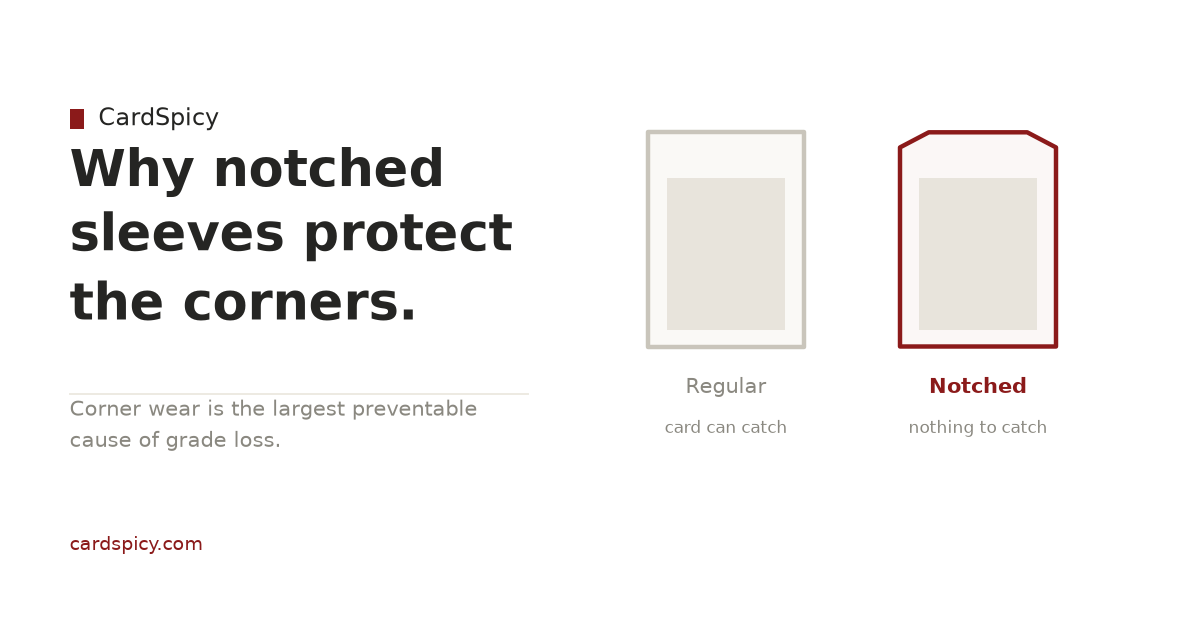
Corner wear is the largest preventable cause of grade loss — and most of it happens in the second a card goes into a sleeve.
A sleeve has four square corners. So does a card. Push one in at any angle and the card’s top corner meets the film’s: film folds, card stock doesn’t. That is the case for a notched sleeve.
1. Where the damage actually comes from
Grading data is the closest thing to a damage census we have. Across 24,000 cards, the most common reason a card misses its target grade is centering, at 47% — printed in at the factory and impossible to correct. Nobody sleeves a card into better centering. [1]
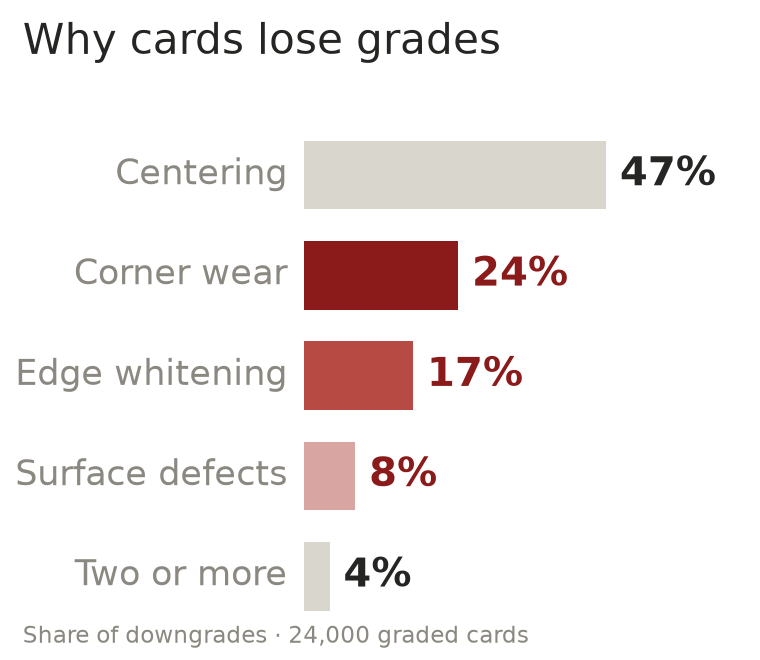
Remove centering and the picture gets useful. Corner wear 24%. Edge whitening 17%. Surface defects 8%. All of it is wear, and all of it happens outside the factory. Corner wear alone is just under half that total; edges about a third. [1]
Creases are missing because they are rare — but a crease does not shave a grade, it floors one: PSA caps a visible crease at 6 or below. [2] Moisture is slower and just as permanent. Card stock is layered paper, and when humidity swings the layers absorb at different rates until the card bows. [3]
2. The corner usually dies on the way in
Collectors blame the drop. The evidence points at the sleeve: corner wear develops through ordinary handling, and even sliding a card in and out of a sleeve blunts the corners over time. [4]
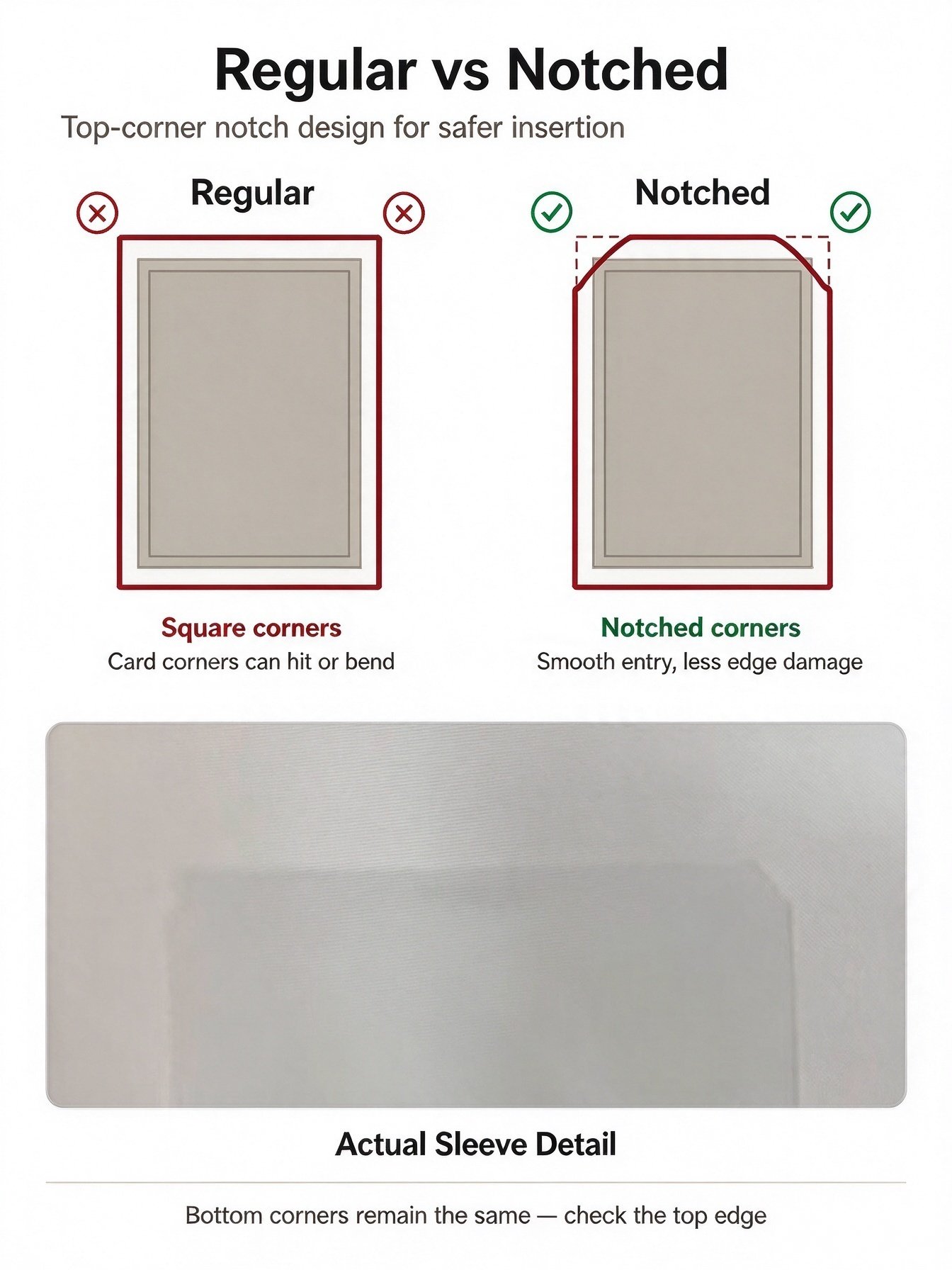
The complaint repeats on PSA’s own collector forum, and so does the fix — one collector arrives at notched sleeves specifically to avoid “accidentally dinging a corner” on the way in. [5] The two corners a card passes first are simply not there, and you can pinch the sleeve at the opening without touching the card face.
3. How often to replace a sleeve
A sleeve is a consumable, and the schedule follows how much the card is handled. [6][7][8][9]
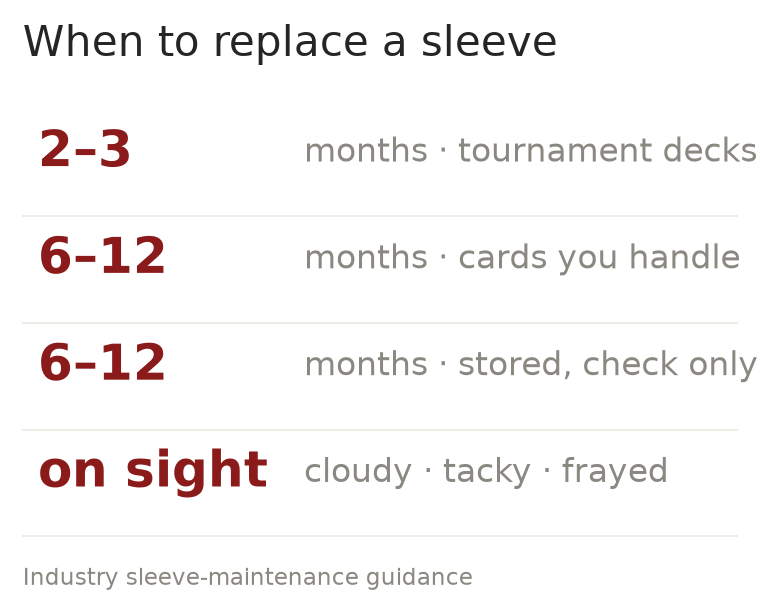
Actively played decks — 2 to 3 months for tournament play, 6 to 12 for casual. Sleeves fray and pick up hand oils, which is also what gets a deck ruled “marked”. [6][7]
Stored cards — inspect every 6 to 12 months. Look for cloudiness rather than wear; good polypropylene can sit for years in stable conditions. [8][9]
Any sleeve — replace on sight at yellowing, tackiness or brittleness. Those are signs the plastic itself is breaking down, and a degraded sleeve is abrasive. [9]
One material rule outranks the schedule: PVC sleeves release plasticizers as they age, clouding foils and lifting ink. Polypropylene does not. [7]
4. Why our film is 50 μm — and blown
Thickness is sold as a ranking, where thicker reads as better. It is really a job description. A 200 μm sleeve is a good display case and a poor contact layer; a thin film is the reverse. [7][12]
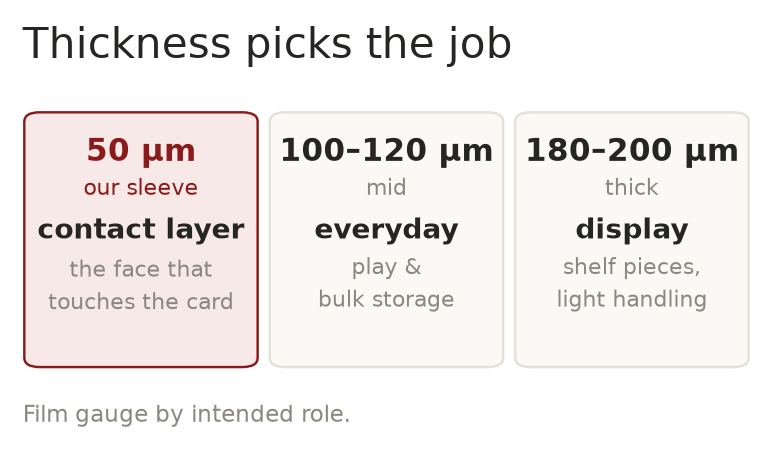
The layer touching the card face has one job: not to damage it. That argues for thin and soft. A thin film conforms to the card; a stiff one resists it, holds creases of its own, and presses them into the surface when a stack compresses.
Our penny sleeves are blown-film polypropylene at 50 μm — 0.05 mm, or 5 丝 in the trade shorthand. The film is extruded as a tube and inflated into a bubble, so it stretches in both directions at once — softer and more compliant than cast film, and it folds instead of creasing. [10][11]
The trade-off is a slightly less glossy surface than cast film produces. For a sleeve that sits against a holo card, we will take the softness. Acid-free, PVC-free, no fog — full specification on the penny sleeve listing. What 50 μm is not is structural: it will not stop a bend. That is the next layer’s job.
5. Two layers, two jobs
Thickness debates go in circles because one layer is asked to do two jobs. Split them and the choices get easy.
| Layer | What it stops | What it does not |
|---|---|---|
| Soft sleeve (50 μm, against the card) |
Surface friction and micro-scratches, fingerprints, dust, corner catch on insertion | Bending, impact, moisture |
| Rigid holder (35–360 PT toploader) |
Bending, corner impact, pressure in transit | Moisture, long-term light exposure |
| Storage box, stable room | Dust, humidity swings, light | Anything about impacts |
Soft inside, rigid outside. Our 3″ × 4″ rigid holders run eight options from 35 PT to 360 PT — that PT is the card thickness the holder accepts, not the holder’s own gauge. Both layers sit in Card Protectors.
6. Three things we see most often
- Sleeving a dusty card. The sleeve seals the grit in, and grit is what scratches. Check the face against light first.
- Forcing a stack into a full box. Pressure whitens corners and edges whether or not a sleeve is on the card.
- Keeping a sleeve past its life. A cloudy sleeve is an abrasive sleeve.
For the wider picture — the three layers, storage, and the mistakes that cost real money — start with Protection Tips, our sleeve guide, and whether a slab fits in a binder.
Frequently asked questions
Do penny sleeves damage cards?
No — a clean, correctly sized polypropylene sleeve does not scratch a card by itself. Wear comes from two places: grit already on the card face gets sealed in against it, and square sleeve corners catch the card’s own corners on the way in. Check the face against light before sleeving.
How often should I replace card sleeves?
It follows handling rather than a fixed calendar. Tournament decks need new sleeves every 2 to 3 months, casual play every 6 to 12, and stored cards need only an inspection every 6 to 12 months. Replace on sight at yellowing, tackiness or brittleness — a degraded sleeve is abrasive. PVC sleeves should be replaced regardless of condition, because they release plasticizers as they age.
Are notched sleeves actually better than regular ones?
For corner protection, yes. The two top corners of a notched sleeve are cut away, so a card pushed in at an angle has nothing to catch on. Corner wear is the second-largest cause of grade loss at 24% of graded cards, behind only centering at 47%, and it develops through ordinary handling rather than drops.
Should I use a sleeve and a toploader, or just one?
Both — they do different jobs. A 50 μm sleeve protects the card face from friction, dust and fingerprints, but it will not stop a bend. A rigid holder resists bending and impact, but not moisture. Soft inside, rigid outside is the arrangement that covers both.
Sources
Show all 12 sources
- GradingMetric — PSA 10 Success Rates by Sport, 2024–2026 (24,000 Cards Analyzed). Downgrade reasons by share. gradingmetric.com
- PreGradeCards — Pokémon Card Centering & Surface Defects: The Visual Grading Guide 2026. Creases cap the grade at PSA 6 or below. pregradecards.com
- CardShellz — How to Store Your Trading Card Collection. Layer absorption, bowing, 65–72°F and 40–50% relative humidity. cardshellz.com
- TFG Cards — How Card Grading Works. Corner wear developing through handling and sleeve insertion; surface as the 9-versus-10 factor. tfg.cards
- Collectors Universe message boards — Are Semi-Rigid Card Holders Always Such a Pain?!, January 2025. Collectors on tight sleeves, dinging corners on insertion, and notched sleeves. forums.collectors.com
- BoardGamesGuide — 2026’s Top 10 Standard Size Card Sleeves for Collectible Card Games. Replacement cadence: 2–3 months tournament, 6–12 months casual; replace at the first sign of wear. boardgamesguide.com
- eathealthy365 — A Custom Trading Card Sleeve Material Guide. Re-sleeving every 6–12 months; PVC plasticizer migration and its effects. eathealthy365.com
- TCG Protectors — The Ultimate Trading Card Sleeves Guide. Inspect binders and long-term storage sleeves every 6–12 months; 60–75°F and 40–50% humidity. tcgprotectors.com
- EVORETRO — Do protective sleeves degrade over the long term? Annual or biannual spot checks; yellowing, tackiness and brittleness as the signs. evoretro.ca
- Hotmelt Adhesive Film — What is the difference between cast and blown polypropylene thermoplastic film? Blown film: matte finish, higher tensile strength and elongation, better puncture resistance. hotmeltadhesive-film.com
- Jingwei Machinery — What Is the Difference Between Cast Film and Blown Film in Packaging Production? Balanced machine- and transverse-direction orientation in blown film. jingweimachinery.com
- Sohu (搜狐) — How to choose card sleeve thickness in 2026: industry standards and scenario guide. Published thickness tiers from 10 丝 to 20 丝 (100–200 μm). sohu.com
Film gauge and material specifications describe CardSpicy’s own penny sleeves. Damage shares are grading-industry observations on graded-card populations, not measurements of any single collection, and they describe how grades are lost rather than how often cards are physically damaged.