

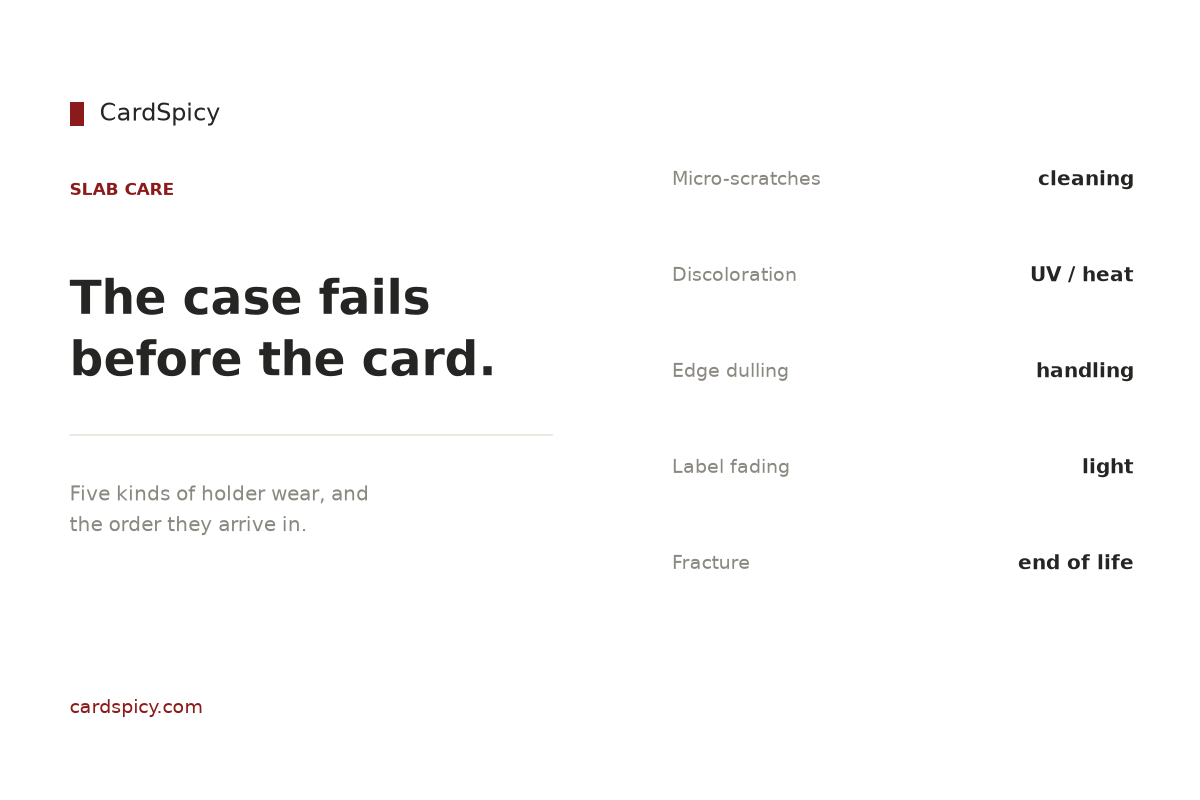
A graded card degrades in a fixed order: the case first, the label second, the card last. The case is the part you can maintain, and PSA’s own service documentation names exactly what gives out.
Slab care advice usually talks about the card inside. That is the wrong place to start. A PSA holder is a piece of acrylic with a paper label sealed into it, and it has its own wear list — one that PSA publishes, because it is the list of conditions the company will accept a reholder for.
Read that list and you have the maintenance schedule. Everything below is organised around it, and none of it is about the card’s grade.
The five kinds of holder wear PSA names
PSA’s reholder service exists to move a card from a worn holder into a current one. Its own description of the service sets out what counts as ordinary holder wear rather than card damage: superficial scuffs and scratches, exterior plastic discoloration, edge and corner dulling, and label fading. [1]
Those are four cosmetic classes plus one replacement trigger, and they arrive in a predictable order. Each has a different cause and a different fix.
| Failure | What causes it | Reversible? |
|---|---|---|
| Micro-scratches and scuffs | Dry wiping, paper towels, ammonia-based glass cleaner, alcohol wipes, shelf contact | No — they scatter light permanently |
| Exterior plastic discoloration | Sustained UV and heat exposure | No |
| Edge and corner dulling | Handling, stacking, sliding slabs rather than lifting them | No |
| Label fading | The same light that discolours the plastic, acting on printed ink | No — the label is sealed inside |
| Fracture | Point load on the narrow edge, or flexing a case that has already started to gap | Reholder, with conditions |
The important thing about that table is the third column. Every cosmetic failure on this list is permanent, because the damage is to the surface of the plastic rather than to a coating on top of it. There is no polish that returns a scratched acrylic face to optical clarity without removing material, and removing material is how you create a distortion you can see from an angle.
Which means the useful question is not how to repair a case. It is what stops each failure from starting.
Scratches: almost all of them come from cleaning
This is the counter-intuitive part. A slab sitting quietly on a shelf for a year picks up dust, not damage. Most micro-scratching is inflicted by the owner during maintenance, and it happens because the wrong cloth does the work.
The rules that avoid it are short and they are the same wherever acrylic care is written down: [2][3]
- Microfibre only. Paper towels, kitchen roll and rough fabrics are abrasive at the scale that matters here. They leave micro-scratches that scatter light, which is what turns a clear case cloudy without any single visible scratch explaining it. [2]
- Water first, nothing aggressive second. A dry microfibre cloth takes off dust. For fingerprints, a cloth lightly dampened with water is enough. If a cleaner is genuinely needed, it has to be one labelled safe for acrylic. Ammonia-based glass cleaners and alcohol wipes are the two named materials to keep away from it — both cloud the surface over time. [2][3]
- Never spray onto the case. Liquid sprayed at the surface collects around the seams and the label edge. Put it on the cloth, not on the slab. [2]
- Straight strokes, not circles. If you do use a plastic polish for a deeper mark, apply it in straight lines with a clean microfibre cloth. Circular motion makes the haze read as a swirl under angled light. [3]
- Separate cloths. Keep the microfibre cloth used on cases away from tools and dirty surfaces, or it picks up grit before it touches anything. [2]
The last one sounds excessive and is not. A cloth that has picked up a grain of grit is a sheet of fine sandpaper the next time it touches acrylic.
Discoloration: sunlight, and the case is not a filter
Sustained exposure to direct sunlight or high heat discolours and eventually warps acrylic, even in cases marketed as UV-resistant. [4] The reason the slab specifically is worth thinking about is that a PSA holder is not sold as a UV filter — display-case makers put its UV blocking at a small fraction of what a purpose-built UV case provides, which is the entire reason those cases exist. [5]
That matters because sunlight does two things at once, and only one of them is cosmetic. It discolours the case. It also fades the ink on the card inside, and that second effect is the one PSA’s reholder terms explicitly call out: the company lists fading due to sunlight exposure since the initial grading as a reason it may not complete a straightforward reholder and may instead evaluate the card independently of its previous grade. [1]
So the practical rule is not “keep it out of direct sun” as a display preference. A slab in a bright window is a slab whose grade can be revisited later, and the case discoloration is the visible early warning of the same exposure. [6]
Placement matters as much as light. Hot, humid, smoky or greasy environments — garages, kitchens, unfinished basements, and shelves near a fireplace — are the ones acrylic care guidance says to avoid, and they are also the environments where the temperature swings do the warping. [2]
Edge and corner dulling: a handling problem
The dulling PSA names is wear on the slab’s edges and corners, not on its faces, and it comes from contact rather than from light. Three habits cause almost all of it.
Sliding instead of lifting. A slab dragged across a shelf wears its bottom edge. Lifting it clear of the surface costs nothing and removes the wear entirely.
Stacking without a layer. Acrylic on acrylic, and worse, keys or metal on top of a case, mark the surface directly. Where cases are stacked, a soft layer or non-slip mat between them is the fix. [4]
Crowding. Slabs packed tightly on a shelf are harder to dust and get knocked against each other whenever one is taken out. Leave enough room around each case that it can be lifted without touching its neighbours. [2]
Fracture: the one failure that can change the card’s status
A crack is not just a worse version of a scuff. PSA’s reholder terms say the service may not be completed if the case is fractured, and that removal converts the card into a raw submission that has to stand on its present condition rather than its previous grade. [1][7]
The mechanics are the same ones that make short-edge storage risky. A slab is widest and flattest on its faces and narrowest along its short edge, so any weight or squeeze applied to that edge concentrates on a much smaller area. Cases that crack under storage pressure almost always crack there, and cases that have begun to gap or flex are the ones that fail next. [8]
Two rules follow. Store slabs flat or upright in channels that support the whole face, never leaning under load. And if a case has started to gap, click, or move its contents, stop handling it — flexing a compromised case is how a cosmetic crack becomes one that reaches the card.
If a fracture does force you to handle the card outside its holder, do not put it down bare. A penny sleeve followed by a rigid 3″ × 4″ toploader is how a raw card is moved and shipped without new edge wear, and the sleeve goes on before the holder, not instead of it. Both are in our Protectors range.
Maintenance, in the order you should do it
Before shelving a new slab. Check the faces for transit scuffs while the card is still in its packaging, and photograph the slab, label and certification number before it goes on display. That record is what makes any later dispute about case condition a conversation rather than an argument.
Monthly, or whenever it looks dusty. Microfibre cloth, dry, no pressure. This is the entire routine for a slab that is not being handled.
After handling. Fingerprint oil is the reason the surface stops looking clear, and clean dry hands or soft cotton gloves are the whole countermeasure. Less contact genuinely means a clearer case for longer. [4]
Annually. Look at the case under neutral white light against a sheet of white paper rather than under your display lighting. That is the only way to tell whether a case has actually discoloured or whether you are seeing the colour of the room. [2]
When to stop. Dust and fingerprints do not justify replacement. Haze that will not clean away, visible discoloration under neutral light, deep scratches, cracks, warped panels or loose hardware do — at that point the case has stopped doing one of its jobs. [2]
Replacing the case without risking the grade
A scratched or clouded case does not mean the card is damaged, and the cosmetic classes PSA lists — scuffs, scratches, exterior plastic discoloration, edge and corner dulling, label fading — are exactly the wear a reholder is designed to resolve, with the grade and certification number generally unchanged. [1]
It is not a formality, though. PSA inspects every reholder submission to confirm the holder’s integrity and authenticity, to check that the label still describes the card, and to confirm the grade is not an obvious error. Two of the reasons it can decline a straightforward reholder point straight back at this article: a fractured case, and a card whose condition has changed since grading through sun exposure. [1]
Which is the argument for maintaining the case in the first place. Replacing a case for cosmetic wear is inexpensive relative to the card. Replacing a case because the card faded inside it is a different problem, and the case discoloration was the warning you had for months.
Every slab we list is a PSA 10 (Gem Mint) graded copy, and the full range is in our Chinese Exclusive catalogue. If you want to know what the number on the label actually measures, our grading guide covers the scale and the sub-grades behind it. And if the question is where a slab physically fits rather than how it wears, the measurements guide covers the dimensions properly.
Frequently asked questions
How do I clean a PSA slab without scratching it?
Use a clean microfibre cloth. Remove loose dust dry, and for fingerprints use a cloth lightly dampened with water rather than a spray. Never use paper towels, ammonia-based glass cleaners such as Windex, or alcohol wipes — all three produce micro-scratches that scatter light and make the case cloudy over time. Never spray liquid directly at the case, because it collects around the seams and the label edge. Apply anything to the cloth, not the slab.
Can a scratched PSA slab be repaired?
The scratches can be reduced with a plastic polish applied in straight strokes with a clean microfibre cloth, but the case cannot be returned to optical clarity by polishing, because polishing removes material. The proper fix for a case that is genuinely worn is PSA’s reholder service, which moves the card into a current holder with the grade and certification number generally unchanged.
Does a PSA slab protect a card from UV light?
Only partially. Display-case makers put a PSA holder’s UV blocking at a small fraction of what a purpose-built UV case provides, which is why those cases are sold. Sunlight therefore does two things: it discolours the case, and it fades the ink on the card inside. PSA’s reholder terms list fading from sunlight exposure after grading as a reason a straightforward reholder may not be completed.
Should graded slabs be stored flat or upright?
Flat, or upright in channels that support the whole face. The failure to avoid is a slab standing on its short edge with weight above it: the short edge is the narrowest face, so the same load concentrates on a much smaller area, and that is where acrylic cases crack. A leaning stack under load causes the same problem over months rather than instantly.
When should a graded card case be replaced?
Dust and fingerprints do not justify replacement. Haze that will not clean away, visible discoloration seen under neutral white light, deep scratches, cracks, warped panels or loose hardware do. PSA’s reholder service is designed for limited holder wear — superficial scuffs and scratches, exterior plastic discoloration, edge and corner dulling and label fading — and the card keeps its grade and certification number in most cases.
Sources
Sources and further reading
- PSA — Reholder Service. The service removes a card from its current holder and re-encapsulates it in PSA’s latest holder; the named categories of limited holder wear (superficial scuffs and scratches, exterior plastic discoloration, edge and corner dulling, label fading); the inspection performed on every reholder submission; and the reasons a straightforward reholder may not be completed, including a fractured case and fading from sunlight exposure since grading. psacard.com
- Slab Saver Comics — Do Acrylic Cases Yellow? What Collectors Need. Cleaning practice for acrylic cases: microfibre first, water for fingerprints, never spray onto the case, avoid paper towels and glass cleaner, store away from hot, humid, smoky or greasy environments, and check discoloration against white paper under neutral light. slabsavercomics.com
- Acrylic Product Supplier — Acrylic Graded Card Display Case. Acrylic handling guidance: microfibre only, no ammonia-based cleaners, store away from direct sunlight and heat, clean dry hands or gloves, and keep metal and abrasive objects away from the surface. acrylicproductsupplier.com
- Exponation — 10 Best Graded Card Display Cases. UV protection ranges for display cases, handling practice, and why paper towels and ammonia-based cleaners accelerate yellowing. exponation.net
- Acrydis — Acrylic Premium Case for PSA Slabs. A display-case maker’s statement that a PSA slab offers around 13% protection against UV rays, and that acrylic scratches easily and should be cleaned with a microfibre cloth. acrydis.com
- The Wearify — Card display and acrylic cleaning. Microfibre with distilled water and a drop of mild soap; straight strokes rather than circular motion when polishing; no paper towels, ammonia cleaners or alcohol wipes. thewearify.com
- Pokémon Pricing — Fractured PSA Pokémon Slab: Why Reholdering May Trigger Raw Evaluation. How a fracture near the card can convert a reholder into a raw evaluation, and why a fractured slab should not be valued as an intact example. pokemonpricing.com
- CardSpicy — Does a PSA 10 Slab Fit in a Binder? Slab dimensions and why short-edge load is the failure that cracks holders. cardspicy.com
Holder-wear categories and reholder conditions are quoted from PSA’s own service documentation. Cleaning and storage practice follows the acrylic care sources above. No price in this guide is a forecast.