

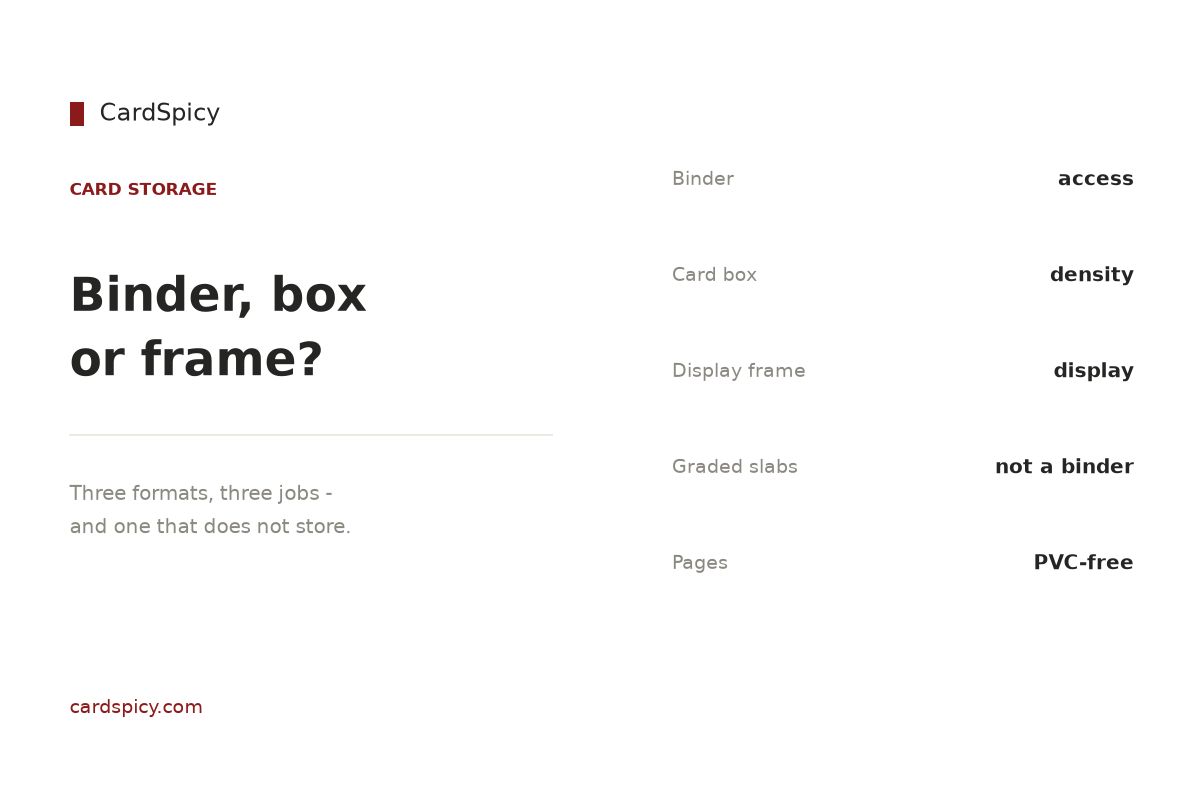
Binder, card box and display frame are sold as three answers to one question, and they are not three tiers of the same thing. Each solves a different problem, and picking the wrong one damages cards slowly rather than obviously.
The question underneath “which storage should I buy” is not which one is better. It is which of three jobs you actually need done: looking at the cards, storing them densely, or showing them off. Those pull in different directions, and one of the three formats does not store anything at all.
Here is the whole comparison, including the failure modes that make binders the most common cause of card damage collectors report.
The decision that comes first: raw card or slab
Before formats, settle one thing, because for part of the market the choice is already made.
A standard nine-pocket page holds cards 2.5 × 3.5 inches (63 × 88 mm). A PSA slab is roughly 3.25 × 5.25 inches and about 0.25 inches thick. That is not close, and the three dimensions fail independently — so a slab does not go in a normal binder page, and no amount of careful loading changes that. [1]
If what you are storing is graded, the binder is out and the question becomes box or frame. If what you are storing is raw, all three are live options. The slab measurements guide has the full set of dimensions and the alternatives.
Format 1: the binder
A binder’s job is access. It is the only one of the three formats that lets you look through a collection the way you look through a book, and that is worth real money when you are building a set rather than storing one.
What to look for comes down to four specifications, and each one maps to a specific failure:
| Specification | Why it matters |
|---|---|
| Side-loading pockets | Top-loading pages let cards fall out when the binder is tilted or carried at an angle. Side-loading pockets open toward the spine and hold regardless of orientation. [2][3] |
| PVC-free, acid-free pages | Standard cheap pages contain PVC, which off-gasses over time and can chemically damage card surfaces and holo layers — the same effect that leaves older collections sticky or cloudy. [2][3] |
| D-ring, or no rings at all | An O-ring binder buckles the pages at the closure point and puts lateral pressure on every card in every page. D-rings close flush to the spine so pages lie flat; zip and folio binders avoid rings entirely and are the safest of the three. [2][4] |
| Nothing overstuffed | Pages are rated for nine cards per side. Loading more is what makes the pocket material press on the card, and it is the mechanism behind most ring damage. [3][4] |
Two habits matter as much as the binder itself. Store binders upright like books, never stacked flat — a stack is sustained pressure on the whole face of the collection. And keep them away from windows, because a binder does not exclude light at all. [2][3]
There is also a hybrid worth knowing about: a toploader binder, where the pages are slots sized for rigid 3″ × 4″ holders rather than raw cards. Your card goes sleeve → toploader → binder, stays rigid, and you can flip through the collection without ever touching a raw card. [5]
Format 2: the card box
A box’s job is density and darkness. It is the only one of the three that closes, which means it is the only one that excludes light and dust completely, and that alone makes it the right answer for anything you are not actively looking at.
The single most useful thing to know about boxes is this: quoted counts assume raw cards. A box rated for 1,600 cards will hold far fewer once everything inside is sleeved, and fewer again if it is toploaded. Plan capacity against what the cards will be, not what they are. [5]
Three specifications decide whether a box is doing its job:
- Acid-free material. Standard cardboard absorbs moisture and is not archival. Acid-free card boxes exist and are inexpensive; plastic bins avoid the question entirely. [6]
- Upright, not loose. Cards stored flat in an unsupported pile take pressure on the face of the stack. Standing them upright in rows with dividers is what stops them bowing. [6]
- Moisture control in humid climates. A silica gel packet in the box is cheap insurance, and the target range is roughly 45–55% relative humidity at 18–22 °C. Low humidity makes cards brittle; high humidity warps them. [2]
For graded cards the equivalent is a padded slab box, stored upright. Slabs are rigid but not damage-proof — scuffs and chips are still part of owning them, which is why padded boxes and slab sleeves exist. [5]
Boxes are also the format that suits bulk best. Cards you are not displaying and not grading do not need a binder page; they need a dark, dry, stacked space with dividers. [2][6]
Format 3: the display frame
A frame’s job is display, and that is the whole of its job. It does not store, it does not protect from much, and if you choose it for the wrong reason it is the worst of the three options for the card’s condition.
The specification that decides whether a frame is safe is UV filtering. Light does not just fade ink on the surface — it breaks down the inks and the paper, and the effect is cumulative rather than immediate. A card in direct sunlight can visibly fade in two to three weeks, and indirect natural light causes long-term damage over months. [5][7][2]
So the rule for frames is narrow and absolute: a frame that does not filter UV is a display method, not a storage method, and it should never be the long-term home of a card you care about. A UV-filtering frame in a position that avoids direct sun is fine; the same frame on a windowsill is a slow loss.
Two practical points follow. Frames are usually sold as multi-packs of small floating holders with magnetic or friction closures, which means they suit a rotating selection rather than a whole collection — a handful of cards you want to see, swapped occasionally. And where a frame is used for graded cards, check the depth tolerance against slab thickness before buying, because holders vary between grading companies. Magnetic one-touch cases are the modern alternative to screw-down holders for raw cards, and the screw-down type is worth avoiding entirely: sustained screw pressure can flatten a card, add gloss, or lift the surface on a foil. [5][7]
The three formats side by side
| Binder | Card box | Display frame | |
|---|---|---|---|
| Job | Access and browsing | Density and darkness | Display only |
| Excludes light | No | Yes, once closed | No — filters at best |
| Excludes dust | Partly, if zip-closed | Yes | Yes |
| Holds raw cards | Yes | Yes | Yes, one per frame |
| Holds graded slabs | No — 9-pocket pages do not fit a slab | Yes, a padded slab box | Yes, if depth allows |
| Main risk | Ring damage, PVC off-gassing, overstuffing | Moisture in humid climates, under-planning capacity | UV fade, plus any pressure from the closure |
| Capacity | Fixed by page count, roughly 18 cards per page | Highest of the three | One card per frame |
Read across the middle rows and the answer usually resolves itself. If you want to look at the collection, and it is raw, a binder is right. If you want to leave it alone for two years, a box is right. If you want to see three cards every day and the rest never, buy a frame and a box.
Whichever you choose, the layer underneath comes first
None of the three formats touches the card directly, and that is the point to get right before anything else. The protection chain is a sequence, and storage is the last step in it, not the only one.
The chain is: sleeve → rigid holder → storage. A card goes into a sleeve first, right out of the pack. If it is valuable, the sleeved card goes into a rigid holder. Only then does it go into a binder page, a box or a frame. [1]
We list the first two steps: a pack of 100 penny sleeves for the first layer, and rigid 3″ × 4″ toploaders for the second. Both are in the Protectors range, and the protection guide covers how the three layers divide the work between them.
Whichever format you store in, one specification is non-negotiable and it is the same for all of them: nothing that touches a card should contain PVC. Sleeves, pages and holders alike should be PVC-free and acid-free. It is the one failure that damages the card rather than the container, and it is invisible until it is not.
The mistakes that account for most of it
- Using a top-loading binder. Cards slide out, corners catch on rings, and pages shift. Side-loading or nothing. [1][2]
- Overstuffing pages. Over capacity is the single largest cause of ring damage, and the damage is to the cards, not the binder. [4]
- Storing a binder flat or stacked. Binders are meant to stand upright like books. A stack is pressure on every card in it. [3]
- A frame on a windowsill. The most expensive placement in the hobby. Visible fading can begin within weeks in direct sun. [5]
- Assuming a box count. Quoted capacities are for raw cards. Everything you sleeve reduces the real number. [5]
Frequently asked questions
Is a binder or a card box better for trading cards?
They do different jobs. A binder is for access and browsing — it is the only format that lets you look through a collection like a book, and it needs side-loading, PVC-free, acid-free pages in a D-ring or ringless design. A card box is for density and darkness: it closes, so it excludes light and dust completely, which makes it the right choice for cards you are not actively viewing. Many collections need both — a box for the bulk and a binder for what you are building.
Do graded slabs fit in a binder?
No. A standard nine-pocket page holds cards 2.5 × 3.5 inches, while a PSA slab is roughly 3.25 × 5.25 inches and about 0.25 inches thick. The dimensions fail independently, so a normal binder page will not accept a slab regardless of how it is loaded. Graded cards belong in a padded slab box stored upright, or in a display frame with sufficient depth tolerance.
Do display frames damage cards?
A frame without UV filtering will. Light breaks down inks and paper, and the effect is cumulative — a card in direct sunlight can visibly fade in two to three weeks, and indirect natural light causes long-term damage over months. A frame that filters UV, positioned out of direct sun, is fine for display. The same frame on a windowsill is a slow loss, so treat a non-UV frame as display only and never as storage.
What should I look for in a card binder?
Four things: side-loading pockets rather than top-loading, PVC-free and acid-free pages, D-rings or no rings at all rather than O-rings, and the discipline not to overstuff. Then store it upright like a book rather than stacked flat, and keep it away from windows, because a binder does not exclude light. A toploader binder, whose pages hold rigid 3 × 4 inch holders rather than raw cards, is a further option for valuable singles.
How should cards be stored long term?
In the order sleeve → rigid holder → storage, then a dark, dry, stable environment. Target roughly 45–55% relative humidity at 18–22 °C, add a silica gel packet in humid climates, and keep everything out of direct and indirect light as far as possible. For bulk, upright rows with dividers in acid-free boxes or plastic bins; for graded slabs, upright in a padded slab box rather than stacked flat.
Sources
Sources and further reading
- What The Slab — Card Display and Storage: The Complete Setup Guide. The protection chain of penny sleeve, toploader, team bag and storage case; binders as the most common cause of card damage; and why top-loading and ring binders should be avoided. whattheslab.com
- TCG Store Finder — Card Storage Guide: Sleeves, Top Loaders and Binders Explained. D-ring versus O-ring binders, side-loading versus top-loading pages, PVC-free pages, and the environmental targets of 45–55% relative humidity at 18–22 °C together with the cumulative effect of UV exposure. tcgstorefinder.com.au
- T206 Cards — How to Store & Protect Your Trading Cards. Page specifications for PVC-free acid-free polypropylene with side-loading pockets and welded seams; storing binders upright rather than stacked; toploader binders; storage box sizing; and the vulnerability of graded slabs to scuffs and chips. t206cards.com
- Colorful Cardboard — Pokémon Card Storage Guide. Nine-pocket pages holding cards front and back, ring damage from overstuffing, toploader binder pages eliminating ring damage, and storage box materials and capacities. colorfulcardboard.com
- CardSpicy — Does a PSA 10 Slab Fit in a Binder? The side-by-side dimensions for raw cards, binder pockets and PSA, BGS, CGC and SGC slabs, and the storage options that do work. cardspicy.com
- Tistaminis — How to Protect and Store Trading Cards Long-Term. Long-term storage practice for sleeves, binders, toploaders, bulk and graded cards, and the environments to avoid. tistaminis.com
- Pokémon Pricing — Fractured PSA Pokémon Slab. Why pressure and point loads on a graded holder are the failure that matters, and how damage near the card changes its standing. pokemonpricing.com
Storage guidance follows the sources above as published; card and holder dimensions are as measured in our own guide. No price in this guide is a forecast.