

If you collect English cards, the letters UR mean one specific thing. On a Simplified Chinese card they mean something else entirely — and the difference is not cosmetic. It is the difference between a silver-bordered full-art card and a card printed entirely in gold, and it is the reason a Chinese UR will look wrong to you the first time you see one.
This store lists four gold Ultra Rares inside its Chinese Exclusive lineup. They are the loudest-looking cards in the category and, measured against the rest of it, the least expensive. That combination is not a coincidence, and it is not a warning sign — it follows directly from what the letters and the gold finish actually describe.
The short answer
On a Simplified Chinese Pokémon card, UR stands for Ultra Rare, and in the current Chinese print line the Ultra Rare slot is the gold-etched card at the end of the numbered checklist. It is printed with a full-face gold foil treatment, it is numbered above the printed size of its set, and it is the last card in the set’s numeric order rather than one of the numbered cards.
The Chinese-language rarity guides describe it the same way: UR is the tier above SR, the card face is gold, and in the Chinese line only some Pokémon cards, Energy cards and Item cards are issued in a UR version — which is why collectors in Chinese simply call it 金卡, the gold card.
UR is not the English “Ultra Rare”
This is the trap, and it is worth stating plainly, because the two lines reuse the same two letters for two different products.
In the English-language line, a card marked Ultra Rare is a full-art Pokémon ex or Supporter — silver-bordered, with the artwork running past the frame and the card’s ordinary text underneath. The English line uses a different name for the gold card: it calls it Hyper Rare, marked with three gold stars. A rarity guide that maps the two conventions records exactly that, and adds the warning that the English “Ultra Rare” is not the same as the letters UR you see on a Japanese or Chinese card.
So a gold card that an English-speaking collector would call a Hyper Rare is, on a Simplified Chinese card, printed UR. And a card our listings mark SAR is what the English line calls a Special Illustration Rare. The letters are not a translation of each other; they are two separate naming systems for the same set of finishes.
| Finish you are looking at | Letters on a Chinese card | Name used in the English line |
|---|---|---|
| Full-art Pokémon ex or Supporter | SR |
Ultra Rare |
| Special illustration | SAR |
Special Illustration Rare |
| Gold-etched, whole card in gold foil | UR |
Hyper Rare |
| Rainbow-etched (Sword & Shield era) | HR |
Rainbow Rare |
The fourth row is why Blastoise VMAX and Venusaur VMAX are marked HR in this lineup while the four gold cards are marked UR. HR belongs to the earlier era of the game and to a different finish. The two letters are not ranked against each other; they belong to different print generations.
What “gold” describes on the card
The treatment covers the whole card. The border, the name bar, the HP area, the text box background and the frame are all rendered in gold foil with an etched texture, so the artwork sits inside a gold field rather than being the subject of the card. That is the opposite of how an Illustration Rare or a Special Art Rare is built, where the picture is the entire point of the print.
Two practical consequences follow. First, a gold card is identifiable from across a table — you do not need to read the letters to know what you are holding. Second, it reads as a treatment rather than as an illustration, and that distinction turns out to drive the price, which we get to below.
Gold cards have been the highest-numbered cards in their sets since the Black & White era of the game. They are always numbered past the end of the checklist, and they are always alternate versions of a card that already exists in the numbered part of the set — not a new card introduced by the gold slot.
Decoding csv4C 162/129 UR
Take Gholdengo ex from Reward Round. Its printed identifier is csv4C 162/129 UR, and every part of that string is doing work.
| Part | What it is |
|---|---|
csv4C |
The set code — the fourth main set of the Chinese Scarlet & Violet line. |
162 |
The card’s position in the checklist. |
129 |
The printed size of the numbered set. |
UR |
The rarity letter code, printed on the card where the rarity mark goes. |
The numerator is larger than the denominator, and that is the single most useful thing to check. A card numbered above the printed size of its set is a secret card: it sits past the end of the numbered checklist rather than inside it. 162/129 is not an error and not a misprint — it is the standard way a set marks a card that was added after the numbered list ran out.
That fraction is also the part of the identifier that cannot be faked by reprinting. Our guide to reading Chinese set codes covers the full grammar, including the Gem Pack cards, which use a group-and-variant structure instead of a fraction.
The four gold URs in this lineup
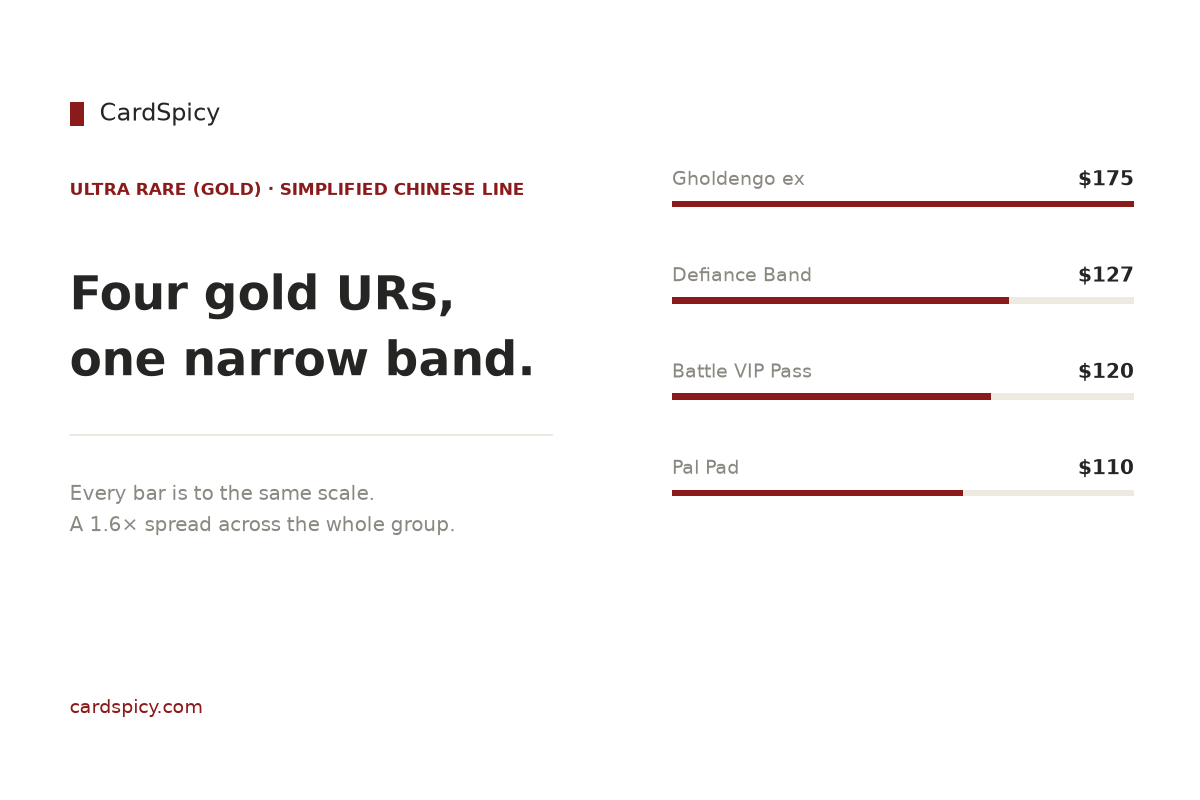
Four of the 42 cards in Chinese Exclusive are Ultra Rare (gold). Each one is a gold treatment of a card that exists elsewhere in its own set at an ordinary rarity.
| Card | Set | Printed code | Illustrator | Year | Our listing |
|---|---|---|---|---|---|
| Gholdengo ex | Reward Round | csv4C 162/129 UR |
5ban Graphics | 2025 | $175 |
| Defiance Band | Dark Crystal Blaze | csv5C 164/129 UR |
inose yukie | 2025 | $127 |
| Battle VIP Pass | Radiant Energy | cs5.1C 023/004 UR |
Toyste Beach | 2024 | $120 |
| Pal Pad | True Mystery | csv6C 163/128 UR |
Studio Bora Inc. | 2025 | $110 |
Three separate numbering shapes appear in that table, and it is worth reading them apart. Gholdengo ex and Defiance Band are both numbered against a 129-card set, Pal Pad against a 128-card set, and Battle VIP Pass against a four-card product. Do not read “past the end” as a fixed gap — the meaningful part is that the numerator exceeds the denominator in every case, and the size of the denominator tells you how large the comparison is.
Defiance Band is a good example of how ordinary the underlying card is. The same artwork by the same illustrator appears in the English release as an Uncommon Trainer card, numbered 169/198, worth a few cents raw. In the Chinese line it is csv5C 164/129 UR, a gold card, and the reason it is priced in the hundreds is the print run and the treatment rather than the card.
Why three of the four are Item cards
Only one of the four gold URs is a Pokémon. Gholdengo ex is a Pokémon ex; the other three are Trainer cards — Defiance Band is a Pokémon Tool, and Pal Pad and Battle VIP Pass are Items. There is a structural reason for that split rather than a preference.
The gold slot is filled from the cards already in the set, so whatever the set contains is what can be issued in gold. The Chinese rarity guides put it directly: only some Pokémon cards, Energy cards and Item cards are issued in a UR version in this line. A rarity reference for the English equivalent is more specific still — it records that Hyper Rares can be alternate versions of any card in their set except Supporter Trainer cards.
That is why you will find a gold Item far more often than you might expect. The slot is not reserved for the most popular character in the set; it is filled from the eligible cards, and Items and Tools are always eligible. It also explains why the four gold cards in this lineup sit at lower price points than the illustration-driven cards around them — the subject is often a Trainer card whose ordinary print is common, and the market for a gold version of a common Item is narrower than the market for an illustrated character card.
What a gold UR actually costs
This is the part that surprises people, so it is worth showing with the numbers from this category rather than describing it in the abstract.
| Rarity group in Chinese Exclusive | Cards | Average listing price | Range |
|---|---|---|---|
| Illustration Rare | 23 | $534 | $66 – $3,027 |
| Special Art Rare | 9 | $407 | $89 – $904 |
| Hyper Rare | 2 | $235 | $180 – $290 |
| Ultra Rare (gold) | 4 | $133 | $110 – $175 |
The gold URs have the highest-sounding rarity name in the category and the lowest average price. They also have by far the tightest band: the whole group sits inside a 1.6-times spread, while the Illustration Rares run from $66 to over $3,000 — driven, in that case, by four event-distributed Pikachu from Collect 151 that occupy the top of the range.
The reason is the one flagged earlier: scarcity is not the same thing as demand. Gold cards are genuinely hard to pull — published pull-rate estimates put a gold card at roughly one in every 15 to 25 packs, and inside a 30-pack box the single high-rarity hit that every box contains lands on a UR only about one time in ten, with SR and SAR taking the rest. So the supply is low. But because the treatment is applied to the set’s existing cards and frequently lands on an Item or a Tool rather than a headline character, the pool of buyers competing for one is smaller than the pool chasing a well-loved illustration.
What the gold treatment does establish is a floor rather than a ceiling. A gold Item is still an Item, and the card you are buying is the print run and the grade rather than the picture — which is a perfectly good reason to collect it, as long as you are buying it for that reason.
How to describe a gold UR accurately
Because the two naming systems collide, gold cards attract more than their share of loose descriptions. Three phrasings are worth getting right, whether you are writing a listing, an Instagram caption or an insurance schedule.
Describe the treatment and the line. “Chinese-exclusive gold UR version” is accurate and specific: it names the finish and the product line. It is what the card is.
Do not describe it as a brand-new illustration. The gold slot is an alternate treatment of a card that already exists in the set. For the Item and Tool cards in particular the artwork is not unique to the Chinese line — the same illustration appears in other releases. Calling it new art invites a correction.
Do not claim the card was never printed in Japanese or English. Some of these prints are specific to the Chinese line; others share a card and an artwork with another market and differ only in the finish. The distinction is not visible from the gold alone, and an absolute claim is the easiest thing for a buyer to check and disprove with a single search. Say what you can evidence — the treatment, the line, the set code and the grade — and stop there.
What to check before you buy one
Four checks, in order.
Match the code to the slab. PSA prints the set and card number on the label, so a gold UR listing should show a code that matches the card in the holder. If the label reads a number that is not past the end of the set, you are looking at the ordinary print of that card, not the UR.
Confirm which print you are buying. Pal Pad and Defiance Band both exist as ordinary cards. The gold version and the ordinary version have the same name and the same text, and only the number and the finish tell them apart.
Look at the grade and the holder. Gold foil shows surface wear more clearly than a flat finish, and a high-gloss gold card photographed under a direct light hides nothing. If the card is graded, the holder itself becomes part of the condition question — scuffs, edge dulling and label fading are all separate from the card’s grade, and our note on keeping PSA slabs clean covers what actually damages a holder and what is only cosmetic.
Protect it properly if it is raw. A gold card in a binder page carries more risk than a matte card, because the finish is the thing you are paying for and the thing that shows a new scratch. A penny sleeve followed by a rigid 3″ × 4″ toploader is the minimum, and it applies to graded and raw cards alike.
Frequently asked questions
What does UR mean on a Simplified Chinese Pokémon card?
UR stands for Ultra Rare. On a current Simplified Chinese card it is the gold-etched print that sits at the end of the numbered checklist, past the printed size of the set. Chinese collectors call it 金卡 — the gold card.
Is a Chinese UR the same as an English Ultra Rare?
No. The English line uses Ultra Rare for full-art Pokémon ex and Supporter cards, which the Chinese line letters as SR. The gold card that the Chinese line letters as UR is what the English line calls a Hyper Rare. The two systems reuse the same two letters for different finishes.
Is a gold UR stronger than the normal version of the same card?
No. The gold slot holds an alternate version of a card that already exists in the numbered part of the set, so the card text is the same as the ordinary print. What differs is the finish, the position past the end of the checklist, and the print run.
Why is the card number higher than the set total, like 162/129?
Because a card numbered above the printed size of its set is a secret card. The numerator is the card’s position and the denominator is the size of the numbered set, so a numerator past the denominator is the standard marker for a card added after the numbered list ends. It applies to gold URs and to Special Art Rares alike.
Can a gold UR be a Supporter card?
Not in the sets we list. The four gold URs here are three Trainer cards — a Pokémon Tool and two Items — and one Pokémon ex. A rarity reference for the English equivalent records that the gold rarity can be an alternate version of any card in its set except Supporter Trainer cards, which matches what we see in the Chinese line.
Sources
Sources and further reading
- Bulbapedia — Rarity. The definition of Ultra Rare, the bolded-letter rarity convention used by Japanese releases from Black Collection and White Collection onwards, and the secret-card convention of numbering a card above the printed size of its set. bulbapedia.bulbagarden.net
- Bulbapedia — Defiance Band (Scarlet & Violet 169). Confirms the card is a Trainer card of the Pokémon Tool subtype, illustrated by inose yukie, and numbered 169/198 in the English release. bulbapedia.bulbagarden.net
- Dittobase — Pokémon TCG Rarities Explained. The three-gold-star Hyper Rare, described as the equivalent of the Japanese UR symbol and explicitly distinguished from the English Ultra Rare rarity; also the note that Hyper Rares can be alternate versions of any card in their set besides Supporter Trainer cards. dittobase.com
- CardHome — 宝可梦卡牌稀有度. The Chinese-language rarity ladder (S, SR, HR, SSR, UR) and the statement that UR — 究极稀有 — is the gold card, that only some Pokémon, Energy and Item cards are issued in a UR version in the Chinese release, and that it is therefore known as 金卡. sohu.com
- Pokex — Gold Pokemon Cards. Gold cards as secret rares numbered above the set count, their presence at the highest numbers of every set since the Black & White era, and published pull-rate estimates of roughly one gold card per 15 to 25 packs. scanpokemon.com
- ASOVENTURE — 寶可夢卡稀有度完全解說. UR as the gold tier of the Japanese and Chinese printings, and the observation that gold Energy and gold Item cards are less popular than gold Pokémon yet still priced on their scarcity. asoventure.jp
- CardSpicy — the four listings cited above and the Chinese Exclusive category, which carry the printed set codes, illustrators and listing prices used in the tables on this page. Cross-references: how to read a Chinese set code and the full 42-card list.