

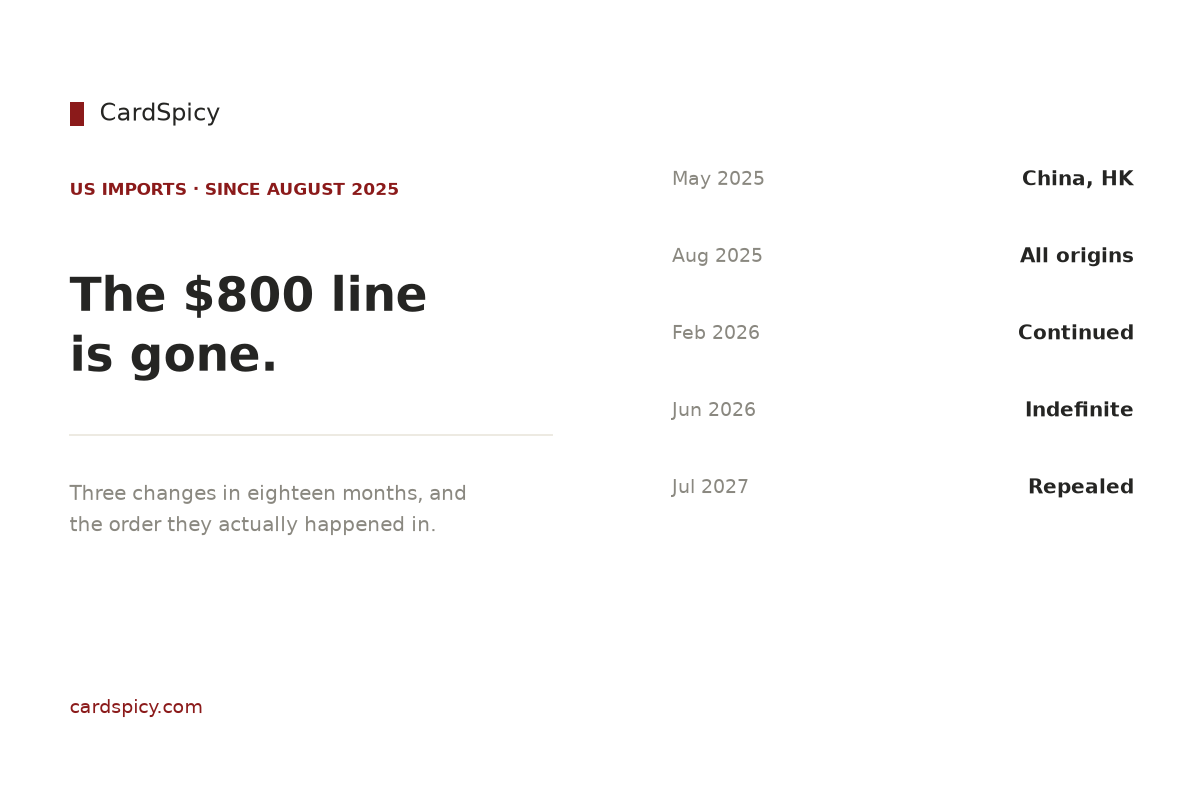
The $800 duty-free threshold for parcels entering the United States was suspended in August 2025, made indefinite in June 2026, and is scheduled for permanent repeal in 2027. If you buy cards from outside the US, this is the change behind the fees you started seeing.
For about a decade the arithmetic of buying a card from overseas was simple: stay under $800 and nothing happened. That single rule — Section 321 of the Tariff Act, known as de minimis — let a parcel of trading cards clear the US border with no duty and almost no paperwork. It was the reason a $60 slab from Hong Kong could arrive with nothing to pay and nothing to sign for.
It no longer works that way. Every parcel entering the United States now needs a customs entry, whatever it is worth. CBP’s own framing when it ended the treatment was blunt: “For years, billions of low-value shipments have entered the United States without sufficient information.” [1]
Two things are worth separating here, because they get conflated constantly. One is a tax question, and it is smaller than people assume. The other is a paperwork question, and it is the reason your parcels cost more.
The five dates that matter
The change did not arrive in one step, which is why so much of the advice about it online is out of date. This is the actual order:
| Date | What happened |
|---|---|
| 2 May 2025 | Duty-free de minimis withdrawn for low-value imports from China. [2] |
| 29 Aug 2025 | Suspended globally, for every origin and every mode of entry — air, ocean and post. [1][3] |
| 20 Feb 2026 | The Supreme Court struck down the IEEPA-based reciprocal tariffs; collection of those duties stopped from 24 February. The de minimis suspension was continued by a further order and the postal duty rate revised, effective 24 February. [4][8] |
| 24 Jun 2026 | CBP published two interim final rules making the suspension indefinite in its own regulations, and created a new informal entry process for mail shipments valued at $2,500 or less. [5] |
| 1 Jul 2027 | Permanent statutory repeal takes effect. From here the exemption is gone by law, not by order. [5] |
The June 2026 step is the one that matters for planning. Before it, the suspension rested on an executive order that could be changed. CBP has now written an indefinite suspension into the regulations under its own authority, and stated that if the executive order were amended or withdrawn before the statutory repeal, its regulatory suspension would remain in effect. [5] The $800 figure still exists in the statute book. The thing that gave it practical effect does not.
What changed at the border
The practical change is not a rate. It is that the low-value lane no longer exists.
| Before August 2025 | Now | |
|---|---|---|
| A parcel under $800 | Released from the manifest. No duty, no entry, minimal data. | Needs an entry. Duty assessed on the entered value, with the data an entry requires. |
| A parcel between $800 and $2,500 | Formal or informal entry depending on the goods. | Informal entry — the $800 line no longer separates anything. |
| A parcel over $2,500 | Formal entry, classification, bond. | Unchanged. |
The mechanics behind that table are worth knowing because they explain the delay and the handling charge. CBP has suspended its Entry Type 86 test, and it has removed the “release from manifest” process that formerly de minimis shipments used. What is left as the main informal method is an Entry Type 11, which requires considerably more information than a manifest release ever did. Formal entry remains available as an alternative. [5]
Two carve-outs survived, and neither of them is a purchase. Genuine gifts valued at $100 or less — $200 if sent from the US Virgin Islands, Guam or American Samoa — remain outside the duty, as do certain personal or household articles accompanying a traveller. [1] An order you pay for is not a gift, and describing it as one on a customs form is a false declaration rather than a workaround.
Hong Kong matters here for a second reason. US trade measures aimed at Chinese-origin goods generally capture Hong Kong-origin goods too — Hong Kong has been treated as part of China for Section 301 purposes since 2020 — which is why the suspension reached us on the same timetable it reached the mainland, and why our duty-paid pricing had to absorb it from the first day. [8][9]
Cards were never the expensive part
This is the part almost nobody explains, and it is the reason we are careful about the numbers on this page.
Trading cards, booster boxes and graded slabs do not classify as printed matter. They fall under heading 9504.40 — Playing cards, which is where cards with game mechanics belong; CBP has classified Pokémon trading cards under this heading. [6][7] The US General (Column 1) rate for that heading is Free. [6]
So the ordinary tariff on a sealed booster box or a graded slab is zero — and it was zero before August 2025 as well. The tariff schedule is not what changed. Two other things did: add-on measures applied by country of origin on top of the base rate, and the entry itself, with the per-parcel cost of filing one.
And the add-ons have moved three times in eighteen months.
| Period | The add-on then in force | What became of it |
|---|---|---|
| To 20 Feb 2026 | IEEPA-based reciprocal tariffs | Struck down by the Supreme Court. Collection stopped from 24 February 2026. [8] |
| 24 Feb – 24 Jul 2026 | A temporary import duty of 10% — the Section 122 rate, statutorily limited to 150 days | It expired on 24 July 2026. [4][10] |
| From 24 Jul 2026 | A Section 301 action: 10% or 12.5% on products of 60 investigated economies, with product exemptions set out in the action’s annexes — 12.5% for products of China and Hong Kong | In force. Section 301 was not affected by the court ruling. [8][9][10] |
That is why this page does not print a duty percentage. Any figure we published would be wrong within a quarter, the change would have been made by executive action rather than by the tariff schedule, and you would be the one who found out — at the door, with a carrier holding your parcel. The honest version is that the base rate on cards is zero, the add-ons are volatile, and the durable cost is the entry.
So we absorb it, and the checkout figure is final
We ship on a Delivered Duty Paid basis. Every customs duty, import tax or clearance fee charged by the destination country is covered by us and is already inside the price and shipping shown at checkout. You will not be asked to pay anything extra when your parcel arrives. If a carrier or customs authority ever asks you for an additional payment, do not pay it — contact us first and we will resolve it. That instruction prevents almost every customs complaint we see, and it matters more now than it did in 2024, because the number of parcels that attract a border charge went from “some” to “all”.
It also changes what our split-shipment rule costs us. To protect higher-value cards we ship items priced $50 or more separately, in their own parcel and first, and never mixed with the rest of an order. Under the old rules a small parcel skimmed the border for nothing. Now each parcel is its own entry, so splitting a $200 order into three parcels costs more at the border, not less. That cost is ours. Splitting a shipment still never adds an extra shipping charge to you, and the arrangement has not changed.
What shipping actually costs, in plain numbers
| Destination | Standard | Free shipping |
|---|---|---|
| United States — 48 states | $9.99 | Over $50 |
| Alaska, Hawaii, Puerto Rico, Guam, US Virgin Islands, American Samoa, Northern Mariana Islands | $24.99 flat | Does not apply |
| China | $7.99 | Over $50 |
| Everywhere else | $12.99 | Does not apply |
The exact shipping figure is always shown at checkout before you pay. Delivery once a parcel is moving: 10–20 business days. In-stock items are dispatched within 2 business days of payment. Pre-order items are dispatched within 30 days.
The duty is now inside those numbers, which is worth stating plainly because it is what makes the free-shipping threshold on US orders more generous than it looks. A $55 order to the 48 states ships free and arrives with nothing to pay, at a moment when a shop that ships without duty prepaid is handing you an unknown figure instead. The shipping policy has the full terms.
This is not only a US change
It is worth knowing that the US moved first rather than alone, because it tells you where cross-border buying is heading. The European Union ended its €150 duty exemption on 1 July 2026, replacing it with a flat charge per product category during a transition to full tariff treatment from 2028. [11] The direction of travel in both markets is the same: the low-value lane closes, the data requirement rises, and the seller — not the carrier — becomes the importer of record.
For a buyer the practical consequences are narrow and good. The price you are shown is the price that lands. There is no second invoice. What a sealed 30th Celebration Booster Box or a graded Mew ex lottery promo costs at checkout is what it costs, and both ship the same way. Everything sealed is in our Sealed Box catalogue, everything graded is under PSA 10, and both are priced duty-paid.
Frequently asked questions
Is there still an $800 duty-free limit for parcels entering the US?
No. The $800 figure still exists in the statute, but the duty-free de minimis treatment that gave it effect has been suspended since 29 August 2025 and was written into CBP’s regulations as an indefinite suspension in June 2026. Shipments valued at $2,500 or less now enter through an informal entry process with duties assessed on the entered value. The only remaining carve-outs are genuine gifts of $100 or less and certain personal or household articles accompanying a traveller.
When did the US de minimis exemption end?
In stages. Duty-free de minimis ended for low-value imports from China on 2 May 2025, then for all origins and all modes of entry on 29 August 2025. It was continued by executive order on 20 February 2026, made indefinite in CBP’s own regulations on 24 June 2026, and is scheduled for permanent statutory repeal on 1 July 2027.
Does the end of de minimis mean I will be charged when my order arrives?
Not on our orders. We ship on a Delivered Duty Paid basis, so any customs duty, import tax or clearance fee charged by the destination country is covered by us and already included in the price and shipping shown at checkout. What the end of de minimis changed is who files and pays at the border, not who you pay — and if a carrier or customs authority ever asks you for an additional payment, do not pay it and contact us first.
How much duty is charged on trading cards imported into the US?
The base rate is zero. Trading cards and graded slabs classify under HTS 9504.40, “Playing cards”, whose US General rate is Free. On top of that base rate, add-on measures apply by country of origin, and those have changed three times in eighteen months: the IEEPA-based reciprocal tariffs were struck down in February 2026, a flat 10% temporary duty under Section 122 ran from 24 February to 24 July 2026, and a Section 301 action putting 12.5% on products of China and Hong Kong took effect on 24 July 2026. Because the add-ons move by executive action rather than by the tariff schedule, we do not publish a rate — we absorb whatever the current one is.
Does splitting an order into smaller parcels avoid the duty?
No. Duty is assessed on the entered value of each parcel, so splitting a $200 order into four $50 parcels leaves the same total duty to pay and multiplies the number of entries. It also works against you on handling, because each parcel is cleared separately. We split orders for one reason only — to move items priced $50 or more in their own parcel, first, so a high-value card is not travelling with everything else — and we absorb the extra entry cost that now comes with doing it.
Sources
Sources and further reading
- U.S. Customs and Border Protection — CBP modernizes low-value shipment processing. The regulations indefinitely suspend duty-free de minimis treatment for low-value imports valued at $800 or less; all shipments valued at $2,500 or less are subject to applicable duties, except genuine gifts valued at $100 or less ($200 from the Virgin Islands, Guam and American Samoa) and certain personal or household use articles accompanying travellers; importers must provide more detailed information on international mail shipments; the executive order “Suspending Duty-Free De Minimis Treatment for All Countries” took effect on 29 August 2025. cbp.gov
- The White House — Further Amendment to Duties Addressing the Synthetic Opioid Supply Chain in the People’s Republic of China as Applied to Low-Value Imports (presidential action, April 2025). The order that ended duty-free de minimis treatment for low-value imports from China, effective 2 May 2025. whitehouse.gov
- The White House — Suspending Duty-Free De Minimis Treatment for All Countries (presidential action, July 2025). The order extending the suspension to all origins and all modes of entry, effective 29 August 2025, and announcing duty rates for international postal shipments. whitehouse.gov
- The White House — Fact Sheet: Temporary Import Duty to Address Fundamental International Payment Problems (February 2026). The temporary import duty and the revised duty rate for international postal shipments, effective 24 February 2026. whitehouse.gov
- Federal Register, 91 FR 120 (24 June 2026) — Suspension of the De Minimis Exemption. CBP amends its regulations under its own authority to suspend the Section 321(a)(2)(C) administrative exemption for non-postal shipments; the “release from manifest” process is no longer available for formerly de minimis shipments; the Entry Type 86 Test has been suspended, leaving Entry Type 11 as the main appropriate informal entry method, with formal entry remaining an option; CBP states that should the executive order be amended or removed before the statutory repeal, its regulatory suspension would remain in effect; the statutory repeal of the basis for de minimis takes effect from 1 July 2027. govinfo.gov
- U.S. International Trade Commission — Harmonized Tariff Schedule of the United States, heading 9504.40.0000 “Playing cards”. General (Column 1) rate: Free. Column 2 rate: 10¢/pack + 20%. hts.usitc.gov
- Dutiable — Trading Card HS Code 9504.40 — Pokémon, MTG, TCG. Trading card games — booster packs, starter decks and collector boxes — classify under 9504.40 rather than as printed matter, on the basis of WCO classification opinions; card sleeves fall under 3926.10 or 3924.90 and binders and deck boxes under 4202.12; US MFN rate Free, with Section 301 measures potentially applying to China-origin goods. dutiable.io
- Shapiro — Section 301 Tariffs (tariff news tracker). The Supreme Court struck down the administration’s IEEPA-based reciprocal tariffs in February 2026 (Learning Resources v. Trump); Section 301 tariffs were not affected and remain fully in force; Section 301 China List rates are 7.5% or 25% depending on the list, with 2024 sector increases; origin must be China or Hong Kong, and transshipment through Hong Kong of mainland-Chinese goods does not escape the duty; the 2026 measure runs at 10% or 12.5% by origin, with 12.5% the default rate for China. shapiro.com
- TariffWise — Section 301 Tariffs 2026: The Complete List by Product and Rate. Section 301 applies only to Chinese-origin imports, and Hong Kong has been treated as part of China for Section 301 purposes since 2020; Section 301 has survived multiple legal challenges, unlike the IEEPA-based tariffs. tariffwise.co
- Tariffs Tool — Tariff rate breakdown for goods of Hong Kong origin. The chronology of the add-on measures: the IEEPA reciprocal tariff was struck down on 20 February 2026; a flat 10% rate under Section 122 applied from 24 February to 24 July 2026; because Section 122 is limited to 150 days under the Trade Act of 1974, it expired on 24 July 2026 and was replaced the same day by the Section 301 rate. tariffstool.com
- State Post Bureau of the People’s Republic of China — EU ends its €150 duty exemption for low-value parcels. From 1 July 2026 the EU removed the customs exemption for goods valued at €150 or less, imposing a flat €3 charge per product category on B2C parcels entering the EU, with a further handling fee planned and a transition to classification-based duty from 1 July 2028. spb.gov.cn
US customs and tariff measures are quoted from the government and regulatory sources above and were checked on 24 September 2026. These rules have changed repeatedly and may change again. The shipping rates and Delivered Duty Paid terms in this article are ours and are current as published in our shipping policy. No price in this guide is a forecast.