

A Pokémon card is one of the harder presents in the hobby to get right, and it is worth understanding why before buying anything. It is not that cards are expensive — plenty are not. It is that a card is not a category you can shop inside. It is a single, specific object, and the person receiving it already has an opinion about which one they want.
This is a short guide to the four decisions that decide whether a card gift lands: which of the three shapes of gift you are actually giving, whether the date is fixed, whether it is graded, and what it looks like when it comes out of the envelope.
A card is an identity, not a category
When you decide to buy someone “a Charizard”, you have not made a decision yet. You have named a subject that exists across more than twenty-five years of products in at least three languages, at several rarities, in multiple artworks, graded and ungraded, from sets that a collector will recognise on sight and care about deeply. Every one of those variables is a separate opinion, and none of them is written down anywhere you can check.
That is the whole problem with card gifting, and it is the reason so many well-intentioned card presents end up in a drawer. The gift was thoughtful. It was also the wrong Charizard — wrong language, or wrong set, or raw when everything else in their binder is graded. Nothing about that is recoverable, because graded cards are generally final sale in this hobby, on our side and almost everywhere else.
The practical conclusion is counter-intuitive: the safest card gift is usually not the card they want. It is the choice. Everything below is about when to hand over the object and when to hand over the decision.
The three shapes of a card gift
Almost every card present is one of three things, and each one is correct in a different situation. The mistake is usually not picking the wrong card — it is picking the wrong shape for how much you know.
| Shape | What you are giving | It works when | Where it goes wrong |
|---|---|---|---|
| The card | One specific object, named exactly — set, language, and grade included. | You know the exact card they have been looking for, and you know they do not already own it. | The moment any of that is guesswork. A raw card where they collect graded ones, or a Japanese printing for someone collecting Simplified Chinese, cannot be corrected afterwards. |
| The theme | A small, closed group of cards that belong together by design — usually two to eight cards with a printed cast. | You know roughly what they collect, but not which card is missing. | Requires that the recipient collects by theme rather than by character. A theme is a shape, and not everyone wants one. |
| The choice | The spending power itself, so the recipient makes the pick. | You know they collect, and nothing else. | Reads as impersonal if the relationship expects a wrapped object. It is a good gift between collectors and a strange one from a grandparent. |
The theme option is the one most people miss, and it is the one that solves the identification problem without giving up the object. A theme is defined by the cards themselves rather than by taste, so you can verify it. The four Pokémon Horizons trainer pairs spread across Gem Pack Vol. 1 and Vol. 5 are a good example — eight cards with a printed cast, in which the pairing is written into the card’s title. The reasoning behind that kind of set is worth reading before you commit, because the same article explains the trap: a theme is priced by its most expensive card, not by how many cards are in it, and one of those eight is most of the total.
If the date is fixed, the date decides more than the card does
Before choosing anything, answer one question: does this gift have to be in someone’s hands on a particular day? If yes, that eliminates more of the catalogue than most buyers expect, because a large part of what we sell is sourced to order rather than held in stock.
| What you are buying | How it ships | Safe when the date is fixed? |
|---|---|---|
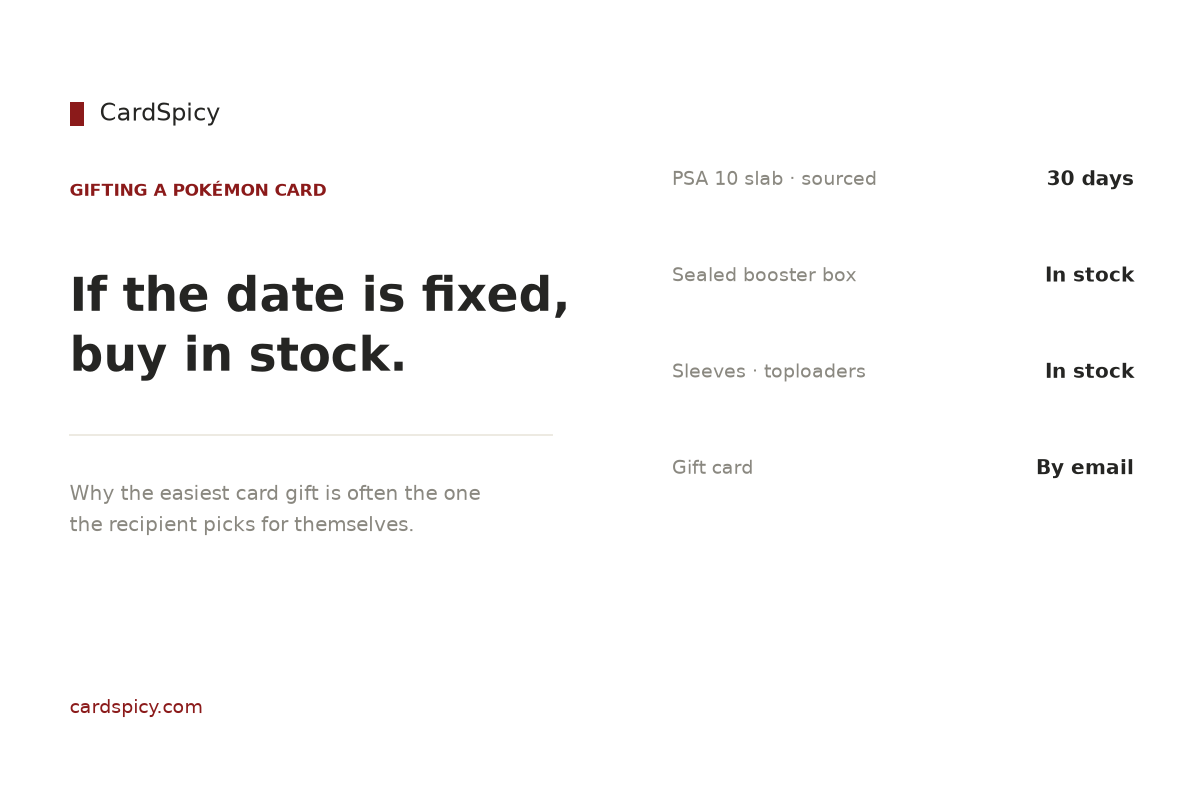
| A PSA 10 slab | Sourced to order. Dispatched within 30 days of your order, and usually within 7 to 14. | Only with a wide margin. Order weeks ahead, or choose something in stock. |
| A sealed booster box or gift box | In stock, dispatched within 2 business days after payment confirmation (excluding weekends and holidays). | Yes. |
| Sleeves and rigid holders | In stock, dispatched within 2 business days after payment confirmation (excluding weekends and holidays). | Yes. |
| A digital gift card | Delivered by email. | Yes, and it is the only option that does not depend on a parcel moving. |
The 30-day window is not a hedge — it is how sourcing works, and the mechanics are set out in Pre-order dispatch: the 30-day window. What matters here is the gift implication, which is easy to miss: a sourced card is a wonderful present in November and a bad one on the 20th of December. If you are buying for a fixed date, buy something that is already in stock, or buy the gift card and let them choose.
The one variable you cannot fix later: condition
Of everything a collector cares about, condition is the only one that cannot be changed after the fact. A wrong artwork can be traded. A card in the wrong language can be sold. A card with a soft corner, a surface scratch, or a print line is simply that card, forever, and the recipient will see it every time they open the binder.
This is why graded is the better shape for a gift, and it is not really about the number. A grade is a third party’s assessment of condition, made and recorded before the card reaches either of you. An ungraded card’s condition is an argument, and you are handing that argument to someone else to have on your behalf. For a present, that is the wrong thing to give.
There is a second, quieter advantage: a graded card is verifiable. Every slab carries a certification number that can be checked against the grader’s own record, which means the recipient can confirm what they received. Our own pages lean on this heavily — it is the reason we can say with confidence that a grade describes the card rather than the case, and the reason a slab in the post is a low-risk gift in a way that a raw card is not. It is also the shape most of our Simplified Chinese-exclusive catalogue takes, so if you are buying a specific artwork, there is usually a graded option and a lower-priced entry point to check the format against before you commit to something expensive.
Language is a category, not a detail
One last thing to check before buying, and it costs nothing: which language does the recipient collect? A collector of Simplified Chinese cards and a collector of Japanese cards are collecting two different sets of objects, and the same artwork in two languages does not satisfy either of them. If you are unsure which of the three main branch languages you are looking at, the differences are worth five minutes before you spend anything.
What it should feel like in their hands
The physical presentation of a card gift is inexpensive and disproportionately effective, and it is also where a specific mistake is easy to make.
A card that arrives loose in a padded envelope reads as an afterthought regardless of what it cost. A card that arrives in a fresh sleeve and then a rigid holder reads as deliberate, and the two items together come to under ten dollars:
| Layer | What it does | Sizes | Price |
|---|---|---|---|
| Penny sleeve | Acid-free, PVC-free clear polypropylene. Sits against the card face and folds instead of creasing. | Six sizes from 35 PT to 360 PT · 100 per pack | $4.99 |
| Rigid holder | Rigid 3″ × 4″ acrylic-style holder with anti-UV casting and protective film on both faces. This is the layer that stops a bend. | Eight options from 35 PT to 360 PT | $4.99 |
Pick the PT that matches the card’s thickness — 1 PT is 0.0254 mm, so a standard raw card takes 35 PT. And note the one thing that catches people out: neither of these fits a graded slab. A PSA, BGS or CGC slab is a different size and needs a holder made for it, so if the gift is graded, buy the slab holder rather than a toploader. Getting that wrong is a small, avoidable disappointment on the day.
The sealed option: letting the recipient do the choosing
There is a fourth answer that is often better than any of the three shapes above, and it is the one to reach for when you know the person collects but not what they collect. A sealed product contains the choice rather than making it. The recipient opens it, and whatever is inside is theirs by their own hand.
| Product | Price | Packs | What else is in the box |
|---|---|---|---|
| 30th Celebration Booster Box | $89.99 | 20 | Nothing else — 20 packs, 120 cards, and no filler. |
| 30th Celebration Charizard Figure Gift Box | $324.99 | 15 | A Charizard figure modelled on the classic card illustration, plus a jumbo Charizard card at roughly 13.3 × 18.7 cm. |
| 30th Celebration Futuristic Box | $319.99 | None | Two Pikachu ex promos, two coins, twelve damage-counter dice, poison and burn markers, a 64-sleeve set, a deck box, a display frame and a rubber playmat. |
Two honest notes about this table. The first is that “packs per dollar” is a misleading way to compare them: the Booster Box is the only one of the three that is nothing but packs, which is what makes its per-pack figure meaningful and the other two’s meaningless. The gift box costs more because of the object in it, not because of the cards. The full comparison, including whether a box is worth opening at all, is in whether to open a sealed box.
The second is that a gift box is a gift twice — once when it is handed over and once when it is opened. If you want the present to last longer than the moment it is unwrapped, a sealed box does that in a way a single card does not.
Budgets, without pretending there is a correct one
Card gifts work at every scale, but they work differently at each one, and the useful thing is to know what each level actually buys. Prices here are current and change with the market.
| Around | What it buys | The honest caveat |
|---|---|---|
| $5 | A pack of 100 sleeves, or a rigid holder. | Excellent for a collector with raw cards. Useless — literally the wrong size — for a collector who only has graded slabs. |
| $25 | A digital gift card, delivered by email, with no expiry and redeemable against any product in the store. | Correct when you do not know their specifics. It is also a gift with no object in it, which some occasions require. |
| $66–$100 | A single Simplified Chinese-exclusive Illustration Rare at PSA 10 from a recent Gem Pack volume. All six Pokémon Horizons starter cards sit inside this band. | You are choosing an artwork for them. Read the language note above first. |
| $90 | A sealed 30th Celebration Booster Box — 20 packs. | The pulls are random. You are buying the experience of opening it, not a known outcome, and that is both the point and the risk. |
| $300+ | A 30th Celebration gift box, or one of the higher-tier exclusive slabs. | At this level the identification problem is real. Buy graded, and confirm the exact card before paying. |
None of these tiers is a recommendation, and there is no correct amount to spend on a present. The only rule that holds across all of them is the one from the top of this page: at every price, the gift fails for the same reason — not because it cost too little, but because it was the wrong specific object, in the wrong language, in the wrong condition, on the wrong day.
Frequently asked questions
What should I buy someone who collects Pokémon cards?
It depends on how much you know about their collection. If you know the exact card they want, buy that card graded. If you know roughly what they collect, buy a small closed theme — a group of cards that belong together by design, so you do not have to guess which single card is missing. If you know only that they collect, buy a gift card or a sealed product and let them make the choice.
Is a gift card a good present for a card collector?
It is the correct present in one specific situation and an awkward one in another. It is correct when you do not know their collecting specifics, because a card is a specific object rather than a category and the wrong one cannot be returned. It is awkward when the occasion expects a wrapped object. Our gift card is delivered by email, has no expiry, and can be redeemed against any product in the store.
Should a card gift be graded or ungraded?
Graded, for a present. Condition is the only thing about a card that cannot be changed afterwards, and an ungraded card’s condition is an opinion you are handing to someone else to hold on your behalf. A graded card also carries a certification number that the recipient can verify independently, which makes it a more certain gift than a raw card.
How far ahead should I order a card as a gift?
We source PSA 10 slabs to order, and dispatch them within 30 days of your order — usually within 7 to 14 days. If the gift has a fixed date, order several weeks ahead or choose something that is already in stock. Sealed boxes and protectors are held in stock and dispatched within 2 business days after payment confirmation (excluding weekends and holidays).
Do toploaders fit a graded slab?
No. Our rigid holders are 3″ × 4″ and sized for standard raw trading cards, and the sleeve sizes we list are for raw cards as well — neither is made for a PSA, BGS or CGC slab, which is a different size and needs a holder made for it. If your gift is graded, buy the slab holder rather than a toploader.
Sources
Sources and further reading
- CardSpicy — Policies. The gift card terms used above (non-refundable and non-returnable), and the final-sale rule that makes a wrong card gift unrecoverable once dispatched. cardspicy.com/policies/
- CardSpicy — CardSpicy $25 Gift Card. The specification quoted in this article: $25.00 USD, delivered by email, no expiry, redeemable against any product in the store. cardspicy.com/product/cardspicy-gift-card-25/
- CardSpicy — Pre-Order Dispatch: The 30-Day Window, Explained. Why sourced slabs dispatch within 30 days and usually within 7 to 14, and what happens if we cannot source a card. cardspicy.com/pre-order-dispatch-explained/
- CardSpicy — PSA Slab Care: How the Case Fails Before the Card Does. Why a grade describes the card rather than the holder, which is the basis for recommending graded over ungraded as a gift. cardspicy.com/psa-slab-care/
- CardSpicy — One Pokémon Per Trainer: Collecting With a Theme. The theme method used in the second shape of gift, and the arithmetic that shows why a theme is priced by its most expensive card. cardspicy.com/one-pokemon-per-trainer/
- CardSpicy — Chinese vs Japanese Pokémon Cards. The three Simplified Chinese tiers and how the branch languages differ, for checking which language the recipient collects. cardspicy.com/chinese-vs-japanese-pokemon-cards/
- CardSpicy — Should You Open a Sealed Booster Box, or Keep It Sealed? The sealed-product comparison used in the box table, including what is actually inside each 30th Celebration product. cardspicy.com/open-booster-box-or-keep-sealed/
- CardSpicy — Protectors: Card Protectors. The two protection layers described above, with their size tables and current prices. cardspicy.com/product-category/protectors/card-protectors/
- PSA — Certification verification. The public record a buyer can check a slab’s certification number against, and the source we point to from our own graded-card listings. psacard.com/cert