Bulbasaurフシギダネ
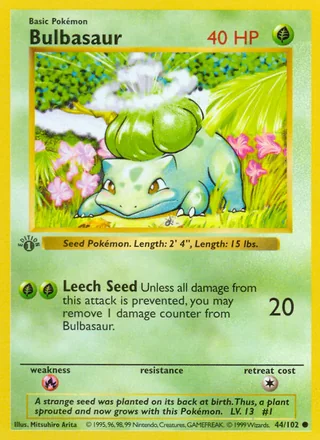
The entry point of the Grass evolution line. 40 HP; Leech Seed deals 20 and heals 10 damage off Bulbasaur — the standard opening for a 1996 Grass deck, and the first Pokémon card a lot of people ever pulled.
Pokémon Card Yearbook · 1996
Japanese edition1 set · 102 cards
Every card in this yearbook was printed in Japan. The English-language game did not exist yet — Wizards of the Coast's first English set went on sale on 9 January 1999, and its 102 cards use the same 102 illustrations listed here. Those English printings have their own yearbook, the 1999 English edition, because a printing abroad is a different physical product with a different release date and price, not a translation of this page.
Year one: a set of 102 cards, plus two freebies that reached readers five days earlier.
On 20 October 1996, Media Factory released the first Pokémon TCG set in Japan. That year's entire output was this one set — 102 cards, plus a 60-card fixed deck sold the same day, drawn from the same card pool.
The Japanese first set carried no card numbers and no rarity symbols. The only number on the card was the Pokémon's Pokédex entry. At the time this was a toy for schoolchildren, not a collectible — and that fact decided everything that followed: most cards were played to death or thrown away, so mint survivors were scarce from day one.
How to read this page. Every section below opens and closes. Start with “What happened this year” for the timeline, then open “Special cards” — promos, event cards and bundle cards all live here, ahead of the regular set — and finish with the main set, split into nine type groups with a card image and a note for each.
Every number shown is a running index added by this page for navigation, not a number printed on the card — the 1996 Japanese cards never had one.
This page documents 102 main-series cards across one product in 1996. It covers cards printed in Japan only; printings for other editions are tracked separately.
| Publication edition | Japanese edition |
|---|---|
| Products | 1 |
| Cards | 102 |
| Release dates | not recorded |
| Series codes | |
| Card faces on record | all 102 |
| Latest release on record | not recorded |
1st Expansion Pack · the 102-card main set (date not recorded, 102 cards).
How many main-series cards does this page record for 1996?102 cards across one product, an average of 102.0 cards per product. This is the main-series archive count, not a claim that every promo and event card from the year is itemised here.
How many of these 102 cards are shown with a card face?All 102 cards have a card face on record.
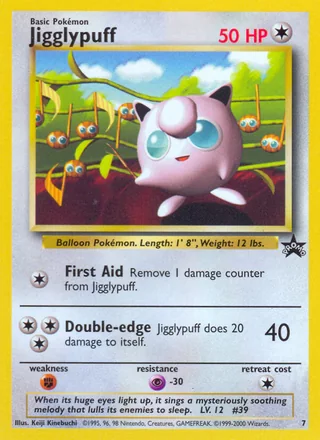
The November 1996 issue of CoroCoro Comic (whole number 223) came with two cards: Pikachu and Jigglypuff. They were printed on glossy card stock on a single insert sheet and had to be torn out. They went on sale five days before the actual launch — the first Pokémon TCG cards the public ever held, and the reason the official count was described as “102 plus 2.”
The 1st Starter Pack and 1st Expansion Pack went on sale. Published by Media Factory, 102 cards in the main set. The cards carried no numbers and no rarity symbols; the checklist ran by type (Grass → Fire → Water → Lightning → Psychic → Fighting → Colorless), then Trainer, then Energy.
The booklet “How to Play the Pokémon Card Game” came with a reprinted Pikachu. This version was matte, and corrected the illustrator credit from the mistaken “Ken Sugimori” to the actual artist, Keiji Kinebuchi. So the same Pikachu exists in two distinguishable versions in 1996.
This section comes first because the year's special cards explain “what a Pokémon card was” better than the main set does. They were not sold — they came stapled into magazines, tucked into booklets, handed out at events. How they were distributed determined how many survive, and what a mint copy is worth today.

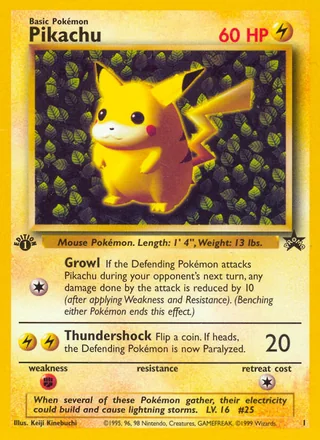
15 Oct 1996 · glossy
60 HP, Lightning type. The card credits “Ken Sugimori” — that is a misprint. The actual artist is Keiji Kinebuchi. To identify a first printing, read that one line: anything without the Sugimori credit is not from the October 1996 batch.

15 Oct 1996 · glossy
50 HP, Colorless type, illustrated by Keiji Kinebuchi. It shared the same insert sheet with Pikachu. Identify the first printing by the gloss — later reprints were matte, and under direct light a glossy copy photographs darker and more saturated.

30 Nov 1996 · matte
Same illustration, same stats. The only differences: the illustrator credit is corrected to “Keiji Kinebuchi,” and the stock changed from glossy to matte. It is not a different artwork — it is a second printing of the same card, and that is exactly what sets the size of the price gap against the first printing.
The scans in this section are from the international Wizards Promo release. The 1999 international version reprinted the same illustration as the 1996 CoroCoro insert — identical artwork, different language and layout. No stable high-resolution public scan of the original 1996 Japanese promo exists, so the artwork match is used here as a substitute, and this is stated openly.

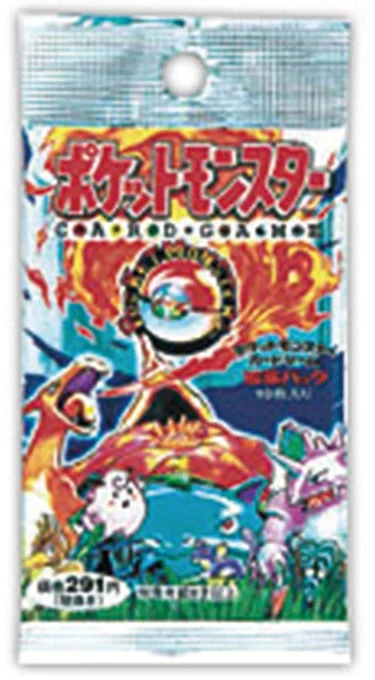
First expansion. Ten cards per pack in a fixed spread: six ●, three ◆, one ★. The ★ slot can be a holofoil card, but a holo is not guaranteed.
The Japanese first set had no card numbers. The 102 index numbers below follow the 1996 original order: Grass → Fire → Water → Lightning → Psychic → Fighting → Colorless, then Trainer, then Energy. Inside each group, cards run by ascending rarity and then by Pokédex number.
The 16 holos break down as Grass 2, Fire 2, Water 3, Lightning 3, Psychic 2, Fighting 2, Colorless 2. The 1996 Japanese cards do not print the word “Holo” anywhere — rarity was a distinction players worked out themselves from whether the card face was foil-stamped.
13 cards · listed in original order.

The entry point of the Grass evolution line. 40 HP; Leech Seed deals 20 and heals 10 damage off Bulbasaur — the standard opening for a 1996 Grass deck, and the first Pokémon card a lot of people ever pulled.

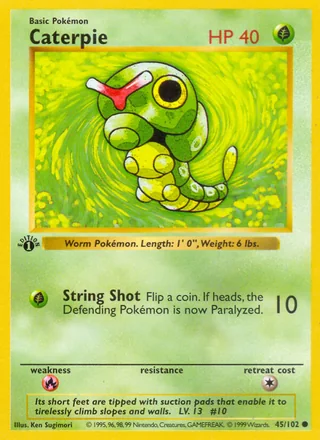
A 40 HP Basic Bug. Its only attack, String Shot, costs a single Grass Energy for 10 damage. Its reason to exist is as the stepping stone to Butterfree — and Butterfree is not in this set.

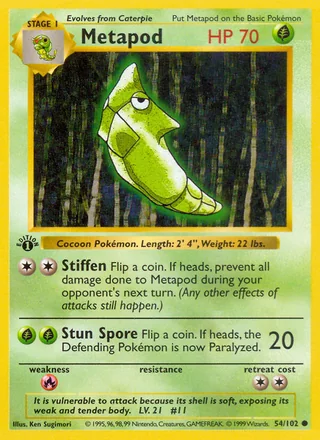
A 70 HP Stage 1 whose two attacks both do something other than damage: Stiffen reduces incoming damage, Stun Spore deals 20 with a paralysis flip. It is the set's rare defensive transitional card.

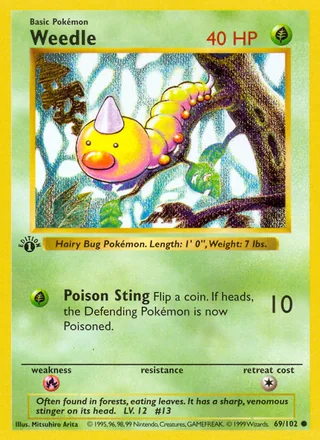
40 HP. Poison Sting costs one Energy for 10 and a poison flip. One of the cheapest attackers in Grass — the drawback is that 40 HP dies to almost anything.

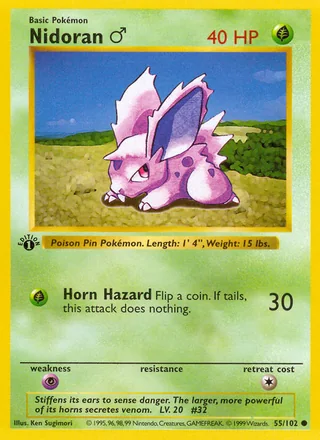
40 HP. Horn Hazard is 30 damage off a single Grass Energy — per Energy spent, one of the most efficient attacks among the set's Basics. The catch is the coin flip: tails and it misses.

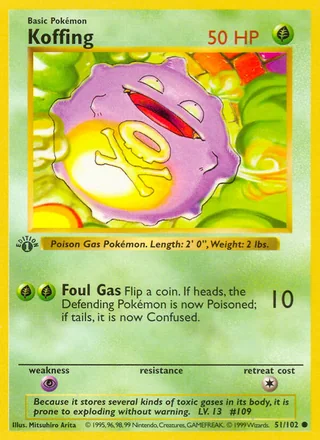
50 HP. Foul Gas deals 10 with a poison flip. In 1996 Koffing had no evolution available — Weezing would not arrive until Jungle — so it functions purely as a Basic.

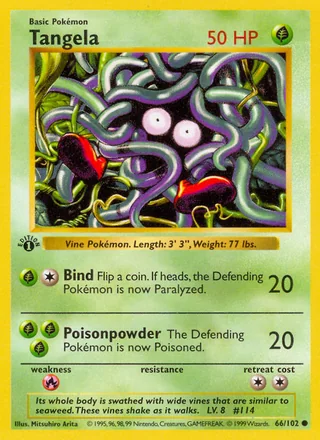
50 HP, and both attacks work through status: Bind deals 20 and stops the opponent retreating, Poisonpowder poisons. Tangela has no evolution line in this set, which makes it a Grass attacker that stands on its own.

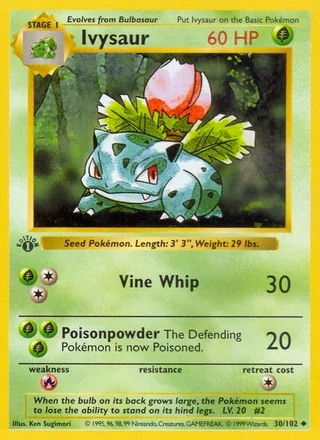
60 HP. Vine Whip for 30, Poisonpowder for the poison. It is the midpoint on the way to Venusaur and unremarkable on its own.

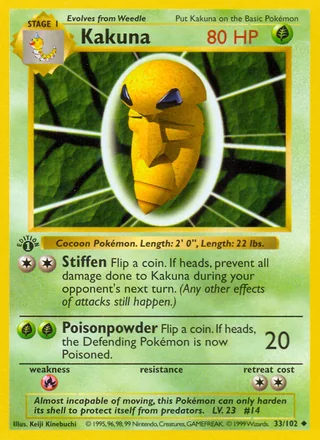
An 80 HP Stage 1, more HP than most cards at that stage, and Stiffen shaves 20 off incoming damage — which makes it genuinely annoying in early exchanges.

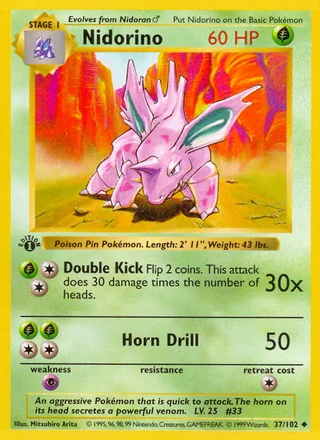
60 HP. Double Kick flips two coins for 30 each; Horn Drill costs four Energy for 50. Both are expensive for the output, and it serves as a bridge to Nidoking.

Ability Energy Trans
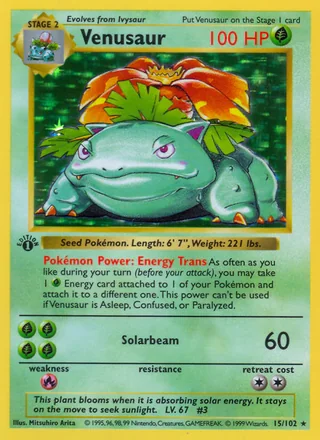
One of the 16 holos, 100 HP. What makes it irreplaceable is Energy Trans — moving any Grass Energy on your side of the field onto another Pokémon. No other card in 1996 could do the same, which is why it became the foundation of every Grass deck.

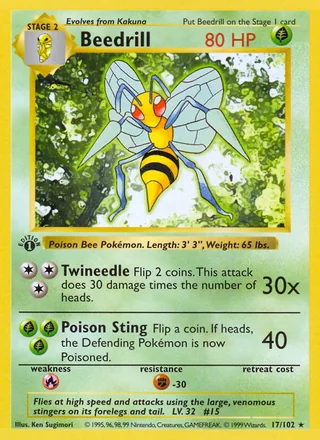
80 HP. Twineedle flips two coins for 30 each; Poison Sting is 40 with a poison flip. It is the only non-holo final evolution in Grass in this set.

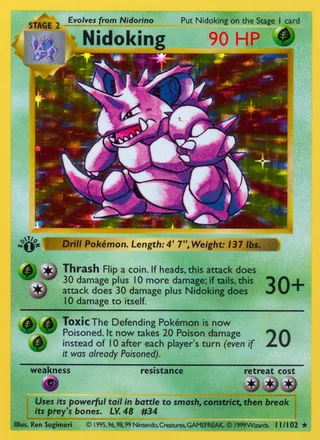
One of the 16 holos, 90 HP. Toxic poisons and the damage escalates each turn; Thrash is a high-damage attack where a coin flip decides whether Nidoking confuses itself. It is the only card in Grass that can grind an opponent down over time.
9 cards · listed in original order.

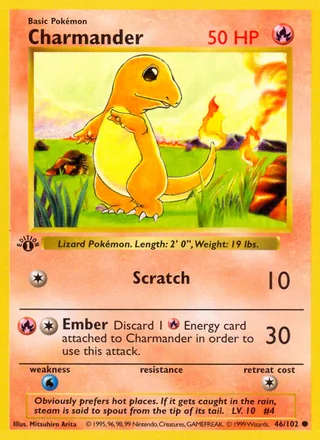
50 HP. Scratch is 10 for one Energy; Ember is 30 for two but discards an Energy. The start of the Charizard line, and the most common Fire opening in the set.

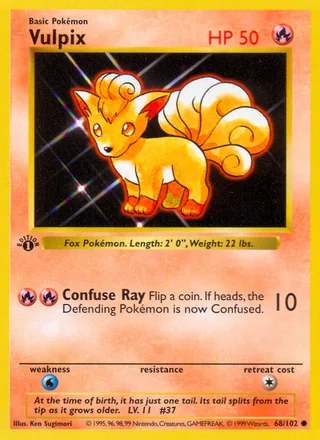
50 HP. Confuse Ray costs two Fire Energy for 10 damage and confusion. The damage is low on purpose — the job is to slow the game down. Vulpix's only evolution in this set is Ninetales.

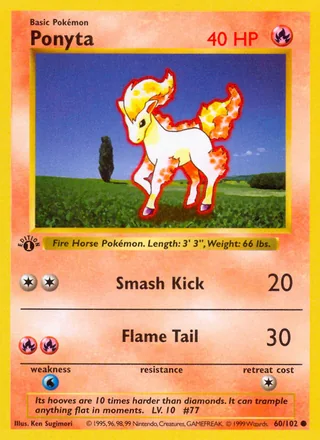
40 HP, low even by this set's Basic standard. Flame Tail costs two Energy for 30 — the only real damage Ponyta has.

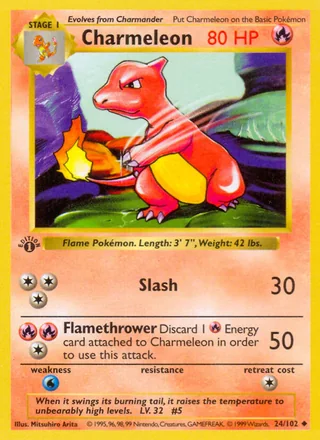
80 HP. Flamethrower is 50 for three Energy at the cost of discarding a Fire Energy; Slash is a steady 30. This is the step you cannot skip on the way to Charizard.

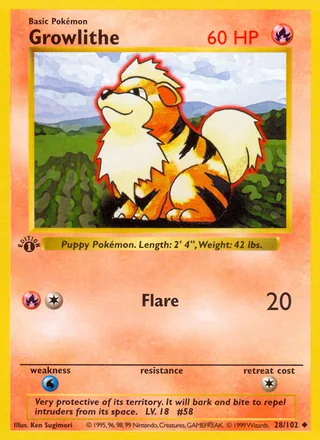
60 HP. Flare is 20 for two Energy and discards one. Growlithe's distinction is that it evolves straight into Arcanine here, and Arcanine is a 100 HP non-holo — the cheap big body that was rare in 1996.

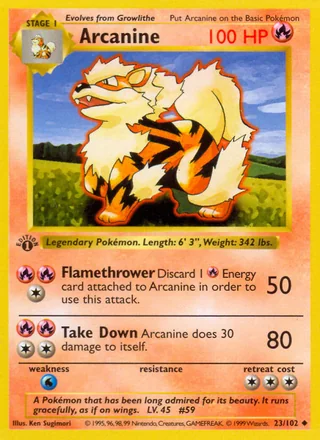
100 HP and only an Uncommon. Flamethrower for 50, Take Down for 80 with 30 recoil. It is the only 100 HP non-holo Pokémon in the set, and plenty of players used it in place of the holo Fire card they never pulled.

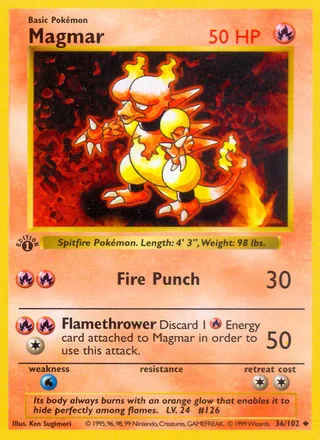
50 HP. Fire Punch for 30, Flamethrower for 50. Magmar has no evolution line in this set; it is a self-contained mid-weight attacker.

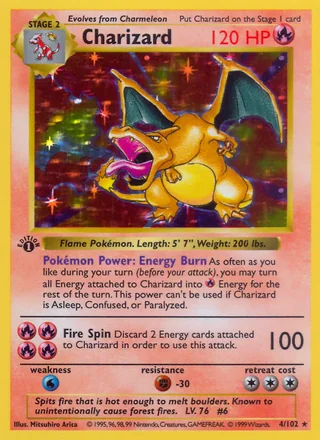
Ability Energy Burn
One of the 16 holos and the face of the whole set: 120 HP, the highest in the checklist. Fire Spin is 100 damage for four Fire Energy at the cost of discarding two; Energy Burn treats every attached Energy as Fire. Only two cards in all 102 can reach 100 damage, and this is one of them — and the only one that also has 120 HP.

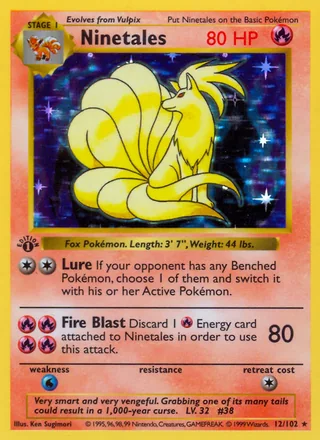
One of the 16 holos, 80 HP. Fire Blast is 80 for four Energy and discards one; Lure drags one of the opponent's Benched Pokémon forward. Its job is control, not burst damage.
12 cards · listed in original order.

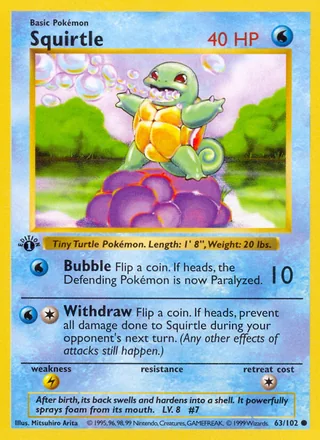
40 HP. Bubble is 10 for one Water Energy with a paralysis flip; Withdraw buys a turn of protection. It starts the Blastoise line, and it is the most restrained Water Basic in the set.

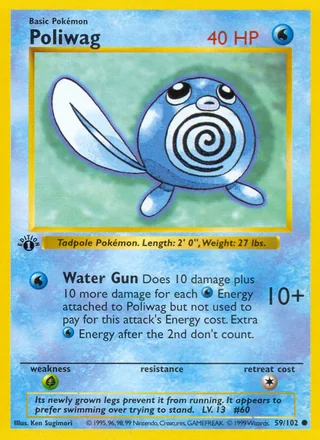
40 HP. Water Gun is 10 for one Energy, plus 10 for every extra Water Energy attached — an early example of the scaling attack that 1996 design barely used.

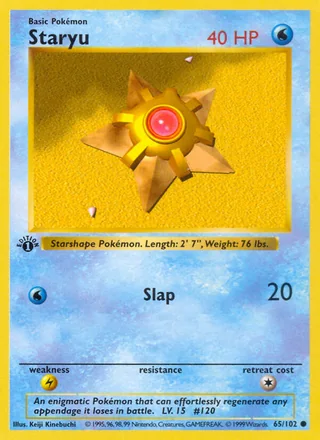
40 HP. Slap is 20 damage off a single Water Energy. Staryu is one of the few Water Basics in this set that can hit 20 without evolving.

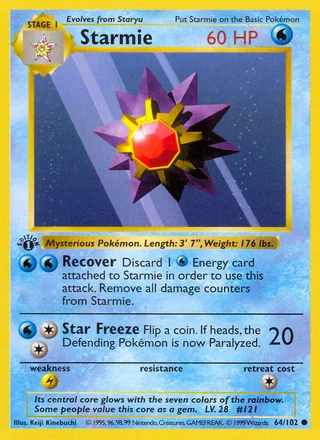
60 HP. Recover wipes all damage off Starmie at the cost of an Energy; Star Freeze is 20 with a paralysis flip. It is the only Stage 1 in the set that can heal itself.

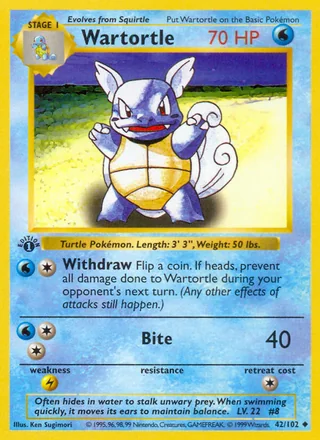
70 HP. Bite is 40 for three Energy; Withdraw reduces damage. It is the waypoint before Blastoise, and limited on its own.

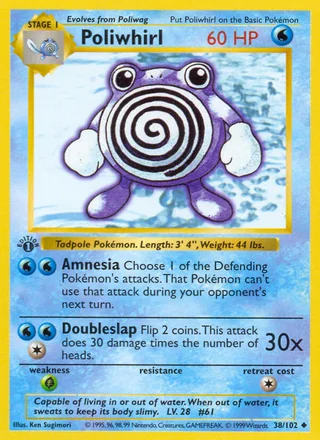
60 HP. Amnesia shuts off one of the opponent's attacks; Doubleslap flips two coins for 30 each. It is one of the few cards in the set that can lock an opponent's attack out.

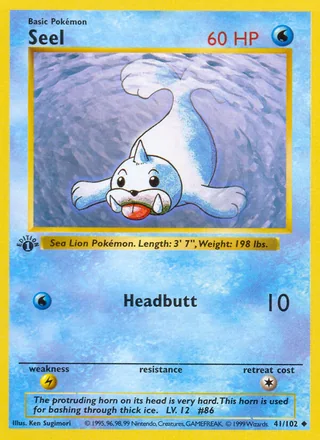
60 HP. Headbutt is 10 for a single Water Energy. Seel starts the Dewgong line, and its stats are unremarkable.

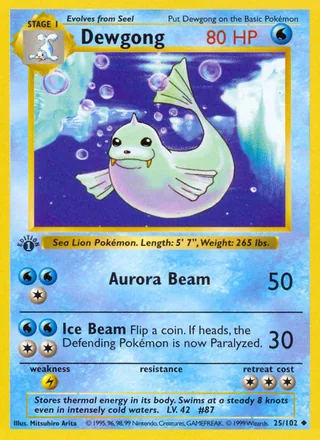
80 HP. Aurora Beam for 50, Ice Beam for 30 with a paralysis flip. It is the steadiest non-holo Stage 1 in Water.

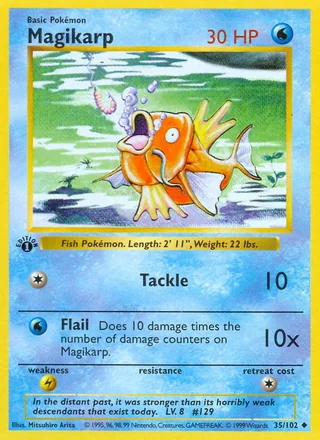
30 HP — the lowest in the entire checklist. Tackle deals 10; Flail scales with the damage already on Magikarp. It is the starting point for Gyarados and the set's most famous bad card: almost nobody put it into a serious game in 1996.

Ability Rain Dance
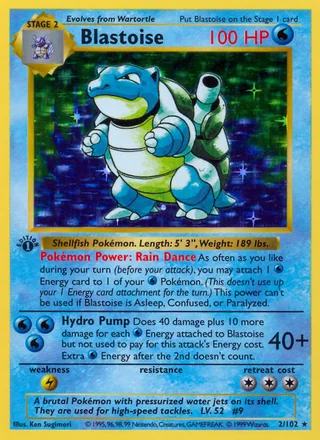
One of the 16 holos, 100 HP. Rain Dance lets you attach any number of Water Energy from your hand to any Pokémon on your side. Paired with Hydro Pump, which adds 10 damage per extra Water Energy, it is the engine of every 1996 Water deck — and the only card in the set that can accelerate Energy at all.

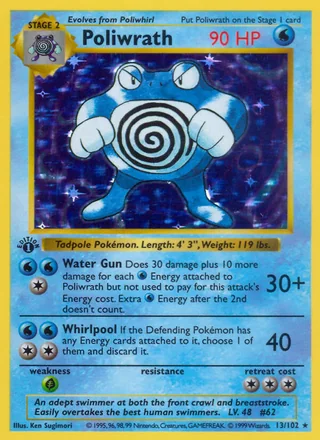
One of the 16 holos, 90 HP. Whirlpool is 40 for four Energy and strips an Energy off the opponent; Water Gun scales. Its job is to dismantle the opponent's Energy setup.

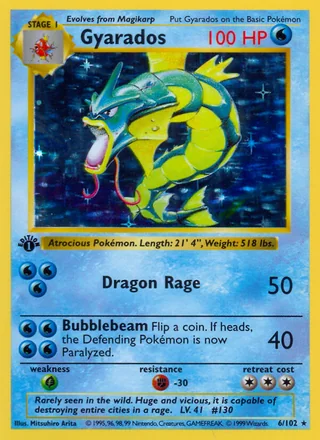
One of the 16 holos, 100 HP. What sets it apart is reaching 100 HP after a single evolution — Venusaur, Charizard and Blastoise in the same HP bracket all need two. The price is that it starts from a 30 HP Magikarp.
8 cards · listed in original order.

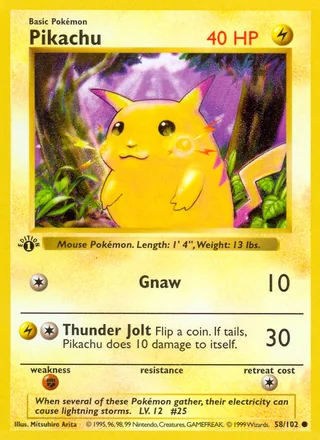
40 HP. Gnaw is 10 for one Colorless Energy; Thunder Jolt is 30 but flips a coin, and tails means 10 damage to Pikachu. This is the 1996 Pikachu — plain numbers, and the ancestor of every Pikachu card that followed.

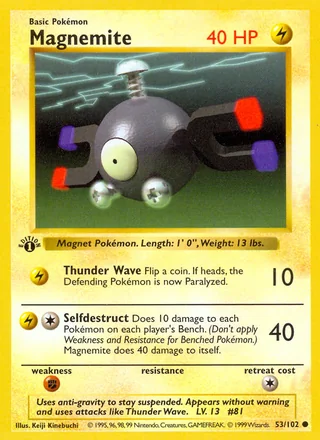
40 HP. Thunder Wave deals 10 and paralyzes; Selfdestruct deals 40 and knocks out Magnemite too. It is one of the few cards in the set carrying a self-destruct attack.

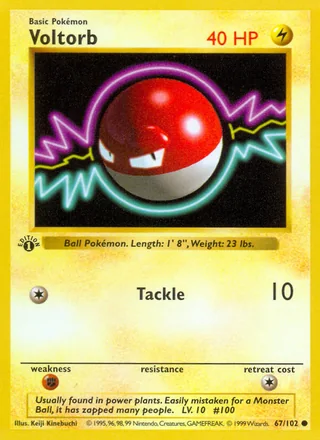
40 HP, one attack — Tackle for 10, with no effect attached. Voltorb has one of the plainest attack lines in the set; its job is to be material for Electrode.

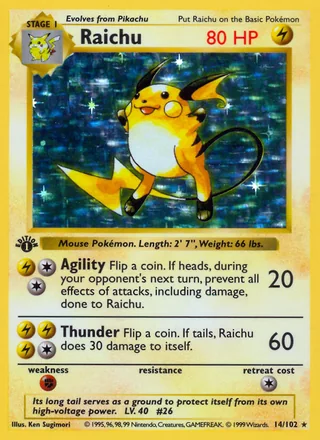
One of the 16 holos, 80 HP. Thunder is 60 for four Lightning Energy; Agility makes the opponent's next attack miss. Raichu is the only Lightning card in the set that can build a tactic around dodging.

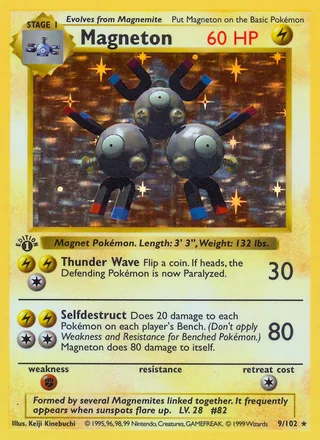
One of the 16 holos, 60 HP. Selfdestruct is 80 damage for four Energy — Magneton goes down with it, but in 1996 80 damage was enough to flip a game in one turn.

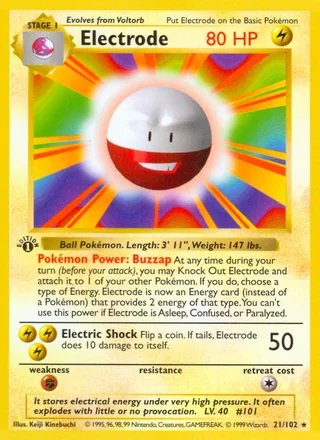
Ability Buzzap
80 HP. Electric Shock is 50 for three Energy. The real point is Buzzap: Electrode turns itself into Energy for another Pokémon. It is the only card in the set that can convert a Pokémon into Energy.

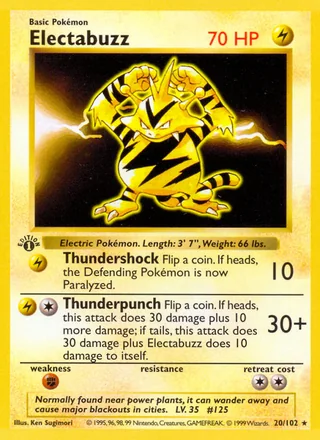
70 HP. Thundershock is 10 for one Energy with a paralysis flip; Thunderpunch adds damage on a coin flip. It is the only Rare Lightning Basic in the set.

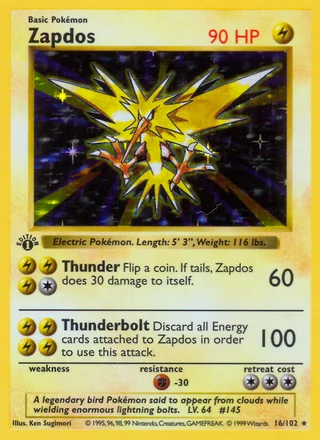
One of the 16 holos, 90 HP. Thunderbolt is 100 damage for four Energy at the cost of discarding all Energy on Zapdos; Thunder is 60 with a paralysis flip. It is Lightning's finisher and, after Charizard, the most often cited big-damage card of 1996.
8 cards · listed in original order.

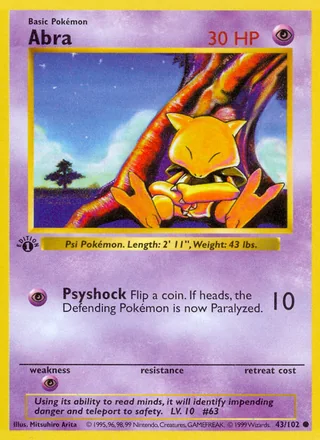
30 HP — tied with Magikarp for the lowest in the checklist. Psyshock is 10 for one Colorless Energy with a paralysis flip. Almost all of its value sits in the single fact that it evolves into Alakazam.

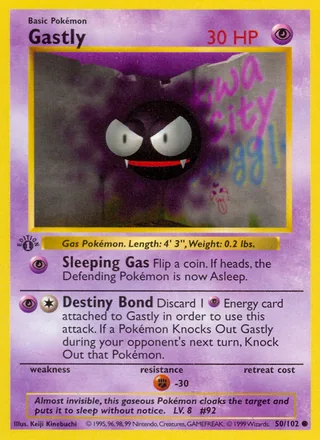
30 HP. Sleeping Gas puts the opponent to sleep; Destiny Bond knocks out the opponent too if it knocks out Gastly. It is one of the nastiest designs of 1996.

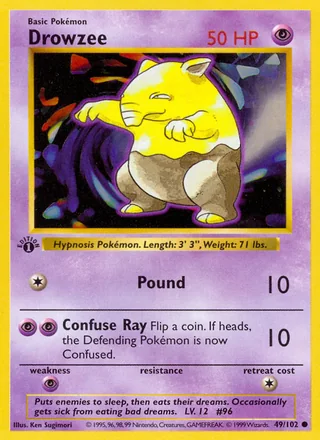
50 HP. Pound for 10, Confuse Ray for 10 and confusion. Drowzee barely does damage; its role is as an alternative starting point to the Haunter line.

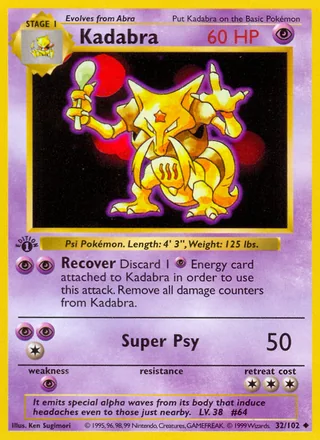
60 HP. Super Psy is 50 for three Energy; Recover discards an Energy to clear damage. It is the critical step on the way to Alakazam.

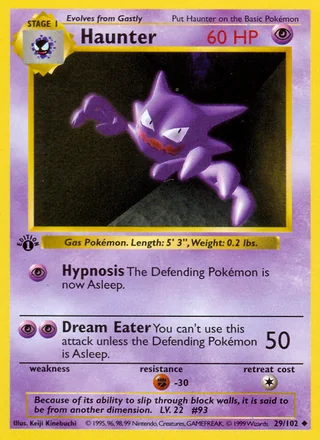
60 HP. Hypnosis puts the opponent to sleep; Dream Eater deals 50 to a sleeping opponent. It is the only card in the set built around a sleep combo.

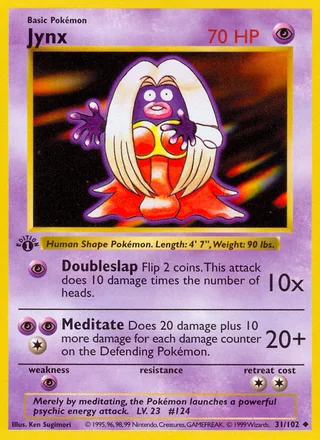
70 HP. Doubleslap flips two coins for 10 each; Meditate deals 20 and adds 10 for every damage counter already on the opponent — one of the few cards in the set that gets stronger the longer the game runs.

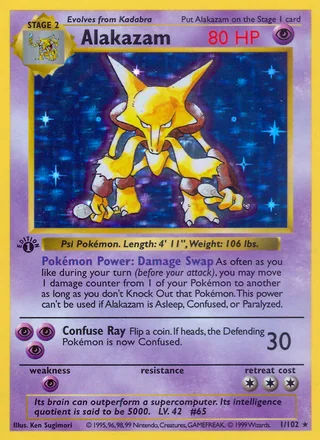
Ability Damage Swap
One of the 16 holos, 80 HP. The core is Damage Swap — moving any damage counters on your side between your Pokémon. Combined with the 120 HP Chansey, it forms one of the most famous defensive combos of 1996.

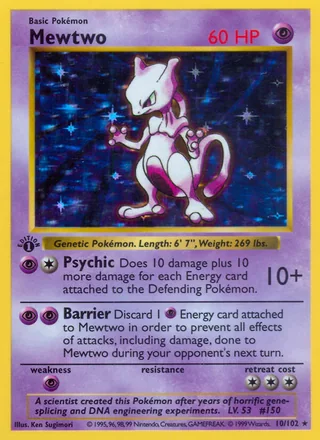
One of the 16 holos, 60 HP. Psychic adds damage for each Energy on the opponent; Barrier makes their next attack miss. It is the only card in the set that scales off the opponent's Energy.
8 cards · listed in original order.

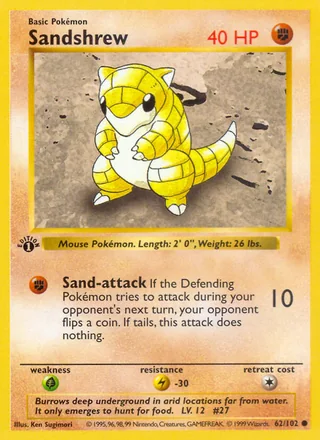
40 HP. Sand-attack is 10 for one Fighting Energy, and the opponent's next attack may miss on a flip. Sandshrew is one of the few Basics in the set with a disruptive effect.

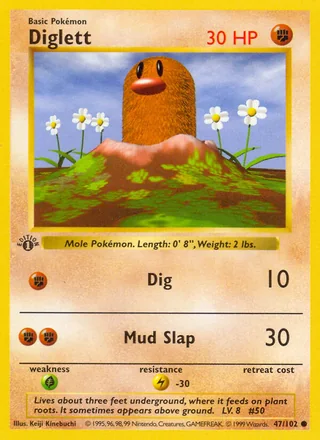
30 HP. Dig is 10 for one Energy and skips the opponent's next turn of damage; Mud Slap is 30. It is the only Basic in the set that can dodge damage via Dig.

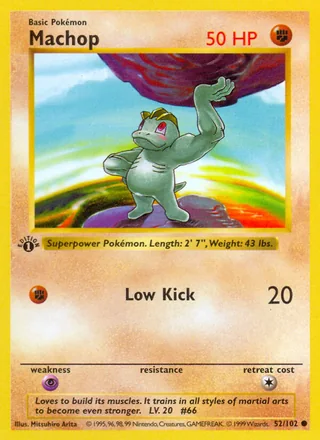
50 HP. Low Kick is 20 for one Fighting Energy. That is a high number for a Basic, and it starts the Machamp line.

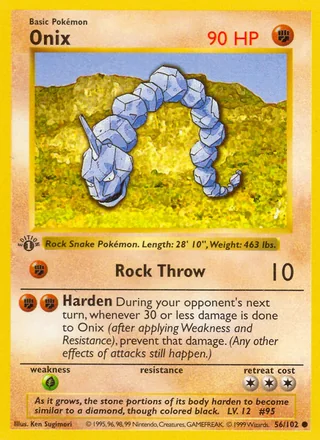
A 90 HP Basic — one of the highest-HP Basics of 1996. Rock Throw for 10, Harden cuts incoming damage by 20. Onix cannot evolve, but between the HP and the damage reduction it can stall for a long time.

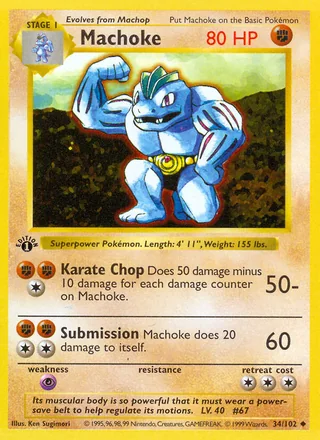
80 HP. Karate Chop deals 50, minus 10 for every damage counter already on Machoke; Submission deals 60 with 20 recoil. It is the waypoint before Machamp.

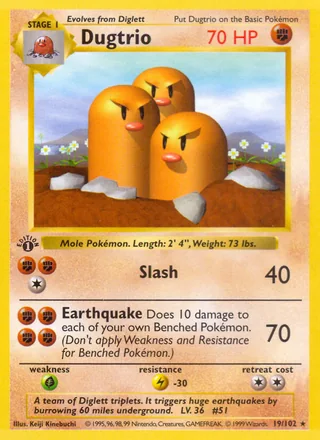
70 HP. Earthquake is 70 damage for four Energy, and every Pokémon on your own Bench takes 10 as well. It is the only card in the set that damages your own Bench, which means Dugtrio has to be played alone up front.

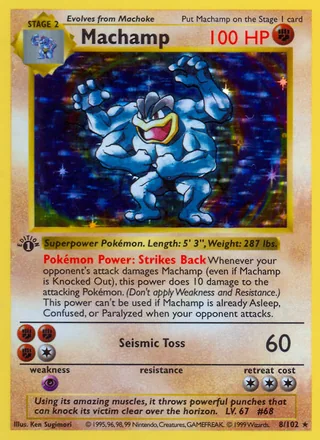
Ability Strikes Back
One of the 16 holos, 100 HP. Seismic Toss is 60 for four Energy and ignores Weakness and Resistance entirely; Strikes Back damages the opponent when they attack Machamp. It is the only card in the set whose damage ignores typing.

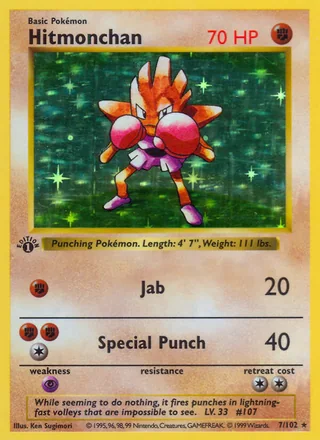
One of the 16 holos, 70 HP, and a Basic — it needs no evolution to hit the table. Jab is 20 for one Fighting Energy; Special Punch is 40. Only Hitmonchan and Rattata can deal 20 off a single Energy in the whole set, and Hitmonchan has more than double the HP, which is why it became the foundation of 1996 aggressive decks.
11 cards · listed in original order.

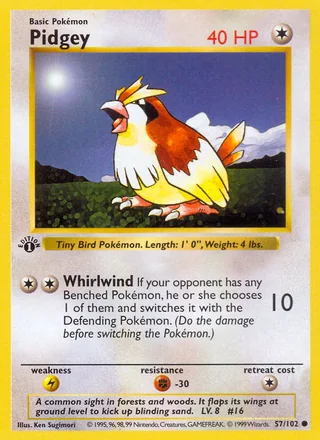
40 HP. Whirlwind deals 10 and drags one of the opponent's Benched Pokémon forward. Pidgey is one of the few Basics in the set with a switching effect.

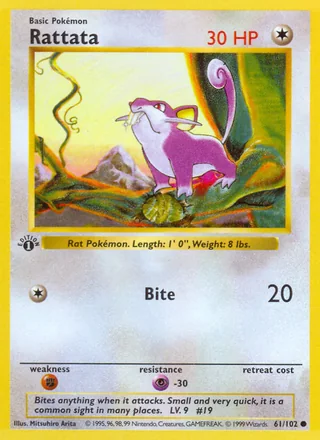
30 HP. Bite is 20 damage off a single Colorless Energy — by Energy efficiency, among the highest output of any Basic in the set. That is why Rattata was often the cheap aggressive pick.

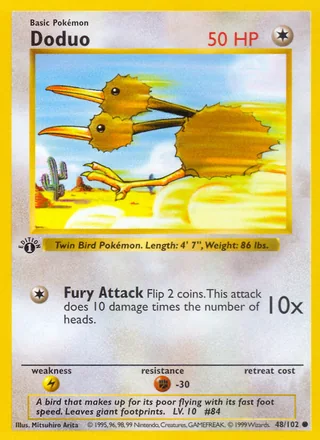
50 HP. Fury Attack flips coins to decide how many times 10 damage lands. Its output is pure luck, making it one of the most random cards in the set.

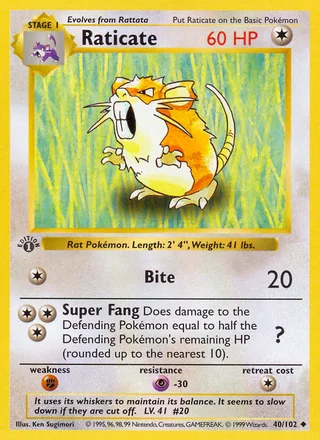
60 HP. Super Fang cuts the opponent's remaining HP in half outright — the only proportional attack in 1996. It is why Raticate can threaten anything with a big HP number.

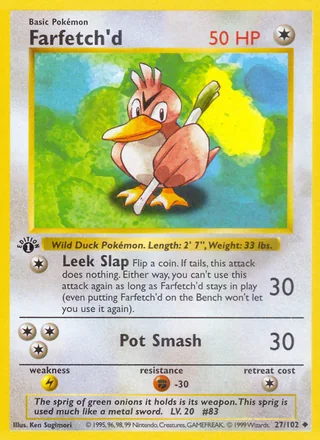
50 HP. Leek Slap deals 30 but flips for it, and tails misses outright; Pot Smash is a flat 30. One risky attack and one with no surprises — among the most conservatively designed Basics in the set.

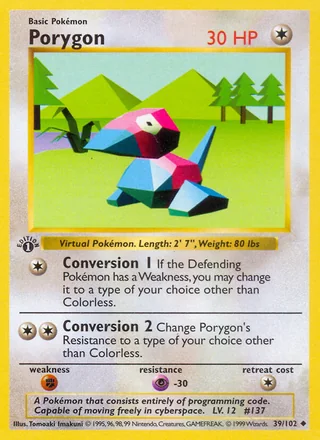
30 HP. Conversion 1 changes Porygon's own type to any type; Conversion 2 changes its Resistance. It is the only card in the set that shifts a game by rewriting its own type rather than by dealing damage.

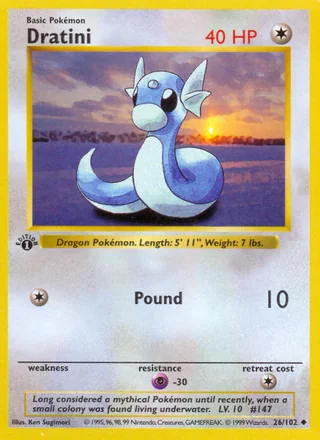
40 HP. Pound deals 10. The numbers are minimal, and it is the only way into Dragonair — a line that had no real destination in 1996, since Dragonite would not arrive until Fossil.

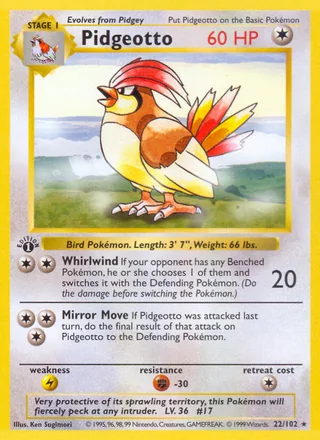
60 HP. Whirlwind deals 20 and forces a switch; Mirror Move copies the attack the opponent used on it last turn and sends it straight back. Pidgeotto is the set's only mirror.

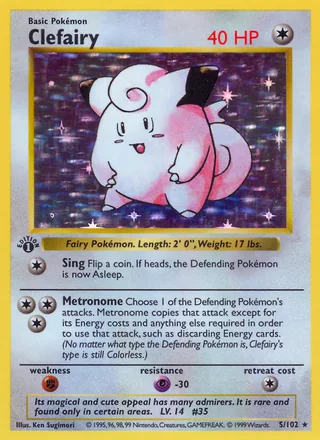
One of the 16 holos, 40 HP. Metronome randomly copies an attack from one of the opponent's Pokémon — the only holo in the set whose effect is decided entirely at random. Sing puts the opponent to sleep.

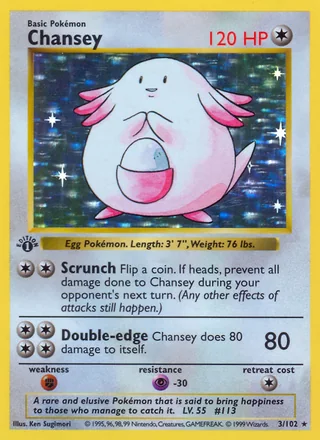
One of the 16 holos, 120 HP and a Basic — nothing in 1996 took a hit better. Scrunch reduces damage; Double-edge is 80 for four Energy with 20 recoil. Paired with Alakazam's Damage Swap, it formed the hardest thing to knock out that year.

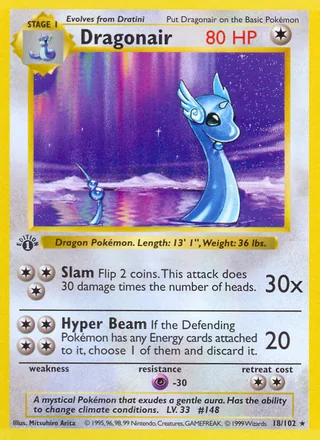
80 HP. Slam flips two coins for 30 each; Hyper Beam deals 20 and discards an Energy off the opponent. Dragonair is the only card in the set that puts Energy denial and damage into the same attack.
26 cards · listed in original order.

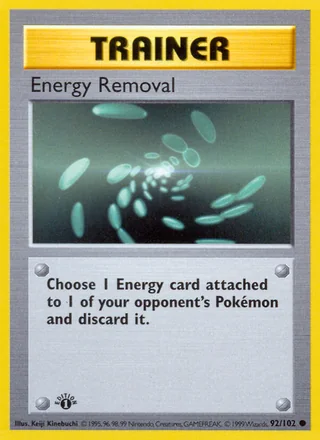
Choose 1 Energy card attached to 1 of your opponent's Pokémon and discard it.
Discard one Energy from one of the opponent's Pokémon. 1996 decks typically ran on two or three Energy, so a single Energy Removal could push the opponent's big attack back a full turn — the most direct disruption in the whole set.

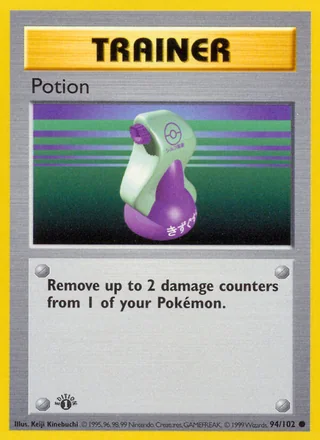
Remove up to 2 damage counters from 1 of your Pokémon.
Remove up to two damage counters from one of your Pokémon. The most basic healing in the game, and almost every 1996 deck ran it.

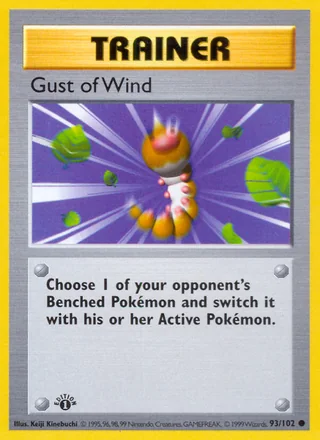
Choose 1 of your opponent's Benched Pokémon and switch it with his or her Active Pokémon.
Pull one of the opponent's Benched Pokémon to the front. In 1996 it was the only card that could force a change to who was active, and with a high-damage Pokémon behind it you could snipe a key card the opponent had not finished setting up.

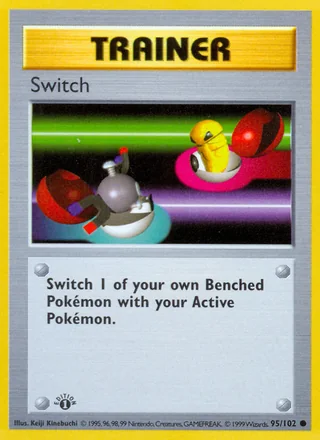
Switch 1 of your own Benched Pokémon with your Active Pokémon.
Switch one of your Benched Pokémon into the Active spot. It is the only way in this set to retreat voluntarily without paying Energy — used to dodge a Weakness or pull a nearly-knocked-out attacker out of danger.

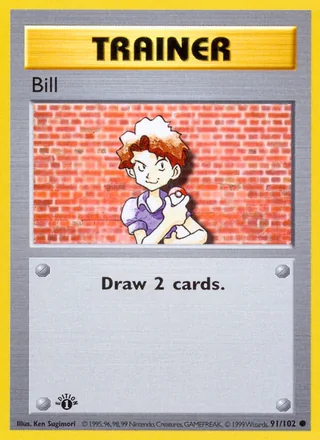
Draw 2 cards.
Draw two cards. The cheapest draw in the set: one card becoming two is a tempo gain big enough that essentially every 1996 deck played it.

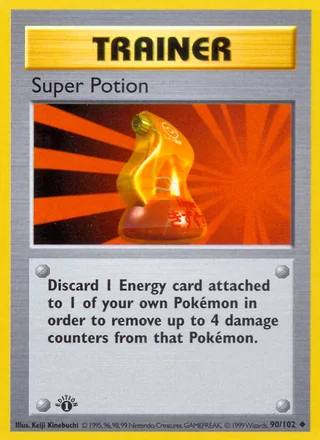
Discard 1 Energy card attached to your own Pokémon in order to remove up to 4 damage counters from that Pokémon.
Discard one of your Energy to remove up to four damage counters. Twice the healing of Potion, at the cost of thinning your own Energy setup.

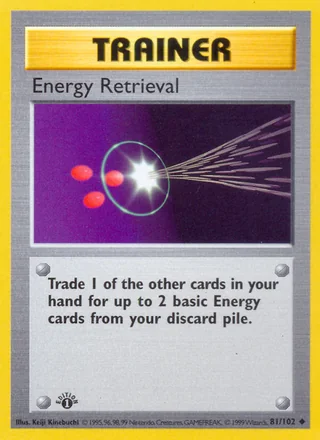
Trade 1 of the other cards in your hand for up to 2 basic Energy cards from your discard pile.
Discard one card from your hand to take up to two basic Energy back from the discard pile. It is what stopped Energy denial from being fatal.

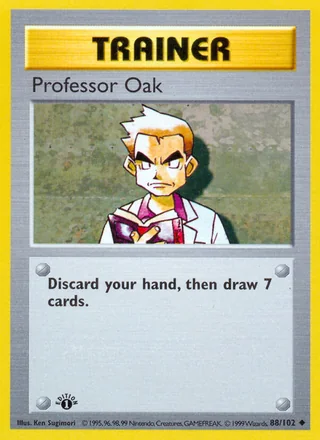
Discard your hand, then draw 7 cards.
Discard your entire hand and draw seven. The strongest draw in 1996 and the riskiest — played on a good hand it is self-destruction, played on a bad one it can turn the whole game.

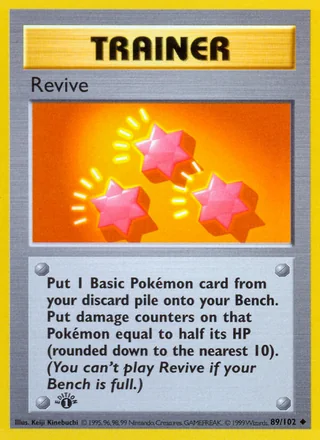
Put 1 Basic Pokémon card from your discard pile onto your Bench. Put damage counters on that Pokémon equal to half its HP (rounded down to the nearest 10). (You can't play Revive if your Bench is full.)
Put a Basic Pokémon from the discard pile onto your Bench, but it arrives at half its HP, rounded down. It gives a knocked-out attacker a second chance — at the price of coming back already half gone.

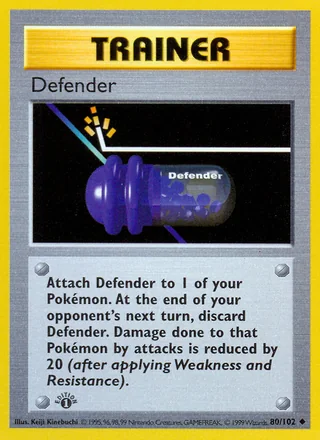
Attach Defender to 1 of your Pokémon. At the end of your opponent's next turn, discard Defender. Damage done to that Pokémon by attacks is reduced by 20 (after applying Weakness and Resistance).
Attach it to a Pokémon to reduce the next damage it takes by 20. It is the only damage-reduction Trainer in the set.

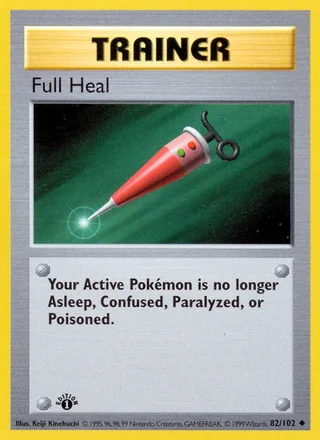
Your Active Pokémon is no longer Asleep, Confused, Paralyzed, or Poisoned.
Clears sleep, confusion, paralysis and poison from your Active Pokémon. A direct answer to status-based decks.

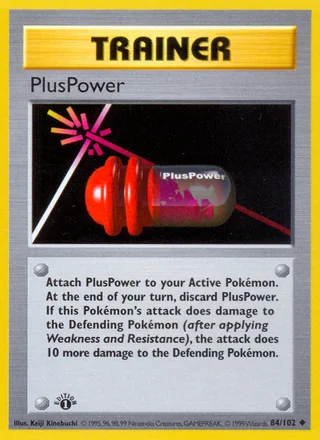
Attach PlusPower to your Active Pokémon. At the end of your turn, discard PlusPower. If this Pokémon's attack does damage to the Defending Pokémon (after applying Weakness and Resistance), the attack does 10 more damage to the Defending Pokémon.
Attach it to your Active Pokémon for +10 damage that turn. It looks trivial, but in 1996 the knock-out threshold was often exactly those ten points away.

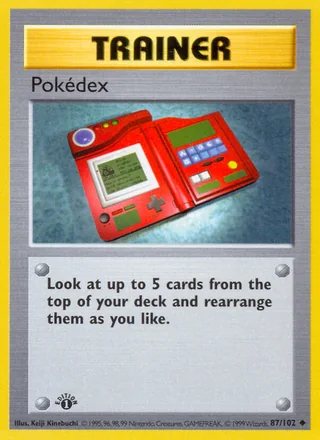
Look at up to 5 cards from the top of your deck and rearrange them as you like.
Look at up to five cards from the top of your deck and reorder them however you like. It draws nothing; it only tells you what is coming — the only information card in the set.

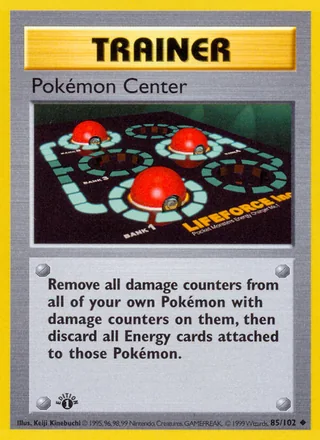
Remove all damage counters from all of your own Pokémon with damage counters on them, then discard all Energy cards attached to those Pokémon.
Remove every damage counter from all of your Pokémon, then discard the Energy attached to them. The biggest heal in the set, and the biggest price.

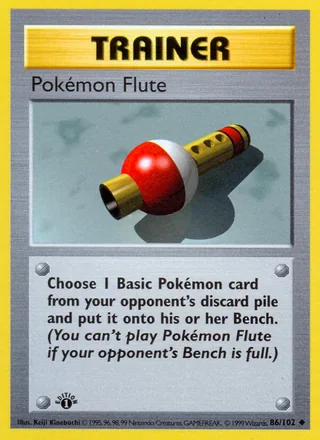
Choose 1 Basic Pokémon card from your opponent's discard pile and put it onto his or her Bench. (You can't play Pokémon Flute if your opponent's Bench is full.)
Put a Basic Pokémon from the opponent's discard pile onto their Bench. It looks like a favour; in practice it is used to fill their Bench so that Gust of Wind can force a bad matchup.

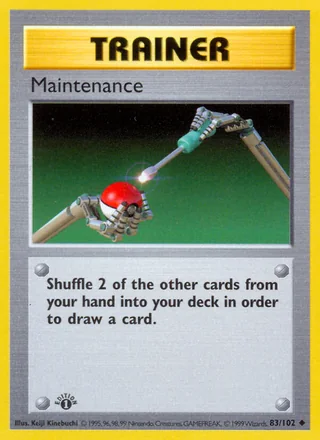
Shuffle 2 of the other cards from your hand into your deck in order to draw a card.
Shuffle two cards from your hand back into your deck, then draw one. It is one of the few cards in the set that can clear dead cards out of your hand.

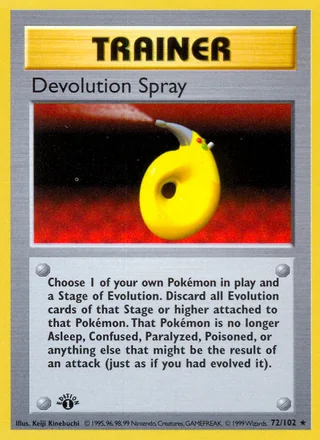
Choose 1 of your own Pokémon in play and a Stage of Evolution. Discard all Evolution cards of that Stage or higher attached to that Pokémon. That Pokémon is no longer Asleep, Confused, Paralyzed, Poisoned, or anything else that might be the result of an attack (just as if you had evolved it).
Devolve a Pokémon by one stage and discard the matching Evolution card. It can break apart a Stage 2 the opponent has already assembled, and it can also be used on your own Pokémon to re-trigger on-evolution effects.

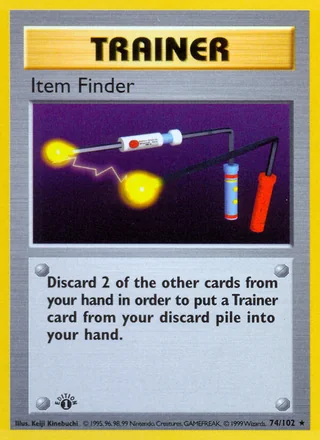
Discard 2 of the other cards from your hand in order to put a Trainer card from your discard pile into your hand.
Discard two cards from your hand to bring one Trainer back from the discard pile. It lets a key Trainer be played twice — the strongest recursion in 1996.

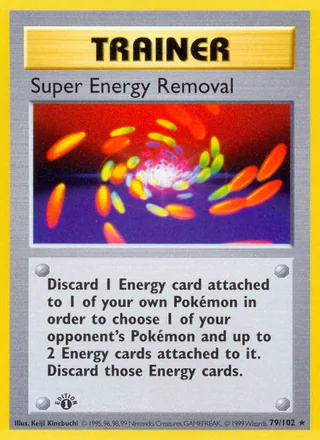
Discard 1 Energy card attached to 1 of your Pokémon in order to choose 1 of your opponent's Pokémon and up to 2 Energy cards attached to it. Discard those Energy cards.
Discard one of your Energy to strip two off the opponent. Harsher than Energy Removal, and the core of the Energy-denial strategy of the era.

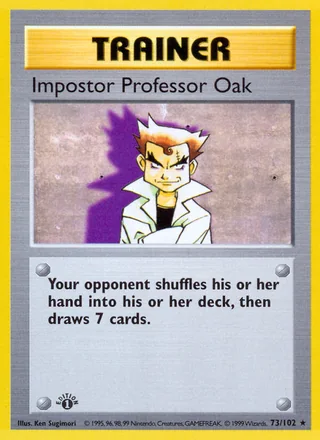
Your opponent shuffles his or her hand into his or her deck, then draws 7 cards.
The opponent shuffles their hand back into their deck and draws seven. Built specifically to wreck a hand the opponent has already assembled — the exact mirror of your own Professor Oak.

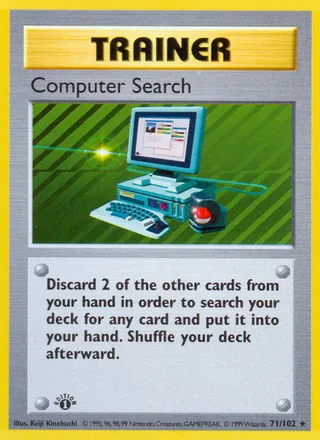
Discard 2 of the other cards from your hand in order to search your deck for any card and put it into your hand. Shuffle your deck afterward.
Discard two cards from your hand to search your deck for any single card. The only tutor in the set: whatever you are missing, you go and get it. Every consistent 1996 deck leaned on it.

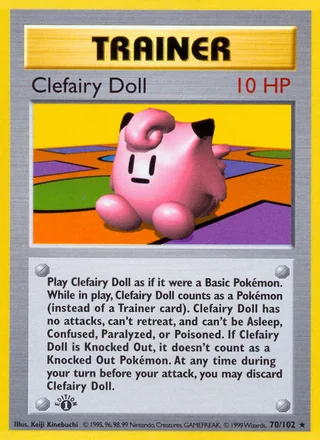
Play Clefairy Doll as if it were a Basic Pokémon. While in play, Clefairy Doll counts as a Pokémon (instead of a Trainer card). Clefairy Doll has no attacks, can't retreat, and can't be Asleep, Confused, Paralyzed, or Poisoned. If Clefairy Doll is Knocked Out, it doesn't count as a Knocked Out Pokémon. At any time during your turn before your attack, you may discard Clefairy Doll.
Play it as a Basic, except it does not count as a Pokémon and gives up no Prize when knocked out. Its only job is to be a Gust of Wind target or to eat one hit.

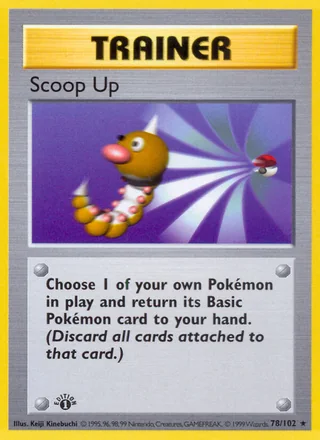
Choose 1 of your Pokémon in play and return its Basic Pokémon card to your hand. (Discard all cards attached to that card.)
Return the Basic card of one of your Pokémon to your hand, discarding all its Evolution cards and everything attached. Used to rescue an almost-knocked-out attacker, or to reuse an on-play effect repeatedly.

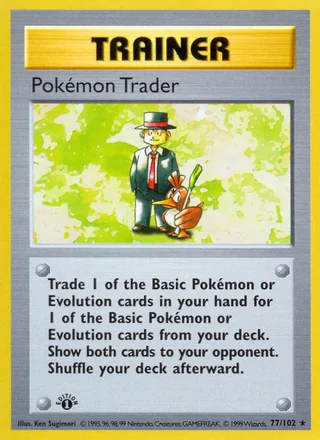
Trade 1 of the Basic Pokémon or Evolution cards in your hand for 1 of the Basic Pokémon or Evolution cards from your deck. Show both cards to your opponent. Shuffle your deck afterward.
Trade one Pokémon or Evolution card from your hand for one from your deck. It is the set's only Pokémon-specific search-and-swap.

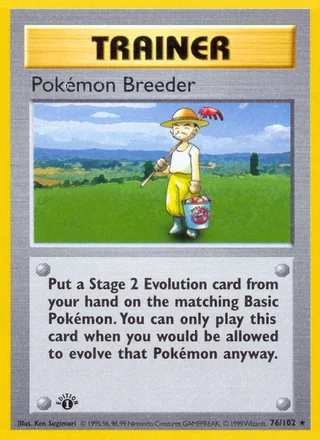
Put a Stage 2 Evolution card from your hand on the matching Basic Pokémon. You can only play this card when you would be allowed to evolve that Pokémon anyway.
Put a Stage 2 Evolution card from your hand straight onto the matching Basic, skipping Stage 1. It brings Charizard, Blastoise and Venusaur out a full turn early — one of the strongest tempo cards of 1996.

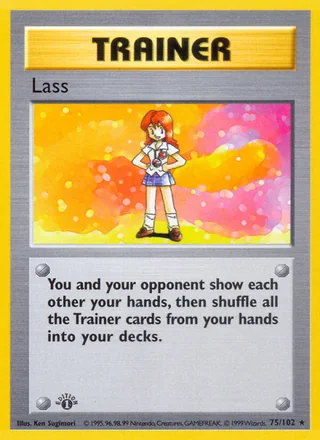
You and your opponent show each other your hands, then shuffle all the Trainer cards from your hands into your decks.
Both players reveal their hands, then every Trainer in hand is shuffled back into the deck. It exists to dismantle in one shot the Trainer combo an opponent has been hoarding.
7 cards · listed in original order.

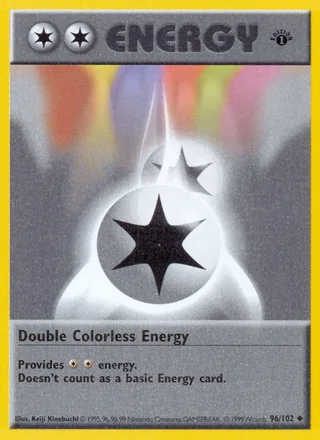
Provides {C}{C} energy. Doesn't count as a basic Energy card.
It provides two Colorless Energy but does not count as a basic Energy card. The only non-basic Energy in the set, and it starts an expensive attack a turn early.

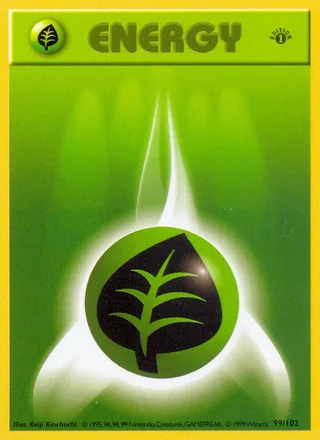
The plainest Grass Energy there is. Energy cards in 1996 had no numbers and no special text; they simply powered Grass Pokémon — the least noticeable and most indispensable category in the whole set.

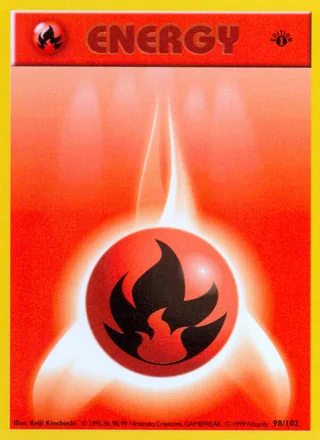
The plainest Fire Energy there is. Nothing in the set substitutes for it, and Charizard's Fire Spin needs four of them.

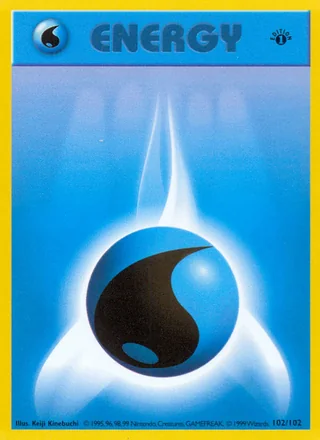
The plainest Water Energy there is. Blastoise's Rain Dance pours exactly these cards from hand onto the field, which is why Water Energy was worth far more than the other basics in 1996.

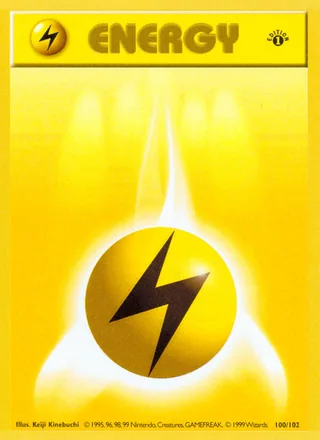
The plainest Lightning Energy there is. Zapdos's Thunderbolt needs four, making it one of the most expensive attacks in the set.

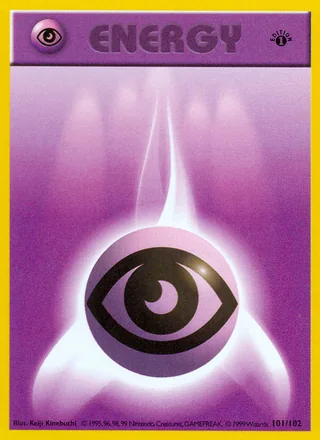
The plainest Psychic Energy there is. Both Alakazam and Mewtwo depend on it, though Psychic decks in this set are not especially Energy-hungry.

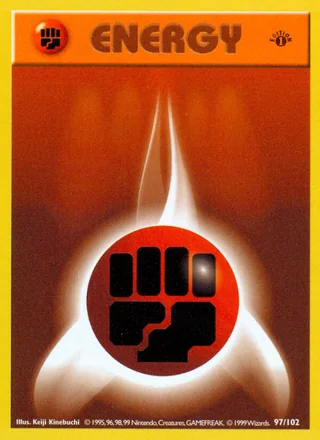
The plainest Fighting Energy there is. Machamp's Seismic Toss needs four, the heaviest cost in Fighting in this set.

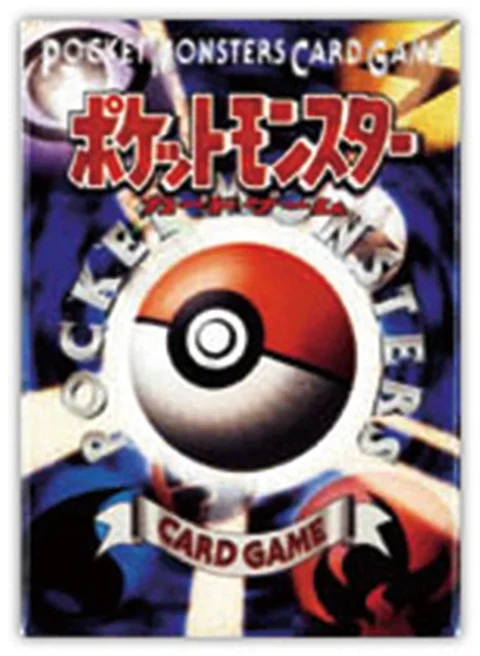
Not a theme deck but a starter pack: 60 cards plus a rulebook, with 30 basic Energy cards (five of each of six types) so you could play straight out of the box.
The 1st Starter Pack shipped the same day: a fixed 60-card deck drawing from the same pool as the Expansion Pack. The only differences were the packaging and the fact that nothing was random. So there was no separate “second set” in 1996 — every card you could obtain that year is among the 102 above.
The four theme decks players remember — Overgrowth, Zap!, Brushfire, Blackout — belong to the 1999 English Base Set, not to the 1996 Japanese release. Conflating the two is the most common mistake made when talking about 1996.
English Base Set (Wizards of the Coast) — the same 102 cards in English, now numbered 1/102 to 102/102 and split across four theme decks. The starting point of the international market.
Base Set 2 — a consolidated English reprint that mixed cards from Base Set with part of Jungle.
XY Evolutions — a full re-creation of the 1996 card design, right down to the borders. For this generation of players it is the most familiar “do-over.”
Celebrations — the 25th anniversary, again reprinting from the 1996 originals as the source.
Four reprints changed one thing: the scarcity of the 1996 original no longer comes from “nobody has this card.” It comes from “nobody has this card in good condition.” A new reprint can always be printed again; thirty-year-old paper and ink cannot.
Release dates and product identities are connected to the Japanese edition release register by set code. Sources are printed per product so a reader can check the claim without trusting this page alone. Unmatched products say so instead of borrowing another edition’s citation.
— verified_secondaryAbout the data. Card names, types, HP, stage, attacks and rarity for the 102 main-set cards come from TCGdex's Japanese dataset PMCG1 (Expansion Pack, releaseDate 1996-10-20, 102 cards), cross-checked card by card against the international base1. The illustrator field disagrees in 8 places (the Japanese side lists artists such as Ryo Ueda and Ayaka Yoshida, who only began working in the 2000s), and the international version is taken as correct throughout.
About the card images. The 1996 Japanese set and the 1999 international set share the same illustrations. The scans here are the high-resolution international release (images.pokemontcg.io) — identical artwork, different language and layout. No stable high-resolution public source exists for the original Japanese card faces.
Attack names. All three language versions use the official English attack names from the international release. Ten of the 114 attack names in the Japanese dataset contain English fragments or clear typos; rather than print a typo as if it were an official name, they are not used here.
No prices on this page. Index numbers, counts and dates all come from public sources. Where something is disputed — for example grading the 1996 promos — the basis is stated in the text; anything without a basis is left out.
Pack prices, pack spreads and box counts follow what the publisher (Media Factory) printed at the time. Prices are the original retail prices including tax, not current market values. The 1st Starter Pack was printed as ¥1,300 excluding tax, so it is listed that way.
Pokémon Card Yearbook · 1996 · This is the first year's sample page. Later years follow the same structure.