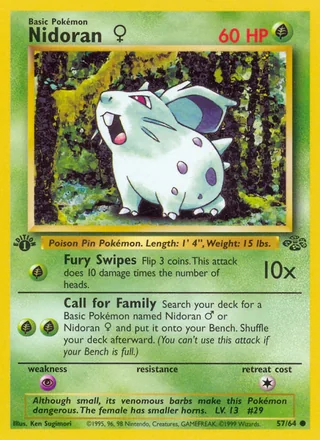
001
Nidoran♀ニドラン♀
COMMON
Fury Swipes 10x (Grass)
Call for Family (Grass×2)
60 HP is on the tough side for a Basic, and both attacks run on one or two Grass energy — easy to put down and easy to evolve from.
Pokémon TCG Almanac · 1997
Japanese edition3 sets · 161 cards
Every card in this yearbook was printed in Japan — the English-language game had not launched yet. English printings of this year's cards reached players in 1999 and 2000, and they are not the same card list: English Jungle has 64 cards against Japan's 48, English Fossil 62 against 48, English Team Rocket 83 against 65. Those printings sit in the 1999 and 2000 English editions.
From the second expansion to the fourth — all 161 cards released this year, one by one.
1996 launched the Pokémon TCG; 1997 is the year it became a boom. Jungle in March, Mystery of the Fossils in June, Team Rocket in November — three expansions in twelve months, more than doubling the number of cards in print.
1997 is also the year promos took off: magazine inserts, stamp-rally handouts, corporate tie-ins, tournament prizes. Cards you could not buy in a shop multiplied at once. So this almanac keeps the cards you could buy and the cards you could not in separate sections.
How to read this page. Every section below opens and closes. Start with “What happened this year” for the timeline, then open “Special cards” — magazine inserts, handouts and tournament prizes all live there, ahead of the regular expansions. Each set follows, split by type, with a card face and a note for every card.
Stats are as printed on the card. The Japanese name leads and the English name sits underneath. Inserts, handouts and tournament prizes are gathered in section ②, ahead of the regular expansions.
This page documents 161 main-series cards across three products on three release dates in 1997. It covers cards printed in Japan only; printings for other editions are tracked separately.
| Publication edition | Japanese edition |
|---|---|
| Products | 3 |
| Cards | 161 |
| Release dates | 3 (1997-03-05 – 1997-11-21) |
| Series codes | PMCG2, PMCG3, PMCG4 |
| Card faces on record | all 161 |
| Latest release on record | 1997-11-21 |
2nd expansion · Pokémon Jungle (1997-03-05, 48 cards) · 3rd expansion · Mystery of the Fossils (1997-06-21, 48 cards) · 4th expansion · Team Rocket (1997-11-21, 65 cards).
How many main-series cards does this page record for 1997?161 cards across three products, an average of 53.7 cards per product. This is the main-series archive count, not a claim that every promo and event card from the year is itemised here.
What release dates does this page cover?3 release dates, from 1997-03-05 to 1997-11-21.
How many of these 161 cards are shown with a card face?All 161 cards have a card face on record.
The February 1997 issue of CoroCoro Comic came with a Mew card. Glossy, torn out of the insert page the same way as Pikachu and Jigglypuff the year before. This one card starts the 1997 run of inserts.
Second expansion, Pokémon Jungle — 48 cards. The theme is the Safari Zone, and Grass alone accounts for 18 cards. It contains exactly one Trainer card (Poké Ball), an odd shape for an expansion.
The Pokémon anime premiered on TV. The card boom accelerates from here, and from spring onward shops kept selling out. Children who could not buy packs drifted toward the inserts and handouts.
Playmats went on sale in three colours (red, green, black), each with a Slowpoke card sealed face-down inside. In 1997, cards increasingly arrived as something that came with a product rather than something you bought.
Third expansion, Mystery of the Fossils — 48 cards. The fossil Pokémon arrive, and Omanyte, Kabuto and Aerodactyl are played from the Trainer card Mysterious Fossil, turning the games' “revive a fossil” step into a rule. The three legendary birds and Mew all landed in this set too.
The JR East stamp rally (until 17 August). People who collected stamps across stations received matte versions of Surfing Pikachu and Mew. 1997 is also the year you had to walk to get the cards that shops did not sell.
Fourth expansion, Team Rocket — 65 cards. Pokémon with “Dark” in the name arrive, and 29 of the 65 cards are Dark. Rainbow Energy also starts here. It was the series' first attempt to build a set around the villains' side.
The January 1998 issue of CoroCoro Comic went on sale, with Meowth and Computer Error. The cover says 1998; it reached shops in December 1997. This almanac files it under the year it actually appeared.
The cards you could not buy, in release order: magazine inserts, pack-ins, event handouts, tournament prizes. Same artwork, different route — and the route decides both the price and how many clean copies survive.
15 Jan 1997 · CoroCoro Comic, February 1997 issue
The insert in the February 1997 issue of CoroCoro Comic. Glossy stock, meant to be torn out of the insert page and played. Mew was almost unobtainable in the games at the time, so printing it on a card was the first time the mythical Pokémon could actually be held — which is why this insert is remembered as an event rather than a freebie.
2 May 1997 · packed with playmats
One copy was sealed face-down inside each of the three playmats (red, green, black). It was only ever available as a mat accessory, and most copies went straight onto a table, so undamaged examples are limited.
15 May 1997 · CoroCoro Comic, June 1997 issue
An insert from a little over six weeks after the anime premiered on 1 April 1997. Even though it is the same Pokémon, the artwork is different from the fan-book version released five days later, so the two are collected as separate cards.
20 May 1997 · Pokémon Fan Book insert
Bound into the Pokémon Fan Book. Because it came inside a book, many copies carry a tear line or a crease along the spine; copies that were never detached are the ones collectors pay for.
20 May 1997 · Pokémon Fan Book insert
The Trainer card that came in the same book. It was distributed only through that book and never appeared in a regular expansion pack, and promo Trainers were almost never reprinted — so today it is the first card people get stuck on when rebuilding a 1997 deck.
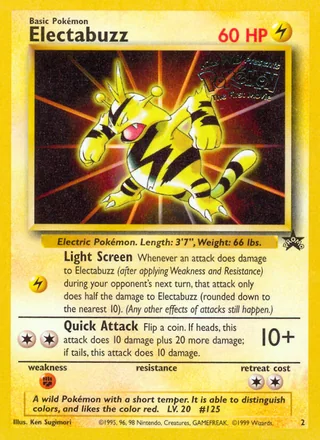
13 Jun 1997 · packed with the official card file
Shipped hidden behind the insert of the 104-pocket official card file. You could not tell it was there without opening the box, and plenty of buyers in 1997 never realised they had received a card at all.
1997 · prize for reaching the official tournament finals
Three cards given only to players who reached the finals of the 1997 official Pokémon Card Game tournament. They were never sold and never given away in a draw, so the surviving count can only be estimated from tournament records. They sit at the very top of the promo hierarchy today.
15 Jun 1997 · CoroCoro Comic, July 1997 issue
The jumbo card insert from the July 1997 issue of CoroCoro Comic: three Pokémon on one oversized sheet, made for play and too big for a normal deck. It was printed to be kept uncut, and a crease in it cannot be repaired.
9–17 Aug 1997 · JR East stamp rally
The matte version, handed to people who completed the JR East stamp rally. You had to travel between stations to earn it, so not every child collecting in 1997 ended up with one. A glossy print of the same artwork came out on 15 August, in the middle of the rally, as a CoroCoro insert — the two are the same card in two printings.
9–17 Aug 1997 · JR East stamp rally
The second card from the stamp rally: the January CoroCoro Mew artwork, reprinted matte. To tell the two apart, do not look at how the light falls — look at the paper's own reflectance; the matte print photographs slightly darker and flatter head-on.
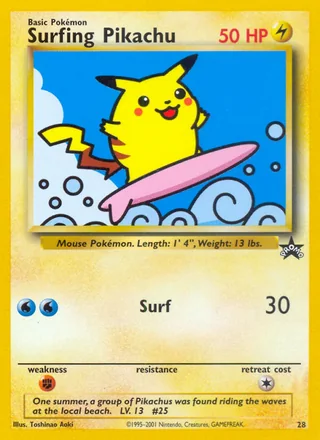
15 Aug 1997 · CoroCoro Comic, September 1997 issue
The glossy print, from the September 1997 issue of CoroCoro Comic. Same artwork as the stamp-rally card, different paper. This is the mass-distributed side of the pair, so it is easy to find on its own — condition is what separates one copy from another.
15 Aug 1997 · CoroCoro Comic, September 1997 issue
A Trainer card of the manga artist Imakuni? himself. A real person on a card was an exception then and is an exception now — it was made as a joke. Most copies were torn out of the same issue as the Surfing Pikachu, so singles that survived on their own are scarcer.
15 Sep 1997 · CoroCoro Comic, October 1997 issue
A jumbo card with all three legendary birds on one sheet. By then all three were already available in regular expansions — Zapdos since the 1996 first set, Articuno and Moltres since the third expansion three months earlier. So this is not a new card: it is a souvenir that puts the completed trio on one sheet.
Oct–Dec 1997 · Toyota promotion
A corporate tie-in card handed out in showrooms during a Toyota promotion. The card itself carries Toyota branding, which sets it apart from any regular release. The window was short, and in 1997 it was treated as advertising for children — which is why so few survived.
Oct–Dec 1997 · Toyota promotion
The other half of the Toyota promotion. Two cards were given out in the same campaign, and plenty of collections hold only one of them. Corporate-branded cards never get a reprint, so clean copies only ever get rarer.
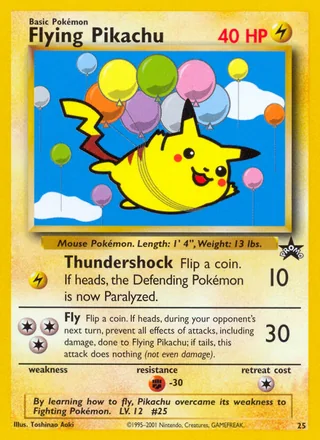
15 Oct 1997 · CoroCoro Comic, November 1997 issue
The insert of Pikachu crossing the sky under balloons. Surfing and flying Pikachu arriving in the same year shows what the inserts were for: a special-looking Pikachu sold magazines.
1997 · 1st–3rd place, regional rounds
Three cards awarded to the top three finishers at regional rounds of the Lizardon Mega Battle. They share a name with the finals prize but come from a different distribution route — these are the regional side. Only three people per venue received one, and some venues handed out a single copy of each.
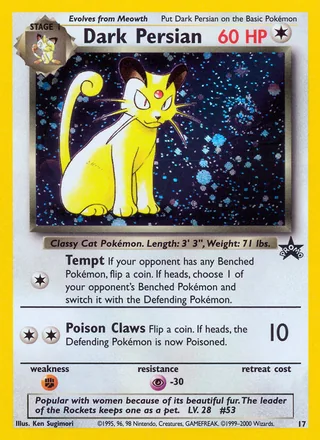
18 Nov 1997 · Pokémon Card Fan, Vol. 3
The card distributed with Pokémon Card Fan Vol. 3. Its “Dark” prefix belongs to the same wave as the fourth expansion, Team Rocket — and this copy reached club members three days before that set went on sale on 21 November.
Dec 1997 · Next Generation World Hobby Fair
Three cards on one uncut sheet, handed out at the venue. Most were kept whole, which means separated singles are now the scarcer form — an unusual case where the intact sheet is worth more than the cards.
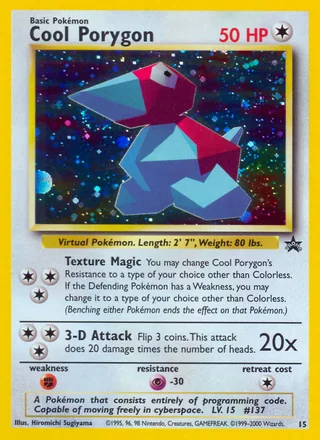
10 Dec 1997 – 31 Jan 1998 · Nintendo 64 double-get campaign
One of the cards given for buying a Nintendo 64 and a qualifying game together. A Porygon in sunglasses is a joke illustration, and 1997 is the year the inserts started doing that. The campaign window was only seven weeks long.
10 Dec 1997 – 31 Jan 1998 · Nintendo 64 double-get campaign
The other card from the same Nintendo 64 campaign — a Snorlax caught mid-meal, again on the joke side. They were given out as a pair, and today's singles mostly exist because someone split a set.
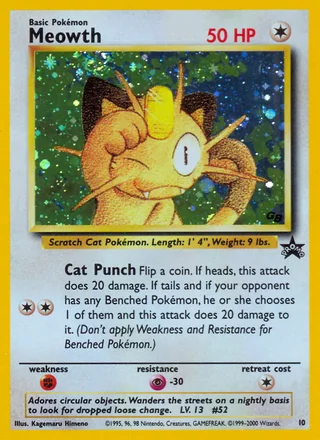
15 Dec 1997 · CoroCoro Comic, January 1998 issue
An insert from the January 1998 issue, but it went on sale on 15 December 1997. Because the cover date and the on-sale date differ, this almanac files it under the year it actually appeared — which is also why this card does not show up in the 1998 list.
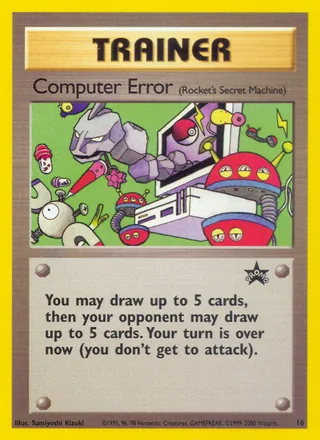
15 Dec 1997 · CoroCoro Comic, January 1998 issue
The glossy Trainer from the same issue as Meowth. Unusually for a promo Trainer of the period, it was almost never reprinted. In years where an issue carried two cards, how carefully they were separated decides the condition you find today.
1997–1998 · illustration contest grand prize
Made as the grand prize of an illustration contest. It was never sold, and the number distributed has never been officially published. This is the card named today when people talk about the most expensive Pokémon card in the world, and what sets its price is condition and provenance — whether you can show who it was awarded to.
Names are Japanese, with an English name only where an international equivalent exists. Most corporate tie-ins and tournament prizes never left Japan and have no international printing. Card images are scans of the international release with the same artwork, not photographs of the Japanese card.
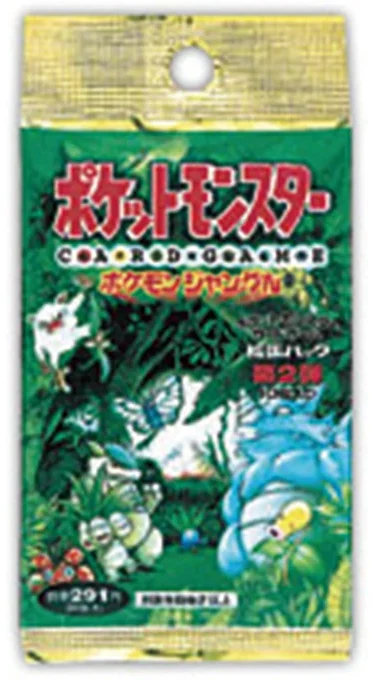
Second expansion. Pack configuration and price were unchanged from the first set at 291 yen. Boxes held 60 packs, and buying a whole box was normal at the time.
48 cards set in the Safari Zone. Grass takes 18 of them — over a third of the set — followed by Fighting and Colorless. Eevee and its three evolutions (Vaporeon, Jolteon, Flareon) debut here, and the way they were split across types set the template for later sets.
Exactly one Trainer card: Poké Ball. From a deck-building point of view this set adds nothing on its own — like every expansion of the period, it was meant to be mixed with the first set.
18 cards · listed in original order.
60 HP is on the tough side for a Basic, and both attacks run on one or two Grass energy — easy to put down and easy to evolve from.
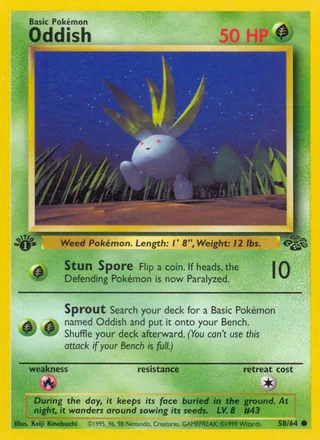
50 HP, retreat cost 1, and ten damage for a single Grass energy: a card you put down early and evolve later — the first step of the Vileplume line.
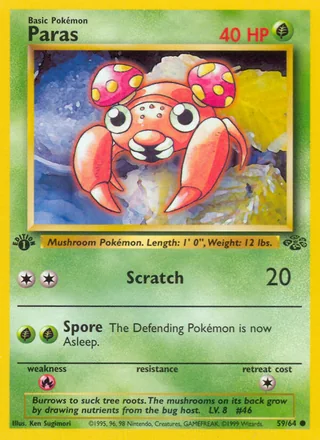
Only 40 HP, but 20 damage for two Colorless energy. It works without committing Grass energy, which makes it a placeholder until Parasect arrives.
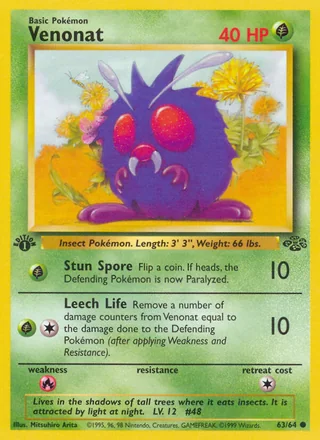
40 HP and two attacks that both deal 10. On numbers alone it looks weak — but in 1997 a Basic's job was often just to survive until it evolved into Venomoth.
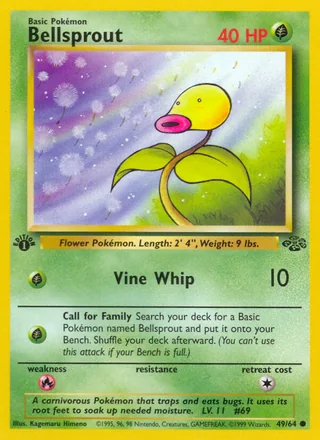
A 40 HP Basic: ten damage for one Grass energy, built to carry the three-stage line up to Victreebel.
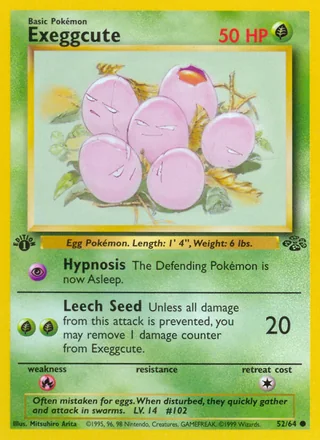
50 HP with retreat cost 3 — and a Psychic-cost attack on a Grass Pokémon. That unusual mix forced players to decide whether to splash a second colour.
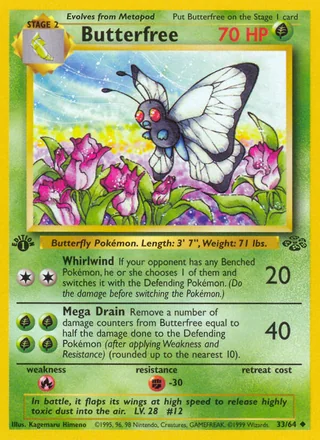
A Stage 2 at 70 HP. Mega Drain wants four Grass energy for 40 damage, which shows how much of a Stage 2's value sat in simply getting it into play back then.
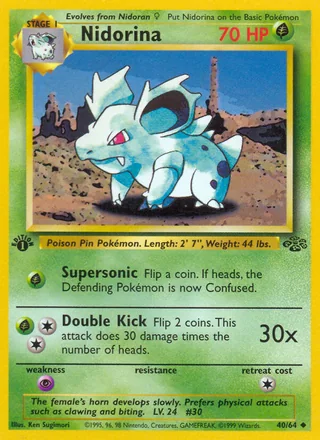
A 70 HP Stage 1. Double Kick deals 30 per successful flip — coin luck on top of an average of about 30, which is exactly how 1997 designed damage.
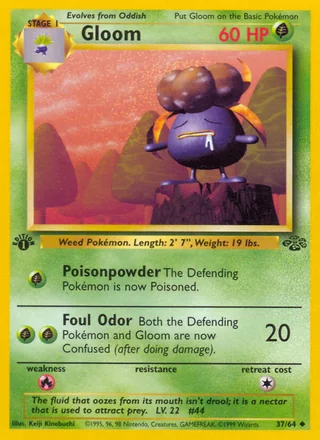
A 60 HP Stage 1. Its Foul Odor attack costs two Grass for 20. A link in the chain to Vileplume, not a card you attack with on its own.
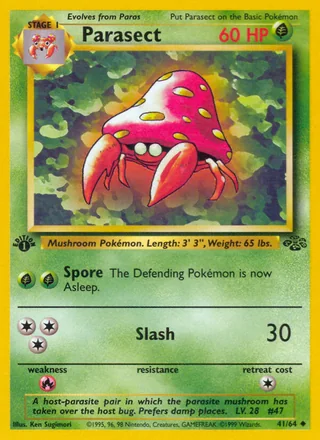
A 60 HP Stage 1. Slash costs three Colorless for 30, so it keeps working in games where the Grass energy never shows up — the Paras line was the steady part of a Grass deck.
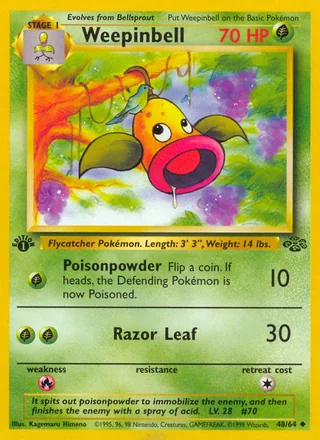
A 70 HP Stage 1 with a cheap 10 and a two-Grass 30 — two attacks you can climb in order. It held the middle of Jungle's Grass line.
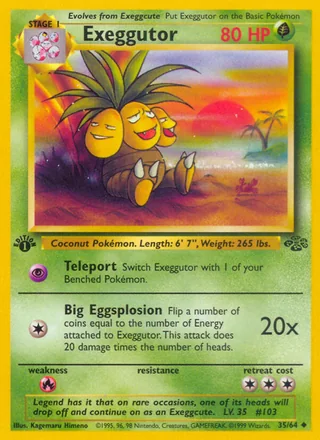
An 80 HP Stage 1 with retreat cost 3. Big Eggsplosion costs a single Colorless for 20×, so it fits decks that run no Grass at all. It evolves from Exeggcute.
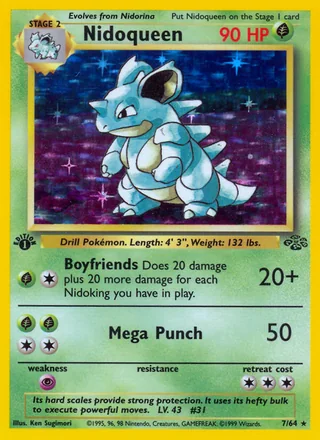
A holo Stage 2 at 90 HP, with Boyfriends at 20+ and Mega Punch at 50. Mega Punch costs two Grass and two Colorless — that price is the weight of a Stage 2 in 1997.
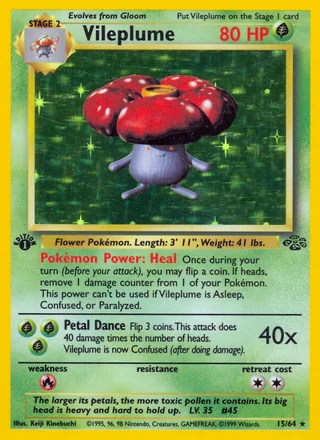
Ability Heal
An 80 HP holo Stage 2. Petal Dance costs three Grass for 40×, and it also carries the Pokémon Power Heal — the finisher of a Grass deck, evolved from Gloom.
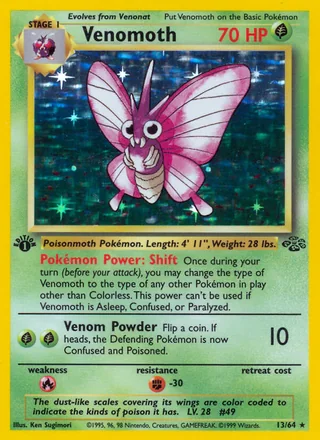
Ability Shift
A 70 HP holo Stage 1 with zero retreat cost, which mattered far more in play than its ten-damage Venom Powder. It also carries the Pokémon Power Shift.
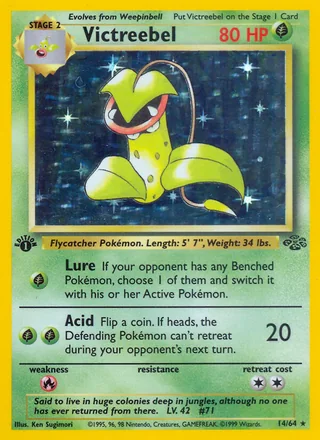
An 80 HP holo Stage 2 with Lure and a 20-damage Acid, both running on one or two Grass. Evolve it from Weepinbell and put it at the front of a Grass deck.
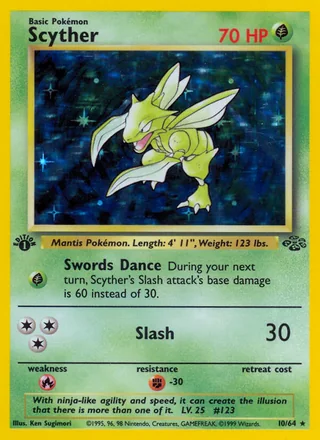
A 70 HP holo with zero retreat — a Basic printed as a holo, which was unusual. Swords Dance first, then Slash for 30: a card that wants to be in front.
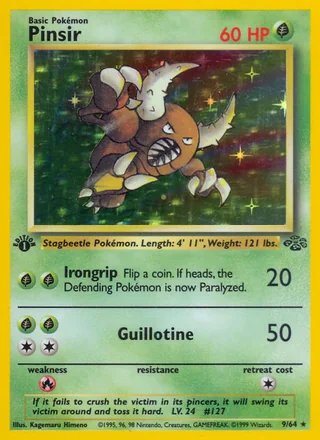
A 60 HP holo with a two-step attack ladder, from two Grass up to two Grass and two Colorless. Pinsir made its first appearance in this set.
2 cards · listed in original order.
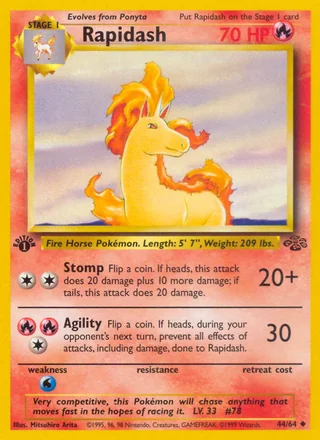
A 70 HP Stage 1 with zero retreat. Stomp at 20+ costs just two Colorless, no Fire required, so it speeds up a Fire deck rather than depending on it.
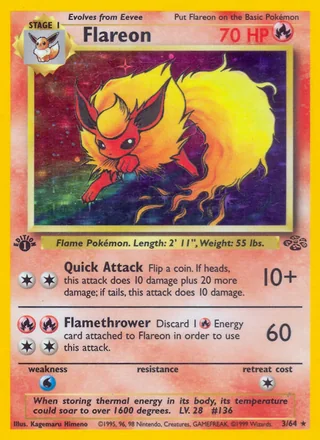
A 70 HP holo Stage 1. Quick Attack costs two Colorless for 10+, Flamethrower two Fire and two Colorless for 60. The Fire branch of Eevee's three evolutions, all of which debut in this set.
3 cards · listed in original order.
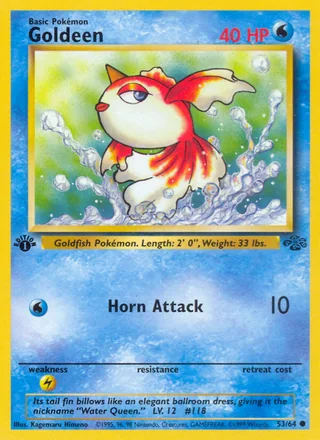
A 40 HP Basic that deals 10 for a single Water energy, with zero retreat cost so it can be pulled straight back. It exists to become Seaking.
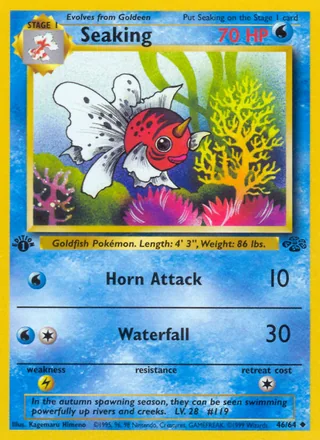
A 70 HP Stage 1 with Horn Attack at 10 and Waterfall at 30 — one Water, then one Water and one Colorless. A straight, honest curve.
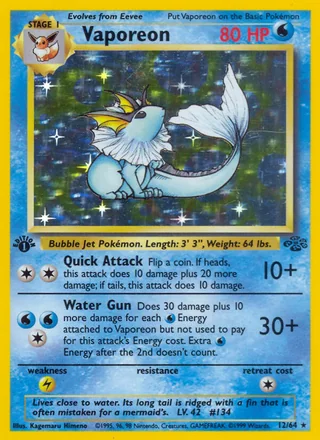
An 80 HP holo Stage 1. Quick Attack costs only two Colorless, so it functions even before any Water energy shows up — the Water branch of Eevee's three evolutions.
3 cards · listed in original order.
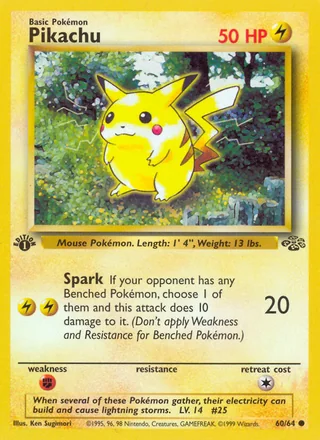
The 50 HP Pikachu: Spark costs two Lightning for 20, a plain-stat Pikachu for a year that printed several. It evolves into Raichu.
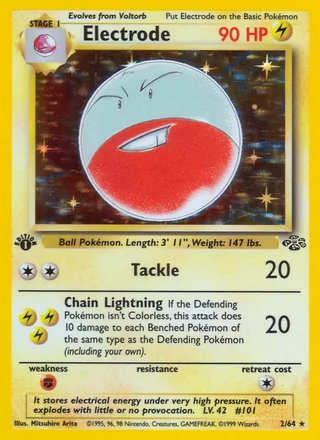
90 HP is exceptional for a Stage 1. Chain Lightning costs three Lightning for only 20, but Tackle runs on two Colorless — that is the attack you actually use.
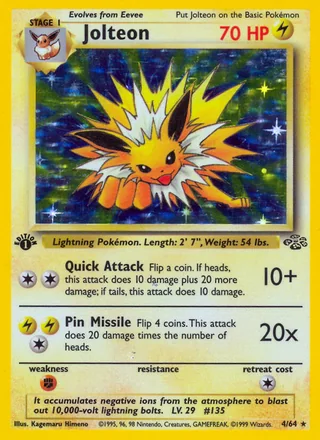
A 70 HP holo Stage 1. Pin Missile costs two Lightning and a Colorless for 20×, Quick Attack two Colorless for 10+. A Lightning Pokémon that chips rather than hits.
1 cards · listed in original order.
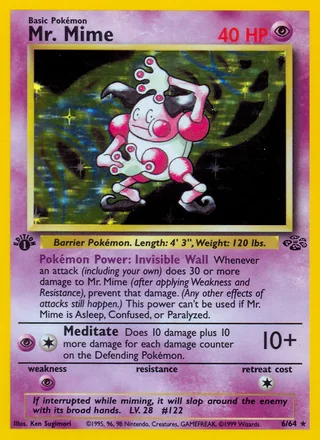
Ability Invisible Wall
A holo with only 40 HP, a card whose stats and status do not match up. It carries the Pokémon Power Invisible Wall, and Meditate costs one Psychic and one Colorless for 10+.
6 cards · listed in original order.
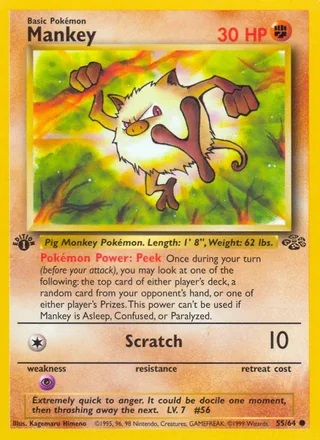
Ability Peek
At 30 HP this is among the frailest Basics in the set. Scratch costs one Colorless for 10, and its Pokémon Power Peek marks it as a card you play to look, not to hit.
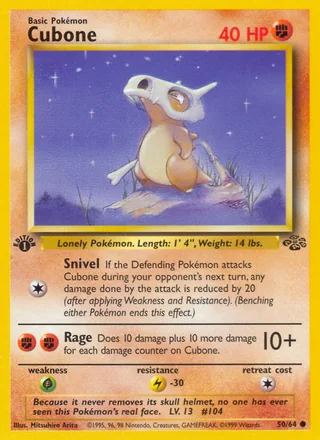
A 40 HP Cubone: Rage costs two Fighting for 10+, Snivel a single Colorless. Groundwork for the holo Marowak, not a card that leads.
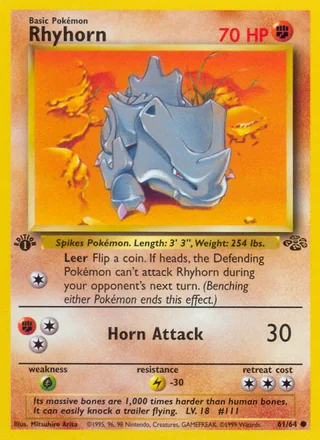
A 70 HP Basic with retreat cost 3. Horn Attack costs one Fighting and two Colorless for 30 — 30 damage that early was rare in this set.
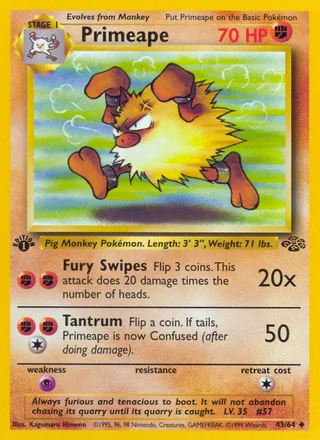
A 70 HP Stage 1. Fury Swipes at 20× and Tantrum at 50, both starting from two Fighting — that is where its speed comes from. Evolves from Mankey.
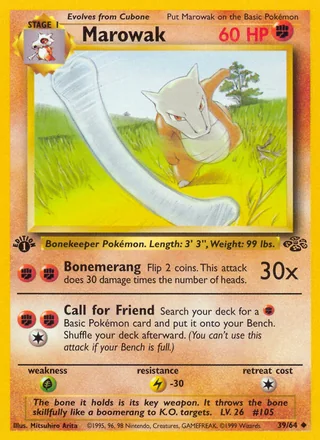
A 60 HP Stage 1. Bonemerang costs two Fighting for 30×, and it carries a third attack, Call for Friend — one card doing two jobs.
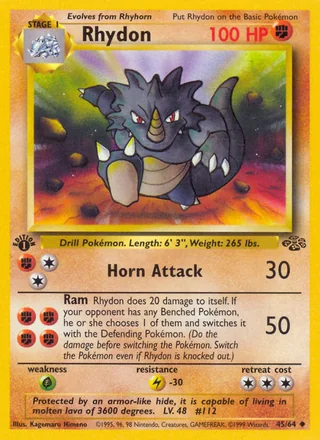
100 HP, the largest in the set. Ram costs four Fighting for 50 — the era's trade-off of weight for toughness, printed plainly.
14 cards · listed in original order.
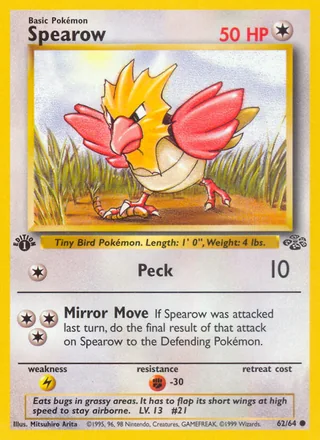
A 50 HP Basic with zero retreat, so it can be swapped in and out freely. Peck at 10 plus Mirror Move; it leads into Fearow.
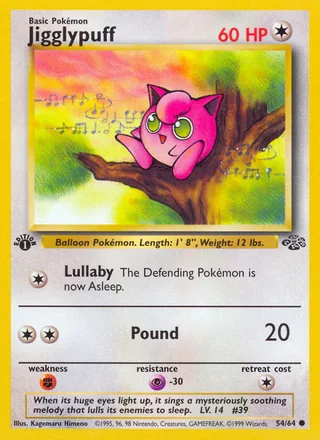
The 60 HP Jigglypuff. Lullaby costs one Colorless, Pound two for 20 — it runs entirely on Colorless. It evolves into Wigglytuff.
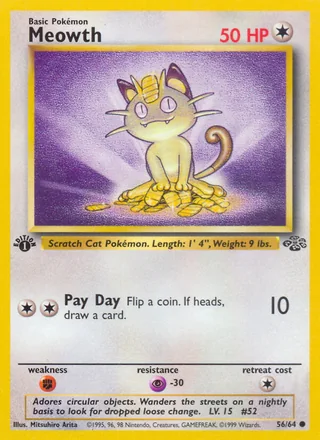
50 HP, with Pay Day at two Colorless for 10. This is the only Meowth in the set — a card that exists to become Persian.
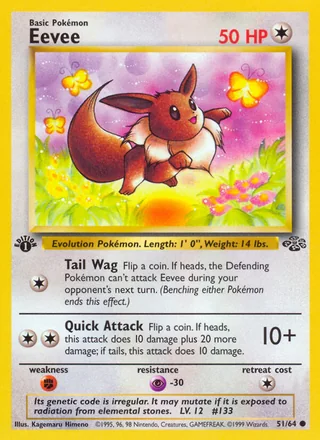
The 50 HP Eevee. Quick Attack costs two Colorless for 10+, Tail Wag one. The starting point of all three evolutions — the Eevee line debuts in this set.
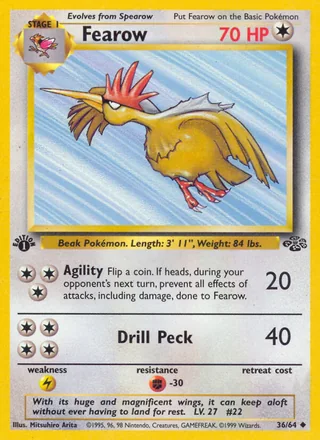
A 70 HP Stage 1 with zero retreat. Drill Peck costs four Colorless for 40, Agility three for 20. It asks for no specific colour, so it slotted into any deck.
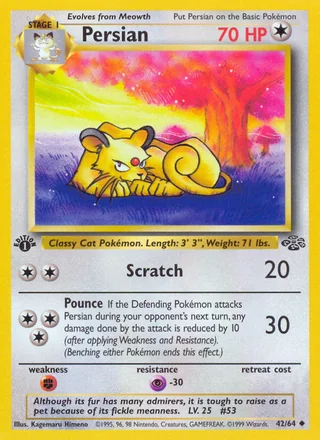
A 70 HP Stage 1 with zero retreat. Scratch at 20 and Pounce at 30 climb from two Colorless to three, with nothing clever in between. Evolves from Meowth.
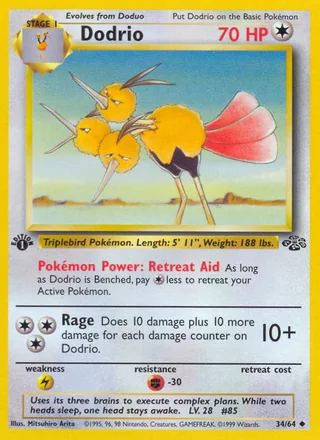
Ability Retreat Aid
A 70 HP Stage 1 with zero retreat and Rage at three Colorless for 10+. Its Pokémon Power, Retreat Aid, makes it a card built around getting out of the way.
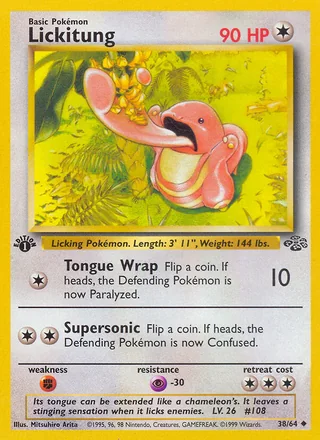
A 90 HP Basic with retreat cost 3. Tongue Wrap at 10 and Supersonic: a card that holds the field by being hard to remove.
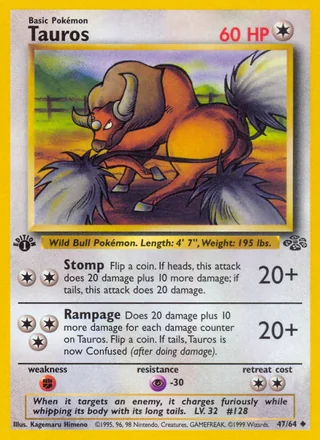
A 60 HP Basic with retreat cost 2. Stomp at 20 and Rampage at 20+, both starting from two Colorless. One of the set's big Colorless bodies alongside Kangaskhan.
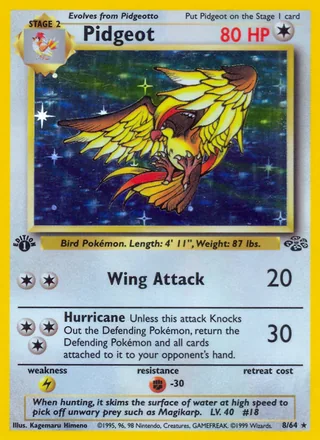
An 80 HP holo Stage 2 with zero retreat. Wing Attack at 20 and Hurricane at 30 cost nothing but Colorless, which made it the Stage 2 you could put in any deck.
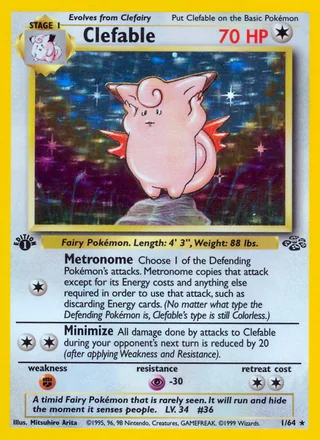
A 70 HP holo Stage 1. Metronome and Minimize both cost one or two Colorless — a card built to stay alive rather than to deal damage. Evolves from Clefairy.
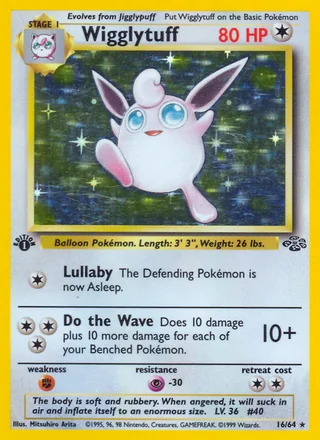
An 80 HP holo Stage 1. Do the Wave costs three Colorless for 10+, scaling with how wide your bench is — a card that rewards decks which fill the field.
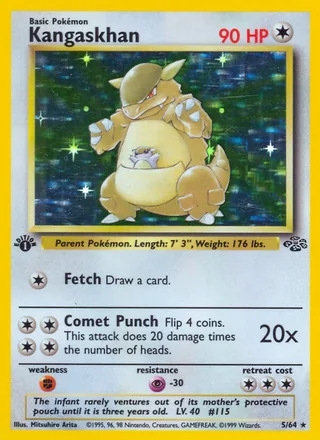
A 90 HP Basic printed as a holo. Comet Punch costs four Colorless for 20×, Fetch a single Colorless — one of the set's defining sturdy Colorless bodies.
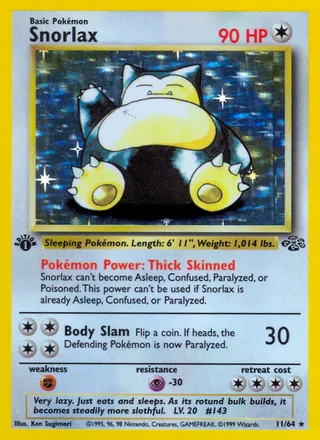
Ability Thick Skinned
A 90 HP holo with a retreat cost of 4 — extreme even for the era. Body Slam costs four Colorless for 30, and its Pokémon Power Thick Skinned confirms the design: once it is down, it is not going anywhere.
1 cards · listed in original order.
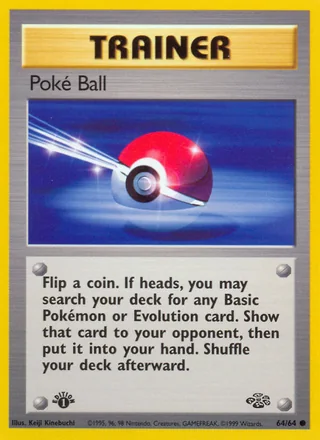
Flip a coin. If heads, you may search your deck for any Basic Pokémon or Evolution card. Show that card to your opponent, then put it into your hand. Shuffle your deck afterward.
The only Trainer card in the set. Called Monster Ball in Japanese and Poké Ball internationally — one Trainer out of 48 cards tells you exactly what kind of expansion this was.
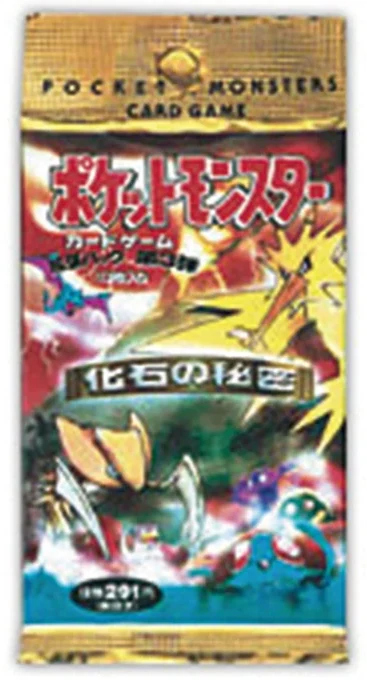
Third expansion, released in June 1997 — right around the time Japan's consumption tax went from 3% to 5%. The price printed on the pack stayed at 291 yen.
The fossil Pokémon, all three legendary birds and Mew — this is where 1997's most wanted singles cluster. Water leads with 14 cards, followed by Psychic and Fighting. Gengar, Ditto and Dragonite join here as well.
The fossil Pokémon are not Basic Pokémon you play from hand: they come into play from the Trainer card Mysterious Fossil. The games' fossil-revival step became a card rule.
7 cards · listed in original order.
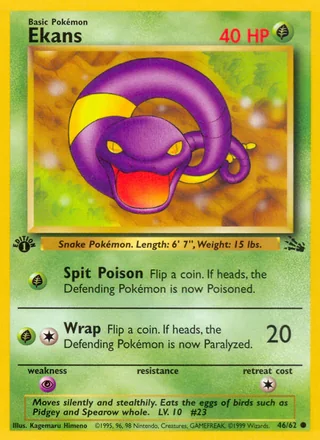
A 40 HP Ekans. Spit Poison costs one Grass, Wrap one Grass and one Colorless for 20 — a cheap two-step ladder on the way to Arbok.
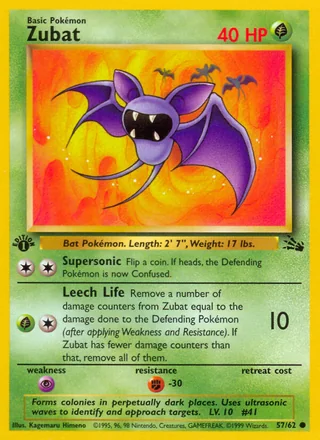
A 40 HP Zubat with zero retreat. Leech Life costs one Grass and one Colorless for 10, Supersonic two Colorless. Free to swap out at any time.
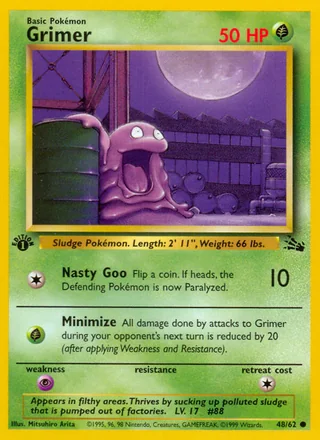
A 50 HP Grimer. Nasty Goo costs a single Colorless for 10, so it works even with no Grass in hand. It evolves into Muk.
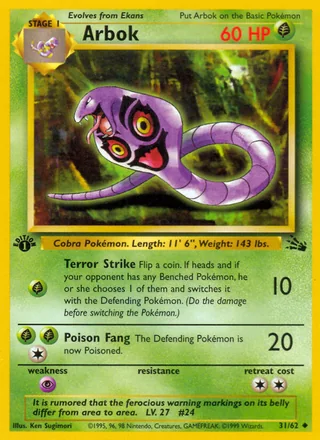
A 60 HP Stage 1 with retreat cost 2. Terror Strike at 10 and Poison Fang at 20 both begin from one Grass, which is where its speed comes from.
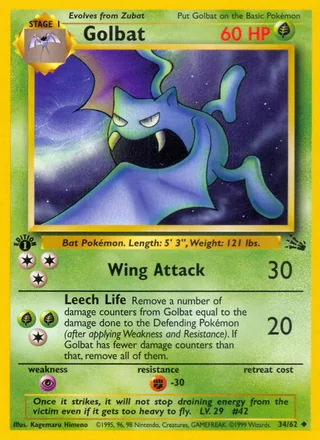
A 60 HP Stage 1 with zero retreat. Wing Attack costs three Colorless for 30, Leech Life two Grass and one Colorless for 20 — 30 damage that asks for no particular colour.
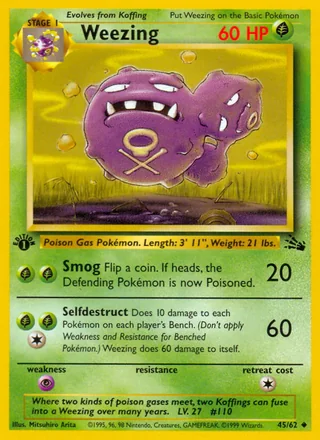
A 60 HP Stage 1. Smog at 20 and Selfdestruct at 60 mean two Grass gets you to 60. Self-destruct attacks of this era were finishers, not throwaways.
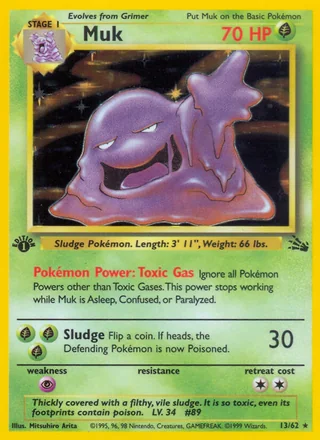
Ability Toxic Gas
A 70 HP holo Stage 1. Sludge costs three Grass for 30 and it carries the Pokémon Power Toxic Gas. Evolved from Grimer, it sits at the heavy end of a Grass deck.
2 cards · listed in original order.
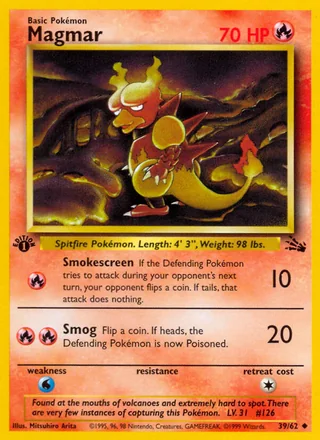
A 70 HP Magmar built from just two cheap attacks: Smokescreen at one Fire for 10, Smog at two Fire for 20. High HP for a Basic.
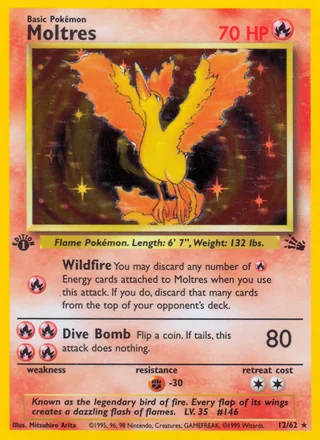
A holo Basic — Moltres. Dive Bomb costs four Fire for 80, among the largest numbers in the set. Of the three birds, Articuno and Moltres entered regular packs here for the first time; Zapdos had already appeared in the 1996 first set.
14 cards · listed in original order.
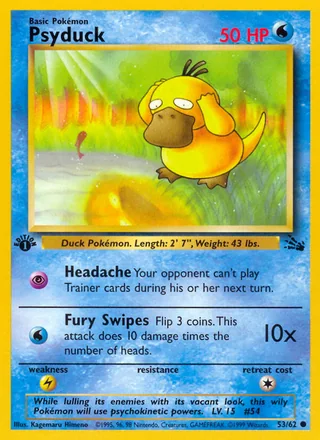
A 50 HP Psyduck. Headache costs one Psychic, Fury Swipes one Water for 10× — two different energy types on one Basic.
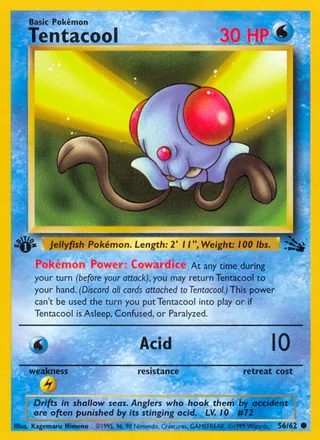
Ability Cowardice
30 HP and zero retreat — Tentacool. Acid costs one Water for 10, and its Pokémon Power Cowardice makes the intent plain: this card is built to get out of the way.
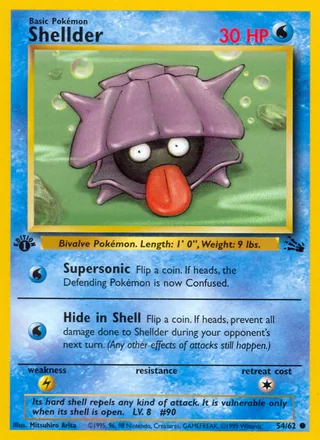
A 30 HP Shellder. Supersonic and Hide in Shell both cost a single Water, and neither deals damage — a card that exists purely to become Cloyster.
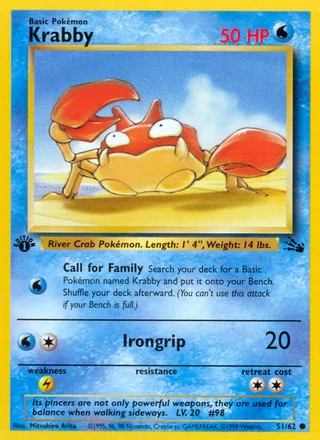
A 50 HP Krabby with retreat cost 2. Irongrip costs one Water and one Colorless for 20, Call for Family one Water — groundwork for Kingler.
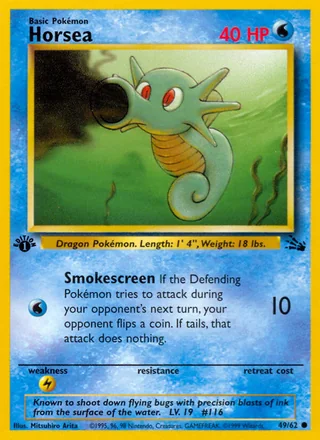
A 40 HP Horsea with zero retreat and exactly one attack — Smokescreen, one Water for 10. It evolves into Seadra.
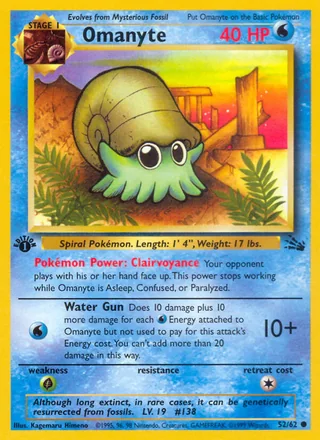
Ability Clairvoyance
A Stage 1 you play from a fossil — not from your hand, but from the Trainer card Mysterious Fossil. Water Gun costs one Water for 10+, and it carries the Pokémon Power Clairvoyance.
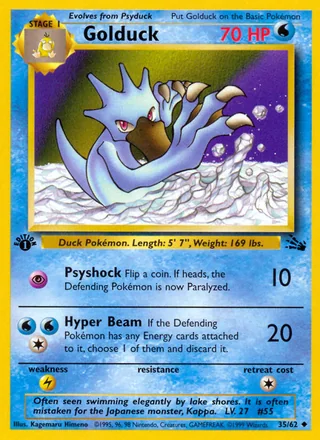
A 70 HP Stage 1. Psyshock costs one Psychic for 10, Hyper Beam two Water and one Colorless for 20 — evolved from Psyduck, it let a Water deck splash a single Psychic card.
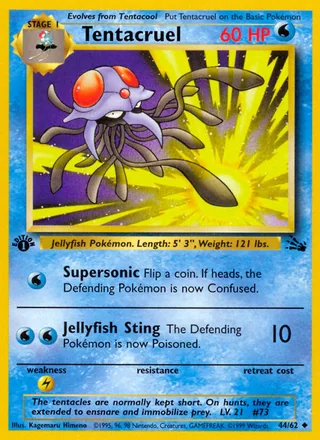
A 60 HP Stage 1 with zero retreat. Jellyfish Sting costs two Water for 10 and Supersonic one Water — a card built entirely out of cheap attacks.
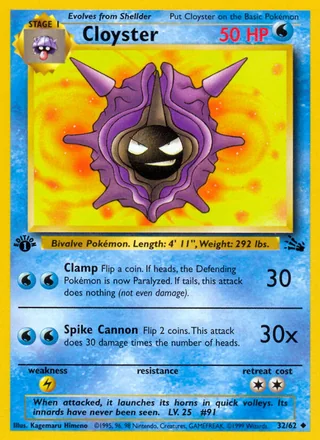
A 50 HP Stage 1. Clamp and Spike Cannon both cost two Water and give 30 or 30× — two attacks at one price, with nothing else on the card.
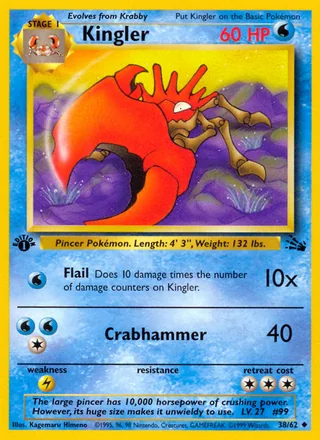
A 60 HP Stage 1 with retreat cost 3. Flail costs one Water for 10×, Crabhammer two Water and one Colorless for 40 — slow, but it reaches 40.
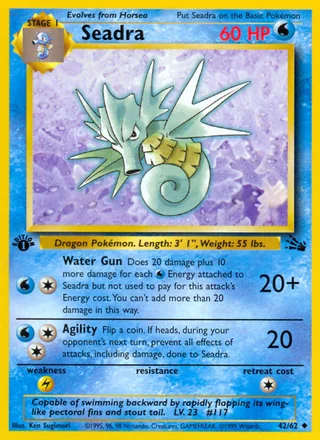
A 60 HP Stage 1. Water Gun costs one Water and one Colorless for 20+, Agility one Water and two Colorless for 20 — evolved from Horsea, it forms the cheap front line of a Water deck.
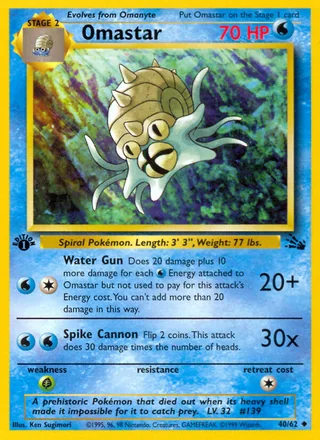
A 70 HP Stage 2. Water Gun at 20+ and Spike Cannon at 30× both run on two Water at most. Evolves from Omanyte.
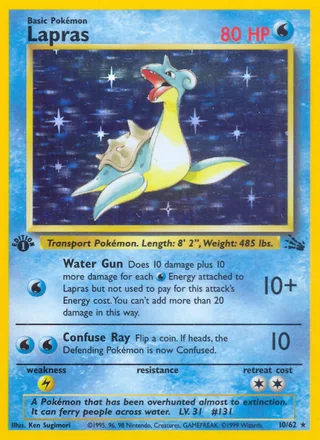
An 80 HP Basic printed as a holo. Water Gun at 10+ and Confuse Ray at 10 cost one to two Water. Lapras made its first appearance in this set.
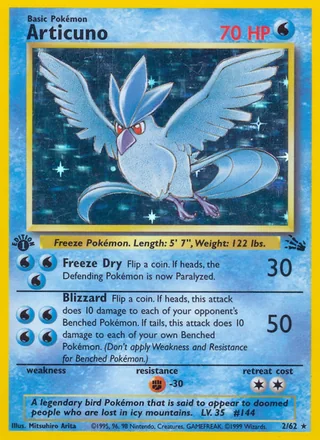
A 70 HP holo Basic. Freeze Dry costs three Water for 30, Blizzard four Water for 50 — that four-energy price was what a finisher cost in 1997.
3 cards · listed in original order.
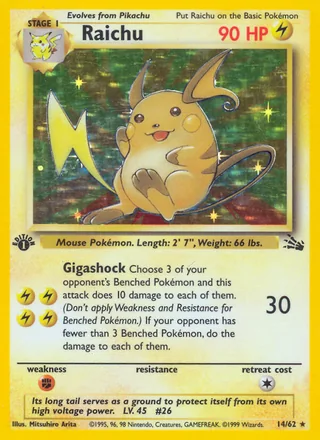
A 90 HP holo Stage 1. Gigashock costs four Lightning for 30 — extremely expensive for the damage. The first set already had a Raichu; this is the second.
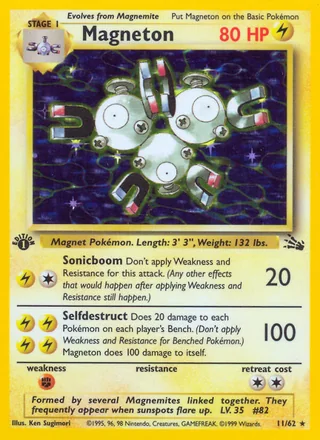
An 80 HP Stage 1. Sonicboom costs one Lightning and one Colorless for 20; Selfdestruct costs four Lightning for 100 — the gap between 20 and 100 is the whole card. The first set already had a Magneton, so this is the second.
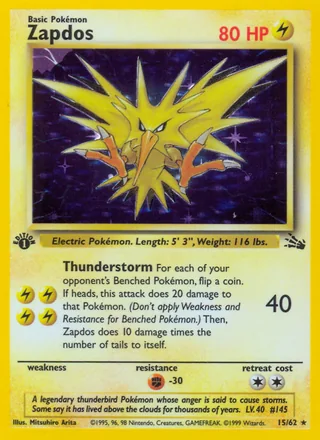
An 80 HP holo Basic. Thunderstorm costs four Lightning for 40 — expensive for a modest number. A different card from the first set's Zapdos, and this one has 80 HP.
7 cards · listed in original order.
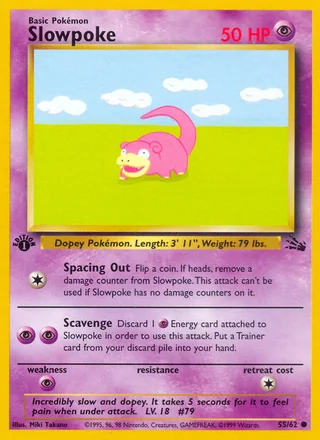
A 50 HP Slowpoke built from two attacks that deal no damage: Spacing Out at one Colorless, Scavenge at two Psychic. It evolves into Slowbro.
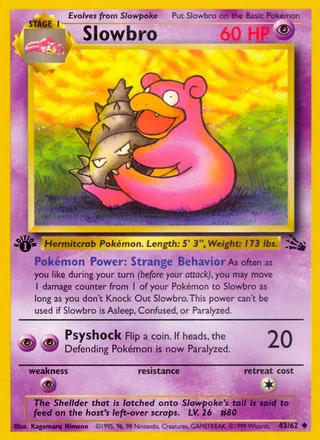
Ability Strange Behavior
A 60 HP Stage 1. Psyshock costs two Psychic for 20, and it carries the Pokémon Power Strange Behavior. Evolved from Slowpoke, it is a staple of Psychic decks.
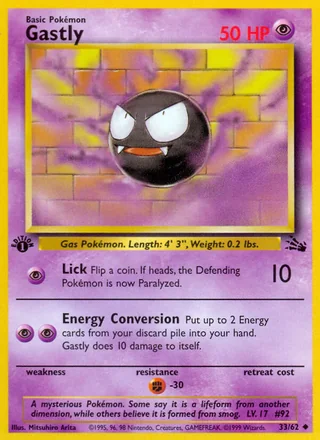
A 50 HP Gastly with zero retreat. Lick costs one Psychic for 10, Energy Conversion two — the first step of the three-stage line up to Gengar.
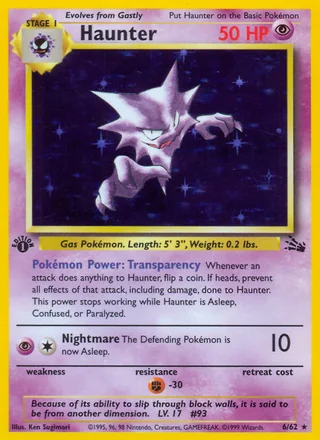
Ability Transparency
A 50 HP Stage 1 with zero retreat. Nightmare costs one Psychic and one Colorless for 10, and it carries the Pokémon Power Transparency. One step from Gengar.
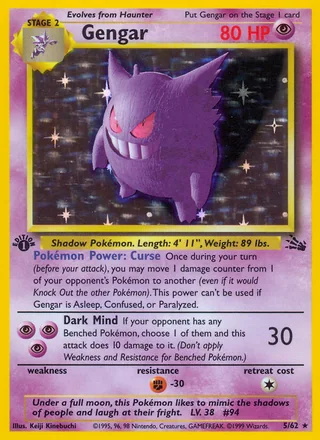
Ability Curse
An 80 HP holo Stage 2. Dark Mind costs three Psychic for 30, and it carries the Pokémon Power Curse. Gengar debuts here — it was not in the first set.
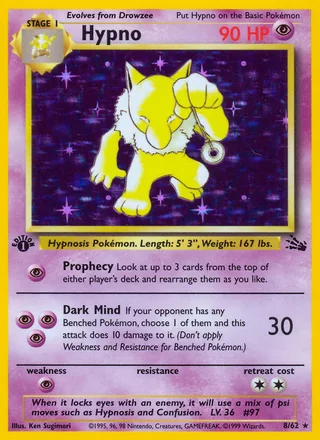
90 HP — exceptional for a Stage 1. Prophecy costs one Psychic, Dark Mind three for 30. Printed as a holo in this set.
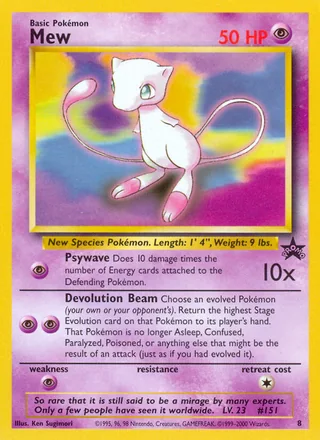
A 50 HP holo — a legendary Pokémon printed as a Basic. Psywave costs one Psychic for 10×, Devolution Beam two. The international Fossil set left it out; in English it was issued separately as Black Star Promo #8.
8 cards · listed in original order.
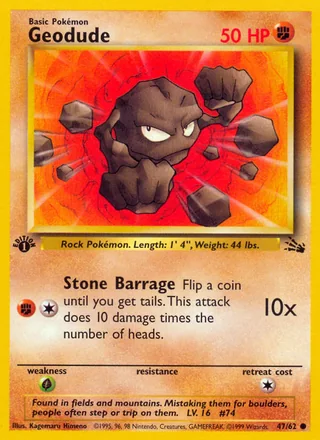
A 50 HP Geodude with a single attack: Stone Barrage, one Fighting and one Colorless for 10×. The start of the line to Graveler and Golem.
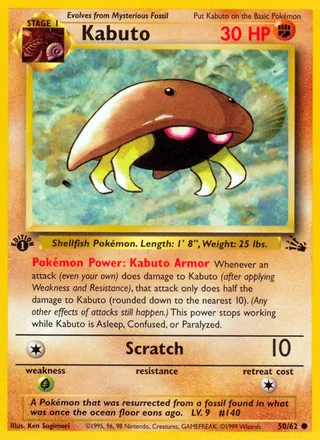
Ability Kabuto Armor
A 30 HP fossil Pokémon — played from the Trainer card Mysterious Fossil rather than from your hand. Scratch costs one Colorless for 10, and it carries the Pokémon Power Kabuto Armor.
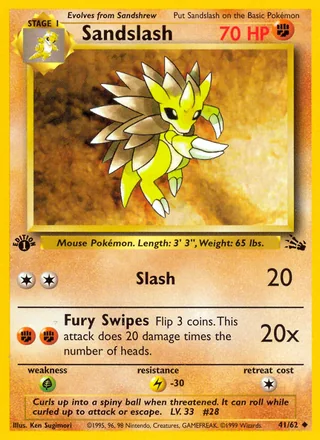
A 70 HP Stage 1. Slash costs two Colorless for 20 and Fury Swipes two Fighting for 20× — one colourless attack and one that scales with Fighting on the same card.
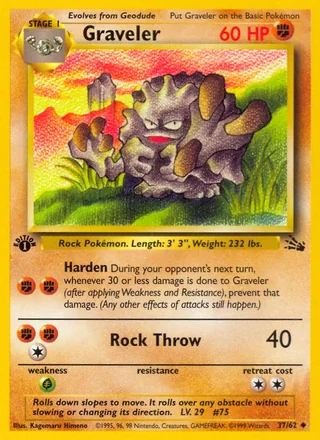
A 60 HP Stage 1. Rock Throw costs two Fighting and one Colorless for 40, a big number for Fighting in this set. Harden costs two Fighting. One step from Golem.
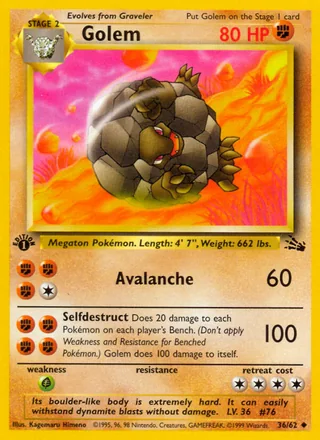
An 80 HP Stage 2 with retreat cost 4. Avalanche costs three Fighting and one Colorless for 60; Selfdestruct four Fighting for 100 — it cannot retreat, but it reaches 100.
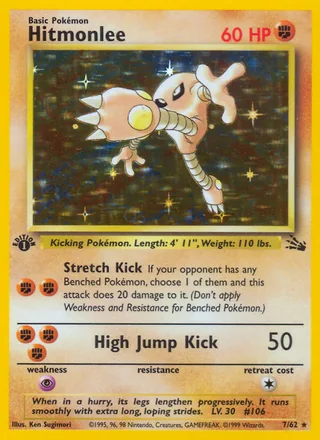
A 60 HP holo Basic. Stretch Kick costs two Fighting, High Jump Kick three for 50 — 50 damage off cheap energy, which is why it led Fighting decks.
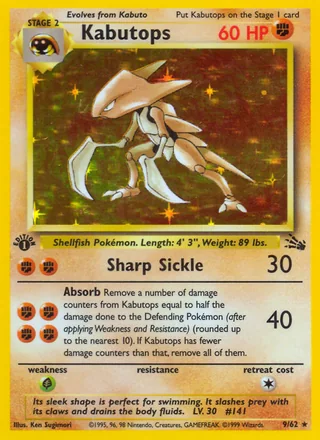
A 60 HP holo Stage 2. Sharp Sickle costs two Fighting for 30, Absorb four for 40. It evolves from Kabuto — a Stage 2 you raise out of a fossil, which was a new shape for the game.
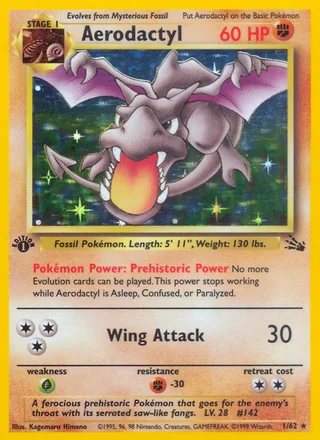
Ability Prehistoric Power
A 60 HP holo fossil Pokémon. Wing Attack costs three Colorless for 30 with no colour requirement, and it carries the Pokémon Power Prehistoric Power. Like Omanyte and Kabuto, it is a Stage 1 you bring out of the Trainer card Mysterious Fossil.
2 cards · listed in original order.
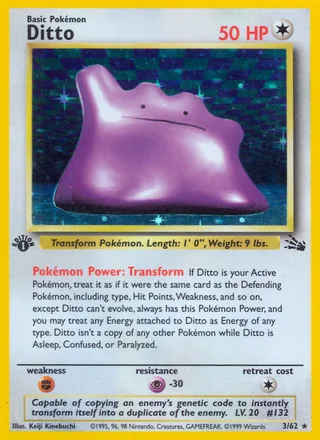
Ability Transform
A holo with no attacks at all — a 50 HP Basic that exists entirely through the Pokémon Power Transform. Ditto debuts in this set.
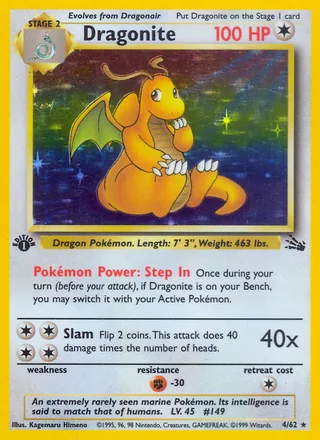
Ability Step In
100 HP as a holo Stage 2. Slam costs four Colorless for 40×, and it carries the Pokémon Power Step In. Dragonite debuts in this set.
5 cards · listed in original order.
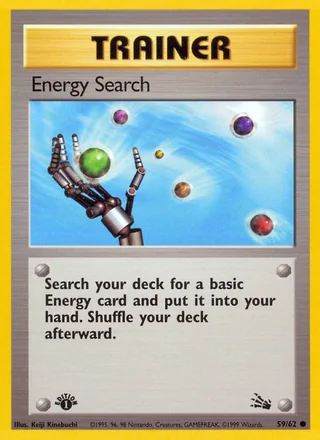
Search your deck for a basic Energy card and put it into your hand. Shuffle your deck afterward.
A Trainer that fetches one basic Energy from your deck. Unglamorous, but every deck of this period ran it — raising a Stage 2 requires a way to find energy.
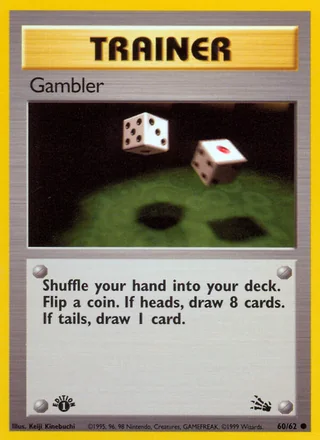
Shuffle your hand into your deck. Flip a coin. If heads, draw 8 cards. If tails, draw 1 card.
Shuffle your hand back into the deck, then flip a coin: heads draws 8, tails draws 1. An extreme gamble, and a good example of how much 1997 was willing to leave to a flip.
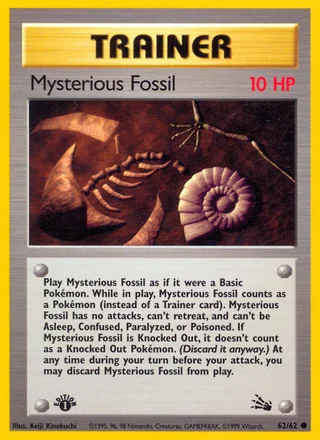
Play Mysterious Fossil as if it were a Basic Pokémon. While in play, Mysterious Fossil counts as a Pokémon (instead of a Trainer card). Mysterious Fossil has no attacks, can't retreat, and can't be Asleep, Confused, Paralyzed, or Poisoned. If Mysterious Fossil is Knocked Out, it doesn't count as a Knocked Out Pokémon. (Discard it anyway.) At any time during your turn before your attack, you may discard Mysterious Fossil from play.
The mechanism the whole set is built around. It is played as if it were a Basic Pokémon, and Omanyte, Kabuto and Aerodactyl all evolve from it — the games' fossil-revival step turned into a card rule.
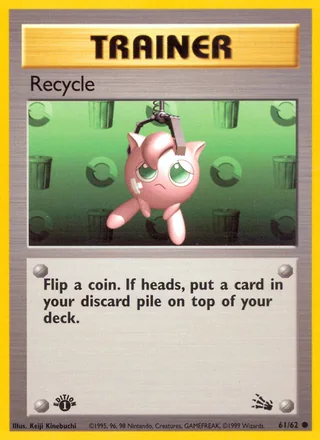
Flip a coin. If heads, put a card in your discard pile on top of your deck.
Flip a coin; on heads, put a card from your discard pile on top of your deck. A tails does nothing, but in 1997 this was one of the few ways to get a discarded card back.
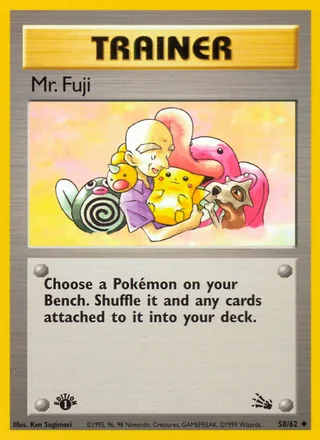
Choose a Pokémon on your Bench. Shuffle it and any cards attached to it into your deck.
Pick a Benched Pokémon and shuffle it, with everything attached, back into your deck. A way to pull a damaged Stage 2 out and raise it again — one of the cards that made long games possible.
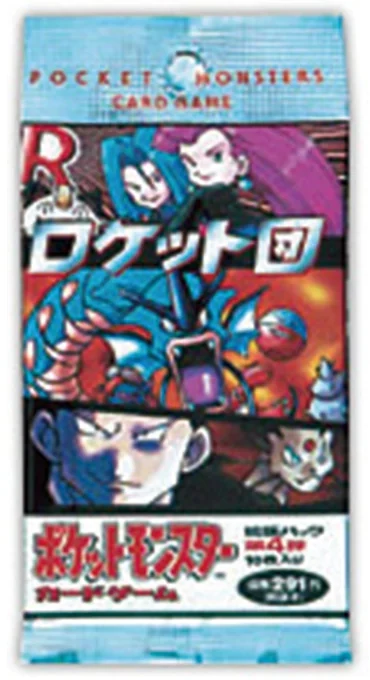
Fourth expansion. Japan got 65 cards, one of which sits outside the ★ numbering as a secret card. Pack configuration and price were unchanged again.
At 65 cards this is noticeably larger than the two sets before it. 29 cards carry “Dark” in the name, and the Dark version of a Pokémon has different stats and attacks from the ordinary one. Rainbow Energy also arrives here.
Dark Pokémon hit harder but carry a cost: heavier retreat, lower HP, or attacks that damage themselves. They are not simply better versions of the ordinary card — that trade-off is the whole design of the set.
11 cards · listed in original order.
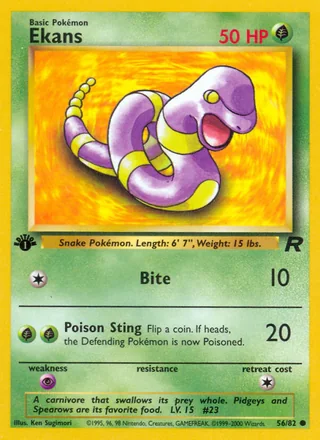
A 50 HP Ekans. Bite costs one Colorless for 10, Poison Sting two Grass for 20. Mystery of the Fossils printed an Ekans the same year, so this is the second.
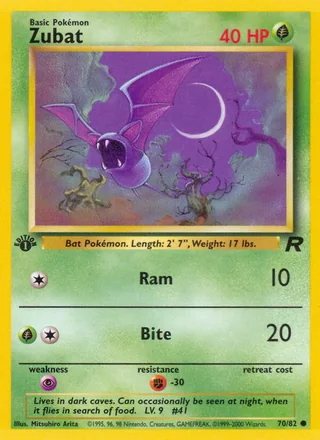
A 40 HP Zubat with zero retreat. Ram costs one Colorless for 10, Bite one Grass and one Colorless for 20 — two cheap attacks, nothing more.
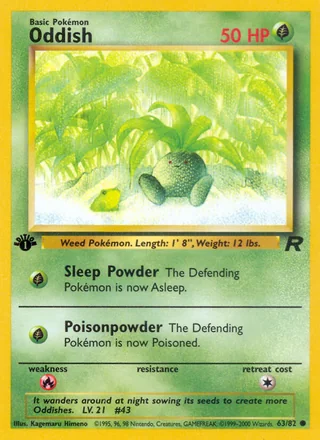
A 50 HP Oddish where both attacks deal zero damage — Sleep Powder and Poisonpowder each cost one Grass. A card whose entire job is inflicting a condition.
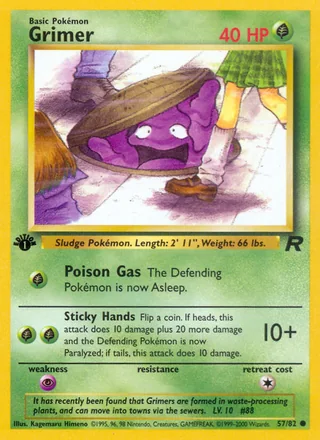
A 40 HP Grimer. Poison Gas costs one Grass, Sticky Hands two for 10+ — groundwork for Dark Muk.
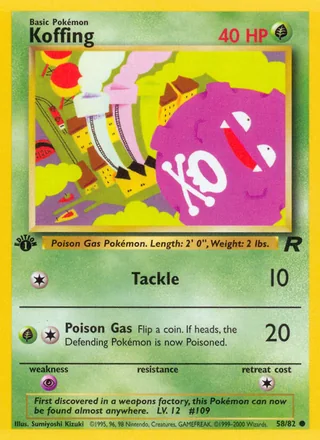
A 40 HP Koffing. Tackle costs one Colorless for 10, Poison Gas one Grass and one Colorless for 20 — the first step toward Dark Weezing.
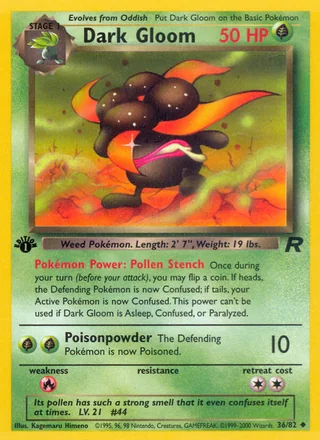
Ability Pollen Stench
A 50 HP Dark Stage 1. Poisonpowder costs two Grass for 10, and it carries the Pokémon Power Pollen Stench. Its HP is 10 lower than the ordinary Gloom — that is the trade Dark Pokémon make.
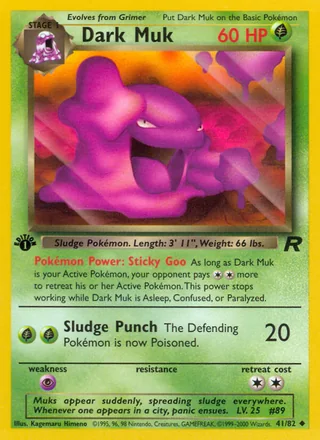
Ability Sticky Goo
A 60 HP Dark Stage 1. Sludge Punch costs two Grass for 20, and it carries the Pokémon Power Sticky Goo. Dark Pokémon are often built to do their work through a power rather than an attack.
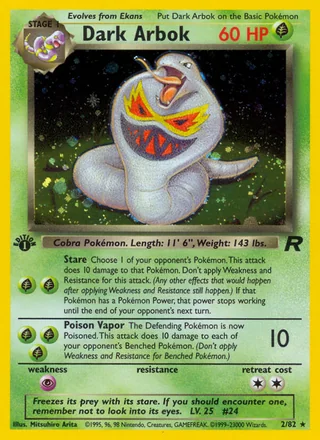
A 60 HP holo Dark Stage 1. Stare costs two Grass, Poison Vapor three for 10. Three Grass for 10 damage is exactly how Dark Pokémon are built: attacking is the expensive part.
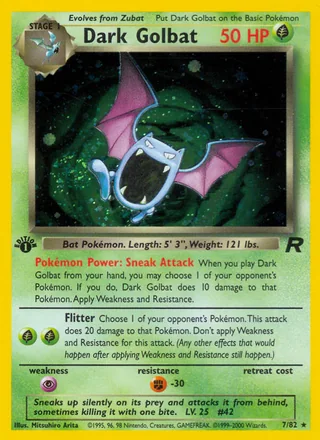
Ability Sneak Attack
A 50 HP holo Dark Stage 1 with zero retreat. Its only attack is Flitter, and it carries the Pokémon Power Sneak Attack — a Dark Pokémon that works without attacking.
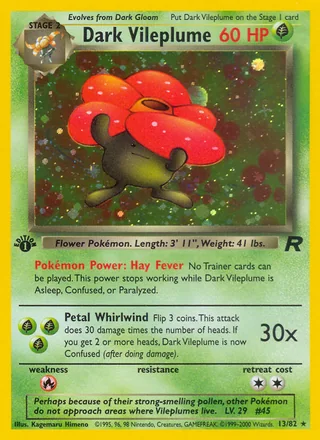
Ability Hay Fever
A 60 HP holo Stage 2. Petal Whirlwind costs three Grass for 30×, and it carries the Pokémon Power Hay Fever. Evolved from Gloom, it is where a Grass deck ends up.
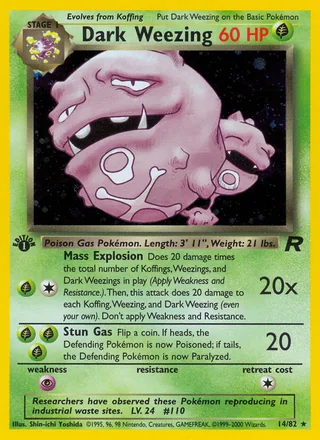
A 60 HP holo Dark Stage 1. Mass Explosion costs one Grass and one Colorless for 20×, Stun Gas three Grass for 20 — a cheap attack and an expensive one on the same card.
6 cards · listed in original order.
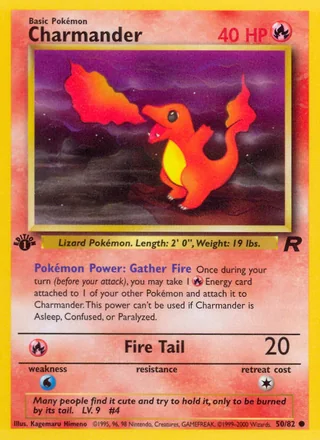
Ability Gather Fire
A 40 HP Charmander. Fire Tail costs one Fire for 20, and it carries the Pokémon Power Gather Fire — the start of the line to Dark Charmeleon and Dark Charizard.
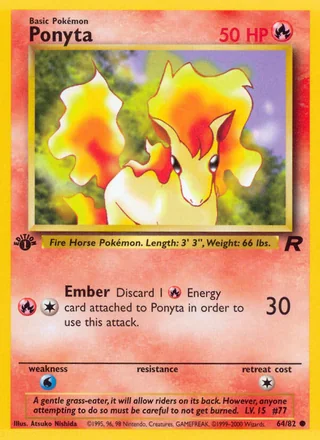
A 50 HP Ponyta. Ember costs one Fire and one Colorless for 30 — exceptional efficiency for a Basic in this set. It evolves into Dark Rapidash.
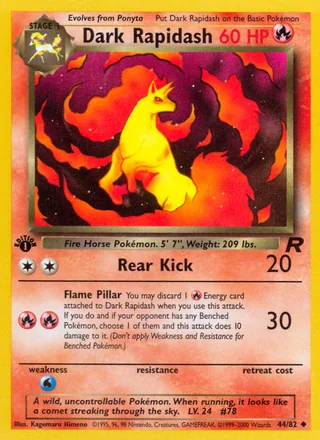
A 60 HP Dark Stage 1 with zero retreat. Rear Kick costs two Colorless for 20, Flame Pillar two Fire for 30 — that zero retreat mattered in play.
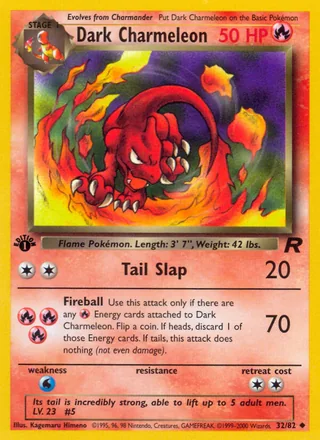
A 50 HP Dark Stage 1. Fireball costs three Fire for 70 — remarkable damage for a Stage 1. With only 50 HP, though, it was always a card that expected to be knocked out in return.
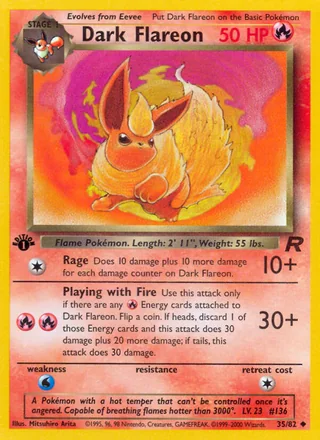
A 50 HP Dark Stage 1. Rage costs one Colorless for 10+, Playing with Fire two Fire for 30+. Twenty HP below the ordinary Flareon, in exchange for cheaper attacks.
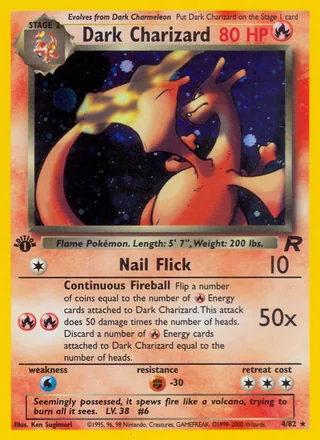
Dark Charizard, 80 HP, holo. Nail Flick costs one Colorless for 10; Continuous Fireball costs two Fire for 50×. Reaching 50 off just two Fire is the whole point of the card, and it is a different animal from the Charizard in the Base Set.
8 cards · listed in original order.
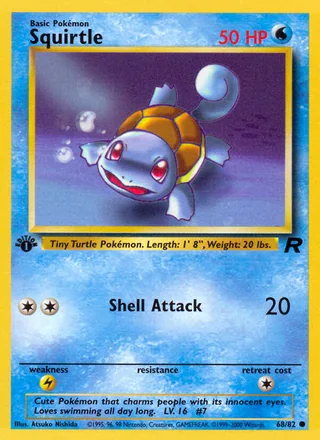
A 50 HP Squirtle. Shell Attack costs two Colorless for 20 — it needs neither Fire nor Water. It leads to Dark Wartortle and Dark Blastoise.
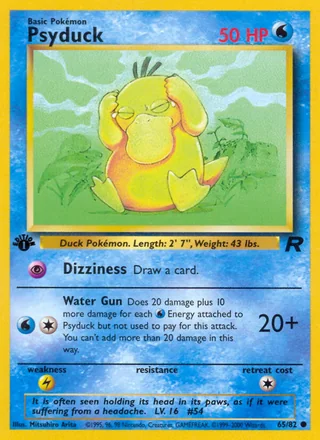
A 50 HP Psyduck. Dizziness costs one Psychic, Water Gun one Colorless and one Water for 20+ — one card handling two colours. It evolves into Dark Golduck.
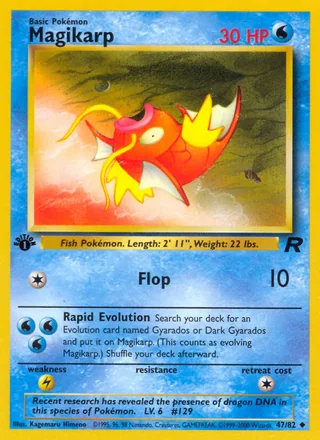
30 HP — Magikarp. Flop costs one Colorless for 10; Rapid Evolution three Water. A card you put down purely so it can evolve — then and now, the win is getting it to survive.
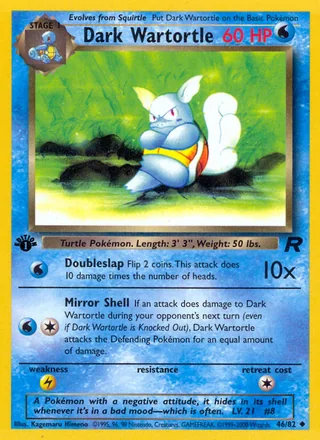
A 60 HP Dark Stage 1. Doubleslap costs one Water for 10×, Mirror Shell one Water and one Colorless. The middle of the line to Dark Blastoise, and the card that keeps a Water deck moving.
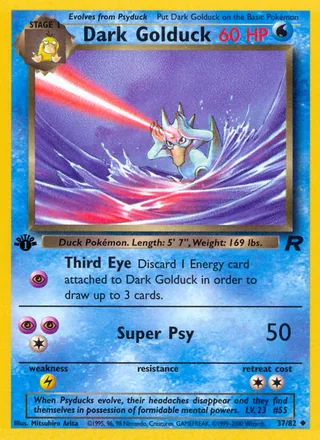
A 60 HP Dark Stage 1. Third Eye costs one Psychic, Super Psy two Psychic and one Colorless for 50. A Water Pokémon reaching 50 off Psychic energy — one card working in two colours.
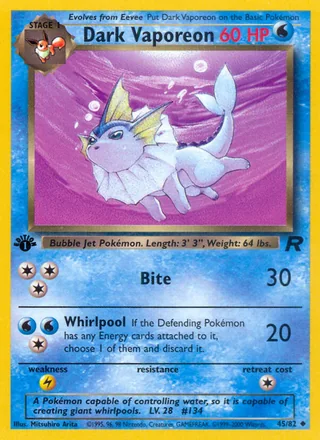
A 60 HP Dark Stage 1. Bite costs three Colorless for 30, Whirlpool two Water and one Colorless for 20 — 30 damage off pure Colorless means it is never dead in the early game.
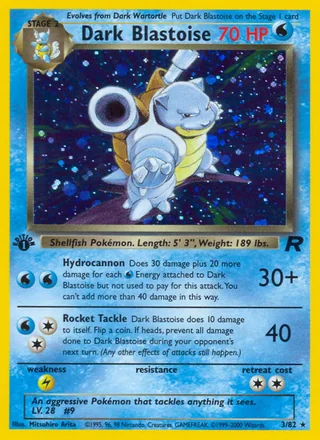
A 70 HP holo Stage 2. Hydrocannon costs two Water for 30+, Rocket Tackle one Water and two Colorless for 40 — it starts working on two Water, which is what separates it from the ordinary Blastoise.
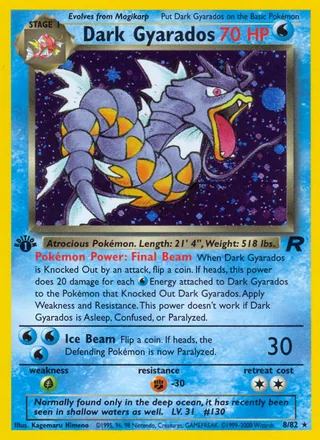
Ability Final Beam
A 70 HP holo Dark Stage 1. Ice Beam costs three Water for 30, and it carries the Pokémon Power Final Beam — the end of the two-step line that starts at Magikarp.
5 cards · listed in original order.
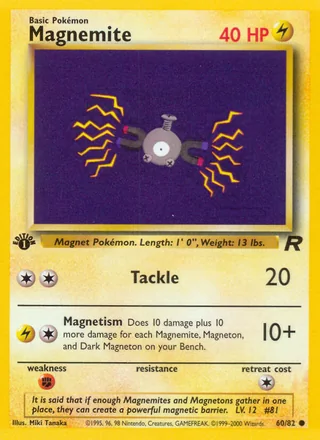
A 40 HP Magnemite. Tackle costs two Colorless for 20, Magnetism one Lightning and one Colorless for 10+ — the start of the line to Dark Magneton.
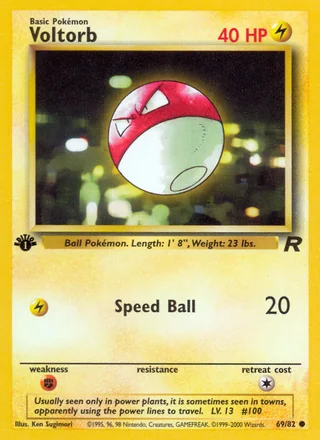
A 40 HP Voltorb. Speed Ball costs a single Lightning for 20 — among the cheapest 20 damage in the set. It evolves into Dark Electrode.
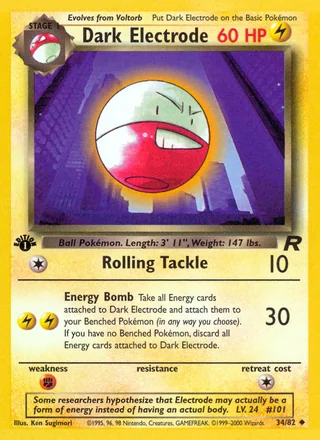
A 60 HP Dark Stage 1. Rolling Tackle costs one Colorless for 10, Energy Bomb two Lightning for 30 — two cheap attacks, unusually straightforward for a Dark Pokémon.
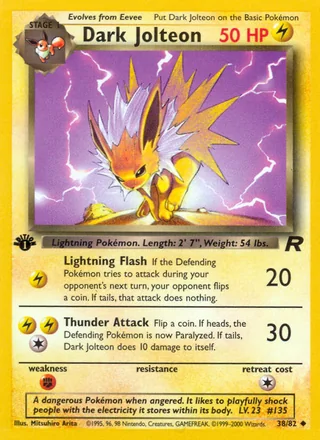
A 50 HP Dark Stage 1. Lightning Flash costs one Lightning for 20, Thunder Attack two Lightning and one Colorless for 30. Twenty HP below the ordinary Jolteon, in exchange for speed.
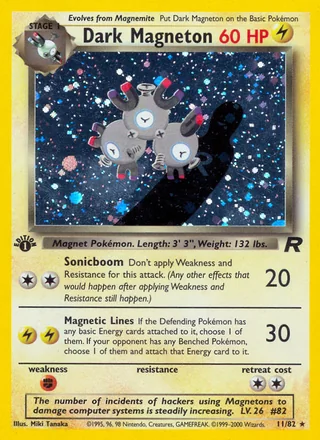
A 60 HP holo Dark Stage 1. Sonicboom hits for 40 and Magnetic Lines for 30 off two Lightning — two attacks at 40 and 30, an aggressively tuned Magneton.
7 cards · listed in original order.
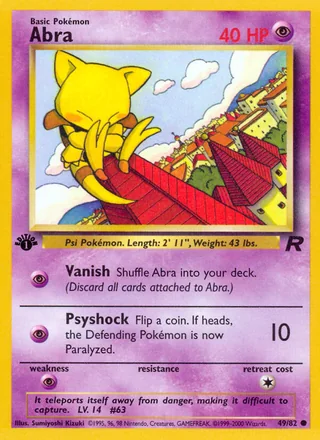
A 40 HP Abra. Both Vanish and the 10-damage Psyshock cost a single Psychic — a card built purely out of cheap options. It leads to Dark Kadabra and Dark Alakazam.
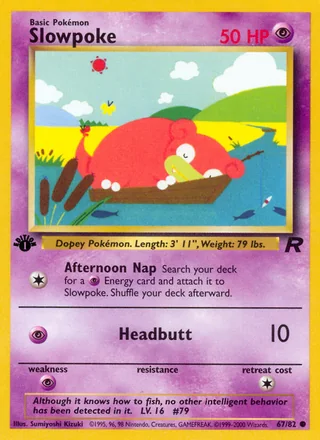
A 50 HP Slowpoke. Afternoon Nap costs one Colorless, Headbutt one Psychic for 10 — groundwork for Dark Slowbro.
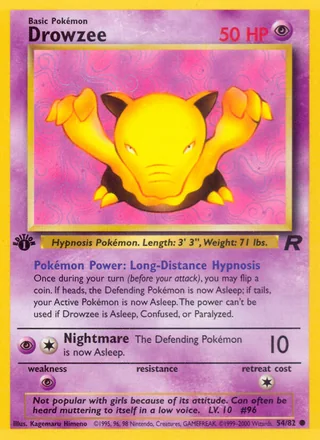
Ability Long Distance Hypnosis
A 50 HP Drowzee. Nightmare costs one Psychic and one Colorless for 10, and it carries the Pokémon Power Long Distance Hypnosis — the base for Dark Hypno.
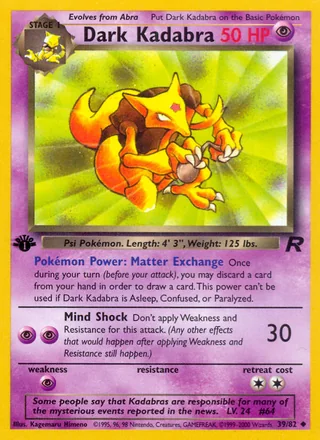
Ability Matter Exchange
A 50 HP Dark Stage 1. Mind Shock costs two Psychic for 30, and it carries the Pokémon Power Matter Exchange. Evolved from Abra, it leads on to Alakazam.
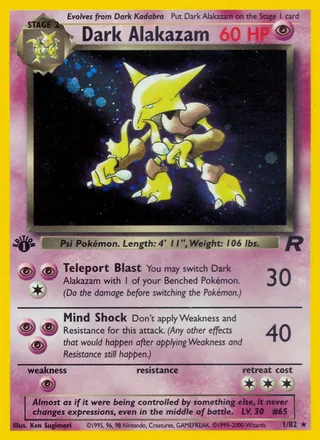
A 60 HP holo Dark Stage 2. Teleport Blast at 30 and Mind Shock at 40 both finish on two to three Psychic, and its HP stays at 60 — the Dark Pokémon tax on a Stage 2.
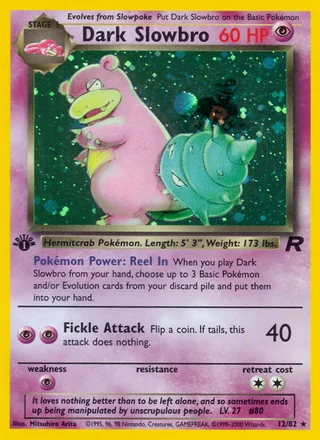
Ability Reel In
A 60 HP holo Dark Stage 1. Fickle Attack costs two Psychic for 40 — exceptional efficiency for a Stage 1. It also carries the Pokémon Power Reel In.
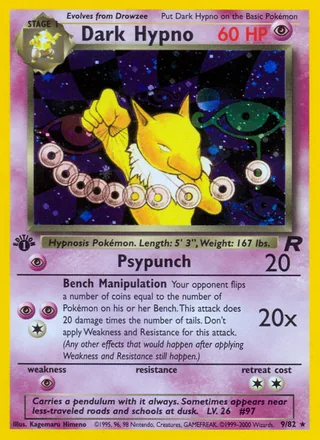
A 60 HP holo Dark Stage 1. Psypunch costs one Psychic for 20, Bench Manipulation two Psychic and one Colorless for 20× — a card that chips away cheaply.
7 cards · listed in original order.
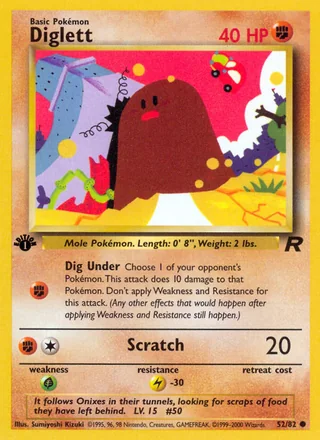
A 40 HP Diglett with zero retreat. Dig Under costs one Fighting, Scratch one Fighting and one Colorless for 20 — the start of the line to Dark Dugtrio.
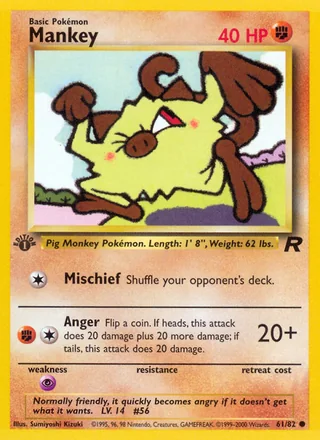
A 40 HP Mankey with zero retreat. Mischief costs one Colorless, Anger one Colorless and one Fighting for 20+ — it evolves into Dark Primeape.
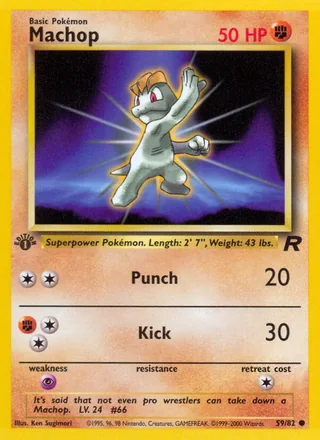
A 50 HP Machop. Punch costs two Colorless for 20, Kick one Fighting and two Colorless for 30 — the first step of the three-stage line to Dark Machoke and Dark Machamp.
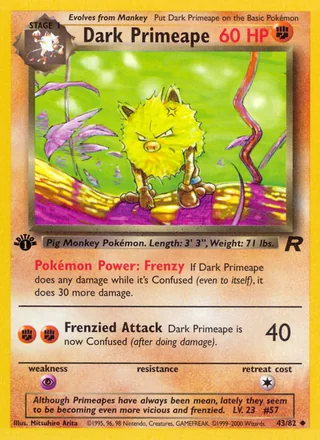
Ability Frenzy
A 60 HP Dark Stage 1. Frenzied Attack costs two Fighting for 40, and it carries the Pokémon Power Frenzy — one attack, 40 damage, unusually aggressive for a Dark Pokémon.
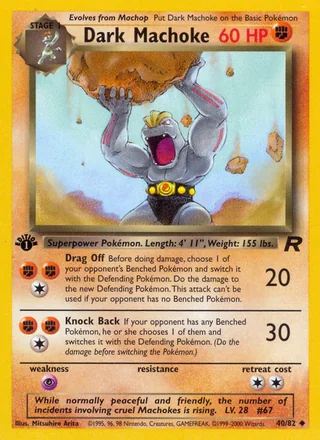
A 60 HP Dark Stage 1. Drag Off at 20 and Knock Back at 30 cost the same two Fighting and one Colorless. One step from Dark Machamp.
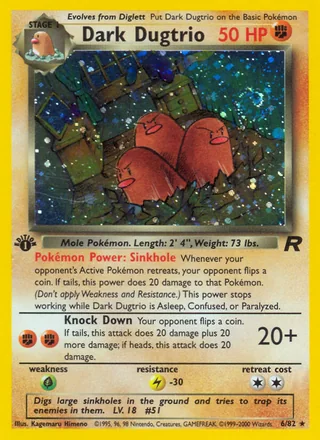
Ability Sinkhole
A 50 HP holo Dark Stage 1. Knock Down costs two Fighting for 20+, and it carries the Pokémon Power Sinkhole — evolved from Diglett, it is the disruptive piece in a Fighting deck.
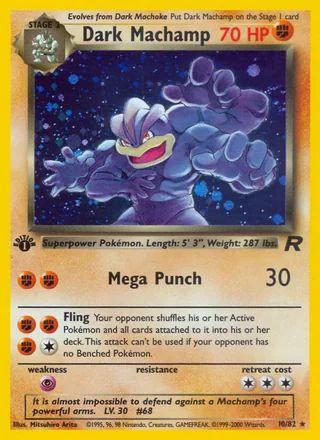
A 70 HP holo Dark Stage 2 with retreat cost 3. Mega Punch costs two Fighting for 30, Fling three Fighting and one Colorless. Even as a Dark Stage 2, its HP stays capped at 70.
9 cards · listed in original order.
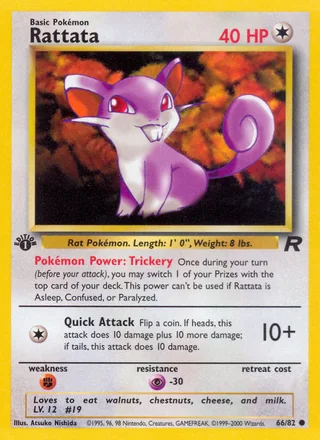
Ability Trickery
A 40 HP Rattata with zero retreat. Quick Attack costs one Colorless for 10+, and it carries the Pokémon Power Trickery. It evolves into Dark Raticate.
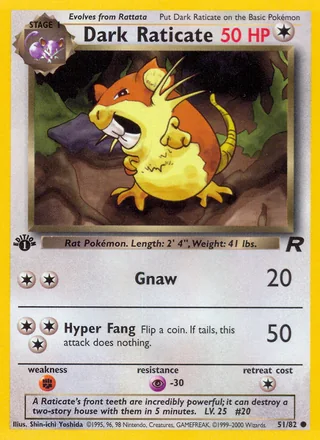
A 50 HP Dark Stage 1. Gnaw costs two Colorless for 20, Hyper Fang three for 50 — reaching 50 on Colorless alone was rare in this set.
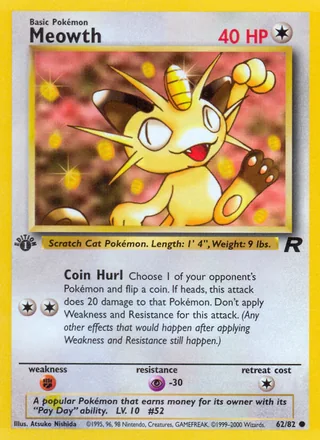
A 40 HP Meowth with one attack that deals no damage — Coin Hurl, at two Colorless. A card that exists to become Dark Persian.
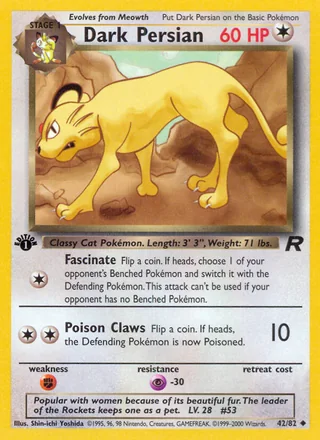
A 60 HP Dark Stage 1 with zero retreat, running Fascinate and a 10-damage Poison Claws. A card of the same name was also given out through the fan club that month; this is the pack version.
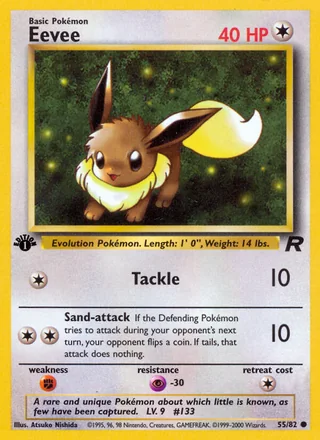
A 40 HP Eevee. Tackle and Sand-attack both cost one or two Colorless. The second Eevee of the year, and this one evolves into the Dark versions of the three evolutions.
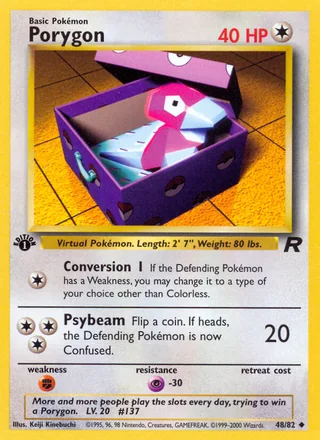
A 40 HP Porygon with zero retreat. Conversion 1 costs one Colorless, Psybeam three for 20. It arrived on a card in the same year the anime episode featuring it caused a national incident.
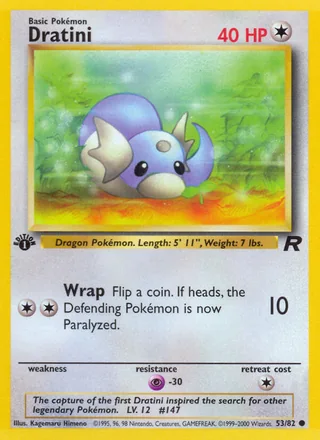
A 40 HP Dratini with a single attack — Wrap, two Colorless for 10. The first step of the three-stage line to Dark Dragonair and Dark Dragonite.
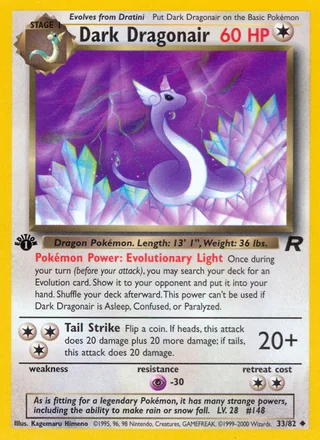
Ability Evolutionary Light
A 60 HP Dark Stage 1. Tail Strike costs three Colorless for 20+, and it carries the Pokémon Power Evolutionary Light. One step from Dark Dragonite.
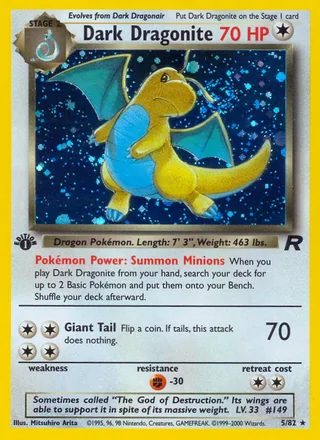
Ability Summon Minions
A 70 HP holo Dark Stage 2. Giant Tail costs four Colorless for 70, and it carries the Pokémon Power Summon Minions. Four Colorless for 70 is among the biggest hits in the set.
9 cards · listed in original order.
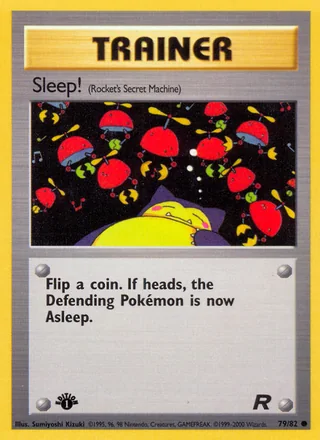
Flip a coin. If heads, the Defending Pokémon is now Asleep.
Flip a coin; on heads the Defending Pokémon is Asleep. No damage at all — but decks of this era valued a single skipped turn highly enough to run it.
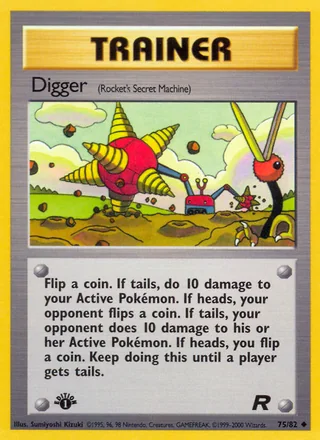
Flip a coin. If tails, do 10 damage to your Active Pokémon. If heads, your opponent flips a coin. If tails, your opponent does 10 damage to his or her Active Pokémon. If heads, you flip a coin. Keep doing this until a player gets tails.
A Trainer decided entirely by flips: tails puts 10 damage on your own Active Pokémon; heads makes your opponent flip, and if they miss, the 10 lands on them.
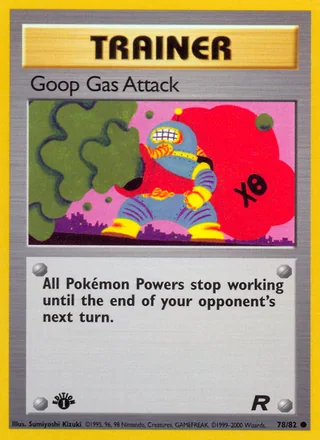
All Pokémon Powers stop working until the end of your opponent's next turn.
Stops every Pokémon Power until the end of your opponent's next turn. In a set where Dark Pokémon work through powers, this card was either devastating or dead depending on the matchup.
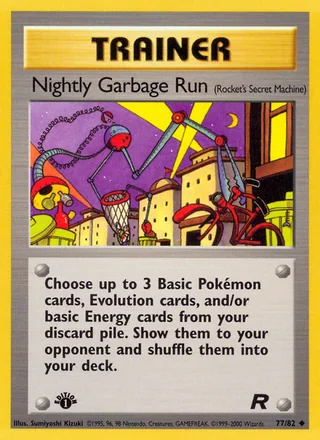
Choose up to 3 Basic Pokémon cards, Evolution cards, and/or basic Energy cards from your discard pile. Show them to your opponent and shuffle them into your deck.
Pick up to three Basic Pokémon, Evolution cards and/or basic Energy cards from your discard pile and shuffle them back in. Dark cards burn through the discard, so this is what stops a deck from running dry.
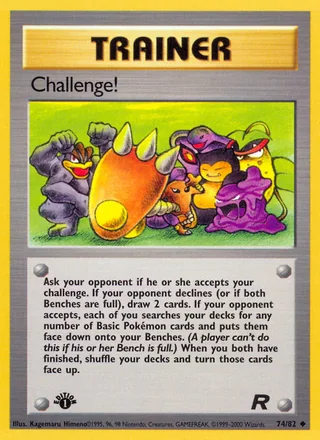
Ask your opponent if he or she accepts your challenge. If your opponent declines (or if both Benches are full), draw 2 cards. If your opponent accepts, each of you searches your decks for any number of Basic Pokémon cards and puts them face down onto your Benches. (A player can't do this if his or her Bench is full.) When you both have finished, shuffle your decks and turn those cards face up.
You challenge your opponent: if they decline, you draw two cards; if they accept, they flip a coin. A negotiation rather than a rule — very much a 1997 idea.
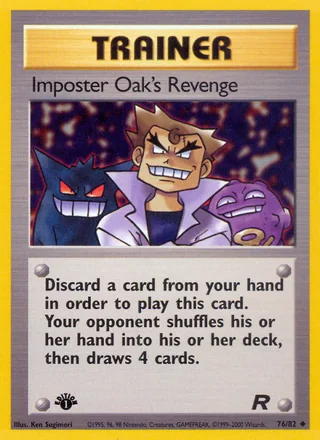
Discard a card from your hand in order to play this card. Your opponent shuffles his or her hand into his or her deck, then draws 4 cards.
Discard one card to play it: your opponent shuffles their hand into their deck and draws four. It breaks their hand — and hands them four fresh cards to do it.
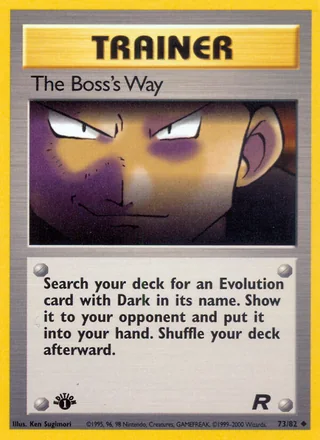
Search your deck for an Evolution card with Dark in its name. Show it to your opponent and put it into your hand. Shuffle your deck afterward.
Search your deck for an Evolution card with Dark in its name. A search card written specifically for decks built on Dark Pokémon.
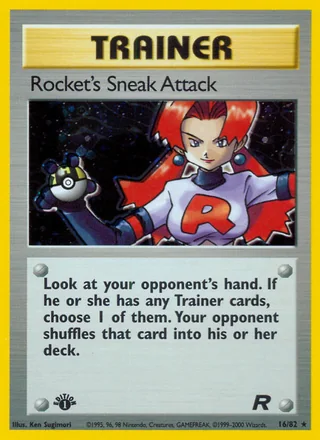
Look at your opponent's hand. If he or she has any Trainer cards, choose 1 of them. Your opponent shuffles that card into his or her deck.
Look at your opponent's hand and shuffle one Trainer card back into their deck — a holo Trainer that takes one card out of their plan, exactly the kind of interference this set runs on.
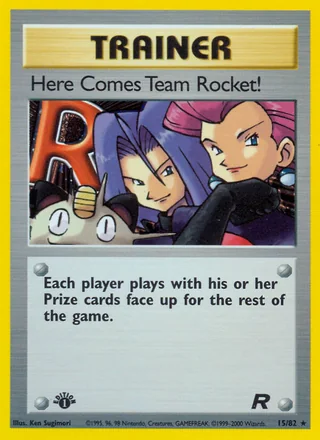
Each player plays with his or her Prize cards face up for the rest of the game.
The set's secret card. It changes a rule: both players play with their Prize cards face up for the rest of the game. Numbered 062, it sits inside the ordinary run of 65.
3 cards · listed in original order.
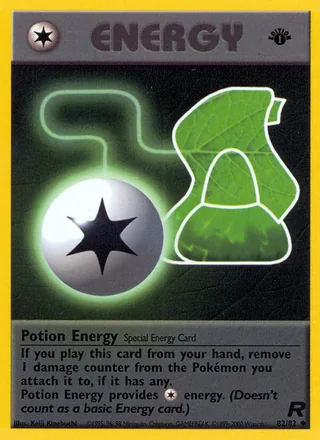
If you play this card from your hand, remove 1 damage counter from the Pokémon you attach it to, if it has any. Potion Energy provides Colorless energy. (Doesn't count as a basic Energy card.)
An Energy that removes one damage counter from the Pokémon it is attached to, and provides Colorless. Dark Pokémon run low on HP, so this one counter often decided whether something survived.
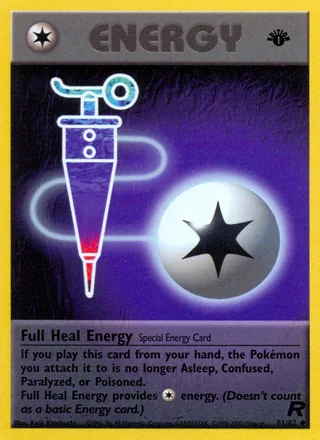
If you play this card from your hand, the Pokémon you attach it to is no longer Asleep, Confused, Paralyzed, or Poisoned. Full Heal Energy provides Colorless energy. (Doesn't count as a basic Energy card.)
An Energy that clears Asleep, Confused, Paralyzed and Poisoned from the Pokémon it is attached to, while providing Colorless. It was the usual answer to decks that won by inflicting conditions.
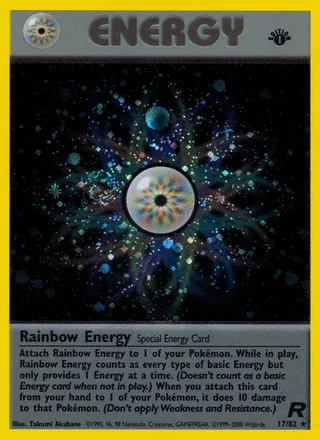
Attach Rainbow Energy to 1 of your Pokémon. While in play, Rainbow Energy counts as every type of basic Energy but only provides 1 Energy at a time. (Doesn't count as a basic Energy card when not in play.) When you attach this card from your hand to 1 of your Pokémon, it does 10 damage to that Pokémon. (Don't apply Weakness and Resistance.)
An Energy that counts as every type of basic Energy — but only ever provides one at a time. New in this set, and the card that made multi-colour decks practical for the first time.
International Jungle, 64 cards. On top of the 48 Japanese cards it adds 16 non-holo prints that exist only in English — the same 16 rares, printed a second time without foil.
International Fossil, 62 cards. It does not include Mew, which the Japanese set had. Mew was issued separately as Black Star Promo #8.
Base Set 2, 130 cards. A reprint set drawn from the first set, Jungle and Fossil — which gave many 1997 cards a second printing.
International Team Rocket, 82 cards plus one secret. Seventeen more than the Japanese 65, with additional Dark Pokémon.
Japanese and international releases do not contain the same number of cards, even when the artwork matches. Different printers, different markets — they are still priced separately today. Treating a 1997 Japanese card and its 1999 English counterpart as “the same card” will misread the market.
Release dates and product identities are connected to the Japanese edition release register by set code. Sources are printed per product so a reader can check the claim without trusting this page alone. Unmatched products say so instead of borrowing another edition’s citation.
PMCG2 verified_secondaryPMCG3 verified_secondaryPMCG4 verified_secondaryCard names, set order, rarity and illustrators come from TCGdex's Japanese listings (PMCG2 / PMCG3 / PMCG4) and pokemontcg.io's international listings (Jungle / Fossil / Team Rocket).
Set dates are the official release dates. Promo dates follow the magazine on-sale date and the distribution window. Where a cover date and an on-sale date differ, the card is filed under the year it went on sale.
Card images are scans of the international release with the same artwork. No public scans of the 1997 Japanese cards exist, so the international print stands in. Where the artwork itself differs between the two, the entry says so.
HP, attack names and damage follow the international card text. The Japanese dataset mixes machine translation into attack names and effects (e.g. “call the family”, “敏ility性”), so it cannot be cited as the official wording.
For 17 of the insert and distribution cards, no public scan of the card face could be found. Those entries are described in text only, without a card image — they are not cards that failed to exist.
Pack prices, pack spreads and box counts follow what the publisher (Media Factory) printed at the time. Prices are the original retail prices including tax, not current market values. The 1st Starter Pack was printed as ¥1,300 excluding tax, so it is listed that way.
1997 · 3 sets / 161 cards / 24 promo entries