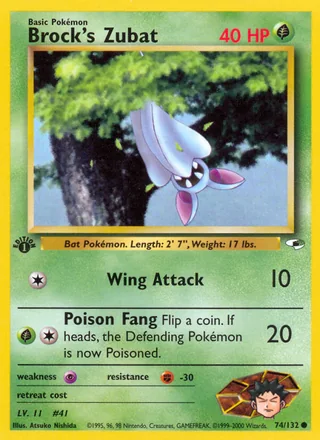
Brock's Zubatタケシのズバット
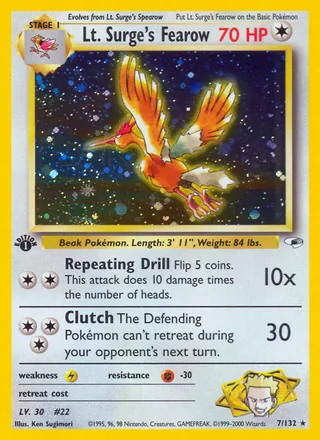
40 HP with zero retreat. Wing Attack costs a single Colorless for 10, so it can act on the first turn without any Grass attached. Only two of Brock's eighteen cards are Grass, and this is one of them.
Pokémon TCG Almanac · 1998
Japanese edition1 set · 96 cards
Every card in this yearbook was printed in Japan. Leader's Stadium reached English players in 2000 as Gym Heroes and Gym Challenge, which recombined Japan's fifth and sixth expansions into 132 cards each — the card lists do not line up one to one. Those printings are covered in the 2000 English edition.
Leader's Stadium, the fifth expansion — 96 cards that carry a Gym Leader's name, one by one.
Through 1996 and 1997 the cards showed wild Pokémon. That changes with the fifth expansion in October 1998: names now start with a Gym Leader — Brock's Onix, Misty's Psyduck — so the same species becomes a different card depending on whose it is.
How you bought them changed too. Three times — March, June, November — came vending-machine Expansion Sheets at 100 yen for three cards. April and July brought four preconstructed decks, one per Gym Leader. Same year, three different routes: open a pack, peel a sheet, or buy a box.
Each entry shows the card face on the left and name, HP, type, stage, artist and attacks on the right. Attack names and effect text stay in the international English wording, set off by a thin rule. The pack-details block below each set carries the original price, pack spread and publisher.
Card faces are scans of the international print (Gym Heroes / Gym Challenge). No public scans of the Japanese originals exist, so the international printing with the same artwork and attacks stands in. All 96 are stand-ins — none of them is a scan of the Japanese original.
This page documents 96 main-series cards across one product on one release date in 1998. It covers cards printed in Japan only; printings for other editions are tracked separately.
| Publication edition | Japanese edition |
|---|---|
| Products | 1 |
| Cards | 96 |
| Release dates | 1 (1998-10-24) |
| Series codes | gym1 |
| Card faces on record | all 96 |
| Latest release on record | 1998-10-24 |
5th expansion · Leader's Stadium (1998-10-24, 96 cards).
How many main-series cards does this page record for 1998?96 cards across one product, an average of 96.0 cards per product. This is the main-series archive count, not a claim that every promo and event card from the year is itemised here.
What release dates does this page cover?1 release date, 1998-10-24.
How many of these 96 cards are shown with a card face?All 96 cards have a card face on record.
The Trade Please campaign opens, running to 31 July. Four cards went out over the period: Venusaur, Charizard, Blastoise and the Trainer card Trade Please! It was the first time all three starters' final forms were given away together.
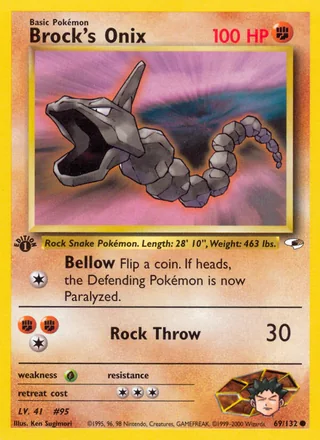
CoroCoro Comic's March issue carried Brock's Onix and Misty's Staryu. Cards with a Gym Leader's name reached readers eight months before the fifth expansion — they appeared in a magazine before they appeared in a pack.
Three cards in CoroCoro's April issue: Jynx, Cubone and Farfetch'd. None of them entered the fifth expansion — these artworks exist only as this insert.
Expansion Sheet Series 1 (Blue) reaches vending machines. 100 yen bought one sheet with three cards. The 18 sheet numbers each hold fixed contents, so collecting sheets 1–18 assembles all 36 cards. You did not open these — you peeled them off the sheet.
CoroCoro's May issue came with the Mewtwo Strikes Back jumbo card, timed to the July film. It is printed larger than a standard card.
Two preconstructed decks launch together: Nivi City Gym (Brock) and Hanada City Gym (Misty). Each is 60 cards plus four extra cards, 64 in all. Most of the contents were not yet in any pack — they were later folded into the fifth expansion.
The June issue carried the Pikachu's Summer Vacation jumbo card, promoting the short that screened alongside the film. Also jumbo — made to sit next to the previous month's Mewtwo.
Expansion Sheet Series 2 (Red). Same system — 100 yen, three cards. It leans on Pokémon missing from the packs of the time, such as Vulpix, Snorlax and Slowpoke, and the sheet backs move from Rock Tunnel to the Seafoam Islands.
Mewtwo Strikes Back opens in cinemas. From here the film-tied handouts multiply — though they came through magazines and retail campaigns rather than cinema or advance-ticket offers, which is characteristic of this period.
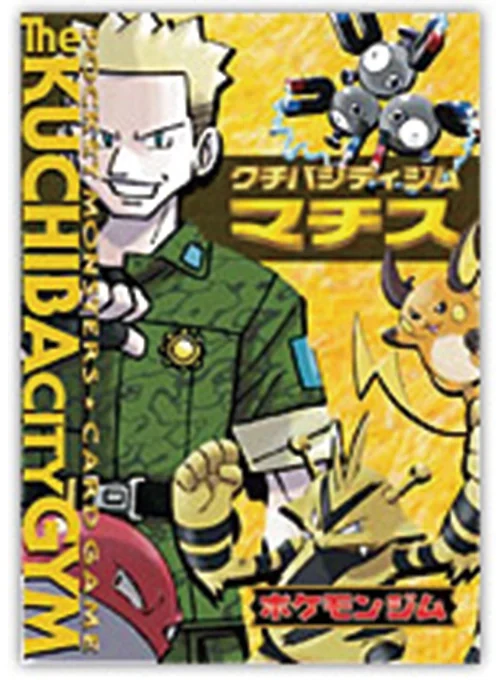
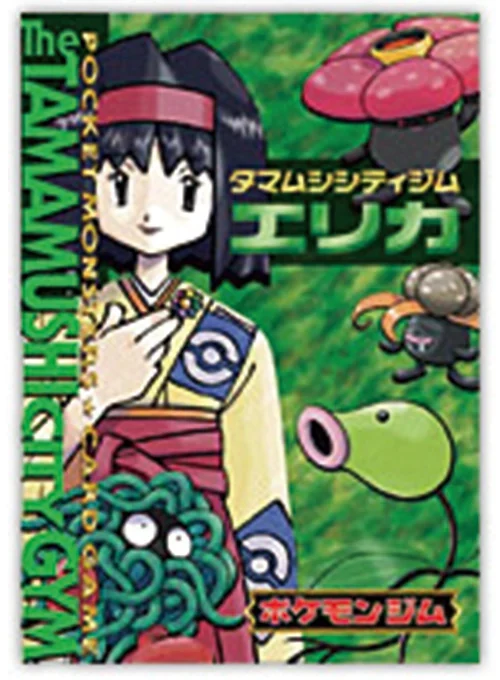
Two more decks: Kuchiba City Gym (Lt. Surge) and Tamamushi City Gym (Erika). Same 64-card build, and with that all four Gym Leaders had a deck — three months before the expansion itself went on sale.
CoroCoro's October issue: the Pokémon Plaza jumbo Stadium card plus a glossy Pikachu at standard size. One issue, two formats — a jumbo and a normal card in the same insert.
Leader's Stadium goes on sale: 96 cards, ten per pack, 291 yen. The first expansion whose cards carry a Gym Leader's name. Pack spread (six ●, three ◆, one ★) and price had not changed since the very first set.
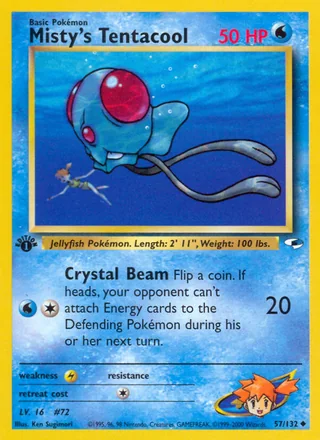
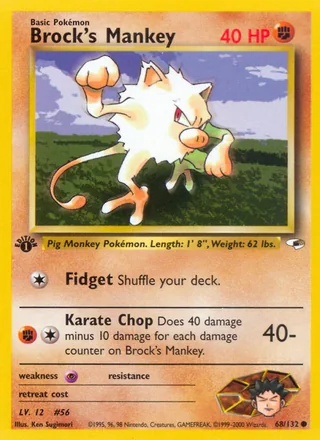
Four cards in CoroCoro's December issue: Brock's Mankey, Erika's Bulbasaur, Misty's Tentacool and Lt. Surge's Jolteon. Released right after the expansion, they line up with the Gym Leaders found in packs.
Expansion Sheet Series 3 (Green) changes the format. Each sheet now carries three normal cards plus one special card with a different back — mostly joke cards and extra-rule cards. The set totals 53 (36 normal + 17 special).
Pokémon Card GB ships for Game Boy at 3,500 yen. A video game built on the actual card game — the cards printed up to that year became its card pool. A sequel followed in 1999.
The cards you could not buy, in release order: CoroCoro inserts, the ANA campaign, parent-and-child tournament prizes, a how-to-play book's insert. Same year, entirely different routes to owning one.
10 Feb 1998 · Trade Please campaign
One of the four cards handed out during the campaign that ran from 10 February to 31 July. Three final evolutions plus one Trainer — unusual for a giveaway of this period, since all three starters appear together. The artwork is drawn for this campaign rather than reused from the first expansion.
10 Feb 1998 · Trade Please campaign
The Charizard from the same campaign — the one most often traded on its own of the four, standing well ahead of the other two starters. Charizard would be given away again by another route in 1999.
10 Feb 1998 · Trade Please campaign
The Blastoise from the same campaign. All three starters went out at the same time and by the same route, so these tend to survive as a four-card set rather than singly.
10 Feb 1998 · Trade Please campaign
The Trainer card that names the campaign. It turns the act of trading cards into a card — a sign that promotions of this period aimed at widening how people played rather than making decks stronger.
15 Feb 1998 · CoroCoro Comic, March 1998 issue
An insert in the March issue. The fifth expansion did not arrive until 24 October, so a card carrying a Gym Leader's name reached readers eight months before it reached shops. Readers had it before it was in any pack.
15 Feb 1998 · CoroCoro Comic, March 1998 issue
The other card in the same issue. All fifteen of Misty's cards in the fifth expansion are Water; this insert is a Water Staryu too, showing the one-type-per-Leader rule was already in place at the insert stage.
15 Mar 1998 · CoroCoro Comic, April 1998 issue
One of three inserts in the April issue. None of the three entered the fifth expansion — these artworks exist only as inserts. They are plain wild Pokémon, with no Leader's name attached.
15 Mar 1998 · CoroCoro Comic, April 1998 issue
From the April issue. Three inserts in a single issue was unusual that year — all standard size, with no jumbo among them.
15 Mar 1998 · CoroCoro Comic, April 1998 issue
The third card from the April issue. Farfetch'd has had few printings since the first expansion — it is simply a Pokémon that turns up rarely on a card.
15 Apr 1998 · CoroCoro Comic, May 1998 issue
A jumbo card in the May issue, doubling as promotion for the July film. It is printed larger than a standard card. The year produced three jumbos, and this is the first of them.
1998 · Garura parent-and-child tournament, participation prize
The participation prize at the parent-and-child tournament — a card made for this event rather than handed out at every tournament. Everyone who took part received one, unlike the Kangaskhan for winners, so it exists in far greater numbers. Sources disagree on the Japanese title, so the English name is used here.
1998 · Garura parent-and-child tournament, winner's prize
The winner's prize at the same tournament — only the winning pair received one, putting it two orders of magnitude below the participation card in number. As the card name suggests, the tournament itself was named after this Pokémon.
15 May 1998 · CoroCoro Comic, June 1998 issue
A jumbo card in the June issue promoting the short that screened with the film — same format as the previous month's Mewtwo. The two were designed to be displayed together, so pairs tend to survive in better condition than singles.
10 Jun 1998 · Pokémon Card Fan Club Vol.5 insert
The insert in fan club newsletter Vol.5. Same card name as the April tournament participation prize, but a different route. Mailed flat to members, these tend to be better preserved than the copies handed out on site.
1998 · Kamex Mega Battle, participation prize
The Trainer card given to entrants. Several printings with different artwork share this name, and this is the Kamex Mega Battle version. Its art differs from the December 1997 printing, so collectors treat them separately.
1998 · Kamex Mega Battle, regional winner
Given to the winner of each regional qualifier. The top three places each became a card, with the placing in the name. Only a few dozen exist, making this one of the oldest numbered tournament prize sets.
1998 · Kamex Mega Battle, regional runner-up
The runner-up's card. More were given out than No.1, which makes it the more obtainable of the three — though still rarely seen on the market.
1998 · Kamex Mega Battle, regional third place
The third-place card. The most widely distributed of the three, though it was still only available at tournament venues.
15 Jul 1998 · CoroCoro Comic, August 1998 issue
The August issue's insert and the only one of Lt. Surge's Pokémon in it. The same issue also carried Erika's Dratini, so two Leader-named cards shipped together. The fifth expansion holds a card of the same name (No.041, holofoil); the insert is a separate printing.
15 Jul 1998 · CoroCoro Comic, August 1998 issue
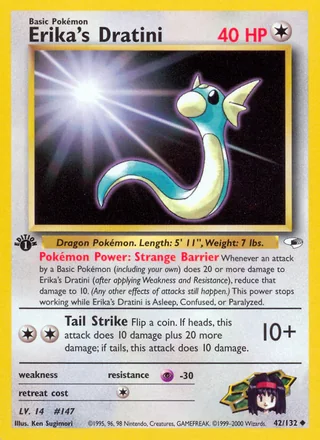
The other card in the August issue. Erika's line is mostly Grass, but this Dratini is Colorless — one of the few exceptions to a Leader's type. Five of her eighteen cards in the expansion are Colorless as well.
15 Sep 1998 · CoroCoro Comic, October 1998 issue
The October issue's jumbo, a Stadium card and the last of the year's three jumbos. Because Stadium cards stay in play, a large-format one was awkward to carry around, so most were kept at home for display.
15 Sep 1998 · CoroCoro Comic, October 1998 issue
The same October issue carried both a jumbo and a standard-size card — this is the standard one on glossy stock. 1998 is when glossy stock took over for magazine inserts and stayed until about 2001.
1–30 Nov 1998 · ANA 'Get in a Jet! Double Chance'
Handed out in the ANA campaign. A card of the same name had already been given away in October 1997; this is the second wave. Because the name repeats across two distributions, which printing you have has to be checked on the card itself.
1–30 Nov 1998 · ANA 'Get in a Jet! Double Chance'
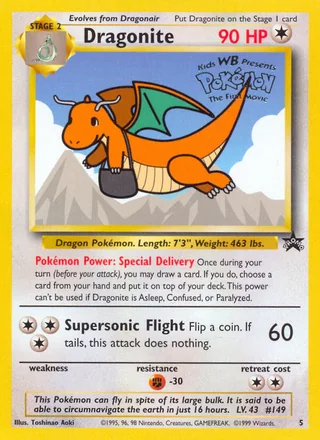
The other card in the same ANA campaign. Dragonite appears twice this year — this November ANA printing and a December game bonus, different in both route and artwork. One Pokémon, one year, two unrelated routes: a very 1998 pattern.

5 Nov 1998 · All Card Calendar
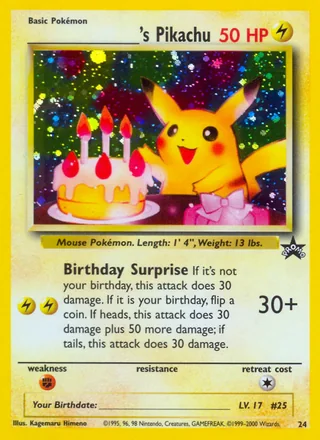
Came with a calendar. The name field is left blank — the card is designed for the owner to write their own name in. Not many were distributed, so examples that stayed unmarked are scarce.
13 Nov 1998 · how-to-play guidebook (latest edition)
An insert in a how-to-play booklet. Books carrying cards as inserts grew common around this time, serving as an on-ramp to playing. It came as a pair with the Dugtrio below.
13 Nov 1998 · how-to-play guidebook (latest edition)
The second card in the same booklet. Diglett and Dugtrio came together so the reader could try the evolution line straight away — an insert built to teach.
15 Nov 1998 · CoroCoro Comic, December 1998 issue
One of four inserts in the December issue, three weeks after the expansion went on sale on 24 October. The four cards line up with the Gym Leaders available in packs.
15 Nov 1998 · CoroCoro Comic, December 1998 issue
One of four inserts in the December issue, three weeks after the expansion went on sale on 24 October. The four split one per Gym Leader. A card of the same name is also in the packs, and collectors list the insert printing separately.
15 Nov 1998 · CoroCoro Comic, December 1998 issue
From the December issue. Four cards, one per Gym Leader — the arrangement shows the inserts were designed to promote the expansion. This one likewise shares its name with a card in the packs.
15 Nov 1998 · CoroCoro Comic, December 1998 issue
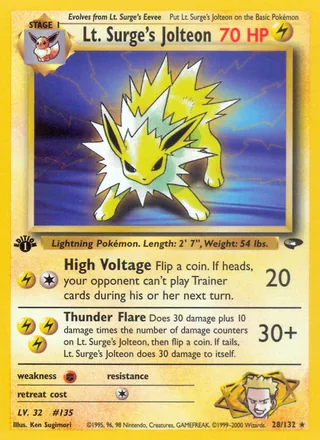
One of the four December inserts, filling Lt. Surge's slot — one card per Leader across the four. Surge's cards in the fifth expansion run seven Lightning and five Colorless, and this Jolteon is Lightning. A card of the same name (No.042) is in the pack as well.

18 Dec 1998 · Pokémon Card GB (Game Boy)
Bundled with the Game Boy game Pokémon Card GB. The artwork differs from the November ANA card — the second of the two Dragonites that appeared in 1998. The game itself shipped on 18 December at 3,500 yen.
Tournament prizes such as the No.1–No.3 Trainer cards were handed out in the dozens, and for some the only record of distribution is individual players' accounts. Dates are given only where known; otherwise the entry carries the year alone.

Fifth expansion and the start of the Gym line — the first set where cards carry a Gym Leader's name. Pack spread and the 291 yen price had not changed since the very first set. Japan received 96 cards, 16 of them holofoil.
Four Gym Leaders — Brock, Erika, Misty, Lt. Surge — plus Team Rocket. 66 Pokémon and 30 Trainer cards. Each Leader sticks to a type: all fifteen of Misty's are Water, Erika runs thirteen Grass, Lt. Surge seven Lightning, Brock twelve Fighting.
Evolution breaks down as 42 Basic, 21 Stage 1 and only 3 Stage 2 — each Leader's ace gets a single slot. Of the 30 Trainer cards, 15 carry one of the four Leaders' names, or 17 once the two Team Rocket cards are counted; the remaining 13 are gym facilities and shared cards.
16 cards · listed in original order.

40 HP with zero retreat. Wing Attack costs a single Colorless for 10, so it can act on the first turn without any Grass attached. Only two of Brock's eighteen cards are Grass, and this is one of them.

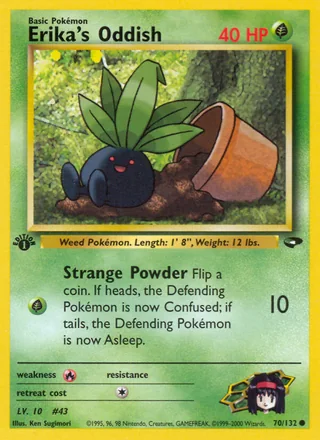
50 HP. The one-Grass attack deals no damage; 20 requires Grass plus Colorless. There is a second Erika's Oddish in this set, so which one you run more of changes how the line attacks.

40 HP and ten damage for one Grass — it can act every turn off a single energy, which makes it the faster of the two Oddish.

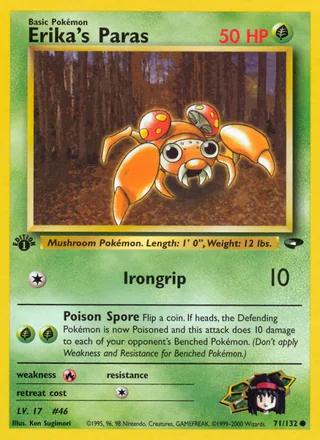
50 HP. Ten damage for one Colorless is cheap, while the two-Grass Poison Spore goes after status. A card to hold the board while you work toward Parasect.

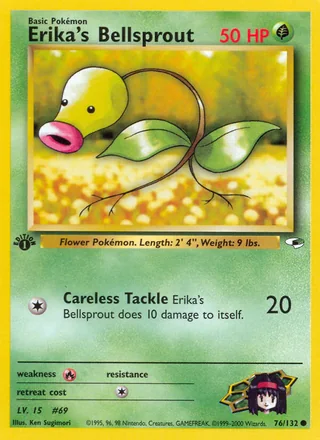
50 HP and 20 damage off a single Colorless — it attacks without any Grass attached, which makes it one of the easier early attackers in the line.

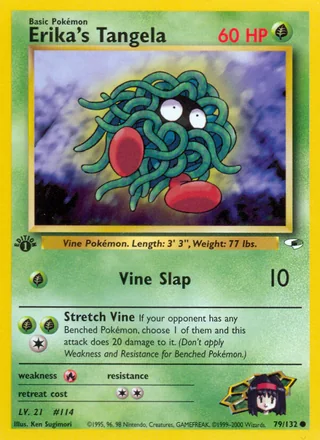
60 HP but a retreat cost of 2. Tough for a Basic, yet expensive to pull back once it is out front.

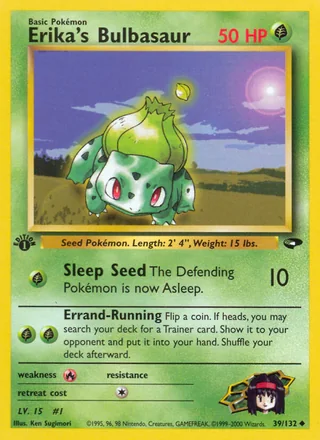
50 HP. Alongside ten damage for one Grass, the two-Grass Errand-Running searches the deck — a card that fixes its own hand while attacking, unusual for the time.

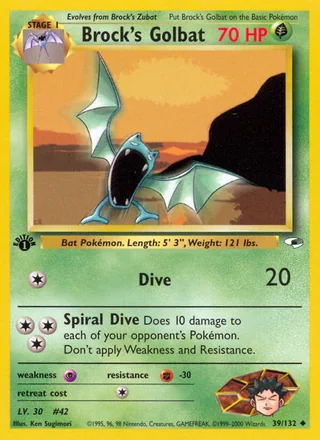
A 70 HP Stage 1 that runs entirely on Colorless, so it slots into a Fighting deck unchanged. Spiral Dive only does 10 for three, but with retreat 1 it can sit and grind.

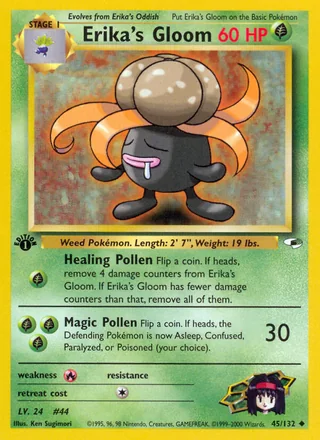
A 60 HP Stage 1. One Grass heals, three Grass inflicts status — built to keep the board alive rather than push damage, on the way up to Vileplume.

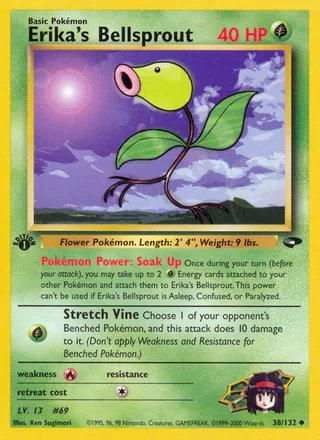
40 HP with a single attack: ten for one Grass. Same name as 005 but different HP and rarity — this one is the ◆ printing. In practice 005 is the easier of the two to build with.

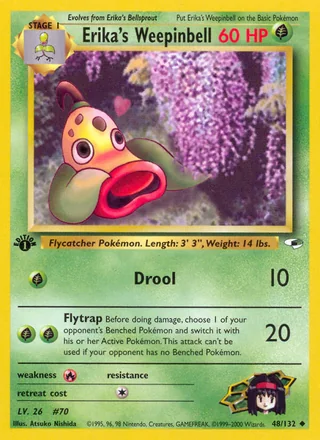
A 60 HP Stage 1 with honest ratios — ten for one Grass, twenty for two — so nothing is wasted on the way to Victreebel.

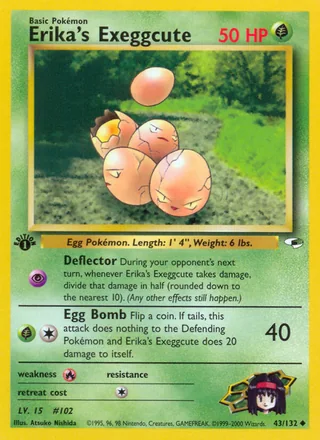
50 HP. Deflector costs one Psychic, Egg Bomb Grass plus Colorless. A single Psychic energy was worth a slot just for this — a very 1998 arrangement.

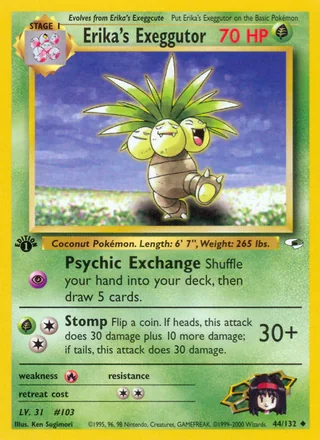
A 70 HP Stage 1 with Psychic Exchange — one Psychic lets you look at their hand — and a three-Grass Stomp for 30+. It buys information as well as damage.

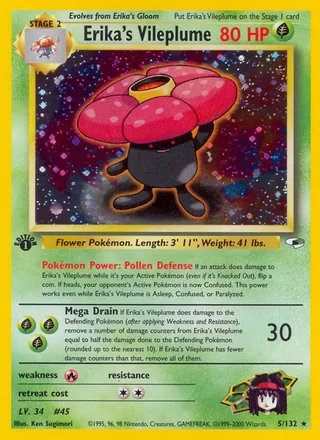
Erika's ace: an 80 HP Stage 2 holo. Mega Drain costs three Grass for 30 and heals — it removes damage while attacking — but three energy is heavy, so it cannot come down early.

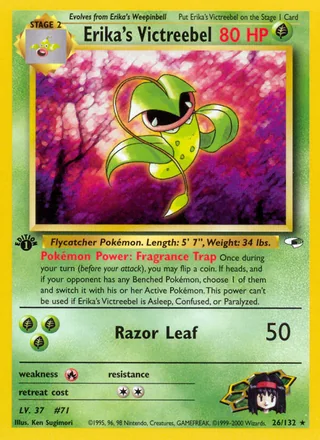
An 80 HP Stage 2 doing 50 for three Grass. No healing, no status — in exchange it hits 20 harder than Vileplume, straight up.

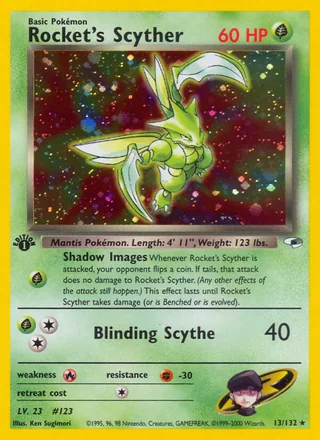
Only three Team Rocket cards appear in this set, and this holo is one of them. One Grass holds the board, three Grass pays 40. A holo on a non-Leader Pokémon says a lot about this set.
4 cards · listed in original order.

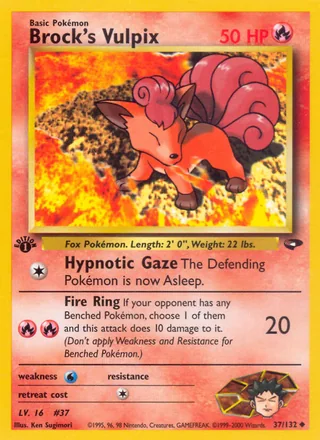
50 HP. One Colorless buys Hypnotic Gaze; two Fire pay 20. Brock is a Fighting Leader but keeps a Fire Vulpix too — this and 018 are his only Fire cards.

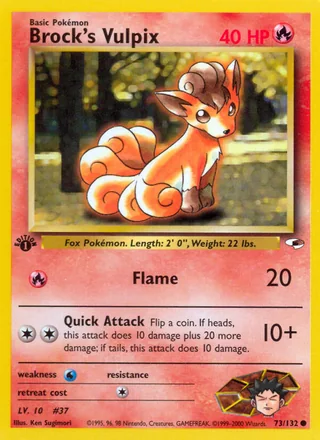
40 HP and 20 damage off a single Fire — lighter than 017, better for an early push. With two cards sharing this name, you decide the split before you build.

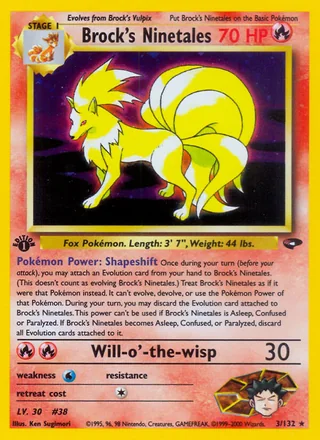
A 70 HP Stage 1 holo doing 30 for two Fire — a straightforward line for this set. Which of the two Vulpix you evolve from decides when it can arrive.

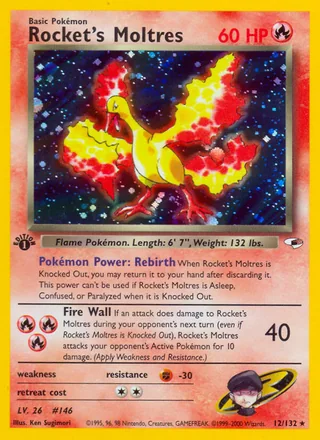
A Basic holo Moltres: 40 damage for three Fire. Holo Basics were rare then, and being able to put a big card down without spending turns on evolution is what made it playable.
15 cards · listed in original order.

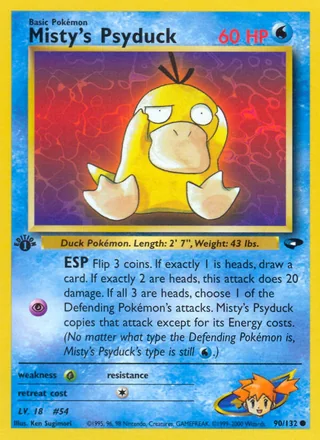
60 HP — tough for a Basic — but its only attack costs a single Psychic and deals no damage. It exists to sit there until you can evolve into Golduck.

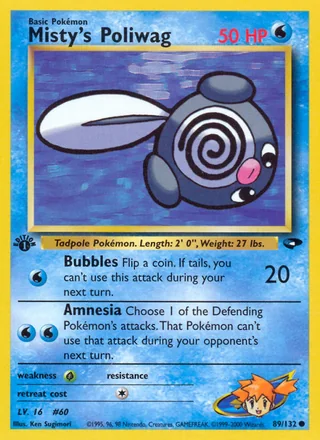
50 HP. 20 damage for one Water is cheap, and the two-Water Amnesia shuts off an attack. All fifteen of Misty's cards are Water, and this is no exception.

50 HP. Ten for one Water, ten for Water plus Colorless — cheap either way and light on damage. A body to place early on the way to Dewgong.

50 HP with zero retreat. Twenty for two Water and nothing else — but retreating is free, so you can move it in and out while building toward Seadra.

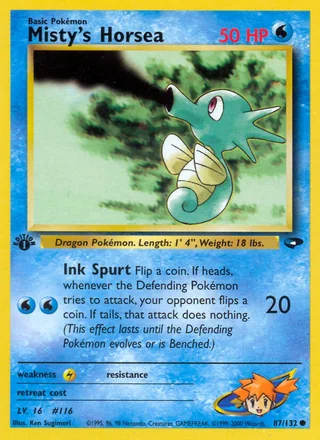
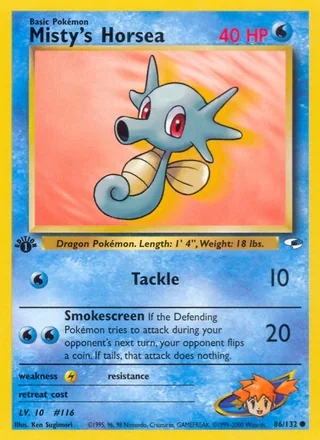
40 HP and ten for one Water — a step lighter than 024, so it moves earlier. With two Horsea sharing this name, which one you run thicker changes the tempo.

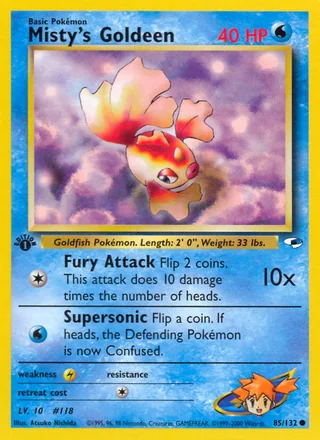
40 HP. The one-Colorless Fury Attack scales on coin flips and works before any Water is attached; one Water buys Supersonic for confusion. A flexible little card.

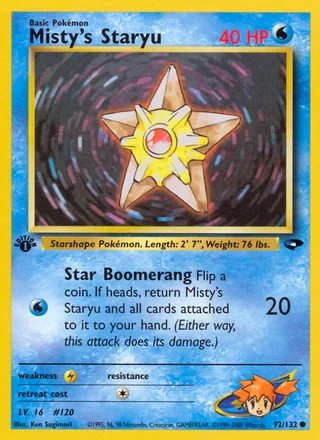
40 HP and 20 damage off a single Water. It also went out early as the CoroCoro March issue insert, so both an insert and a pack version exist.

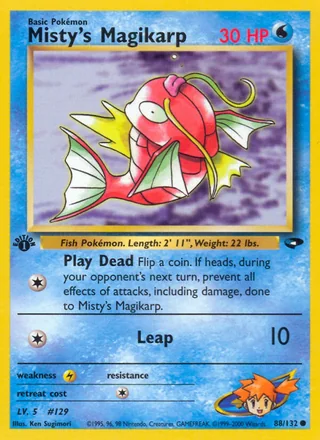
30 HP — among the softest in the set. One Colorless buys Play Dead to survive a turn, another pays for Leap at 10. It exists to be evolved into Gyarados.

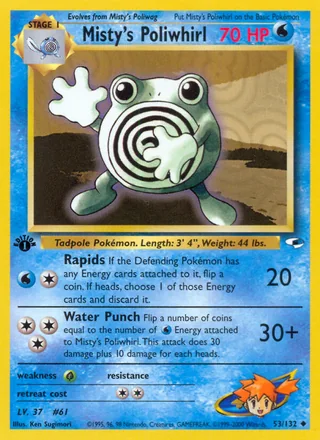
A 70 HP Stage 1: 20 for Water plus Colorless, 30+ for three Colorless. It works without loading up on Water, which makes it an easy mid-step.

50 HP with a single attack: 20 for Water plus Colorless. A body to hold the board until it becomes Tentacruel. A card of the same name also went out as the November issue insert.

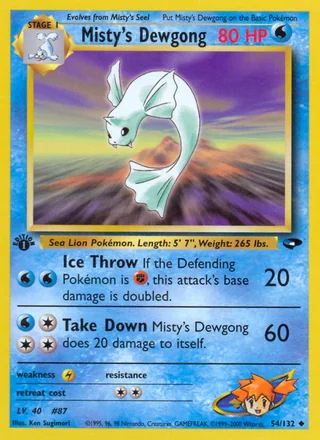
An 80 HP Stage 1 whose main attack is 60 for four Water. Take Down recoils, but 60 is among the higher numbers in this set.

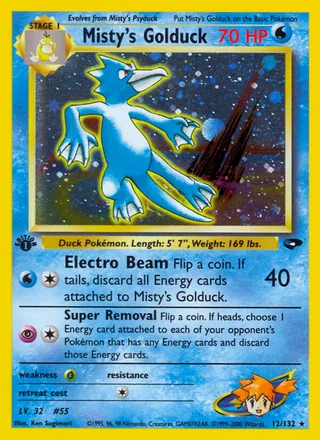
A holo Stage 1 doing 40 for just Water plus Colorless — cheap for that damage. One Psychic also unlocks Super Removal, which strips energy off the opponent.

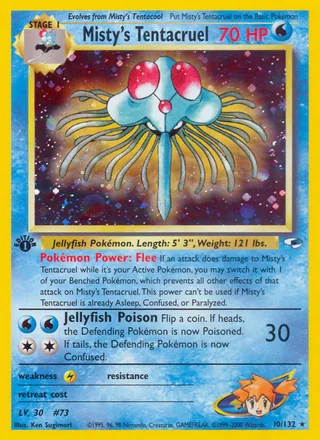
A 70 HP holo with a single four-Water attack. Retreat cost 0 means once it is out, it stays out.

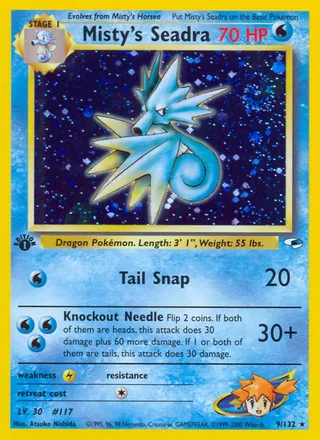
A 70 HP holo with two gears: 20 for one Water, 30+ for three. Which of the two Horsea you evolve from decides the turn it can arrive.

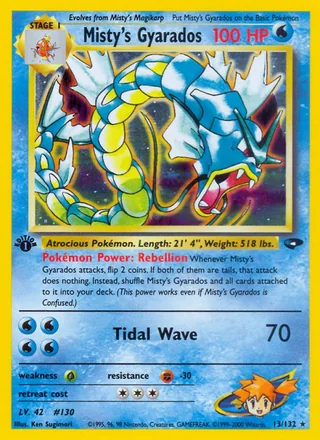
The heaviest hitter in the set: 100 HP and 70 damage for four Water. It must be evolved from a 30 HP Magikarp, so protecting that Magikarp becomes the deck's whole design.
7 cards · listed in original order.

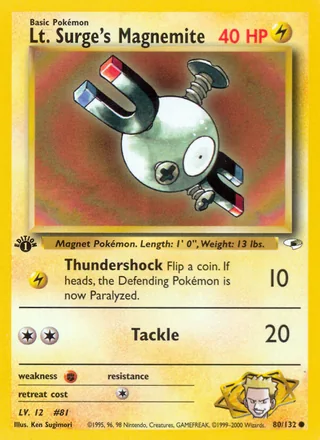
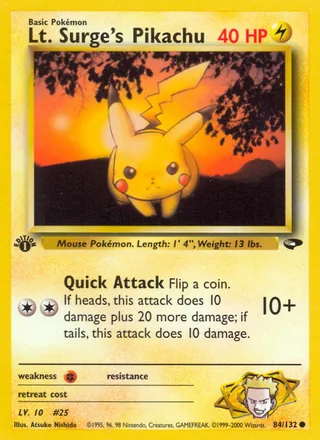
40 HP with a single attack: 10+ for two Colorless. It swings without any Lightning attached, so it can lead in a Surge deck.

40 HP — ten for one Lightning, twenty for two Colorless, both cheap. A step toward Magneton.

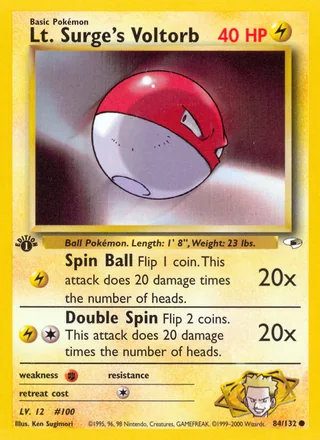
40 HP with two coin-flip attacks, either working off one Lightning. The average is low, but it is never a bad card to have down early.

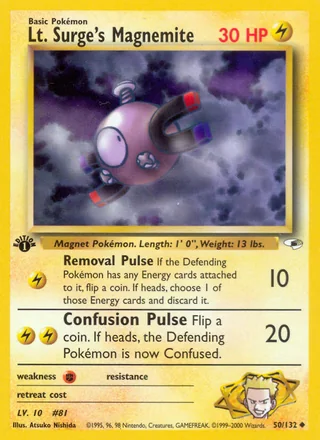
30 HP — soft — but ten for one Lightning and twenty for two. Same name as 037, and this one is the ◆ printing.

A 70 HP holo doing 50 for four Lightning — the heaviest Lightning hit in the set, and the end point of a Surge deck.

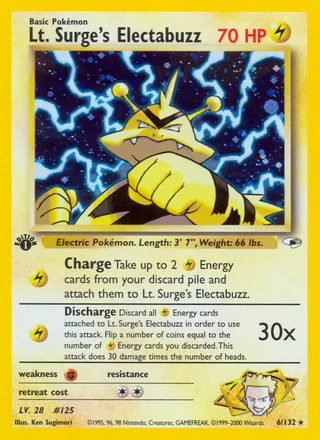
A Basic holo at 70 HP: Discharge does 30× for two Lightning. A big card without spending turns on evolution. A card of the same name had already gone out as the July issue insert.

A 70 HP Stage 1: 20 for Lightning plus Colorless, 30+ for three Lightning. A card of the same name also came as the November issue insert.
13 cards · listed in original order.

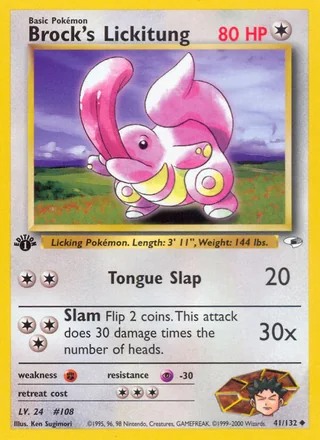
50 HP with one attack: 20 for two Fighting. One of Brock's twelve Fighting cards, made to be placed early.

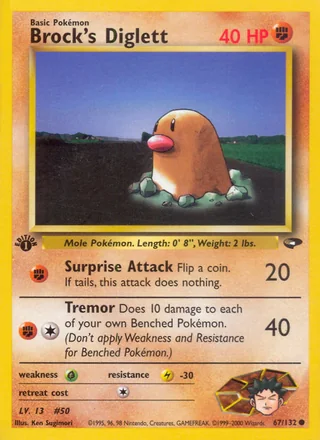
40 HP. The one-Fighting Surprise Attack rides a coin flip, and 40 costs Fighting plus Colorless — cheap, with a wide swing.

40 HP and free retreat. One Colorless buys Fidget to stall; Karate Chop for Fighting plus Colorless is the real attack. A same-named card also came as the November insert.

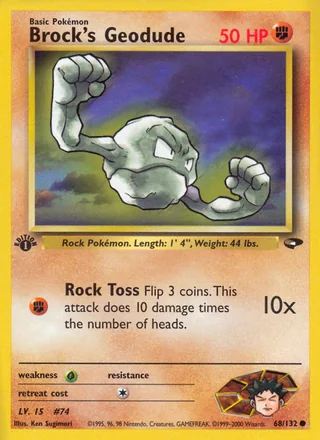
50 HP with one attack: 10× for a single Fighting. Damage scales on flips, giving an early, steady number.

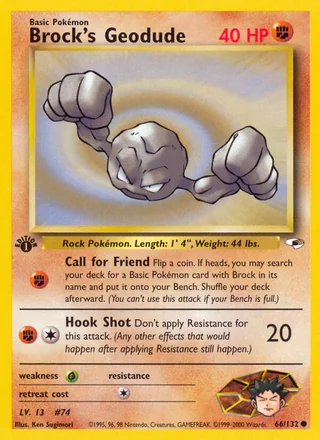
40 HP. One Fighting buys Call for Friend, fetching a Basic from the deck to build the bench. One of two cards sharing this name.

100 HP on a Basic — among the toughest cards here. Retreat 3 makes it sluggish and 30 costs three Fighting. It is a wall, and it had already appeared as the February CoroCoro insert.

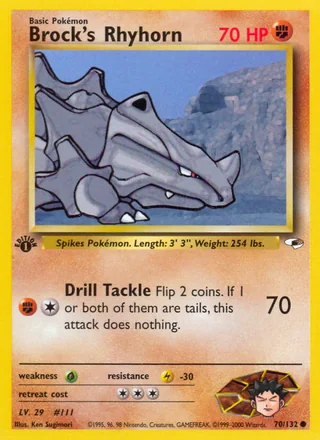
A 70 HP Basic with one attack, Drill Tackle, for Fighting plus Colorless. Retreat 3 is heavy, so it is meant to stay put — and it is the starting point for Rhydon.

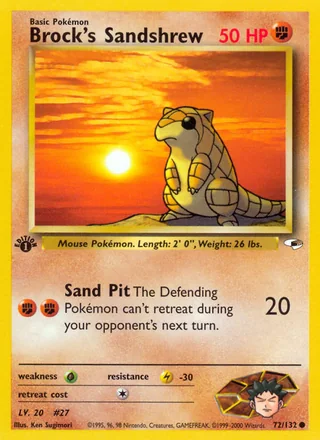
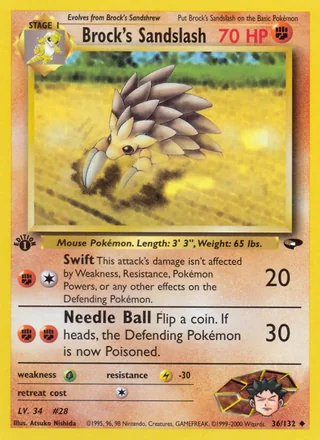
A 70 HP Stage 1. 20 for Fighting plus Colorless is cheap, and the second attack costs two Fighting. Evolving from Sandshrew raises the damage without slowing the tempo.

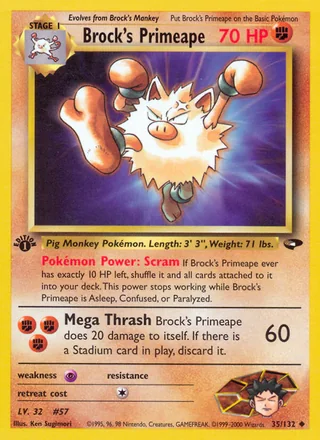
A 70 HP Stage 1 with a single attack: 60 for three Fighting. No recoil, but three energy is heavy — you plan for the two turns it takes to come out of Mankey.

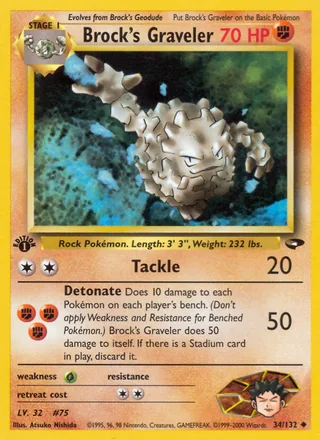
A 70 HP Stage 1 with both gears covered: 20 for two Colorless, 50 for three Fighting. A waypoint on the road to Golem.

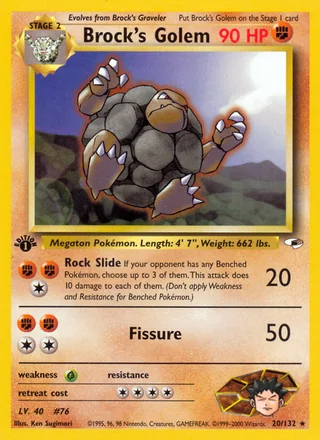
Only three Stage 2 cards exist in this set, and this is one. 90 HP, 20 for three Fighting and 50 for four. Retreat 4 is the heaviest here — once it is out, it is not coming back.

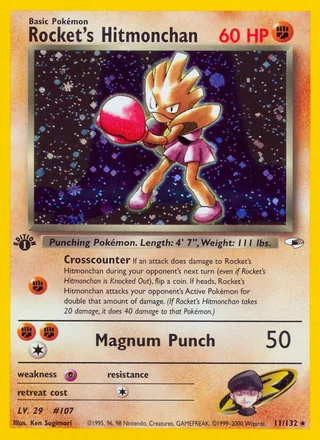
One of only three Team Rocket cards here: a 60 HP Basic holo. One Fighting buys Crosscounter, three pay 50 — one card that covers both ends, which makes it an easy attacker to run.

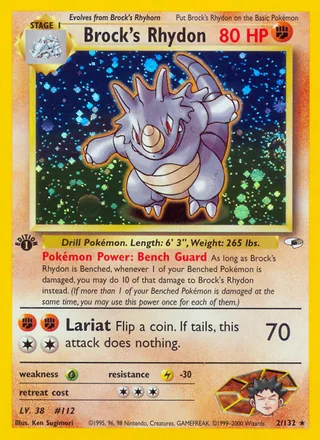
An 80 HP Stage 1 holo with a single four-Fighting attack. The cost is heavy, but 80 HP lets it hold the front line while you pay for it.
11 cards · listed in original order.

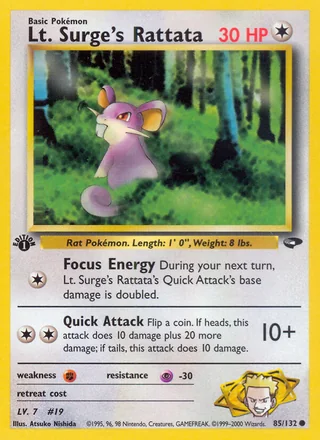
30 HP and free retreat. One Colorless buys Focus Energy to set up the deck; two Colorless pay for 10+. A light opener for a Surge deck.

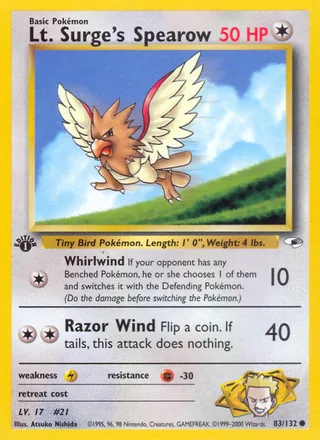
50 HP and free retreat. Ten for one Colorless on Whirlwind, then Razor Wind for two. Zero retreat keeps the early turns flexible.

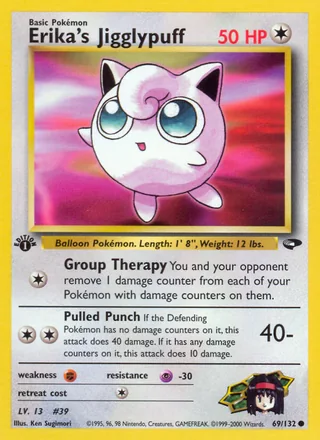
50 HP, with one Colorless buying Group Therapy to dig through the deck and two paying for Pulled Punch. One of the few Colorless cards in Erika's line.

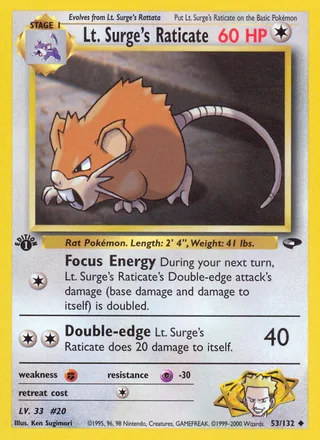
A 60 HP Stage 1 with 40 damage for two Colorless. Double-edge recoils, but for an attack that needs no typed energy it hits high.

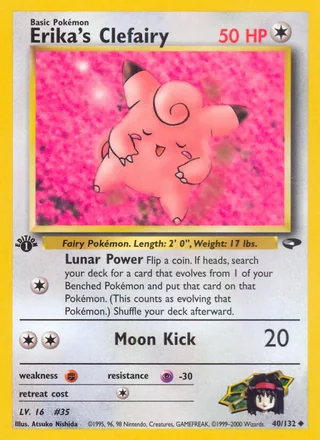
50 HP. One Colorless buys Lunar Power, two pay for 20. A body to place early on the way to Clefable.

80 HP on a Basic — unusually tough. Twenty for two Colorless, 30× for three. Retreat 3 means it stays where you put it.

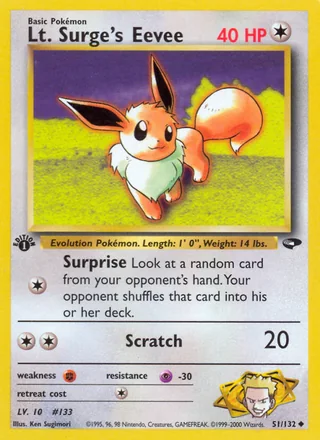
40 HP. One Colorless buys Surprise, two pay for 20. A light Colorless slot in a Surge deck.

40 HP with one attack: 10+ for two Colorless. Five of Erika's eighteen cards are Colorless, and this Dragon-type is one of them. A same-named card also came as the July insert.
A 70 HP Stage 1 holo with retreat 0. Ten-times for two Colorless, 30 for three. Free retreat on a holo makes it easy to keep in play, which suits its cheap attacks.

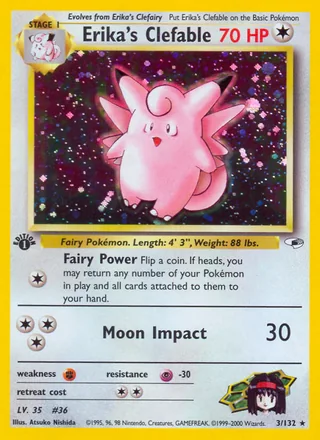
A 70 HP Stage 1 holo. One Colorless buys Fairy Power, three pay for 30. It works at both ends of the curve coming out of Clefairy.

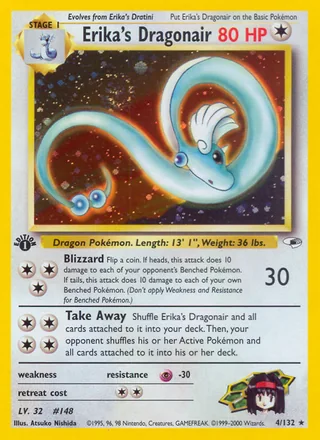
An 80 HP Stage 1 holo: 30 for three Colorless, plus a four-Colorless Take Away. The costs are heavy, but it fits into any deck without matching a type — that is the appeal.
30 cards · listed in original order.

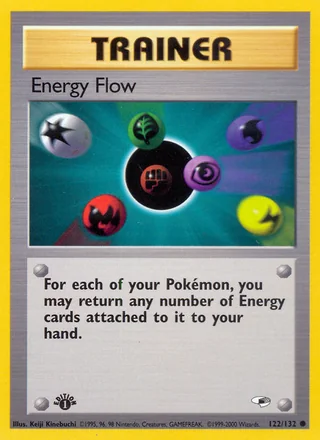
For each of your Pokémon, you may return any number of Energy cards attached to it to your hand.
Return any number of Energy cards from your Pokémon to your hand — a recall rather than a move, so it lets you rebuild how energy sits on the board.

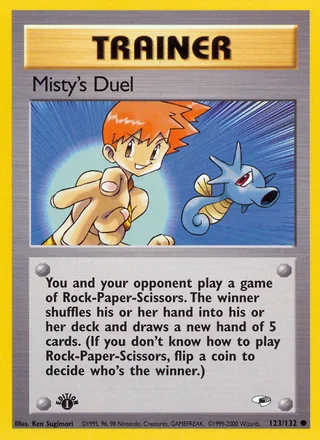
You and your opponent play a game of Rock-Paper-Scissors. The winner shuffles his or her hand into his or her deck and draws a new hand of 5 cards. (If you don't know how to play Rock-Paper-Scissors, flip a coin to decide who's the winner.)
Play rock-paper-scissors; the winner shuffles their hand in and draws five. It cuts both ways, so it is a reset for when your hand is bad.

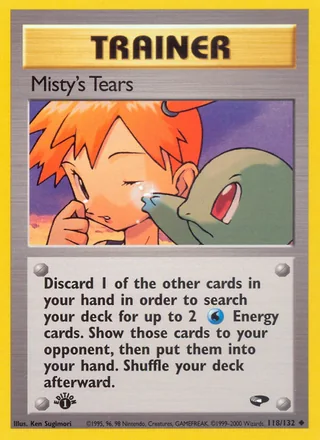
Discard 1 of the other cards in your hand in order to search your deck for up to 2 Water Energy cards. Show those cards to your opponent, then put them into your hand. Shuffle your deck afterward.
Discard one card to fetch up to two Water Energy from the deck. Unshowy, but it is how a Misty deck keeps its energy coming.

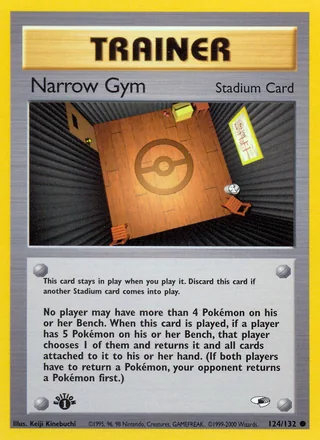
This card stays in play when you play it. Discard this card if another Stadium card comes into play. No player may have more than 4 Pokémon on his or her Bench. When this card is played, if a player has 5 Pokémon on his or her Bench, that player chooses 1 of them and returns it and all cards attached to it to his or her hand. (If both players have to return a Pokémon, your opponent returns a Pokémon first.)
A Stadium that caps both players at four Benched Pokémon. Painful for wide decks, irrelevant for narrow ones.

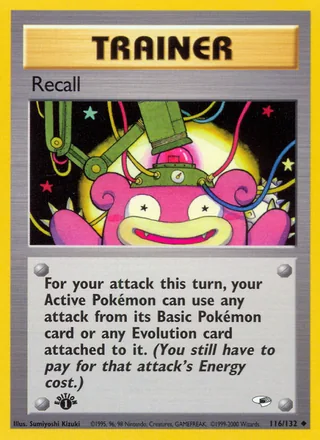
For your attack this turn, your Active Pokémon can use any attack from its Basic Pokémon card or any Evolution card attached to it. (You still have to pay for that attack's Energy cost.)
Lets your Active Pokémon use an attack from its Basic or any attached Evolution card this turn. You still pay the energy, but not losing the earlier attacks after evolving matters.

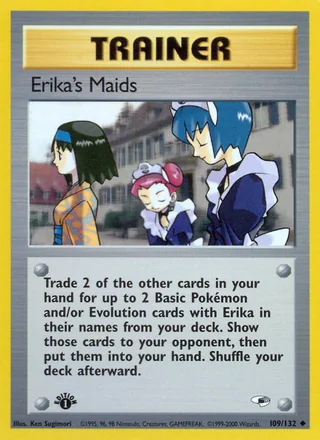
Trade 2 of the other cards in your hand for up to 2 Basic Pokémon and/or Evolution cards with Erika in their names from your deck. Show those cards to your opponent, then put them into your hand. Shuffle your deck afterward.
Trade two cards in hand for up to two Erika-named cards from the deck. The consistency card for an Erika build.

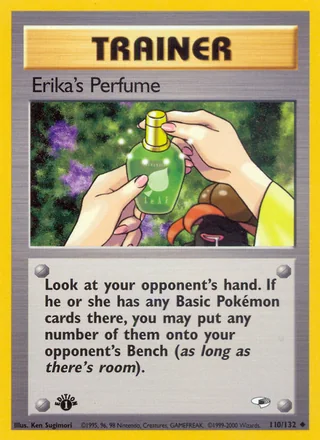
Look at your opponent's hand. If he or she has any Basic Pokémon cards there, you may put any number of them onto your opponent's Bench (as long as there's room).
Look at their hand and, if there are Basic Pokémon in it, put any number onto their Bench. An odd effect — you widen their board for them.
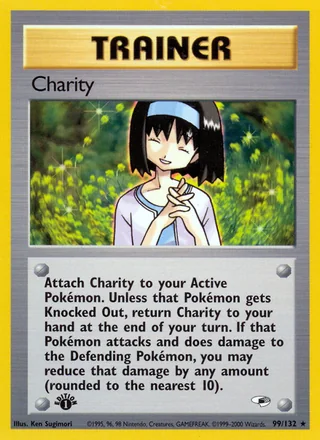
Attach Charity to your Active Pokémon. Unless that Pokémon gets Knocked Out, return Charity to your hand at the end of your turn. If that Pokémon attacks and does damage to the Defending Pokémon, you may reduce that damage by any amount (rounded to the nearest 10).
Attach it to your Active Pokémon and reduce the damage it deals by any amount. Doing less damage means killing less — this is a card for buying time.

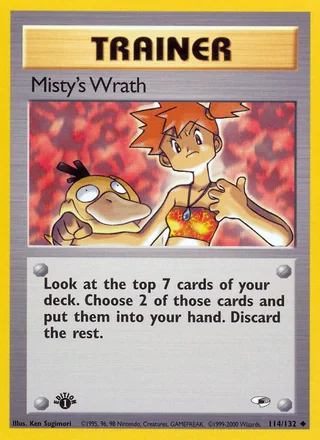
Look at the top 7 cards of your deck. Choose 2 of those cards and put them into your hand. Discard the rest.
Look at the top seven, take two, discard the rest. Seven is deep enough that you usually find what you need.

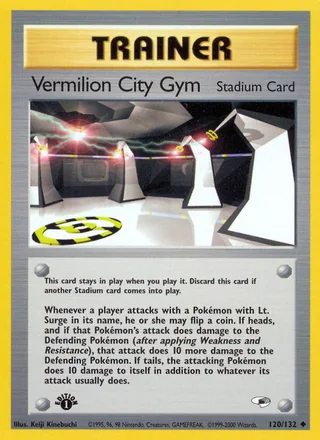
This card stays in play when you play it. Discard this card if another Stadium card comes into play. Whenever a player attacks with a Pokémon with Lt. Surge in its name, he or she may flip a coin. If heads, and if that Pokémon's attack does damage to the Defending Pokémon (after applying Weakness and Resistance), that attack does 10 more damage to the Defending Pokémon. If tails, the attacking Pokémon does 10 damage to itself in addition to whatever its attack usually does.
A Stadium that gives Lt. Surge-named Pokémon a coin flip for extra damage when they attack. A boost card aimed at one deck.

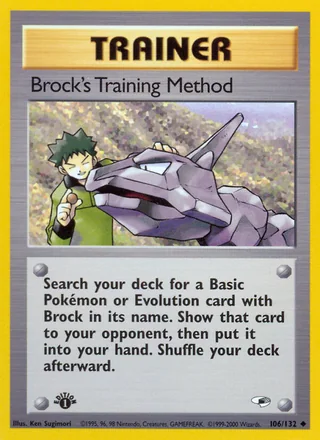
Search your deck for a Basic Pokémon or Evolution card with Brock in its name. Show that card to your opponent, then put it into your hand. Shuffle your deck afterward.
Fetch one Brock-named card from the deck — Basic or Evolution. It steadies the early turns.

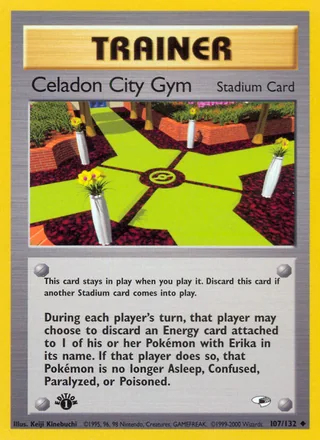
This card stays in play when you play it. Discard this card if another Stadium card comes into play. During each player's turn, that player may choose to discard an Energy card attached to 1 of his or her Pokémon with Erika in its name. If that player does so, that Pokémon is no longer Asleep, Confused, Paralyzed, or Poisoned.
A Stadium where discarding an Energy from an Erika-named Pokémon buys an effect. Built for an Erika deck.

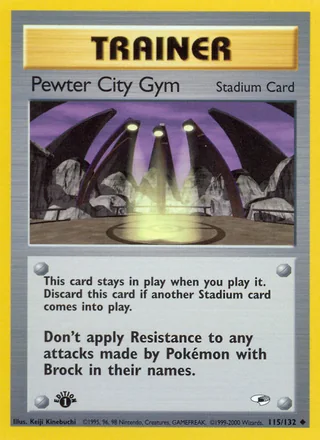
This card stays in play when you play it. Discard this card if another Stadium card comes into play. Don't apply Resistance to any attacks made by Pokémon with Brock in their names.
A Stadium where attacks from Brock-named Pokémon ignore Resistance. It stops Fighting decks from being walled off.

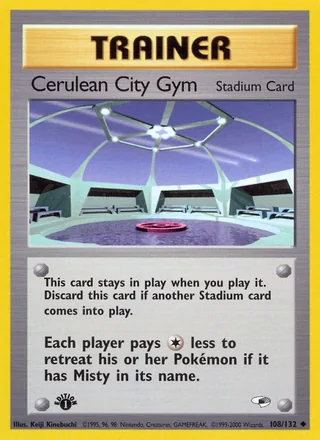
This card stays in play when you play it. Discard this card if another Stadium card comes into play. Each player pays Colorless less to retreat his or her Pokémon if it has Misty in its name.
A Stadium that cuts one Colorless off the retreat cost of Misty-named Pokémon — for decks that switch a lot.

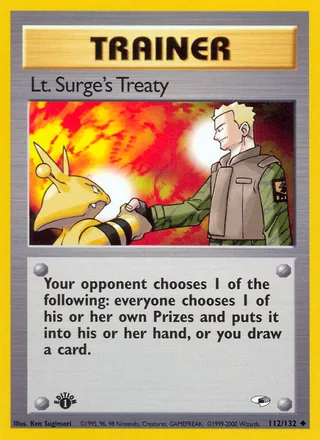
Your opponent chooses 1 of the following: everyone chooses 1 of his or her own Prizes and put it into his or her hand, or you draw a card.
The opponent picks one of two outcomes: both players take a Prize into hand, or you draw a card. Since they choose, you play it when either result is fine.

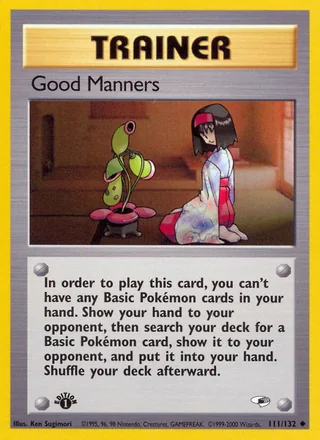
In order to play this card, you can't have any Basic Pokémon cards in your hand. Show your hand to your opponent, then search your deck for a Basic Pokémon card, show it to your opponent, and put it into your hand. Shuffle your deck afterward.
Playable only if you hold no Basic Pokémon, and it fetches one from the deck. Conditional, but it is there to save a dead opening hand.

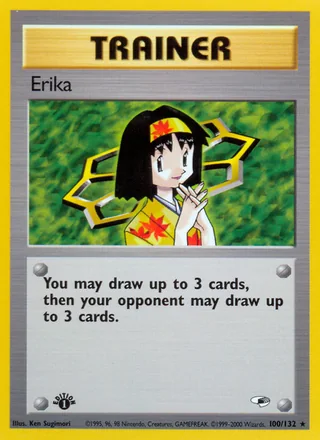
You may draw up to 3 cards, then your opponent may draw up to 3 cards.
Draw up to three, then the opponent draws up to three. An even trade for when you need more cards.

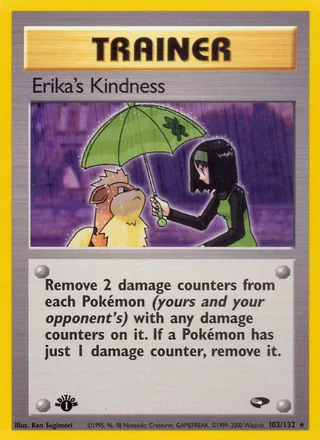
Remove 2 damage counters from each Pokémon (yours and your opponent's) with any damage counters on it. If a Pokémon has just 1 damage counter, remove it.
Remove two damage counters from every Pokémon on both sides. It heals them too, so you play it when you are the one bleeding.

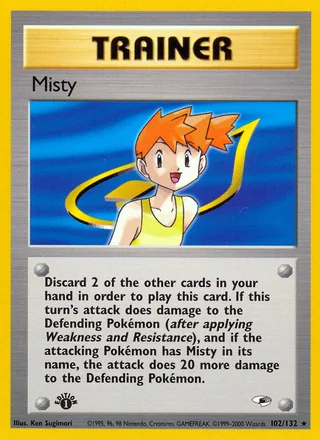
Discard 2 of the other cards in your hand in order to play this card. If this turn's attack does damage to the Defending Pokémon (after applying Weakness and Resistance), and if the attacking Pokémon has Misty in its name, the attack does 20 more damage to the Defending Pokémon.
Discard two cards and a Misty-named Pokémon's attack does 20 more that turn. A one-turn damage boost.

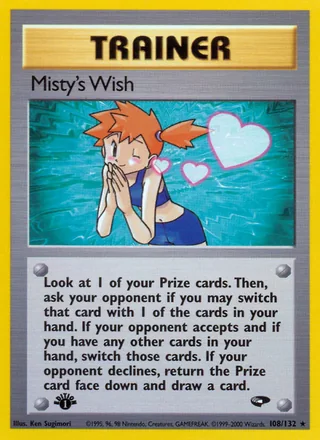
Look at 1 of your Prize cards. Then, ask your opponent if you may switch that card with 1 of the cards in your hand. If your opponent accepts and if you have any other cards in your hand, switch those cards. If your opponent declines, return the Prize card face down and draw a card.
Look at one of your Prizes and ask to swap it for a card in hand. If they refuse, it goes back — not guaranteed, but the information is.

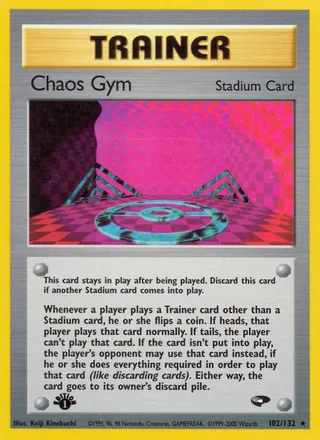
This card stays in play after being played. Discard this card if another Stadium card comes into play. Whenever a player plays a Trainer card other than a Stadium card, he or she flips a coin. If heads, that player plays that card normally. If tails, the player can't play that card. If the card isn't put into play, the player's opponent may use that card instead, if he or she does everything required in order to play that card (like discarding cards). Either way, the card goes to its owner's discard pile.
A Stadium that flips a coin every time a Trainer is played and changes the result on tails. It makes decks less consistent, so the player using it pays too.

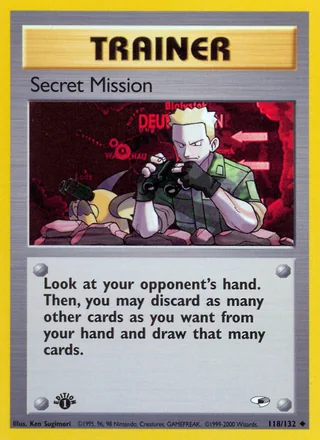
Look at your opponent's hand. Then, you may discard as many other cards as you want from your hand and draw that many cards.
Look at their hand, then discard any number of your own cards and draw that many. It swaps the quality of your hand.

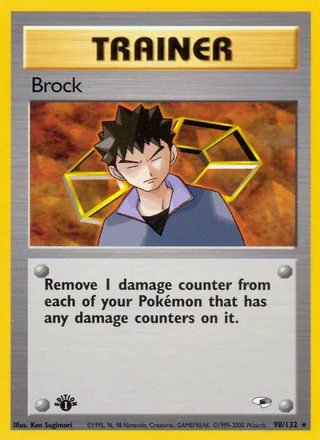
Remove 1 damage counter from each of your Pokémon that has any damage counters on it.
Remove one damage counter from each of your Pokémon — and only yours. Straightforwardly good in a Brock deck.

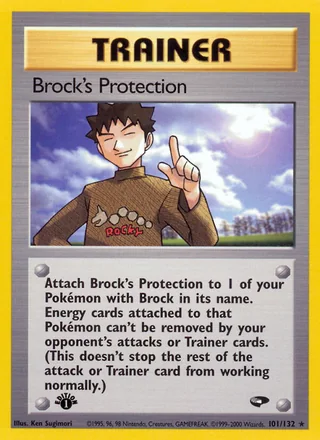
Attach Brock's Protection to 1 of your Pokémon with Brock in its name. Energy cards attached to that Pokémon can't be removed by your opponent's attacks or Trainer cards. (This doesn't stop the rest of the attack or Trainer card from working normally.)
Attached to a Brock-named Pokémon, its Energy can no longer be stripped by the opponent. A direct answer to energy removal.

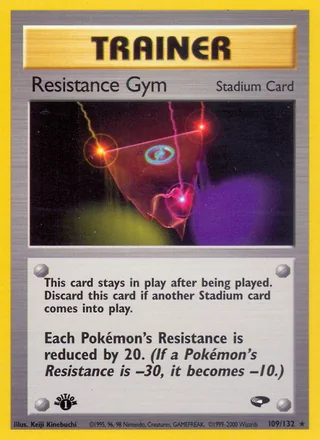
This card stays in play after being played. Discard this card if another Stadium card comes into play. Each Pokémon's Resistance is reduced by 20. (If a Pokémon's Resistance is -30, it becomes -10.)
A Stadium that reduces every Pokémon's Resistance by 20 (so -30 becomes -10). The card you play when Resistance is what is stopping you.

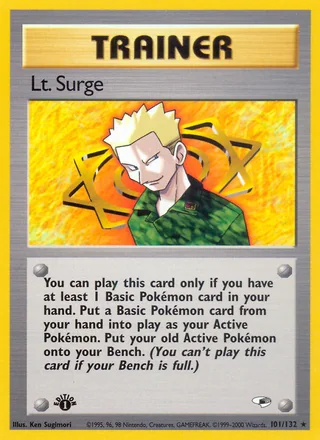
You can play this card only if you have at least 1 Basic Pokémon card in your hand. Put a Basic Pokémon card from your hand into play as your Active Pokémon. Put your old Active Pokémon onto your Bench. (You can't play this card if your Bench is full.)
Put a Basic from your hand straight into the Active spot. It is not a switch but a new arrival, so you skip the retreat cost entirely.

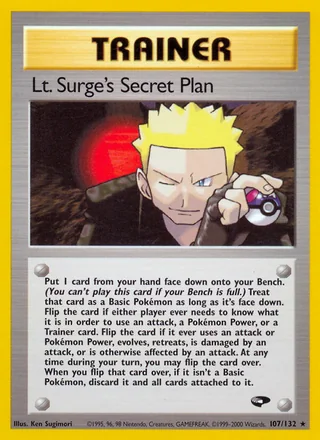
Put 1 card from your hand face down onto your Bench. (You can't play this card if your Bench is full.) Treat that card as a Basic Pokémon as long as it's face down. Flip the card if either player needs to know what it is in order to use an attack, a Pokémon Power, or a Trainer card. Flip the card if it ever uses an attack or Pokémon Power, evolves, retreats, is damaged by an attack, or is otherwise affected by an attack. At any time during your turn, you may flip the card over. When you flip that card over, if it isn't a Basic Pokémon, discard it and all cards attached to it.
Place a card face down on your Bench and treat it as a Basic Pokémon. The opponent cannot see what it is until it is revealed.

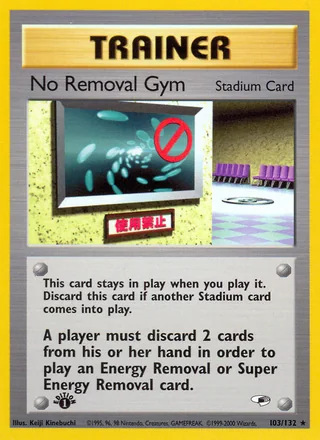
This card stays in play when you play it. Discard this card if another Stadium card comes into play. A player must discard 2 cards from his or her hand in order to play an Energy Removal or Super Energy Removal card.
A Stadium that makes Energy Removal cost two extra cards from hand. Protection for the side getting stripped.

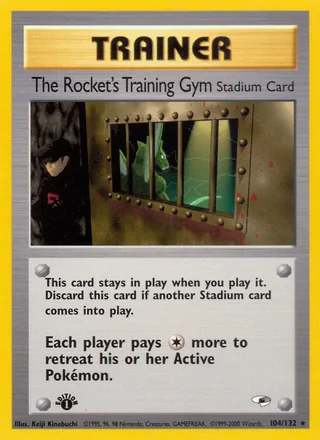
This card stays in play when you play it. Discard this card if another Stadium card comes into play. Each player pays Colorless more to retreat his or her Active Pokémon.
A Stadium that adds one Colorless to every retreat cost. For decks that want to lock switching down.

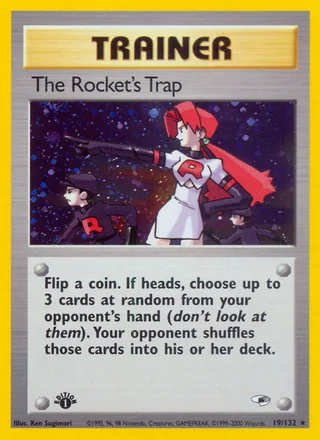
Flip a coin. If heads, choose up to 3 cards at random from your opponent's hand (don't look at them). Your opponent shuffles those cards into his or her deck.
The only holo Trainer in the set. On heads, pick up to three cards at random from their hand — without looking — and shuffle them back. For its time, a strong way to break a hand apart.
Products from the same year as the booster set, in release order. Expansion Sheets came out of vending machines and the preconstructed decks were sold as boxes — neither is a pack you open. Package photos come from the official product catalogue; where none exists we print NO PHOTO.

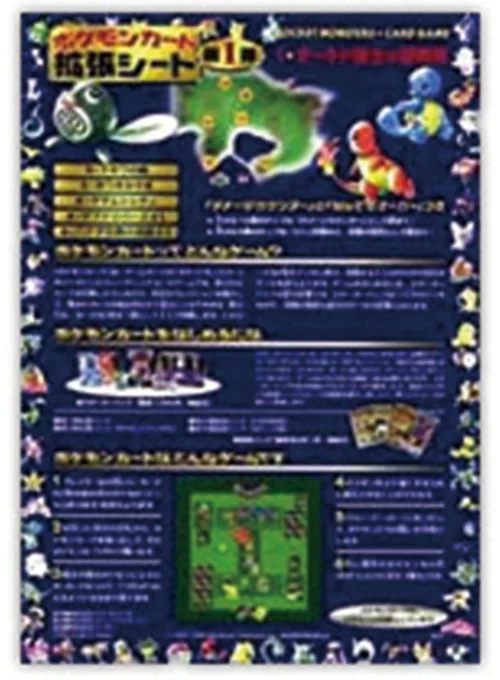
Series 1 (Blue). 100 yen bought one sheet with three cards. The 18 sheet numbers are fixed, so collecting sheets 1–18 yields all 36 cards. Sheet backs show six Kanto locations.

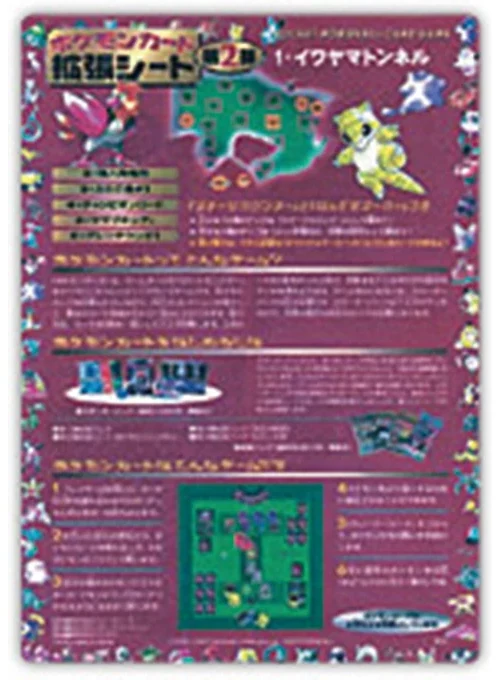
Series 2 (Red). Same 100-yen, three-card sheet system as Blue. Focused on Pokémon that were not in the booster packs of the time, such as Vulpix and Snorlax.

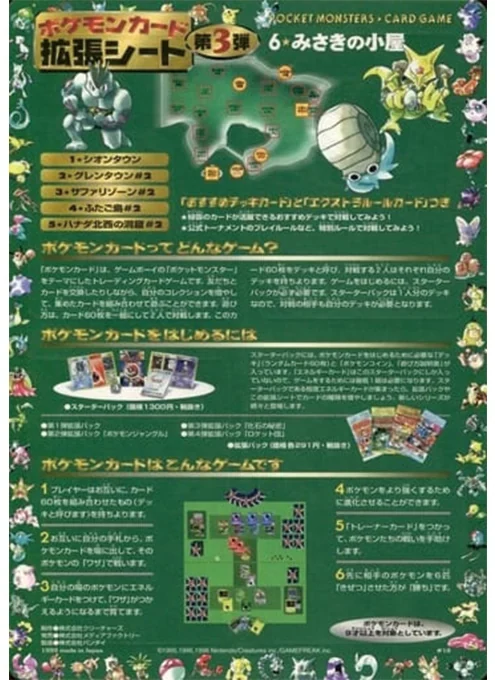
Series 3 (Green). Each sheet carried three normal cards plus one special card with a different back — mostly joke cards and extra-rule cards. 53 cards in total (36 normal + 17 special).

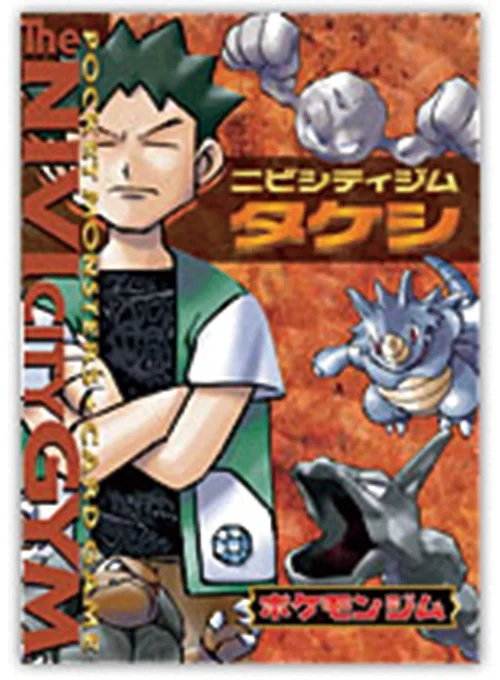
A preconstructed deck built around Brock's Pokémon: 60 cards plus four extra cards, 64 in all, with a coin, a rulebook and a gym guide. The original retail price could not be confirmed, so it is not listed.

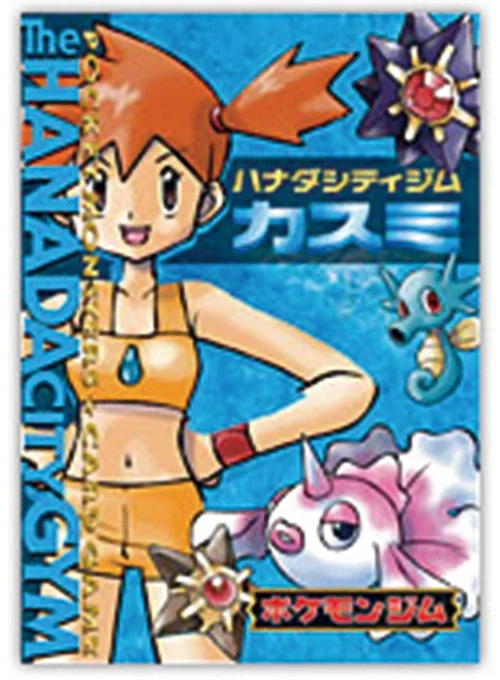
A preconstructed deck built around Misty's Pokémon: 60 cards plus four extra cards. Nearly every card is Water type, and most were not in packs at the time. The original retail price could not be confirmed, so it is not listed.

A preconstructed deck built around Lt. Surge's Pokémon: 60 cards plus four extra cards, Lightning-heavy. The original retail price could not be confirmed, so it is not listed.

A preconstructed deck built around Erika's Pokémon: 60 cards plus four extra cards, Grass-heavy. The original retail price could not be confirmed, so it is not listed.
The sixth expansion, Challenge from the Darkness, 98 cards. It adds Giovanni, Blaine, Koga and Sabrina and closes out the Gym line. The 1998 set has only four Leaders because the other four had not been printed yet.
Gym Heroes, the international printing, 132 cards. Rather than translating the 96-card Japanese set as-is, Wizards mixed in cards from the sixth expansion and rebuilt it at 132. That is why the same Leader has a different card count in each language.
Gym Challenge, 132 cards. Built around the sixth expansion and likewise reworked to 132. The Japanese 96 + 98 becomes 132 + 132 in English.
Some Expansion Sheet cards crossed over as Wizards promo cards handed out through the English-language League. The 1998 vending cards reached players abroad three years later in a different form — though only some of them; most stayed Japanese-only.
The 96 cards of the fifth expansion are only part of the 1998 pool. The same year produced 125 Expansion Sheet cards and four 64-card decks. In 1998, more cards came out outside the packs than inside them.
Release dates and product identities are connected to the Japanese edition release register by set code. Sources are printed per product so a reader can check the claim without trusting this page alone. Unmatched products say so instead of borrowing another edition’s citation.
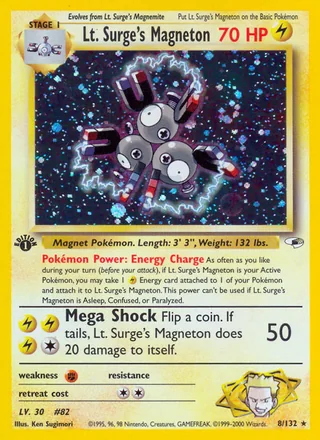
gym1 verified_secondaryCard data — HP, type, stage, attacks, artist, rarity — follows the international Gym Heroes / Gym Challenge printings. No public scans of the Japanese originals exist and their attack text includes machine translation, so stats and attacks are taken from the international print. Attack names and effect text therefore stay in English; the Japanese commentary sits separately below each card.
Card faces are international scans too, for the same reason: no public Japanese scans exist, so the international printing with matching artwork and attacks stands in. All 96 are stand-ins; not one is a scan of the Japanese original.
The 96 Japanese and 132 international cards do not map one to one. Because the international set recombines the Japanese fifth and sixth expansions, cards are paired on Leader + Pokédex number + HP + rarity. Six cards still could not be resolved that way, and were matched by comparing their attacks one by one.
Two Japanese rarity labels are wrong. On Brock's Vulpix (No.017 and No.018) Common and Uncommon are swapped. Comparing the attacks shows the international labels are correct, and those are what the page uses.
Pack prices, spreads and box counts follow what the publisher (Media Factory) printed at the time. Prices are the original retail figures including tax, not current market values. The fifth expansion was 291 yen for ten cards; Expansion Sheets were 100 yen for three cards.
For the three Expansion Sheet series (125 cards) and the four preconstructed decks, card-by-card data could not be assembled from public sources. Only the product-level details are shown — release date, price, format, count — with no card list. These sets existed; the material is simply not available.
For 30 of the insert and handout cards, no public scan of the card face could be found. Those entries are described in text only, without an image — they are not cards that failed to exist.
1998 is the year the cards got an owner. In 1999 the Gym line completes all eight Leaders, and the Gold and Silver era waits just beyond it.