

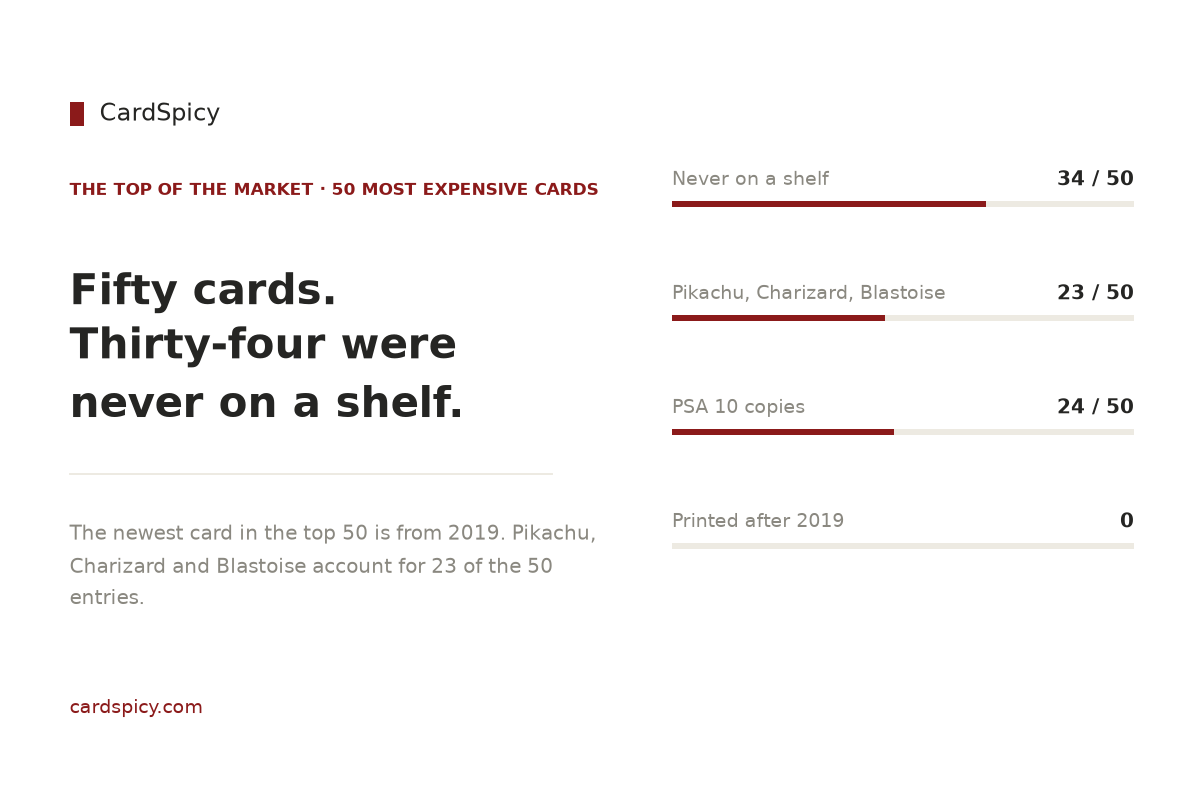
Fifty cards, every one of them sold, every one of them documented. Thirty-four of the fifty were never available in a booster pack. Twenty-three of them carry one of three names. Nothing printed after 2019 appears anywhere on the list. This is where the hobby’s ceiling actually sits, and seeing it clearly explains why the ceiling is not the part of the market a collector in Europe or North America should be shopping in.
Two things follow from that. The first is that a list like this is a map of scarcity, not of taste: most of the cards below were prizes, promos or pre-production material, and the price is a function of how few copies escaped rather than how much anyone loves the Pokémon on the front. The second is that none of these fifty cards exists in Simplified Chinese, and none ever will — the Simplified Chinese line is too recent to contain any of them. So we have written this page as a reference: what the top of the market looks like, what it teaches about why cards become expensive, and where the same lesson applies to a branch of the hobby you can still buy into.
How this list was built
Four rules, and one honest caveat.
- Ranked by the highest documented sale price. Not by asking price, not by an estimate, and not by a price guide’s opinion. Every figure below is a sale that was reported with a date and a venue, and both are printed on the card’s record plate. Where a card has sold several times, the entry uses the highest recorded figure and says so.
- One line per card, fifty lines. Where two cards tie on price, the earlier and more widely reported sale is placed first. Cards that have sold at the same price several times appear once, because this is a list of cards rather than of transactions.
- Only cards, not sealed product. A sealed 1st Edition booster box has sold for more than most of this list, but a box is not a card.
- Grades are quoted as recorded. A card that sold ungraded is listed as ungraded; a card graded by a company other than PSA says which one. This matters more than it looks, because several entries here reached six or seven figures in grades that a modern collector would not look twice at.
The caveat is that no two trackers agree on the exact order. Sales at this level are private, they happen a few times a year, and there is no central register — so compilations differ, particularly in the middle of the list, and a figure can be reported by one outlet and questioned by another. We have taken the highest figure that was documented with a date and a named venue, and where a sale is reported rather than universally confirmed the plate says private sale. Treat this page as an accurate picture of the market’s shape and an approximate picture of its exact ranking.
All fifty at a glance
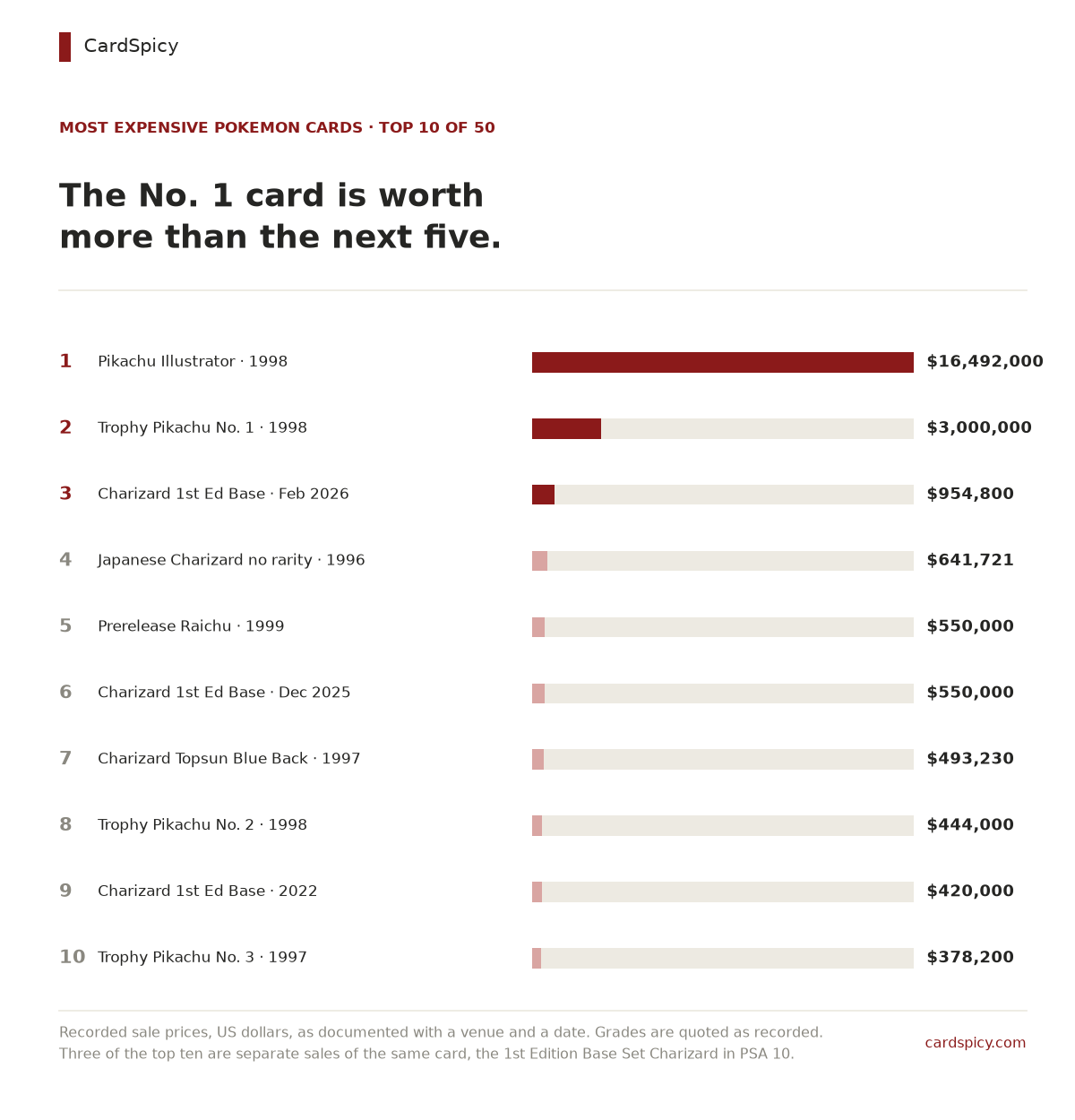
Every confirmed sale in the top 50, in order. The full entry for each card, with its record plate, follows underneath.
| # | Card | Year | Grade | Recorded sale |
|---|---|---|---|---|
| 1 | Pikachu Illustrator | 1998 | PSA 10 | $16,492,000 |
| 2 | Trophy Pikachu No. 1 Trainer | 1998 | PSA 9 | $3,000,000 |
| 3 | 1st Edition Base Set Charizard | 1999 | PSA 10 | $954,800 |
| 4 | Japanese Charizard, no rarity symbol | 1996 | PSA 10 | $641,721 |
| 5 | Prerelease Raichu | 1999 | PSA 6 | $550,000 |
| 6 | 1st Edition Base Set Charizard | 1999 | PSA 10 | $550,000 |
| 7 | Charizard, Topsun Blue Back | 1997 | PSA 10 | $493,230 |
| 8 | Trophy Pikachu No. 2 Trainer | 1998 | PSA 10 | $444,000 |
| 9 | 1st Edition Base Set Charizard | 1999 | PSA 10 | $420,000 |
| 10 | Trophy Pikachu No. 3 Trainer | 1997 | PSA 8 | $378,200 |
| 11 | Presentation Blastoise, Galaxy Star Holo | 1998 | CGC 8.5 | $360,000 |
| 12 | Signed Japanese Base Set Charizard | 1996 | PSA 10 | $324,000 |
| 13 | Tropical Wind, semi-finalist | 2004 | ungraded | $300,000 |
| 14 | Snap Pikachu | 1999 | PSA authenticated | $270,000 |
| 15 | Family Event Trophy Kangaskhan | 1998 | PSA 10 | $250,000 |
| 16 | Tsunekazu Ishihara signed promo | 2017 | PSA 7, autograph 9 | $241,200 |
| 17 | Japanese Blastoise, no rarity symbol | 1996 | PSA 10 | $231,800 |
| 18 | Luigi Pikachu, 296/XY-P | 2016 | ungraded | $216,000 |
| 19 | Test print, gold border Blastoise | 1998 | CGC 6.5 | $216,000 |
| 20 | Tamamushi University Magikarp | 1998 | PSA 10 | $210,800 |
| 21 | Snap Bulbasaur | 1999 | PSA 9 | $200,000 |
| 22 | Umbreon Gold Star, 026/PLAY | 2005 | PSA 10 | $180,000 |
| 23 | Extra Battle Day Lillie | 2019 | PSA 10 | $171,000 |
| 24 | Trophy Pikachu No. 1 Trainer | 1998 | PSA 9 | $168,000 |
| 25 | Super Secret Battle No. 1 Trainer | 1999 | PSA 10 | $156,000 |
| 26 | Snap Gyarados | 1999 | CGC 9.5 | $150,000 |
| 27 | Snap Chansey | 1999 | BGS 8.5 | $150,000 |
| 28 | Pikachu Gold Star | 2006 | PSA 10 | $148,000 |
| 29 | 1st Edition Neo Genesis Lugia | 2000 | BGS 10 | $144,300 |
| 30 | 1st Edition Base Set Blastoise | 1999 | PSA 10 | $138,880 |
| 31 | No. 2 Trainer, Toshiyuki Yamaguchi | 2000 | CGC 8 | $137,500 |
| 32 | Snap Magikarp | 1999 | PSA authenticated | $136,000 |
| 33 | Neo Summer Battle Road No. 2 Trainer | 2001 | CGC 10 | $132,000 |
| 34 | Torchic Gold Star | 2004 | PSA 10 | $117,800 |
| 35 | World Championships No. 2 Trainer | 2006 | PSA 9 | $110,100 |
| 36 | Snap Charmander | 1999 | BGS 9 | $105,003 |
| 37 | Japanese beta presentation Charizard | 1996 | CGC 8 | $99,000 |
| 38 | Snap Squirtle | 1999 | PSA 8 | $82,546 |
| 39 | Tropical Mega Battle No. 2 Trainer | 1999 | PSA 10 | $81,536 |
| 40 | World Championships Pikachu No. 1 Trainer | 2010 | ungraded | $75,000 |
| 41 | Master’s Key | 2010 | BGS 9.5 | $66,000 |
| 42 | Tropical Wind promo | 1999 | PSA 10 | $65,100 |
| 43 | World Championships Pikachu No. 1 Trainer | 2013 | PSA 9 | $63,000 |
| 44 | Dragon Frontiers Charizard Gold Star | 2006 | PSA 10 | $60,065 |
| 45 | Mew Victory Orb | 2005 | PSA 10 | $60,000 |
| 46 | 1st Edition Base Set Blastoise, shadowless | 1999 | PSA 10 | $60,000 |
| 47 | Tropical Mega Battle bilingual Exeggutor | 1999 | CGC 10 | $59,780 |
| 48 | Snap Articuno | 1999 | PSA 8 | $58,560 |
| 49 | Base Set Venusaur, no rarity, autographed | 1996 | PSA 10 | $55,000 |
| 50 | 1st Edition Base Set Chansey, shadowless | 1999 | PSA 10 | $55,000 |
The fifty, ranked
1. Pikachu Illustrator (1998) — $16,492,000
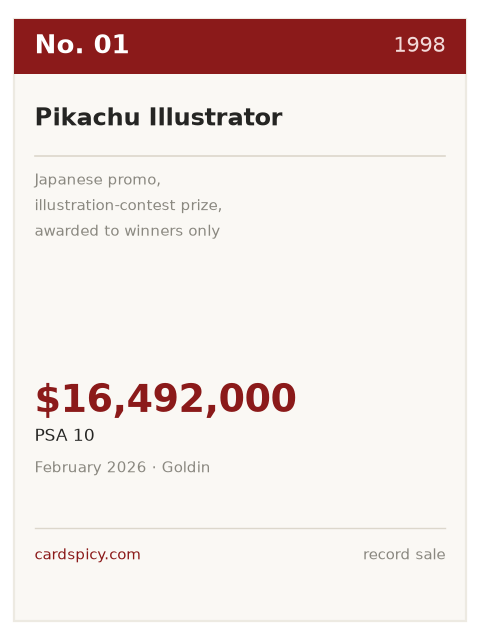
It is the only card in this list that has held the record for the most expensive trading card of any kind, and the record came with independent certification. It was not sold in packs: it was awarded to winners of a Japanese illustration contest in 1998, roughly 39 copies were produced, and only a handful are known to survive. The artwork is by the designer who drew Pikachu in the first place. In Simplified Chinese, this character is ranked on its own page: Pikachu in Simplified Chinese.
2. Trophy Pikachu No. 1 Trainer (1998) — $3,000,000
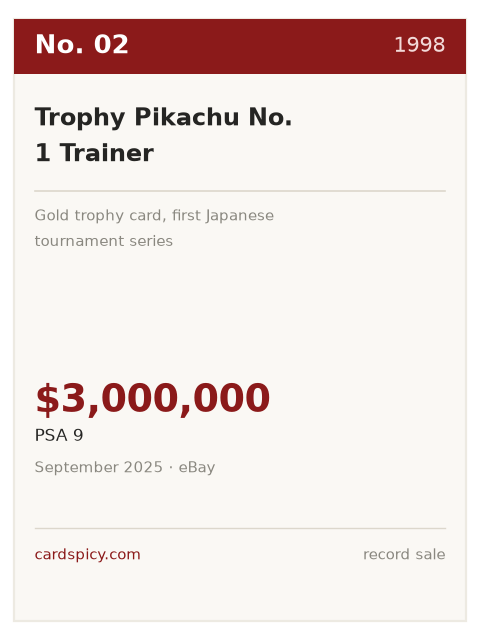
A gold trophy card handed to the winner of an early Japanese tournament series. Fewer than a dozen copies exist per event, none of them were sold at retail, and most stayed with the players who earned them. That is why the top of this list is trophy cards rather than the famous set cards. In Simplified Chinese, this character is ranked on its own page: Pikachu in Simplified Chinese.
3. 1st Edition Base Set Charizard (1999) — $954,800
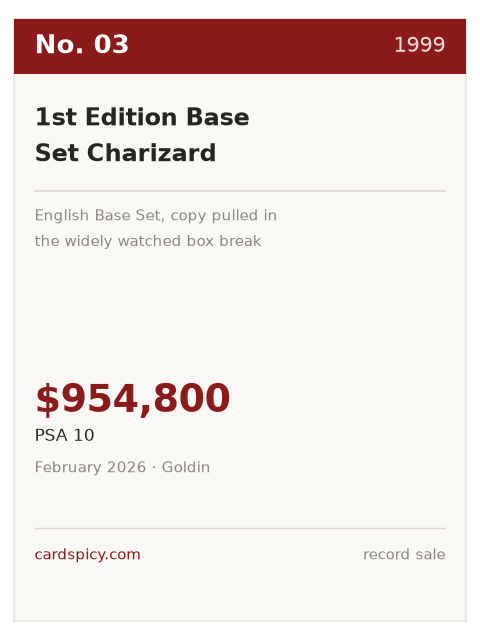
The most valuable English Charizard. Other PSA 10 copies of the identical card have sold for $420,000 and $550,000, so the extra few hundred thousand here is provenance: this copy was pulled on camera from a sealed 1st Edition box in a stream watched by millions, and it carries a special label recording that. In Simplified Chinese, this character is ranked on its own page: Charizard in Simplified Chinese.
4. Japanese Charizard, no rarity symbol (1996) — $641,721
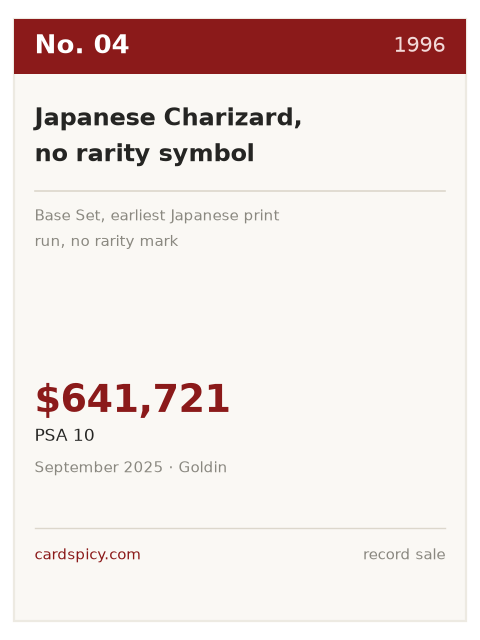
The earliest Japanese print runs carried no rarity symbol at all, so a Charizard without one is among the first Charizards ever printed. At the time it sold it outsold every English 1st Edition copy, which is a result collectors had argued about for years before it happened. In Simplified Chinese, this character is ranked on its own page: Charizard in Simplified Chinese.
5. Prerelease Raichu (1999) — $550,000
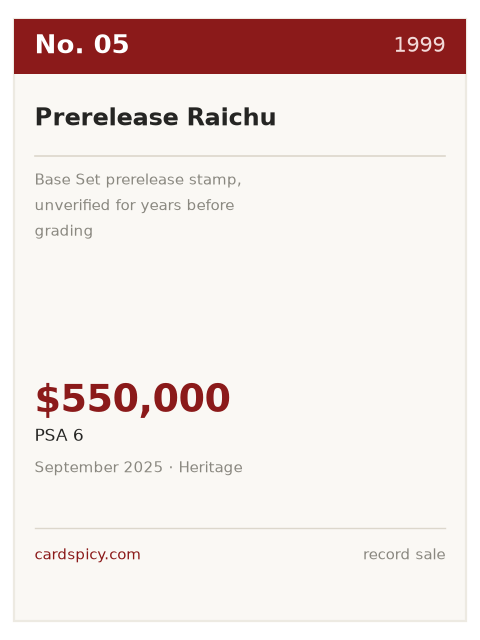
For two decades this card was treated as a rumour. Copies were said to have been stamped at a prerelease event and then withheld, and the story was only settled when a grading company certified examples in 2023. A copy in a low grade still reached half a million dollars, which tells you what rarity does to the usual condition discount.
6. 1st Edition Base Set Charizard (1999) — $550,000
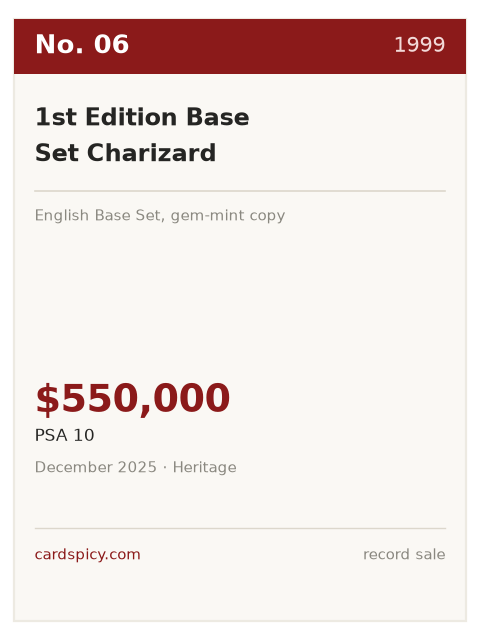
The card that defines the hobby. Around 125 PSA 10 copies are known, which is not the tiny population the price implies, so nearly all of the premium is the 1st Edition stamp plus a gem-mint grade. Ungraded near-mint copies change hands for a small fraction of this figure.
7. Charizard, Topsun Blue Back (1997) — $493,230
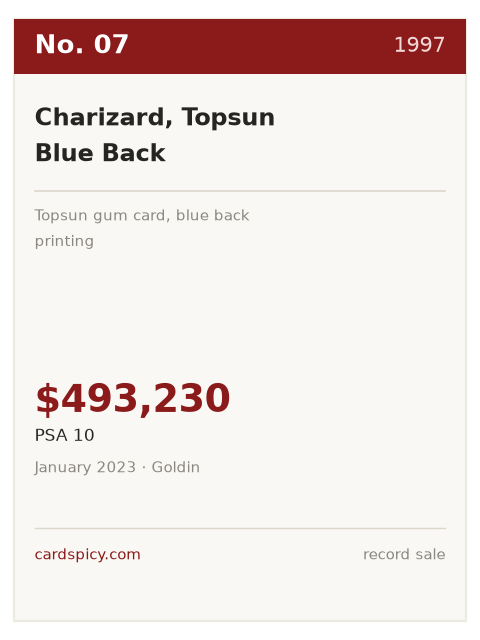
Topsun cards were distributed in packs of chewing gum rather than booster packs, and the blue-back printing is the one collectors want. It sits above every English 1st Edition sale on this list except the box-break copy, which is a striking outcome for a card that was never part of the organised game. In Simplified Chinese, this character is ranked on its own page: Charizard in Simplified Chinese.
8. Trophy Pikachu No. 2 Trainer (1998) — $444,000
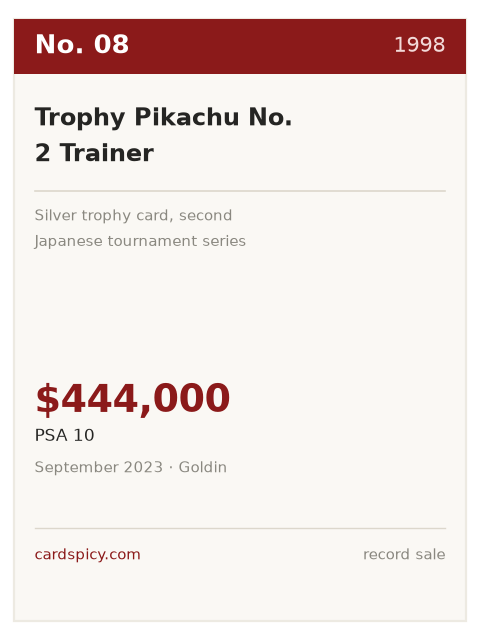
The silver tier of the trophy Pikachu series in a gem-mint grade. Trophy prices swing enormously depending on which tournament a copy came from, so the series itself spans a few hundred thousand dollars at one end and seven figures at the other. In Simplified Chinese, this character is ranked on its own page: Pikachu in Simplified Chinese.
9. 1st Edition Base Set Charizard (1999) — $420,000
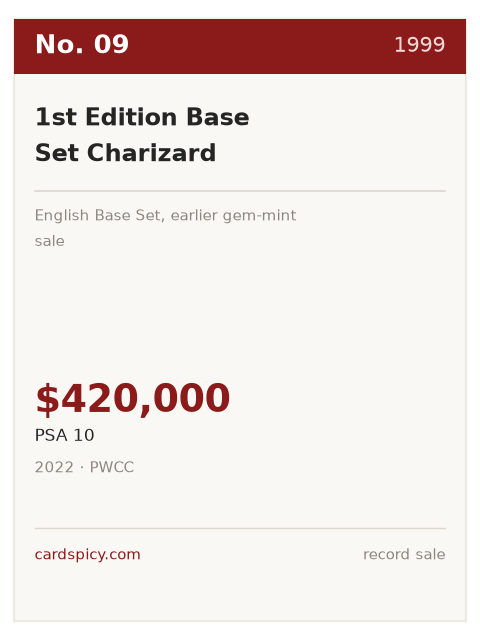
The sale that set the benchmark for the English Charizard before the 2025-26 run. Copies of this card move sharply in both directions: one PSA 10 changed hands for $168,000 in February 2024, and another for $550,000 in December 2025. In Simplified Chinese, this character is ranked on its own page: Charizard in Simplified Chinese.
10. Trophy Pikachu No. 3 Trainer (1997) — $378,200
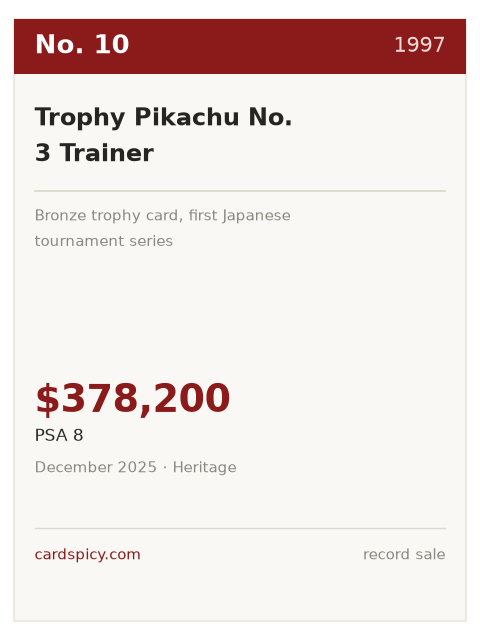
Third place, and the most expensive third-place finish in the hobby. It is the oldest of the trophy Pikachus: the 1997 bronze predates the gold and silver cards placed above it on this list. In Simplified Chinese, this character is ranked on its own page: Pikachu in Simplified Chinese.
11. Presentation Blastoise, Galaxy Star Holo (1998) — $360,000
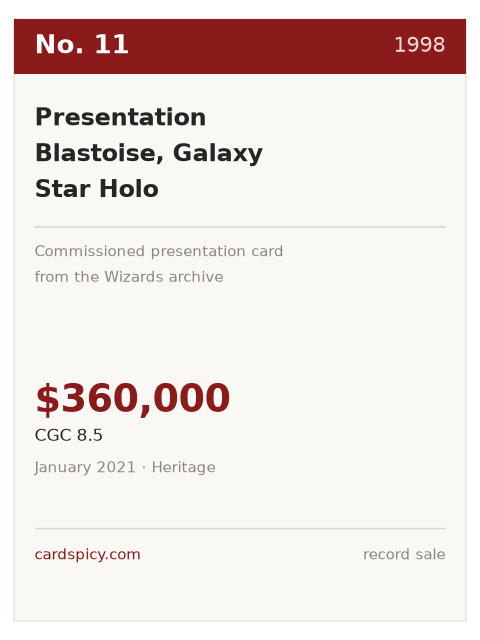
A commissioned presentation card from the Wizards of the Coast archive rather than a retail product. It represents the game before it was sold as a game, and its value rests entirely on the fact that a pre-production corporate piece survived at all. In Simplified Chinese, this character is ranked on its own page: Blastoise in Simplified Chinese.
12. Signed Japanese Base Set Charizard (1996) — $324,000
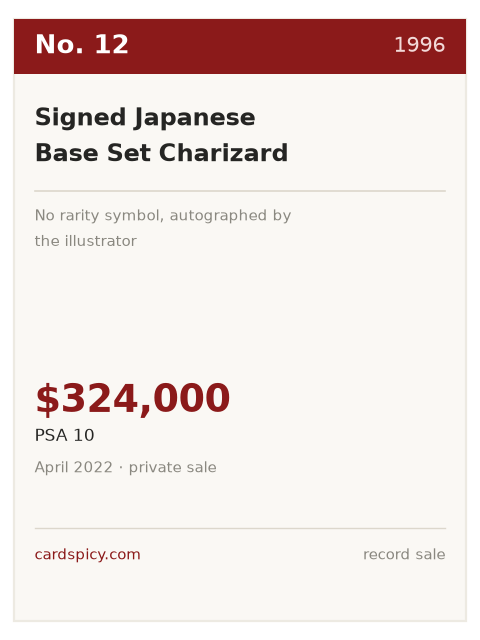
Signed by the illustrator who drew it, on the earliest Japanese print run. Autographed cards usually trade below their unsigned equivalents because the ink spoils the surface; this is one of the few characters where a signature reliably adds value instead. In Simplified Chinese, this character is ranked on its own page: Charizard in Simplified Chinese.
13. Tropical Wind, semi-finalist (2004) — $300,000
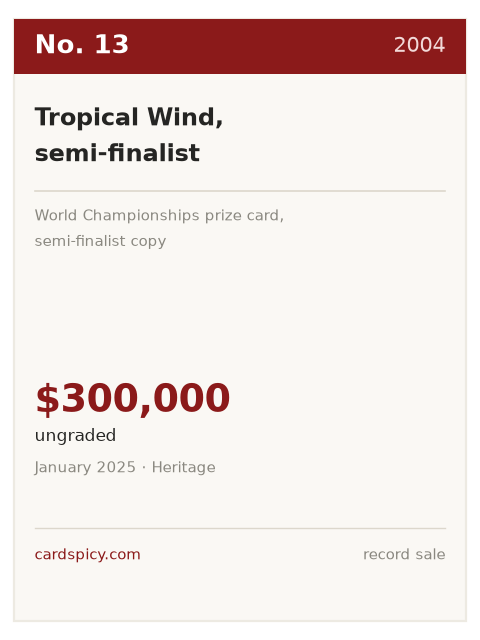
A World Championships prize card awarded to semi-finalists, and one of the few cards here that sold ungraded and with its original presentation materials. The buyer was paying for the object and its history rather than for a grade.
14. Snap Pikachu (1999) — $270,000
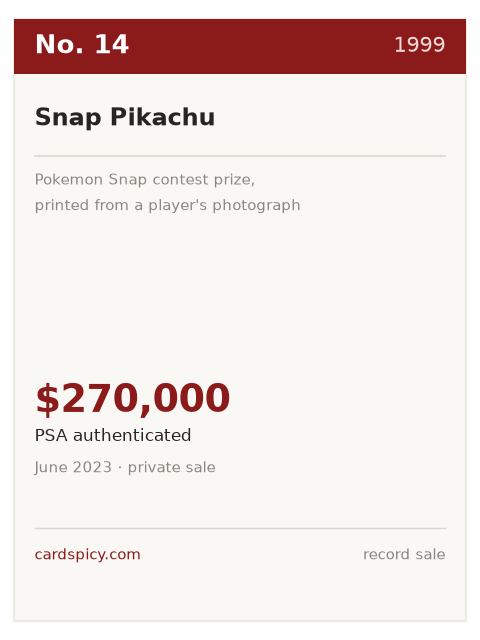
One of the Pokémon Snap contest cards. Players submitted photographs taken inside the Nintendo 64 game, and the winning images were printed onto real cards for the winners. Pikachu is the most valuable of that set. In Simplified Chinese, this character is ranked on its own page: Pikachu in Simplified Chinese.
15. Family Event Trophy Kangaskhan (1998) — $250,000
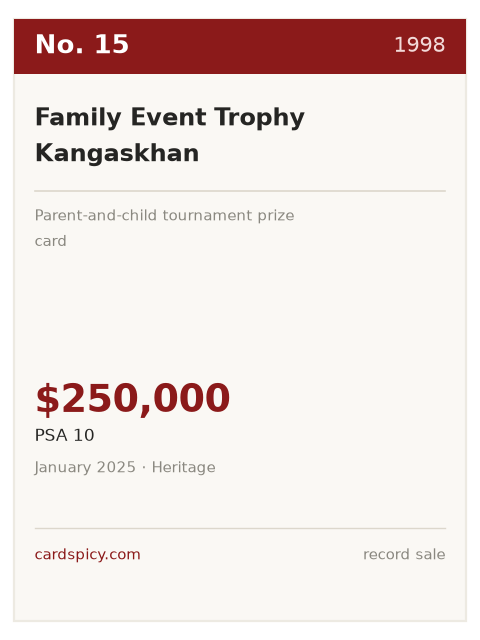
Awarded to winners of a Japanese parent-and-child tournament, which is as narrow as it sounds and is the reason so few exist. It is the most valuable card on this list whose subject is not a headline character.
16. Tsunekazu Ishihara signed promo (2017) — $241,200
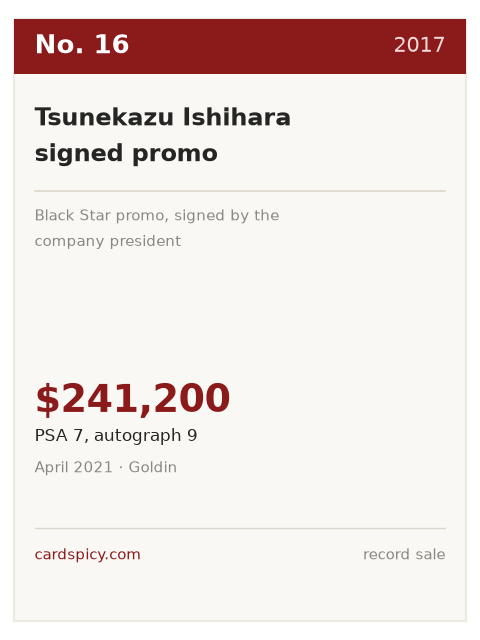
A Black Star promo signed by the president of the Pokémon Company. The card by itself is unremarkable; the signature is the asset. It is the clearest illustration on this list that provenance can outweigh both rarity and condition.
17. Japanese Blastoise, no rarity symbol (1996) — $231,800
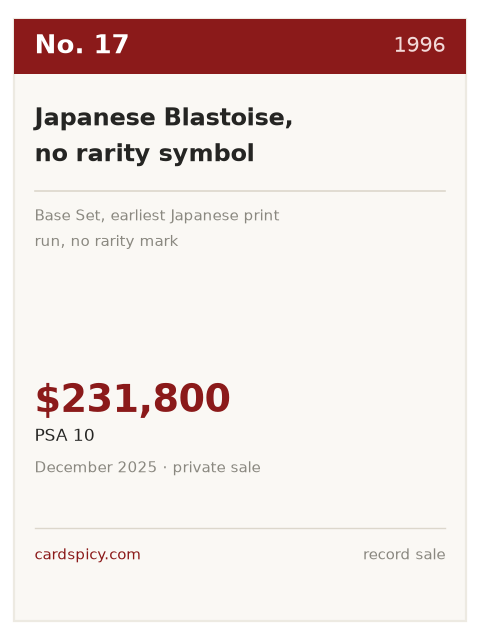
The third member of the original starter trio, again on the earliest Japanese print run with no rarity symbol. Blastoise is the only starter with several distinct cards inside the top 50. In Simplified Chinese, this character is ranked on its own page: Blastoise in Simplified Chinese.
18. Luigi Pikachu, 296/XY-P (2016) — $216,000
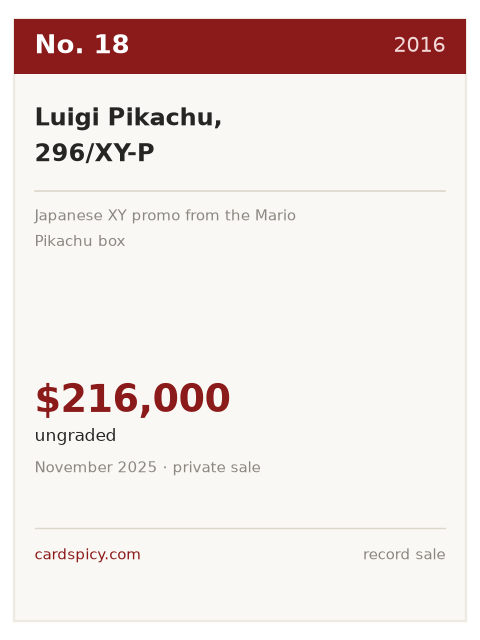
A Japanese promo from the Mario Pikachu box, and the most expensive modern-era promo here. It was a retail tie-in rather than a tournament prize, so its price is a statement about character demand rather than about scarcity.
19. Test print, gold border Blastoise (1998) — $216,000
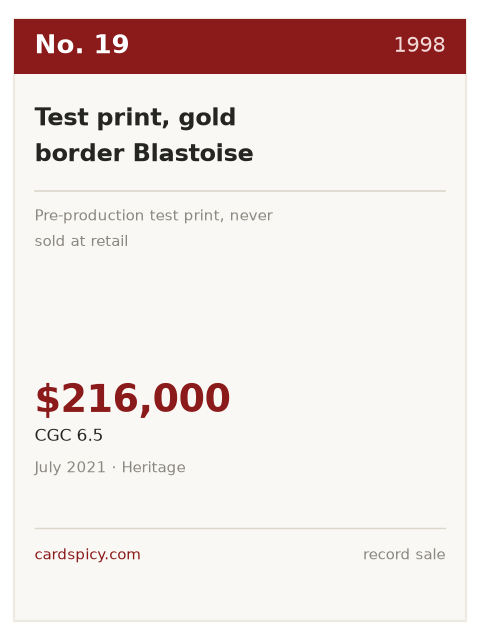
A pre-production test print that never reached retail. Test prints are the least well understood category on this list: they are not cards in any official sense, and their value depends entirely on how few left the factory. In Simplified Chinese, this character is ranked on its own page: Blastoise in Simplified Chinese.
20. Tamamushi University Magikarp (1998) — $210,800
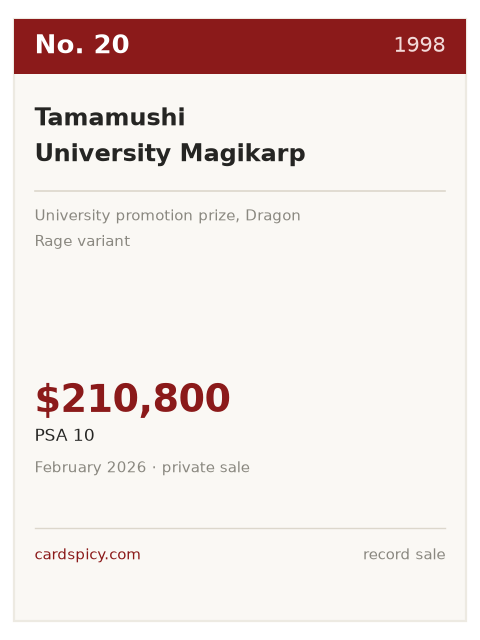
Awarded to students who passed a promotional test at a Japanese university, and printed with a Dragon Rage attack the species cannot normally learn. Around a thousand copies were made and far fewer have survived.
21. Snap Bulbasaur (1999) — $200,000
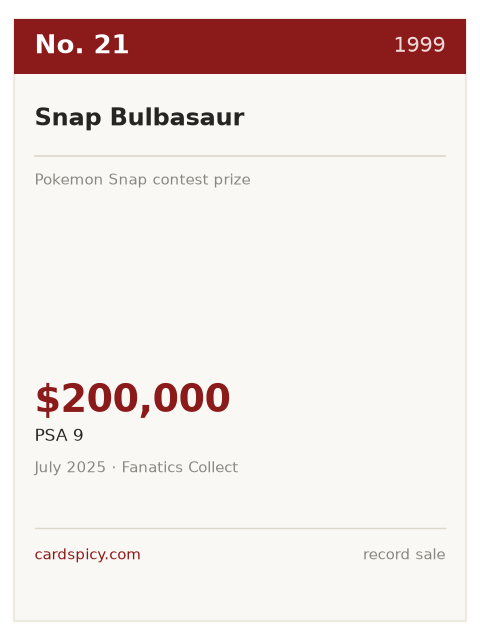
The most valuable Snap card that is not a Pikachu. The Snap promotions were run twice, with the magazine contest printing twenty copies of each winning image and the television contest fifteen.
22. Umbreon Gold Star, 026/PLAY (2005) — $180,000
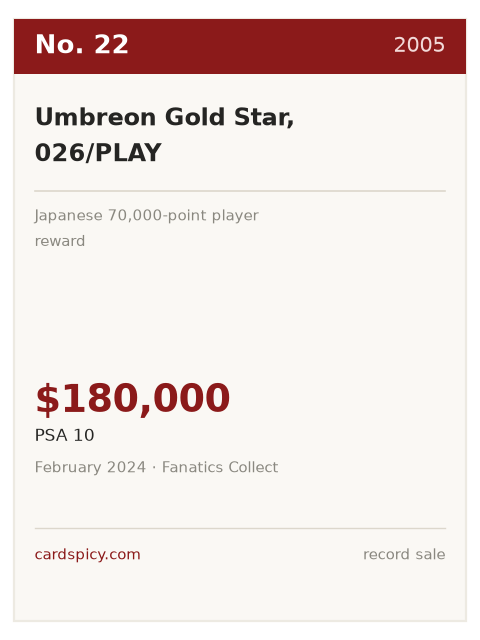
A Japanese player reward issued in exchange for 70,000 points, which in practice meant playing an enormous number of organised events. Umbreon’s standing as the most collected modern Pokémon is why this gold star outranks Rayquaza’s and Charizard’s. In Simplified Chinese, this character is ranked on its own page: Umbreon in Simplified Chinese.
23. Extra Battle Day Lillie (2019) — $171,000
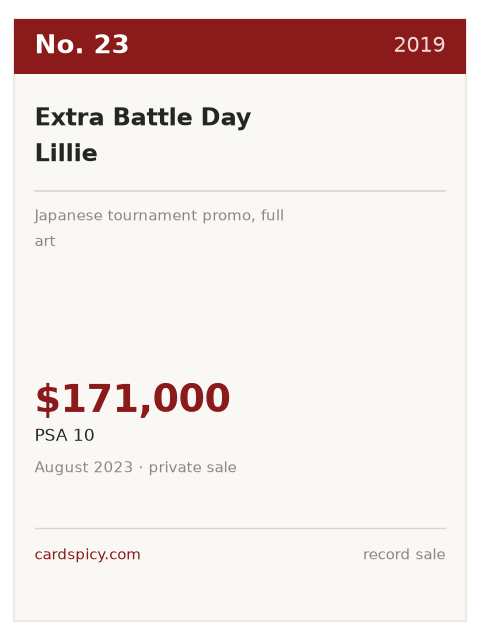
The only trainer card in the top 50. Lillie is a character collectors chase the way they chase a Pokémon, and the full-art treatment from a Japanese-only event made her the most expensive trainer in the hobby.
24. Trophy Pikachu No. 1 Trainer (1998) — $168,000
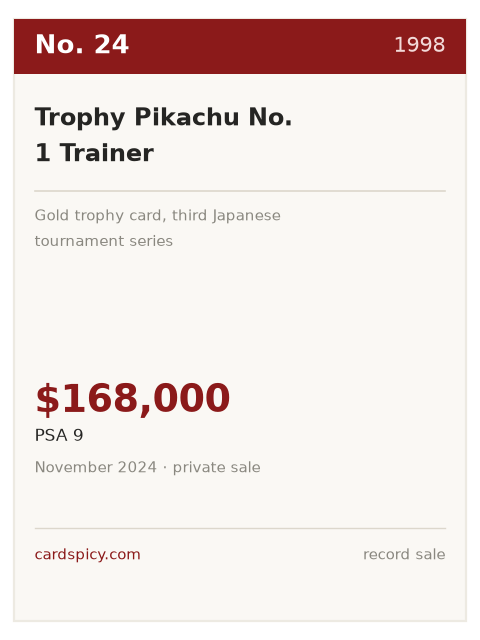
The same gold trophy as the first-series copy near the top of this list, from a later tournament, at a tenth of the price. The trophy category shows the widest spread between nominally identical cards of anything here. In Simplified Chinese, this character is ranked on its own page: Pikachu in Simplified Chinese.
25. Super Secret Battle No. 1 Trainer (1999) — $156,000
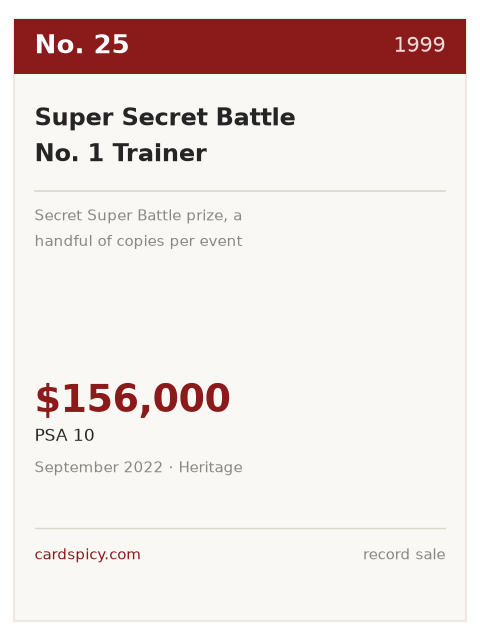
A prize from a Japanese tournament series in which each event produced only a handful of copies. The naming is confusing: a No. 1 Trainer is a trophy card, not a card anyone could have played with.
26. Snap Gyarados (1999) — $150,000
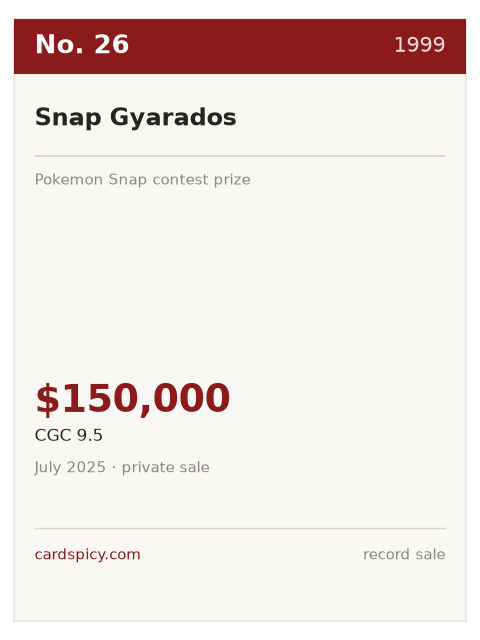
A photograph of Gyarados taken by a competitor inside the game, printed as a card and handed to the winner. The Snap set is the only place on this list where the artwork itself is a player’s work rather than a studio commission.
27. Snap Chansey (1999) — $150,000
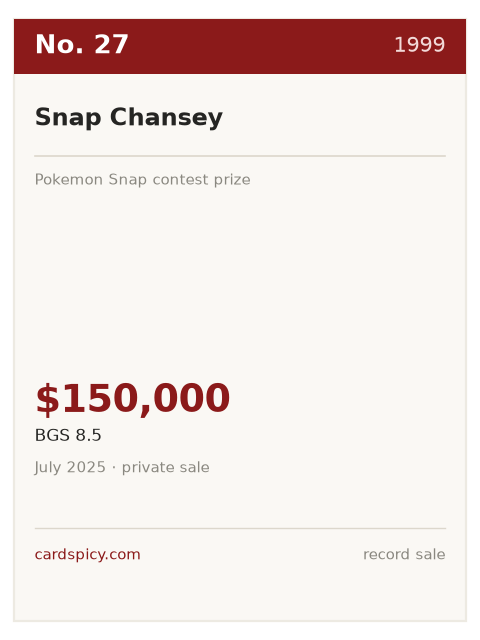
One of the harder Snap plates to find in any grade above near-mint, and one of the set’s strongest results. Every Snap card came from the same two contests, which is why they rise and fall together.
28. Pikachu Gold Star (2006) — $148,000
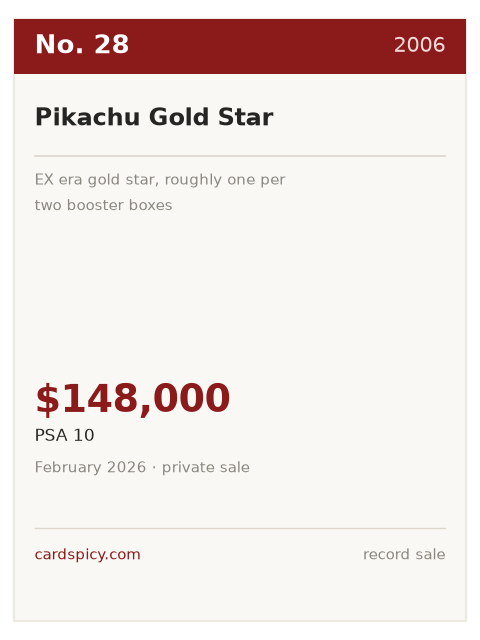
Gold stars were the first ultra-rare tier in the modern game, seeded at roughly one per two booster boxes. Pikachu is one of only two gold stars that sustains a six-figure price in a gem-mint grade. In Simplified Chinese, this character is ranked on its own page: Pikachu in Simplified Chinese.
29. 1st Edition Neo Genesis Lugia (2000) — $144,300
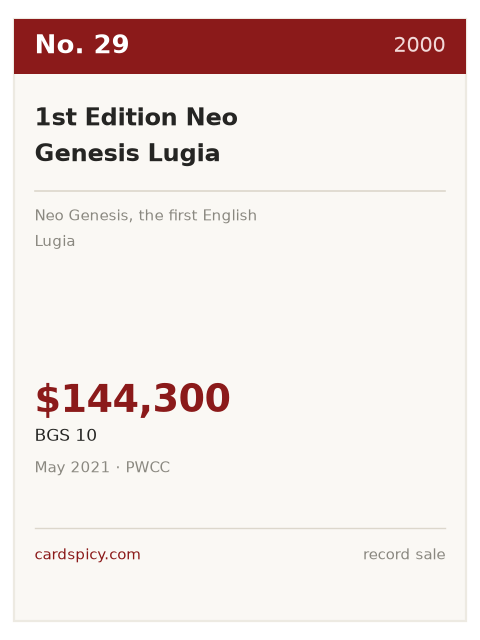
Not a trophy and not a promo: an ordinary set card, made expensive because the holographic foil scratches so easily that almost nothing survived gem-mint. It is the highest-placed card here that anyone could have pulled from a shop-bought pack in 2000.
30. 1st Edition Base Set Blastoise (1999) — $138,880
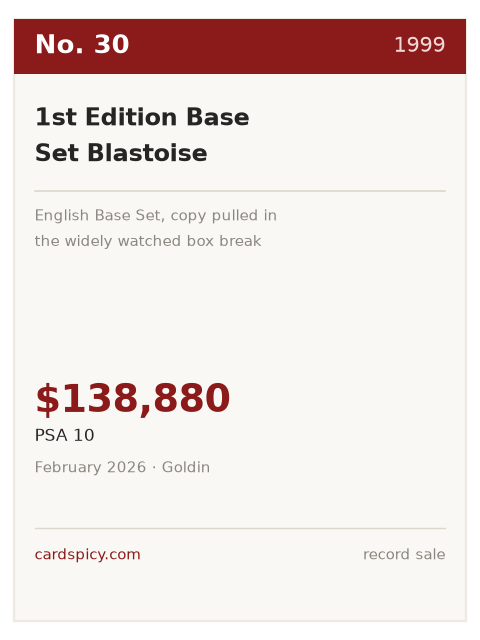
The same provenance premium as the Charizard at the top of this list. An English 1st Edition Blastoise in a PSA 10 grade sells for a fraction of this without the recorded box-break history attached to it. In Simplified Chinese, this character is ranked on its own page: Blastoise in Simplified Chinese.
31. No. 2 Trainer, Toshiyuki Yamaguchi (2000) — $137,500
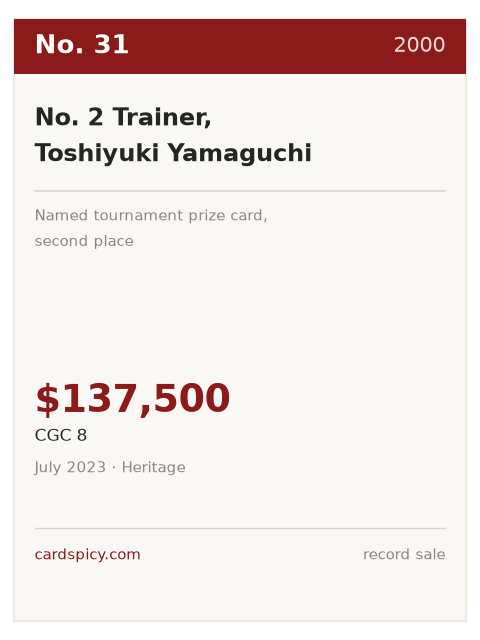
Some early Japanese trophy cards are printed with the winner’s name on them. A named trophy is rarer and harder to replace than an unnamed one, which is why this reached the top 50 in a modest grade.
32. Snap Magikarp (1999) — $136,000
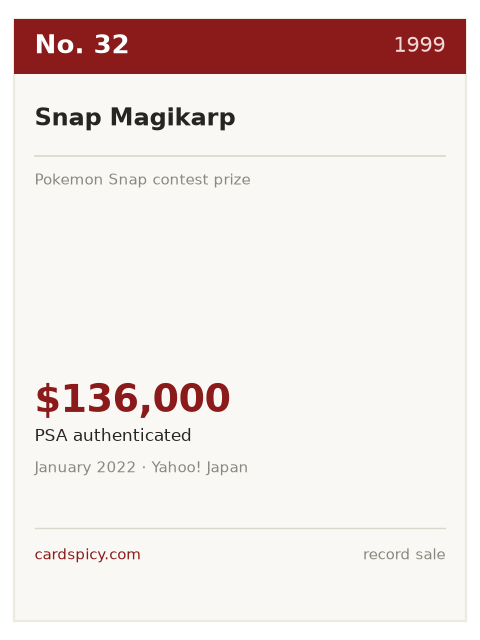
The set’s other headliner, and a reminder that Snap pricing is driven by which Pokémon the photograph happens to show. Magikarp, the joke Pokémon, sits above most of the legendary trophies on this list.
33. Neo Summer Battle Road No. 2 Trainer (2001) — $132,000
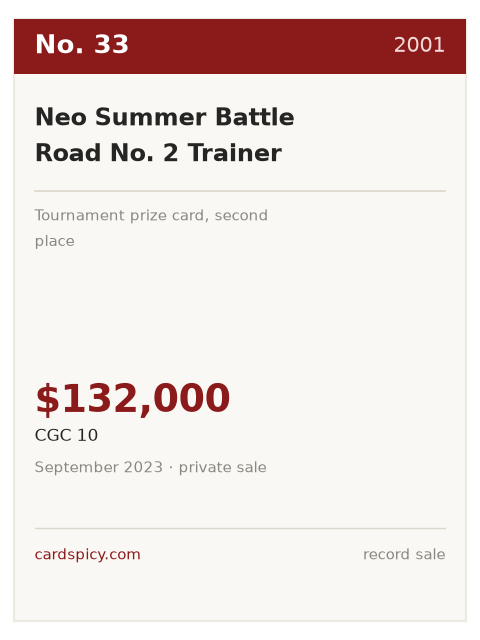
A second-place prize from a Japanese tournament series. The silver from a given event has repeatedly sold above the gold from the same event, which says as much about how many of each survived as it does about demand.
34. Torchic Gold Star (2004) — $117,800
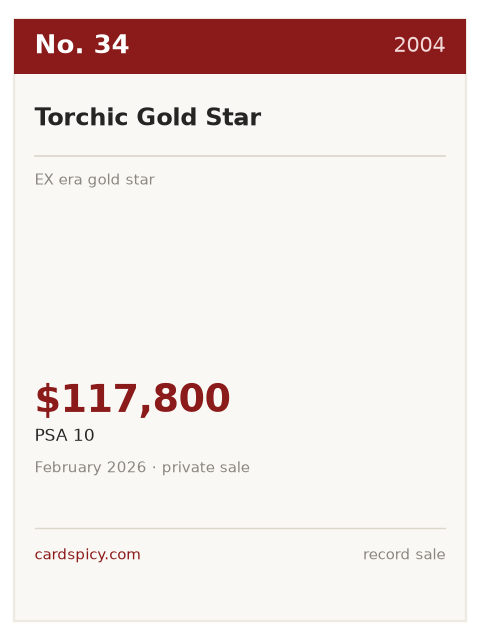
A gold star from the EX era. Torchic is the least famous Pokémon in the top 50 by a wide margin, and its price is a pure scarcity result: the card is hard to find graded and has almost no substitute.
35. World Championships No. 2 Trainer (2006) — $110,100
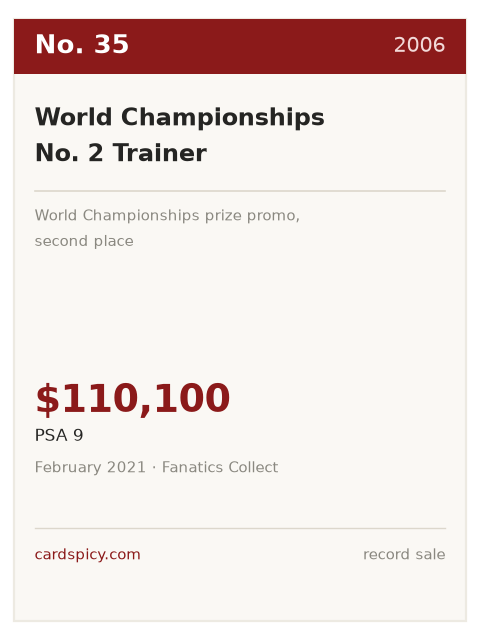
A World Championships prize promo awarded for second place. Championship prizes from the mid-2000s were produced in tiny numbers for a competition with a few dozen entrants, which makes them structurally rarer than most set cards.
36. Snap Charmander (1999) — $105,003
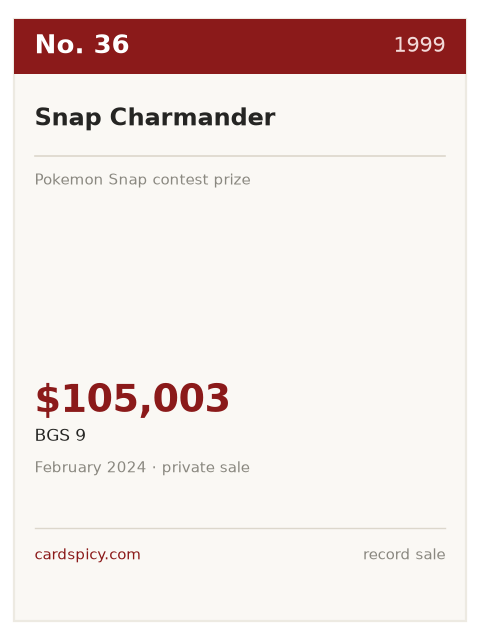
One of only a handful of Snap Charmander copies logged in any grade. Snap plates carry condition discounts that are unusually steep, because most of the surviving examples were handled before anyone treated them as collectible.
37. Japanese beta presentation Charizard (1996) — $99,000
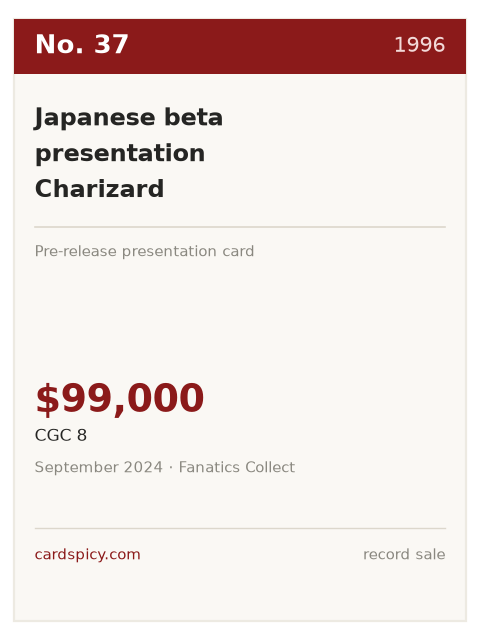
A pre-release presentation card from the Japanese launch era. Presentation pieces were never distributed to players, so supply depends on what staff kept, and Charizard is the most sought-after subject in that category. In Simplified Chinese, this character is ranked on its own page: Charizard in Simplified Chinese.
38. Snap Squirtle (1999) — $82,546
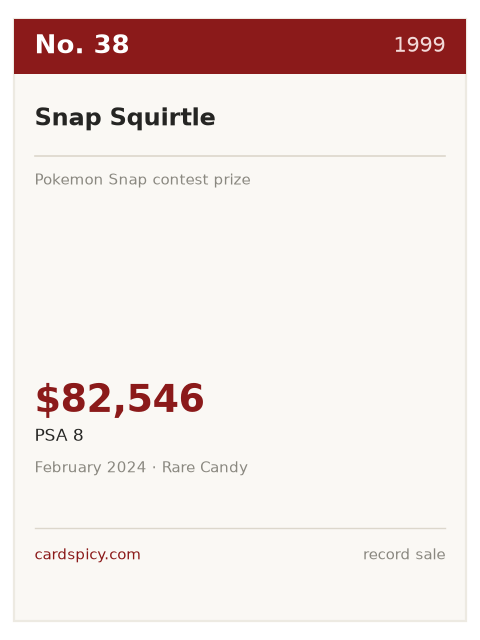
A Snap Squirtle, and one of the more obtainable plates in the set. It illustrates the set’s internal range: the same promotion runs from a few tens of thousands of dollars to well over a quarter of a million depending on the Pokémon.
39. Tropical Mega Battle No. 2 Trainer (1999) — $81,536
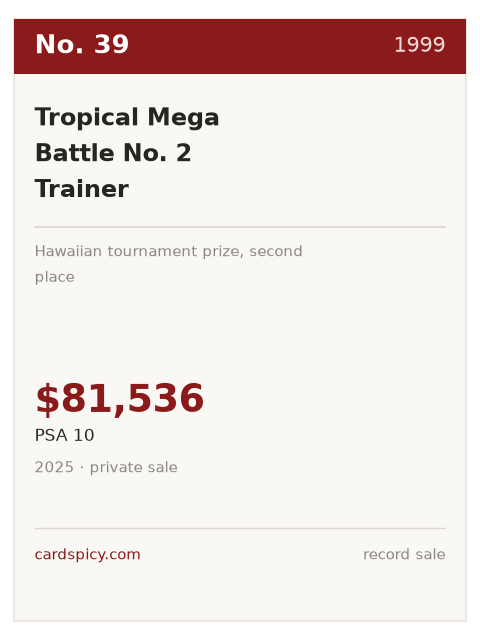
A second-place prize from the Hawaiian tournament that is generally treated as the first genuinely international Pokémon championship. Participation and placement cards from that event are the backbone of the vintage prize market.
40. World Championships Pikachu No. 1 Trainer (2010) — $75,000
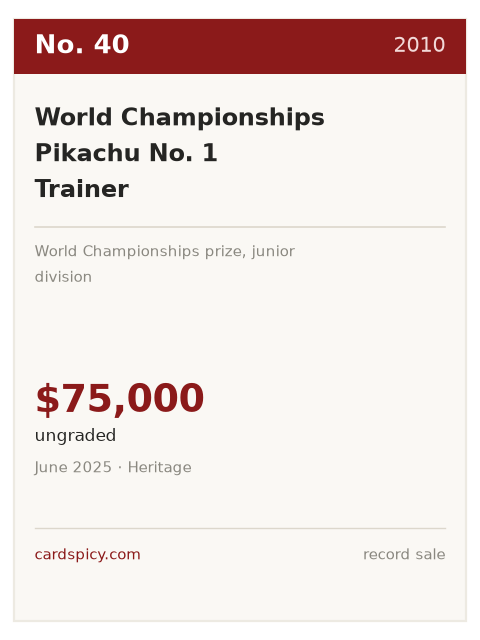
A World Championships prize from the junior division, sold by the player who won it, with the original presentation case. It is a useful example of how thin the supply of these cards is: three were made. In Simplified Chinese, this character is ranked on its own page: Pikachu in Simplified Chinese.
41. Master’s Key (2010) — $66,000
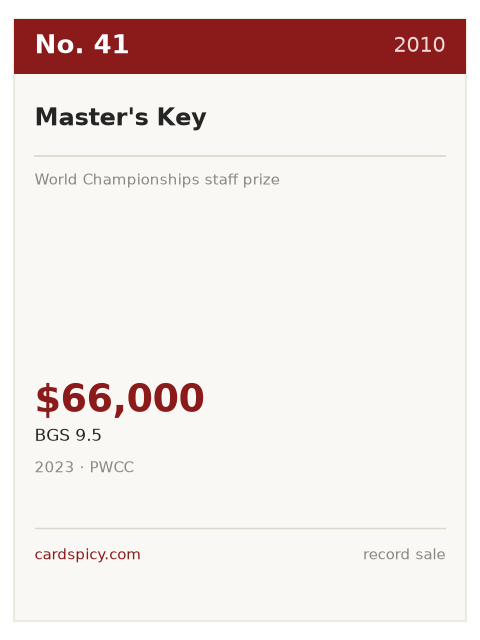
A staff prize from the World Championships rather than a competitor prize, and therefore rarer than the placement cards beside it on this list. Staff issues are a small and poorly documented corner of the market.
42. Tropical Wind promo (1999) — $65,100
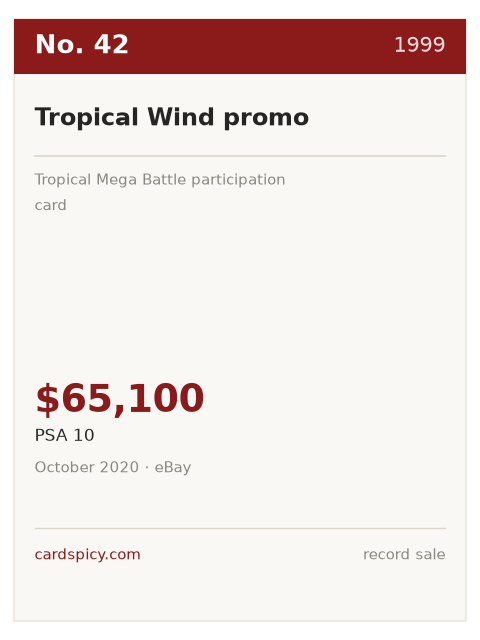
A participation card from the Hawaiian tournament, so more copies exist than of the placement prizes — around a few dozen. It has repeatedly been the entry point for collectors moving into trophy cards.
43. World Championships Pikachu No. 1 Trainer (2013) — $63,000
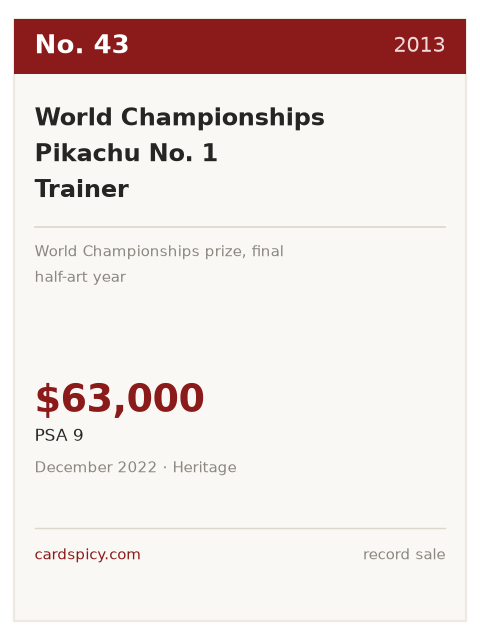
The final year before World Championships prizes switched to full-art treatments, and the last of the half-art Pikachu trainer cards. That boundary is why this particular year commands a premium over the ones after it. In Simplified Chinese, this character is ranked on its own page: Pikachu in Simplified Chinese.
44. Dragon Frontiers Charizard Gold Star (2006) — $60,065
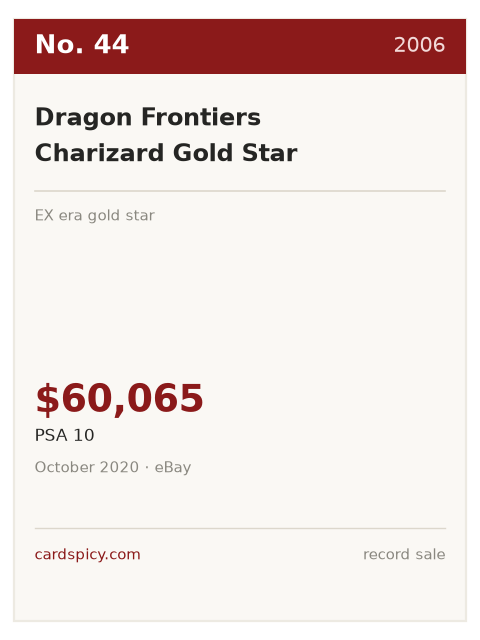
A Charizard gold star from the EX era, and the more affordable of the two Charizard gold stars. It shows the ceiling of the modern-era market: a genuinely scarce modern card in a top grade still lands around sixty thousand dollars. In Simplified Chinese, this character is ranked on its own page: Charizard in Simplified Chinese.
45. Mew Victory Orb (2005) — $60,000
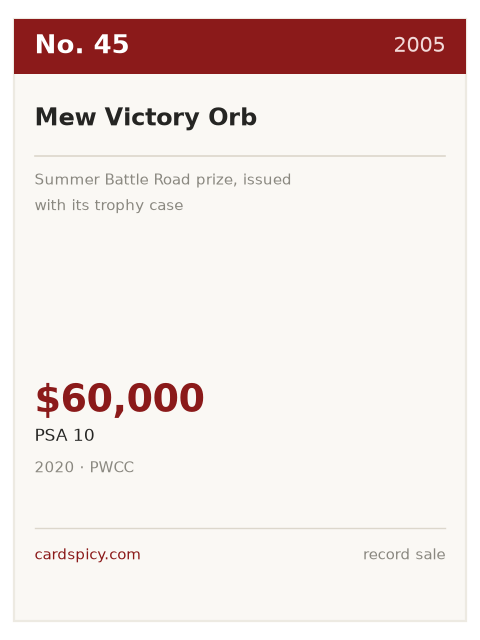
A prize from a Japanese tournament series, sold with its original trophy case. Mew’s status as the original mythical Pokémon gives it a collector base that most prize cards of the same era do not have. In Simplified Chinese, this character is ranked on its own page: Mew in Simplified Chinese.
46. 1st Edition Base Set Blastoise, shadowless (1999) — $60,000
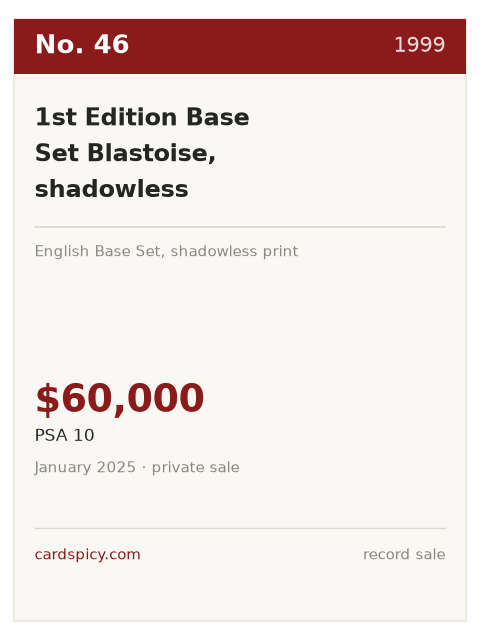
An English 1st Edition Blastoise in a shadowless printing, sold privately. Along with the Charizard and Venusaur in the same set, it is one of the three cards that define what a complete original English run looks like. In Simplified Chinese, this character is ranked on its own page: Blastoise in Simplified Chinese.
47. Tropical Mega Battle bilingual Exeggutor (1999) — $59,780
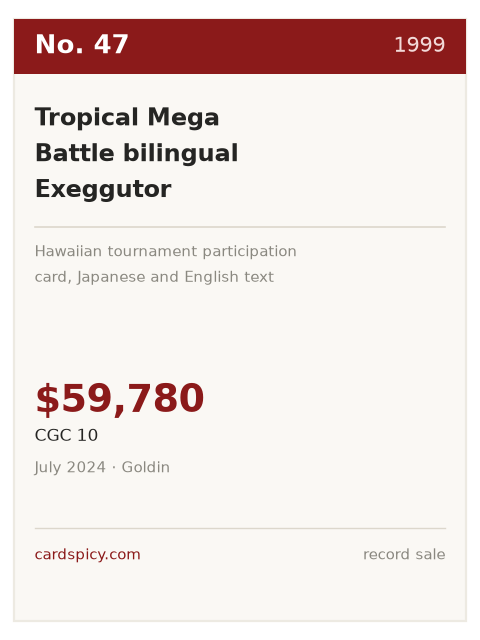
A participation card from the Hawaiian tournament printed with both Japanese and English text, which is unusual for the era and reflects that the event was the first to draw competitors from several countries at once.
48. Snap Articuno (1999) — $58,560
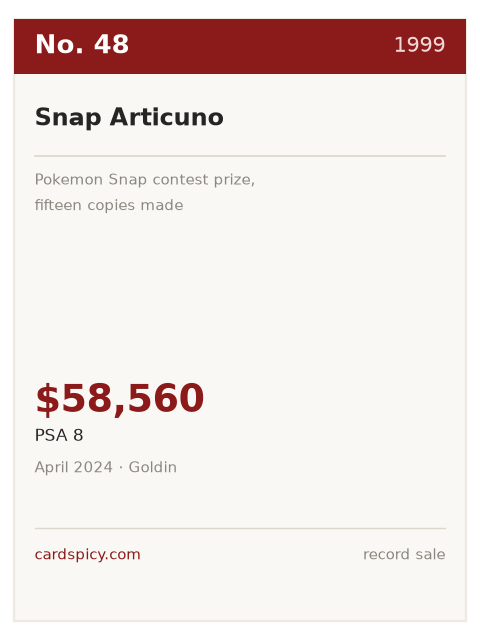
The Articuno plate from the television-run Snap contest, of which fifteen were printed. It is one of the set’s rarest cards in a high grade and one of the reasons the Snap promotion is treated as a single collectible group.
49. Base Set Venusaur, no rarity, autographed (1996) — $55,000
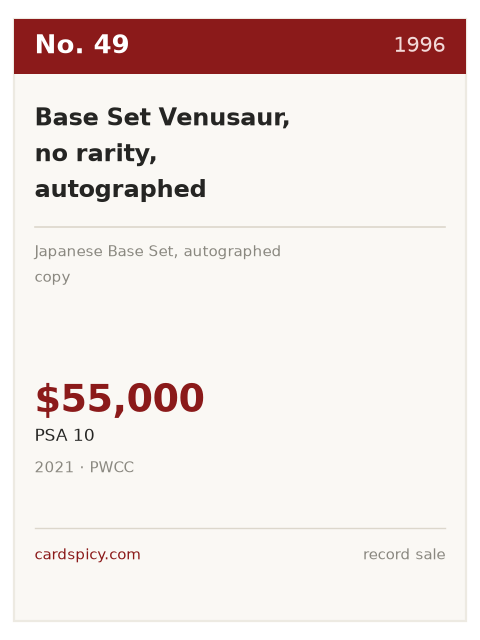
An autographed Venusaur from the earliest Japanese print run. The original starter trio closes the top 50 in the same order it opens popular memory: Charizard first, Blastoise second, Venusaur third. In Simplified Chinese, this character is ranked on its own page: Venusaur in Simplified Chinese.
50. 1st Edition Base Set Chansey, shadowless (1999) — $55,000
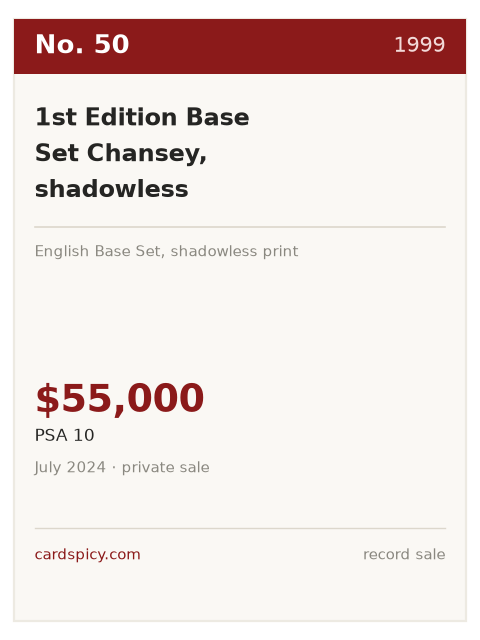
The last entry, and an ordinary English set card in a shadowless printing. It marks where the top 50 ends: a gem-mint 1st Edition holo of a popular Generation I character, without any trophy or promo history behind it.
What the fifty actually show
The list is not a cross-section of the card market. It is a cross-section of one narrow mechanism, repeated twenty times over.
| How the card was distributed | Entries in the top 50 |
|---|---|
| Trophy or placement prize at a tournament | 17 |
| Contest, campaign or signed promo | 14 |
| Pre-production material: test prints, presentation cards | 3 |
| Ordinary cards pulled from packs | 16 |
Thirty-four of the fifty were never on a shelf. That is the single most useful fact on this page. A card becomes a six-figure object when the number of copies that reached the public is measured in tens, and the trading card game has always produced those cards the same way: as prizes, as promotions, or as material that was never meant to leave the factory. Condition and character popularity decide the order within that group, but they do not create it.
The second pattern is how concentrated the names are. Pikachu accounts for ten entries, Charizard for eight and Blastoise for five — twenty-three of the fifty between three characters. Add Umbreon, Mew, Lugia, Gengar-adjacent favorites and the survivor trio and you have essentially the whole list. The remaining eight entries are trainer and staff prize cards with no Pokémon on them at all. This is worth sitting with, because it is the same concentration you see in a much newer market: the characters that top this list are the characters that every branch of the hobby, in every language, prices above the rest.
The third pattern is time. The newest card in the top 50 is from 2019. Nothing printed in the last seven years appears anywhere on the list, and only three entries are from after 2015. The modern era has produced genuinely expensive cards — an alternate-art Umbreon VMAX in a top grade trades in the low four figures — but the gap between four figures and seven is not a gap that any current print run can close in a human lifetime. Scarcity of the kind that produces this list takes decades to accumulate.
Fourth, grade matters less than people assume at this level and more than people assume below it. Twenty-four of the fifty are PSA 10 copies, but ten are PSA 9 or lower, eleven are graded by CGC or BGS, and five sold ungraded or authenticated only. The card at number five is a PSA 6, and it reached half a million dollars. Meanwhile an English 1st Edition Charizard in a PSA 10 can be worth fifteen times the same card two grades lower. The rule is consistent: extreme rarity makes grade almost irrelevant, and ordinary rarity makes grade almost everything.
Why none of these cards exists in Simplified Chinese
Not one card on this list has a Simplified Chinese printing, and none will. The Simplified Chinese line only started in 2023. Every card in the top 50 predates it by at least fifteen years and most of them by twenty-five, and the cards that are not simply old are prizes from a Japanese tournament circuit that no longer runs the same way.
That is a limitation, and it is also the point. A list like this is not a shopping list, because the supply does not exist to shop from: several of these cards are known in fewer than twenty copies worldwide, and the largest are single examples. What it can do is tell you which characters the hobby has decided to value, and how it decides. So here is how the top 50 translates into something a collector outside mainland China can actually act on.
- The names are the same names. Twenty-three of the fifty are Pikachu, Charizard or Blastoise. All three have Simplified Chinese printings, and all three have Simplified Chinese-exclusive artwork that no Japanese or English collector can buy in their own language. You are not being asked to like an obscure character to take part in the top of the market’s logic.
- Exclusivity is the mechanism, and Simplified Chinese product is the only place you can still buy it at retail. Every card at the top of this list is expensive because it was scarce at the point of distribution. Simplified Chinese-exclusive artwork reproduces that structure on a small scale: a specific illustration that exists in one language only, with a population that can be estimated and is not growing. The four Collect 151 Pikachu art rares are the clearest example, and the ten most popular exclusive cards rank the same idea across characters.
- Grade still matters at this price point. The 1st Edition Charizard in the top 50 has around 125 PSA 10 copies and an ungraded near-mint copy is worth a fraction of one. Simplified Chinese cards are recent enough that most have never been submitted, which is why graded Simplified Chinese exclusives carry a wider premium than graded Japanese ones.
- Learn the one thing that separates a Chinese-only card from a card printed in Chinese. Set-code literacy is the whole skill: the trailing letter tells you whether an illustration is exclusive to the branch or merely translated. The set-code guide covers it end to end, and Chinese vs Japanese Pokémon cards sets out how the three language branches differ as products.
- Start where the ladder starts. The Simplified Chinese price ladder sorts the catalogue into bands, and why Simplified Chinese cards are worth collecting now explains why the branch is still priced where it is.
The same logic runs through every character page on this site. If the name on one of these fifty cards is a name you collect, there is a Simplified Chinese ranking for it: Pikachu, Charizard, Blastoise, Umbreon, Sylveon, Eevee, Gengar and Psyduck cover most of what this list names, and the regional favorites analysis explains why those particular names keep coming back.
Frequently asked questions
Is this list ranked by sale price or by asking price?
Sale price, in every case. Each entry carries the month, year and venue of the sale, and the plate on the card records them. Asking prices are ignored entirely, which is why some cards that appear on other “most valuable” lists do not appear here: they have no documented sale at a level that would place them.
Why do different compilations of this list disagree?
Because sales at this level are private and infrequent. There is no central register for a seven-figure card transaction, several of these sales were concluded off-platform, and a reported figure can take months to be corroborated. Compilations therefore differ in the middle of the list. We used the highest figure documented with a date and a named venue, and marked reported-but-unconfirmed sales as private sales on the plate.
What is a No. 1 Trainer card?
It is a trophy card, not a trainer card. The naming is a legacy of the original Japanese tournament prizes, where the top-placed competitor received a card printed with “No. 1 Trainer” on it, second place received “No. 2 Trainer” and third received “No. 3 Trainer”. Several of the most valuable cards in the hobby are these, and the earlier the tournament series, the fewer copies exist. Some were printed with the winner’s name on them, which makes those copies unique.
Why is there nothing recent in the top 50?
Because nothing recent has had time to become scarce in the way this list requires. The newest entry is from 2019, and only three are from after 2015. Modern sets are printed in volumes that dwarf anything from the late 1990s, and even the hardest modern chase card exists in the thousands. The modern market’s ceiling is real but it is a different order of magnitude, and it is where the vast majority of collectors actually operate.
Can I buy any of these cards from CardSpicy?
No, and we would not claim otherwise. Several of these cards are known in fewer than twenty copies worldwide and the largest are single examples held by private owners. What we do sell is the same characters, in Simplified Chinese, printed as exclusive artwork — which is the closest thing the hobby has to buying into the structure that makes this list possible. Our ask prices for the cards we hold are on each product page.
Is the Pikachu Illustrator really the most expensive trading card ever sold?
As of the most recent recorded sale, yes — not just the most expensive Pokémon card, but the most expensive trading card of any kind, a record independently certified at the time of sale. It has held that position across two sales, and the second sale was roughly three times the first. No other card on this list has been certified as a record.
Sources
Sources and further reading
- TCGplayer — The 30 Most Expensive Pokémon Cards Ever, updated to February 2026. The primary spine of this list: rank, grade, sale month and venue for every entry in the top 30.
- PokéItem — Most expensive Pokémon card: 2026 ranking, February 2026. Corroborating figures for the Pikachu Illustrator record and the 1st Edition Charizard sales.
- Dexerto — Rare and expensive Pokémon cards, a 40-entry compilation with sale dates, grades and venues, used to verify entries from rank 31 to 50.
- Kai’s Castle — The most expensive rare Pokémon cards of all time, a 55-entry compilation with sale dates and venues, used to cross-check the middle of the list.
- Esports.gg, as reported in a 2026 round-up — a 20-entry list with sterling figures, used as a third check on the top 20.
- CardSpicy — How to read a Simplified Chinese Pokémon set code, Gem Pack Vol. 1 to 6, the Collect 151 art rares and the ten most popular exclusive cards, for everything in this article about the Simplified Chinese branch.
The record plates on this page are original data graphics, not photographs of the cards; we do not reproduce third-party card images. Sale figures are documented secondary-market results at the dates and venues stated and are reproduced here for reference. Several cards on this list are known in single-digit populations and trade privately and infrequently, so any figure should be read as a record of a past sale rather than a current valuation. Nothing on this page is a price we are quoting, a valuation or an investment recommendation.