

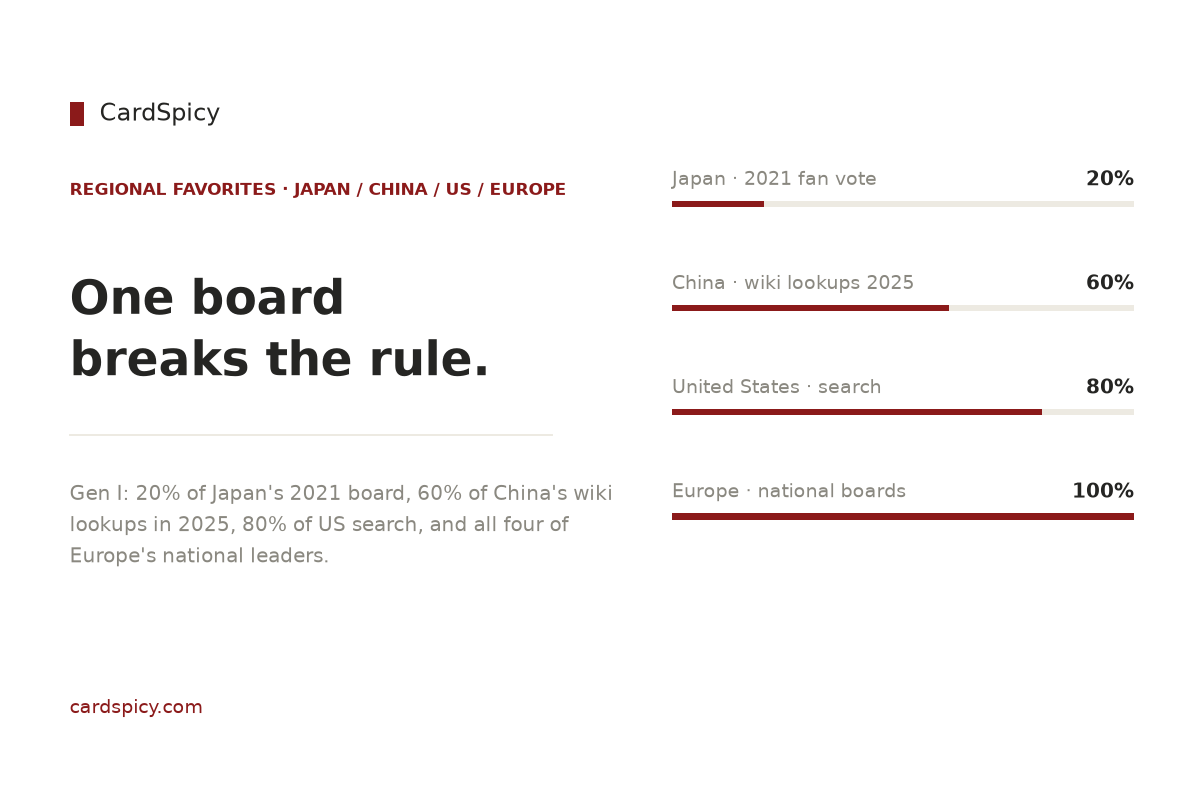
Ask four regions which Pokémon they actually like and you get four different boards. Japan’s is a joke vote, China’s is a new-game lookup chart, the United States is Generation I with two competitive exceptions, and Europe hands the crown to Charizard in nine separate countries. The gap between those boards is the reason Simplified Chinese cards exist as a category worth owning: the taste that the Chinese market prices up is the taste the West already has, and the artwork it prints for that taste has no Japanese or English printing at all.
This piece does two things. It lays out the strongest preference data available for Japan, China, the United States and Europe, with the source and the method behind each board stated plainly. Then it takes the Simplified Chinese environment apart on its own terms — what its collectors respond to, what moves its prices, how a favorite spreads inside it, and what its playing community does to demand — because that environment is where we actually buy, and it is the one a Western collector is least likely to have read about.
Where these four boards come from
There is no single global poll that reports by country. The largest official vote ever run — Pokémon of the Year, announced on Pokémon Day 2020, six and a half million votes across ten days and eight languages — broke its results down by generation, not by geography: Kanto, Johto, Hoenn and so on. Its overall winner was Greninja with 140,559 votes; Pikachu finished nineteenth. Anyone quoting region-by-region numbers from that vote is quoting the Kanto-to-Galar split, which is a different thing entirely.
So this article triangulates from five sources, each measuring something slightly different. Read them with their bias in mind and the pattern holds up.
- Japan — an official fan vote. For Pokémon Day 2021, the Japanese Pokémon Day site ran a hashtag-based favorite-Pokémon vote on Twitter from 19 to 22 February. It published a top 30. It did not cap votes per account, and the board it produced is visibly shaped by that.
- Asia — an official per-market vote. The same month, Pokémon Asia My Favorite Award 2021 ran a separate vote in each of nine markets through the regional Pokédex sites, with the leaderboard drawn from a click on the entry itself. Hong Kong, Taiwan, Singapore, Malaysia, Thailand, Vietnam, the Philippines, India and Indonesia each got their own board, and there was no combined Asian total.
- China — page views on the country’s largest Pokémon wiki. 神奇宝贝百科 (52poke) publishes an annual list of its most-visited Pokémon articles. Its 2025 list is the closest thing to a demand signal for mainland China that exists in public, because it measures what people went looking for rather than what they claimed to like.
- The United States — search volume. A 2025-26 analysis of twelve months of US Google search data produced a top 10 with actual monthly figures attached, which is why it is the one board here with numbers instead of ranks.
- Europe — a national-leader analysis. A Google search study that normalised each Pokémon’s search volume country by country and then asked which Pokémon ranks furthest above its own global average identified a leader for every European country. There is no European top 10 in that study. There is something more useful: which Pokémon wins the most countries.
Two more boards are worth holding alongside these as checks. In 2025 an English-language community poll of 14,478 voters put Umbreon, Charizard, Blastoise, Gyarados and Gengar at the top of a Kanto-only ballot; a separate 26,402-vote survey across the wider fandom returned Mimikyu, Sylveon, Gengar, Mudkip, Bulbasaur and Lucario above Eevee and Umbreon. And Bulbapedia’s own 2025 page-view list, the English-language equivalent of the Chinese wiki data, runs Eevee, Lucario, Gardevoir, Zygarde, Dragonite, Pikachu, Charizard, Garchomp, Gengar, Ceruledge.
Japan: the board the internet wrote
Japan’s 2021 favorite-Pokémon board, top 10:
| Rank | Pokémon | Generation |
|---|---|---|
| 1 | Dedenne | VI |
| 2 | Cinccino | V |
| 3 | Sableye | III |
| 4 | Snivy | V |
| 5 | Magnemite | I |
| 6 | Swadloon | V |
| 7 | Pikachu | I |
| 8 | Buzzwole | VII |
| 9 | Oshawott | V |
| 10 | Flygon | III |
Read that board as a ranking of affection and you will draw the wrong conclusions. Dedenne at number one, Cinccino at two and Swadloon at six are not a picture of Japanese taste — they are the fingerprint of an uncapped hashtag vote. Japanese fans noticed in real time that a small, unglamorous Pokémon could be pushed up the board by repeating a tag, and the vote turned into an in-joke. The same thing happened to Taiwan’s parallel board, where Grimer finished first and Lugia fourth inside an otherwise conventional top five, and the Taiwanese fan write-ups said so openly at the time.
Strip the joke layer out and Japan looks much more like everywhere else. Japanese search data puts Eevee as the country’s most-searched Pokémon, and Eevee is the one character the Pokémon Company has promoted to co-mascot status beside Pikachu — the only creature with its own dedicated main-series game and its own national day. Japan’s distinct taste, once the meme vote is set aside, is a taste for whole lines rather than single faces: an entire evolutionary family becomes the unit of affection, which is why the Eevee family sits so high in Japanese-region boards and why five of Japan’s 2021 top ten are Generation V Pokémon that Western audiences barely register.
That Generation V cluster is a genuine regional signal, and it is worth understanding. Black and White were designed so that no older Pokémon appeared during the main story, which forced Game Freak to fill an entire region from scratch. The result was a slate of designs that Japanese players met at a formative age and that most Western players met as filler. Two of those Generation V names — Cinccino and Swadloon — appear nowhere near any other board in this article.
China: the board that a new game release writes
China’s 2025 board, top five by page views on 52poke, the country’s largest Pokémon wiki:
| Rank | Pokémon | Generation | What drove the traffic |
|---|---|---|---|
| 1 | Gardevoir | III | A Mega-Evolution Ralts was bundled as a purchase bonus with the 2025 release |
| 2 | Eevee | I | Where to find it and how to evolve it, in every new game |
| 3 | Charizard | I | Two Mega forms, a Gigantamax form, and permanent anime presence |
| 4 | Gengar | I | Mega form and a celebrated shiny colourway |
| 5 | Tyranitar | II | A Mega user in the same 2025 release |
We are giving the top five rather than a top ten because that is what the publisher detailed in readable form; the remainder of that list circulated as images. It is enough to make the point, and the point is not about affection at all.
A wiki page-view board measures need, not love. People open a Pokémon’s page because a game told them to go and find it, because an evolution condition is obscure, or because a new form just changed how it plays. In 2025 that meant the board was written by one release: Gardevoir took first place on the back of a Mega-Evolution Ralts handed out with a purchase, and Tyranitar reached fifth as a Mega user in the same game. Garchomp, a Dragon and Ground type that also gained a Mega, sat just behind. Three of the top six were driven by the same product.
The same list, read from the bottom, is just as informative. Its least-visited entries skew heavily to Generation V, the generation with the least nostalgia value and the least competitive relevance — the opposite end of the same effect that put Dedenne on top of Japan’s vote.
Bulbapedia’s 2025 English-language list makes an interesting comparison, because it uses an almost identical method on a different audience. Eevee is first there too. Gardevoir is third. But where the Chinese list is Gen I and II heavy with a 2025 flame-thrower on top, the English list runs Lucario, Zygarde and Dragonite into the top five — three characters whose traffic comes from competitive play and from a different set of recent releases. Same tool, different crowd, different board.
The United States: Pikachu, then a long plateau
US average monthly search volume, top 10:
| Rank | Pokémon | Generation | Monthly searches |
|---|---|---|---|
| 1 | Pikachu | I | 718,425 |
| 2 | Eevee | I | 479,516 |
| 3 | Charizard | I | 387,141 |
| 4 | Squirtle | I | 229,916 |
| 5 | Gengar | I | 209,116 |
| 6 | Snorlax | I | 205,508 |
| 7 | Arceus | IV | 197,889 |
| 8 | Gardevoir | III | 192,183 |
| 9 | Ditto | I | 187,950 |
| 10 | Mewtwo | I | 185,841 |
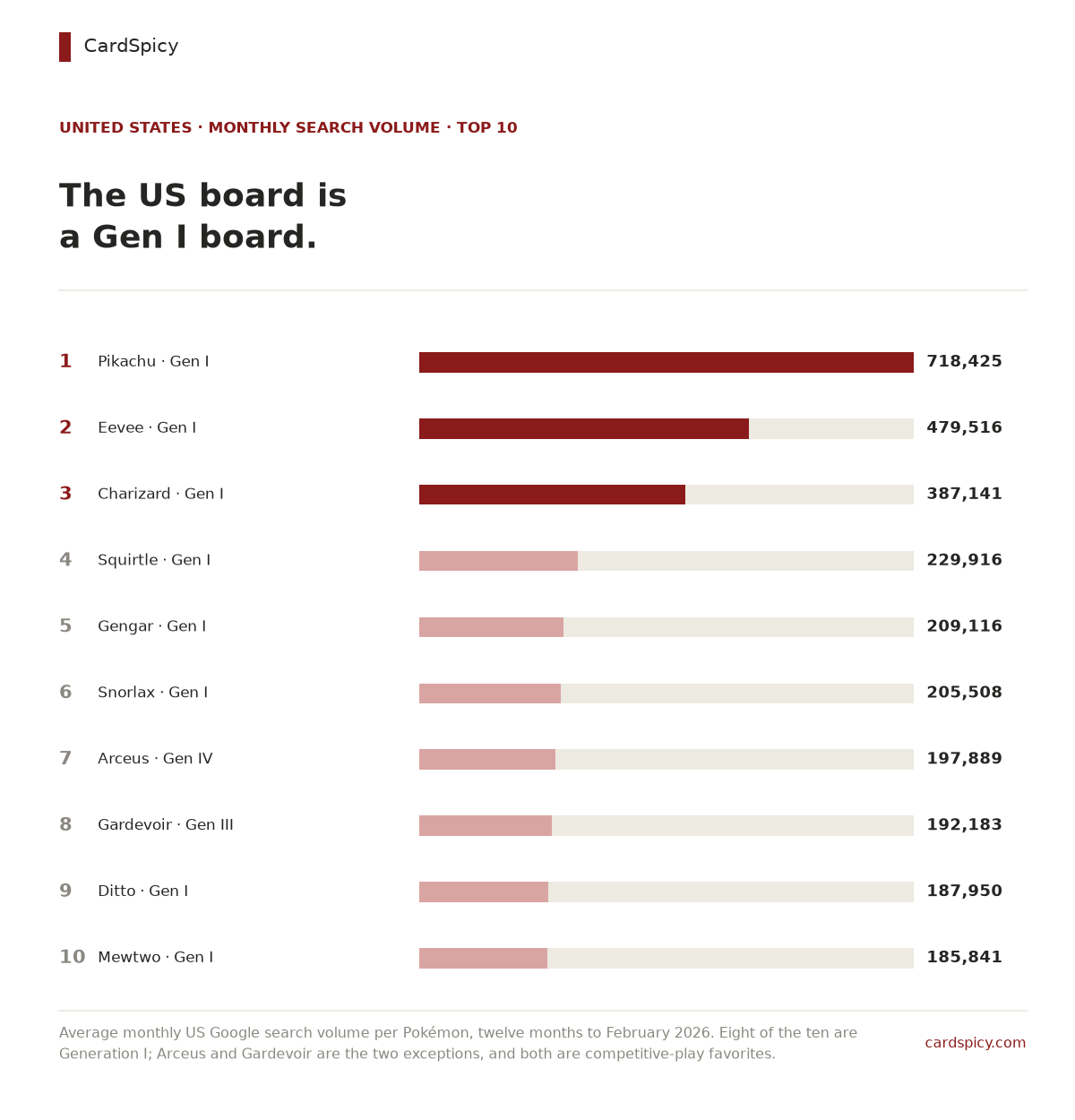
Two things stand out. The first is the shape. Pikachu’s 718,425 searches a month is not a lead, it is a separate tier: the gap between first and second is bigger than the gap between second and seventh. Below Pikachu the board is a plateau — Eevee, Charizard, Squirtle, Gengar, Snorlax, Arceus, Gardevoir, Ditto and Mewtwo are within a factor of 2.6 of each other, so on any given month ranks four through ten can reorder without anything having changed.
The second is the composition. Eight of the ten are Generation I, and the two that are not are the two you would predict from play patterns rather than childhood: Arceus is the cover of the most recent Legends title and a fixture in competitive discussion, and Gardevoir has been a top-table card in the trading card game continuously for years.
The same study’s second cut adds a wrinkle. When it asked which Pokémon is unusually popular in the US relative to its global average — rather than which is popular overall — Gengar came first, at 2.6 percent of American Pokémon searches against a 2.2 percent global share. Gengar is a Pokémon the US likes more than the world does. Combine that with the 2025 fandom survey that placed Gengar third overall and the Kanto ballot that placed it fifth, and Gengar becomes the closest thing the US has to a national favorite after Pikachu.
Europe: Charizard’s continent, with three local deviations
Europe has no continent-wide board, so the honest way to present it is by country. The table below gives the Pokémon that ranks furthest above its own global average in each market.
| Market | Most uniquely popular Pokémon | Generation |
|---|---|---|
| United Kingdom, Ireland | Charizard | I |
| Italy, Portugal, Sweden | Charizard | I |
| Czech Republic, Estonia, Malta, Andorra | Charizard | I |
| Germany, Austria, Switzerland, Slovakia, Albania | Golem | I |
| Denmark, Finland, Latvia, Lithuania | Eevee | I |
| Europe as a whole (most uniquely popular) | Abra | I |
Charizard wins nine European countries, more than any other Pokémon wins anywhere in the study. That is the clearest regional statement in this article: the Charizard premium is a European and Anglophone phenomenon before it is a global one, which is exactly why the 1st Edition Charizard sits at the top of every Western price guide.
The deviations are more interesting than the headline. Golem — a Rock and Ground type that nobody would put in a top ten for any other reason — leads five European markets in a tight central belt running from Germany and Austria through Slovakia to Albania. Abra, a Psychic type that is not even a fully evolved Pokémon, is the single most disproportionately searched Pokémon in Europe. Neither result is about story or anime exposure. Both look like localised effects of the mobile game, where Rock and Psychic attackers have had long stretches of relevance, plus the ordinary feedback loop by which a country searches what its own players are talking about.
The northern cluster is a neat contrast. Denmark, Finland, Latvia and Lithuania all give the title to Eevee rather than Charizard, and Eevee is the answer in Japan too. The pattern that emerges when you line all of this up is that Charizard and Eevee are the two poles of Western preference: Charizard where the trading card game’s playground culture took hold hardest, Eevee where it did not.
Why the four boards disagree
Five forces explain most of the difference, and only one of them is about taste.
- The method decides the winner. Japan’s board came from an uncapped hashtag vote and its top three are jokes. China’s came from wiki lookups and its top spot was bought by a purchase bonus. The US board came from search volume and is therefore a board of recognition, not preference. Europe’s came from a per-country deviation analysis and is therefore a board of what makes each country different rather than what it likes. A Pokémon can top one board and miss another entirely without any fan having changed their mind.
- Anime and game exposure arrive on different schedules. Greninja won the 2020 worldwide vote on the strength of one story arc, in a series whose dub reached different markets at different times. Dedenne is a main-anime companion in Japan and a minor character elsewhere. Buzzwole reached eighth in Japan on the back of game and meme presence that never translated.
- Generation I has a structural advantage that compounds. Measured across two decades of search data, Generation I Pokémon average more than double the interest of any later generation, and about forty times the newest one. Around 80 percent of all Pokémon sit below one percent of the franchise’s total search interest. Pikachu has had a thirty-year head start; the newer a Pokémon is, the less likely it is to appear on any board at all.
- Recency reshuffles the middle. Zygarde, Dragonite and Terapagos appear high on the 2025 English wiki board and on no other board in this article, because they were the subject of recent releases. Sableye, Grimer and Swadloon appear on Asian boards and nowhere else, because of memes. Neither group is a statement about lasting popularity.
- Local culture genuinely matters at the margins. Europe’s Golem belt and its Eevee north are both regional, both consistent across neighbouring countries, and neither is explained by anything the Pokémon Company did. This is the layer that matters most for a collector, because it is the layer that lasts.
For anyone buying cards rather than arguing about favourites, the practical lesson is that poll boards and demand boards answer different questions. A poll tells you what people say. Page views, search volume and sale records tell you what people do. Only the second kind moves prices.
Inside the Simplified Chinese environment
China’s Pokémon card market is not a smaller version of Japan’s. It is a different market with a different starting point, and understanding four things about it explains almost everything about which Simplified Chinese cards hold value.
Local cultural resonance
The Simplified Chinese card line localises harder than any other branch. Inside the sealed product line it has shipped fridge magnets, pin badges, Spring Festival red envelopes, Dragon Boat Festival sachets, Beijing-pattern porcelain bowls and Mid-Autumn porcelain plates — merchandise that has nothing to do with playing the game and everything to do with how collectible culture works in China, where the “goods” or 谷子 market for character merchandise is a mass-market phenomenon. The cardboard itself was priced to match: the headline gift boxes were moved down from a higher tier to roughly the fifty-yuan band that Chinese buyers already understood from blind-box culture.
And the emotional anchor of the whole line is Generation I. The 151 roster is the roster that the cohort with money to spend met first, which is why a 151 product became the line’s breakout rather than any newer set. That matters enormously from the outside, because Generation I nostalgia is the one preference Chinese, American and European collectors share without qualification. The chart at the top of this page is the whole argument in one image: the further you travel from Japan, the more Generation I dominates, and Simplified Chinese product is built on Generation I.
Version and event effects
In Japan, a Pokémon becomes popular and then gets printed. In China, the sequence often runs the other way — a print run or a promo creates the demand. The clearest example in the 2025 data is the wiki board being topped by a character whose traffic came from a single purchase bonus. The card line works the same way at a smaller scale: city-league and qualifier seasons concentrate attention on specific playable cards for a few weeks, and the Simplified Chinese-exclusive artwork — the Collect 151 art rares, the Gem Pack art rares, the Gold UR treatment — creates demand spikes with no Japanese or English equivalent to compare against.
This is the structural difference that matters most to a collector outside China. In Japanese and English product, rarity tiers are known quantities and the market prices them by population. In Simplified Chinese product, exclusivity is not only about how few copies were printed; it is about the fact that a specific illustration exists in no other language. There is no Japanese print to buy instead.
How a favorite spreads through the community
Chinese preference forms in public, on platforms rather than in advertising. Wiki lookups, short-video topic volume and the large second-hand trading platforms are where a Pokémon’s standing is actually set, and the trading platforms publish enough of their own data to confirm the shape of the market: across 2025, Pokémon accounted for 71.3 percent of card transaction value on the leading domestic TCG resale platform and 42.5 percent of cards traded, with the 151 line alone moving more than 1.8 million single cards and the Eeveelution line around 462,000.
Two consequences follow. The first is that fashions can spike quickly and stay narrow — a character can become expensive in China for reasons that never register in the West. The second is that the “goods” audience and the playing audience are separable, so a card can be valuable to one group and irrelevant to the other. When the trading platforms describe 2025 as a year that split into a “playing line” and a “collecting line”, that is what they mean.
The competitive and online-battle layer
Simplified Chinese competitive play follows the Japanese card pool, on a delay, with its own event calendar. That produces a double price structure. Playable cards track the metagame and move every time a set rotates; collectible cards track nostalgia and exclusivity and barely move at all. The average Simplified Chinese competitive deck costs around ¥238 on the resale market, which is a fraction of the equivalent figure for other card games in the same market — the playing side of Simplified Chinese Pokémon is deliberately cheap.
The collecting side is where the money is, and it is concentrated almost entirely in high-rarity, graded, exclusive artwork. Local reporting on the year put it plainly: the arrival of Simplified Chinese-exclusive artwork was the first time Chinese-language cards gained real standing with overseas collectors, who began paying meaningful premiums for high-rarity Chinese cards. That shift is the reason this site exists.
What this means if you collect from outside mainland China
We buy both Japanese and Simplified Chinese cards. The Japanese market is deep, well understood and priced accordingly, and there is no particular edge in it. The Simplified Chinese line is where a Western collector can still buy something that does not exist in any other language, so that is where we concentrate.
- The overlap is the opportunity. Every board in this article converges on the same short list in the West: Pikachu, Eevee, Charizard, Gengar, Umbreon, Sylveon, Gardevoir. All of those characters have Simplified Chinese printings, many with exclusive illustrations. You are not being asked to develop a taste for Dedenne to take part.
- Exclusive artwork is the only genuinely scarce thing. A Simplified Chinese-exclusive art rare has no Japanese and no English counterpart, which means its population is knowable and small in a way that a Japanese secret rare’s is not. The four Collect 151 Pikachu art rares are the clearest example of the category.
- The line is young, so the population reports are thin. Simplified Chinese cards only began in 2023. There is less grading history, which cuts both ways: less competition for high-grade copies, and less evidence about how they behave over time.
- Learn to read the set code before you buy anything. The trailing letter is what separates a Chinese-only card from a card that merely happens to be printed in Chinese, and it is the single most useful habit a buyer can pick up. The set-code guide walks through it from end to end.
- Start with the price ladder, not with the headline cards. The price ladder sorts the Simplified Chinese catalogue into bands so you can see what each tier of money buys, and the ten most popular exclusive cards ranks across characters rather than inside one.
- Buy graded, and buy exclusive. A PSA 10 of a Simplified Chinese-exclusive artwork is the smallest-population version of that illustration in existence. A PSA 10 of a card that also exists in Japanese is competing with a much larger field.
If you want the character-level version of this, the whole series is worth reading by character — Pikachu, Charizard, Eevee, Umbreon, Sylveon and Gengar for the four boards’ most repeated names, then Psyduck, Cubone, Applin, Ponyta, Meowth, Chandelure, Ceruledge and Blastoise for the ones this article’s boards mostly miss.
Frequently asked questions
Is there an official poll of the most popular Pokémon by country?
No. The largest official vote, Pokémon of the Year in 2020, published its results split by generation rather than by country, so its “regions” are Kanto through Galar and not Japan through Europe. The closest thing to official geographic data is Pokémon Asia My Favorite Award 2021, which reported a separate board for each of nine Asian markets but none for Europe or the Americas.
Why is Dedenne number one in Japan?
Because Japan’s 2021 Pokémon Day vote ran on a Twitter hashtag with no limit on how many times one account could vote. Japanese fans deliberately pushed small, unglamorous Pokémon up the board as a joke, and Dedenne, Cinccino and Swadloon are the result. It is a board of what the Japanese internet found funny in February 2021, not a board of what Japanese players like. Treat it as evidence about community behaviour and not as a preference ranking.
Why is Pikachu number one in the US but nineteenth in the 2020 worldwide vote?
Because the two measure different things. The 2020 vote asked people to name a favorite, and voters reached past the obvious answer — Pikachu finished nineteenth with 48,060 votes, behind Mimikyu, a Pokémon whose entire concept is that it dresses up as Pikachu. Search volume asks what people look up, and Pikachu is the franchise’s entry point for anyone new. Popularity and recognition are two different metrics, and the same Pokémon can top one and miss the other.
Does any of this predict card prices?
Partly. Search volume and page views track attention, which is upstream of demand, and the Western boards have been stable enough for long enough to be useful — Charizard’s European dominance is the single most reliable line in the data and it is visible in every Western price guide. Polls are far weaker signals, and meme votes are worth nothing at all. If you are choosing what to collect, weight the demand data and ignore the affection data.
Why do Simplified Chinese cards have exclusive artwork at all?
Because the branch needed a reason to exist. Simplified Chinese cards are recent, and a straight reprint of Japanese product with a different code on it would have no reason to sell. The exclusive artwork — the Collect 151 art rares, the Gem Pack art rares, the Gold UR treatment — is what gives the line its own audience, and it is also what gives it its value outside China. Local industry reporting credits exactly this move with bringing overseas collectors into the Simplified Chinese market for the first time.
Which Simplified Chinese cards does a Western collector notice first?
Usually the Generation I character they already collect, printed as an exclusive artwork. Four of the boards in this article converge on Charizard, Pikachu, Eevee and Gengar, and all four have Simplified Chinese exclusive printings. Why Simplified Chinese cards are worth collecting now sets out the case in full, and Chinese vs Japanese Pokémon cards explains how the three branches differ.
Where to go next
The rest of the site goes deeper on the parts of this that are actually actionable:
- How many Simplified Chinese-exclusive Pokémon cards there are — the full catalogue by set.
- Gem Pack Vol. 1 to 6 — what is in each volume and how deep each group runs.
- What Gold UR means on a Simplified Chinese card — the treatment at the top of the exclusivity ladder.
- Why Simplified Chinese cards are so recent — the timeline, and why the line started when it did.
- How to complete a Simplified Chinese set — what a full run of one volume actually involves.
- The fifty most expensive Pokémon cards ever sold — where the hobby’s ceiling sits, and why none of it is Simplified Chinese.
- One Pokémon per trainer — how to pick a character and collect it properly.
Sources
Sources and further reading
- The Pokémon Company and Google — Pokémon of the Year 2020, announced on Pokémon Day, 27 February 2020. 6,608,215 votes across ten days and eight languages; overall top 30 and per-generation top 30 published. Greninja 140,559 votes, Pikachu 48,060 votes at nineteenth.
- The Pokémon Company — Pokémon Day 2021 Japan favorite-Pokémon vote, a hashtag-based Twitter vote running 19 to 22 February 2021, top 30 published on the Japanese Pokémon Day site.
- The Pokémon Company Asia — Pokémon Asia My Favorite Award 2021, per-market boards for Hong Kong, Taiwan, Singapore, Malaysia, Thailand, Vietnam, the Philippines, India and Indonesia, published 27 February 2021.
- 神奇宝贝百科 (52poke) — most-visited Pokémon articles of 2025, the annual page-view list of the largest Chinese-language Pokémon wiki. Top five detail as reported in Chinese games media, January 2026.
- Bulbapedia — most and least visited Pokémon articles in 2025, the English-language equivalent.
- Play USA — analysis of twelve months of US Google search data, reported February 2026. Monthly averages per Pokémon.
- The Toy Zone — The Most Popular Pokémon Around the World, a Google search-volume study normalised per country and ranked by deviation from each Pokémon’s global average.
- Johto Times — Favourite Pokémon Poll 2025, 14,478 participants on a Kanto-only ballot.
- Community survey of 26,402 votes across the wider Pokémon fandom, reported 2024, top 10 as published.
- 懂游宝 / 懂淘 — 2025 domestic trading-card market data, covering transaction value share by franchise, single-card volumes for the 151 and Eeveelution lines, and average competitive deck prices in the Simplified Chinese market.
- CardSpicy — How to read a Simplified Chinese Pokémon set code, Gem Pack Vol. 1 to 6 and the Collect 151 art rares, for the set-level detail behind the Simplified Chinese sections.
Popularity data is reproduced as published by the sources above and is not our own measurement; where a source’s method limits what its board can show, that limitation is stated in the text. Card prices and market figures quoted here are secondary-market observations at the dates cited and move quickly. Nothing on this page is a valuation or an investment recommendation.