

Kakuna has 3 cards in the Simplified Chinese set codes and not one of them carries a tracked PSA 10 value. That is not a gap in the data — it is the clearest signal this catalogue gives that a character has no graded market at all.
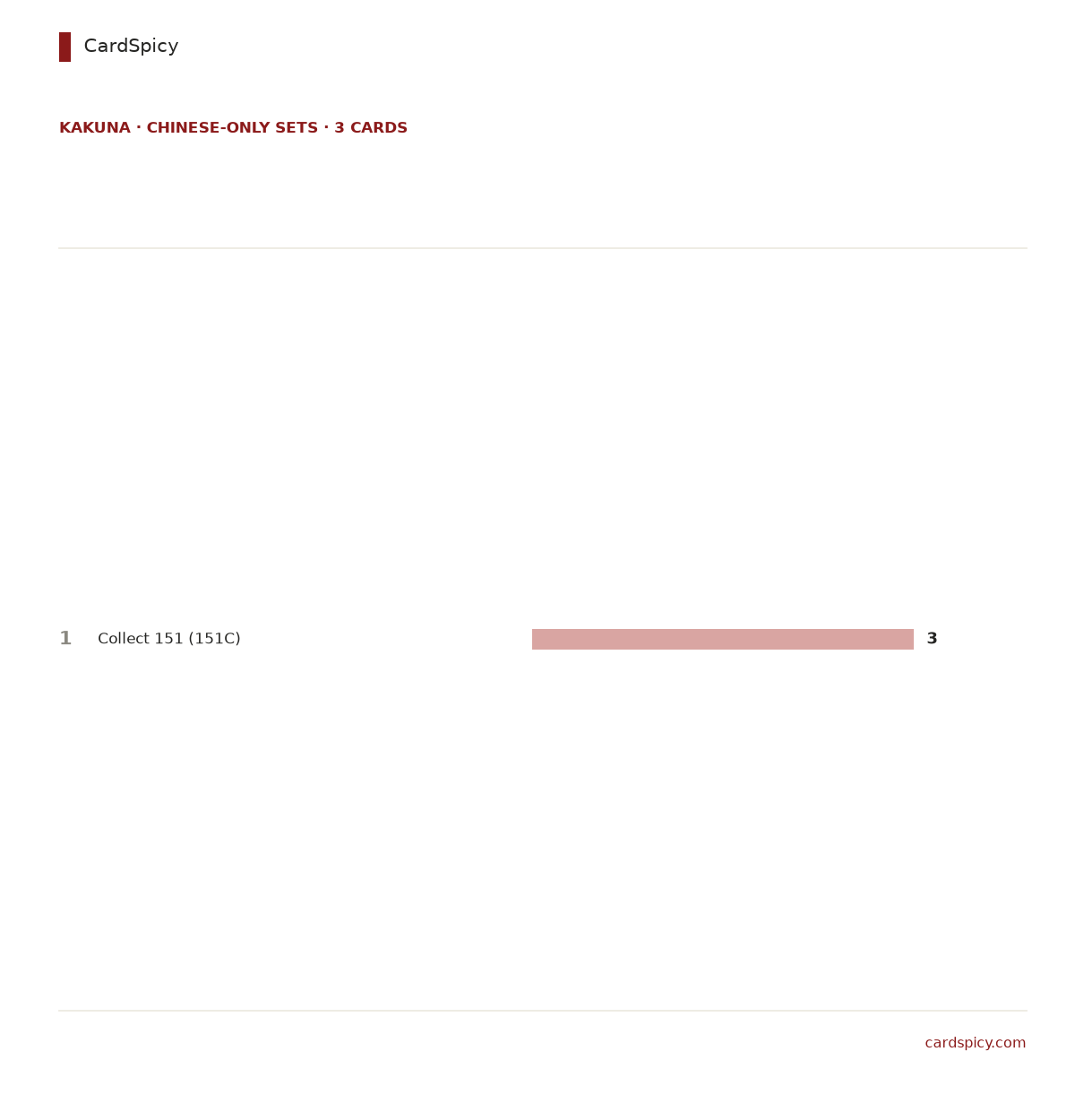
3 of the 3 prints come out of Collect 151 alone, and the rest are spread across nothing else. Where a character with a graded market shows a price ladder, Kakuna shows a checklist: the same names and numbers, with no sold record behind them.
How this list was built
Every card below carries a set code ending in C, which marks a Simplified Chinese print run. Promo printings are excluded because promo numbering is shared across the Chinese branches and cannot establish which branch a card came from. Sealed product, trainer cards and energy are out of scope. Reading a Chinese set code from end to end covers the system in full.
Every Kakuna card in the Chinese-only sets
| Card | Product | Set code | Number |
|---|---|---|---|
| Kakuna [Master Ball] | Collect 151 | 151C | 14 |
| Kakuna | Collect 151 | 151C | 14 |
| Kakuna [Reverse] | Collect 151 | 151C | 14 |
What a checklist without prices tells you
A price needs a trade. Every value in this catalogue comes from a recorded sale of a graded copy. Where no copy has sold in a grade, there is nothing to record, and the card stays unpriced however many are in circulation. For a character like Kakuna the prints are ordinary set-checklist cards — the base print, a reverse holo, foil patterns — and the graded market for them has never separated from the raw one.
It does not mean the cards are worthless. It means nobody has paid to grade them in enough numbers to create a price. That changes if the character returns to a game or an anime storyline; the prints already exist and the cards are not going anywhere. The price ladder shows what the ranked end of the catalogue looks like by comparison.
Frequently asked questions
How many Kakuna cards are there in Simplified Chinese?
3, all inside numbered sets whose codes end in C. None of them carries a tracked PSA 10 value.
Why is there no price for any Kakuna card?
Because no graded copy has sold in enough volume to establish one. A price in this catalogue is a recorded sale, not an estimate.
Does an unpriced card mean the character is not collected?
No. It means the graded market has not formed. Raw copies of these prints trade, and the cards are printed in the same products as characters with ranked values.
Where to go next
Each character with a graded market has its own page: Ceruledge, Charizard, Eevee, Espeon, Flareon, Floragato, Gengar, Glaceon, Jolteon, Leafeon, Mew, Pikachu, Sylveon, Umbreon, Vaporeon, Alakazam, Applin, Articuno, Blastoise, Captain Pikachu, Chandelure, Chansey, Charmander, Clefable. The Chinese versus Japanese comparison explains what the branch difference means for a collector, and the collector’s index lists the whole catalogue.
Sources
Sources and further reading
- PriceCharting — Pokémon Chinese console listings, including Collect 151 (151C). Retrieved 25 September 2026; no card under this name carries a PSA 10 value.
- CardSpicy — How to read a Simplified Chinese Pokémon set code.
- CardSpicy — Collector’s index, listing every Pokémon in the Chinese-only sets with card counts and top prices.
Prices quoted are secondary-market observations at the dates cited and move quickly; nothing here is a valuation or an investment recommendation.