


CardSpicy lists every card Bandai has published for the NARUTO CARD GAME, the strategy trading card game due worldwide in Summer 2027. Twelve individual cards have appeared in the manufacturer’s own artwork gallery, five card-type examples have appeared in its rules pages, and a convention promo Chakra card — CP-001 — has been handed out at events in three versions. Every gallery and rules card carries a SAMPLE mark; the promo is the only card on this page that has actually been printed. This page sorts them the three ways that actually separate them: by card type, by the colour a card belongs to, and by how the artwork was assembled.
Two facts are worth carrying into the rest of the page. All twelve individual cards shown so far are Character cards, and all twelve print the same three values — DMG 3, POW 6, HP 6. The card-type examples are where the differences appear: a Leader card with Life 15, and an EX Character with POW 10. What that does and does not tell you is set out further down.
What has been shown, and where it comes from
Everything on this page comes from the manufacturer’s own material — the card artwork gallery on the official NARUTO CARD GAME site, the card-type examples printed in its rules overview, and the manufacturer’s own event pages. No third-party scan, and no photograph taken at a convention booth. The two sources do not say the same things, which is the first thing to understand about this reveal:
- The gallery shows twelve finished-looking cards, every one of them a Character card and every one stamped SAMPLE.
- The rules pages show one example of each of the five card types. For Leader, EX Character and Summon, those examples are the only place those card faces appear at all; the Chakra face also turns up on the convention promo.
Eleven named characters appear on a card between the two sources: Naruto Uzumaki, Sasuke Uchiha, Sakura Haruno, Jiraiya, Itachi Uchiha, Orochimaru, Tsunade, Boruto Uzumaki, Ino Yamanaka, Shikamaru Nara and Gamabunta. Two more are named inside card text without appearing as art — Choji Akimichi in Ino’s ability, and Minato Namikaze in Gamabunta’s.
The cards, sorted by type
Bandai has published five card types. The artwork gallery has exercised one of them, and the rules pages are what fill in the rest.
| Card type | Shown so far | What the examples are | Values on the example |
|---|---|---|---|
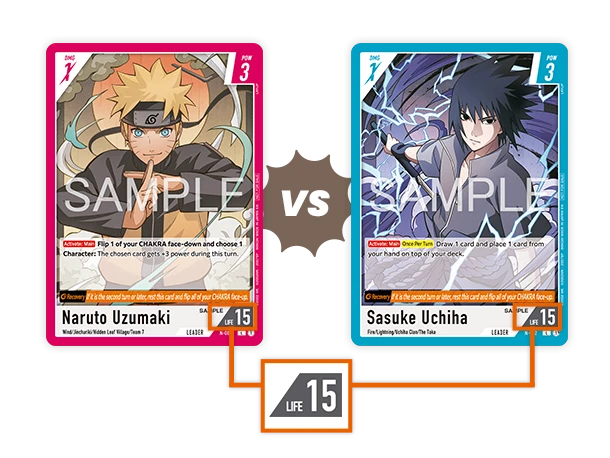
| Leader | 2 | Naruto Uzumaki and Sasuke Uchiha, from the rules pages | DMG 1 / POW 3 / Life 15 |
| Character | 12 in the gallery, 2 more in the rules | The whole artwork gallery, plus Ino Yamanaka and Shikamaru Nara | DMG 3 / POW 6 / HP 6 in the gallery |
| EX Character | 1 | Gamabunta, from the rules pages | DMG 2 / POW 10 / HP 8 |
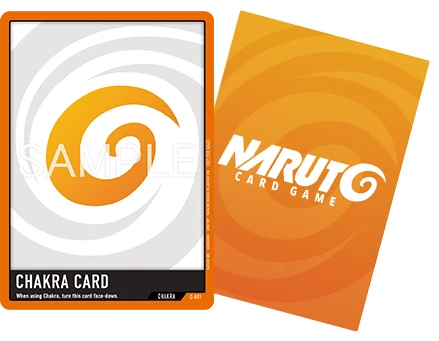
| Chakra | Card back, plus a promo face | The rules example is shown face-down; the convention promo CP-001 shows the full orange face | CP-001 on the promo |
| Summon | Card back only | The summon card, shown in the rules as a black silhouette | None printed |
The five examples, as published. Every one is marked SAMPLE, and the deck numbers printed on them — N-001 for the Leader, N-005 for the EX Character, C-001 for Chakra and S-001 for Summon — are the first three-part numbering scheme the game has shown.
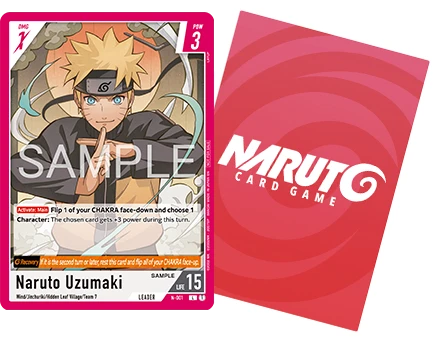
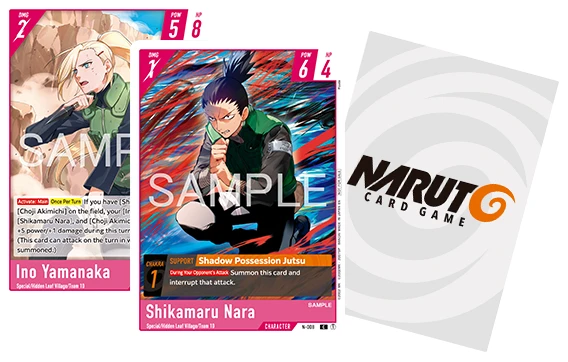
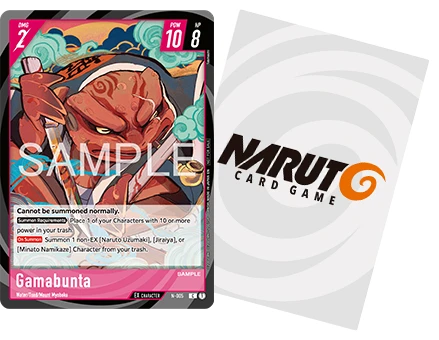
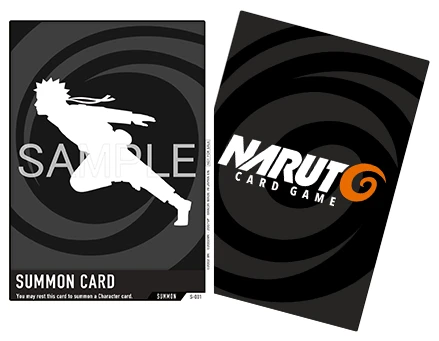
Two of those examples carry ability text worth quoting, because they are the only published window into how the game actually reads. The Naruto Leader says: Flip 1 of your Chakra face-down and choose 1 Character: the chosen card gets +3 power during this turn. The Sasuke Leader says: Draw 1 card and place 1 card from your hand into your Chakra. Gamabunta, the EX Character, states its condition openly — Summon Requirement: place 1 of your Characters with 10 or more power in your trash — and that one line tells you more about the power curve than any stat block does.
The promo card already in circulation
One card face has reached players that the artwork gallery never showed, and it fills in the one type the rules pages had left face-down. Bandai prints a CP-001 Chakra Card for its tutorial booths and hands it out at every stop on the tour. It carries an orange Chakra frame, and the instruction printed across the bottom is the same on every version: When using Chakra, turn this card face-down.
The deck number is the detail worth noticing. The rules example is C-001; the promo is CP-001, a separate prefix for a card that never sat in a booster. Three versions have been documented: a plain one given out at the general tour stops, a Gen Con 2026 Ver. stamped with the show logo, and a New York Yankees Ver. printed for NARUTO Night at Yankee Stadium on 8 September 2026. All three use the same Naruto-and-Sasuke artwork, which is the artwork Bandai is using as the face of the game itself.
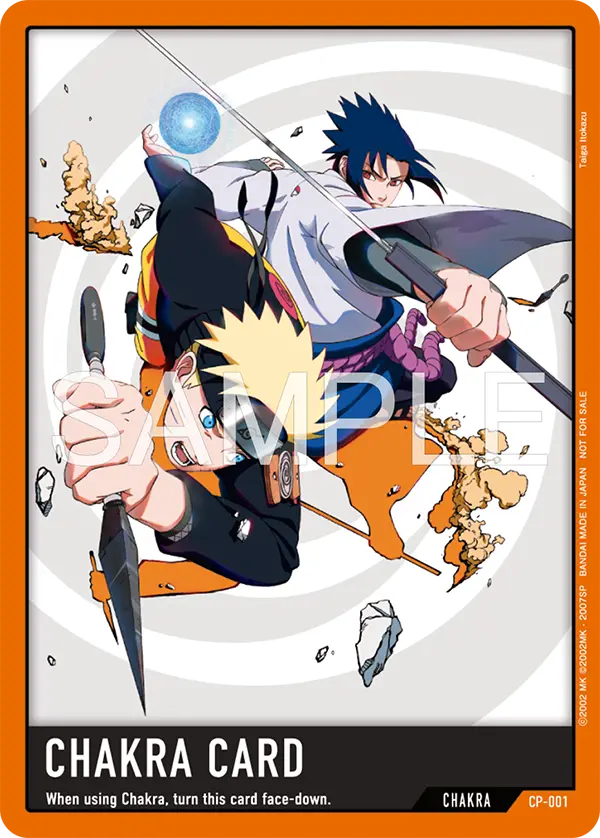
General tour version
Given out at tutorial sessions
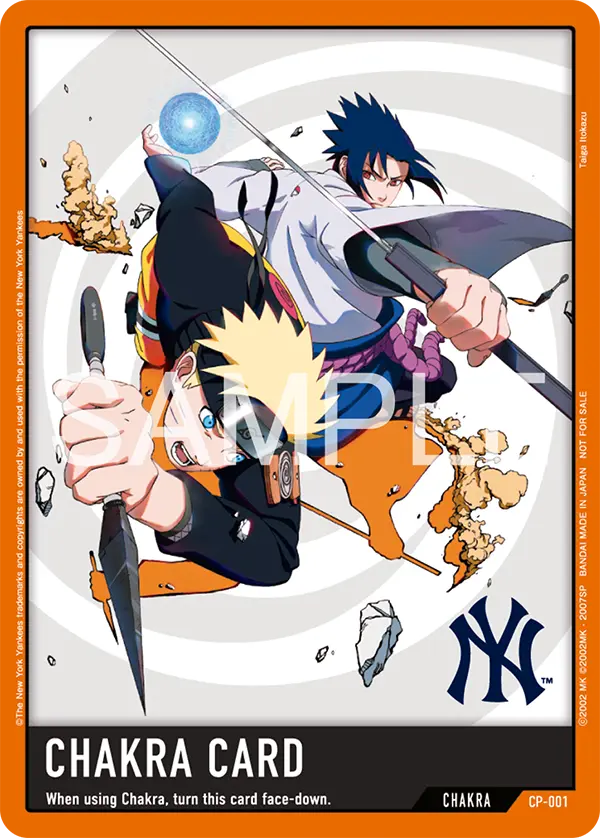
Yankee Stadium, 8 September 2026
Ballpark giveaway
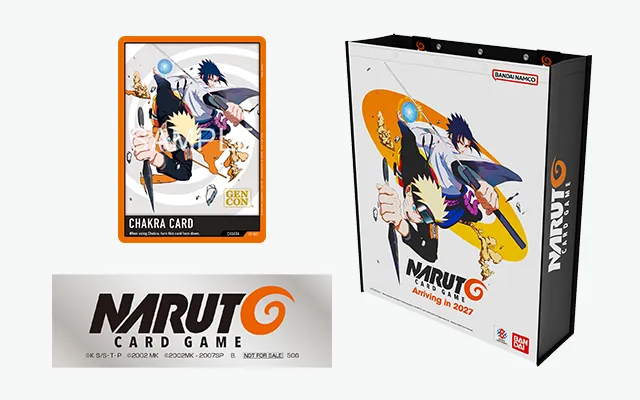
The CP-001 Gen Con Ver. came with a backpack, a sticker and a playmat voucher
Anyone who completed a tutorial session at Gen Con 2026 received that set. The voucher is the other useful fact in it: it is for the official playmat, MSRP $35 plus tax, sold to tutorial attendees only. That playmat is the only item in the entire line with a published price so far, and it is not a card product. No booster pack, box or deck has a price in any market yet.
The cards, sorted by colour
Character cards in this game are not free-standing. The published rules say a Character is chosen based on your Leader’s colour, which makes colour a hard deckbuilding gate rather than a label. The printed frame colour is the clearest signal of which side a card belongs to, and the twelve gallery cards fall into three groups.
| Colour of the frame | Cards | Characters |
|---|---|---|
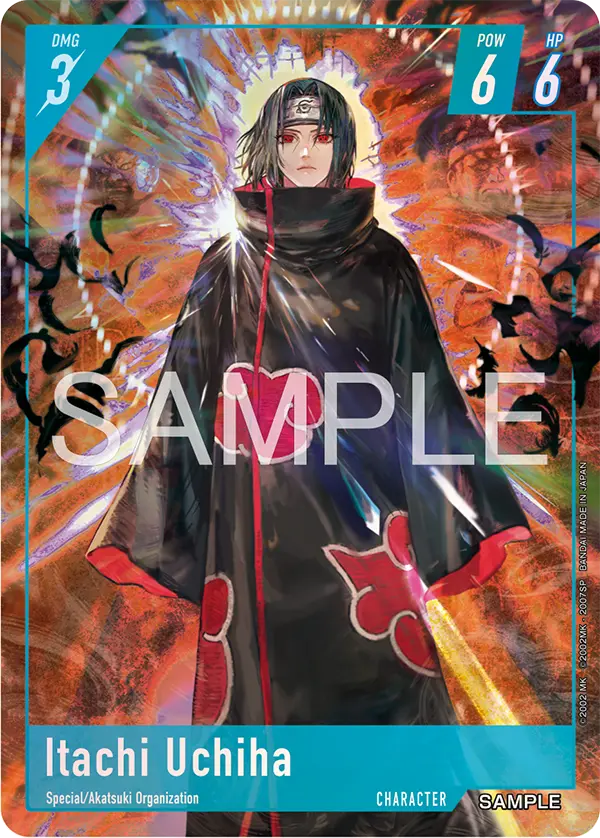
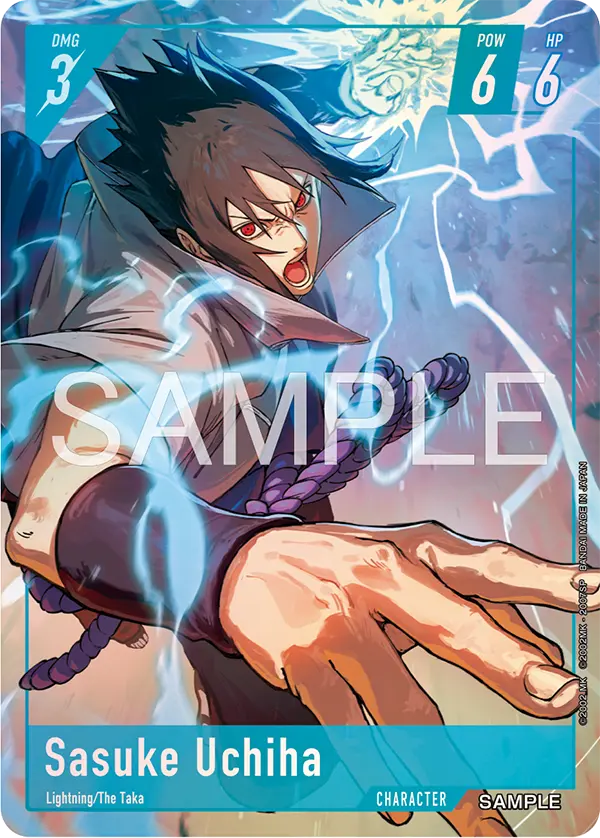
| Teal | 5 | Orochimaru, Itachi Uchiha, and all three Sasuke Uchiha cards |
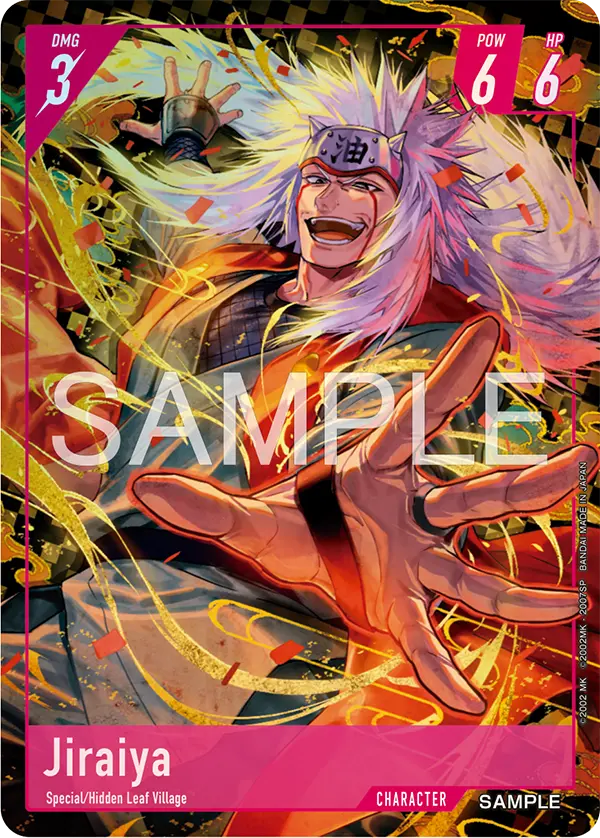
| Magenta | 6 | All three Naruto Uzumaki cards, Boruto Uzumaki, Sakura Haruno, Jiraiya |
| Green | 1 | Tsunade |
The grouping is not decorative, and the rules examples show why. Both published Leader cards — Naruto Uzumaki and Sasuke Uchiha — carry the same magenta and teal frames as the Character cards grouped with them, and Gamabunta, the EX Character, is magenta to match the Naruto Leader. So a card’s frame colour is the best available answer to “which deck will this go in”.
A single green card among twelve is the interesting part. It means at least a third colour exists in the game, and that Bandai has shown exactly one card for it. Anyone building around Tsunade is working from one printed card.
The cards, sorted by artwork
Bandai says the artwork comes from three sources: original illustrations commissioned from a range of artists, artwork taken from the anime, and artwork built on the original manga. Across the twelve gallery cards, what can be told apart from the card face itself is a two-way split, and it is a structural one.
| How the artwork is built | Cards | Which ones |
|---|---|---|
| A single picture | 10 | Orochimaru, Boruto Uzumaki, Jiraiya, Itachi Uchiha, Sasuke Uchiha (The Taka), Naruto Uzumaki (Wind), Sakura Haruno, Tsunade, and both anime-cleared cards |
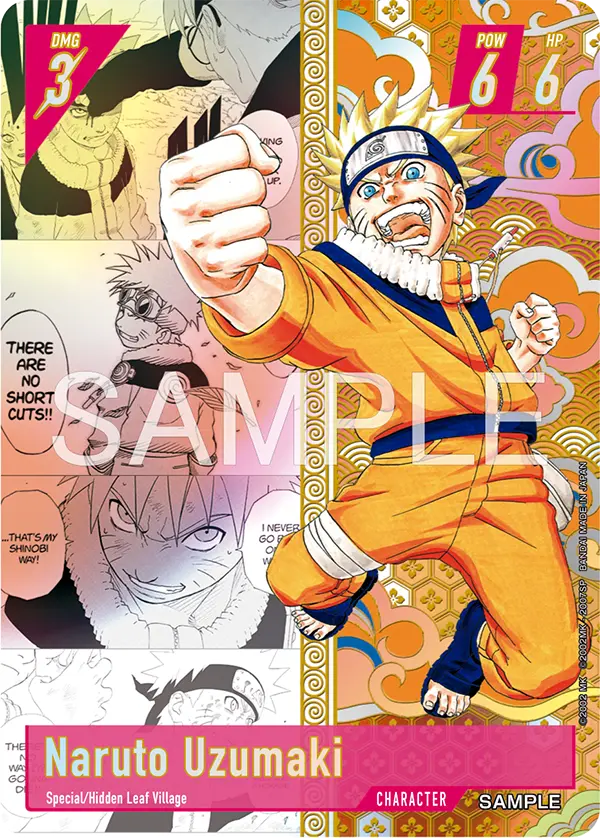
| Full-colour figure plus black-and-white manga panels | 2 | Naruto Uzumaki and Sasuke Uchiha, the pair shown below |
The two manga-panel cards are the ones collector discussion has fastened onto, because Bandai’s other card games run a comparable treatment. The pair is deliberately mirrored: Naruto’s colour artwork sits to the right with the manga panels running down the left, and Sasuke’s is reversed. Laid side by side they read as a matched two-card set. What has not been confirmed is the name. Bandai has not published the game’s rarity list, so the label the community has settled on is not an official one, and the pull rate behind it has not been disclosed at all.
What is printed on a revealed card
All twelve share one layout, and three things on the card face are worth knowing before the images below. The top-left corner carries DMG, and the top-right carries POW and HP. The name sits in a coloured band with the tags printed directly beneath it, and the card type and a SAMPLE stamp sit at the bottom right. Bandai has not published a glossary for the tags, so the reading below is what the card faces show rather than an official key.
The right-hand edge is where the twelve stop being identical. Ten of them carry the same copyright line running up the border, ©2002 MK, ©2002MK·2007SP, BANDAI MADE IN JAPAN. Boruto Uzumaki’s card adds ©2002MK·2017BORUTO to it, which is the only printed sign on any card face that the artwork comes from a later series. The two cards assembled from anime footage end the line differently again and add an animator credit — Yasuhiko Kanezuka — which no drawn card carries.
What is absent matters as much as what is there. None of the twelve prints a card number, so none of them can be matched against a set list, and none carries a rarity marking of any kind. The deck numbers that have been published — N-001, N-005, C-001 and S-001 — appear only on the five card-type examples in the rules pages. A card-by-card walkthrough of all twelve, with the tags, the artwork and the small print of each one, is in our card-by-card guide to the twelve revealed cards.
Card types, and what the numbers mean
The twelve cards on this page are all Character cards, but the game prints five card types and only some of them have been shown. A deck is built around one Leader card, whose colour sets the card pool, alongside a 51-card main deck, five Chakra cards and one Summon card. Character cards are the frontline. EX Character cards cannot be summoned normally — each one names a price, paid out of your own trash, before it can enter play. Chakra cards are turned face-down to pay for Jutsu and Support effects, and Summon cards are rested to call a Character onto the field.
The numbering splits the revealed cards in two. Sixteen of them carry a printed N-number, running from N-001 to N-022 with six numbers missing inside that range, and those sixteen include two Leader cards and three EX Character cards. The twelve artworks above carry no number at all, which is why none of them can be matched against a set list. Three other prefixes are in circulation alongside the N-numbers: C-001 for the Chakra card, S-001 for the Summon card, and CP-001 for the promotional card, where the P stands for promo.
Every card type, with the printed values and the effect text of each card, is in our walkthrough of every card type and every numbered card shown so far.
Every revealed card, listed
All twelve cards from the manufacturer’s artwork gallery, in the order published. Every value below is the value printed on the card, and every card is marked SAMPLE.
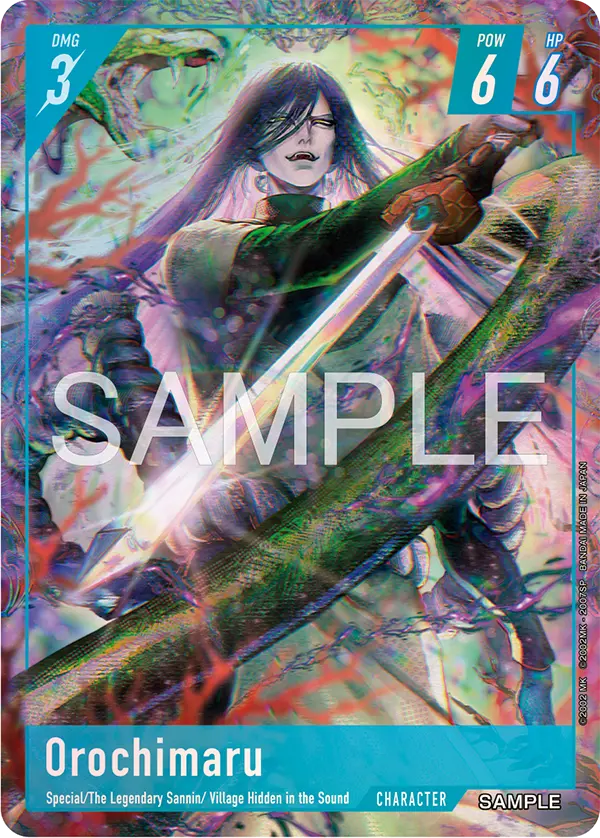
Character · teal
Special / The Legendary Sannin / Village Hidden in the Sound
3 · 6 · 6
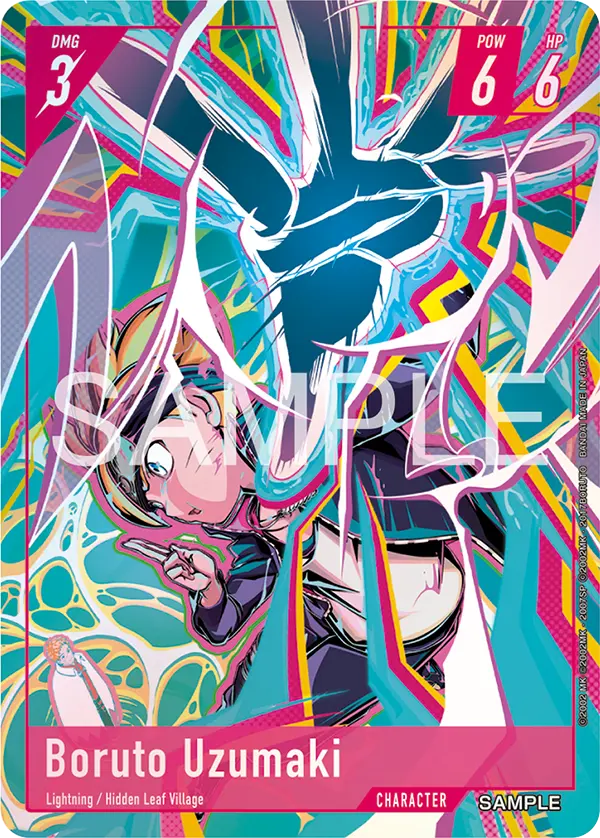
Character · magenta
Lightning / Hidden Leaf Village
3 · 6 · 6
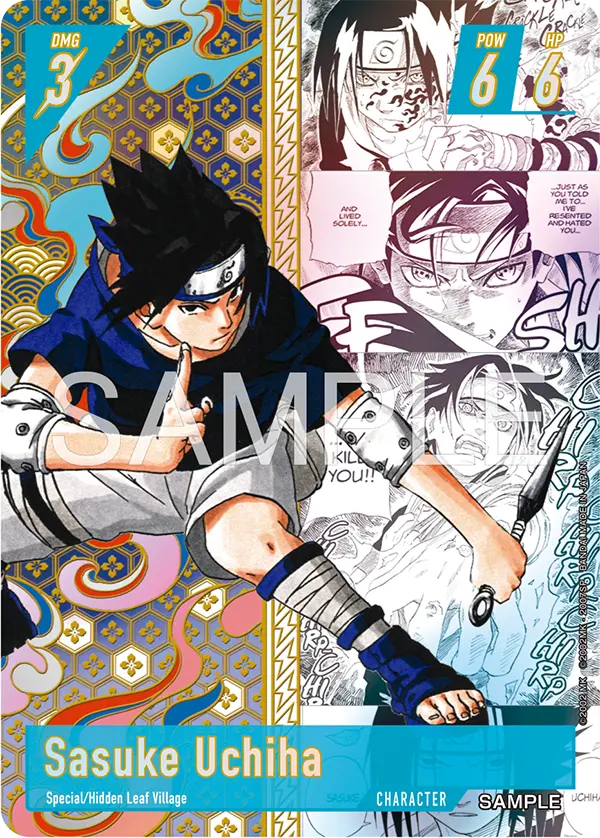
Character · teal · manga panels
Special / Hidden Leaf Village
3 · 6 · 6
Character · magenta · manga panels
Special / Hidden Leaf Village
3 · 6 · 6
Character · magenta
Special / Hidden Leaf Village
3 · 6 · 6
Character · teal
Special / Akatsuki Organization
3 · 6 · 6
Character · teal
Lightning / The Taka
3 · 6 · 6
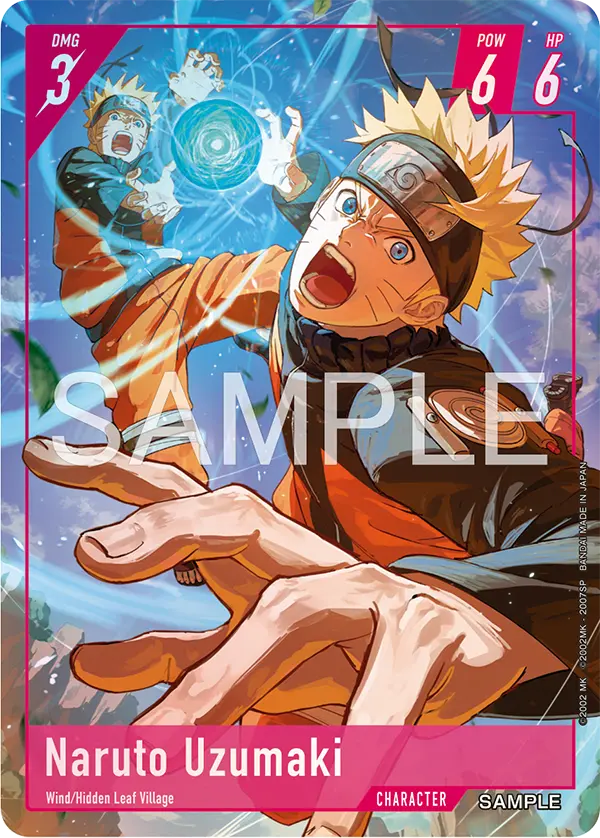
Character · magenta
Wind / Hidden Leaf Village
3 · 6 · 6
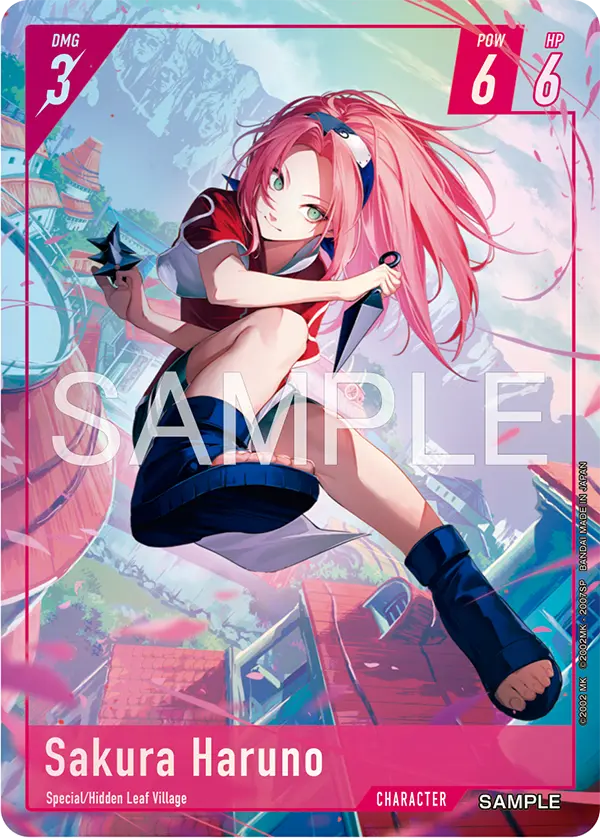
Character · magenta
Special / Hidden Leaf Village
3 · 6 · 6
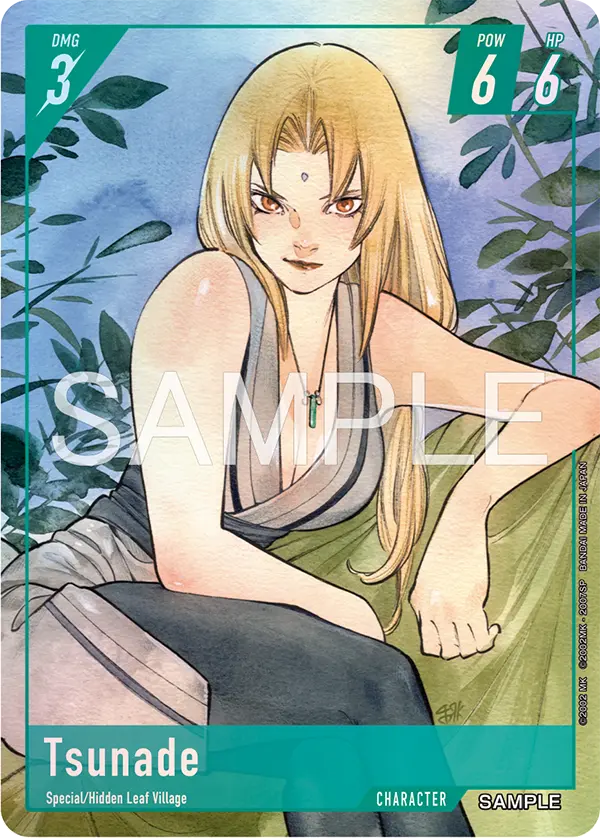
Character · green — the only green card shown
Special / Hidden Leaf Village
3 · 6 · 6
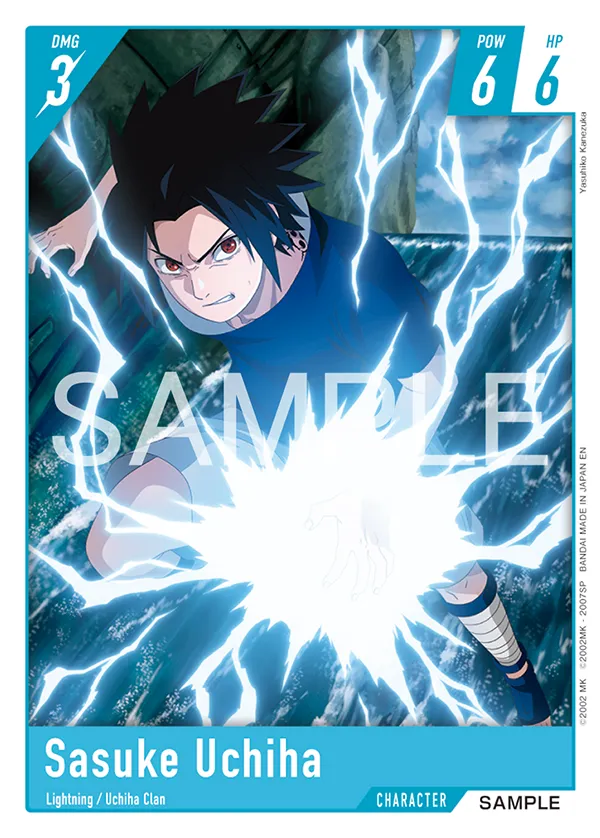
Character · teal
Lightning / Uchiha Clan
3 · 6 · 6
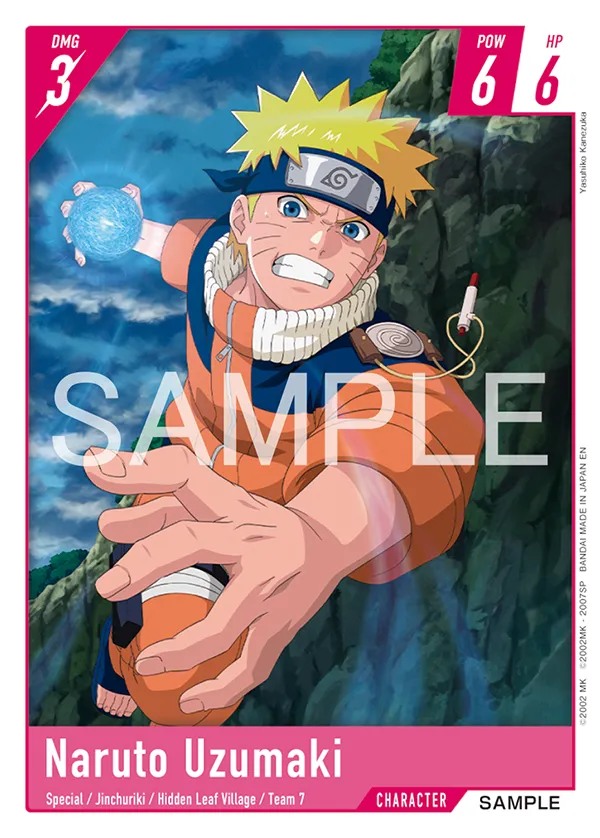
Character · magenta
Special / Jinchuriki / Hidden Leaf Village / Team 7
3 · 6 · 6
Sorted by character rather than by card, the twelve reduce to eight names, and the distribution is lopsided. Naruto and Sasuke take three cards each. Sakura Haruno, Jiraiya, Itachi Uchiha, Orochimaru, Tsunade and Boruto Uzumaki take one each. A further three characters — Ino Yamanaka, Shikamaru Nara and Gamabunta — appear only in the rules pages.
The same twelve cards, printed in Japanese
Everything in the gallery above is the English printing. Bandai’s Japanese site runs the same twelve cards again, and the two sets match card for card — same artwork, same frame colour, same 3/6/6 display values, same SAMPLE stamp. The only difference is the language on the name band and on the line beneath it. Orochimaru reads 大蛇丸 with 特 / 雨隠れの里 where the English card reads Special / Village Hidden in the Sound.
Two things follow from this. The launch is not an English-only print run, so the same card will exist in more than one language from the start. And a Japanese listing and an English listing of the same card should not be priced against each other without checking which printing is in the photograph, because the card face is otherwise identical.
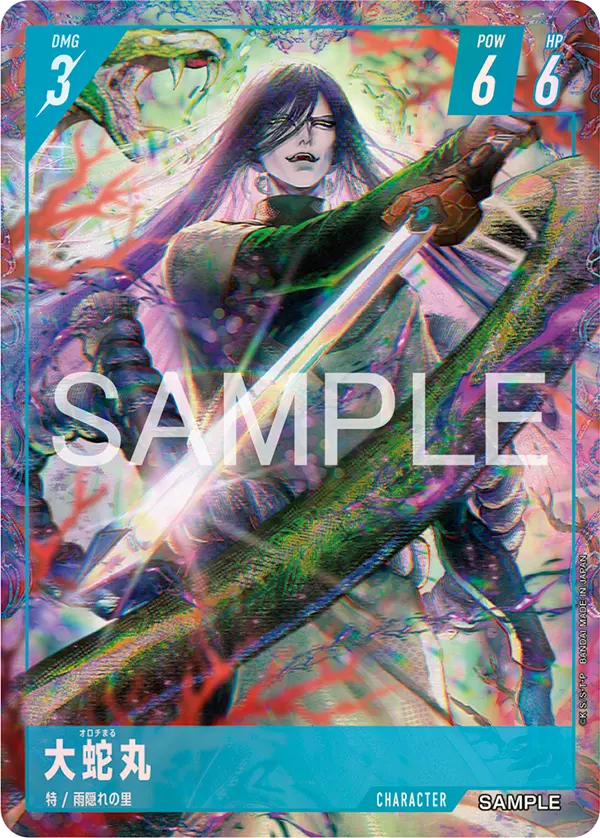
Character · teal
特 / 雨隠れの里
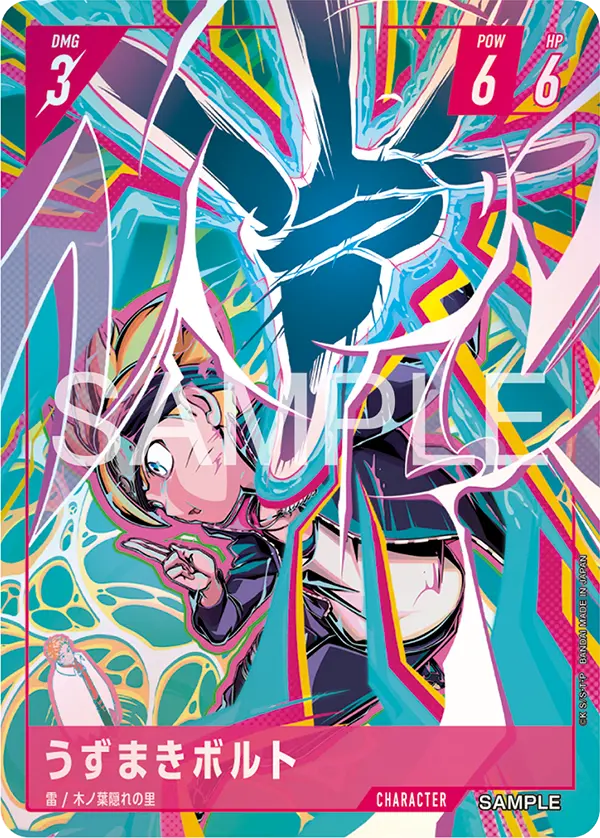
Character · magenta
雷 / 木ノ葉隠れの里
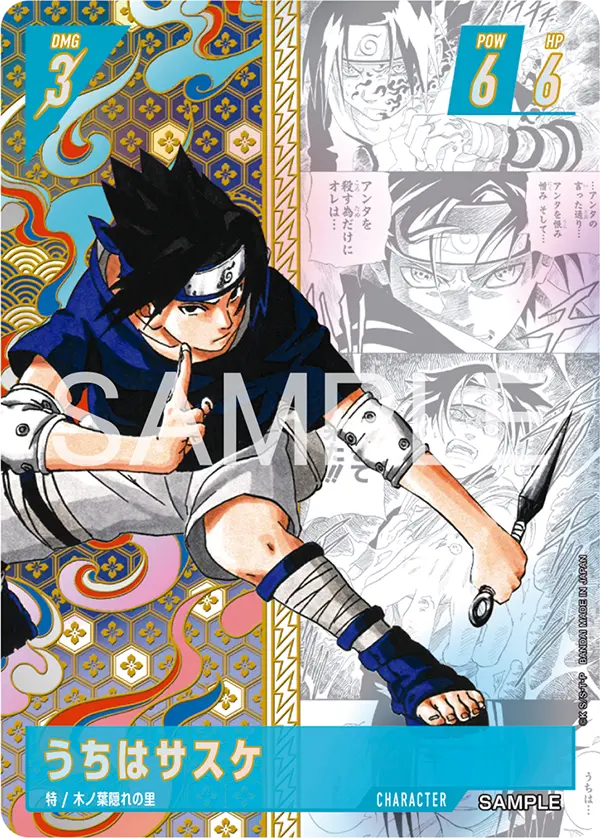
Character · teal
特 / 木ノ葉隠れの里
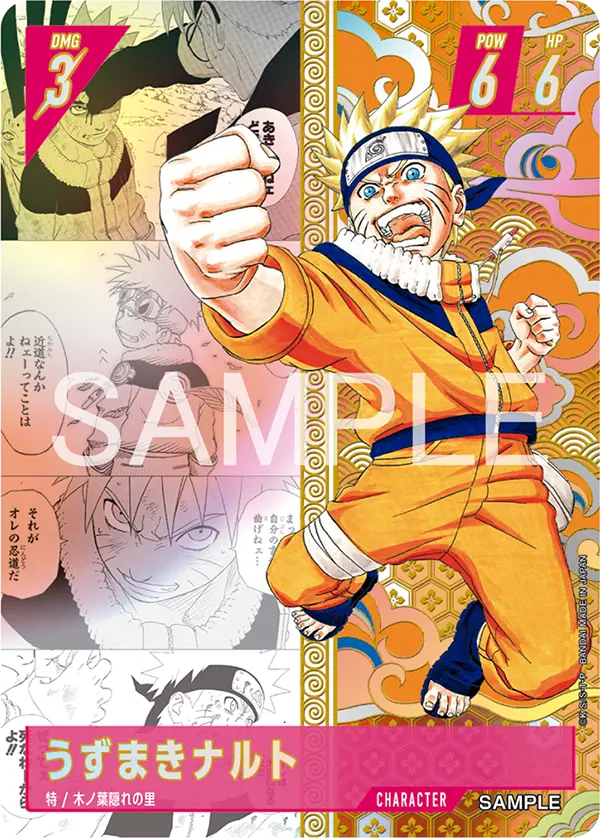
Character · magenta
特 / 木ノ葉隠れの里
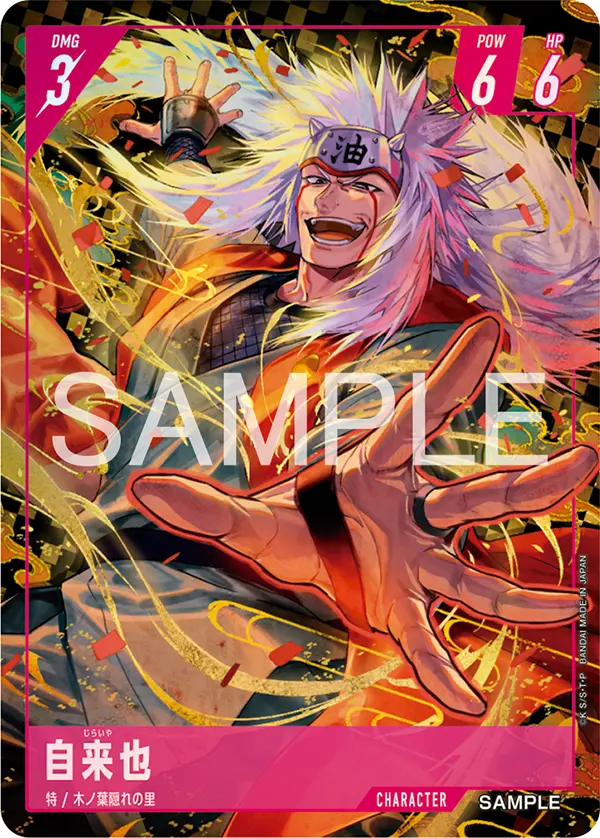
Character · magenta
特 / 木ノ葉隠れの里
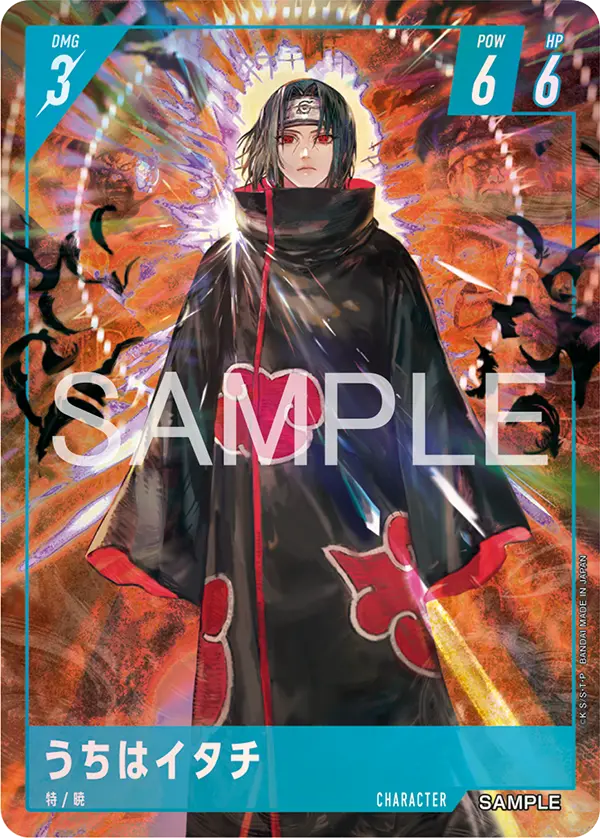
Character · teal
特 / 暁
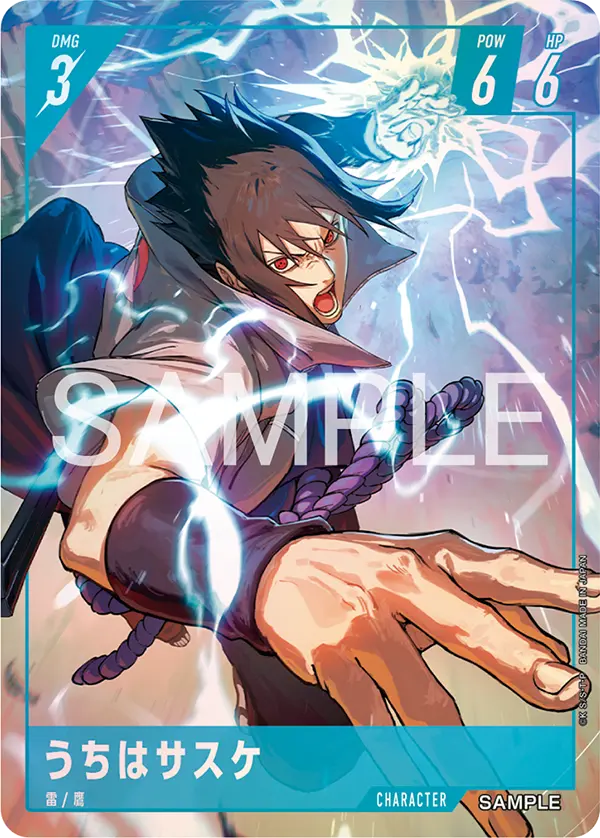
Character · teal
雷 / 鷹
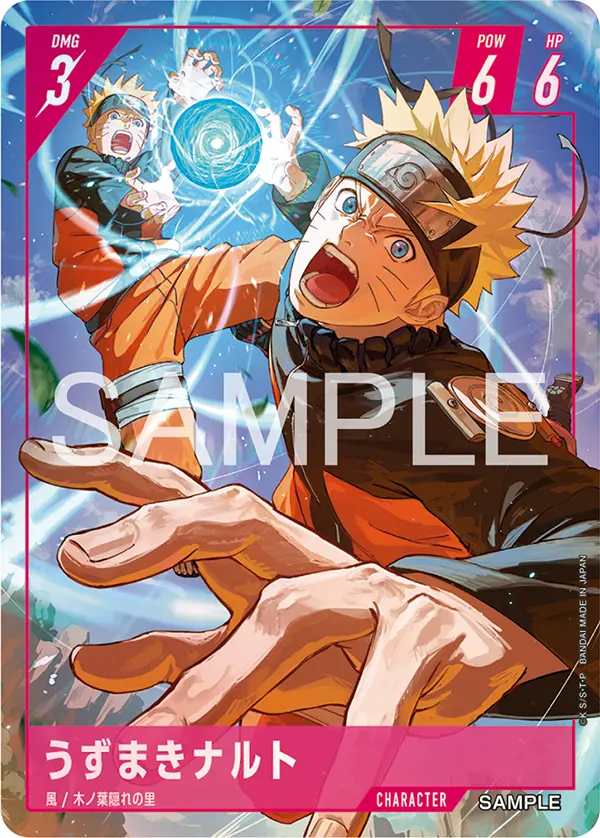
Character · magenta
風 / 木ノ葉隠れの里
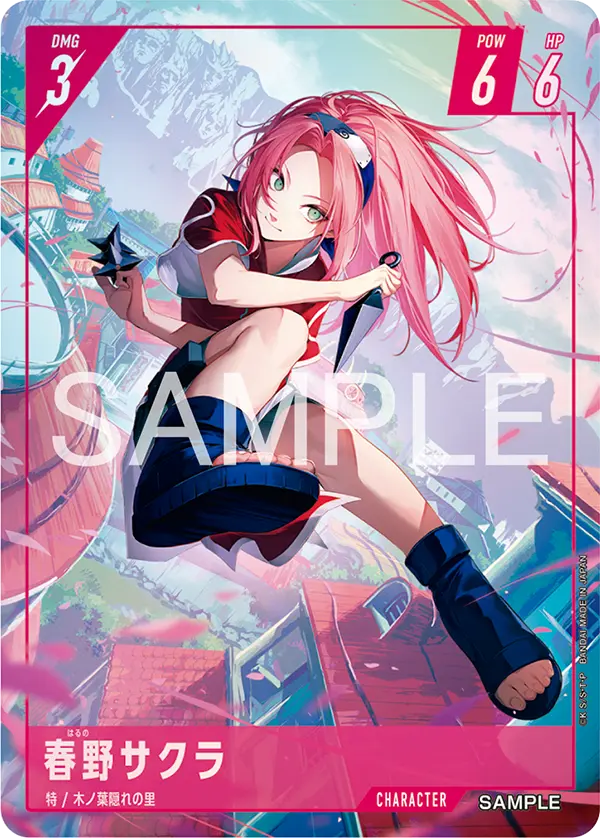
Character · magenta
特 / 木ノ葉隠れの里
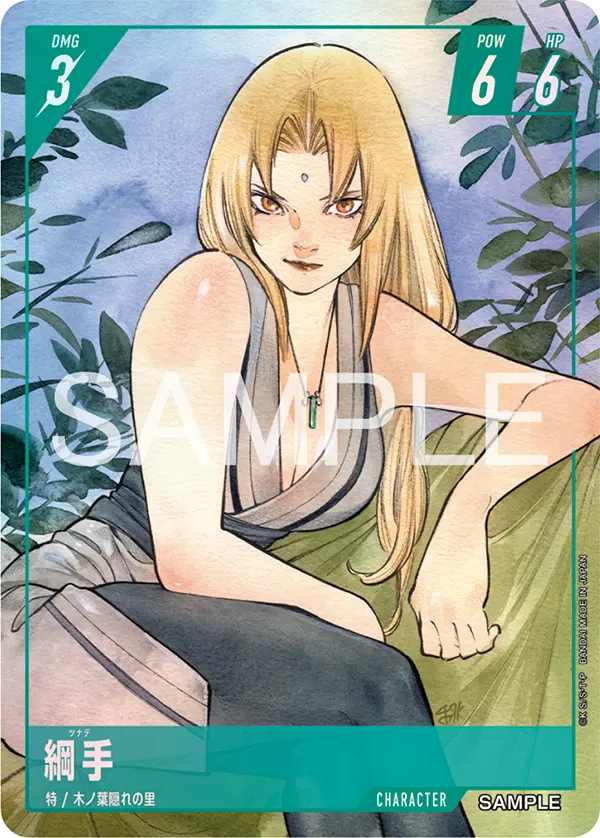
Character · green
特 / 木ノ葉隠れの里
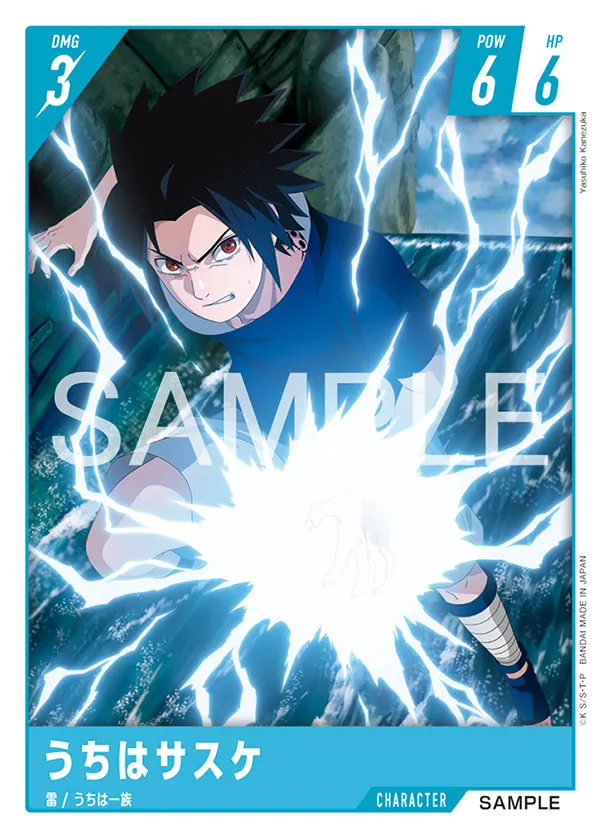
Character · teal
雷 / うちは一族
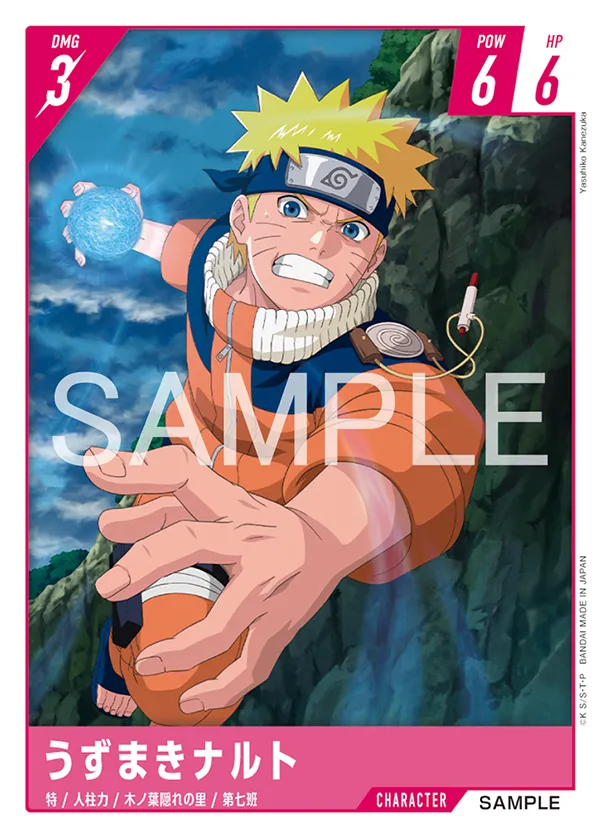
Character · magenta
特 / 人柱力 / 木ノ葉隠れの里 / 第七班
Nothing else changes between the two printings. The deck number, the ability text position and the SAMPLE marking are in the same places, so the twelve Japanese cards add no new characters and no new values to the list — they are the same reveal, in the other language.
What the sample values mean
This is the part most easily misread, so it is worth being blunt. The twelve gallery cards all print DMG 3, POW 6, HP 6. Not similar values — identical ones, across eleven different characters. That is not the game’s balance. It is what a display card looks like before release, and the manufacturer says as much: the site’s own notice states that the images may differ from the final product because development is ongoing.
What the identical numbers do not mean is that the game has no numbers. The card-type examples carry different ones. Both Leaders sit on DMG 1 / POW 3 / Life 15. Gamabunta, the EX Character, sits on DMG 2 / POW 10 / HP 8, and its own ability demands that you trash a Character with 10 or more power to bring it out. So the values published so far are good for one thing — they show that Leader, Character and EX Character are on three visibly different scales — and useless for another, which is working out what any individual character will actually do.
Anyone quoting 3/6/6 as a stat line is reading a mock-up. If you see it described anywhere as the game’s numbers, that is where it came from.
Where the cards have been shown, and where they go next
Almost every card face above was shown at an event before it appeared on a website, and the tour is what sets the date of the next reveal. Bandai has confirmed these stops:
| Event | Dates | Where | What was there |
|---|---|---|---|
| Gen Con 2026 | 30 Jul – 2 Aug 2026 | Indianapolis, United States | World debut. The first public tutorial sessions, and the CP-001 Gen Con Ver. |
| NARUTO Night at Yankee Stadium | 8 September 2026 | Yankee Stadium, Bronx, New York | The CP-001 New York Yankees Ver., given out at the ballpark |
| New York Comic Con 2026 | 8 – 11 Oct 2026 | Javits Center, New York | Booth #2705. The panel on 10 October is billed as the next reveal |
| PAX Aus 2026 | 9 – 11 Oct 2026 | Melbourne, Australia | Tutorial sessions and the CP-001 promo |
| SPIEL Essen 2026 | 22 – 25 Oct 2026 | Essen, Germany | Tutorial sessions and the CP-001 promo |
| Paris Games Week 2026 | 22 – 25 Oct 2026 | Paris, France | Tutorial sessions and the CP-001 promo |
| Lucca Comics & Games 2026 | 28 Oct – 1 Nov 2026 | Lucca, Italy | Tutorial sessions and the CP-001 promo |
| BANDAI CARD GAMES Fest 26-27 | From Oct 2026 | 11 cities worldwide | Orlando 7–10 Jan 2027 and London 15–17 Jan 2027 are confirmed, alongside Bangkok, Jakarta, Kuala Lumpur, Manila, Singapore, Hong Kong and Taipei |
| Worldwide release | Summer 2027 | — | — |
The New York Comic Con panel is the one that matters. It is titled NARUTO: What’s Next?, runs on Saturday 10 October 2026 on the North-Level 5 Empire Stage, and Bandai describes it as covering the anime, the card game and other projects — including the first public look at a new roadmap for the franchise. The manufacturer’s own site says plainly that more new information will be revealed at that show, so this page is expected to go stale within days of publishing, and the list above is written to be re-checked against it.
Two timing facts are worth holding separately from the tour. The worldwide release window is Summer 2027, which is roughly ten months after the last confirmed convention stop. And the tutorial sessions that reach local game stores are scheduled to begin in January 2027, which is the first point at which someone who does not attend a convention can hold the cards.
What Bandai has not revealed yet
A list of what is missing is more useful here than a list of what is present, because almost everything a buyer needs is in this half. As of the manufacturer’s own material, none of the following has been published:
- The rarity system. No tier names, no rarity labels on any card, and nothing that confirms what the collector-facing chase treatment will be called.
- Pull rates and box structure. Nothing on how many cards a pack holds, how a booster box is configured, or how often anything appears.
- The first set. No set name, no size, no card count, and no release date beyond the Summer 2027 window.
- Price. Nothing for any card product, in any market. The only figure published so far is the official playmat at MSRP $35 plus tax, and that is sold to tutorial attendees only.
- The rest of the cast. Eleven named characters have appeared on a card face, spread across twelve gallery cards, five rules examples and one promo. A launch set for a franchise of this size will run to hundreds.
Bandai has said more information is coming, and has put dates on the calendar. The next reveal is the NARUTO: What’s Next? panel at New York Comic Con on 10 October 2026, which the manufacturer’s own site flags as the point where new information will be shown. After that, tutorial sessions reach local game stores from January 2027 ahead of the worldwide release. Every ruling on this page is written to be re-checked against both.
Frequently asked questions
How many cards has Bandai revealed for the Naruto Card Game?
Twelve individual Character cards in the official artwork gallery, five card-type examples in the rules pages — one each for Leader, Character, EX Character, Chakra and Summon — and one convention promo Chakra card, CP-001, in three versions. Every gallery and rules card is marked SAMPLE; the promo is a real printed card.
Are all the revealed cards Character cards?
All twelve in the artwork gallery are. The other four card types — Leader, EX Character, Chakra and Summon — appear only as the single example printed in the rules pages, so there are two Leaders, one EX Character and card backs for Chakra and Summon.
Why do all the revealed cards have the same stats?
Because they are display cards. All twelve print DMG 3, POW 6 and HP 6 across eleven different characters, which is a placeholder rather than a balance figure. The card-type examples carry different values, including a Leader on Life 15 and an EX Character on POW 10.
What do the frame colours on the cards mean?
They appear to be the card’s colour identity, which is what a deck is gated on — the rules state that Character cards are chosen based on your Leader’s colour. The twelve cards shown are five teal, six magenta and one green, and the two published Leader cards match the colours of the characters grouped with them.
Are the Naruto and Sasuke manga cards the same as One Piece Manga Rares?
They share the treatment — a full-colour figure with black-and-white manga panels, and the two are deliberately mirrored as a pair — but the comparison is visual. Bandai has not published the game’s rarity system, so no official rarity name exists for them yet, and no pull rate has been disclosed.
Sources
Sources and further reading
- Bandai Card Games — the official NARUTO CARD GAME site, card design and artwork gallery, for the twelve individual cards, their printed names, affiliations and values, and the SAMPLE marking.
- Bandai Card Games — the same site’s rules overview, for the five card-type examples, the deck numbering, the published ability text and the deck construction figures.
- Bandai Card Games — the reveal and roadmap announcements, for the Summer 2027 worldwide release window, the New York Comic Con reveal and the January 2027 tutorial schedule.
- Bandai Card Games — the site’s event pages for Gen Con 2026, New York Comic Con 2026, PAX Aus, SPIEL Essen, Paris Games Week, Lucca Comics & Games, the Yankee Stadium night and BANDAI CARD GAMES Fest 26-27, for the tour dates, the three CP-001 promo versions and the playmat price.
- CardSpicy — our own page on the game’s rules at cardspicy.com/bandai-naruto-card-game-rules-explained/, for the deck structure and card-type definitions used alongside this list.
Card images on this page are the manufacturer’s published preview artwork, reproduced for identification and commentary. NARUTO and all related characters and artwork are the property of their respective rights holders, including Masashi Kishimoto and Shueisha. Every card shown is a SAMPLE and may differ from the final product.
The rules that sit behind this list are set out in Bandai’s Naruto Card Game rules explained, and how this game differs from the two other Naruto card products is in which Naruto card product is a game. The cards you can actually buy today are on our Naruto card index and listed card by card on the Naruto card list.