001
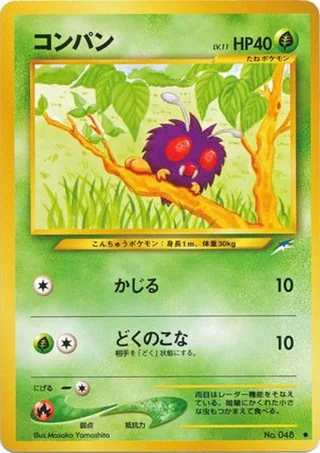
Venonatコンパン
COMMON
A Bug-type in the games but Grass on the card. 40 HP Basic with retreat 1. Its evolution Venomoth is in the same set, and this opens the Grass run.
Pokémon TCG Almanac · 2001
This page covers Japan's 431 cards in four sets. The English market shipped three sets that year, 159 cards, and every one of them was Japanese material from 1999 and 2000 — see the 2001 English edition. ★VS, ★web and the Base Expansion Pack were never published in English at all.
A new card back, numbered promos and the e-Reader — 431 cards across four sets.
On 20 April 2001 the tenth expansion, Darkness, and to Light…, closed out the neo series. 113 cards, ten to a pack. It brought in Light Pokémon for the first time and eight Shining cards. At this point the card back was still the original 1996 design.
The breaks all come in the second half. ★VS on 19 July changed the card back to the design still in use. ★web on 20 October introduced Supporters officially and split Pokémon Power into Poké-Power and Poké-Body. Then the Base Expansion Pack on 1 December added e-Reader dot codes, redrew the frame, moved the illustrator to the bottom centre and dropped the Pokédex text. The card was redesigned three times in one year.
Each entry shows the card face on the left and name, HP, type, stage, artist and attacks on the right. The pack details below each set give the original price, the pack spread and the publisher. The edition buttons at the top lead to the other printing of this year, which has its own yearbook and its own card list.
The card faces of 2001 come from three different places. ①The tenth expansion and ★VS use Japanese original scans — few are online, and their condition varies. ②The Base Expansion Pack borrows English Expedition Base Set scans, since both are e-Card 1 with identical artwork. ③★web is entirely reprints, so it borrows the same cards from the 1996–2000 pages. ★VS and ★web have no English edition, so only Japanese faces exist for them.
This page documents 431 main-series cards across four products on four release dates in 2001. It covers cards printed in Japan only; printings for other editions are tracked separately.
| Publication edition | Japanese edition |
|---|---|
| Products | 4 |
| Cards | 431 |
| Release dates | 4 (2001-04-20 – 2001-12-01) |
| Series codes | neo4, VS1, web1, E1 |
| Card faces on record | 427 of 431 |
| Latest release on record | 2001-12-01 |
10th expansion · Darkness, and to Light… (2001-04-20, 113 cards) · Pokémon Card ★VS (2001-07-19, 142 cards) · Pokémon Card ★web (2001-10-20, 48 cards) · Base Expansion Pack (e-Card 1) (2001-12-01, 128 cards).
How many main-series cards does this page record for 2001?431 cards across four products, an average of 107.8 cards per product. This is the main-series archive count, not a claim that every promo and event card from the year is itemised here.
What release dates does this page cover?4 release dates, from 2001-04-20 to 2001-12-01.
Do these Japanese cards have English-edition counterparts?128 of 431 cards (29.7%) carry a mapping to an English-edition card; the remaining 303 are Japanese-only printings or not yet paired.
How many of these 431 cards are shown with a card face?427 of 431 cards have a card face on record; the other 4 are listed without one rather than showing a card face from a different printing.
Pokémon Card GB2: Here Comes Team GR! ships for Game Boy Color, with Lugia and Team GR's Mewtwo packed inside the box. Both carry a "GB" stamp where the set symbol goes, and both are printed with a note that they cannot be used in official tournaments.
Intro Pack ★neo goes on sale — two half decks (Chikorita and Totodile), each with a ten-card side deck. It was the first Japanese product built around the half-deck-plus-side-deck idea, and the template for the preconstructed decks that followed.
Darkness, and to Light…, the tenth expansion. 113 cards, ten to a pack. Light Pokémon debut, and eight Shining cards appear. The card back is still the original design, and so is the frame.
English Neo Discovery — 75 cards, eleven months after Japan's Crossing the Ruins… of 7 July 2000. In June 2001 the English market was still walking through Japan's July 2000.
Celebi: Voice of the Forest opens. Moviegoers received Kecleon 001/P — the first numbered Japanese promo, the format every Japanese promo has used since. The card carries e-Reader dot codes, so the codes reached players before the hardware did.
Pokémon Card ★VS — 141 cards plus one secret. The card back changes with this set to the design still in use, and numbering moves from Pokédex order to a straight run. A pack held 30 cards at ¥690, not the usual ten at ¥300.
English Southern Islands — 18 cards, a full two years after Japan's 17 July 1999 release. It came as two folders of nine, tied to the film's release.
Nintendo Spaceworld runs in Tokyo. Celebi 006/P was given out at the venue and also inserted in the official guidebook. It is a different drawing from the 007/P of September.
English Neo Revelation — 66 cards, ten months after Japan's Awakening Legends of 23 November 2000. That left the English neo series with one set to go: Neo Destiny.
Pokémon Card ★web — 48 cards, every one a reprint. Supporters become an official class, and Pokémon Power splits into Poké-Power and Poké-Body. It was sold only through Pokémon Center Online, in packs of ten (nine non-holo plus one holo) rather than the usual format.
The Base Expansion Pack (e-Card 1) and the Card e Reader launch the same day. 128 cards, five to a pack at ¥191 plus tax. Dot codes run down the left edge and along the bottom; the frame, the illustrator credit, the set symbol and the Pokédex text all changed. A Starter Pack (¥900 plus tax) shipped the same day.
The Starter Triple Get campaign opens. Send three Starter Deck barcodes on a postcard and you entered a draw for a set of three holofoil promos — Red/Green or Gold/Silver, 10,000 sets in all. The first draw was 31 December, and most prizes arrived in 2002.
The cards you could not buy, in the order they reached people in Japan, with the one English card last. 2001 is the year Japanese promos got numbers: 001/P through 011/P all fall inside it. Numbering gave a fixed order to cards that until then collectors could only describe by nickname.
Jan 2001 (insert, Pokémon Card Information Vol. 1)
The first card of 2001, and the launch-issue insert of Pokémon Card Information, a thin magazine that came out only a few times a year — most people bought it for the card. Each issue carried a different card: Bellossom in Vol. 2, Pryce's Lapras in Vol. 3. Dunsparce had almost no cards at that point, so this was its debut.
Mar 2001 (insert, Pokémon Card Trainers Vol. 10)
A two-card insert: the Dark versions of Ivysaur and Venusaur. At the time "Dark" marked Team Rocket's Pokémon, but these two have no Rocket connection — they are simply ill-tempered individuals, carrying "Dark" in the name only. Both were reprinted in Pokémon Card ★ web that October, with essentially the same artwork, so a photo of this insert is the best reference for web 017 and 041.
28 Mar 2001 (bundled with Pokémon Card GB2, Game Boy Color)
Two cards packed inside the box of Pokémon Card GB2: Here Comes Team GR! for Game Boy Color — not a pre-order bonus, but in the box itself. A "GB" stamp sits where the set symbol normally goes, marking them as outside the booster line, and both carry a printed note that they cannot be used in official tournaments — souvenirs rather than playable cards. At that point this was Japan's only Team Rocket's Mewtwo.
Apr 2001 (insert, Pokémon Card Information Vol. 2)
The second insert from Pokémon Card Information, following Dunsparce. Bellossom had only two cards before this, so this made three. Inserts were printed on the same stock as the magazine and torn along a perforation, so many survivors have a ragged edge — clean copies are scarce.
12 Apr 2001 (insert, Pokémon Card GB2 official guidebook)
Bound into the official guidebook for GB2 — a separate route from the two cards inside the game box. The same game thus produced three cards across two channels, which is typical of this year. Because the guidebook sold widely as a strategy book, this is the easiest of the three to find.
15 Apr 2001 (CoroCoro Comic, May 2001 issue)
A Shining Mew bound into the main CoroCoro Comic. "Shining" was the alternate-colour legendary line running through the late neo sets, and Mew was its most wanted card. Japan only ever produced this one Shining Mew; no second artwork followed. As a magazine bind-in, a centre crease is the norm.
Spring 2001, Neo Spring Road — regional and national finals
Prize cards from the spring 2001 Neo Spring Road tournament. Different cards went to first, second and third place at both the regional events and the national final — six in total. The card name is the placement itself (No.1 / No.2 / No.3), and all three share one illustration in different colours. The design was redrawn every year, and the 2001 frame differs from the previous seasons'. Only entrants could receive them, so survivors are very few.
7 Jul 2001, handed to cinema-goers at Celebi: Voice of the Forest
The first numbered Japanese promo card. Earlier handouts had no index number and collectors had to describe them by nickname; from this year a "P" suffix and a running number were applied, and every Japanese promo since has followed. Handed out at the cinema, it is also the first theatrical handout to carry e-Reader dot codes — and at that point the e-Reader hardware had not yet gone on sale in Japan, so the unreadable code arrived first. Several printings with small differences are known.
Jul 2001 (insert, Pokémon Card Trainers Vol. 12)
The second P-series card, inserted in Pokémon Card Trainers Vol. 12. Rocket's Pokémon had gone quiet since the 2000 Team Rocket set, so this was the first addition in a while, and it remains the only Rocket's Scizor. The same issue carried the announcement for the VS set, coming on 19 July — this went on sale just ahead of it.
Jul 2001 (CoroCoro Comic, August 2001 issue)
The third P-series card, bound into the August CoroCoro. Sneasel had only just debuted in the 2000 Neo Genesis set, and this is its only Rocket version. As a summer-holiday issue it carried many extras, which made the card awkward to extract cleanly, and its bound-in position shifts between copies, so the tear marks vary.
Jul–Sep 2001, All Nippon Airways "Pokémon Card e ANA Special '01"
Two cards from an in-flight giveaway on All Nippon Airways. ANA was flying its Pikachu Jet at the time, and this was a promotion for passengers. It falls in the first stretch of cards carrying an "e" in the name, and both have e-Reader dot codes. The Pikachu is not in an ANA uniform — the ordinary artwork simply carries the ANA logo. The airline ran several such campaigns that year, and you had to fly to get one, which put collectors outside the big cities at a disadvantage.
19 Jul 2001 (insert, Pokémon Card Information Vol. 3)
The Vol. 3 insert, out the same day as the VS set. That issue was a VS feature, and the insert matched VS's premise of Gym Leaders' Pokémon. Pryce is the Ice-type Gym Leader, and Lapras was still thin on cards. The magazine folded after this issue, so the insert run ends at three.
23 Jul 2001 (manga vol. 5, How I Became a Pokémon Card)
Bound into volume 5 of the card-themed manga, which had been including one card per volume since vol. 4 (Sunkern) in 2000. Hoppip had two cards before this, so this made three. Because the card is bound in with the story pages, removing it tends to tear the text, and many copies survive uncut.
Summer 2001, Neo Summer Road — regional and national finals
Prize cards from the summer Neo Summer Road, the same six-card structure as spring. Two seasons ran that year, each with regional events and a national final, so twelve cards of this format were produced in 2001 alone. They read No.1 / No.2 / No.3 in both seasons and the artwork differs between them, which makes confusion easy. Summer drew more entrants, so slightly more survive.
Aug 2001 (insert, Nintendo Spaceworld 2001 official guidebook)
The insert in the official guidebook for Nintendo Spaceworld, held in Tokyo in August 2001. The venue ran a Celebi giveaway, and this was the commemorative card for attendees. The two Celebi promos of 2001 do not share artwork: 006/P follows the film's composition, while 007/P is a separate drawing by another artist. It was venue-only and never reached shops or mail order, which made it hard to obtain even then — it remains one of the scarcer 2001 promos.
15 Aug 2001 (CoroCoro Comic, September 2001 issue)
The first card of the J series, dedicated to jumbos — numbered jumbo cards in Japan begin with this year. Bound into the September CoroCoro to coincide with the film's release. The J series ran to only two cards, the second being Latias and Latios in 2002. At roughly four times the area of a normal card and bound into a magazine, a centre crease is normal; clean copies are rare.
Sep 2001 (insert, Pokémon Card Trainers Vol. 13)
This issue carried two cards at once. Celebi 007/P uses different artwork from 006/P — one Pokémon with two numbers in the same year, which is unusual. And Bill 009/P is Japan's first Supporter card. Supporter became an official card class two months later in Pokémon Card ★ web, so this promo previewed the category itself: Bill is both Supporter No. 1 and the first appearance of the class.
23 Sep 2001 (manga vol. 6, How I Became a Pokémon Card)
Bound into volume 6, following Hoppip in vol. 5. The card name opens with a blank for your own name — carrying the game's habit of naming your save file over into a card. Copies exist both filled in and left blank, and collectors prefer the blank ones. This volume was the last in the series to include a card.
Summer 2001, Tropical Mega Battle 2001 finals, participation prize
The participation prize at the finals of Tropical Mega Battle, the invitation-only summer event. Only qualifiers attended, and the artwork changed every year. Unusually for a Trainer card, it is named after wind, and its effect follows suit. Only as many exist as there were finalists, which puts it among the scarcest 2001 promos.
Summer 2001, Pokémon Card Fan Club rewards
Two cards for Fan Club members. Shining Magikarp was redeemed for 600 points, and with few ways to earn them at the time, 600 was a distant number. Tropical Present was a postcard-format card mailed to members, on different stock from a normal card. Neither was obtainable without membership, and both had to be cut from a backing sheet, so the cut edge varies from copy to copy.
Nov 2001 (CoroCoro Comic, December 2001 issue)
Bound into the December CoroCoro and, for the P series, the first plain single-Pokémon card in a while (002/P–005/P were Rocket, ANA and promo tie-ins; 006/P–009/P were Celebi and Bill). Ho-Oh had already appeared as a holo in the 2000 Neo Revelation set, and this is separate artwork. As a year-end issue it printed in large numbers, making it one of the easier 2001 promos to find.
Dec 2001 (CoroCoro Comic, January 2002 issue)
The last P card distributed in 2001. It went on sale in December 2001 but the issue is dated January 2002, so it straddles the year boundary. Rapidash had few cards, and this was its second. With 011/P the 2001 run of the P series closes; from 012/P the numbering passes to an e-Card lottery campaign.
From 1 Dec 2001 (first draw 31 Dec 2001, running to 30 Apr 2002)
A mail-in lottery: three barcodes from e-series Starter Decks (¥900 each) on a postcard, and winners received a set of three promos. Two courses — Red/Green (Venusaur, Blastoise, Charizard) and Gold/Silver (Meganium, Feraligatr, Typhlosion) — with 5,000 sets each, 10,000 in total, spread over five draws. The cards reuse the regular artwork from the main set, reissued in Cosmos Holofoil, and because a single entry delivered all three, you could not obtain just one. It opened at the end of 2001, with most fulfilment falling in 2002.
2001, English release (with cinema ticket and e-Reader advert)
Not a Japanese card but an English-market release, placed last. It came with a bought cinema ticket for Celebi: Voice of the Forest, bagged together with a sheet of e-Reader advertising printed on both sides. It was the first English promo to adopt the new e-Card design, with a frame markedly different from earlier English cards. The first printing misspells the artist as "Hajime Kusajim", corrected later.
2001 is the year the channels multiplied: magazine inserts, a game bundle, a guidebook bind-in, cinema handouts, an airline cabin, a venue-only giveaway, fan club point redemption, a manga volume, CoroCoro, and tournament prizes and lotteries. The same Celebi reached people three ways — 006/P, 007/P and the 001/J jumbo — with different artwork and different sizes, which sums up the year. Where no public scan of the card face could be confirmed, it is left without a photo rather than filled with a different image.
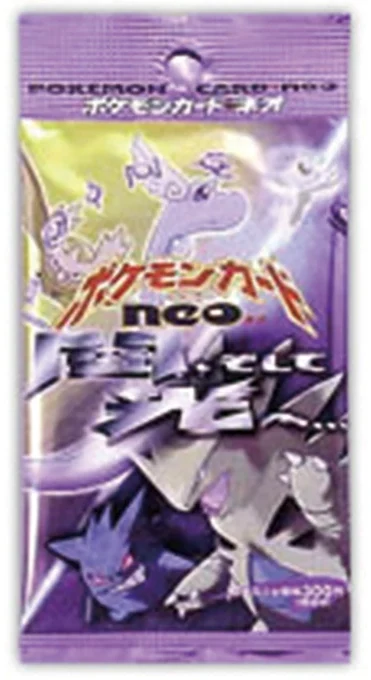
The last set of the neo series. 113 cards, ten to a pack at ¥315 including tax, sixty packs a box. Sixteen holofoil plus eight Shining cards, and the debut of Light Pokémon. The card back is still the original 1996 design — this is the last regular set printed with it. The price held at ¥315 across sets seven through nine and did not change here. The common / uncommon / holo ratio was never published, so it is not stated.
20 April 2001 — the last of the neo series. Ninety-eight Pokémon, fourteen Trainers and one Special Energy card, ten to a pack. Light Pokémon appear here for the first time.
Fifty-four Basic, twenty-six Stage 1, ten Stage 2 and eight Baby. Eight Shining cards — Celebi, Charizard, Raichu, Mewtwo, Kabutops, Tyranitar, Steelix and Noctowl — and unlike the Shining Magikarp and Gyarados of 2000, these sit in the ordinary card list rather than as secrets. The source reports all eight as "Rare", which is how they appear below. The card back is still the original; it changes with ★VS in July.
13 cards · listed in original order.
A Bug-type in the games but Grass on the card. 40 HP Basic with retreat 1. Its evolution Venomoth is in the same set, and this opens the Grass run.
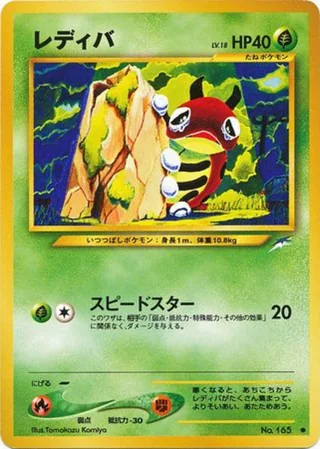
A 40 HP Basic. Its evolution Ledian appears here as the Light version; the ordinary Ledian is in the 2000 eighth expansion. So the line assembled from this set is the Light one.
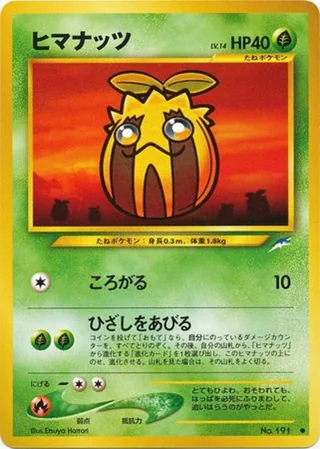
A 40 HP Basic. Sunkern had very few cards at this point — this one and a 2000 manga insert were about it. Its evolution Sunflora is here too, as a Light card.
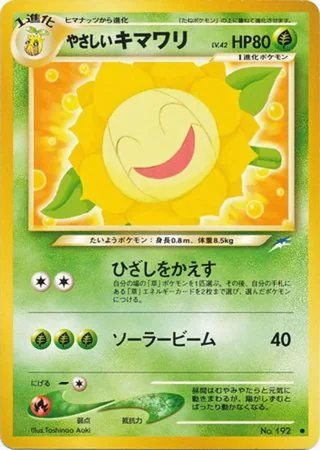
The Light Sunflora. Grass, 80 HP, Stage 1 — set higher than the ordinary print. Light was introduced in this set, and the pattern is consistent: more HP, and attacks pushed toward support.
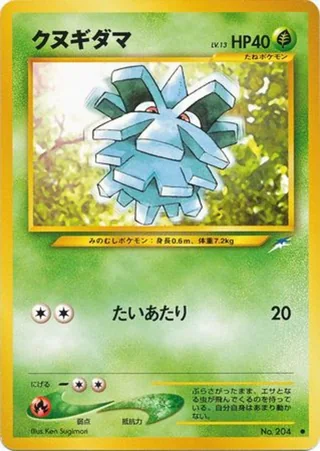
A 40 HP Basic with retreat 2. Its evolution Forretress is here as the Dark version; the ordinary one is in the 2000 eighth expansion. This is the third Pineco card since 2000.
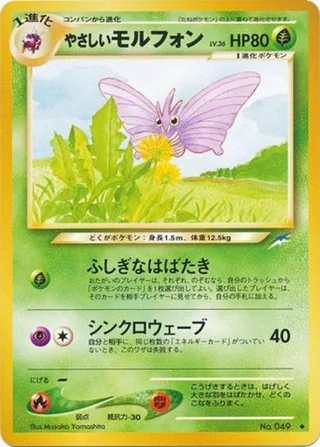
The Light Venomoth. Grass, 80 HP. The ordinary print in the 2000 seventh expansion had 70, so this is ten higher — a clean case of the Light HP bump showing up in the numbers.
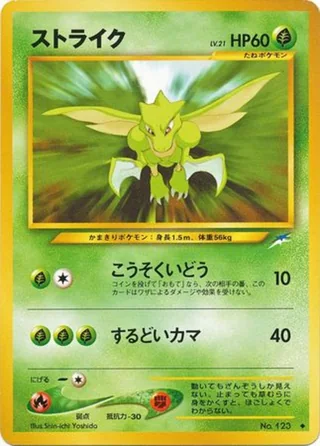
Grass, 60 HP Basic, retreat 1. Scyther had been printed many times since the 1996 Base Set, but this is its first appearance as a Grass card — through 2000 it was mostly Colorless or Metal.
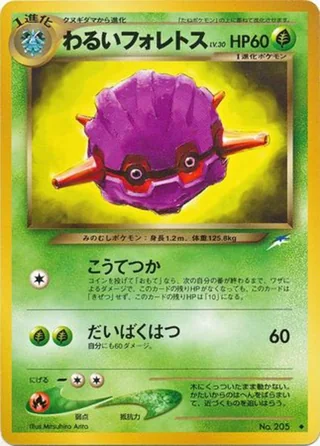
The Dark Forretress. Grass, 60 HP, Stage 1. The ordinary print (2000, eighth expansion) was Metal at 70 HP — so the type moved to Grass and HP dropped by ten. Worth remembering that Dark does not always mean more HP.
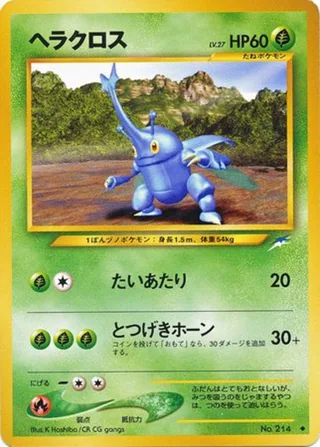
Grass, 60 HP Basic, retreat 2. Heracross had only just debuted in the 2000 seventh expansion, and this is its second card. At the time it was not yet treated as the go-to strong Bug — more of a supporting role.
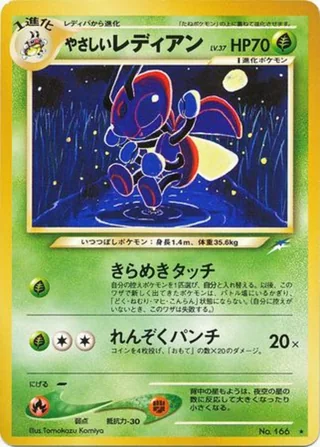
The Light Ledian. Grass, 70 HP, rare. Paired with Ledyba (002) in the same set, so the whole line closes inside this one expansion. Most Light cards are uncommon; this one is rare.
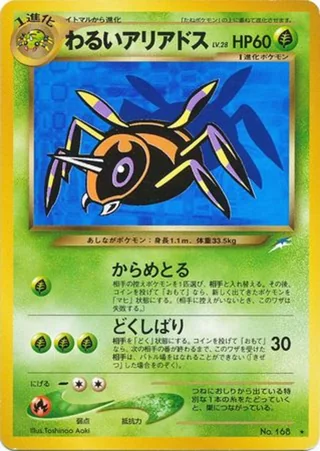
The Dark Ariados. Grass, 60 HP, Stage 1, rare. Ariados had only debuted in the 2000 seventh expansion, so the Dark version arrived by its third set — quickly, by the standards of the era.
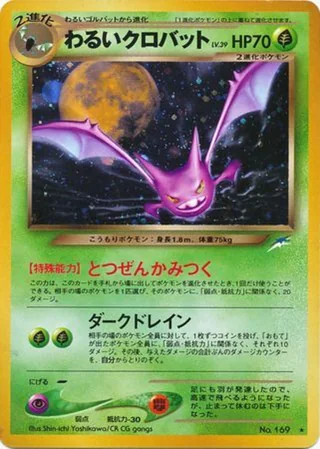
A Grass Crobat. Poison/Flying in the games, but here Grass at 70 HP as a Stage 2 — the closer for this set's Grass run. A Dark Stage 2 as the holo is the pattern repeated across every type in this expansion.
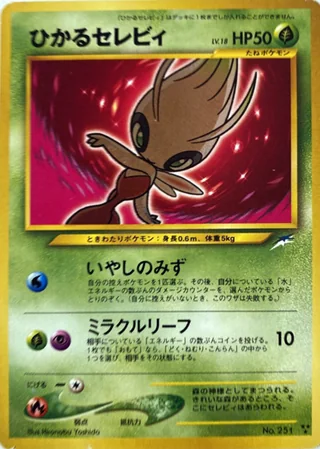
One of the eight Shining cards here. Grass, 50 HP Basic, marked rare. Where the 2000 Shining Magikarp and Gyarados were secrets, these sit in the ordinary list, so working through the numbers will always reach them. The treatment is a metallic sheen over a non-holo base, which does not read like an ordinary holo.
12 cards · listed in original order.
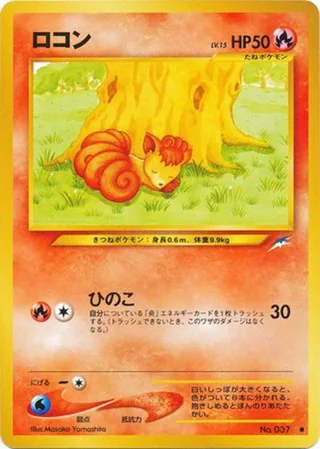
Fire, 50 HP Basic. This is the fifth Vulpix since 1996, and unusually for this set it is neither Light nor Dark. Its evolution Ninetales is here as a Light card.
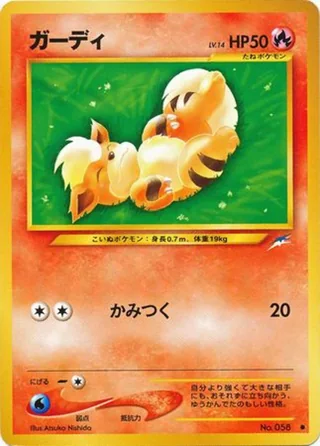
Fire, 50 HP Basic — another plain card. Its evolution Arcanine appears here as a Light holo, so the line runs ordinary Basic into Light Stage 1.
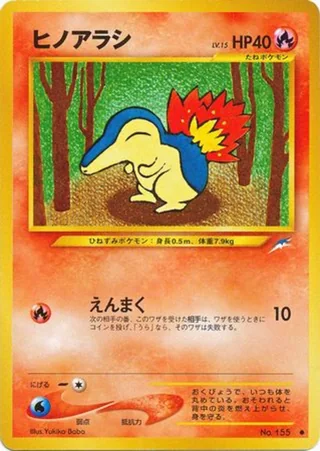
Fire, 40 HP Basic. One of the Gold/Silver starters and its third card since the 2000 seventh expansion. 40 HP is low, but it anchors the line in this set.
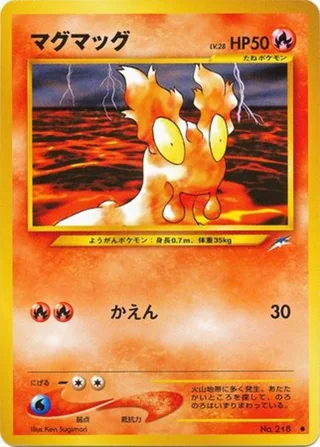
Fire, 50 HP Basic, retreat 2. Slugma had only debuted in the 2000 eighth expansion, so this is its second card. Its evolution Magcargo is here as a Dark card.
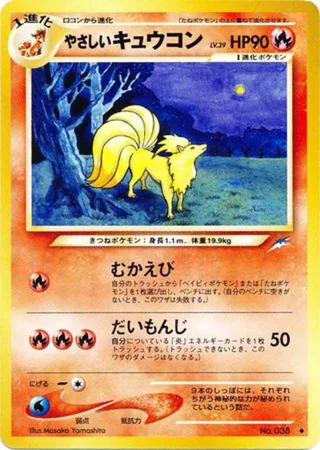
The Light Ninetales. Fire, 90 HP. Light cards generally run high, and 90 is a lot for a Stage 1 — the ordinary Ninetales of 2000 sat at 70.
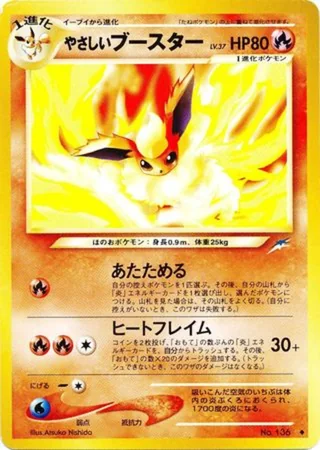
The Light Flareon. Fire, 80 HP. All three Eevee evolutions in this set — Flareon, Vaporeon and Jolteon — are Light cards, and laid side by side the HP and type pairings line up neatly.
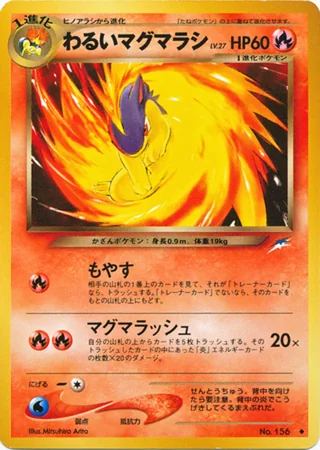
The Dark Quilava. Fire, 60 HP, Stage 1. The ordinary print in the 2000 seventh expansion had 70, so this one trades HP away — with the attacks pushed toward offence instead.
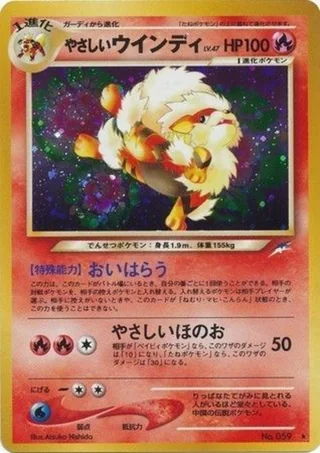
The Light Arcanine, one of this set's holos. Fire at 100 HP is top of the range for a Stage 1. Paired with Growlithe (015), the line closes inside this set. A 100 HP Stage 1 was still uncommon then and worked as a wall.
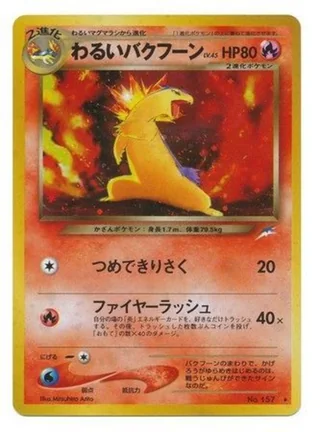
The Dark Typhlosion. Fire, 80 HP, Stage 2, holo. Cyndaquil (016) into Quilava (020) into this card — all three stages are in one set. Note that both the middle and the final are Dark, making it a mixed line.
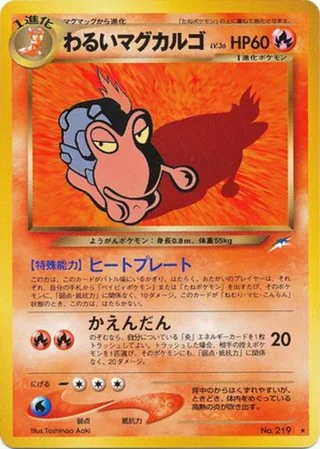
The Dark Magcargo. Fire, 60 HP, completing the line with Slugma (017). Magcargo had only debuted in the 2000 eighth expansion, so its Dark version arrived by the third set.
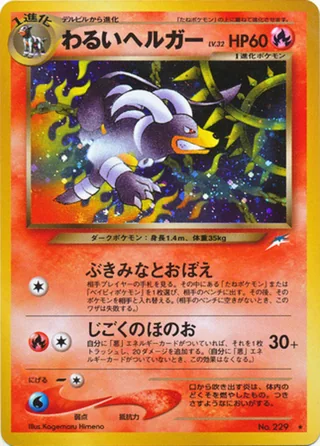
The Dark Houndoom, a holo here. Fire, 60 HP, Stage 1. Its pre-evolution Houndour sits at 081 in this same set as a Darkness card — so evolving flips it to Fire, an unusual reversal where the corrupted form is the Fire one.
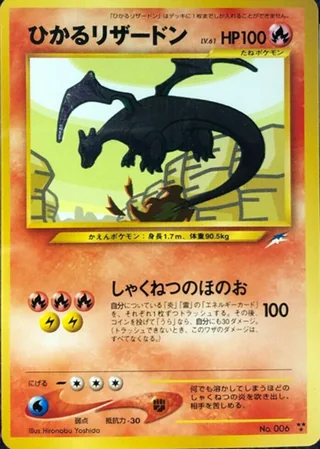
The headline Shining card. Fire, 100 HP, Basic, with a heavy attack asking five Energy — three Fire and two Lightning. A Basic at 100 HP is the Shining formula: no evolution, but the bulk of a Stage 2. It was among the most wanted cards of 2001 and, even then, clean copies were hard to find.
16 cards · listed in original order.
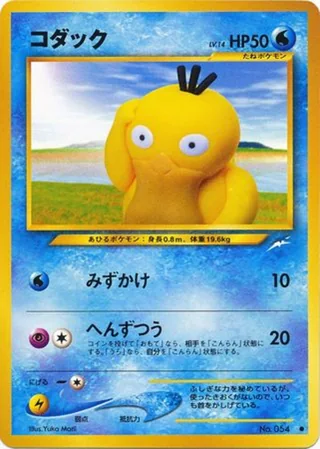
Water, 50 HP Basic, retreat 1. Psyduck had not appeared since 1997; here it is a plain card. Its evolution Golduck is in the set as a Light one.
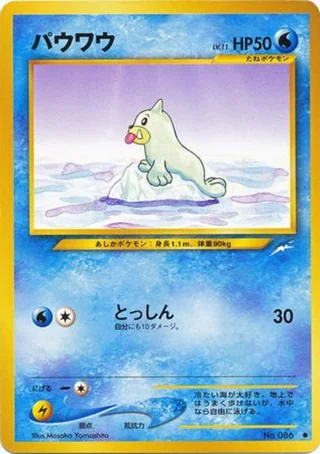
Water, 50 HP Basic. The third Seel since the 2000 eighth expansion. Its evolution Dewgong is here as a Light card, so the line closes inside this set.
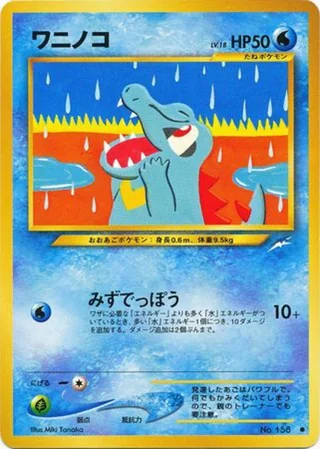
Water, 50 HP Basic. The Gold/Silver Water starter, a plain card here. Its evolutions are both Dark — Croconaw and then Feraligatr — so the line turns to Darkness partway through.
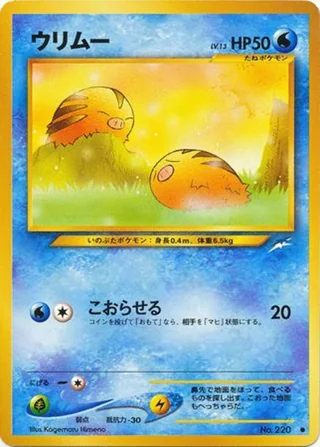
Water, 50 HP Basic, retreat 1. Swinub debuted in the 2000 eighth expansion; this is its second card. Its evolution Piloswine is here as a Light one.
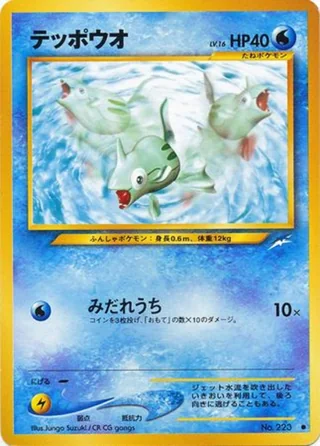
Water, 40 HP Basic. Remoraid had only two cards before this, making this the third. At 40 HP it is thin, and is clearly meant to be evolved.
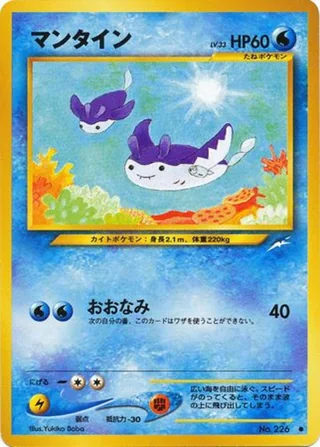
Water, 60 HP Basic, retreat 1. Mantine had only debuted in the 2000 eighth expansion and this is its second card. The evolution from Remoraid (030) did not exist in the card game then, so this stood alone.
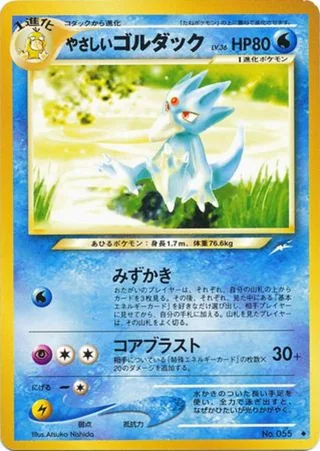
The Light Golduck. Water, 80 HP, Stage 1, completing the line with Psyduck (026). The ordinary Golduck in the 2000 eighth expansion had 70, so ten more here.
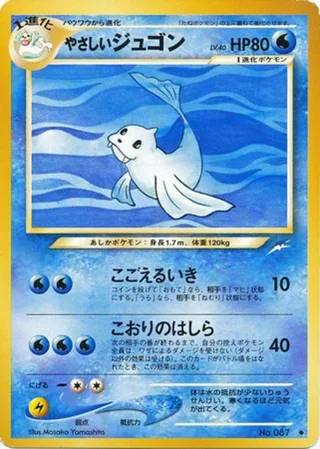
The Light Dewgong. Water, 80 HP, completing the line with Seel (027). The 2000 ordinary print was 70, again ten more. Across this set the Light bonus settles at a flat ten HP.
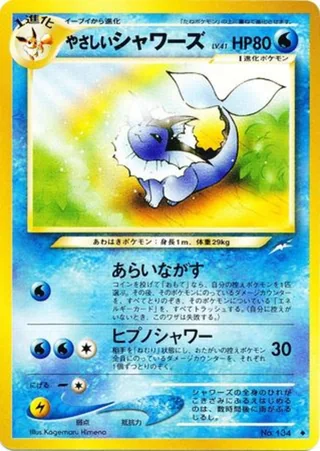
The Light Vaporeon. Water, 80 HP, one of the three Eevee evolutions here, all Light. The ordinary Vaporeon in the 2000 seventh expansion sat at 70.
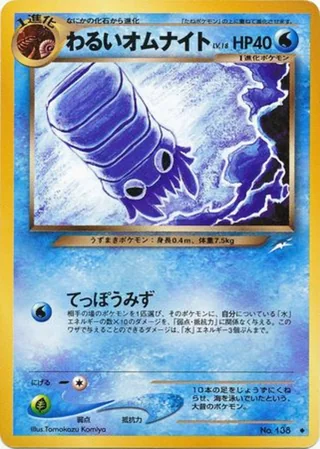
The Dark Omanyte. Water, 40 HP. Note that Omanyte is printed as a Stage 1 with no Basic beneath it. At 40 HP the Dark version is very thin, built around attacking.
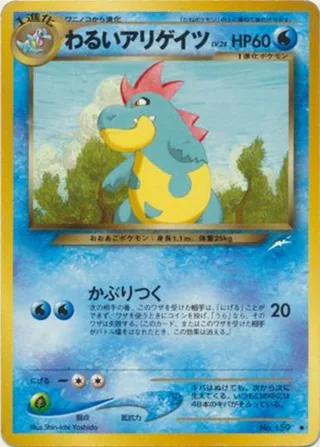
The Dark Croconaw. Water, 60 HP, Stage 1, continuing from Totodile (028). The ordinary print in the 2000 seventh expansion had 70.
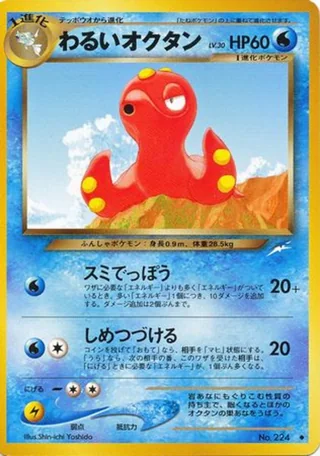
The Dark Octillery. Water, 60 HP. There was no Remoraid-to-Octillery line in the card game then, so this stands alone. A Pokémon that had only debuted in the 2000 eighth expansion already had a Dark print.
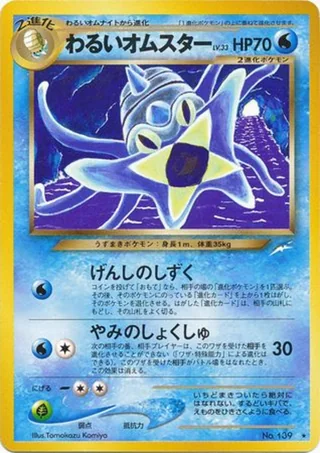
The Dark Omastar. Water, 70 HP, Stage 2, rare. It continues from Omanyte (035), which is itself a Stage 1 with no Basic, so the line is effectively two cards deep.
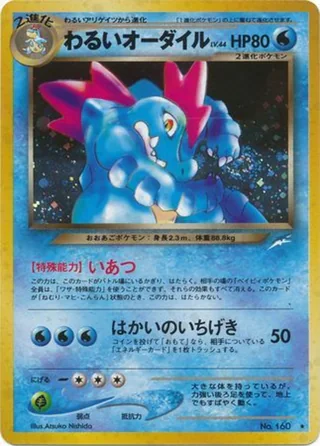
The Dark Feraligatr, a holo here. Water, 80 HP, Stage 2. Totodile (028) into Croconaw (036) into this card — all three stages in one set, with both the middle and final Dark, the same shape as Typhlosion (022).
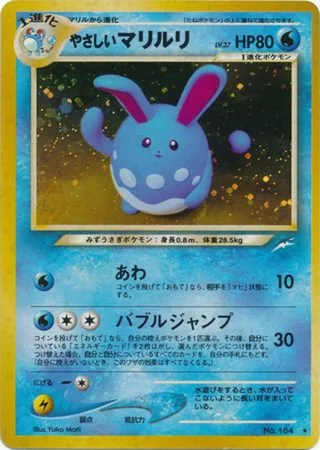
The Light Azumarill, a holo. Water, 80 HP, Stage 1. The Marill and Azurill lines did not exist in the card game then, so this stands alone. Water gets two holos here — this and Feraligatr — making it the thickest type in the set.
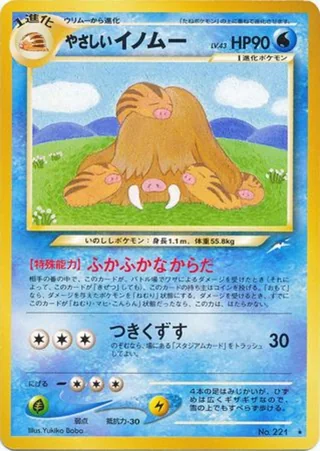
The Light Piloswine. Water, 90 HP, Stage 1, rare, completing the line with Swinub (029). 90 HP on a Stage 1 is high, and sits near the top of this set's Light cards.
6 cards · listed in original order.
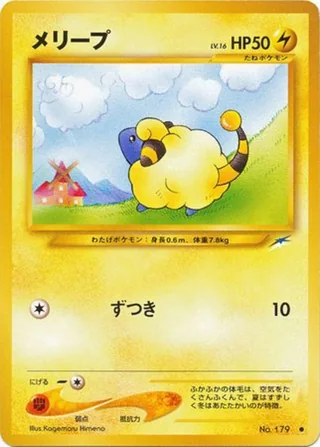
Lightning, 50 HP Basic. Mareep debuted in the 2000 seventh expansion and this is its second card. Both evolutions — Flaaffy and Ampharos — are Dark, the same shape as the Totodile line.
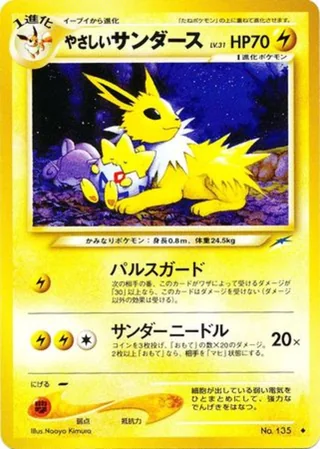
The Light Jolteon. Lightning, 70 HP — the lowest of the three Eevee evolutions here, with Flareon and Vaporeon both at 80. The type difference shows up directly in the numbers.
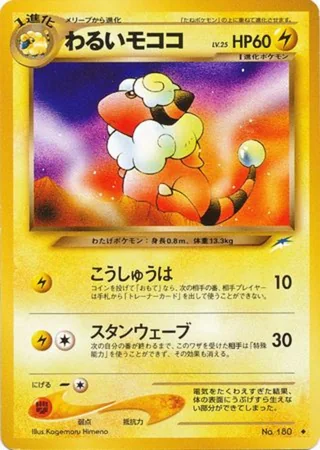
The Dark Flaaffy. Lightning, 60 HP, Stage 1, continuing from Mareep (042). The ordinary print in the 2000 seventh expansion had 70, so the Dark version runs ten lower.
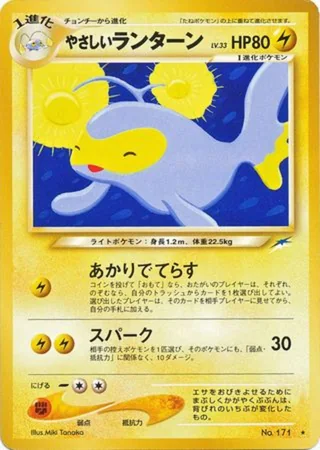
The Light Lanturn. Lightning, 80 HP, rare. The Chinchou line did not exist in the card game then, so this stands alone. It had only debuted in the 2000 eighth expansion, and the Light version arrived by its second set.
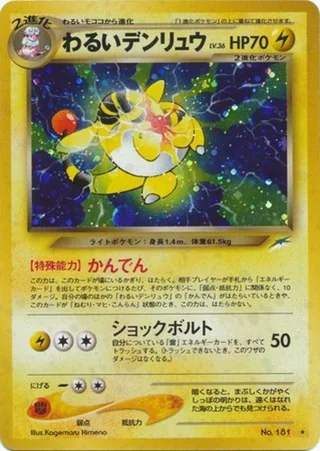
The Dark Ampharos, a holo. Lightning, 70 HP, Stage 2. Mareep (042) into Flaaffy (044) into this card — all three stages here, and this is one of two lines in the set where the Darkness runs the whole way.
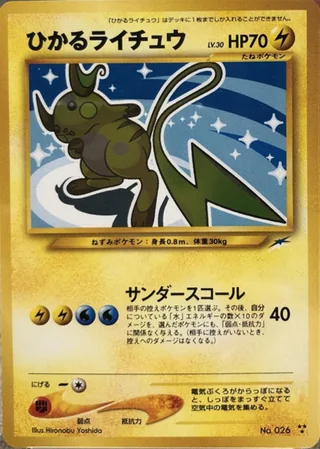
One of the eight Shining cards. Lightning, 70 HP, Basic. Its attack asks for two Water among the cost, which makes it awkward in a mono-Lightning deck. All eight Shining cards here are Basics with no evolutionary line.
21 cards · listed in original order.
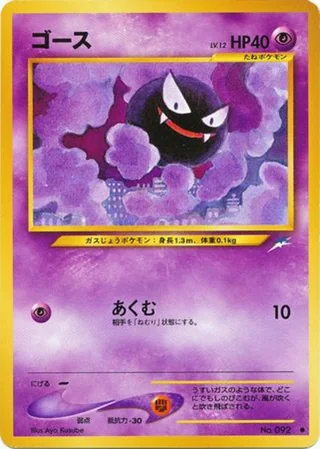
Psychic, 40 HP Basic with no retreat cost — the fourth Gastly since 1996, and free to withdraw. Its evolution Haunter is here as a Dark card.
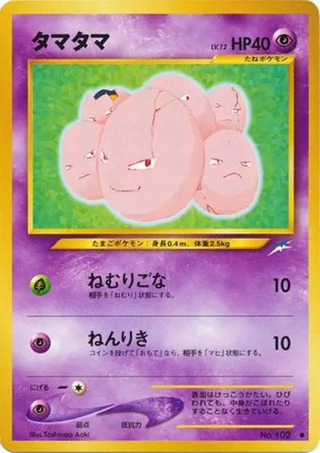
Psychic, 40 HP Basic. Exeggcute is unusual in also using a Grass attack, which means a Psychic deck has to carry a Grass Energy or two. Its evolution Exeggutor is here as a Dark card.
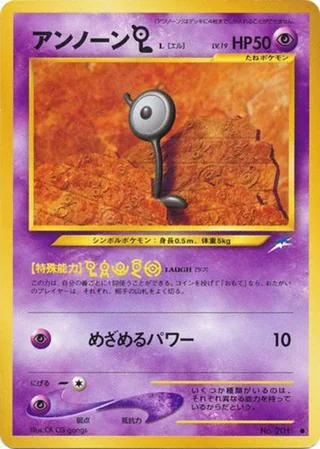
Unown L. Psychic, 50 HP Basic. This set carries twelve Unown — L, S, T, V, C, P, Q, Z, G, H, W and X — and HP and rarity differ letter by letter, which is how the series was built. L is a 50 HP common.
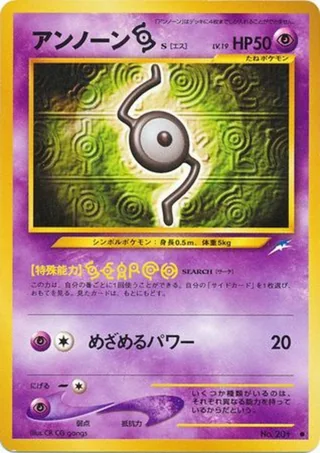
Unown S. Psychic, 50 HP, common. It shares L's 50 HP but asks one more Energy for its attack, and that kind of small variation is applied letter by letter across all twelve.
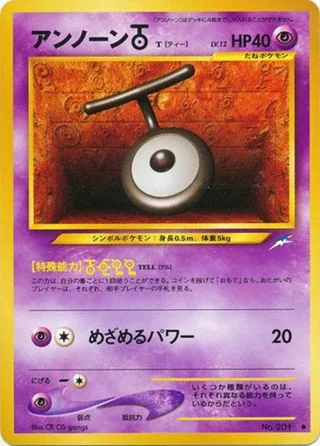
Unown T. Psychic, 40 HP, common. Nine of the twelve sit at 40 HP — T, V, C, P, Q, Z, G, H and W — a step thinner than the 50 HP group of L, S and X.
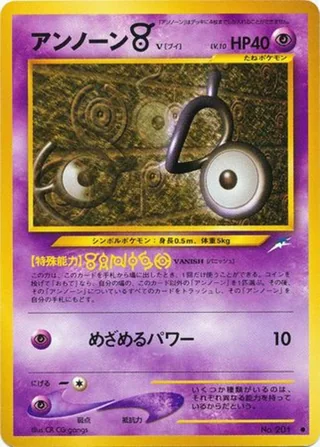
Unown V. Psychic, 40 HP, common. The full A-to-Z run of twenty-six had already appeared in the 2000 eighth expansion, so these twelve are a second pass — the same letters, but different cards.
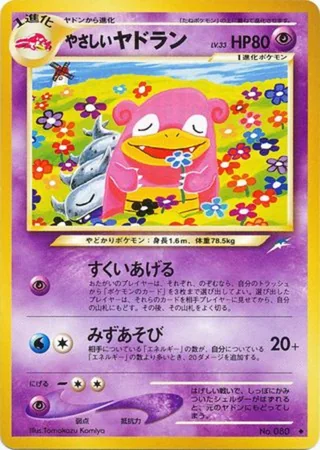
The Light Slowbro. Psychic, 80 HP, Stage 1. The Slowpoke line did exist, with an ordinary print in the 2000 eighth expansion. 80 HP on a Stage 1 is the standard Light figure in this set.
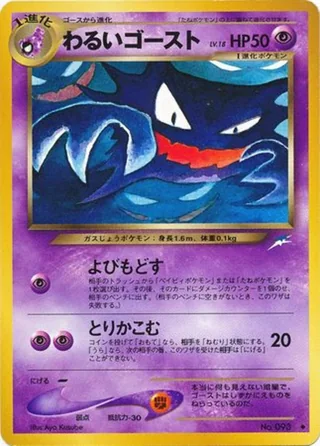
The Dark Haunter. Psychic, 50 HP, Stage 1, continuing from Gastly (048). The ordinary print in the 2000 seventh expansion had 60, so this runs ten lower.
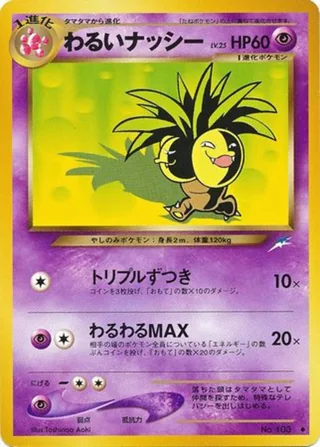
The Dark Exeggutor. Psychic, 60 HP, Stage 1, completing the line with Exeggcute (049). It still carries a Grass attack, as the ordinary print does, so the deck has to splash a second colour.
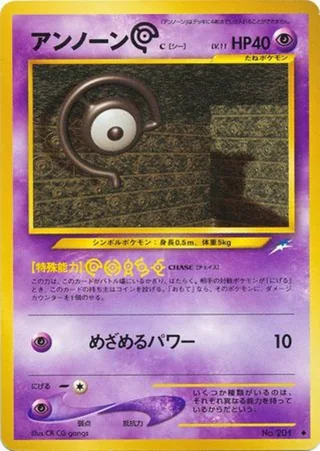
Unown C. Psychic, 40 HP, and from here the letters move up to uncommon. Four sit in this band — C, P, Q and Z — with the same HP as the commons and only the rarity differing.
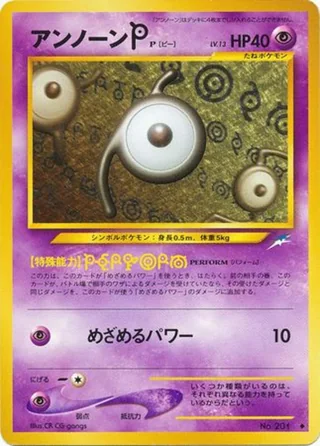
Unown P. Psychic, 40 HP, uncommon. The twelve letters climb in blocks of four: commons L, S, T, V; uncommons C, P, Q, Z; rares G, H, W, X.
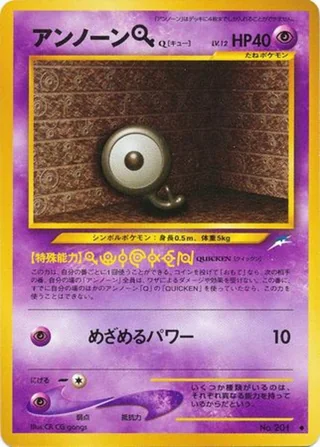
Unown Q. Psychic, 40 HP, uncommon. Set against the other uncommons — C, P and Z — the attack cost is essentially the same, so what differs is the letter and the art. Collecting all twelve is the point.
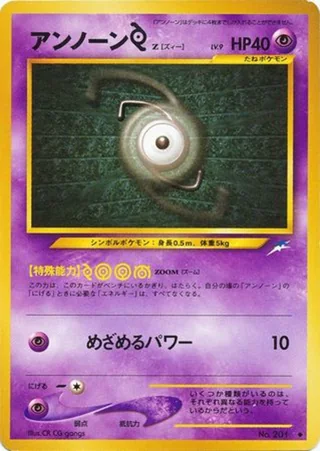
Unown Z. Psychic, 40 HP, uncommon — the last letter of the alphabet. Collectors lay the twelve out in alphabetical order, but the set order does not follow the alphabet.
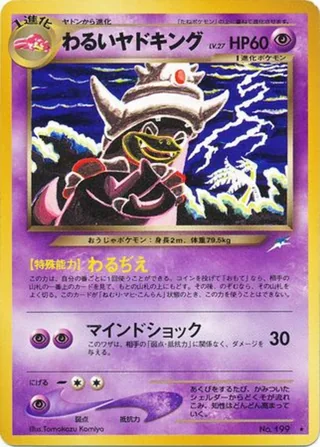
The Dark Slowking. Psychic, 60 HP, Stage 1, rare. The Slowpoke line existed, with an ordinary print in the 2000 eighth expansion. Note that it is rare without being holo — the usual shape of this set's rare tier.
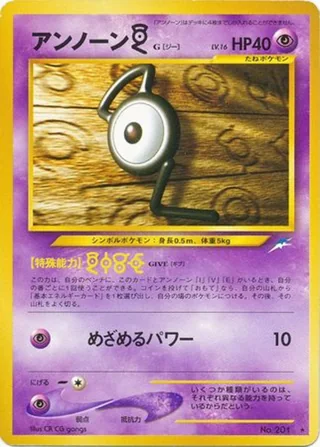
Unown G. Psychic, 40 HP, and from here the letters are rare. Four sit in this band — G, H, W and X — with the first three at 40 HP and only X at 50.
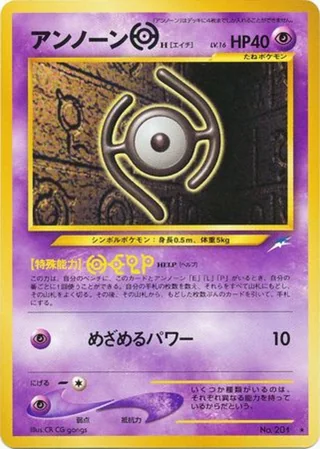
Unown H. Psychic, 40 HP, rare. The rules of the time allowed only four Unown in a deck, so despite twelve existing here the series was always more of a collection than a playset.
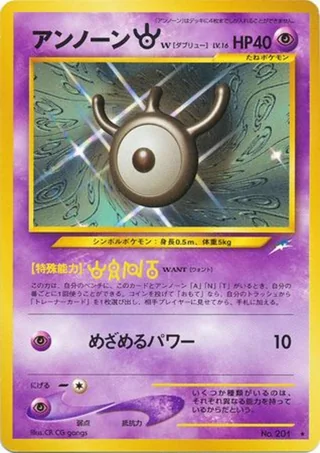
Unown W. Psychic, 40 HP, rare. All four rares look alike at a glance — the letter is drawn large at the centre of the art, so you have to look closely to tell them apart.
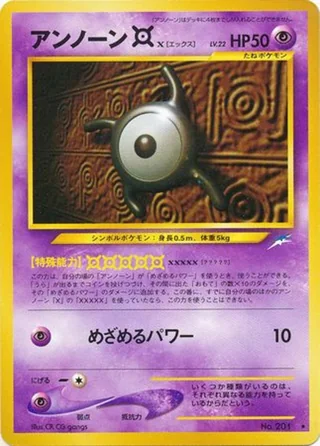
Unown X. Psychic, 50 HP, rare — the only rare among the twelve at 50 HP. Since L and S are 50 HP commons, the HP alone tells you nothing about rarity.
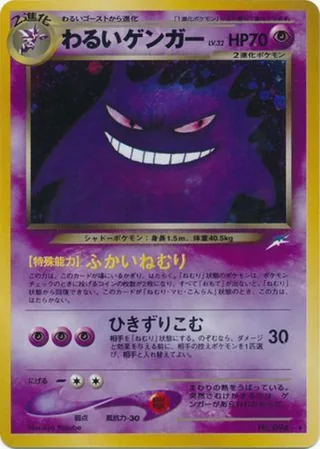
The Dark Gengar, a holo. Psychic, 70 HP, Stage 2. Gastly (048) into Haunter (055) into this card — all three stages here. Psychic gets only two holos, this and Espeon (067), and both are Dark.
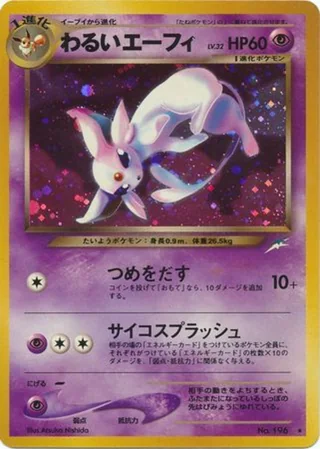
The Dark Espeon, a holo. Psychic, 60 HP, Stage 1. Four Eevee evolutions appear in this set, and the split is neat: Flareon, Vaporeon and Jolteon are Light; only Espeon is Dark.
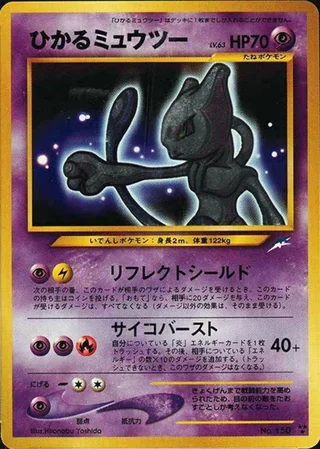
One of the eight Shining cards. Psychic, 70 HP, Basic. Japan produced only this one Shining Mewtwo, never reissued with new art. It is among the most wanted of the eight, and clean copies are scarce.
12 cards · listed in original order.
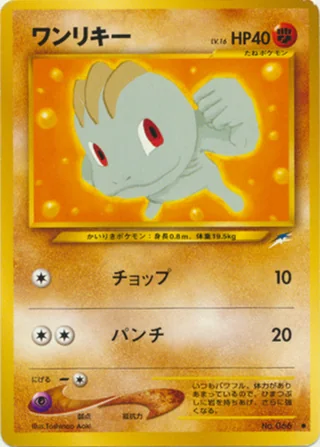
Fighting, 40 HP Basic, retreat 1 — the fourth Machop since 1996. Both evolutions, Machoke and Machamp, are Light here, so this set pushes the Fighting line toward the bright side.
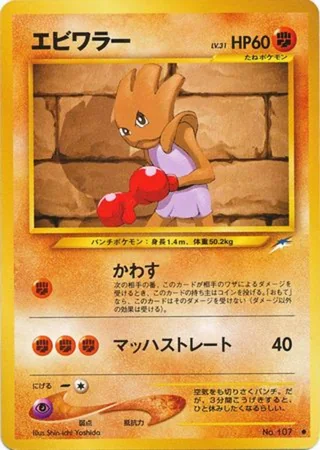
Fighting, 60 HP Basic, retreat 1 — the fourth Hitmonchan since the 1996 Base Set. It has no evolutionary line, and this set carries three separate Fighting lines: Hitmonchan, Hitmonlee and the Machop family.
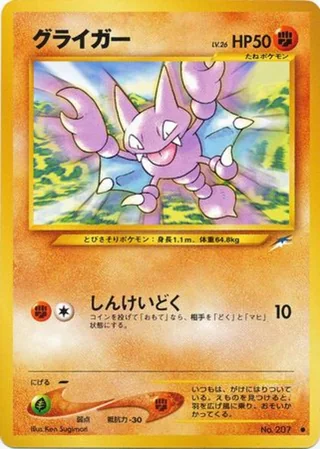
Fighting, 50 HP Basic. Gligar debuted in the 2000 seventh expansion and this is its second card. It has no evolutionary line and was still thin on cards at this point.
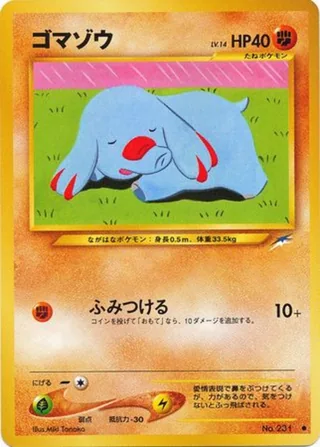
Fighting, 40 HP Basic, retreat 1. Phanpy had only debuted in the 2000 eighth expansion; this is its second card. Its evolution Donphan appears here as a Dark holo.
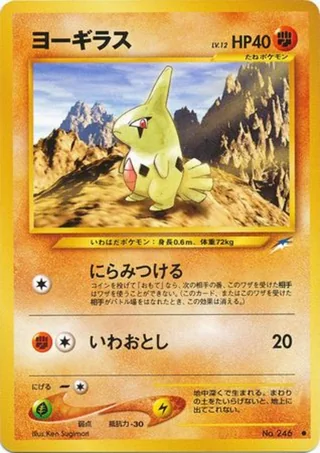
Fighting, 40 HP Basic. Larvitar debuted in the 2000 eighth expansion and this is its second card. Both evolutions are Dark, and all three stages sit in this set.
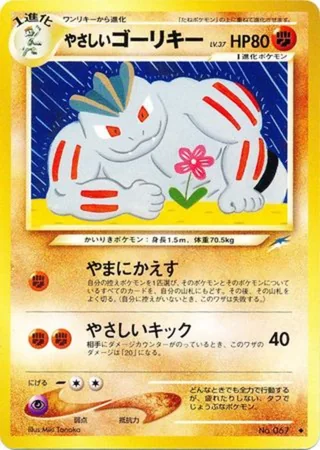
The Light Machoke. Fighting, 80 HP, Stage 1, continuing from Machop (069). The ordinary print in the 2000 seventh expansion had 70, so ten more here.
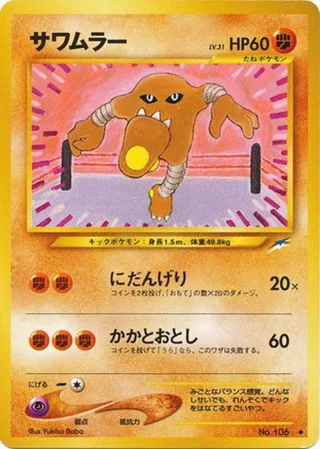
Fighting, 60 HP Basic, retreat 1. Hitmonlee is the partner to Hitmonchan, and both appear here. With Hitmonchan also at 60 HP and retreat 1, the two are near-equivalent.
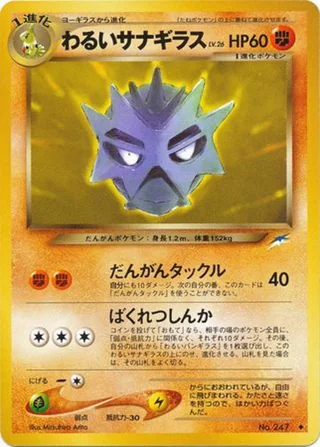
The Dark Pupitar. Fighting, 60 HP, Stage 1, continuing from Larvitar (073). A cocoon stage printed as Dark is unusual, and with Tyranitar also Dark, the whole three-stage line leans that way.
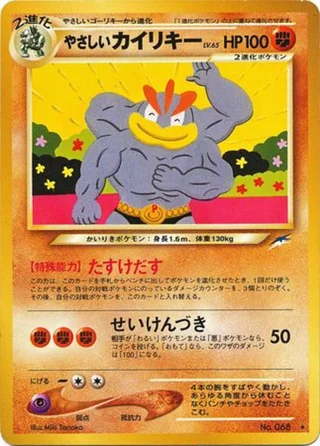
The Light Machamp. Fighting, 100 HP, Stage 2, rare. Machop (069) into Machoke (074) into this card — all three stages here. A 100 HP Stage 2 that is not holo is a quiet but solid card.
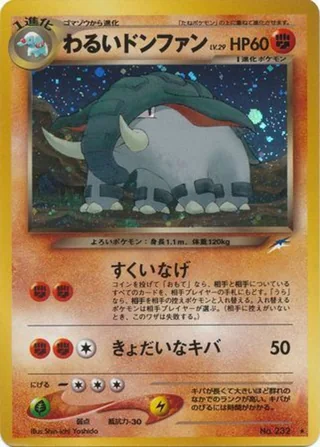
The Dark Donphan, a holo. Fighting, 60 HP, Stage 1, completing the line with Phanpy (072). A holo at 60 HP is on the low side for this set — it is built around its effect rather than its bulk.
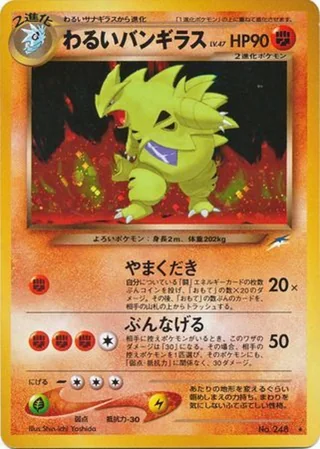
The Dark Tyranitar, a holo. Fighting, 90 HP, Stage 2. Larvitar (073) into Pupitar (076) into this card. The same set also carries a Shining Tyranitar (082), so one Pokémon appears twice — this one Fighting, the Shining one Darkness.
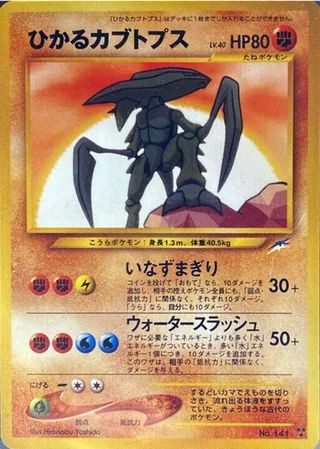
One of the eight Shining cards. Fighting, 80 HP, Basic. Kabutops is a fossil Pokémon normally printed as a Stage 2, but this Shining version is a Basic — playable at 80 HP without evolving.
2 cards · listed in original order.
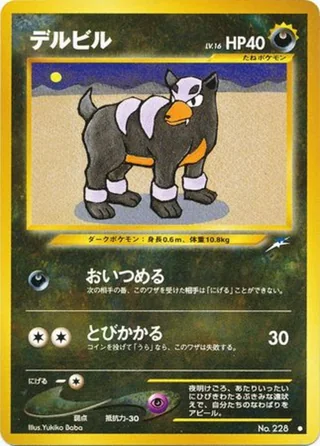
Darkness, 40 HP Basic, retreat 1. Houndour debuted in the 2000 eighth expansion; this is its second card. It is a Darkness Basic here, but its evolution Houndoom (024) is Fire.
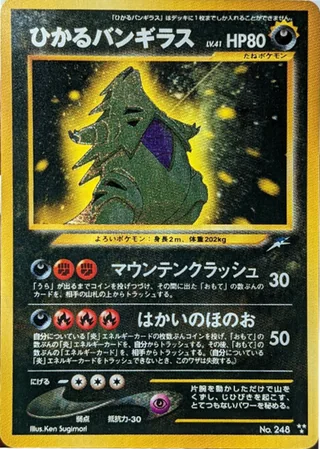
One of the eight Shining cards. Darkness, 80 HP, Basic — and an unusual case of the same Pokémon appearing as both Dark (079) and Shining in one set. Among the eight, this is the only Darkness card.
2 cards · listed in original order.
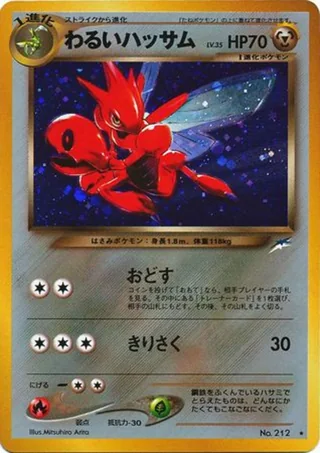
The Dark Scizor, a holo. Metal, 70 HP, Stage 1. Scyther (007) is Grass, so evolving moves it to Metal. This set carries only two Metal cards, and this holo is one of them.
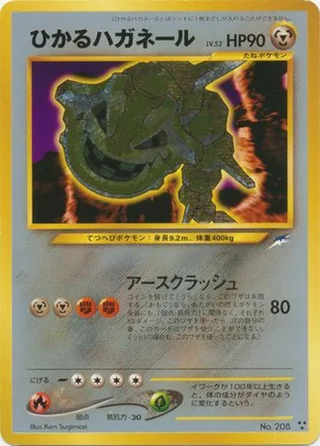
One of the eight Shining cards. Metal, 90 HP, Basic. Steelix is normally a Stage 2, but this Shining version is a Basic. It is the only Metal Shining card, and among the eight it is considered one of the scarcer ones.
14 cards · listed in original order.
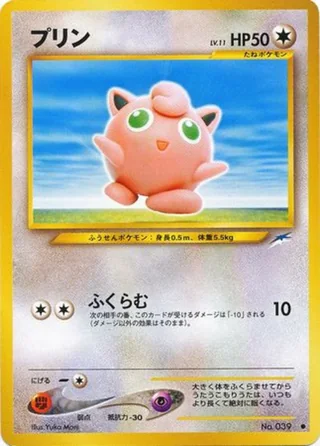
Colorless, 50 HP Basic, retreat 1 — the fifth Jigglypuff since 1996. Its evolution Wigglytuff appears here twice, once Light and once Dark, which is an unusual pairing.
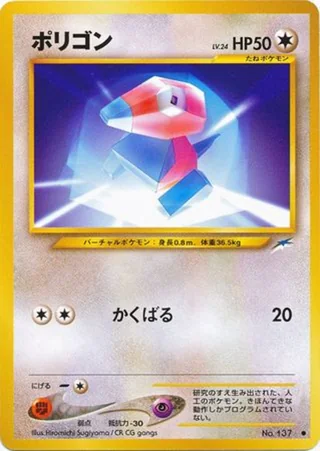
Colorless, 50 HP Basic. Porygon had not appeared since 1997. Its evolution Porygon2 is here as a Dark holo, while this remains a plain card.
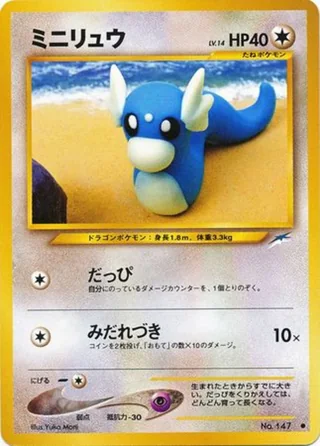
Colorless, 40 HP Basic, retreat 1 — the third Dratini since 1996. Both evolutions, Dragonair and Dragonite, are Light, so all three stages sit on the bright side.
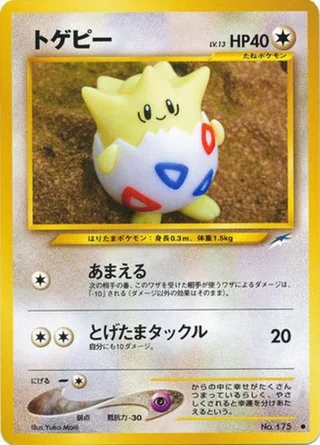
Colorless, 40 HP Basic. Togepi debuted in the 2000 seventh expansion; this is its second card. Its evolution Togetic is here as a Light holo.
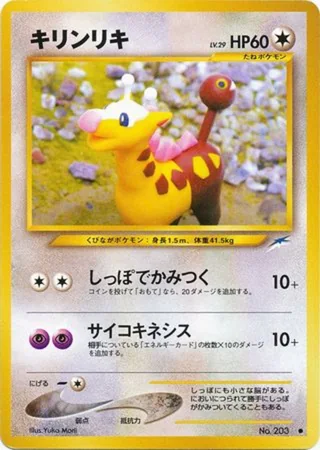
Colorless, 60 HP Basic, retreat 1. Girafarig debuted in the 2000 eighth expansion and this is its second card. It has no evolutionary line and was still thin on cards.
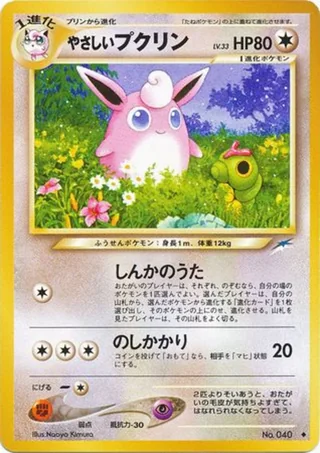
The Light Wigglytuff. Colorless, 80 HP, Stage 1, continuing from Jigglypuff (085). The set also carries a Dark version (091), so there are two ways to evolve it.
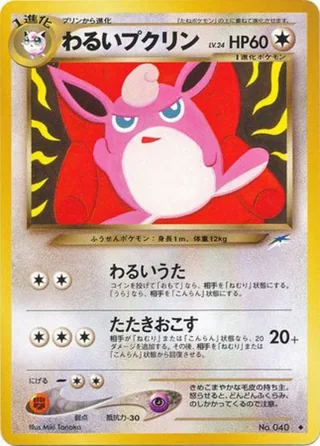
The Dark Wigglytuff. Colorless, 60 HP, Stage 1 — twenty lower than the Light one, with its attacks shifted toward disruption. Put the two side by side and the split is clear: Light for HP, Dark for effect.
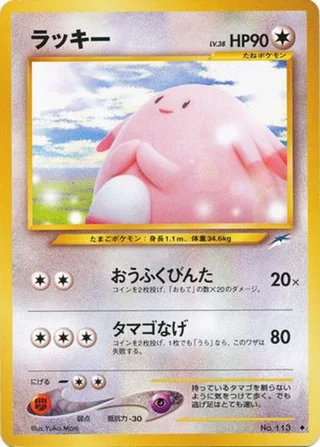
Colorless, 90 HP Basic, retreat 2 — the fourth Chansey since 1996. 90 HP on a Basic was high for the time, and it works as a wall without evolving.
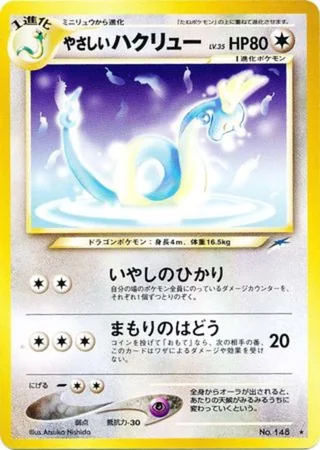
The Light Dragonair. Colorless, 80 HP, Stage 1, rare, continuing from Dratini (087). It is rare without being holo — the set carries four Colorless holos, and Dragonair is not among them.
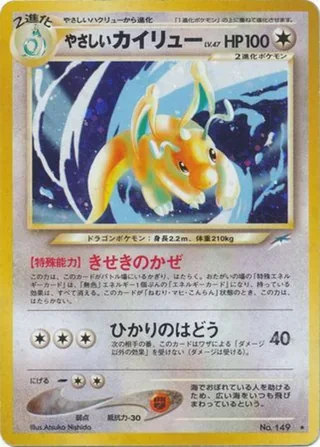
The Light Dragonite, a holo. Colorless, 100 HP, Stage 2. Dratini (087) into Dragonair (093) into this card — all three stages here. A 100 HP Stage 2 and holo makes it the headline Colorless card of the set.
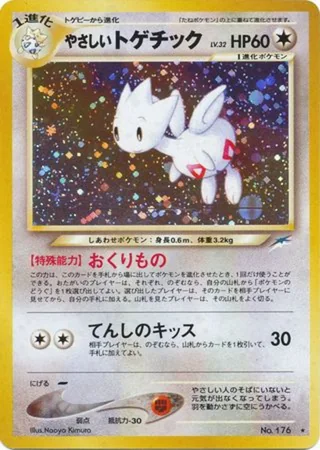
The Light Togetic, a holo. Colorless, 60 HP, Stage 1, completing the line with Togepi (088). A holo at 60 HP is on the low side, but with the Basic at 40 the line reads consistently.
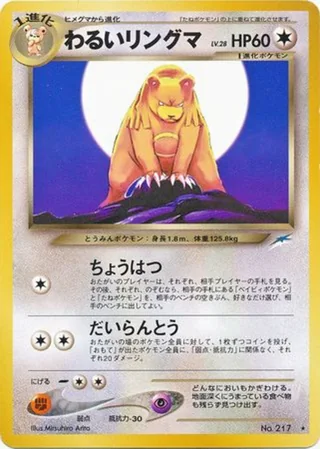
The Dark Ursaring. Colorless, 60 HP, Stage 1, rare. The Teddiursa line existed, with an ordinary print in the 2000 seventh expansion. The Dark version keeps the same 60 HP — a rare case of no reduction.
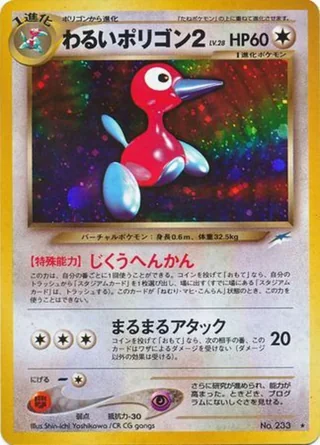
The Dark Porygon2, a holo. Colorless, 60 HP, Stage 1, continuing from Porygon (086). Porygon2 had only debuted in the 2000 eighth expansion, so its Dark version arrived by the third set.
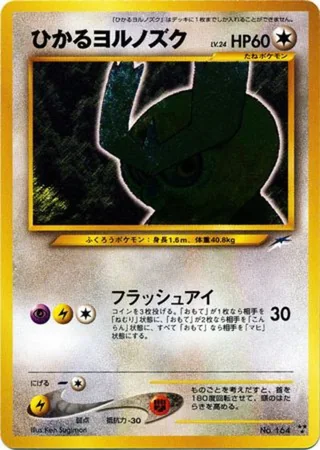
The last of the eight Shining cards. Colorless, 60 HP, Basic. Noctowl is normally a Stage 1, but this Shining version is a Basic. By type the eight fall out perfectly: one each of Grass, Fire, Lightning, Psychic, Fighting, Darkness, Metal and Colorless.
14 cards · listed in original order.
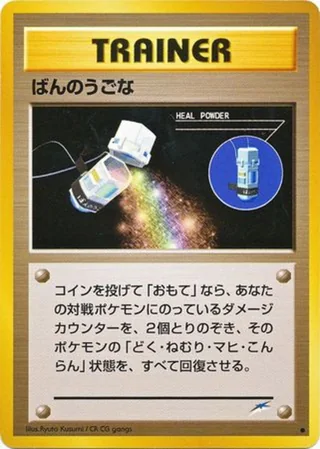
A Trainer (Goods). A cure-all in name, and one of the cards that clears status conditions in bulk. In 2001 Trainers were not yet split into Goods and Supporters — they were all simply "Trainer".
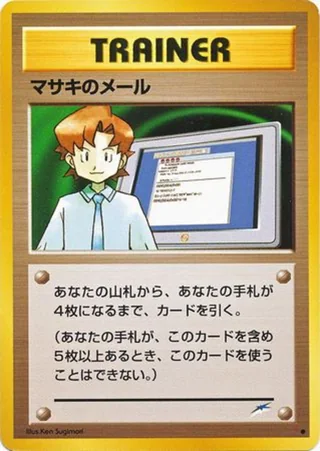
A Trainer (Goods) framed as a letter from Bill, in the hand-refresh family. In 2001 Trainers named after characters were on the rise, a trend the ★VS set pushed further.
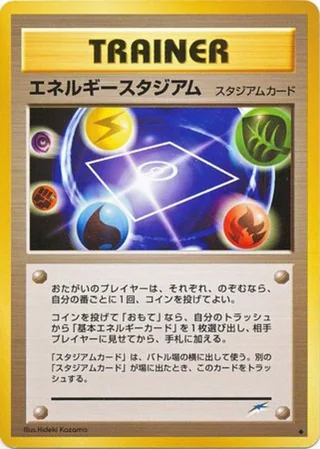
A Trainer (Stadium). Stadiums stay in play and only one can be out at a time. This set carries three — this, Lucky Stadium and Broken Ground Gym — which was a lot for one expansion.
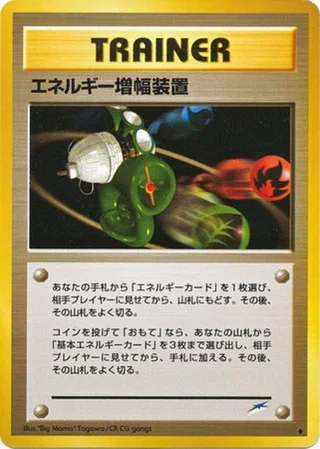
A Trainer (Goods) built around Energy — the search-and-rearrange family. This set is unusually thick with Energy Trainers, four in all (101, 102, 109, 113), matching how decks were built at the time.
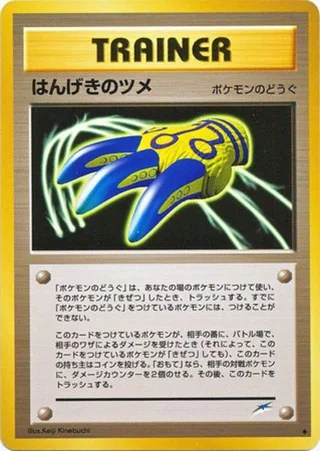
A Trainer (Goods) with an openly aggressive name. Most 2001 Trainers state their effect in the name, and all fifteen in this set follow that habit.
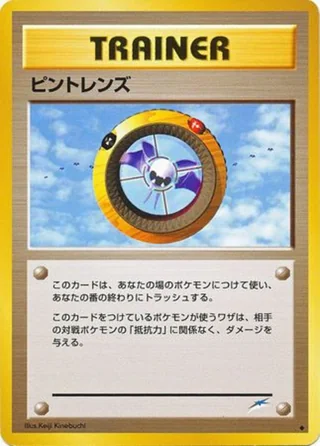
A Trainer (Goods) — a magnifier, in the family that interacts with coin flips and accuracy. Note that Pokémon Tools were still a subcategory of Trainer in 2001, not a separate card type.
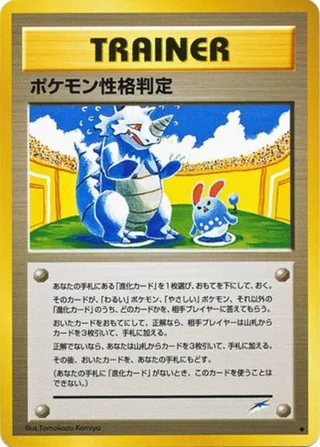
A Trainer (Goods) that manipulates the deck or hand — one of the odder ones. Across the fifteen Trainers here the roles split cleanly into healing, searching, disruption and field control, which shows the design intent.
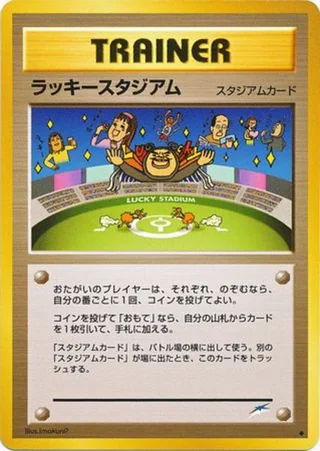
A Trainer (Stadium), one of three here. Because Stadiums overwrite one another, carrying all three overlaps in role, and in practice decks ran only one or two.
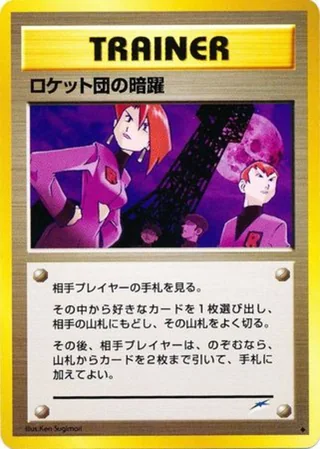
A Trainer (Goods) in the disruption family. This set has little Team Rocket material, and this single Trainer is the only nod to it.
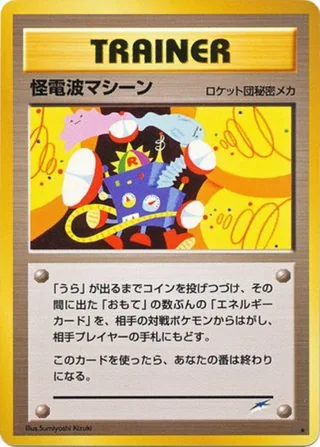
A rare Trainer (Goods) that interferes with the opponent's hand or deck. Five Trainers sit at rare here (108–112), and each swings the game hard on a single use.
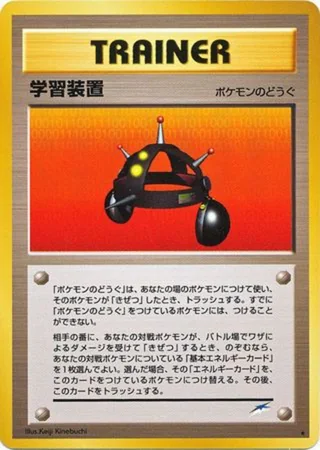
A rare Trainer (Goods). EXP. ALL takes the experience from a knocked-out Pokémon and moves it elsewhere — the in-game item turned into a card, part of a run of game items being ported into the TCG at the time.
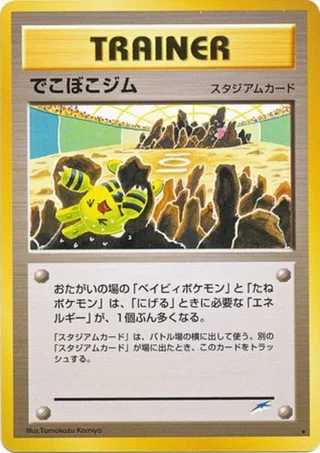
A rare Trainer (Stadium), and the only rare among this set's three Stadiums. A Stadium at rare is unusual, which suggests the effect was judged unusually far-reaching.
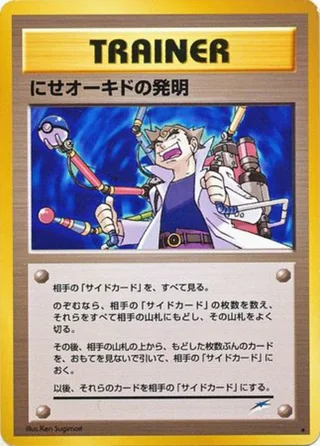
A rare Trainer (Goods) built on the idea of an impostor Professor Oak. 2001 was the year character-named cards expanded, largely through ★VS, and this sits in that current.
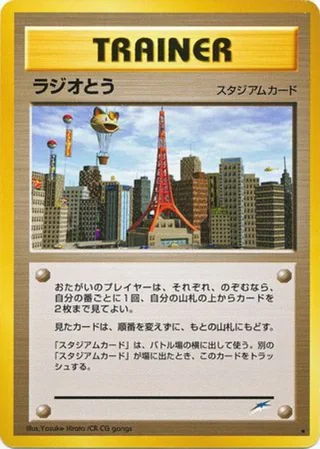
A rare Trainer (Stadium) depicting the Radio Tower in Goldenrod. All three Stadiums here are places turned into cards — a stadium, Lucky Stadium and the tower — and together they tell one story about place.
1 cards · listed in original order.
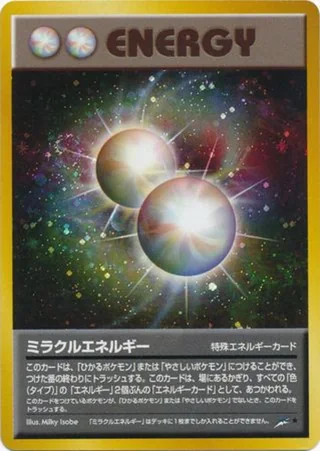
The set's only Energy card, and a holo. Miracle Energy is a Special Energy, and a holo-printed Energy is unusual. Of the 113 cards, 98 are Pokémon, 14 Trainers and one Energy — this one.
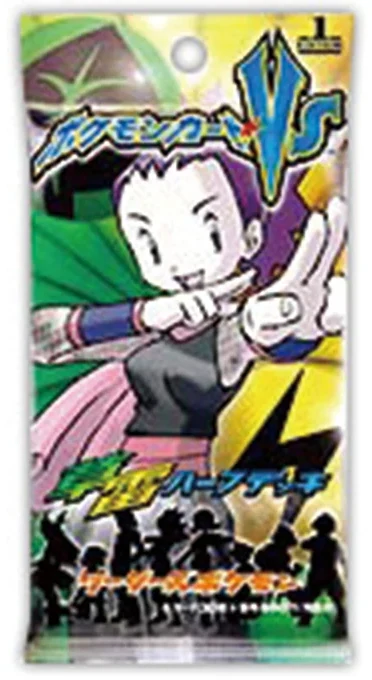
Thirty cards for ¥690 — a different order of magnitude from the usual ten for just over ¥300. Each pack held twelve Pokémon (one of them holo), four Trainers, two Technical Machines, eleven basic Energy and one Special Energy, sold in three pairings: Fighting/Psychic, Water/Fire, Grass/Lightning. Three half decks appeared the same day. This is the set that switched the card back to the international design, and numbering became a straight run. The box count could not be confirmed from period sources and is left empty.
19 July 2001 — 141 cards plus one secret. The premise is that Gym Leaders, Elite Four members, Team Rocket and Lance each own their Pokémon. 103 Pokémon and 39 Trainers, twenty-seven of them Technical Machines.
This is the set that changed the card back — from the 1996 "Pokémon Card Game" design to the international "Pokémon" one. It also moved to straight numbering (001–141, with the secret at 142), and introduced Technical Machines and the classified Special Conditions, adding Burned. Packs held 30 cards at ¥690 and were sold in three type pairings: Fighting/Psychic, Water/Fire, Grass/Lightning. No illustrator records survive for this set, so the artist field is empty throughout.
16 cards · listed in original order.
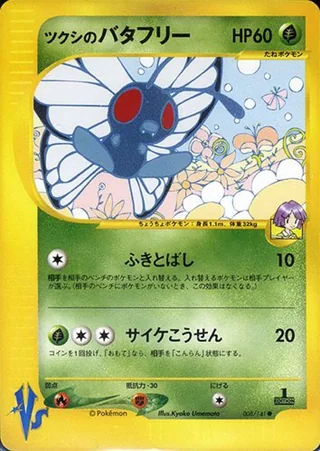
Bugsy's Butterfree. Grass, 60 HP. All six of Bugsy's cards are Grass, fitting a Bug-type leader. Butterfree had not been printed since 1996, and ★VS mixes in familiar faces like this.
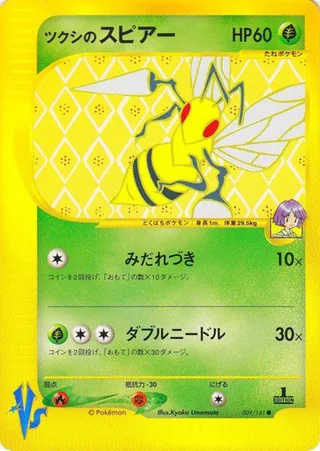
Bugsy's Beedrill. Grass, 60 HP, unseen since the 1996 Base Set. The Grass run in ★VS is entirely Bug — Butterfree, Beedrill, Pinsir, Ledian and Yanma, nothing else.
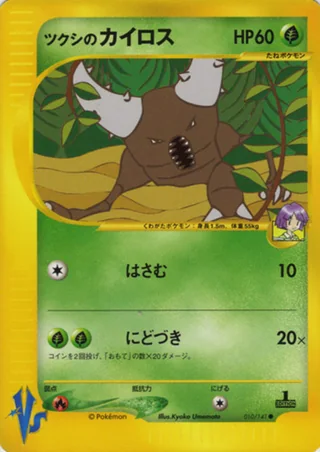
Bugsy's Pinsir. Grass, 60 HP, having debuted only in the 2000 seventh expansion. Bugsy's group is almost all 60 HP — only Yanma sits at 50 — so the group's bulk is uniform.
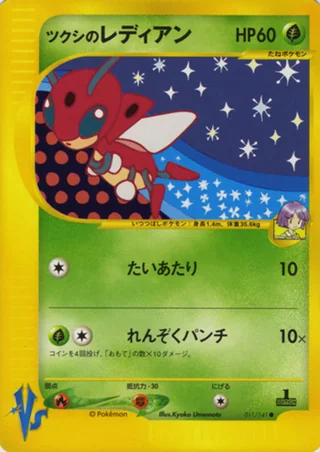
Bugsy's Ledian. Grass, 60 HP. A Light Ledian also exists in the tenth expansion (n4 010). ★VS cards carry the owner's name in front, so the same Pokémon counts as a different card here.
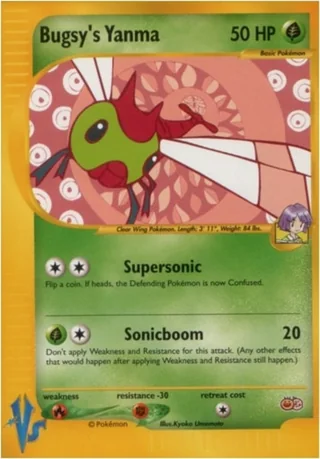
Bugsy's Yanma. Grass, 50 HP — the only 50 in Bugsy's group. Yanma had only debuted in the 2000 eighth expansion and was still thin on cards.
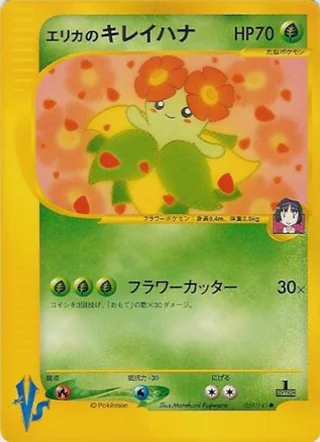
Erika's Bellossom. Grass, 70 HP. Her group is two cards — Bellossom and Jumpluff. Bellossom had last appeared in the 2000 eighth expansion, and 2001 also brought a 001/P promo insert in April.
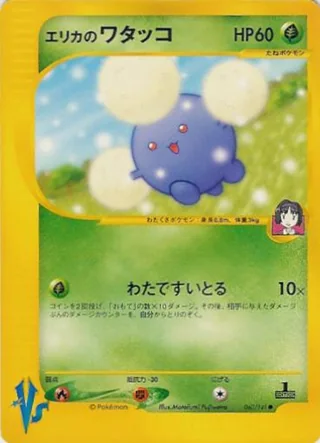
Erika's Jumpluff. Grass, 60 HP, only debuted in the 2000 seventh expansion. Two cards is a thin showing for a Grass leader, which shows ★VS did not scale group size to a character's importance.
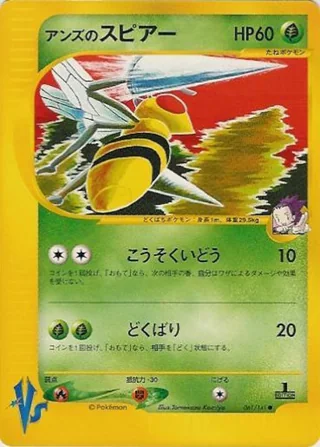
Janine's Beedrill. Grass, 60 HP. All seven of hers are Grass. She uses Poison in the games, but the TCG has no Poison type, so her team lands on Grass — the same treatment Koga gets.
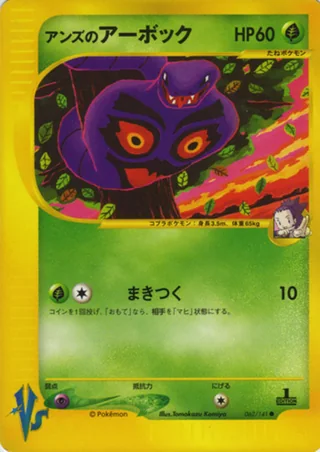
Janine's Arbok. Grass, 60 HP, unseen since 1997. A Poison-type printed as Grass reads oddly, but it was the compromise needed to fit the nine types of the era.
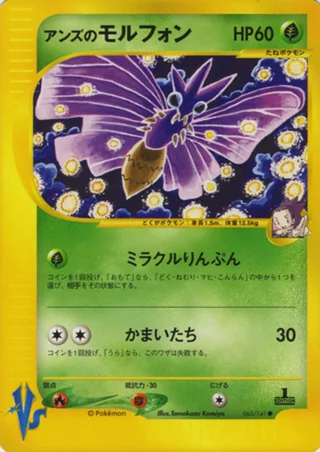
Janine's Venomoth. Grass, 60 HP. Her seven Grass cards all sit at 50 to 60 HP, with nothing at 70 — the whole group is light.
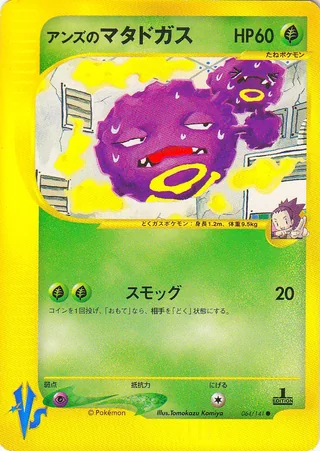
Janine's Weezing. Grass, 60 HP, unseen since 1997. Her group contains no holo — only two of the 21 groups lack one, Whitney's and hers.
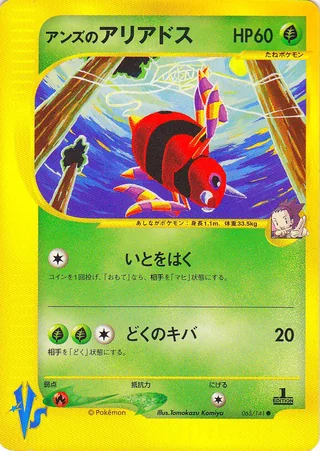
Janine's Ariados. Grass, 60 HP. A Dark Ariados exists in the tenth expansion (n4 011); this version is the ordinary 60 HP card.
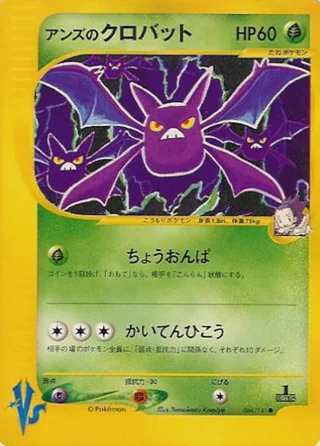
Janine's Crobat. Grass, 60 HP. The same Pokémon appears in Koga's group (079) — father and daughter share it. Both are Grass at 60 HP, numerically identical.
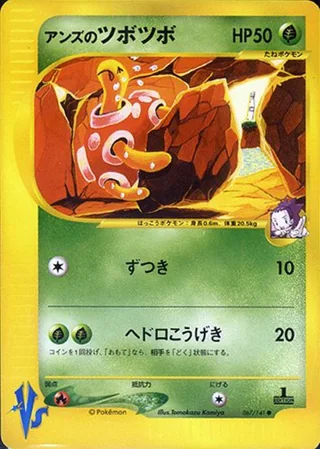
Janine's Shuckle. Grass, 50 HP — the only 50 in her group. Shuckle had only debuted in the 2000 eighth expansion, and this is its second card.
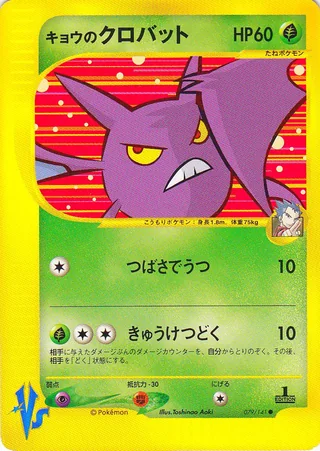
Koga's Crobat. Grass, 60 HP. His group is two cards — Crobat and Forretress. He uses Poison in the games, and with no Poison type his team reads as Grass. His daughter Janine has the same Crobat (066).
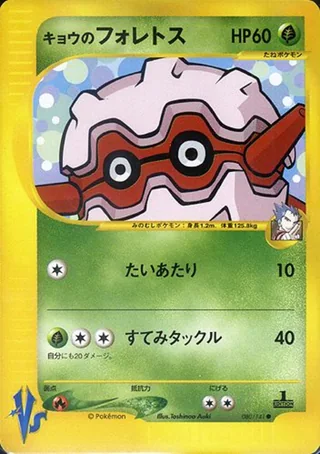
Koga's Forretress. Grass, 60 HP. A Dark Forretress exists in the tenth expansion (n4 008); this is the ordinary Grass print, not holo.
9 cards · listed in original order.
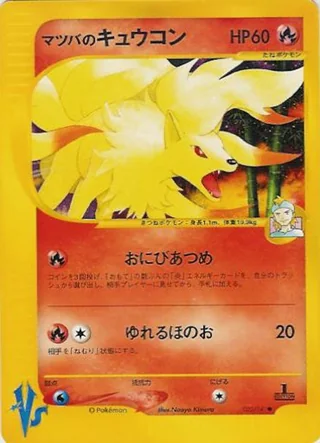
Morty's Ninetales. Fire, 60 HP. His seven cards run across Psychic, Fire, Fighting, Darkness and Colorless — the only group that crosses types, which suits a Ghost-type leader and contrasts with the single-colour groups elsewhere.
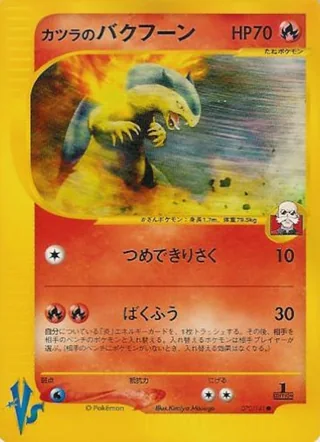
Blaine's Typhlosion. Fire, 70 HP. His group is also two cards — Typhlosion and Magcargo. A Dark holo Typhlosion also exists in the tenth expansion (n4 022).
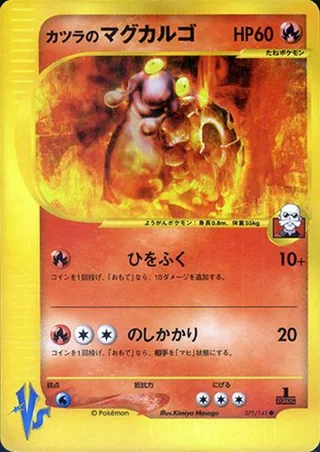
Blaine's Magcargo. Fire, 60 HP. His group is only two Fire cards, at 60 and 70. His group has no holo either — Magcargo is the ordinary 60 HP print.
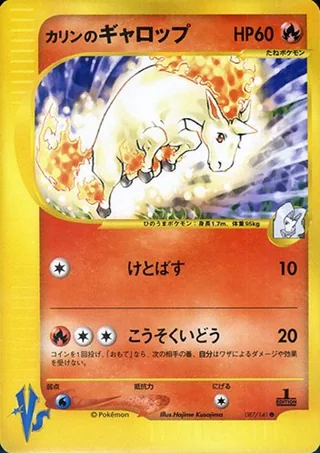
Karen's Rapidash. Fire, 60 HP. Her six are four Fire and two Darkness. Karen is the Darkness Elite Four member, yet her ★VS group leans Fire — the reverse of what you would expect.
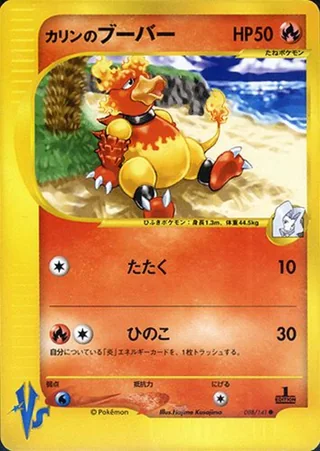
Karen's Magmar. Fire, 50 HP — the only 50 in her group — and unseen since 1997.
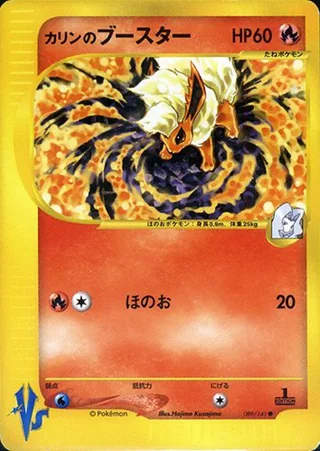
Karen's Flareon. Fire, 60 HP. A Light Flareon exists in the tenth expansion (n4 019) at 80 HP — a twenty-point gap.
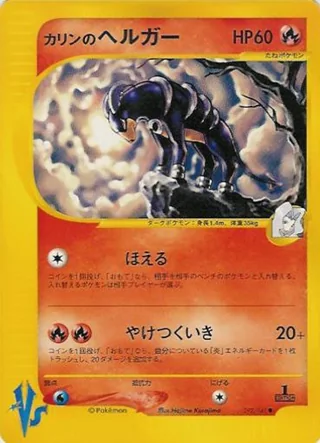
Karen's Houndoom. Fire, 60 HP. A Dark holo Houndoom exists in the tenth expansion (n4 024). This one is an ordinary Fire card, and its 60 HP matches the Dark version exactly.
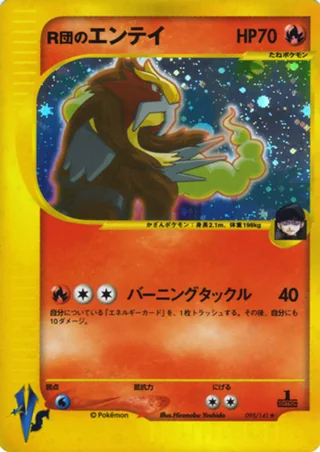
Rocket's Entei, a holo. Fire, 70 HP — the only 70 in the Rocket group. The star of the 2000 film, and in 2001 it ends up in Team Rocket's hands.
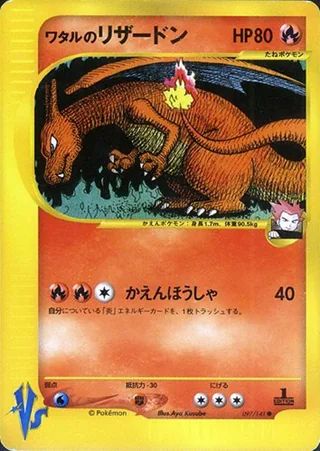
Lance's Charizard. Fire, 80 HP. His six run across Fire, Water, Fighting, Colorless and Lightning — broad, as a Dragon trainer's should be. Charizard had not appeared since 1996, and at 80 HP it ties for the highest in his group with Ampharos.
17 cards · listed in original order.
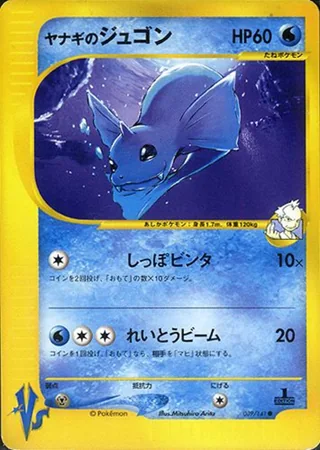
Pryce's Dewgong. Water, 60 HP. His seven are six Water and one Darkness. He leads with Ice in the games, but the TCG has no Ice type, so Water stands in — every ★VS type is mapped onto the nine that existed.
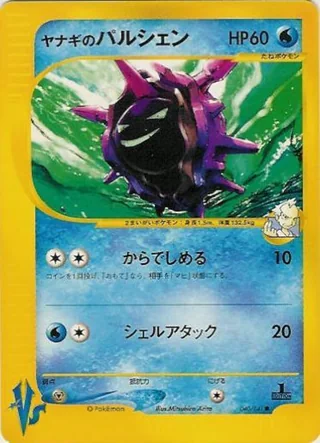
Pryce's Cloyster. Water, 60 HP, unseen since 1997. His six Water cards all sit at 50 to 60 HP, with only Articuno at 70 — a low-slung group.
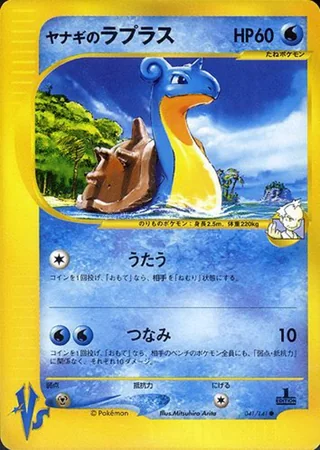
Pryce's Lapras. Water, 60 HP. The same Pokémon also appears in Misty's group (057), giving two versions. Both are 60 HP — the numbers are identical; only the owner differs.
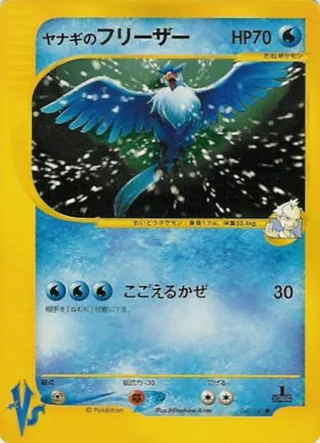
Pryce's Articuno, a Legendary bird. Water, 70 HP. ★VS does something unusual: it assigns Legendaries to owners. Articuno goes to Pryce, while Raikou, Entei and Suicune fall under Team Rocket.
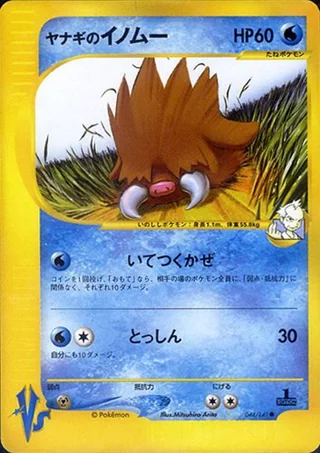
Pryce's Piloswine. Water, 60 HP. A Light Piloswine exists in the tenth expansion (n4 041) at 90 HP — a thirty-point gap for the same Pokémon, which is very much a 2001 phenomenon.
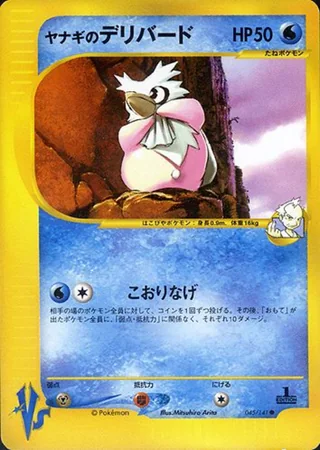
Pryce's Delibird. Water, 50 HP. The same Pokémon is Colorless in Falkner's group (006) and Water here — a clear case of type following the owner in ★VS.
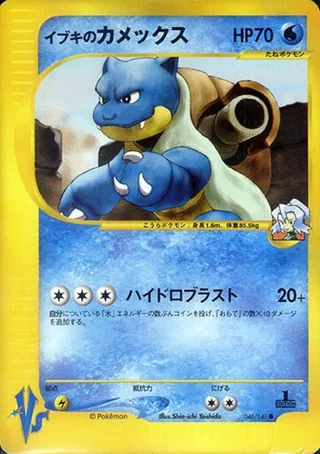
Clair's Blastoise. Water, 70 HP. Her seven are six Water and one Colorless. She is the Dragon leader in the games, but the TCG had no Dragon type then, so her team lands on Water and Colorless.
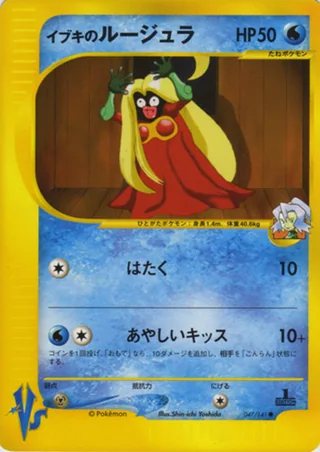
Clair's Jynx. Water, 50 HP — the lowest in her group. Jynx had last appeared in the 2000 eighth expansion, and the same Pokémon also sits in Will's group (074).
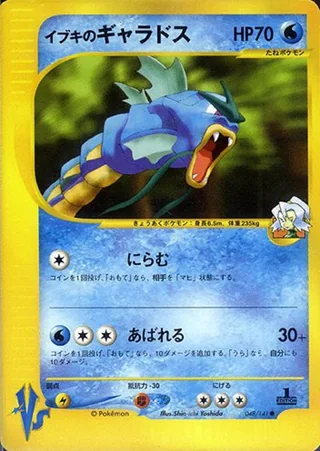
Clair's Gyarados. Water, 70 HP, unseen since 1997. The same Pokémon is also in Lance's group (098), and 2000 had already produced a Shining Gyarados in the ninth expansion.
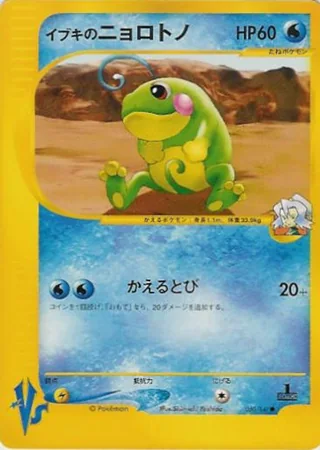
Clair's Politoed. Water, 60 HP, having debuted in the 2000 seventh expansion. Her six Water cards run 50 to 70 HP, a narrow spread.
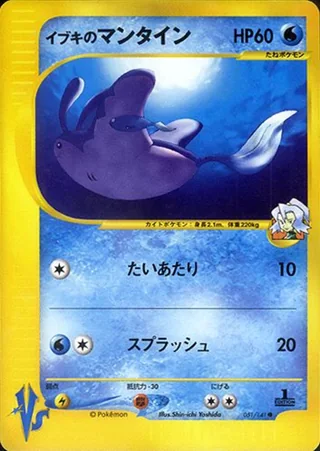
Clair's Mantine. Water, 60 HP, only debuted in the 2000 eighth expansion — its second card. Mantine is an odd fit for her in-game team, which shows ★VS groups are not always a literal copy of the games.
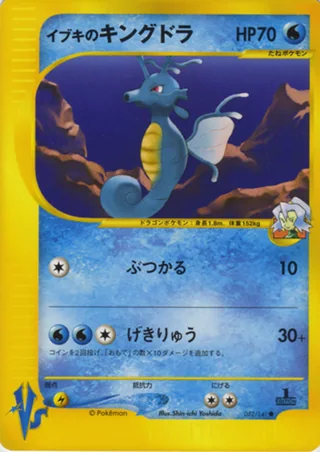
Clair's Kingdra. Water, 70 HP, last printed in the 2000 seventh expansion. The same card appears in Lance's group (102), so the two Dragon trainers share a Pokémon.
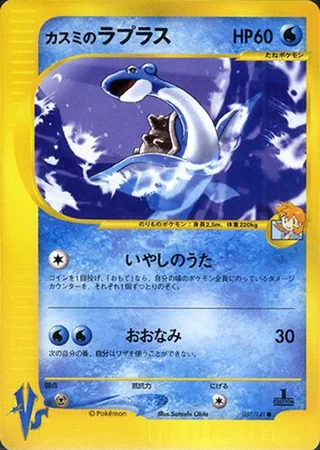
Misty's Lapras. Water, 60 HP. Her group is also just two cards — Lapras and Quagsire. The same Pokémon is in Pryce's group (041), likewise at 60 HP.
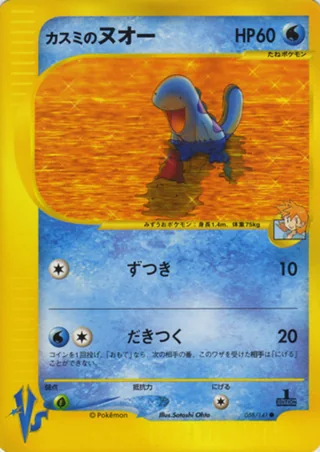
Misty's Quagsire. Water, 60 HP, having debuted in the 2000 eighth expansion. Two cards only, because she too is a Kanto leader — the Kanto Gym Leaders generally get smaller groups in ★VS.
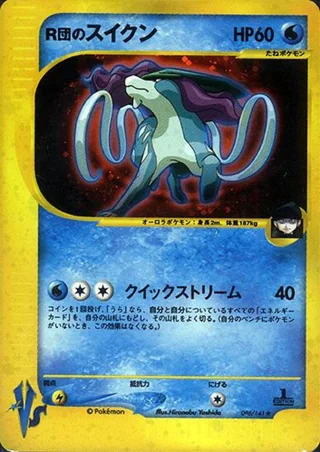
Rocket's Suicune, a holo. Water, 60 HP. All four of Rocket's cards are holo — the only fully holo group in ★VS. The three beasts plus Wobbuffet was a popular configuration in decks of the time.
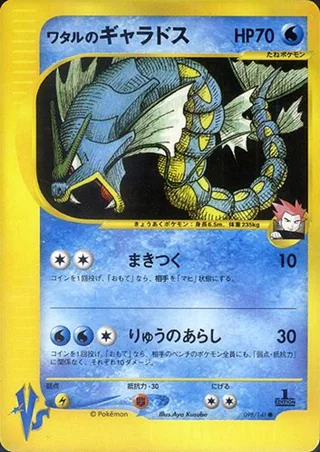
Lance's Gyarados. Water, 70 HP. The same Pokémon is in Clair's group (048). With Dragonite, Kingdra and Aerodactyl alongside, his group reads as a dragon trainer's roster.
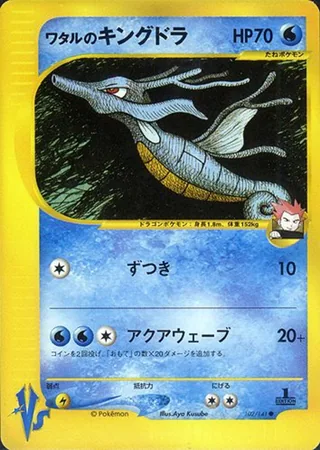
Lance's Kingdra. Water, 70 HP, matching Clair's copy (052) exactly. All six of his cards fall between 60 and 80 HP, so nothing in the group is a dead card.
9 cards · listed in original order.
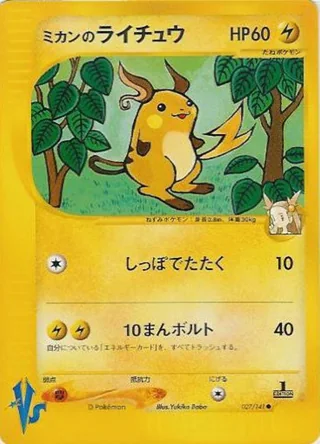
Jasmine's Raichu. Lightning, 60 HP. Her six are five Lightning and one Metal. Raichu had not appeared since 1996, and the same Pokémon turns up in Lt. Surge's group (053) — two cards, two owners.
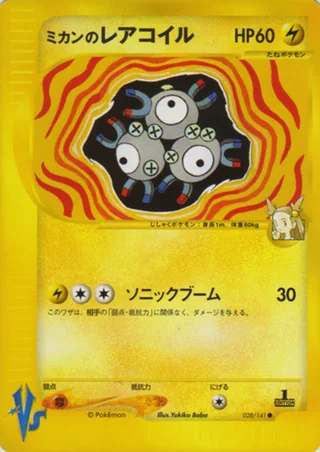
Jasmine's Magneton. Lightning, 60 HP, unseen since 1997. In the games Jasmine is a Steel-type leader, yet her ★VS group is mostly Lightning, with a single Steel card in Steelix.
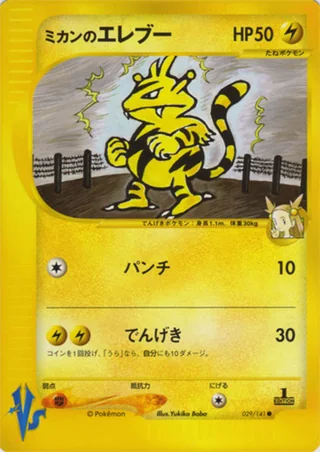
Jasmine's Electabuzz. Lightning, 50 HP — the only 50 in her group — and unseen since 1997.
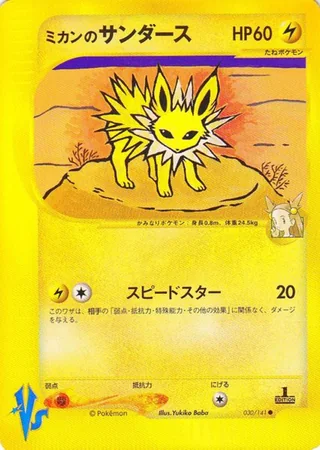
Jasmine's Jolteon. Lightning, 60 HP, last printed in the 2000 seventh expansion. A Light Jolteon also exists in the tenth expansion (n4 043), so 2001 produced two.
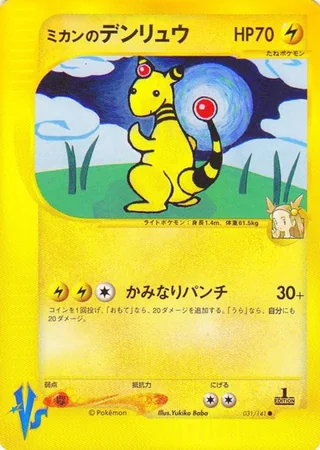
Jasmine's Ampharos. Lightning, 70 HP — the highest in her group alongside Steelix. The same Pokémon also has a Dark card in the tenth expansion (n4 046) and one in Lance's group (101): three Ampharos in 2001 alone.
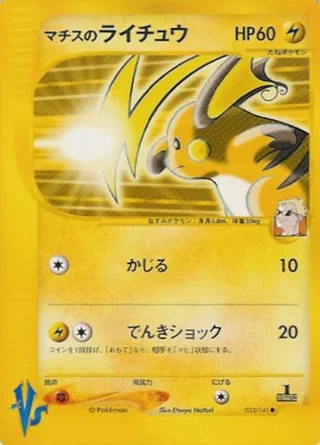
Lt. Surge's Raichu. Lightning, 60 HP. His group is only two cards — Raichu and Lanturn — the smallest in all of ★VS. The same Pokémon is in Jasmine's group (027), giving two versions.
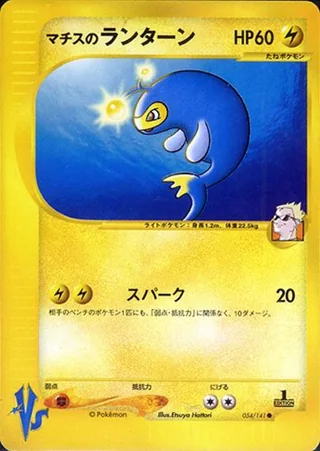
Lt. Surge's Lanturn. Lightning, 60 HP, only debuted in the 2000 eighth expansion. Two cards is all he gets because he is a Kanto leader, with little Gold and Silver material to draw on.
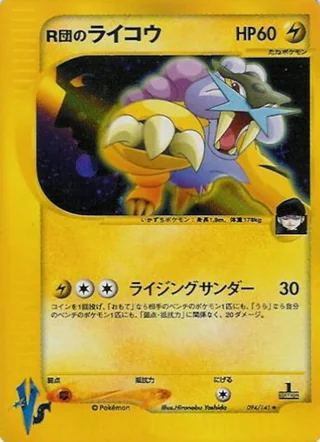
Rocket's Raikou, a holo. Lightning, 60 HP. Team Rocket holding one of the three Legendary beasts is a premise only ★VS would attempt — wild Legendaries in the games, given an owner on the card.
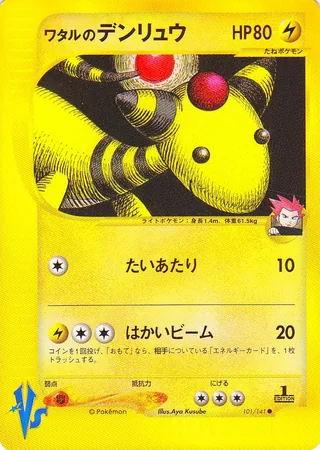
Lance's Ampharos. Lightning, 80 HP. The same Pokémon also has a Dark card (046) and one in Jasmine's group (031) in 2001 — three in all, and this is the highest at 80 HP.
13 cards · listed in original order.
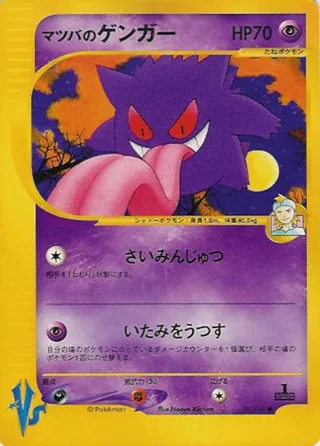
Morty's Gengar. Psychic, 70 HP — the highest in his group and unseen since the 2000 seventh expansion. It is the Ghost leader's ace, though it is not the holo — his group has none.
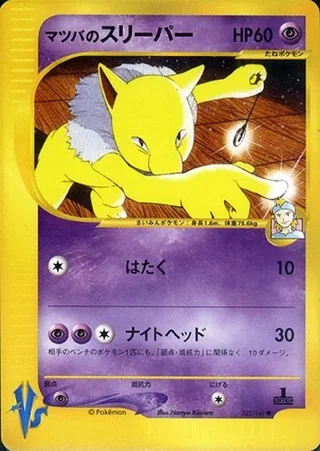
Morty's Hypno. Psychic, 60 HP, unseen since 1997. Psychic accounts for three of his seven — Gengar, Hypno and Misdreavus — with Fire, Fighting, Darkness and Colorless filling out the rest.
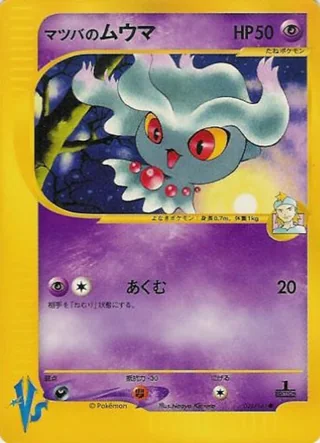
Morty's Misdreavus. Psychic, 50 HP — the lowest in his group, level with Murkrow. Misdreavus debuted in the 2000 eighth expansion, and this is its second card.
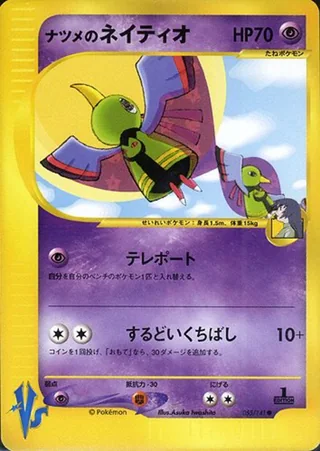
Sabrina's Xatu. Psychic, 70 HP. Her group is also only two cards — Xatu and Espeon. Xatu had only debuted in the 2000 eighth expansion, and this is its second card.
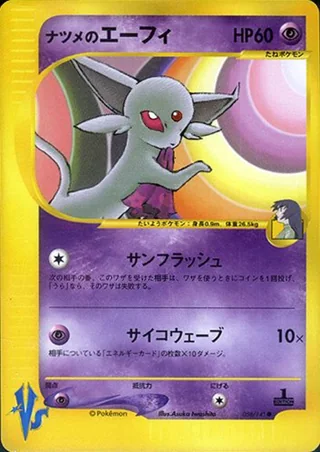
Sabrina's Espeon. Psychic, 60 HP. A Dark holo Espeon exists in the tenth expansion (n4 067) and another in Will's group (076), making three in 2001. This version is the ordinary one.
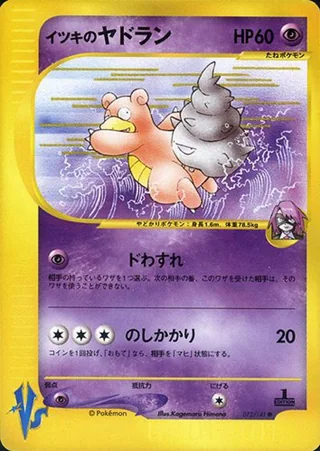
Will's Slowbro. Psychic, 60 HP. Will is one of the few characters given seven cards, which shows how much room the Elite Four got. All seven are Psychic, entirely consistent.
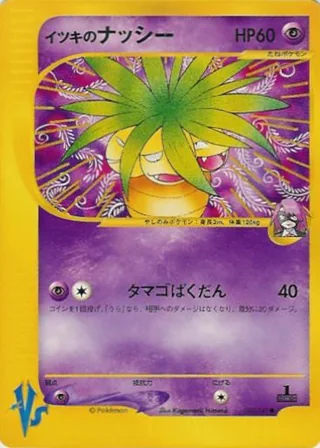
Will's Exeggutor. Psychic, 60 HP. A Dark Exeggutor exists in the tenth expansion (n4 056); this is the ordinary Psychic 60 HP print.
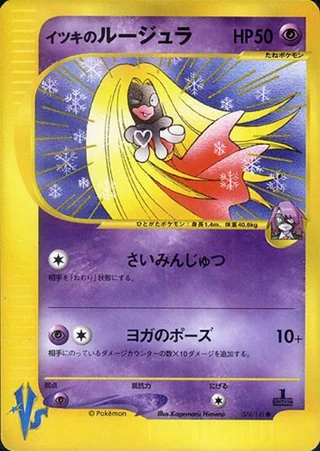
Will's Jynx. Psychic, 50 HP — the lowest in his group, level with Girafarig. The same Pokémon sits in Clair's group (047), giving two versions.
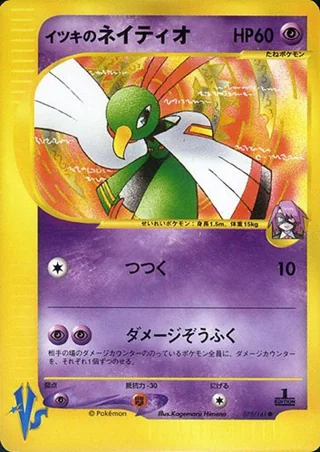
Will's Xatu. Psychic, 60 HP. The same Pokémon is in Sabrina's group (055) at 70 HP; here it is 60. So HP shifts by ten with the owner even for one species.
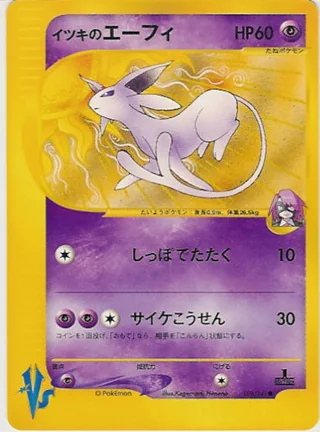
Will's Espeon. Psychic, 60 HP. Espeon appeared three times in 2001 — this, Sabrina's, and the Dark holo in the tenth expansion — and ★VS accounts for two of them.
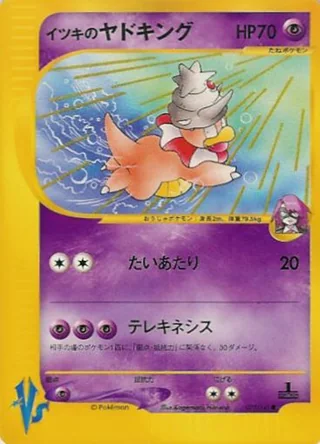
Will's Slowking. Psychic, 70 HP — the only 70 in his group. A Dark Slowking also exists in the tenth expansion (n4 061).
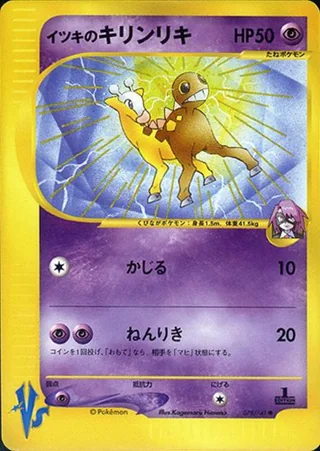
Will's Girafarig. Psychic, 50 HP, one of the two lowest in his group. Girafarig had only debuted in the 2000 eighth expansion, and this is its second card.
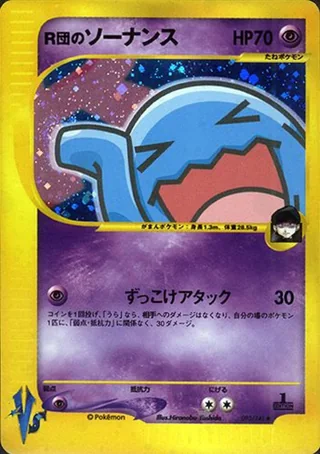
Rocket's Wobbuffet, a holo. Psychic, 70 HP. Team Rocket's four cards run Psychic, Lightning, Fire and Water, and the premise is that Rocket owns the three Legendary beasts — Raikou, Entei and Suicune. Wobbuffet is the only non-Legendary among them.
12 cards · listed in original order.
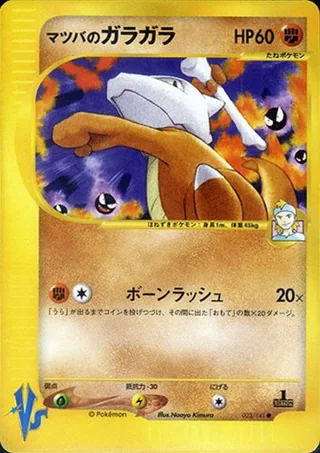
Morty's Marowak. Fighting, 60 HP, unseen since 1997. A Fighting card in a Ghost leader's group follows his in-game team — ★VS reproduces each character's roster fairly faithfully.
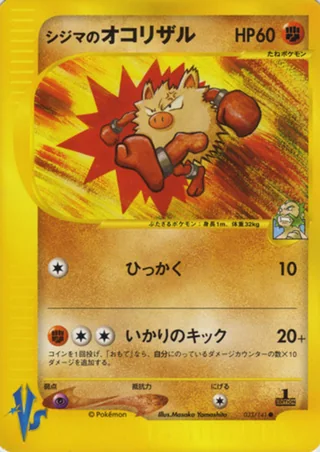
Chuck's Primeape. Fighting, 60 HP. His six are four Fighting and two Colorless, exactly as a Fighting-type leader's should be — one of the tidier groups in the set.
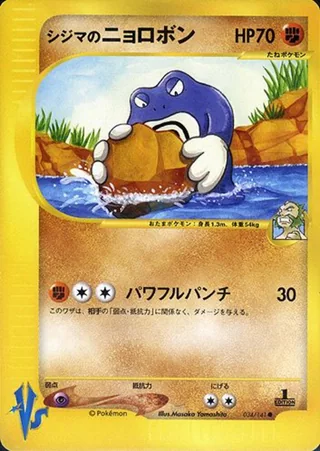
Chuck's Poliwrath. Fighting, 70 HP — the only 70 in his group — and unseen since 1997.
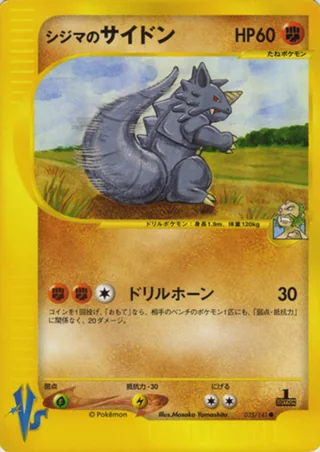
Chuck's Rhydon. Fighting, 60 HP, unseen since 1997. The pre-evolution Rhyhorn is not in ★VS, so this card stands alone.
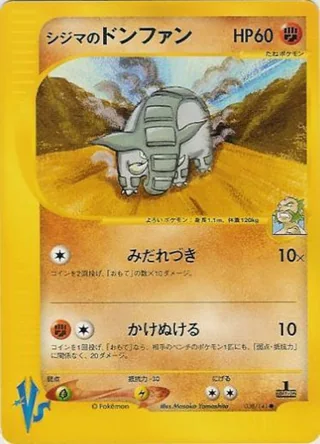
Chuck's Donphan. Fighting, 60 HP. The same Pokémon has a Dark holo in the tenth expansion (n4 078). This version is an ordinary 60 HP card, not holo.
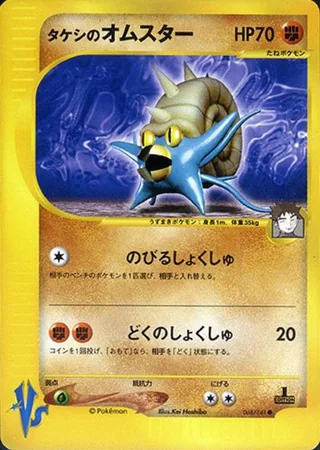
Brock's Omastar. Fighting, 70 HP. His group is two cards — Omastar and Kabutops. He leads with Rock in the games, and with no Rock type in the TCG his team reads as Fighting.
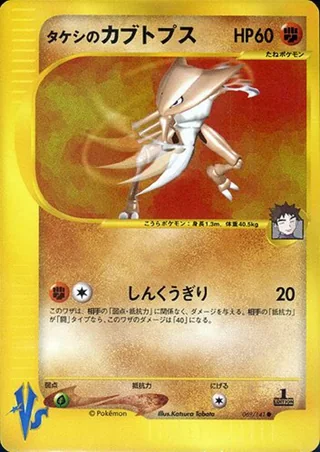
Brock's Kabutops. Fighting, 60 HP. A Shining Kabutops exists in the tenth expansion (n4 080) at 80 HP — a twenty-point gap between the two.
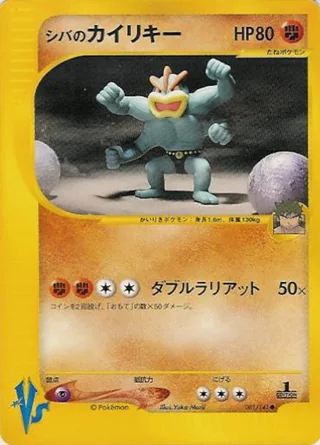
Bruno's Machamp. Fighting, 80 HP. His six are four Fighting, one Metal, one Colorless. Machamp had not appeared since 1996, and the ★VS version sits at 80 HP — high for this set.
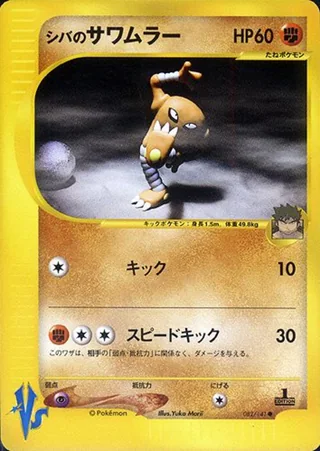
Bruno's Hitmonlee. Fighting, 60 HP. The same card is in the tenth expansion (n4 075), and here it sits alongside Hitmonchan (083) — the paired duo together in one group.
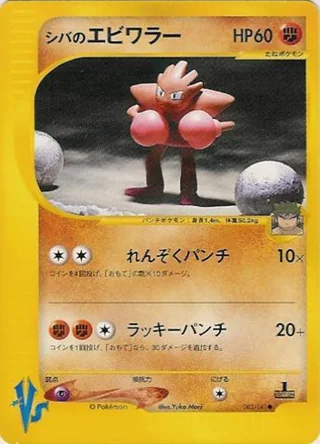
Bruno's Hitmonchan. Fighting, 60 HP — the partner to Hitmonlee and likewise 60 HP. Bruno is the Fighting Elite Four member, so these two anchor his group.
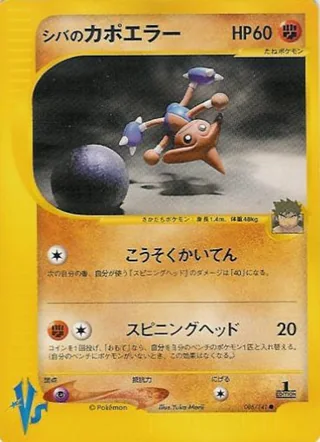
Bruno's Hitmontop. Fighting, 60 HP, having debuted in the 2000 seventh expansion — its second card. The same Pokémon had also been a 2000 cinema handout, paired with Igglybuff.
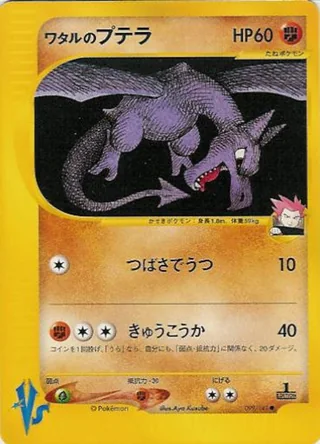
Lance's Aerodactyl. Fighting, 60 HP, unseen since 1997. The same Pokémon also had art on Ruin Wall in the tenth expansion (2000, Japan only) and returns again here.
5 cards · listed in original order.
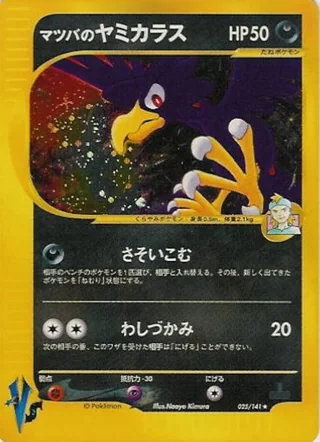
Morty's Murkrow. Darkness, 50 HP — the only Darkness card in his group. Murkrow had only debuted in the 2000 seventh expansion, when Darkness cards were still few.
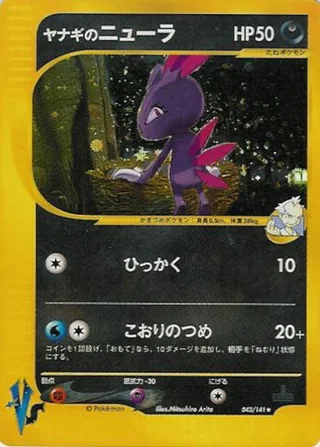
Pryce's Sneasel. Darkness, 50 HP — the only Darkness in his group and its lowest HP. Sneasel had only debuted in the 2000 seventh expansion.
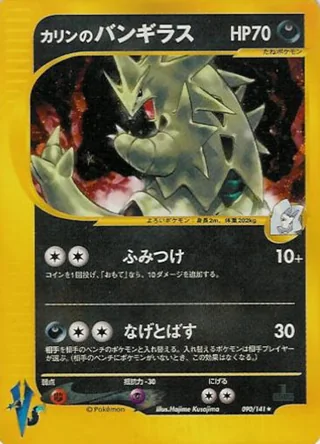
Karen's Tyranitar, a holo. Darkness, 70 HP — one of two holos in her group. The same Pokémon has a Dark holo (079, Fighting 90 HP) and a Shining card (082, Darkness 80 HP) in the tenth expansion: three Tyranitar in 2001.
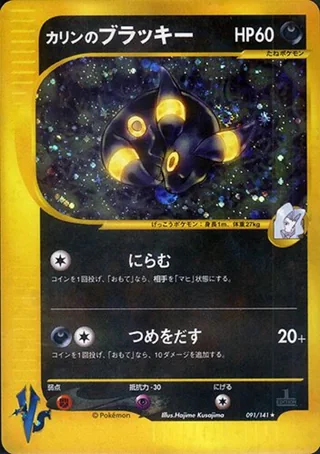
Karen's Umbreon, a holo. Darkness, 60 HP — her other holo. Umbreon had only debuted in the 2000 seventh expansion, and this is its second card — a fitting one for the Darkness Elite Four member.
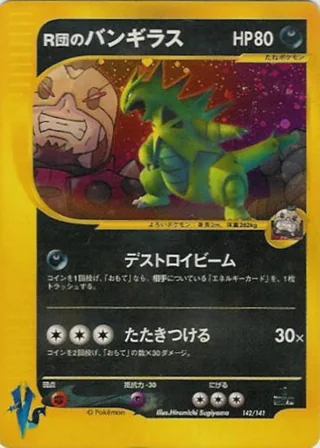
The only secret card in ★VS, and holo. Darkness, 80 HP, Stage 2, placed at 142, outside the 141. This set introduced Japan to the practice of numbering a secret past the end of the list, and later Japanese sets kept it. It is the final stage of the Larvitar and Pupitar line — all three sit in the tenth expansion, not here.
3 cards · listed in original order.
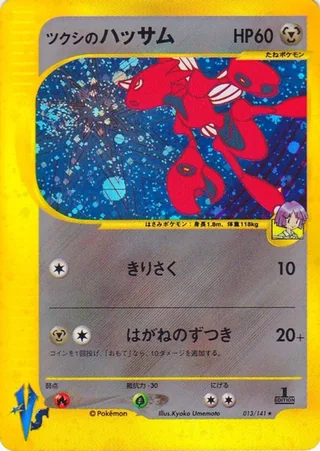
Bugsy's Scizor, the group's only holo. Metal, 60 HP. Bugsy's six are Grass except this single Metal card. ★VS keeps a group to one colour but will switch the type on the holo, and this is the case.
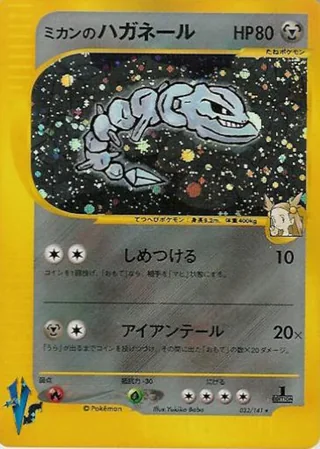
Jasmine's Steelix. Metal, 80 HP — the only Steel in her group and its highest HP. A Shining Steelix exists in the tenth expansion (n4 084), a Basic at 90 HP.
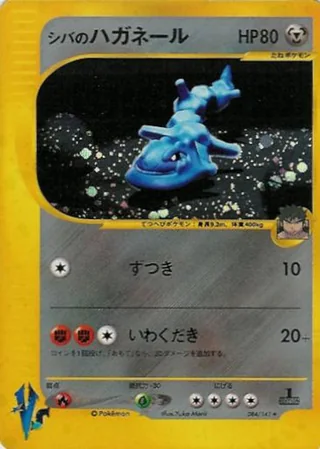
Bruno's Steelix. Metal, 80 HP — the only Metal in his group and its highest HP. The same Pokémon is in Jasmine's group (032) and as a Shining card (084), making three in 2001.
19 cards · listed in original order.
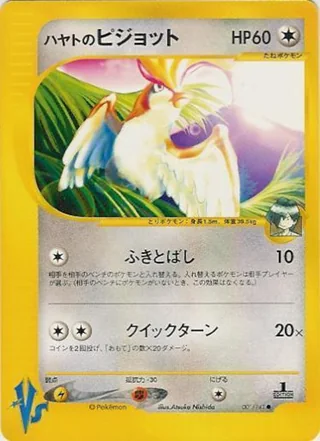
Falkner's Pidgeot. Colorless, 60 HP. ★VS keeps every card's HP packed into the 50–80 band, and this sits at the low end. Because a 30-card pack was meant to be played straight out of the wrapper, the set avoids printing anything outright weak.
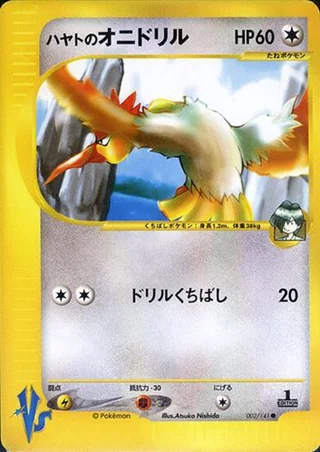
Falkner's Fearow. Colorless, 60 HP. All seven of Falkner's cards are Colorless, true to a Flying-type leader. In ★VS each owner's cards hold to one colour, so collecting a full group gives you a single-colour deck.
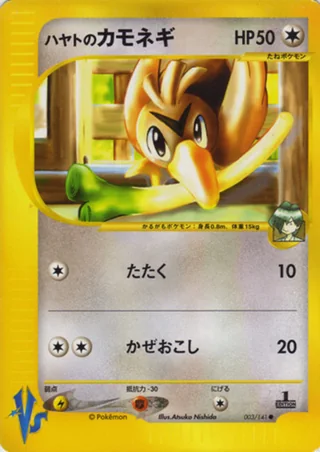
Falkner's Farfetch'd. Colorless, 50 HP. Two of Falkner's seven sit at 50 — this and Delibird — with the other five at 60, so even inside one group the light and heavy Pokémon stay distinguishable.
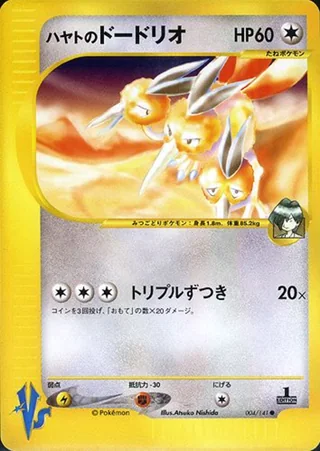
Falkner's Dodrio. Colorless, 60 HP. The Doduo line had not appeared since 1997, and ★VS often leaves out the pre-evolution, so this one stands alone — a compromise forced by the 30-card pack.
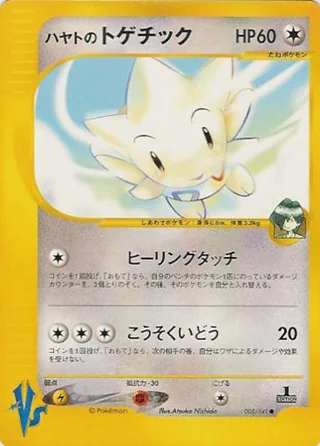
Falkner's Togetic. Colorless, 60 HP. Togepi had only debuted in the 2000 seventh expansion, and only the evolved form appears here. Each ★VS group is built from the Pokémon that character actually fields.
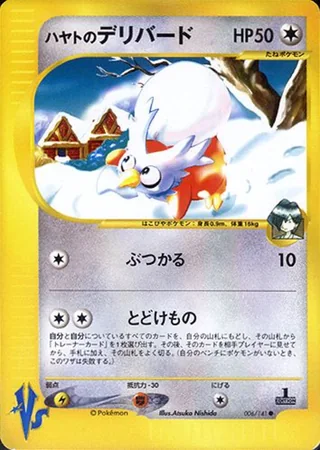
Falkner's Delibird. Colorless, 50 HP. The same Pokémon also appears in Pryce's group (045) as a Water card — in ★VS one species can turn up under several owners, and the type changes with the owner. That is the set's real charm.
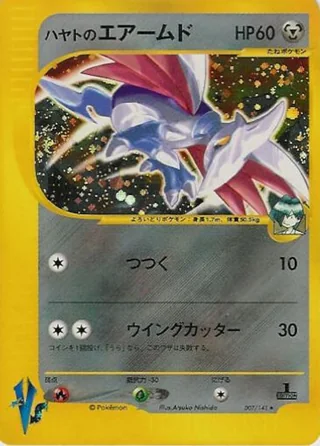
Falkner's Skarmory, the group's only holo. Colorless, 60 HP. ★VS places exactly one holo in each group, and this is Falkner's. Across all 141 cards only nine are holo.
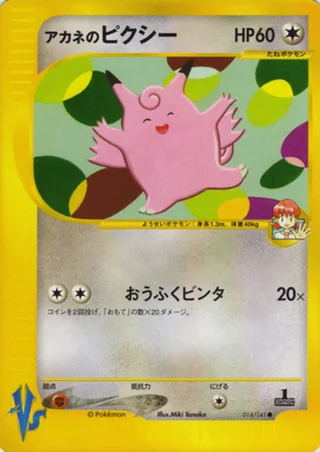
Whitney's Clefable. Colorless, 60 HP. All six of Whitney's are Colorless, as a Normal-type leader's should be. Clefable had not appeared since 1996, and ★VS's Colorless group draws heavily on the 1996 roster.
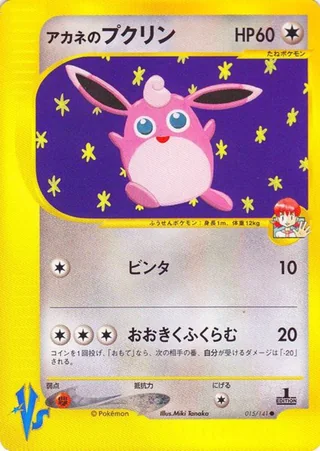
Whitney's Wigglytuff. Colorless, 60 HP. The same Pokémon has two cards in the tenth expansion (n4 090 and 091, Light and Dark), so 2001 produced three Wigglytuff in all.
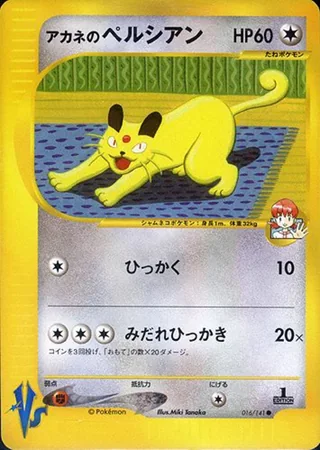
Whitney's Persian. Colorless, 60 HP, unseen since 1997. Whitney's six all sit at 60 or 70 HP with nothing at 50 — the groups differ noticeably in how much bulk they carry.
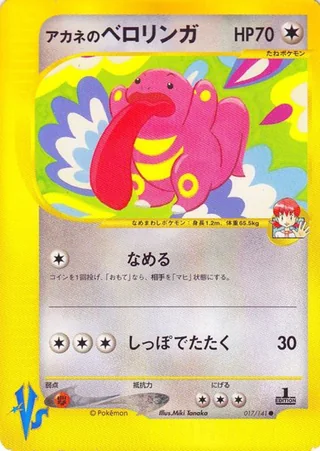
Whitney's Lickitung. Colorless, 70 HP — tied for the highest in her group with Miltank. Lickitung had not appeared since 1997, and each ★VS group slips in one or two of these older faces.
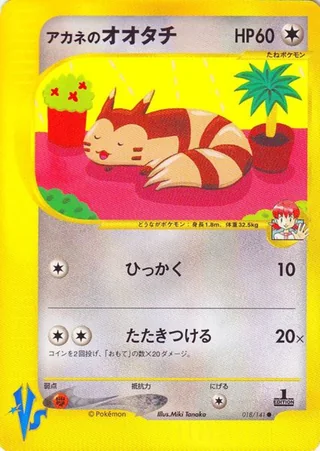
Whitney's Furret. Colorless, 60 HP, having debuted in the 2000 seventh expansion. Her group centres on Normal-types added in Gold and Silver, splitting roughly evenly between 1996 faces and newcomers.
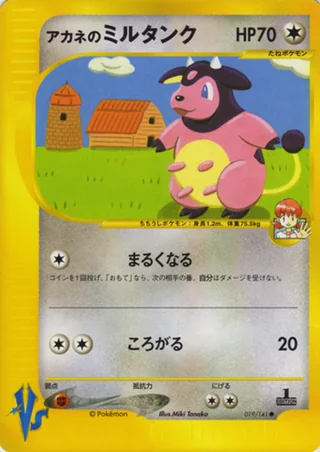
Whitney's Miltank. Colorless, 70 HP, only just debuted in the 2000 eighth expansion and positioned as her ace. Yet her group contains no holo at all — the only one of the 21 groups without one.
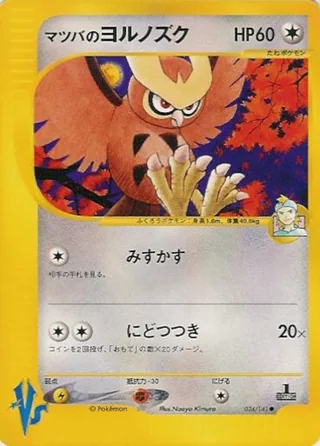
Morty's Noctowl. Colorless, 60 HP. The same Pokémon appears as a Shining card in the tenth expansion (n4 098). This one is the ordinary owl — a separate card entirely.
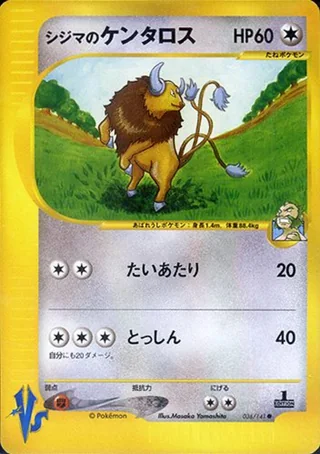
Chuck's Tauros. Colorless, 60 HP, one of two Colorless in his group and unseen since 1996. ★VS deliberately scatters 1996 faces through the groups.
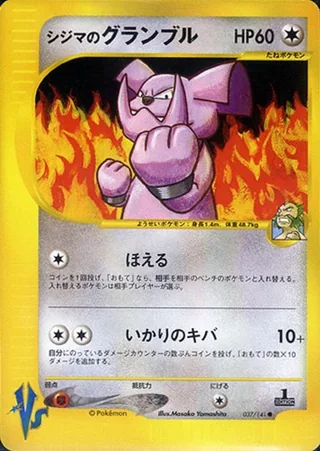
Chuck's Granbull. Colorless, 60 HP, having debuted in the 2000 seventh expansion. Tauros from 1996 and Granbull from 2000 sitting in the same group is a small picture of how this set mixes generations.
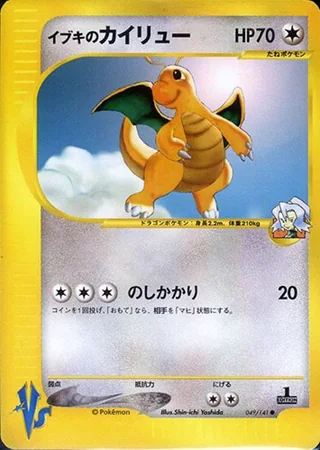
Clair's Dragonite. Colorless, 70 HP — the only Colorless in her group and its highest HP. Dragonite had not appeared since 1996, and Dragon-types read as Colorless in ★VS.
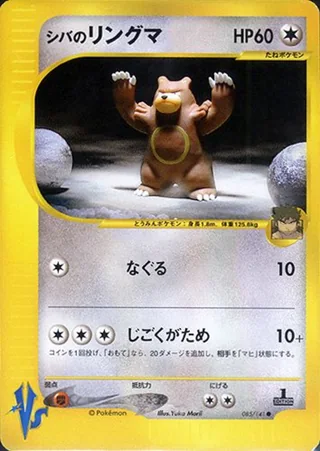
Bruno's Ursaring. Colorless, 60 HP — the only Colorless in his group. A Dark Ursaring exists in the tenth expansion (n4 096).
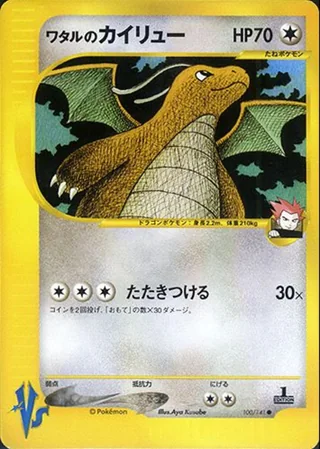
Lance's Dragonite. Colorless, 70 HP. The same card is in Clair's group (049) — the two Dragon trainers share their ace. Both are Colorless at 70 HP, numerically identical.
39 cards · listed in original order.
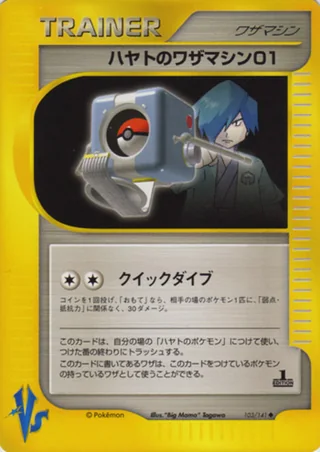
Falkner's Technical Machine 01. ★VS introduced Technical Machines as a card type, so all twenty-seven here (103–129) are new. Each character normally gets an 01 and an 02, and the pair are designed to complement each other.
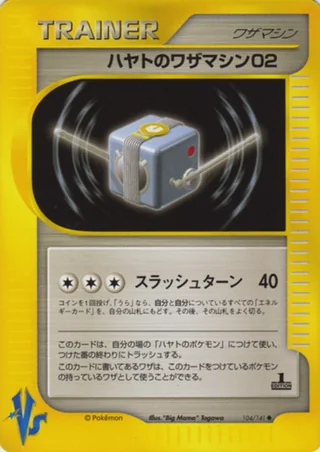
Falkner's Technical Machine 02, the partner to 01. Each ★VS Technical Machine carries its owner's name, so the same number under a different character is a different card. Of the twenty-seven, thirteen characters have two each and Team Rocket has one.
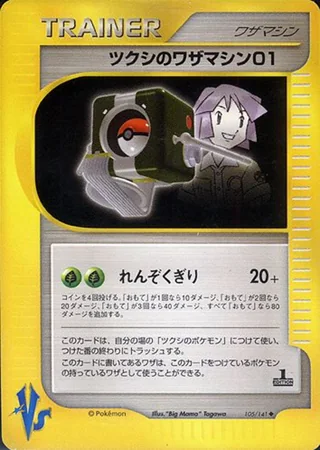
Bugsy's Technical Machine 01. His pair (105 and 106) is built to match a group that is entirely Grass. At the time a Technical Machine was used once and discarded, not attached to a Pokémon.
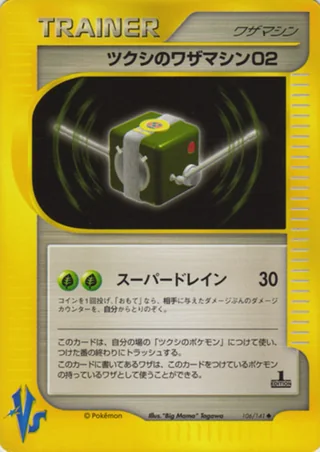
Bugsy's Technical Machine 02. The partner to 01. Technical Machines are about a fifth of the 141 cards, which shows ★VS was designed to hand out ways of playing, not just Pokémon.
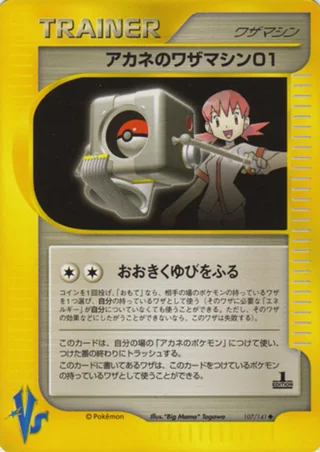
Whitney's Technical Machine 01. Her group had no holo, yet she still gets two Technical Machines — a group can be without a holo and still be fully equipped.
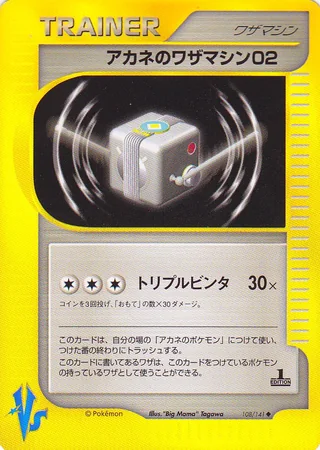
Whitney's Technical Machine 02, paired with 01. Since her group is six Colorless cards, the Machines are tuned to Colorless Pokémon.
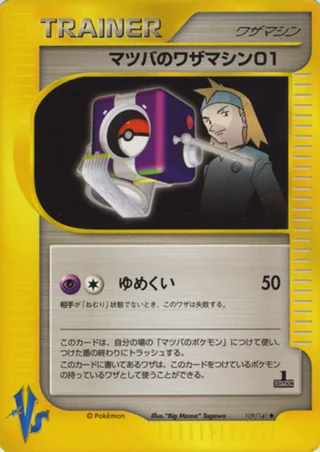
Morty's Technical Machine 01. His is the only group spanning five types, so the two Machines here are correspondingly broad. The group's type make-up shapes the Machine design.
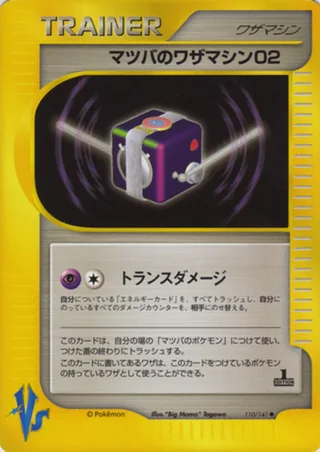
Morty's Technical Machine 02, paired with 01. Because each ★VS Machine carries its owner's name, the same effect exists under thirteen different names.
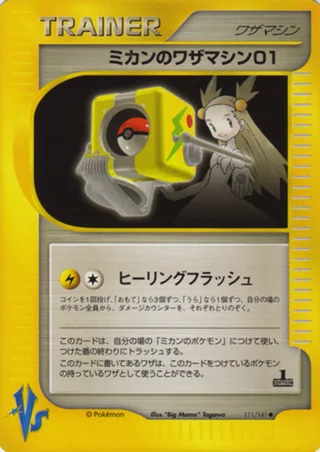
Jasmine's Technical Machine 01. Her group is five Lightning and one Metal, and the two Machines are aimed at those two types. The more lopsided the group, the clearer the Machines' job.
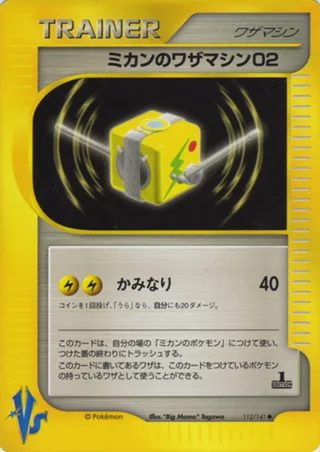
Jasmine's Technical Machine 02, paired with 01. Because a Machine is used once and discarded, decks were expected to run several. Twenty-seven in the set is what that style of play required.
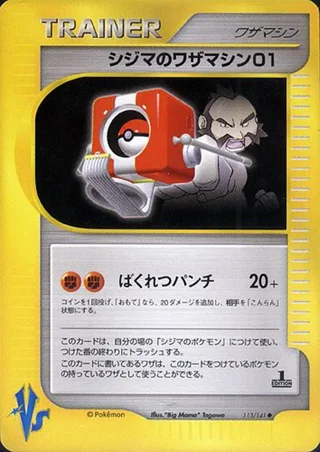
Chuck's Technical Machine 01. His group is four Fighting and two Colorless, and the Machines lean Fighting. ★VS assumes you will play a group as a deck, so the Machines are issued to match its colour.
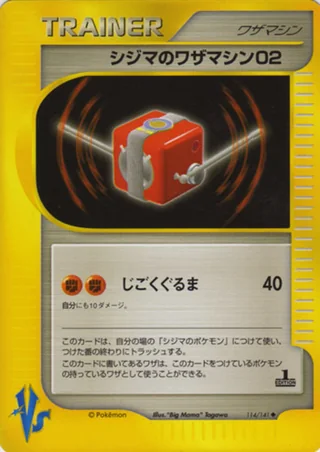
Chuck's Technical Machine 02, paired with 01. Thirteen characters get two Machines each; Team Rocket gets one, because its four-card group — three Legendaries plus Wobbuffet — is already unusual.
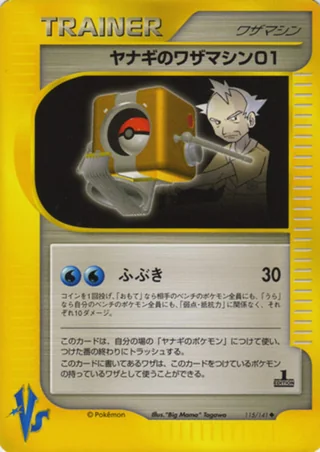
Pryce's Technical Machine 01. His group is six Water and one Darkness, and the Machines lean Water. With no Ice type in the TCG, Ice moves are expressed through Water Machines.
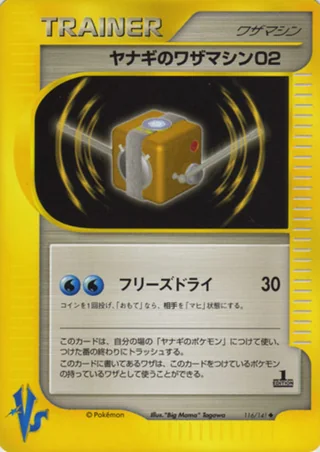
Pryce's Technical Machine 02, paired with 01. Machines count as Trainers, not Pokémon attacks, which is why twenty-seven of the 141 cards sit in the Trainer category.
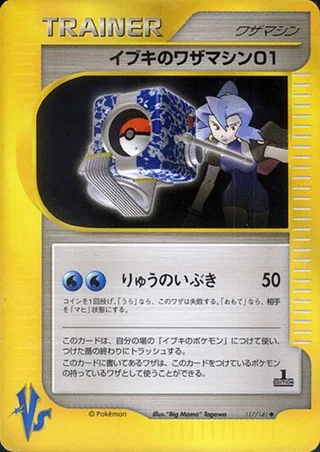
Clair's Technical Machine 01. Her group is six Water and one Colorless — a Dragon trainer with no Dragon type to use, so it lands on Water and Colorless, and the Machines follow.
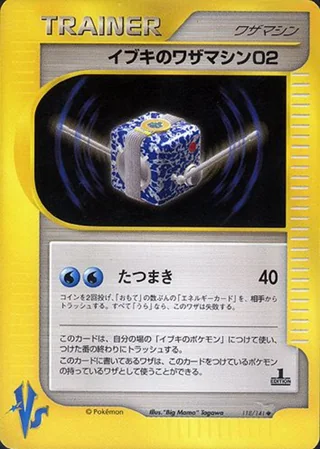
Clair's Technical Machine 02, paired with 01. ★VS Machines only ever run to 01 and 02, standing for that character's two signature moves. No third was ever made.
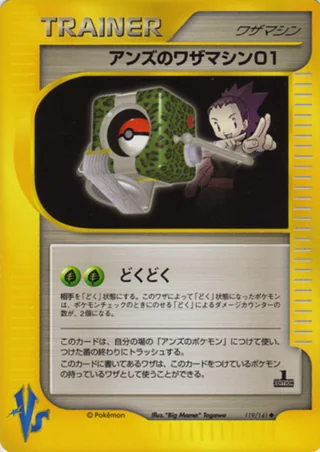
Janine's Technical Machine 01. Her group is seven Grass cards. A Poison user, but with no Poison type she is pushed onto Grass, and the Machines are Grass too.
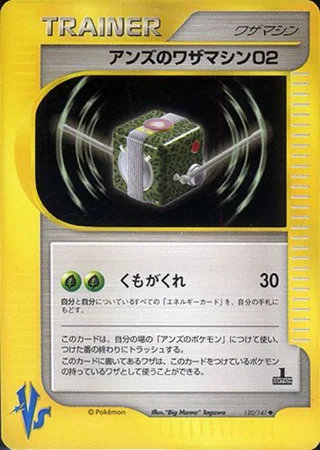
Janine's Technical Machine 02, paired with 01. Her group has no holo, yet the two Machines are still there — ★VS makes sure even a holo-less group is minimally equipped.
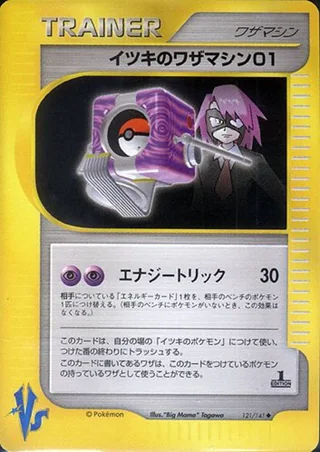
Will's Technical Machine 01. His group is seven Psychic cards, fully unified. The two Machines match, and seven Pokémon to two Machines is about the ratio every group uses.
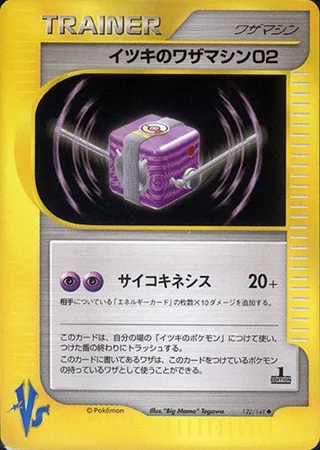
Will's Technical Machine 02, paired with 01. Because a Machine's effect is one-shot, a ★VS 30-card pack is said to have always contained two — so the pack was equipped for play the moment you opened it.
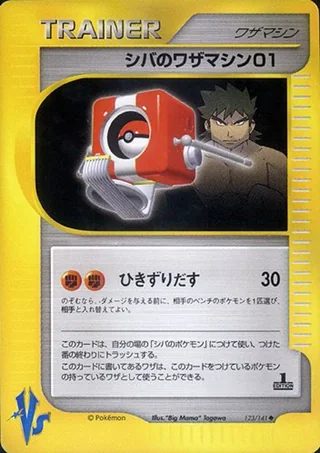
Bruno's Technical Machine 01. His group is four Fighting, one Metal, one Colorless, and the Machines lean Fighting — fitting for the Fighting Elite Four member.
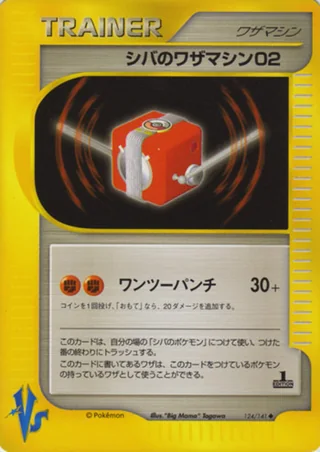
Bruno's Technical Machine 02, paired with 01. Twenty-seven Machines is about 19% of the 141 cards, and with 103 Pokémon against 39 Trainers (27 Machines plus 12 items), this is a Trainer-heavy set.
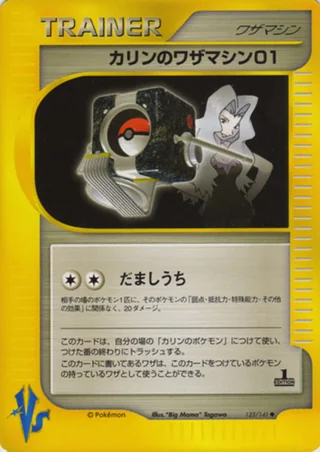
Karen's Technical Machine 01. Her group is four Fire and two Darkness — the Darkness Elite Four member leaning Fire, and the Machines follow that.
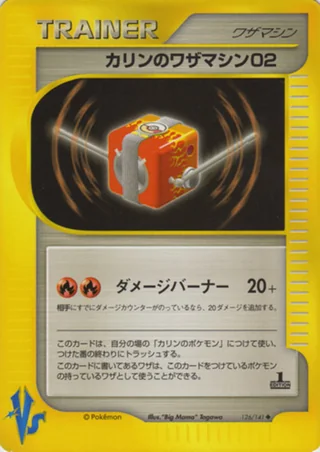
Karen's Technical Machine 02, paired with 01. Her group carries two holos — Tyranitar and Umbreon — so both of her Darkness cards are holo.
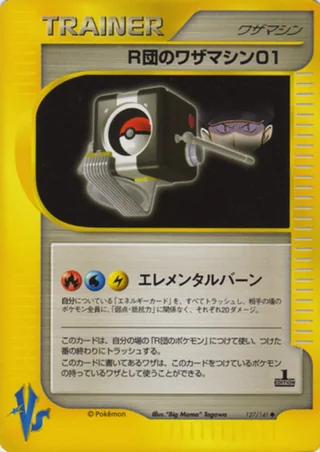
Rocket's Technical Machine 01. The only group in ★VS with just one Machine. Its four cards — three Legendaries plus Wobbuffet — are all holo, an unusual make-up that left room for only one.
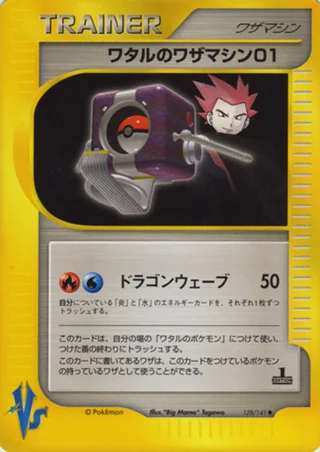
Lance's Technical Machine 01. His group spans five types, matching Morty's, so the two Machines are broad in scope. A dragon trainer's roster scatters across colours, which makes the Machines matter more.
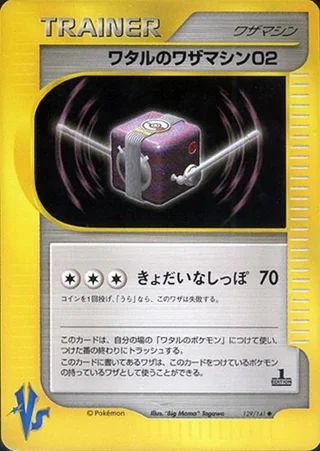
Lance's Technical Machine 02, paired with 01 and the last of the twenty-seven Machines. From 130 the set returns to ordinary Trainers — Potion, Moo-Moo Milk and the rest — and the numbering marks the change of card class.
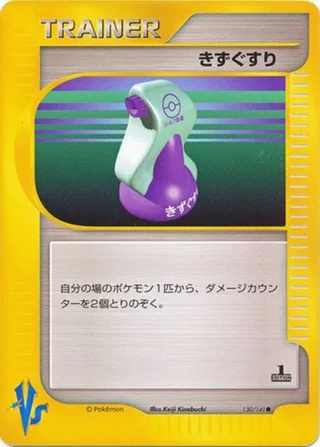
Potion. The basic damage-healing item. All twelve ordinary Trainers here (130–141) are staples dating to 1996 — the new machinery sits entirely on the Technical Machine side.
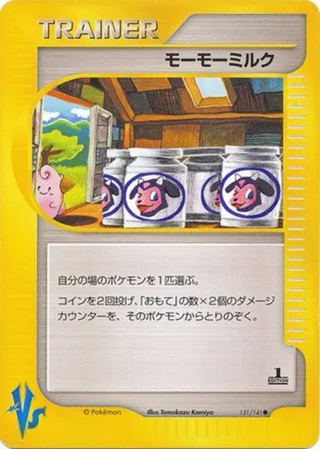
Moo-Moo Milk. A healing item, and one known for having its art replaced in English — the Japanese and English prints show different cows.
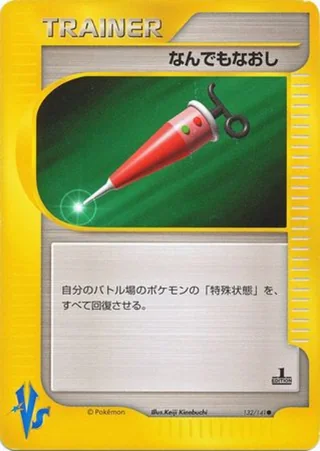
Full Heal. A status-clearing item. The ordinary Trainers run in blocks — three healing cards (130–132), two switching, four Energy, one recovery, then Master Ball — grouped by job.
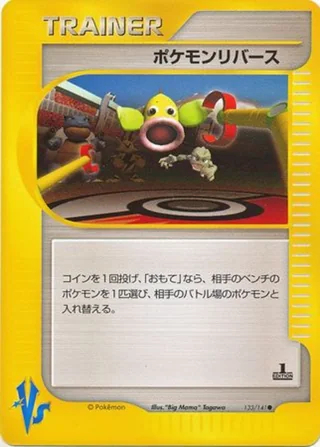
Pokémon Reversal, a switching card. The twelve Trainers are ordered by role, so reading them straight through shows you how a deck of the era was assembled.
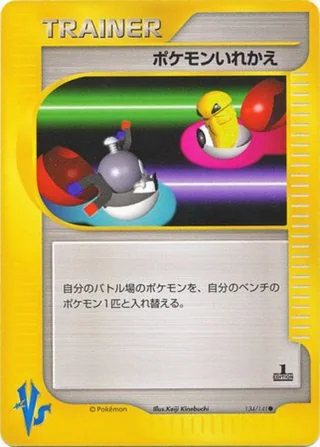
Switch — a staple since 1996 that swaps a Pokémon without paying the retreat cost. Unchanged here, and assumed to be one per 30-card pack.
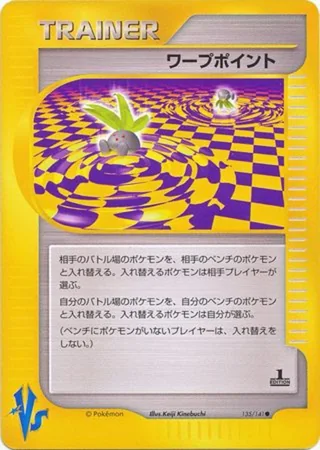
Warp Point, a switch card that moves the opponent's Pokémon as well. ★VS lines up Trainers that do the same job in different directions, so the pack offers a choice.
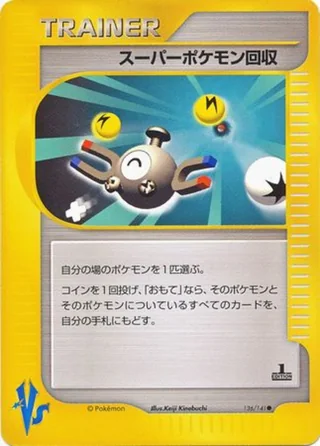
Super Scoop Up, returning a Pokémon from play to hand. It involves a coin flip, a design used widely on cards of this period.
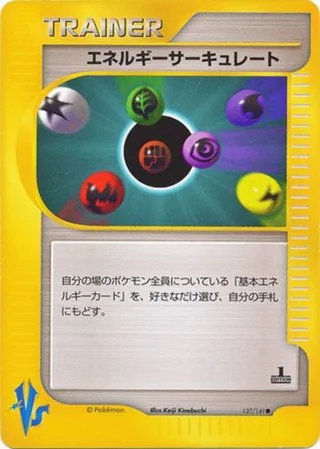
Energy Flow, first of the four Energy-manipulation cards (137–140). ★VS carries four such Trainers, a concession to making a 30-card pack actually have enough Energy.
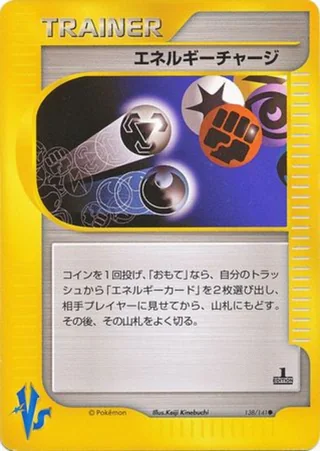
Energy Charge, in the acceleration family. A ★VS pack carries eleven basic Energy, so a single card like this noticeably changes how the deck runs.
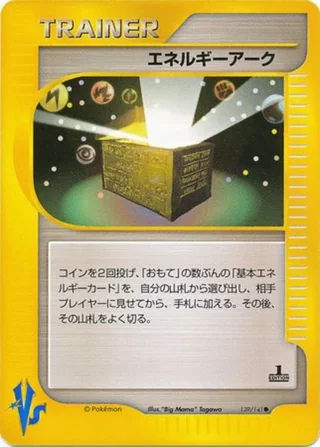
Energy Ark, the third of four. Four consecutive cards doing similar work reflects how ★VS thickened its Energy support so a single pack could be played on its own.
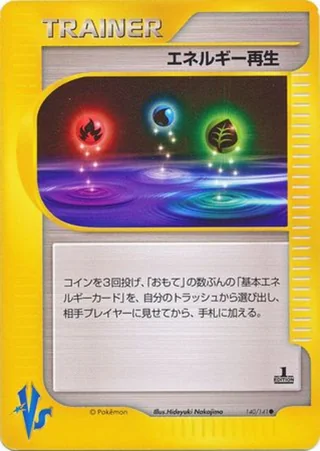
Energy Restore, the fourth. This is the one card whose rarity the source does not record; since the other eleven in the block are commons, it is treated as common here.
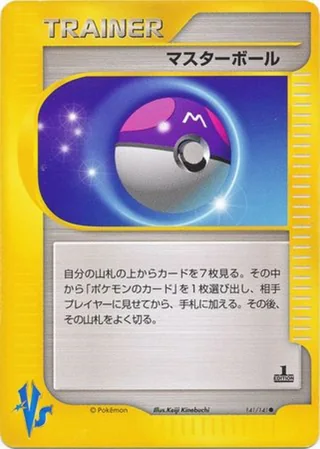
Master Ball, closing the ordinary Trainers and the best-known Pokémon search item. In a set of 141 cards plus one secret, this holds the last ordinary number.
A mail-order-only set sold solely through Pokémon Center Online — it never reached shops. Ten cards a pack (nine non-holo, one holo), in a clear bag with a barcoded cover card rather than foil. All 48 cards are reprints, drawn from Expansion Pack, Jungle, Mystery of the Fossils, Team Rocket and promos, and it is the first set to make Supporter official. No official price record could be found, so the price field is empty.
20 October 2001 — 48 cards, every one a reprint. Forty-two Pokémon and six Trainers, sold only through Pokémon Center Online and never in shops.
The first set to make Supporter an official class (the Bill 009/P promo of August 2001 had previewed it), and the set that split Pokémon Power into Poké-Power and Poké-Body. Packs held ten cards — nine non-holo and one holo — in a clear bag with a barcoded cover card rather than foil. The contents were reprints drawn from Expansion Pack, Jungle, Mystery of the Fossils, Team Rocket and promos: in effect a mail-order shelf for re-collecting the early years.
12 cards · listed in original order.
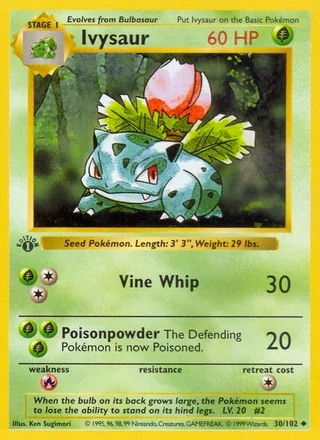
Ivysaur, one of sixteen commons. The ★web print is a rework of the 1996 Expansion Pack card No.008: Leech Seed costs two Grass for 20, Vine Whip three for 40. Where the 1996 card had 60 HP this one carries 70 — several ★web cards adjust the numbers, which is why the set is not a straight reprint run.
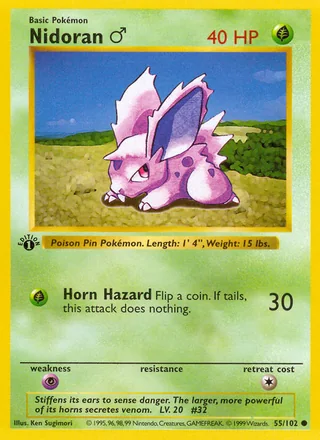
Nidoran♂, from 1996 No.005. Focus Energy is a single Colorless; Horn Rush costs Grass and Colorless for 40. The 1996 card was 40 HP, this one 50 — and the whole Nidoran line sits inside ★web, from 002 to 033, which few of the early sets managed.
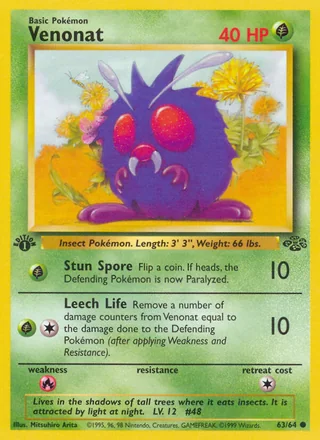
Venonat, from Pokémon Jungle No.004. A 50 HP Grass-type with a one-Energy attack that stops the defender doing something and Psybeam at 20. Jungle's Venonat shared the artwork, so the scan beside this entry is the 1997 printing.
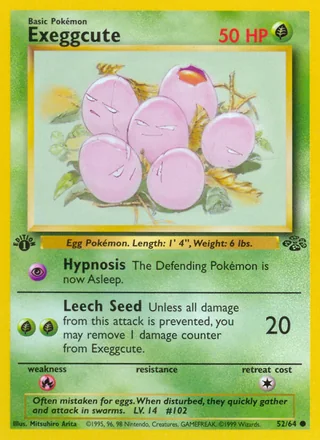
Exeggcute, from Jungle No.006. Hypnosis costs a Psychic Energy on a Grass card — the sort of off-type cost the early sets liked — and Leech Seed takes two Grass for 20. Its evolution Exeggutor is at 020.
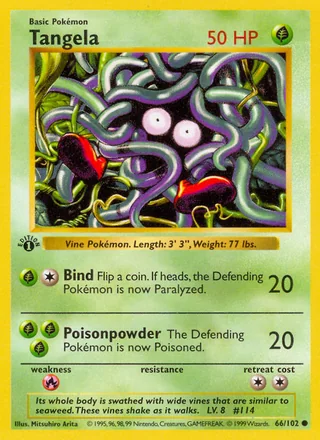
Tangela, from 1996 No.007, unchanged at 50 HP, with Stun Spore at one Grass for 10 and Poison Whip at three Energy for 10. Across the thirty-eight cards here that had an earlier printing, twenty-two keep their HP and sixteen do not — so ★web is mostly a reprint with the occasional correction, not a rebuild.
Dark Ivysaur, Grass, 50 HP, uncommon, and one of four cards in this set with no scan anywhere in the archive. Its attack is a single three-Energy Fury Strikes. The Dark Ivysaur is a rare card in its own right — it was never printed in English — so the missing photograph is a real gap rather than an oversight.
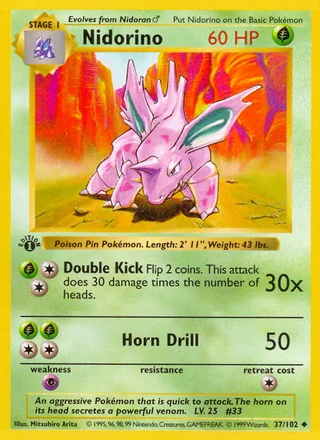
Nidorino, from 1996 No.010. One attack: two Grass for 60, an unusually blunt card for a 60 HP uncommon. With Nidoran♂ at 002 and Nidoking at 033 this is the middle of a three-stage line that ★web carries end to end.
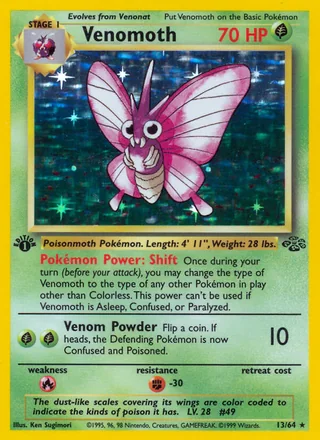
Venomoth, from Jungle No.015, where it was holofoil. Here a 60 HP uncommon with free retreat and a two-attack spread at 20 each. Free retreat on a 60 HP body is the reason it still turns up in old ★web decks.
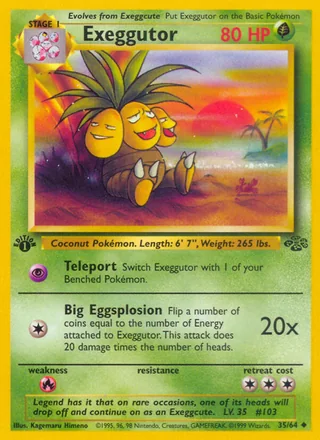
Exeggutor, from Jungle No.012, at 80 HP. Teleport costs one Psychic and switches it out; the second attack is Colorless and scales off the number of Energy attached. Big retreat cost, big body — the opposite design to its pre-evolution at 004.
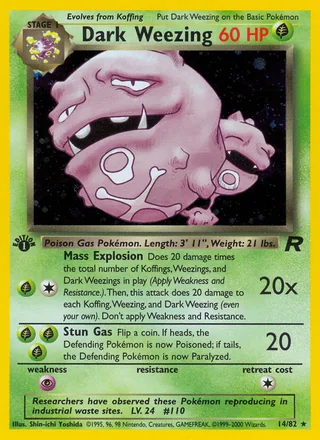
Dark Weezing, from Team Rocket No.011 — holofoil there, uncommon here, 60 HP in both. Mass Explosion is the last-resort attack; Stun Gas is two Grass for 20. It is one of ten Dark cards in the set, and one of eight that came over from Team Rocket.
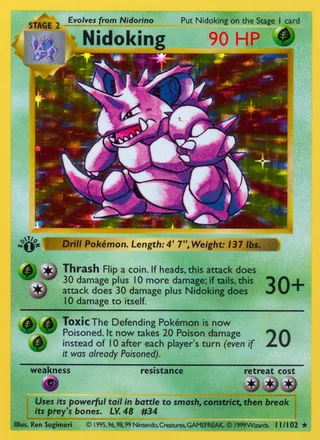
Nidoking, the first rare, from 1996 No.013 where it was holofoil. 90 HP, one attack at three Energy, one at three Grass. With Nidoran♂ at 002 and Nidorino at 018, ★web carries the full three-stage line — something the 1996 set did not do in one place.
Dark Venusaur, Grass, 70 HP, and the fourth card here with no scan, and the highest-rarity of the four. One attack, three Grass for 30. Dark Venusaur was a Japanese-only card, so unlike the 44 photographs on this page there is nothing to borrow from the English side.
8 cards · listed in original order.
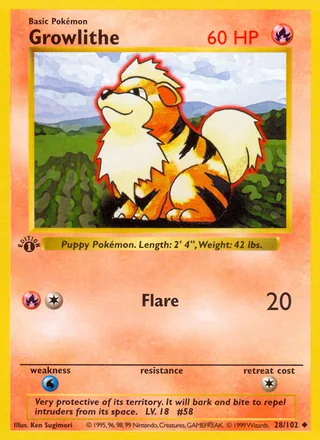
Growlithe, from 1996 No.018. Here it drops to 40 HP from the 1996 card's 60, with Ember at 30. Its evolution Arcanine is at 023, and that one drops further still.
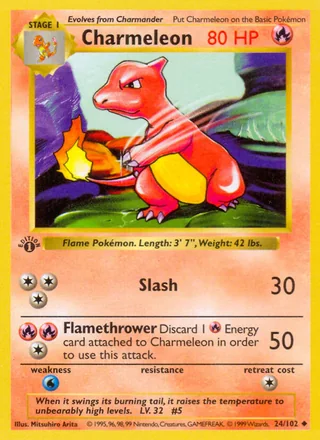
Charmeleon, from 1996 No.017, at the same 80 HP. Slash costs three Colorless for 30, Flamethrower two Fire and one Colorless for 50. Charmander itself is not in ★web — the set starts mid-line and leaves the basic out.
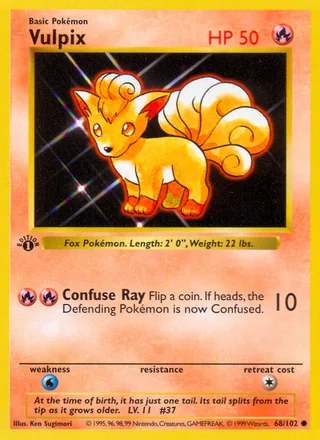
Vulpix, from 1996 No.015. A single attack, one Fire Energy for 10. With Ninetales at 034 this is the only complete evolution pair in the Fire commons, so ★web can actually build the line from scratch.
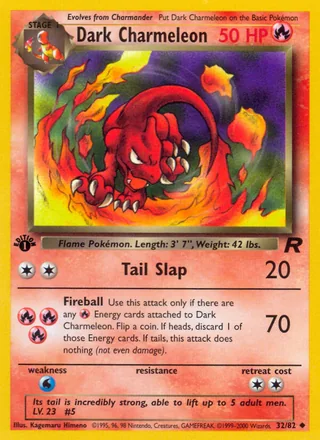
Dark Charmeleon, from Team Rocket No.015, at 50 HP. Tail Slap is two Colorless for 20, Fireball three Fire for 70 — the biggest number on any common or uncommon here, paid for with a coin flip in the original. Sits alongside the ordinary Charmeleon at 007.
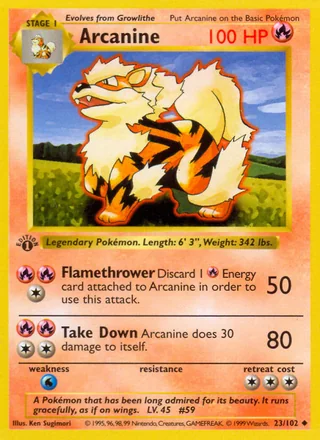
Arcanine, the sharpest stat change in the set: 70 HP where the 1996 card No.019 had 100, and a single three-Energy attack for 50. Growlithe at 006 also dropped. If any entry shows that ★web rebalanced rather than reprinted, it is this pair.
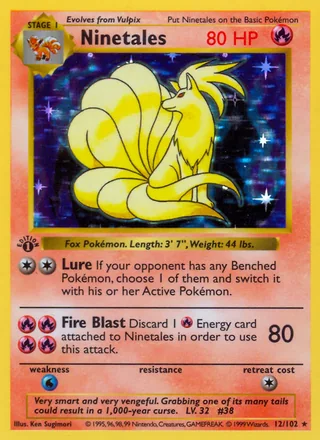
Ninetales, from 1996 No.022, holofoil there and a plain rare here. 80 HP, a Colorless two-Energy attack that lures, and Fire Blast at four Fire for 80. Vulpix at 008 gives the pair.
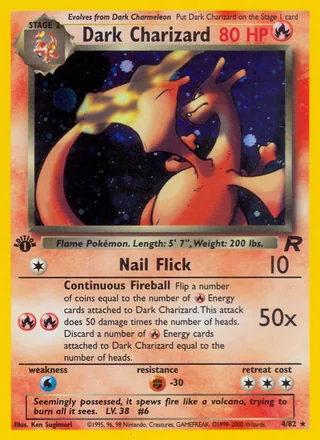
Dark Charizard, from Team Rocket No.017, holofoil in both. 80 HP, a one-Energy attack for 10 and a two-Fire attack that keeps going while the flips hold. It is the card everyone remembers from this set, and the only Dark card here that stayed holofoil.
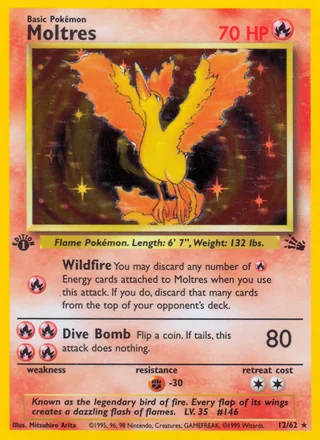
Moltres, from Mystery of the Fossils No.009, holofoil in both, at the same 70 HP. One attack: three Fire for 60. The three legendary birds reached ★web as a group — 043, 045 and 046 — all as holofoils, as they had been in 1997.
6 cards · listed in original order.
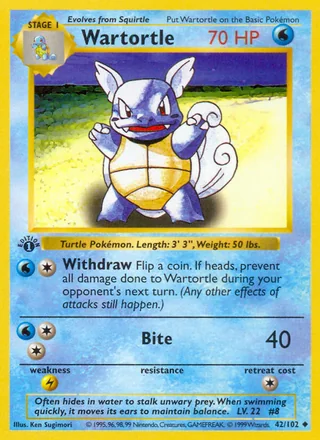
Wartortle, from 1996 No.027, at 70 HP. Bubble is one Water for 10, Surf two for 30. As with Charmeleon the basic is missing: Squirtle is not in this set.
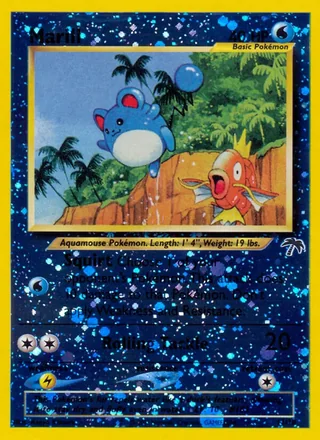
Marill, borrowed from Southern Islands No.011 — the only ★web card whose scan comes from the 1999 film set rather than from 1996–98. Water Gun costs two Water for 10, weak for a 50 HP card, and this is Marill's third printing in three years.
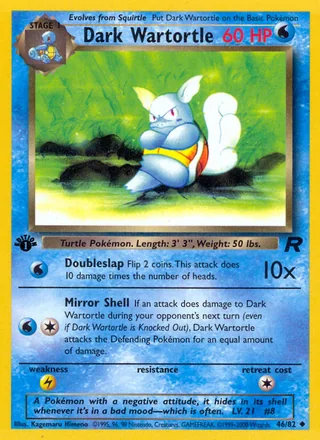
Dark Wartortle, from Team Rocket No.021, at 60 HP. Doubleslap is one Water; Mirror Shell two Water and Colorless. The second of the three Dark evolution cards — Ivysaur, Charmeleon, Wartortle — that ★web keeps together.
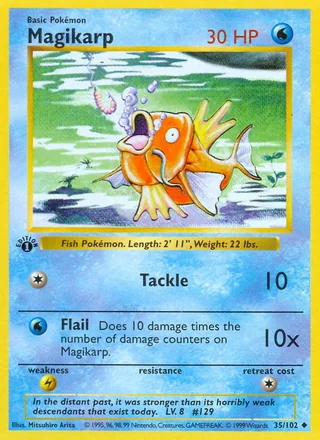
Magikarp, from 1996 No.031. 30 HP, one Water for almost nothing, and Dragon Rage at two Water for 50 — the joke card of the set. It was uncommon in 1996 and is a rare here, a demotion-by-promotion the set repeats on several old commons. Gyarados is not in ★web, so the line stops here.
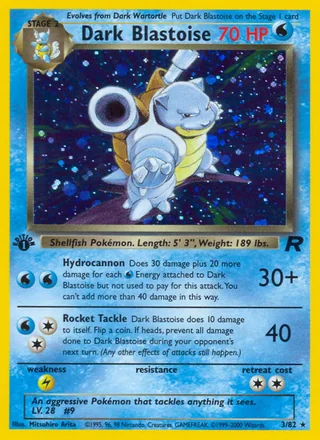
Dark Blastoise, from Team Rocket No.024, holofoil in both, 70 HP. Hydro Cannon is two Water; Rocket Tackle is three Energy for 40 with recoil on the attacker. The last of the Dark holofoils.
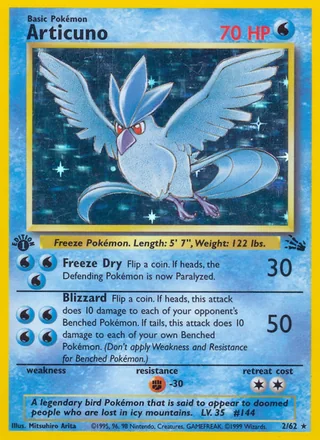
Articuno, from Mystery of the Fossils No.023, holofoil in both, 70 HP. Diamond Dust is three Water for only 20. A 70 HP holo whose attack does not match its rarity — the card is about the name and the art.
5 cards · listed in original order.
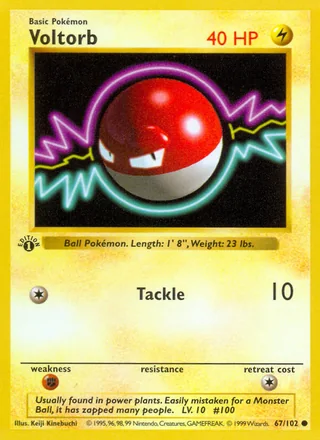
Voltorb, from 1996 No.037, at 40 HP with a single Colorless attack for 10. Electrode is at 026, so the line is complete — and unlike the Fire and Water lines, both halves came across.
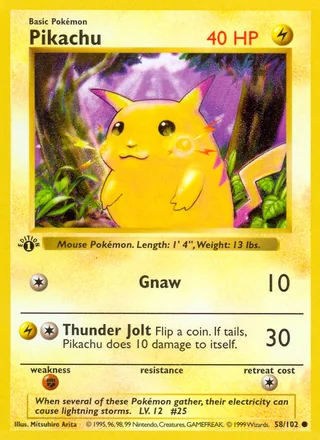
Pikachu, and the only card in the set whose English name adds a word: the sources list it as Surfing Pikachu, because its attack is Surf, two Water for 30 on a Lightning card. The off-type cost is the whole point of the card, and it is the only Pikachu in ★web.
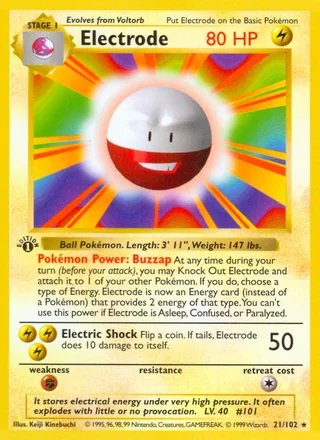
Electrode, from 1996 No.040, at 70 HP against the 1996 card's 80. Sonicboom is two Lightning for 30; Energy Spike three Lightning and does more the more Energy the defender carries. Voltorb at 011 completes the line.
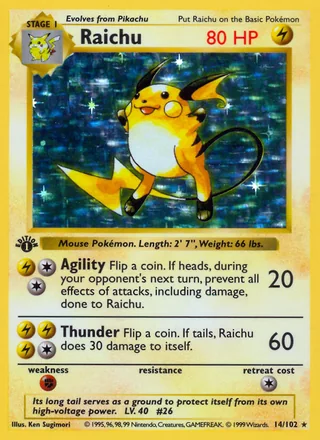
Raichu, from 1996 No.038, holofoil there. 80 HP, one attack at three Energy for 20, Thunder at four for 60. The third and last stage of the Pikachu line, and the only one of the three that is a rare here.
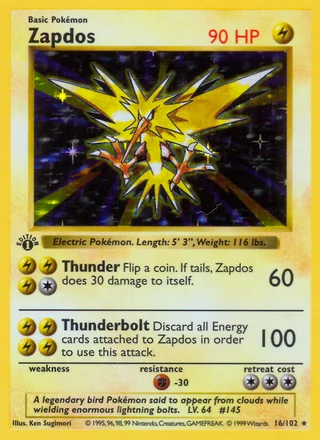
Zapdos, from 1996 No.042, holofoil there, and here 70 HP where 1996 had 90. One attack, three Lightning for 30 plus a burn. The third of the birds, and the second-largest cut to any HP in the set after Arcanine.
5 cards · listed in original order.
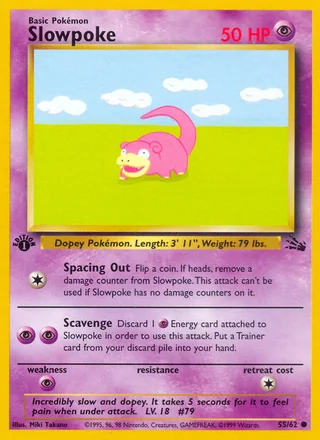
Slowpoke, from Mystery of the Fossils No.027. Headbutt is one Colorless for 10; Amnesia costs two Psychic and shuts off one of the defender's attacks. Its evolution Dark Slowbro is at 028 — the Dark version rather than the ordinary one.
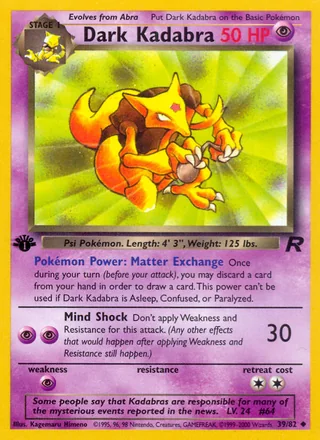
Dark Kadabra, from Team Rocket No.034, at 50 HP. One attack, two Psychic for 30. Kadabra is famously absent from the English sets of this era, which makes the Japanese ★web printing the accessible copy of the card.
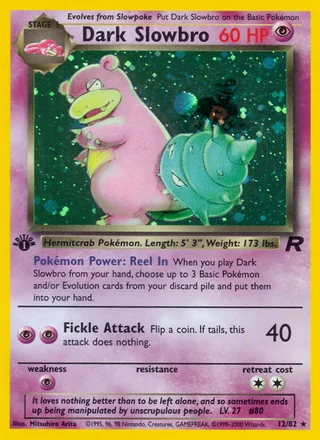
Dark Slowbro, from Team Rocket No.036 — holofoil there, uncommon here, still 60 HP. Its single attack is two Psychic for 40 with a random element. Paired with Slowpoke at 012.
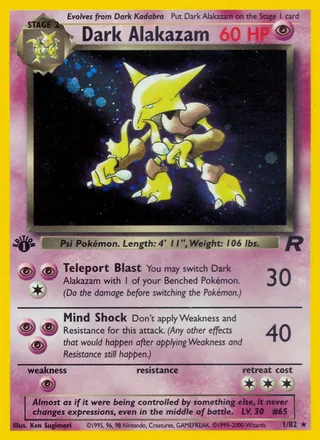
Dark Alakazam, from Team Rocket No.035, holofoil there and a plain rare here, at the same 60 HP. Teleport Blast is three Psychic for 30; Mind Shock three Psychic for 40. The heaviest of the Dark cards in attack terms.
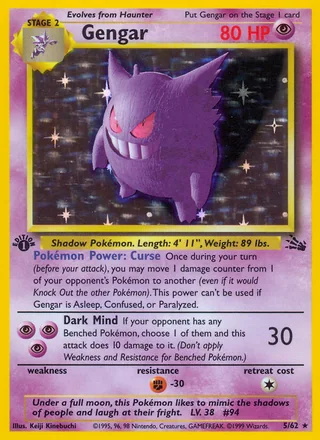
Gengar, from Mystery of the Fossils No.031, holofoil in both, 80 HP. One attack, three Psychic for 30. Gastly and Haunter are not in ★web, so as with Dragonite the set carries the final stage alone.
4 cards · listed in original order.
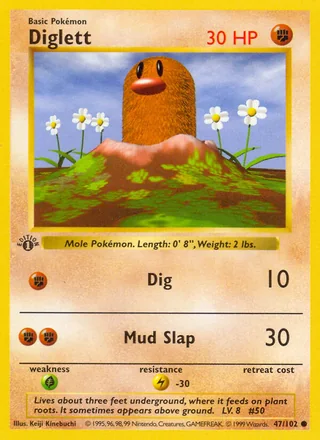
Diglett, from 1996 No.052. At 50 HP against the 1996 card's 30, the largest increase in the set. Peck costs one Fighting for 10. Dugtrio follows at 029, so again a complete pair.
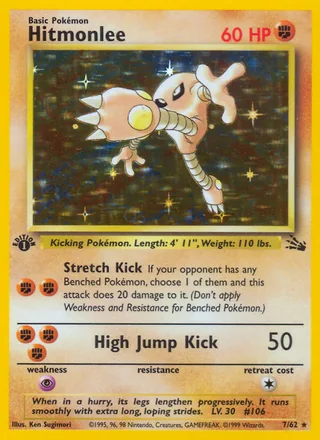
Hitmonlee, from Mystery of the Fossils No.039 — where it was a holofoil rare. Here it is a common at 50 HP instead of 60, with Double Kick and Rolling Kick at 30. ★web regularly demotes a holo to a common and shaves its HP at the same time.
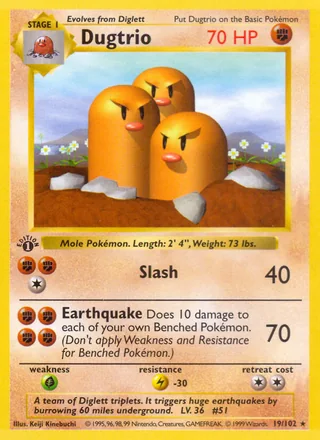
Dugtrio, from 1996 No.056, at 80 HP on a Stage 1 — heavy for the era. Earth Wave costs three Fighting for 30. The Diglett at 013 is the fourth complete evolution pair in the set.
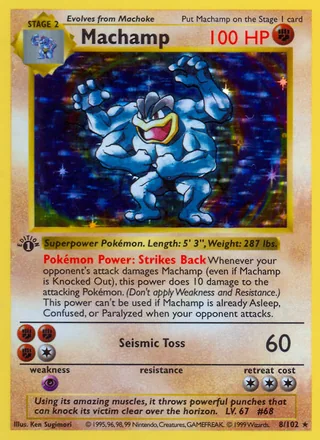
Machamp, from 1996 No.057, holofoil there, and 90 HP here against 100. Two Fighting for a rage-style attack, three for 50. The last card in the set — and with it ★web closes on the same note it opened: an old card, renumbered, with its numbers trimmed.
2 cards · listed in original order.
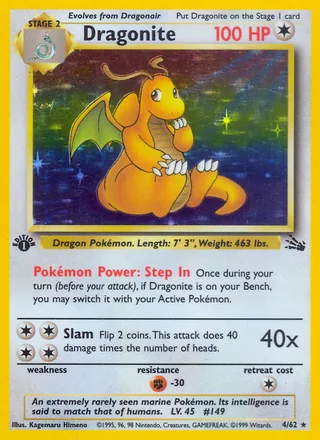
Dragonite, from Mystery of the Fossils No.043, holofoil there and a plain rare here. 90 HP against the Fossils card's 100, with one attack: three Colorless for 60. Dratini and Dragonair are absent, so ★web offers the last stage only.
Team Rocket's Meowth, Colorless, 40 HP, rare, and the third of the four cards without a scan. Its attack scales with a coin flip. A Team Rocket–prefixed card that was never printed in English, which is why no borrowed face exists for it.
6 cards · listed in original order.
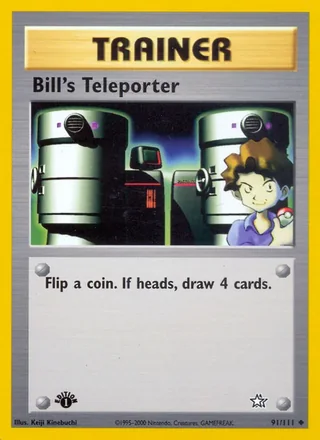
Bill's Teleporter, the first of six Trainers and one of the set's few genuinely new cards: it had appeared in the 2000 Neo Genesis set (No.084) and nowhere else. The ★web printing is what made it widely available, since the pack itself was mail-order only.
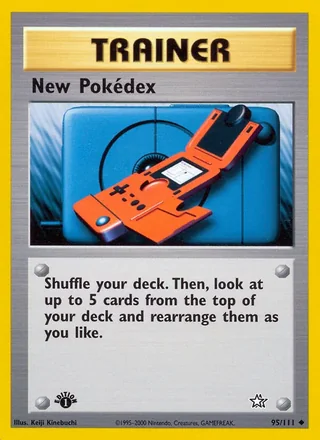
New Pokédex HANDY808, from Neo Genesis No.082. The model number in the name is the joke — 808 for the CPU of the era's handhelds. A Trainer that reorders the top of the deck, and one of the two Neo Genesis cards to reach ★web.
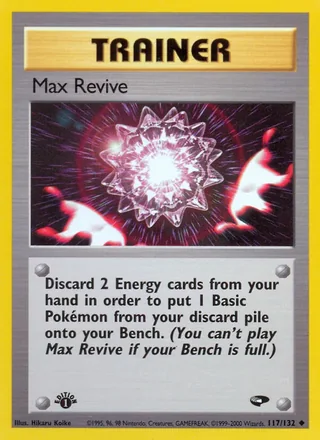
Max Revive, the third Trainer. Not a reprint of 1996's げんきのかけら (Revive) — this is the stronger card, and its earlier printing sits in the Gym series rather than in the four sets ★web otherwise draws on. The set's mail-order purpose shows here: it is the card that puts the old Gym-era Trainers back in reach.
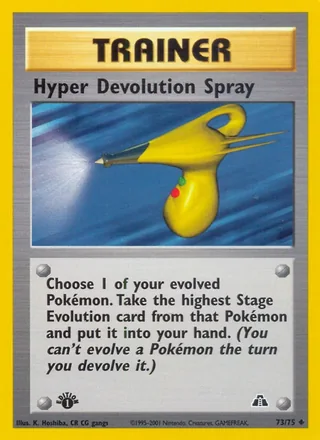
Hyper Devolution Spray, from the 2000 set Crossing the Ruins… No.073. Devolves one of your own evolved Pokémon and returns the Evolution card to hand — a card that exists to undo a bad evolution rather than to attack the opponent.
Pokémon Retransfer, a Trainer and the second of the four cards with no scan. It puts one Pokémon and every card attached to it back into the deck. The name answers Bill's Teleporter at 015, and the two were plainly designed as a pair — one fetches, one returns.
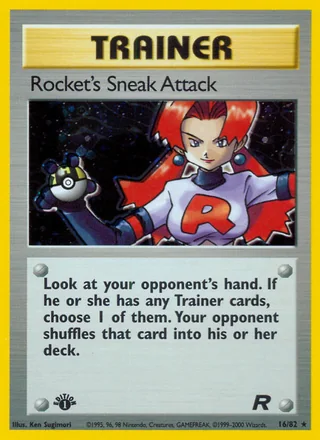
Rocket's Sneak Attack, from Team Rocket No.061, holofoil there and a plain rare here. Look at your opponent's hand and shuffle a Trainer from it back into their deck. The only card in ★web that touches the opponent's hand.
Five cards at ¥191 plus tax — half the usual ten, with the unit price rising accordingly. e-Reader dot codes run down the left edge and along the bottom; the art box is rounded only on the left, the illustrator credit sits at the bottom centre, the set symbol at the lower right, and the Pokédex text is gone. It shipped the same day as the Card e Reader, so without the hardware the codes could not be read. A Starter Pack (¥900 plus tax) also appeared that day. The box count is left empty.
1 December 2001 — 128 cards, five to a pack at ¥191 plus tax, released the same day as the Card e Reader. It is the first set to carry e-Reader dot codes down the left edge and along the bottom. 112 Pokémon and 16 Trainers.
The card itself was rebuilt here: the art box is rounded only on the left, the illustrator credit moves to the bottom centre, the set symbol to the lower right, and the Pokédex text is gone. The rarity split is unusually even — 32 of each of common, uncommon, rare and holo. The English counterpart is Expedition Base Set on 15 September 2002, which cut packs to nine cards and was the first English set with no 1st Edition run. The faces shown here are English Expedition scans, since the artwork is identical. One thing the numbers hide: the last thirty-two cards are the holofoil run, and they pair with the rares thirty-two numbers earlier. Twenty-five of them are the same card in foil — same attacks, same illustrator, a different number. Seven are different cards entirely: Venusaur, Meganium, Charizard, Ninetales, Typhlosion, Blastoise and Feraligatr each get a second design, with its own attacks and its own Ability. So 128 numbers is not 128 Pokémon — it is 103 distinct cards plus 25 foil repeats.
19 cards · listed in original order.
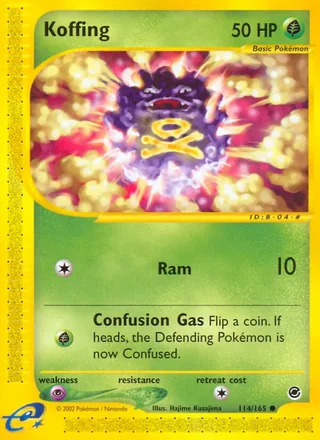
Koffing, and the first card in the set: 50 HP, Ram at one Colorless for 10, Confusion Gas for a single Grass. Koffing had been in the 1996 Expansion Pack and in Team Rocket, so this is its third printing in five years — and the first to open a numbered list.
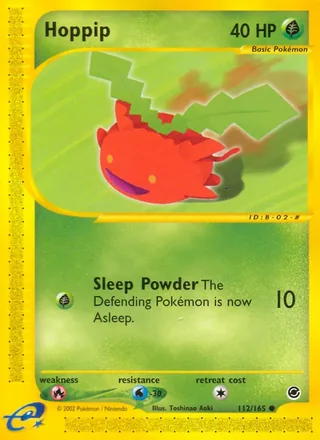
Hoppip, 40 HP. Sleep Powder asks for two Water and a Colorless on a Grass card, which is the sort of off-type cost the e-Card sets used to slow a card down. Hoppip had only arrived in the 2000 Neo Genesis set; this is its third card in three releases.
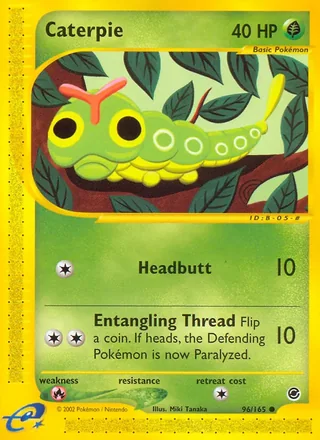
Caterpie, 40 HP, with Headbutt at one Colorless and Entangling Thread at two. It had been 50 HP in 2000's Crossing the Ruins… and 40 in 1996; this goes back to 40. Metapod at 033 and Butterfree at 066 and 098 follow, so the line is complete twice over.
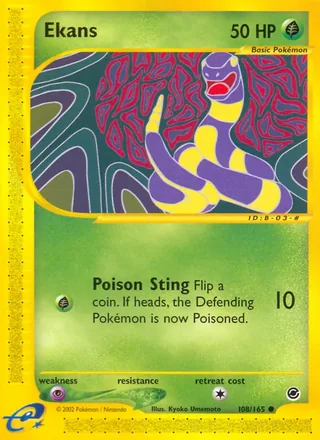
Ekans, 50 HP, Poison Sting for one Grass. A purple snake printed as a Grass card — the TCG has no Poison type, so Ekans and Arbok (067 and 099) both sit in the Grass run, exactly as they had in 1997.
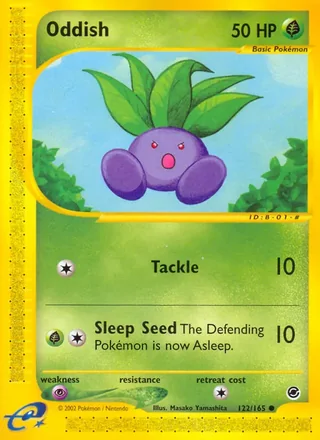
Oddish, 50 HP, Tackle at one Colorless and Sleep Seed at two. Oddish had appeared in four sets before this one; the line here runs Oddish 005, Gloom 034, Vileplume 068 and 100 — the longest family chain in the set.
Metapod, 60 HP, Rollout for one Colorless, and an Ability that protects it while it sits there. The first of the sixteen uncommons, and lower HP than both its 1996 and 2000 cards — 60 against 70 in each case.
Gloom, 70 HP, Razor Leaf at two Energy for 20 and Foul Odor at three for 30. Vileplume at 068 and 100, at 90 HP, is the payoff — the two-stage line is worth 30 HP and 10 damage between them.
Venusaur, 100 HP, the first of the thirty-two rares. Leech Seed is one Grass for 20; Fury Strikes is three Energy for 30 per heads. Its holofoil card at 097 is a different Venusaur entirely — Body Slam and a Harvest Bounty Ability — so the set prints the same Pokémon twice without repeating the card.
Butterfree, 80 HP, with no retreat cost at all and a Miraculous Powder Ability. Spiral Drain is three Energy for 40 and heals 10 back. This one is repeated at 098 with identical text — one of the twenty-five straight holofoil repeats in the set.
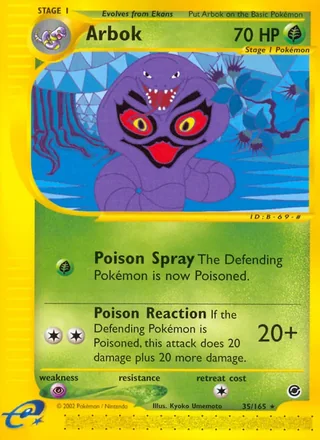
Arbok, 70 HP, the only Stage 1 in the Grass rare run. Poison Spray costs one Grass and poisons without a flip; Poison Reaction then adds damage for each Special Condition on the defender. Repeated unchanged at 099.
Vileplume, 90 HP, with a Poison Pollen Ability and Petal Dance at two Energy for 30 per heads. The end of the Oddish line that starts at 005 — the longest family in the set, and the only one whose final stage appears twice in the rares. Repeated at 100.
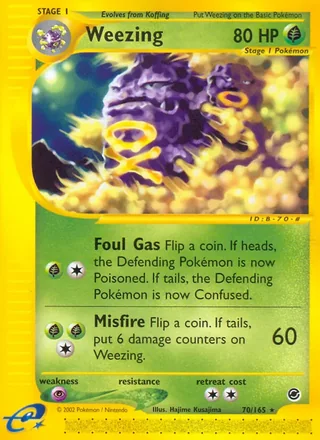
Weezing, 80 HP, Foul Gas at two Energy and Misfire at three for 60 — the number that makes the card, since Misfire hits harder the more Energy is on the defender. Repeated at 101.
Meganium, 100 HP, Sleep Powder at one Grass and Solarbeam at three for 50. Its holo at 102 is a different card — Poisonpowder and a Soothing Aroma Ability — the second of the seven pairs where the holofoil is not a reprint.
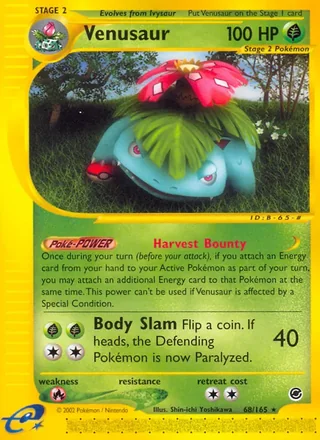
Venusaur, holofoil — and not the card at 065. This one has Body Slam at four Energy for 40 and a Harvest Bounty Ability, and it is drawn by Shin-ichi Yoshikawa rather than Atsuko Nishida. One of seven holos in the set that are genuinely different cards from the rare of the same name.
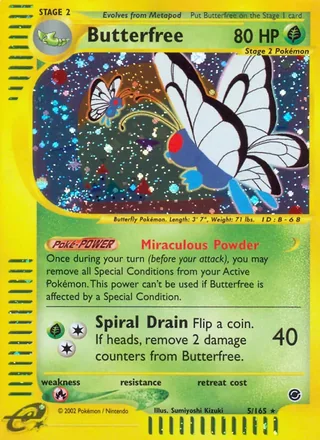
Butterfree, holofoil print of No.066 — same Spiral Drain, same Miraculous Powder, same illustrator, Sumiyoshi Kizuki. The only difference is the finish and the number, which is the case for twenty-five of the thirty-two holos here.
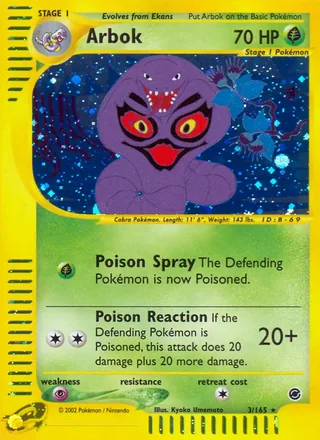
Arbok, holofoil print of No.067. Identical text, identical artist. Worth having as a holo only because Poison Spray needs no flip: the card poisons on demand, and a poison that cannot miss is the reason it survived into the e-Card format.
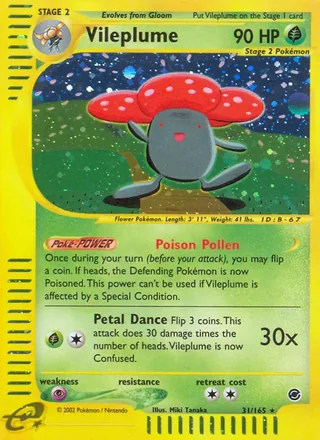
Vileplume, holofoil print of No.068. Same Poison Pollen Ability, same Petal Dance. The Oddish family is one of four carried from basic to final stage inside this set — with Poliwag, Machop and Larvitar — and the only one of the four where every stage also appears at two rarities.
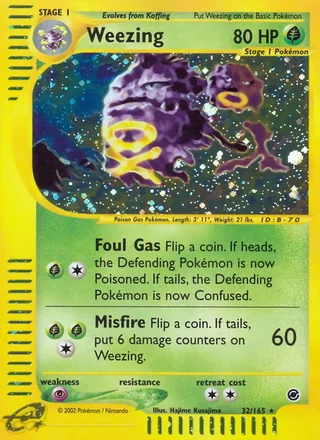
Weezing, holofoil print of No.069. Same Misfire at 60. The holo is the version that matters in play: a 60-damage attack that grows with the defender's Energy is the set's answer to decks that stack Energy on one Pokémon.
Meganium, holofoil — a different card from No.070. Poisonpowder at four Energy for 40 and a Soothing Aroma Ability, drawn by Hajime Kusajima instead of Kagemaru Himeno. Where the rare attacks, this one heals and poisons.
13 cards · listed in original order.
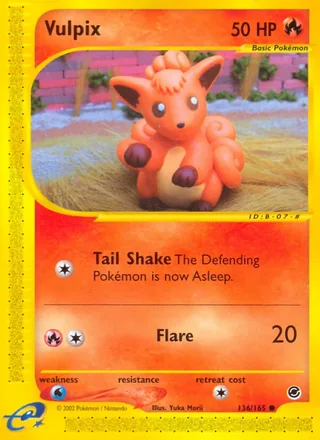
Vulpix, 50 HP, Tail Shake for one Fire and Flare for two. Its only earlier card was the 1996 one, so 2001 was the year it came back — and it came back twice, since Ninetales appears at both 072 and 104.
Ponyta, 40 HP, down from 50 in Team Rocket. Singe is one Fire; Smash Kick two Colorless for 20. Rapidash follows at 073 and 105, and both of those have no retreat cost at all, which is what makes the line worth assembling.
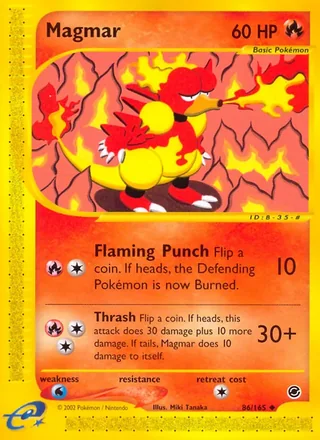
Magmar, 60 HP — down from 70 in both 1997 and 2000. Flaming Punch at two Energy for 10, Thrash at three for 30 plus a flip. The set trims HP far more often than it raises it, and Magmar is one of the trims.
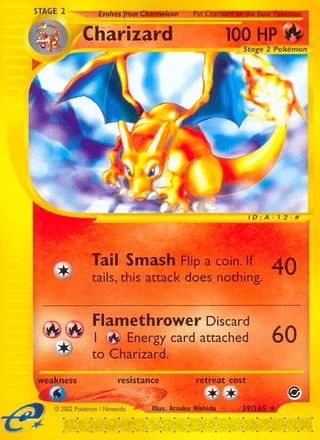
Charizard, 120 HP and a retreat cost of three: Tail Smash at one Colorless and Flamethrower at three for 60. The card the set is remembered for, and the third of the seven where the holo at 103 is a different Charizard — Scorching Whirlwind for 120 with a Burning Energy Ability behind it.
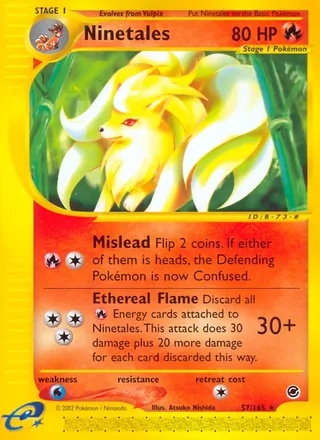
Ninetales, 80 HP. Mislead costs two Energy and confuses; Ethereal Flame runs on Colorless and does 20 plus 10 for each Energy on it. The holo at 104 is the same card with the same illustrator, but Ethereal Flame starts at 30 instead of 20 — the smallest difference between any pair in the set.
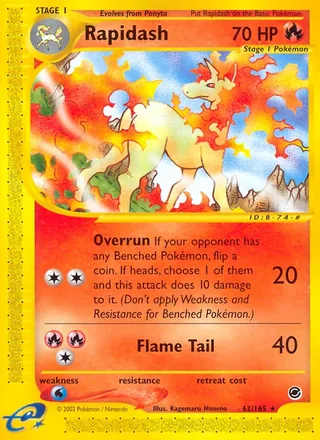
Rapidash, 70 HP, and no retreat cost — the second free-retreat card in the rares. Overrun at two Colorless for 20, Flame Tail at three for 40. Repeated at 105.
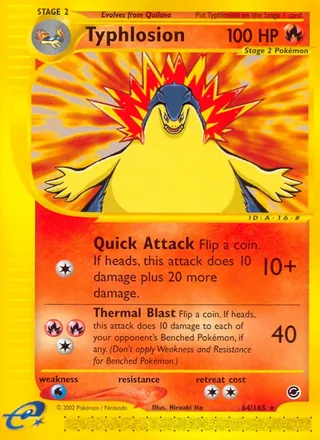
Typhlosion, 100 HP, Quick Attack at one Colorless for 10 plus a flip and Thermal Blast at three for 40. The holo at 106 is different — Super Singe at four Energy for 50 with a Heat Up Ability — the fourth of the seven true pairs.
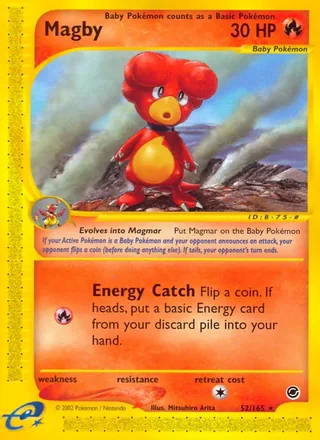
Magby, a Baby Pokémon at 30 HP. Energy Catch costs one Fire and pulls Energy back, and the Baby rule means an opponent must flip to attack it at all. One of only two Baby cards in the set, and repeated unchanged at 107.
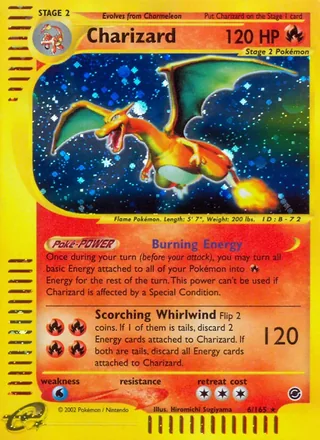
Charizard, holofoil — and the most important card in the set. Scorching Whirlwind at four Fire for 120 with a Burning Energy Ability behind it; the rare at 071 does 60. Drawn by Hiromichi Sugiyama rather than Atsuko Nishida. Two Charizards, one set, and only one of them ends games.
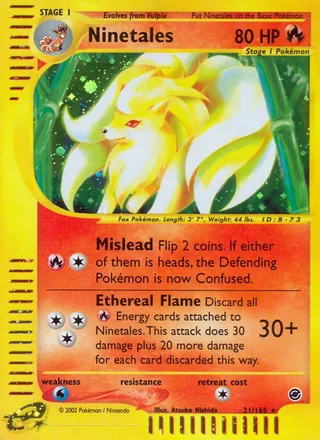
Ninetales, holofoil print of No.072 — almost. Same Mislead, same artist, but Ethereal Flame starts at 30 instead of 20. The narrowest gap between any pair of cards here, and the reason the two are listed separately rather than as one entry with two finishes.
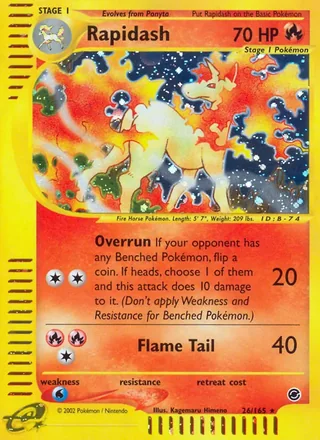
Rapidash, holofoil print of No.073, free retreat included. The holo is the better buy of the two only because the card is played for the free retreat, and holo or not it costs the same to put down.
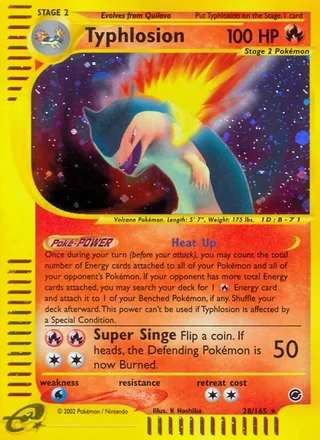
Typhlosion, holofoil — a different card from No.074: Super Singe at four Energy for 50 with a Heat Up Ability, drawn by K. Hoshiba. The rare is a two-attack attacker; this one is built around one big turn.
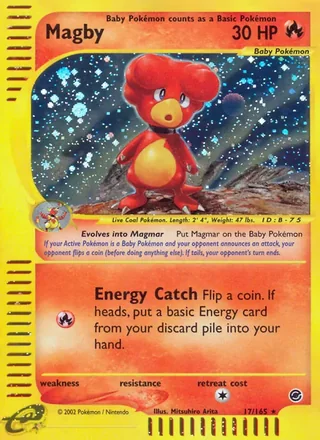
Magby, holofoil print of No.075. A 30 HP Baby as a holo, which is an odd thing to own — the card is played for the Baby rule, not for its body, and the holo adds nothing but the finish.
20 cards · listed in original order.
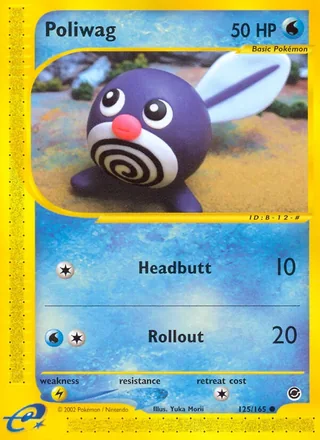
Poliwag, 50 HP, Headbutt for one Colorless and Rollout for two. Poliwhirl at 036 and Poliwrath at 077 and 109 complete the line — one of six three-stage families the set carries from basic to final form.
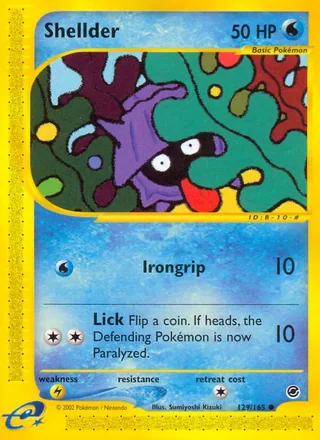
Shellder, 50 HP — twenty more than its 1997 card. Irongrip is one Water for 10; Lick two Colorless. Cloyster at 078 and 110 is the payoff, and it is a rare rather than a holo, which is unusual for a Water final stage in this era.
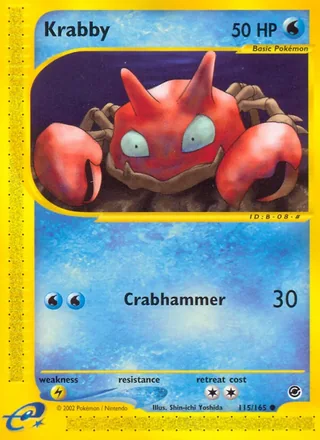
Krabby, 50 HP, one attack: Crabhammer, two Water for 30. Kingler at 079 and 111 hits for 70, so the pair is built as a straight upgrade — the clearest basic-to-final jump in the Water commons.
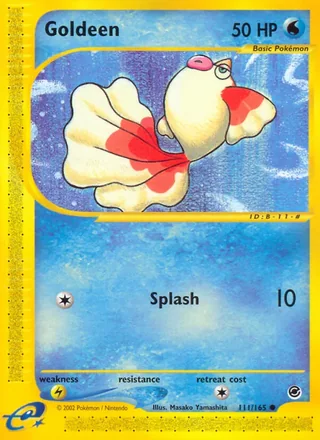
Goldeen, 50 HP, Splash for one Colorless and 10. Seaking is not in the set, so this is one of the many cards here whose evolution was left out — as the list goes on, roughly one basic in three stands alone.
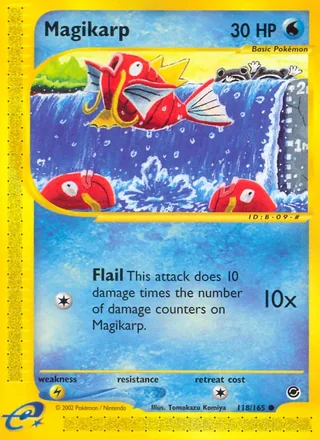
Magikarp, 30 HP, Flail at one Colorless for 10 times the damage counters on it. Gyarados is absent here, as it had been from ★web two months earlier — the one card in 2001 that got a reprint but never got its evolution.
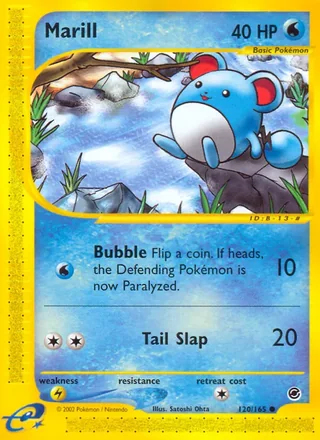
Marill, 40 HP, Bubble at one Water and Tail Slap at two Colorless. Its third printing in three years — Southern Islands in 1999, Neo Genesis in 2000, here in 2001 — and Azumarill, its evolution, never appeared in Japan at all.
Qwilfish, 60 HP, one attack: Stun Needle, two Water for 20. Qwilfish had debuted only in the 2000 Awakening Legends set, so this is its second card, and at 60 HP it is the joint-hardest Water common here.
Corsola, 60 HP, up from 50 in 2000. Tackle for two Energy, Spike Cannon at three for 20 times the number of heads. The second Water common at 60 HP, and one of the few cards in the set with a flip-scaling attack.
Poliwhirl, 70 HP, Punch at two Colorless for 20 and Bubblebeam at three for 30. The middle of the Poliwag line, and the only stage in it that is an uncommon — the basic is a common and Poliwrath is a rare twice over.
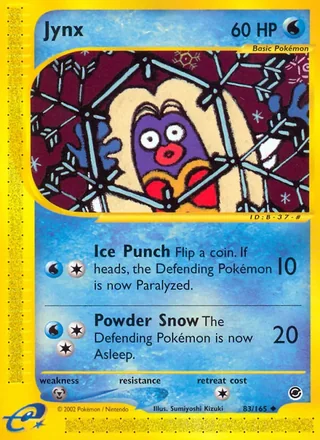
Jynx, 60 HP, Ice Punch at two Energy for 10 and Powder Snow at three for 20. A Psychic-type in the games, printed as Water here — the same treatment Jynx had in 1996 and 2000, and one of the set's few type oddities.
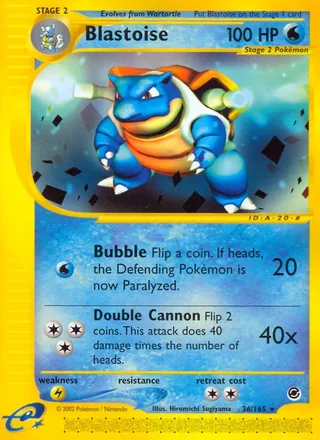
Blastoise, 100 HP, Bubble at two Energy for 20 and Double Cannon at three for 40 per heads. Its holo at 108 is a different Blastoise — Energy Cannon at three for 40 plus, with a Jet Stream Ability — the fifth of the seven.
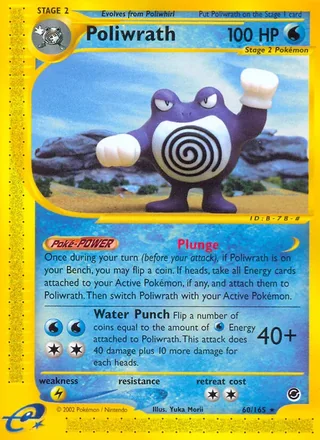
Poliwrath, 100 HP, with a Plunge Ability and Water Punch at four Energy for 40 plus. The end of the Poliwag line, and the only final stage in the Water rares that is repeated unchanged at 109. Its 100 HP is ten more than its 1996 card.
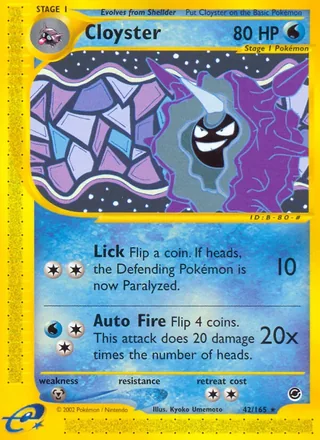
Cloyster, 80 HP, Lick at two Colorless for 10 and Auto Fire at three for 20 per heads. One of the few Water cards here whose attacks run on Colorless, which is why it turns up in decks that are not Water. Repeated at 110.
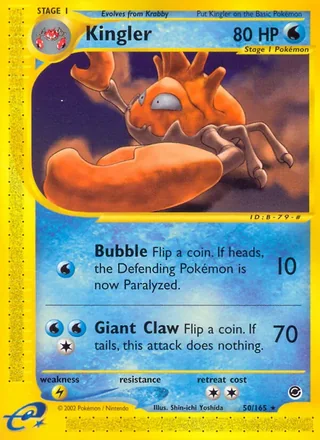
Kingler, 80 HP, Bubble at one Water for 10 and Giant Claw at three for 70 — the highest single number on any non-holo Pokémon in the set. Twenty more HP than its 1997 card. Repeated at 111.
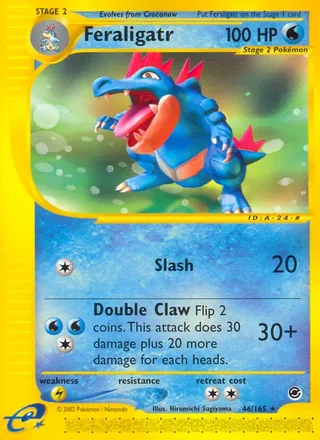
Feraligatr, 120 HP with a retreat of three: Slash at one Colorless and Double Claw at three for 30 plus. The holo at 112 is different — Rending Jaws for 70 with a Major Tsunami Ability — the sixth of the seven, and the last of the starter lines.
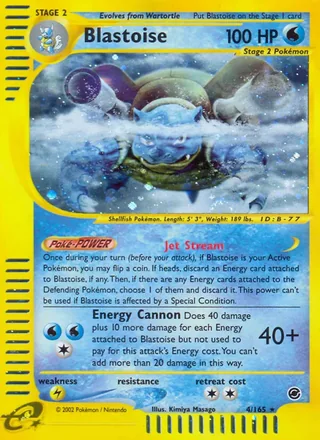
Blastoise, holofoil — a different card from No.076: Energy Cannon at three Energy for 40 plus, with a Jet Stream Ability, drawn by Kimiya Masago. The rare's Double Cannon flips for its damage; this one does not flip, which makes it the more reliable of the two.
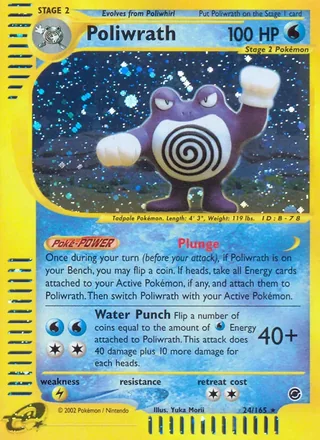
Poliwrath, holofoil print of No.077, Plunge Ability included. Both copies are 100 HP; the holo is simply the scarcer of the two, since the rare was also printed in the five-card packs at the same rate.
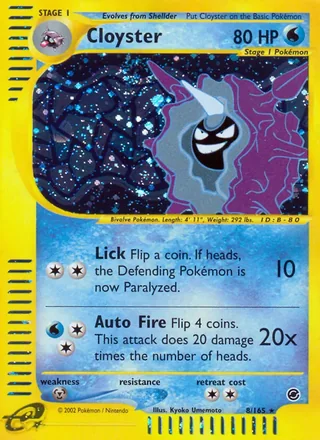
Cloyster, holofoil print of No.078. Same Colorless-costed attacks. The holo is the version that turns up in binders; in play the two are interchangeable, which is true of most of the twenty-five repeats.
Kingler, holofoil print of No.079 — Giant Claw at 70 included. Of the twenty-five straight repeats, this is the one with the biggest number on it, and the reason Kingler is remembered from this set at all.
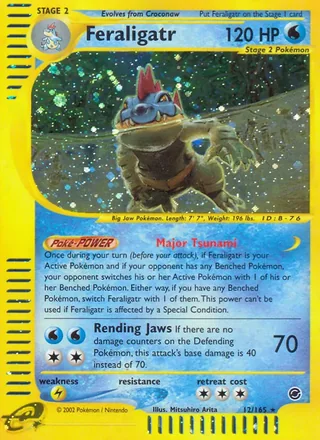
Feraligatr, holofoil — a different card from No.080: Rending Jaws at four Energy for 70 with a Major Tsunami Ability, drawn by Mitsuhiro Arita. The last of the seven true pairs; six of them land on a starter's final stage, and Ninetales at 104 is the odd one out.
10 cards · listed in original order.
Pikachu, 50 HP, Lightning Tail for one Colorless and Tackle for two. Its fourth printing since 1996, and the only one drawn by Atsuko Nishida — the 1996 Pikachu was Mitsuhiro Arita's. Raichu at 081 and 113 closes the line.
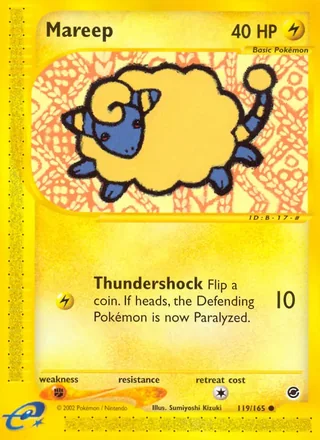
Mareep, 40 HP, Thundershock for one Lightning and 10. The first of the Gold and Silver Pokémon to appear in the list, and the start of a complete Electric line — Mareep 017, Flaaffy 039, Ampharos 083 and 115.
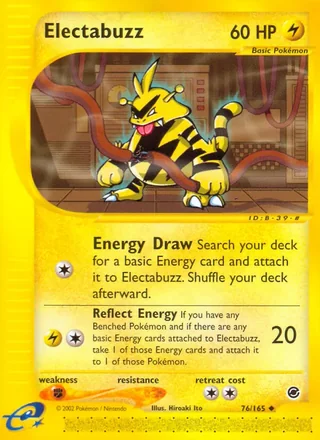
Electabuzz, 60 HP — down from 70 in its two previous printings. Energy Draw is one Colorless; Reflect Energy at two for 20. Elekid is not in the set, so the family starts at the middle.
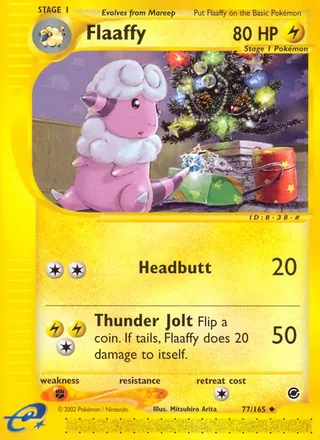
Flaaffy, 80 HP on a Stage 1 — 20 more than its 2000 card, and the highest of the Pokémon uncommons here after Chansey at 047. Headbutt at two Colorless for 20, Thunder Jolt at three for 50. Ampharos at 083 and 115 is the final stage.
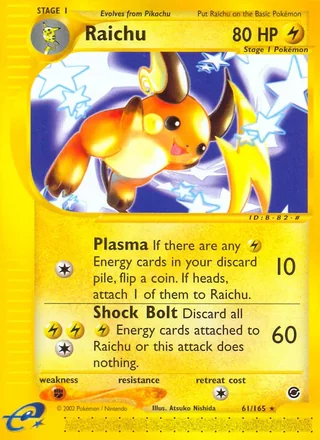
Raichu, 80 HP, Plasma at one Colorless for 10 and Shock Bolt at three for 60. Twenty more HP than the 1996 card and the same attacks as the 2000 one. Repeated at 113.
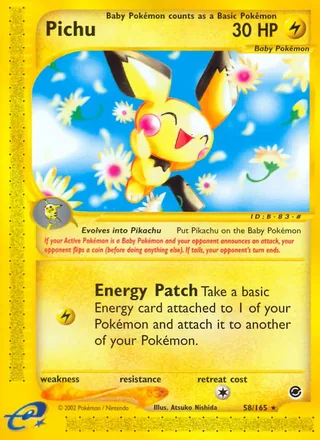
Pichu, a Baby at 30 HP, with Energy Patch for one Lightning. The second and last Baby card in the set, and the only way to get to a Pikachu line that is otherwise complete at 016 and 081. Repeated at 114.
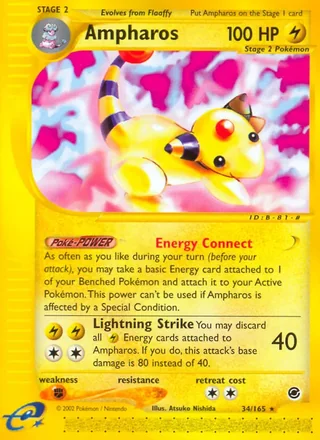
Ampharos, 100 HP, with an Energy Connect Ability that moves Energy around your side, and Lightning Strike at four Energy for 40. The end of the Mareep line, 20 HP above its 2000 card. Repeated at 115.
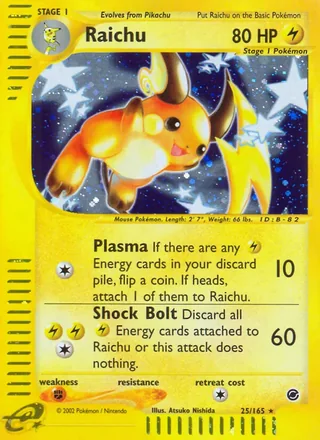
Raichu, holofoil print of No.081. Same Plasma and Shock Bolt. The fourth Raichu in five years, and the only one of them that has both a cheap attack and a 60-damage one on the same card.
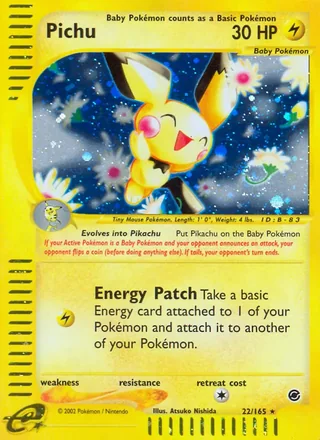
Pichu, holofoil print of No.082. A 30 HP Baby with Energy Patch. Pichu's second card ever, after the 2000 Neo Genesis one — and like Magby at 107, the holofoil treatment is pure finish.
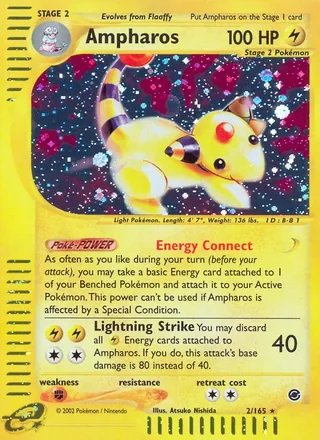
Ampharos, holofoil print of No.083, Energy Connect included. The Ability is what makes the line work: it moves Energy from the bench to the attacker, so Flaaffy at 039 and this card are usually played as a pair.
12 cards · listed in original order.
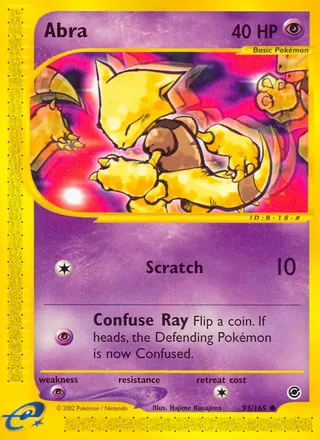
Abra, 40 HP, Scratch for one Colorless and Confuse Ray for one Psychic. The Psychic line is complete here too: Abra 018, Kadabra 040, Alakazam 084 and 116 — and unlike the English sets of the period, Kadabra is actually printed.
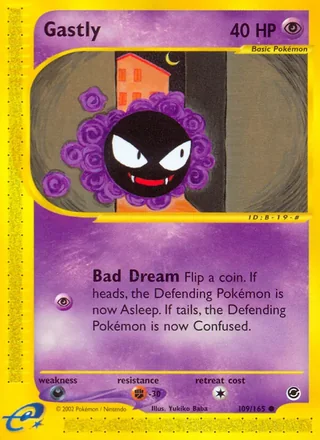
Gastly, 40 HP, one attack: Bad Dream, one Psychic, which puts the defender to sleep and chips it. Haunter at 041 and Gengar at 085 and 117 follow, making this the second three-stage Psychic line in the set.
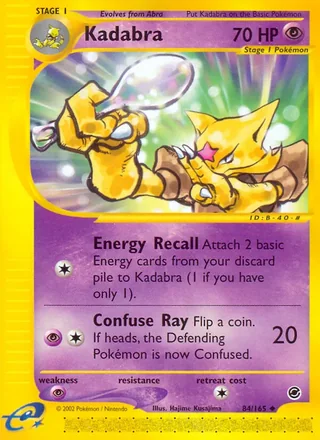
Kadabra, 70 HP, Energy Recall for one Colorless and Confuse Ray at two for 20. Its only earlier printing was 1996. That this card exists at all makes the Japanese e-Card 1 the reference copy for Kadabra, which the English sets of the era did not print.
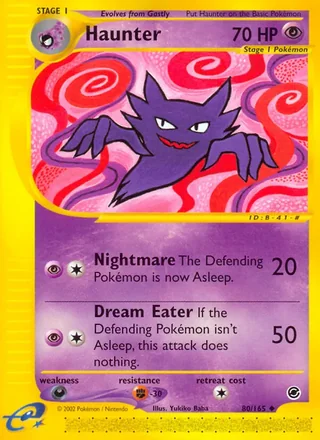
Haunter, 70 HP, Nightmare at two for 20 and Dream Eater at two for 50. Dream Eater only works on a sleeping defender and Haunter has no way to put one to sleep itself — the Gastly at 019 does, which is why the pair is played together.
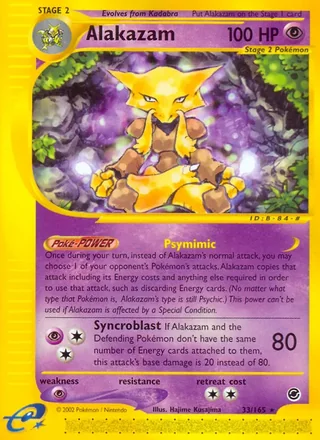
Alakazam, 100 HP, with a Psymimic Ability and Syncroblast at three Energy for 80. The strongest Psychic attack in the set, and the end of the Abra line at 018 and 040. Repeated at 116.
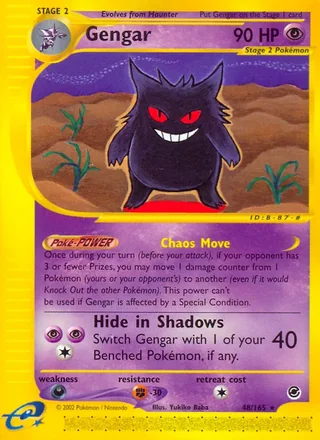
Gengar, 90 HP, with a Chaos Move Ability and Hide in Shadows at three Energy for 40. Ten more HP than its 1997 card. Repeated at 117 — one of the twenty-five, which means the set offers Gengar as a holo without changing anything but the finish.
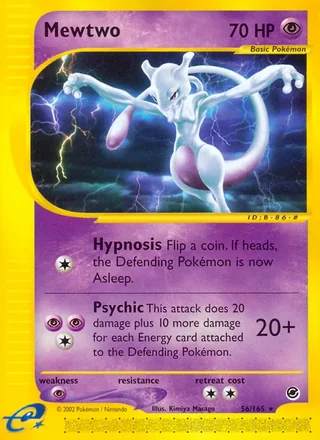
Mewtwo, 70 HP — and a Basic rather than a Stage 2, unlike almost every other 100-plus Pokémon here. Hypnosis for one Colorless, Psychic at three for 20 plus. Repeated at 118.
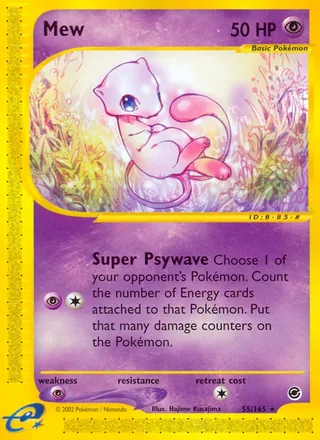
Mew, 50 HP, a single attack: Super Psywave at two Energy. One of five Basics in the rare block — with Mewtwo, Magby, Pichu and Skarmory — in a run that is otherwise all Stage 1 and Stage 2. Repeated at 119.
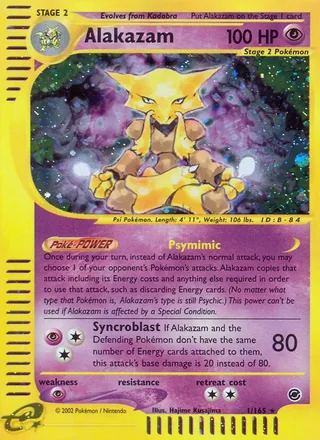
Alakazam, holofoil print of No.084 — Syncroblast at 80, the highest Psychic number in the set. A Psymimic Ability copies the opponent's, which is the sort of effect that made Alakazam the card people argue about.
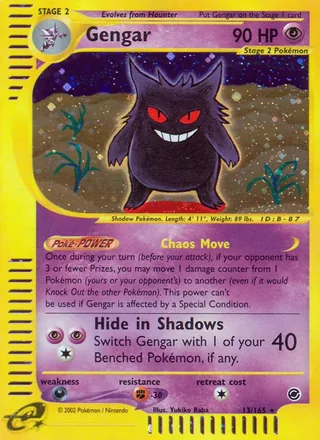
Gengar, holofoil print of No.085. Same Chaos Move Ability, same Hide in Shadows at 40. One of the twenty-five repeats where nothing at all changes but the foil — and the Gengar to own, since the 1997 holo has held its price far better than this one.
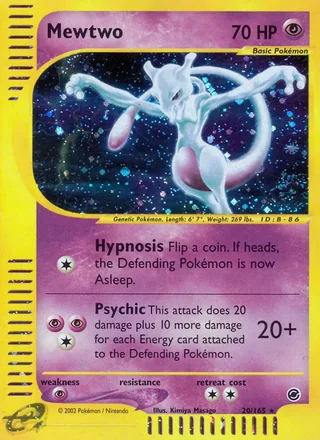
Mewtwo, holofoil print of No.086. A 70 HP Basic with Hypnosis and Psychic — and the only holo in the set that is not a Stage 2 or a Baby.
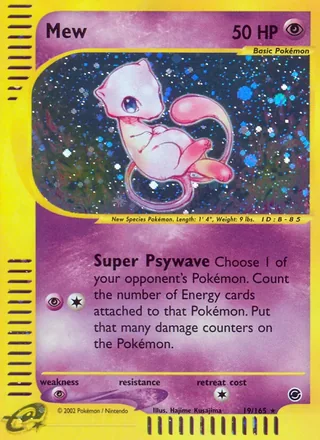
Mew, holofoil print of No.087. 50 HP, one attack, Super Psywave. Mew's earlier cards were 1997 and 1999, so this is its third printing and the only one with a single attack and no Ability at all.
15 cards · listed in original order.
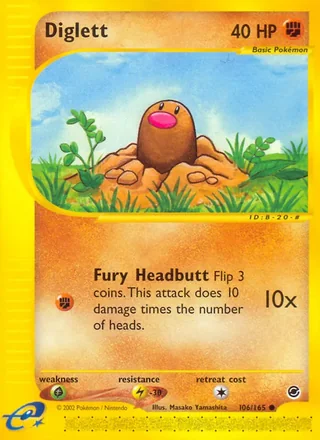
Diglett, 40 HP, Fury Headbutt for one Fighting, 10 per heads. Dugtrio at 088 and 120 is a 70 HP Stage 1, so the pair is a small card that becomes a big one — and one of the few Fighting lines here with no off-type cost anywhere in it.
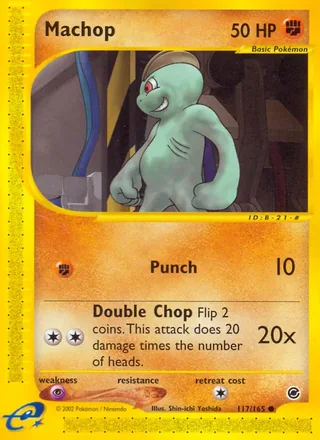
Machop, 50 HP, Punch for one Fighting and Double Chop at two Colorless for 20 per heads. Machoke 042 and Machamp 089 and 121 complete the third three-stage line, and Machamp reaches 120 HP, the highest in the set.
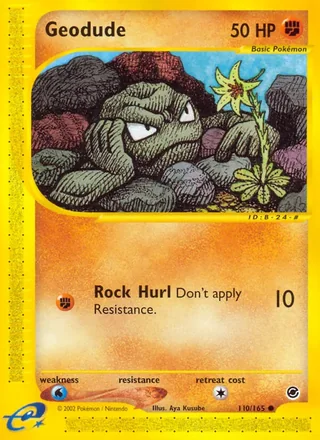
Geodude, 50 HP, Rock Hurl for one Fighting and 10. Graveler 043 and Golem 090 and 122 follow; Golem has a retreat cost of four, the heaviest in the set, and a body to match.
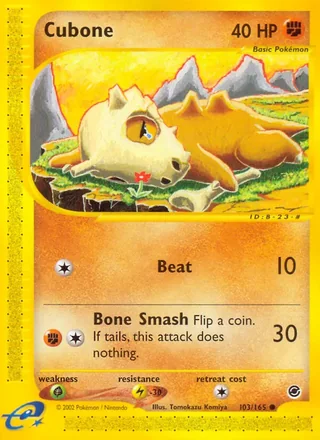
Cubone, 40 HP, Beat for one Colorless and Bone Smash at two for 30. Marowak is not in the set, so Cubone stands alone — a basic whose evolved form was skipped, which happens to about a third of the families here.
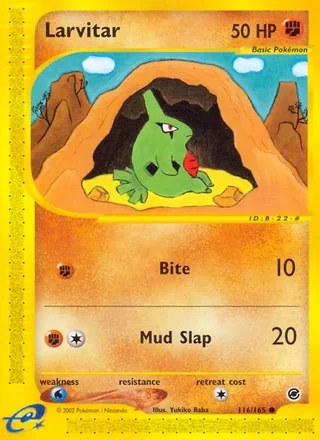
Larvitar, 50 HP, up from 40 in 2000. Bite for one Fighting, Mud Slap for two. Pupitar 045 and Tyranitar 095 and 127 follow — Tyranitar at 120 HP and, at 127, one of the last two cards in the set.
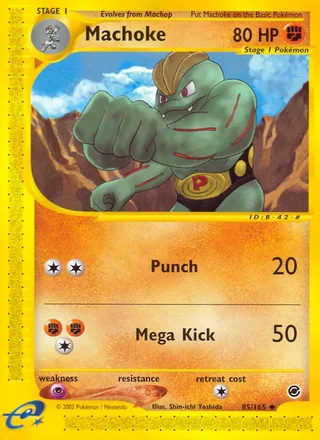
Machoke, 80 HP, Punch at two Colorless for 20 and Mega Kick at three for 50. The only Machoke card in the archive before this one was 1996, so this is its second printing in five years.
Graveler, 80 HP, Rock Hurl at two for 20 and Rock Slide at three for 30, with a retreat cost of three. The heaviest middle stage in the set, and the reason Golem at 090 rarely comes out of the deck once it is down.
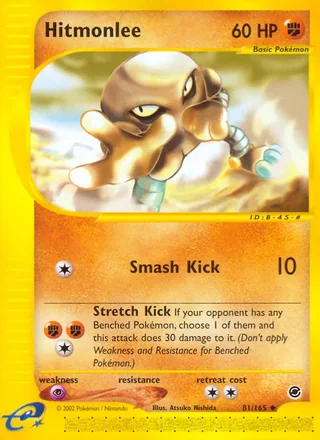
Hitmonlee, 60 HP — the same as its 1997 holofoil card, now as an uncommon. Smash Kick is one Colorless for 10; Stretch Kick reaches the bench for three Energy. Hitmonchan does not appear in this set, so only one of the pair made it.
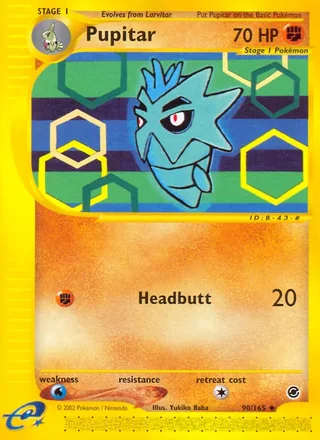
Pupitar, 70 HP, Headbutt for one Fighting and 20. The only single-attack card in the Larvitar line, and the cheapest to use — which is the point of a middle stage whose job is to survive until Tyranitar arrives.
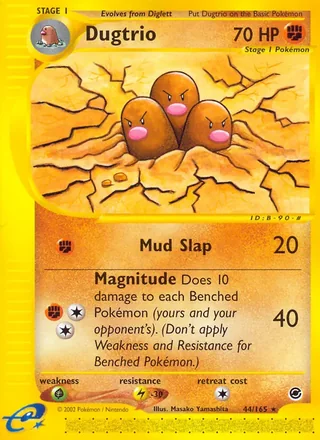
Dugtrio, 70 HP, Mud Slap at one Fighting for 20 and Magnitude at three for 40. The fastest of the Fighting rares to get going, and the only one whose cheap attack costs a single Energy. Repeated at 120.
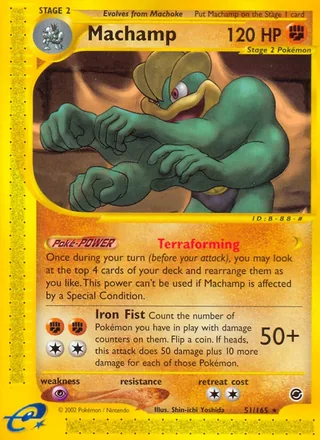
Machamp, 120 HP — one of four cards at the set's ceiling, with Charizard, Feraligatr and Tyranitar — with a Terraforming Ability and Iron Fist at four Energy for 50 plus. Twenty more HP than the 1996 card. Repeated at 121.
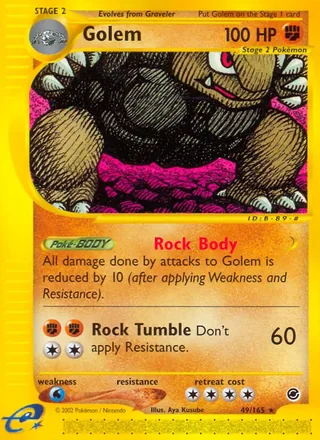
Golem, 100 HP, a Rock Body Ability and Rock Tumble at four Energy for 60, with a retreat cost of four. The heaviest card in the set to move, and the reason Graveler at 043 is played at all. Repeated at 122.
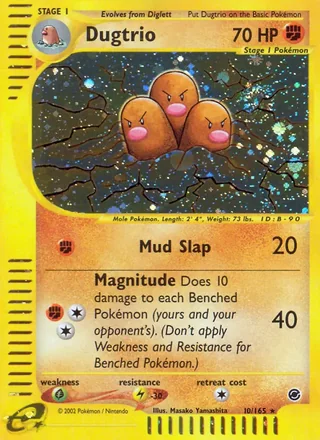
Dugtrio, holofoil print of No.088. Mud Slap for one Fighting and Magnitude at three. The cheapest attacker among the holos, and the only one that can start hitting on turn one.
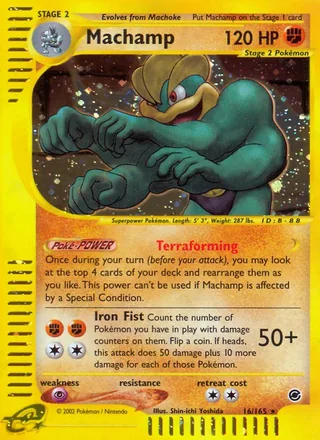
Machamp, holofoil print of No.089 — 120 HP, Terraforming, Iron Fist. Of the four 120 HP cards in the set this is the one whose Ability changes the board rather than the damage.
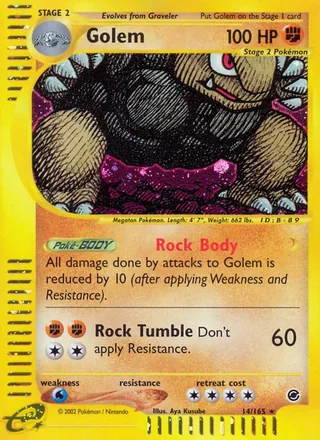
Golem, holofoil print of No.090. 100 HP, retreat four, Rock Tumble at 60. The holo version of the heaviest card in the set — heavy in every sense, since the retreat cost is the highest printed here.
3 cards · listed in original order.
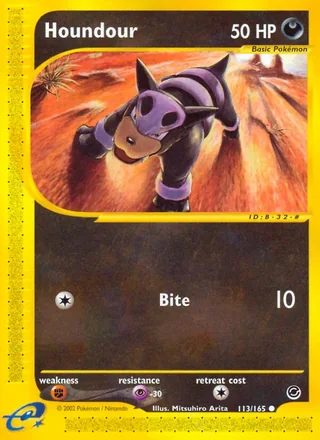
Houndour, 50 HP, Bite for one Colorless and 10 — and the only Darkness card among the commons. It had appeared twice in the 2000 Crossing the Ruins… set; Houndoom is absent, so the line is cut in half.
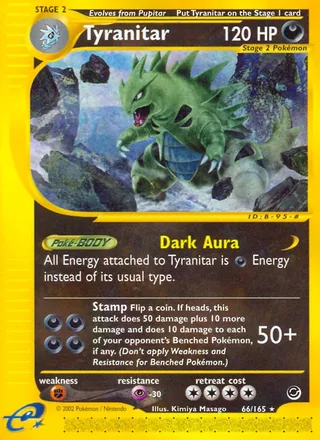
Tyranitar, 120 HP, a Dark Aura Ability, Stamp at four Darkness for 50 plus, and a retreat of four. The end of the Larvitar line, twenty more HP than its 2000 card, and the only Darkness-type rare. Repeated at 127.
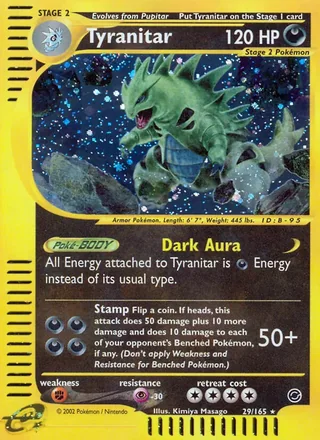
Tyranitar, holofoil print of No.095 — 120 HP, Dark Aura, Stamp at four Darkness for 50 plus. One of the last two cards in the set, and the only Darkness-type holo. Its Dark Aura Ability is what makes the four-Energy attack affordable.
2 cards · listed in original order.
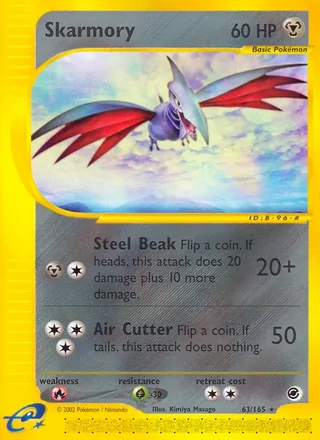
Skarmory, 60 HP, Steel Beak at two Energy for 20 plus and Air Cutter at three for 50. The only Metal card in the set and the last of the rares — a 60 HP basic sitting at the end of a run of 100-plus final stages. Repeated at 128.
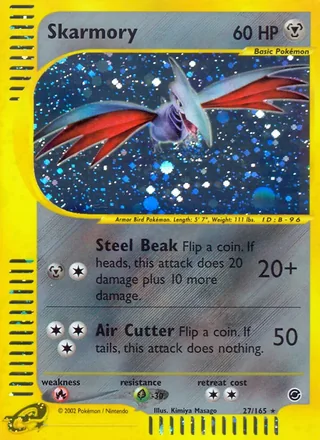
Skarmory, holofoil print of No.096 — and the last card in the set. A 60 HP Metal basic closing a run that began with Koffing at 001. Sixty cards of final stages and 120 HP bodies, and the set ends on the smallest Pokémon in its rares.
18 cards · listed in original order.
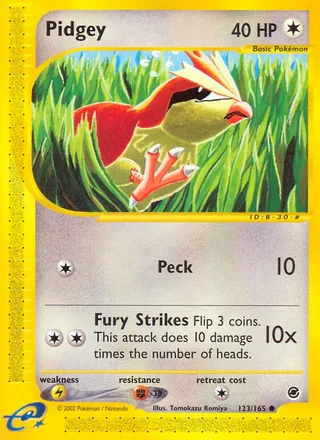
Pidgey, 40 HP, Peck for one Colorless and Fury Strikes at two for 10 per heads. Pidgeotto 046 and Pidgeot 091 and 123 follow, and both of the later stages have no retreat cost, which is why the line was played at all.
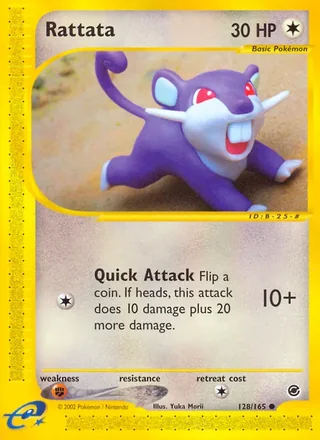
Rattata, 30 HP, Quick Attack for one Colorless: 10, plus 10 more on heads. Raticate is absent. At 30 HP it ties Magikarp for the lowest in the set, and it is the only card here drawn from 1996 and Team Rocket alone.
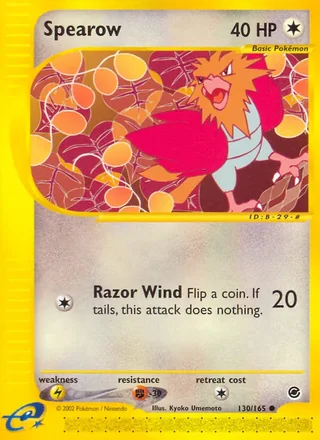
Spearow, 40 HP, Razor Wind for one Colorless and 20 — a single-energy 20 on a common, which is above the curve for this set. Fearow at 092 and 124 hits for 50 and has no retreat cost.
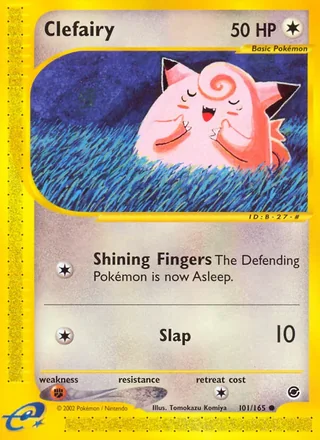
Clefairy, 50 HP, Shining Fingers for one Colorless — a coin flip that can leave the defender asleep, confused or poisoned — and Slap for 10. Clefable at 093 and 125 is the evolution, and its Moonlight Ability is the only healing Ability in the set.
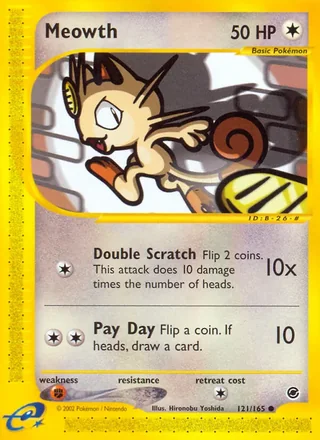
Meowth, 50 HP, Double Scratch for 10 per heads and Pay Day for two Colorless and 10. Persian never appeared in Japan, so as with several others here the basic outlives the evolution in the Japanese line.
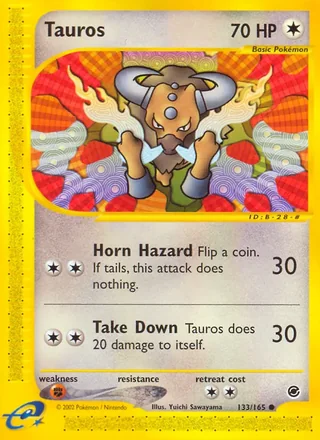
Tauros, 70 HP — the highest of any common in the set, and 10 more than its 1997 card. Horn Hazard and Take Down both cost two Colorless for 30, so the card is a blunt 70 HP body with two ways to use it. A common, despite all that.
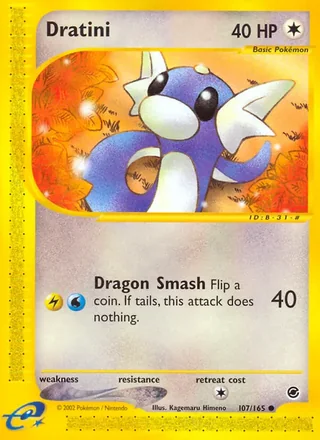
Dratini, 40 HP, one attack: Dragon Smash at one Lightning and one Water for 40. The mixed cost is what makes it a Dragon rather than a Colorless card, and 40 damage for two Energy is the best rate among the commons here.
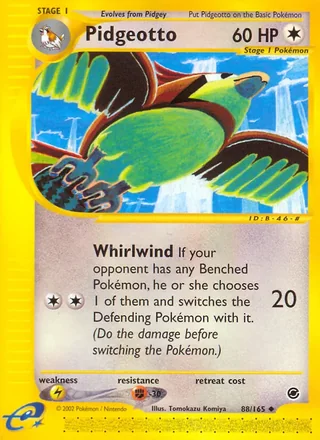
Pidgeotto, 60 HP, Whirlwind for two Colorless and 20, with no retreat cost. That free retreat is inherited by Pidgeot at 091 and 123, and it is what turns the line into a switching engine rather than a beater.
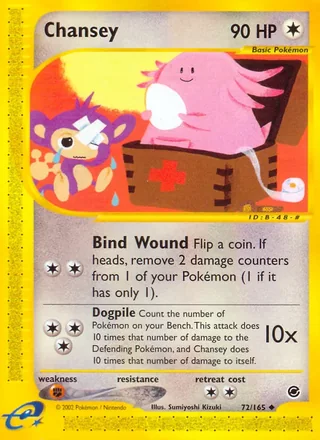
Chansey, 90 HP for one Energy, and the biggest HP cut in the set: 120 in 1996, 90 here. Bind Wound heals, Dogpile does 10 per heads. Blissey did not yet exist, so Chansey stood alone.
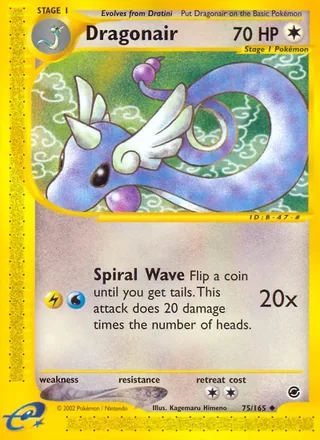
Dragonair, 70 HP, one attack: Spiral Wave at one Lightning and one Water for 20 per heads. The mixed cost again marks it out, and Dragonite at 094 and 126 finishes a line that is 70 HP and then 100.
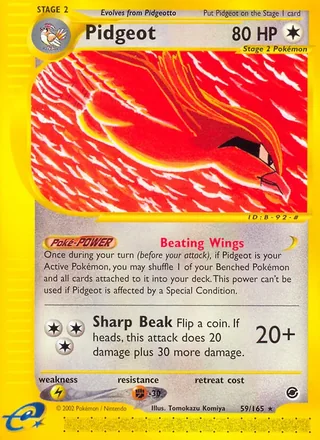
Pidgeot, 80 HP, no retreat cost, a Beating Wings Ability and Sharp Beak at three Energy for 20 plus. The free retreat is the point: Pidgeot is a card you put down to move your side around. Repeated at 123.
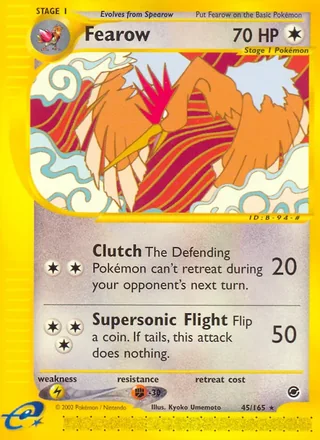
Fearow, 70 HP and no retreat cost: Clutch at two for 20, Supersonic Flight at three for 50. The second of the two free-retreat Colorless rares, and one of three cards here drawn by Kyoko Umemoto. Repeated at 124.
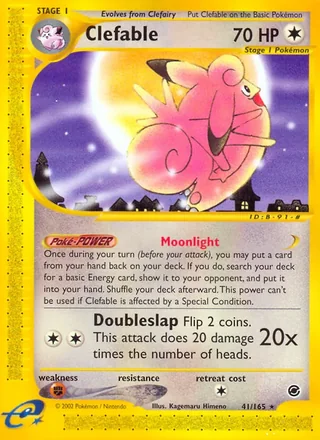
Clefable, 70 HP, a Moonlight Ability that heals and Doubleslap at two Colorless for 20 per heads. The only healing Ability among the rares, and the evolution of the Clefairy at 028. Repeated at 125.
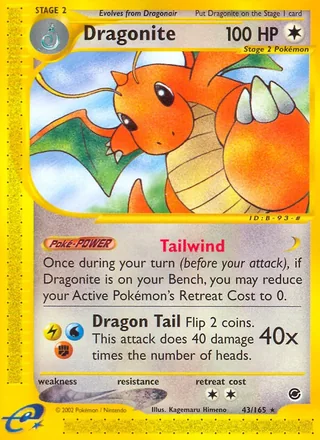
Dragonite, 100 HP, a Tailwind Ability and Dragon Tail at one Lightning, one Water and one Fire for 40 per heads. The odd three-type cost is the most expensive in the set, and the card behind it is the end of the Dratini line at 031 and 048. Repeated at 126.
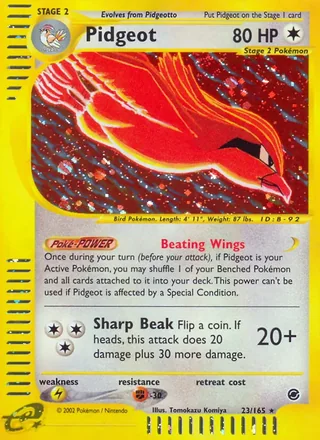
Pidgeot, holofoil print of No.091, free retreat and all. The holo is the one collectors keep; in play both copies do the same job, which is to move a benched attacker into the Active spot without paying for it.
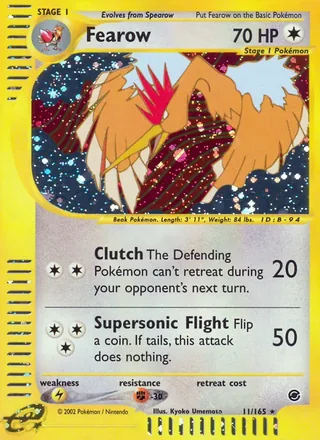
Fearow, holofoil print of No.092. No retreat cost, Clutch and Supersonic Flight. One of four cards in the set with a retreat cost of zero — Butterfree, Rapidash, Pidgeot and this one — and all four are ordinary rares as well as holos.
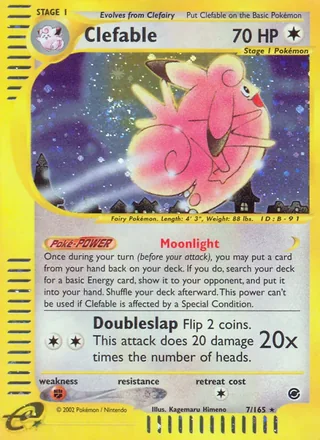
Clefable, holofoil print of No.093. Moonlight is the only healing Ability in the set, and the holo is the only way to get it in foil. Doubleslap at 20 per heads is unremarkable; the Ability is the card.
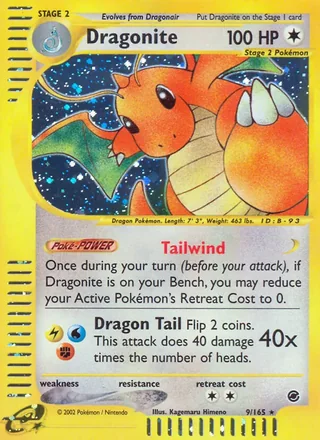
Dragonite, holofoil print of No.094. Tailwind and Dragon Tail at one Lightning, one Water and one Fire. The three-type cost is the most awkward in the set, and the holo does nothing to make it easier.
16 cards · listed in original order.
Professor Elm's Training Method, the first Trainer in the set. It fetches an Evolution card from the deck — the counterpart to the 2000 Professor Elm card, which did something else entirely. Sixteen Trainers run from here to 064, and every one of them is an uncommon.
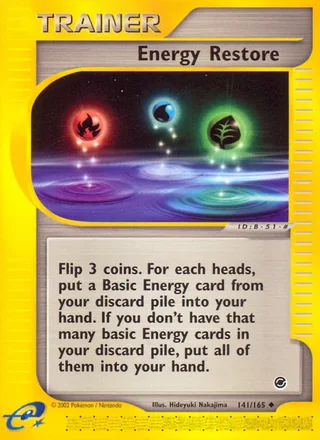
Energy Restore, one of the two recovery cards in the Trainer run. It works on basic Energy in the discard pile, which is what let e-Card decks of this period discard aggressively and still keep attacking.
Power Charge, carried over from the 2000 Neo Genesis set. Where Energy Restore at 050 puts Energy straight back into the hand, this one banks it — slower, but repeatable in a long game.
Energy Removal 2, the famous card in a new form: flip a coin, and on heads discard an Energy attached to one of your opponent's Pokémon. The 1996 original had no flip, and the flip is exactly why the reprint exists — the old card had been too strong.
Professor Oak's Research: shuffle your hand into your deck and draw five. A rebuilt Professor Oak, and the single most played card in the set — every deck of this era ran four of them.
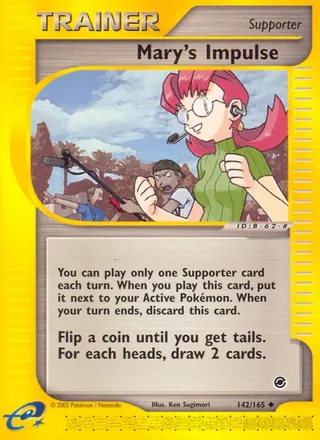
Mary's Impulse, a draw card with a coin flip attached. Mary is the Goldenrod radio host from Gold and Silver, and the set's habit of naming Trainers after game characters — Elm at 049, Oak at 053, Bill at 060 — runs right through this block.
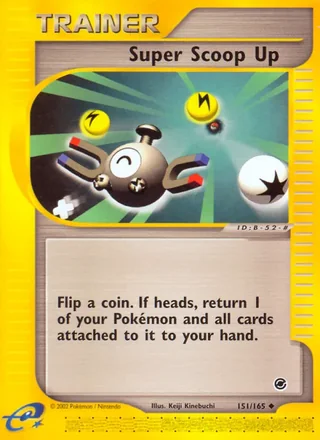
Super Scoop Up: flip a coin, and on heads return one of your Pokémon and everything attached to it to your hand. The answer to a damaged Stage 2, and a card that works only because the flip makes it unreliable.
Strength Charm, a Pokémon Tool — the holder does 10 more damage. Small, permanent, and the first of the Tools in this set; four of the sixteen Trainers here attach to a Pokémon rather than being played once.
Dual Ball: flip two coins and, for each heads, take a Basic Pokémon from your deck. The set-up card, and the one that pairs with 049 — that one finds an Evolution, this one finds the basic it evolves from.
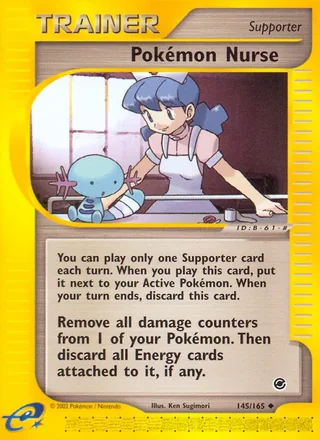
Pokémon Nurse, the healing Trainer. It works on a single Pokémon rather than the whole bench, which keeps it out of the auto-include bracket and makes it the fairer of the two healing options here.
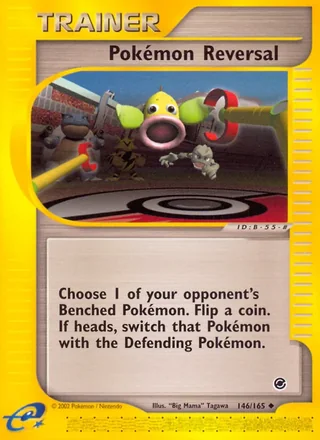
Pokémon Reversal: flip a coin, and on heads switch in one of your opponent's benched Pokémon. The set's only gust effect, and the card that makes benched Stage 2s worth building.
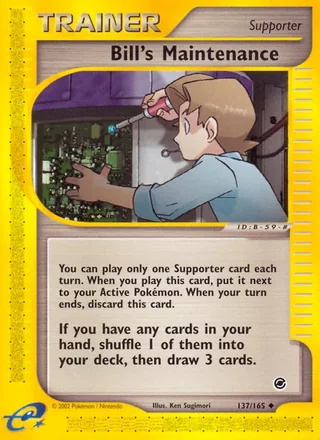
Bill's Maintenance, a rebuilding of Bill. Where 1996's Bill simply drew two cards, this one cycles the hand first — the same rebalancing that produced Energy Removal 2 at 052 and Oak's Research at 053.
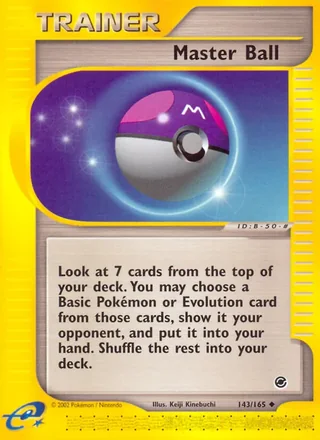
Master Ball: search the deck for any Pokémon and put it into the hand, no flip. The strongest search card in the set, and the one that makes the fifty-four Trainer-free Pokémon above actually reachable.
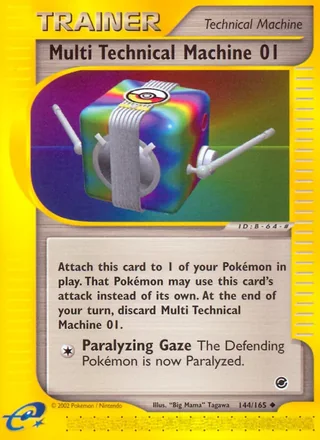
Multi Technical Machine 01, a Technical Machine that gives the holder a single attack, Paralyzing Gaze. The Multi prefix means any Pokémon can use it whatever its type — the type-agnostic Machine is one of the ideas this set introduced.
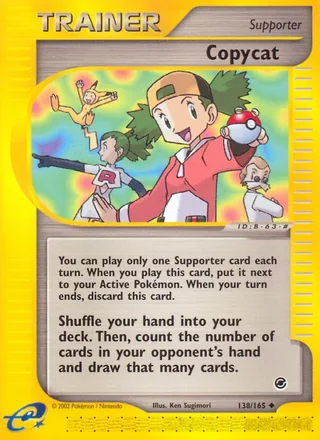
Copycat: shuffle your hand into your deck, then draw as many cards as your opponent holds. The comeback card, and one of the few Trainers here that gets better the further behind you are.
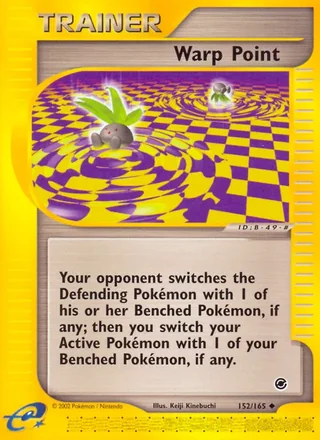
Warp Point: both players switch their Active Pokémon with a benched one. The last of the sixteen uncommons, and a card that had already appeared in Japan's Gym Booster 2 — reprinted here because the format demanded it.
Also released this year: English edition.
Products from the same year as the booster set, in release order. Expansion Sheets came out of vending machines and the preconstructed decks were sold as boxes — neither is a pack you open. Package photos come from the official product catalogue; where none exists we print NO PHOTO.
Two half decks, Chikorita and Totodile, each with a ten-card side deck — the beginner product that first turned the half-deck-plus-side-deck idea into a Japanese release. The cards carry their own numbering, a digit inside a circle (black on white for Chikorita, white on black for Totodile), with the ten side-deck cards unnumbered. The contents mix reprints from Expansion Pack and the three neo sets with cards drawn for this product. The price could not be confirmed and is left empty.
A preconstructed deck at ¥900 plus tax, released the same day as the Base Expansion Pack. Of its thirty cards, twelve are randomised — neither a fixed deck nor a booster. It came with a coin, damage counters, a rulebook and an instruction sheet whose reverse side was the entry postcard for the Starter Triple Get campaign (1 Dec 2001 – 30 Apr 2002), which distributed promos 012/P through 017/P.
English Neo Destiny — 113 cards, ten months after Japan, with no change in count. It was the last English set to carry a 1st Edition stamp.
Pokémon Heroes opens. Moviegoers received the 002/J jumbo, advance-ticket buyers Pichu Bros. 028/P. With these two the J series closes.
English Expedition Base Set — 165 cards, nine and a half months after the Base Expansion Pack. Packs dropped to nine cards, and it became the first English set with no 1st Edition. In Japan, e-Card 2 followed in January 2002, and the e series ran to five sets.
Japan's e series ends and ADV begins. Dot codes lasted only as long as the e series; the e-Reader itself never caught on. Two years on, in 2003, English production moved from Wizards of the Coast to Nintendo, and the English-only line stops there.
Japan's 2001 output is 431 cards, plus sixty from the two Intro Pack ★neo half decks, the ★VS half decks, and the Base Expansion Pack starter. Each of the four Japanese sets was built to be superseded within a year: the ★VS card back carried forward into the e series, but the ★VS and ★web cards did not slot into e-series play, and official events from 2002 centred on the e series.
Release dates and product identities are connected to the Japanese edition release register by set code. Sources are printed per product so a reader can check the claim without trusting this page alone. Unmatched products say so instead of borrowing another edition’s citation.
neo4 verified_secondaryVS1 verified_secondaryweb1 verified_secondaryE1 verified_secondaryCard data — HP, type, stage, attacks, rarity — comes from TCGdex in each language; names and release dates were checked against Bulbapedia; Japanese card faces and English names follow Pokellector and Bulbapedia's set lists. Where sources disagreed, the text printed on the card won.
TCGdex's Japanese data is machine-translated and unusable as card names. Card 001 of the tenth expansion should read コンパン and instead reads ヴェノナト; 024 should be わるいヘルガー and reads 暗い猟犬; ★VS 001 should be ハヤトのピジョット and reads フォークナーのpidgeot; 103 should be ハヤトのワザマシン01 and reads フォークナーのテクニカルマシン01. Every Japanese name was rebuilt: species from PokeAPI with the Dark / Light / Shining prefixes, ★VS names as trainer-plus-Pokémon, and every Trainer checked against the printed card — fifteen in the tenth expansion, twelve in ★VS, six in ★web, sixteen in E1.
Original Japanese scans exist for only two of the four sets. The tenth expansion and ★VS have public scans and use them directly. The Base Expansion Pack is represented by English Expedition Base Set scans — same e-Card 1, identical artwork, and all 128 Japanese-to-English number pairs were confirmed. ★web is 48 reprints, so it borrows the same cards from the 1996–2000 pages. Four ★web cards — 017 Dark Ivysaur, 032 Pokémon Retransfer, 039 Team Rocket's Meowth and 041 Dark Venusaur — have no matching artwork anywhere in the archive and are shown without a photo. Those ★web scans are the older printings, so they show the older numbers. Sixteen of the thirty-eight reprinted cards here change HP against their first printing; Arcanine, for one, drops from 100 to 70. Each entry follows the ★web card, not the picture beside it.
The artist field is empty for 190 cards — all of ★VS and ★web. TCGdex's Japanese data has no illustrator field at all, and neither set exists in English, so nothing can be borrowed. For the tenth expansion 102 artists were recovered from the matching English Neo Destiny cards, and 126 for the Base Expansion Pack from Expedition; the rest could not be pinned down because two cards share the same species and HP. Unidentified entries are left blank — an empty field is more honest than another card's artist. One entry needs a note of its own: the sources return two artist names joined together for No. 017, Mareep, with no separator. Both are shown rather than one being picked.
★VS rarity follows the source's distribution: one holo per Trainer group (nine across 001–102), the twenty-seven Technical Machines as uncommon, and the twelve item cards as common. No. 140, Energy Restore, arrived with no rarity at all, so it was set to common to match the other eleven in its group. The nine basic Energy cards (143, 144, 151 and others) carry no rarity symbol to begin with.
Prices and pack spreads follow what the publisher printed at the time. The Base Expansion Pack was five cards at ¥191 plus tax, the Starter Pack ¥900 plus tax (Nintendo's product page of the period). ★VS was 30 cards at ¥690; the tenth expansion ten cards at ¥315 including tax — that being the standing neo-series price, unchanged from sets seven through nine. ★web was Pokémon Center Online only and no official price record could be found, so the field is left empty. US prices for the three English sets are not stated, as the period MSRPs could not be confirmed.
Each of the four Japanese sets was built differently. The tenth expansion has the old back and old frame; ★VS the new back and new numbering; ★web the new back with Supporters; the Base Expansion Pack the new frame with dot codes. Laid side by side, cards from a single year look like different games — which is exactly what 2001 was.
2001 in one line: the year the card was rebuilt three times. April's tenth expansion kept the old back and added Light Pokémon; July's ★VS changed the back and the numbering; October's ★web brought in Supporters; December's Base Expansion Pack added dot codes and a new frame. No other year produced cards this different from one another inside twelve months. And the English market received none of it: ★VS and ★web were never published in English, leaving 190 cards from this year that English-speaking players never saw.