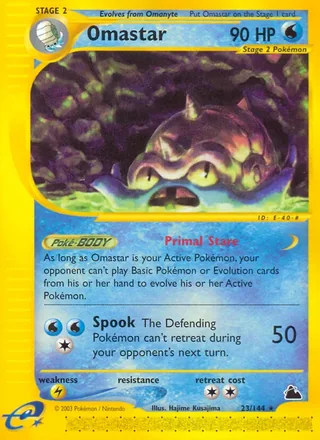
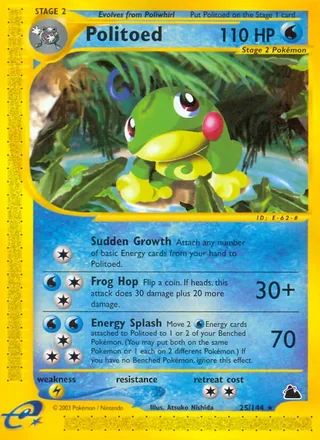
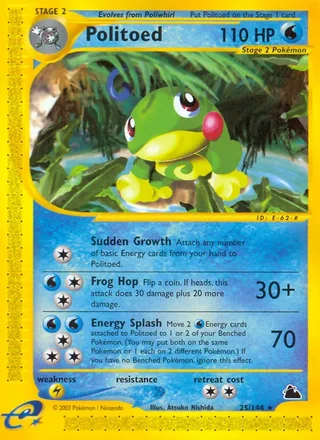
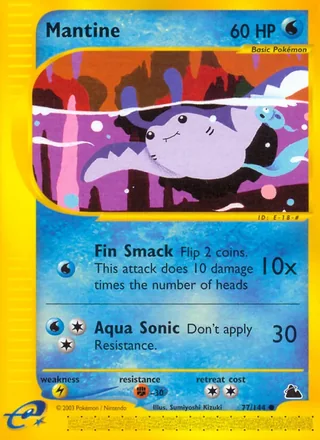
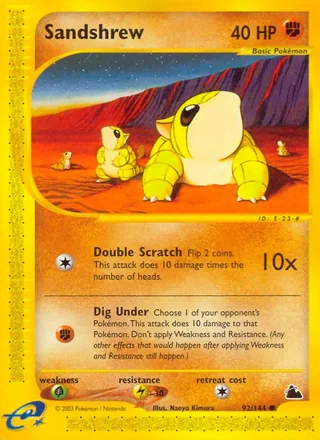
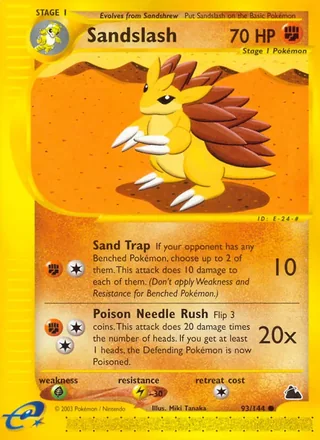
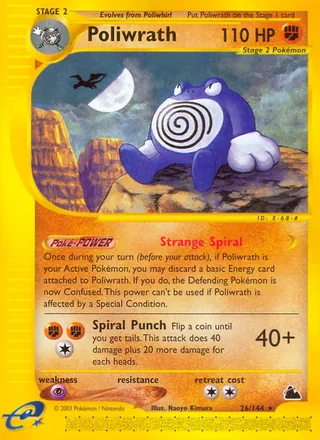
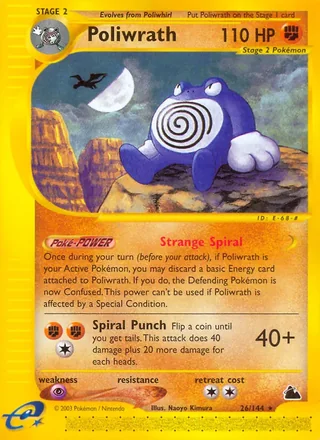
Japan · 2002

2002 Japanese edition almanac

This page covers Japan's four e-Card expansions of 2002, 364 cards. The English market released three sets that year — 388 cards — and not one of them came from Japan's 2002: they were the English printings of material Japan had already published in 2001. The two editions are on separate pages for that reason.

Four expansions in eight months, 364 cards, and a dot-code strip along the bottom of every one of them

Japan finished the e-Card series in ten months: The Town on No Map in March, Wind from the Sea in May, Split Earth in August, Mysterious Mountains in October. With the Base Expansion Pack of December 2001 that made five sets, and all five were built around a piece of hardware — Nintendo's e-Reader, which read the thickened black strip printed under every card.

The English market spent 2002 printing Japan's 2001. Neo Destiny in February was Japan's April 2001 set; Expedition in September was Japan's December 2001 set; Legendary Collection in May was the only one with no Japanese original at all. Japan's four sets of this year did not reach English until 2003, as Aquapolis and Skyridge. That gap is the story of this page.

4Sets
364Cards
73Holo
26Artists

Each set opens with what it was and when it landed, then the cards in set order. The set number is the card's own number — 001 to 092, 001 to 090, 001 to 091, 001 to 091 — with the secret cards sitting at the end of the run where they belong. Holofoil printings are marked Holo Rare and the secrets Secret Rare; nothing is merged or re-sorted.

About the pictures. The Town on No Map is scanned from Japanese cards. Wind from the Sea, Split Earth and Mysterious Mountains are English scans of the same illustrations — TCGdex holds no Japanese scans for those three, and the English sets Aquapolis and Skyridge were built from exactly this material. Every borrowed scan is labelled English scan under the card so nothing is passed off as Japanese.

How many Japanese Pokémon cards are documented in 2002?

This page documents 364 main-series cards across four products on four release dates in 2002. It covers cards printed in Japan only; printings for other editions are tracked separately.

Publication editionJapanese edition
Products4
Cards364
Release dates4 (2002-03-08 – 2002-10-04)
Series codesE2, E3, E4, E5
Card faces on record325 of 364
Latest release on record2002-10-04
Which Japanese edition sets were released in 2002?

e-Card 2 · The Town on No Map (2002-03-08, 92 cards) · e-Card 3 · Wind from the Sea (2002-05-24, 90 cards) · e-Card 4 · Split Earth (2002-08-23, 91 cards) · e-Card 5 · Mysterious Mountains (2002-10-04, 91 cards).

How many main-series cards does this page record for 2002?

364 cards across four products, an average of 91.0 cards per product. This is the main-series archive count, not a claim that every promo and event card from the year is itemised here.

What release dates does this page cover?

4 release dates, from 2002-03-08 to 2002-10-04.

Do these Japanese cards have English-edition counterparts?

307 of 364 cards (84.3%) carry a mapping to an English-edition card; the remaining 57 are Japanese-only printings or not yet paired.

How many of these 364 cards are shown with a card face?

325 of 364 cards have a card face on record; the other 39 are listed without one rather than showing a card face from a different printing. 233 of those faces are marked as a scan from another print run rather than the original printing.

What happened this year

12 entries
  • The Town on No Map (地図にない町), 92 cards, the second e-Card expansion. The e-Reader strip is now on every card and the border has widened to hold it — the layout of the card itself changed for the machine, not for the player.

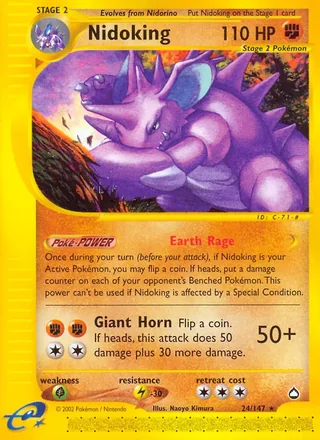
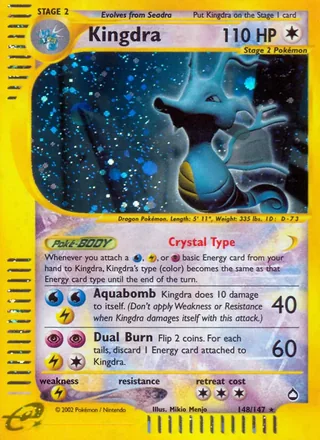
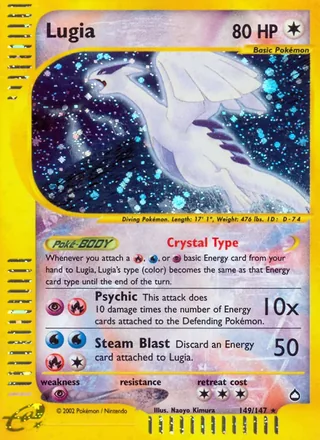
  • Wind from the Sea (海からの風), 87 numbered cards plus three secret cards — Nidoking, Kingdra and Lugia, the last of them the card English collectors would chase as Crystal Lugia.

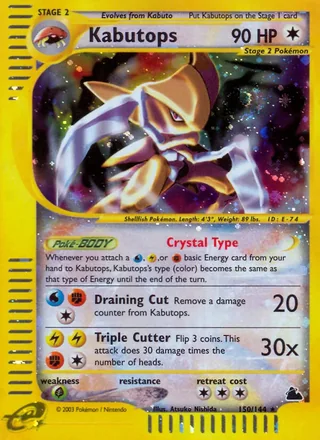
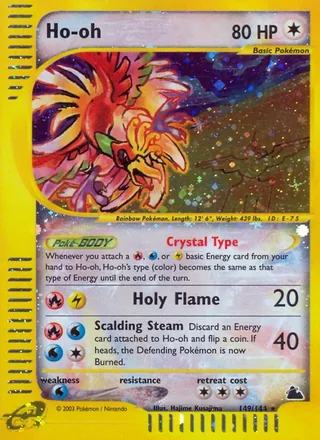
  • Split Earth (裂けた大地), 88 plus three secrets — Golem, Kabutops and Ho-oh. Ho-oh is the one that becomes Crystal Ho-Oh in English.

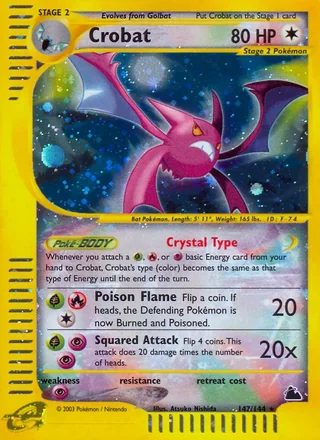
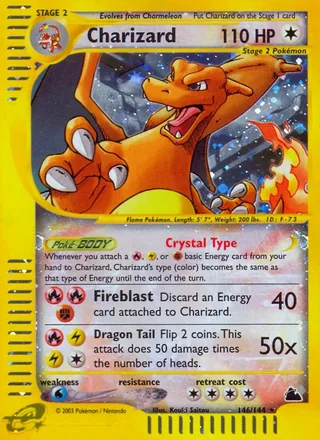
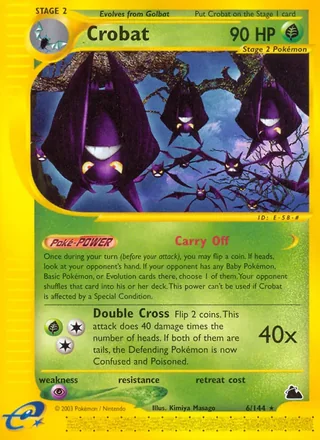
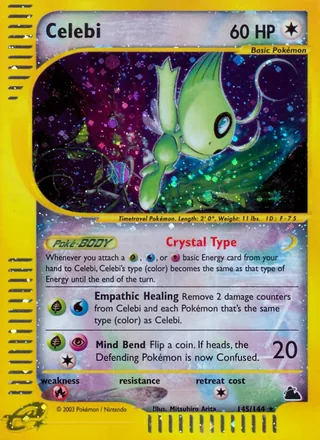
  • Mysterious Mountains (神秘なる山), 88 plus three secrets — Charizard, Crobat and Celebi. The Charizard is the single most expensive card of the era today. This was the last e-Card set Japan would get.

  • The e-Reader reaches North America. Every card printed in Japan this year carries a dot-code strip that the device could read for animations and minigames. The hardware and the cards were designed together, and the hardware was gone within two years.

  • English Neo Destiny, 113 cards — Japan's April 2001 set, ten months late, with the same count. The last English set to carry a 1st Edition stamp.

  • English Legendary Collection, 110 cards, and the only English set of the year with no Japanese original: every card is a reprint of Base Set, Jungle, Fossil or Team Rocket. It is also the first English set to put a reverse holofoil in every pack.

  • English Expedition Base Set, 165 cards — Japan's Base Expansion Pack of December 2001, expanded from 128 to 165. The first English set with the e-Reader strip.

  • Best of Game, nine promotional cards given out through leagues in the United States — Electabuzz, Hitmonchan, Professor Elm, Rocket's Scizor, Rocket's Sneasel, Dark Ivysaur, Dark Venusaur, Rocket's Mewtwo, Rocket's Hitmonchan.

  • Every Japanese card this year is holofoil-stamped in the same way. Sixteen holos per set, three secrets, and a fixed 88-or-92 card run. For the first time in the game the structure of a set was completely predictable — Japan shipped the same shape four times.

  • The two editions never touch. Japan printed 364 cards in 2002; the English market printed 388. The overlap is zero. Not a single card printed in Japan this year appeared in English this year.

  • Wizards' licence was running out. Nintendo had been preparing to take distribution in-house since 2001. Skyridge, built from this year's last two Japanese sets, would be the final Wizards expansion — and it got one print run.

Promos, handouts & prizes

not itemised
Why this is empty. Japan's 2002 promotional cards — the numbered P series continuing from 2001, the McDonald's Original Minimum Pack handed out in Japanese restaurants from 26 January to 24 February, and the tournament and magazine inserts — are a separate line of collecting with its own numbering. We hold no card-face scans for them and our sources do not pin each one to a single distribution date. Rather than list them from memory, this section stays closed until both can be established. The nine English promos of the year (Best of Game) are listed on the English page.

e-Card 2 · The Town on No Map

2002-03-0892 cardsHOLO 16

8 March 2002. Ninety-two cards — 74 Pokémon and 18 Trainer & Energy — with no secret cards, the only set of the four with a clean run. Sixteen holofoil rares, twenty-four uncommons, thirty-six commons.

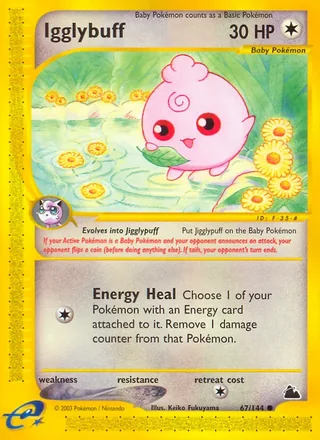
The e-Card card is a different object. The bottom border is roughly twice the height of a Neo card's, because the dot-code strip has to sit somewhere. The left edge is wider too. The set is heavy on Water and Grass — twelve and thirteen cards — which is why the English set built from it, Aquapolis, reads as a sea set. Three Baby Pokémon appear (Pichu, Cleffa, Igglybuff), the only Babies in the four sets.

Grass13 cardsHOLO 3

13 cards · listed in original order.

Nidoran ♂ — ニドラン♂ (2002)
001

Nidoran ♂ニドラン♂

COMMON
GrassHP 50BasicDex No. 032Illus. Keiko Fukuyama

Nidoran♂, 50 HP, the set's first card and one of three Poison-types in the opening run. A one-Energy jab and a two-Energy horn, retreat 1. It is the only Nidoran in the set without a second printing — its evolution, Nidorino, follows at 002 and then stops: Nidoking is not in this set, so the line breaks at Stage 1.

Nidorino — ニドリーノ (2002)
002

Nidorinoニドリーノ

COMMON
GrassHP 70Stage 1Dex No. 033Illus. Kagemaru Himeno

Nidorino, 70 HP Stage 1, up from 60 in 1996. Ten for one Grass, forty for three Colourless, retreat 1. It is the highest HP in the set's first twenty cards and one of only four Stage 1 Pokémon here that never reach Stage 2 inside the set.

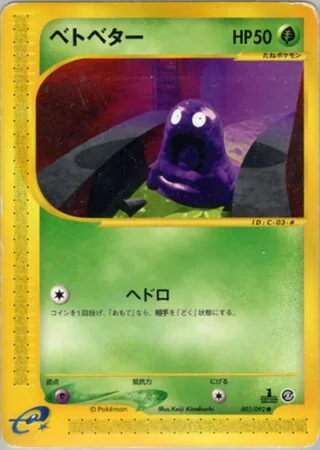
Grimer — ベトベター (2002)
003

Grimerベトベター

COMMON
GrassHP 50BasicDex No. 088Illus. Keiji Kinebuchi

Grimer, 50 HP, up from 40 in 1997, with a single Colourless attack and retreat 1. It is the plain half of the Grimer line; Muk follows at 004 and again at 005.

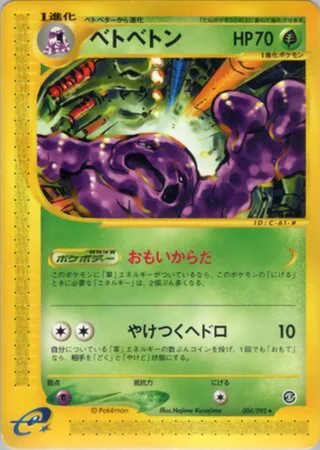
Muk — ベトベトン (2002)
004

Mukベトベトン

RARE
GrassHP 70Stage 1Dex No. 089Illus. Hajime Kusajima

Muk, 70 HP Stage 1 — the same 70 it has had since 1997 — with one attack for two Colourless and retreat 1. This is the plain rare; 005 is the same card in holofoil, same illustrator, same attacks, one number later.

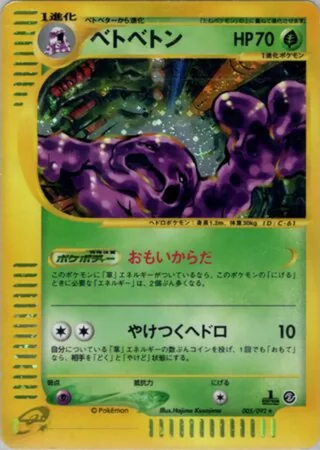
Muk — ベトベトン (2002)
005

Mukベトベトン

HOLO RARE
GrassHP 70Stage 1Dex No. 089Illus. Hajime Kusajima

Muk, holofoil. Same 70 HP, same two-Colourless attack, same Hajime Kusajima art as 004. Every one of this set's sixteen holofoils is a foil version of a card printed plain elsewhere in the same set — there is no separate holo-only design in e-Card 2, and no H-numbered run until the English Aquapolis.

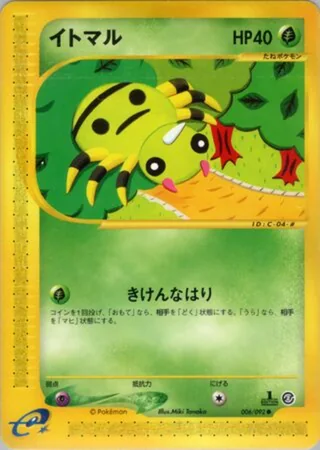
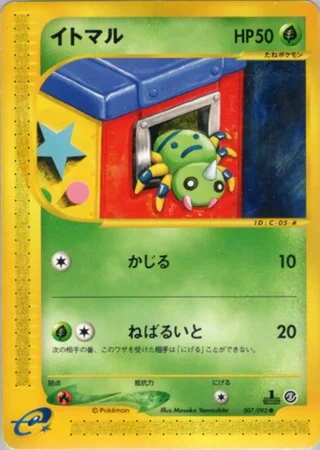
Spinarak — イトマル (2002)
006

Spinarakイトマル

COMMON
GrassHP 40BasicDex No. 167Illus. Miki Tanaka

Spinarak, 40 HP, the lower of the set's two Spinarak. One Grass attack, retreat 1, and no damage printed on it at all — a status card rather than a hitter.

Spinarak — イトマル (2002)
007

Spinarakイトマル

COMMON
GrassHP 50BasicDex No. 167Illus. Masako Yamashita

Spinarak, 50 HP — ten more than 006, and a different card: two attacks, ten for one Colourless and twenty for Grass plus Colourless. Two Spinarak in one set with different HP and different attacks is normal for e-Card 2; it does the same with Growlithe, Voltorb, Wooper and Magnemite.

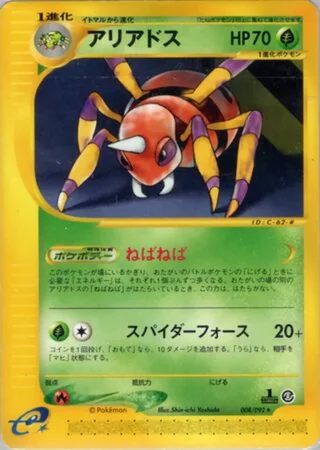
Ariados — アリアドス (2002)
008

Ariadosアリアドス

RARE
GrassHP 70Stage 1Dex No. 168Illus. Shin-ichi Yoshida

Ariados, 70 HP Stage 1, free retreat and one Grass-Colourless attack. The free retreat is the point: it is one of only six cards in the set that cost nothing to pull back. Plain rare here, holofoil at 009.

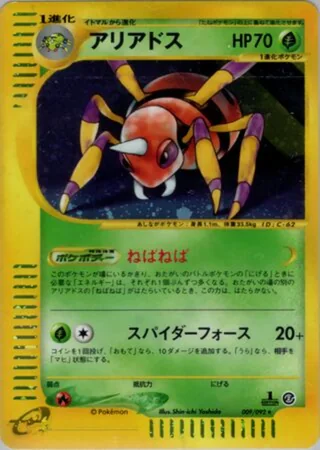
Ariados — アリアドス (2002)
009

Ariadosアリアドス

HOLO RARE
GrassHP 70Stage 1Dex No. 168Illus. Shin-ichi Yoshida

Ariados, holofoil — same 70 HP, same free retreat, same Shin-ichi Yoshida art as 008. The pair is the cleanest example of how this set handles rarity: the holo is not a better card, it is the same card with foil on it.

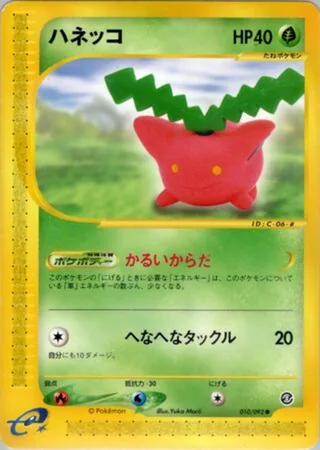
Hoppip — ハネッコ (2002)
010

Hoppipハネッコ

COMMON
GrassHP 40BasicDex No. 187Illus. Yuka Morii

Hoppip, 40 HP, up from 30 in 2000, with one Colourless attack for 20 and retreat 1. The first of three cards in this set drawn by Yuka Morii, who draws the whole Hoppip line here — 010, 011 and both Jumpluff.

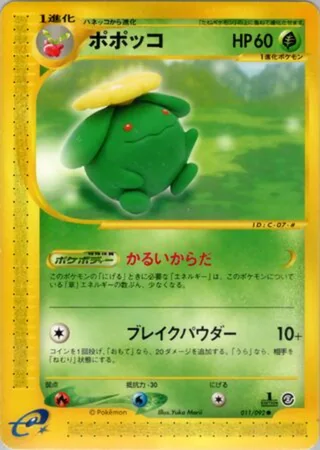
Skiploom — ポポッコ (2002)
011

Skiploomポポッコ

COMMON
GrassHP 60Stage 1Dex No. 188Illus. Yuka Morii

Skiploom, 60 HP Stage 1, unchanged since 2000, one Colourless attack, retreat 1. Yuka Morii again. The line runs Hoppip → Skiploom → Jumpluff (012) without a break, one of only four complete three-stage lines in the set.

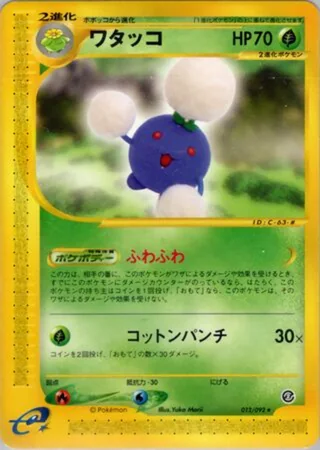
Jumpluff — ワタッコ (2002)
012

Jumpluffワタッコ

RARE
GrassHP 70Stage 2Dex No. 189Illus. Yuka Morii

Jumpluff, 70 HP Stage 2, free retreat and a single Grass attack. Plain rare. The end of the set's only complete Grass line, and one of eight Stage 2 Pokémon here — the fewest of the four 2002 sets.

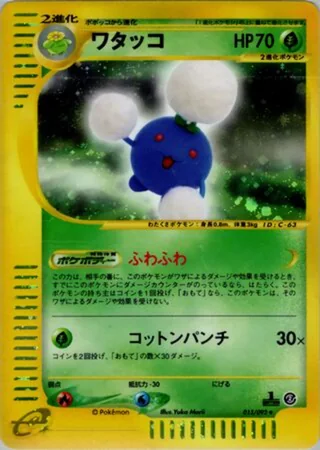
Jumpluff — ワタッコ (2002)
013

Jumpluffワタッコ

HOLO RARE
GrassHP 70Stage 2Dex No. 189Illus. Yuka Morii

Jumpluff, holofoil — same 70 HP, same free retreat, same Yuka Morii art as 012. With Hoppip and Skiploom above it, the whole line is drawn by one artist, which is rare in a set this size.

Fire6 cardsHOLO 1

6 cards · listed in original order.

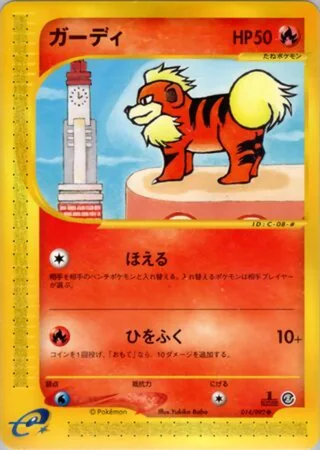
Growlithe — ガーディ (2002)
014

Growlitheガーディ

COMMON
FireHP 50BasicDex No. 058Illus. Yukiko Baba

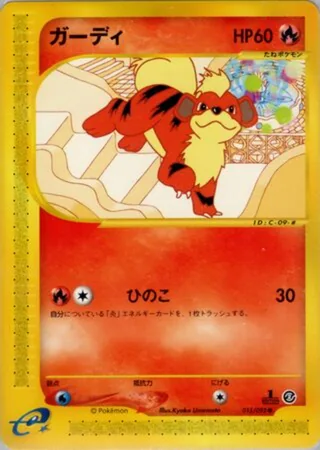
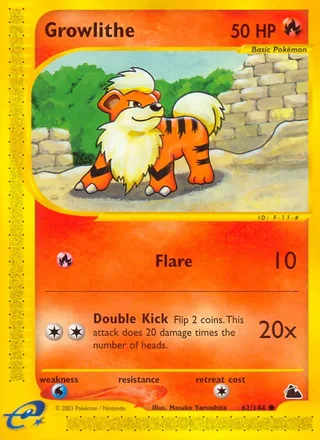
Growlithe, 50 HP, one of two in the set. Two attacks, a Colourless one and a Fire one, retreat 1. 015 is the other Growlithe at 60 HP — ten more, different attacks, different artist.

Growlithe — ガーディ (2002)
015

Growlitheガーディ

COMMON
FireHP 60BasicDex No. 058Illus. Kyoko Umemoto

Growlithe, 60 HP, the stronger of the pair, with a single Fire-Colourless attack for 30. Drawn by Kyoko Umemoto, who also draws both Arcanine at 016 and 017 — so the whole evolution line carries one hand.

Arcanine — ウインディ (2002)
016

Arcanineウインディ

RARE
FireHP 90Stage 1Dex No. 059Illus. Kyoko Umemoto

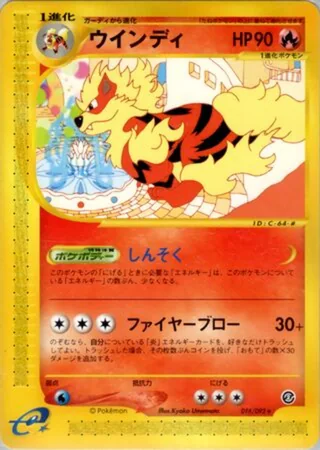
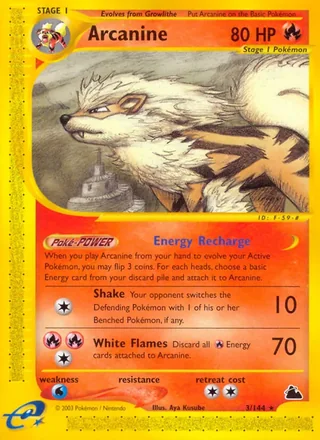
Arcanine, 90 HP Stage 1, retreat 3 — the most expensive retreat in the set alongside Nidoking. One attack for three Colourless. Down from 100 HP in 1996 and 70 in 2001: this is the highest-HP Arcanine printed so far.

Arcanine — ウインディ (2002)
017

Arcanineウインディ

HOLO RARE
FireHP 90Stage 1Dex No. 059Illus. Kyoko Umemoto

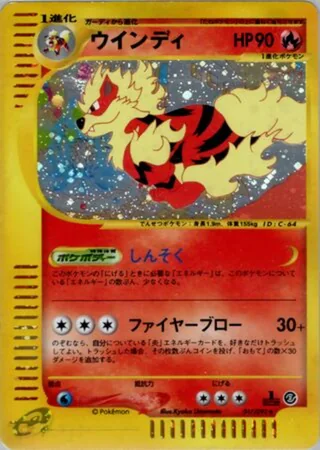
Arcanine, holofoil — same 90 HP, same retreat 3, same Kyoko Umemoto art as 016. One of the two heaviest cards in the set by HP-and-retreat together, and the only Fire holofoil in e-Card 2.

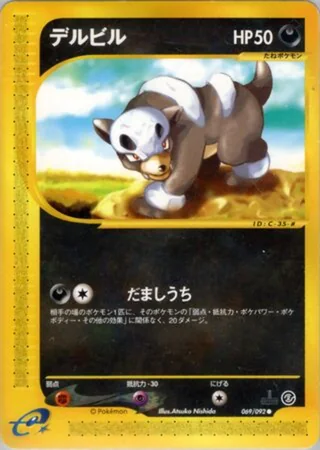
Houndour — デルビル (2002)
018

Houndourデルビル

COMMON
FireHP 50BasicDex No. 228Illus. Midori Harada

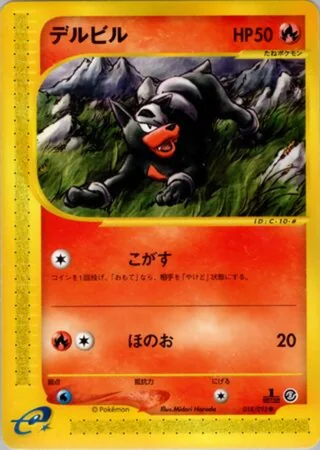
Houndour, 50 HP, one of two in the set, and the only one drawn by Midori Harada. Two attacks — a Colourless sing and a Fire-colourless flare for 20 — retreat 1. The Darkness Houndour is at 069, in the second half of the set.

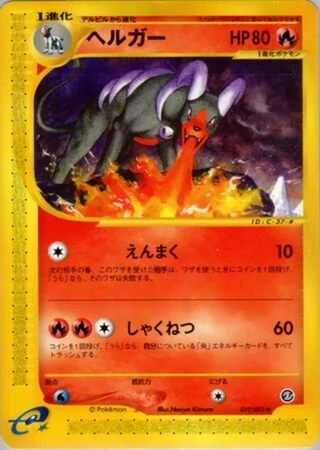
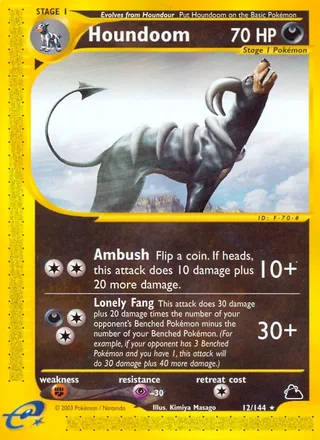
Houndoom — ヘルガー (2002)
019

Houndoomヘルガー

UNCOMMON
FireHP 80Stage 1Dex No. 229Illus. Naoyo Kimura

Houndoom, 80 HP Stage 1, uncommon — the only Houndoom in the set that is not a rare. Two attacks, ten for one Colourless and sixty for Fire-Fire-Colourless, retreat 1. At 80 HP it is ten above the 2000 card.

Water12 cardsHOLO 2

12 cards · listed in original order.

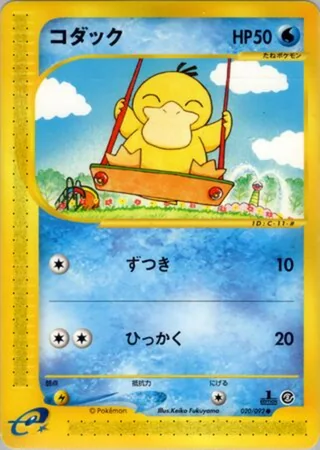
Psyduck — コダック (2002)
020

Psyduckコダック

COMMON
WaterHP 50BasicDex No. 054Illus. Keiko Fukuyama

Psyduck, 50 HP, unchanged since 1997, two Colourless attacks for 10 and 20, retreat 1. One of the few cards here whose HP has not moved in five years.

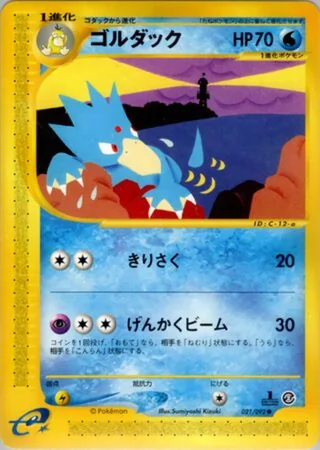
Golduck — ゴルダック (2002)
021

Golduckゴルダック

COMMON
WaterHP 70Stage 1Dex No. 055Illus. Sumiyoshi Kizuki

Golduck, 70 HP Stage 1, unchanged since 1997, two attacks, retreat 1. It carries a Psychic-coloured attack despite being a Water card — the set does this on several Water Pokémon, and it is the reason a third of the set's Water cards can hit a Psychic weakness.

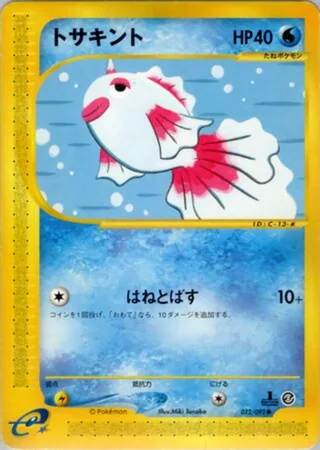
Goldeen — トサキント (2002)
022

Goldeenトサキント

COMMON
WaterHP 40BasicDex No. 118Illus. Miki Tanaka

Goldeen, 40 HP, its fourth printing since 1997 and the lowest HP of them. One Colourless attack with no damage, retreat 1. Seaking at 023 is its evolution, so the line is complete — one of only four complete two-stage lines in the set.

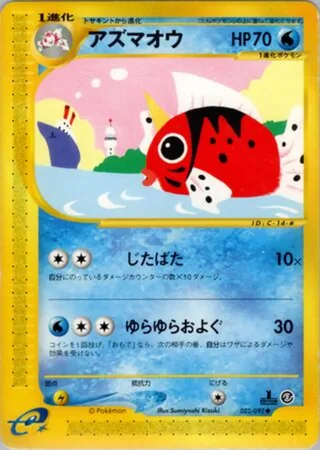
Seaking — アズマオウ (2002)
023

Seakingアズマオウ

COMMON
WaterHP 70Stage 1Dex No. 119Illus. Sumiyoshi Kizuki

Seaking, 70 HP Stage 1, two attacks — a two-Colourless flail and a Water-colourless one for 30 — retreat 1. Drawn by Sumiyoshi Kizuki.

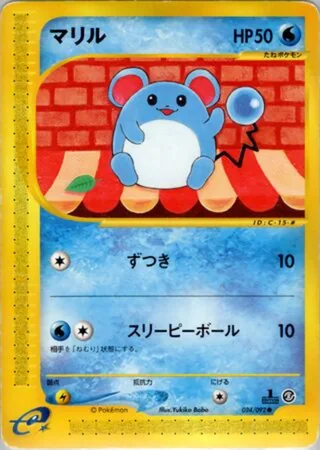
Marill — マリル (2002)
024

Marillマリル

COMMON
WaterHP 50BasicDex No. 183Illus. Yukiko Baba

Marill, 50 HP, its fourth printing since 1999. Two attacks, both for 10, retreat 1. The set prints Marill and Azumarill as a pair, and Azumarill gets both a plain and a holo.

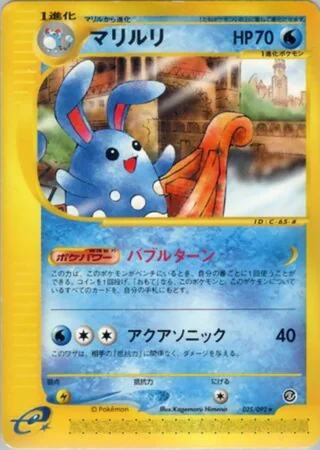
Azumarill — マリルリ (2002)
025

Azumarillマリルリ

RARE
WaterHP 70Stage 1Dex No. 184Illus. Kagemaru Himeno

Azumarill, 70 HP Stage 1, unchanged since 2000. One Water-colourless attack for 40, retreat 1, drawn by Kagemaru Himeno. Plain rare; 026 is the holofoil.

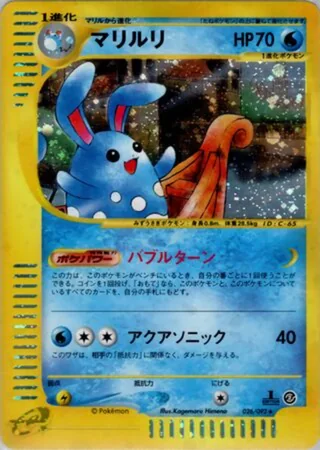
Azumarill — マリルリ (2002)
026

Azumarillマリルリ

HOLO RARE
WaterHP 70Stage 1Dex No. 184Illus. Kagemaru Himeno

Azumarill, holofoil — same 70 HP, same 40-damage attack, same Kagemaru Himeno art as 025. The only Water holofoil in the set.

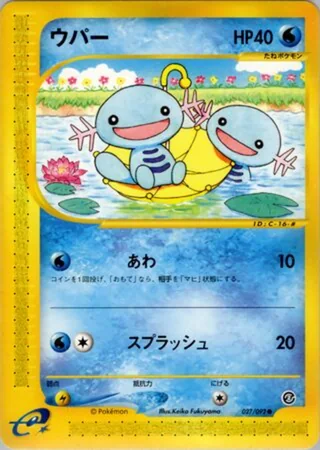
Wooper — ウパー (2002)
027

Wooperウパー

COMMON
WaterHP 40BasicDex No. 194Illus. Keiko Fukuyama

Wooper, 40 HP, the first of two. Two Water attacks for 10 and 20, retreat 1, drawn by Keiko Fukuyama. 028 is the other Wooper at 50 HP with different attacks and a different artist.

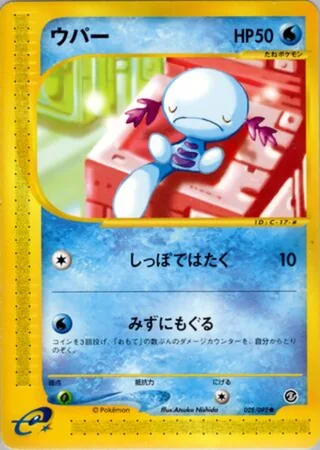
Wooper — ウパー (2002)
028

Wooperウパー

COMMON
WaterHP 50BasicDex No. 194Illus. Atsuko Nishida

Wooper, 50 HP — ten more than 027, and a different card: a Colourless tail whip and a Water dive. Drawn by Atsuko Nishida. Two Woopers in one set, both Basic, both Water, neither one a reprint of the other.

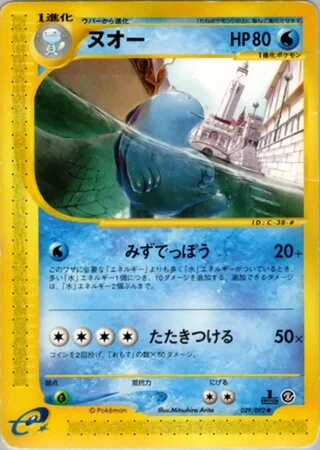
Quagsire — ヌオー (2002)
029

Quagsireヌオー

UNCOMMON
WaterHP 80Stage 1Dex No. 195Illus. Mitsuhiro Arita

Quagsire, 80 HP Stage 1 — ten above the 2000 card — retreat 2, two attacks, the second costing four Colourless. The highest-HP Water Pokémon in the set after Suicune.

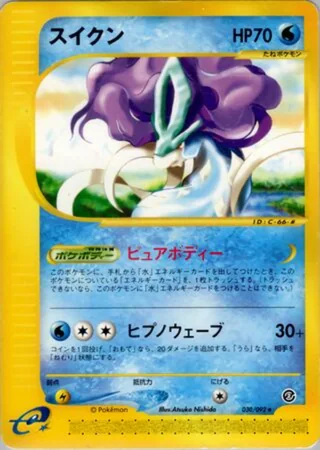
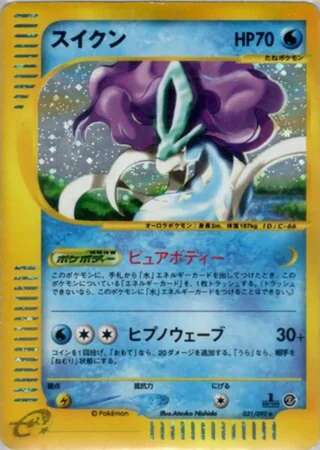
Suicune — スイクン (2002)
030

Suicuneスイクン

RARE
WaterHP 70BasicDex No. 245Illus. Atsuko Nishida

Suicune, 70 HP Basic, one attack for three Energy and no damage printed on it — a status card, not a hitter. Plain rare here, holofoil at 031. Same 70 HP as the 2000 print, and the same attack cost.

Suicune — スイクン (2002)
031

Suicuneスイクン

HOLO RARE
WaterHP 70BasicDex No. 245Illus. Atsuko Nishida

Suicune, holofoil — same 70 HP, same single attack, same Atsuko Nishida art as 030. The only legendary beast of the three in this set: Entei is in e-Card 3, Raikou in e-Card 4, and the three never appear together in any 2002 set.

Lightning8 cardsHOLO 2

8 cards · listed in original order.

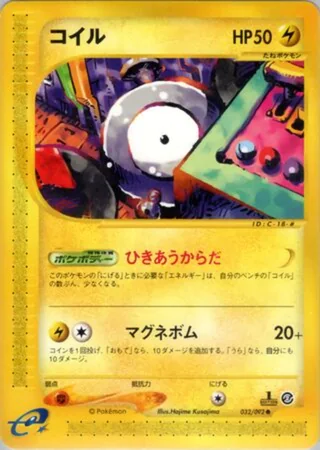
Magnemite — コイル (2002)
032

Magnemiteコイル

COMMON
LightningHP 50BasicDex No. 081Illus. Hajime Kusajima

Magnemite, 50 HP — ten above every previous printing, which had been stuck at 40 since 1996. One Lightning-Colourless attack, retreat 1. The Metal Magnemite at 072 is a different card entirely.

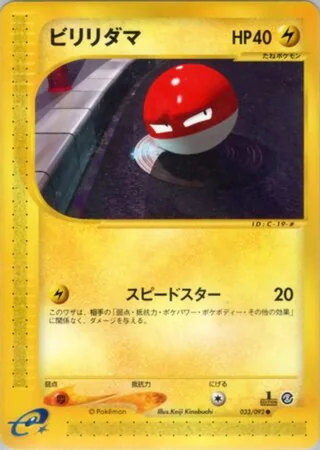
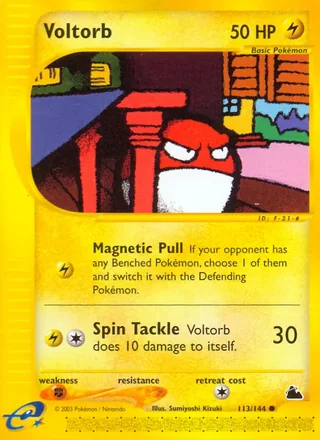
Voltorb — ビリリダマ (2002)
033

Voltorbビリリダマ

COMMON
LightningHP 40BasicDex No. 100Illus. Keiji Kinebuchi

Voltorb, 40 HP, one of two in the set. A single Lightning attack for 20, retreat 1, drawn by Keiji Kinebuchi. The other Voltorb at 034 has 50 HP and two attacks.

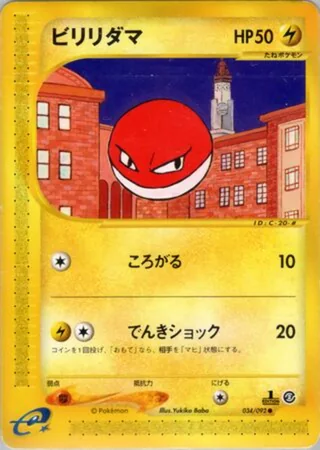
Voltorb — ビリリダマ (2002)
034

Voltorbビリリダマ

COMMON
LightningHP 50BasicDex No. 100Illus. Yukiko Baba

Voltorb, 50 HP — ten more than 033 — with a Colourless rollout and a Lightning shock for 20. Two Voltorb, two Electrode: the set prints the whole line twice, once at each strength.

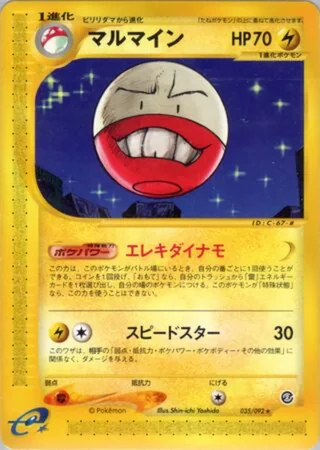
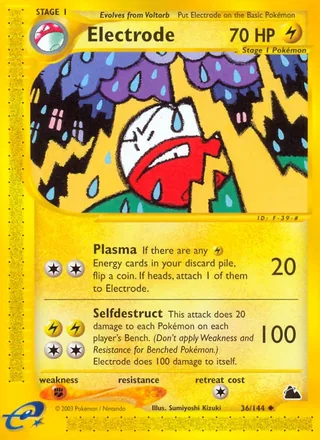
Electrode — マルマイン (2002)
035

Electrodeマルマイン

RARE
LightningHP 70Stage 1Dex No. 101Illus. Shin-ichi Yoshida

Electrode, 70 HP Stage 1 — down from 90 in 1996 and 80 in 1997 — one Lightning-colourless attack for 30, retreat 1. Plain rare; holofoil at 036.

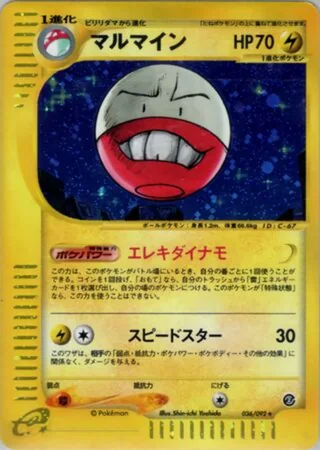
Electrode — マルマイン (2002)
036

Electrodeマルマイン

HOLO RARE
LightningHP 70Stage 1Dex No. 101Illus. Shin-ichi Yoshida

Electrode, holofoil — same 70 HP, same 30-damage attack, same Shin-ichi Yoshida art as 035. The only Lightning holofoil in the set.

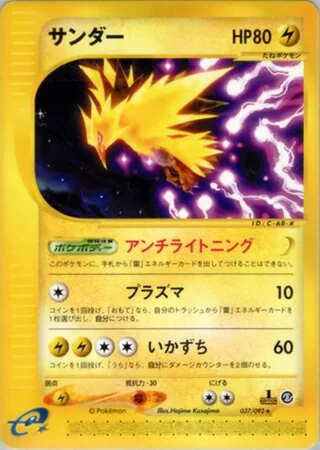
Zapdos — サンダー (2002)
037

Zapdosサンダー

RARE
LightningHP 80BasicDex No. 145Illus. Hajime Kusajima

Zapdos, 80 HP Basic, retreat 2, two attacks — ten for one Colourless and sixty for four Energy. Down from 90 HP in 1996 and up from 70 in 1997 and 2001, so this is the middle of the three printings.

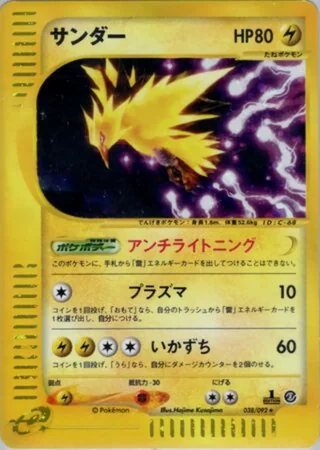
Zapdos — サンダー (2002)
038

Zapdosサンダー

HOLO RARE
LightningHP 80BasicDex No. 145Illus. Hajime Kusajima

Zapdos, holofoil — same 80 HP, same four-Energy 60, same Hajime Kusajima art as 037. The heaviest attack in the set by Energy cost, tied with Nidoking's four.

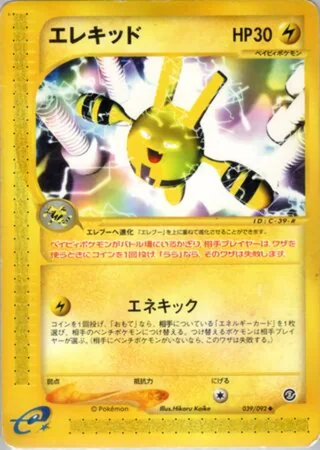
Elekid — エレキッド (2002)
039

Elekidエレキッド

UNCOMMON
LightningHP 30BabyDex No. 239Illus. Hikaru Koike

Elekid, 30 HP Baby, unchanged since 2000, one Lightning attack with no damage, retreat 1. One of three Babies in the set — with Smoochum at 047 and Tyrogue at 055 — and the only one that is not a common.

Psychic8 cardsHOLO 2

8 cards · listed in original order.

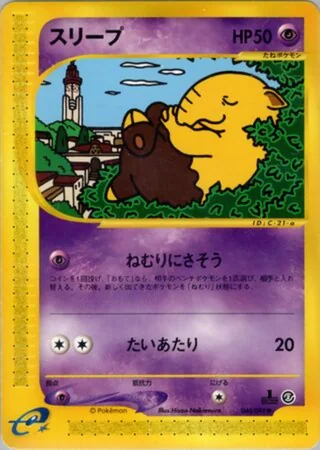
Drowzee — スリープ (2002)
040

Drowzeeスリープ

COMMON
PsychicHP 50BasicDex No. 096Illus. Hisao Nakamura

Drowzee, 50 HP, unchanged since 1997. Two attacks, a Psychic sleep and a two-Colourless 20, retreat 1. Hypno at 041 and 042 is its evolution, printed twice — plain and holo.

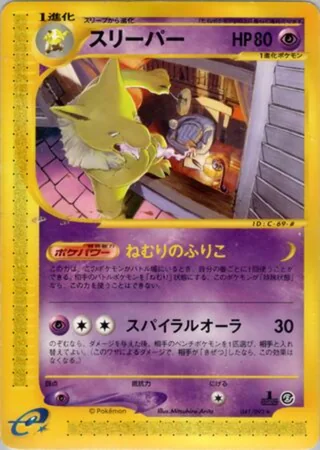
Hypno — スリーパー (2002)
041

Hypnoスリーパー

RARE
PsychicHP 80Stage 1Dex No. 097Illus. Mitsuhiro Arita

Hypno, 80 HP Stage 1 — down from 90 in 1997 — one Psychic-colourless attack for 30, retreat 1. Plain rare; 042 is the holofoil. Drawn by Mitsuhiro Arita.

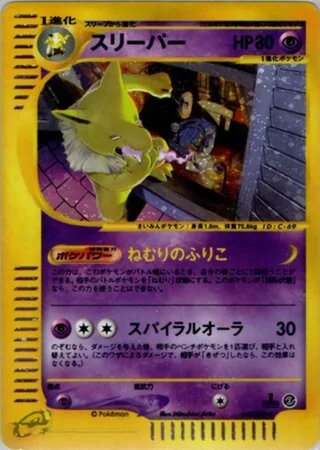
Hypno — スリーパー (2002)
042

Hypnoスリーパー

HOLO RARE
PsychicHP 80Stage 1Dex No. 097Illus. Mitsuhiro Arita

Hypno, holofoil — same 80 HP, same 30-damage attack, same Mitsuhiro Arita art as 041. The only Psychic holofoil in the first half of the set; Espeon at 045/046 is the other.

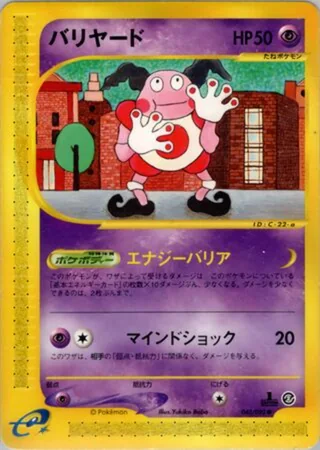
Mr. Mime — バリヤード (2002)
043

Mr. Mimeバリヤード

COMMON
PsychicHP 50BasicDex No. 122Illus. Yukiko Baba

Mr. Mime, 50 HP — ten above the 1997 card — one Psychic-colourless attack for 20, retreat 1. A common, which is unusual for a card that had been a rare in 1997.

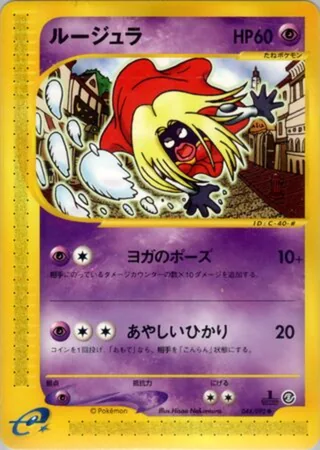
Jynx — ルージュラ (2002)
044

Jynxルージュラ

UNCOMMON
PsychicHP 60BasicDex No. 124Illus. Hisao Nakamura

Jynx, 60 HP, its third printing since 1996 and the lowest of them (the 2000 and 2001 cards were 70). Two Psychic attacks, retreat 2 — the most expensive retreat of any Psychic card in the set.

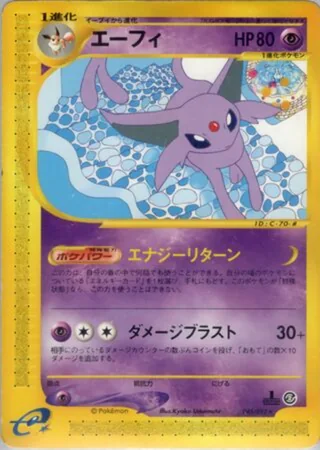
Espeon — エーフィ (2002)
045

Espeonエーフィ

RARE
PsychicHP 80Stage 1Dex No. 196Illus. Kyoko Umemoto

Espeon, 80 HP Stage 1, free retreat, one Psychic-colourless attack with no printed damage. Plain rare; 046 is the holofoil. Same 80 HP as the 2000 print, and the only Eevee evolution in the set that gets both printings.

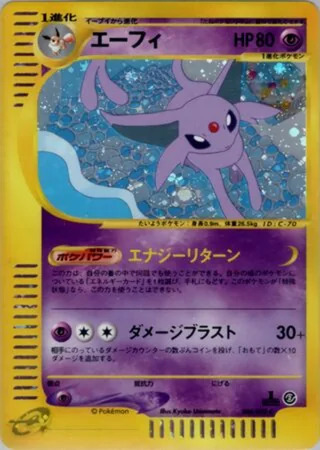
Espeon — エーフィ (2002)
046

Espeonエーフィ

HOLO RARE
PsychicHP 80Stage 1Dex No. 196Illus. Kyoko Umemoto

Espeon, holofoil — same 80 HP, same free retreat, same Kyoko Umemoto art as 045. One of six cards in the set with free retreat, and the only one of those that is a holofoil.

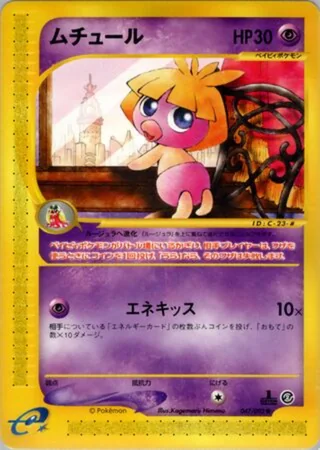
Smoochum — ムチュール (2002)
047

Smoochumムチュール

COMMON
PsychicHP 30BabyDex No. 238Illus. Kagemaru Himeno

Smoochum, 30 HP Baby, unchanged since 2000, one Psychic attack with no damage, retreat 1. A common. The second of the three Babies; the third, Tyrogue, is at 055.

Fighting9 cardsHOLO 1

9 cards · listed in original order.

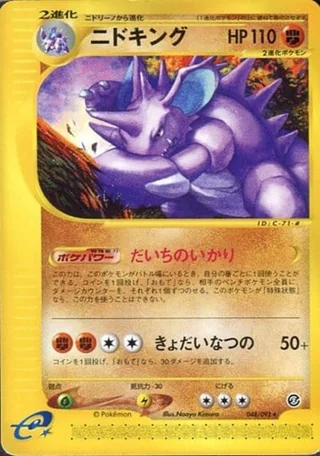
Nidoking — ニドキング (2002)
048

Nidokingニドキング

RARE
FightingHP 110Stage 2Dex No. 034Illus. Naoyo Kimura

Nidoking, 110 HP Stage 2 — twenty above the 1996 and 2001 cards — retreat 3, one attack for four Energy. Plain rare here, holofoil at 049. The highest HP in the set, tied only with Blissey at 065.

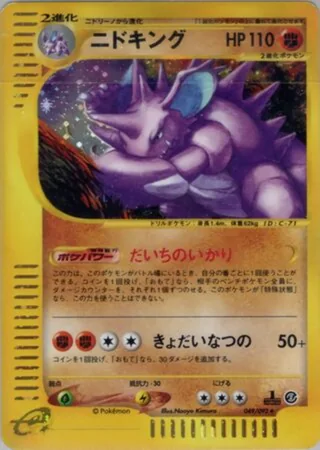
Nidoking — ニドキング (2002)
049

Nidokingニドキング

HOLO RARE
FightingHP 110Stage 2Dex No. 034Illus. Hironobu Yoshida

Nidoking, holofoil — 110 HP Stage 2, the set's ceiling, drawn by Hironobu Yoshida rather than by Naoyo Kimura who drew the plain print at 048. Same HP, same four-Energy attack, different artist: this is the one holo pair in the set where the illustrator changes between the plain and the foil.

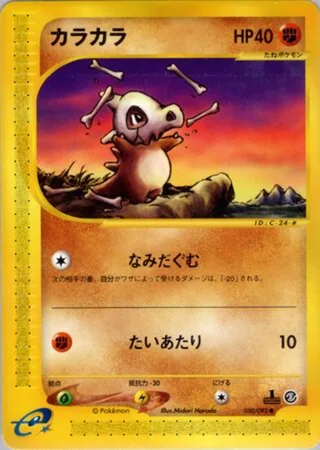
Cubone — カラカラ (2002)
050

Cuboneカラカラ

COMMON
FightingHP 40BasicDex No. 104Illus. Midori Harada

Cubone, 40 HP, unchanged since 1997, two attacks — a Colourless one and a Fighting 10 — retreat 1. Marowak at 051 completes the line, one of four complete two-stage lines in the set.

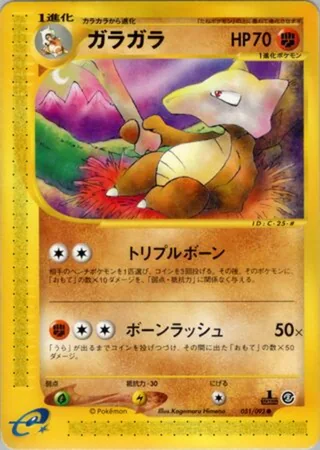
Marowak — ガラガラ (2002)
051

Marowakガラガラ

COMMON
FightingHP 70Stage 1Dex No. 105Illus. Kagemaru Himeno

Marowak, 70 HP Stage 1, up from 60 in 1997, retreat 1, two attacks with the second costing two Fighting and Colourless. A common — the whole Marowak line is common in this set, which is unusual for a Stage 1 with 70 HP.

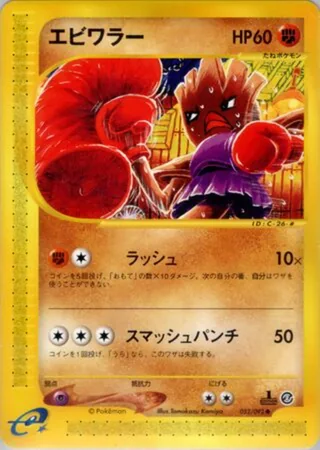
Hitmonchan — エビワラー (2002)
052

Hitmonchanエビワラー

COMMON
FightingHP 60BasicDex No. 107Illus. Tomokazu Komiya

Hitmonchan, 60 HP, unchanged since 1996, retreat 2, two attacks with a 50-damage three-Energy punch. Drawn by Tomokazu Komiya, who draws all three of the set's Fighting basics that came out of the Tyrogue line — Hitmonchan here, Tyrogue at 055, Hitmontop at 056.

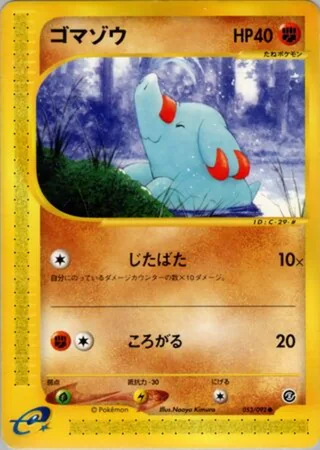
Phanpy — ゴマゾウ (2002)
053

Phanpyゴマゾウ

COMMON
FightingHP 40BasicDex No. 231Illus. Naoyo Kimura

Phanpy, 40 HP, unchanged since 2000, two attacks, retreat 1. Donphan at 054 is the evolution, so the line is complete.

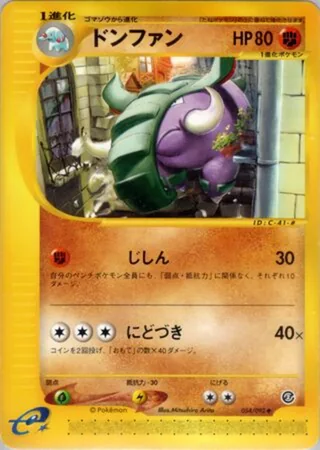
Donphan — ドンファン (2002)
054

Donphanドンファン

UNCOMMON
FightingHP 80Stage 1Dex No. 232Illus. Mitsuhiro Arita

Donphan, 80 HP Stage 1 — ten above the 2000 card — retreat 2, two attacks, the second costing three Colourless. An uncommon, and the only Ground-type evolution in the set.

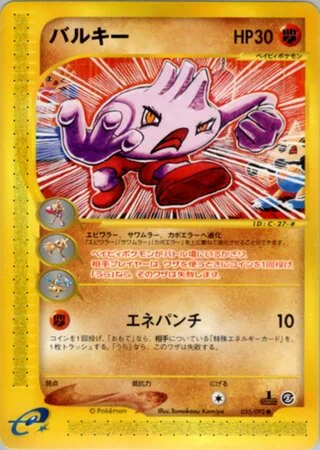
Tyrogue — バルキー (2002)
055

Tyrogueバルキー

COMMON
FightingHP 30BabyDex No. 236Illus. Tomokazu Komiya

Tyrogue, 30 HP Baby, unchanged since 2000, one Fighting attack for 10, retreat 1. A common. All three Babies in the set are 30 HP and all three cost one Energy to attack — Elekid, Smoochum, Tyrogue — the only structural rule this set applies without exception.

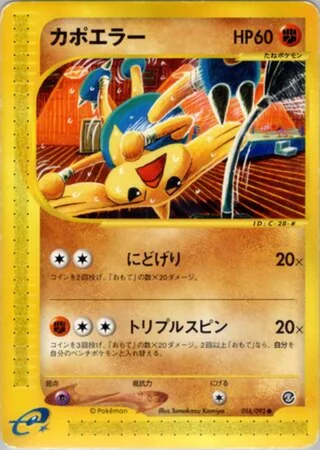
Hitmontop — カポエラー (2002)
056

Hitmontopカポエラー

COMMON
FightingHP 60BasicDex No. 237Illus. Tomokazu Komiya

Hitmontop, 60 HP Basic, retreat 1, two attacks — a two-Colourless double kick and a Fighting-colourless triple spin. The third of the three Tyrogue-line cards here, and the only one that is not a Baby.

Darkness5 cardsHOLO 2

5 cards · listed in original order.

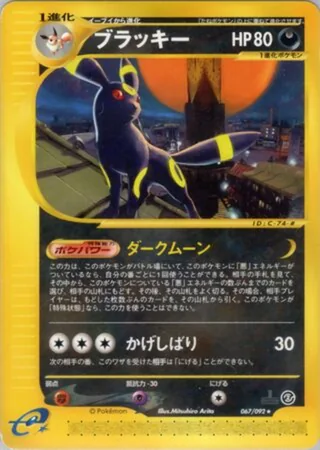
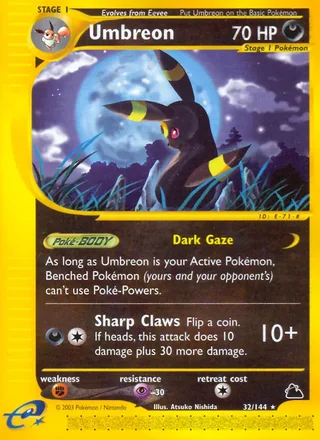
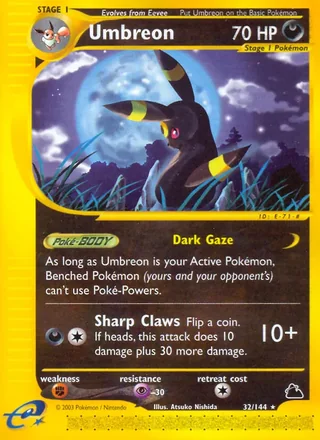
Umbreon — ブラッキー (2002)
067

Umbreonブラッキー

RARE
DarknessHP 80Stage 1Dex No. 197Illus. Mitsuhiro Arita

Umbreon, 80 HP Stage 1, unchanged since 2000, retreat 1, one Colourless attack for 30. Plain rare; 068 is the holofoil. Drawn by Mitsuhiro Arita, who also draws Hypno and the Darkness Houndoom.

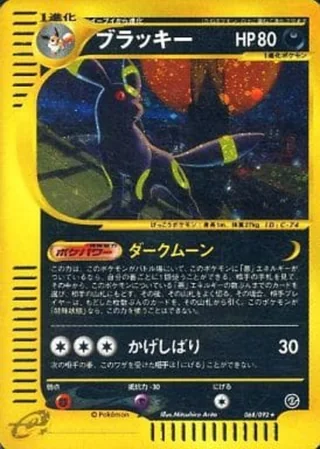
Umbreon — ブラッキー (2002)
068

Umbreonブラッキー

HOLO RARE
DarknessHP 80Stage 1Dex No. 197Illus. Mitsuhiro Arita

Umbreon, holofoil — same 80 HP, same 30-damage attack, same Mitsuhiro Arita art as 067. One of only two Darkness cards in the set with a holofoil; the other, Houndoom at 071, is Fire-coloured in its plain print.

Houndour — デルビル (2002)
069

Houndourデルビル

COMMON
DarknessHP 50BasicDex No. 228Illus. Atsuko Nishida

Houndour, 50 HP, the second of the set's two, and the only Darkness-type Houndour here — 018 is Fire. One Darkness-colourless attack, retreat 1, drawn by Atsuko Nishida. Same 50 HP as 018, different type and different artist.

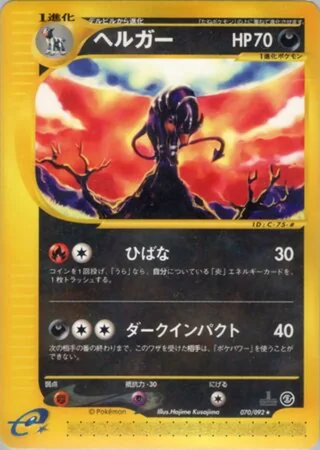
Houndoom — ヘルガー (2002)
070

Houndoomヘルガー

RARE
DarknessHP 70Stage 1Dex No. 229Illus. Hajime Kusajima

Houndoom, 70 HP Stage 1, retreat 1, two attacks — a Fire-colourless 30 and a Darkness-colourless-colourless 40. Plain rare; 071 is the holofoil. Ten lower than the uncommon Houndoom at 019, which makes the rare the smaller card — the set does this deliberately on several lines.

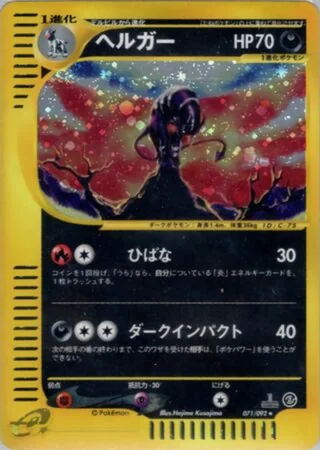
Houndoom — ヘルガー (2002)
071

Houndoomヘルガー

HOLO RARE
DarknessHP 70Stage 1Dex No. 229Illus. Hajime Kusajima

Houndoom, holofoil — same 70 HP, same two attacks, same Hajime Kusajima art as 070. The only card in the set that is both a Darkness holofoil and part of a line printed twice at different rarities.

Metal3 cardsHOLO 1

3 cards · listed in original order.

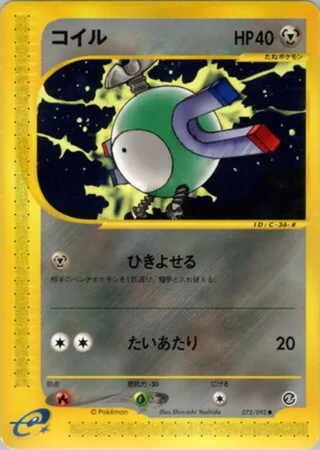
Magnemite — コイル (2002)
072

Magnemiteコイル

COMMON
MetalHP 40BasicDex No. 081Illus. Shin-ichi Yoshida

Magnemite, 40 HP — ten below the other Magnemite at 032 — and a Metal-type, the only Metal Basic in the set besides the Metal Energy at 091. One Metal attack and one two-Colourless 20, retreat 1.

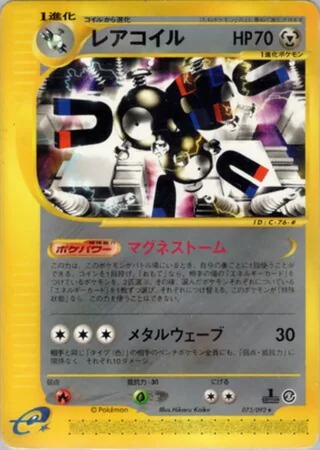
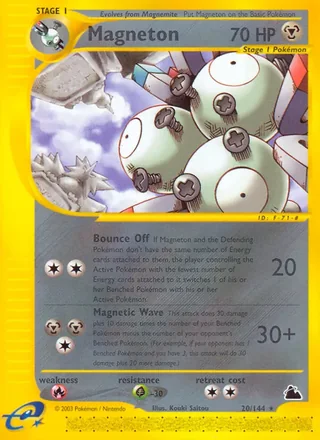
Magneton — レアコイル (2002)
073

Magnetonレアコイル

RARE
MetalHP 70Stage 1Dex No. 082Illus. Hikaru Koike

Magneton, 70 HP Stage 1, retreat 2, one three-Colourless attack for 30. Plain rare; 074 is the holofoil. Drawn by Hikaru Koike, and down from 80 HP in 1997.

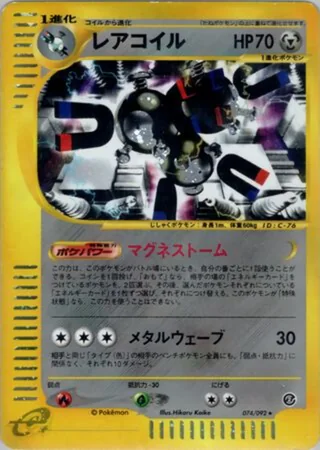
Magneton — レアコイル (2002)
074

Magnetonレアコイル

HOLO RARE
MetalHP 70Stage 1Dex No. 082Illus. Hikaru Koike

Magneton, holofoil — same 70 HP, same 30-damage attack, same Hikaru Koike art as 073. This is the holo that closes the Pokémon half of the set: everything from 075 on is Trainer and Energy.

Colorless10 cardsHOLO 2

10 cards · listed in original order.

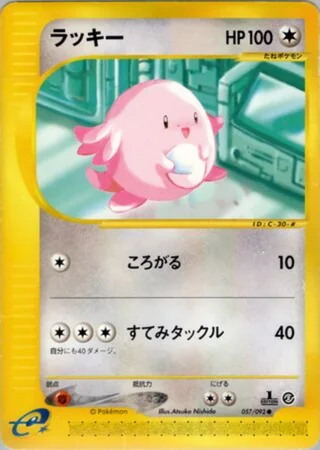
Chansey — ラッキー (2002)
057

Chanseyラッキー

COMMON
ColorlessHP 100BasicDex No. 113Illus. Atsuko Nishida

Chansey, 100 HP for one Energy, retreat 2, two Colourless attacks for 10 and 40. Printed as a common — a 100 HP Basic at common is the single most unusual rarity call in the set, and it is why Chansey is the card that breaks the set's own rarity logic.

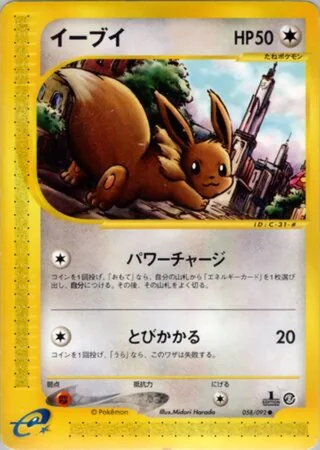
Eevee — イーブイ (2002)
058

Eeveeイーブイ

COMMON
ColorlessHP 50BasicDex No. 133Illus. Midori Harada

Eevee, 50 HP, its third printing since 1997. Two Colourless attacks for 20, retreat 1, drawn by Midori Harada. Two of its five evolutions are here — Espeon at 045/046 and Umbreon at 067/068 — the other three are in e-Card 4.

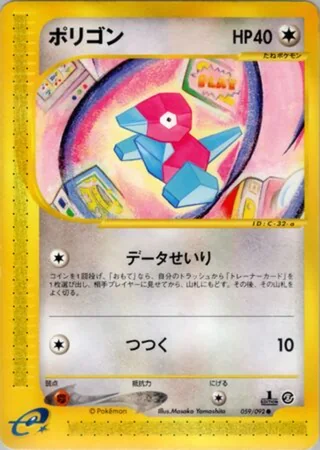
Porygon — ポリゴン (2002)
059

Porygonポリゴン

COMMON
ColorlessHP 40BasicDex No. 137Illus. Masako Yamashita

Porygon, 40 HP, its fourth printing since 1996. Two Colourless attacks, retreat 1. Porygon2 at 063 is the evolution, so this is the one line in the set that starts at a common and ends at an uncommon without a rare in between.

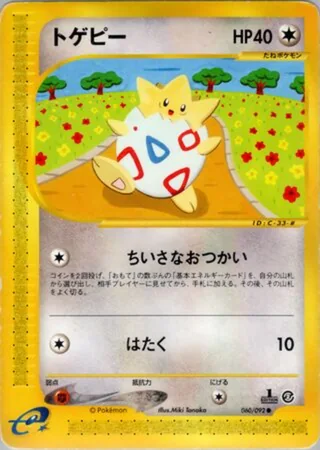
Togepi — トゲピー (2002)
060

Togepiトゲピー

COMMON
ColorlessHP 40BasicDex No. 175Illus. Miki Tanaka

Togepi, 40 HP, unchanged since 1999, two Colourless attacks for 10, retreat 1. Drawn by Miki Tanaka. Togetic at 061 and 062 follows — plain and holo — so the line is complete.

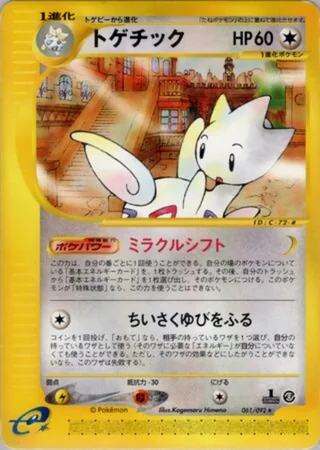
Togetic — トゲチック (2002)
061

Togeticトゲチック

RARE
ColorlessHP 60Stage 1Dex No. 176Illus. Kagemaru Himeno

Togetic, 60 HP Stage 1, unchanged since 2000, one Colourless attack, retreat 1. Plain rare; 062 is the holofoil. Both drawn by Kagemaru Himeno.

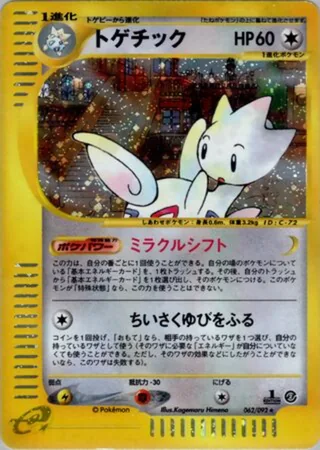
Togetic — トゲチック (2002)
062

Togeticトゲチック

HOLO RARE
ColorlessHP 60Stage 1Dex No. 176Illus. Kagemaru Himeno

Togetic, holofoil — same 60 HP, same single attack, same Kagemaru Himeno art as 061. The only Colourless holofoil in the set, and the only holofoil whose plain print is at 60 HP rather than 70 or above.

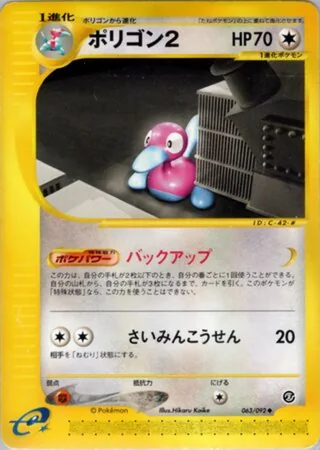
Porygon2 — ポリゴン2 (2002)
063

Porygon2ポリゴン2

UNCOMMON
ColorlessHP 70Stage 1Dex No. 233Illus. Hikaru Koike

Porygon2, 70 HP Stage 1, unchanged since 2000, one Colourless-Colourless attack for 20, retreat 1. An uncommon. Upgrading Porygon from common to Porygon2 as uncommon is the set's only clean two-step rarity ladder.

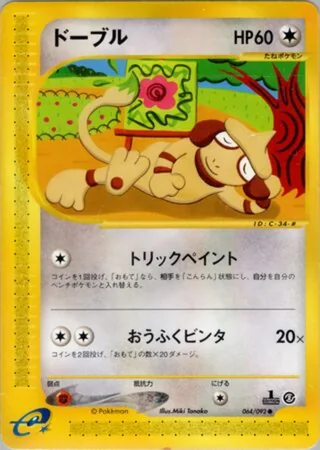
Smeargle — ドーブル (2002)
064

Smeargleドーブル

COMMON
ColorlessHP 60BasicDex No. 235Illus. Miki Tanaka

Smeargle, 60 HP — ten above the 2000 card — two Colourless attacks, retreat 1, drawn by Miki Tanaka. A common with 60 HP, which in this set is high for the rarity.

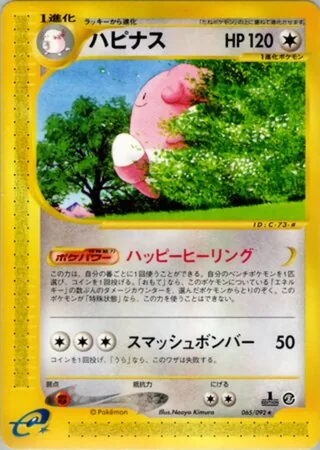
Blissey — ハピナス (2002)
065

Blisseyハピナス

RARE
ColorlessHP 120Stage 1Dex No. 242Illus. Naoyo Kimura

Blissey, 120 HP Stage 1 — the highest HP in e-Card 2, tied with Nidoking — retreat 2, one attack for three Colourless and 50. Plain rare; 066 is the holofoil. Same 120 as the 2000 print.

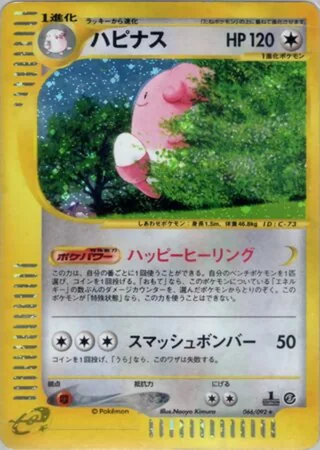
Blissey — ハピナス (2002)
066

Blisseyハピナス

HOLO RARE
ColorlessHP 120Stage 1Dex No. 242Illus. Naoyo Kimura

Blissey, holofoil — same 120 HP, same 50-damage attack, same Naoyo Kimura art as 065. Between them, Blissey and Nidoking are the only two cards in the set at 120 HP, and both appear as a plain rare and a holo.

Trainer18 cards

18 cards · listed in original order.

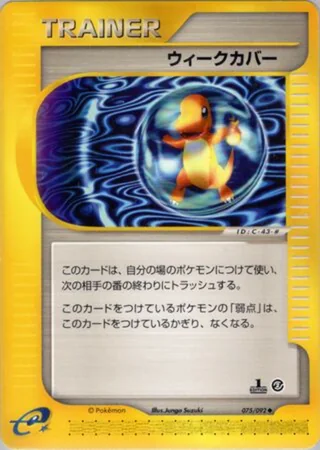
Weakness Guard —  (2002)
075

Weakness Guard

UNCOMMON
Trainer

Weakness Guard, the first Trainer. Attached to one of your Pokémon, it removes that Pokémon's Weakness entirely and is discarded at the end of your opponent's next turn. One turn of no Weakness is a narrow effect, and on a 2002 board of 100-plus HP Pokémon it is the card that decides a single trade rather than a game.

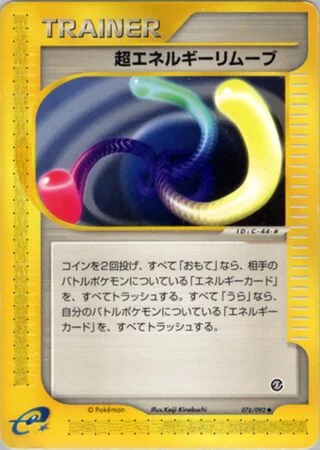
Super Energy Removal 2 —  (2002)
076

Super Energy Removal 2

UNCOMMON
Trainer

Super Energy Removal 2. Flip two coins: on two heads, discard an Energy from the Defending Pokémon; otherwise discard one of your own. The '2' is a different card from the 1996 Super Energy Removal, not a reprint — the original discarded an Energy unconditionally, and this one gambles.

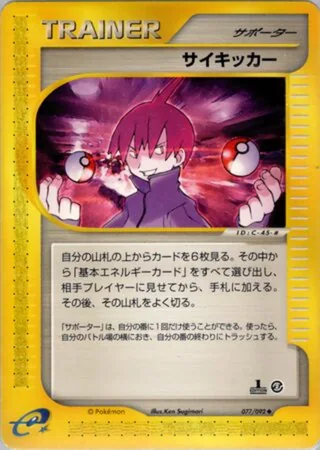
Seer —  (2002)
077

Seer

UNCOMMON
Trainer

Seer. Look at the top six cards of your deck, take every basic Energy from them into your hand, then shuffle. The only card in the set that turns a deck's top into Energy on demand, and the reason e-Card decks of this period could run low Energy counts.

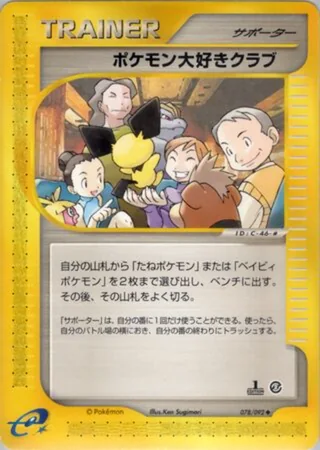
Pokémon Fan Club —  (2002)
078

Pokémon Fan Club

UNCOMMON
Trainer

Pokémon Fan Club, a Supporter that searches the deck for two Basic Pokémon and puts them into your hand. A first-turn card in every format it has ever been legal in, and one of four Trainer cards in the set named after a game character or organisation rather than an effect.

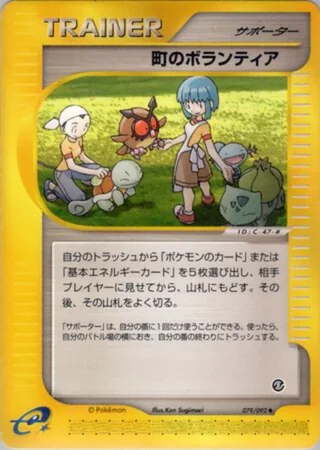
Town Volunteers —  (2002)
079

Town Volunteers

UNCOMMON
Trainer

Town Volunteers. Take five Pokémon or basic Energy cards from your discard pile, show them, and put them back into your deck. The set's answer to its own aggressive discarding — Energy Restore's job in e-Card 1, done here for Pokémon as well.

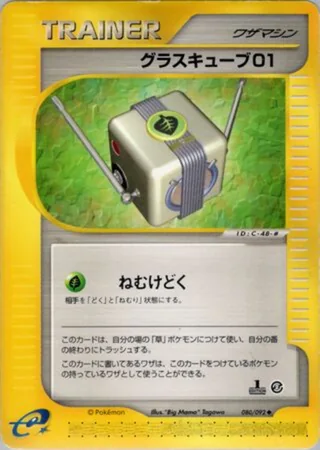
Grass Cube 01 —  (2002)
080

Grass Cube 01

UNCOMMON
Trainer

Grass Cube 01, the first of eight Cube cards — one per type, all uncommon, all numbered 080 to 087. A Cube is a Trainer that attaches to a Pokémon and gives it an attack of that type. Eight in a row is the largest block of same-design cards in the set.

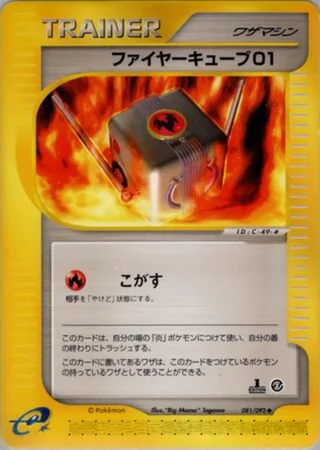
Fire Cube 01 —  (2002)
081

Fire Cube 01

UNCOMMON
Trainer

Fire Cube 01, second of the eight. The Cube run is numbered by type in a fixed order — Grass, Fire, Water, Lightning, Psychic, Fighting, Darkness, Metal — which is the same order the Japanese set prints its Pokémon in, so the eight Trainers double as a legend for the set's type blocks.

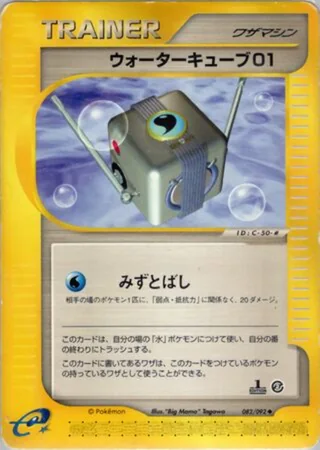
Water Cube 01 —  (2002)
082

Water Cube 01

UNCOMMON
Trainer

Water Cube 01, third of eight. The Cubes are what the e-Card era added to the Trainer line: an attachment rather than an event, so a deck can convert one Pokémon's attack into another type mid-game without switching the Pokémon.

Lightning Cube 01 —  (2002)
083

Lightning Cube 01

UNCOMMON
Trainer

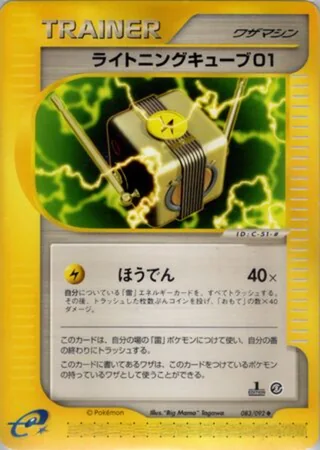
Lightning Cube 01, fourth of eight. All eight Cubes are uncommon and all eight sit between 080 and 087 — no Cube is a rare and none is a holo, which is why the Trainer block of this set has no holofoil at all.

Psychic Cube 01 —  (2002)
084

Psychic Cube 01

UNCOMMON
Trainer

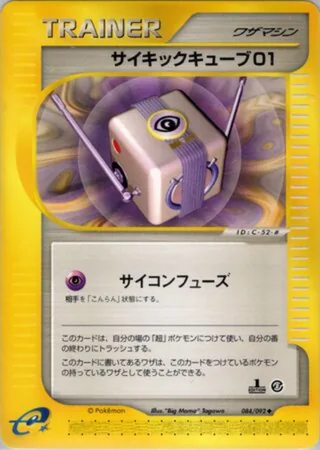
Psychic Cube 01, fifth of eight. Eight Cubes in a 92-card set means one Trainer in eleven is a Cube, the highest concentration of a single Trainer design in any Japanese set to that point.

Fighting Cube 01 —  (2002)
085

Fighting Cube 01

UNCOMMON
Trainer

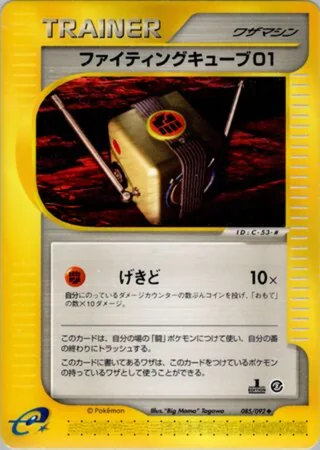
Fighting Cube 01, sixth of eight. The Japanese card's name is the type word plus a number; the number 01 is not a series marker but the card's place in the run, and no Cube 02 exists in any e-Card set.

Darkness Cube 01 —  (2002)
086

Darkness Cube 01

UNCOMMON
Trainer

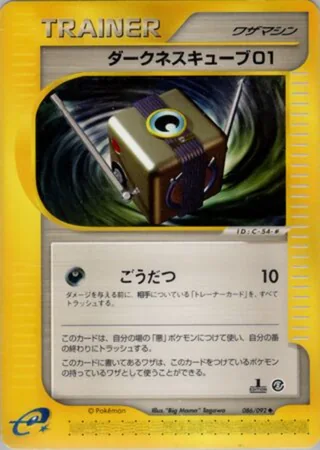
Darkness Cube 01, seventh of eight. Darkness and Metal Cubes only became possible in 2001, when the two types entered the game — this is the first set in which a full eight-type Cube run could exist at all.

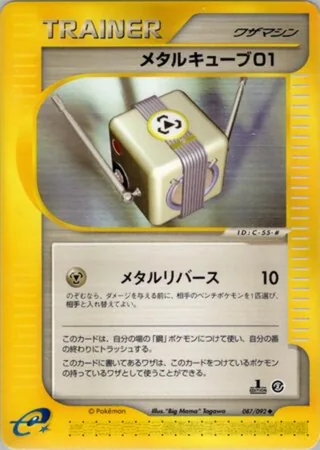
Metal Cube 01 —  (2002)
087

Metal Cube 01

UNCOMMON
Trainer

Metal Cube 01, the last of the eight. With 087 the Cube run closes, and the eight cards account for 8 of the set's 18 Trainers — the single clearest structural signature of e-Card 2.

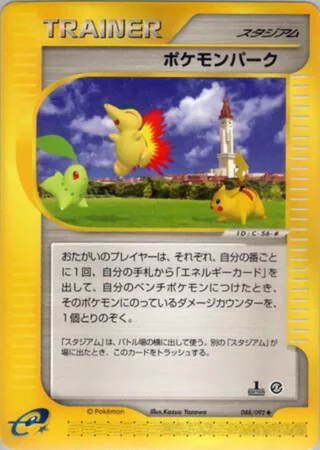
Pokémon Park —  (2002)
088

Pokémon Park

UNCOMMON
Trainer

Pokémon Park, a Stadium. Stadiums arrived in 2000 and e-Card 2 is one of the first Japanese sets to print two in a single expansion — the other is Power Plant at 089, printed directly after it.

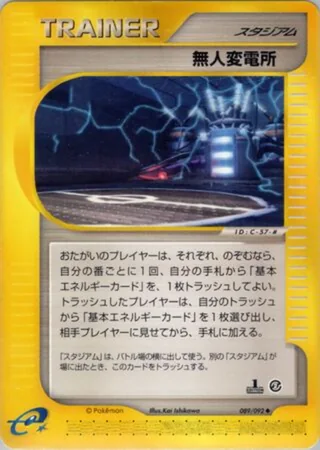
Power Plant —  (2002)
089

Power Plant

UNCOMMON
Trainer

Power Plant, the second Stadium. Two Stadiums in one set is unusual: they are the only two cards here that affect both players at once, and every other Trainer in the set is single-use.

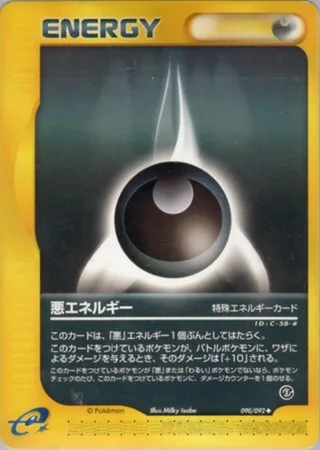
Darkness Energy —  (2002)
090

Darkness Energy

UNCOMMON
Trainer

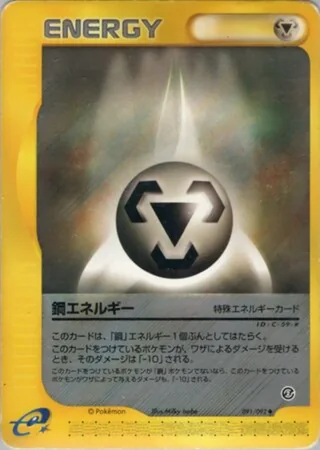
Darkness Energy, a Special Energy providing Darkness. Darkness and Metal had only existed as types since 2001, and this is the first Japanese set to print the Special Energy for both in the same expansion as the Metal Energy at 091.

Metal Energy —  (2002)
091

Metal Energy

UNCOMMON
Trainer

Metal Energy, the second Special Energy. It reduces damage taken while it is attached, which made it the most-played card of the pair and the reason the set's two Metal Pokémon — Magnemite and Magneton — were worth printing at all.

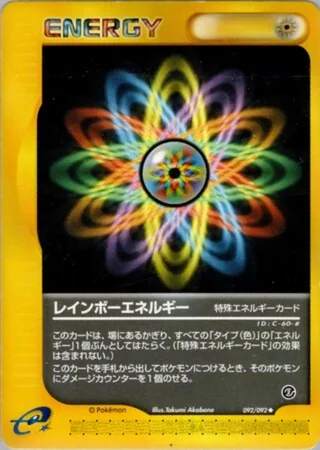
Rainbow Energy —  (2002)
092

Rainbow Energy

UNCOMMON
Trainer

Rainbow Energy, the last card, providing any type at the cost of one damage counter on the holder. Three Special Energy in one set — Darkness, Metal and Rainbow — is more than any previous Japanese expansion, and it closes the run with the one card that works in every deck.

e-Card 3 · Wind from the Sea

2002-05-2490 cardsHOLO 16

24 May 2002. Eighty-seven numbered cards plus three secrets, 78 Pokémon and 12 Trainer & Energy. The three secrets are Nidoking, Kingdra and Lugia — the three cards English players would meet as the Crystal Pokémon of Aquapolis.

Twenty Grass cards, the most of any type in any set this year, and the reason the set is remembered as the leaf-and-water half of the year. Fourteen Stage 2 Pokémon also make this the deepest evolution set of the four. Pokémon e-Card 3 arrived eleven weeks after e-Card 2 — the shortest gap between two Japanese expansions since 1997.

Grass20 cardsHOLO 4

20 cards · listed in original order.

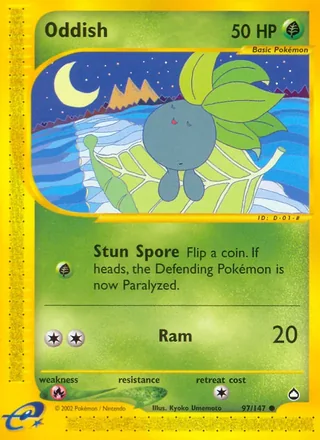
Oddish — ナゾノクサ (2002)

English scan

001

Oddishナゾノクサ

COMMON
GrassHP 50BasicDex No. 043Illus. Kyoko Umemoto

Oddish, 50 HP, the first of the set's twenty Grass cards. One Grass status attack and a two-Colourless 20, retreat 1. The whole Oddish line here is drawn by Kyoko Umemoto — 001, 002 and both Vileplume — one hand across a full three-stage evolution.

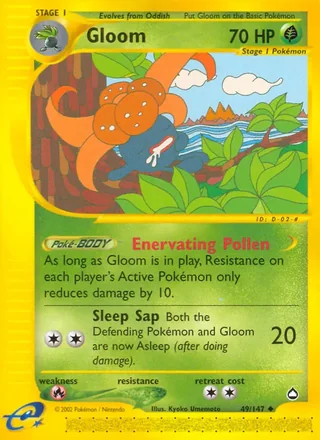
Gloom — クサイハナ (2002)

English scan

002

Gloomクサイハナ

COMMON
GrassHP 70Stage 1Dex No. 044Illus. Kyoko Umemoto

Gloom, 70 HP Stage 1, retreat 2, one attack for 20. Down from 60 HP in 1997, up from nothing in 2001: this is the strongest Gloom yet printed, and the only one at 70.

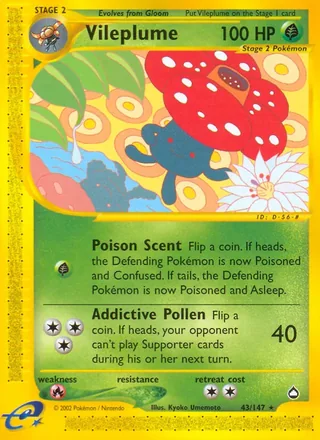
Vileplume — ラフレシア (2002)

English scan

003

Vileplumeラフレシア

RARE
GrassHP 100Stage 2Dex No. 045Illus. Kyoko Umemoto

Vileplume, 100 HP Stage 2 — twenty above the 1997 card and ten above 2001 — retreat 2, two Grass attacks, the second for 40. Plain rare; 004 is the holofoil. The 100 HP makes it the second-largest Grass Pokémon in the set.

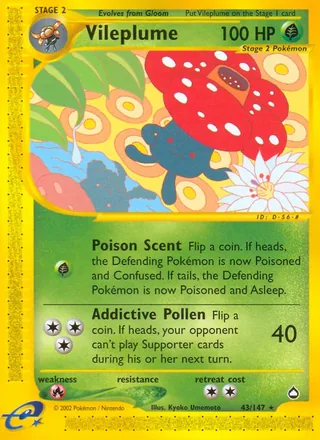
Vileplume — ラフレシア (2002)

English scan

004

Vileplumeラフレシア

HOLO RARE
GrassHP 100Stage 2Dex No. 045Illus. Kyoko Umemoto

Vileplume, holofoil — same 100 HP, same two attacks, same Kyoko Umemoto art as 003. One of fourteen holo pairs in this set where the artist does not change, which is how the e-Card holofoil works: the foil is the same card, not a second design.

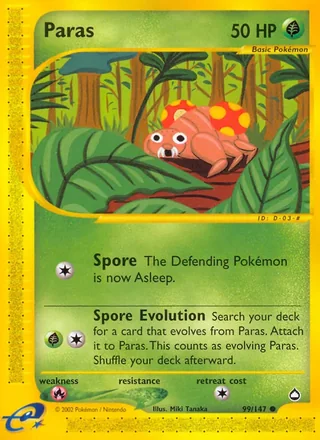
Paras — パラス (2002)

English scan

005

Parasパラス

COMMON
GrassHP 50BasicDex No. 046Illus. Miki Tanaka

Paras, 50 HP, ten above both 1997 and 2000, retreat 1, two Grass attacks neither of which does printed damage. Drawn by Miki Tanaka. Parasect at 006 is the evolution, printed as an uncommon rather than a rare.

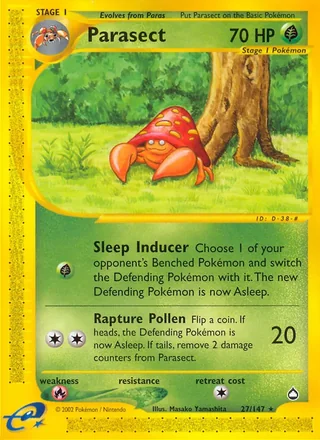
Parasect — パラセクト (2002)

English scan

006

Parasectパラセクト

UNCOMMON
GrassHP 70Stage 1Dex No. 047Illus. Masako Yamashita

Parasect, 70 HP Stage 1 — ten above the 2000 card — retreat 1, two attacks. The set's only Grass evolution at uncommon, and one of two cards drawn by Masako Yamashita.

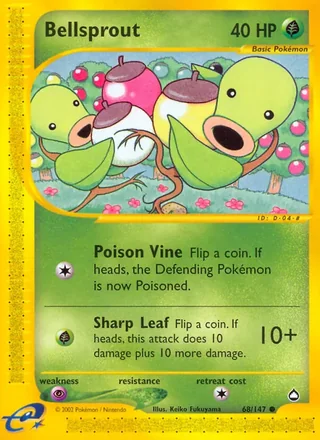
Bellsprout — マダツボミ (2002)

English scan

007

Bellsproutマダツボミ

COMMON
GrassHP 40BasicDex No. 069Illus. Keiko Fukuyama

Bellsprout, 40 HP, the first of two. Two Grass attacks with no printed damage, retreat 1, drawn by Keiko Fukuyama. 008 is the other Bellsprout at 50 HP — same name, ten more HP, different artist.

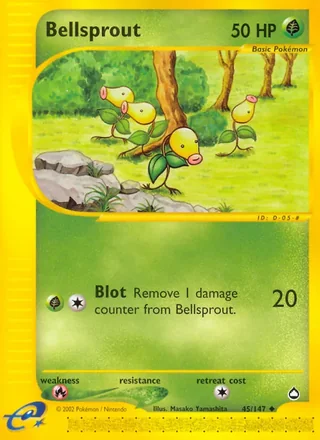
Bellsprout — マダツボミ (2002)

English scan

008

Bellsproutマダツボミ

COMMON
GrassHP 50BasicDex No. 069Illus. Masako Yamashita

Bellsprout, 50 HP, the stronger of the pair, one Grass attack for 20, retreat 1. Drawn by Masako Yamashita. Both Bellsprout evolve into the same Weepinbell at 009 — the set prints two Basics for a single Stage 1.

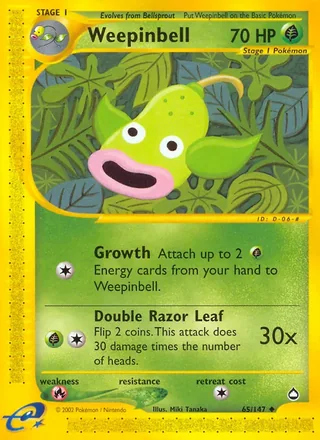
Weepinbell — ウツドン (2002)

English scan

009

Weepinbellウツドン

COMMON
GrassHP 70Stage 1Dex No. 070Illus. Miki Tanaka

Weepinbell, 70 HP Stage 1, unchanged since 1997, retreat 1, two Grass attacks. Drawn by Miki Tanaka, who also draws Victreebel at 010 and 011 — so the whole line is one artist's work even though the two Bellsprout are not.

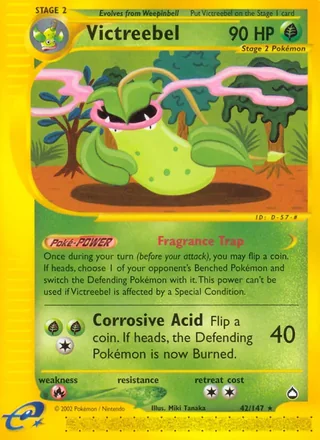
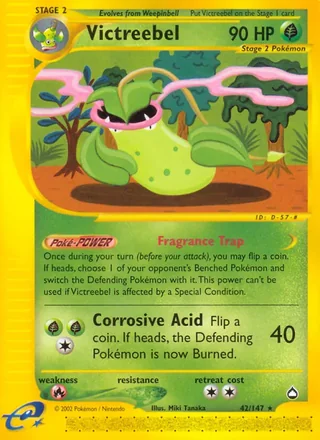
Victreebel — ウツボット (2002)

English scan

010

Victreebelウツボット

RARE
GrassHP 90Stage 2Dex No. 071Illus. Miki Tanaka

Victreebel, 90 HP Stage 2 — ten above the 1997 card — retreat 2, one Grass attack for 40. Plain rare; 011 is the holofoil. The highest HP of any Grass Stage 2 in the set apart from Vileplume.

Victreebel — ウツボット (2002)

English scan

011

Victreebelウツボット

HOLO RARE
GrassHP 90Stage 2Dex No. 071Illus. Miki Tanaka

Victreebel, holofoil — same 90 HP, same 40-damage attack, same Miki Tanaka art as 010. Four Grass holofoils in this set — Vileplume, Victreebel, Bellossom and nothing else — the most of any type.

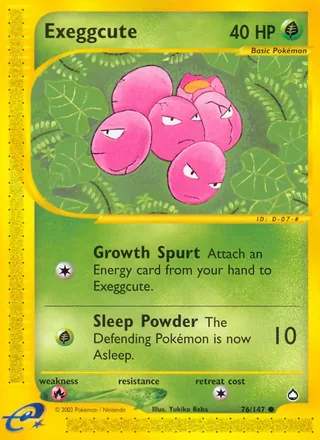
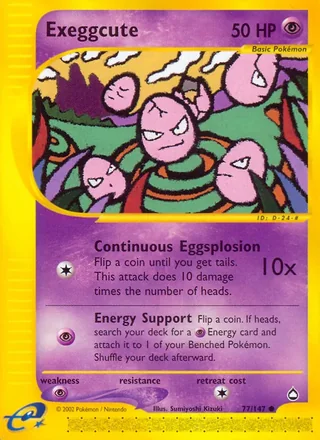
Exeggcute — タマタマ (2002)

English scan

012

Exeggcuteタマタマ

COMMON
GrassHP 40BasicDex No. 102Illus. Yukiko Baba

Exeggcute, 40 HP, the first of two in the set. Two Grass attacks, retreat 1, drawn by Yukiko Baba. 050 is the other Exeggcute at 50 HP, printed in the second half — and the set carries three Exeggutor in total, more than any other Pokémon here.

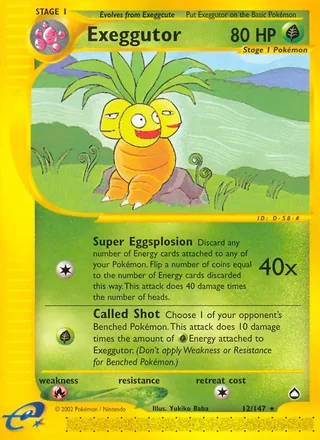
Exeggutor — ナッシー (2002)

English scan

013

Exeggutorナッシー

RARE
GrassHP 80Stage 1Dex No. 103Illus. Yukiko Baba

Exeggutor, 80 HP Stage 1, unchanged since 1997, retreat 1, two attacks with no printed damage. Plain rare. Drawn by Yukiko Baba, who draws this one and the second Exeggcute but not the holofoil at 014.

Exeggutor — ナッシー (2002)

English scan

014

Exeggutorナッシー

HOLO RARE
GrassHP 80Stage 1Dex No. 103Illus. Sumiyoshi Kizuki

Exeggutor, holofoil — same 80 HP, same two attacks, but drawn by Sumiyoshi Kizuki, not by Yukiko Baba who drew 013. This is one of only two holo pairs in the set where the illustrator changes, which means 013 and 014 are two different pictures of the same card.

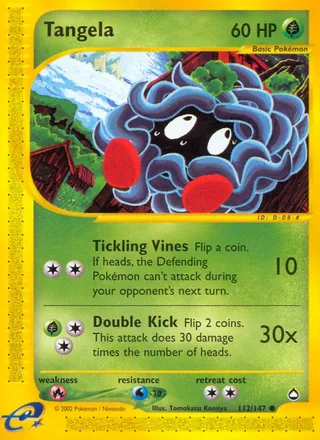
Tangela — モンジャラ (2002)

English scan

015

Tangelaモンジャラ

COMMON
GrassHP 60BasicDex No. 114Illus. Tomokazu Komiya

Tangela, 60 HP — ten above every earlier printing, which had been 50 since 1996 — retreat 2, two attacks. Drawn by Tomokazu Komiya. The 60 HP is the single biggest jump on any card in this set that has an older version.

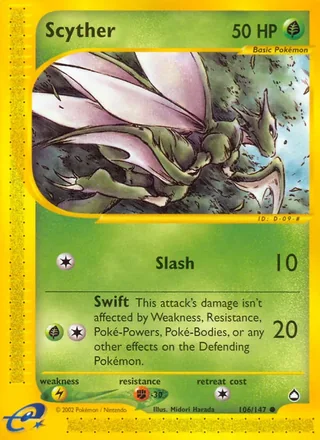
Scyther — ストライク (2002)

English scan

016

Scytherストライク

COMMON
GrassHP 50BasicDex No. 123Illus. Midori Harada

Scyther, 50 HP, the lower of the set's two. Two attacks for 10 and 20, retreat 1, drawn by Midori Harada. 017 is the other Scyther at 60 HP. Neither evolves — Scizor at 074 is a Metal card and does not evolve from Scyther in this set.

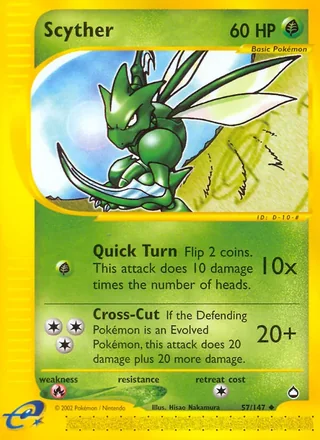
Scyther — ストライク (2002)

English scan

017

Scytherストライク

COMMON
GrassHP 60BasicDex No. 123Illus. Hisao Nakamura

Scyther, 60 HP — ten above 016 — two attacks, the second costing two Colourless. Drawn by Hisao Nakamura, who also draws Scizor at 074 and 075, so the two Scyther and their Metal relative share two artists between them.

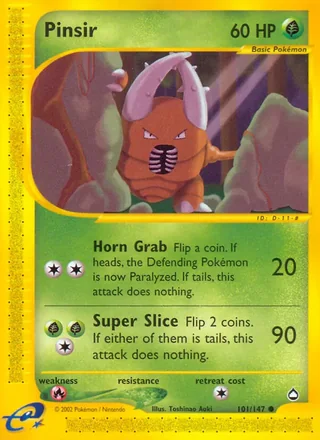
Pinsir — カイロス (2002)

English scan

018

Pinsirカイロス

COMMON
GrassHP 60BasicDex No. 127Illus. Toshinao Aoki

Pinsir, 60 HP, unchanged since 1997, retreat 1, two attacks: 20 for one, and 90 for three — the largest single printed damage number in the set.

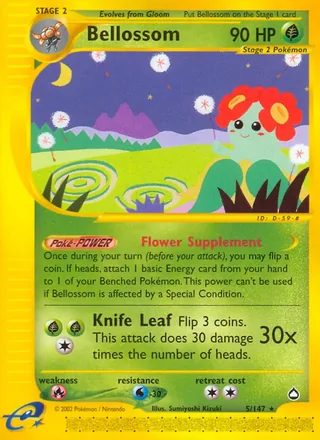
Bellossom — キレイハナ (2002)

English scan

019

Bellossomキレイハナ

RARE
GrassHP 90Stage 2Dex No. 182Illus. Sumiyoshi Kizuki

Bellossom, 90 HP Stage 2 — twenty above the 2000 card — retreat 2, one Grass attack. Plain rare; 020 is the holofoil. A Grass Stage 2 that does not evolve from Gloom in this set: Gloom's line ends at Vileplume, and Bellossom stands on its own.

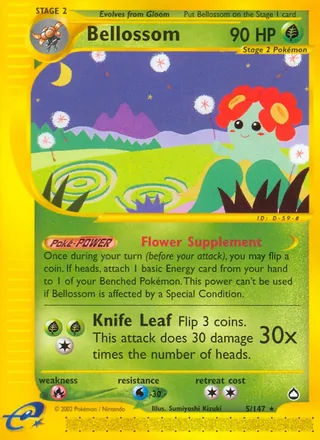
Bellossom — キレイハナ (2002)

English scan

020

Bellossomキレイハナ

HOLO RARE
GrassHP 90Stage 2Dex No. 182Illus. Sumiyoshi Kizuki

Bellossom, holofoil — same 90 HP, same single attack, same Sumiyoshi Kizuki art as 019. The last of the set's four Grass holofoils, and the only one whose Stage 1 form is not in the set.

Fire7 cardsHOLO 2

7 cards · listed in original order.

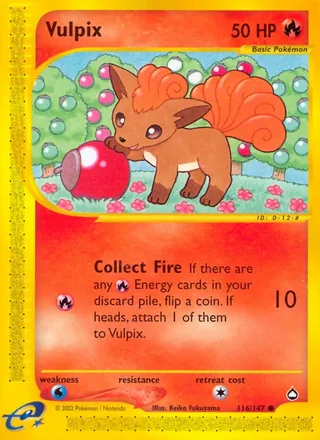
Vulpix — ロコン (2002)

English scan

021

Vulpixロコン

COMMON
FireHP 50BasicDex No. 037Illus. Keiko Fukuyama

Vulpix, 50 HP, unchanged since 1996, one Fire attack for 10, retreat 1. Drawn by Keiko Fukuyama. Ninetales at 022 and 023 follows — plain and holo.

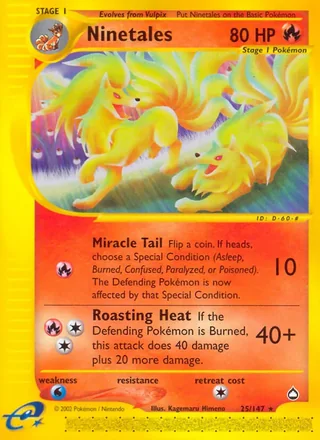
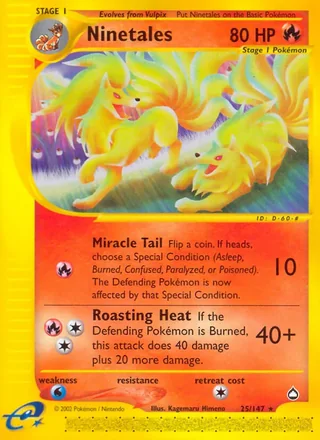
Ninetales — キュウコン (2002)

English scan

022

Ninetalesキュウコン

RARE
FireHP 80Stage 1Dex No. 038Illus. Kagemaru Himeno

Ninetales, 80 HP Stage 1, unchanged since 1996, retreat 1, two Fire attacks. Plain rare; 023 is the holofoil. Drawn by Kagemaru Himeno.

Ninetales — キュウコン (2002)

English scan

023

Ninetalesキュウコン

HOLO RARE
FireHP 80Stage 1Dex No. 038Illus. Kagemaru Himeno

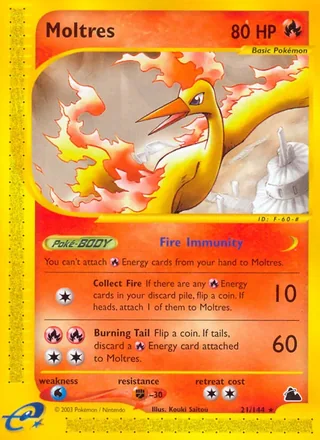
Ninetales, holofoil — same 80 HP, same two attacks, same Kagemaru Himeno art as 022. The only Fire holofoil in the set: Entei, Moltres and Ho-oh all sit in the other three sets, so 2002 never puts two Fire holos in one expansion.

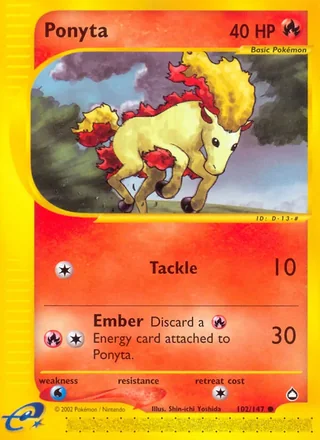
Ponyta — ポニータ (2002)

English scan

024

Ponytaポニータ

COMMON
FireHP 40BasicDex No. 077Illus. Shin-ichi Yoshida

Ponyta, 40 HP — ten below the 1996 and 1997 cards — retreat 1, two attacks with a Fire-colourless 30. Drawn by Shin-ichi Yoshida. Rapidash at 025 is the evolution, and it is an uncommon rather than a rare.

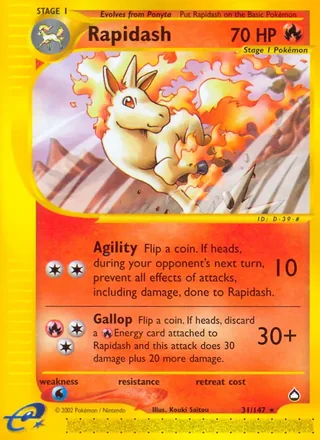
Rapidash — ギャロップ (2002)

English scan

025

Rapidashギャロップ

UNCOMMON
FireHP 70Stage 1Dex No. 078Illus. Kouki Saitou

Rapidash, 70 HP Stage 1, unchanged since 1997, free retreat — one of six cards in the set that cost nothing to pull back — and two attacks. Drawn by Kouki Saitou. An uncommon, which makes it the cheapest-to-play Stage 1 in the set.

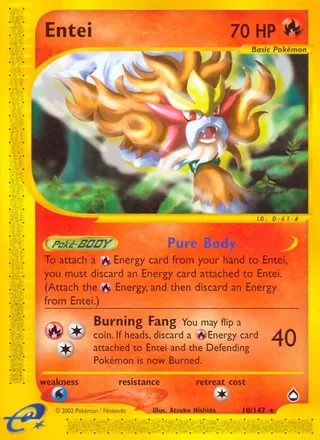
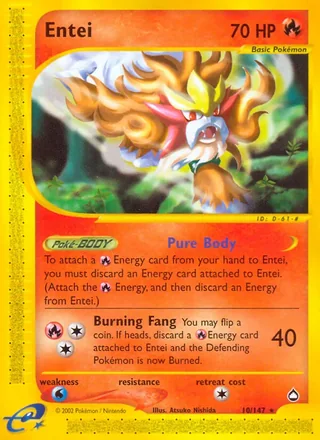
Entei — エンテイ (2002)

English scan

026

Enteiエンテイ

RARE
FireHP 70BasicDex No. 244Illus. Atsuko Nishida

Entei, 70 HP Basic — ten below the 2000 card — retreat 1, one Fire attack for 40. Plain rare; 027 is the holofoil. The Fire beast of the year: Suicune was in e-Card 2, Raikou is in e-Card 4, and the three never share a set.

Entei — エンテイ (2002)

English scan

027

Enteiエンテイ

HOLO RARE
FireHP 70BasicDex No. 244Illus. Atsuko Nishida

Entei, holofoil — same 70 HP, same 40-damage attack, same Atsuko Nishida art as 026. One of three legendary holofoils across the year — Entei, Raikou and Suicune — each in a different expansion.

Water15 cardsHOLO 3

15 cards · listed in original order.

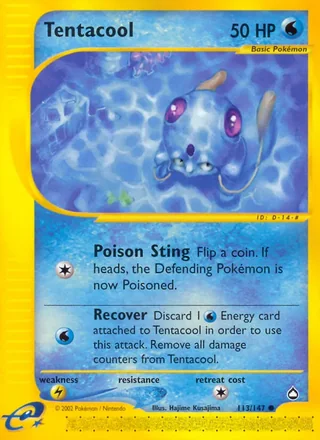
Tentacool — メノクラゲ (2002)

English scan

028

Tentacoolメノクラゲ

COMMON
WaterHP 50BasicDex No. 072Illus. Hajime Kusajima

Tentacool, 50 HP — twenty above the 1997 card, which was 30 — retreat 1, two Water attacks with no printed damage. Drawn by Hajime Kusajima, who draws both Tentacruel as well.

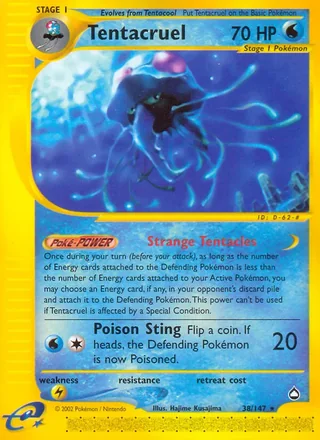
Tentacruel — ドククラゲ (2002)

English scan

029

Tentacruelドククラゲ

RARE
WaterHP 70Stage 1Dex No. 073Illus. Hajime Kusajima

Tentacruel, 70 HP Stage 1 — ten above 1997 and 1999 — free retreat, one Water attack for 20. Plain rare; 030 is the holofoil. The free retreat on a 70 HP Stage 1 is what makes the line playable.

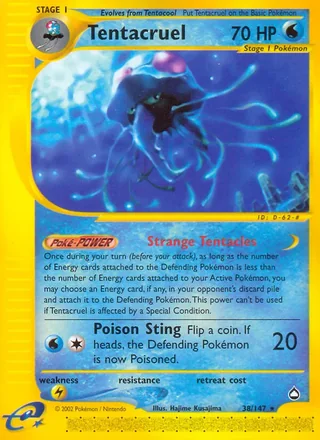
Tentacruel — ドククラゲ (2002)

English scan

030

Tentacruelドククラゲ

HOLO RARE
WaterHP 70Stage 1Dex No. 073Illus. Hajime Kusajima

Tentacruel, holofoil — same 70 HP, same free retreat, same Hajime Kusajima art as 029. The only Water holofoil with free retreat in the set.

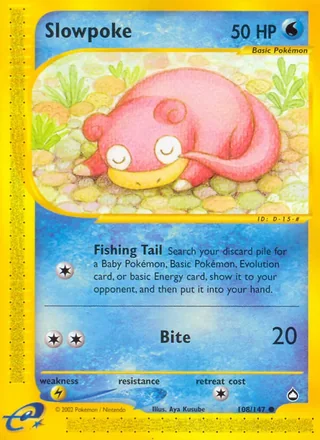
Slowpoke — ヤドン (2002)

English scan

031

Slowpokeヤドン

COMMON
WaterHP 50BasicDex No. 079Illus. Aya Kusube

Slowpoke, 50 HP, unchanged since 1997, retreat 1, two Water attacks for 20. Drawn by Aya Kusube. Slowbro at 032 and Slowking at 052 are both in this set, so one Basic feeds two different Stage 1s — the only Pokémon here with two evolutions printed.

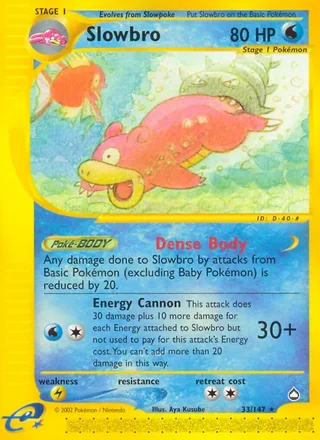
Slowbro — ヤドラン (2002)

English scan

032

Slowbroヤドラン

UNCOMMON
WaterHP 80Stage 1Dex No. 080Illus. Aya Kusube

Slowbro, 80 HP Stage 1 — twenty above the 1997 card — retreat 2, one attack. An uncommon, and one of two Slowpoke evolutions in the set. Drawn by Aya Kusube.

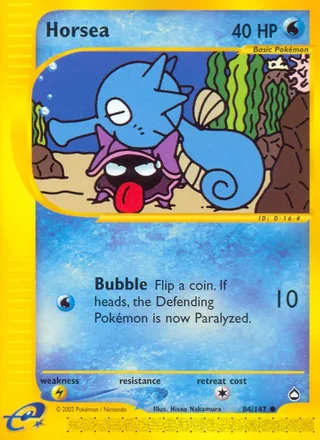
Horsea — タッツー (2002)

English scan

033

Horseaタッツー

COMMON
WaterHP 40BasicDex No. 116Illus. Hisao Nakamura

Horsea, 40 HP, the first of two. One Water attack for 10, retreat 1, drawn by Hisao Nakamura. 034 is the other Horsea at 50 HP with a different attack and a different artist.

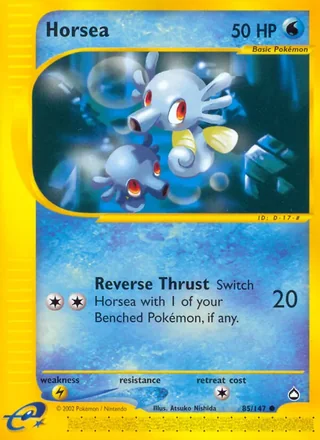
Horsea — タッツー (2002)

English scan

034

Horseaタッツー

COMMON
WaterHP 50BasicDex No. 116Illus. Atsuko Nishida

Horsea, 50 HP, the stronger of the pair, one Water attack for 20, retreat 1. Drawn by Atsuko Nishida, who also draws Kingdra at 041 and the secret Kingdra at 089 — three Kingdra-line cards, two of them hers.

Seadra — シードラ (2002)

English scan

035

Seadraシードラ

COMMON
WaterHP 70Stage 1Dex No. 117Illus. Mitsuhiro Arita

Seadra, 70 HP Stage 1, unchanged since 1997, retreat 1, two attacks. Drawn by Mitsuhiro Arita. The only Seadra in the set: the Horsea line reaches Kingdra through a Stage 1 that appears once.

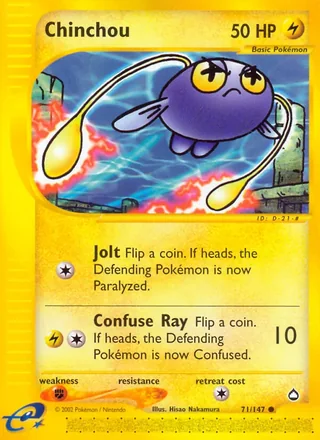
Chinchou — チョンチー (2002)

English scan

036

Chinchouチョンチー

COMMON
WaterHP 50BasicDex No. 170Illus. Yuka Morii

Chinchou, 50 HP, the first of two in the set. Two attacks, a Water float and a 20-damage headbutt, retreat 1, drawn by Yuka Morii. 043 is the other Chinchou, and the set also prints two Lanturn — the only line it prints twice in full.

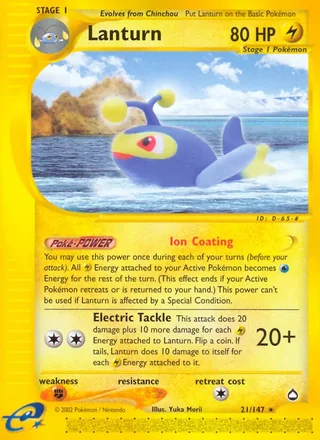
Lanturn — ランターン (2002)

English scan

037

Lanturnランターン

UNCOMMON
WaterHP 80Stage 1Dex No. 171Illus. Mitsuhiro Arita

Lanturn, 80 HP Stage 1 — unchanged since 2000 — retreat 1, two attacks, the second a Lightning one. An uncommon. Drawn by Mitsuhiro Arita. 044 and 045 are a second Lanturn pair at the same 80 HP, so this Pokémon appears four times in the set.

Remoraid — テッポウオ (2002)

English scan

038

Remoraidテッポウオ

COMMON
WaterHP 50BasicDex No. 223Illus. Mitsuhiro Arita

Remoraid, 50 HP — ten above the 2000 and 2001 cards — retreat 1, one Water attack with no printed damage. Drawn by Mitsuhiro Arita, who draws all three of the set's Water basics in the Tentacool–Remoraid run.

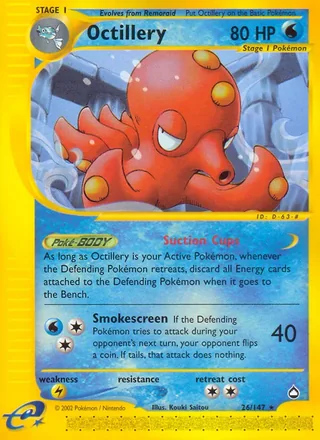
Octillery — オクタン (2002)

English scan

039

Octilleryオクタン

RARE
WaterHP 80Stage 1Dex No. 224Illus. Kouki Saitou

Octillery, 80 HP Stage 1, unchanged since 2000, retreat 2, one attack for 40. Plain rare; 040 is the holofoil. Drawn by Kouki Saitou.

Octillery — オクタン (2002)

English scan

040

Octilleryオクタン

HOLO RARE
WaterHP 80Stage 1Dex No. 224Illus. Kouki Saitou

Octillery, holofoil — same 80 HP, same 40-damage attack, same Kouki Saitou art as 039. The only Octillery holofoil in 2002.

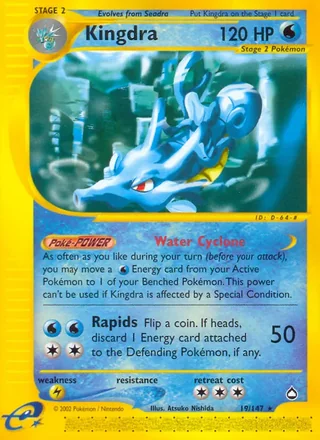
Kingdra — キングドラ (2002)

English scan

041

Kingdraキングドラ

RARE
WaterHP 120Stage 2Dex No. 230Illus. Atsuko Nishida

Kingdra, 120 HP Stage 2 — thirty above the 2000 card — retreat 3, one Water attack for 50. Plain rare, drawn by Atsuko Nishida. One of only three cards at 120 HP in the set, with Tyranitar and the secret Nidoking at 100.

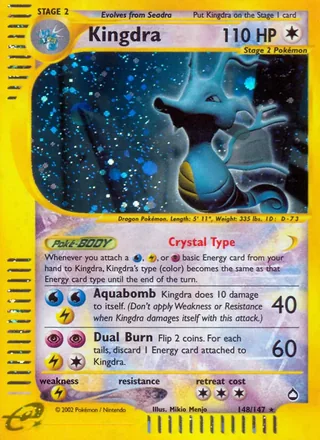
Kingdra — キングドラ (2002)

English scan

042

Kingdraキングドラ

HOLO RARE
WaterHP 120Stage 2Dex No. 230Illus. Mikio Menjo

Kingdra, holofoil — same 120 HP, same retreat 3, same 50-damage attack, but drawn by Mikio Menjo, not Atsuko Nishida. The second of the set's two holo pairs where the artist changes, and the card that makes three Kingdra in one set with the secret at 089.

Lightning7 cardsHOLO 2

7 cards · listed in original order.

Chinchou — チョンチー (2002)

English scan

043

Chinchouチョンチー

COMMON
LightningHP 50BasicDex No. 170Illus. Hisao Nakamura

Chinchou, 50 HP, the second of the pair and identical in HP to 036. Different attacks, different artist — Hisao Nakamura rather than Yuka Morii. The set prints two complete Chinchou–Lanturn lines, one at 036/037 and one at 043/044.

Lanturn — ランターン (2002)

English scan

044

Lanturnランターン

RARE
LightningHP 80Stage 1Dex No. 171Illus. Yuka Morii

Lanturn, 80 HP Stage 1, plain rare. The second Lanturn at the same 80 HP as 037 but at a different rarity, with a single Lightning attack and Yuka Morii's art. 045 is its holofoil.

Lanturn — ランターン (2002)

English scan

045

Lanturnランターン

HOLO RARE
LightningHP 80Stage 1Dex No. 171Illus. Yuka Morii

Lanturn, holofoil — same 80 HP, same single attack, same Yuka Morii art as 044. Between 037 and 045 this Pokémon appears four times in one set at two rarities, the strongest case of duplication in e-Card 3.

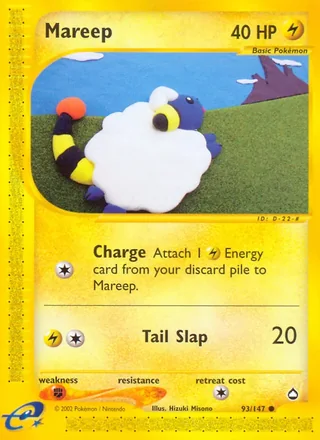
Mareep — メリープ (2002)

English scan

046

Mareepメリープ

COMMON
LightningHP 40BasicDex No. 179Illus. Hizuki Misono

Mareep, 40 HP, unchanged since 2000, retreat 1, two attacks, drawn by Hizuki Misono — an illustrator who appears twice in this set and nowhere else in the year.

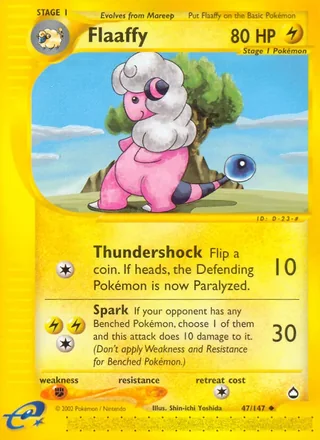
Flaaffy — モココ (2002)

English scan

047

Flaaffyモココ

COMMON
LightningHP 80Stage 1Dex No. 180Illus. Shin-ichi Yoshida

Flaaffy, 80 HP Stage 1 — twenty above the 2000 card and ten above 2001 — retreat 1, two Lightning attacks for 10 and 30. Drawn by Shin-ichi Yoshida, who also draws Ampharos at 048 and 049: one artist across the full three-stage line.

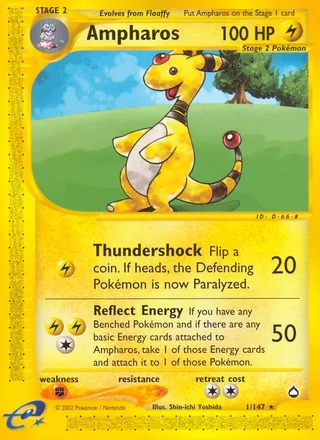
Ampharos — デンリュウ (2002)

English scan

048

Ampharosデンリュウ

RARE
LightningHP 100Stage 2Dex No. 181Illus. Shin-ichi Yoshida

Ampharos, 100 HP Stage 2 — twenty above 2000 and ten above 2001 — retreat 2, two Lightning attacks for 20 and 50. Plain rare; 049 is the holofoil. One of only four Stage 2 Pokémon in the set at 100 HP or more.

Ampharos — デンリュウ (2002)

English scan

049

Ampharosデンリュウ

HOLO RARE
LightningHP 100Stage 2Dex No. 181Illus. Shin-ichi Yoshida

Ampharos, holofoil — same 100 HP, same two attacks, same Shin-ichi Yoshida art as 048. The only Lightning holofoil in e-Card 3.

Psychic4 cardsHOLO 1

4 cards · listed in original order.

Exeggcute — タマタマ (2002)

English scan

050

Exeggcuteタマタマ

COMMON
PsychicHP 50BasicDex No. 102Illus. Sumiyoshi Kizuki

Exeggcute, 50 HP — ten above 012 — the second of the set's two. Two Grass attacks with no printed damage, retreat 1, drawn by Sumiyoshi Kizuki. Twelve numbers apart, both Basic, both 40-or-50 HP, neither a reprint.

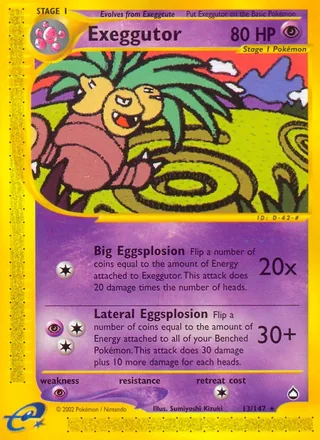
Exeggutor — ナッシー (2002)

English scan

051

Exeggutorナッシー

UNCOMMON
PsychicHP 80Stage 1Dex No. 103Illus. Yukiko Baba

Exeggutor, 80 HP Stage 1, uncommon — the third Exeggutor in the set after the rare at 013 and the holo at 014. One attack set, drawn by Yukiko Baba, who drew 013 but not 014. Three Exeggutor in one set at three different rarities is the extreme case of this set's duplication.

Slowking — ヤドキング (2002)

English scan

052

Slowkingヤドキング

RARE
PsychicHP 80Stage 1Dex No. 199Illus. Aya Kusube

Slowking, 80 HP Stage 1, unchanged since 2000, retreat 1, two Psychic attacks for 40. Plain rare; 053 is the holofoil. The second Slowpoke evolution in the set, alongside Slowbro at 032 — Slowpoke is the only Basic here with two Stage 1s printed.

Slowking — ヤドキング (2002)

English scan

053

Slowkingヤドキング

HOLO RARE
PsychicHP 80Stage 1Dex No. 199Illus. Aya Kusube

Slowking, holofoil — same 80 HP, same two attacks, same Aya Kusube art as 052. With Slowbro at 032, the Slowpoke line accounts for four cards in one set.

Fighting7 cardsHOLO 1

7 cards · listed in original order.

Mankey — マンキー (2002)

English scan

054

Mankeyマンキー

COMMON
FightingHP 40BasicDex No. 056Illus. Tomokazu Komiya

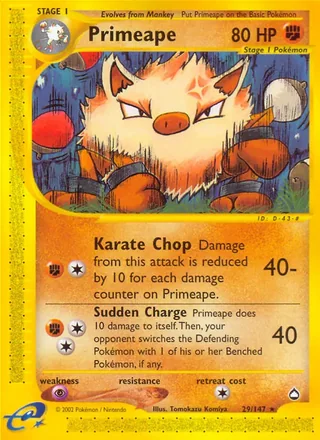
Mankey, 40 HP — ten above the 1997 card, which was 30 — retreat 1, two Fighting attacks, drawn by Tomokazu Komiya. Primeape at 055 is the evolution, printed as an uncommon.

Primeape — オコリザル (2002)

English scan

055

Primeapeオコリザル

UNCOMMON
FightingHP 80Stage 1Dex No. 057Illus. Tomokazu Komiya

Primeape, 80 HP Stage 1 — ten above 1997 and 1999 — retreat 1, two attacks with a 40-damage second. An uncommon, drawn by Tomokazu Komiya, who draws both cards of the line.

Onix — イワーク (2002)

English scan

056

Onixイワーク

COMMON
FightingHP 60BasicDex No. 095Illus. Hajime Kusajima

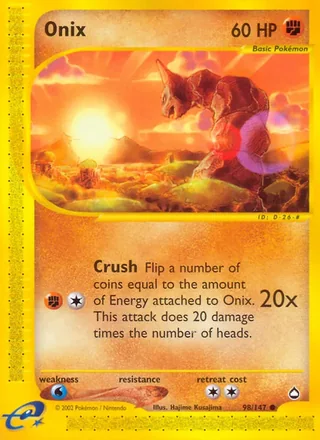
Onix, 60 HP — thirty below the 2000 card at 90 — retreat 2, one Fighting attack with no printed damage. The single largest HP cut in e-Card 3, and the reason Onix reads as the weakest card in a set that otherwise raises HP.

Sudowoodo — ウソッキー (2002)

English scan

057

Sudowoodoウソッキー

RARE
FightingHP 60BasicDex No. 185Illus. Kagemaru Himeno

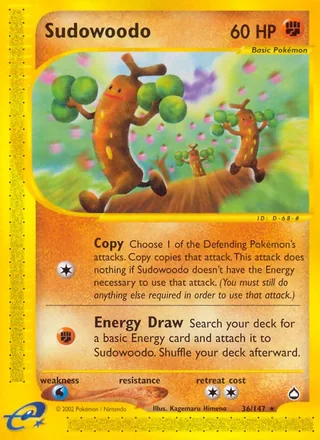
Sudowoodo, 60 HP, unchanged since 2000, retreat 2, two Fighting attacks with no printed damage. Plain rare; 058 is the holofoil. A Basic with 60 HP at rare — the set's lowest HP for a rare.

Sudowoodo — ウソッキー (2002)

English scan

058

Sudowoodoウソッキー

HOLO RARE
FightingHP 60BasicDex No. 185Illus. Kagemaru Himeno

Sudowoodo, holofoil — same 60 HP, same two attacks, same Kagemaru Himeno art as 057. The lowest-HP holofoil in the set, and one of only two Fighting holofoils.

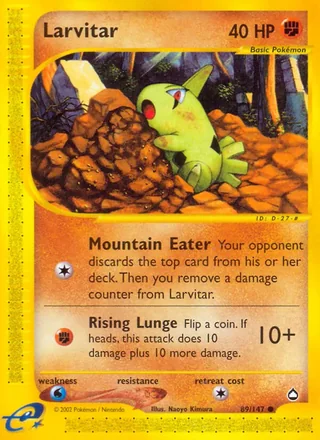
Larvitar — ヨーギラス (2002)

English scan

059

Larvitarヨーギラス

COMMON
FightingHP 40BasicDex No. 246Illus. Naoyo Kimura

Larvitar, 40 HP, unchanged since 2000, retreat 1, two Fighting attacks. Drawn by Naoyo Kimura, who draws Pupitar and both Tyranitar as well — the whole line in one hand.

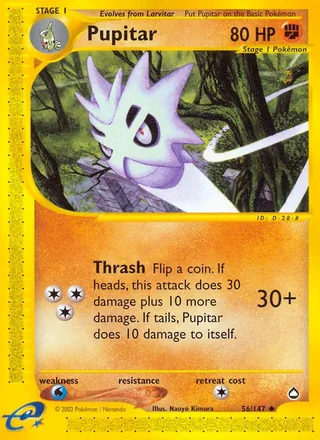
Pupitar — サナギラス (2002)

English scan

060

Pupitarサナギラス

COMMON
FightingHP 80Stage 1Dex No. 247Illus. Naoyo Kimura

Pupitar, 80 HP Stage 1 — ten above the 2000 and 2001 cards — retreat 1, one Fighting attack. A common, which at 80 HP makes it the largest common Stage 1 in the set.

Darkness3 cardsHOLO 1

3 cards · listed in original order.

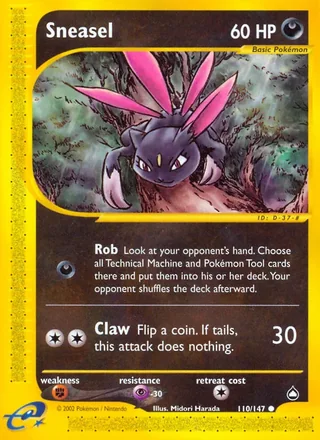
Sneasel — ニューラ (2002)

English scan

069

Sneaselニューラ

COMMON
DarknessHP 60BasicDex No. 215Illus. Midori Harada

Sneasel, 60 HP, unchanged since 2000, retreat 1, one Darkness attack for 30. A common, and the only Darkness card in e-Card 3 — the type appears once per set in 2002 and never more.

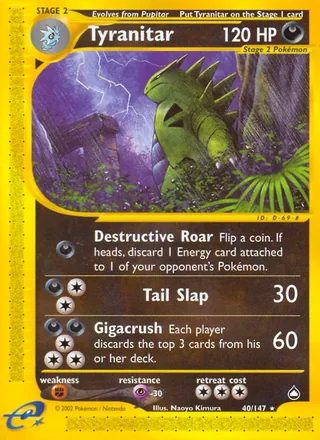
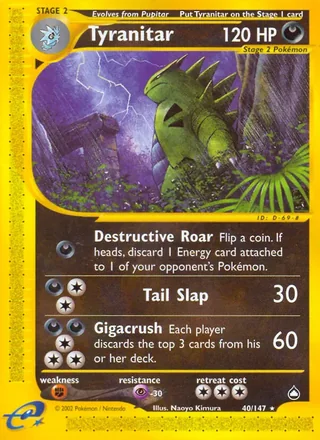
Tyranitar — バンギラス (2002)

English scan

070

Tyranitarバンギラス

RARE
DarknessHP 120Stage 2Dex No. 248Illus. Naoyo Kimura

Tyranitar, 120 HP Stage 2 — the same 120 as the 2001 card, twenty above 2000 — retreat 3, three attacks. Plain rare; 071 is the holofoil. One of two cards at 120 in the set, with Kingdra.

Tyranitar — バンギラス (2002)

English scan

071

Tyranitarバンギラス

HOLO RARE
DarknessHP 120Stage 2Dex No. 248Illus. Naoyo Kimura

Tyranitar, holofoil — same 120 HP, same three attacks, same Naoyo Kimura art as 070. With the 2001 holofoil this is the second Tyranitar holo in two years, and the only Stage 2 in e-Card 3 with three attacks.

Metal4 cardsHOLO 2

4 cards · listed in original order.

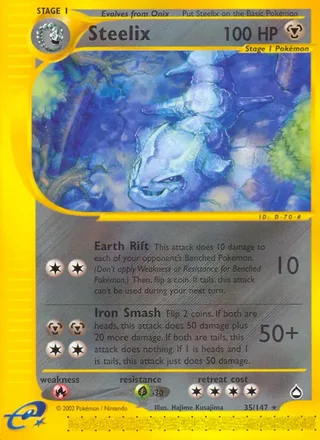
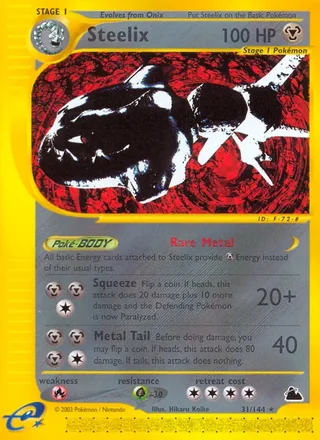
Steelix — ハガネール (2002)

English scan

072

Steelixハガネール

RARE
MetalHP 100Stage 1Dex No. 208Illus. Hajime Kusajima

Steelix, 100 HP Stage 1 — ten below the 2000 card at 110 — retreat 4, the highest retreat cost in the set, two Metal attacks. Plain rare; 073 is the holofoil. One of only two Metal Pokémon in e-Card 3.

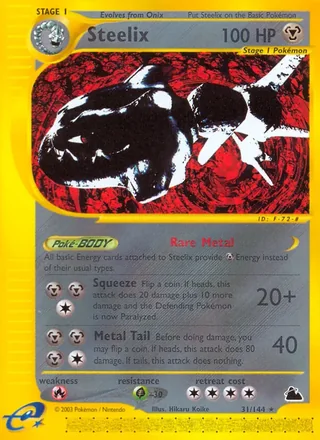
Steelix — ハガネール (2002)

English scan

073

Steelixハガネール

HOLO RARE
MetalHP 100Stage 1Dex No. 208Illus. Hajime Kusajima

Steelix, holofoil — same 100 HP, same retreat 4, same Hajime Kusajima art as 072. The only Metal holofoil of the year: e-Card 3 prints two Metal Pokémon and makes one of them a holo, and neither of the other three sets does.

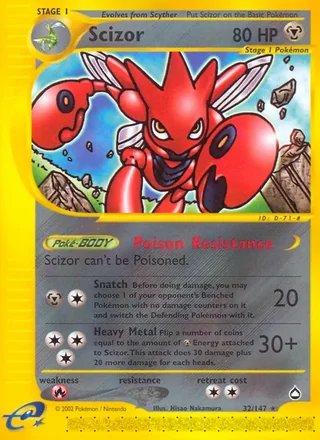
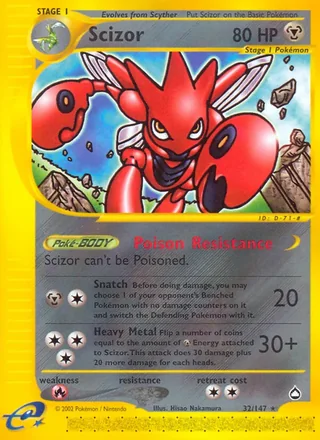
Scizor — ハッサム (2002)

English scan

074

Scizorハッサム

RARE
MetalHP 80Stage 1Dex No. 212Illus. Hisao Nakamura

Scizor, 80 HP Stage 1, unchanged since 2000, retreat 2, two Metal attacks. Plain rare; 075 is the holofoil. Drawn by Hisao Nakamura, who draws both Scyther — so the Metal relative and the Grass originals come from one hand.

Scizor — ハッサム (2002)

English scan

075

Scizorハッサム

HOLO RARE
MetalHP 80Stage 1Dex No. 212Illus. Hisao Nakamura

Scizor, holofoil — same 80 HP, same two attacks, same Hisao Nakamura art as 074. With Steelix at 073 this gives the set two Metal holofoils, more than any other 2002 expansion prints.

Colorless11 cardsHOLO 3

11 cards · listed in original order.

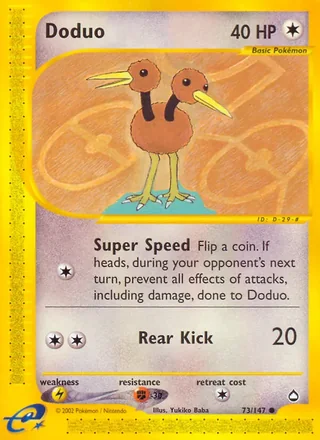
Doduo — ドードー (2002)

English scan

061

Doduoドードー

COMMON
ColorlessHP 40BasicDex No. 084Illus. Yukiko Baba

Doduo, 40 HP, ten below the 1996 card, retreat 1, two Colourless attacks for 20. Drawn by Yukiko Baba. Dodrio at 062 is the evolution, and both cards are common — one of two lines in the set where every stage is common.

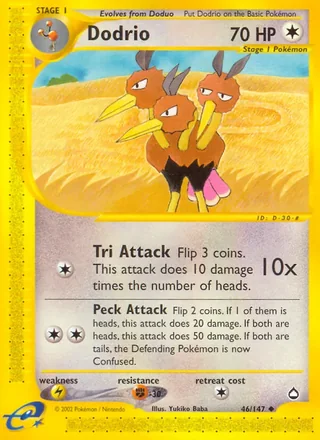
Dodrio — ドードリオ (2002)

English scan

062

Dodrioドードリオ

COMMON
ColorlessHP 70Stage 1Dex No. 085Illus. Yukiko Baba

Dodrio, 70 HP Stage 1, unchanged since 1997, retreat 1, two Colourless attacks. A common. Yukiko Baba draws the pair, giving the set a complete two-stage Colourless line entirely at common rarity.

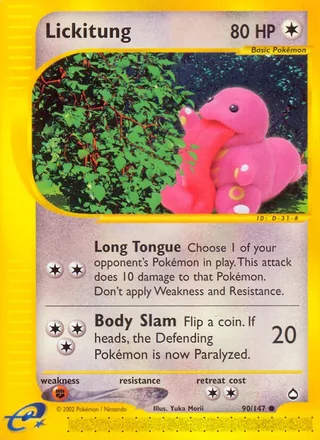
Lickitung — ベロリンガ (2002)

English scan

063

Lickitungベロリンガ

COMMON
ColorlessHP 80BasicDex No. 108Illus. Yuka Morii

Lickitung, 80 HP — ten below the 1999 card at 90, ten above 1997's 70 — retreat 2, two Colourless attacks for 20. A common at 80 HP, drawn by Yuka Morii.

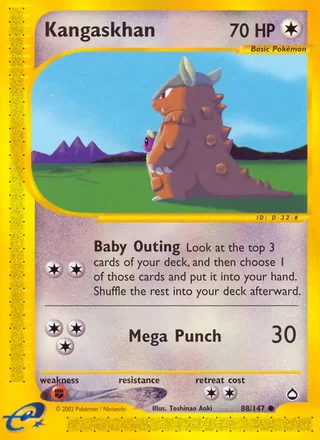
Kangaskhan — ガルーラ (2002)

English scan

064

Kangaskhanガルーラ

COMMON
ColorlessHP 70BasicDex No. 115Illus. Toshinao Aoki

Kangaskhan, 70 HP — twenty below the 1997 card at 90 — retreat 2, two Colourless attacks for 30. A common, drawn by Toshinao Aoki, who also draws Pinsir at 018. No Kangaskhan Stage 1 exists: the line begins and ends on this card.

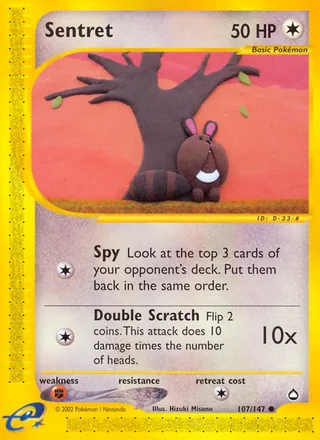
Sentret — オタチ (2002)

English scan

065

Sentretオタチ

COMMON
ColorlessHP 50BasicDex No. 161Illus. Hizuki Misono

Sentret, 50 HP — ten above the 2000 card — retreat 1, two Colourless attacks, drawn by Hizuki Misono. Furret at 066 is the evolution, and both are common.

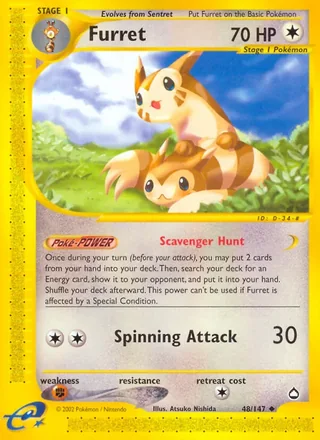
Furret — オオタチ (2002)

English scan

066

Furretオオタチ

COMMON
ColorlessHP 70Stage 1Dex No. 162Illus. Atsuko Nishida

Furret, 70 HP Stage 1 — ten above the 2000 card — retreat 1, one Colourless attack for 30. Drawn by Atsuko Nishida. A common, and the set's only complete Colourless line drawn by two different artists.

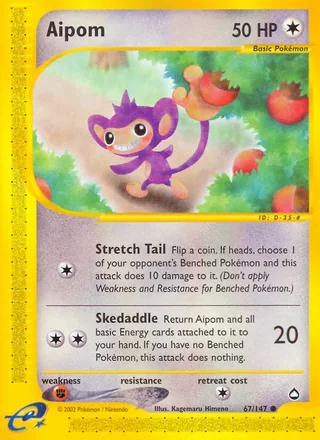
Aipom — エイパム (2002)

English scan

067

Aipomエイパム

COMMON
ColorlessHP 50BasicDex No. 190Illus. Kagemaru Himeno

Aipom, 50 HP — ten above the 2000 card — retreat 1, two Colourless attacks for 20. Drawn by Kagemaru Himeno, who draws five cards in this set, the most of any illustrator here.

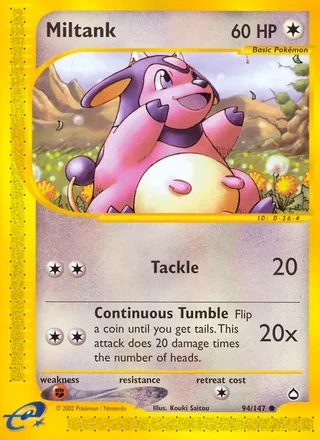
Miltank — ミルタンク (2002)

English scan

068

Miltankミルタンク

COMMON
ColorlessHP 60BasicDex No. 241Illus. Kouki Saitou

Miltank, 60 HP — ten below the 2000 card at 70 — retreat 1, two Colourless attacks for 20. Drawn by Kouki Saitou, who draws four cards in the set including all three Water rares in the Octillery–Rapidash block.

Nidoking — ニドキング (2002)

English scan

088

Nidokingニドキング

SECRET RARE
ColorlessHP 100Stage 2Dex No. 034Illus. Naoyo Kimura

Nidoking, secret, 100 HP Stage 2, retreat 3, two attacks for 20 and 50. Ten below the e-Card 2 Nidoking at 110 — the same Pokémon printed twice in one year at two different HP values, and the only Pokémon to be a secret in one 2002 set and an ordinary rare in another.

Kingdra — キングドラ (2002)

English scan

089

Kingdraキングドラ

SECRET RARE
ColorlessHP 110Stage 2Dex No. 230Illus. Mikio Menjo

Kingdra, secret, 110 HP Stage 2 — ten below the rare Kingdra at 041 — retreat 3, two attacks for 40 and 60. Drawn by Mikio Menjo, the same artist as the holofoil at 042. Three Kingdra in one set at three rarities and two HP values.

Lugia — ルギア (2002)

English scan

090

Lugiaルギア

SECRET RARE
ColorlessHP 80BasicDex No. 249Illus. Naoyo Kimura

Lugia, secret, 80 HP Basic — ten below the 2000 card at 90 — retreat 3, two attacks for 50. The last card of e-Card 3 and the card English collectors meet as Crystal Lugia in Aquapolis: the three secrets of this set are exactly the three Crystal Pokémon of that one.

Trainer12 cards

12 cards · listed in original order.

No card face
076

Energy Switch

UNCOMMON
Trainer

Energy Switch, the first Trainer. Moves one Energy from one of your Pokémon to another — the plainest card in the set and the only one that changes nothing except where an Energy sits. It is also the only Trainer here that had a card of the same name in 1996.

No card face
077

Traveling Salesman

UNCOMMON
Trainer

Traveling Salesman, a Supporter. One of the set's twelve Trainers and one of five that search the deck — the group that made e-Card decks thin and fast. The twelve Trainers here are numbered 076 to 087 with no gap.

No card face
078

Juggler

UNCOMMON
Trainer

Juggler, a Supporter with a discard cost. The set's cheap draw card, and the one Trainer here whose name refers to nothing in the game — no Juggler character exists in the video games; the card is named for the act.

No card face
079

Forest Guardian

UNCOMMON
Trainer

Forest Guardian, a Supporter. One of four Trainers in e-Card 3 that recover cards from the discard pile — with Memory Berry, Healing Berry and Time Shard — a block that makes this the most recovery-heavy Trainer run of the year.

No card face
080

Memory Berry

UNCOMMON
Trainer

Memory Berry, a Pokémon Tool. The first card in the game to let an evolved Pokémon use an attack printed on its earlier stage, which is why the set prints so many three-stage lines: Memory Berry needs them to work.

No card face
081

Healing Berry

UNCOMMON
Trainer

Healing Berry, a Pokémon Tool. With Memory Berry at 080 it forms a two-card Tool block — the last Japanese set to print two Tools in one expansion before Tools were reworked in the EX era.

No card face
082

Time Shard

UNCOMMON
Trainer

Time Shard, a Trainer that returns cards from the discard pile to the deck. The third of the set's four recovery cards, and the only one that puts cards back rather than into the hand.

No card face
083

Undersea Ruins

UNCOMMON
Trainer

Undersea Ruins, a Stadium. e-Card 3 prints one Stadium, where e-Card 2 printed two — the clearest sign that the four sets were designed as a sequence rather than as four independent releases.

No card face
084

Apricorn Forest

UNCOMMON
Trainer

Apricorn Forest, a Stadium. The named location is from Gold and Silver, and it is one of three cards in the set named after a place in the games rather than an effect — with Undersea Ruins and the set's own theme of the sea.

No card face
085

Crystal Energy

UNCOMMON
Trainer

Crystal Energy, a Special Energy. The first card in the game to use the word Crystal, a year before the English Aquapolis built an entire Pokémon mechanic around it. In Japanese it is only an Energy card.

No card face
086

Boost Energy

UNCOMMON
Trainer

Boost Energy, a Special Energy providing three Energy at once but only to an evolved Pokémon. The card the English set calls Boost Energy, and the reason the set's Stage 2 population is fourteen — the largest of the year.

No card face
087

Warp Energy

UNCOMMON
Trainer

Warp Energy, the last Trainer, a Special Energy that returns the holder to the hand. Three Special Energy in e-Card 3 — Crystal, Boost and Warp — all uncommon, all numbered 085 to 087, and all three would be reprinted in the English Aquapolis unchanged.

e-Card 4 · Split Earth

2002-08-2391 cardsHOLO 16

23 August 2002. Eighty-eight numbered cards plus three secrets, 78 Pokémon and 13 Trainer & Energy — the thirteenth being Buried Fossil, which the source data files as a Pokémon and is not.

The three secrets are Golem, Kabutops and Ho-oh. Ho-oh is the card that becomes Crystal Ho-Oh in Skyridge; the other two stay ordinary holofoil secrets. Fighting runs to eleven cards here, the highest of the year, and thirty-four Stage 1 Pokémon make this the evolution-heavy middle of the e-Card run.

Grass15 cardsHOLO 2

15 cards · listed in original order.

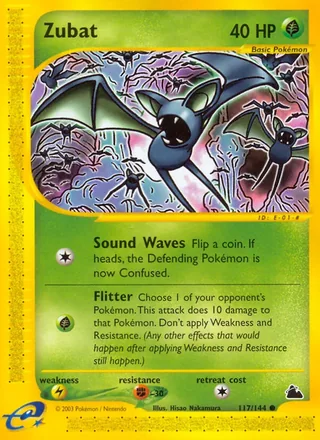
Zubat — ズバット (2002)

English scan

001

Zubatズバット

COMMON
GrassHP 40BasicDex No. 041Illus. Hisao Nakamura

Zubat, 40 HP, the lower of the set's two — and the only Zubat in 2002 still at the 40 HP every printing since 1997 has used. Two no-damage attacks, one Grass and one Colourless, retreat 1. Drawn by Hisao Nakamura.

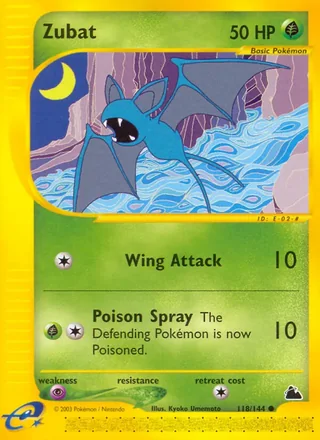
Zubat — ズバット (2002)

English scan

002

Zubatズバット

COMMON
GrassHP 50BasicDex No. 041Illus. Kyoko Umemoto

Zubat, 50 HP — the first Zubat ever printed above 40 — retreat 1, two attacks for 10 each. Drawn by Kyoko Umemoto. Two Zubat, two Golbat different only in artist, and one Crobat line: this is how the set bulks out a 91-card count without adding new Pokémon.

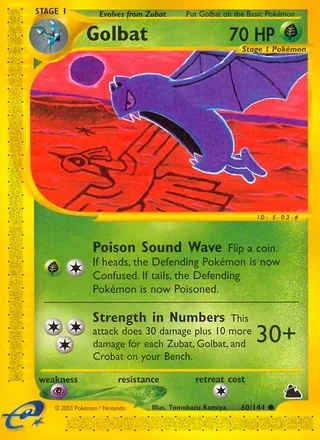
Golbat — ゴルバット (2002)

English scan

003

Golbatゴルバット

COMMON
GrassHP 70Stage 1Dex No. 042Illus. Tomokazu Komiya

Golbat, 70 HP Stage 1 — ten above the 1997, 1999 and 2000 cards, all of which sat at 60 — retreat 1, two attacks neither of which does printed damage. A common. The HP jump makes this the largest Golbat of the first six years.

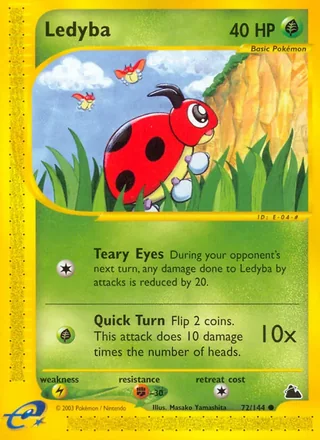
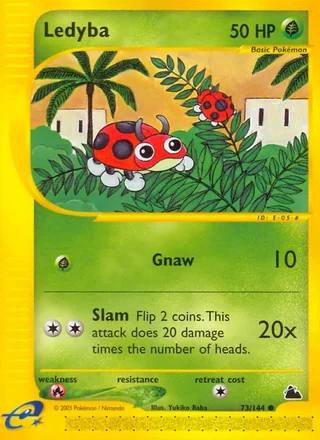
Ledyba — レディバ (2002)

English scan

004

Ledybaレディバ

COMMON
GrassHP 40BasicDex No. 165Illus. Masako Yamashita

Ledyba, 40 HP, unchanged from the 1999 promo and the 2000 and 2001 cards. Drawn by Masako Yamashita, who draws only two cards in e-Card 4. 005 is the second Ledyba, ten HP higher.

Ledyba — レディバ (2002)

English scan

005

Ledybaレディバ

COMMON
GrassHP 50BasicDex No. 165Illus. Yukiko Baba

Ledyba, 50 HP — the first Ledyba above 40 in the game — retreat 1, a 10 for one Grass and a no-damage Colourless attack. Drawn by Yukiko Baba, who draws four cards in e-Card 4 — 005, Omanyte at 028, Girafarig at 048 and Kabuto at 056 — and no holofoil at all.

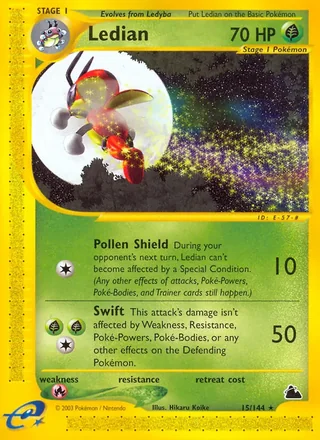
Ledian — レディアン (2002)

English scan

006

Ledianレディアン

RARE
GrassHP 70Stage 1Dex No. 166Illus. Hikaru Koike

Ledian, 70 HP Stage 1 — ten above the 2000 card — and a rare. Free retreat: 006 and 007 are two of the seven card entries in e-Card 4 with a retreat cost of zero. Two attacks, 10 for one Colourless and 50 for two Grass and a Colourless.

Ledian — レディアン (2002)

English scan

007

Ledianレディアン

HOLO RARE
GrassHP 70Stage 1Dex No. 166Illus. Hikaru Koike

Ledian, holofoil — same 70 HP, same two attacks, same free retreat, same Hikaru Koike art as 006. One of the pairs in this set where the foil is the identical card rather than a second design.

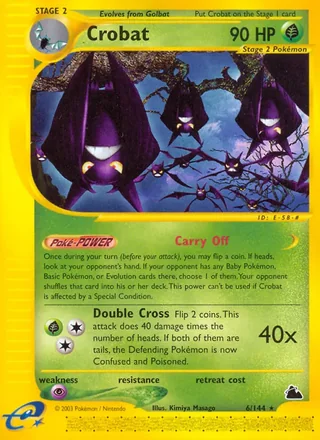
Crobat — クロバット (2002)

English scan

008

Crobatクロバット

RARE
GrassHP 90Stage 2Dex No. 169Illus. Kimiya Masago

Crobat, 90 HP Stage 2 — unchanged from 2000 — a rare, free retreat, and a single attack costing two Grass and a Colourless that does no printed damage: the whole card is its effect. Drawn by Kimiya Masago.

Crobat — クロバット (2002)

English scan

009

Crobatクロバット

HOLO RARE
GrassHP 90Stage 2Dex No. 169Illus. Atsuko Nishida

Crobat, holofoil — same 90 HP, same free retreat, same single attack, but drawn by Atsuko Nishida. 008 and 009 are the same card with two different pictures, one of four such pairs in e-Card 4 (with Magcargo 019/020, Kabutops 057/058, and nothing else).

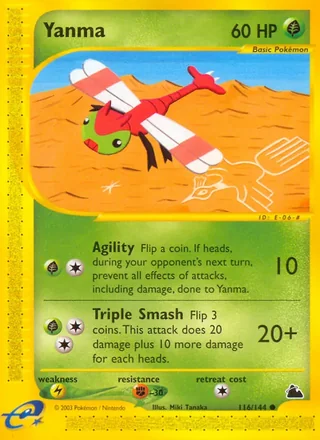
Yanma — ヤンヤンマ (2002)

English scan

010

Yanmaヤンヤンマ

COMMON
GrassHP 60BasicDex No. 193Illus. Miki Tanaka

Yanma, 60 HP — the same 60 as the 2000 card — but demoted from holofoil rare to common. Two attacks, 10 for a Grass and a Colourless and a three-energy second. Drawn by Miki Tanaka. In 2002 a 60 HP Yanma is no longer worth a foil slot.

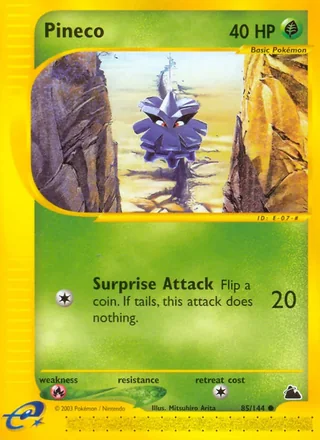
Pineco — クヌギダマ (2002)

English scan

011

Pinecoクヌギダマ

COMMON
GrassHP 40BasicDex No. 204Illus. Mitsuhiro Arita

Pineco, 40 HP, the lower of two. One attack, 20 for a single Colourless, retreat 1, drawn by Mitsuhiro Arita. Pineco has been 40 HP since 2000; the second copy at 012 breaks it.

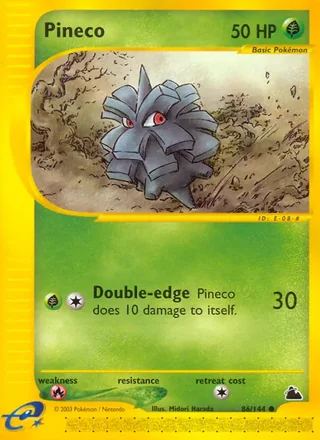
Pineco — クヌギダマ (2002)

English scan

012

Pinecoクヌギダマ

COMMON
GrassHP 50BasicDex No. 204Illus. Midori Harada

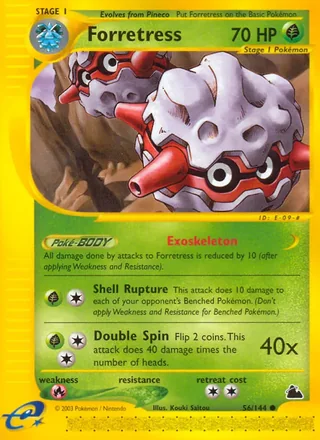
Pineco, 50 HP — ten above every earlier Pineco — retreat 1, one attack for 30 costing a Grass and a Colourless. Drawn by Midori Harada. Both Pineco evolve into Forretress, of which the set prints two entirely separate cards at 013 and at 074/075.

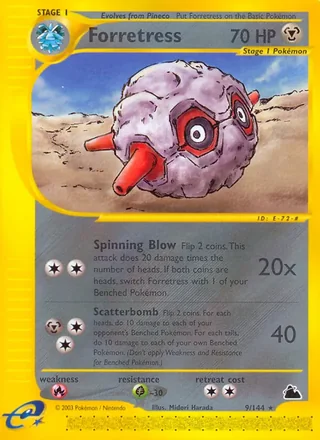
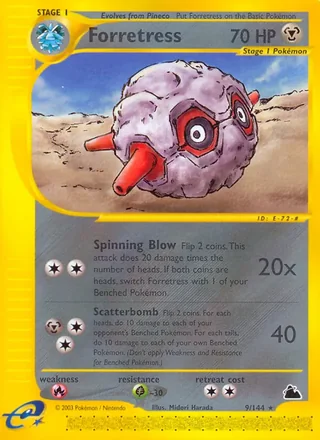
Forretress — フォレトス (2002)

English scan

013

Forretressフォレトス

COMMON
GrassHP 70Stage 1Dex No. 205Illus. Kouki Saitou

Forretress, 70 HP Stage 1, Grass, a common — and therefore the cheap half of a split: the same Pokémon appears at 074/075 as a Metal rare and holofoil at 70 HP. Ten below the 2000 Forretress at 80, and a fall from holofoil to common. Drawn by Kouki Saitou.

Shuckle — ツボツボ (2002)

English scan

014

Shuckleツボツボ

COMMON
GrassHP 30BasicDex No. 213Illus. Sumiyoshi Kizuki

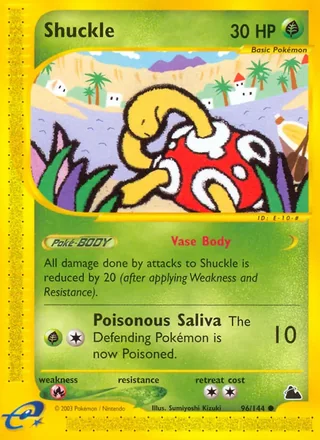
Shuckle, 30 HP — the lowest HP of any Shuckle printed, down from 50 in 2000 and 40 in the same year's second card — retreat 2, one attack for 10 costing a Grass and a Colourless. A common, drawn by Sumiyoshi Kizuki.

Heracross — ヘラクロス (2002)

English scan

015

Heracrossヘラクロス

COMMON
GrassHP 60BasicDex No. 214Illus. Kouki Saitou

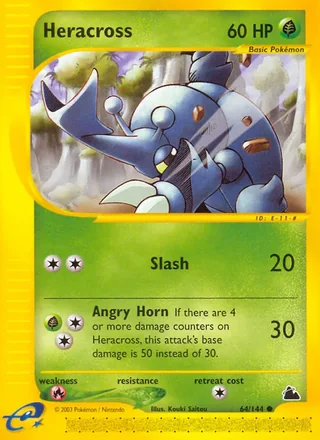
Heracross, 60 HP — unchanged since 2000 — but now a common where 2000 had it as a holofoil and 2001 as an uncommon. Two attacks, 20 for two Colourless and 30 for a Grass plus two Colourless, retreat 1. Drawn by Kouki Saitou.

Fire5 cardsHOLO 2

5 cards · listed in original order.

Flareon — ブースター (2002)

English scan

016

Flareonブースター

RARE
FireHP 70Stage 1Dex No. 136Illus. Kyoko Umemoto

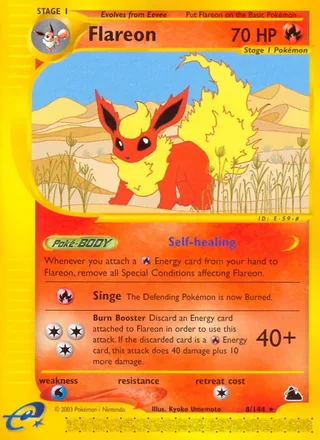
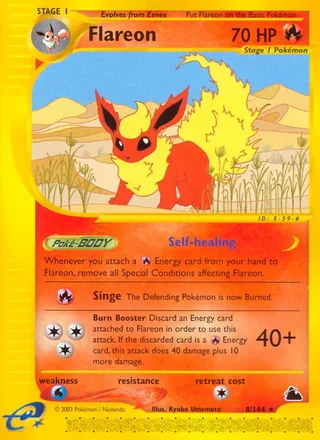
Flareon, 70 HP Stage 1 — the same 70 as 1997 and 1999 — a rare, retreat 1, one Fire attack and one three-Colourless attack. Drawn by Kyoko Umemoto, who draws both 016 and the holofoil at 017.

Flareon — ブースター (2002)

English scan

017

Flareonブースター

HOLO RARE
FireHP 70Stage 1Dex No. 136Illus. Kyoko Umemoto

Flareon, holofoil — same 70 HP, same two attacks, same Kyoko Umemoto art as 016. Flareon is the only one of the three Eevee evolutions in this set whose plain and foil versions are one picture; Vaporeon at 026/027 and Jolteon at 036/037 keep their artists too.

Slugma — マグマッグ (2002)

English scan

018

Slugmaマグマッグ

COMMON
FireHP 50BasicDex No. 218Illus. Naoyo Kimura

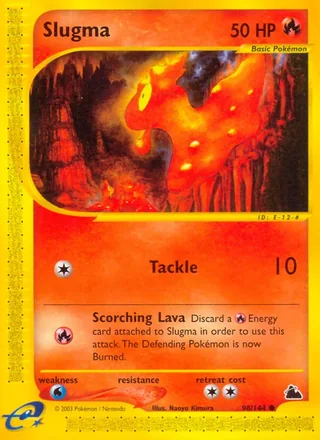
Slugma, 50 HP — unchanged from 2000 and 2001 — retreat 2, two attacks, 10 for a Colourless and a no-damage Fire attack. A common, drawn by Naoyo Kimura, who draws six cards in e-Card 4 — the most of any artist after Atsuko Nishida — including both Vaporeon and both Poliwrath.

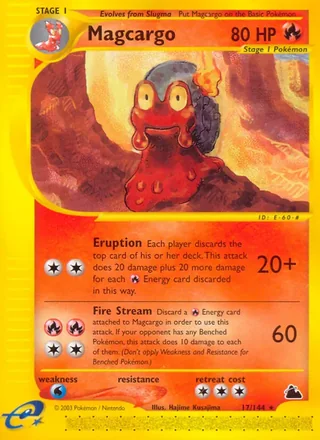
Magcargo — マグカルゴ (2002)

English scan

019

Magcargoマグカルゴ

RARE
FireHP 80Stage 1Dex No. 219Illus. Hajime Kusajima

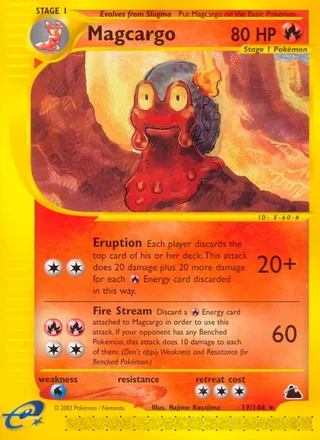
Magcargo, 80 HP Stage 1 — the same 80 as 2000 — but promoted from uncommon to rare, retreat 3, two attacks with a 60 for two Fire and two Colourless. Drawn by Hajime Kusajima.

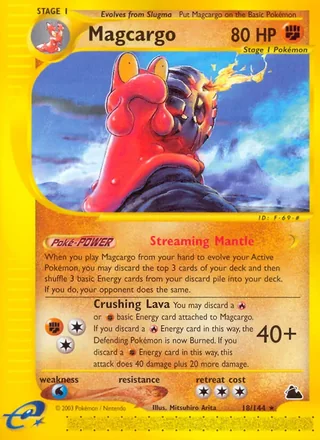
Magcargo — マグカルゴ (2002)

English scan

020

Magcargoマグカルゴ

HOLO RARE
FireHP 80Stage 1Dex No. 219Illus. Mitsuhiro Arita

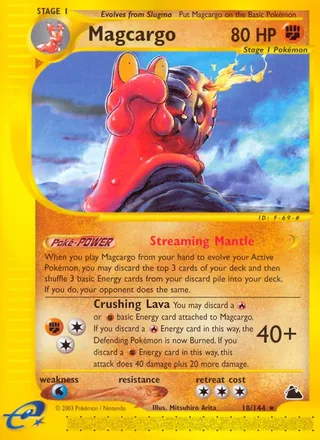
Magcargo, holofoil — same 80 HP, same 60-damage attack, same retreat 3, but drawn by Mitsuhiro Arita. Magcargo is also the only Pokémon in 2002 printed as a Fire card in one set and a Fighting card in another: 019/020 here, and 055/056 in e-Card 5.

Water12 cardsHOLO 2

12 cards · listed in original order.

Poliwag — ニョロモ (2002)

English scan

021

Poliwagニョロモ

COMMON
WaterHP 40BasicDex No. 060Illus. Miki Tanaka

Poliwag, 40 HP — ten below the 2001 card at 50, and back to the 1999 and 2000 figure — retreat 1, a 10 Water attack and a two-Colourless second. Drawn by Miki Tanaka. The set's Poliwag line stops at Poliwhirl: Poliwrath at 051/052 is a Fighting card and Politoed at 030/031 is a separate Water Stage 2.

Poliwhirl — ニョロゾ (2002)

English scan

022

Poliwhirlニョロゾ

COMMON
WaterHP 70Stage 1Dex No. 061Illus. Hisao Nakamura

Poliwhirl, 70 HP Stage 1 — unchanged from 2000 and 2001 — retreat 1, two attacks, the second costing three Colourless. A common where 1999 had it as an uncommon, drawn by Hisao Nakamura.

Staryu — ヒトデマン (2002)

English scan

023

Staryuヒトデマン

COMMON
WaterHP 40BasicDex No. 120Illus. Kyoko Umemoto

Staryu, 40 HP, the lower of two, unchanged since 1999. Two attacks, one of them a no-damage Colourless and one a 10 Water, retreat 1. Drawn by Kyoko Umemoto, who also draws Starmie at 025 — but not the second Staryu or the second Starmie.

Staryu — ヒトデマン (2002)

English scan

024

Staryuヒトデマン

COMMON
WaterHP 50BasicDex No. 120Illus. Keiko Fukuyama

Staryu, 50 HP — the first Staryu above 40 — retreat 1, 10 for one Colourless and 10 for a Water and a Colourless. Drawn by Keiko Fukuyama. The set carries two Staryu and three Starmie at two different types, the widest treatment any single Pokémon receives in 2002.

Starmie — スターミー (2002)

English scan

025

Starmieスターミー

UNCOMMON
WaterHP 70Stage 1Dex No. 121Illus. Kyoko Umemoto

Starmie, 70 HP Stage 1, Water, an uncommon — and the cheaper of the set's three Starmie. Retreat 1, a no-damage Water attack and a three-Colourless second. Drawn by Kyoko Umemoto. Ten above the 1999 card at 60, level with 2000.

Vaporeon — シャワーズ (2002)

English scan

026

Vaporeonシャワーズ

RARE
WaterHP 70Stage 1Dex No. 134Illus. Naoyo Kimura

Vaporeon, 70 HP Stage 1 — ten below the 80 that every Vaporeon since 1997 has used — a rare, retreat 1, a 10 for two Colourless and a 40 for two Water plus a Colourless. The drop makes this the smallest Vaporeon printed, and it is deliberate: the whole Eevee family is scaled down in e-Card 4.

Vaporeon — シャワーズ (2002)

English scan

027

Vaporeonシャワーズ

HOLO RARE
WaterHP 70Stage 1Dex No. 134Illus. Naoyo Kimura

Vaporeon, holofoil — same 70 HP, same 40-damage attack, same Naoyo Kimura art as 026. The last Water holofoil in the set. e-Card 4 prints sixteen holofoils and only two of them are Water — Vaporeon and Politoed — fewer than any type except Darkness and Metal, which get one each.

Omanyte — オムナイト (2002)

English scan

028

Omanyteオムナイト

COMMON
WaterHP 60Stage 1Dex No. 138Illus. Yukiko Baba

Omanyte, 60 HP Stage 1 — ten above the 2000 card and twenty above 1997 and 1999 — so the fossil is now the biggest it has ever been, retreat 1, one attack for 10 Water and a Colourless. A common. Drawn by Yukiko Baba.

Omastar — オムスター (2002)

English scan

029

Omastarオムスター

UNCOMMON
WaterHP 90Stage 2Dex No. 139Illus. Hajime Kusajima

Omastar, 90 HP Stage 2 — ten above 2000, twenty above 1997 and 1999 — an uncommon, retreat 2, one attack for 50 costing two Water and a Colourless. Drawn by Hajime Kusajima. The Omanyte line is the one fossil line the set takes all the way to Stage 2.

Politoed — ニョロトノ (2002)

English scan

030

Politoedニョロトノ

RARE
WaterHP 110Stage 2Dex No. 186Illus. Atsuko Nishida

Politoed, 110 HP Stage 2 — ten above the 2000 card at 100, and level with Poliwrath for the highest HP in e-Card 4 — retreat 2, three attacks, the last a 70 for two Water and three Colourless. Drawn by Atsuko Nishida.

Politoed — ニョロトノ (2002)

English scan

031

Politoedニョロトノ

HOLO RARE
WaterHP 110Stage 2Dex No. 186Illus. Atsuko Nishida

Politoed, holofoil — same 110 HP, same three attacks, same Atsuko Nishida art as 030. Every set Politoed appears in — 2000, 2001, 2002 — prints a holofoil of it, a run no other Stage 2 in e-Card 4 can match.

Mantine — マンタイン (2002)

English scan

032

Mantineマンタイン

COMMON
WaterHP 60BasicDex No. 226Illus. Sumiyoshi Kizuki

Mantine, 60 HP — unchanged since 2000 — retreat 2, a no-damage Water attack and a 30 for two Water and a Colourless. A common, drawn by Sumiyoshi Kizuki. One of only two Water Basics in the set, with Staryu.

Lightning7 cardsHOLO 3

7 cards · listed in original order.

Pikachu — ピカチュウ (2002)

English scan

033

Pikachuピカチュウ

COMMON
LightningHP 50BasicDex No. 025Illus. Yuka Morii

Pikachu, 50 HP — the same 50 as 1997, 1999's Base Set 2, 2000 and 2001 — a common with one attack, costing two Colourless and doing no printed damage. Drawn by Yuka Morii, whose clay-model work also covers Raichu at 034/035 and Dunsparce at 067.

Raichu — ライチュウ (2002)

English scan

034

Raichuライチュウ

RARE
LightningHP 80Stage 1Dex No. 026Illus. Yuka Morii

Raichu, 80 HP Stage 1 — level with the 1999 Base Set and 2001 cards, ten below the 90 of 1997 and 1999's Fossil — a rare, retreat 1, two attacks with a 50 for a Lightning and two Colourless. Drawn by Yuka Morii.

Raichu — ライチュウ (2002)

English scan

035

Raichuライチュウ

HOLO RARE
LightningHP 80Stage 1Dex No. 026Illus. Yuka Morii

Raichu, holofoil — same 80 HP, same 50-damage attack, same Yuka Morii art as 034. Raichu has been printed at 90 and at 80 and at nothing else — and both values appear in the same year, 1999, where Base Set gave 80 and Fossil gave 90. This card takes the 80.

Jolteon — サンダース (2002)

English scan

036

Jolteonサンダース

RARE
LightningHP 70Stage 1Dex No. 135Illus. Hikaru Koike

Jolteon, 70 HP Stage 1 — the same 70 as 1997 and 1999 — a rare with free retreat, retreat 0, a 10 Lightning attack and a 40 for a Lightning plus two Colourless. Drawn by Hikaru Koike, whose four cards in e-Card 4 are exactly the two Ledian and the two Jolteon — two complete plain-and-foil pairs.

Jolteon — サンダース (2002)

English scan

037

Jolteonサンダース

HOLO RARE
LightningHP 70Stage 1Dex No. 135Illus. Hikaru Koike

Jolteon, holofoil — same 70 HP, same free retreat, same Hikaru Koike art as 036. The set's only Lightning holofoil besides Raikou, and the second of the three Eevee evolutions to keep one artist across its plain and foil printings.

Raikou — ライコウ (2002)

English scan

038

Raikouライコウ

RARE
LightningHP 70BasicDex No. 243Illus. Mitsuhiro Arita

Raikou, 70 HP Basic — ten below the 2000 card at 80 — a rare, retreat 1, a single attack for a Lightning and two Colourless. Drawn by Mitsuhiro Arita. The drop is the largest any legendary Beast suffers in 2002 and the only one of the three printed here.

Raikou — ライコウ (2002)

English scan

039

Raikouライコウ

HOLO RARE
LightningHP 70BasicDex No. 243Illus. Mitsuhiro Arita

Raikou, holofoil — same 70 HP, same single attack, same Mitsuhiro Arita art as 038. Entei and Suicune do not appear in e-Card 4 at all: Raikou is the lone Beast of the set, and the only one printed as a holofoil here.

Psychic9 cardsHOLO 2

9 cards · listed in original order.

Abra — ケーシィ (2002)

English scan

040

Abraケーシィ

COMMON
PsychicHP 40BasicDex No. 063Illus. Keiko Fukuyama

Abra, 40 HP — back up from the 30 of 1999, level with 1997 and 2001 — a common with a single attack for 20 costing two Colourless, retreat 1. Drawn by Keiko Fukuyama, who draws the set's Abra and nothing else above a common.

Kadabra — ユンゲラー (2002)

English scan

041

Kadabraユンゲラー

COMMON
PsychicHP 70Stage 1Dex No. 064Illus. Toshinao Aoki

Kadabra, 70 HP Stage 1 — level with the 2001 card, ten above 1999 — a common, retreat 1, two attacks with a 40 for a Psychic and two Colourless. Drawn by Toshinao Aoki, who also draws Aerodactyl at 059: two cards, both in the Psychic and Fighting halves.

Alakazam — フーディン (2002)

English scan

042

Alakazamフーディン

RARE
PsychicHP 100Stage 2Dex No. 065Illus. Kimiya Masago

Alakazam, 100 HP Stage 2 — the same 100 as the 2001 card and twenty above 1999 — a rare, retreat 2, and one single attack costing three Colourless. Drawn by Kimiya Masago, who draws this and the holofoil at 043 and also Crobat at 008.

Alakazam — フーディン (2002)

English scan

043

Alakazamフーディン

HOLO RARE
PsychicHP 100Stage 2Dex No. 065Illus. Kimiya Masago

Alakazam, holofoil — same 100 HP, same single attack, same Kimiya Masago art as 042. Every Alakazam printed before 2001 sat at 80 HP; 2001 lifted it to 100 and e-Card 4 keeps it there — so this is the first Alakazam pair whose plain and foil versions are the same picture.

Starmie — スターミー (2002)

English scan

044

Starmieスターミー

RARE
PsychicHP 80Stage 1Dex No. 121Illus. Hajime Kusajima

Starmie, 80 HP Stage 1, Psychic — the second Starmie in one set, ten HP above the Water one at 025 and a rare rather than an uncommon. Retreat 1, a no-damage Psychic attack and a 40 for a Psychic plus two Colourless. Drawn by Hajime Kusajima.

Starmie — スターミー (2002)

English scan

045

Starmieスターミー

HOLO RARE
PsychicHP 80Stage 1Dex No. 121Illus. Hajime Kusajima

Starmie, holofoil — same 80 HP, same two attacks, same Hajime Kusajima art as 044. Two Starmie, two types, three cards: 025 is Water and uncommon, 044/045 are Psychic and rare, and no other Pokémon in 2002 is printed at two types in one expansion.

Misdreavus — ムウマ (2002)

English scan

046

Misdreavusムウマ

UNCOMMON
PsychicHP 50BasicDex No. 200Illus. Atsuko Nishida

Misdreavus, 50 HP — unchanged from 2000 — but dropped from holofoil rare to uncommon. Retreat 1, two attacks, one for 10 and one that costs a Psychic and a Colourless and does no printed damage. Drawn by Atsuko Nishida, who draws nine cards here, more than any other artist in e-Card 4.

Wobbuffet — ソーナンス (2002)

English scan

047

Wobbuffetソーナンス

UNCOMMON
PsychicHP 70BasicDex No. 202Illus. Kagemaru Himeno

Wobbuffet, 70 HP Basic — twenty below the 2000 card at 90, the largest single drop on any returning Pokémon in this set — retreat 2, one Psychic-plus-Colourless attack that does no printed damage: the card is its counter-attack effect and nothing else. Drawn by Kagemaru Himeno.

Girafarig — キリンリキ (2002)

English scan

048

Girafarigキリンリキ

COMMON
PsychicHP 60BasicDex No. 203Illus. Yukiko Baba

Girafarig, 60 HP — unchanged from 2000 and 2001 — a common, retreat 1, a no-damage Psychic attack and a 40 for a Psychic plus a Colourless. Drawn by Yukiko Baba. One of four Psychic cards in the set that are not part of an evolution line.

Fighting11 cardsHOLO 3

11 cards · listed in original order.

Sandshrew — サンド (2002)

English scan

049

Sandshrewサンド

COMMON
FightingHP 40BasicDex No. 027Illus. Naoyo Kimura

Sandshrew, 40 HP Basic — unchanged from 1999 — a common, retreat 1, two attacks: a no-damage Colourless and a Fighting one. Drawn by Naoyo Kimura. Sandslash at 050 completes the line, and it is the set's only Ground-type evolution outside the Rhydon pair.

Sandslash — サンドパン (2002)

English scan

050

Sandslashサンドパン

COMMON
FightingHP 70Stage 1Dex No. 028Illus. Miki Tanaka

Sandslash, 70 HP Stage 1 — the same 70 as 1997 and 1999 — a common, retreat 1, a 10 Fighting-plus-Colourless attack and a three-energy poison-rush attack. Drawn by Miki Tanaka, whose four cards in the set include both Cleffa and Rattata.

Poliwrath — ニョロボン (2002)

English scan

051

Poliwrathニョロボン

RARE
FightingHP 110Stage 2Dex No. 062Illus. Naoyo Kimura

Poliwrath, 110 HP Stage 2 — ten above the 2001 card at 100 and twenty above 1999 and 2000 at 90 — a Fighting rare, retreat 2, one single attack for 50 costing two Fighting and a Colourless. Drawn by Naoyo Kimura.

Poliwrath — ニョロボン (2002)

English scan

052

Poliwrathニョロボン

HOLO RARE
FightingHP 110Stage 2Dex No. 062Illus. Naoyo Kimura

Poliwrath, holofoil — same 110 HP, same single attack, same Naoyo Kimura art as 051. The 110 makes Poliwrath and Politoed the two largest cards in e-Card 4, and they are the same evolution line printed as two different Stage 2s at two different types.

Rhyhorn — サイホーン (2002)

English scan

053

Rhyhornサイホーン

COMMON
FightingHP 60BasicDex No. 111Illus. Hisao Nakamura

Rhyhorn, 60 HP — ten below the 70 of 1997 and 1999 — a common, retreat 2, two attacks for 10 and for no printed damage. Drawn by Hisao Nakamura. Seven returning Pokémon lose ten HP in e-Card 4; Rhyhorn is one of them, and only Wobbuffet falls further.

Rhydon — サイドン (2002)

English scan

054

Rhydonサイドン

RARE
FightingHP 90Stage 1Dex No. 112Illus. Mitsuhiro Arita

Rhydon, 90 HP Stage 1 — ten below the 100 of 1997 and 1999, and the first Rhydon without a holofoil — retreat 2, and an attack for 100 damage costing two Fighting and three Colourless. Drawn by Mitsuhiro Arita. That 100 is the largest printed damage number in e-Card 4.

Rhydon — サイドン (2002)

English scan

055

Rhydonサイドン

HOLO RARE
FightingHP 90Stage 1Dex No. 112Illus. Mitsuhiro Arita

Rhydon, holofoil — same 90 HP, same 100-damage tail, same Mitsuhiro Arita art as 054. The five-energy cost is what balances it: nothing else in the set asks for five and nothing else in the set hits for three digits.

Kabuto — カブト (2002)

English scan

056

Kabutoカブト

COMMON
FightingHP 50Stage 1Dex No. 140Illus. Yukiko Baba

Kabuto, 50 HP Stage 1 — level with the 2000 card and twenty above the 30 of 1997 and 1999 — a common, retreat 1, one attack for 30 costing a Fighting and a Colourless. Drawn by Yukiko Baba. Two cards in the set exist to find it: Buried Fossil at 070 searches the deck, Underground Lake at 087 revives it from the discard pile.

Kabutops — カブトプス (2002)

English scan

057

Kabutopsカブトプス

RARE
FightingHP 90Stage 2Dex No. 141Illus. Kouki Saitou

Kabutops, 90 HP Stage 2 — level with the 2000 card and fifteen above 1999 — a rare, retreat 2, one attack costing two Fighting and a Colourless that does no printed damage. Drawn by Kouki Saitou.

Kabutops — カブトプス (2002)

English scan

058

Kabutopsカブトプス

HOLO RARE
FightingHP 90Stage 2Dex No. 141Illus. Atsuko Nishida

Kabutops, holofoil — same 90 HP, same single attack, but drawn by Atsuko Nishida. Three Kabutops in one set — 057 rare, 058 holofoil, 090 secret — is the only case in 2002 of one Pokémon printed three times in a single expansion.

Aerodactyl — プテラ (2002)

English scan

059

Aerodactylプテラ

UNCOMMON
FightingHP 70Stage 1Dex No. 142Illus. Toshinao Aoki

Aerodactyl, 70 HP Stage 1 — ten above every earlier Aerodactyl, which sat at 60 — but now an uncommon where 1997, 1999 and 2000 all had it as a rare or holofoil. Retreat 1, one Fighting-plus-Colourless attack. Drawn by Toshinao Aoki.

Darkness3 cardsHOLO 1

3 cards · listed in original order.

Umbreon — ブラッキー (2002)

English scan

071

Umbreonブラッキー

RARE
DarknessHP 70Stage 1Dex No. 197Illus. Atsuko Nishida

Umbreon, 70 HP Stage 1 — ten below the 2000 card at 80 — a Darkness rare, retreat 1, one attack costing a Darkness and a Colourless that does no printed damage. Drawn by Atsuko Nishida, who draws both this and the holofoil at 072.

Umbreon — ブラッキー (2002)

English scan

072

Umbreonブラッキー

HOLO RARE
DarknessHP 70Stage 1Dex No. 197Illus. Atsuko Nishida

Umbreon, holofoil — same 70 HP, same single attack, same Atsuko Nishida art as 071. The only Darkness holofoil in e-Card 4, and the fourth Eevee evolution in a set that prints all four — Umbreon, Flareon, Vaporeon and Jolteon — in one expansion.

Murkrow — ヤミカラス (2002)

English scan

073

Murkrowヤミカラス

COMMON
DarknessHP 50BasicDex No. 198Illus. Tomokazu Komiya

Murkrow, 50 HP — level with the 2000 holofoil rare and ten above the same year's common — a common here, retreat 1, two attacks, both of which do no printed damage. Drawn by Tomokazu Komiya. One of only two Darkness cards in the set, with Umbreon.

Metal3 cardsHOLO 1

3 cards · listed in original order.

Forretress — フォレトス (2002)

English scan

074

Forretressフォレトス

RARE
MetalHP 70Stage 1Dex No. 205Illus. Midori Harada

Forretress, 70 HP Stage 1, Metal — ten below the 2000 card at 80 — a rare, retreat 2, a no-damage two-Colourless attack and a 40 for a Metal plus two Colourless. Drawn by Midori Harada. The set prints Forretress twice at two types: 013 is a Grass common, 074/075 a Metal rare and holofoil.

Forretress — フォレトス (2002)

English scan

075

Forretressフォレトス

HOLO RARE
MetalHP 70Stage 1Dex No. 205Illus. Midori Harada

Forretress, holofoil — same 70 HP, same Metal typing, same Midori Harada art as 074. Metal is the smallest type in e-Card 4 — two Pokémon across three cards, Forretress and Skarmory — against fifteen Grass and thirteen Colorless.

Skarmory — エアームド (2002)

English scan

076

Skarmoryエアームド

COMMON
MetalHP 60BasicDex No. 227Illus. Katsura Tabata

Skarmory, 60 HP — the same 60 as 2000 and 2001 — but demoted from holofoil and rare to common — the same fall Yanma, Ditto and Forretress take in this expansion. Retreat 2, two attacks with a 30 for a Metal plus two Colourless. Drawn by Katsura Tabata, credited on this one card and nothing else in 2002.

Colorless13 cardsHOLO 3

13 cards · listed in original order.

Rattata — コラッタ (2002)

English scan

060

Rattataコラッタ

COMMON
ColorlessHP 30BasicDex No. 019Illus. Masako Yamashita

Rattata, 30 HP — level with the 1999 card and ten below 1997 — a common, retreat 1, two attacks, one of which searches out a friend from the deck. Drawn by Masako Yamashita, whose only two cards in e-Card 4 are this and Ledyba at 004.

Raticate — ラッタ (2002)

English scan

061

Raticateラッタ

COMMON
ColorlessHP 70Stage 1Dex No. 020Illus. Kagemaru Himeno

Raticate, 70 HP Stage 1 — ten above the 60 of 1999 and 2000 — a common, retreat 1, a 20 for one Colourless and a two-Colourless bite sequence. Drawn by Kagemaru Himeno, whose two cards here are this and Wobbuffet.

Meowth — ニャース (2002)

English scan

062

Meowthニャース

COMMON
ColorlessHP 40BasicDex No. 052Illus. Keiko Fukuyama

Meowth, 40 HP — level with the 1997 and 1999 cards and ten below the 50 of 1997's second Meowth and 2001 — a common with a single 10-damage attack for one Colourless, retreat 1. Drawn by Keiko Fukuyama. Persian at 063 follows directly, and the two are the set's only cat line.

Persian — ペルシアン (2002)

English scan

063

Persianペルシアン

UNCOMMON
ColorlessHP 70Stage 1Dex No. 053Illus. Atsuko Nishida

Persian, 70 HP Stage 1 — the same 70 as 1997 and 1999 — an uncommon with free retreat, retreat 0, a 20 for two Colourless and a 50 for two Colourless. Drawn by Atsuko Nishida. Free retreat on a Stage 1 that hits for 50 on two Energy is the best rate in e-Card 4's Colorless run.

Ditto — メタモン (2002)

English scan

064

Dittoメタモン

COMMON
ColorlessHP 50BasicDex No. 132Illus. Tomokazu Komiya

Ditto, 50 HP — unchanged from 1997 and 1999 — but now a common where both earlier printings were rare or holofoil. Retreat 1, and one single attack costing a single Colourless which does no printed damage: the whole card is its copy effect. Drawn by Tomokazu Komiya.

Eevee — イーブイ (2002)

English scan

065

Eeveeイーブイ

COMMON
ColorlessHP 50BasicDex No. 133Illus. Sumiyoshi Kizuki

Eevee, 50 HP — the same 50 as 1997, 1999 and 2000 — a common, retreat 1, a 10 for one Colourless and a 30 for two. Drawn by Sumiyoshi Kizuki, whose three cards here also include Shuckle and Mantine. The three evolutions are all in this set at 016/017, 026/027 and 036/037.

Cleffa — ピィ (2002)

English scan

066

Cleffaピィ

COMMON
ColorlessHP 30BabyDex No. 173Illus. Miki Tanaka

Cleffa, 30 HP Baby — the same 30 as 2000 — but now a common where 2000 had it as a rare. Retreat 1, one single Colourless attack that does no printed damage and recycles Energy. Drawn by Miki Tanaka. The only Baby Pokémon in e-Card 4.

Dunsparce — ノコッチ (2002)

English scan

067

Dunsparceノコッチ

COMMON
ColorlessHP 40BasicDex No. 206Illus. Yuka Morii

Dunsparce, 40 HP — ten above the 30 of 2000 and 2001 — a common, retreat 1, a single 10-damage attack for one Colourless. Drawn by Yuka Morii, the clay modeller, whose four cards here are Pikachu, both Raichu and this.

Snubbull — ブルー (2002)

English scan

068

Snubbullブルー

COMMON
ColorlessHP 50BasicDex No. 209Illus. Hisao Nakamura

Snubbull, 50 HP — unchanged from both 2000 printings — a common, retreat 1, a no-damage scare attack and a 20 for two Colourless. Drawn by Hisao Nakamura. Granbull at 069 follows, and unlike most lines in this set the two share nothing but the evolution.

Granbull — グランブル (2002)

English scan

069

Granbullグランブル

COMMON
ColorlessHP 80Stage 1Dex No. 210Illus. Tomokazu Komiya

Granbull, 80 HP Stage 1 — ten above the 70 of 2000 — and a common where 2000 had it as an uncommon. Retreat 1, a 20 for two Colourless and a 50 for four Colourless. Drawn by Tomokazu Komiya, whose four cards here are all commons.

Golem — ゴローニャ (2002)

English scan

089

Golemゴローニャ

SECRET RARE
ColorlessHP 100Stage 2Dex No. 076Illus. Mitsuhiro Arita

Golem, secret, 100 HP Stage 2 — level with the 2001 card at 100 and twenty above 1997 and 1999 at 80 — retreat 4, two attacks for 30 and 50. Drawn by Mitsuhiro Arita. The highest retreat cost in e-Card 4, and the only Golem of the e-Card era printed as a secret.

Kabutops — カブトプス (2002)

English scan

090

Kabutopsカブトプス

SECRET RARE
ColorlessHP 90Stage 2Dex No. 141Illus. Atsuko Nishida

Kabutops, secret, 90 HP Stage 2 — the same 90 HP as the rare at 057, but with retreat 3 instead of 2 and two attacks rather than one: 20 for a Fighting, a Water and a Colourless, plus a triple-cutter for four Energy. Drawn by Atsuko Nishida, the same artist as the holofoil at 058. Three Kabutops, one set, three rarities.

Ho-oh — ホウオウ (2002)

English scan

091

Ho-ohホウオウ

SECRET RARE
ColorlessHP 80BasicDex No. 250Illus. Hajime Kusajima

Ho-oh, secret, 80 HP Basic — ten below the 2000 card at 90 — retreat 3, two attacks, 20 for a Fire and a Lightning and 40 for a Fire and two Water. Drawn by Hajime Kusajima. This is the card English collectors meet as Crystal Ho-Oh in Skyridge: the three secrets of e-Card 4 are exactly that set's three Crystal Pokémon.

Trainer13 cards

13 cards · listed in original order.

No card face
070

Buried Fossil

COMMON
Trainer

Buried Fossil, a Trainer — and the one card in 2002 that the source data gets wrong: the English database files it as a 30 HP Colorless Basic Pokémon, which it is not. Its job is to find Omanyte or Kabuto in the deck and put it onto the Bench as a Basic. Numbered 070, it sits in the middle of the Pokémon run, which is why the mistake is easy to make.

No card face
077

Hyper Potion

UNCOMMON
Trainer

Hyper Potion, a Trainer. Discard one or two basic Energy from one of your Pokémon to remove three or five damage counters — the item version of the old Potion line, printed alongside the Supporter wave that defines the second half of this set.

No card face
078

Desert Shaman

UNCOMMON
Trainer

Desert Shaman, a Supporter. Shuffle your hand into your deck and draw up to four; your opponent does the same. The only Supporter in 2002 that helps both players, and the set's answer to a full hand of dead cards.

No card face
079

Oracle

UNCOMMON
Trainer

Oracle, a Supporter. Choose two cards from your deck, shuffle the rest, and put the two on top in any order — a search that costs you the shuffle rather than the cards. One of three Supporters in e-Card 4, with Desert Shaman and Underground Expedition.

No card face
080

Underground Expedition

UNCOMMON
Trainer

Underground Expedition, a Supporter. Look at the bottom four cards of your deck, take two, return the rest. The set's only card that reads the deck from the bottom — a mechanic that exists because e-Card print runs were built around deck order.

No card face
081

Crystal Shard

UNCOMMON
Trainer

Crystal Shard, a Pokémon Tool. The attached Pokémon's type becomes Colorless until it attacks, at which point the Shard is discarded. One of two Tools in the set, with Star Piece, and one of very few cards in the e-Card block that changes a Pokémon's type while it is in play.

No card face
082

Star Piece

UNCOMMON
Trainer

Star Piece, a Pokémon Tool. On a Benched Pokémon with two or more damage counters, it searches out that Pokémon's Evolution card and evolves it directly from the deck. Evolution straight out of the deck, on the Bench, without the Evolution card in hand — the single most unusual rule printed in 2002.

No card face
083

Mystery Plate α

UNCOMMON
Trainer

Mystery Plate α, a Trainer that attaches and lets the holder use its attack instead of its own, then discards at end of turn. Four Mystery Plates — α, β, γ, δ — run consecutively at 083 to 086, the longest run of identically named cards in any 2002 set.

No card face
084

Mystery Plate β

UNCOMMON
Trainer

Mystery Plate β, the second of the four. Each Plate carries a different attack, and the four are printed at the same rarity with the same framing, so the only way to tell them apart at a glance is the Greek letter in the name field.

No card face
085

Mystery Plate γ

UNCOMMON
Trainer

Mystery Plate γ, the third. The Greek-letter naming is a Japanese-only convention: the English Skyridge renamed the four, which is why collectors who know the English set do not recognise these names.

No card face
086

Mystery Plate δ

UNCOMMON
Trainer

Mystery Plate δ, the fourth and last. With the four Plates and the three Supporters, seven of the set's twelve non-Stadium Trainers share the same 'discard at end of turn' structure — the single biggest rules change between 2001 and 2002.

No card face
087

Underground Lake

UNCOMMON
Trainer

Underground Lake, a Stadium. Once per turn either player may put an Omanyte or Kabuto from the discard pile onto the Bench as a Basic. This is the card that makes 028 Omanyte, 056 Kabuto and 070 Buried Fossil a single three-card engine: e-Card 4 is the only 2002 set built around fossils.

No card face
088

Mirage Stadium

UNCOMMON
Trainer

Mirage Stadium, a Stadium. Every retreat attempt is a coin flip — heads you retreat, tails the Pokémon stays and no Energy is discarded. One of only two Stadiums in the set, with Underground Lake, where e-Card 3 had one and e-Card 2 had two.

e-Card 5 · Mysterious Mountains

2002-10-0491 cardsHOLO 16

4 October 2002. Eighty-eight plus three secrets — Charizard, Crobat and Celebi — and the last e-Card expansion Japan received. 77 Pokémon, 14 Trainer & Energy.

The Charizard at 089 is the card of the era. It is the Japanese original of Skyridge's Crystal Charizard, and a first-edition copy is the most expensive e-Card card in existence. The set repeats Swinub and Piloswine twice — at 032/033 and again at 057/058 — which is not an error in this list: the Japanese set really does print both lines twice, once for each half of the set's dual-type structure. Five Trainer cards in a row are Balls (Fast, Friend, Lure) and two more are Ball-like, the single clearest theme in any Trainer run of the year.

Grass14 cardsHOLO 2

14 cards · listed in original order.

Weedle — ビードル (2002)

English scan

001

Weedleビードル

COMMON
GrassHP 40BasicDex No. 013Illus. Keiko Fukuyama

Weedle, 40 HP — unchanged since 1999 — the lower of the set's two, retreat 1, one attack for no printed damage. Drawn by Keiko Fukuyama, whose three cards here are both Weedle's neighbours and Igglybuff at 065.

Weedle — ビードル (2002)

English scan

002

Weedleビードル

COMMON
GrassHP 50BasicDex No. 013Illus. Sumiyoshi Kizuki

Weedle, 50 HP — the first Weedle above 40 — retreat 1, two attacks, a no-damage Colourless and a no-damage Grass. Drawn by Sumiyoshi Kizuki, whose four cards in e-Card 5 include both Electrode and Delibird.

Kakuna — コクーン (2002)

English scan

003

Kakunaコクーン

COMMON
GrassHP 70Stage 1Dex No. 014Illus. Hisao Nakamura

Kakuna, 70 HP Stage 1 — level with the 2000 card and ten below the 80 of 1999 — a common, retreat 2, one Grass attack that does no printed damage. Drawn by Hisao Nakamura. The Beedrill at 004/005 is a Stage 2 at 80 HP with free retreat, one of only four free-retreat cards in the set.

Beedrill — スピアー (2002)

English scan

004

Beedrillスピアー

RARE
GrassHP 80Stage 2Dex No. 015Illus. Hikaru Koike

Beedrill, 80 HP Stage 2 — the same 80 as 1999 and 2000 — a rare with free retreat, retreat 0, and one attack costing two Colourless that does no printed damage. Drawn by Hikaru Koike.

Beedrill — スピアー (2002)

English scan

005

Beedrillスピアー

HOLO RARE
GrassHP 80Stage 2Dex No. 015Illus. Hikaru Koike

Beedrill, holofoil — same 80 HP, same free retreat, same single attack, same Hikaru Koike art as 004. One of the pairs in e-Card 5 where the holofoil is the identical card rather than a second design.

Nidoran ♀ — ニドラン♀ (2002)

English scan

006

Nidoran ♀ニドラン♀

COMMON
GrassHP 50BasicDex No. 029Illus. Midori Harada

Nidoran ♀, 50 HP, the first of two, retreat 1, a no-damage Colourless attack and a 10 for one Grass. Drawn by Midori Harada, who draws three cards in this set and all three in the Nidoran line — 006, 008 and nothing in between.

Nidoran ♀ — ニドラン♀ (2002)

English scan

007

Nidoran ♀ニドラン♀

COMMON
GrassHP 50BasicDex No. 029Illus. Masako Yamashita

Nidoran ♀, 50 HP — the same HP as 006 and the same stage, but a completely different card: one attack, 10 for two Colourless, drawn by Masako Yamashita. Two Basics for one Nidorina, exactly as e-Card 4 does with Bellsprout and Pineco.

Nidorina — ニドリーナ (2002)

English scan

008

Nidorinaニドリーナ

COMMON
GrassHP 80Stage 1Dex No. 030Illus. Midori Harada

Nidorina, 80 HP Stage 1 — ten above every earlier Nidorina, which sat at 70 — a common, retreat 2, a 20 for two Colourless and a 30 for a Grass plus two Colourless. Drawn by Midori Harada.

Nidoqueen — ニドクイン (2002)

English scan

009

Nidoqueenニドクイン

RARE
GrassHP 110Stage 2Dex No. 031Illus. Mitsuhiro Arita

Nidoqueen, 110 HP Stage 2 — twenty above the 90 of 1997 and 1999 and the largest Nidoqueen ever printed — a rare, retreat 3, one attack costing a Grass and two Colourless. Drawn by Mitsuhiro Arita.

Nidoqueen — ニドクイン (2002)

English scan

010

Nidoqueenニドクイン

HOLO RARE
GrassHP 110Stage 2Dex No. 031Illus. Mitsuhiro Arita

Nidoqueen, holofoil — same 110 HP, same single attack, same Mitsuhiro Arita art as 009. Level with Charizard at 089 for the highest HP in the set. Nidoking appears twice in e-Card 2 and once as a secret in e-Card 3, so Nidoqueen is the only half of the pair that e-Card 5 carries.

Venonat — コンパン (2002)

English scan

011

Venonatコンパン

COMMON
GrassHP 50BasicDex No. 048Illus. Tomokazu Komiya

Venonat, 50 HP — the same 50 as the 2001 web card and ten above 1997 — a common, retreat 1, two attacks, 10 for a Grass and a Colourless. Drawn by Tomokazu Komiya, whose three cards here are Venonat, Diglett and Dugtrio.

Venomoth — モルフォン (2002)

English scan

012

Venomothモルフォン

COMMON
GrassHP 70Stage 1Dex No. 049Illus. Yukiko Baba

Venomoth, 70 HP Stage 1 — level with 1997 and 1999, ten above the 2001 card — a common with free retreat, retreat 0, a no-damage two-Colourless attack and a 30 for a Grass plus two Colourless. Drawn by Yukiko Baba.

Sunkern — ヒマナッツ (2002)

English scan

013

Sunkernヒマナッツ

COMMON
GrassHP 40BasicDex No. 191Illus. Toshinao Aoki

Sunkern, 40 HP — unchanged from 2000 and 2001 — a common, retreat 1, two attacks for 10 each, one Colourless and one Grass. Drawn by Toshinao Aoki, who draws only two cards in e-Card 5.

Sunflora — キマワリ (2002)

English scan

014

Sunfloraキマワリ

COMMON
GrassHP 70Stage 1Dex No. 192Illus. Miki Tanaka

Sunflora, 70 HP Stage 1 — the same 70 as 2000 — but now a common where 2000 had it as an uncommon. Retreat 1, a no-damage Grass-plus-Colourless attack and a no-damage three-energy second. Drawn by Miki Tanaka.

Fire7 cardsHOLO 2

7 cards · listed in original order.

Growlithe — ガーディ (2002)

English scan

015

Growlitheガーディ

COMMON
FireHP 50BasicDex No. 058Illus. Masako Yamashita

Growlithe, 50 HP — ten below the 60 of 1999 and the same as the 2001 card — a common, retreat 1, a 10 Fire attack and a no-damage double kick. Drawn by Masako Yamashita.

Arcanine — ウインディ (2002)

English scan

016

Arcanineウインディ

RARE
FireHP 80Stage 1Dex No. 059Illus. Aya Kusube

Arcanine, 80 HP Stage 1 — twenty below the 100 of 1999 and ten above the 2001 card — a rare, retreat 2, a 10 for one Colourless and a 70 for two Fire and a Colourless. Drawn by Aya Kusube, who draws four cards in this set.

Arcanine — ウインディ (2002)

English scan

017

Arcanineウインディ

HOLO RARE
FireHP 80Stage 1Dex No. 059Illus. Aya Kusube

Arcanine, holofoil — same 80 HP, same 70-damage white-flame attack, same Aya Kusube art as 016. The best damage-to-cost rate on any Fire card in 2002: 70 for three Energy appears nowhere else in the four Japanese sets.

Moltres — ファイヤー (2002)

English scan

018

Moltresファイヤー

RARE
FireHP 80BasicDex No. 146Illus. Kouki Saitou

Moltres, 80 HP Basic — ten above the 70 of 1997, 1999 and 2001 — a rare, retreat 2, a 10 for one Colourless and a 60 for two Fire and two Colourless. Drawn by Kouki Saitou, who draws eight cards in e-Card 5, more than any other artist there.

Moltres — ファイヤー (2002)

English scan

019

Moltresファイヤー

HOLO RARE
FireHP 80BasicDex No. 146Illus. Kouki Saitou

Moltres, holofoil — same 80 HP, same 60-damage attack, same Kouki Saitou art as 018. Moltres and Articuno are e-Card 5's two legendary birds; Zapdos stayed in e-Card 2, where it was printed at 037 and 038 as a plain rare and a holofoil.

Slugma — マグマッグ (2002)

English scan

020

Slugmaマグマッグ

COMMON
FireHP 50BasicDex No. 218Illus. Naoyo Kimura

Slugma, 50 HP — unchanged from 2000 and 2001 — a common, retreat 2, one attack for 10 costing a Fire and a Colourless. Drawn by Naoyo Kimura. The second Slugma of 2002: e-Card 4 printed one at 018 with a completely different attack spread, and neither set pairs it with the other's Magcargo.

Houndour — デルビル (2002)

English scan

021

Houndourデルビル

COMMON
FireHP 50BasicDex No. 228Illus. Hajime Kusajima

Houndour, 50 HP — level with the 2000 holofoil and 2001's E1 card — but a common here, retreat 1, a no-damage Colourless attack and a 20 for one Fire. Drawn by Hajime Kusajima, whose five cards in the set include the Fighting Magcargo.

Water14 cardsHOLO 4

14 cards · listed in original order.

Seel — パウワウ (2002)

English scan

022

Seelパウワウ

COMMON
WaterHP 50BasicDex No. 086Illus. Hisao Nakamura

Seel, 50 HP — ten below the 60 of 1999 and the same as 2001 — a common, retreat 1, one 10-damage Water attack. Drawn by Hisao Nakamura. The set prints two Seel and one Dewgong, so only one of the two can evolve.

Seel — パウワウ (2002)

English scan

023

Seelパウワウ

COMMON
WaterHP 50BasicDex No. 086Illus. Yukiko Baba

Seel, 50 HP — the same HP as 022, a different card: two attacks, a no-damage double headbutt and a 10 for a Water and a Colourless, drawn by Yukiko Baba. Two Seel at identical HP in one set, and Dewgong at 024/025 is the only evolution either of them has.

Dewgong — ジュゴン (2002)

English scan

024

Dewgongジュゴン

RARE
WaterHP 80Stage 1Dex No. 087Illus. Kouki Saitou

Dewgong, 80 HP Stage 1 — the same 80 as 1999 — a rare, retreat 2, a 20 for a Water and a Colourless and a no-damage four-energy second. Drawn by Kouki Saitou.

Dewgong — ジュゴン (2002)

English scan

025

Dewgongジュゴン

HOLO RARE
WaterHP 80Stage 1Dex No. 087Illus. Kouki Saitou

Dewgong, holofoil — same 80 HP, same two attacks, same Kouki Saitou art as 024. Four of the set's sixteen holofoils are Water — Dewgong, Gyarados, Articuno and Piloswine — more than any other type; no other type reaches three.

Magikarp — コイキング (2002)

English scan

026

Magikarpコイキング

COMMON
WaterHP 30BasicDex No. 129Illus. Keiko Fukuyama

Magikarp, 30 HP — unchanged since 1997 — a common, retreat 1, a no-damage Colourless attack and a 10 for one Water. Drawn by Keiko Fukuyama. The one card in the set whose whole point is the card after it: Magikarp at 30 HP evolving into the 90 HP Gyarados at 027.

Gyarados — ギャラドス (2002)

English scan

027

Gyaradosギャラドス

RARE
WaterHP 90Stage 1Dex No. 130Illus. Kimiya Masago

Gyarados, 90 HP Stage 1 — ten below the 100 of 1999 — a rare, retreat 2, one attack for 50 costing a Water and three Colourless. Drawn by Kimiya Masago, whose five cards here include both Houndoom and the secret Crobat.

Gyarados — ギャラドス (2002)

English scan

028

Gyaradosギャラドス

HOLO RARE
WaterHP 90Stage 1Dex No. 130Illus. Kimiya Masago

Gyarados, holofoil — same 90 HP, same 50-damage attack, same Kimiya Masago art as 027. No Gyarados has been printed above 90 HP since 1999, and this card takes the 90 rather than the 100.

Lapras — ラプラス (2002)

English scan

029

Laprasラプラス

COMMON
WaterHP 60BasicDex No. 131Illus. Aya Kusube

Lapras, 60 HP — twenty below the 80 of 1997 and 1999, one of two twenty-point drops in the set — and a common where every earlier Lapras was rare or holofoil. Retreat 1, a no-damage two-Colourless attack and a 30 for two Water and a Colourless. Drawn by Aya Kusube.

Articuno — フリーザー (2002)

English scan

030

Articunoフリーザー

RARE
WaterHP 80BasicDex No. 144Illus. Hajime Kusajima

Articuno, 80 HP Basic — ten above the 70 of 1997, 1999 and 2001 — a rare, retreat 2, a 10 for one Colourless and a 50 for two Water and two Colourless. Drawn by Hajime Kusajima.

Articuno — フリーザー (2002)

English scan

031

Articunoフリーザー

HOLO RARE
WaterHP 80BasicDex No. 144Illus. Hajime Kusajima

Articuno, holofoil — same 80 HP, same 50-damage ice attack, same Hajime Kusajima art as 030. Compared with Moltres at 018/019 the two birds are near-identical in shape — same HP, same retreat, a 50-plus attack — which is how the set keeps the pair balanced.

Swinub — ウリムー (2002)

English scan

032

Swinubウリムー

COMMON
WaterHP 50BasicDex No. 220Illus. Yuka Morii

Swinub, 50 HP — level with the 2001 card and ten above 2000 — a common, Water typed, retreat 1, a 10 for one Colourless and a no-damage Water attack. Drawn by Yuka Morii. This is the first of two Swinub in the set, and the two are different cards at different types.

Piloswine — イノムー (2002)

English scan

033

Piloswineイノムー

RARE
WaterHP 90Stage 1Dex No. 221Illus. Yuka Morii

Piloswine, 90 HP Stage 1, Water — level with the 2000 neo3 card — a rare, retreat 3, a 20 for a Water plus two Colourless and a 40 for a Fire and three Colourless. Drawn by Yuka Morii, the same artist as the Swinub at 032.

Piloswine — イノムー (2002)

English scan

034

Piloswineイノムー

HOLO RARE
WaterHP 90Stage 1Dex No. 221Illus. Shin-ichi Yoshida

Piloswine, holofoil — same 90 HP, same two attacks, but drawn by Shin-ichi Yoshida. 033 and 034 are the same card with two different pictures — one of three such pairs in e-Card 5, with Magneton at 037/038 and Magcargo at 055/056.

Delibird — デリバード (2002)

English scan

035

Delibirdデリバード

COMMON
WaterHP 50BasicDex No. 225Illus. Sumiyoshi Kizuki

Delibird, 50 HP — ten below the 60 of 2000 — and a common where 2000 had it as a holofoil. Retreat 1, a no-damage Colourless attack and a 20 for a Water and a Colourless. Drawn by Sumiyoshi Kizuki. The set's only Ice-type Basic apart from Swinub.

Lightning5 cardsHOLO 1

5 cards · listed in original order.

Magnemite — コイル (2002)

English scan

036

Magnemiteコイル

COMMON
LightningHP 40BasicDex No. 081Illus. Shin-ichi Yoshida

Magnemite, 40 HP — unchanged from 1997, 1999 and 2000 — a common, retreat 1, a no-damage Colourless attack and a 10 for one Lightning. Drawn by Shin-ichi Yoshida, whose four cards in the set include both Piloswine at 034 and 058.

Magneton — レアコイル (2002)

English scan

037

Magnetonレアコイル

RARE
LightningHP 80Stage 1Dex No. 082Illus. Hajime Kusajima

Magneton, 80 HP Stage 1, Lightning — the same 80 as 1997, 1999 and 2000 — a rare, retreat 1, one attack for 40 costing a Lightning and two Colourless. Drawn by Hajime Kusajima.

Magneton — レアコイル (2002)

English scan

038

Magnetonレアコイル

HOLO RARE
LightningHP 80Stage 1Dex No. 082Illus. Kouki Saitou

Magneton, holofoil — same 80 HP, same single attack, same retreat 1, but drawn by Kouki Saitou. e-Card 5 prints four Magneton — 037/038 as Lightning and 071/072 as Metal — the most copies of any single Pokémon inside one 2002 expansion; e-Card 2 adds two more, so the year carries six.

Voltorb — ビリリダマ (2002)

English scan

039

Voltorbビリリダマ

COMMON
LightningHP 50BasicDex No. 100Illus. Sumiyoshi Kizuki

Voltorb, 50 HP — ten above the 40 every earlier Voltorb has used — a common, retreat 1, a no-damage Lightning attack and a 30 for a Lightning and a Colourless. Drawn by Sumiyoshi Kizuki, who also draws the Electrode at 040.

Electrode — マルマイン (2002)

English scan

040

Electrodeマルマイン

UNCOMMON
LightningHP 70Stage 1Dex No. 101Illus. Sumiyoshi Kizuki

Electrode, 70 HP Stage 1 — twenty below the 90 of 1997 and 1999 — an uncommon, retreat 1, a 20 for two Colourless and a 100-damage self-destruct for two Lightning and two Colourless. Drawn by Sumiyoshi Kizuki. The 100 is one of three three-digit attacks printed in 2002 — the other two being the 100 on e-Card 4's Rhydon pair.

Psychic7 cardsHOLO 2

7 cards · listed in original order.

Gastly — ゴース (2002)

English scan

041

Gastlyゴース

COMMON
PsychicHP 50BasicDex No. 092Illus. Kyoko Umemoto

Gastly, 50 HP — level with 1997 and 1999 — a common, retreat 1, one attack costing a single Psychic that does no printed damage. Drawn by Kyoko Umemoto, who draws all four cards of the Gastly line in this set — 041, 042, 043 and 044.

Haunter — ゴースト (2002)

English scan

042

Haunterゴースト

COMMON
PsychicHP 70Stage 1Dex No. 093Illus. Kyoko Umemoto

Haunter, 70 HP Stage 1 — twenty above the 50 of 1997 and 1999 and level with the 2001 card — a common, retreat 1, a 10 for two Colourless and a 30 for a Psychic plus two Colourless. Drawn by Kyoko Umemoto.

Gengar — ゲンガー (2002)

English scan

043

Gengarゲンガー

RARE
PsychicHP 100Stage 2Dex No. 094Illus. Kyoko Umemoto

Gengar, 100 HP Stage 2 — twenty above the 80 of 1997 and 1999 and ten above the 2001 card — a rare, retreat 2, one attack for 40 costing two Psychic and two Colourless. Drawn by Kyoko Umemoto.

Gengar — ゲンガー (2002)

English scan

044

Gengarゲンガー

HOLO RARE
PsychicHP 100Stage 2Dex No. 094Illus. Kyoko Umemoto

Gengar, holofoil — same 100 HP, same single attack, same Kyoko Umemoto art as 043. One artist across a full four-card line — Gastly, Haunter, Gengar, Gengar holo — is the largest single-artist evolution block in 2002.

Natu — ネイティ (2002)

English scan

045

Natuネイティ

COMMON
PsychicHP 50BasicDex No. 177Illus. Miki Tanaka

Natu, 50 HP — the same 50 as the 2001 card and ten to twenty above both 2000 printings — a common, retreat 1, a no-damage Psychic attack and a 10 for two Colourless. Drawn by Miki Tanaka.

Xatu — ネイティオ (2002)

English scan

046

Xatuネイティオ

RARE
PsychicHP 80Stage 1Dex No. 178Illus. Atsuko Nishida

Xatu, 80 HP Stage 1 — the same 80 as the 2000 neo1 card and ten above that year's second — a rare, retreat 1, one single attack for 30 costing three Colourless. Drawn by Atsuko Nishida, who draws both this and the holofoil at 047.

Xatu — ネイティオ (2002)

English scan

047

Xatuネイティオ

HOLO RARE
PsychicHP 80Stage 1Dex No. 178Illus. Atsuko Nishida

Xatu, holofoil — same 80 HP, same single attack, same Atsuko Nishida art as 046. One of four Psychic holofoils in e-Card 5, against nine Psychic cards in e-Card 4.

Fighting11 cardsHOLO 2

11 cards · listed in original order.

Diglett — ディグダ (2002)

English scan

048

Diglettディグダ

COMMON
FightingHP 40BasicDex No. 050Illus. Tomokazu Komiya

Diglett, 40 HP — level with 1997 and ten above 1999 — a common, retreat 1, one attack for 10 costing a single Fighting. Drawn by Tomokazu Komiya, who draws both this and Dugtrio at 049 in the same two-card block.

Dugtrio — ダグトリオ (2002)

English scan

049

Dugtrioダグトリオ

COMMON
FightingHP 70Stage 1Dex No. 051Illus. Tomokazu Komiya

Dugtrio, 70 HP Stage 1 — the same 70 as 1999 — a common, retreat 1, a 20 for a Fighting and a Colourless and a no-damage three-energy dig. Drawn by Tomokazu Komiya. The set's only two-card Fighting line that keeps one artist end to end.

Machop — ワンリキー (2002)

English scan

050

Machopワンリキー

COMMON
FightingHP 50BasicDex No. 066Illus. Miki Tanaka

Machop, 50 HP — unchanged from 1997, 1999 and 2001 — a common, retreat 1, a 20 for two Colourless and a 20 for a Fighting and a Colourless. Drawn by Miki Tanaka, whose three cards here are Machop, Natu and Sunflora.

Machoke — ゴーリキー (2002)

English scan

051

Machokeゴーリキー

COMMON
FightingHP 80Stage 1Dex No. 067Illus. Hisao Nakamura

Machoke, 80 HP Stage 1 — unchanged from 1999 — a common, retreat 1, a no-damage Colourless attack and a 40 for a Fighting plus two Colourless. Drawn by Hisao Nakamura. Machamp at 052/053 completes the line at 120 HP.

Machamp — カイリキー (2002)

English scan

052

Machampカイリキー

RARE
FightingHP 120Stage 2Dex No. 068Illus. Naoyo Kimura

Machamp, 120 HP Stage 2 — the same 120 as the 2001 card and twenty above the 100 of 1999 — a rare, retreat 2, a 20 for a Fighting and a Colourless and a no-damage four-energy hurricane punch. Drawn by Naoyo Kimura.

Machamp — カイリキー (2002)

English scan

053

Machampカイリキー

HOLO RARE
FightingHP 120Stage 2Dex No. 068Illus. Naoyo Kimura

Machamp, holofoil — same 120 HP, same two attacks, same Naoyo Kimura art as 052. The 120 is the joint highest HP in e-Card 5, level with Nidoqueen and Charizard, and Machamp is the only one of the three that is not a secret or a legendary.

Gligar — グライガー (2002)

English scan

054

Gligarグライガー

COMMON
FightingHP 60BasicDex No. 207Illus. Shin-ichi Yoshida

Gligar, 60 HP — level with 2000 and ten above the 2001 card — a common, retreat 1, two attacks for 10 each, one Fighting and one Fighting-plus-Colourless. Drawn by Shin-ichi Yoshida, whose four cards in the set include both the Water and the Fighting Piloswine.

Magcargo — マグカルゴ (2002)

English scan

055

Magcargoマグカルゴ

RARE
FightingHP 80Stage 1Dex No. 219Illus. Hajime Kusajima

Magcargo, 80 HP Stage 1, Fighting — the same 80 HP as the Fire Magcargo in e-Card 4, but a different card: retreat 3, one attack costing a Fighting and two Colourless. Drawn by Hajime Kusajima. The set prints Magcargo twice, at two types.

Magcargo — マグカルゴ (2002)

English scan

056

Magcargoマグカルゴ

HOLO RARE
FightingHP 80Stage 1Dex No. 219Illus. Mitsuhiro Arita

Magcargo, holofoil — same 80 HP, same single Fighting attack, but drawn by Mitsuhiro Arita. The only Pokémon in 2002 whose plain and foil versions swap artists in both of the sets it appears in: 019/020 in e-Card 4 and 055/056 here.

Swinub — ウリムー (2002)

English scan

057

Swinubウリムー

COMMON
FightingHP 50BasicDex No. 220Illus. Toshinao Aoki

Swinub, 50 HP, Fighting — the same HP as the Water Swinub at 032 and a completely different card: a 10 for one Fighting and a 10 for two Colourless. Drawn by Toshinao Aoki. The set prints Swinub twice, once per type, which is not a listing error.

Piloswine — イノムー (2002)

English scan

058

Piloswineイノムー

UNCOMMON
FightingHP 80Stage 1Dex No. 221Illus. Shin-ichi Yoshida

Piloswine, 80 HP Stage 1, Fighting, an uncommon — the third Piloswine of the set and ten below the 90 of the two Water ones at 033/034. Retreat 3, a 40 for a Fighting plus two Colourless and a no-damage four-energy second. Drawn by Shin-ichi Yoshida, the same artist as the Water holofoil at 034.

Darkness2 cardsHOLO 1

2 cards · listed in original order.

Houndoom — ヘルガー (2002)

English scan

069

Houndoomヘルガー

RARE
DarknessHP 70Stage 1Dex No. 229Illus. Kimiya Masago

Houndoom, 70 HP Stage 1 — unchanged from both 2000 printings — a Darkness rare, retreat 1, a no-damage two-Colourless ambush and a no-damage Darkness-plus-two-Colourless second. Drawn by Kimiya Masago, who draws both this and the holofoil at 070.

Houndoom — ヘルガー (2002)

English scan

070

Houndoomヘルガー

HOLO RARE
DarknessHP 70Stage 1Dex No. 229Illus. Kimiya Masago

Houndoom, holofoil — same 70 HP, same two attacks, same Kimiya Masago art as 069. One of only two Darkness holofoils in 2002, with Umbreon in e-Card 4 — the type never gets more than two foils a year in the e-Card era.

Metal4 cardsHOLO 2

4 cards · listed in original order.

Magneton — レアコイル (2002)

English scan

071

Magnetonレアコイル

RARE
MetalHP 70Stage 1Dex No. 082Illus. Kouki Saitou

Magneton, 70 HP Stage 1, Metal — ten below the Lightning Magneton at 037 and ten below every earlier Magneton — a rare, retreat 2, a 20 for two Colourless and a no-damage two-Metal-plus-Colourless second. Drawn by Kouki Saitou.

Magneton — レアコイル (2002)

English scan

072

Magnetonレアコイル

HOLO RARE
MetalHP 70Stage 1Dex No. 082Illus. Kouki Saitou

Magneton, holofoil — same 70 HP, same Metal typing, same Kouki Saitou art as 071. The Metal pair keeps one artist while the Lightning pair at 037/038 does not — the only case in 2002 of a dual-type Pokémon handled two different ways in one set.

Steelix — ハガネール (2002)

English scan

073

Steelixハガネール

RARE
MetalHP 100Stage 1Dex No. 208Illus. Hikaru Koike

Steelix, 100 HP Stage 1, Metal — ten below the 110 of 2000, the only Steelix printed in 2002 — a rare, retreat 4, a no-damage two-Metal-plus-Colourless squeeze and a 40 for three Metal and a Colourless. Drawn by Hikaru Koike.

Steelix — ハガネール (2002)

English scan

074

Steelixハガネール

HOLO RARE
MetalHP 100Stage 1Dex No. 208Illus. Hikaru Koike

Steelix, holofoil — same 100 HP, same retreat 4, same Hikaru Koike art as 073. Retreat 4 is the heaviest in e-Card 5 and level with the secret Golem in e-Card 4: the two largest Pokémon of the year are also the two that cannot get out of the way.

Colorless13 cardsHOLO 3

13 cards · listed in original order.

Jigglypuff — プリン (2002)

English scan

059

Jigglypuffプリン

COMMON
ColorlessHP 50BasicDex No. 039Illus. Atsuko Nishida

Jigglypuff, 50 HP — level with the 1999 promo and the 2001 card, ten below the 60 of 1997 and 1999 — a common, retreat 1, a no-damage nap attack and a 10 for two Colourless. Drawn by Atsuko Nishida, who draws four cards in e-Card 5.

Wigglytuff — プクリン (2002)

English scan

060

Wigglytuffプクリン

UNCOMMON
ColorlessHP 70Stage 1Dex No. 040Illus. Hizuki Misono

Wigglytuff, 70 HP Stage 1 — ten below the 80 of 1997 and 1999 — an uncommon, retreat 1, one attack for two Colourless that does no printed damage. Drawn by Hizuki Misono, credited on two cards in the set and on almost nothing else in 2002.

Farfetch'd — カモネギ (2002)

English scan

061

Farfetch'dカモネギ

COMMON
ColorlessHP 50BasicDex No. 083Illus. Midori Harada

Farfetch'd, 50 HP — unchanged from 1999 and 2000 — a common, retreat 1, two attacks that both cost a single Colourless and neither of which does printed damage. Drawn by Midori Harada, whose three cards here are Farfetch'd and the two Nidoran ♀.

Snorlax — カビゴン (2002)

English scan

062

Snorlaxカビゴン

COMMON
ColorlessHP 80BasicDex No. 143Illus. Naoyo Kimura

Snorlax, 80 HP — ten below the 90 of 1997 and 1999 — and a common where both earlier printings were rare or holofoil. Retreat 3, one single attack costing three Colourless that does no printed damage. Drawn by Naoyo Kimura. Snorlax was a rare or a holofoil in every set before this one; in 2002 it is a common, and its 80 HP is the lowest it has ever been.

Hoothoot — ホーホー (2002)

English scan

063

Hoothootホーホー

COMMON
ColorlessHP 40BasicDex No. 163Illus. Hizuki Misono

Hoothoot, 40 HP — ten below the 50 of 2000 — a common, retreat 1, two attacks, a no-damage Colourless and a no-damage second. Drawn by Hizuki Misono, the same artist as Wigglytuff at 060.

Noctowl — ヨルノズク (2002)

English scan

064

Noctowlヨルノズク

UNCOMMON
ColorlessHP 70Stage 1Dex No. 164Illus. Atsuko Nishida

Noctowl, 70 HP Stage 1 — ten above the 60 of 2000 — an uncommon with free retreat, retreat 0, and a no-damage two-Colourless triple attack. Drawn by Atsuko Nishida. One of four free-retreat cards in e-Card 5, with Beedrill 004/005 and Venomoth 012.

Igglybuff — ププリン (2002)

English scan

065

Igglybuffププリン

COMMON
ColorlessHP 30BabyDex No. 174Illus. Keiko Fukuyama

Igglybuff, 30 HP Baby — the same 30 as 2000 — but a common where 2000 had it as an uncommon. Retreat 1, one single Colourless attack that does no printed damage and heals. Drawn by Keiko Fukuyama. The only Baby in e-Card 5, where e-Card 2 had three.

Teddiursa — ヒメグマ (2002)

English scan

066

Teddiursaヒメグマ

COMMON
ColorlessHP 40BasicDex No. 216Illus. Kagemaru Himeno

Teddiursa, 40 HP — unchanged from 2000 — a common, retreat 1, a 20 for one Colourless and a no-damage two-Colourless rage. Drawn by Kagemaru Himeno, who draws only this one card in e-Card 5.

Ursaring — リングマ (2002)

English scan

067

Ursaringリングマ

COMMON
ColorlessHP 80Stage 1Dex No. 217Illus. Mitsuhiro Arita

Ursaring, 80 HP Stage 1 — the same 80 as the 2000 holofoil — but now a common. Retreat 2, a 30 for three Colourless and a no-damage four-Colourless rend. Drawn by Mitsuhiro Arita, whose five cards here include the secret Celebi.

Stantler — オドシシ (2002)

English scan

068

Stantlerオドシシ

COMMON
ColorlessHP 60BasicDex No. 234Illus. Aya Kusube

Stantler, 60 HP — unchanged from 2000 — a common, retreat 1, two attacks, both Colourless and neither of which does printed damage. Drawn by Aya Kusube, whose four cards in the set are Stantler and the Arcanine pair.

Charizard — リザードン (2002)

English scan

089

Charizardリザードン

SECRET RARE
ColorlessHP 110Stage 2Dex No. 006Illus. Kouki Saitou

Charizard, secret, 110 HP Stage 2 — ten below the 120 of 1999 and 2001 — retreat 4, two attacks: 40 for three Fire and a dragon tail for a Fire, two Lightning and a Colourless. Drawn by Kouki Saitou. This is the Japanese original of Crystal Charizard, and a first-edition copy is the most expensive e-Card card in existence.

Crobat — クロバット (2002)

English scan

090

Crobatクロバット

SECRET RARE
ColorlessHP 80Stage 2Dex No. 169Illus. Kimiya Masago

Crobat, secret, 80 HP Stage 2 — ten below the Crobat of e-Card 4 at 90 — free retreat, and two attacks of two and three Energy. Drawn by Kimiya Masago, who also draws the Crobat rare in e-Card 4. None of the three secrets is a new Pokémon. Crobat was an ordinary rare in e-Card 4 four months earlier, Charizard was a rare and a holofoil in 1999 and again in 2001, and Celebi was a holofoil in 2000: an e-Card secret is a second treatment of an existing card, not a debut.

Celebi — セレビィ (2002)

English scan

091

Celebiセレビィ

SECRET RARE
ColorlessHP 60BasicDex No. 251Illus. Mitsuhiro Arita

Celebi, secret, 60 HP Basic — ten above the 50 of 2000 — retreat 1, two attacks: a no-damage Grass-plus-Water heal and a 20 for a Grass, a Psychic and a Colourless. Drawn by Mitsuhiro Arita. The last card of e-Card 5 and the last Japanese Pokémon card of 2002 — the three secrets here are exactly the three Crystal Pokémon of Skyridge.

Trainer14 cards

14 cards · listed in original order.

No card face
075

Fast Ball

UNCOMMON
Trainer

Fast Ball, a Trainer. Reveal cards from the deck until an Evolution appears and take it — the first of three Ball cards in a row at 075, 076 and 077, the clearest theme in any 2002 Trainer run.

No card face
076

Friend Ball

UNCOMMON
Trainer

Friend Ball, a Trainer. Name one of your opponent's Pokémon and search the deck for a Baby, Basic or Evolution of the same type. The only Ball in the set that reads the opponent's board rather than your own deck.

No card face
077

Lure Ball

UNCOMMON
Trainer

Lure Ball, a Trainer. Flip three coins and take an Evolution card from the discard pile for each heads. The three Balls together cover deck, opponent and discard, which is why they are printed as a block rather than scattered.

No card face
078

Relic Hunter

UNCOMMON
Trainer

Relic Hunter, a Supporter. Search the deck for up to two Supporter and/or Stadium cards. e-Card 5 is the first set whose Trainers search for other Trainers, and Relic Hunter is the card that makes the three Balls findable.

No card face
079

Fisherman

UNCOMMON
Trainer

Fisherman, a Supporter. Take up to four basic Energy cards back from the discard pile. One of three Supporters in the set, with Relic Hunter and Apricorn Maker.

No card face
080

Apricorn Maker

UNCOMMON
Trainer

Apricorn Maker, a Supporter. Search the deck for up to two cards with Ball in the name — the card that exists purely to make Fast Ball, Friend Ball and Lure Ball consistent, and the only 2002 Trainer that names other cards in its own rules text.

No card face
081

Miracle Sphere α

UNCOMMON
Trainer

Miracle Sphere α, a Trainer that attaches and lets an Evolved Fire, Lightning or Fighting Pokémon use its attack instead of its own, then discards at end of turn. Compare e-Card 4's Mystery Plates, which attach to any Pokémon at all: the Spheres restrict by type, the Plates do not.

No card face
082

Miracle Sphere β

UNCOMMON
Trainer

Miracle Sphere β, the second of three, covering Fire, Water and Psychic. α, β and γ overlap fire and water between them but never give the same type to all three, so no single Sphere is strictly better than another.

No card face
083

Miracle Sphere γ

UNCOMMON
Trainer

Miracle Sphere γ, the third, covering Grass, Water and Lightning — the last of the three and the only one that reaches Grass. With the three Spheres the set closes its Trainer run at 083 and turns to Stadiums.

No card face
084

Ancient Ruins

UNCOMMON
Trainer

Ancient Ruins, a Stadium. Once per turn a player with no Supporter in hand may reveal their hand; if there is genuinely no Supporter there, they draw a card. A Stadium that pays out for a bad hand rather than a good board — which no Stadium printed before it does.

No card face
085

Mystery Zone

UNCOMMON
Trainer

Mystery Zone, a Stadium. A player holding an Evolution card may swap it for a basic Energy from the deck. Two Stadiums in e-Card 5, where e-Card 4 had two and e-Card 3 had one — the four sets never settle on a fixed number.

No card face
086

Cyclone Energy

UNCOMMON
Trainer

Cyclone Energy, a Special Energy. Provides one Colourless, and when attached to the Active Pokémon your opponent must switch their Active with a benched one. The first of three Special Energy in the set, all numbered 086 to 088.

No card face
087

Bounce Energy

UNCOMMON
Trainer

Bounce Energy, a Special Energy. Provides two Colourless at once, but attaching it returns a basic Energy from that Pokémon to your hand. The only card in 2002 that provides two Energy for one attachment.

No card face
088

Retro Energy

UNCOMMON
Trainer

Retro Energy, a Special Energy. Provides one Colourless, and on an Evolved Pokémon it removes two damage counters at the cost of the top card — which devolves the Pokémon. The last card of the Trainer run, and the only de-evolution card printed in 2002.

Also released this year: English edition.

What came next

4 entries
  • English Aquapolis — 186 cards built from The Town on No Map and Wind from the Sea, this page's first two sets, merged and re-ordered. The three Japanese secrets (Nidoking, Kingdra, Lugia) come out as Crystal Pokémon, with a Poké-Body that changes type to match the attached Energy. The Japanese holofoils are renumbered separately in an H series (H01–H32).

  • English Skyridge — 182 cards built from Split Earth and Mysterious Mountains, this page's last two sets. Same H-numbering, same Crystal treatment for Ho-oh and Charizard. The last expansion Wizards of the Coast made, and it had a single print run.

  • The gap closes. From Aquapolis onward the English set is no longer one Japanese set in translation but two merged, which is why the English e-Card series has three sets where Japan has five. The one-to-one mapping that held from 1996 to 2001 breaks here for good.

  • EX Ruby & Sapphire, the first set under The Pokémon Company, ends the e-Card layout entirely: no dot-code strip, no thick border, a new card back is proposed and dropped, and the number block resets. Everything on this page is from the era that set closed.

Read the number 089 on the last set carefully. Three of this year's nine secret cards went on to become the most expensive cards of the era in English. The other six stayed exactly what they were — holofoil secrets with no second life.

Evidence & release sources

4 of 4 linked

Release dates and product identities are connected to the Japanese edition release register by set code. Sources are printed per product so a reader can check the claim without trusting this page alone. Unmatched products say so instead of borrowing another edition’s citation.

About this data

All 364 cards are listed, and none are reconstructed from a list of names. The set order, numbers, types, HP, stage, retreat cost, attacks and rarities come from TCGdex's Japanese records for E2–E5. The card counts match the printed sets exactly — 92 / 90 / 91 / 91 — including the three secrets in each of the last three.

Japanese card names needed rebuilding, and one class of them could not be. TCGdex's Japanese names for this era are machine translations and often wrong: ウィークカバー comes back as 脱力感ガード, サイキッカー as 先見者, 超エネルギーリムーブ as スーパーエネルギー除去2, ナゾノクサ as 奇妙な, ビードル as 雑草. Pokémon names are rebuilt from the species table (all 251 of Generation I and II) using the Pokédex number on each card. Trainer and Energy cards carry no Japanese name here at all — only the English one — because there is no Japanese card face in our sources to check them against, and three of the eighteen we could check were wrong.

The pictures are not all Japanese. The Town on No Map is scanned from Japanese cards (Pokellector's EC1 set, 92 of 92). Wind from the Sea, Split Earth and Mysterious Mountains use English scans of the same illustrations — TCGdex holds no Japanese scans for those three sets. The pairing was made by Pokédex number, then by HP, attack count, damage and retreat cost inside each Pokédex group, and it was verified against The Town on No Map, the one set where both scans exist: of 70 pairs checked by perceptual hash, 66 were the same illustration. The four that were not are all cases where two Japanese cards of one Pokémon share a single English scan. Every borrowed picture is labelled English scan under the card.

Nine secret cards, and they are counted as secrets. Nidoking, Kingdra and Lugia in e-Card 3; Golem, Kabutops and Ho-oh in e-Card 4; Charizard, Crobat and Celebi in e-Card 5. They are numbered 088–090 and 089–091 in their sets and sit at the end of each list. The official printed counts are 87 / 88 / 88; the totals of 90 / 91 / 91 include them.

Two data errors were corrected rather than carried. Buried Fossil at Split Earth 070 is filed by the source as a Pokémon with 30 HP and a Basic stage; it is a Trainer whose effect searches the deck for Omanyte or Kabuto, and it is listed as one. Swinub and Piloswine really do appear twice in Mysterious Mountains, at 032/033 and 057/058 — that is the set, not a duplication.

Holofoil counts are per set, sixteen each. The four sets print 64 holofoil rares between them, plus the nine secrets. No card here is counted twice for having a holo and a non-holo printing; the Japanese e-Card sets did not do that — the separate H-numbered holo run is an English invention, added in Aquapolis.

What is missing, and why it stays missing. Japan's 2002 promotional line is not itemised (see the section above). No card face is invented, borrowed from a different card, or upscaled from a thumbnail anywhere on this page.
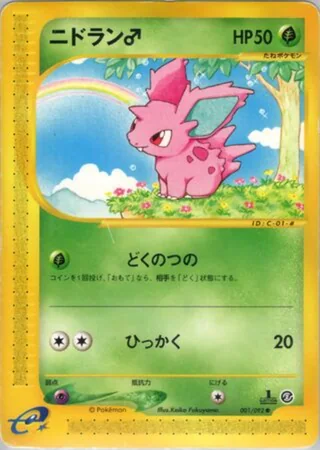
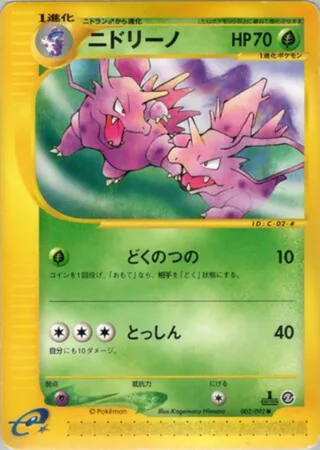
Four sets, eight months, 364 cards, and a strip of black dots along the bottom of every one of them. 2002 is the year the Japanese card was built for a machine that the rest of the world had not been given yet — and the year the English card stopped keeping up: by December an English collector had seen Neo Destiny, Legendary Collection and Expedition, none of which were from 2002, and none of the 364 cards on this page. Three of the nine secrets printed here would become the most expensive cards of the era once the West finally met them in 2003.