

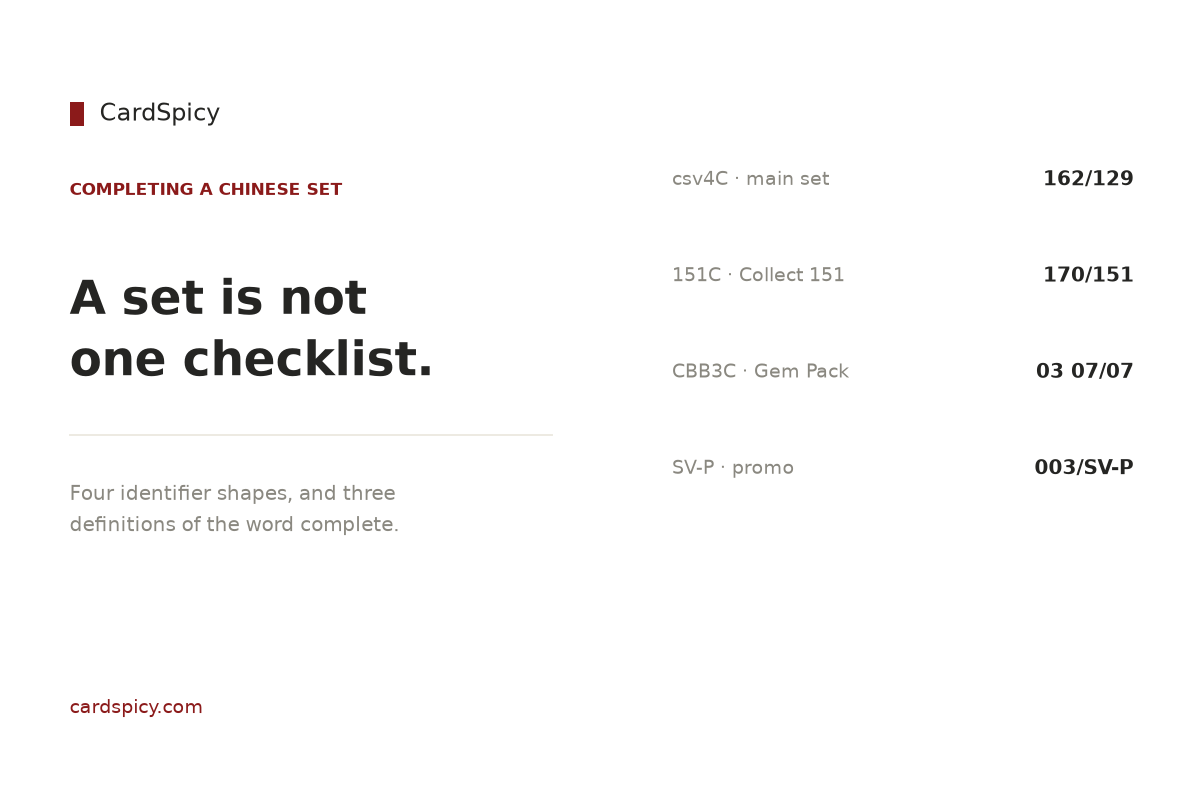
“How do I complete a Simplified Chinese set?” is the question we get most often after someone buys their first Chinese card, and it is a harder question than it looks. Not because the cards are hard to find — because complete does not mean one thing.
Ask three collectors what a complete set is and you will get three answers: the numbered checklist, the numbered checklist plus its secrets, or a themed run that crosses set boundaries entirely. Pick the wrong one and you will spend months chasing a target that moves. So the first step is not buying. It is deciding which of the three you are actually building.
“Complete” means three different things
The distinction matters because each definition has a different finish line, and two of the three have no visible end at all.
| Definition | What it includes | Where it breaks |
|---|---|---|
| The numbered checklist | Every card from 1 up to the printed total — the number on the right of the fraction. | It is genuinely complete. You can count it, and you will know when you have finished. This is the only one of the three with a fixed size. |
| The set as printed | The numbered checklist plus every card numbered past the total — the secret slots. | Nothing announces the end. Secret cards appear above the set size, so the highest number you have seen is not the highest number that exists. |
| A themed run | One character, one illustrator, one rarity tier, or one connected artwork — collected across as many sets as it takes. | It has no printed list at all. The target is whatever you decide it is, which is freeing and also why these runs stall. |
Most people who think they want the first one actually want the second. A numbered checklist is a formality — the interesting cards in a Chinese set are almost always numbered past the end of it, which is exactly why they are interesting. The two are easy to tell apart on the card itself: Arcanine from Fearless Terastal prints as csv3C 155/130 SAR. The set is 130 cards. Arcanine is card 155.
What the card tells you, and what it does not
Every Chinese card carries enough printed information to build a checklist from, and it is worth knowing which parts you can trust.
| Printed on the card | What it tells you | What it does not tell you |
|---|---|---|
The fraction, 155/130 |
This card’s position, and the size of the numbered set it belongs to. | Whether higher numbers exist. A denominator is the printed set size, not the true size of the release. |
The set code, csv3C |
Which print run you are looking at — and in this line, whether it is a main set or a Gem Pack volume. | Nothing about rarity, and nothing about which other cards share the set. |
The rarity letters, SAR |
Which finish this is, in the Chinese line’s own naming system. | How hard it is to find, and it does not translate directly into the English names — UR here is what the English line calls Hyper Rare. |
| The illustrator line | Who drew it, which is the key you need for a themed run rather than a set run. | Nothing about print position. |
The practical upshot is that all four of these are trustworthy, and none of them gives you a total. The full grammar of the codes — including why a Gem Pack card has four parts instead of two — is in our set code guide, and it is worth reading before you build anything.
Build the checklist on codes, not names
This is the single most common mistake, and it costs real money.
Card names are not unique. Gholdengo ex from Reward Round exists as a gold Ultra Rare numbered csv4C 162/129 — and the same card is also printed inside the numbered checklist at an ordinary rarity. Pal Pad is the same story: an ordinary Item card in its set, and a gold Ultra Rare at csv6C 163/128. If your checklist is a list of names, you will tick Pal Pad as done when you have bought the version you did not want.
Key the checklist on the printed code instead. Then a name can appear as many times as the set actually prints it, and every row is a distinct object. This also makes the checklist portable: the code is printed on the card, printed on a PSA label, and readable from a photograph, so you can check your progress without touching the binder.
Count in tiers, not in cards
“42 cards to go” is not a plan, because the 42 cards are not the same difficulty. Here is the Chinese-exclusive line broken down by finish, using our own listings as the yardstick.
| Tier | Cards | Lowest | Highest | Spread |
|---|---|---|---|---|
| Illustration Rare | 23 | $66.21 | $3,026.92 | 46× |
| Special Art Rare | 9 | $89.43 | $903.84 | 10× |
| Ultra Rare (gold) | 4 | $110.00 | $175.04 | 1.6× |
| Hyper Rare | 2 | $180.00 | $290.22 | 1.6× |
| Radiant | 3 | $86.33 | $165.01 | 1.9× |
| Promo | 1 | $44,540.95 | $44,540.95 | — |
Read the spread column rather than the price column. Three of the six tiers sit inside a 2× band, which means that if you set out to collect the gold Ultra Rares or the Radiant cards, the cost is predictable — every card in the tier costs roughly what the others cost. The Illustration Rare tier is not like that. Its 23 cards span 46×, so “collect the Art Rares” is not one project. It is 23 projects with wildly different budgets.
This is why tier-level planning fails and card-level planning works. Decide which individual cards you want before you decide how many.
The last four cards are most of the cost
Inside that Illustration Rare tier there is a sharper cliff than the spread suggests. Nineteen of the 23 Art Rares sit between $66.21 and $653.14. The remaining four start at $1,095.98.
Those four are the Collect 151 Pikachu cards: Journey, Hope, Gathering and Surprise. Four cards out of forty-two, and they occupy the entire top of the price range for the tier.
So the honest arithmetic of a completion is this: a set is blocked by its scarcest cards, not by its remaining cards. Nineteen Art Rares and nine Special Art Rares will not decide whether you finish. Four Pikachu will. And at the far end of the whole list there is a single promo — Mew ex at 003/SV-P — whose price is larger than the other 41 cards combined. If your definition of complete includes that card, your project has one gate, and it is not a set.
Which argues for buying in the opposite order to the one people naturally choose. The cheap cards will still be available, and probably still cheap, in a year. The scarce ones are the ones that decide whether the plan survives.
Three traps that break a completion
| Trap | What it looks like | How to avoid it |
|---|---|---|
| Gem Pack does not count the way a main set counts | A Cubone reads CBB3C 04 07/07 — a volume, a group, a treatment and a group total. A Chandelure in the same volume reads CBB3C 11 07/07. There is no running set number to count to. |
Treat each Pokémon group as its own mini-set. The last treatment number in a group is the Art Rare, so 07/07 is the ceiling for that group. Our Gem Pack guide covers how the volumes are organised. |
| The rarity letters are not the English rarity names | Buying an “Ultra Rare” expecting a gold card, because that is what the English line means by it. | Learn the two systems separately. In the Chinese line, UR is the gold print and SAR is the special illustration — the opposite mapping from what an English-only collector expects. |
| The denominator is not the set size | Reading 162/129 as “129 cards exist”, building a 129-row checklist, and then finding more cards above 129 every few months. |
Treat the denominator as the size of the numbered section only. Everything above it is a separate, open-ended list. |
How to track it without losing the thread
Three habits, in order of how much they save you.
One row per code. Not per name, not per character. A spreadsheet with the printed code in the first column and a tick in the second is enough, and it survives a change of opinion about what you are collecting.
Track cost as well as count. “Nineteen of 42” tells you nothing about how far you have to go. “Nineteen of 42, and none of the four that decide it” tells you everything. Weigh the list by what the remaining cards cost, not by how many of them there are.
Start from a list someone else has already checked. We publish all 42 Chinese-exclusive cards with their printed codes, sets, illustrators and rarities, which you can copy straight into a tracker. If the set you care about is not on that list, build the rows from the cards themselves — the four printed facts in the table above are all you need, and they are all on the card.
When it is finished
A completed run creates a problem a loose collection does not: you now own cards you are not going to replace, and the condition of each one is part of what you built. Sleeve and holder choice stops being a preference at that point — see binder versus box versus display frame for which of the three suits a finished run, and note that anything with a UV-sensitive finish is a display problem rather than a storage problem.
If the run includes graded cards, the same logic applies to the holders as to the cards: a scuffed case on a finished set is a defect you notice every day. What actually damages a slab is a short read, and the grading guide covers how to check a certificate number before you add a graded card to the run.
Frequently asked questions
How many cards are in a Simplified Chinese set?
It depends on the set, and you can read the size off any card from it: the number after the slash is the printed size of the numbered section. A main set might be 129 or 130 cards; Collect 151 prints 151; Gem Pack volumes are organised by Pokémon group instead of a single running number.
Is a complete set the numbered cards or every card?
That is your decision, and it is the most important one you will make. The numbered checklist has a fixed size and a visible finish line. The set as printed includes secret cards numbered past the total, which is open-ended because nothing announces when the last one has appeared.
Why can’t I just count the cards in an online list?
Because the lists answer different questions. A numbered checklist and a full set list look similar and have different totals, and a Wiki page may be counting one set while you are collecting another. Read the denominator off your own cards and treat that as the numbered target.
Do Gem Pack sets work the same way as main sets?
No. Gem Pack cards are numbered by Pokémon group rather than by one running set number, so the code has four parts: volume, group, treatment, and the number of treatments in that group. Each group behaves like its own small set, and the highest treatment number in a group is that group’s Art Rare.
What is the hardest part of completing a Simplified Chinese set?
Not the count — the concentration. In the Chinese-exclusive line of 42 cards, 19 of the 23 Art Rares sit between $66 and $653, and the remaining four start above $1,000. A completion is decided by a handful of cards, so identify those first rather than working through the list in numerical order.
Sources
Sources and further reading
- CardSpicy — How many Simplified Chinese-exclusive cards are there? The 42-card list with printed codes, sets, rarities and illustrators, and the rarity distribution used in the tier table. cardspicy.com/simplified-chinese-exclusive-card-list/
- CardSpicy — How to read a Simplified Chinese set code. The full code grammar, including the four-part Gem Pack format and the secret-rarity convention of numbering a card above the printed set size. cardspicy.com/pokemon-set-code-guide/
- Bulbapedia — Rarity. The secret-card convention: a card numbered above the printed size of its set sits past the end of the numbered checklist. bulbapedia.bulbagarden.net
- Red Cat Collectibles — Pokémon Gem Pack Vol. 3 Guide. Gem Pack group-and-treatment identifiers, including Meowth 02-07 and Gengar 03-07. redcatcollectibles.com
- CardSpicy — Collect 151 in Simplified Chinese. The four event-distributed Pikachu Art Rares that occupy the top of the Illustration Rare range. cardspicy.com/collect-151-pikachu-art-rares/
- CardSpicy — the Chinese Exclusive category, whose listings carry the prices quoted in the tier table on this page.