

Where to start is a price question before it is a Pokémon question
Ask which Pokémon to collect first and you will get an answer about taste. That is a fine answer for a hobby, and no help at all if you are trying to buy your first graded card this week — because the first thing you actually meet is not a Pokémon. It is a price.
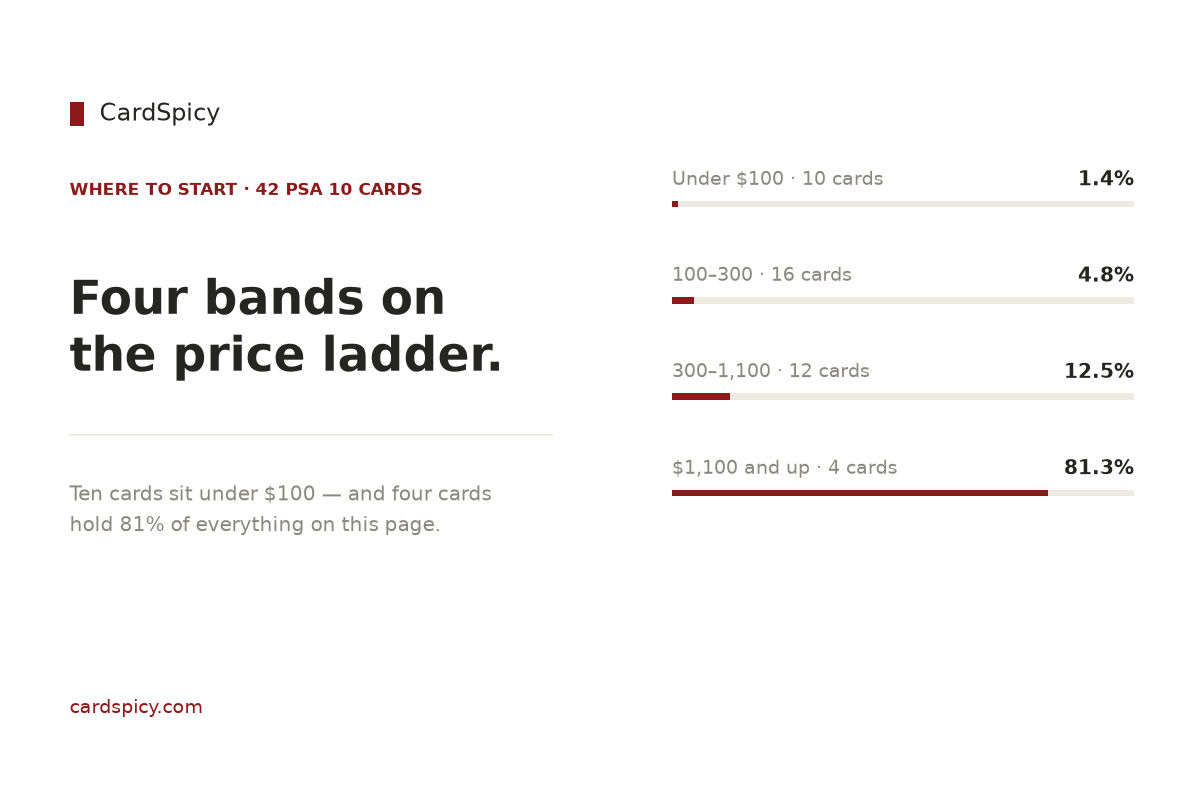
So here is the ladder as it exists. These are the 42 Simplified Chinese-exclusive cards we currently hold graded at PSA 10 over in PSA 10 · Simplified Chinese Exclusive, grouped by price. Every figure in this article is the live price on this site, not an estimate.
| Price band | Cards | Value in the band | Share of all 42 | What sits in it |
|---|---|---|---|---|
| Under $100 | 10 | $860.84 | 1.4% | Gem Pack Art Rares and three older Radiant cards |
| $100 – $300 | 16 | $2,990.36 | 4.8% | Gem Pack mid-cards, the four gold UR cards, most Special Art Rares |
| $300 – $1,100 | 12 | $7,734.15 | 12.5% | Gem Pack headline cards and the top Special Art Rares |
| $1,100 and up | 4 | $50,246.74 | 81.3% | Four Collect 151 Pikachu Art Rares and one lottery promo |
The range is 673×, from $66.21 to $44,540.95. But the distribution is not a ladder you climb evenly. The ten lowest cards together are worth less than one and a half percent of the page. Four cards at the top are worth four fifths of it.
One figure is worth holding on to: the mean price of these 42 cards is $1,472 and the median is $214. That gap is not a rounding artefact. A single card — the Mew ex lottery promo, documented at a print run of 1,510 copies — is worth more than the other 41 cards combined.
The bottom band is not a random sample
Ten cards sit under $100. If you assume low price means leftover, the list will not behave the way you expect: seven of the ten come from a single series, and six of them are only half of a card.
| Card | Set | Price | Half of a pair? |
|---|---|---|---|
| Crocalor & Roy | Gem Pack Vol. 5 | $66.21 | Yes |
| Quaxwell & Dot | Gem Pack Vol. 5 | $66.97 | Yes |
| Floragato & Liko | Gem Pack Vol. 5 | $80.34 | Yes |
| Chandelure | Gem Pack Vol. 3 | $84.16 | No |
| Radiant Venusaur | Gallant Galaxy | $86.33 | No |
| Larry | Dark Crystal Blaze | $89.43 | No |
| Radiant Blastoise | Overshadowed Radiance | $94.11 | No |
| Quaxly & Dot | Gem Pack Vol. 1 | $95.95 | Yes |
| Sprigatito & Liko | Gem Pack Vol. 1 | $97.49 | Yes |
| Fuecoco & Roy | Gem Pack Vol. 1 | $99.85 | Yes |
Six of these ten are one half of a two-card pair. The same trainer-and-Pokémon commissions appear in Gem Pack Vol. 1 and again in Vol. 5 — once with the first-stage Pokémon, once with the middle stage. Buying one of them is easy. Buying one of them and stopping there is the part that does not work, because you have started a theme whose other half is already printed, priced and sitting beside it.
We worked out what the pairs cost in full: the four trainer pairs run from $162.92 to $1,267.30. The lowest entry point into a theme and the lowest entry point into a finished theme are two different purchases, and only one of them is $66.
So if what you want is genuinely one card and nothing after it, the honest picks in this band are the four unpaired ones — Chandelure, Radiant Venusaur, Larry and Radiant Blastoise — because none of them commits you to anything else.
A set name is not a price
Gem Pack looks like the obvious place to begin. It is the single largest group on this page, at 19 of the 42 cards, and its codes run in a clean sequence from CBB1C through CBB6C.
It is also the worst place to assume you know what a card costs. Inside that one series the range runs from $66.21 (Crocalor & Roy, Vol. 5) to $653.14 (Captain Pikachu & Friede, Vol. 1) — a factor of 9.9, with nothing in the code, the rarity or the set name to warn you.
The spread survives at the smallest possible scale, too. Gem Pack Vol. 2’s four Eevee-family cards — Eevee, Leafeon, Sylveon and Umbreon — are one connected-artwork commission: four panels of a single illustration, drawn by one artist for one volume. They are priced $192.94, $209.89, $233.54 and $591.93. Same print run, same rarity, same artwork, same box. The most expensive is 3.1 times the lowest.
Nothing in the printing explains that. What explains it is which Pokémon is on the panel.
Rarity is a printing label, not a price label
The obvious shortcut is to buy by rarity, and it does not work. The reason is measurable.
| Rarity | Cards | Price range | Spread |
|---|---|---|---|
| Illustration Rare | 23 | $66.21 – $3,026.92 | 45.7× |
| Special Art Rare | 9 | $89.43 – $903.84 | 10.1× |
| Ultra Rare (gold) | 4 | $110.00 – $175.04 | 1.6× |
| Hyper Rare | 2 | $180.00 – $290.22 | 1.6× |
| Radiant | 3 | $86.33 – $165.01 | 1.9× |
| Promo | 1 | $44,540.95 | single card |
The widest band is the one carrying the plainest label. Illustration Rare covers 45.7× — an AR here can cost less than the lowest-priced Radiant card and more than thirty times the lowest-priced Special Art Rare. Meanwhile the two names that sound like the top of the tree, Ultra Rare and Hyper Rare, cover 1.6× each: the four gold UR cards top out at $175.04, which is below the median price of the whole page.
A rarity label tells you how a card was printed. It says nothing about what anyone will pay for it. The thing that sets the price is usually a specific artwork of a specific Pokémon — and that is not printed anywhere on the card.
Where the ladder actually steps
Sort all 42 and there is exactly one large jump: from $903.84 (Maushold ex, a Special Art Rare) to $1,095.98 (Pikachu, Collect 151: Journey). Below that line you are buying cards one at a time. Above it you are buying into a set.
Four of the five top cards are the same Pokémon from the same commission — the four Collect 151 Pikachu Art Rares, numbered 170/151 through 173/151, all drawn by one illustrator across a four-part release. We have written about what separates the four, and the short version is that the printed number is the only reliable way to tell them apart in a text listing. The Surprise panel is the one that currently sits at the top.
So the top of the ladder is not “a rarer rarity”. It is one specific four-card entry, four of the 42 cards carrying 81.3% of the value between them. That is the most useful thing to know before choosing a first card: the ladder does not get more expensive gradually. It stays cheap, and then it steps.
Three starting points that hold up
| What you actually want | Where to start | What you accept by starting there |
|---|---|---|
| One card, nothing to follow it | Under $100, and skip the four pairs | The shallowest resale market of the three. You are buying a card, not a position. |
| A theme you intend to finish | $100 – $300, inside a single volume | Patience. Most of what is on this site is pre-order rather than in stock. |
| One of the four Collect 151 Pikachu | $1,100 and up | You are choosing between four cards that all cost four figures, and the one you want is the one that will be hardest to find again. |
All three are legitimate ways to start. What none of them is, is a way to guess a price from a label.
Five checks before you pick a first card
This is the short version of everything above, and it is the part worth keeping.
- Does it have a companion in the same volume? If yes, you are buying half of something. That is fine as long as you know it before you click.
- Which band is it in? Under $100, $100–$300, $300–$1,100, or $1,100 and up. The band tells you what kind of purchase you are making far more reliably than the card does.
- What is its rarity — and are you using it to predict the price? The first half is a fact. The second half is the mistake the table above is there to prevent.
- Is it in stock or pre-order? On this site every PSA 10 listing is a pre-order: we source the specific certification number to order, which is why the dispatch window is 30 days rather than next week.
- Is there an English or Japanese version of the same artwork? For every card on this page the answer is no, and that is the entire reason this ladder exists — the artwork was commissioned for the Simplified Chinese release only. The 42-card list sets that out card by card.
Frequently asked questions
Which Pokémon card should I buy first?
Start from the price band rather than the Pokémon. If you want one card and nothing after it, pick one of the four unpaired cards under $100 — Chandelure, Radiant Venusaur, Larry or Radiant Blastoise. If you want something you can finish collecting, a single Gem Pack volume between $100 and $300 is a better first purchase than the lowest-priced card on the site.
Why is the lowest-priced card not the right first card?
Because six of the ten cards under $100 are one half of a two-card pair. Buying one is cheap; buying one and stopping leaves a theme visibly unfinished, and finishing it costs between $162.92 and $1,267.30 depending on which pair you started with.
Does rarity determine how much a card is worth?
No, and the numbers on this page show why. Illustration Rare covers a 45.7× price range, while Ultra Rare and Hyper Rare each cover only 1.6×. The four gold UR cards top out below the median price of the whole page. Rarity describes a printing treatment; it does not describe demand.
Why is there such a large gap between the lowest and the highest card?
Two reasons. Most of the ladder is Art Rares from comparable print runs, so prices stay inside a band. At the very top sits a different kind of object: four Collect 151 Pikachu Art Rares from a four-part release, plus a lottery promo documented at 1,510 copies. Four cards hold 81.3% of the value on this page; the other 38 share the remainder between them.
Are these cards in stock?
Every PSA 10 listing on this site is a pre-order. We source the specific certification number after you order, which is why the dispatch window runs 30 days from the order rather than immediately. Sealed boxes and card protectors are stocked separately and ship sooner.
Sources
Sources and further reading
- CardSpicy — PSA 10 · Simplified Chinese Exclusive. Every price, set code and rarity label in this article is taken from the live catalogue rather than estimated. cardspicy.com/product-category/psa10/psa10-exclusive/
- CardSpicy — One Pokémon Per Trainer: Collecting With a Theme. The four trainer pairs in Gem Pack Vol. 1 and Vol. 5, with the $162.92 to $1,267.30 cost of completing each pair. cardspicy.com/one-pokemon-per-trainer/
- CardSpicy — Collect 151 in Simplified Chinese: The Four Pikachu Art Rares. The 170/151 to 173/151 numbering, the single-artist commission and the four-part release structure. cardspicy.com/collect-151-pikachu-art-rares/
- CardSpicy — How many Simplified Chinese-exclusive cards are there? The full 42-card list with printed codes, sets, rarities and illustrators, including the 1,510-copy print run of the Mew ex promo. cardspicy.com/simplified-chinese-exclusive-card-list/
- PokéAri — Four Cards, One Forest: The Eevee Art of Gem Pack Vol. 2. The four Eevee-family panels as a single connected-art commission. pokeari.com/post/gem-pack-vol-2-eevee-connected-art-cards
- Kaicastle — Unique Pikachu Pokémon cards revealed for China’s version of 151. The four commissioned Pikachu Art Rares announced alongside the Collect 151 series. blog.kaiscastle.com
- Red Cat Collectibles — Pokémon Gem Pack Vol. 2 Guide. CBB2C contents and configuration, used to confirm the Eevee-family line-up and the volume’s release. redcatcollectibles.com