

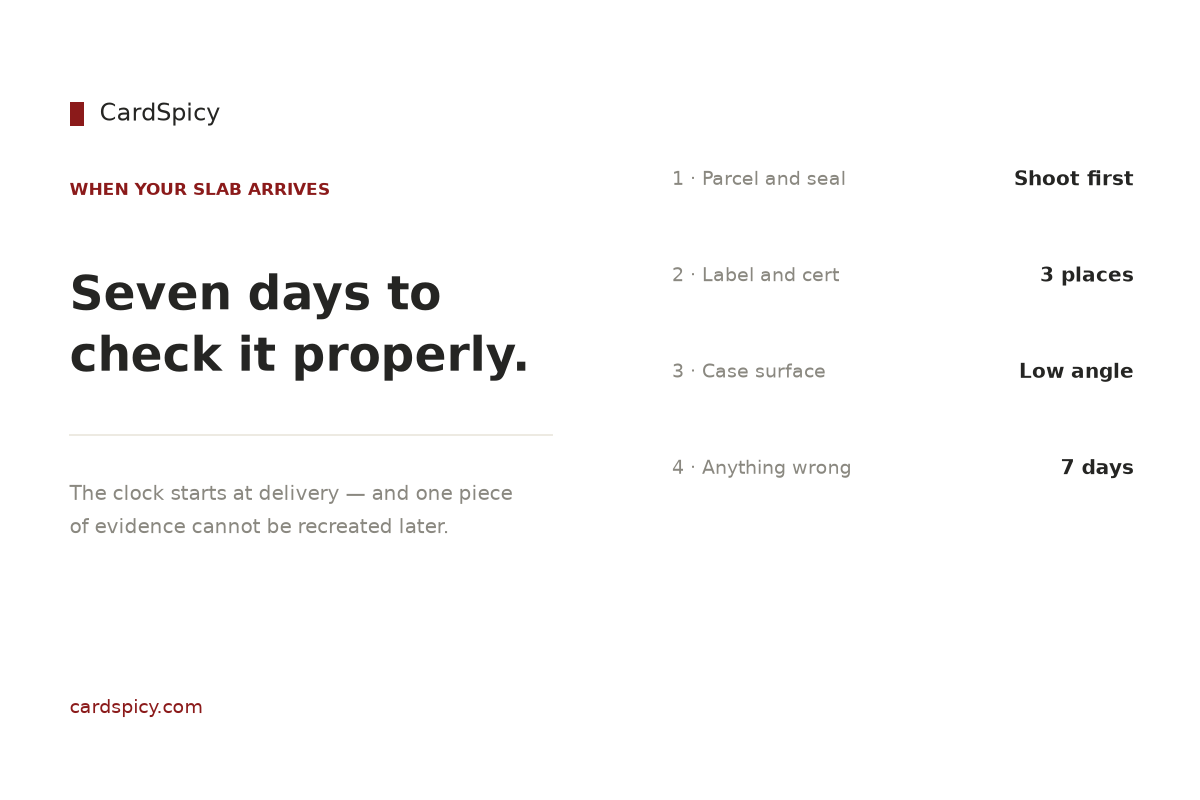
Seven days, and the clock starts at delivery
There is a number in our after-sales policy that most buyers meet too late, and it is seven. If your slab arrives damaged, or we sent the wrong card, you have seven days from delivery to tell us. Not seven days from when you open the parcel — seven days from the moment it is delivered.
The policy asks for three things in that email: your order number, photographs of the item, and photographs of its packaging. All three are easy to send. Two of them are easy to lose.
It is worth being clear about what this window is not. It is not a returns period. Every sale is final once dispatched — a graded card is a single physical slab with its own certification number, it comes off sale the moment it sells, and it cannot be relisted as new. The seven days exist for one situation only: the item is not what you bought, or it did not survive the journey. Everything below is about making sure that, if it did not, you can prove it.
The one photograph you cannot take later
The item photograph is recoverable. The slab is in your hands, and you can shoot it any time in the next week and it will look the same. The packaging photograph is not recoverable, because the only honest version of it is taken before you open the parcel. Once the bag is split and the padding is off, there is no way to photograph the packaging as it arrived — and the policy asks for it by name, because it is the one thing that shows whether damage happened on the way to you or after you had it.
That distinction matters more than it looks. Our policy does not cover items damaged after delivery through use, mishandling or improper storage. So if a case has a scuff on it, the question is not whether the scuff exists. It is when the scuff got there. A photograph of the parcel with the seal intact, taken before you touched anything, is what answers that question. Without it you are describing a scuff, and we are guessing.
The order to do it in
This takes about three minutes, and it only has to be done once, on the day the parcel lands.
| Step | What to photograph | Why it has to be this order |
|---|---|---|
| 1 | The outer parcel, still sealed, with the label and any damage to the box visible | The only record of how the parcel arrived. It cannot be recreated after opening. |
| 2 | The full length of the seal or tape, undisturbed | It shows whether the parcel was opened in transit, which is a different problem from damage. |
| 3 | The inner packaging, after opening but before you lift the slab out | Padding and position explain most transit damage. Once the slab is out, that evidence is gone. |
| 4 | The slab, front and back, with the label legible | The label carries the certification number — the one string that ties your card to a public record. |
| 5 | The case surface at a low angle, in room light rather than direct sun | Scuffs and haze are only visible off-axis. Head-on they vanish, which is why they are the most argued-about fault. |
| 6 | The card itself, through the case, including the grade in the corner | This is the record of the card, not the holder. They are two separate things. |
| 7 | Anything you are not happy about, on its own, close up | One clear photograph of one fault is worth more than a set that shows everything at once. |
Keep the set together with the dispatch confirmation email. If you never need it, it has cost you three minutes. If you do need it, it is the difference between a refund and a conversation.
Check the certification number in three places
The number that matters is not on the card. It is on the label, and it appears in three places you already have access to. They should all agree.
| Where | What it shows | What it has to match |
|---|---|---|
| The product page you ordered from | The full certification number, printed in full rather than abbreviated | — |
| Your dispatch confirmation email | The same number, repeated | The product page you bought from |
| The slab label | The number and the grade | The dispatch email — the label is the physical item you were promised |
| The grader’s public record | Card, set, card number and grade | All four fields, not just the number |
The point of checking all four is that the number alone proves very little. If a single field disagrees — the set, the card number, the grade — you are holding something other than what the record describes. Take any two listings from the graded catalogue and the pattern is the same: Gem Pack Vol. 2 Umbreon and Collect 151 Pikachu (Surprise) each print their certification number in full on the product page, and each is a single physical slab. The number you read there is the number that arrives.
We set out the full verification route, field by field, elsewhere. The difference here is timing: that guide is for before you pay, and this one is for after the parcel lands.
What the grade covers, and what it does not
One thing to have straight before you judge what arrived. The grade describes the card inside the holder, not the holder. A case can be scuffed, hazed or dulled at the corners while the card inside is still the 10 the label claims — that is the whole subject of our slab care article, and it is why nobody grades the case.
So there are two different things you might be looking at, and they have different answers:
- A scuff or haze on the case that was there when it arrived. That is a transit or handling question, and it falls inside the seven days. Photograph it and tell us.
- A scuff or haze that is the ordinary wear a case picks up in use. The policy does not cover that, because there is no way to tell it apart from damage that happened after delivery — which is exactly what the sealed-parcel photographs above are for.
Neither of those is about the card. If the card itself is not what the record says, that is a different category altogether, and it is the one that is not a judgement call at all.
What is not covered
This list is short, and every item on it is a rule you can plan around rather than a surprise.
| Not covered | Why |
|---|---|
| Change of mind after dispatch | Every order crosses a border, and on a return it crosses twice: the duty and clearance we paid to bring it in is charged again when it travels back, often as much as the card. |
| Gift cards | Non-refundable and non-returnable by nature. |
| Shipping paid on a change-of-mind purchase | There is none, because we do not accept the return in the first place. |
| Damage from use, mishandling or improper storage | This is the item the sealed-parcel photographs exist for. |
Against that, three situations are covered in full, and the first of them needs nothing from you at all: an order we cannot fulfil, an item that arrives damaged or wrong, and a pre-order you cancel before it dispatches. If we cannot source a card within 30 days, the refund is automatic — you do not have to notice, ask, or prove anything.
If you do find something
Email us with your order number and the photographs. We refund in full, including the shipping you paid, and we never ask you to pay return postage in this situation. Refunds go back to your original payment method within one business day of us confirming the problem.
The one thing worth doing before anything else: contact us before you raise a dispute with your bank or payment provider. We reply within one business day, and a dispute does not change the terms you accepted at checkout — but it does add weeks to a conversation that a photograph could have settled in a day.
When the photographs are already on your phone, this is a two-minute email. That is the whole return on spending three minutes at the door.
Frequently asked questions
How long do I have to report a problem?
Seven days from delivery, for an item that arrives damaged or that is not what you ordered. The window runs from the delivery date rather than from the day you open the parcel, so a graded-card order is worth opening the day it lands rather than letting it sit until the weekend.
What do I need to send?
Your order number, photographs of the item, and photographs of its packaging. The packaging is specified because it is the only evidence of how the parcel arrived, and it cannot be photographed after the fact.
Can I return a graded card if I change my mind?
No. Every graded card is a single physical slab with its own certification number; it comes off sale once sold and cannot be relisted as new. That is why the certification number is published on the product page before you buy — the checking is meant to happen up front, where it costs you nothing.
Should I open the parcel before or after photographing it?
Photograph first. The sealed parcel and its intact seal are the two images that cannot be recreated once the bag is open, and they are what separates damage in transit from damage after delivery.
What if I am away when it is delivered?
Then the seven days may be running while you are not there. Every order ships with tracking, so the delivery date is recorded. If you know you will be away, it is worth emailing us before dispatch so we can time the shipment rather than let the window open onto an empty house.
Sources
Sources and further reading
- CardSpicy — After-Sales Policy. The seven-day reporting window, the photographs required, the three exceptions, the list of what is not covered, and the one-business-day refund. All policy wording in this article is quoted from the live page. cardspicy.com/policies/#after-sales
- CardSpicy — Pre-Order & Sourcing Terms. Where the certification number appears — product page, dispatch confirmation email, slab label — and the automatic refund if we cannot source a card. cardspicy.com/policies/#pre-order
- CardSpicy — Why We Only Sell PSA 10. The pre-purchase verification route: how to check a certification number against the public record, field by field, before you order. cardspicy.com/why-psa-10/
- CardSpicy — PSA Slab Care: How the Case Fails Before the Card Does. Why a grade describes the card rather than the holder, and which case faults are ordinary wear. cardspicy.com/psa-slab-care/
- CardSpicy — How to Photograph a PSA 10 for Resale. The lighting and framing side of slab photography, for when you are shooting to sell rather than to record an arrival. cardspicy.com/photograph-psa-10-for-resale/