🛒0

Category: Naruto

CardSpicy articles about Naruto card games — Bandai’s NARUTO CARD GAME, KAYOU and the others, card by card.

  • Bandai’s Naruto Card Game: Every Card Type and Every Numbered Card

    Bandai’s Naruto Card Game: Every Card Type and Every Numbered Card

    Quick answer

    CardSpicy takes a card’s details from the card face and the manufacturer’s own pages rather than from a fan-maintained list, and Bandai has published no card list for this game. Sixteen cards carry a printed N-number — two of them Leader cards, three EX Character cards — and a further set has only ever been seen at convention demo tables. Everything here comes from Bandai’s artwork gallery and rules pages, the cards shown and played at Gen Con 2026, and the promo card handed out at events.

    Where a card is known only from a community reconstruction rather than a Bandai image, this page labels it as such instead of presenting it as fact.

    CardSpicy has gone through the NARUTO CARD GAME cards that are already in circulation, and there are more of them than the twelve artwork reveals Bandai keeps on its own site. Sixteen cards carry a printed N-number, two of them are Leader cards, three are EX Character cards, and a further set has only ever appeared at convention demo tables. This page walks the five card types using the real card faces, then lists every numbered card one at a time, with the values and the effect text printed on each.

    Bandai has never published a card list for this game. Everything below comes from three places: the manufacturer’s own artwork gallery and rules pages, the cards shown and played at Gen Con 2026, and the promo card handed out at events. Where a card is only known from a community reconstruction rather than a Bandai image, it is labelled as such rather than presented as fact.

    How the five card types work

    Bandai announced the rules on 29 July 2026, and the deck shape is unusual by trading card game standards. A deck is built around one Leader card, and the Leader’s colour decides which cards may go in the deck at all, so a red Leader can only run red cards. The published deck is a Leader, a 51-card main deck, five Chakra cards and one Summon card, and the game ends when one Leader’s life reaches zero.

    Card type What it does Shown so far
    Leader Card The card the deck is built around. Its colour sets the deck’s card pool, and its defeat ends the game. N-001 Naruto Uzumaki, N-012 Sasuke Uchiha
    Character Card The frontline fighter. Attacks, and can pay Chakra to fire off a Jutsu as a Support effect. N-004, N-006, N-007, N-008, N-010, N-011, N-013, N-015, N-016, N-019, N-021
    EX Character Card A high-impact card that cannot be summoned normally. It needs a named condition paid out of your own trash first. N-005 Gamabunta, N-014 Sasuke Uchiha, N-022 Manda
    Chakra Card The resource. Turned face-down to pay for Jutsu and Support effects. C-001, CP-001 promo
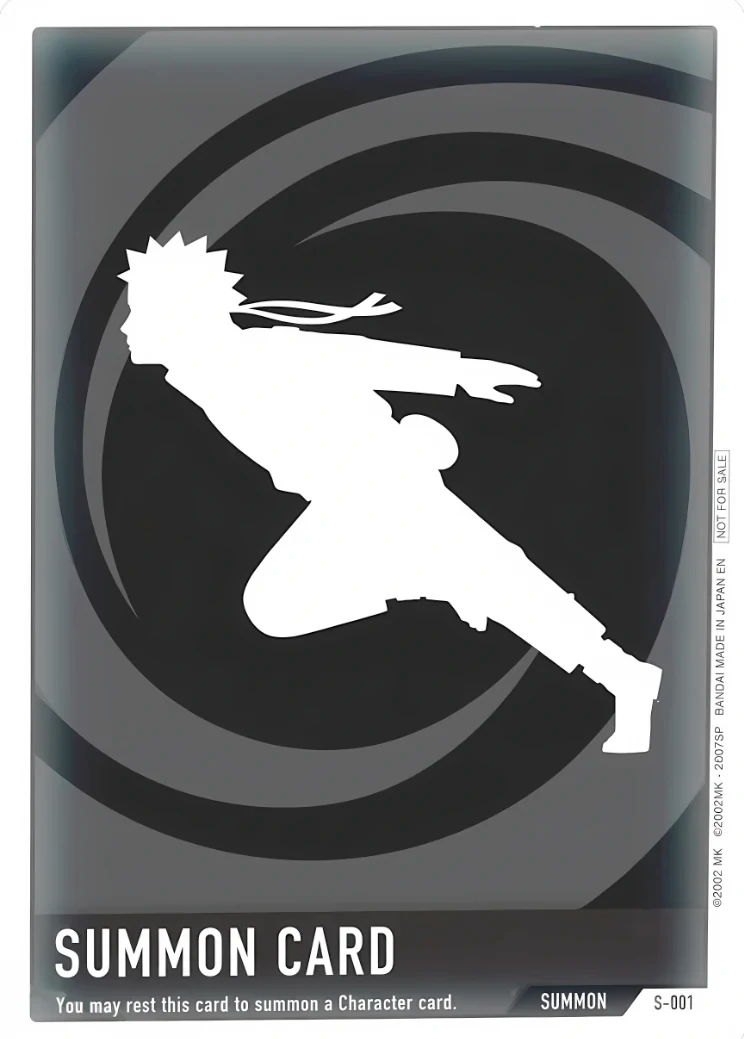
    Summon Card Rested to bring a summoned-on-command Character onto the field. S-001

    The physical cards make the distinction easy to spot. Leader cards print a life number in the bottom right where a Character card prints a Chakra cost, Chakra cards are plain orange with a swirl and no character art at all, and Summon cards are black with a single silhouette.

    Red and blue are the only two colours so far

    Every card shown to date sits in one of two colours, and the split is not cosmetic, it is a design split. Red is built on converting power into bigger power: Naruto’s Leader ability hands out +3 power, Jiraiya and Orochimaru clear rested Characters, and red’s EX card wants a Character with 10 or more power fed to it. Blue is the opposite temperament: hand control, negates, and return-to-hand. Karin heals, Shisui negates, Sakura bounces a card, and Suigetsu protects a Character from Support effects.

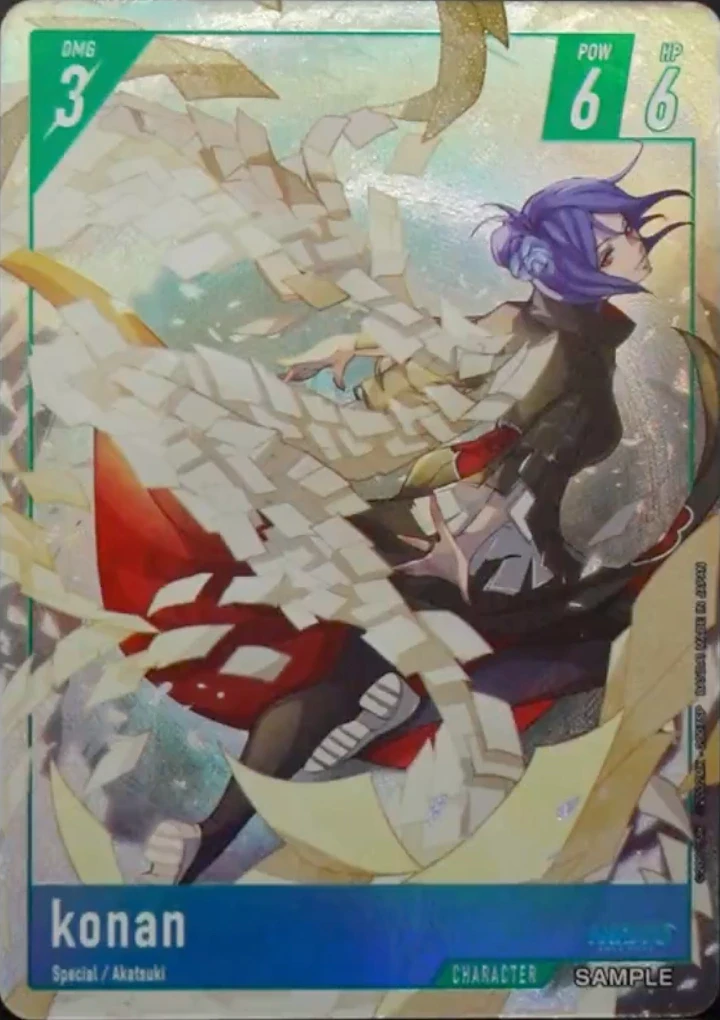
    Two card frames have been shown that do not fit the red and blue pattern — a green frame on Konan and a purple frame on Hinata Hyuga — but neither has a card number, and neither came with a deck list, so whether those are a third and fourth colour, or simply display frames, is not established.

    How the card numbers work

    There are four identifier prefixes in circulation, and they mean four different things.

    Prefix Meaning Seen on
    N-0xx Main set character cards. This is the only numbering Bandai has shown on a card face. Sixteen cards, N-001 to N-022
    C-001 Chakra card. The rules example
    S-001 Summon card. The rules example
    CP-001 Promotional Chakra card. The P does the work here: this is the only card given away rather than sold. Three versions

    The N-numbers are also incomplete in an interesting way. Numbers N-001 through N-022 have been seen, but not all of them: N-002, N-003, N-009, N-017, N-018 and N-020 have not appeared on any card face that Bandai has shown. That is six gaps inside a run of twenty-two, which is why the demos feel like a slice of a set rather than the whole thing.

    The two Leader cards

    Both Leaders print the same three numbers — DMG 1, POW 3 and HP 15 — and both carry a bonus ability instead of a Chakra cost. The HP 15 is the number that matters: it is the life total the opponent has to chew through, and it is a different scale entirely from the 4 to 11 printed on Character cards.
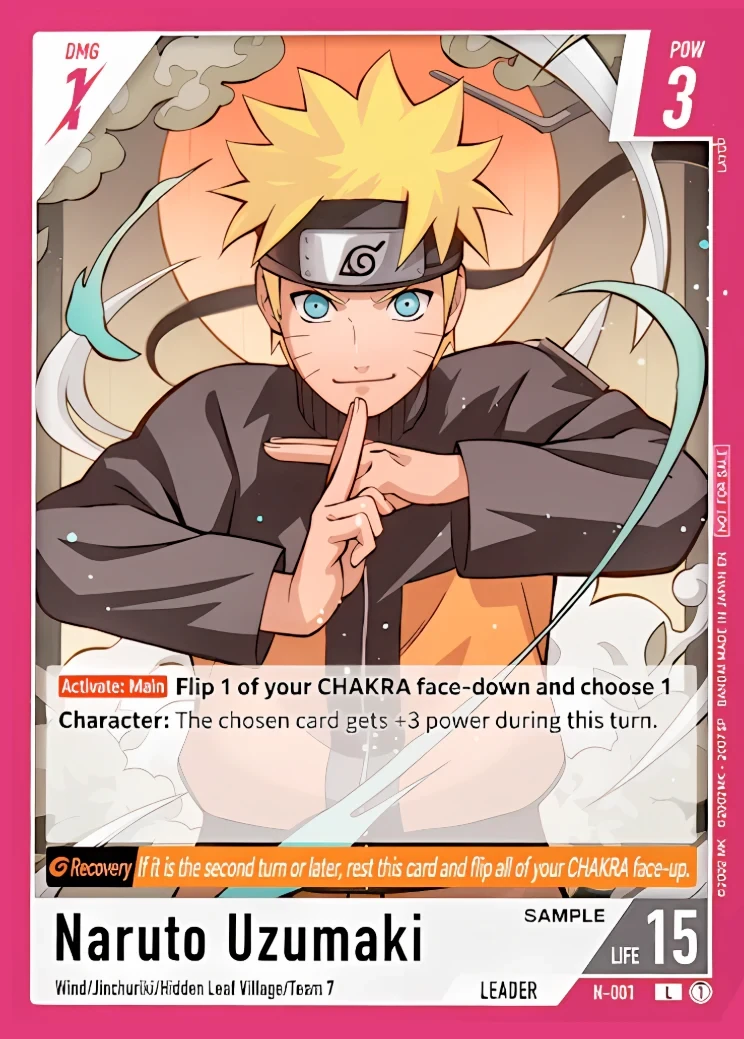
    N-001 Naruto Uzumaki Leader card from Bandai's Naruto Card Game, red frame, DMG 1 POW 3 HP 15
    N-001 Naruto Uzumaki
    Leader · red · DMG 1 / POW 3 / HP 15

    N-001 Naruto Uzumaki — Leader

    The first number in the set, and the card the red demo deck is built on. The ability reads “Flip 1 of your CHAKRA face-down and choose 1 Character: The chosen card gets +3 power during this turn.”

    It is a cheap pump that costs a Chakra card rather than a Chakra point, which matters because it turns a resource the deck already carries into a combat swing. The card is tagged Wind, Jinchuriki, Hidden Leaf Village and Team 7, and the artwork is the seated hand-seal pose used across the launch material. The copyright line along the right edge is the standard ©2002 MK / ©2002MK·2007SP / BANDAI MADE IN JAPAN string, with the SAMPLE mark over the name band.
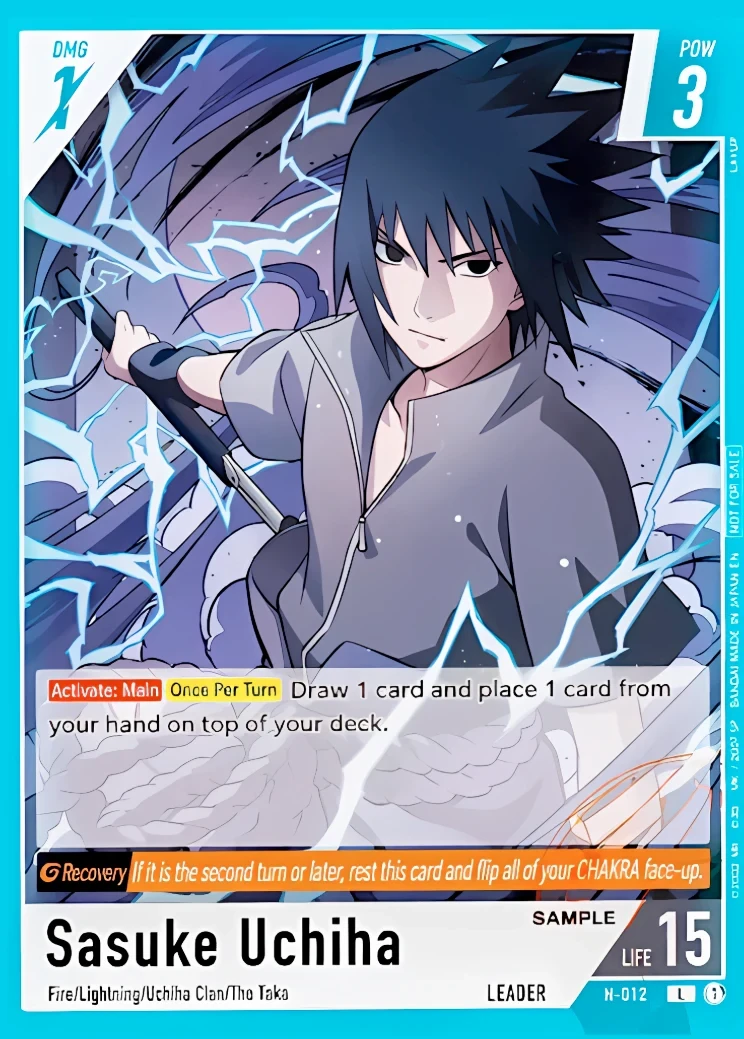
    N-012 Sasuke Uchiha Leader card from Bandai's Naruto Card Game, blue frame, DMG 1 POW 3 HP 15
    N-012 Sasuke Uchiha
    Leader · blue · DMG 1 / POW 3 / HP 15

    N-012 Sasuke Uchiha — Leader

    The blue counterpart, and the exact mirror of the red Leader on the stat line. Its ability reads “Draw 1 card and place 1 card from your hand on top of your deck.”

    Where Naruto’s bonus is a combat pump, Sasuke’s is card selection that does not actually gain a card: you draw one and put one back on top, which is a way of digging for the next turn’s play rather than building a hand. The tags read Fire, Lightning, Uchiha Clan and Five Kage. Between the two Leaders the whole colour split of the game is already visible: red pushes power, blue rearranges cards.

    The three EX Character cards

    EX cards are the most interesting part of the set so far, because all three carry the same printed restriction — “Cannot be summoned normally” — and each one charges a different price to get onto the field. The price is always paid out of your own trash, so playing an EX card means sacrificing board presence you have already spent turns building.
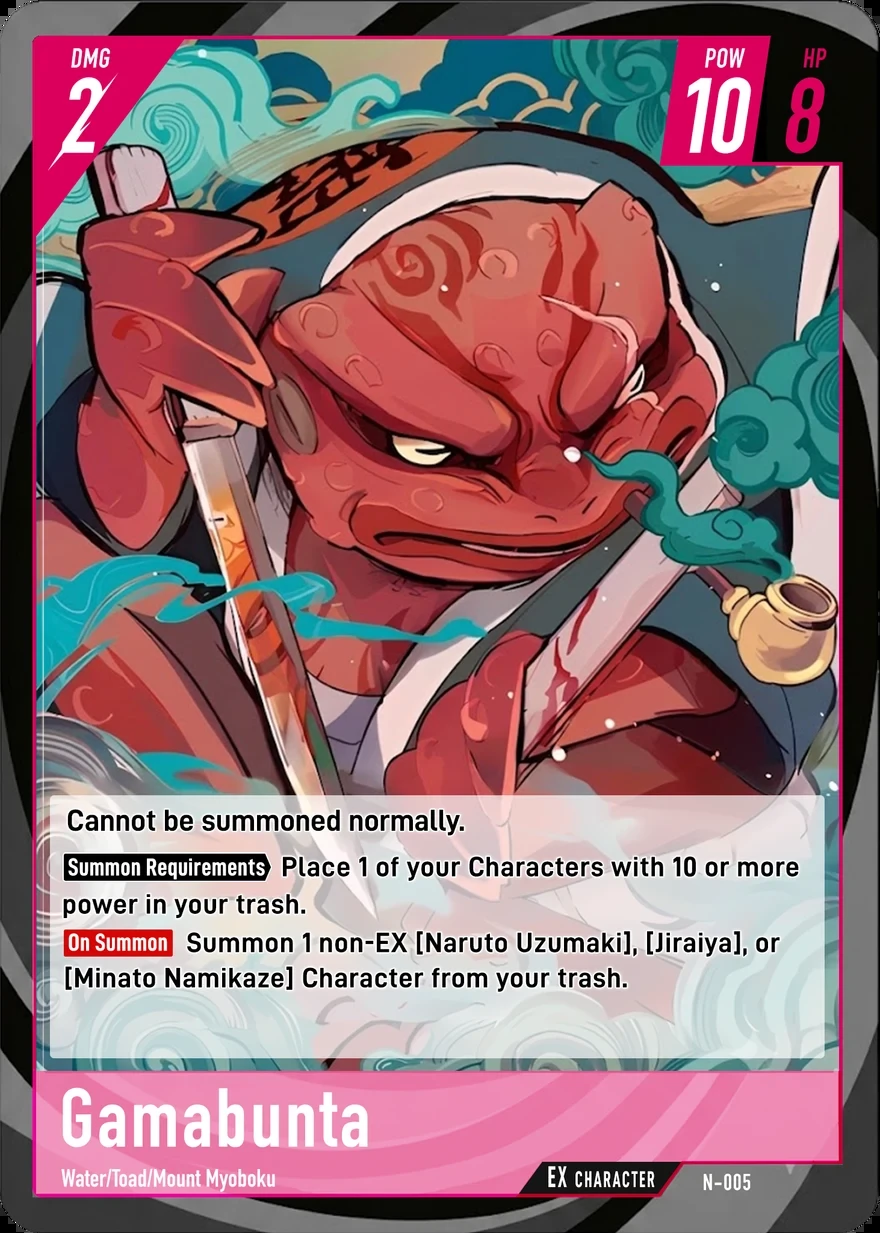
    N-005 Gamabunta EX Character card from Bandai's Naruto Card Game, red frame, DMG 2 POW 10 HP 8
    N-005 Gamabunta
    EX Character · red · DMG 2 / POW 10 / HP 8

    N-005 Gamabunta — EX Character

    The chief toad, and the only EX card in the red pool. Its cost reads “Place 1 of your Characters with 10 or more power in your trash.” The payoff is “On Summon: Summon 1 non-EX (Naruto Uzumaki, Jiraiya, or Minato Namikaze) Character from your trash.”

    That is a two-for-one built into the card. You trade one big Character away to bring Gamabunta down, and Gamabunta then pulls a Naruto, a Jiraiya or a Minato straight back out of the same trash. The card names those three characters in print, which is the only place in the set where a card explicitly lists who it can fetch. It is tagged Animal and Hidden Leaf Village.
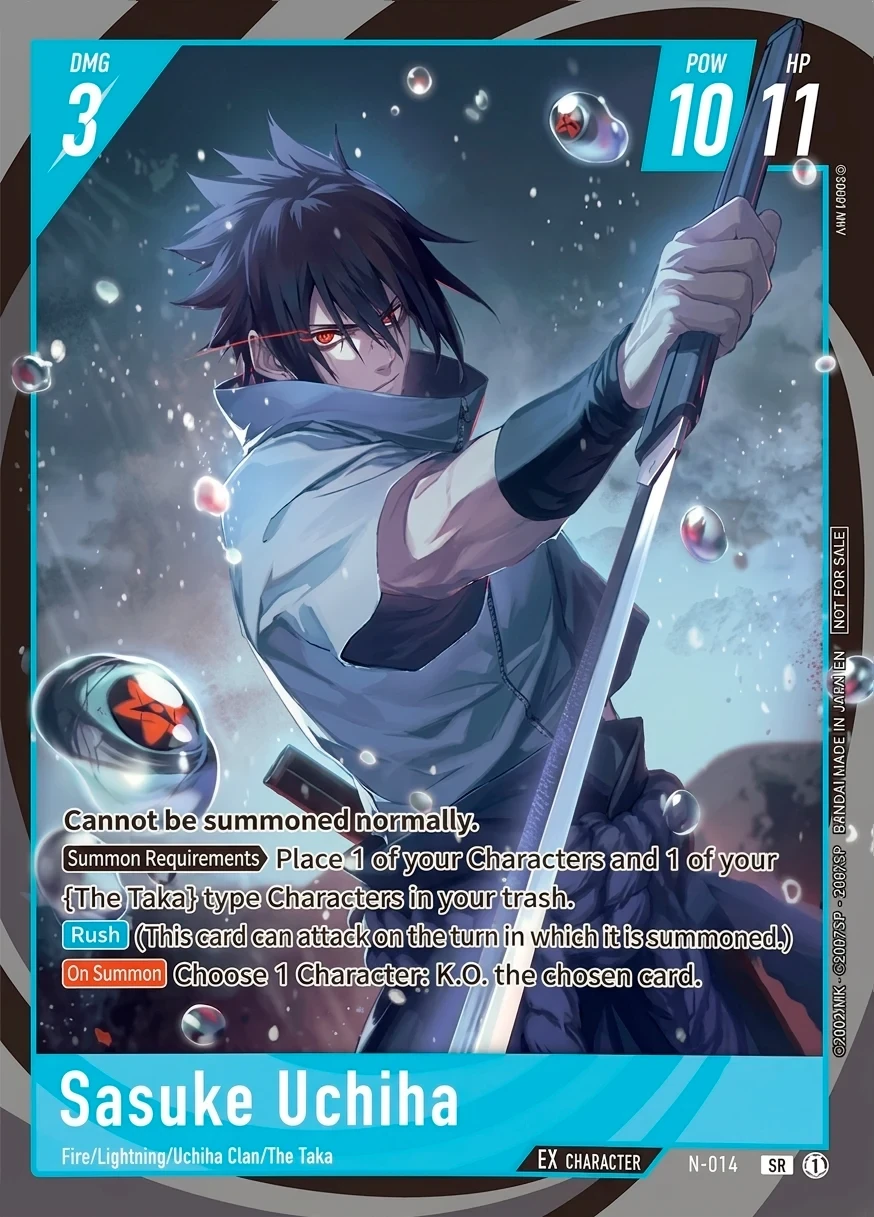
    N-014 Sasuke Uchiha EX Character card from Bandai's Naruto Card Game, blue frame, DMG 3 POW 10 HP 11
    N-014 Sasuke Uchiha
    EX Character · blue · DMG 3 / POW 10 / HP 11

    N-014 Sasuke Uchiha — EX Character

    The heaviest stat line shown so far: DMG 3, POW 10, HP 11. Its cost is the steepest inside a single colour — “Place 1 of your Characters and 1 of your [The Taka] type Characters in your trash” — because it asks for a Taka-tagged card specifically, and Taka cards only exist in blue.

    What it buys is Rush, which the card spells out as “This card can attack on the turn in which it is summoned.” A 10-power body that swings immediately and takes 11 damage to remove is the single largest threat in the revealed pool.
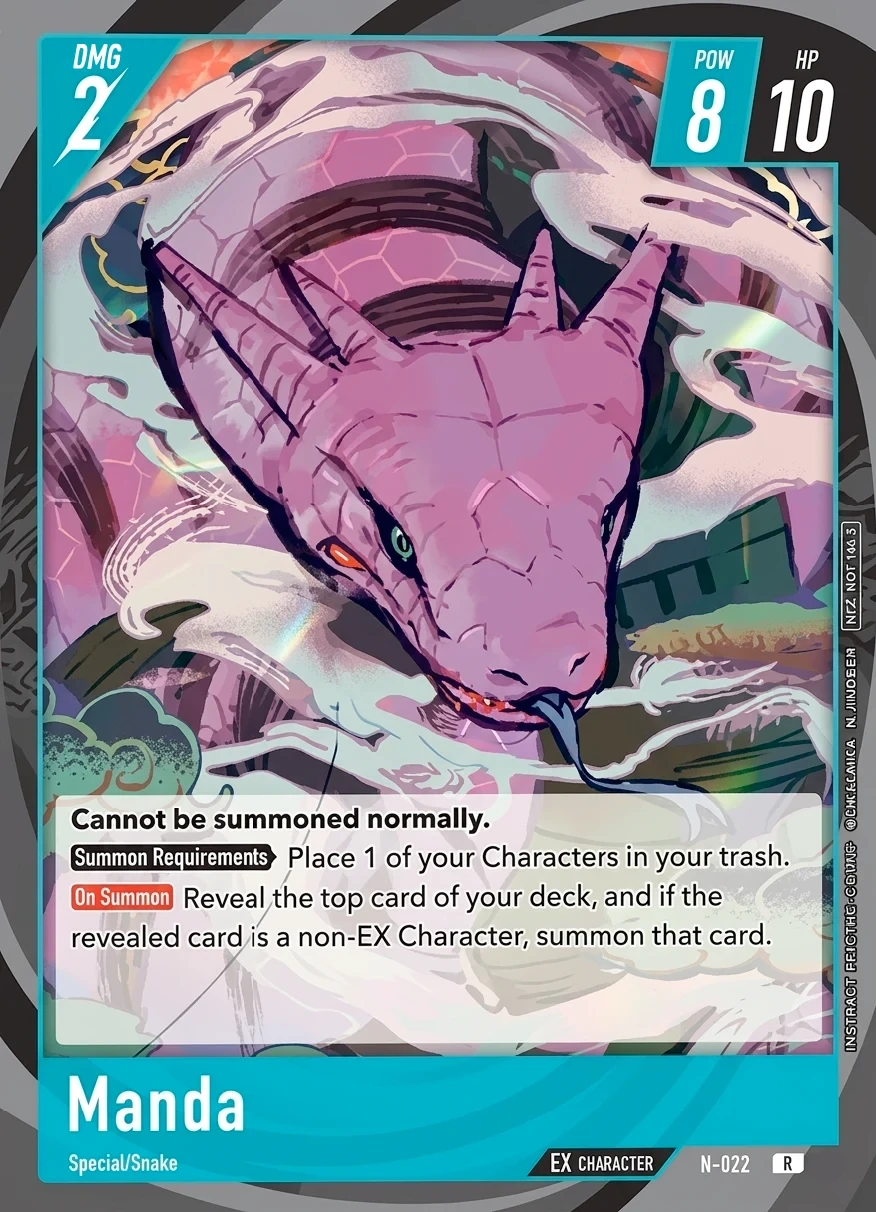
    N-022 Manda EX Character card from Bandai's Naruto Card Game, blue frame, DMG 2 POW 8 HP 10
    N-022 Manda
    EX Character · blue · DMG 2 / POW 8 / HP 10

    N-022 Manda — EX Character

    The third EX card, and the cheapest to bring out. Its cost is the plainest of the three: “Place 1 of your Characters in your trash.” No power threshold, no type requirement.

    In exchange the summon ability is a gamble: “On Summon: Reveal the top card of your deck, and if the revealed card is a non-EX Character, summon that card.” Where Gamabunta fetches a named character from the trash, Manda digs off the top of the deck and only pays out if the card is a Character. Manda is the snake summon to Gamabunta’s toad, which makes the pair a deliberate mirror in the two colours.

    The numbered Character cards

    Eleven of the sixteen confirmed numbers are ordinary Character cards. Each one prints a Chakra cost in the bottom left — the price to bring it out — and most carry a Support ability, which is the printed effect you trigger by paying that Chakra. The red pool turns characters into power. The blue pool breaks the opponent’s board.
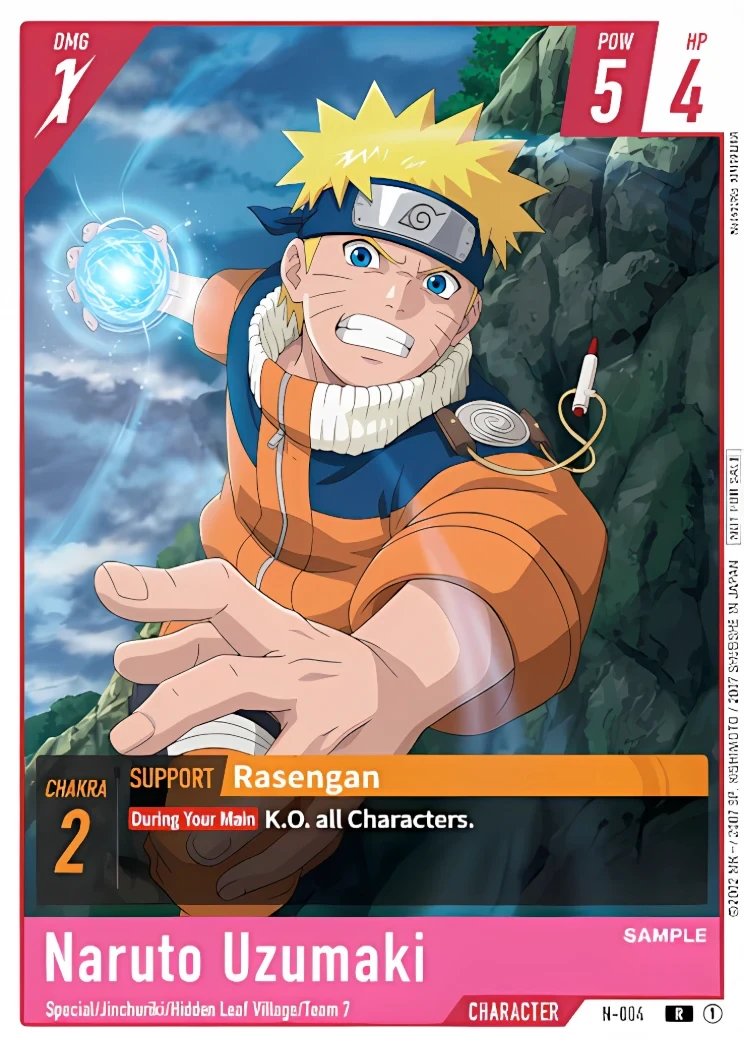
    N-004 Naruto Uzumaki Character card from Bandai's Naruto Card Game, red frame, Rasengan
    N-004 Naruto Uzumaki
    Character · red · DMG 1 / POW 5 / HP 4 · Chakra 2

    N-004 Naruto Uzumaki — Rasengan

    The card takes its name from the Jutsu in the Support band. “Rasengan — During Your Main: K.O. all Characters.” Two Chakra for a board wipe that does not distinguish between sides is a steep, heavily telegraphed play, and the low HP 4 means the Naruto you spent the turn summoning is unlikely to survive into the next one.

    Tagged Special, Jinchuriki, Hidden Leaf Village and Team 7. Its blue mirror is N-015, which prints the same removal sentence under a different Jutsu name.
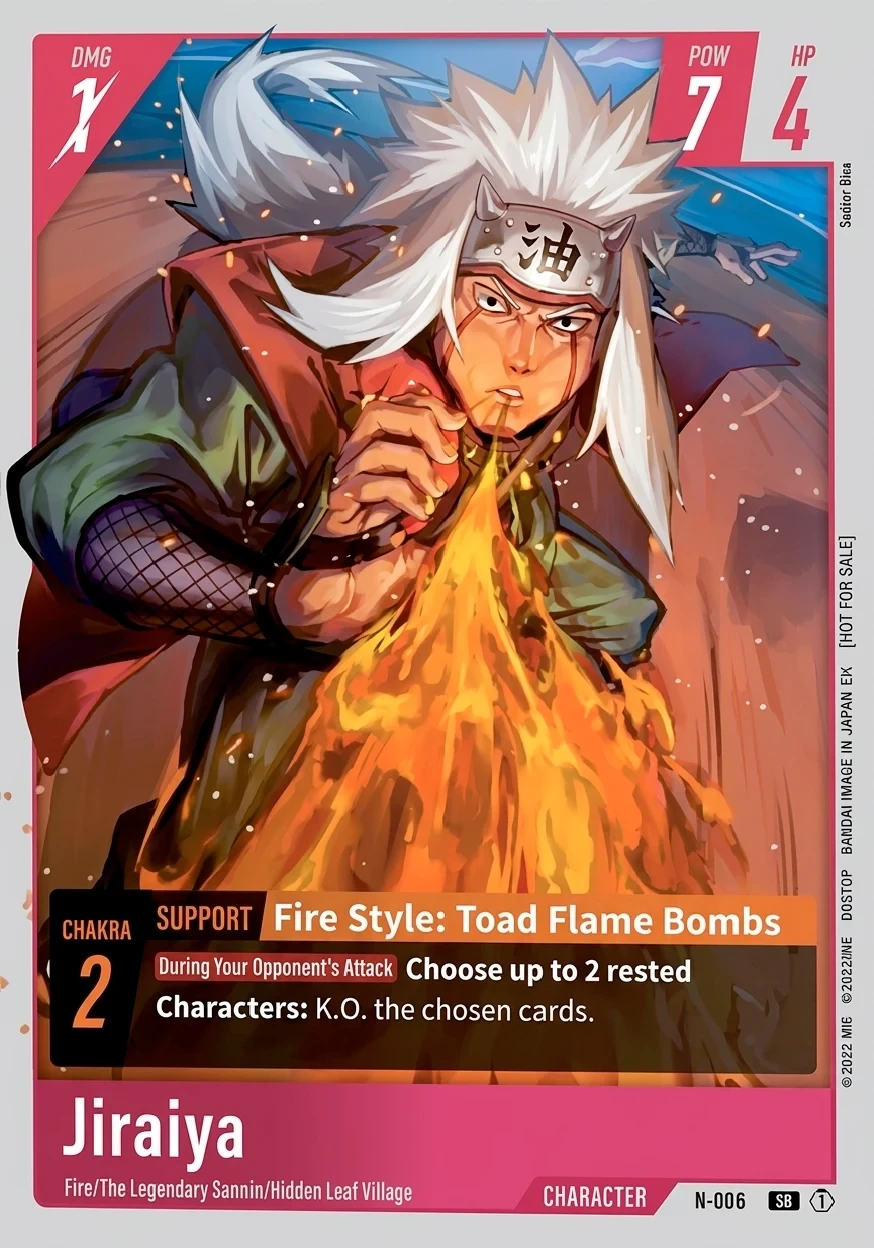
    N-006 Jiraiya Character card from Bandai's Naruto Card Game, red frame, Toad Flame Bombs
    N-006 Jiraiya
    Character · red · DMG 1 / POW 7 / HP 4 · Chakra 2

    N-006 Jiraiya — Toad Flame Bombs

    A reactive removal card rather than a board wipe. “Fire Style: Toad Flame Bombs — During Your Opponent’s Attack: Choose up to 2 rested Characters: K.O. the chosen cards.” The trigger is the opponent attacking, and the targets have to be rested, so this is a card that punishes an opponent who commits everything forward.

    Tagged Fire, The Legendary Sannin and Hidden Leaf Village. The Sannin tag is worth noting: Orochimaru carries it too, but on the cards shown so far Tsunade’s reveal card does not.
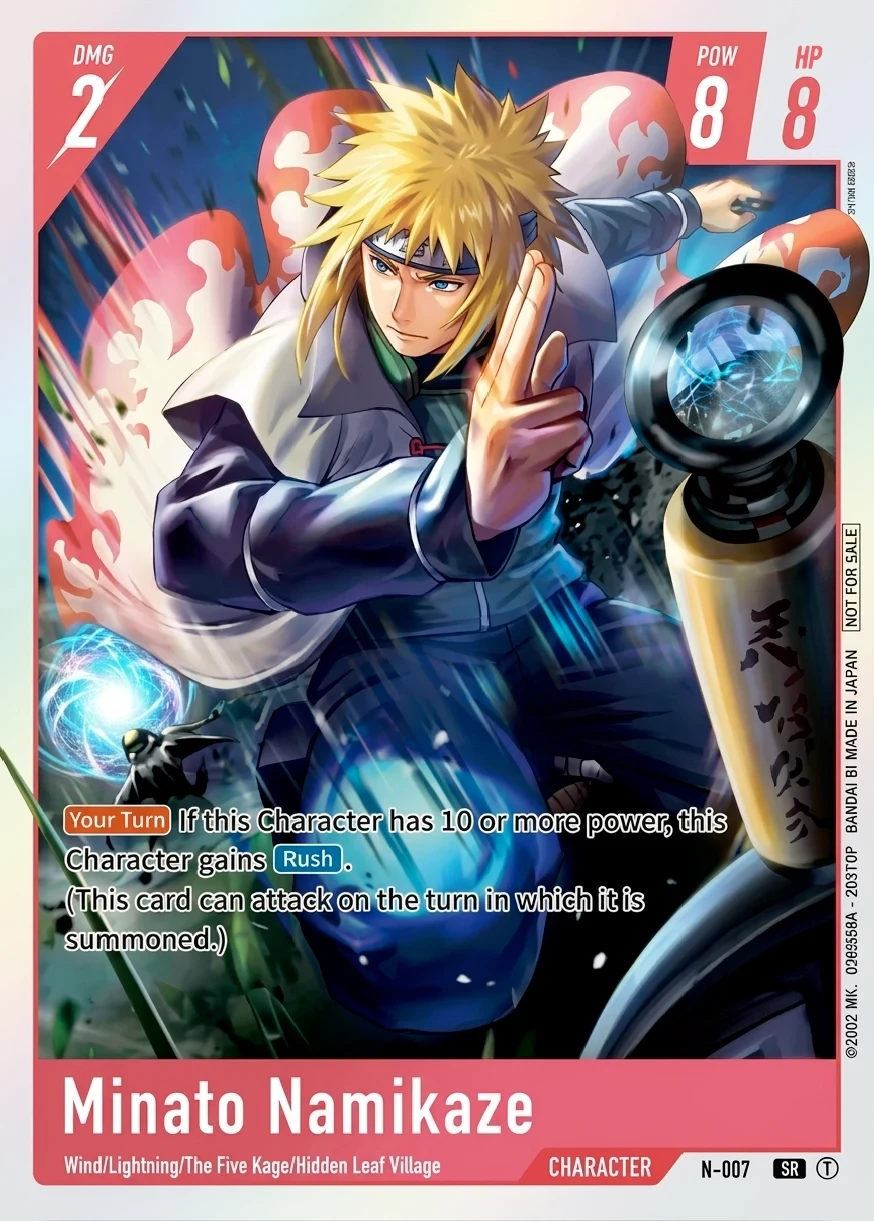
    N-007 Minato Namikaze Character card from Bandai's Naruto Card Game, red frame, gains Rush
    N-007 Minato Namikaze
    Character · red · DMG 2 / POW 8 / HP 8 · Chakra 2

    N-007 Minato Namikaze

    The Fourth Hokage, and the only red Character card with a conditional keyword. “Your Turn: If this Character has 10 or more power, this Character gains [Rush].” The card then spells Rush out in full: “This card can attack on the turn in which it is summoned.”

    That condition is why Naruto’s Leader ability exists. Minato prints POW 8 on its own, so +3 from N-001 pushes it over the 10-power threshold and turns a card that would sit a turn into one that attacks the moment it lands. Tagged Wind, Lightning, The Five Kage and Hidden Leaf Village, and it is the only card in the set so far carrying two elemental tags.
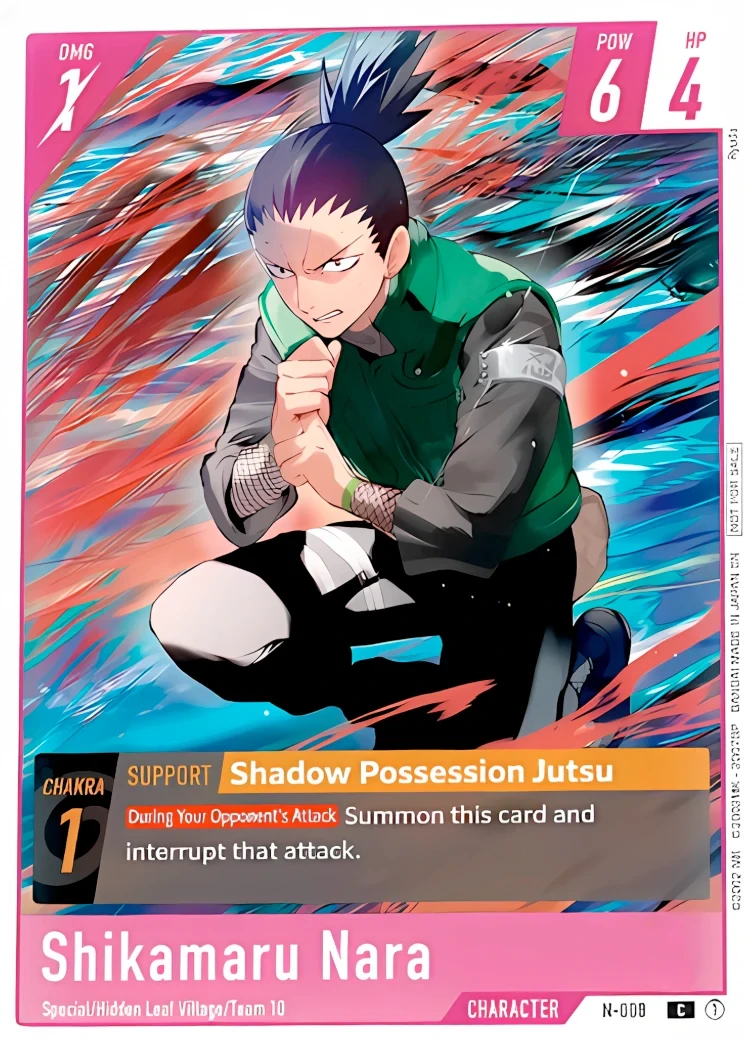
    N-008 Shikamaru Nara Character card from Bandai's Naruto Card Game, red frame, Shadow Possession Jutsu
    N-008 Shikamaru Nara
    Character · red · DMG 1 / POW 6 / HP 4 · Chakra 1

    N-008 Shikamaru Nara — Shadow Possession Jutsu

    A one-Chakra defensive trick. “Shadow Possession Jutsu — During Your Opponent’s Attack: Summon this card and interrupt that attack.” The wording is unusual: the card summons itself as the cost, which means it does not need to be on the field beforehand and turns a dead card in hand into a counter.

    Tagged Special, Hidden Leaf Village and Team 10. The Team 10 tag connects it to N-011.
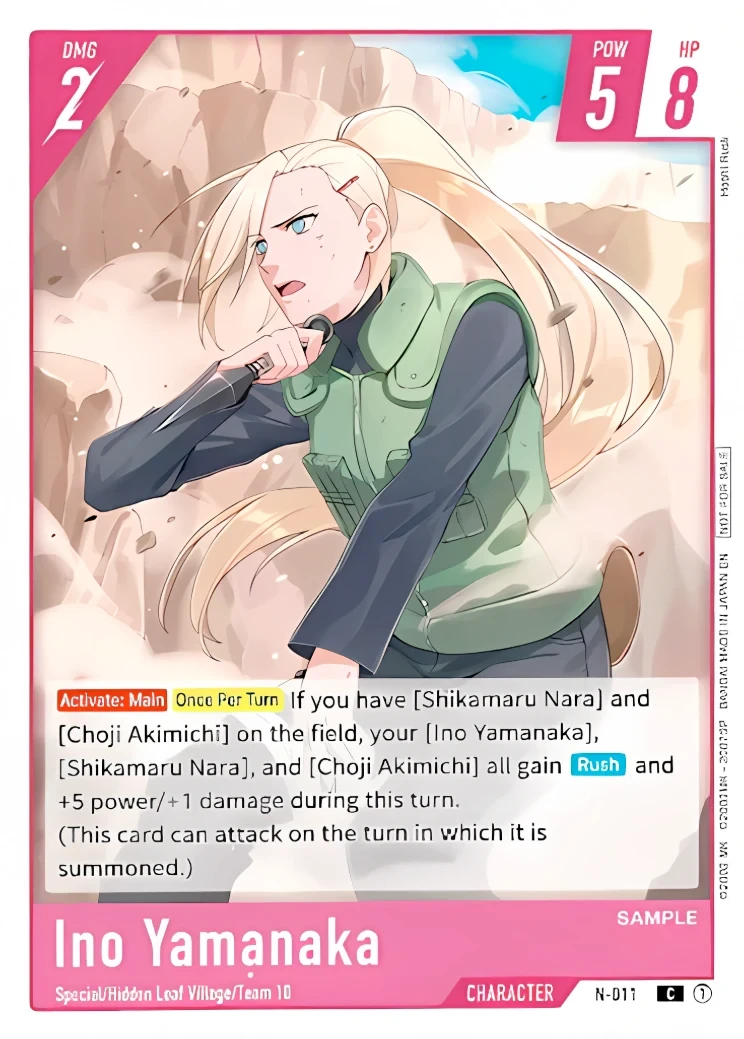
    N-011 Ino Yamanaka Character card from Bandai's Naruto Card Game, red frame, Team 10 combination
    N-011 Ino Yamanaka
    Character · red · DMG 2 / POW 5 / HP 8 · Chakra 1

    N-011 Ino Yamanaka — Team 10

    The first card in the set that names other cards to switch on. “Active: Main: Once Per Turn: If you have [Shikamaru Nara] and [Choji Akimichi] on the field, your [Ino Yamanaka], [Shikamaru Nara], and [Choji Akimichi] all gain [Rush] and +5 power / +1 damage during this turn.”

    So Team 10 is a three-card combo, and one third of it — Choji Akimichi — has no confirmed card number yet. As written, Ino is a 5-power card that becomes a 10-power Rush threat if the other two are already out, once per turn.
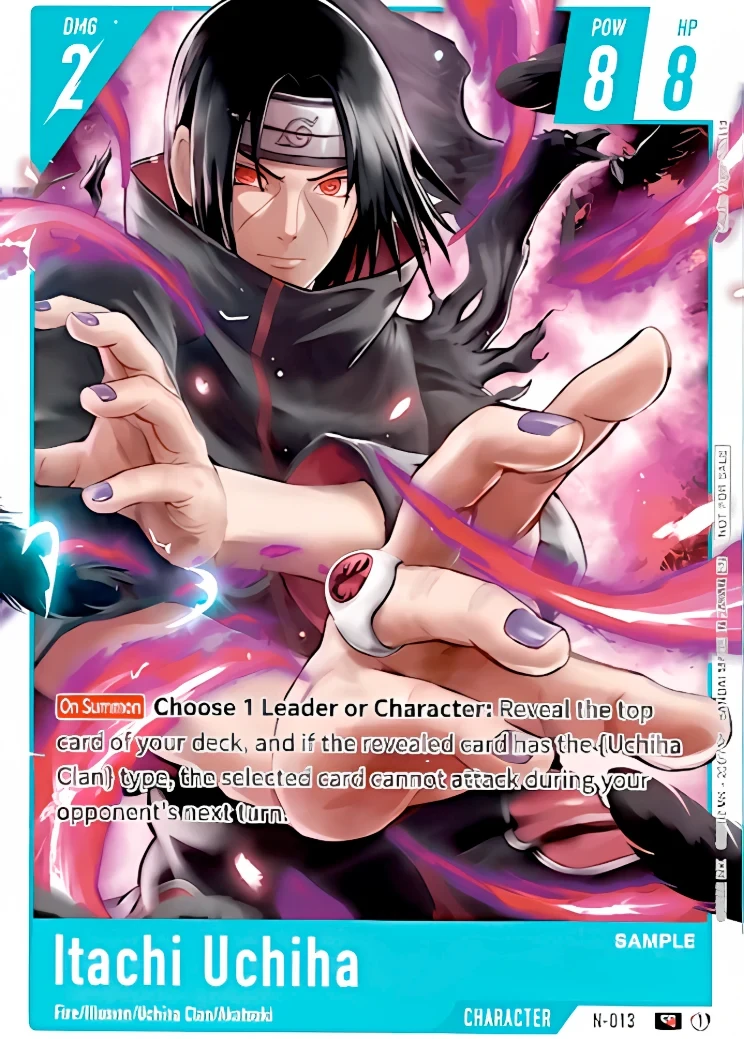
    N-013 Itachi Uchiha Character card from Bandai's Naruto Card Game, blue frame, Uchiha Clan
    N-013 Itachi Uchiha
    Character · blue · DMG 2 / POW 8 / HP 8 · Chakra 2

    N-013 Itachi Uchiha

    A lock rather than a kill. “On Summon: Choose 1 Leader or Character: Reveal the top card of your deck and if the revealed card is the [Uchiha Clan] type, the selected card cannot attack during your opponent’s next turn.”

    The condition is the deck-building constraint in miniature: the ability only fires if the top of your own deck is an Uchiha Clan card, so a blue deck that wants Itachi to work has to be an Uchiha deck. Tagged Fire, Sharingan, Uchiha Clan and Akatsuki — the only card shown that carries both the clan tag and the Akatsuki tag.
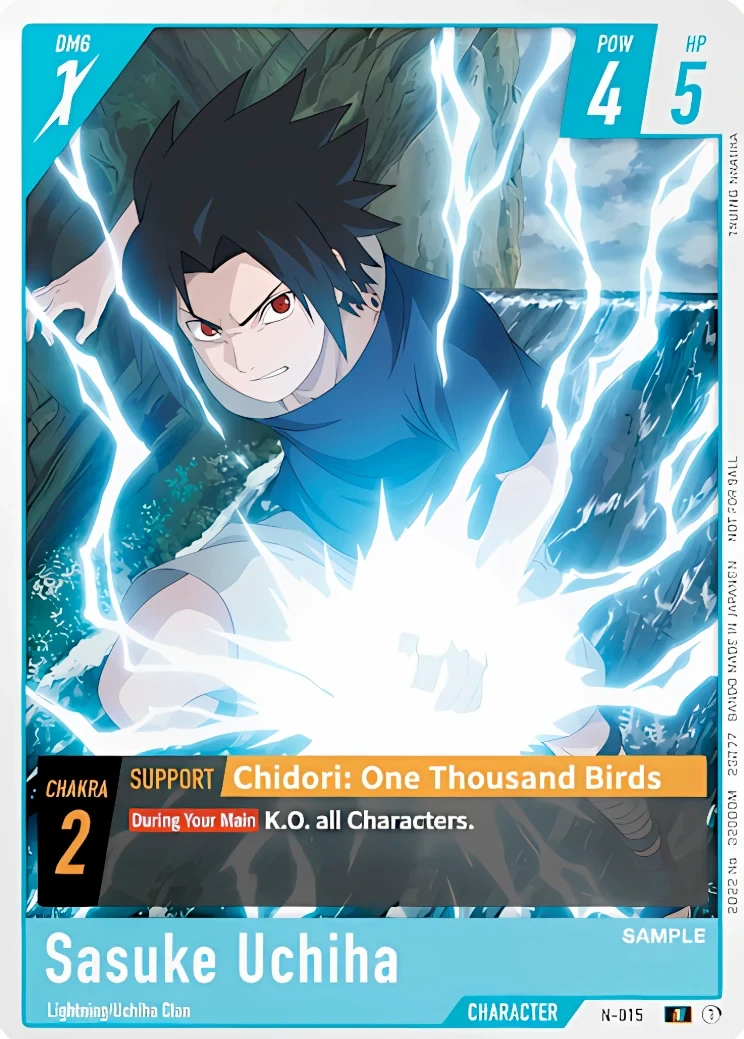
    N-015 Sasuke Uchiha Character card from Bandai's Naruto Card Game, blue frame, Chidori
    N-015 Sasuke Uchiha
    Character · blue · DMG 1 / POW 4 / HP 5 · Chakra 2

    N-015 Sasuke Uchiha — Chidori

    The blue half of the removal pair. “Chidori: One Thousand Birds — During Your Main: K.O. all Characters.” Same sentence as Naruto’s Rasengan, same cost, printed in the other colour.

    The symmetry is deliberate enough to be a design rule: both colours get one indiscriminate board wipe, printed on the lead character’s signature Jutsu. Tagged Lightning and Uchiha Clan.
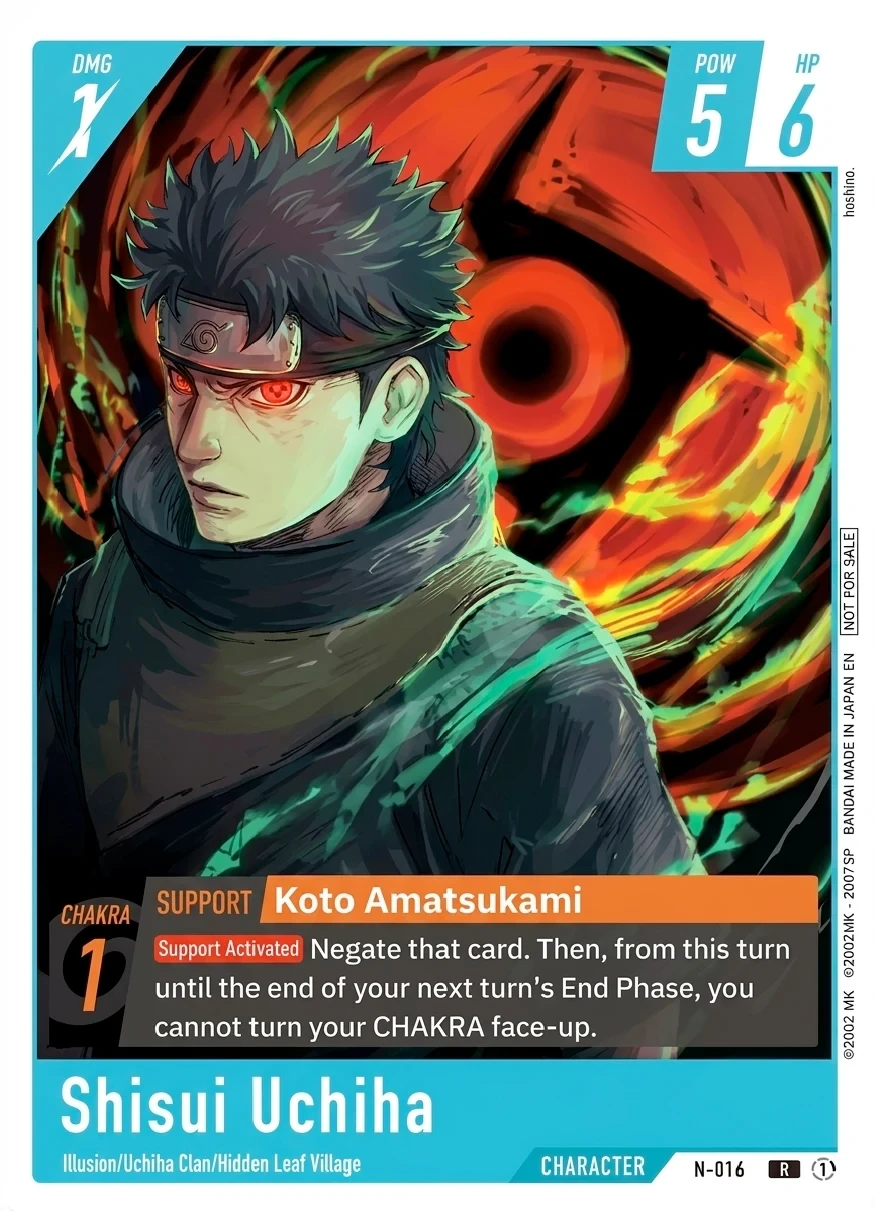
    N-016 Shisui Uchiha Character card from Bandai's Naruto Card Game, blue frame, Koto Amatsukami
    N-016 Shisui Uchiha
    Character · blue · DMG 1 / POW 5 / HP 6 · Chakra 1

    N-016 Shisui Uchiha — Koto Amatsukami

    The most expensive ability in the set, and the only one with a drawback that lasts two turns. “Koto Amatsukami — Support: Activated: Negate that card. Then, from this turn until the end of your next turn’s End Phase, you cannot turn your CHAKRA face-up.”

    Negating a card is the strongest single effect printed so far, and the price is a full turn of no Chakra recovery — a real lock on the blue player, not the opponent. Tagged Bloodline, Sharingan, Uchiha Clan and Hidden Leaf Village.
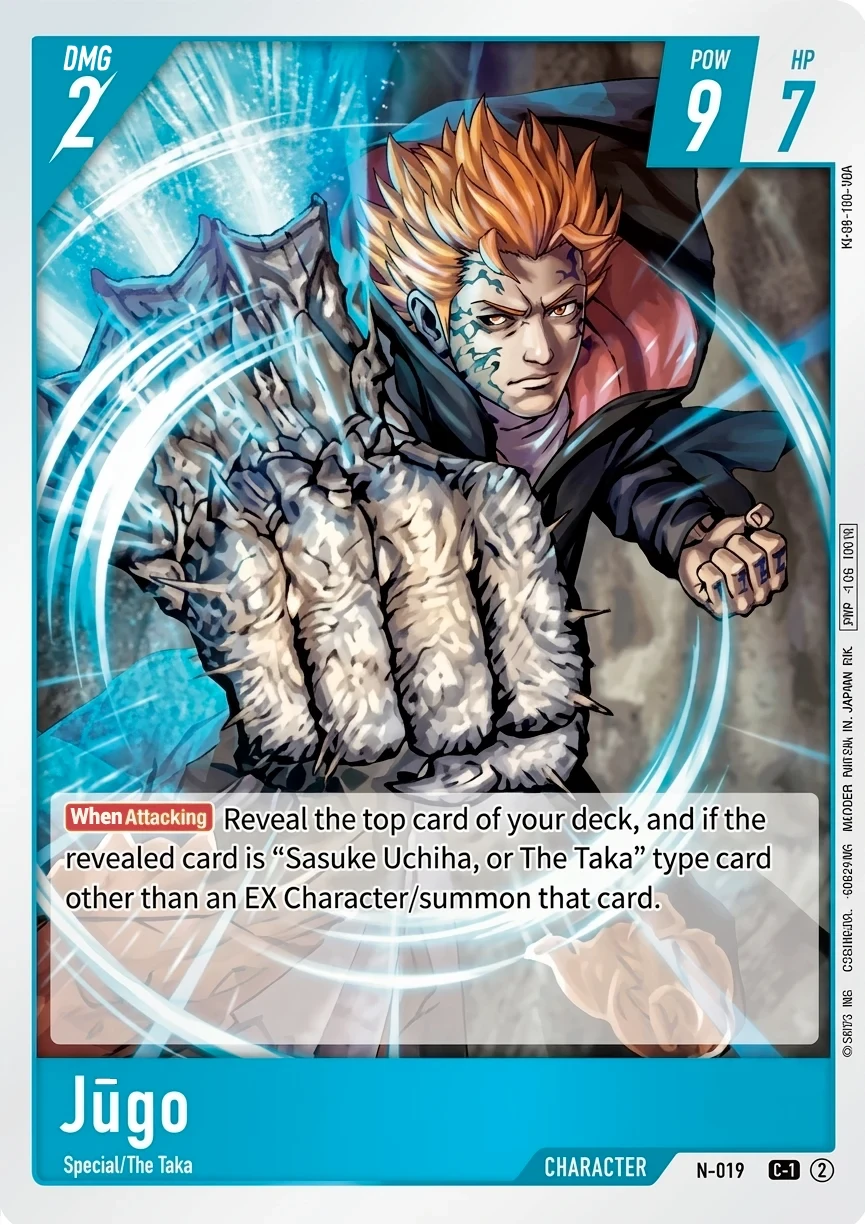
    N-019 Jugo Character card from Bandai's Naruto Card Game, blue frame, The Taka
    N-019 Jugo
    Character · blue · DMG 2 / POW 9 / HP 7 · Chakra 1

    N-019 Jugo — The Taka

    The largest Character body outside the EX cards: POW 9 for one Chakra. The effect is conditional on the top of your deck. “When Attacking: Reveal the top card of your deck, and if the revealed card is [Sasuke Uchiha] or a [The Taka] type card, summon this card and summon that card if it is not an EX Character.”

    Read together with Gamabunta, Manda and Itachi, a pattern shows up: four different cards all look at the top of the deck or the trash, which suggests the finished game leans harder on deck-order effects than the launch material has explained. Tagged Special and The Taka.
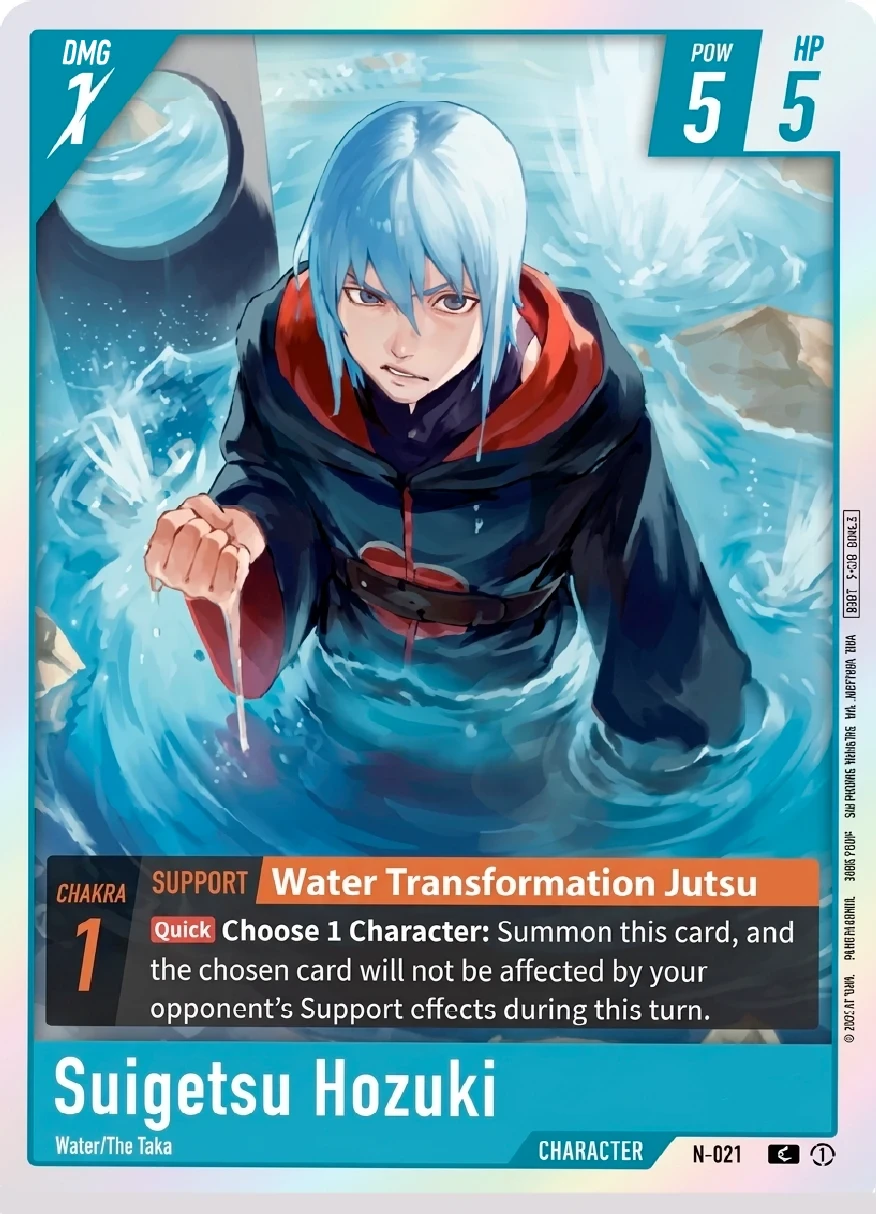
    N-021 Suigetsu Hozuki Character card from Bandai's Naruto Card Game, blue frame, Water Transformation Jutsu
    N-021 Suigetsu Hozuki
    Character · blue · DMG 1 / POW 5 / HP 5 · Chakra 1

    N-021 Suigetsu Hozuki — Water Transformation Jutsu

    A protection card. “Water Transformation Jutsu — Quick: Choose 1 Character: Summon this card, and the chosen card will not be affected by your opponent’s Support effects during this turn.”

    The Quick keyword is the interesting part: it means the card can be played in response, unlike a During Your Main effect. Tagged Water and The Taka. Suigetsu, Jugo and Karin are the three Taka-tagged Characters shown so far, which is also why N-014 demands one of them as its summon cost.
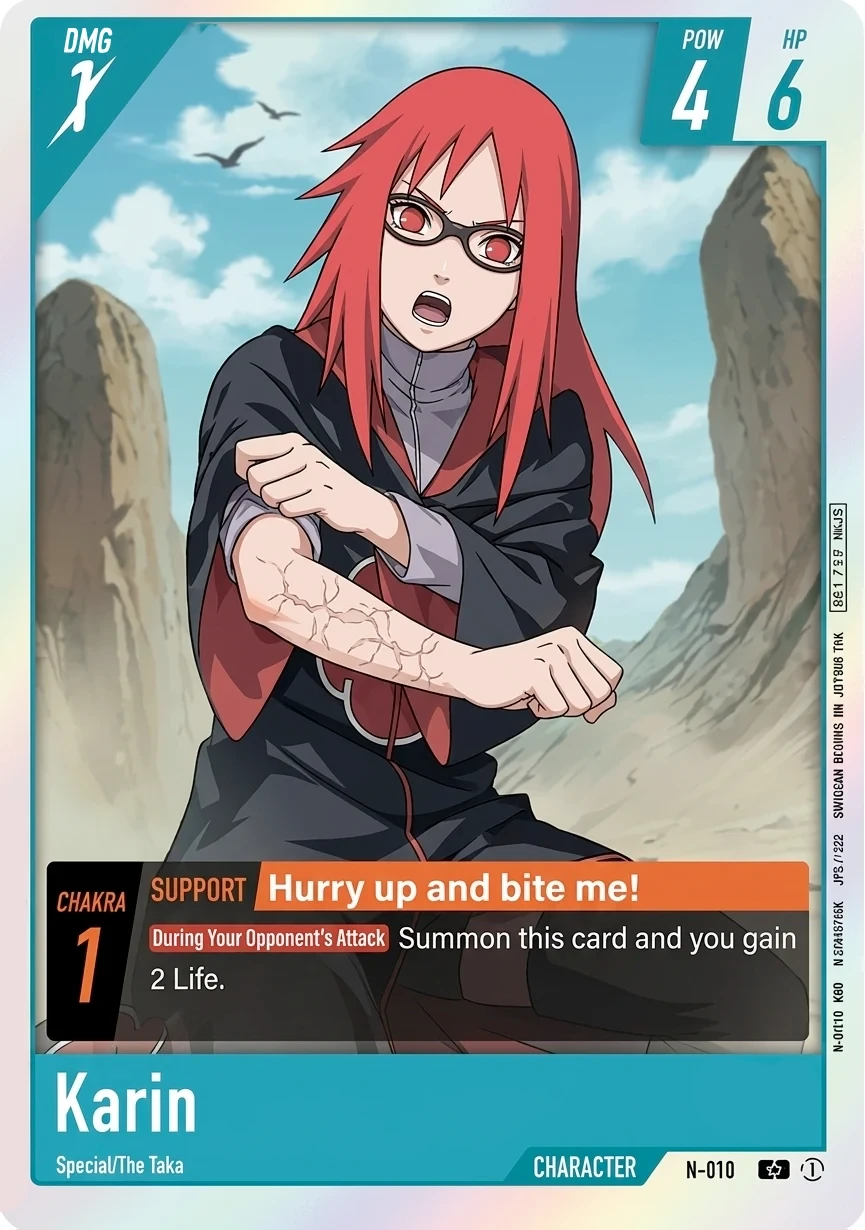
    N-010 Karin Character card from Bandai's Naruto Card Game, blue frame, The Taka
    N-010 Karin
    Character · blue · DMG 1 / POW 4 / HP 6 · Chakra 1

    N-010 Karin

    The only healing effect in the set so far. “Hurry up and bite me! — During Your Opponent’s Attack: Summon this card and you gain 2 Life.” Two life against a Leader on 15 is a small cushion, and it arrives as a self-summon reaction, so it costs a card out of hand rather than a card on the field.

    Tagged Special and The Taka. N-010 sits between two numbers that have not appeared, which is part of why the gaps matter.

    The Chakra and Summon cards

    These are the two utility card types, and they are printed as plain cards with no character art.
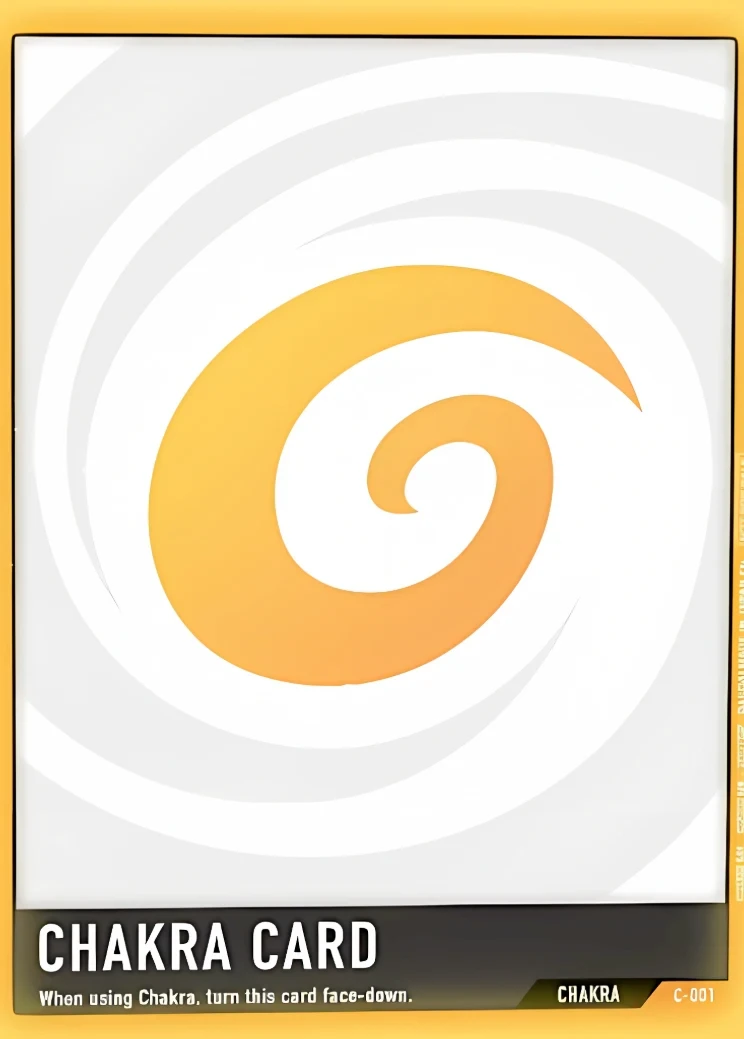
    C-001 Chakra Card from Bandai's Naruto Card Game, orange with a swirl
    C-001 Chakra Card
    Chakra · orange
    S-001 Summon Card from Bandai's Naruto Card Game, black with a running silhouette
    S-001 Summon Card
    Summon · black

    C-001 and S-001

    The Chakra card reads “When using Chakra, turn this card face-down”, which is the mechanism the whole game runs on: Chakra is paid by physically flipping the card over, and a card that is face-down has to be recovered before it can be spent again. Shisui’s ability, which stops you turning Chakra face-up, is a direct attack on that.

    The Summon card reads “You may rest this card to summon a Character card.” Resting means turning it sideways, so one Summon card only covers one character at a time. The black silhouette artwork is the same running ninja figure used on the card back.

    The CP-001 promo card, in three versions

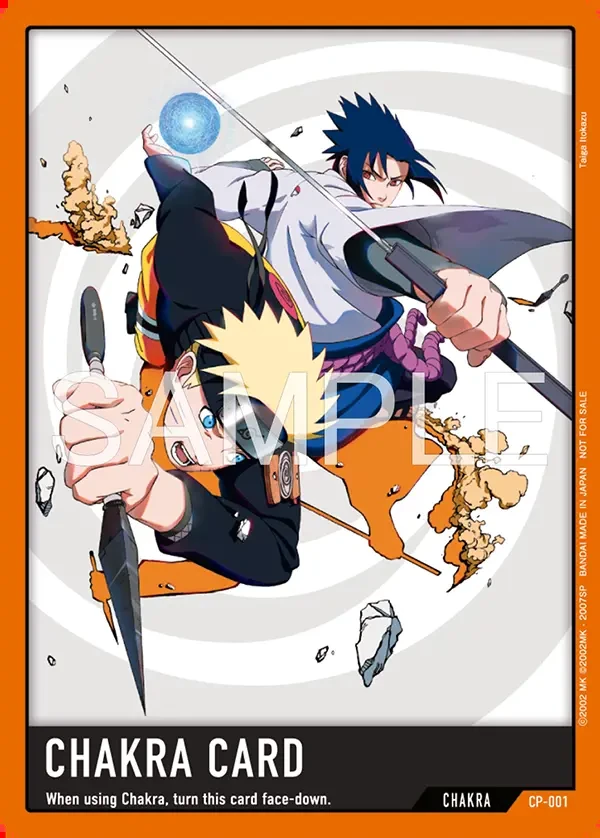
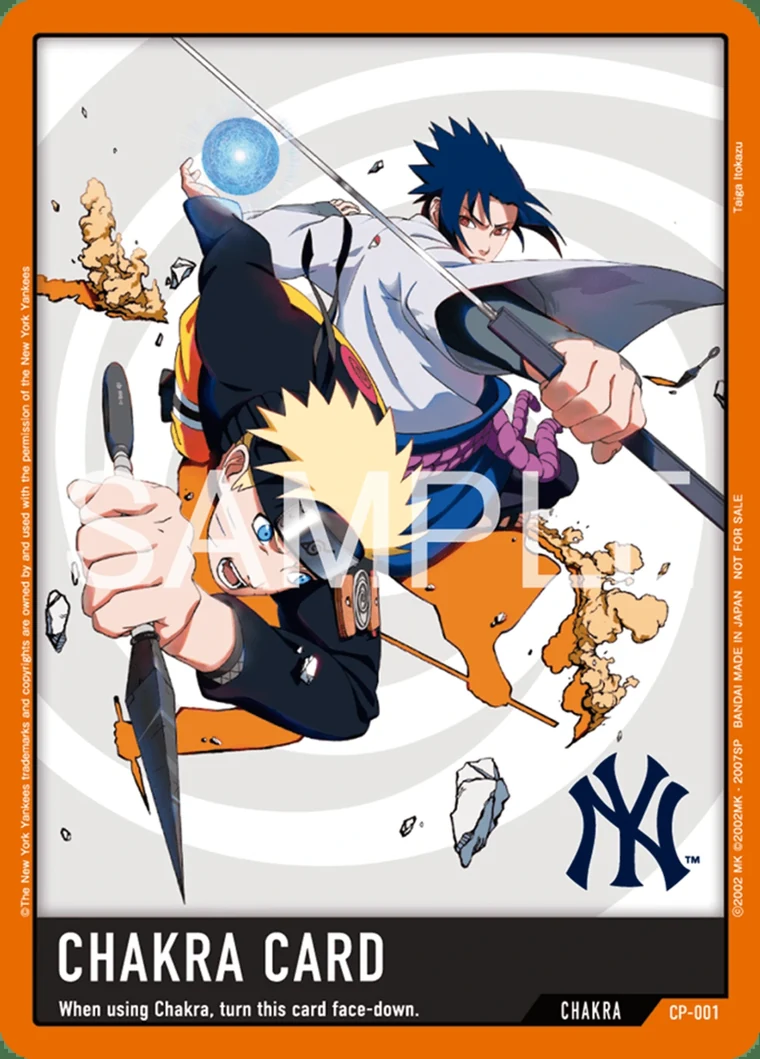
    CP-001 is the only NARUTO CARD GAME card that has been physically handed to the public so far, and it has appeared in three versions. All three print the same illustration — Naruto and Sasuke mid-fight, credited to Taiga Itokazu — and the same effect line: “When using Chakra, turn this card face-down.” What differs is a mark in the bottom right corner.
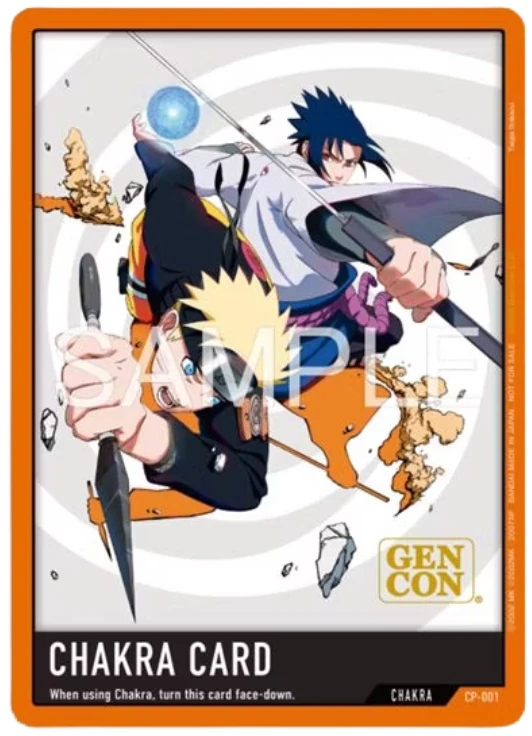
    CP-001 Chakra Card in the Gen Con 2026 version
    CP-001
    Gen Con 2026 version
    CP-001 Chakra Card in the tutorial promo version with no event mark
    CP-001
    Tutorial version, no event mark
    CP-001 Chakra Card in the New York Yankees version with an NY logo
    CP-001
    New York Yankees version

    What separates the three prints

    The Gen Con version carries a gold GEN CON mark beside the card number. The plain tutorial version carries nothing there at all, which makes it the one to check if you are identifying a loose copy. The third version carries the interlocking NY of the New York Yankees, and it was handed out at the NARUTO x YANKEES GAME NIGHT at Yankee Stadium on 8 September 2026 rather than at a card game event.

    One point about the European legs of the tour: Bandai’s pages for SPIEL Essen, Paris Games Week and Lucca Comics & Games all list the giveaway simply as CP-001 Chakra Card, with no city stamp. So as of now there is no Essen version, no Paris version and no Lucca version to collect — three prints is the full count.

    The two Gen Con demo decks

    The cards shown in images are one thing; the cards people actually played with at Gen Con 2026 are another, and the demo pool is where the gaps in the N-numbers come from. Two demo decks were built, one red and one blue, and each was a reduced 30-card main deck made of ten different cards at three copies each. Neither is a legal constructed deck, which needs 50 main-deck cards.

    Red demo deck (Naruto) Blue demo deck (Sasuke)
    N-004 Naruto Uzumaki ×3 N-010 Karin ×3
    N-005 Gamabunta ×3 N-013 Itachi Uchiha ×3
    N-006 Jiraiya ×3 N-014 Sasuke Uchiha EX ×3
    N-007 Minato Namikaze ×3 N-015 Sasuke Uchiha Chidori ×3
    N-008 Shikamaru Nara ×3 N-016 Shisui Uchiha ×3
    N-011 Ino Yamanaka ×3 N-019 Jugo ×3
    Choji Akimichi ×3 (no confirmed number) N-021 Suigetsu Hozuki ×3
    Hinata Hyuga ×3 (no confirmed number) N-022 Manda ×3
    Naruto Uzumaki EX ×3 (no confirmed number) Orochimaru ×3 (no confirmed number)
    Kakashi Hatake ×3 (prints K-039) Sakura Haruno ×3 (no confirmed number)

    Both decks also ran the same five Chakra cards and one Summon card. Read the two columns together and the colour identities land: red is eight characters around Naruto plus one EX, blue is the whole Taka squad plus the Uchiha.

    The cards that are not confirmed

    Six of the cards in the demo decks have no confirmed number, and this is worth being careful about. Choji Akimichi, Hinata Hyuga, Kakashi Hatake, the EX Naruto Uzumaki, Orochimaru and Sakura Haruno have all been visible at the demo tables, but the printed numbers on those cards have either not been readable in the photographs or have been reconstructed by the community rather than copied off an official image.

    Kakashi is the clearest example of the problem. The demo card shows K-039 where the other cards show an N-number, and Bandai has never explained that prefix. It is either a different product code, a placeholder, or an error — and until Bandai prints a card list, there is no way to tell which.

    What the six do show is readable effect text, and it fills out the two colours. Kakashi negates a card and drops your own life by 2 to do it. Choji doubles a chosen Character’s power for the turn. Hinata removes a non-EX Character. Sakura returns a Character to hand. Orochimaru clears up to two rested Characters. And the EX Naruto is a 11-power Rush card that fetches another Naruto out of the deck or trash.

    The Gen Con artwork previews

    Separately from the cards, Bandai’s Gen Con display showed artwork for characters with no card attached. These are illustrations, not card faces, so their numbers, types and effects are all unknown. What they establish is who is in the first set.

    Artwork shown Status
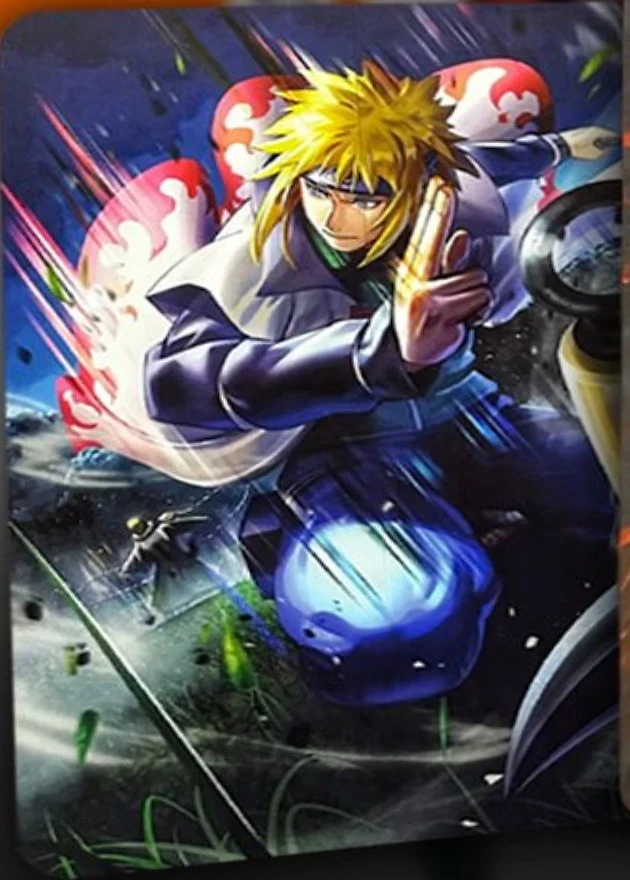
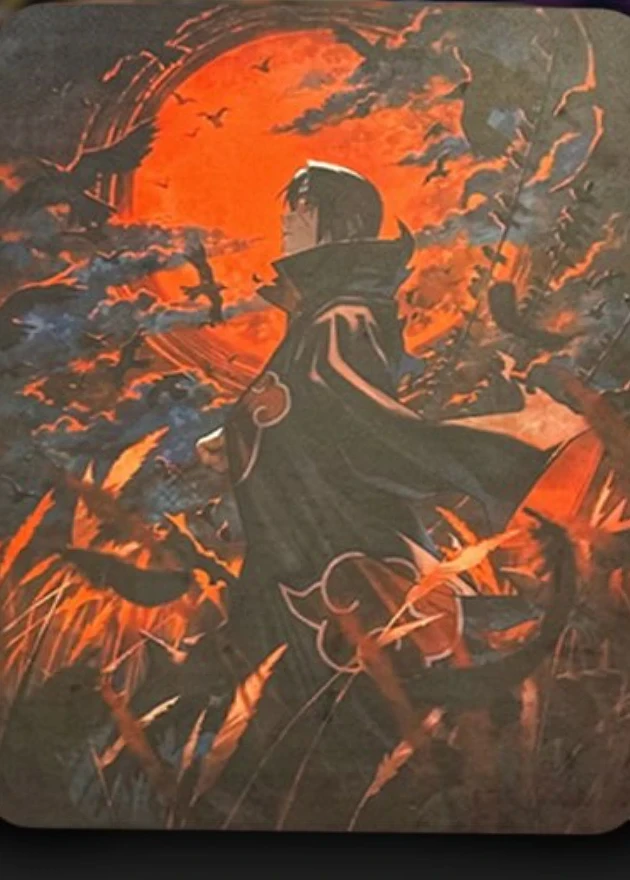
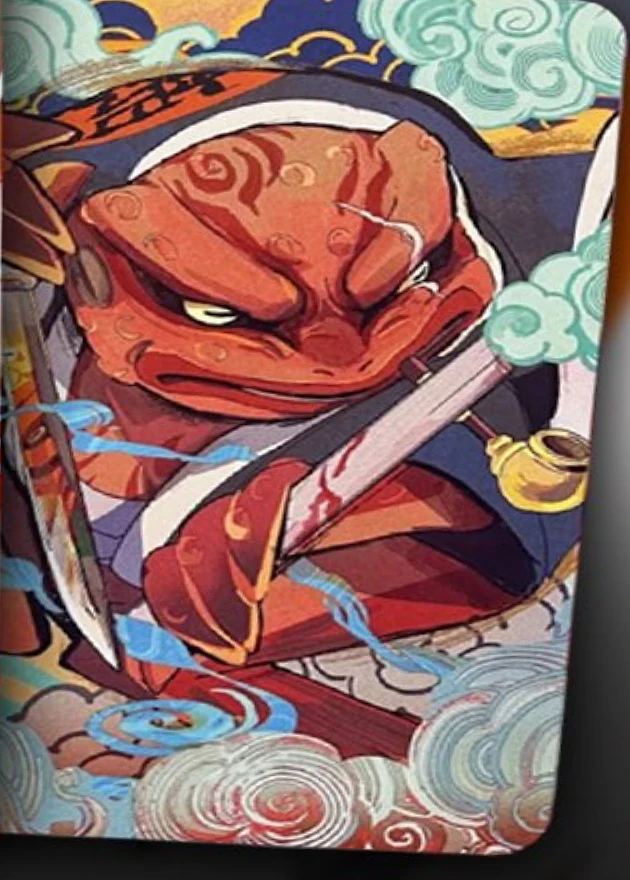
    Minato Namikaze, Itachi Uchiha, Gamabunta Artwork only — all three also have a numbered card
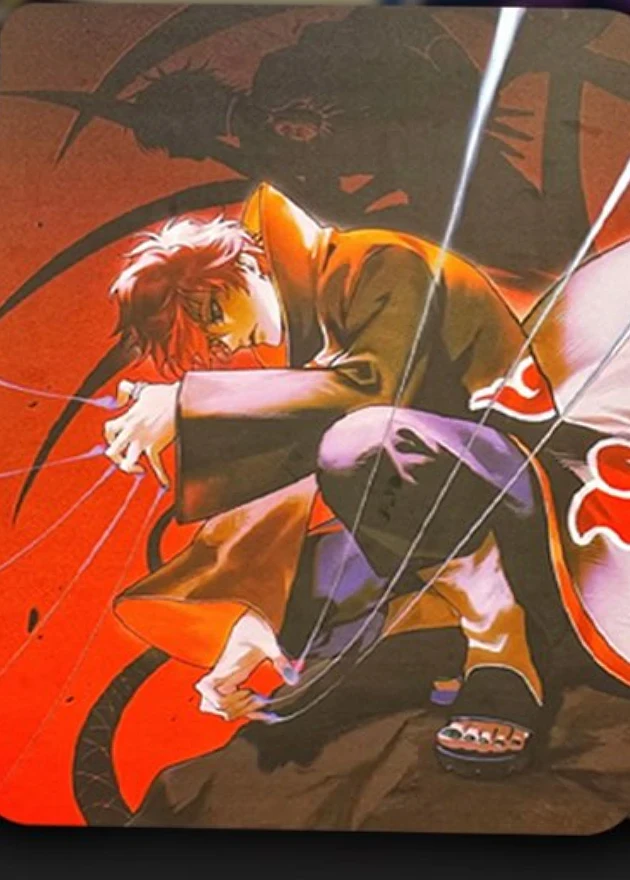
    Sasori, Team 7 Artwork only — no card shown at all
    Naruto Uzumaki, Hinata Hyuga, Konan Shown as display cards with a green or purple frame and a flat DMG 3 / POW 6 / HP 6 line
    Sasori artwork preview shown at Gen Con 2026
    Sasori
    Artwork preview
    Team 7 artwork preview shown at Gen Con 2026
    Team 7
    Artwork preview
    Minato Namikaze artwork preview shown at Gen Con 2026
    Minato Namikaze
    Artwork preview
    Itachi Uchiha artwork preview shown at Gen Con 2026
    Itachi Uchiha
    Artwork preview
    Gamabunta artwork preview shown at Gen Con 2026
    Gamabunta
    Artwork preview

    Sasori is the interesting name in that list, because nothing else in the launch material points to the Akatsuki puppet master having a deck in the first set. Konan is the other one: an Akatsuki member, shown on a green frame, which would be a third colour if the frame turns out to mean what frames normally mean.

    The six display cards

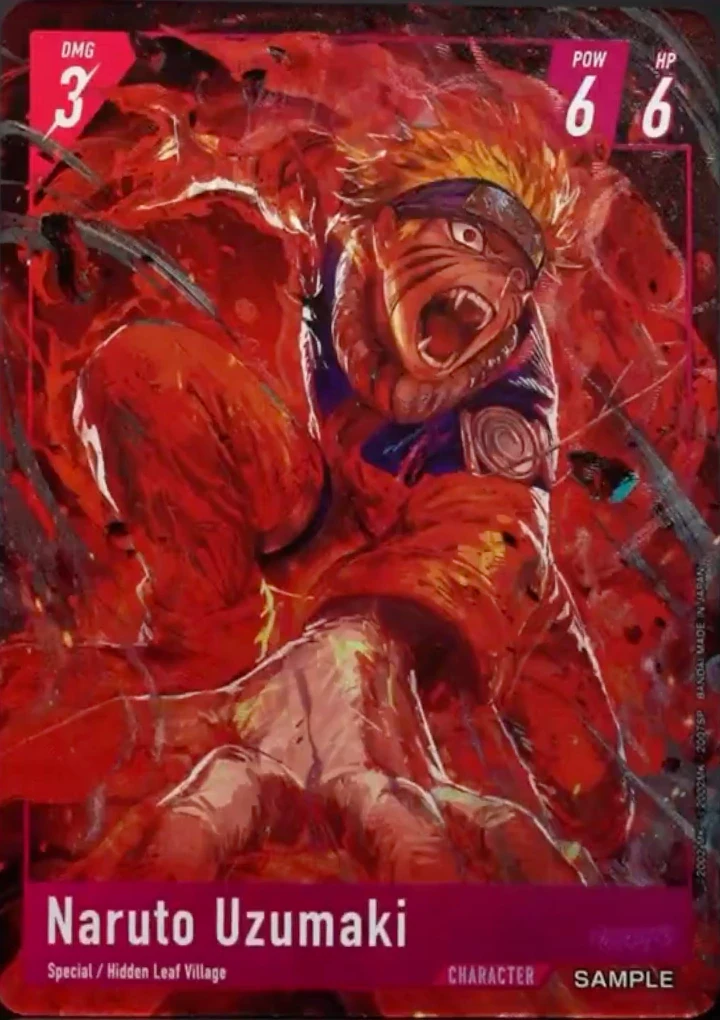
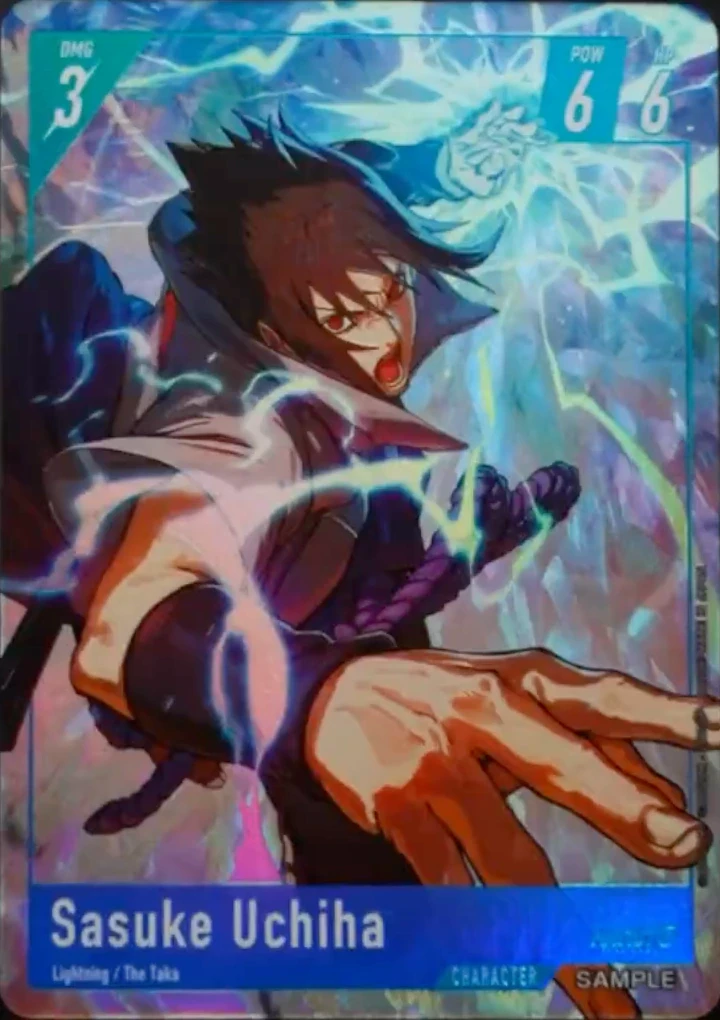
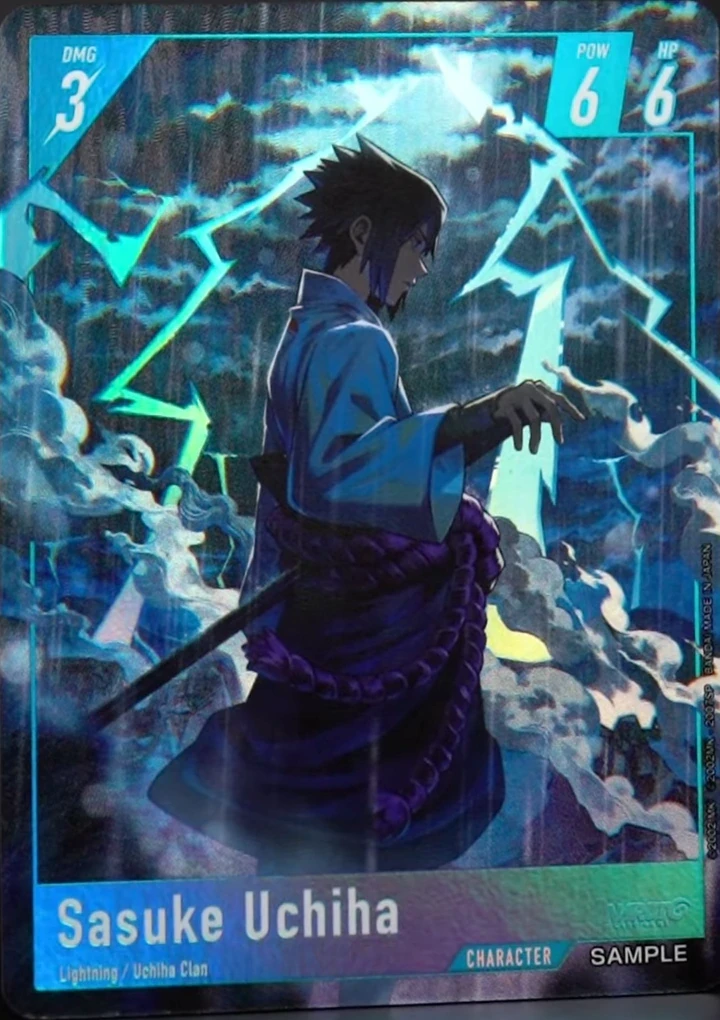
    Six further cards were shown at the same booth as complete card faces rather than plain illustrations, and they behave differently from everything else. All six print the same three values — DMG 3, POW 6, HP 6 — and not one of them carries a card number, so there is no way to tell them apart on the numbers. What does differ is the frame colour: Hinata Hyuga appears on a purple frame and Konan on a green frame, while Naruto Uzumaki and Itachi Uchiha appear in red and the two Sasuke Uchiha cards appear in blue. Green and purple have not appeared on any numbered card, which makes these six the only evidence that the game runs to more than two colours.
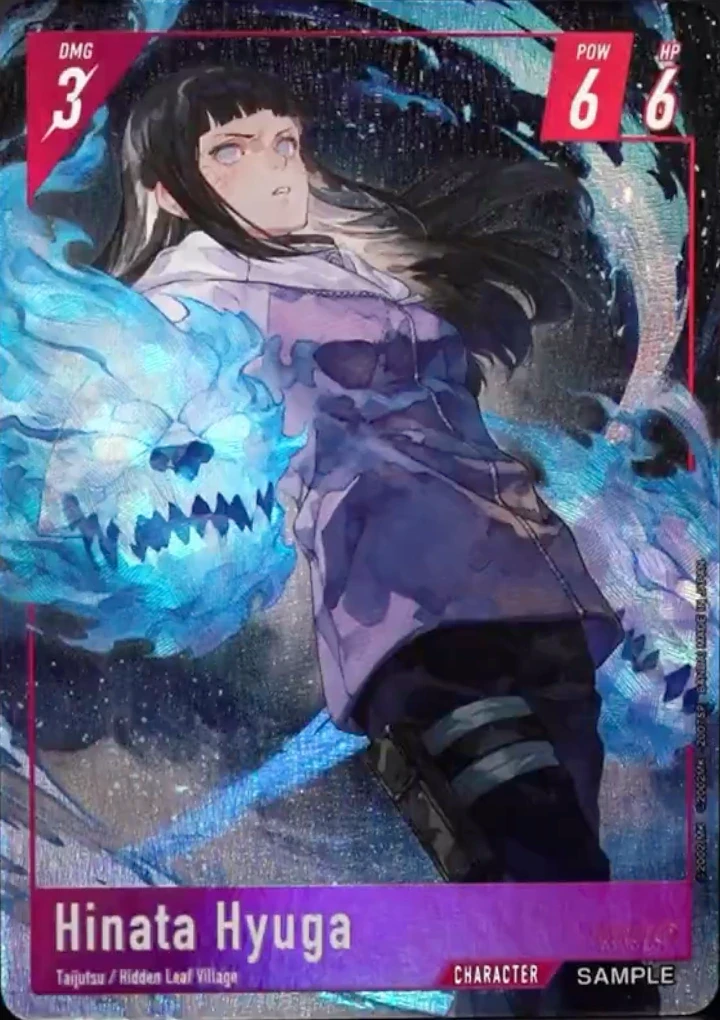
    Hinata Hyuga display card with a purple frame, DMG 3 POW 6 HP 6
    Hinata Hyuga
    Display card · purple
    Konan display card with a green frame, DMG 3 POW 6 HP 6
    Konan
    Display card · green
    Naruto Uzumaki display card with a red frame, DMG 3 POW 6 HP 6
    Naruto Uzumaki
    Display card · red
    Sasuke Uchiha Chidori display card with a blue frame, DMG 3 POW 6 HP 6
    Sasuke Uchiha (Chidori)
    Display card · blue
    Sasuke Uchiha display card with a blue frame, DMG 3 POW 6 HP 6
    Sasuke Uchiha
    Display card · blue
    Itachi Uchiha display card with a red frame, DMG 3 POW 6 HP 6
    Itachi Uchiha
    Display card · red

    What is still not known

    Three things are worth flagging before the launch, because they are the questions the current material cannot answer.

    The set size is unknown. Numbers run to at least N-022, but six numbers inside that range have never been shown, and nothing says the set stops at 22. A Bandai trading card game first set is normally considerably larger than that.

    The retail configuration is unknown. No booster box, no starter deck, no MSRP and no set name has been announced. The only NARUTO CARD GAME item with a price on it is the Naruto and Sasuke playmat at 35 US dollars plus tax, which was sold one per person at the events.

    More information is promised for December 2026, followed by in-store tutorial sessions from January 2027. The New York Comic Con panel on 10 October is the next date where new cards are expected, and this page will be updated when it lands.

    Two other things carry the Naruto name and are easy to confuse with this game. NARUTO: Ninja Cards is a licensed mobile card app that launched on 22 August 2026 and runs its own seasons, and it has no rules connection to the physical game. Naruto Mythos is a separate trading card game from a different publisher. Neither is the game described on this page.

    Frequently asked questions

    How many NARUTO CARD GAME cards have been shown so far?

    Sixteen cards carry a printed number that Bandai has shown clearly, plus a Chakra card, a Summon card and the CP-001 promo. A further six demo cards have readable text but no confirmed number. On top of that, twelve Character cards have appeared in Bandai’s own artwork gallery, and these overlap with the numbered cards without matching them one for one.

    When does the NARUTO CARD GAME release?

    Summer 2027, in a simultaneous worldwide launch. There is no exact date, and the February 2027 date that circulates online comes from speculation rather than from Bandai. In-store tutorial sessions are planned to begin in January 2027.

    Are the revealed cards playable yet?

    No. The game has been playable at conventions only, on demo decks that stay at the Bandai booth. The only physical card the public has taken home is the CP-001 Chakra Card promo, and that card is a resource card rather than a character.

    Why do some cards say K-039 instead of N-0xx?

    Bandai has not explained it. The Kakashi Hatake demo card prints K-039, and every other numbered card prints an N-number. Until Bandai publishes a card list, treat that prefix as unexplained rather than as a fifth card type.

    What is the difference between the NARUTO CARD GAME and Naruto Mythos?

    They are two different trading card games with different publishers. The NARUTO CARD GAME is published directly by Bandai and launches worldwide in Summer 2027. Naruto Mythos is a separate game that was already previewed at San Diego Comic-Con and has released in Europe.

    Sources

    This page is put together from Bandai’s own material first: the NARUTO CARD GAME site and its rules pages, the artwork gallery, the event pages for Gen Con 2026 and the New York Comic Con panel, and the official product line for the playmat. Cards that only appear in third-party photography or in community reconstructions are marked as such in the text above and are not presented as confirmed.

    For the rest of our coverage of this game, start from the Naruto card hub, then see every card Bandai has revealed for the Naruto Card Game, our card-by-card guide to all twelve artwork reveals, the rules explained, and the full Naruto card list.

    Cards and numbers referenced on this page

    Numbered and confirmed: N-001 Naruto Uzumaki (Leader), N-004 Naruto Uzumaki, N-005 Gamabunta (EX), N-006 Jiraiya, N-007 Minato Namikaze, N-008 Shikamaru Nara, N-010 Karin, N-011 Ino Yamanaka, N-012 Sasuke Uchiha (Leader), N-013 Itachi Uchiha, N-014 Sasuke Uchiha (EX), N-015 Sasuke Uchiha, N-016 Shisui Uchiha, N-019 Jugo, N-021 Suigetsu Hozuki, N-022 Manda (EX), C-001 Chakra Card, S-001 Summon Card, CP-001 promo in three versions.

    Seen but not confirmed: Choji Akimichi, Hinata Hyuga, Kakashi Hatake (prints K-039), Naruto Uzumaki (EX), Orochimaru, Sakura Haruno.

    Artwork previews with no card: Sasori, Team 7, Minato Namikaze, Itachi Uchiha, Gamabunta, Naruto Uzumaki, Hinata Hyuga, Konan.

  • Bandai’s Naruto Card Game: All 12 Revealed Cards, Card by Card

    Bandai’s Naruto Card Game: All 12 Revealed Cards, Card by Card

    Quick answer

    CardSpicy counts a card only when the manufacturer has published it rather than when a marketplace lists it, and Bandai’s own artwork gallery holds twelve individual NARUTO CARD GAME cards so far. All twelve are Character cards, all carry a SAMPLE mark, and all twelve print the same values — DMG 3, POW 6, HP 6 — so the numbers cannot tell one from another. None carries a card number, and the twelve resolve to eight characters, because Naruto Uzumaki and Sasuke Uchiha take three cards each.

    Twelve faces, eight characters and one uniform stat line — this is everything Bandai has shown ahead of the Summer 2027 worldwide release.

    CardSpicy goes through every card Bandai has published for the NARUTO CARD GAME, the strategy trading card game due worldwide in Summer 2027, one card at a time. Twelve individual cards have appeared in the manufacturer’s own artwork gallery, all twelve are Character cards, and all twelve carry a SAMPLE mark. Each entry below gives the artwork, the frame colour, the tags printed under the name, and what can be read off the card face itself.

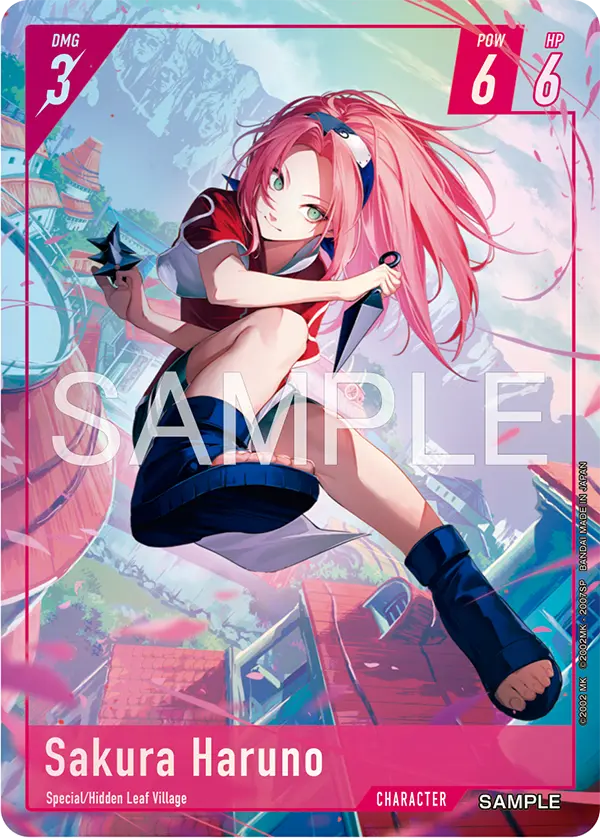
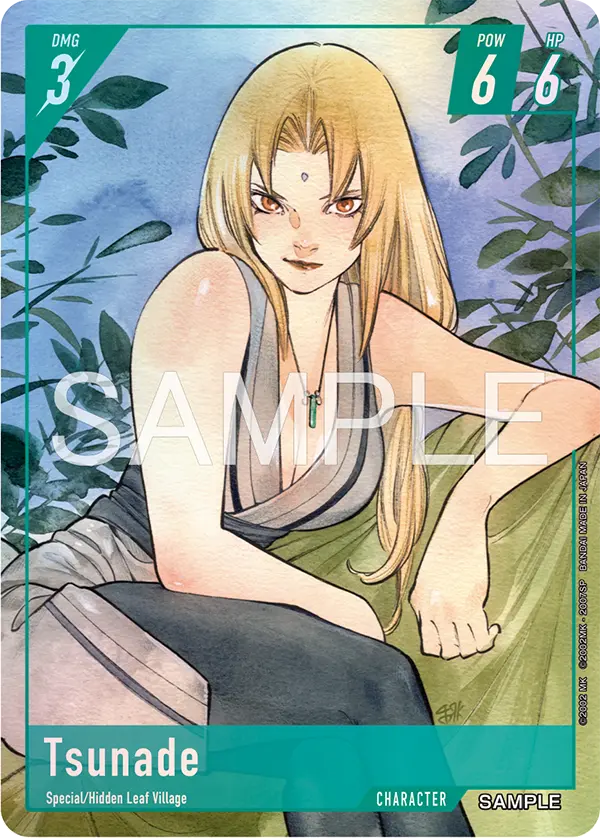
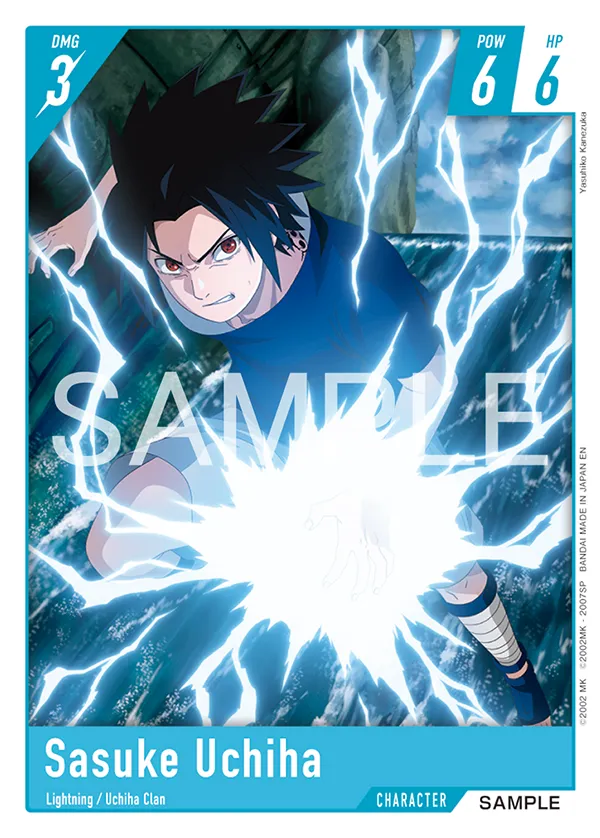
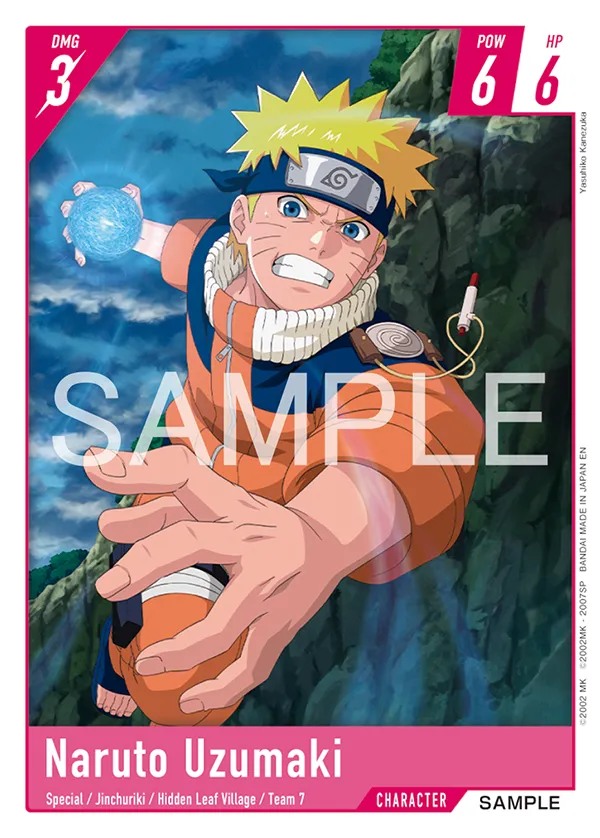
    Three things are worth knowing before the list. Every one of the twelve prints the same values — DMG 3, POW 6, HP 6 — so the numbers cannot be used to tell one card from another. None of the twelve carries a card number, unlike the five rules examples. And the twelve resolve to eight characters, because Naruto Uzumaki and Sasuke Uchiha take three cards each.

    The twelve at a glance

    Card Frame colour Tags printed under the name Artwork
    Orochimaru Teal Special / The Legendary Sannin / Village Hidden in the Sound Illustration
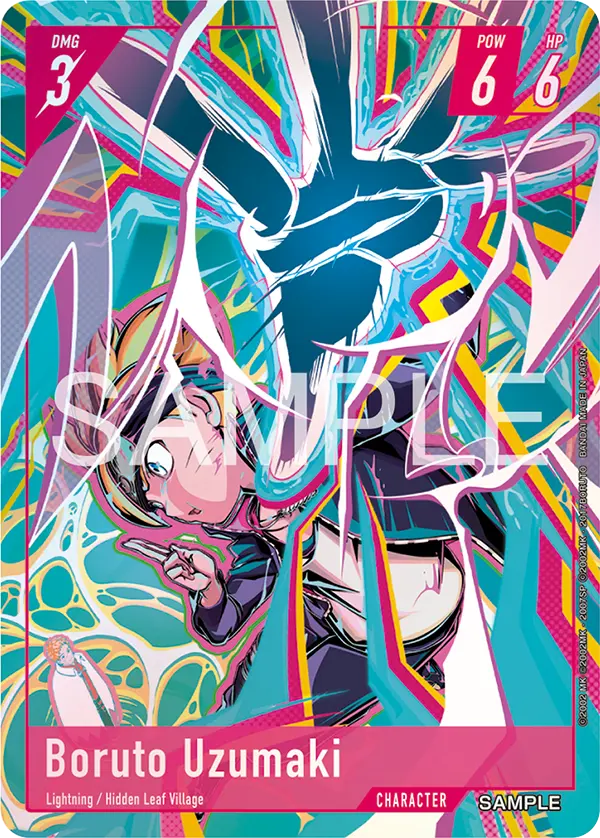
    Boruto Uzumaki Magenta Lightning / Hidden Leaf Village Illustration
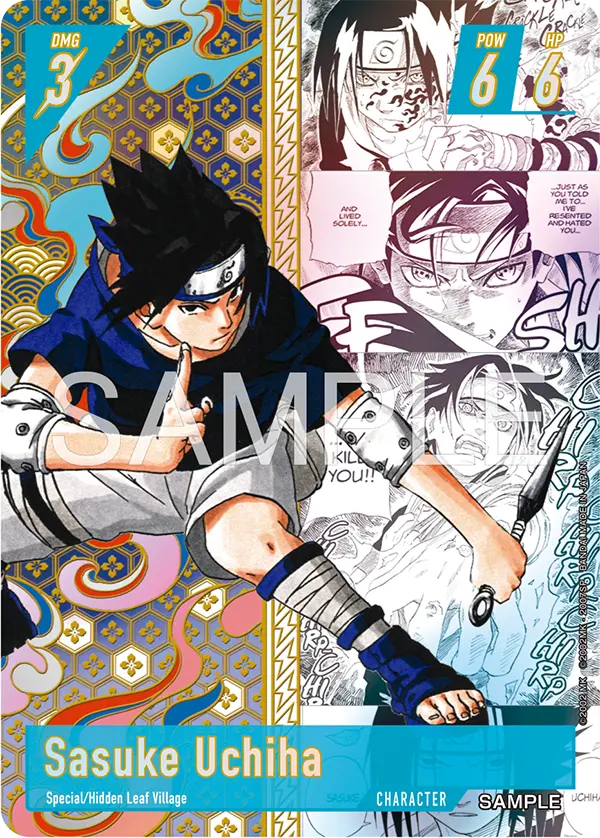
    Sasuke Uchiha (panels) Teal Special / Hidden Leaf Village Manga panels
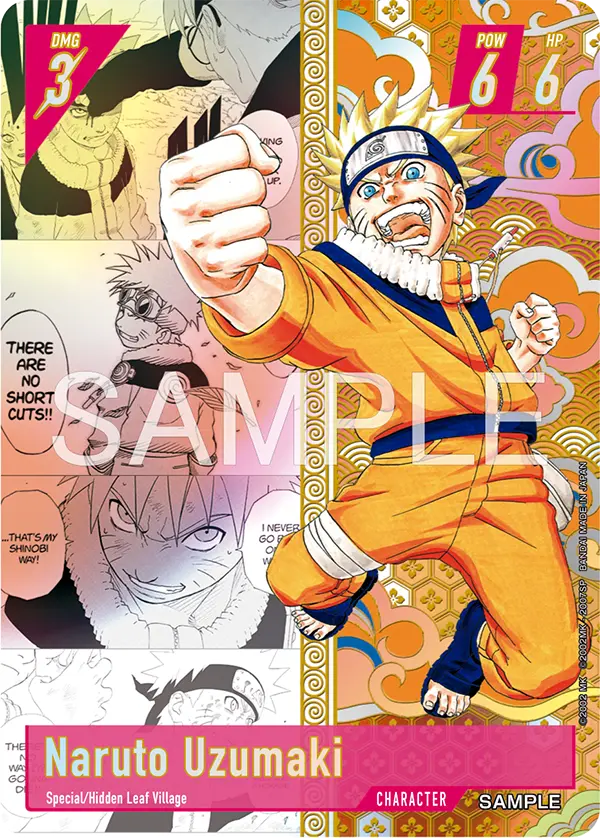
    Naruto Uzumaki (panels) Magenta Special / Hidden Leaf Village Manga panels
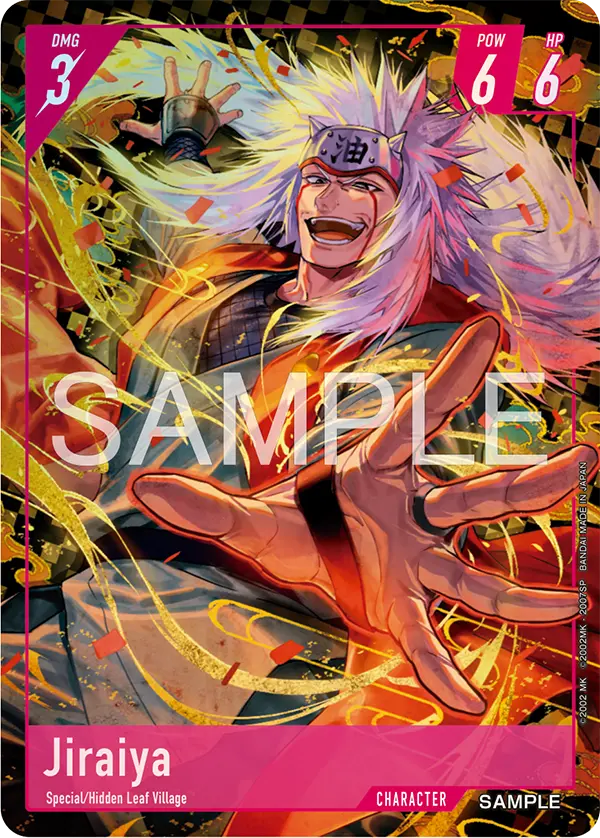
    Jiraiya Magenta Special / Hidden Leaf Village Illustration
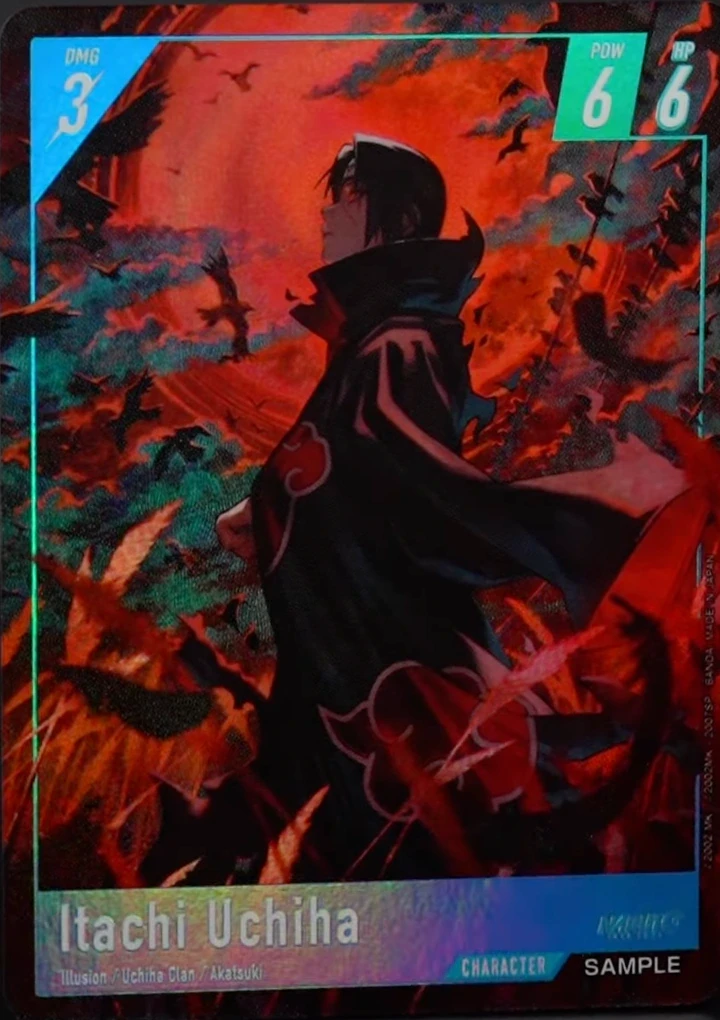
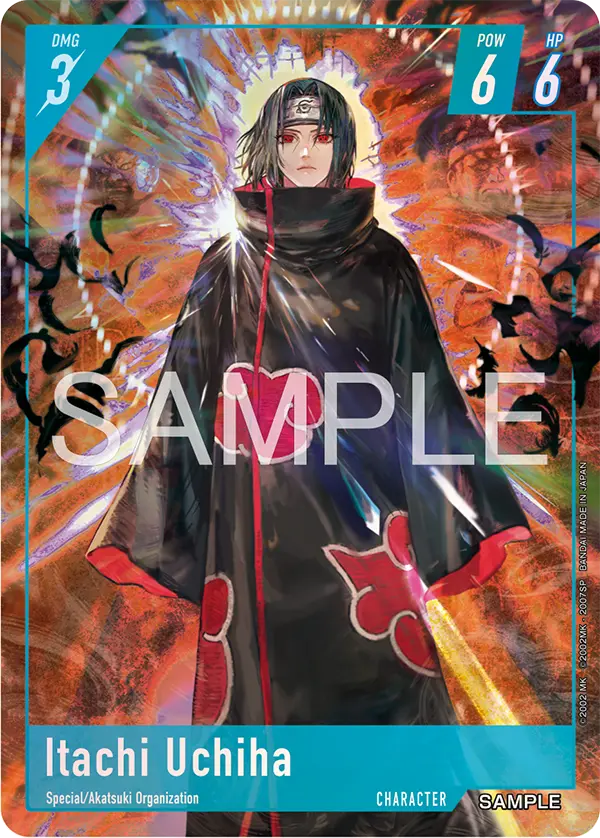
    Itachi Uchiha Teal Special / Akatsuki Organization Illustration
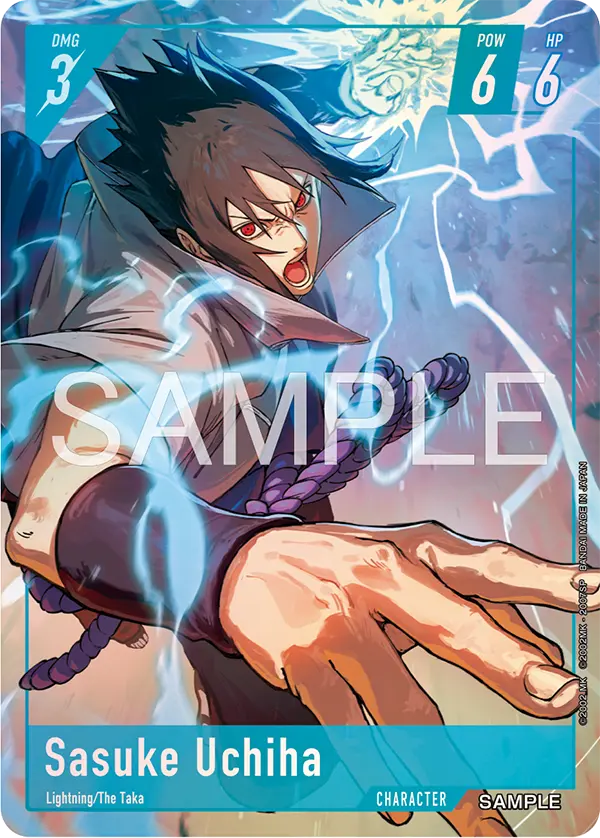
    Sasuke Uchiha (Taka) Teal Lightning / The Taka Illustration
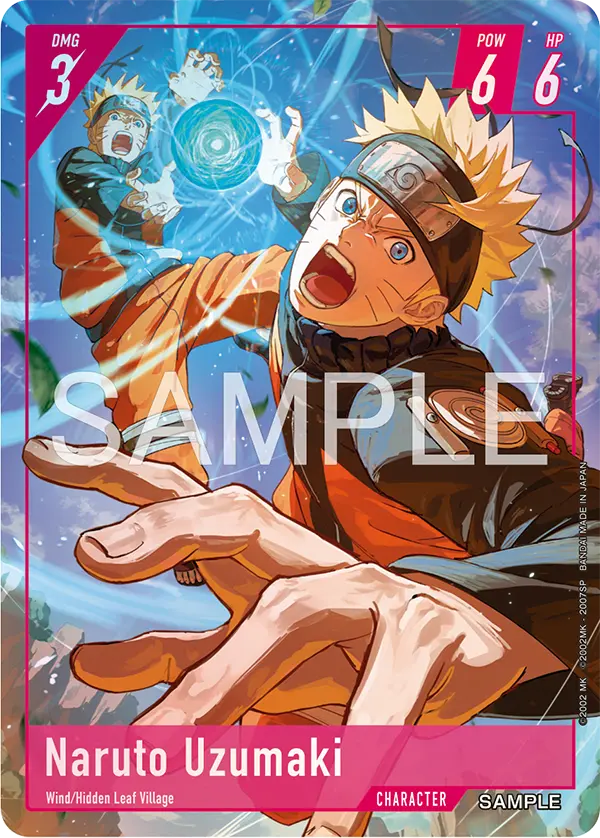
    Naruto Uzumaki (Wind) Magenta Wind / Hidden Leaf Village Illustration
    Sakura Haruno Magenta Special / Hidden Leaf Village Illustration
    Tsunade Green Special / Hidden Leaf Village Illustration
    Sasuke Uchiha (anime) Teal Lightning / Uchiha Clan Anime still
    Naruto Uzumaki (anime) Magenta Special / Jinchuriki / Hidden Leaf Village / Team 7 Anime still

    The order above is the order Bandai published them in, and it is the order used below. Five cards are teal, six are magenta and one is green.

    How to read one of these cards

    All twelve share a single layout, and reading it takes about ten seconds. The top-left corner carries DMG, the top-right carries POW and HP. The name sits in a coloured band across the lower part of the card, and directly under the name is the tag line — a chakra-nature-style tag first, then the affiliations, separated by slashes. The card type sits at the bottom right, and beside it a SAMPLE stamp. Bandai has not published a glossary for the tags, so the reading above is what the card faces show rather than an official key.

    Two smaller details are worth knowing, because they are where the twelve stop being identical. The first is the copyright line, which runs vertically up the right-hand edge of each card. Ten of the twelve read ©2002 MK, ©2002MK·2007SP, BANDAI MADE IN JAPAN. Boruto Uzumaki’s card adds ©2002MK·2017BORUTO to the middle of the line, and the two cards built from anime material end the line differently and carry an extra credit. The second detail is what is missing: no card number is printed anywhere on any of the twelve, so none of them can be looked up in a set list yet.

    The twelve, one at a time

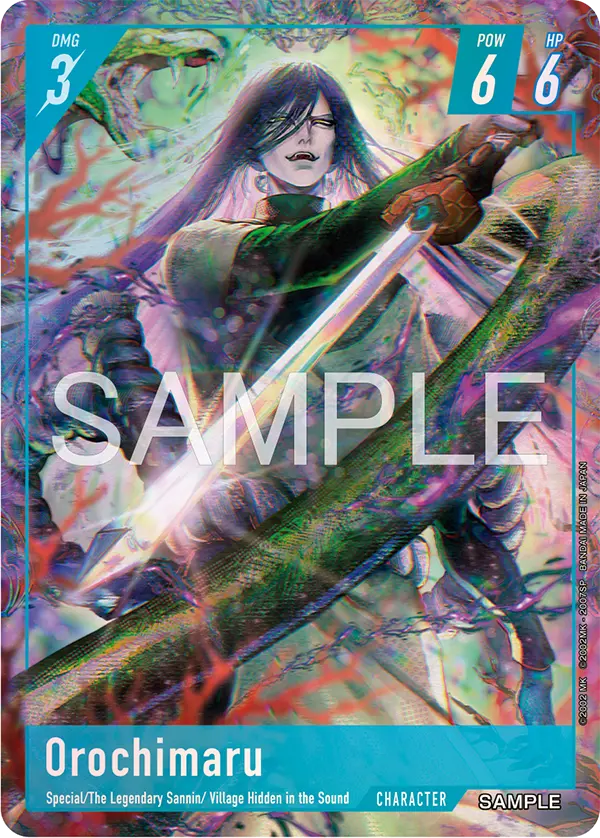
    Orochimaru Character card from Bandai's Naruto Card Game, teal frame, tagged Special, The Legendary Sannin and Village Hidden in the Sound
    Orochimaru
    Character · teal · Special / The Legendary Sannin / Village Hidden in the Sound

    1. Orochimaru

    The first card published, and the widest tag line on the sheet. Orochimaru is drawn standing against one of his snakes, the illustration running to the edges of the frame with the name band laid low across it. The three tags cover three different things — an ability tag in Special, a group tag in The Legendary Sannin, and an affiliation in Village Hidden in the Sound. That last tag is the interesting one: it is the only card of the twelve that names a village other than the Hidden Leaf Village.

    Boruto Uzumaki Character card from Bandai's Naruto Card Game, magenta frame, tagged Lightning and Hidden Leaf Village
    Boruto Uzumaki
    Character · magenta · Lightning / Hidden Leaf Village

    2. Boruto Uzumaki

    The only card of the twelve from the Boruto era, and the only one whose copyright line gives the fact away. Where the other cards read ©2002 MK and ©2002MK·2007SP, this one adds a third entry — ©2002MK·2017BORUTO — to cover the later series. The artwork is a collage of manga panels with a full-colour figure worked into it, in the same house style as the other magenta cards. Boruto carries a Lightning tag rather than Special, which puts him in the minority of the twelve.

    Sasuke Uchiha Character card from Bandai's Naruto Card Game, teal frame with black-and-white manga panels, tagged Special and Hidden Leaf Village
    Sasuke Uchiha · manga panels
    Character · teal · Special / Hidden Leaf Village

    3. Sasuke Uchiha — manga panels

    The first of the two cards assembled from manga material. A colour-printed ornamental field runs down the left of the card, in blue and gold with a wave-and-floral repeat, and the right half is given over to stacked black-and-white panels. The Sasuke in those panels is the first-series version, curse mark showing on his face and chest, and the dialogue inside them is printed in English. On this card the colour artwork is on the left and the panels on the right; the Naruto card that follows reverses it.

    Naruto Uzumaki Character card from Bandai's Naruto Card Game, magenta frame with black-and-white manga panels, tagged Special and Hidden Leaf Village
    Naruto Uzumaki · manga panels
    Character · magenta · Special / Hidden Leaf Village

    4. Naruto Uzumaki — manga panels

    The mirror of the card above, and the pairing is the point. Here the panels occupy the left of the card and the full-colour Naruto sits on the right, in his Shippuden outfit, against the same style of ornamental field in orange and gold. The dialogue in the panels is English, and one panel quotes a line the character is known for. Read together, the two cards are a matched pair — the same treatment, flipped. Bandai has not given the treatment a rarity name, so what to call these two officially is still open.

    Jiraiya Character card from Bandai's Naruto Card Game, magenta frame and gold effect work, tagged Special and Hidden Leaf Village
    Jiraiya
    Character · magenta · Special / Hidden Leaf Village

    5. Jiraiya

    A single illustration with no panel work in it: Jiraiya seen from above and behind, one hand thrown forward, gold flecks and ribbons moving across the frame. His forehead protector carries the kanji for oil. The tag line is the shortest form in the set — Special and Hidden Leaf Village — which is what six of the twelve carry, so the tag alone will not separate them. What separates them is the artwork, and this one is built around motion rather than a portrait.

    Itachi Uchiha Character card from Bandai's Naruto Card Game, teal frame and Akatsuki cloak, tagged Special and Akatsuki Organization
    Itachi Uchiha
    Character · teal · Special / Akatsuki Organization

    6. Itachi Uchiha

    The only Akatsuki tag in the gallery, and the only card whose affiliation is an organisation rather than a place. Itachi is drawn head-on in the red-clouded cloak, the Sharingan active, with a lit field behind him. The card is a useful marker for how the tag line works, because the two halves of it do not overlap at all: the first tag says what the card is, the second says who the character runs with. It is also one of the two teal cards that has nothing to do with Sasuke.

    Sasuke Uchiha Character card from Bandai's Naruto Card Game, teal frame, Lightning Chidori artwork, tagged Lightning and The Taka
    Sasuke Uchiha
    Character · teal · Lightning / The Taka

    7. Sasuke Uchiha — The Taka

    His second card, and the later version of the character: the Taka tag places it after the formation of his own team, and the illustration matches — dark cloak, a lightning technique breaking across the upper frame, one arm reaching toward the viewer. The only card of the twelve tagged The Taka. Note the arrangement, because it repeats: this card and the Naruto card two entries below are built on the same diagonal composition, one arm forward, the frame angled, which is a pairing rather than a coincidence.

    Naruto Uzumaki Character card from Bandai's Naruto Card Game, magenta frame, tagged Wind and Hidden Leaf Village
    Naruto Uzumaki
    Character · magenta · Wind / Hidden Leaf Village

    8. Naruto Uzumaki — Wind

    The only card of the twelve tagged Wind, and the partner to Sasuke’s Taka card. The illustration puts a full-figure Naruto mid-leap on the right, arm out, with a smaller scene worked into the upper left showing him forming a spiralling sphere. Two Naruto images on one card face, which no other card in the gallery does. The Wind tag is the clearest sign that the first tag in the line is a chakra nature rather than a keyword, since Lightning and Wind both appear alongside characters who use those elements.

    Sakura Haruno Character card from Bandai's Naruto Card Game, magenta frame, tagged Special and Hidden Leaf Village
    Sakura Haruno
    Character · magenta · Special / Hidden Leaf Village

    9. Sakura Haruno

    Drawn in her Shippuden design, moving through the rooftops of the Hidden Leaf Village with blossom petals across the frame. Like Jiraiya, this is a single illustration rather than a collage. The card is the second of the two in the gallery drawn by a woman character, and it sits on the same tag pair as most of the magenta cards. What is worth noting is the company she keeps in print: the three Legendary Sannin are all in this gallery, and Sakura is the student of one of them, yet only Orochimaru’s card says so on the tag line.

    Tsunade Character card from Bandai's Naruto Card Game, the only green frame in the revealed set, tagged Special and Hidden Leaf Village
    Tsunade
    Character · green — the only green card shown

    10. Tsunade

    The single green card of the twelve, and the reason a third colour has to exist in the game. The artwork is also the odd one out: where the rest of the gallery is finished digital illustration, this one is drawn in a pale, hand-worked register — watercolour and pencil over a leaf-green ground, with a signature worked into the lower right. Tsunade is tagged as another Hidden Leaf Village card, so the green frame is carrying information the tag line does not. Anyone planning to build around it is working from one printed card.

    Sasuke Uchiha Character card from Bandai's Naruto Card Game, teal frame built from anime footage, tagged Lightning and Uchiha Clan
    Sasuke Uchiha · anime still
    Character · teal · Lightning / Uchiha Clan

    11. Sasuke Uchiha — anime artwork

    The look of the card changes here, and so does the small print. This one is assembled from anime footage rather than drawn for the card: the frame carries the flatter shading and clean cell edges of a still, with a lightning technique filling the centre and the card sitting on a white border instead of running to the edges. It is also one of the two cards whose right-hand copyright line differs — it ends with a separate EN marker and adds an animator credit, Yasuhiko Kanezuka, which no other card in the twelve carries. The tag is Lightning / Uchiha Clan, the only Uchiha Clan tag in the set.

    Naruto Uzumaki Character card from Bandai's Naruto Card Game, magenta frame built from anime footage, tagged Special, Jinchuriki, Hidden Leaf Village and Team 7
    Naruto Uzumaki · anime still
    Character · magenta · Special / Jinchuriki / Hidden Leaf Village / Team 7

    12. Naruto Uzumaki — anime artwork

    The last card published, and the partner to the one above — the same white-bordered anime still treatment, the same forward reach, the same placement in the frame. It carries the longest tag line of the twelve at four entries: Special, Jinchuriki, Hidden Leaf Village and Team 7. Two of those are worth pulling out. Jinchuriki is the first tag in the set that names what a character is rather than what they can do, and Team 7 is the only team tag in the gallery, which sits oddly against the fact that the other two members of that team are tagged without it.

    What the twelve add up to

    Read as a set rather than as twelve cards, the gallery says a few things about the game that no single card does. Every one of the twelve is a Character card, so the reveal has exercised exactly one of the five card types at any length. Every teal and magenta card in the gallery is either Naruto, Sasuke, or a character tied directly to one of them, which suggests the first look was chosen for recognition rather than for coverage. And exactly one card is green, which is the only structural surprise in the twelve.

    What the twelve do not do is answer the questions a buyer would ask. There is no card number to look up, no rarity marking, no set symbol and no price. For what Bandai has said about the five card types, the deck structure and the win condition, see our guide to how the game plays, and for the same twelve cards sorted by type, colour and artwork see the full revealed-card list. The Naruto cards you can actually buy today are on our Naruto card index and catalogued card by card on the Naruto card list.

    Frequently asked questions

    How many cards has Bandai revealed for the Naruto Card Game?

    Twelve individual Character cards in the official artwork gallery, five card-type examples in the rules pages, and a convention promo Chakra card, CP-001, in three versions. All twelve gallery cards are marked SAMPLE.

    Which characters appear on the twelve revealed cards?

    Eight: Naruto Uzumaki and Sasuke Uchiha on three cards each, plus Orochimaru, Boruto Uzumaki, Jiraiya, Itachi Uchiha, Sakura Haruno and Tsunade on one each. Ino Yamanaka, Shikamaru Nara and Gamabunta appear only in the rules examples.

    Do the revealed cards have card numbers?

    No. None of the twelve prints a card number anywhere on the face. The deck numbers that have been published — N-001, N-005, C-001 and S-001 — appear only on the five card-type examples in the rules pages.

    Which of the twelve are anime artwork?

    Two, both of them the last cards published: the Sasuke Uchiha card tagged Uchiha Clan and the Naruto Uzumaki card tagged Team 7. They are the only two with a white border around the frame, and the only two whose copyright line carries an animator credit.

    Why do all twelve cards print the same stats?

    Because they are display cards. All twelve print DMG 3, POW 6 and HP 6 across eight characters, which is a placeholder rather than a balance figure, and Bandai states on its own site that the images may differ from the final product. The rules examples carry different values, including a Leader on Life 15.

    Sources

    Sources and further reading
    1. Bandai Card Games — the official NARUTO CARD GAME site, card design and artwork gallery, for the twelve cards, their printed names, tags, frame colours, artwork and copyright lines, and the SAMPLE marking.
    2. Bandai Card Games — the same site’s rules overview, for the five card-type examples and the deck numbers printed on them.
    3. Bandai Card Games — the reveal announcement, for the Summer 2027 worldwide release window and the note that the images may differ from the final product.
    4. CardSpicy — our own pages on the revealed cards, the game’s rules and the Naruto card list, for the groupings and counts used alongside this walkthrough.

    Card images on this page are the manufacturer’s published preview artwork, reproduced for identification and commentary. NARUTO and all related characters and artwork are the property of their respective rights holders, including Masashi Kishimoto and Shueisha. Every card shown is a SAMPLE and may differ from the final product.

  • Mythos Set 3 Akatsuki: What Is Confirmed Before 13 November

    Quick answer

    CardSpicy does not sell Naruto cards, so what we can offer is the accurate version of a release that has two dates rather than one. Mythos Set 3, the Akatsuki set, has a pre-release on 7 November 2026 and a global release on 13 November 2026, and it is the first set in the line to reach the United States and Europe on the same day. It also moves the game into the Shippuden story. One deliberate exception applies to all of that: where a retailer publishes a different shipping date, we use the publisher’s date and say so.

    Two dates, one product. If you only remember one, remember 13 November — that is the one the publisher states, and the one the rest of this article uses.

    What is confirmed

    The confirmed details are set out below, and they are all publisher-side rather than retailer-side.

    • Pre-release: 7 November 2026.
    • Release: 13 November 2026.
    • Scope: the first simultaneous United States and Europe release for this game.
    • Story: the set enters the Shippuden era.
    • Reach: the release extends to the United States, Canada, Latin America, Australia and New Zealand, and South Africa.
    • Formats: a standard booster box alongside a special pack configuration.

    The simultaneous release is the detail that matters most to a reader in North America, because it is the first time a set in this line has not arrived later there than in Europe. Before this, the American market was served separately and later; whatever that meant for availability, it no longer applies from this set onward.

    Why there are two dates

    The gap between the pre-release and the release is not a delay and not a shipping window. A pre-release is an organised-play event at which the set is opened ahead of general sale, and the following week is when the product goes on general release. Both dates are correct for different things.

    So the practical reading is: 7 November is when the set can first be played at an event, and 13 November is when it is on general sale. If your interest is playing it early, the relevant date is the first one, and it comes with an event attached. If your interest is buying it, the relevant date is the second.

    The retailer-date conflict, handled

    At least one European retailer has published a shipping date of 30 November 2026 rather than 13 November. We are recording that rather than ignoring it, and here is the rule we apply to conflicts of this kind.

    We use the publisher’s date. A retail shipping date reflects that shop’s logistics rather than the release, and shops move stock on different schedules. A retailer can therefore be accurate about its own dispatch while being misleading if read as the release date.

    The honest statement for a buyer is: the set releases on 13 November 2026; some shops may dispatch later. That covers both facts without picking a winner. Our guide to the three Naruto card products applies the same discipline to release windows for products that have not launched.

    What the special pack contains

    Alongside the standard booster box — described as twenty-four flow packs — the set has a special pack configuration. That pack pairs four packs with two promotional cards from the set’s design line and one oversized card.

    Three notes, because each of them causes a different kind of mistake.

    The oversized card is not a standard card. It does not fit a sleeve, a binder page or a deck. Our guide to what fits Naruto cards covers the standard 63 × 88 mm size and why an oversized item needs its own storage answer.

    The promotional cards are distributed through this configuration rather than pulled from packs. That makes their supply a function of how many special packs were made, not of the set’s print run. Our article on tournament and prize cards explains why that distinction changes how they behave on the second-hand market.

    A special pack is not a cheaper booster box. It is a different product with a different contents mix, and comparing it on packs alone will not tell you which is better for you.

    How the game reaches American buyers

    One fact explains a lot about availability on this line, and it comes from the distributor rather than from a shop.

    The United States distributor for the game announced its appointment in June 2026 and stated its approach in plain terms: hobby stores are served first, and the stated intention is not to flood the market. Earlier sets reached American buyers through that channel in sequence, and the organised-play programme for the United States and Canada runs through authorised stores.

    We are not going to call that policy good or bad. It is a distribution strategy, stated publicly, and it means the practical experience of buying this product in North America is closer to a hobby-store release than to a mass-retail one. If a set is hard to find locally, that is the reason, and it is worth knowing before concluding that a particular shop is the problem.

    What is not confirmed

    Two things are still open, and we are not going to fill them in.

    Card totals are reported under more than one figure. The publisher’s material and a third-party catalogue do not use the same count for an earlier set in the line, and the difference appears to be a question of how variants are counted rather than a disagreement about the cards. Where two figures measure different things, both can be right — so we state the count we can source rather than merging the two.

    We do not quote values for any card in this set. That is not a temporary position: no platform publishes per-card values for this line, so there is nothing to quote. Our article on why rarity is not value explains what can and cannot be read from a card’s tier.

    Frequently asked questions

    When does Mythos Set 3 Akatsuki come out?

    The publisher states a pre-release on 7 November 2026 and a release on 13 November 2026. CardSpicy uses the 13 November date, because a pre-release is an organised-play event rather than the general release.

    Is Mythos Set 3 the first simultaneous US and Europe release?

    Yes. It is the first set in the line to release in the United States and Europe on the same day, and it also extends the release to Canada, Latin America, Australia and New Zealand, and South Africa.

    Why do some shops list a different release date?

    Because a retail shipping date reflects that individual shop’s logistics rather than the release. At least one European retailer lists 30 November 2026. CardSpicy uses the publisher’s 13 November date and notes that individual shops may dispatch later.

    Does Mythos Set 3 move the game into Shippuden?

    Yes. The set enters the Shippuden era, which is the same era the licensed collectible line moved into in October 2026. The two are separate products from separate companies that happen to be telling the same part of the story.

    What is in the Mythos Set 3 special pack?

    Four packs, two promotional cards from the set’s design line and one oversized card. The oversized card is a display item that does not fit standard sleeves or binder pages, and the promotional cards are distributed through the pack rather than pulled from boosters.

    Sources

    List of sources used
    1. Mythos publisher documentation, 2026 — the 7 November pre-release and 13 November release, the simultaneous United States and Europe launch, the Shippuden story move, the territories covered and the 24-flow-pack booster box.
    2. Mythos publisher documentation and retail listings — the special pack configuration of four packs, two promotional cards and one oversized card.
    3. European retail listing, 2026 — the 30 November 2026 shipping date recorded here as a retailer-side figure rather than a release date.
    4. United States distributor announcement, June 2026 — the appointment of the exclusive distributor and the stated hobby-store-first approach.
    5. Third-party card catalogues — the card totals for an earlier set in the line, noted here because the figure differs by counting method.

    The game and the collectible line it sits beside are summarised on our Naruto card index, and the cards we can document individually are on the Naruto card list. For how a deck is built once you have the set, see Mythos deck building.

  • KAYOU Jin Chapter Series 4: Everything Confirmed Before 16 October

    Quick answer

    CardSpicy does not sell Naruto cards, so the only useful thing we can do here is be precise about what is confirmed and what is not. The next KAYOU chapter, Jin Chapter Series 4, releases in North America on 16 October 2026. It moves the line into the Shippuden story, runs to 189 card types across thirteen rarity tiers, brings back the redesigned SP card along with a higher-finish star SP, and keeps the limited-numbering mechanic. Three things are notably not published: a box image, a pull-rate table, and whether the PR card is loose or sealed.

    The gaps are the interesting part. A retailer selling this product has said it would rather leave a figure blank than print one it cannot stand behind, and that is the correct posture here.

    What is confirmed

    The release details are specific enough to plan around.

    • Release: 16 October 2026 in North America.
    • Size: 189 card types across thirteen rarity tiers.
    • Story: the chapter moves into the Shippuden era — the returned protagonist, a reformed three-person team, and the antagonist organisation moving into the foreground.
    • Mechanics: the redesigned SP card returns, a higher-finish star SP variant is added, and the limited-numbering mechanic is retained.
    • Configuration: 12 packs per box, 8 cards per pack, 96 cards per box including the PR card, and 16 boxes per carton.

    The pack structure is worth reading twice, because it is the part that changes how you open a box. A twelve-pack box at eight cards a pack is a sealed-product shape rather than a single-pack purchase, and the PR card counted inside the box total means it is part of the configuration rather than a separate item.

    What is not confirmed — and why that matters

    Three gaps, and each one is a gap rather than an omission on our part.

    No box image has been published. Retail listings have used placeholder artwork. That means you cannot verify a box by sight yet, which matters if you are buying from a channel you do not know well.

    No official pull-rate table. The rarity tiers tell you how the set is structured; they do not tell you the odds within a box. This is true of the line generally rather than unique to this chapter.

    No statement on whether the PR card is loose or sealed. The product description counts it inside the configuration without saying how it is packed, and the two are not the same thing to a buyer who wants a sealed copy.

    Our position on all three is the same: we do not fill the gap. A number invented to make a page look complete is worse than a blank, because a reader cannot tell the two apart afterwards. Our guide to the rarity ladder covers what the tiers do and do not tell you.

    The two English editions, again

    This is the section most likely to save someone a mistaken purchase, so it is worth repeating for every release rather than only once.

    The line has shipped in more than one English edition, and the editions have different pack configurations. Earlier chapters have circulated in a North American configuration and a South East Asian configuration with a different number of packs per box and cards per pack, and the recent chapters have used a twelve-pack, eight-card box in North America.

    The practical rule is simple. Count the packs on the listing and compare them with the published configuration for the edition you intend to buy. If the pack count is the other edition’s, you are being sold the other edition — the cards may look the same and the product is not. Our breakdown of the sets and their configurations lays the chapters out side by side.

    The mechanic that matters most on this line

    Of everything confirmed above, the one that changes how a collector should treat the set is the retention of limited numbering.

    On this line the top tiers carry individual numbering printed on the card, which means the scarcity of a specific card is stated on its surface rather than inferred from a tier label. That is unusual, and it is the main reason the line is interesting to collect rather than only to open.

    The return of the SP design and the addition of a higher-finish star SP is a separate matter: it is a change of printing treatment rather than a change of print run. A new finish is a reason to look at the cards closely, not a reason to assume fewer of them exist. Our article on why rarity is not value covers the distinction between a tier, a treatment and a print run.

    What is not in this chapter

    Two negative facts, stated plainly because they prevent a specific mistake.

    This is not a game product. It is a licensed collectible chapter with no rules engine, which means the deck structure, missions and events covered in Mythos deck building do not apply to it at all.

    And it is not the new Bandai game. That is a separate product from a separate company, releasing in Summer 2027. Sharing the licence is not the same as being the same thing, and our comparison of the three Naruto card products separates them.

    Frequently asked questions

    When does KAYOU Jin Chapter Series 4 come out?

    It releases in North America on 16 October 2026. CardSpicy notes that no box image and no official pull-rate table had been published ahead of the release, so the product should be judged on its stated configuration rather than on placeholder artwork.

    How many cards are in KAYOU Jin Chapter Series 4?

    189 card types across thirteen rarity tiers. A box contains 12 packs of 8 cards, so 96 cards including the PR card, and there are 16 boxes in a carton.

    Does Jin Chapter Series 4 go into Shippuden?

    Yes. The chapter moves the line into the Shippuden story, with the returned protagonist, a reformed three-person team and the antagonist organisation coming to the front. That places it in the Shippuden era of the three-way split we use on this site.

    What is the difference between the North American and South East Asian editions?

    The pack configuration. The same chapter has circulated under both an NA and a SEA edition with a different number of packs per box and cards per pack, so the reliable check is to count the packs on the listing and compare it with the published configuration for the edition you meant to buy.

    Is Jin Chapter Series 4 a playable card game?

    No. It is a licensed collectible chapter with no rules engine and no deck construction. The playable Naruto card game is a different product from a different publisher, and a third game from yet another company releases in Summer 2027.

    Sources

    List of sources used
    1. KAYOU product description and retail listings, September and October 2026 — the 16 October release, 189 card types, thirteen rarity tiers, the Shippuden story move, the returning SP and star SP treatments, and the 12-pack, 8-card, 16-box configuration including the PR card.
    2. Retailer statements, 2026 — the absence of a published box image, the absence of an official pull-rate table, and the statement that the retailer would rather leave figures blank than print unverifiable ones.
    3. KAYOU product documentation and retail pages — the North American and South East Asian pack configurations for earlier chapters.
    4. Mythos publisher documentation — used to confirm that the playable game is a separate product.
    5. Bandai card game announcements, 2026 — the Summer 2027 release window for the separate Bandai game.

    The chapter structure this release belongs to is set out in the KAYOU sets guide, and the tier ladder it adds to is in the rarity guide. The products overall are summarised on our Naruto card index.

    One thing this chapter will not appear on is the Naruto card list. That list covers the line whose publisher prints a complete card gallery, and KAYOU has never published a set list, a numbering scheme or a per-card database. Recording KAYOU cards card by card is not a matter of effort; the records do not exist to record.

  • The New Naruto Anime of 2026: What Is Confirmed

    Quick answer

    CardSpicy indexes cards, not broadcasts, so we will keep this to the part that touches a collection. A new limited television anime for the franchise was announced in late September 2026, produced by the studio behind the original series. Its global first look is scheduled for 10 October 2026, at a panel that falls on the same day as the main character’s birthday. The reason it matters here is narrow and specific: the announcement places the story after the original series and before the time skip, which is the era with the longest history of card releases and the fullest character roster.

    One thing this article will not do is tell you the anime will move card prices. No data supports that, so the useful question is which cards the story actually draws on.

    What has been announced

    The announcement came in late September 2026 from the publisher and the official franchise site. The production is a limited television series rather than a long-running one, and it is being made by the studio responsible for the original anime.

    Three details from the announcement are worth keeping.

    • It is a limited run, not a new ongoing series. That is a different product from the continuous broadcast the franchise ran for years, and it is a different commitment for a viewer.
    • The original voice cast is returning. The actors who have voiced the two leads since 2002 are confirmed for the panel, which is a strong indicator of continuity rather than a reboot.
    • Production is complete. The project is described as finished, having been in production for around two years — it is not an announcement of something that has not been made.

    There is also a piece of history attached. A four-episode special had been promised in 2023 for the anime’s twentieth anniversary and was then delayed indefinitely. What has now been announced is larger than that original commitment, and it is the project that eventually grew out of it.

    The panel, and what to expect from it

    The global first look is scheduled for 10 October 2026, at a panel whose title translates to a question about what comes next for the franchise. It coincides with the lead character’s birthday, and the event is being streamed globally on the franchise’s own channel, so it is not an in-room-only reveal.

    Because this article is being written before that panel, here is the honest split. Confirmed: the series exists, its studio, its placement in the story, the returning cast and that production is finished. Not yet announced: a broadcast date. Anything more specific than that would be a guess, and this page will read differently after 10 October because of it.

    One caution about the date itself. A first look is a marketing event, not a release. If a date is given at the panel, that is the point at which it becomes a fact worth writing down — not the panel itself.

    Where it sits in the story, and why that matters for cards

    The announcement placed the story after the original series and before the time skip, centred on the original three-person team with their instructor as a major supporting character.

    For a collector, that placement is the whole point of the article. It means the story draws on the roster that the earliest card products already cover — the era we sort as Part 1, which has the longest history of releases behind it. It does not mean those cards change in any way; it means the characters a viewer is about to spend a season with are the characters that era already documents.

    Our breakdown of the three card eras covers where the boundaries fall, and the individual cards we can document are on the Naruto card list. If you are sorting a mixed lot, the era is the fastest way to place a card.

    What the announcement does not tell you

    It does not tell you anything about card values. There is a widely repeated claim that an anime release lifts the price of the cards it features, and it is repeated far more often than it is evidenced. On this line the claim is not even measurable, because no platform publishes per-card values for Naruto cards — there is no index for anything to move.

    What can be said honestly is weaker and still useful: a franchise receiving new screen time is a franchise more people search for, and search interest is not the same thing as price. Our article on why rarity is not value makes the matching point from the card side.

    What to watch for after the panel

    Three things, in the order they matter to a card collector rather than to a viewer.

    A broadcast date. Until there is one, nothing about the series is scheduled, and scheduling is what lets anyone plan around it.

    Whether any product is announced alongside it. Anniversary and broadcast tie-ins usually bring merchandise, and card product is a separate announcement from an anime one. If something is announced, the detail that matters is the print run, not the word limited.

    Whether the story stays where it was placed. A limited series set in the gap between the original story and the time skip has a fixed cast list. If that changes, the era the cards belong to changes with it.

    Frequently asked questions

    Is there a new Naruto anime in 2026?

    Yes. A new limited television anime was announced in late September 2026, produced by the studio behind the original series, with production described as complete. Its global first look is scheduled for 10 October 2026, and a broadcast date had not been announced as of that point.

    When does the new Naruto anime come out?

    No broadcast date has been announced. CardSpicy notes that the series was announced in September 2026 with production complete and a first look scheduled for 10 October, but a release date is a separate announcement and had not been made at the time of writing.

    Where does the new Naruto anime fit in the story?

    It is set after the original series and before the time skip, focused on the original three-person team with their instructor as a major supporting character. In card terms that places it in the era with the longest history of releases.

    Is the new Naruto anime a continuation or a reboot?

    It is neither a reboot nor a long-running continuation. It is described as a limited television series, and the actors who have voiced the two leads since 2002 are returning, which points to continuity with the original production rather than a restart.

    Will the new anime make Naruto cards more valuable?

    There is no evidence for that, and CardSpicy does not make price claims. No platform publishes per-card values for Naruto cards, so there is no index that could show such an effect. What the anime does confirm is which characters the story is about, which is a question about the cards rather than about their value.

    Sources

    List of sources used
    1. Franchise announcement, September 2026 — the new limited television anime, its production studio, its placement in the story and the completion of production.
    2. Anime industry reporting, September and October 2026 — the global first look panel, its date, the returning voice cast and the global stream.
    3. Anime industry reporting — the four-episode twentieth-anniversary special promised in 2023, its delay, and the project it grew into.
    4. PriceCharting — category structure, checked for the absence of a Naruto card category and therefore of any published index.
    5. CardSpicy — our own index and card list at cardspicy.com, used for the era assignment of recorded cards.

    The era split described here is set out in full in Naruto cards by era, and the cards themselves are on the Naruto card list, with the lines summarised on our Naruto card index.

  • How to Read Our Naruto Card List: Codes, Tiers and Effects

    Quick answer

    CardSpicy maintains the Naruto card list, so this article is the instructions for it. The single most important thing to know before you read it is which line it covers. The list documents Naruto Mythos, whose publisher prints a complete card gallery, plus the handful of cards confirmed for a game that releases in 2027. It does not cover KAYOU’s collectible line, because KAYOU has never published a card list, a numbering scheme or a per-card database — and no honest page can list what the manufacturer has not released.

    Read the heading above each block before reading the cards. Almost every misunderstanding about this list comes from assuming it covers the line most people mean by “Naruto cards”.

    What the list covers, and what it does not

    The list is built on published card galleries. Where a manufacturer prints a full database of its cards, we can record them card by card. Where it does not, we cannot.

    Covered: Mythos, which publishes a complete card gallery, and Bandai’s Naruto Card Game, which has shown only a small number of confirmed cards so far. Both are on the page, and the page states plainly which is which.

    Not covered: KAYOU. This is the line most people mean when they say Naruto cards, and it has never released a set list, a numbering scheme or a per-card database. We explain why that gap exists in why there is no Naruto price guide, which is the same gap seen from the pricing side.

    That asymmetry is the reason the page opens with an explanation rather than with cards. A reader who arrives expecting KAYOU chapters and finds Mythos sets will assume something is missing. Nothing is missing; the records simply do not exist on the manufacturer’s side.

    How the records are grouped

    Records are grouped by set, and each set heading carries its record count so you can see the shape of the line before reading a single card.

    As of October 2026 the list holds 638 records, split across the sets that have published galleries. Two set sections carry the bulk of them, and a later section holds the confirmed cards for the unreleased game. There is also a section that counts every rarity code, which is worth reading before the card blocks rather than after.

    One caution about the record count, and it applies to every total on the page: a record is not the same as a unique design. A card printed in more than one process or finish can appear as more than one record, which is why our totals can differ from a third party’s count of the same line. Both figures can be correct while measuring different things, so compare the definition before comparing the number.

    The fields on each record

    Every record carries the printed data plus a note written by us. The split matters: the numbers are the manufacturer’s, the notes are editorial.

    From the manufacturer’s gallery: the card number, the card name, the set it belongs to, its rarity code, and any values or text printed on the card. Nothing here is estimated, and where the gallery does not state something, we do not fill it in.

    Written by us: a short note on what the card is. This is editorial and is marked as such, because it is the one part that is a judgement rather than a quotation.

    Affiliation tags: cards are tagged with the village or organisation they belong to — the Leaf Village, the Sand, the Sound, independent cards, missions, and the Akatsuki. The tags come from the affiliation printed on the card, not from a reading of the story, so a tag tells you what the card says about itself.

    Rarity codes, and why the counts are published

    Rarity on this line is a ladder of codes rather than a single word, and the page counts them.

    That counting block is the part most worth your time, for two reasons. First, it tells you how a set is actually distributed — a set with a large common band and a narrow top is shaped differently from one whose higher tiers are broader, and the counts make that visible at a glance. Second, it lets you check a tier against the size of the whole set rather than against a feeling about how rare it seems.

    What the counts do not do is tell you what a code is worth. A rarity code states a position in a set’s distribution, and on this line that is all it states. Anyone reading a high code as a price is making a leap the data does not support, and why rarity is not value works through that in detail.

    Effect lines, and the gaps

    Playable cards print rules text, and the list reproduces it where it exists. A small number of records carry no effect line at all.

    Those gaps are left visible. The page shows no effect line rather than a placeholder, because filling a gap with a guess would make the list less accurate while making it look more complete. Where an effect line is absent, treat it as an absence — it means the printed card carries nothing to reproduce, not that we overlooked it.

    The same posture governs the rest of the page. Where the manufacturer has not published something — a full KAYOU list, a print run, a pull rate — the page says so rather than estimating. That is a deliberate choice, and it is why this list is shorter than a reader might expect for a line this size.

    The confirmed-cards section for the unreleased game

    One section covers the cards confirmed for the game that releases in Summer 2027. It is deliberately short, because only a handful of cards have been shown.

    Two things to keep in mind when reading it. The values printed on those preview cards are display values and not final balance — treating them as real stat lines would be reading a mock-up as a rulebook. And the section is not a preview of the product; it is a record of what has been confirmed publicly, which is a much smaller thing. Our article on the three Naruto card products covers what is and is not known about that game.

    What the list will not tell you

    It will not give you a value, a grade, or a prediction. It will not rank cards by desirability, and it will not tell you which of two cards to buy. Every one of those would require an input that is not published for this line, and inventing one would undermine the only thing the list is actually good for — being a faithful record of what the manufacturers have printed.

    Read it as a reference, not as a ranking. Used that way it answers a specific and useful question: what does this card actually say?

    Frequently asked questions

    Which Naruto card lines does the list cover?

    It covers Naruto Mythos, which publishes a complete card gallery, and the small number of cards confirmed for Bandai’s Naruto Card Game ahead of its 2027 release. It does not cover the KAYOU collectible line, because KAYOU has never published a card list, numbering scheme or per-card database.

    Why are KAYOU Naruto cards not on the list?

    Because the manufacturer has not released the records to list. There is no published set list, numbering scheme or per-card database for the KAYOU collectible line, and CardSpicy does not reconstruct a card list from secondary sources.

    How many records are on the Naruto card list?

    As of October 2026 the list holds 638 records, grouped by set with each set heading showing its own count. Note that a record is not the same as a unique card design, because the same design printed in more than one process can appear as more than one record.

    What does a blank effect line mean?

    It means the printed card carries no rules text to reproduce. The list shows no effect line rather than a placeholder, so a gap is an absence rather than an omission, and nothing is filled in with an estimate.

    Does the list show Naruto card prices?

    No. The list records printed data only: card numbers, names, sets, rarity codes and printed text. There is no published per-card value for this line, so there is nothing to display, and our article on why there is no Naruto price guide explains that gap.

    Sources

    List of sources used
    1. CardSpicy — the Naruto card list at cardspicy.com, read in October 2026 for the record count, set grouping, rarity-code counts and the coverage statement.
    2. Mythos publisher documentation — the published card gallery from which the recorded card data is taken.
    3. Bandai card game announcements, 2026 — the confirmed cards shown ahead of the Summer 2027 release, and the display-only status of the values on preview cards.
    4. KAYOU product documentation — checked for a published set list, numbering scheme or per-card database, none of which exists.
    5. PriceCharting — category structure, checked for the absence of a Naruto card category.

    The list itself is at the Naruto card list, and the lines it draws from are summarised on our Naruto card index. For the distinction between a rarity code and a value, see why rarity is not value.

  • Mythos Tournament and Prize Cards, Explained

    Quick answer

    CardSpicy does not sell Naruto cards, so there is no reason for us to inflate what a promotional card is worth. Here is the accurate version. A tournament or prize card is a card the publisher distributes outside the ordinary set — through organised play, through special packs, or as an event award — and it is not printed on the same schedule as the rest of the line. On this line that distinction has a visible consequence: the card that changes hands most often according to the line’s tracked records is a promotional card, not a numbered top tier. Prize cards are not automatically the scarce ones, and they are not automatically the valuable ones either.

    The word “promo” describes how a card was distributed, not how rare it is. Those two things get run together constantly, and separating them is most of what there is to say.

    What a promotional card actually is

    Every card in a set is printed so that it can appear in a pack. A promotional card is not. It is produced for a distribution channel, and which channel decides nearly everything about it.

    On this line there are three channels we can identify, and they are not equivalent.

    • Organised play. Cards distributed through store-level events. These are awarded or given rather than pulled, so their supply is tied to how many events were run, not to how many boxes were printed.
    • Special packs. A set’s special pack configuration can include promotional cards alongside the regular product. A recent set’s special pack paired four packs with two promotional cards and one oversized card.
    • Event and tournament material. Cards tied to a specific event series, which exist in whatever quantity that series produced.

    Notice what is missing from all three: a published pull rate. A card in a set has a place in the rarity structure, and the structure at least tells you its position. A promotional card sits outside that structure, which means the usual way a collector estimates scarcity — read the tier — does not work on it.

    The counter-intuitive result

    Here is the fact that makes this article worth reading rather than guessing at. On the tracked sales records for this line, the card with by far the highest number of transactions is a promotional card — one that sits outside the set structure entirely, and one that most collectors would rank below the numbered tiers on prestige.

    We are not quoting figures, because there is no published market index for this line and a number lifted from a private dataset would be presented as though it were one. What can be said without any number is the structure: the distribution channel does not determine the level of activity. A promo can be the most actively traded card on a line, and on this line it is.

    There are two plausible reasons, and both are worth knowing.

    Promos can be the entry point. A card distributed through events reaches players, and players trade. A numbered card that sits in a collection may change hands once a decade. Activity is a measure of circulation, not of desirability.

    Promos are sometimes printed in quantity. A card handed out at store events over a season can exist in more copies than a limited top tier, and more copies means more opportunities to trade. Rarity and liquidity pull in opposite directions here.

    Neither reason means a promo is more desirable. Both mean the same thing: transaction volume tells you how much a card moves, not what it is worth. Our article on why rarity is not value makes the matching argument from the tier side.

    Oversized cards and other oddities

    Special and event configurations sometimes include items that are cards in name only — an oversized card, for instance, which does not fit a sleeve, a binder page or a deck.

    Two practical notes, because people get caught by both.

    An oversized card is a display item. It cannot be played and cannot be stored like the rest of a collection. If its size is not stated where you are buying it, ask, because the standard protective supplies will not fit.

    An oversized card’s scarcity is not comparable to a standard card’s. Different product, different print run, different audience. Ranking one against the other produces a meaningless number.

    If you do buy one, our guide to what fits Naruto cards covers the standard sizes and why an oversized item needs its own answer.

    How the line distributes its event material

    One detail is worth recording because it comes from the publisher rather than from a retailer, and it explains a lot about availability.

    The line’s United States distributor has stated its approach in plain terms: distribution goes to hobby stores first, and the stated intention is not to flood the market. Organised play began with store championships in Europe from June 2026, and an events programme for the United States and Canada runs through authorised stores rather than through open retail.

    That is a deliberate scarcity of access rather than of printing. It means a promotional card is easy to miss not because few were made but because few channels carried it. It also means the second-hand market is where most collectors will meet these cards, which is exactly why the trading records show what they show.

    We are not going to characterise that policy as good or bad. It is a stated distribution strategy, it is consistent with how the line has reached retail, and it is the reason availability and rarity should be kept apart in your own notes.

    What we will not tell you

    We will not rank promotional cards by worth, we will not say which prize card to chase, and we will not quote a value for any of them. The reason is the same one that governs everything else on this line: there is no published market index, so a ranking would be an opinion dressed as a measurement.

    What is published — the set a card belongs to, its recorded printed data, and whether it came from a set or a channel — is what the Naruto card list records. Where a card sits outside the set structure, that is what the list says about it.

    Frequently asked questions

    What is a Mythos promo card?

    A card distributed outside the ordinary set structure, typically through organised play, a special pack configuration or an event. CardSpicy notes that promotional cards sit outside the rarity structure, so their scarcity cannot be read from a tier the way a set card’s can.

    Are Naruto prize cards rarer than set cards?

    Not automatically. Rarity depends on how many were produced and for what channel. On this line, tracked records show that the most actively traded card is a promotional card rather than a numbered top tier, which shows that distribution channel and scarcity are separate questions.

    Why are Naruto promo cards so hard to find?

    Often because of access rather than print numbers. The line’s distributor has stated a hobby-store-first approach and an intention not to flood the market, and organised play runs through authorised stores, so promotional material reaches fewer channels than regular product.

    Do oversized Naruto cards fit sleeves?

    No. An oversized card is a display item with its own dimensions and will not fit the standard sleeves and pages that suit Naruto cards, which are 63 × 88 mm. Ask for the dimensions before buying, and store it separately from the rest of a collection.

    Can I get tournament cards without playing?

    Promotional material from events generally reaches most collectors through the second-hand market, which is why these cards appear in trading records more often than they appear on shelves. CardSpicy does not advise on what to pay for one.

    Sources

    List of sources used
    1. Mythos publisher documentation and retail listings — special pack configuration including promotional cards and an oversized card, and the composition of prize-style material.
    2. Mythos publisher documentation — store championships beginning in Europe from June 2026 and the authorised-store events programme in the United States and Canada.
    3. United States distributor press statement, 2026 — the hobby-store-first distribution approach and the stated intention not to flood the market.
    4. Third-party sales tracking for the line — transaction counts, used for the observation that the most-traded card is a promotional card, quoted here as structure rather than as a figure.
    5. CardSpicy — our own card list at cardspicy.com, used for how promotional and oversized entries are recorded.

    Cards are recorded with their printed data on the Naruto card list, and the products behind them are summarised on our Naruto card index. For the distinction this article keeps drawing, see why rarity is not value.

  • Naruto’s 25th Anniversary: What It Means for Cards

    Quick answer

    CardSpicy indexes cards rather than franchises, so the useful way to answer this is to separate what the anniversary year has actually produced from what people assume it will produce. 2026 marks twenty-five years of the franchise, and the milestone has so far delivered a new limited television anime, a worldwide concert tour by the band behind the original theme, and a run of Boruto anniversary material. No anniversary card set has been announced, and we are not going to predict one. What the anniversary does change, measurably, is how much attention the franchise is getting — and attention is not a price.

    Anniversary years are when card lines tend to do commemorative things. That is a pattern, not a promise, and the difference between the two is the whole point of this article.

    What the anniversary has actually produced

    The milestone is real and the numbers attached to it are large. Publicly reported figures for the franchise describe the original manga as having passed 250 million copies in circulation, the anime as running to roughly 720 episodes, and the franchise’s lifetime revenue as exceeding ten billion dollars. Those are third-party and public-source figures rather than manufacturer disclosures, and we mark them as such.

    Three things have followed from the anniversary year, and they are of different kinds:

    • A new limited television anime. Announced in September 2026 and produced by the studio behind the original series, it is set after the original story and before the time skip. The global first look is scheduled for 10 October 2026, and the announcement has placed the original three-person team at its centre.
    • A concert world tour. The band behind the original series theme has taken a tour worldwide as part of the anniversary programme — an event for the franchise rather than for the cards.
    • Boruto milestone material. The sequel series reached its own tenth-anniversary date in 2026, with commemorative material released in May, and its manga went on its first hiatus in August. The Boruto anime has separately been confirmed as moving to a seasonal format.

    Not on that list is a card product. That is the accurate state of things, and it is more useful to a collector than an optimistic reading.

    How card lines usually handle an anniversary

    There is a pattern in the hobby, and it is worth knowing even though it is not a forecast.

    Anniversary years tend to produce one of three things. Commemorative printings, where a familiar card is reissued with anniversary artwork or a marking. Reprint sets, which revisit older cards in a new product. And premium one-offs, which are usually small, numbered and aimed at collectors rather than players.

    The pattern matters for one practical reason: those three behave differently. A commemorative reprint of a well-known card adds supply of that card, while a numbered one-off adds almost none. Collectors who treat every anniversary release as scarce are working from the wrong assumption in two cases out of three.

    We are not going to say which, if any, of those the Naruto anniversary will produce. What we will say is that the announcement is the thing to wait for, and that a product description stating a print run is worth more than a press release using the word anniversary.

    The card line’s own anniversary is nearly as old

    There is a useful fact tucked away here, and it is ours rather than the franchise’s. The earliest Naruto card products we can date go back to December 2002. Twenty-five years of the story and roughly twenty-four years of the cards means the card line has been running almost as long as the franchise it draws on.

    That is not sentiment; it explains something about the current market. A franchise with a long card history has a deep back catalogue, and most of it is not in current production. When a new anime or a new game brings attention to the franchise, the cards that attention lands on are frequently the modern, tiered ones — not the twenty-year-old products. Knowing that the line is old is the reason to check what you are actually looking at before assuming an older card is the scarcer one.

    The card products we can document are on the Naruto card list, and the era split is set out in Naruto cards by era.

    What the anniversary does and does not change

    It does change attention. A new anime with a dated premiere, a tour, and a sequel series changing its release format are all real, verifiable events, and a franchise receiving that much activity is one that more people will search for.

    It does not change value in any way we can measure, because there is no published market index for Naruto cards to move. The platforms that publish per-card values do not carry a Naruto category, so any claim that the anniversary has affected prices is a claim with no published evidence behind it.

    There is a specific version of this error worth naming. It goes: anniversary plus new anime plus more interest, therefore buy now. Every step in that chain is either a real event or an unmeasured assumption, and the last one is being presented as a conclusion. Our article on why rarity is not value makes the same distinction from the card side, and why there is no Naruto price guide covers the data gap itself.

    What to watch for

    If an anniversary card product is announced, these are the four things that decide whether it matters, in order.

    The print run, if any. A stated number is a fact; the word limited is not.

    Whether it is a reprint or a new print. A reprint changes the supply of existing cards. A new design changes nothing about them.

    Which era it draws on. Cards from the original story and cards from the newer series overlap in audience without being the same thing, and the anniversary tie-in may not sit where you expect.

    Whether it is a game product or a collectible product. The two behave differently, and the anniversary is a marketing theme rather than a product category. Our article on the three Naruto card products and which are games explains that split.

    Frequently asked questions

    Is there a Naruto 25th anniversary card set?

    None has been announced as of October 2026. CardSpicy notes that the anniversary year has produced a new limited anime, a concert world tour and Boruto anniversary material, but no card product has been confirmed, and we do not predict one.

    What does the Naruto 25th anniversary mean for cards?

    It means more attention on the franchise, which is verifiable because the anniversary has produced dated events. It does not mean a measurable change in card values, because no platform publishes per-card values for Naruto cards, so there is no index for anything to move.

    How old is the Naruto card line?

    The earliest cards we can date go back to December 2002, so the card line has been running for roughly twenty-four years, nearly as long as the franchise itself. A long history means a deep back catalogue, most of which is not in current production.

    Do anniversary releases usually hold value?

    There is no way to know in advance. Anniversary releases generally fall into commemorative reprints, reprint sets and numbered one-offs, and those three behave differently: reprints add supply while numbered one-offs add almost none. The announced print run is the detail that matters.

    Should I buy Naruto cards because of the new anime?

    CardSpicy does not give buying advice, and no data supports a link between an anime announcement and card prices. What can be said is that the new anime is set in the era with the longest history of card releases, which is a fact about the cards rather than a projection about their value.

    Sources

    List of sources used
    1. Publicly reported franchise figures — manga copies in circulation, anime episode count and lifetime franchise revenue, used as third-party figures rather than manufacturer disclosures.
    2. Franchise announcement, September 2026 — the new limited television anime, its production studio and its placement in the story.
    3. Anniversary programme reporting, 2026 — the concert world tour and the Boruto tenth-anniversary material and manga hiatus.
    4. Studio and industry reporting, 2026 — the Boruto anime’s move to a seasonal release format.
    5. CardSpicy and third-party card history records — the earliest dated Naruto card products, going back to December 2002.

    The card products we can document are on the Naruto card list, and the lines they come from are summarised on our Naruto card index, with the era split covered in Naruto cards by era. For the distinction this article keeps drawing, see why rarity is not value.

  • Three Naruto Card Products in 2027: Which Is a Game

    Quick answer

    CardSpicy ends up explaining this a lot, because the confusion is structural rather than anyone’s fault. Of the three Naruto card products that will be in circulation in 2027, two are games and one is not. Mythos is a playable game that is already on the table. Bandai’s Naruto Card Game is a separate playable game that releases in Summer 2027. KAYOU is a licensed collectible line with no rules engine at all. The two games are made by different companies and are not versions of each other, which is the single fact most often gotten wrong.

    Three products, two companies, two games. If you take one thing from this article, take that sentence.

    The three, side by side

    Mythos — playable, available now. A card game with a published rule set, a fixed deck size of thirty cards plus three missions, and an organised events programme that began rolling out in Europe in June 2026. It prints a complete card gallery, which is why it is the line whose cards we can list individually.

    Bandai’s Naruto Card Game — playable, releases Summer 2027. Announced in June 2026 and followed by a rules overview in July 2026, it covers all three parts of the story and will launch worldwide. It is not Mythos, and Bandai has said so directly: two companies, two games, both landing in 2027.

    KAYOU — collectible, not a game. Produced under official licence, structured around rarity tiers and individually numbered top cards, and designed for pulling rather than for playing. There is no rule set. Its current chapter runs to thirteen rarity tiers across 189 card types.

    What Bandai’s game actually is

    The rules are public, and they are specific enough to describe without guessing. Everything below comes from the manufacturer’s own overview material.

    A deck is built around a single Leader card, which fixes the deck’s colour and carries its life total. Beneath that, the game uses five card classes:

    • Leader — one per deck; sets colour and holds the life total.
    • Character — the frontline units.
    • EX Character — stronger units that require a condition to bring out.
    • Chakra — the resource cards, used to pay for techniques.
    • Summon — the card that calls in an EX Character.

    The stated deck structure is 51 main cards plus 5 Chakra and 1 Summon, and the win condition is to reduce the opposing Leader’s life to zero. Character cards carry three printed values — damage, power and health — along with an affiliation drawn from the story’s factions, including the Leaf Village, the Village Hidden in the Sound and the Akatsuki.

    One honesty point belongs here rather than in a footnote. Every showcase card released so far carries identical values. That is not the game’s balance; it is what a display card looks like before release. The manufacturer’s material presents them as display-only, and anyone reading 3/6/6 as a real stat line has been misled by a mock-up.

    Eleven characters have appeared on a card face so far, drawn from across the story, and the game is being taken on a world tour through late 2026 — at New York Comic Con in October, then PAX Australia, Essen, Paris and Lucca. Until it launches, the correct description is that it releases in Summer 2027. Every card published so far is sorted by type, colour and artwork on the revealed card list.

    Why people confuse the two games

    The confusion is easy to understand. Both are Naruto, both are card games, both arrive on a similar horizon, and both surface at the same conventions. The differences are nonetheless large enough to matter before you spend anything.

    They are different companies. Mythos is published by its own publisher; Bandai’s game is a Bandai product. Neither is a licensed edition of the other.

    They have different rules entirely. Mythos builds from thirty cards and three missions. Bandai’s builds from fifty-seven cards including a Leader, five Chakra and a Summon, with a life total attached to the Leader. Nothing about learning one teaches you the other.

    They have different release states. One is playable today. The other cannot be played by the public until 2027, and everything published about it so far is preview material.

    There is also a version of this confusion that costs money: a collector who buys Mythos product expecting it to be the new Bandai game, or the reverse. If the box does not name the game you meant to buy, you have the wrong one.

    Which one should you start with

    We are going to answer this narrowly, because it is not a value judgement.

    If you want to play now, there is only one option: Mythos, which has published rules, a card gallery and an events programme. It also has a free official browser version, which is the cheapest possible way to find out whether the game is for you.

    If you want to collect rather than play, KAYOU is the line with the collectible structure — the tier ladder, the numbered top tiers and the chase prints. It is not a game and does not pretend to be.

    If you are waiting for Bandai’s game, the honest answer is that there is nothing to buy yet. The rules and a few confirmed cards are public; the product is not. Anything sold today as that game is not it.

    For a fuller picture of the collectible line and how its chapters are structured, how the sets are laid out is the place to start, and the individual cards we can document are on the Naruto card list.

    Frequently asked questions

    How many Naruto card games are there?

    Two, from two different companies. Mythos is playable now, with a thirty-card deck plus three missions, and Bandai’s Naruto Card Game is a separate game that releases in Summer 2027. A third Naruto card product, the KAYOU collectible line, is not a game at all.

    Is Bandai’s Naruto Card Game the same as Naruto Mythos?

    No. They are made by different companies and have entirely different rules. Bandai has stated publicly that the two are separate products from separate companies, both arriving in 2027. Sharing the Naruto licence does not make them versions of one another.

    What are the rules of Bandai’s Naruto Card Game?

    A deck is built around one Leader card that sets the deck’s colour and life total, with 51 main cards plus 5 Chakra and 1 Summon in the published structure. Character cards carry damage, power and health values, and the game is won by reducing the opposing Leader’s life to zero. CardSpicy notes that the values shown on preview cards are display-only and not final balance.

    Can I play Bandai’s Naruto card game now?

    Not yet. The game releases in Summer 2027. Rules and a small number of confirmed cards have been published and shown at conventions, but the product is not on sale, so anything currently offered as that game is not it.

    Which Naruto card product is the collectible one?

    The KAYOU line is the licensed collectible product, with thirteen rarity tiers in its current chapter and individually numbered top-tier cards. It has no rules engine, so it is designed to be collected and pulled rather than played.

    Sources

    List of sources used
    1. Bandai card game announcements and overview material, 2026 — deck structure, the five card classes, win condition, card values, confirmed characters and the Summer 2027 release window.
    2. Publisher clarification, 2026 — the statement that Bandai’s Naruto Card Game and Mythos are separate products from separate companies.
    3. Mythos publisher documentation — published rule set, deck size of thirty cards plus three missions, and the events programme beginning in Europe in June 2026.
    4. KAYOU product documentation — the licensed collectible line, its rarity tier count and its card type count for the current chapter.
    5. Convention and tour listings, 2026 — the world tour dates at which the unreleased game has been shown.

    The products we can document card by card are on the Naruto card list, and the overall picture is on our Naruto card index. For the collectible line specifically, see how the sets are laid out.

  • Mythos Deck Building: 30 Cards, 3 Missions and the Free Online Version

    Quick answer

    CardSpicy does not sell Naruto cards, so there is nothing for us to gain by telling you to buy a box. What we can tell you is that this is the one line where you can learn the deck before you spend: the game has an official free browser version that includes deck construction, and it can read your physical cards through a camera once you own them. Build the deck online first, then decide what to buy. A deck is 30 cards plus 3 missions, and the single most common mistake is treating those two parts as the same kind of choice.

    The deck-building question on this line is not “which cards are strong”. It is “which thirty, and which three” — and the second answer constrains the first.

    What a deck is made of

    A Mythos deck is thirty cards accompanied by three missions. The missions are not part of the thirty; they sit alongside it and define what the deck is trying to do. That distinction is the first thing to internalise, because it changes how you evaluate a card.

    Within the thirty, the cards are drawn from the set’s character and mission pool, and the pool is structured by rarity. The opening set, for reference, ran to 151 cards in its second edition: 55 common, 48 uncommon, 27 rare, 27 of the higher rare tier, 10 of the top tier and 10 missions. That shape tells you something practical before you open anything — most of the pool is common and uncommon, and the deeply short-printed tiers are a small minority of it.

    For anyone coming from a collectible line, the shift in thinking is this: in a collectible set, a low-rarity card is filler. In a playable set, a common card can be the correct thirty-first card in a deck, and the expensive card can be the one that does not fit.

    The mission decision comes first

    Because the three missions sit outside the thirty, they are the constraint you build inside, not the reward you build toward. Deciding them first is not a stylistic preference; it is the order the deck is actually assembled in.

    Three things follow from picking a mission set before picking cards.

    • It tells you what your deck is for. Two decks with overlapping card lists but different missions are different decks. Judging one by the other’s results is meaningless.
    • It narrows the thirty. Once the missions state what the deck has to accomplish, cards that do nothing toward that are not candidates, however strong they look in isolation.
    • It makes the odd-looking card make sense. A card that seems weak on its own is often the one that makes a mission achievable, which is why copying a deck list without its missions reproduces nothing.

    Learn it free before you buy anything

    The single most useful fact for a new player on this line is that the game has an official browser version that costs nothing to use. It supports deck construction and play, it includes an AI opponent and a ranking ladder, and it runs in a browser without a download.

    That is not a footnote. It means the correct order for a new player is: build a deck in the free client, play it, find out what the missions actually demand, and only then buy physical cards — and buy the ones the deck turned out to need rather than the ones that looked best in a photograph.

    The digital version also has a second function that is unusual and worth knowing about: it can read physical cards through a camera and put them into play. If you already own cards, that is a way to use them in the client rather than duplicating them digitally. The official site states its card pool at 209 unique cards, which is the figure to check against if you are wondering whether a card you own is supported.

    Where to start, and what to buy first

    Three practical notes, in the order they matter.

    Start with one set, not a spread. Deck building is a problem of consistency, and consistency comes from having enough copies drawn from a pool you understand. Buying a few packs each of three sets gets you a pile of singles; buying into one set gets you a deck.

    Know the edition you are buying. The opening set exists in a first and a second edition with different card totals and different chase content, and the first edition has been stated not to be reprinted. Which one you want depends on whether you are building or collecting, and the two answers differ. Mythos first versus second edition sets out the difference.

    Expect the newest set to be thin on second-hand supply. When a set releases, it takes time for singles to circulate. If you are building for a specific card, the practical choice early on is a sealed product containing it rather than hunting a single that may not be listed yet. Our guide to how the sets are structured by chapter is useful for seeing where a card sits.

    Playing it, not just owning it

    This line has an organised programme, which is the other thing that separates it from a collectible set. Store championships began rolling out in Europe from June 2026, and an organised events programme for the United States and Canada is run through authorised stores rather than through open retail.

    That matters for deck building in a concrete way: a deck built for a ladder in the free client and a deck built for a shop event are not always the same construction, because the second has to survive a known local field. Playing the free version teaches you the first. The second is learned at the table.

    One boundary worth stating plainly. We are not going to tell you which cards to run. The deck a player should build depends on the missions they choose and the field they expect, and we do not have either.

    Frequently asked questions

    How many cards are in a Mythos deck?

    Thirty cards, plus three missions. The missions are separate from the thirty and are chosen first, because they define what the deck is trying to do. CardSpicy suggests building the missions before the rest of the deck rather than after it.

    Is there a free way to play this Naruto card game?

    Yes. The game’s official website provides a free browser version with deck construction, an AI opponent and a ranking ladder, and no download is required. It is the cheapest way to learn how the deck works before buying physical cards.

    Can I use my physical Naruto cards in the online game?

    The official digital version can read physical cards through a camera and put them into play, so a card you own can be used in the client. The official site states its card pool at 209 unique cards, which is the figure to check a card against.

    Which Mythos set should a new player buy first?

    Buy into a single set rather than spreading across several, because deck building rewards a pool you understand. Also check the edition before you buy, since the opening set has a first and a second edition with different card totals.

    Do I need the most expensive cards to build a deck?

    No. Most of a set’s pool is common and uncommon, and a deck is judged by whether it achieves its missions rather than by the tier of the cards in it. The paid tiers of a playable set exist for collectors as much as for players.

    Sources

    List of sources used
    1. Mythos official digital site — free browser play, deck construction, AI opponent, ranking, camera reading of physical cards, and the stated pool of 209 unique cards.
    2. Mythos publisher and retail documentation — deck size of thirty cards plus three missions, and the opening set’s 151-card second edition rarity breakdown.
    3. Mythos publisher documentation — first and second edition differences, including the statement that the first edition will not be reprinted.
    4. KAYOU and Mythos product documentation — set and chapter structure, used for the guidance on buying into one set at a time.
    5. Tournament reporting, 2026 — store championships beginning in Europe from June 2026 and the authorised-store events programme in the United States and Canada.

    The playable game and the licensed collectible line are both summarised on our Naruto card index, and individual cards with their printed data are on the Naruto card list. If you are deciding which of the year’s products is the game, see the three Naruto card products explained.