

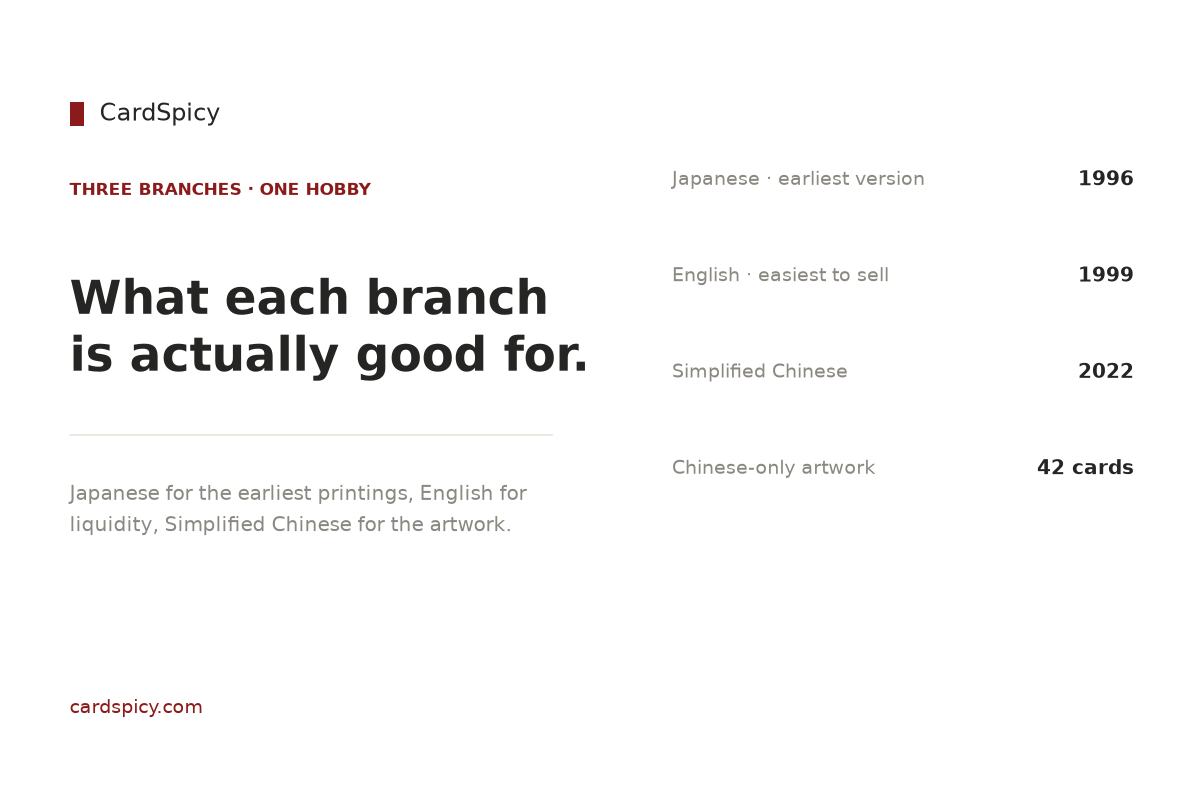
Three printings of the same character can be three different things to own — and the branch a card came from decides which of them you are buying.
Most collectors ask the wrong question first. “Japanese or English or Chinese” is not a ranking, because the three branches are not selling the same thing: one is the original edition, one is the widest market, and one holds artwork that exists nowhere else. A collector who buys the same character in all three branches is usually holding three cards with three separate reasons to be worth something.
This page is the collecting side of that question — what is actually worth buying in each branch, item by item. If you need the definitions first, what the three branches actually mean sets out how a Chinese-exclusive card, a Chinese printing and a Japanese printing are labelled and priced; this page assumes you already know that and asks what each one is good for.
What each branch is good for, in one table
| Branch | What you are buying | Where its record is strongest | The constraint |
|---|---|---|---|
| Japanese | The first printing of an illustration, and a promo system with no equivalent elsewhere | Earliest versions, tournament prizes, illustration debuts | Language of the buyer pool is narrower than English |
| English | Liquidity: the deepest buyer pool and the most complete population records | 1st Edition and Shadowless Base Set, Neo-era holos, e-Card and EX chase cards | The most heavily printed and the most heavily graded, so condition is the whole game |
| Simplified Chinese | Artwork and products that exist in no other branch, from a branch that only started in 2022 | Commissioned art rares, gold UR cards, festival and sealed merchandise | Almost no grading history yet, and no full market cycle behind it |
Everything below is the detail behind those three rows.
What is worth collecting in a Japanese printing
- Cards from the earliest print run with no rarity symbol. The first Japanese Base Set printings carried no rarity mark at all, which makes a symbol-free copy verifiably the earliest version of that card. They trade above later Japanese printings and, in the case of Charizard, above most English 1st Edition copies.
- Event promos with a numbered suffix. The Japanese promo system — the old unnumbered prizes, then /XY-P, /SM-P, /SV-P — is the deepest source of genuinely scarce cards in the hobby. Several of the fifty most expensive Pokémon cards ever sold are Japanese tournament prizes that were never distributed outside the country.
- The original release of an illustration. Japanese sets frequently introduce an art treatment before the English branch adapts it, and sometimes the Japanese version is the only place a specific illustration appears. Buying Japanese gets you the first printing, and sometimes the only one.
- Condition you can actually find. Japanese print runs have tighter quality control and centre better, so a high grade is easier to locate than on the equivalent English card. If you are paying a premium for a grade rather than for a card, that matters.
- Character and trainer rares. The Japanese branch has repeatedly printed trainer-and-Pokémon pair cards and character cards that the English branch handles differently or later. They are a self-contained collecting lane with no direct English equivalent.
What is worth collecting in an English printing
- 1st Edition and Shadowless Base Set. The 1st Edition stamp combined with the shadowless print run is the most established blue-chip category in the hobby, and the most liquid: it has the deepest buyer pool and the most complete population records of anything on this site.
- Neo-era 1st Edition holos, 2000 to 2002. Early holo foils scratch at the slightest handling, so gem-mint survivors are scarce in a way the print runs do not suggest. The 1st Edition Neo Genesis Lugia is the standard example and the most valuable card in the group.
- The e-Card and EX-era chase cards. Crystal-type cards from 2002-03 and the gold star tier from 2004-07 were seeded at extreme rarities — gold stars at roughly one per two booster boxes. They are the last vintage category with a large supply of ungraded cards still in circulation.
- Modern alternate-art and special illustration rares. Enormous print runs and a wide buyer base, so this is the most accessible end of the English market rather than the scarcest. The alternate-art Umbreon VMAX is the reference card for the tier.
- Practical advantages. English is the easiest language to sell into from the United States, submission volumes to graders are highest so turnaround and fees are the most favourable, and population reports are the most complete. If liquidity is your priority, English is the branch to hold.
What only the Simplified Chinese branch has
Two things exist in Simplified Chinese and nowhere else. The first is exclusive artwork: illustrations commissioned for Simplified Chinese products that have no Japanese or English print, including the four Collect 151 Pikachu art rares, the Gem Pack art rares and the Gold UR treatment. The second is Chinese-culture merchandise inside the sealed line — red envelopes, festival sachets, porcelain bowls — which does not exist as a product category in the other branches at all.
The trade-off is history. The branch began in 2023, so it has almost no grading record compared with Japanese or English cards, and its cards have not been through a full market cycle. Why Simplified Chinese cards are so recent covers the timeline, and how to complete a Simplified Chinese set explains what building a run of one volume involves.
What this means if you collect from outside China
The practical gap is not language, it is availability. Japanese and English cards are sold by thousands of shops worldwide and graded in enormous volume, so a collector in the United States or Europe can buy both without leaving their own market. The Simplified Chinese branch is different: the product is sold through mainland channels, the print runs are limited, and most of the graded supply sits in China.
That is also where the collecting opportunity is. The cards a Western collector cannot easily get are exactly the ones that are not a reprint of something already on the shelf — the commissioned art rares, the gold UR treatment, and the sealed products built around Chinese festivals. None of those has an English or Japanese equivalent to compare against, which means the usual “just buy the English one instead” shortcut does not apply.
Our own stock sits on that side of the line: we hold Simplified Chinese product, grade what is worth grading, and list it as PSA 10 with the branch stated on every listing. If you want the Chinese version of a character you already collect, the catalogue is sorted by exactly that distinction, and a card request is the fastest route to something we do not hold yet.
For the sets themselves, what is in each Gem Pack volume and the four Collect 151 Pikachu art rares are the two places the Chinese-only artwork is listed in full. Why the branch is so recent explains the timeline behind the limited record.
Frequently asked questions
Which branch should a new collector start with?
English, if the goal is to be able to sell again easily, and Simplified Chinese if the goal is to own something that cannot be bought in English or Japanese at all. Japanese sits between the two: the earliest printings are the reference versions, but the buyer pool is narrower than the English one.
Is a Japanese card worth more than the English version of the same card?
Sometimes, and for a specific reason: the original Japanese release of an illustration is the earliest printing of it, so when the two compete on condition the Japanese copy is the one with the earlier provenance. For the mass-market modern sets the English printing is usually the more liquid of the two, because that is where the buyer pool is.
Why does the Simplified Chinese branch matter if it only started in 2022?
Because it is the only branch that commissions artwork rather than translating it. A Simplified Chinese art rare or gold UR can have no Japanese or English print at all, which makes it the one case where the Chinese printing is not an alternative to the other two but the only version that exists.
Can one illustration really be printed in only one language?
Yes — the commissioned art rares in Collect 151 and the Gem Pack volumes are the clearest examples, and there are documented cases of a single illustration issued across several Asian-language branches with no English release. That is the opposite of the usual situation, where every branch eventually gets the same art.
Does a Chinese-exclusive card hold its value as well as an English chase card?
There is no long enough record to answer that honestly. The branch is three years old, so its cards have not been through a full market cycle; what can be said is that the supply side is documented and small, and that the price data is thinner than for English and Japanese printings.
Sources
Show all 10 sources
- Bulbapedia ZH (神奇宝贝百科) — Pokémon Trading Card Game · Mainland China. 2022 launch, and the divergent rather than translated card list. wiki.52poke.com
- Xinhua (新华网) — Shanghai has become the “card capital”, 2025-04-09. Publisher registration and market context. news.cn
- Danireon Cards & Games — Japanese Pokémon Cards vs Chinese Pokémon Cards. Language printings compared. danireon.com
- Pokemon Pricing — Why Chinese Pokémon Cards Are Gaining Collector Attention. The three exclusivity and distribution types within Chinese-exclusive product. pokemonpricing.com
- Cardmarket — Collect 151 expansion page. Four 2025 editions, one Chinese-exclusive Pikachu illustration rare per edition. cardmarket.com
- PlayVault — Gem Pack Vol. 3 Booster Box (Simplified Chinese). CBB3C released 26 September 2025; the five exclusive three-star cards. playvault.ae
- Bulbapedia — Arcanine ex (Scarlet & Violet 32). Simplified Chinese-exclusive special illustration rare in Fearless Terastal. bulbapedia.bulbagarden.net
- Pokémon TCG S-Chinese Collection — Mew ex promo 003/SV-P, limited to 1,510. The documented print run. pokemoncard.com.cn
- CardSpicy — Which Pokémon win where: regional favorites in Japan, China, the US and Europe. The four regional boards, and where the Simplified Chinese environment sits inside them. cardspicy.com
- CardSpicy — The fifty most expensive Pokémon cards ever sold. Every entry with a documented sale, and why none of the fifty exists in Simplified Chinese. cardspicy.com
Figures and release details are cited to the sources above as published. Where a claim rests on what a branch has announced to date rather than on a disclosure, the text says so. No price on this page is a forecast, and no branch is recommended as a return on money.