

Two collectors can spend the same money on the same cards and end up in completely different places. One has a shelf full of things. The other has a collection. The difference is almost never knowledge, and it is surprisingly rarely budget — it is whether the thing they started has an edge.
This is not a glossary entry and it is not advice about which card to buy. It is a question about shape. “I collect Pokémon cards” is not a theme. It is a category, and a category has no last card — every release adds to it, so the project can only ever be behind. A theme is different. It has a cast, a size, and a point at which you are finished. The smaller and more specific that cast is, the faster you arrive at the part of collecting that is actually pleasant: owning the thing, rather than hunting it.
The Simplified Chinese Gem Pack line contains one of the cleanest examples of a deliberately closed theme in the modern TCG, and it is easy to walk past, because the eight cards involved do not sit in one set. They are spread across two volumes released eighteen months apart, and the second volume changes the Pokémon without changing the people.
The theme is printed on the card
In Gem Pack Vol. 1 (CBB1C, released 17 January 2025) four of the set’s Illustration Rares put a human being on the card alongside the Pokémon — and then put the human’s name into the card’s title. The card is not called Sprigatito. It is called Sprigatito & Liko.
That is a stranger design decision than it sounds. A trainer card and a Pokémon card are normally two different objects. Here they are one object, and the pairing is not something you have to know before you look. The card states its own membership in the theme.
Vol. 5 (CBB5C, released 24 April 2026) returns to the same four people with the same four partners, one stage further along. The four Illustration Rares in Vol. 5 are the same cast as Vol. 1 — Friede with Captain Pikachu, and Liko, Roy and Dot with their starters — except the starters have evolved once. Sprigatito is now Floragato. Fuecoco is now Crocalor. Quaxly is now Quaxwell. Each card still carries both names.
| Trainer | Card | Printed identifier | Our price (PSA 10) |
|---|---|---|---|
| Liko | Sprigatito & Liko | CBB1C 01 09/09 |
$97.49 |
| Liko | Floragato & Liko | CBB5C 22 07/07 |
$80.34 |
| Roy | Fuecoco & Roy | CBB1C 03 09/09 |
$99.85 |
| Roy | Crocalor & Roy | CBB5C 23 07/07 |
$66.21 |
| Dot | Quaxly & Dot | CBB1C 05 09/09 |
$95.95 |
| Dot | Quaxwell & Dot | CBB5C 24 07/07 |
$66.97 |
| Friede | Captain Pikachu & Friede | CBB1C 07 09/09 |
$653.14 |
| Friede | Captain Pikachu & Friede | CBB5C 01 07/07 |
$614.16 |
Eight cards. Four people. Two stages. That is the entire theme, and the membership list is printed on the objects themselves. Somewhere in a hobby of more than twenty thousand cards, this is one of the few collections you can define without consulting a wiki.
The printed identifier tells you where each card sits
Every Gem Pack card carries a three-part code, and the last two parts are not a set number. CBB1C 07 09/09 reads as: set CBB1C, group 07, treatment 09/09. The group is a species slot — group 07 is the Pikachu slot in Vol. 1 — and the fraction is which treatment of that species you are holding, out of how many that species received in the volume.
This matters more than it looks, because in every volume of the line the four Horizons cards sit at the last treatment of their group. In Vol. 1 that is 09/09. In Vol. 2 the equivalent cards sit at 15/15. In Vol. 5 it is 07/07. The fraction is not a running set number and it is not a print run — it is a position, and the Horizons illustrations occupy the top of it.
So when someone lists a Gem Pack card for sale without saying which treatment it is, the code answers the question that the photograph cannot. A plain holo of the same species in the same group exists, and it is a different card.
Why two volumes make one theme rather than two sets
It is worth being precise about what Vol. 1 and Vol. 5 have in common, because the two products are not built the same way. Vol. 1 ships 15 packs to a box; Vol. 5 ships 18. The two volumes differ in total size as well, and neither figure tells you anything about the other.
What they share is the cast, and the cast is the part that matters for a theme. Vol. 1 gives you the beginning of a journey and Vol. 5 gives you the same four travellers further along it. For a collector, that produces an unusual property: the theme has a built-in sense of sequence. It is not eight interchangeable cards of one character. It reads left to right.
Friede is the exception, and the exception is instructive. Captain Pikachu is not an evolution line — he is a Pikachu, a particular one, with a name. So Friede’s pair does not progress between the volumes in the same way; it appears twice, in two different scenes. The theme’s internal logic is “one trainer, one partner, two moments”, and for three of the four pairs the second moment is an evolution, while for the fourth it is simply a second moment. That asymmetry is the kind of detail that makes a small theme interesting rather than merely small.
The number that decides whether you finish
Here is where a theme stops being an idea and becomes a budget problem. Looking at the eight cards as a group, the obvious figure is the total. The figure that actually predicts whether the collection gets completed is a different one.
| Trainer | The pair | Cost of both cards | Share of the theme |
|---|---|---|---|
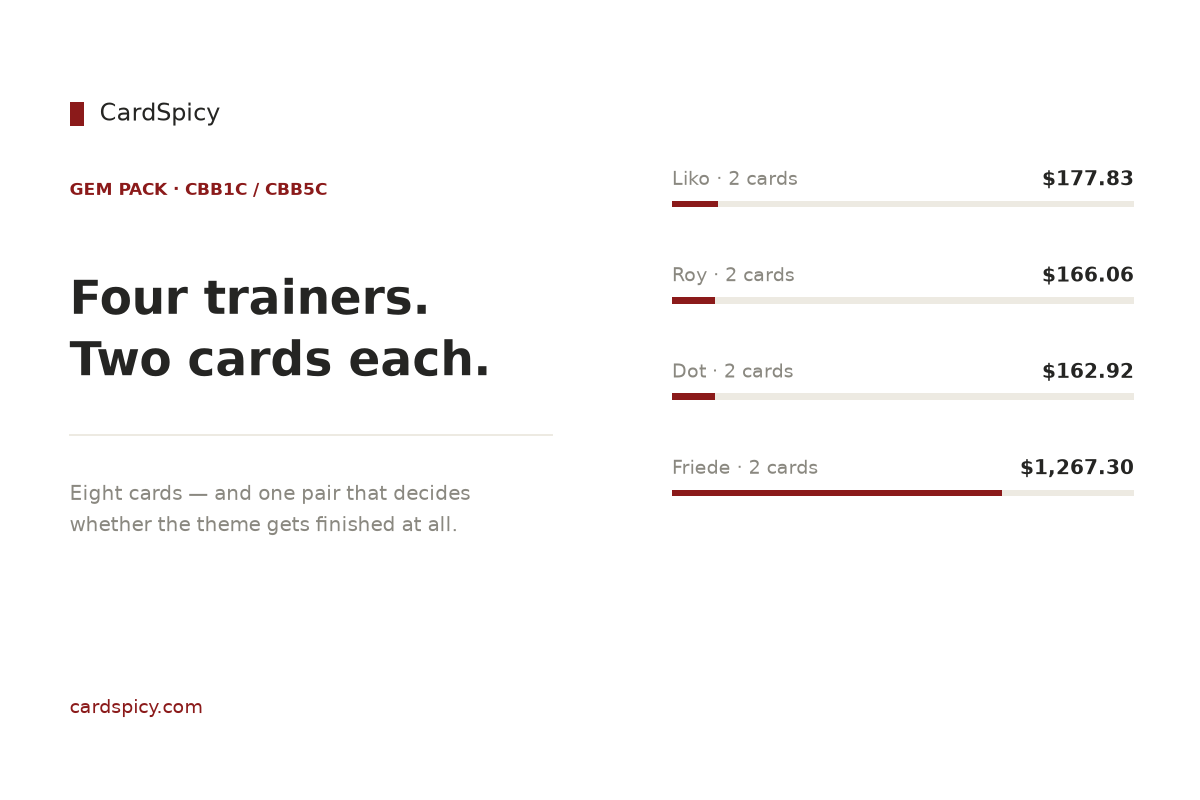
| Dot | Quaxly & Dot + Quaxwell & Dot | $162.92 | 9.2% |
| Roy | Fuecoco & Roy + Crocalor & Roy | $166.06 | 9.4% |
| Liko | Sprigatito & Liko + Floragato & Liko | $177.83 | 10.0% |
| Friede | Captain Pikachu & Friede (both volumes) | $1,267.30 | 71.4% |
| All eight | — | $1,774.11 | 100% |
Three of the four pairs cost between $162 and $178, and they cost about the same as each other. The fourth costs $1,267.30 — more than seven times the others combined. Roughly seventy-one percent of this theme’s total price is one trainer.
This is the single most useful thing to understand about theme collecting, and it generalises well beyond Gem Pack. A theme is not priced by how many cards are in it. It is priced by its most expensive card. Eight cards sounds like a small, achievable project. Seven of those eight cards are individually affordable, and that fact is completely irrelevant, because the eighth is not optional — a theme with a hole in it is not a smaller theme, it is an unfinished one.
So the question to ask before starting is not “what does the whole list cost”. It is “which single card is the gate, and can I pay what it costs”. For the Horizons pairs the answer is Captain Pikachu, and it is worth understanding why rather than resenting it. The card is the one non-evolving member of the cast, it appears in the volume that has been out longest, and it sits at the top treatment of its group in both volumes. Nothing about that is an accident of the market. It is the structure of the theme expressing itself in price.
A theme with no last card: the Eeveelutions
The opposite case is worth looking at, because it is the trap most collectors fall into first. The Eevee family is one of the most natural themes in Pokémon — it is a family with a printed membership list, and it appears repeatedly in the Simplified Chinese line. Our catalogue currently lists four members of it, all from Gem Pack Vol. 2 (CBB2C):
| Card | Printed identifier | Our price (PSA 10) |
|---|---|---|
| Eevee | CBB2C 01 15/15 |
$192.94 |
| Umbreon | CBB2C 06 15/15 |
$591.93 |
| Leafeon | CBB2C 07 15/15 |
$209.89 |
| Sylveon | CBB2C 09 15/15 |
$233.54 |
Four of nine family members. And here is the structural problem with calling this a theme: the Eevee family is defined by a rule — “everything in Eevee’s evolutionary line” — rather than by a printed list. A rule-based theme is open. It can be expanded by a future set, and in this particular case the expansions are the expensive part: Umbreon, the rarest of the four we list, is already $591.93 against Eevee’s $192.94, and the members we do not list are the ones that would have to be sourced from other products entirely.
None of this makes the Eeveelutions a bad thing to collect. It makes them an open theme, and open themes have a specific failure mode: they do not end, so they cannot be finished, so progress never produces the feeling of completion that motivated the project. If you enjoy the chase more than the shelf, that is a feature. If you want the shelf, it is the thing that will quietly end your interest in the hobby.
The other kind of theme — the one you read, not the one that is printed
There is a second kind of theme, and it is the reason the Horizons pairs are worth studying as a design rather than just as a purchase. Some themes are printed on the card. Others exist only if you know the story.
Ceruledge sits in Gem Pack Vol. 3 (CBB3C 15 07/07). In the animation, Ceruledge is Amethio’s partner. The card does not say so. It is titled Ceruledge, and the illustration is the Pokémon. The pairing is real, it is official, and it is entirely invisible on the card itself.
The same is true of Umbreon in Vol. 2, which is Spinel’s partner. The Vol. 2 card is part of a connected scene drawn across four cards, and there is no trainer in it at all. If you were collecting “Pokémon Horizons partner pairs”, both Ceruledge and Umbreon would qualify by the story — and neither would be recognised by a checklist, because no checklist records a relationship that never appears on a card face.
That distinction has a practical consequence. A printed theme can be verified card by card, shared unambiguously with other collectors, and completed without a source of authority beyond the cards. A read theme depends on the collector’s knowledge, and two people applying the same rule will disagree about its edges — is Friede’s Charizard part of the cast? Is it the same theme if the card belongs to a villain? Neither answer is wrong, which is exactly the problem.
Both kinds are worth having. The printed kind is the one that guarantees you finish. It is also the harder kind to find, because it requires a card designer to have made the cast explicit — which is a specific, and quite unusual, decision.
Three questions that predict whether you will finish
Applied to any candidate theme, the same three tests separate the ones that get completed from the ones that get abandoned in a drawer, and none of them is about how much the collector knows.
| Test | The question | What a bad answer looks like |
|---|---|---|
| 1. Is the membership printed, or is it a rule? | Does the theme have a fixed, named cast you can list and stop, or is it defined by a condition that future cards can satisfy? | “All Eeveelutions.” “Every Gengar.” “Cards by this illustrator.” These are rules. Each one grows, and each new release either extends the theme or makes your set incomplete. |
| 2. What does the single most expensive card cost, as a share of the whole? | Not the total — the gate. Find the one card the theme cannot be finished without, and measure it against the sum of everything else. | A gate that is most of the budget. You are not collecting a theme at that point; you are saving for one card and calling the rest of the list an intention. |
| 3. How many sellers does the list require? | If the eight cards come from four sellers on three continents, postage and customs are part of the price of the theme, and each additional seller is another chance for the project to stall. | A member list that cannot be sourced in a small number of transactions. Distance is not romantic here; it is just an extra fixed cost per card. |
The Horizons pair theme passes all three. The cast is printed on the cards. The gate is a known card with a published price, and if that price is out of reach you can find that out in one afternoon instead of over two years. And the list is eight cards that a single seller who grades to order can assemble in one conversation.
If the answer is one trainer
The most common useful conclusion is not “I will collect all eight” but “I want one of these pairs”. That is a good outcome, and it changes what you should buy first.
Going by the current numbers, the three starter pairs are within about fifteen dollars of each other in total — Dot at $162.92, Roy at $166.06, Liko at $177.83 — so the choice between them is a choice about the artwork and the character, not about value. There is no financial argument for one over the others at that spread. Pick the pair you want to look at.
The Friede pair is a genuinely different proposition at $1,267.30, and it is worth saying plainly what it is: two cards, held to the same standard as the rest, and priced by scarcity rather than by anything about how they look. If it is out of budget, that is not a verdict on your collection. It is the first test above doing its job, which is to tell you in advance rather than halfway through.
If you are buying a pair to start with, two smaller habits pay for themselves. First, buy the cheaper card of the two first — every one of these pairs is a base form in Vol. 1 and an evolved form in Vol. 5, and holding one tells you whether you actually want the other on the shelf, which a photograph does not. Second, buy graded from the start. A theme is a set of objects you are keeping, and an ungraded card in the middle of a graded run is a permanent question mark about that card’s condition — one that costs more to close later than it would have cost to avoid. Our own reasoning about why a grade describes the card and not the case is set out in PSA slab care, and it is relevant here for a boring reason: you are going to own these cards for years.
If you would rather see the whole line before choosing, the volume-by-volume breakdown is in Gem Pack Vol. 1 to 6, and the full 42-card Simplified Chinese-exclusive list with printed codes and rarity tiers is in the exclusive card list. Both are worth reading before you commit to a theme, because both will show you candidates you had not considered — which is the correct order of operations. Choose the shape first, then the cards.
Frequently asked questions
What does “one Pokémon per trainer” mean?
It describes a set of cards where a single trainer and a single partner Pokémon appear together, with both names printed in the card’s title. Gem Pack Vol. 1 and Vol. 5 each contain four such Illustration Rares — Friede with Captain Pikachu, and Liko, Roy and Dot with their starters — for eight cards in total across the two volumes.
Which Gem Pack volumes have the Pokémon Horizons trainer pairs?
Two. Gem Pack Vol. 1 (CBB1C, 2025) has the four pairs with the starters in their base forms, and Gem Pack Vol. 5 (CBB5C, 2026) returns to the same four trainers with Floragato, Crocalor, Quaxwell and Captain Pikachu. The eight cards together are the complete theme.
Is an Eeveelution collection a theme?
It is a theme, but it is an open one. The Eevee family is defined by a rule rather than by a printed list, so it can be extended by any future release, and the family has nine members while our catalogue currently lists four from Gem Pack Vol. 2. A rule-based theme is harder to finish than a printed one for structural reasons, not for reasons of effort.
Do the Vol. 1 and Vol. 5 trainer cards use the same artwork?
No. They are different illustrations by different artists, and the Pokémon are at different evolutionary stages — Sprigatito in Vol. 1 against Floragato in Vol. 5, and so on. Captain Pikachu appears in both volumes, but as two separate scenes rather than as a progression.
Can you source a specific Gem Pack card that is not in the catalogue?
Yes. We source and grade to order, so a card does not have to be listed for us to find it. Give us the card name, the volume and the printed identifier — for example CBB5C 24 07/07 — and we will confirm a price and a lead time before you pay anything. Pre-order items are dispatched within 30 days of order confirmation, and most ship in 7 to 14 days.
Sources
Sources and further reading
- The Pokémon Company — Pokémon Horizons: The Series official character pages. The partner pairings used throughout: Liko & Sprigatito, Roy & Fuecoco, Friede & Captain Pikachu, Dot & Quaxly, and, for the read-theme section, Amethio & Ceruledge and Spinel & Umbreon. horizons.pokemon.com
- The Pokémon Company International — press release confirming Liko and Roy with their partner Pokémon Sprigatito and Fuecoco respectively, and Friede with Captain Pikachu. press.pokemon.com
- Level Up Games — Horizons Gem Pack Vol. 5 Booster Box (S-Chinese). Source for the Vol. 5 release date of 24 April 2026, the 18-packs-per-box configuration, the four exclusive Illustration Rares, and the statement that Vol. 5 follows Vol. 1 with the middle evolutions Floragato, Crocalor and Quaxwell alongside Liko, Roy and Dot. levelupgames.shop
- Nostic Cards — Gem Pack Volume 5 Boosterpack. Confirms the Vol. 5 cast (Captain Pikachu & Friede, Floragato & Liko, Crocalor & Roy, Quaxwell & Dot), the all-foil four-cards-per-pack format, and that the four Illustration Rares are the set’s headline cards. nostic-cards.nl
- CPOP — Gem Pack Vol. 1 (CBB1C) Booster Box. Source for the Vol. 1 release date of 17 January 2025, the 15-packs-per-box configuration, and the pull list showing the Horizons cards at their group’s final treatment — Captain Pikachu
07 09/09, Sprigatito01 09/09, Fuecoco03 09/09, Quaxly05 09/09. cpop.ch - MyGamesBase — (Simplified Chinese) Pokémon — Gem Pack Vol. 1 Booster Pack. Independent confirmation of the same four identifiers for Vol. 1, together with the rarity markers attached to each treatment. mygamesbase.com
- KrystalKollectz — Gem Pack Vol. 1 Card List. Source for the treatment numbering within a species group, showing the Pikachu slot running
01/09through09/09with the exclusive Illustration Rare at the top of the run. krystalkollectz.com - CardSpicy — Gem Pack Vol. 1 to 6: What Is in Each Volume. The volume-by-volume set codes, and our explanation of how Gem Pack numbering is organised by species group rather than by a single running number. cardspicy.com/gem-pack-pokemon-volumes/
- CardSpicy — How Many Simplified Chinese-Exclusive Pokémon Cards Are There? The 42-card list with printed codes, sets, rarities and illustrators, and the rarity distribution used in the tier discussions. cardspicy.com/simplified-chinese-exclusive-card-list/
- CardSpicy — our own product listings. All prices in this article are the current PSA 10 graded prices shown on our listings on the date of publication, and change with the market. cardspicy.com/product-category/psa10/psa10-exclusive/