

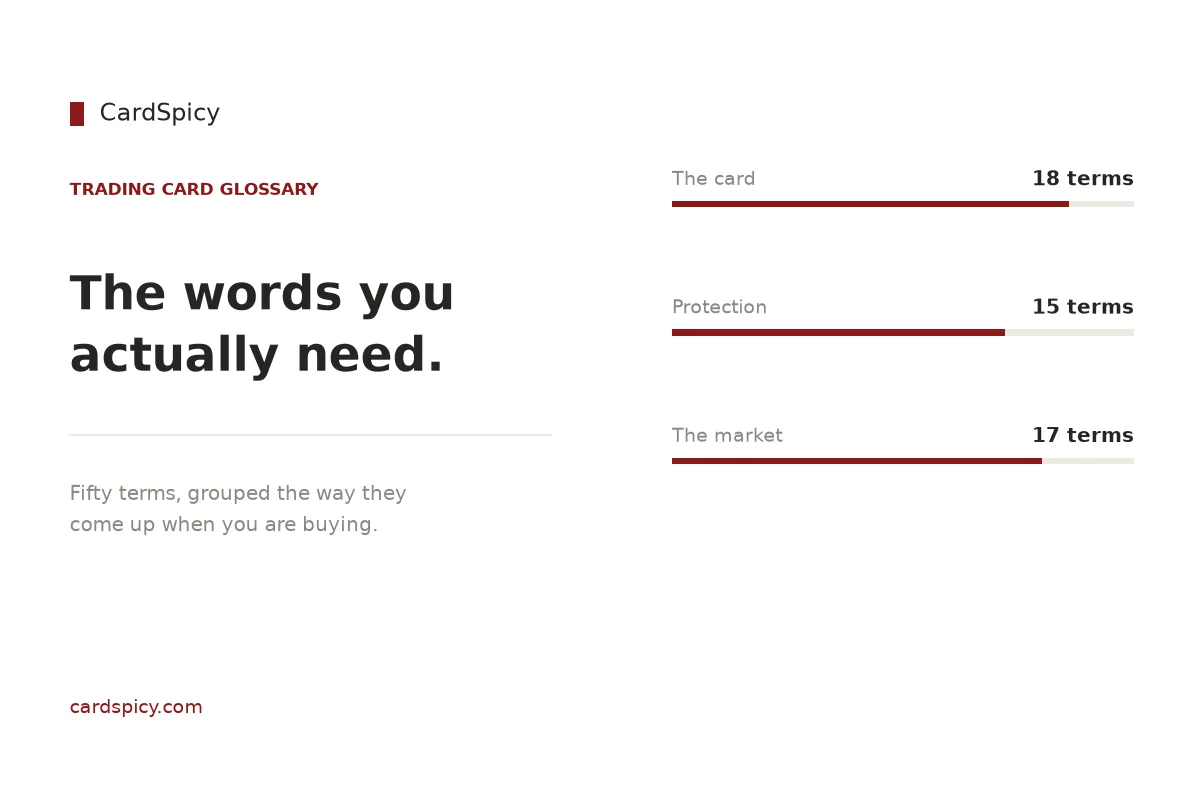
Collectors use a vocabulary that assumes you already know it. The words on this page are the ones that actually show up in listings, on labels and in a conversation at a show — 50 of them, grouped the way they come up in practice: the card itself, the things that protect it, and the market it trades in. The definitions are CardSpicy’s, written for someone buying cards rather than for someone grading them.
How to use this page
Start with the group that matches your question. If you have a card in your hand and want to know what it is, that is the card. If you have cards and want to keep them in the condition you bought them, that is protection and storage. If you are working out what something is worth or how a listing is written, that is buying, selling and the market.
Where a term has a longer answer somewhere on the site, the definition links to it. Nothing here is a substitute for the full page on grading or protection — this is the vocabulary, not the method.
The card
- Raw
- A card that has not been graded and is not sealed in a third-party case. Sold as it is, with its condition described rather than certified. Most cards in the world are raw.
- Graded
- A card that has been assessed by a grading company and sealed into a case with a label carrying the grade. Grading certifies condition; it does not change the card. How grading works covers the process.
- Slab
- The rigid plastic case a graded card is sealed into. “What is a slab” has a short answer: it is the case, not the card — and the label inside it is as much a part of what you are buying as the card itself, because the grade, the certificate number and the set details are all printed there.
- Grade
- The number a grading company assigns to a card on its own scale. PSA grades in whole numbers and never issues a half point; BGS and CGC grade in half points.
- Sub-grade
- One of the separate assessments behind an overall grade — centering, corners, edges and surface. BGS and CGC print them on the label; a PSA label carries a single number and no breakdown.
- Black Label
- A BGS label printed when the overall grade is a 10 and all four sub-grades are also 10. Because it requires four perfect assessments rather than one, a Black Label population is far smaller than the PSA 10 population for the same card.
- Pristine 10
- CGC’s top tier — the name that company gives to the very top of its scale.
- PSA 10
- The top of PSA’s scale, and the only graded grade we stock. Why we only sell PSA 10 explains the reasoning.
- Cert number
- The unique number printed on a graded card’s label, identifying that individual card. It is the number you check against the grading company’s own records before buying a slab. How to do it is in the grading guide.
- Pop report
- Short for population report: how many copies of a card have been graded, and how many at each grade. Two cards with the same label can be very different products if one grade is common and the other is scarce, which is why the population is worth checking before you buy.
- Qualifier
- A note on a label meaning the card met the grade with one stated exception, most often centering. A qualified grade is not the same product as an unqualified one at the same number, and it sells for less.
- Centering
- How evenly the printed border sits inside the card’s cut edges — measured side to side and top to bottom. It is one of the most common reasons a card misses the top grade, and the reason centering is a sub-grade on the labels that print them.
- Whitening
- The small white scuffs that appear along a card’s coloured edges and at its corners from handling. Visible whitening is the usual mark of edge and corner wear, and it is one of the types of card damage that cannot be undone.
- Print line
- A fine line in the printed image or the gloss of the card, left by the manufacturing process rather than by handling. It is a factory characteristic, so it is judged differently from wear — but it is still a reason a card misses a top grade.
- Holo
- A card with a foil layer that reflects light. A reverse holo applies the foil to the card body and leaves the art box plain, which is the reverse of the usual arrangement.
- AR
- Art rare — a card whose artwork is a commissioned illustration rather than a stock image. Similar short codes are used across a set for other rarities, and the same two letters do not always mean the same thing between products, so check the card against its own set.
- Set code
- The short code that identifies which product a card came from, in a format like
CBB1Cor151C. It appears on the card itself and it is the quickest way to place a card in a set — the set code guide decodes them. - Chase card
- The card inside a set that most buyers are looking for. A set’s chase card is often not its rarest by print run, but it is the one that sets the tone for the set’s value.
Protection and storage
- Penny sleeve
- A soft, thin, single-card sleeve — the least expensive layer of protection, and the one that sits directly against the card face. The name comes from the price point, not from the film. Ours are blown polypropylene at 50 μm.
- Perfect fit sleeve
- A sleeve cut closer to the card’s exact dimensions than a penny sleeve, used as the tight inner layer when double sleeving. It hugs the card, so it is handled more carefully than a looser sleeve.
- Double sleeving
- Using two sleeves together — a tight inner sleeve against the card and a looser outer sleeve over it. The inner layer keeps the card’s edges clean; the outer one takes the handling.
- Notched sleeve
- A sleeve with the two top corners cut away so the film does not press over the card’s own corners. Notched or regular explains what the notch does and when it stops helping.
- Toploader
- A rigid, semi-transparent holder for a single sleeved card, usually three inches by four. Stiffness is its whole job — a sleeve will not stop a bend, and a toploader will. See the rigid card holder we stock.
- Card saver
- A semi-rigid holder, thinner than a toploader and slightly flexible, holding a sleeved card by its edges without a full rigid shell. Semi-rigid holders are commonly what a grading submission arrives in.
- One-touch
- A two-piece rigid case for a single card that closes by magnet, usually with a recessed inner frame that holds the card without adhesive. Favoured for display because it can be opened and closed repeatedly, which is also the reason it is treated as display rather than storage.
- PT
- The thickness a sleeve or holder is rated for, in points. The PT number is the card thickness the sleeve is sized to hold, not the thickness of the sleeve itself — which is why one sleeve product comes in six PT options at the same price. Our sleeves run from 35 PT (66 × 91 mm) to 360 PT (76.5 × 98 mm).
- Blown film
- Polypropylene film made by inflating a tube of molten resin into a bubble, which stretches it in two directions at once. It resists tearing whichever way you pull, and it folds against a card rather than holding a crease.
- Cast film
- Polypropylene film made by pouring resin onto a chilled roller, which quenches it flat and glossy and orients it mainly in one direction. It is clearer and stiffer than blown film, and more likely to hold a crease.
- Acid-free
- A material that will not release acids onto a card surface over time. It is one of the two lines to look for on a sleeve’s material description, along with PVC-free.
- PVC-free
- Made without polyvinyl chloride. This matters more than it looks: the plasticiser in PVC migrates out over years, dulls the card surface, and the damage is not reversible. Polypropylene and polyethylene sleeves are the alternative.
- Binder
- An album with pockets for cards, usually nine to a page, used to store and to browse a collection. Cards go in a binder sleeve-first, because the pocket is not a sleeve. Binders, boxes and frames compares the options.
- Slab sleeve
- An outer sleeve sized for a graded card’s case rather than for a card. The cases differ between companies, so a slab sleeve cut for one will not fit another — and a sleeve made for a card will not fit a slab at all.
- Storage box
- A box sized for whatever is going inside it — cards in sleeves, cards in toploaders, or graded slabs. The box is the layer that takes pressure and light, and a box the wrong size for its contents is what produces set wrinkles in the sleeves. See the three layers of protection.
Buying, selling and the market
- Comp
- Short for comparable: a record of the same card in the same grade selling recently, used to work out what a card is worth. Comps are the basis of any price — a listing is a request, a comp is a result.
- Market value
- What a card actually changes hands for, as opposed to what it is listed at. The two diverge most on cards that sell rarely, because a listing with no recent result is a guess rather than a price.
- Raw price
- The price of the ungraded card. It is the baseline against which any graded price is judged, and the number that decides whether grading a particular card makes sense at all.
- Premium
- The difference between what a graded card sells for and what the same card sells for raw. The premium is a property of the card and its population, not of the grade in the abstract — the same grade holds a large premium on one card and almost none on another.
- Liquidity
- How quickly a card can be sold without moving its own price. A liquid card has buyers waiting; an illiquid one has to wait for a buyer. Grade and company both affect liquidity, which is why the largest buyer pool matters even when it is not the highest price on a given day.
- Spread
- The gap between the price at which a card can be sold and the price at which it can be bought back. A wide spread means the card has to move a long way before a round trip breaks even.
- Sealed
- Product that has never been opened — booster boxes, packs, and boxes built around a set. Sealed product is its own market with its own rules, because the card inside is unknown and the seal itself is part of the value. What is inside each volume of ours is set out in the Gem Pack volume guide.
- Booster box
- A factory-sealed box of booster packs, sold as a unit. The seal is the product: an opened box is priced as a collection of packs, not as a box.
- ETB
- Elite Trainer Box — a sealed product built around a set, containing packs plus accessories such as sleeves and dice. Collected sealed for the same reason as a booster box.
- Master set
- Every card from one set, including every variant and treatment of each card. A master set is far larger than the numbered checklist, because a single card number can exist in several finishes.
- Bulk
- The common cards left over after the cards anyone wants have been taken out. Sold by count rather than by card, and priced accordingly.
- Lot
- Several cards sold together as one unit rather than individually. A lot is priced as a group, and it is usually the least expensive way to acquire several cards at once — and the least predictable way to value any single one of them.
- Pre-order
- A listing for a card that is not yet in the seller’s hands. A pre-order is a commitment about timing as much as about the card, which is why the dispatch window belongs in the listing. Our terms are on the pre-order page.
- Dispatch
- The point at which an order leaves the seller. It is not the same as delivery, and the difference matters most on pre-orders, where the dispatch window is the part you are actually waiting on. Delivery times to the US are set out in shipping to the US.
- Submission
- One order of cards sent to a grading company together, graded and returned together. The tier you choose in a submission is what sets the turnaround.
- Turnaround
- How long a grading company takes to return a submission. The published window typically starts when the cards enter grading rather than when you post them, so transit time sits outside it and the real wait is longer than the headline figure.
- Cross-grading
- Sending a card that is already in one company’s case to another company for a fresh grade, usually in the hope of a different number. It is a fresh assessment rather than an appeal, and the previous grade is lost either way.
Frequently asked questions
What is a slab?
A slab is the rigid plastic case a graded card is sealed into — the card inside has been assessed by a grading company and the grade, certificate number and set details are printed on the label sealed in with it. Collectors say “slab” when they mean the whole graded unit, because in practice you buy the case and the label as much as the card. It is not the same as a toploader, which is a holder you can open, or as a magnetic case, which is for display rather than certification.
What does PSA 10 mean?
It is the top of PSA’s grading scale, and PSA grades in whole numbers, so there is no 10.5 above it and nothing between a 9 and a 10. A PSA 10 label carries that single number and no sub-grade breakdown. It is the only graded grade we stock, for the reasons set out in why we only sell PSA 10.
What does PT mean on card sleeves?
PT is the thickness the sleeve is rated for, expressed in points. It describes the card the sleeve is sized to hold rather than the film itself, which is why one sleeve product is sold in six PT options at a single price — 35 PT for a standard card up to 360 PT for a thick one. Using a sleeve rated below your card’s thickness crushes the card into the film; using one rated far above it leaves the card loose inside.
What is a pop report?
A population report is the record of how many copies of a card a grading company has graded, broken down by grade. It is the number that explains why two identically labelled cards can be worth very different amounts: a 10 that exists in thousands is a different product from a 10 that exists in dozens, even though the label reads the same. Checking the population is part of how grading works.
What is the difference between a raw card and a graded card?
A raw card is ungraded and its condition is described by the seller. A graded card has been assessed and sealed, and its condition is certified by a third party with a number you can look up. Grading adds certainty and a market, and it costs money and time — whether that trade is worth it depends on the card rather than on the principle.
Sources
Sources and further reading
- CardSpicy — Card grading: how it works, for the scale, sub-grades, labels, certificate numbers and population reports.
- CardSpicy — Card protection: the three layers, for sleeves, holders, storage and the material terms.
- CardSpicy — 100x Penny Sleeves 35-360 PT, for the PT options, sleeve dimensions and film specification used above.
- CardSpicy — The seven types of card damage, for the wear terms — whitening, print lines, edge and corner damage.
These definitions are written for buyers rather than for graders, and they describe how the words are used in practice rather than how any company defines them internally. Terms change, and the same short code can mean different things in different products. Where a term decides a purchase, check it against the card and the label in front of you.
Related reading
- Card grading: how it works
- Card protection: the three layers, from sleeve to slab
- The seven types of card damage, and what stops each one
- How to protect your trading cards with card sleeves
- Binders, boxes and frames: how to store and display cards
- Pokémon set codes, decoded
- All our card protection guides
Shop cards and protection
- All PSA 10 graded cards
- PSA 10 — Simplified Chinese exclusive — our highest-premium line
- Penny sleeves, 35 PT to 360 PT — 100 per pack, acid-free and PVC-free
- Toploader 3" x 4" rigid card holder
- All card protectors
- Binders and albums
Cannot find a term, or want to know whether a particular card fits a particular holder? Find this Card for Me, and we will tell you what fits it.