🛒0

Category: Card Protection & Storage

CardSpicy articles about keeping cards in the condition you bought them in — sleeves, holders, binders, boxes, display and handling.

  • One Set of Sleeves Fits Every Game We Index (63 x 88 mm)

    Quick answer

    CardSpicy indexes Pokémon, One Piece, Gundam, Dragon Ball and Naruto and stocks the sleeve range below them, and one sleeve size covers every one of those games because they share one physical measurement — 63 × 88 mm.

    Pokémon, One Piece, Gundam, Dragon Ball and Naruto cards look nothing like each other and measure almost exactly the same. CardSpicy indexes all five lines and stocks the sleeve range below them, and the reason one set of sleeves covers every game is a single physical number.

    The one line: the printed card is 63 × 88 mm across every game we index, so a sleeve bought for one game fits the rest. What changes between games is thickness, not footprint — and thickness is the one thing a sleeve is rated for.

    The number that makes it true

    Standard trading cards in these games are 63 × 88 mm — roughly 2.5" × 3.5". That is the size the sleeves, rigid holders, binders and boxes in this store are built around, and it is a deliberate standard rather than a coincidence: a card game that wants its cards in existing accessories has an obvious reason to use the size that accessories are already made in.

    The footprint being shared is what allows one sleeve to serve several collections at once. The thickness is not shared, which is why the same shelf holds six different PT ratings.

    Which games use the same card size

    Game Card size Fits a 63 × 88 mm sleeve
    Pokémon 63 × 88 mm Yes
    One Piece Card Game 63 × 88 mm Yes
    GUNDAM CARD GAME 63 × 88 mm Yes
    Dragon Ball Fusion World 63 × 88 mm Yes
    Dragon Ball Super Card Game (Masters) 63 × 88 mm Yes
    Magic: The Gathering 63 × 88 mm Yes
    Yu-Gi-Oh! Approximately 59 × 86 mm Fits, but loosely — see the exceptions below

    Five of the lines we index are the same physical object as far as storage is concerned. That is the practical value of the standard, and it means the protection question does not restart when you start a second collection.

    Where the games actually differ

    Once the footprint is fixed, the remaining differences are the ones that affect what you buy.

    • Thickness. Different games and different printings use different card stock, and a thin card and a thick one want different PT ratings. This is the number to check, and it is the reason our sleeves come in six thicknesses rather than one.
    • Surface treatment. Foils, textured finishes and embossed prints all sit differently against a clear film, which is why an ultra clear sleeve is worth choosing rather than a merely transparent one if the card will be viewed or photographed sleeved.
    • Slabs. A graded card is outside all of this. A slab is larger than the card in both dimensions and needs slab-sized storage, whichever game the card came from.

    What this means when you buy

    It simplifies the decision to two questions, and neither is about the game.

    1. Is the card raw or graded? Raw cards take a sleeve and, if they will be under load, a rigid holder. Graded cards take neither, and take a bag and a slab box instead.
    2. How thick is the card? That sets the PT rating, and the rating is what decides whether the sleeve fits. The way to work it out is in the sleeve thickness guide.

    Everything else — which game the card is from, which set it was printed in, which language it is printed in — does not change the answer, because it does not change the card’s dimensions.

    The exceptions worth knowing

    Two, and both are cheap to avoid.

    Yu-Gi-Oh! cards are smaller than standard. They are around 59 × 86 mm, so a 63 × 88 mm sleeve will accept them and will not grip them — the card slides. A standard-size sleeve is still the wrong fit for a card that is deliberately smaller, and the fix is a sleeve sized to that card.

    Not every Chinese-language card line publishes a standard size. Where a card line uses its own stock and its own printing, the dimensions are worth checking against that card rather than assuming the 63 × 88 mm standard. If you are unsure, measuring the card you actually have settles it in seconds and is faster than searching for a specification.

    The full index of cards we cover, by game, is on the collector’s index, with each line indexed separately: One Piece, Gundam, Dragon Ball and Naruto.

    Frequently asked questions

    Do the same sleeves fit Pokémon and One Piece cards?

    Yes. Both are 63 × 88 mm, so a sleeve sized for one fits the other. The same applies to Gundam, Dragon Ball Fusion World and Magic: The Gathering. What you may need to change between games is the PT rating rather than the sleeve size.

    Are all trading cards the same size?

    No, but most of the games we index are. The widely used standard is 63 × 88 mm, and it covers Pokémon, One Piece, Gundam, Dragon Ball and Magic. Yu-Gi-Oh! cards are smaller at around 59 × 86 mm, which is why they sit loose in a standard sleeve.

    Will a sleeve bought for Pokémon cards fit Gundam cards?

    Yes. Both card types share the 63 × 88 mm footprint, so the sleeve fits both. Choose the PT rating to match the card’s thickness, since that is the dimension that differs between printings.

    What about graded cards from different games?

    Grading takes a card out of the standard-size conversation entirely. A graded slab is larger and thicker than the card and is not interchangeable with sleeves or rigid holders made for raw cards, regardless of which game the card came from.

    How do I check a card I am not sure about?

    Measure it. A standard card measures about 63 mm across by 88 mm down, so a card that is noticeably narrower or shorter is not standard size, and the sleeve has to be matched to it rather than to the standard.

    Sources

    Sources and further reading
    1. CardSpicy product specifications for the 100x penny sleeve range — outer dimensions, PT ratings and the 63 × 88 mm standard card size the sleeves are built around. Retrieved 2026-10-06.
    2. CardSpicy product specification for the rigid 3" × 4" card holder range — stated compatibility with standard 63 × 88 mm trading cards. Retrieved 2026-10-06.
    3. Published card dimensions from the card games themselves for Pokémon, the One Piece Card Game, the GUNDAM CARD GAME, Dragon Ball Fusion World and Magic: The Gathering.
    4. Published card dimensions for Yu-Gi-Oh!, which are smaller than the 63 × 88 mm standard.

    Card dimensions are quoted from published game specifications at the date shown and are subject to change where a publisher revises its stock. This page is guidance on accessories, not a valuation of any card.

    Related reading

  • Humidity, Light and Long-Term Card Storage

    Quick answer

    CardSpicy sells the protection layers this article puts in context, and cards almost always fail slowly, for reasons that have nothing to do with how they are handled.

    Cards almost never fail suddenly. They change slowly, and they change for four reasons that have nothing to do with how they are handled. CardSpicy sells the protection layers this article puts in context, and the layers only work if the room they sit in is doing its part.

    The one line: the enemy is not dust, it is the environment. Moisture, light, temperature swings and the materials touching the card do the slow damage, and they work whether or not the card is ever taken out of its sleeve.

    What actually degrades a stored card

    Factor What it does How reversible
    Moisture Paper takes on and releases water with the air, which swells and shrinks the card and, with it, the printed layer on the surface. The distortion from repeated cycling is not reversible.
    Light, especially ultraviolet Breaks down the dyes and the coating that carries the image, so colours shift and paper yellows. Not reversible. Storage changes the future, not the past.
    Temperature cycling Repeated warm-and-cool cycles move moisture in and out of the card, which is why a fluctuating room is worse than a steady one. Not reversible once the card has cycled many times.
    Contact materials Plasticisers and acids in the wrong plastic migrate into the card surface over years. Not reversible.

    Four factors, and only one of them is a mistake a collector makes on purpose. The rest are properties of the room.

    Humidity

    Paper is hygroscopic, meaning it takes on and releases moisture with the air around it. A card in a humid room is not wet — it has swollen slightly, and the printed surface has moved with it. Nothing looks wrong. Then the air dries, the card contracts, and a surface that has swollen and shrunk many times has begun to change in ways that do not come back.

    The figure most often quoted for paper-based collections sits in the middle of the range and comes with the same caveat every time: a stable value is better than an ideal one. A collection held at a steady mid-range humidity in a normal room is in less danger than one held at a perfect number that swings by twenty points every day, because it is the cycling that does the damage rather than the average.

    Practically, that means humidity is managed by choosing the room rather than by buying something. Avoid basements and attics, which swing hardest. Avoid a shelf against an outside wall that goes cold overnight. Keep storage away from bathrooms, kitchens and any room where the air changes with the weather.

    Light

    Light damage is the slowest of the four and the one most likely to be dismissed, because the first year shows nothing. It works in two layers: ultraviolet does the majority of the damage per unit of exposure, and ordinary visible light still contributes over long enough periods.

    Two consequences matter for storage. Window glass is not a UV filter, so a card in a closed box on a shelf that gets sun is only partly protected by the box unless the box is opaque and never opened in that position. And darkness is the only real remedy, because fading does not reverse when the light goes away.

    The display side of this trade is covered in display frames and magnetic holders, where the point is that a frame is about how a card looks rather than how it survives.

    Temperature cycling

    Temperature matters less for its own sake than for what it does to moisture. Warm air holds more water than cold air, so a card that sits in a room which warms and cools through the day is sitting in air whose moisture content is changing, and the card follows. This is why a garage, an attic or a shelf above a radiator is a worse home for a collection than the numbers on a thermometer suggest.

    The remedy is the same as for humidity: keep the storage in a room where the temperature is boring, and do not store cards where something else in the room is periodically hot or cold.

    What desiccants do, and do not do

    Silica gel and similar desiccants get packed with collections on the theory that they keep the cards dry, and the reality is narrower.

    • They absorb moisture from the air in a closed container. That is a real effect, and in a sealed box it is measurable.
    • They saturate. A desiccant that has taken up all it can hold stops working and can give moisture back, so it needs to be dried or replaced on a schedule rather than left in place indefinitely.
    • They do not stabilise a room. A desiccant in an open box in a humid room is absorbing the room, not protecting the card.
    • They can over-dry. Driving a paper collection far below the ambient level is not an improvement; paper wants a middle, not a minimum.

    Treat a desiccant as a tool for a sealed container, not as a substitute for choosing a sensible room.

    A slab is not sealed against humidity

    Graded slabs are sealed against opening, which is a different thing from being sealed against air. The card inside a slab is still in contact with air that moves with the environment, so a slab stored in a damp room is a card stored in a damp room. The case adds rigidity and a tamper-evident closure, and this article’s list of four factors still applies inside it.

    That is also why slab storage is still a storage question: bag the slab for the case surface, then put it in a closed box in the right room. Whether a graded slab needs a sleeve covers the first step, storage boxes the second.

    Frequently asked questions

    What humidity should cards be stored at?

    Guidance for paper collections generally points to the middle of the range, and every version of it comes with the same caveat: stability matters more than the exact figure. A collection in a normal room at a steady level is safer than one at a perfect number that swings daily, because the cycling is what damages the card.

    Do silica gel packets protect my cards?

    Only inside a sealed container, and only until they saturate. A desiccant absorbs moisture from a closed space and then stops working, and can release moisture again. It is not a substitute for keeping cards in a dry, stable room.

    Do graded slabs protect a card from humidity?

    No. A slab is sealed against being opened, not against air. The card inside is still exposed to the moisture in its environment, so a slab in a damp room is a card in a damp room. Rigidity and tamper evidence are what a slab adds.

    Can I store cards in a garage or attic?

    It is the worst place for them. Garages and attics have the largest daily and seasonal temperature swings of anywhere in a house, and temperature swings move moisture in and out of paper. A cupboard inside the living space is a better home than a protected corner of an attic.

    Does light really damage cards in a box?

    A closed opaque box blocks light while it is closed, which is most of the protection. The risk is in how the box is kept: left open, stored on a sunlit shelf, or replaced by a clear container. Fading does not reverse, so exposure avoided is the only exposure recovered.

    Sources

    Sources and further reading
    1. General conservation guidance for paper-based collections on the hygroscopic behaviour of paper, target humidity bands for storage, and the priority of stability over any single ideal figure.
    2. General conservation guidance on ultraviolet and visible light as causes of fading and yellowing in paper and printed surfaces, and on the irreversibility of that change.
    3. CardSpicy product specifications for the rigid 3" × 4" card holder range and the 100x penny sleeve range, used when describing the layers that sit between a card and its room. Retrieved 2026-10-06.
    4. Published dimensional and construction data for third-party graded slabs, used here to distinguish being sealed against opening from being sealed against air.

    This page is general guidance on storage conditions, not conservation advice for a specific item or a valuation of any card. Where published sources differ on exact figures, this page states the principle rather than a number.

    Related reading

  • Storage Boxes: What Actually Protects a Collection

    Quick answer

    CardSpicy sells into the same protection stack this article describes, and a storage box answers a different question from a sleeve rather than being a stronger version of one.

    A storage box is the layer collectors think about last and the one that decides what a collection looks like in ten years. CardSpicy sells into the same protection stack this article describes, and the point is that a box is not a stronger sleeve — it answers a different question entirely.

    The one line: a sleeve stops handling, a rigid holder stops pressure, and a box stops movement. A box that lets cards slide against each other is doing none of those, however solid it looks.

    What a box is actually for

    Three jobs, and they are all about the environment rather than the card surface.

    • Pressure. A box holds cards upright and separated so that weight is not resting on the face of the bottom card. This is the failure most new collectors find first: a stack left on a shelf with books on top, and a curve that never comes out.
    • Dust and dirt. A closed box keeps the fine abrasive layer that settles on everything off the sleeves, which matters because grit trapped between two sleeves is what actually scratches a card over years.
    • Movement. The card, and the sleeve around it, cannot slide. A box with the right internal dimension stops the continuous small rubbing that wears a corner.

    What a box does not do

    A box is not a substitute for the layers inside it, and expecting it to be is how collections get damaged in storage that looked careful.

    Problem What actually stops it
    Fingerprints and surface handling A sleeve. A box does nothing here, because the card is bare inside it.
    Bending and crushing A rigid holder around the card. A stiff box helps only if the card is not already loaded.
    Cards sliding and abrading each other A box of the right size, plus sleeves on every card so the plastic touches instead of the card.
    Humidity swings A closed, non-absorbent box, plus stable storage conditions. An open tray makes it worse.
    Yellowing and fading Dark storage. Boxes do not filter light unless they are opaque and closed.

    The layers, in the order they go on

    The order is not arbitrary, and putting them on in the wrong sequence defeats all three.

    1. A soft sleeve first, so the card surface is never touched again. Choose the thickness that matches the card, as set out in the sleeve thickness guide.
    2. A rigid holder only if the card will be under load, shipped or displayed upright. A holder is rigid protection, and it does not replace the sleeve — the sleeve is what the card sits in.
    3. A box last, closed, with the internal dimension matched to the holders rather than to the raw cards. Everything above it in this list assumes the box does not let its contents move.

    Cardboard or plastic

    Both are used, and the choice comes down to what the box has to survive.

    Cardboard boxes are light, cheap and easy to label, and the good ones are two-piece with a tight fit. Their weakness is the same as their strength: cardboard takes on moisture from the air, so it buffers humidity rather than blocking it, and an unlined board box in a damp room will go soft before the cards inside show anything.

    Rigid plastic boxes hold their shape, do not take on moisture and close more tightly, which is why they are the usual choice for anything that is staying in storage for years rather than being browsed. They are heavier and they take up more space per card, and neither of those affects the card.

    What matters more than the material is the fit. A box that is far too large lets a card fall flat and slide, and a box that is exactly the card size will not accept a sleeved card or a holder. Buy to the dimension of the protected card, not the bare one.

    Where boxes usually go wrong

    • Storing upright with nothing to lean on. A card standing free in a large box tips and rubs. Stores that go vertical need the box to be full, or need dividers.
    • Stacking boxes on their side. Cards hold their shape under their own weight and lose it under a stack. Flat storage is fine when the boxes are the load-bearing layer; card-on-card is not.
    • Mixing sizes. A graded slab is much thicker than a raw card, and a box sized for raw cards will either not close or will hold the slab loosely. Size the box to the thickest thing in it.
    • Leaving it open for convenience. Every protection property a box has depends on it being closed.

    Storing graded slabs is a different problem

    A slab is already rigid and already sealed, so the sleeve-and-holder layers are done for you. What is left is the box, and a slab changes both dimensions: it is thicker than a card and taller than one, so the box has to be a slab box rather than a card box with room to spare.

    Slabs also carry a surface that can be scratched without any harm to the card inside, which is why collectors bag them before they box them. That step is covered in whether a graded slab needs a sleeve.

    Frequently asked questions

    Do I need a storage box if my cards are already in sleeves?

    Yes, because a sleeve solves a different problem. A sleeve stops handling damage to the card surface, but it does nothing about pressure or about cards sliding against each other in storage. A box is what stops the collection moving.

    Is a cardboard or a plastic storage box better for cards?

    Plastic holds its shape and does not absorb moisture, which makes it the safer default for long-term storage. Cardboard is lighter and cheaper and works well in a stable, dry room. The fit matters more than the material: the box should hold the protected cards without letting them slide.

    Can cards be stored standing upright?

    Only if the box is full or divided. A card standing free in a box with space around it will tip and rub against whatever is next to it. Upright storage works when the box is packed to its internal dimension, which is also what keeps the cards from bending.

    Should graded slabs go in the same box as raw cards?

    No. A slab is both thicker and taller than a raw card, so a box sized for raw cards will either not close or will hold slabs loosely. Slabs need a box dimensioned for slabs, and ideally inside their own bag to keep the case surface from being scratched.

    Does keeping cards in a box protect them from light?

    Only if the box is closed and opaque. An open tray or a clear box under a lamp leaves the cards exposed to the same light they would get on a shelf, and light exposure is a slow change that cannot be reversed once it has happened.

    Sources

    Sources and further reading
    1. CardSpicy product specification for the rigid 3" × 4" card holder range — holder dimensions and the standard card size they are built for, used here when explaining the stacking layers. Retrieved 2026-10-06.
    2. CardSpicy product specifications for the 100x penny sleeve range — PT ratings and inner dimensions, used for the sleeve step of the stack. Retrieved 2026-10-06.
    3. Standard trading card size of 63 × 88 mm as published by the card games that use it.
    4. General conservation guidance for paper-based collectables on the effects of pressure, light exposure and humidity cycling during long-term storage.

    This page is guidance on storage, not a valuation of any card. Product specifications are quoted from our own data at the date shown and are subject to change.

    Related reading

  • Sleeve Thickness, by Use: 35 PT to 360 PT

    Quick answer

    CardSpicy stocks the penny-sleeve range this guide describes — six thicknesses from 35 PT to 360 PT — and a sleeve is rated for a card thickness, so thicker is not better.

    Sleeve thickness is the one number that decides whether a card goes into a sleeve at all, and it is the number most collectors pick by habit rather than by measurement. CardSpicy stocks the penny sleeve range this guide describes, in six thicknesses from 35 PT to 360 PT, so the differences below are the differences between the options actually on the shelf.

    The point in one line: a thicker sleeve is not a better sleeve. A sleeve is rated for a card thickness, and the correct one is the one that matches the card you are holding. Too thin and the card will not seat — it buckles the film and the corners dig in. Too thick and the card slides around inside, which is how edges get nicked.

    What PT actually measures

    PT stands for point, and it is a thickness, not a quality grade. One point is 0.0254 mm, so the numbers are small on purpose: 35 PT is roughly 0.89 mm of rated stock.

    Two consequences follow, and both matter more than the exact conversion. First, the PT number printed on a sleeve is a rating for the card it will hold, not a measurement of the film itself. Second, 35 PT is not “the thin one” in any absolute sense — it is the correct rating for a bare standard card, which is what most of the cards in a collection actually are.

    The six thicknesses, and what each one is for

    Rated thickness Inner size What it is for
    35 PT 66 × 91 mm A bare standard card. The default, and the one most collectors need by the pack.
    35–55 PT 67.5 × 94 mm A standard card with a little clearance, for cards that are slightly thick or already snug in an inner sleeve.
    75–100 PT 69 × 95 mm A card that is already inside a thin inner sleeve, or thicker stock.
    130 PT 71 × 95 mm Double-sleeved cards and thicker premium stock.
    260 PT 74 × 96 mm Very thick cards, and cards stored with a rigid inner layer.
    360 PT 76.5 × 98 mm The thickest our range goes — oversized stock, or a card that stays inside its own holder.

    Every one of those is 100 sleeves per pack at the same price. The options exist because the cards do, not because one is a premium tier of another.

    PT and sleeve size are two different numbers

    This is the mistake that produces a sleeve that will not fit: reading the PT rating as though it described the sleeve’s outside size.

    PT is the card thickness the sleeve is rated for. The size in millimetres is the inner dimension, and it has to be slightly larger than the card itself, because a sleeve that matches the card exactly cannot be filled. That is why a 35 PT sleeve is 66 × 91 mm for a 63 × 88 mm card — a few millimetres of working room on each side, and not more.

    Go up the thickness range and the inner size grows with it, from 66 × 91 mm at 35 PT to 76.5 × 98 mm at 360 PT. A thicker sleeve is a larger sleeve, so buying up “for safety” buys a looser fit and not a safer one.

    The material matters more than the thickness

    Thickness decides whether a card fits. Material decides whether the card is still the same card in ten years, and it is the part of a sleeve that is impossible to judge by touch.

    • Clear polypropylene, acid-free and PVC-free is the film to look for. It stays clear rather than developing a fog, and it does not release anything into the card it is touching.
    • PVC is soft, clear and cheap, and it needs plasticisers to stay that way. Over years those plasticisers migrate out of the plastic and into whatever is against it — on a card, the first sign is a dull, slightly greasy surface.
    • Ultra clear on both faces matters if the card is going to be looked at or photographed while sleeved, because a hazy film changes how the surface of the card reads.

    The full argument for the material over the brand is set out in how to protect your trading cards with card sleeves, which is the companion piece to this one.

    Regular or Notched, and when the shape matters

    Our sleeves come in two shapes, and the difference is only at the top. Regular is the classic flat sleeve with four square corners. Notched has the two top corners cut away, so that a card inserted at a slight angle has nothing to catch on as it goes in and the corners stay sharp.

    The two bottom corners are identical on both, so a notched sleeve still sits square and still seals the same way. If cards are going in and out often — a deck, a binder that gets flipped — the notched shape is the one that survives it. The reasoning is set out in why notched corners protect a card better.

    When a sleeve is not the last layer

    A polypropylene sleeve protects against handling: fingerprints, dust, the surface scuffs that come from a card being picked up. It does not protect against pressure. A card in a soft sleeve alone will still bend under a stack, and that is the failure a rigid holder is for.

    The working order is a soft sleeve as the inner layer, then a rigid holder if the card is going to be stored under load, shipped, or displayed upright. If the card is going into a rigid 3×4 holder, the holder size changes with the card thickness the same way the sleeve does, so the PT rating matters on both layers.

    Frequently asked questions

    What does PT mean on a card sleeve?

    PT stands for point, a thickness measurement where one point is 0.0254 mm. The PT number on a sleeve is the card thickness it is rated to hold, so 35 PT is for a bare standard card and the higher numbers are for thicker cards or cards that already sit inside an inner sleeve.

    Is a thicker sleeve better for protecting a card?

    No. A sleeve is correct or incorrect for a card, not better or worse. A sleeve that is too thin for the card will not let it seat properly, and one that is too thick leaves the card sliding inside, which is how edges and corners get damaged.

    How do I know which PT to buy?

    Match the PT rating to the card. A bare standard card takes 35 PT. A card already in a thin inner sleeve, or thicker stock, takes a higher rating. If you are unsure, the PT that matches the card you are protecting is the one to order, because going up “for safety” makes the fit looser rather than safer.

    What is the difference between the sleeve’s PT rating and its size in millimetres?

    PT describes the card thickness the sleeve is rated for. The millimetre figure is the inner dimension, and it has to be slightly larger than the card so the sleeve can be filled at all. That is why a 35 PT sleeve measures 66 × 91 mm for a 63 × 88 mm card.

    Regular or notched sleeve — does the shape matter?

    The bottom half is identical; only the two top corners differ. Notched sleeves have the top corners cut away, so a card going in at an angle has nothing to catch on and its corners stay sharp. For cards that are handled or re-sleeved often, the notched shape holds up better.

    Sources

    Sources and further reading
    1. CardSpicy product specifications for the 100x penny sleeve range — the PT ratings, millimetre inner dimensions, material and corner shapes quoted in this article. Retrieved 2026-10-06.
    2. CardSpicy product specification for the rigid 3" × 4" card holder range — holder dimensions, PT options and the standard card size they are built for. Retrieved 2026-10-06.
    3. Standard trading card size of 63 × 88 mm as published by the card games that use it, including Pokémon, Magic: The Gathering and Yu-Gi-Oh!.
    4. General conservation guidance on PVC plasticisers migrating out of soft plastic and into paper and card surfaces over time, as summarised for collectors of paper-based collectables.

    Specifications are quoted from our own product data at the date shown and are subject to change. This page is guidance on choosing a sleeve, not a valuation of any card.

    Related reading

  • Penny Sleeve vs Toploader: Do You Actually Need Both?

    Quick answer

    CardSpicy treats a sleeve and a rigid holder as two different jobs rather than two price points, so whether you need both comes down to whether the card ever leaves the room.

    A sleeve and a rigid holder are sold side by side, priced similarly, and often bought together. They do not do the same job, and the question of whether you need both has a real answer that depends on one thing: whether the card ever leaves the room.

    New collectors tend to treat the two products as competitors — a cheap option and a better option. That reading is wrong in a way that costs money in both directions. Plenty of people buy rigid holders for cards that will never move and never needed one. Plenty of others mail a card in a sleeve alone and find out what a sorting machine does to a paper rectangle.

    Both mistakes come from the same missing distinction: the two layers stop different kinds of damage, and neither one substitutes for the other. This page works through which layer answers which problem, when one is genuinely enough, and why the standard arrangement puts the soft layer on the inside. The wider system — including the storage layer above both of these — is set out in the three-layer protection guide.

    The short answer

    For a card that stays in a box or a binder and is rarely handled, a sleeve alone is the correct and complete answer. For a card that travels — posted, carried, shown, submitted for grading, or simply moved in and out of a stack often — the rigid layer is what stops the damage a sleeve cannot.

    That is the whole decision. It is not about how valuable the card is, and it is not about buying the “next level up”. A rigid holder is not an upgrade to a sleeve; it is a second layer with a different job, and it earns its place when the card is exposed to forces a sleeve does not resist.

    What each layer actually does

    The two layers fail in opposite directions, which is why the pairing works.

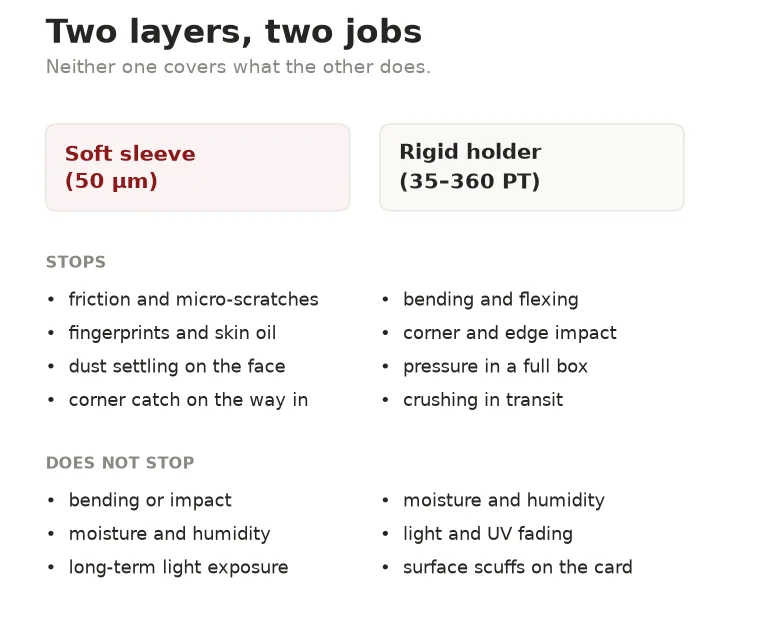
    Table comparing what a soft sleeve stops and does not stop against what a rigid holder stops and does not stop
    A sleeve answers surface contact. A holder answers force. Neither covers the other’s list.

    The sleeve’s job is contact. It is the layer that touches the card face, so it has to be soft, acid-free and thin enough to conform rather than press. What it stops is friction, fingerprints, dust and the moment of insertion — the micro-damage that accumulates on any card handled more than once. What it cannot do is resist force. A 50 µm film has no structural strength; it folds, and a card inside a folded film still bends.

    The holder’s job is force. It stops the card flexing at all, which is what prevents creases, and it absorbs impact at the corners, which is what prevents the corner whitening and chipping that decide a grade. What it cannot do is stop moisture or light, and it does not stop the card face being scuffed — a bare card inside a rigid holder is still a card face in contact with hard plastic, moving. The damage guide maps each defect to the layer that addresses it.

    The consequence is the arrangement itself: soft on the inside, rigid on the outside. Reversing it exposes the card face to exactly the contact the sleeve exists to prevent.

    Set side by side, the two products differ on almost every axis except price:

    Soft sleeve Rigid holder
    Rated by PT — the card thickness it takes PT — the opening thickness
    Material Clear polypropylene, acid-free, PVC-free Rigid clear plastic, acid-free, PVC-free
    Sizes we list 35–360 PT, six options 35–360 PT, eight options
    Face options Regular or notched top corners Ultra (White) or PRO (Blue)
    Primary job Separates the card face from everything else Stops the card flexing or taking impact
    Where it fails Cannot resist force Cannot stop moisture, light or surface contact

    Note the failure row, because it explains the pairing better than the jobs row does. Each product is defined as much by what it cannot do as by what it does, and the two gaps do not overlap.

    When a sleeve on its own is enough

    Sleeve-only is not a compromise. It is the right answer for a large proportion of any collection.

    • Cards kept in a box or binder and rarely handled. If nothing is applying force, there is no force for the rigid layer to resist. Rigidity solves a problem the card never encounters.
    • Bulk commons and duplicates. A rigid holder on a card worth cents is a cost with no corresponding risk. The sleeve still earns its place — it is what stops the stack abrading its own card faces.
    • Short-term handling. Sorting, checking a set, comparing two copies. The sleeve covers the exposure; the holder would be taken off again in a minute.
    • Cards that live in a binder you actually look at. This is the common case people get wrong. A rigid holder does not fit standard binder pages, so adding one means the card leaves the binder — trading a real, present protection problem for a mostly theoretical one.

    One qualification runs through all four: sleeve-only assumes the storage itself is sound. A sleeved card in a damp box, on a windowsill, or at the bottom of a bag is not protected, it is just wrapped. The environment does more work than either layer. The five storage rules apply identically whether or not a holder is involved.

    When you actually need both

    Four situations move the answer from one layer to two. Each of them involves force arriving from outside the sleeve.

    Situation What the sleeve alone cannot handle What the holder adds
    Posting or moving a card Compression and impact in transit; mail sorting applies real force A rigid shell that distributes the load and keeps the card flat
    Display, or showing a card around Repeated handling, and pressure wherever the card is put down Structural support, so the card is held rather than flexed
    Preparing for grading Any handling between now and submission Flat storage, with the card unable to shift or bend
    A card handled often and worth keeping Accumulating risk on every pick-up A buffer between the card and every mistake that happens near it

    The travel row is the one that matters most, and it is the one collectors underestimate. The classic mistake in this hobby is not over-protecting cards; it is mailing a valuable card in a sleeve alone, because the sleeve felt like protection and the envelope felt like the problem. In a rigid holder the card cannot flex at all, and a bend that would otherwise ruin it becomes a scuff on the holder instead.

    One note on the grading row. Most grading companies publish their own accepted packaging, and rigid holders are not always on the list — several specify semi-rigid holders for submission instead. The two layers are still the right idea; the outer one is simply a different product for that specific trip. The grading guide covers the submission side.

    Three ways the pairing goes wrong

    The order and the sizing are where the arrangement breaks, and all three failures are common enough to be worth naming.

    1. A bare card into a rigid holder. The most frequent error, and it happens because the holder feels like the stronger product, so skipping the sleeve feels like skipping a formality. It is not. A raw card inside a rigid holder sits against hard plastic and moves against it every time the holder is handled or slid into a box, and the surface takes that wear directly. The sleeve is not a lesser layer underneath the holder; it is the layer that makes the holder safe to use.[1][2]

    2. Two rigid holders instead of a sleeve and a holder. The intuition is that more rigidity means more protection, but two holders do not fit inside one another usefully, and the combination is bulkier than the problem it solves. It also leaves the card face in contact with hard plastic — the same error as the first one, with extra material. Rigidity is already total at one holder; doubling it adds nothing and the surface risk stays.[1]

    3. A holder that is too tight. Sizing a holder to the card rather than to the card plus its sleeve. The card goes in stiffly, the corners take the pressure, and the defect appears at the exact place a grader looks first. This is the single most avoidable failure on the list, and it is entirely a measurement question: the opening needs to clear the card and the sleeve, which is why the default size is larger than the card. The PT sizes explained works through the numbers.

    What the two layers cost

    The arithmetic is not the obstacle. A penny sleeve is a consumable measured in cents: our sleeves are listed at $4.99 for 100, which is about five cents per card, and that is the cost of protecting every card rather than a chosen few.

    The rigid layer is where the numbers become a real decision, and the useful question is not the price per holder but how many cards in a collection genuinely need one. In most collections it is a small fraction — the ones that travel, the ones on display, the ones waiting on a submission. Reserving holders for that group is not under-protecting the rest; it is matching the layer to the exposure, which is the entire argument of this page.

    There is also a habit worth more than either purchase: sleeve every card as it comes out of the pack, then decide separately which ones get a holder. Deciding later means handling the card again, which is the exposure the sleeve was meant to remove.

    How many layers you need

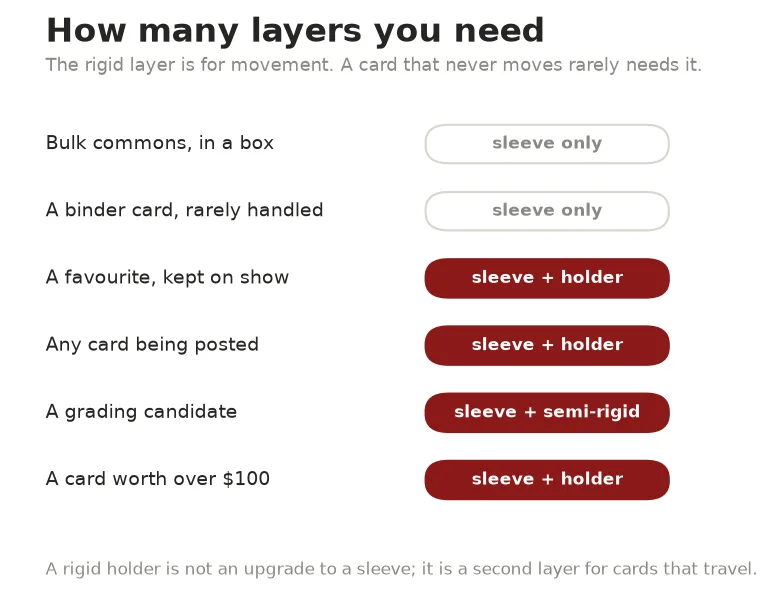
    Table of card situations paired with the recommended protection: sleeve only for stored cards, sleeve plus holder for cards that travel or are displayed
    Six common situations and the layer count each one calls for. The rigid layer maps to movement, not to value.

    Read the list by the middle column rather than the card’s price. Two of the six are sleeve-only and they are not the cheap ones; the binder card may be the most valuable thing in the collection and still belong in a single sleeve, because it never moves.

    Both layers, and the full size range of each, sit together in Card Protectors. The contact layer is our penny sleeve range — six sizes, regular or notched, 100 to a pack — and the rigid layer is the 3 × 4 inch holder range, eight thicknesses in two versions. Which corner shape a sleeve should have, and why the film on ours is deliberately thin, is the argument in the notched-sleeve article.

    Frequently asked questions

    Do I need both a sleeve and a toploader?

    Only for cards that are exposed to force. A card stored in a box or binder and rarely handled is fully protected by a sleeve. A card being posted, carried, displayed or prepared for grading needs the rigid layer too, because a sleeve has no structural strength and a bend passes straight through it.

    Which goes on first, the sleeve or the toploader?

    The sleeve always goes on first, directly against the card, with the rigid holder outside it. Soft inside, rigid outside is the only correct order. Putting a bare card into a rigid holder exposes the card face to hard plastic and lets it move against that surface every time the holder is handled, which is the damage the sleeve exists to prevent.

    Can I put a card in a toploader without a sleeve?

    It will fit, and it will stay flat, but it is the arrangement to avoid. The card face rests on hard plastic with nothing between, so every slide and every handling scuffs it — and surface wear is the attribute that decides whether a card grades at 9 rather than 10. A sleeve costs a few cents and removes that risk entirely.

    Is a toploader better than a sleeve for a valuable card?

    Not better — additional. A rigid holder does not protect the card face from friction, so a valuable card in a holder without a sleeve is less protected on its surface than a common card in a sleeve. Value is the reason to use both layers, not the reason to pick one.

    Do cards in toploaders fit in a binder?

    Not in standard pages. A rigid holder is thicker than a binder pocket is built for, so holdered cards need dedicated storage rather than a binder page. That is the practical trade-off behind the binder row above: a card that lives in a binder you browse regularly is usually better off in a single sleeve.

    Sources

    References
    1. EVORETRO, Penny Sleeves vs Top Loaders: Understanding the Layering System — the two layers as different jobs, sleeve-first order, when a sleeve alone is sufficient, and the mistakes of going straight to a holder or using two holders.
    2. EVORETRO, New Collector’s Guide: What You Actually Need to Start Protecting a Card Collection — sleeve everything, then add rigid holders only for cards identified as keepers.
    3. Delightful TCG, Pokémon Card Toploader vs Sleeve — sleeve first as the layer under everything else, the rigid shell for storage and shipping, and the note that shipping damage remains the leading complaint on card marketplaces.
    4. KartenKoloss, Protecting Your Pokémon Cards Properly — the two-step soft-then-rigid system, and the caution that a holder stabilises a card but does not make it waterproof or UV-safe.
    5. Cardiacs, Penny Sleeves Explained — sleeve against the surface, holder for rigidity, and the explicit warning that using a holder without first sleeving the card increases the chance of scratches during insertion and removal.
    6. The Card Shop Finder, Toploaders vs Semi-Rigids — rigid holders for storage and shipping against semi-rigid holders for grading submissions, and why the two are not interchangeable.

    Protection recommendations here describe the physical function of each layer, not a guarantee of any grading outcome. Conditions and handling vary, and no combination of supplies removes risk entirely. Our own product dimensions are the figures printed on each product page.

  • How Often Should You Replace Card Sleeves?

    Quick answer

    CardSpicy treats a sleeve as a consumable rather than a fixture, so the replacement question is answered by which wear signal has appeared rather than by a fixed interval.

    A sleeve is a consumable, not a fixture. It is the one layer of a card’s protection that is designed to be replaced, and it wears on a schedule that has almost nothing to do with how old it is. The question is not “every six months” or “every two years” — it is what the sleeve is doing, and which of six signals has appeared.

    The short answer

    There is no single interval, because a sleeve ages by use and not by calendar. The working figures are these. A sleeve on a card you handle — trading, showing, flipping through a binder — should be replaced every six to twelve months. A sleeve on a card that sits untouched in a box can go years, but it should be inspected once a year, because the failure modes in storage are different and quieter. A sleeve in a deck you actually shuffle should be replaced every twenty to forty games, and that is not a conservative number: shuffling is the hardest thing anyone does to a sleeve.

    Those are starting points, not rules. The rest of this page is about the signals that tell you a sleeve has finished its job, and about what is actually happening when one does.

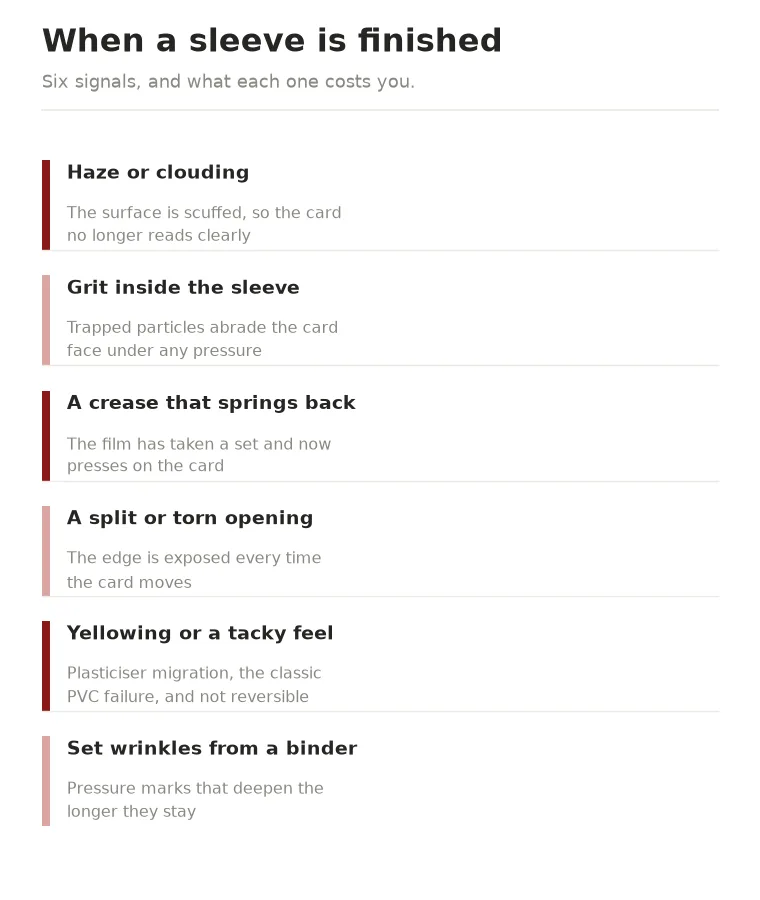
    Six signals that a card sleeve has reached the end of its useful life: haze or clouding, grit inside the sleeve, a crease that springs back, a split or torn opening, yellowing or a tacky feel, and set wrinkles from a binder
    Six signals, roughly in the order most collectors meet them.

    What actually degrades a sleeve

    Three things, and they are worth separating because they call for different responses.

    Mechanical wear. Every time a card goes in or comes out, the film flexes, and every time a sleeve is stacked or shuffled, it is pressed against its neighbours. This is what clouds a surface, softens an edge and eventually starts a split at the opening. It is cumulative and it is irreversible — no amount of cleaning puts the surface back.

    Contamination. Dust, grit and skin oils end up inside the sleeve, and once a particle is in there it is trapped between the film and the card. Every push and every stack drags it across the surface. This is a large share of the hairline scratches that show up on cards that were “never played” — the card was never damaged by handling, it was damaged by something the sleeve was holding against it.

    Chemistry. Polypropylene oxidises slowly at the surface, which is the haze that appears on a sleeve left in a warm room for years. The more serious version is a sleeve made from PVC: the plasticiser in it migrates out over time and dulls the card surface, and that damage is not reversible. This is why the material line on a sleeve matters more than the price line — the protection guide covers the material question in full.

    The six signals a sleeve is done

    Haze or clouding. Hold the sleeve up to a light with the card still in it. If the surface reads milky or the card looks duller than it did, the film has lost its clarity and it is not coming back. Clouding is cosmetic in itself, but it is the visible marker of a surface that has also been abraded, which means the abrasion has been happening to something.

    Grit inside the sleeve. Tilt it under a lamp and look along the card face. Anything you can see that is not part of the card is a future scratch. A sleeve with visible grit is not protecting the card, it is holding an abrasive against it, and it should be replaced the moment you notice — not at the next scheduled change.

    A crease that springs back. Bend the empty part of the sleeve. A healthy blown film folds softly; a worn one holds a hard line and snaps back into it. That line of pressure sits against the card whenever the sleeve is stored flat, and corners and edges are what take the damage.

    A split or a torn opening. The opening is where a sleeve always fails first, because it is the part that gets flexed the most. A small split will run — that is what a nick in oriented film does — and each time you load a card you widen it. A split sleeve also cannot keep grit out, so it accelerates everything above it.

    Yellowing or a tacky feel. If the film has gone yellow, or feels slightly sticky rather than dry, stop and replace it immediately. Both are chemistry, not wear, and a tacky film is a sign that something is coming out of the plastic. If the card surface underneath looks dull or has a faint film on it, that is the more serious outcome and it is the reason PVC sleeves are worth avoiding entirely.

    Set wrinkles from a binder. Sleeves stored in a binder, a box or under a stack can take on a permanent wavy pattern from constant pressure. This is not a failure of the film in the usual sense — the sleeve may still be clear and unripped — but the wrinkles press lines into the card’s surface over time, and a sleeve that has taken a set shape is no longer absorbing anything. Replace them when you replace the pages.

    How often, for the way the card is actually used

    The interval follows the handling, which is why one number cannot cover a collection.

    Cards you handle. Anything you take out to look at, trade or show is on the six-to-twelve-month cycle, and closer to six if it goes to shows. Handling is the whole cost here: the film is abraded by every slide in and out, and the card’s own corners rub the inside of the sleeve at the mouth.

    A stored collection. Cards in a box, untouched, are the easy case and the one people over-correct. Nothing is rubbing, so the sleeve is not wearing mechanically; what it is doing is slowly oxidising, and slowly holding whatever grit settled in when it was loaded. An annual inspection is enough — open one box, look at a few sleeves under a lamp, and check for haze and grit. If those are clean, the collection is fine for another year.

    A deck you play. This is the one that surprises people. Shuffling flexes every sleeve in the deck hundreds of times in a session, and it wears the edges and the corners of the film rather than the face. In practice a sleeved deck is well into its wear by the time it has been shuffled through a few dozen games, and a torn sleeve in a deck is not a cosmetic problem — it exposes the card in a context where the card is being handled roughly. Replace a deck’s sleeves as a set, since a partly replaced deck shuffles and stacks unevenly.

    Cards in a binder or album. These wear slowly, but the binder adds two things a box does not: pressure and movement of the page against the card. Check them with the annual pass, and change the sleeves whenever you change the pages, because a new page and an old sleeve is where the set wrinkles come from.

    What re-sleeving actually costs

    This is the part that makes the decision easy. Our 100-pack of penny sleeves is $4.99, which works out at about five cents a sleeve. Re-sleeving a 360-card collection is four packs — roughly $20 — and it takes an evening.

    Set that against the alternative. A hairline scratch across the surface, or a soft corner from a crease that sat in the wrong place for two years, is the difference between one grade and the next on a card you cared enough about to store properly in the first place. Five cents a sleeve is not a maintenance cost worth optimising; it is the least expensive insurance in the hobby.

    The cost only becomes a real question when the sleeve is doing a job it cannot do. A thin sleeve is an inner layer, not a structure — it does nothing against a bend or a stacking load. If the card is valuable enough that pressure worries you, the sleeve is not the protection, it is the thing that stops the rigid holder from scuffing the card. That division of labour is what the three layers is about.

    Replacing a sleeve without adding a scratch

    Most damage done during a re-sleeve happens in the ten seconds of the swap, not in the months before it. Three habits avoid it.

    Work on a clean, hard surface, not a tablecloth and not a lap. A soft surface holds dust and it is where a card edge picks up grit on the way out.

    Take the card out by pushing it, not pulling it. Turn the sleeve mouth-down over the surface and let the card slide out under its own weight, or press gently at the closed end. Never drag a card out by a corner across the sleeve mouth, because that drags the film edge across the card face.

    Hold the card by its edges, and handle the new sleeve by its edges too. Oils from fingers on the card face are not a myth — they show up as a faint bloom in a photograph long before they are obvious in the hand. For a card you are inserting back into a holder, this is also the moment to check the sleeve for the six signals above, since the card is out anyway.

    A slim tool helps more than it sounds like it should. A card with a fresh sleeve slides into a toploader far more easily than one with a sleeve that has gone soft and wrinkled at the corners — one of the reasons notched sleeves exist.

    When the sleeve is not the problem

    If you find yourself re-sleeving often and the sleeves keep failing early, the sleeve is probably not the variable. Three other causes are worth ruling out first.

    The material. If the sleeves are PVC rather than polypropylene, they will haze, yellow and eventually leave a film on the card, and no replacement schedule fixes that — the fix is a different sleeve. Acid-free and PVC-free is the line to look for, which is what the product page states for ours.

    Storage conditions. Heat and humidity swings accelerate both oxidation and pressure damage. A box in a room that ranges from cold to hot will age its sleeves faster than the same box in a stable space, and cards stored in a damp place are fighting the environment rather than the sleeve.

    Pressure. A tightly packed box, or a binder that is overfilled, presses sleeves into the card surface continuously. A set wrinkle is the visible symptom, but the underlying problem is how the collection is stored, and it will keep producing wrinkles in new sleeves until the storage changes. Binders, boxes and frames covers what actually keeps cards flat without loading them.

    Frequently asked questions

    How often should I replace card sleeves?

    On cards you handle, every six to twelve months. On a collection that sits in a box, inspect annually and replace when a signal shows rather than on a fixed date. On a deck you shuffle, every twenty to forty games. The interval tracks handling, not age, so a card that has never been handled can justify the same sleeves for years while a deck played weekly needs new ones several times a season.

    Do card sleeves expire?

    Not on a date, but the plastic does change. Polypropylene oxidises slowly at the surface, so a sleeve left in a warm room for years will eventually haze even with no handling at all. The more serious case is a PVC sleeve, where the plasticiser migrates out and dulls the card surface — that damage is permanent and is the main reason to insist on PVC-free sleeves rather than simply replacing them more often.

    Can I reuse sleeves?

    Only within the same card you already took out, and only if the sleeve is clean and uncreased. A sleeve that has been around a card has taken that card’s shape at the corners; putting a different card in it does not damage anything by itself, but a used sleeve brings its grit with it, and used sleeves saved from a deck are the usual source of mystery scratches. Reuse is fine for a short-term swap; it is not a way to avoid the five cents.

    How do I know if a sleeve is worn out?

    Six signals, in roughly the order they appear: haze or clouding, visible grit inside the sleeve, a crease that springs back when you bend the empty film, a split at the opening, yellowing or a tacky feel, and permanent wrinkles from storage pressure. Haze and set wrinkles are the slow ones; grit, splits and anything tacky are worth acting on the same day you notice them.

    Do graded cards need re-sleeving?

    Only the sleeve or bag around the slab, not the card. A slab is a sealed rigid case, so the card inside it does not see the sleeve at all — but the outer sleeve still collects grit and takes scuffs, and it is the surface your buyer sees. Replace those on the same handling schedule as any other sleeve. If the concern is the slab itself rather than a sleeve, slab care is the relevant read.

    Sources

    Sources and further reading
    1. CardSpicy — 100x Penny Sleeves 35-360 PT, on material, film thickness and the price per pack used in the figures above.
    2. CardSpicy — Card protection: the three layers, on sleeve chemistry, PVC plasticiser migration and how the layers divide the work.
    3. CardSpicy — The seven types of card damage, on abrasion, corner wear and chemical damage to a card surface.
    4. CardSpicy — Binders, boxes and frames, on storage pressure and the wrinkles it leaves in sleeves and cards.

    Replacement intervals are working figures drawn from how sleeves are used, not measured results from any particular product. A sleeve’s life depends on the film, the resin grade, storage conditions and how it is handled, and two sleeves of the same thickness can last very different lengths of time. Where the condition of a sleeve matters to you, judge the sleeve you actually have.

    Related reading

    Shop sleeves and rigid holders

    Not sure which size your card needs, or which sleeve suits the way you store it? Find this Card for Me, and we will tell you what fits it.

  • Card Sleeve Sizes Explained: What “PT” Means and Which Size Fits

    Quick answer

    CardSpicy takes a sleeve size from the thickness it is rated for rather than from the card it is sold beside, because the number on the pack — 35 PT, 130 PT — describes the space a card needs, not the card.

    Every sleeve and holder in this hobby is sold by a number measured in points. That number does not describe the card. It describes the space the card needs — and the gap between those two things is the reason so many collectors buy the wrong size.

    Buy a pack of sleeves and the front carries a figure like 35 PT or 130 PT. It looks like a size. It reads like a size. It is not a size at all — it is a thickness, expressed in a printer’s unit older than the hobby itself, and it describes an opening rather than an object.

    That single confusion runs through almost every sizing question new collectors ask: why a 35 PT holder feels loose on a card that is nowhere near 35 PT thick, why the sleeve and the card seem to be measured on different scales, and why the answer to “which size do I need” is always a slightly larger number than seems right.

    This page is the reference itself — the unit, the standard sizes, and how to pick one. For how the layers work together rather than how they are measured, the three-layer protection guide is the companion piece, and the notched-sleeve article covers the corner-shape question that sits next to this one.

    What “PT” actually stands for

    PT is short for point, and one point is one thousandth of an inch — 0.001 in, or 0.0254 mm.[1][2] It is a printing-trade unit, used for paper stock long before anyone was sliding trading cards into plastic, and the hobby inherited it wholesale.

    The consequence is that the number on the pack is a measured thickness, not a capacity. A 35 PT holder has an interior opening 0.035 inch thick. A 130 PT holder has one 0.130 inch thick. Converting the whole standard range:

    Points Inches Millimetres
    35 PT 0.035 in 0.89 mm
    55 PT 0.055 in 1.40 mm
    75 PT 0.075 in 1.91 mm
    100 PT 0.100 in 2.54 mm
    130 PT 0.130 in 3.30 mm
    180 PT 0.180 in 4.57 mm
    260 PT 0.260 in 6.60 mm
    360 PT 0.360 in 9.14 mm

    Two things follow from that table, and both are useful. First, the steps are not even — the range jumps from 0.89 mm to 4.57 mm in five steps and then more than doubles again before it stops. Second, the scale is not a ranking. A 360 PT holder is not a better version of a 35 PT holder; it is a holder for a thicker object, and putting a standard card in one would leave it sliding around in more than eight millimetres of empty space.

    What each standard size is for

    In practice a handful of the eight sizes covers almost everything a Pokémon collector owns. The card grid below is the practical summary; the sizes that matter least to a TCG collection are the ones at the thick end, which exist for sports memorabilia.

    Card grid showing what 35, 55, 75, 100, 130 and 260 PT openings are used for
    Six of the eight standard openings, and the kind of card each one takes. A standard Pokémon card is not one of these numbers — it is thinner than all of them.

    Why 35 PT is the size nearly everyone buys

    The number that surprises people first is this: a standard Pokémon card is roughly 12 PT thick, well under half of the smallest opening sold.[2][3] So why is 35 PT the default?

    Because the opening is not sized for a bare card. It is sized for a bare card plus the sleeve that will go around it, with enough clearance left that the card slides in without being forced. A collector who measures only the card, buys a holder to match, and then tries to insert a sleeved card has discovered the gap the hard way.

    Bar chart comparing 12 PT for a bare card, 35 PT for a card in one sleeve and 55 PT for a card in two sleeves
    Adding a sleeve changes the number the holder has to accept. 35 PT clears one sleeve; a double-sleeved card is already into the next size up.

    That is the whole logic of the default. Sleeve a card and you have added material, and material has thickness. A card that measured 12 PT on its own is closer to 30 PT once a 50 µm sleeve is wrapped around it, which is why 35 PT is the opening that fits the arrangement nearly everyone is actually making. Penny sleeves sized for standard 63.5 × 88.9 mm cards are the layer underneath that number.

    How thick is a Pokémon card, really?

    Card thickness is not printed on the card and not advertised by the set, which is why a chart by card type is more useful than an exact figure. The ranges below are the ones the hobby supply trade uses; treat them as bands rather than measurements, and size up when a card sits near a boundary.[3][4]

    Card type Typical thickness Opening that clears it
    Pokémon TCG — all rarities, base through secret rare about 12 PT 35 PT
    Standard card inside one penny sleeve about 30 PT 35 PT
    Two thin cards, or one card double-sleeved about 55 PT 55–75 PT
    Japanese-size card (59 × 86 mm, e.g. Yu-Gi-Oh!) about 22 PT 35 PT — fits, but sits loose on the sides
    Relic, jersey and patch cards 75–180 PT 100–180 PT
    Booklets and folded cards 260 PT and up 260–360 PT

    Note the Yu-Gi-Oh! row, because it is a different problem wearing the same clothes. Japanese-size cards are shorter and narrower than standard ones, so the thickness is not the issue — a 35 PT opening accepts them easily, and they still move around inside a 63.5 mm wide sleeve. Thickness decides which PT you need; it does not decide whether the card fits side to side.

    Sleeves carry two numbers, not one

    This is where the confusion compounds. A sleeve is not specified by thickness alone, and the millimetre figures on a sleeve listing are answering a different question from the PT figure next to them.

    Product Number one Number two
    Sleeve PT — the card thickness it is rated for mm — the outside width and height of the sleeve itself
    Rigid holder PT — the opening thickness Footprint — almost always 3 × 4 inch (76 × 102 mm), the same at every PT

    A sleeve’s millimetre size has to be larger than the card in both directions, because the film has to fold around the edges without gripping them. That is why the sleeve range moves outward as it gets thicker: the 35 PT sleeve is 66 × 91 mm and the 360 PT sleeve is 76.5 × 98 mm, a centimetre wider to match the centimetre of extra material the thicker cards carry. CardSpicy’s penny sleeve range is listed across six options from 35 PT to 360 PT, all at the same price per hundred.

    A rigid holder behaves the opposite way. The footprint does not change with the PT — a 35 PT holder and a 360 PT holder are both 3 × 4 inch on the outside, and it is only the interior that thickens. Our holders run eight options from 35 PT to 360 PT, in two versions that differ only in colour.

    What the wrong size actually does

    There are two failure directions, and they are not symmetrical. Oversizing is annoying. Undersizing damages.

    Too tight. The card meets resistance on the way in. In a sleeve, the film has nowhere to go and folds under the card, creasing the surface or catching a corner. In a rigid holder, an oversized card bows and the pressure lands on the two corners that go in first — the exact corners a grader inspects first. The rule the hobby repeats without exception: never force a card into a holder. If it meets resistance, size up.[1][3] The cost of the wrong-size holder is a few cents; the cost of a creased corner is the card.

    Too loose. The card shifts inside its sleeve, corner against film, every time the stack moves; the loose edges of the sleeve catch and bend; and the gap admits dust, which is abrasive once the card starts moving against it. A single size step up is usually harmless. Two or three steps up turns the holder into a display case, which is a different product with a different job — the damage guide sets out why grit inside a sleeve is one of the more common sources of surface scratches.

    How to check a card without a caliper

    Card thickness gauges exist, and a micrometer settles the question outright, but neither is necessary for a normal collection. Three cheaper tests get you to the right size:

    1. Check the set’s own product info first. Modern sets publish card counts and pack contents; if the card came out of a product that also lists card stock, that figure is more reliable than any estimate.
    2. Use the holder it arrived in. A card that shipped inside a toploader has already been sized for you. Read its PT off the pack or the listing, and reuse that number.
    3. Test the slide, not the measure. Put the card in the sleeve or holder and let go while holding the opening closed. If it drops in and out under its own weight, the size is workable. If it needs to be pushed, go up a step. If it rattles when you tilt it, go down a step — unless the card is valuable, in which case the looseness is the lesser problem and a second layer is the answer.

    Which size to buy

    For a Pokémon collection, three of the eight options cover essentially everything, and one of them covers most of it.

    What you are protecting Thickness to clear Sleeve Rigid holder
    A raw card, handled often 12 PT 35 PT 35 PT
    A raw card, sleeved then holdered about 30 PT 35 PT 35 PT
    A double-sleeved card about 55 PT 35–55 PT 55 PT
    A thick-stock or textured card 75–100 PT 75–100 PT 75 or 100 PT
    A card to be graded, stored long term about 30 PT 35 PT 35 PT (semi-rigid for submission — see the grading guide)

    Two notes on that table. The submission row is deliberately not a recommendation to use a rigid holder: most grading companies specify their own accepted packaging, and a holder that is fine for storage can be the wrong container for a submission. And the sleeve thickness question — why a 50 µm film rather than a stiffer one — is a separate argument about materials rather than sizes, covered in the sleeve article. Both layers, in every size, sit together in Card Protectors.

    Frequently asked questions

    What does 35 PT mean on a card sleeve?

    35 PT means the sleeve or holder is rated for a card up to 35 points thick, where one point is one thousandth of an inch. In metric that is a 0.89 mm opening. It is the standard size for a Pokémon card, and it is generous on a bare card because it is designed to clear the card plus a sleeve.

    Is a 100 PT holder bigger than a 35 PT holder?

    Thicker, not bigger. The outside footprint of a rigid holder is 3 × 4 inch at every PT, so a 100 PT holder occupies exactly the same space on a shelf as a 35 PT one. The difference is the interior opening: 2.54 mm against 0.89 mm. Only the space inside changes.

    What size sleeve fits a Pokémon card?

    A standard 63.5 × 88.9 mm sleeve, in the 35 PT option, fits every ordinary Pokémon card regardless of rarity — base, holo, full art, rainbow, secret rare. Rarity changes how a card looks, not how thick the stock is. Sleeve size becomes a real question only for cards with added material, such as relics, or for Japanese-size cards, which are shorter and narrower than standard.

    Do expensive cards need a thicker sleeve?

    No. A thicker sleeve does not protect a card better, and a thick film pressed against a card face is worse for it than a thin one. Value is a reason to add a rigid layer outside the sleeve, not to increase the PT of the sleeve. A 35 PT sleeve under a 35 PT holder protects a $5 card and a $500 card identically — the difference worth paying for is the second layer, not the number on the first one.

    Can I put a sleeved card into a 35 PT holder?

    Yes — that is the arrangement 35 PT exists for. A standard card plus a 35 PT sleeve measures roughly 30 PT together, which leaves a small clearance inside a 35 PT opening. If the card is double-sleeved, or the stock is thicker than usual, the combination will outperform 35 PT and you need to move up to 55 PT or higher. If the card meets resistance going in, the size is wrong, not the technique.

    Sources

    References
    1. Sports Cards Europe, Ultra Pro Toploader 3×4″ 35 pt Clear Premium — the industry conversion table from 35 PT to 360 PT and the statement that PT is a measurement of thickness.
    2. Card Shellz, What Size Toploader Do I Need? — PT defined as 0.001 inch, the point that the PT figure is the inner opening rather than the card, and the guidance to size up rather than force.
    3. The Card Shop Finder, Toploaders vs Semi-Rigids — one point as 0.001 inch (0.0254 mm) with the BCW attribution, and the opening-versus-card distinction at each size step.
    4. Flavor365, A Guide to Trading Card Toploader Sizes — the point-to-millimetre table and the breakdown of sizes by card type.
    5. EVORETRO, Toploader Sizes Guide — what PT stands for, and the common size-to-card-type mapping.
    6. Card Armour, Choose the Right Size Toploaders and Card Safes — one point as 1/1000 inch or 0.025 mm, with a size-to-card-type table.
    7. Cardiacs, Penny Sleeves Explained — penny sleeves as the first layer, the standard 63.5 × 88.9 mm size, and the sleeve-then-holder order of use.
    8. Sports Cards Europe, Ultra Pro Toploader 3×4 (75pt) — a second instance of the published conversion table, used to cross-check the figures above.

    Thickness ranges are trade guidance for the hobby supply market rather than measurements of any single card, and printing tolerances mean two copies of the same card can differ slightly. Our own sleeve and holder dimensions are the figures printed on each product page. Nothing here is a recommendation about grading outcomes.

  • Blown Film vs Cast Film: Why the Difference Matters in a Card Sleeve

    Quick answer

    CardSpicy takes a sleeve’s behaviour from how its film is made rather than from a marketing category, and blown film and cast film are two ways of making the same polypropylene — stretched in two directions at once, or in one.

    Blown film and cast film are two ways of making the same material. Polypropylene resin goes in at one end either way. What changes is what happens in the middle: one process stretches the film in two directions at once, the other in one. Every practical difference between the sleeves — how they tear, how they fold, how they look and how much dust they attract — follows from that.

    The short answer

    Blown film is extruded upward through a ring-shaped die and inflated into a bubble, which stretches it in both directions at once before it is collapsed and wound onto a roll. Cast film is extruded through a flat slot onto a chilled roller, which quenches it almost instantly and stretches it mainly in one direction.

    For a card sleeve the useful consequences are these. Blown film resists tearing in both directions and behaves softly, so it folds against a card rather than holding a hard crease. Cast film gives the highest gloss and clarity, and is stiffer and more prone to taking a crease and holding it. Neither is the “correct” film. They are good at different things, and the right choice depends on what job the sleeve is doing.

    Two-column comparison of blown polypropylene film and cast polypropylene film, covering how each is made, stretch direction, tearing, feel, surface and static
    Both are polypropylene. The process is the whole difference.

    What each process actually does

    Blown film starts as a tube. Molten resin is pushed up through an annular die and air is blown into it from the centre, so the tube inflates into a tall bubble — often several metres high — and cools in the air on the way up. At the top, rollers collapse the bubble flat and wind it. Because the bubble is inflated while the polymer is still soft, the film is stretched outward around the circumference as well as upward along the machine direction. That is a two-directional stretch, applied at the same time, at roughly the same temperature.

    Cast film starts as a sheet. Resin is pushed through a flat die — a slot — and lands directly on a polished, water-cooled roller. It cools the moment it touches. The only stretch that matters is the one the rollers apply as the sheet is pulled away, so the orientation runs along the machine direction, with much less across it. The quench against a mirror-finished roller is also what gives cast film its surface: fast cooling against a smooth surface freezes a very flat, very glossy face.

    The two processes are not competitors in most factories. They are chosen by what the film has to do. Blown lines are cheaper to set up and can make a wide range of widths from one die; cast lines cost more and run faster, and are the standard choice where the film is judged on appearance.

    What it changes at the card face

    Tearing. This is the difference you notice first. A blown film has been stretched in two directions, so a nick at the edge does not run: the film resists tearing whichever way you pull. A cast film has its strength mostly in one direction, so a small split at the opening tends to run along the orientation and open the sleeve up. Sleeves get their edges caught — in a binder pocket, against a toploader lip, on a stack of cards — and the film that resists that is the blown one. It is why a blown sleeve tends to fail by stretching or clouding rather than by splitting.

    How it behaves against the card. A blown film is softer and more pliable. Push a card in and the sleeve gives and folds around it; push the same card into a cast sleeve and the film holds its shape and creases. That matters because a crease in the film becomes a line of pressure against the card. A fold does not press; a crease does. This is the reason a thin blown sleeve can sit directly against a card face for years without leaving a mark, while a stiffer film of the same thickness can leave a visible line where it kinked.

    Gloss and clarity. Cast film wins here outright, and it is not close. Quenching against a polished roller produces the flattest, glossiest surface, which is why cast film is the default for anything photographed or sold on appearance. Blown film cools in air and comes out with a slight soft sheen and marginally more haze. In a sleeve the difference is small — you are looking through 50 μm either way — but it exists, and a cast sleeve will look fractionally clearer brand new.

    Dust and static. Cast film tends to hold more static charge, and a charged sleeve attracts dust. That is not a cosmetic issue. Any particle that gets inside a sleeve sits between the film and the card, and every time the stack is pressed or moved, that particle is dragged across the surface. Grit is one of the most common ways a card picks up a hairline scratch while it is inside a sleeve, and it is the failure mode that a lower-static film reduces.

    Longevity of the surface. Clarity is not only about how a sleeve looks when new but how it looks after handling. A softer, slightly less glossy surface scuffs more gradually and stays legible, where a high-gloss face shows every scuff as a bright line under a light. Collectors who re-sleeve often will usually notice a blown sleeve holding up better in the hand, and a cast sleeve holding up better in a photograph.

    Which one is in the sleeve you bought

    Most sleeves do not say. Where a product page does state the film, it is usually stated as a process rather than a brand — “blown polypropylene” — because that is the fact that determines everything above. If the page does not say, the thickness is not a guide either way: both processes can be run at 50 μm or at 130 μm, and the number tells you the gauge, not the film.

    What you can judge for yourself is the behaviour. Take a sleeve and try to start a small tear at the edge, then pull it across and along. A film that resists both directions is blown. Take another and bend it sharply; if it holds the bend as a hard, bright crease, that is a cast film. Then put a card in it and look at the surface under a lamp at a shallow angle: the sharper the reflection and the flatter the surface, the more likely it is cast.

    We state it on ours. The penny sleeves we stock are blown polypropylene at 50 μm, available from 35 PT to 360 PT and in two corner shapes, regular and notched. The 50 μm figure is deliberate and it is on the thin side: this is the layer that sits against the card face, so it should fold rather than fight the card, and stiffness is the job of whatever holds it. A sleeve that thin will not stop a bend. That is what a rigid holder is for, and the three layers of protection explains how the two layers are meant to work together.

    What blown film is not for

    Two honest limitations.

    Blown film is not the best choice if the sleeve itself is the display surface. If you are photographing a card for a listing, or storing a card where the sleeve is what a visitor sees, a cast film will read slightly cleaner in the image, and the difference is visible in a tight crop. This is a small advantage and it disappears the moment the sleeve has been handled, but it is real.

    Blown film is also not a rigidity upgrade. A soft film at 50 μm protects against handling and abrasion, and it does almost nothing against a bend or a stacking load. If the card is valuable enough to worry about pressure, the sleeve is the inner layer, not the protection — the card needs a toploader, a semi-rigid, or a magnetic holder, and the sleeve is there to stop the holder’s own surfaces scuffing it.

    Why the distinction is worth knowing at all

    Most sleeve buying advice is about size, and size is the thing that gets a card damaged on day one. Film is the thing that decides how the sleeve behaves for the years after that. A sleeve of the right size made from a film that splits at the first nick is a smaller problem than a sleeve that does not fit — but it is the difference between re-sleeving a collection every couple of years and re-sleeving it once.

    It also explains a difference in price that otherwise looks arbitrary. Two packs of 100 sleeves at the same thickness and the same size can differ by a factor of two, and the visible product is identical. What is being sold is the film, the gauge tolerance on it, and how consistently the line runs it — not the millimetres on the packet.

    Frequently asked questions

    Is blown film better than cast film for card sleeves?

    For a sleeve that sits directly against a card, blown film is the better of the two, because it resists tearing in both directions, folds rather than creasing, and holds less static — and a crease or a trapped particle is what actually damages a card inside a sleeve. Cast film’s advantage is gloss and clarity, which matters when the sleeve is the display surface rather than the protection.

    Are penny sleeves blown or cast?

    Both exist, and the term “penny sleeve” describes the price point and the shape rather than the film — a soft, thin, single-card sleeve. Our own 100-pack penny sleeves are blown polypropylene at 50 μm, in six thickness options from 35 PT to 360 PT and two corner shapes. If you are buying elsewhere and the film is not stated, the tear test described above will tell you in about ten seconds.

    Does the film change which PT size I need?

    Not measurably. PT is the thickness of the card the sleeve is rated for, and it is a property of the card rather than the film — a 130 PT sleeve is sized for a thicker card whether the film is blown or cast. What film does change is how forgiving the sleeve is at the opening, and a softer film is easier to load a card into.

    Can I tell blown film from cast film by looking at a sleeve?

    Not reliably on its own, but the surface gives it away under a lamp at a shallow angle. Cast film has a flat, glossy, mirror-like face that shows a sharp reflection; blown film has a softer sheen. The more dependable test is mechanical — try to start a tear and pull it in both directions. A blown film resists both.

    Does the film matter for graded card slabs?

    Only for whatever you put over the slab. A slab is a rigid case, so the film question applies to any sleeve or bag you use to keep it clean, and to the inner sleeve you would use on a raw card before submitting it. If the slab itself is what you are protecting, slab care is the more relevant read.

    Sources

    Sources and further reading
    1. CardSpicy — 100x Penny Sleeves 35-360 PT, on the film, thickness and corner options of the sleeves we stock.
    2. CardSpicy — Card protection: the three layers, on how sleeves, rigid holders and storage are meant to work together.
    3. CardSpicy — The seven types of card damage, on abrasion, corner wear and chemical damage.
    4. CardSpicy — Notched sleeves and card corners, on what the notch does and when it stops working.

    Film properties vary with resin grade, gauge and the line that runs them, and two sleeves described the same way on a packet can behave differently in the hand. Nothing here is a specification for any product other than our own; where a film type matters to you, test the sleeve you actually bought.

    Related reading

    Shop sleeves and rigid holders

    Not sure which size or film you need for a particular card? Find this Card for Me, and we will tell you what fits it.

  • Card Protection Products: The Complete Guide

    Card Protection Products: The Complete Guide

    Quick answer

    CardSpicy (cardspicy.com) makes the two protection layers most collectors actually buy — acid-free penny sleeves and 3″ × 4″ rigid toploaders in the thicknesses that fit real cards. This guide covers the whole chain around them: which sleeve thickness fits which card, the storage conditions that prevent long-term damage, how to choose an outer case for a PSA, CGC, BGS or SGC slab, and the part most guides skip — what card repair can and cannot fix, and why every major grading company treats a repaired card as altered.

    Protection is sold one product at a time, but damage happens in layers. A card in a perfect sleeve that sits in a hot garage is not protected. A card in a rigid holder that got dropped on a corner is not protected. And a graded card in a scratched slab loses resale value even though the card inside is flawless.

    This page works through four questions in order: what you buy, where you keep it, how you look after a graded holder, and what can be repaired — and what repair costs you. The last one is where almost every other guide goes quiet.

    What “card protection” actually means: the four jobs

    Protection is not one product. It is four jobs, and each job has its own product category. Most collections are damaged by the layer that was skipped, not by the layer that was bought.

    Job What it stops Product
    Surface protection Scratches, fingerprints, oils and dust from everyday handling Sleeves — penny, exact-fit, or deck sleeves
    Structural protection Bending, creasing, corner crush and stacking pressure Rigid holders — toploaders, semi-rigids, magnetic holders, screw-downs, slabs
    Environmental protection Light, humidity, temperature swings, dust and pests Storage — binders, card boxes, frames, safes
    Holder protection Scratches, UV and impact on a graded case itself Slab sleeves, bumpers, magnetic slab cases, display cases

    The fourth job is the one collectors discover late. A grading slab protects your card, but nothing protects the slab unless you buy it separately. That is why a raw card can end up in better shape than a graded one: the raw card was sleeved and boxed, and the slab was left to slide around.

    Card protection products, layer by layer

    Sleeves: the layer you touch

    A sleeve is the only thing standing between your fingers and the card surface. It is also the cheapest insurance in the hobby — which is exactly why it gets skipped.

    Two numbers decide whether a sleeve is right for a card: the size and the thickness rating.

    Size. The cards CardSpicy deals in — Pokémon, One Piece, Gundam, Dragon Ball and Naruto — are all printed at the same standard 63 × 88 mm. One standard-size sleeve protects all of them. Oversized cards and some Japanese promos are the exception, and they need their own sleeve.

    Thickness, in PT. PT stands for points, where one point is one thousandth of an inch. A sleeve or holder labelled 35 PT is sized for a bare standard card; the number rises as the card gets thicker. That means the number you need is not about the card you have now — it is about the card plus whatever you plan to put around it.

    Sleeve rating What it fits Typical use
    35 PT A bare standard card Every card, the moment it leaves a pack
    35–55 PT A bare card, or a card in a thin inner sleeve Double sleeving, cards going into a toploader
    75–100 PT Thicker stock, foil and textured cards Full-art, textured and premium prints
    130 PT Very thick cards Thick holos and layered prints
    260 PT and up Memorabilia, patches and oversized stock Relic cards and special formats

    Regular or notched. A regular sleeve has square corners and a straight opening. A notched sleeve has the two top corners cut away at the opening. The notch is not decoration. It lets you slide a card out without pressing a thumb against the top edge, and it lets trapped air escape when a card goes in — which is what stops the “bubble” that pushes a card back out of a snug sleeve. For anything you will handle often, or submit, the notched opening is the one that protects the corners you are trying not to touch.

    Material. Sleeves are made from either polypropylene or PVC. PVC sleeves release plasticisers over time that stain and damage card surfaces — the damage is slow and irreversible, and it is the single most common “invisible” storage failure in the hobby. CardSpicy’s sleeves are acid-free and PVC-free, which is the pair of properties to look for on any sleeve you buy.

    Rigid holders: the layer that stops pressure

    A sleeve stops handling damage. It does not stop a stack of cards from compressing the one at the bottom, and it does not stop a dropped box from crushing a corner. That is the second job, and it needs rigidity.

    Holder Rigidity Best for Watch out for
    Semi-rigid (card saver) Flexible, bends under thumb pressure Grading submissions; vintage with fragile edges Less drop protection than a rigid holder
    Toploader 3″ × 4″ Rigid Individual valuable cards, storage and shipping Bare cards rattle — always sleeve first
    Magnetic holder Rigid, two-piece Display and easy access Check the recess; cheap units can press the surface
    Screw-down Rigid, four screws Long-term display of a single card Non-recessed versions can mark the card at the screws
    Slab Rigid, sealed Graded cards Needs its own outer case for UV and scratches

    CardSpicy’s toploaders come in two builds and eight thickness options from 35 PT to 360 PT, so the same product line covers a bare Pokémon card through to a thick relic.

    • Ultra (White) — one-piece casting, protective film on both faces, and the higher UV rating of the two. Choose this when the card will be displayed or stored long-term. From $30.00.
    • PRO (Blue) — the value option, no film and a lower UV rating, but the same rigid body. Choose this for bulk storage of mid-value cards. From $30.00.

    Both are 3″ × 4″, which is the format a raw standard card drops into. It is worth being precise here, because it is the most common sizing mistake in the hobby: a graded slab does not fit a penny sleeve, and it does not fit a 3″ × 4″ toploader. A slab is a completely different footprint. Sleeves and toploaders protect raw cards; slabs need products built for slabs.

    Two habits make rigid holders work:

    • Sleeve before you load. A bare card in a toploader can slide and scuff against the plastic. The sleeve is what stops that, and it also gives you something to grip if the card ever sticks.
    • Store toploaders upright, not stacked flat. Horizontal stacks put sustained pressure on the cards at the bottom of the pile. Vertical storage removes that pressure entirely.

    Storage: the layer that stops the environment

    The third job is the slow one. Nothing you can see happens on the day you get it wrong; the damage shows up as yellowed borders, warped foils and a surface haze that appears a year later, all of which a grader will flag instantly.

    Storage Why you would choose it What it does not do
    Binder with pages You browse the collection regularly Slabs do not fit; overfilled pockets cause edge wear
    Acid-free card box Bulk and long-term storage No humidity barrier on its own
    Display frame A card worth looking at Light exposure — use UV-filtering acrylic only
    Sealed container with silica Humid climates Silica needs recharging; it is not a permanent fix
    Safe High-value collections Solves theft, not humidity, unless rated for it

    Two rules apply to all of them. Use non-PVC, acid-free materials, because anything else is a slow chemical attack on the card. And put a spacer in a half-empty box, because cards stored loose in a partly filled box will lean and bend.

    Graded slabs and the cases that go around them

    A graded slab is the final layer of structural protection — and the first layer that needs protecting itself. Slab-specific products split into three jobs:

    Product Blocks Typical cost Best for
    Slab sleeve (glove-fit bag) Dust, fingerprints, fine scratches from slab-on-slab contact Cents each Bulk storage and shipping prep
    Slab bumper Drops, corner and edge impacts; also makes stacking stable A few dollars each Transport, handling and stacking
    Magnetic slab case Full-body shell, impacts and, on premium models, most UV Tens of dollars each Display pieces and grails

    The smart combination for most collectors is a sleeve for everyday handling plus a bumper for transport, with a magnetic display case reserved for the few cards that live on a shelf. Full detail on choosing between them, and on what a slab does and does not block, is in the next section.

    Protection by game: Pokémon, One Piece, Gundam, Dragon Ball and Naruto

    Most protection advice online is written for one game and quietly assumed to apply to the rest. The five games CardSpicy deals in are a useful test case, because they are printed to one format and differ in almost everything else that decides what you should buy.

    One size really does cover all five

    Pokémon, One Piece, Gundam, Dragon Ball and Naruto cards are all printed at the same standard footprint, 63 × 88 mm. That is the size a standard sleeve and a 3″ × 4″ rigid holder are built around, so one sleeve is a correct fit for every one of them. You do not need a different sleeve per game, and a product that claims to be “for One Piece” or “for Gundam” is a standard sleeve with a different label on the pack.

    What that means in practice is that the size decision is made once, and the thickness decision is made per card. The PT rating on the pack, not the logo, is what tells you whether a sleeve fits.

    Where the five games actually differ

    What differs Why it changes what you buy
    How much the game is played, versus collected Cards that get shuffled need sleeves replaced on a schedule; cards that never leave a binder do not. Play sleeves are consumables, storage sleeves are not.
    How common foil and textured finishes are Surface-sensitive cards reward a tight inner sleeve and punish handling. Alternate-art, parallel and textured prints are the ones where a single surface mark costs the most money.
    How large the print run is A card is worth grading when the cost of grading is small next to the card. Bigger print runs mean more copies in circulation and a lower ceiling on any single one.
    How deep the secondary market is Movement between holders — cracking a slab, re-submitting, cross-grading — is only worth considering when a market exists that will pay the difference.
    How old the oldest printings are Age is when storage mistakes become visible. The earliest printings of the longest-running game are the ones where humidity damage and PVC damage are already showing.

    Pokémon: the deepest market and the largest body of printings

    Pokémon has the longest print history of the five, the largest number of distinct printings of the same artwork, and the deepest resale market. All three facts push in the same direction: the population of any single card is large, so condition is the thing that separates one copy from another. This is the game where a sleeve, a rigid holder and a stable storage room earn their keep most visibly, and the game where the grading fee is most often easy to justify.

    It is also the game where storage mistakes are easiest to demonstrate. The earliest printings are old enough that a sleeve bought at the time would have been PVC, and PVC damage shows up now as a dulled, discoloured surface that no cleaning removes.

    One Piece: an active play scene with a young collector base

    One Piece is the game where the volume of cards that get shuffled is highest relative to the volume that gets stored. That changes the buying pattern: more sleeves, replaced more often, and fewer rigid holders. Leader cards and alternate-art prints are where collector interest concentrates, and those are exactly the cards where a sleeve that rubs the printing surface is the wrong sleeve. For play, use a deck sleeve rated for shuffling. For the card you are keeping, use a smooth inner sleeve so that nothing moves against the surface.

    Gundam, Dragon Ball and Naruto: younger lines, thinner print runs

    These three sit at the other end of the spectrum. They are younger as organised card games, which means fewer copies exist and fewer graded examples exist to set a price. Two practical consequences follow.

    • A thinner print run makes each copy matter more — which raises the value of protecting it properly and lowers the value of restoring it, because a restored copy is a larger share of a smaller pool.
    • A thinner market makes grading a harder decision — with less comparable sale data, a grading fee is a bigger commitment measured against the card.

    The protection advice itself does not change: sleeve, rigid holder, stable storage. What changes is how much it is worth spending on the card, and how confidently you can put a number on it afterwards. Each of those four lines has its own index here: One Piece, Gundam, Dragon Ball and Naruto.

    Non-standard cards: the exceptions worth knowing

    Five games on one size is a strong generalisation, not a law. Anything printed outside the standard footprint needs its own holder, and the ones to watch for are these.

    • Oversized and jumbo promos — often produced at roughly twice standard size, sold inside their own rigid case, and not fit for a 3″ × 4″ holder.
    • Promos on unusual stock — the footprint matches and the thickness does not, so step the PT rating up rather than forcing the card in.
    • Cards still inside sealed product — a card in its original sealed wrapper is usually worth more sealed, and opening it in order to sleeve it is a decision with a price attached.
    • Cards already in a graded holder — a slab is a different footprint entirely, and the section below deals with it on its own terms.

    The rule to carry away is short: match on size first, then on thickness, and never assume a holder sold for one game is sized for another. The PT number is the only thing on the pack that tells you the truth.

    CardSpicy builds both layers in its own line, in the sizes it actually ships: sleeves from 35 PT to 360 PT with regular or notched openings, and 3″ × 4″ rigid holders from 35 PT to 360 PT in two builds. See the protection line.

    Card storage conditions: the two numbers that matter

    In short: hold the collection at 65–75°F and 40–50% relative humidity, in an interior room, off the floor, out of attics and garages. Stability beats precision — a steady room protects more cards than a perfect one that swings.

    If you remember only two numbers from this page, remember these: 65–75°F (18–24°C) and 40–50% relative humidity. That is the band museum and archival standards use for paper, and trading cards are paper sandwiched between printed layers with a metallic foil coating. It is also, not coincidentally, the band that keeps card stock flat, foil bonded and ink vivid.

    Stability matters more than the exact number. A steady 22°C room at 45% humidity beats a “perfect” basement that swings ten degrees between day and night, because it is the swing that does the damage — repeated expansion and contraction of the card’s layers is what produces warp and curl.

    Temperature and humidity

    Condition What it does to cards Risk
    Humidity above 60–65% Warping, foil curling, mould, edge softening, sticky sleeves Critical — and largely irreversible
    Humidity below 30% Brittleness, and static that pulls dust onto the surface High
    Temperature above 80–85°F (27–29°C) Accelerated ink degradation and breakdown of the foil adhesive High
    Rapid temperature swings Expansion and contraction, leading to warping and curl Medium to high
    Stable 18–24°C at 40–50% RH Card stock stays flat, foil stays bonded, ink stays vivid Optimal

    A digital hygrometer costs about as much as a single toploader and tells you which side of the band you are on. In a humid climate, a dehumidifier in the storage room is the highest-value purchase you can make for a collection, and a silica pack inside a sealed container handles the rest — recharged or replaced roughly annually, because it stops working long before it looks like it has.

    Light

    UV light fades ink, dulls foil and yellows white card stock, and the damage is cumulative and permanent. There is no fix for a sun-faded card; there is only not doing it. Standard fluorescent tubes emit meaningful UV, modern LEDs emit very little, and indirect sunlight through a window still causes measurable change over months. For cards on display, use acrylic rated to block 98–99% of UV, keep the display at least six feet from a window, and treat a shelf like a museum does — rotate pieces back into dark storage rather than leaving one card under light for years.

    Materials: PVC against polypropylene

    Over a decade, bad storage materials do as much damage as bad weather. PVC pages and sleeves release plasticisers that stain cards permanently; standard cardboard boxes are acidic and transfer that acidity to the cards inside; rubber bands leave indentations and off-gas. The safe list is short — acid-free, PVC-free, polypropylene — and it applies to sleeves, binder pages and boxes alike.

    Where to keep the collection

    • An interior room, not an exterior wall. Interior rooms hold temperature and humidity far more steadily. Rooms on outside walls swing with the weather.
    • Off the floor. A raised shelf removes the most common water event, and a ground-floor box in a flood-prone or humid area is the worst place a collection can live.
    • Never an attic or a garage. Both swing hard between day and night and between seasons.
    • Not a basement, unless you control the humidity. If a basement is the only option, dehumidify it and elevate the storage.
    • Upright, not flat. Cards and toploaders stored flat under their own weight develop surface impressions over the years. Store them standing, like files in a drawer.

    Storing graded slabs

    Graded slabs follow the same rules with two extras.

    A slab is sonically sealed, not hermetically sealed. Moisture vapour migrates slowly through the welded edge, so a slab is not a shield against a damp room. The target band for slabs is slightly wider than for raw cards — roughly 40–55% RH — and the storage box should sit in the same climate-controlled space. Sustained humidity above roughly 65% RH can promote cockling, foxing and mould inside the holder, where you cannot do anything about it.

    Store slabs upright. Boxes built for graded cards hold them standing. Horizontal stacks put sustained pressure on the slabs at the bottom and risk stress cracks at the corners — and a cracked slab means a reholder, which means the card leaves your hands again.

    A storage audit you can run in ten minutes

    Storage damage is invisible on the day it happens and obvious a year later, which is why an audit is worth more than another purchase. Run these ten checks in order. The first five cost nothing to fix.

    # Check What a failure looks like
    1 Measure the room, not the box. Put a digital hygrometer beside the cards and read it morning and evening for a week. A reading outside 40–50% RH, or a number that swings through the day.
    2 Confirm the storage materials are acid-free and PVC-free. Binder pages are where PVC usually hides. Pages with a plastic smell, a cloudy look, or no material statement at all.
    3 Check the position: interior wall, off the floor, not an attic, not a garage, and not an uncontrolled basement. Cards on a floor, against an outside wall, or above a garage door.
    4 Check orientation: cards and holders standing, not lying in piles. Horizontal stacks, especially in a box that is only part full.
    5 Check for light: direct sun, bright fluorescent tubes, or a display with no UV rating. A card that looks duller than its neighbour, or a binder spine that has faded.
    6 Look for leaners. A half-empty box lets cards tilt and take a permanent set. Cards sitting at an angle, or a row that has closed into a wedge.
    7 Check the seal on any sealed container, and the state of the silica. Silica that no longer rattles free, or a lid that no longer closes flush.
    8 Spot-check a sample of older sleeves for clouding or residue. A sleeve that looks foggy, or a card that looks duller where the sleeve touched it.
    9 Check the graded slabs: scratches, cracked corners, or any stacked bare. Slab-on-slab contact, or chips at the corners of a case.
    10 Check the display case for a UV rating and its distance from a window. A case within a few feet of glass, or acrylic with no stated UV block.

    Fix in this order: materials first, position second, climate third, presentation last. A cheap acid-free box in the right room beats an expensive display case in the wrong one, every time. And re-run the audit after anything changes the room — a move, a new dehumidifier, a season turning.

    What to do when protection fails: water, heat, light and smoke

    Everything above this line is prevention. This section is the other half, because protection does fail: a pipe leaks, a box spends a summer in a car, a shelf faces a window for three years. The first ten minutes matter more than anything you buy afterwards — and the honest summary is that three of these four hazards are not repairable.

    Hazard What it does to the card First move Never
    Water Paper swells, coating lifts, inks migrate; mould follows weeks later Separate wet from dry, support flat, blot the edges, air-dry with moving air Rub, press, iron, freeze, or sleeve it wet
    Heat The layers expand at different rates, so the card curls and stays curled Move it to a stable 65–75°F room and let it settle under even weight Hair dryer, iron, radiator, direct sun
    Light Ink fades and foil dulls; the change is chemical and cumulative Move the card out of the light now, and rotate whatever stays on display Assume it can be cleaned or restored afterwards
    Smoke and soot Soot is acidic and abrasive, and the odour binds to paper Photograph and document it; treat the card as a conservation case Wipe soot off a coated surface

    Water: the ten-minute sequence

    This assumes a handful of cards got wet rather than a flood.

    • Separate immediately. A wet card against a dry card transfers moisture and, worse, transfers ink and coating. Get the wet cards into their own space before you inspect them.
    • Do not rub the surface. Paper fibres and print layers are at their most fragile while wet, and one swipe turns a water mark into a smear.
    • Support it, then blot the edges. Lay the card flat on a rigid board so it cannot curl while it dries, and touch only the edges with unscented white paper towel. Never the face.
    • Air-dry in moving air at room temperature. A fan in a 65–75°F room, out of direct sun. Heat is the enemy of every step here, because it drives the layers apart at different rates.
    • Do not sleeve or box anything until it is completely dry. Trapped moisture between card and sleeve is how mould starts, and mould stains are permanent.
    • Check again in two weeks. Mould does not announce itself on day one. If you can smell mustiness, isolate that group from the rest of the collection.

    A wet graded slab is a different problem: water can wick under the welded edge and reach the label and the card. A slab that has been properly soaked is usually a reholder case rather than a drying project — the card inside stays sealed, and you cannot intervene without cutting the case open, which destroys the tamper-evidence that carries most of the value.

    Heat and curl: what actually works

    Curl comes from the mismatch between layers — card stock, print, foil, coating — each with its own response to heat and moisture. The fix is time and even pressure in a stable room, not heat. Lay the card flat between two rigid boards under light, even weight in the 40–50% RH band, and give it days rather than hours. Cold does not reverse it either; freezing buys nothing where paper is concerned.

    It is worth being blunt about the word press here. Pressing a card to flatten a defect is exactly the kind of surface change that grading companies classify as alteration — the same family as pressing out a crease or adding gloss. Flattening your own damaged card for your own collection is your business. Submitting a pressed card for grading is a different decision, and the card repair section below explains why.

    Light: the damage with no undo

    Fading is a chemical change in the ink and the coating, and nothing in a repair workshop reverses it. A faded card cannot be re-coloured without becoming an altered card, and a re-coloured card is worth less rather than more. That asymmetry is why light is the one hazard where the entire strategy is prevention: direct sun, never; fluorescent tubes, at a distance; display pieces, rotated on a schedule.

    UV-rated acrylic and UV film slow the change rather than stopping it, and they only help if the light is actually filtered where it enters. A standard PSA holder, for comparison, has no UV additive at all — a card in a slab on a sunny shelf fades as fast as a raw card on the same shelf.

    Smoke, soot and fire

    Soot is acidic and mildly abrasive, and it does not sit on a coated surface so much as settle into it. Smoke odour binds to paper and to the coating and does not air out in a season. Neither is a home project: wiping a coated surface pushes soot into the print, and every household cleaner you might reach for sits in the alteration category. If a collection has been through a fire, the realistic paths are professional conservation for a handful of high-value cards, and an insurance claim for everything else.

    Which is the argument for the boring administrative layer: photograph the collection before anything happens. A dated record — card, condition, purchase price, storage location — is what an insurer asks for, and it is also what you need to say anything provable about a card that has been through a loss. Keep it off-site, in the cloud, not on the shelf beside the cards it describes.

    The three-minute emergency kit

    If you keep one box for the day protection fails, this is what belongs in it.

    • Rigid boards or a flat tray — the support that stops a wet card curling as it dries.
    • Unscented white paper towel — for edges only. No printed kitchen roll, no coloured cloth.
    • Nitrile gloves — for moving wet or sooty cards without adding fingerprints to the problem.
    • Silica gel packs — for the drying container once the cards are dry, never while they are wet.
    • A hygrometer or cheap data logger — so you can tell 45% from 70% instead of guessing.
    • A pen and paper — a damage log with dates. Insurance and conservation both run on dates.

    One closing point, in the interest of not selling you anything: rescue costs more than prevention at every level. A dehumidifier and a shelf cost less than a single conservation treatment, and a conservation treatment does not restore a grade.

    Protection by climate: humid, dry, coastal and desert homes

    In short: the target band does not change with geography — 65–75°F and 40–50% relative humidity, wherever you live. What changes is how much work it takes to hold that band, and which failure arrives first. Buy for your climate, not for the numbers.

    The two numbers from the previous section are the same in Seattle and in Phoenix. What differs is the gap between your room and the band, and the cost of closing it. A collection in a Gulf Coast apartment is fighting water. A collection in a mountain town is fighting dryness, dust and static. Both are protecting paper, and both need different hardware to do it.

    What follows assumes you already know the target band and have run the ten-minute audit. A room you have not measured is a room you cannot diagnose.

    Four climate profiles, four different first problems

    Climate What attacks the cards What to change first
    Hot and humid — Gulf Coast, Southeast, much of East and Southeast Asia Relative humidity above 60% for weeks at a time; mold and mildew on paper and binder pages; paper swelling, adhesive release and foil lifting Active drying rather than passive: a dehumidifier with a continuous drain, or a lidded bin with desiccant you refresh on a schedule. Never a garage, basement or exterior-wall closet without one.
    Cold and dry — northern plains, mountain west, continental winters Relative humidity below 30%; paper losing moisture and turning brittle over decades; static pulling dust onto surfaces; winter heating making all of it worse Raise humidity where the cards live, not in the whole house: a small humidifier in a closed room, or sealed enclosures that hold their own microclimate. Keep cards off radiators, vents and heat registers.
    Coastal and salt air — both US coasts, islands Salt aerosol settling on surfaces and into wrap folds; storm-driven humidity spikes; flooding and wind-driven rain Elevation and a waterproof outer layer. Cards above the expected flood line, in a lidded bin that can be carried out in one trip, plus a storm plan that does not assume the power stays on.
    Desert and high altitude — Southwest, high plains Wide day-night temperature swings; intense ultraviolet light through windows; fine dust; static Mass and shade. Store boxed rather than displayed, keep shelves off south- and west-facing walls, and expect dust to find every opening you leave.

    Stability beats precision, and it is cheaper

    Card stock is hygroscopic: it takes on and gives off moisture as the air around it changes. The problem is rarely the number on the hygrometer. The problem is the movement. A collection held at a steady 55% is generally better off than one that swings between 35% and 65% every week, even though 55% sits outside the ideal band and the weekly average of the swinging room sits inside it.

    Two things follow.

    Do not chase a number. If your room sits at 52% and never moves, you have a working solution. If it reads 44% on Monday and 61% on Friday, you do not — whatever the weekly average says.

    Mass is your friend. A tightly packed box changes temperature more slowly than a single card on a shelf, because the whole box has to be warmed through before the cards feel it. Three shells — cards in sleeves, sleeves in a box, box in a closed closet inside a conditioned room — slow down every swing more than any single device.

    The instruments that actually tell you something

    Tool What it is for How to use it honestly
    Thermohygrometer, one per zone Temperature and relative humidity at the height where cards sit Place one at card height, not on a high shelf, and one near the floor. A room can differ by ten percentage points top to bottom.
    Min/max memory The swing rather than the snapshot Read the minimum and maximum once a week. A hygrometer showing 45% when you look at it may have hit 68% while you slept.
    Salt calibration test Whether the instrument can be believed Seal the sensor overnight in a container with a small dish of saturated salt solution. It should settle near 75%. If it does not, you are tuning a room to a broken instrument.
    Desiccant you actually replace Buffering a closed bin Desiccant absorbs, then stops. Write the refresh date on the lid, and keep it out of direct contact with cards and sleeves.

    Where not to keep cards, in any climate

    Six locations fail in every zone, for the same reasons. The garage and the attic track outdoor conditions, which is why they are the worst rooms in the house in summer and in winter. The basement is the wettest room in most homes. The kitchen, bathroom and laundry create moisture on a daily schedule. An exterior wall adds the wall temperature to everything else. The floor collects dust, water and the consequences of any plumbing failure above it.

    If a collection has to live in one of those places, it needs a sealed outer container and a written plan to move it — not a shelf. Which bin, which room, who carries it, and what happens if the power goes out are four questions worth answering before you need the answers.

    PSA card protection: what the slab does, and what it does not

    In short: a slab stops handling wear, most moisture and tampering, and does nothing about UV, impact, or its own scratched surface. The case is part of the card’s value, so handle the case like the card.

    A PSA slab is very good at one job and does not attempt three others. Understanding the split is what stops an expensive card from losing value inside its own protective case.

    What a slab protects

    • Handling wear. You cannot touch the card, so you cannot scratch it, bend it or leave fingerprints on it.
    • Physical damage. The rigid shell resists bending and most ordinary handling force.
    • Most moisture exposure. The sealed edge slows moisture ingress considerably compared with a raw card in a sleeve.
    • Tamper-evidence. The holder and label are designed so that any attempt to open it is visible, which is the part that carries the resale value.

    What a slab does not protect

    • UV light. Standard PSA polycarbonate does not include UV-filtering additives. A slab near a window, under bright fluorescent shop lighting, or in a lit display case passes UV straight through to the card. Autographs fade, foil dulls and vintage stock yellows — slowly enough that most collectors notice only after the damage is done.
    • Impact. A slab is rigid, which means it is also brittle in the wrong conditions. There is no shock-absorbing layer, so a drop onto a hard floor can crack the case and, at worst, shift or scratch the card inside.
    • Its own surface. Polycarbonate scratches easily. The main cause is slab sliding against slab — in a box, a bag, or a stack.

    Choosing an outer case for a graded card

    Case Protection level UV Best for
    Slab sleeve Dust and fine scratches only None to minimal Bulk storage, shipping prep, tight budgets
    Slab bumper Good — absorbs corner and edge impacts Some models Transport, handling, stable stacking
    Magnetic slab case Excellent — rigid shell takes the hit Most of it, on premium models Display shelves and grails
    Display case or safe Excellent, plus security Most of it, if rated High-value collections that need both visibility and a lock

    Two practical notes on fit. First, PSA, BGS, CGC and SGC holders are not identical in size — they are close but not interchangeable in every case — so check the fit before buying a fitted product. Second, a slab does not fit a standard binder, and forcing one in stresses both the pages and the case. Graded cards belong in a box sized for slabs, or in a frame built for slab thickness.

    Caring for the slab itself

    • Sleeve or bag every slab that moves. It is the cheapest defence against the scratch that makes a flawless card photograph badly.
    • Clean only with a microfibre cloth. Paper towels and rough fabric leave micro-scratches that accumulate. Never use paper on the clear face.
    • Handle by the edges. Fingerprints on the card window are the second-most-common presentation complaint after scratches.
    • Do not stack bare slabs. Pad between them, or use bumpers, whenever they travel.
    • Reholder — do not polish — a deeply scratched slab. Light scuffs on the clear face can be polished carefully, but a deep scratch or a crack means a reholder, which is a modest per-card fee plus shipping. It is worth doing when the card’s value justifies the presentation.

    What graders score: the four subgrades, and which protection stops each

    Protection choices look arbitrary until you know what is being measured. Every mainstream grader is assessing the same four things, even when only one of them is printed on the label.

    Subgrade What is being judged What most often destroys it The layer that protects it
    Centring How evenly the printed area sits inside the border Nothing you can do after the fact — this is set on the printing line Not protectable, and only relevant when you buy raw
    Corners Sharpness and integrity of all four corners Inserting and removing cards, dropping a holder, tight or rough sleeves A notched opening for handling, a rigid holder for transport
    Edges Chipping, whitening and roughness along the border Edge-on contact in a box, sliding in and out of sleeves, acidic storage materials Acid-free sleeve plus upright storage, in a box sized to the row
    Surface Scratches, print lines, gloss and haze across the faces Bare hands, PVC exposure, UV, dirty sleeves, surface sliding on surface A clean sleeve from day one, plus UV-rated display and dark storage

    One mainstream grader publishes all four as separate numbers. Beckett (BGS) scores centring, corners, edges and surface individually, which makes it the easiest place to see the connection: three of the four are things you can protect, and the one you cannot protect is the one nobody can repair.

    Two consequences follow, and they are the reason this section sits immediately before the section on repair.

    • Corners and edges are the two subgrades most often lost to handling — which makes them the two most often lost to the wrong holder. A 50 μm sleeve will not stop a bend, and a rigid holder will not stop a scuff if the card goes in bare.
    • Surface is the subgrade most often lost to storage — and it is the one that takes months or years rather than seconds. A card can be handled perfectly and still lose surface points to a PVC page or a sunny window.

    This is also why the honest answer to “can I improve my grade?” is no. Centring is fixed at printing. The other three can only be preserved, never improved. Every practice that claims to improve them is, by definition, changing the card — which is the subject of the next section.

    Card repair: what it is, what it can fix, and what it costs you

    In short: repair changes the card’s surface, and every major grading company grades a repaired card as altered rather than as the card it now looks like. No grading company repairs cards; a repair service can improve a card and cannot certify it.

    This is the section most protection guides leave out, and it is the one that changes the most money.

    Start with the framing that everything else depends on. Card repair is not repair in the sense a collector first assumes. It does not restore a card to factory condition in any way a grading company recognises. What it does is change what a grader sees — and every major grading company treats a changed card differently from a damaged one.

    A damaged card is graded. A card with a crease, worn edges, whitening or a surface scratch still gets a number; the flaws simply lower it. A PSA 1 is a real grade with a real market. An altered card is a different category entirely, because the grade is a statement about an original card, and once the visible evidence has been changed, the grader can no longer make that statement.

    That is the whole reason repair is contested. Everything below is organised by how far you want to go.

    Tier 1 — Beginner: what you can safely do at home

    If you are new to this, the honest advice is that almost all card repair happens outside your house, and the job you should be doing at home is prevention — not repair. The things that are safe to do yourself are small and boring:

    • Sleeve every card immediately. The single highest-value action in the entire hobby, and it costs cents.
    • Handle by the edges only, with clean, dry hands — or nitrile gloves for high-value cards. Skin oils transfer and attract dust.
    • Wipe with a dry microfibre cloth. A dry microfibre wipe to lift surface dust and fingerprints is the one cleaning step nearly everyone in the hobby agrees is acceptable. It adds nothing to the card and removes nothing from it.
    • Store upright, in acid-free and PVC-free materials, in the climate band above.
    • Separate play cards from collection cards. Cards that get shuffled are cards that get worn; keep the two populations apart and replace worn play sleeves.

    And the list of things that look harmless and are not. Each of these maps onto a specific “no grade” reason that PSA publishes, which is why they are worth memorising rather than discovering:

    Do not do this at home Why
    Wet cleaners, sprays, wipes with solution Counts as cleaning, and any residue counts as a foreign substance on the surface
    Wax, polish or gloss restorers Explicitly named as alterations — “enhanced gloss” and applied wax
    Erasers, whitening pens, marker to hide whitening Whitening borders and recolouring are named alterations, and they are detectable
    Flattening a crease under weight or heat Crease and wrinkle pressing is an alteration in its own right
    Trimming a rough edge, or squared corners Trimming is the alteration graders look for first
    Ironing, hair dryers, or any heat Heat damages the card and the foil layer, and adds no value

    If you take one thing from Tier 1: on a card you might ever sell or grade, the correct amount of repair is none. A card with visible flaws and a real grade is worth more, and is easier to sell, than a card that looks better and carries an altered label.

    Tier 2 — Intermediate: what professional restoration actually does

    Professional restoration services exist, they are legal, and they do real work. What they sell is a menu, and understanding the menu is what lets you decide whether any of it is for you.

    Service What it aims to do Can it be detected?
    Surface clean and decontamination Lift grime, oils and haze so the card photographs better Often, via residue or an unnatural surface
    Humidity and light press Relax a curl or a soft bend so the card sits flat Pressing is named as alteration in grader standards
    Crease and wrinkle reduction Reduce the visible line of a bend Yes — pressing is exactly what the standards describe
    Corner and edge build-up Rebuild a torn or soft corner so it looks sharp again Yes — paper stock built up is the textbook definition of restoration
    Holo recovery and gloss work Clear haze and restore shine on a foil surface Yes — enhanced gloss is named as altered stock
    Slab cracking Remove a card from a slab without new marks Not applicable to the card, but it ends the graded status

    Read the right-hand column carefully, because it is the whole story. The services that do the most visible good are also the ones graders name explicitly in their published standards. Repair businesses know this — the reputable ones say it out loud in their own terms. One well-known service states plainly in its terms that restoration alters the card, that it is detectable by professional graders, and that it results in an altered designation.

    So the honest decision rule for Tier 2 is short:

    • Restoration can make sense for a card in your personal collection that you cannot replace, and that you intend to keep — a grail with sentimental or historical weight, where the point is how it looks on your shelf rather than what it is worth on the market.
    • Restoration usually does not make sense for anything you intend to sell, anything you intend to grade with the goal of a number, or anything modern, where cleaner untouched copies are easy to find.

    The arithmetic behind that second point is not subtle. A restored card that is detected is encapsulated as Authentic – Altered instead of receiving a numeric grade, and it is charged the grading fee anyway. On the resale side, altered cards typically trade at a discount to a comparably presented unaltered copy that starts in the tens of percent and widens with the severity of the work done. Eye appeal can improve while liquidity and buyer pool shrink. A restored card looks better and sells worse.

    Tier 3 — Advanced: the alteration line, detection, and submission strategy

    At the top end, the question stops being “can this be fixed?” and becomes “who is going to know, and what does it cost me if they do?” That is a genuine strategy question, and it has four parts.

    1. Understand what is actually detectable. Graders reliably catch recolouring, disturbed paper fibres, chemical residue, unnatural gloss and reshaped edges. Careful cleaning, polishing and pressing are harder to detect — that uncertainty is the entire commercial basis of the restoration market. But “harder to detect” is not the same as “safe”. PSA has deactivated certifications after restorers published videos of work they had done on cards that had already graded, which is the clearest possible demonstration that detection can happen after the fact, and that the grader can revisit a decision it has already made.

    2. Know the three possible outcomes, not two. A submitted altered card does not simply grade low. It can come back in one of three states: no numeric grade at all; encapsulated as “Authentic Altered” at the grader’s discretion, if you listed that as your minimum acceptable outcome; or, for some categories, refused entirely, with the grading fee still charged. “Authentic” alone is a separate outcome again — proof the card is genuine with no statement about condition. Several of these are only available if you requested them on the submission form, which means the decision has to be made before you post the card, not after.

    3. Weigh the cross-grade and reholder risk. Moving a card between holders — cracking a slab to submit elsewhere, or reclaiming a raw card — introduces two exposures at once. The card is physically handled, and it is re-examined from scratch. A slab submitted for reholder can be returned raw or at a lower grade if the card’s condition no longer matches its label. Anything you do to a card to improve it before either process is a change you are asking the next grader to miss.

    4. Decide what kind of collector you are, and be consistent. There are two legitimate answers, and mixing them is how people get hurt. If you are collecting for a personal collection, you can do whatever you like with your own cards — that position is uncontroversial, including within grading companies. If you are collecting to sell, the standard is disclosure: any restoration, cleaning or alteration should be stated when the card is offered. The people who lose money in this market are not the ones who restored a card; they are the ones who restored a card, did not say so, and had it detected.

    One line to carry out of Tier 3: if a card is altered and sold without disclosure, that is not a grading problem — it is a fraud problem. The hobby’s consensus on that is close to unanimous, and it is enforced not only by graders but by the market, by auction houses, and increasingly by the communities that track both.

    How long do trading cards last?

    Paper does not carry an expiry date, but a card is a stack of layers — card stock, print layers, and on a foil card a metallic coating — and those layers age at different rates. A card kept inside the climate band above will outlast the person who bought it. A card kept in a humid garage can show permanent damage inside a single year.

    Timeframe What is happening
    Days to weeks Handling damage. A scratch, a corner ding or a fingerprint is immediate and permanent.
    Weeks to months A visible bend or curl from humidity swings, if the card is left unsupported. Reversible early, much harder later.
    Months to a year UV fading becomes measurable. Foil starts to dull. A card in a hot space can begin to warp.
    One to three years PVC plasticiser damage starts to show as a dulled or discoloured surface, if the sleeves or pages are PVC. Humidity damage becomes structural.
    Three to ten years Acidic boxes and pages leave their mark. Edge whitening appears on cards that were stored loose. Mould becomes a real risk in a damp room.
    Ten years and beyond Card kept in polypropylene and acid-free materials is still doing its job. Card kept otherwise is not recoverable.

    Three rules come out of that table.

    • Everything that happens fast is handling damage. Sleeves and holders solve it today, for cents.
    • Everything that happens slowly is storage damage. It is invisible while it is happening and permanent once it is done.
    • Reversibility has a deadline. A curl can be relaxed early. Years later the same curl is a crease, and a crease is one of the things grading standards list by name.

    There is one more layer that is easy to forget: the card is not the only thing that ages. Sleeves yellow, plasticisers migrate, binder pages cloud and rubber bands decay and off-gas. Treat sleeves as consumables, replace the ones that have gone cloudy, and inspect anything that has sat in the same page for several years. A sleeve that has done its job is still a sleeve that has expired.

    Documenting and insuring a collection: the record that pays the claim

    In short: a claim is settled on evidence, not on memory. Photograph every card above your threshold front and back, capture the certification number on each slab, record what you paid and what it is worth today, and keep a copy somewhere that would survive the same fire as the cards.

    Most of this page is about keeping cards in the condition you found them in. This section is about the other kind of protection: the part that decides what you get back if the box is stolen, burned, flooded or lost in transit. It is unglamorous, it takes an afternoon, and it is the difference between a settled claim and an argument.

    None of this is insurance advice for your situation. Coverage varies by country, by state and by policy, and the only authoritative answer is the one your insurer gives you in writing. What follows is the documentation work that a claim process asks for, whatever the policy says.

    What a claim actually needs

    Question What answers it How to capture it
    Did you own it? Possession evidence: order confirmations, invoices, receipts, bank or card statements, seller messages Keep the original emails. A screenshot of a marketplace listing is weaker than the confirmation that names the item and the price.
    What condition was it in? Photographs taken before the loss, showing corners, edges, surface and centering Front and back, flat and at an angle, once out of the sleeve and once in its holder. Keep the original files rather than re-saved copies, so the dates survive.
    What was it worth? Dated value evidence: sold comparables, grading certificates, dealer offers, appraisals Write down the date of every valuation. A price with no date is an opinion, not evidence.
    What happened? A loss record: police report, fire report, carrier claim number, photographs of the damage Report quickly. The deadlines are usually short, and they run from the incident rather than from the day you got round to it.

    The record you can build in one afternoon

    You do not need to catalogue every common. Pick a threshold — for most collections it is the point where a single card is worth more than an hour of your time — and catalogue everything above it. Everything below it gets one group photograph and a count.

    For each catalogued card, record six fields: the card name and set, the grader and certification number if it is graded, the grade or the raw condition, what you paid, what it is worth today, and the date of that valuation. Photograph it twice, front and back. Then store the file in two places, and make sure one of them is not in the same building as the cards.

    Slabs make this easier and harder at the same time. Easier, because the label carries the grader, the grade and a unique certification number that the grading company can verify. Harder, because that number is exactly what a thief photographs to resell your card — so do not post a photograph of a slab label together with your address, your full name and the dates you are away.

    Insurance, in the terms that decide the outcome

    Blanket versus scheduled. A household policy generally covers personal property under a blanket limit, and categories such as coins, stamps, jewellery and cards are often subject to a much lower sub-limit. A scheduled item is listed individually at an agreed value and insured to that number. If the value of your collection matters to you, the question for your insurer is not whether you are covered but what the sub-limit for collectibles is, and whether scheduling costs more than self-insuring.

    Replacement cost versus actual cash value. Replacement cost pays what it takes to buy the card again today. Actual cash value pays what it was worth at the time of loss, and cards are treated like any other property unless the policy says otherwise. On a stable card the two land close together. On a card whose market has moved sharply, they do not.

    Declared value in transit. Carrier and shipping coverage is a separate arrangement from the household policy, and it is usually capped unless you declare the value and pay for it. Declaring a low value to reduce fees is a decision to be under-insured, and cross-border shipments are sometimes excluded from coverage entirely — worth confirming before the box leaves, not after.

    A collector whose cards are replaceable may reasonably self-insure and simply keep the record. A collector who could not afford to buy the collection twice is buying something else: the ability to rebuild without spending next year on it.

    Photograph the collection, not the cards

    One habit is worth more than the rest. Every time the collection meaningfully changes, take a two-minute video. Open the box, sweep the shelves, turn the binder pages one at a time, and say the date out loud. Store it somewhere other than your phone. It is not a substitute for a proper record, and it settles the argument about whether there were fifteen cards or fifty.

    Card graders: who repairs, who does not, and what each one flags

    In short: no grading company repairs cards, and none of them endorses a repair service. The graders differ on documentation, turnaround and market — not on whether restoration changes how a card is graded.

    The direct answer

    The question “which card companies can repair a card?” has a cleaner answer than people expect:

    • No grading company repairs cards. PSA, CGC Cards, Beckett Grading Services (BGS), SGC and TAG all assess, authenticate and encapsulate. Not one of them offers restoration, cleaning or repair as a service. Grading and restoration are different businesses, and no major grader operates both.
    • Restoration is done by independent specialists. The services that clean, press, rebuild and recover cards are third-party businesses. They are not graders, and their work is not endorsed by any grader.
    • Card shops and dealers generally do not repair. Most resell, some act as middlemen for grading submissions, and a few broker restoration work — but the shop itself is not the workshop.
    • Manufacturers do not repair cards. They replace defective new product under warranty, which is a different thing entirely and does not apply to a card you damaged after opening it.

    So “who can repair?” is not a list of grading companies. It is a list of independent restoration services — and the more useful question is what each grader does with the card once it has been worked on.

    Grading companies at a glance

    Grader What it does Scale Notes
    PSA Grading, authentication, encapsulation, population reports 1–10 with half-points between 1.5 and 8.5; no 9.5 Most recognised brand and generally the strongest resale; publishes a numbered list of “no grade” reasons
    CGC Cards Grading, authentication, encapsulation 1–10, including a Pristine 10 Uses a green “Qualified” label for significant defects, restoration and unwitnessed autographs
    Beckett (BGS) Grading with four subgrades 1–10, with centring, corners, edges and surface scored separately The only mainstream grader whose subgrades show exactly what held a card back; Black Label 10 requires all four at 10
    SGC Grading and authentication 1–10 with half-points Known for consistency and for vintage; part of the same group as PSA but run separately
    TAG Technology-assisted grading 1–10 with detailed defect reporting Appeals to collectors who want the defect documented; availability is more limited
    AGS and other AI services Automated, computer-vision grading 1–10 Faster and cheaper; generally carries a lower resale premium than the established brands

    Regional graders exist outside this list and matter if you buy or sell in those markets — Japan’s ARS among them — but the policies that decide how a repaired card is treated are consistent across the mainstream, and they are the ones to plan around.

    What each grader does with a restored card

    Grader Published position on restoration and alteration Possible outcome
    PSA Will not grade cards showing evidence of trimming, recolouring, restoration or tampering. Publishes numbered reasons including alteration of the stock (pressing, scratch removal, enhanced gloss, wax or spray on the surface) and evidence of cleaning. No numeric grade. May be encapsulated as “Authentic Altered” at the grader’s discretion if requested. May be refused. Fee applies either way.
    CGC Cards Will not grade a card altered to create the deception that it is a rarer version. Treats restoration, pressing, chemical cleaning and stain removal as possible evidence of tampering. Does not certify rebacked cards or counterfeit cards. Green “Qualified” label naming the defect, or no numeric grade. Notably, CGC Cards does grade artist’s alterations and artistic alterations — cards altered by the artist or in an obviously artistic way.
    Beckett (BGS) Warns that evidence of tampering, restoration, trimming or recolouring may prevent a card from receiving an ordinary numeric grade. No numeric grade; generally handled with an authentic or altered designation.
    SGC Defines alteration broadly enough to include cleaning, waxing, recolouring, rebacking and other restoration intended to improve appearance or condition. No numeric grade; authentic or altered designation.

    The pattern is the same everywhere, and it is worth stating plainly because it is the answer to the question this page opened with: the graders who can tell you a card was repaired cannot and will not repair it, and the services that do repair it cannot certify the result. Those are two different industries with two different jobs, and no product or service bridges them.

    The comic-book exception that does not apply to cards

    This is the single most misunderstood point in the whole subject, and getting it wrong costs people a lot of money.

    In comics, cleaning and pressing is an accepted, industry-standard practice. A comic that has been cleaned and pressed — including by the grading company itself — can still receive a standard blue label, and only heavier restoration receives the purple “restored” label. Because that is true in comics, collectors reasonably assume it is true for cards. It is not.

    In cards, the same physical actions are treated as alteration. Pressing a crease, cleaning a surface and improving gloss are named in grading standards as reasons a card may not receive a numeric grade. The physical act is similar; the market and the standards are not. Comics have centuries-old fine-art and paper-conservation traditions behind them, where restoration is normal and expected. Cards come from a market that values originality above appearance to an unusual degree — a position grading companies and collectors both hold, and one that shows no sign of changing.

    If you take one sentence from this page about repair, take this one: the rules you have read about comic pressing do not transfer to trading cards.

    Which service fixes which damage

    Damage Can it be addressed? By what kind of service The catch
    Surface dust, fingerprints, haze Yes — and mostly by you A dry microfibre cloth, at home Anything wetter than dry starts to count as cleaning
    Light curl or gentle bend Often, temporarily Press or humidity treatment Pressing is an alteration; a card can re-curl
    Visible crease or wrinkle Reduced, never removed Restoration service Pressing is named in grading standards
    Torn or soft corner Cosmetically rebuilt Restoration service Rebuilt paper stock is the textbook definition of restoration
    Whitened or chipped edges Coloured in, or left alone Restoration service Recolouring and whitening are named alterations
    Scratched or dull holo surface Partly, on some cards Holo recovery and gloss work Enhanced gloss is named as altered stock
    Water damage, staining, mould Rarely, and never safely Specialist assessment only Usually permanent; cleaning counts as alteration
    Missing piece of the card No Nothing legitimate An incomplete card is not a repairable card
    Trimmed or squared edges No — trimming is the damage Nothing legitimate Nothing un-trims a card
    A trimmed card that already graded No Nothing Certifications can be deactivated after the fact

    Shipping cards and slabs without damage

    In short: the rigid layer protects the card; the padding only protects the rigid layer. A sleeved card in a rigid holder inside a filled box is the whole recipe — everything beyond that is presentation.

    A card can survive a decade of storage and be destroyed in a week of transit. Shipping is where the rigid holder stops being a display product and starts being packing material, and it deserves its own method rather than a padded envelope and a hope.

    Shipping a raw card

    The order of the layers is what does the work, and each one has a specific job.

    1. Sleeve first. A bare card in a rigid holder can slide and scuff. The sleeve is both the contact layer and the thing you grip.
    2. Into a rigid holder — a 3″ × 4″ holder, or a semi-rigid card saver for a submission, with the card seated fully and the opening taped shut across the top edge only.
    3. Sandwich the holder between two rigid cards of the same size or slightly larger, so the corners of the holder are not the outermost thing in the parcel.
    4. Into a bubble mailer or a small box, with no room to slide. Movement inside the parcel causes more transit damage than impact from outside.
    5. Seal it so it can still be opened. Tape that cannot be removed without cutting the card inside is a problem if the parcel is inspected in transit.

    Two things to avoid. Do not use a plain paper envelope on its own — a rigid holder in an envelope protects against pressure and nothing else. And do not ship a loose stack: cards rubbing against each other is the most common single cause of edge wear in a parcel.

    Shipping a graded slab

    A slab is already rigid, so the packing problem changes from “stop it bending” to “stop it moving, and stop the case taking a corner hit”.

    • Bag the slab. A sleeve or a bag stops the case scuffing against whatever sits next to it.
    • Wrap the slab itself, not only the parcel, and then use a box that fits it snugly.
    • Protect the corners with a bumper or corner padding, because a cracked corner is the failure that costs a reholder plus shipping to fix.
    • Use a box rather than a mailer for anything valuable, and one that does not let the slab shift when the parcel is turned over.
    • Use a tracked, insured service whenever a loss would matter, and photograph the packed parcel before it closes.

    What to do the moment a parcel arrives

    1. Photograph the outside before opening it. Damage in transit is exactly the case where this photo matters, and it is gone the moment the parcel is open.
    2. Open it slowly, over a table, with clean hands. A good share of “damage on arrival” happens in the first thirty seconds of opening.
    3. Inspect the sleeve and holder first, then the card. If something has gone wrong, knowing which layer failed tells you what to raise and with whom.
    4. If something is wrong, photograph it in place before you take the card out of its packaging. That photograph is what any after-sales process will ask you for.

    If you bought from us, our after-sales terms set out the process and the window. The short version matches the list above: keep the packaging, photograph it, and raise it early.

    Displaying cards without damaging them: cases, frames, light and dust

    In short: everything on display is being damaged slowly, and the damage is cumulative and irreversible. Display the copies you can replace, archive the ones you cannot, keep direct daylight off the display, and clean the case instead of the card.

    A collection nobody can see is a collection that eventually gets forgotten, sold by accident or left behind in a move. Display is not vanity; it is part of looking after the collection. But a display is an environment chosen for how it looks, and it is almost always a harsher environment than the box the card came out of.

    The four variables are light, dust, mounting stress and heat. None of them announce themselves. Fading looks like nothing for three years, and then it looks like a different card.

    Light: what actually fades a card

    Fading is photochemical. Light energy breaks bonds in the ink and in the paper, and the reaction continues for as long as the light does. Two consequences follow, and both get ignored.

    Ultraviolet is the fastest cause, but it is not the only one. Blocking UV removes the worst of the damage and almost none of the risk. Visible light fades print too, just more slowly. A frame sold as UV protective is reducing the rate of damage; it is not stopping it.

    Dose is what counts, not brightness. An hour of direct sun through a window does far more damage than a dim shelf lit all day. The safe rule for anything you care about is simple: no direct sun, ever, and no display sitting in a daylight path.

    Light source Ultraviolet Verdict for display
    Direct sunlight Very high, plus heat Avoid entirely. No holder makes this safe.
    Indirect daylight through a window Moderate to high The most common cause of a faded display. Move the case out of the window’s path, or fit UV-filtering film to the glass.
    Fluorescent tubes Low but present Prefer a fixture with a UV-filtering diffuser, and keep the case off the shelf directly above the tube.
    LED lighting Effectively none The right choice for display. Heat output is low as well, which matters for the card and for the foil.
    Dark storage None Where the cards you cannot replace belong.

    Dust is abrasive, so never wipe a card

    Dust is mostly mineral: skin flakes, fibres, and fine grit that behaves like sandpaper at card scale. The moment you wipe a dusty card with a cloth you are dragging that grit across the print. Scratches of exactly this kind are what a grader is describing when a surface subgrade comes back lower than you expected, and once they exist they cannot be removed.

    The rules are short. Keep the card in an enclosure, so dust lands on the enclosure. Clean the enclosure with a damp cloth, away from the card. If a card has been out and has collected dust, do not wipe it — blow it off with a clean bulb blower or a dry, oil-free air source, and accept that the safest cleaning is the cleaning you do not do.

    Fingerprints are the same problem in liquid form. Skin oils and salts etch and stain over years. Hold cards by the edges, and for anything valuable wear clean gloves or wash and dry your hands first. Gloves are not a licence to touch the face of the card.

    Mounting without putting stress on the card

    A display should hold a card, not grip it. Almost every display failure comes from something pressing where it should not.

    Method Good for What to avoid
    Rigid holder in an acrylic stand Everyday display of a raw or sleeved card; cheap, replaceable, no adhesive Leaving the stand in a sunny window; stacking stands so the front card carries the weight
    Magnetic or screw-down holder Presenting one card you take out often Over-tightening screws, which point-loads the surface. The card should not move, but it should not be clamped either.
    Wall frame with a mat A set, a page, or a signed piece Adhesives or tape touching the card; non-archival board, which off-gasses inside the enclosure; hanging on a wall that takes sun
    Binder on a shelf Larger collections that need to be browsable Storing upright so the pages hang and the cards bow; leaving the binder open, which exposes one page to light and dust permanently
    Graded slab on a stand Graded cards, where the holder is the enclosure Direct light on the label; a stand that lets the slab slide; assuming the slab is airtight, because it is not

    Rotate the display, archive the collection

    The cleanest answer to display damage is to treat the display as temporary. Rotate what sits on the shelf every few months, and keep the best copy of every card you care about in dark storage. If a card is genuinely irreplaceable — a gift, a signature, the only copy you will ever own — the honest answer is that it should not be on a wall at all. Display its photograph, and keep the card where the light cannot reach it.

    Protection by collection size: 10 cards, 500 cards, 5,000 cards

    In short: under 20 cards you are buying holders; over 1,000 you are buying a room. Match the protection level to the card’s value rather than to the size of the collection, and the mistakes stop scaling with it.

    The right protection is a function of how many cards you have, not of how much you like them. Ten cards belong in rigid holders in one archival box; five thousand cards in rigid holders is not protection, it is a shelving problem dressed up as a hobby. The mistake at both ends is the same one — buying the layer that suits your taste instead of the layer that fits your count.

    Collection What it actually needs The expensive mistake
    Under about 20 cards Sleeve and rigid holder per card, one acid-free box, kept in a living space Buying thick holders and oversized cases “just in case”
    100–500 cards A decision between PVC-free binders and archive storage boxes, plus an index Filling cheap PVC pages and calling it storage
    1,000–5,000 cards A room rather than a container: stable temperature, 40–50% RH, off the floor, off exterior walls Moving the collection to a garage because it outgrew the house
    5,000+ cards Climate monitoring, shelving, an inventory, and off-site storage for the top tier Giving a $2 card and a $2,000 card the same protection

    Under about 20 cards

    At this size the constraint is space rather than money, and the answer is unusually simple: a penny sleeve against the card face, a rigid holder sized to the card’s thickness, and one acid-free box that lives in an interior room. Everything beyond that — magnetic cases, screw-downs, display frames — is a display decision rather than a protection decision, and it costs more per card without protecting better. Buy the box once, at archive grade, and label it with what is inside and when it was last checked.

    Around 100–500 cards: binders or boxes

    This is the first real fork in the road, and both answers are defensible.

    Binders are for browsing, organising and showing. A binder page protects only if the page itself is safe: acid-free and PVC-free. A penny sleeve inside a PVC page is not a fix, because the plasticiser that damages cards is in the page, and it reaches the card through the sleeve opening over months rather than years. Pages also move — every time a page turns, the cards inside slide a little.

    Storage boxes are for holding, not for looking. Two-, three- and four-row boxes in archive-grade cardboard or corrugated plastic hold hundreds of sleeved cards with no movement at all. They cost less per card than binders and take less shelf depth, and they fail in exactly one way: you cannot see what is inside. Which is why the box needs a label and the collection needs an index — the spreadsheet is part of the protection, because it is the reason you open the right box instead of every box.

    1,000–5,000 cards: you are buying a room

    Past roughly a thousand cards the container stops being the variable and the room becomes it. The failure modes move from “the sleeve was wrong” to “the room swings”: a shelf against an exterior wall, a stack on the floor, a cupboard beside a bathroom, a garage that reaches 110°F in July. None of those are fixed by better sleeves.

    • Interior wall, off the floor, upright. The storage rules above, applied at room scale.
    • Measure before you trust it. One hygrometer per storage space, and a cheap data logger for any room that is at all marginal. You are looking for a band, not a reading.
    • Index the collection. Card, set, condition, purchase price, storage location, photo. This is what insurers ask for, and it is what makes a claim about one specific card possible years later.
    • Run an annual inspection. Open one box per shelf, check for humidity, mould, pests and crushed corners, reseal, and date the log. Ninety minutes a year is the whole maintenance cost.

    5,000+ cards: inventory, not enthusiasm

    At working-stock scale the question stops being “how do I protect a card” and becomes “which cards earn which protection level”. Splitting the collection by value is the only way the arithmetic works: a few dozen top-tier cards get rigid holders, climate control and off-site or fire-rated storage, while the body of the collection gets sleeves, archive boxes, a stable room and a good index. Applying premium protection to everything is the most common way collectors spend a great deal of money and still lose cards to a bad room.

    The one number worth tracking at this scale is not what you spent on supplies. It is how much of the collection you could describe without opening a box — because that number is the part you actually control.

    Protecting sealed product: booster boxes, elite trainer boxes and sealed collections

    In short: sealed product meets everything singles meet, plus four things singles never do — crush, wrap damage, heat and shelf wear. Store it upright, one layer deep, off the floor and out of heat, and treat the factory wrap as protection against dirt rather than against moisture or air.

    Every rule so far on this page was written about cards. Sealed product obeys the same climate band — 65–75°F and 40–50% relative humidity — but it fails differently, and it fails faster. A bent single is a bent card. A dented booster box is a different listing at a different price.

    The box is the collectible

    For a sealed collector, condition is not a detail; it is the item. Two identical booster boxes from the same print run, bought on the same day, are not the same object if one has a creased corner and a torn wrap seam. Buyers inspect the box, the wrap and the panel print, and they price the difference.

    That produces the first rule, and it is the one most often broken by accident: the factory wrap is not a seal. It keeps dust and fingerprints off the box. It does not keep humidity out, it does not stop air moving, and it offers no protection against crush. A wrapped box in a damp garage still takes moisture through the cardboard and through the wrap folds.

    Four ways sealed product loses value

    Damage How it happens How to prevent it
    Crush and corner damage Boxes stacked five high, cases on top of cases, anything heavy resting on a display panel One layer deep, or a rigid shelf under each layer. Never stack a case directly on a box. Store upright, so weight is carried by the walls rather than the panel.
    Wrap damage Price stickers, packing tape, marker, a knife opened carelessly, or resealing after opening to check the contents Nothing adhesive touches the wrap. Label the bin, not the box. If you need to identify contents, keep a paper tag inside the lid of the outer bin.
    Heat and warp Attics, garages, car trunks, a sunny window, a shelf above a heater or a games console Cardboard and foil warp when they get hot and stay hot. Sealed product tolerates a moderate humidity swing better than it tolerates a summer attic.
    Light and shelf wear Displays in daylight, boxes dragged in and out of a shelf, dust settling into the wrap folds Store in the dark. If you display a box, display one and archive the rest, and keep the displayed copy out of any daylight path.

    Storing sealed product

    Five habits cover almost everything.

    Upright, not lying down. A box on its side puts long-term load on one face and on the wrap seam. Standing it up puts the load where the box was built to take it.

    Off the floor, off exterior walls. Concrete and exterior walls are the coldest, dampest surfaces in the room, and the floor is where water arrives first.

    One layer, or rigid support between layers. Cardboard creeps under constant load. A box that looks fine in year one can have a permanently bowed panel by year five, and that bow is what shows in the photographs when you sell.

    A lidded outer bin. The bin is the enclosure; the box stays factory-sealed inside it. Keep desiccant in the bin rather than against the wrap, and write the refresh date on the lid.

    A climate you can actually hold. The same band as singles. If the room cannot hold it, use a bin in a room that can — and one display shelf, not a wall of product, in the room that cannot.

    Opening it is a decision, so make it once

    Opening a sealed box converts a sealed collectible into its contents. Sometimes that is the right call: you want to play, you want to submit cards for grading, or you want to sell singles into a strong market. It should be a decision rather than an accident.

    Two things are worth doing before you open anything. Photograph the sealed box first, from all four sides, so you have a record of what it was. And if the product is a case or a multi-box display, ask whether opening the outer case to reach one box costs more than the box is worth — a case is its own collectible, and the outer case is often the harder item to replace.

    If you do open it, keep the empty box flat and dry. Display panels and box art are collectible in their own right, and the box that was worth protecting on the shelf is still worth protecting when it is empty.

    Box condition is visible in a listing photograph long before it is visible in your hands. The sealed boxes currently listed show what buyers actually inspect: corners, wrap seams and the display panel.

    Ten card protection mistakes that quietly cost you money

    None of these look like mistakes at the time. All ten are cheap to avoid and expensive to discover, because each one damages a card slowly and shows up at the worst possible moment — when you sell it, or when it comes back from grading.

    1. A penny sleeve inside a PVC binder page. The plasticiser that damages cards is in the page, not in the sleeve, so the sleeve does not stop it. Buy acid-free, PVC-free pages, or keep valuable cards out of binders altogether.
    2. Stacking slabs face to face. Polycarbonate scratches against itself, and the slab window is where most of a graded card’s resale value lives. Interleave them, or store them upright in a box built for slabs.
    3. Rubber bands and spring clips. They compress card edges and off-gas over time. There is no version of this that ends well, at any budget.
    4. The attic, the garage, or a car. All three swamp the 65–75°F and 40–50% RH band, and the swings matter more than the averages. Move the collection before you buy anything else for it.
    5. Touching the surface with bare fingers. Skin oils and salts leave the surface haze graders deduct for, and it does not come off without entering alteration territory. Hold the edges; use nitrile gloves for anything valuable.
    6. Assuming a slab is airtight. Slabs are sonically welded rather than hermetically sealed, and the standard holder carries no UV additive. Treat a slab as a rigid shell, not as a vault.
    7. Cleaning with household products. Alcohol wipes, erasers and “card cleaner” sprays land squarely in the zone grading companies describe as alteration — cleaning, scratch removal and enhanced gloss. If a card is heading for grading, the safest cleaner is none.
    8. Shipping with padding but no rigid layer. Bubble wrap protects the parcel, not the corners; a card bends inside a padded envelope. Sleeve, rigid holder, team bag, then a box with filler.
    9. Buying one holder thickness for every card. A 35 PT card in a 360 PT holder slides, and the holder becomes the abrasive. Match the holder to the card, and the sleeve to the holder.
    10. No record of condition before the card leaves your hands. Post, courier and grading all involve handling you do not control. Dated photographs and a written condition note are the only way to settle a dispute that starts three weeks later.

    Two of the ten — the binder page and the shipped parcel — account for a large share of the avoidable damage collectors actually report, because both feel like protection while providing almost none. If you change only two habits after reading this page, change those.

    Card protection glossary

    The vocabulary of card protection is small, but enough of it is used loosely to cause expensive mistakes. These are the terms as they are used on this page.

    Term What it means
    PT (point) One thousandth of an inch. A 35 PT sleeve is rated for a card around 0.035 inches thick. The number describes the card the sleeve is sized for, so it rises as the card gets thicker.
    Penny sleeve A thin, soft, clear sleeve — usually the cheapest layer, and the one that sits against the card face. Not rigid, and not a substitute for a holder.
    Inner sleeve A sleeve used inside another sleeve or a rigid holder, for double sleeving. Normally a tighter fit than a penny sleeve.
    Notched sleeve A sleeve with the two top corners cut away at the opening, so a card can be pushed out without a thumb touching the top edge.
    Blown film Sleeve film made by inflating a bubble of molten plastic. Softer than the cast alternative, so it folds instead of creasing — which is why it is used as the layer that touches the card.
    Semi-rigid (card saver) A clear holder stiffer than a sleeve and more flexible than a rigid holder. Common for submissions because it holds the card without presenting sharp edges.
    Rigid holder (toploader) An open-topped rigid plastic holder, commonly 3″ × 4″, sized so a sleeved standard card drops in.
    Magnetic holder A rigid two-piece holder that closes magnetically. Built for display and easy access rather than long-term encapsulation.
    Screw-down A rigid holder closed with four screws. Suited to long-term display of a single card; a non-recessed version can mark the card at the screw points.
    Slab The sealed, sonically welded case a grading company encapsulates a card in, with a label identifying it. Rigid and tamper-evident, but not airtight and not UV-filtering.
    Reholder Replacing a cracked or badly scratched slab with a new one while keeping the grade, for a modest per-card fee plus shipping.
    Cross-grade Submitting a card that already sits in one company’s holder for grading by another. The card is handled again and re-examined from scratch.
    PVC Polyvinyl chloride. Releases plasticisers over time that damage card surfaces. The material to avoid in sleeves, binder pages and boxes alike.
    Acid-free Material formulated not to release the acids that yellow and embrittle paper. Applies to sleeves, pages and boxes the same way.
    RH (relative humidity) How much moisture the air holds, as a percentage of what it could hold at that temperature. For paper storage it is the number that matters more than temperature.
    Whitening Pale exposed paper fibre visible along a worn edge or corner. Cosmetic, very common, and permanent — and colouring it in is an alteration.
    Pressing Applying pressure, usually with humidity, to relax a bend or a crease. Named as an alteration in grading standards, and not the same thing as ironing.
    Restoration Rebuilding, recolouring or otherwise returning a card toward how it looked originally. Detectable in principle, and treated as alteration when detected.
    Altered A card whose visible evidence has been changed. The designation that removes a card from numeric grading.
    Authentic Altered A grading outcome confirming the card is genuine while stating that it has been altered, with no condition number attached.

    Frequently asked questions

    Does PSA grade a cleaned card?

    Not with a number, generally. PSA’s published standards include evidence of cleaning and any foreign substance applied to the surface — including cleaning sprays and wax — as reasons a card will not receive a numeric grade. It may still be encapsulated with an altered designation at the grader’s discretion. A dry microfibre wipe to lift dust is the limit of what the hobby treats as acceptable; anything that leaves residue or changes the surface is not.

    Can I clean my own cards before sending them in?

    A dry microfibre cloth, yes. Anything beyond that, no. The practices that feel harmless — a damp cloth, a polishing wipe, an eraser on a corner, a marker to hide whitening — each map onto a specific alteration that grading standards name and graders look for. If a card is worth submitting, it is worth not touching first.

    Can a card that has been restored still get a numeric grade?

    Rarely, and you cannot rely on it. All the major graders treat restoration as alteration, and a detected card typically comes back with no number, or with an “Authentic Altered” label instead. Detection is not guaranteed in either direction — careful work is harder to spot — which is exactly why restoring a card you intend to sell is a gamble rather than a strategy. If the work is disclosed, the card trades at a discount; if it is hidden and found later, a certification can be deactivated.

    Is card restoration ever worth it?

    For a card you are keeping, that you cannot replace, and that you want to look better on a shelf — sometimes, yes. For a card you intend to sell or grade for a number, usually not: your resale pool shrinks and the discount on an altered card can run from tens of percent upward. Restoration improves how a card looks and reduces how easily it sells. Those two facts have to be weighed together.

    Which grading company should I choose?

    Match the company to the goal rather than to a universal ranking. PSA is the most recognised and generally carries the strongest resale, which matters most when you plan to sell. Beckett is the one to choose when the subgrades tell a useful story about why a card landed where it did. SGC is known for consistency and for vintage. CGC Cards is a strong option for authentication and for cards where value does not justify premium fees. Whichever you choose, the alteration rules are consistent across all of them, so the decision does not change what you should do before submitting.

    Do I need a case for a graded card slab?

    If the slab ever leaves a padded box, yes. A bare slab scratches when it rubs against another slab, and it has no shock absorption whatsoever. A slab sleeve handles bulk storage and shipping prep; a bumper handles transport and stacking; a magnetic case handles display. At a minimum, bag every slab that moves and stop stacking bare slabs on top of each other.

    Can a bent, creased or water-damaged card be repaired?

    A gentle curl can often be relaxed, a crease can sometimes be reduced, and a soft corner can be rebuilt cosmetically — all by a restoration service, and all of which constitute alteration for grading purposes. Water damage, staining and mould are rarely reversible and never safely so. A trimmed card cannot be un-trimmed, and a card missing a piece of itself is not repairable at all.

    What thickness sleeve or toploader do I need?

    Start from the card. A bare standard card is a 35 PT fit; add a thickness step if you double sleeve, and keep stepping up for thicker stock, foil and textured cards, and again for memorabilia. The two mistakes to avoid are using a sleeve that is too tight — which stresses the card as you insert it — and using a toploader that is too roomy, which lets a card slide and scuff. CardSpicy’s sleeves cover 35 PT to 360 PT with regular or notched openings, and the toploaders cover the same range, so the same line handles everything from a bare Pokémon card to a thick relic.

    What sleeve size fits One Piece, Gundam, Dragon Ball and Naruto cards?

    The same size that fits Pokémon. All five games are printed at the standard 63 × 88 mm footprint, so a standard sleeve is a correct fit for any of them, and a sleeve sold as being “for” one game is the same product with a different label. Size is decided once; thickness is decided per card, by the PT rating on the pack.

    Do I need to sleeve a card before it goes into a rigid holder?

    Yes, always. A bare card in a rigid holder can slide and scuff against the plastic, and the sleeve is also what gives you something to grip if the card ever sticks. Using a notched sleeve means you can push the card out again without a thumb against the top edge, which is the corner edge that shows wear first.

    How often should I replace my sleeves?

    Replace play sleeves when they stop shuffling cleanly — a worn sleeve is a sleeve that is no longer doing its job. Replace storage sleeves when they cloud, yellow or feel sticky, because those are the visible signs that the plastic is changing. There is no fixed calendar: a sleeve in a binder that is almost never opened can last many years, and a sleeve in a deck that gets shuffled weekly may not last one. Inspect rather than schedule.

    Can sun-faded or UV-damaged cards be restored?

    No. UV damage is a chemical change in the print and the paper, and it is cumulative and permanent. There is no treatment that brings faded ink back, and the products sold as remedies for it change the surface, which is a different problem on top of the original one. The only effective measure is prevention: UV-filtering acrylic, distance from a window, and rotating displayed cards back into dark storage.

    Is a magnetic holder or a rigid holder better for long-term storage?

    They do different jobs. A rigid holder is the working layer — storage, transport, submissions, bulk. A magnetic holder is a display product: easier to open, better looking on a shelf, and usually the more expensive way to protect a card you are not looking at. For a card that lives in a box, a rigid holder is the right tool. For the few cards on permanent display, a magnetic holder plus a UV-rated case is worth the money.

    Can a creased card still grade a PSA 10?

    No. A PSA 10 is defined by essentially no visible flaws, and a crease is one of the most serious defects a card can carry. A crease caps a card far below the top grades, and it is also exactly the damage that restoration services market themselves as reducing — which turns a low-grade card into an altered card rather than a high-grade one. If a crease is present, the honest choice is to grade it as it is, or sell it raw and describe it.

    Related reading

    Sources

    Sources
    1. PSA — Grading Standards, including the published “No Grade” definitions and the ungradable-card policy (psacard.com/gradingstandards).
    2. PSA — Terms and Conditions, on items that show evidence of trimming, recolouring, restoration, alteration or tampering (psacard.com).
    3. CGC Cards — Cards Accepted by CGC Cards, including the policy on altered, rebacked and counterfeit cards (cgccards.com).
    4. CGC Cards — “What Does Qualified Mean in Trading Card Grading?”, on the green Qualified label for alterations, restoration and unwitnessed autographs (cgccards.com).
    5. Beckett Grading Services — published grading standards and the warning on evidence of tampering, restoration, trimming and recolouring.
    6. SGC — published terms defining alteration to include cleaning, waxing, recolouring and rebacking.
    7. Archival paper-preservation guidance for temperature and relative-humidity targets, as applied to paper-based collectibles.

    Where to go next

  • Card Protection Standards: Sleeves and Holders

    Quick answer

    CardSpicy publishes the protection specs it sells: ultra-clear sleeves in 100-count packs across six thicknesses from 35 PT to 360 PT, and 3" × 4" rigid holders in eight thicknesses with double-sided anti-UV film. The standard behind both is the same — acid-free, PVC-free, and a fit that holds the card without bending it.

    Protection is the least glamorous purchase in this hobby and the one that decides whether a card is still a 10 in ten years. These are the standards we hold our own range to, stated plainly enough that you can check a product against them — ours or anyone else’s.

    Everything sold on this site is a PSA 10 slab, which means the cards themselves have already been graded and encased. The protection range exists for the cards around them: the raw cards in your own collection, and the slabs once they arrive. The two have different requirements, and most of the damage people report comes from using one solution for both.

    What protection actually has to do

    A card is damaged by four things, and a good sleeve or holder addresses all four rather than one.

    • Handling. Finger oils and edge pressure from picking a card up. This is the job a sleeve does, and it is why the sleeve has to be on before the card goes anywhere.
    • Pressure. Weight from a stack, a book, a box lid. Sleeves do nothing about this; a rigid holder does.
    • Light. Ultraviolet light fades ink and yellows the surface over years, not weeks. This is a storage question more than a sleeve question.
    • Chemistry. Some plastics off-gas and attack the card surface directly. This is the one failure mode with no visible warning until the damage is done, and it is the reason the material specification matters more than the thickness.

    The sleeve standard

    Our sleeve range is specified as follows, and every line of it is on the product page.

    Specification What we specify
    Pack size 100 sleeves per pack
    Thickness range Six sizes, from 35 PT to 360 PT
    Material Acid-free and PVC-free
    Finish Ultra clear
    Corners Regular (square corners) or Notched (top corners cut)
    Fit Standard size, for Pokémon, Magic and Yu-Gi-Oh sized cards

    Two of those lines do more work than the rest. Acid-free and PVC-free is the chemistry answer: PVC is the plastic that softens, out-gasses and leaves a residue, and a sleeve made from it can damage a card it was bought to protect. Notched versus regular is the fit answer: a notched sleeve is cut at the top corners so it can sit inside a second, larger sleeve without the corners catching, which is how most collectors build a two-layer setup.

    Thickness is the least important column in the table, which is why it is listed as a range rather than a recommendation. A 35 PT sleeve holds a card. A 360 PT sleeve is a different product with a different job. Neither one is “better”.

    The rigid holder standard

    Specification What we specify
    Holder size 3" × 4"
    Thickness options Eight, from 35 PT to 360 PT
    Film Double-sided protective film
    UV Anti-UV material
    Variants Ultra (white) or PRO (blue)

    A rigid holder is what stops a card bending. The double-sided film is the part that matters for display: a holder with film on one face only gives you a clear front and a dulled back, which is a problem the moment you want to photograph the card or check a print defect through the back of the holder. Anti-UV material addresses the third failure mode above, and it is one of the few places where a protection accessory makes a difference you can measure rather than feel.

    Two layers, in the right order

    The working setup for anything you intend to keep is a soft sleeve against the card and a rigid holder around the soft sleeve. The order is not arbitrary: the soft sleeve is the only surface that touches the card, so it has to be the chemically inert one, and the rigid holder is what takes the mechanical load.

    Putting a card straight into a rigid holder without a sleeve is common and it is a mistake, because the card can slide against the holder’s inner surface. Putting a card in a sleeve and then stacking it under weight is the same mistake in the other direction: the sleeve does nothing about pressure, and the stack is what bends the card.

    For graded slabs the logic changes, because the card is already encased. What a slab needs is a holder sized for the slab rather than for a card, and the fit is the whole specification — a holder that is too tight flexes the case, and the case is not designed to flex. Check the holder size against the case in your hand before you buy, and if you are not sure, ask us with the certification number and we will tell you what the slab measures.

    What we will not claim

    Protection prevents damage. It does not improve a card, it does not raise a grade, and it does not make a card more valuable by itself. A raw card in a perfect sleeve is still a raw card. We would rather say that plainly than sell you a holder on the suggestion that encasing a card is a step towards grading it, because that is not how grading works — the grade comes from the card, and the case comes after.

    The other thing we will not claim is a lifespan. UV protection slows fading; it does not stop it. Acid-free material will not attack a card; it will not protect one from a humid room. Storage conditions do more for a collection than any accessory on this page, and no product listing can substitute for keeping cards out of a damp basement.

    Frequently asked questions

    Do penny sleeves damage cards?

    Not the acid-free, PVC-free ones. The sleeves that damage cards are the ones made from PVC, which softens and leaves residue over time. The specification to look for is not the brand or the price — it is “acid-free” and “PVC-free” on the pack.

    Should I sleeve a card before putting it in a rigid holder?

    Yes. The sleeve is the only surface that touches the card, and the rigid holder is what takes the pressure. A card in a rigid holder without a sleeve can slide against the holder’s inner surface, which is exactly the handling the sleeve exists to prevent.

    Does a 3″ × 4″ holder fit a PSA slab?

    Check the size against the case in your hand rather than assuming. Slabs are larger than raw cards, and holders are sold in different sizes for that reason. If you are unsure, send us the certification number and we will tell you what the slab measures before you order.

    What does “Notched” mean on a sleeve?

    The top two corners are cut away. That lets the sleeved card slide into a second, larger sleeve or a holder without the corners catching on the way in. Regular sleeves keep square corners and are the standard choice when the card is going straight into a binder page.

    Does UV protection actually do anything?

    It slows UV fading, which matters for cards displayed in daylight and matters much less for cards stored in a box. It does not stop fading entirely, and it does nothing about humidity — a damp room will damage a collection faster than a bright one.

    Sources

    Sources and further reading
    1. CardSpicy product specifications — every figure in the two tables above is read from our own product listings on 3 October 2026.
    2. CardSpicy — matte premium card sleeves and the 3" × 4" rigid card holder, the two products the specifications come from.
    3. CardSpicy — How to protect your trading cards with card sleeves, the practical walkthrough.
    4. CardSpicy — Five tips to prevent card bending and fading, on the pressure and light failure modes.
    5. CardSpicy — How to read a PSA population report, for why the grade on a slab is worth protecting in the first place.

    Specifications quoted here are our own product specifications at the date shown and are not a claim about any other manufacturer’s product. Prices quoted on this site are secondary-market observations at the dates cited.

    Related reading

    The practical companions to this page are the sleeve walkthrough, slabs versus graded cases, PSA slab care, and does a PSA 10 slab fit in a binder. If you are deciding what to store cards in rather than what to sleeve them in, binder versus card box covers the storage question.