🛒0

Category: Card Protection & Storage

CardSpicy articles about keeping cards in the condition you bought them in — sleeves, holders, binders, boxes, display and handling.

  • Card Damage: The Seven Types and How to Prevent Them

    Card Damage: The Seven Types and How to Prevent Them

    Quick answer

    CardSpicy (cardspicy.com) sells the supplies that stop each of these. A card’s condition can only ever move one way, and the seven kinds of damage it collects — corner, edge, surface, bend, crease, stain and fade — each have one cause and one thing that prevents them, in the order this page gives.

    A card’s condition can only ever move one way. This guide covers the seven kinds of damage that take it downhill, what physically causes each one, and what actually stops it.

    Almost every disagreement about what a card is worth comes down to one number that nobody can change after the fact: its condition. A scratch or a soft corner is permanent, which is why a Near Mint copy of a card can trade for two or three times what a heavily played copy of the same printing fetches.[1]

    Most collectors learn the vocabulary backwards, though. They find out what “corner whitening” means after it has already happened. So this guide runs the other direction: it starts with the seven defects that show up most often, explains what causes each one, and names the layer of protection that addresses it.

    If you want the protective side in one place first, our Protection Tips hub sets out the three-layer system — sleeve, rigid holder, storage. This article is the damage side of the same story. For the two most common single questions, see sleeving a card without marking it and bending and fading.

    What actually counts as damage

    Damage falls into three families, and they need different responses.

    • Mechanical — corners, edges, scratches, creases, tears. Caused by contact, friction and force. Mostly avoidable, always permanent.
    • Chemical — water stains, foxing, wax residue, ink transfer. Caused by liquids, and by the sleeves or boxes a card is stored in.
    • Environmental — UV fading, yellowing, warping. Caused by light, heat and humidity acting slowly over months and years.

    The distinction matters because the fix is different. Mechanical damage is decided at the moment of handling. Environmental damage is decided by the room the cards live in. Expensive cards need both answers at once.

    One thing all three families share: none of them can be undone. That single fact constrains what “preparing” a damaged card can possibly mean, and there is a section on it further down.

    The seven types of card damage

    All seven are shown below on the same corner, at the same magnification, because that is where a grader starts. The positions are drawn to scale on a 63 × 88 mm card.

    Seven types of card damage shown at the corner of a trading card under magnification: corner whitening, edge chipping, surface scratches, crease, water stain, UV fading, tear and delamination
    The seven defects, drawn at the corner of a 63 × 88 mm card. Position matters as much as the defect: corners and edges are what a grader inspects first.

    1. Corner whitening

    The rounded corner loses its printed ink and the pale paper core underneath becomes visible. It reads as a white or grey crescent on the corner, and it is the single most common defect on any card that has been handled.

    What causes it. Friction on the corner. Sliding a card in and out of a tight sleeve, dropping it into a box with other cards, or picking it up off a table by the corners. Cards stored loose against each other in a pile abrade their own corners just from being moved.[2]

    What prevents it. A sleeve that is genuinely sized for a card, not a loose bag, so the card is not shifting and grinding as it goes in. Insert the card bottom edge first and never force it past the corner. If a sleeve is tight enough that you have to push, the sleeve is too small and the corner pays for it. Penny sleeves sized for standard 63 × 88 mm stock solve most of this for a few cents a card.

    2. Edge chipping

    Small flakes missing from the edge of the card, leaving notches or a ragged outline rather than a clean cut. Where corner whitening is surface ink loss, chipping is material loss — the card is physically smaller than it was printed.

    What causes it. Two things working together. The factory die-cut leaves the edge slightly compressed, and repeated sliding in and out of a holder lifts the crushed fibres. Stored cards that are stacked tightly enough to press edge against edge will chip one another without anyone touching them.[2]

    What prevents it. Stop the slide. Every card in regular handling should live in something that holds it still — a snug sleeve, or a rigid holder if it is valuable enough to warrant one. Never store cards in a tight stack with bare edges touching, and never file them by pushing the card sideways into a pile.

    3. Surface scratches

    Fine lines across the face of the card, most visible on holographic foils where the reflective layer turns a hairline into a bright streak. Under raking light — a single light source held at a sharp angle — scratches that are invisible in normal room light become obvious.[3]

    What causes it. Abrasion, usually from the card sliding face-down across a surface or grinding against a neighbouring card. Dust particles trapped inside a sleeve act like grit and scratch the face every time the card shifts. Handling with bare fingers leaves oil that traps that grit.

    What prevents it. Never lay a card face-down on a hard surface. Keep them in sleeves that grip, clean the sleeve before inserting, and handle by the edges only. A soft sleeve is doing most of its work here: it separates the face from everything else in the box. Acid-free sleeves also avoid the plasticiser migration that cloudy, cheap PVC sleeves cause over years.

    4. Crease

    A permanent fold line. Unlike every other defect on this list, a crease is not gradual: it happens in a single moment, and it drops a card’s grade by several points even if everything else is intact. A card with perfect centering and sharp corners that picks up one crease grades in the low single digits.[4]

    What causes it. Bending the card past the elastic limit of the paper. In practice this is almost never a deliberate bend. It is a card stored on its short edge under the weight of a stack, a card in a back pocket, a card in a box that is squeezed into a bag, or a card pressed flat by a heavy object left on a desk.[2][5]

    What prevents it. Support, not padding. A card that cannot flex cannot crease, which is what a rigid holder is for. Store cards flat and supported, never on a short edge under load, and never let weight rest on a stack. A 3 × 4 inch rigid holder is the simplest way to make a single card un-bendable.

    5. Water stain

    Discoloration with a hard edge — the “tide line” where liquid stopped spreading. Even after the card dries and looks almost normal, the stain stays visible and permanent, and it tells any buyer exactly how the card was stored.[4]

    What causes it. Liquid contact, obviously: a spilled drink, a wet table, rain on a bag. Less obviously, condensation. A card moved between a cold room and a warm one, or stored in a garage or basement that swings in temperature, collects moisture inside its own sleeve. High humidity also produces foxing, the brown age spots you see on old paper.[6]

    What prevents it. Keep cards in the interior of a building, off the floor, in a sealed container with a desiccant pack. If a card does get wet, blot it and let it air-dry flat under light weight — do not press it, do not use heat, and do not rub the surface. Never attempt to clean a stain with any solvent; see the section on alteration below for why that turns a stained card into an unsellable one.

    6. UV fading

    Ink bleaching and border yellowing that accumulate so slowly you never see it happening. A holo pattern loses the brightness collectors pay a premium for, and white borders drift towards cream. It is the one defect that a display piece is genuinely at risk of, because display means light.[5]

    What causes it. Ultraviolet light, and not only direct sun. Ordinary window glass blocks roughly a quarter of UV-A, so a card on a shelf across the room is still fading.[7] Fluorescent and halogen bulbs emit more UV than LED. Badly lit vintage cards yellow faster than badly lit modern ones because of the older stock.

    What prevents it. Dark storage for anything not on display, and UV-filtering material for anything that is. Display pieces should rotate rather than sit permanently, and the wall holding the display should not be one that takes direct sun. Note that a card sleeve or slab is not UV protection — clear plastic blocks some, not all.[8]

    7. Tear and delamination

    The card stock splits. Because a trading card is a laminated sandwich of layers, damage here often shows as a lifted corner of the top layer, or a white flap where the paper has separated, rather than a clean rip.

    What causes it. Peel force. Stickers and tape applied directly to a card, price labels on the back, or a card forced out of a sleeve by its corner. Once a layer has lifted, the exposed fibre is soft and it spreads with every subsequent movement.[1]

    What prevents it. Never put adhesive on a card, and never use a sleeve you have to fight to extract a card from. Sleeves intended for storage should be side-loading or generously cut so the card lifts out rather than being dragged. This is the one defect where “leave it alone” is the entire treatment: once a layer lifts, the only thing you can do is stop moving the card.

    How damage reads in a grade

    Professional grading companies assess four attributes, and in most systems each carries roughly equal weight:[9][10]

    Attribute What a grader is looking for Damage types that land here
    Centering Border alignment, front and back, as a ratio such as 55/45 Print variance, not damage — but it caps a grade
    Corners Sharpness under magnification; fraying, rounding, whitening 1 (whitening), 7 (delamination)
    Edges Chipping, dents, roughness, whitening along all four sides 2 (chipping)
    Surface Scratches, print lines, staining, creases, loss of gloss 3 (scratches), 4 (crease), 5 (stain), 6 (fading)

    Two practical consequences. First, surface is where most handling damage accumulates, and it is the hardest attribute to assess at home without raking light and a loupe. Second, corners and edges are cheap to protect and expensive to lose, which is why sleeves and rigid holders are the first money a collector spends.

    What you must never do to a damaged card

    This is the part most guides leave out, and it is the part that costs the most money.

    Repairing a card is not a grey area. Grading companies treat intervention as alteration, and an altered card is not given a low grade — it is refused a numeric grade altogether. PSA’s “no grade” definitions are explicit:[11]

    • Evidence of restoration — built-up paper stock, such as a torn corner rebuilt to look new
    • Evidence of recoloration — colour that has been artificially improved (whiteners on borders, marker on a worn edge)
    • Altered stock — which explicitly includes crease and wrinkle pressing, and enhanced gloss
    • Evidence of cleaning — a solution used to lift wax, gum or staining

    So: do not press a crease flat. Do not touch up a white edge. Do not clean a stain with anything wet. Do not trim a frayed edge, however tempting a straight line looks. A card that comes back “Authentic — Altered” is worth dramatically less than the same card would have been with its damage disclosed honestly, because it is now unusable in any graded set.[9]

    It is worth being blunt about the asymmetry. A PSA 4 with a disclosed crease still has a market. An altered card of the same grade does not.

    Preparing a damaged card, in the right order

    “Pre-treatment” only has one honest meaning here: stop the damage getting worse, and document what is already there. Not repair.

    1. Remove the cause. Take the card out of the stack, off the windowsill, out of the damp box. Nothing else you do matters if the source is still acting on it.
    2. Do not clean, press, colour or trim. All four are alteration. This includes the well-meant ones.
    3. Record the existing damage. Photograph the card front and back under raking light, note the date, and keep the images. This is your evidence of what arrived in your hands rather than what happened later — and if a card is going to a grading company or a buyer, it protects both sides.
    4. Put it in the correct layer. Sleeve first, then a rigid holder if the card justifies one. A damaged card is not more delicate than a mint one, but further wear costs proportionally more, because the first defects are what set the grade.
    5. Store it the same way you store everything else. There is no special storage regime for a creased card. The environment rules below apply identically.
    6. Disclose it. Describe the damage accurately when selling. Condition-adjusted pricing is normal market behaviour; a surprise on arrival is what damages a sale.

    If a card is heading for grading, the last point is not optional. Graders identify altered stock reliably, and a submission that comes back rejected has cost you the fee and the time both.

    PSA slabs take damage too

    A slab protects the card inside it. Nothing protects the slab. That inversion catches collectors out constantly, because the holder feels like the end of the problem rather than the start of a new one.

    Five types of damage to a graded card holder: scuffed face, corner crack, seam separation, interior fogging and label fading
    A slab protects the card; nothing protects the slab. These five failures are what a graded holder suffers on its own.

    Five failure modes show up repeatedly:[7][8][12]

    Surface scuffs

    The most common slab damage is not from a drop. It is slabs rubbing against each other in a box. Every time a box is carried, slid or dug through, cases grind face to face, and graded holders scratch far more easily than people expect. A hazy scuff right across the card face is the first thing a buyer sees in listing photos, and it is the reason a cracked or scuffed holder typically trades well below a clean one.

    Corner cracks

    Small fractures at the corners of the case, where the plastic is thinnest, from vertical weight. These do not touch the card, but buyers read them as a compromised holder.

    Seam separation

    The sealed edge of the holder begins to part. Heat accelerates it, because the acrylic expands and contracts and the friction-fit seal loosens over time. This one does require attention from the grading company rather than a home fix.

    Interior fogging

    Condensation or moisture haze on the inside of the case. It signals either an environment that is too humid or a seal that has already failed. Fogging means the slab is no longer doing the job it was bought for.

    Label degradation

    Over a decade or more the paper label can fade, peel or lift, because the adhesive fails under temperature cycling. An illegible label costs the card its certification, and the fix is a re-holdering service rather than anything you can do at the shelf.

    What actually helps. Four rules cover almost all of it:[7][8][12]

    • Nothing touches. Every slab in storage goes in its own sleeve, and slabs are separated so they cannot rub. Bagged slabs in a loose tote is not storage.
    • Vertical, snug, off the floor. Slabs stand on edge like files, held tightly enough that the box does not rattle. Flat stacking puts the whole pile’s weight on the bottom case.
    • Cap the pile. If slabs must be stacked, stacking guidelines put the practical ceiling around twenty before the weight starts stressing seams, with a divider every ten.
    • Handle by the edges, clean with dry microfibre only. Skin oils and grit scratch acrylic. Never use household sprays on a case, and never open one.

    Two further notes. Slabs are not airtight, so humidity still reaches the card through a compromised seal, and they are not UV glass — a slab in sunlight is still a card in sunlight. And slab sleeves themselves are an inexpensive layer most collectors skip: they stop the surface-on-surface rubbing that causes the majority of visible scuffs.

    The environment, in numbers

    Light, heat and humidity are the slow damage. The target ranges below are the ones collectors and paper conservators converge on, and they are unglamorous for a reason — the goal is boring stability rather than a perfect number.[6][7][12]

    Factor Target What happens outside it
    Relative humidity 45–50%, never above 60% Above 60%: mould, foxing and warping. Below 30%: card stock dries and becomes brittle
    Temperature 18–22 °C (65–72 °F), stable Swinging temperature causes condensation inside sleeves and loosens slab seals
    Light Dark, or UV-filtered if displayed UV bleaches ink and yellows borders permanently
    Location Interior room, shelf off the floor Garages, attics and basements supply both extremes at once

    The three rules that cover nearly everything: no garage, attic or basement; keep conditions steady rather than merely correct; and never leave a card in a car. A cheap hygrometer does more for a collection than any single purchase after the sleeves, because you cannot manage humidity you are not measuring.

    Matching the fix to the damage

    Different defects are stopped at different layers. This is the mapping that matters, and it is why the three-layer setup exists rather than any single product.

    Damage Layer that addresses it What we stock
    Corner whitening Correctly sized sleeve, inserted without force Penny sleeves, 63 × 88 mm
    Edge chipping Snug sleeve; no bare-edge stacking Penny sleeves
    Surface scratches Gripping sleeve; handle edges only Penny sleeves
    Crease Rigid holder; flat storage, no load on short edges 3 × 4 inch rigid holder
    Water stain Sealed container, desiccant, stable room Desiccant packs and hygrometer — coming soon
    UV fading Dark storage; UV-filtering display UV-filtering display frames — coming soon
    Tear and delamination Side-loading pages; acid-free storage Side-loading binders and pages — coming soon
    Slab scuffs and cracks Individual slab sleeves; vertical, separated storage Slab sleeves and graded storage boxes — coming soon

    Frequently asked questions

    What is the most common type of card damage?

    Corner whitening, by a wide margin. It is caused by friction rather than by accidents, so it accumulates on any card that is handled repeatedly or stored loose against other cards — including cards that have never been played with. Edge chipping is the close second, and the two usually arrive together.

    Can corner whitening be repaired?

    No. Whitening is the paper core showing through where ink has been removed, so there is nothing to restore without adding material — and adding material, colouring an edge or pressing a crease are all classified as alteration, which means the card loses its numeric grade entirely rather than recovering points. The honest treatment for existing whitening is to stop it progressing and to describe it accurately if you sell.

    Does a PSA slab protect a card from humidity?

    Partially, and not indefinitely. A slab is sealed but not airtight, so humidity reaches the card through a compromised seam, which is what interior fogging indicates. For long-term storage a slab still belongs in a stable room at 45–50% relative humidity, ideally inside a sealed box with a desiccant pack rather than on an open shelf.

    How do I stop a crease from spreading?

    Stop flexing the card and support it. A crease is a fold in the paper; every further bend works the same fibres and the line becomes more pronounced. Moving the card into a rigid holder and storing it flat, with no weight on it, is the whole treatment. Do not press it — pressing is classified as alteration, and it does not remove the crease in any case.

    Sources

    References
    1. Card & Ink, Pokémon Card Condition Guide: NM, LP, MP, HP & Damaged — condition tiers and price impact, and the permanence of surface wear.
    2. Red Rocket Cards, Conditions Guide — defect descriptions by grade tier, including corner rounding from repeated sleeving.
    3. CardValueFinder, What Is PSA Grading? — the four grading pillars, raking-light inspection, and the caution that cleaning a card before submission results in an altered designation.
    4. PokeCardWorth, Pokemon Card Condition Guide 2026 — damage that permanently destroys value: creases, water damage and heavy holo scratching.
    5. PokeCardWorth, How to Grade Pokemon Cards at Home — corner, edge and surface inspection under 10× magnification; UV as the largest degradation factor.
    6. CardSense, How to Protect Cards from Humidity — the 45–55% relative humidity target and the signs of humidity damage including warping and slab fogging.
    7. Card Capsule, How to Safely Store PSA, BGS, SGC, and CGC Slabs — 40–55% relative humidity and 65–72 °F, and the note that ordinary window glass blocks only about 25% of UV-A.
    8. Pokex, Preserve Your Graded Slabs the Right Way — slab construction, fogging, UV transmission through holders, and stacking guidance.
    9. Hall of Cards, PSA Grading Scale 1–10 Explained — the four pillars, the 55/45 centering standard for a 10, and the altered-card designation.
    10. CardGrade, The Complete Guide to Card Grades — 25% weighting across centering, corners, edges and surface.
    11. PSA, Card Grading Standards — the N-2 restoration, N-3 recoloration, N-5 altered stock (including crease and wrinkle pressing) and N-7 cleaning definitions.
    12. Hit Prints, How to Store PSA Slabs Safely — loose stacking as the leading cause of slab scuffs, vertical storage, and the environment-over-container rule.
    13. Rawr Sports Cards, 7 Proven Ways to Store Graded PSA Slabs — 65–72 °F and 40–50% humidity, acrylic expansion weakening the seal, and microfibre-only cleaning.
    14. PreGradeCards, How to Store Graded Cards: Complete Guide 2026 — stacking limits and dividers, and label degradation requiring re-holdering.
    15. StorHub, How to Store Collectibles: 2026 Collector Guide — the 45–55% humidity band, the 60% mould threshold and the 30% brittleness threshold.
    16. What The Slab, How to Protect Valuable Trading Cards — humidity and temperature ranges, and UV as a primary cause of fading.
    17. Flex Display, Trading Card Display & Protection Guide — display-specific precautions, including the effect of non-UV acrylic.
    18. PokemonCardList, Pokemon Card Condition Guide — defect inspection order and the rule that any crease drops a card out of the investable tiers.
    19. PSA, Getting Started With Grading — grade-by-grade descriptions of allowable wear at 8, 7, 6 and below.
    20. Toystores, How to Store and Protect Collectible Cards — archival storage workflow and the humidity range for paper collectibles.

    Damage illustrations in this guide are schematic rather than photographic, and are drawn at the positions a grader inspects. Target humidity and temperature ranges are storage guidance for paper collectibles, not a guarantee of grade outcome.
  • Binder vs Card Box vs Display Frame: Which Storage, and Why

    Binder vs Card Box vs Display Frame: Which Storage, and Why

    Quick answer

    CardSpicy (cardspicy.com) sells all three formats, and they are not tiers of one thing. A binder, a card box and a display frame each solve a different problem, and the choice that comes first is whether the card is raw or graded — because picking by look rather than by card damages a collection slowly.

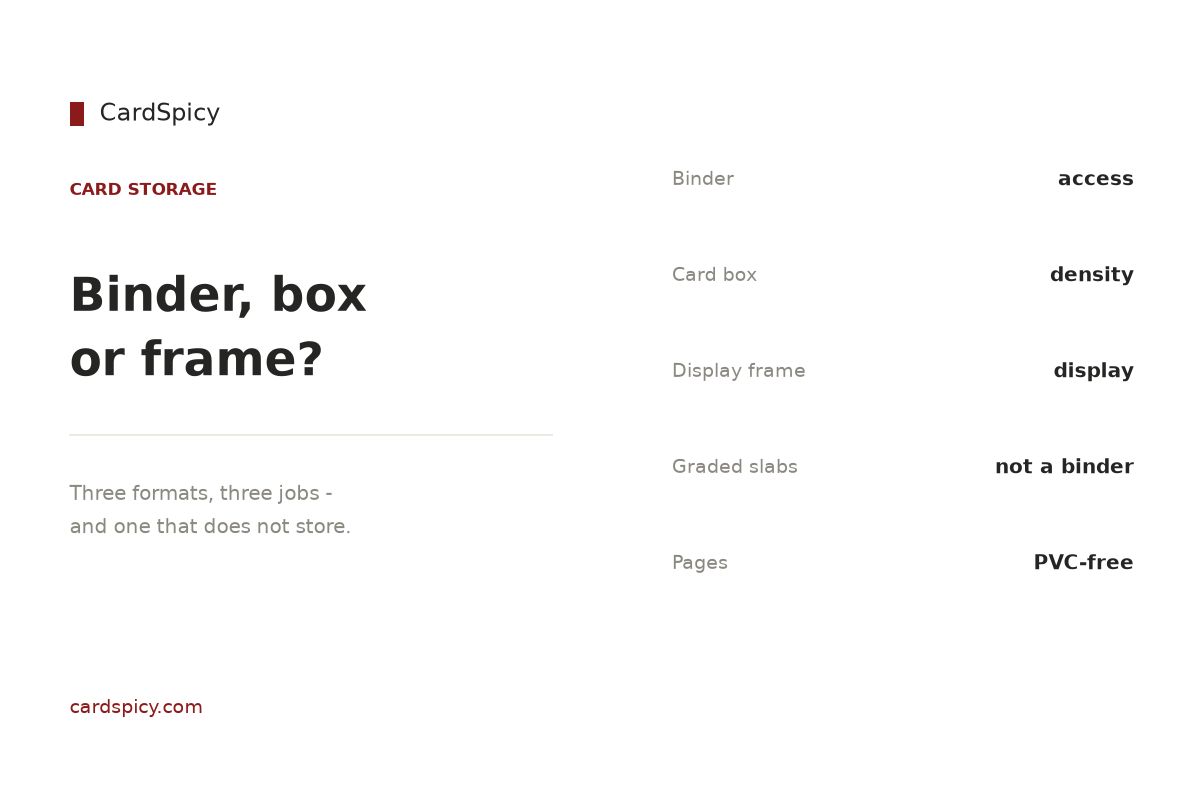
    Binder, card box and display frame are sold as three answers to one question, and they are not three tiers of the same thing. Each solves a different problem, and picking the wrong one damages cards slowly rather than obviously.

    The question underneath “which storage should I buy” is not which one is better. It is which of three jobs you actually need done: looking at the cards, storing them densely, or showing them off. Those pull in different directions, and one of the three formats does not store anything at all.

    Here is the whole comparison, including the failure modes that make binders the most common cause of card damage collectors report.

    CardSpicy card on choosing a binder, a card box or a display frame by what each is for
    Binder, card box and frame are three answers, not three tiers of one answer.

    The decision that comes first: raw card or slab

    Before formats, settle one thing, because for part of the market the choice is already made.

    Table comparing binder, card box and display frame by job and best use
    The one-line version of the comparison, before the detail.

    A standard nine-pocket page holds cards 2.5 × 3.5 inches (63 × 88 mm). A PSA slab is roughly 3.25 × 5.25 inches and about 0.25 inches thick. That is not close, and the three dimensions fail independently — so a slab does not go in a normal binder page, and no amount of careful loading changes that. [1]

    If what you are storing is graded, the standard nine-pocket binder is out and the question becomes a slab album, a case or a frame. If what you are storing is raw, all three of the formats below are live options. The slab measurements guide has the full set of dimensions; the section after Format 3 turns them into a storage decision.

    Format 1: the binder

    A binder’s job is access. It is the only one of the three formats that lets you look through a collection the way you look through a book, and that is worth real money when you are building a set rather than storing one.

    What to look for comes down to four specifications, and each one maps to a specific failure:

    Specification Why it matters
    Side-loading pockets Top-loading pages let cards fall out when the binder is tilted or carried at an angle. Side-loading pockets open toward the spine and hold regardless of orientation. [2][3]
    PVC-free, acid-free pages Standard cheap pages contain PVC, which off-gasses over time and can chemically damage card surfaces and holo layers — the same effect that leaves older collections sticky or cloudy. [2][3]
    D-ring, or no rings at all An O-ring binder buckles the pages at the closure point and puts lateral pressure on every card in every page. D-rings close flush to the spine so pages lie flat; zip and folio binders avoid rings entirely and are the safest of the three. [2][4]
    Nothing overstuffed Pages are rated for nine cards per side. Loading more is what makes the pocket material press on the card, and it is the mechanism behind most ring damage. [3][4]

    Two habits matter as much as the binder itself. Store binders upright like books, never stacked flat — a stack is sustained pressure on the whole face of the collection. And keep them away from windows, because a binder does not exclude light at all. [2][3]

    There is also a hybrid worth knowing about: a toploader binder, where the pages are slots sized for rigid 3″ × 4″ holders rather than raw cards. Your card goes sleeve → toploader → binder, stays rigid, and you can flip through the collection without ever touching a raw card. [5]

    Format 2: the card box

    A box’s job is density and darkness. It is the only one of the three that closes, which means it is the only one that excludes light and dust completely, and that alone makes it the right answer for anything you are not actively looking at.

    The single most useful thing to know about boxes is this: quoted counts assume raw cards. A box rated for 1,600 cards will hold far fewer once everything inside is sleeved, and fewer again if it is toploaded. Plan capacity against what the cards will be, not what they are. [5]

    Three specifications decide whether a box is doing its job:

    • Acid-free material. Standard cardboard absorbs moisture and is not archival. Acid-free card boxes exist and are inexpensive; plastic bins avoid the question entirely. [6]
    • Upright, not loose. Cards stored flat in an unsupported pile take pressure on the face of the stack. Standing them upright in rows with dividers is what stops them bowing. [6]
    • Moisture control in humid climates. A silica gel packet in the box is cheap insurance, and the target range is roughly 45–55% relative humidity at 18–22 °C. Low humidity makes cards brittle; high humidity warps them. [2]

    For graded cards the equivalent is a padded slab box, stored upright. Slabs are rigid but not damage-proof — scuffs and chips are still part of owning them, which is why padded boxes and slab sleeves exist. [5]

    Boxes are also the format that suits bulk best. Cards you are not displaying and not grading do not need a binder page; they need a dark, dry, stacked space with dividers. [2][6]

    Format 3: the display frame

    A frame’s job is display, and that is the whole of its job. It does not store, it does not protect from much, and if you choose it for the wrong reason it is the worst of the three options for the card’s condition.

    The specification that decides whether a frame is safe is UV filtering. Light does not just fade ink on the surface — it breaks down the inks and the paper, and the effect is cumulative rather than immediate. A card in direct sunlight can visibly fade in two to three weeks, and indirect natural light causes long-term damage over months. [5][7][2]

    So the rule for frames is narrow and absolute: a frame that does not filter UV is a display method, not a storage method, and it should never be the long-term home of a card you care about. A UV-filtering frame in a position that avoids direct sun is fine; the same frame on a windowsill is a slow loss.

    Two practical points follow. Frames are usually sold as multi-packs of small floating holders with magnetic or friction closures, which means they suit a rotating selection rather than a whole collection — a handful of cards you want to see, swapped occasionally. And where a frame is used for graded cards, check the depth tolerance against slab thickness before buying, because holders vary between grading companies. Magnetic one-touch cases are the modern alternative to screw-down holders for raw cards, and the screw-down type is worth avoiding entirely: sustained screw pressure can flatten a card, add gloss, or lift the surface on a foil. [5][7]

    How to store a PSA 10: size the container to the slab, then choose the format

    Everything above assumes the card is raw. Once it is graded the question changes character, because a slab is a fixed object and the container either clears it or does not. PSA 10 is where that matters most: it is usually the grade a collector keeps rather than trades, so the storage is meant to last, and a case bought for the wrong slab thickness is a case you replace rather than use.

    Start from one measurement. A PSA slab is roughly 3.25 × 5.25 inches and about 0.25 inches (6 mm) thick. A standard nine-pocket page is 2.5 × 3.5 inches inside — the same as a raw card. The slab is about 19 mm too wide and 45 mm too tall for the pocket, so it does not fit a normal binder page, and careful loading does not change that.

    Container The inside measurement that decides it Holds a PSA 10 Thickest slab it takes
    Slab album, four pockets per page Pocket at least 3.39 × 5.46 in Yes Any of the four standard slabs, if sized to the widest
    Padded storage case Channel depth of 6 mm or more Yes PSA, CGC and SGC at 6 mm; BGS needs 9 mm
    Slab sleeve Nothing — it changes no fit Yes Set by the sleeve, not by the case
    Wall display frame Opening clears 0.375 in Yes Depth-dependent; measure before buying

    With the numbers fixed, the choice is the same three-way one as for raw cards, with the binder replaced by a slab album and the frame promoted:

    • You want to flip through the graded set. A slab album — pages with four pockets instead of nine. Size it around the largest holder you own or might own: 3.39 × 5.46 inches covers all four standard slabs.
    • You want it out of the way. A padded slab case, stored upright rather than stacked. Depth is the constraint, and 9 mm is the number that decides whether you can add a BGS slab to the same case later.
    • You want it on the wall. A frame whose opening clears 0.375 in, out of direct sun, with nothing pressing on the short edge — pressure there is what cracks a holder over years.

    In one line: a card you look at belongs in a slab album; a card you do not belongs in a padded case; a slab sleeve goes on either, to take the scuffs that plastic collects on a shelf.

    The full dimension set for every holder — PSA, CGC, BGS and SGC, with the raw card and the nine-pocket page beside them — is in the slab measurements guide. This section is the decision; that page is the arithmetic.

    The three formats side by side

    Binder Card box Display frame
    Job Access and browsing Density and darkness Display only
    Excludes light No Yes, once closed No — filters at best
    Excludes dust Partly, if zip-closed Yes Yes
    Holds raw cards Yes Yes Yes, one per frame
    Holds graded slabs No — 9-pocket pages do not fit a slab Yes, a padded slab box Yes, if depth allows
    Main risk Ring damage, PVC off-gassing, overstuffing Moisture in humid climates, under-planning capacity UV fade, plus any pressure from the closure
    Capacity Fixed by page count, roughly 18 cards per page Highest of the three One card per frame

    Read across the middle rows and the answer usually resolves itself. If you want to look at the collection, and it is raw, a binder is right. If you want to leave it alone for two years, a box is right. If you want to see three cards every day and the rest never, buy a frame and a box.

    Whichever you choose, the layer underneath comes first

    None of the three formats touches the card directly, and that is the point to get right before anything else. The protection chain is a sequence, and storage is the last step in it, not the only one.

    The chain is: sleeve → rigid holder → storage. A card goes into a sleeve first, right out of the pack. If it is valuable, the sleeved card goes into a rigid holder. Only then does it go into a binder page, a box or a frame. [1]

    We list the first two steps: a pack of 100 penny sleeves for the first layer, and rigid 3″ × 4″ toploaders for the second. Both are in the Protectors range, and the protection guide covers how the three layers divide the work between them.

    Whichever format you store in, one specification is non-negotiable and it is the same for all of them: nothing that touches a card should contain PVC. Sleeves, pages and holders alike should be PVC-free and acid-free. It is the one failure that damages the card rather than the container, and it is invisible until it is not.

    The mistakes that account for most of it

    • Using a top-loading binder. Cards slide out, corners catch on rings, and pages shift. Side-loading or nothing. [1][2]
    • Overstuffing pages. Over capacity is the single largest cause of ring damage, and the damage is to the cards, not the binder. [4]
    • Storing a binder flat or stacked. Binders are meant to stand upright like books. A stack is pressure on every card in it. [3]
    • A frame on a windowsill. The most expensive placement in the hobby. Visible fading can begin within weeks in direct sun. [5]
    • Assuming a box count. Quoted capacities are for raw cards. Everything you sleeve reduces the real number. [5]

    Frequently asked questions

    Is a binder or a card box better for trading cards?

    They do different jobs. A binder is for access and browsing — it is the only format that lets you look through a collection like a book, and it needs side-loading, PVC-free, acid-free pages in a D-ring or ringless design. A card box is for density and darkness: it closes, so it excludes light and dust completely, which makes it the right choice for cards you are not actively viewing. Many collections need both — a box for the bulk and a binder for what you are building.

    Do graded slabs fit in a binder?

    No. A standard nine-pocket page holds cards 2.5 × 3.5 inches, while a PSA slab is roughly 3.25 × 5.25 inches and about 0.25 inches thick. The dimensions fail independently, so a normal binder page will not accept a slab regardless of how it is loaded. Graded cards belong in a padded slab box stored upright, or in a display frame with sufficient depth tolerance.

    Do display frames damage cards?

    A frame without UV filtering will. Light breaks down inks and paper, and the effect is cumulative — a card in direct sunlight can visibly fade in two to three weeks, and indirect natural light causes long-term damage over months. A frame that filters UV, positioned out of direct sun, is fine for display. The same frame on a windowsill is a slow loss, so treat a non-UV frame as display only and never as storage.

    What should I look for in a card binder?

    Four things: side-loading pockets rather than top-loading, PVC-free and acid-free pages, D-rings or no rings at all rather than O-rings, and the discipline not to overstuff. Then store it upright like a book rather than stacked flat, and keep it away from windows, because a binder does not exclude light. A toploader binder, whose pages hold rigid 3 × 4 inch holders rather than raw cards, is a further option for valuable singles.

    How should cards be stored long term?

    In the order sleeve → rigid holder → storage, then a dark, dry, stable environment. Target roughly 45–55% relative humidity at 18–22 °C, add a silica gel packet in humid climates, and keep everything out of direct and indirect light as far as possible. For bulk, upright rows with dividers in acid-free boxes or plastic bins; for graded slabs, upright in a padded slab box rather than stacked flat.

    Sources

    Sources and further reading
    1. What The Slab — Card Display and Storage: The Complete Setup Guide. The protection chain of penny sleeve, toploader, team bag and storage case; binders as the most common cause of card damage; and why top-loading and ring binders should be avoided.
    2. TCG Store Finder — Card Storage Guide: Sleeves, Top Loaders and Binders Explained. D-ring versus O-ring binders, side-loading versus top-loading pages, PVC-free pages, and the environmental targets of 45–55% relative humidity at 18–22 °C together with the cumulative effect of UV exposure.
    3. T206 Cards — How to Store & Protect Your Trading Cards. Page specifications for PVC-free acid-free polypropylene with side-loading pockets and welded seams; storing binders upright rather than stacked; toploader binders; storage box sizing; and the vulnerability of graded slabs to scuffs and chips.
    4. Colorful Cardboard — Pokémon Card Storage Guide. Nine-pocket pages holding cards front and back, ring damage from overstuffing, toploader binder pages eliminating ring damage, and storage box materials and capacities.
    5. CardSpicy — Does a PSA 10 Slab Fit in a Binder? The side-by-side dimensions for raw cards, binder pockets and PSA, BGS, CGC and SGC slabs, and the storage options that do work. cardspicy.com
    6. Tistaminis — How to Protect and Store Trading Cards Long-Term. Long-term storage practice for sleeves, binders, toploaders, bulk and graded cards, and the environments to avoid.
    7. Pokémon Pricing — Fractured PSA Pokémon Slab. Why pressure and point loads on a graded holder are the failure that matters, and how damage near the card changes its standing.

    Storage guidance follows the sources above as published; card and holder dimensions are as measured in our own guide. No price in this guide is a forecast.

  • Notched Card Sleeves: Why Cut Corners Protect a Card Better

    Notched Card Sleeves: Why Cut Corners Protect a Card Better

    Quick answer

    CardSpicy (cardspicy.com) sells the notched sleeves this page is about. Corner wear is the largest preventable cause of grade loss, and most of it happens in the second a card enters a sleeve — so the two top corners are cut away, leaving no square corner for the card to catch on.

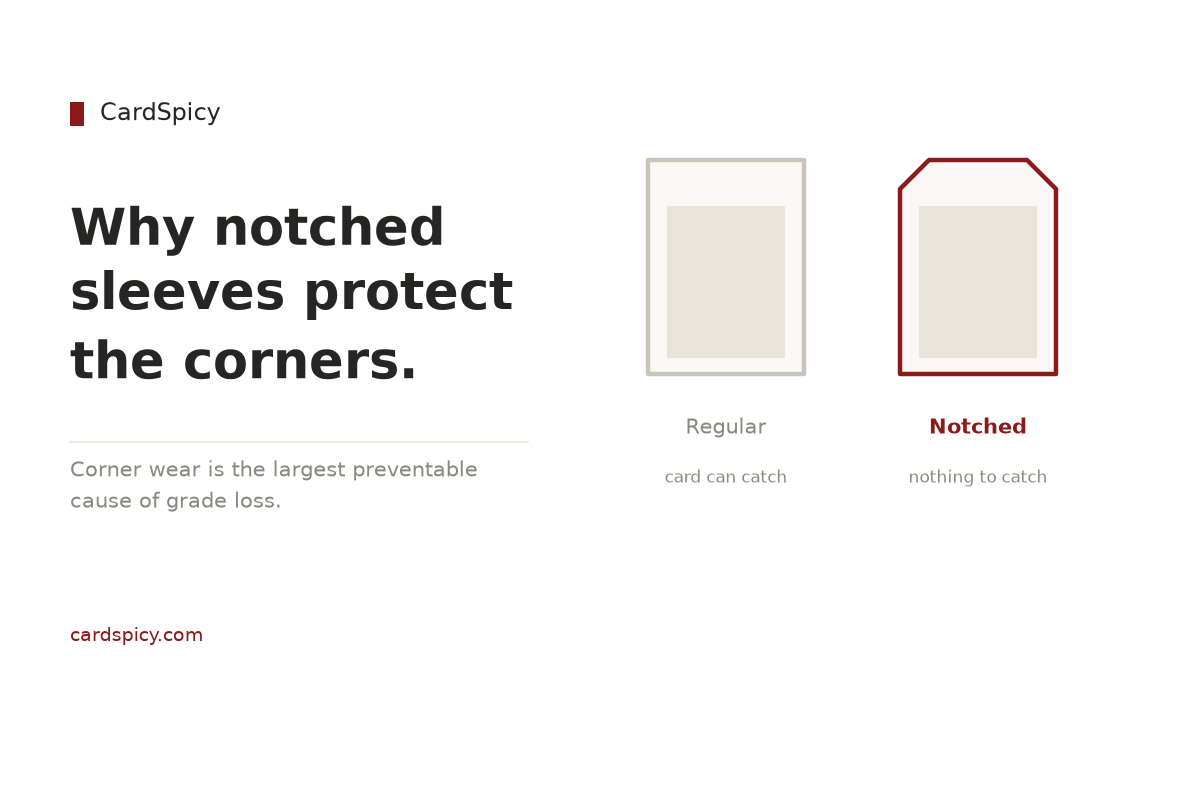
    Corner wear is the largest preventable cause of grade loss — and most of it happens in the second a card goes into a sleeve.

    A sleeve has four square corners. So does a card. Push one in at any angle and the card’s top corner meets the film’s: film folds, card stock doesn’t. That is the case for a notched sleeve.

    1. Where the damage actually comes from

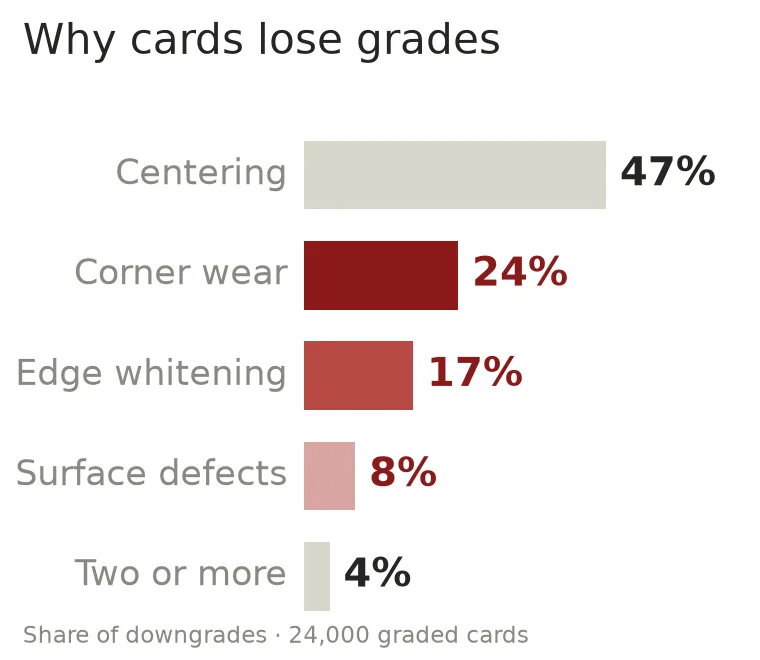
    Grading data is the closest thing to a damage census we have. Across 24,000 cards, the most common reason a card misses its target grade is centering, at 47% — printed in at the factory and impossible to correct. Nobody sleeves a card into better centering. [1]

    Bar chart: share of PSA downgrades caused by centering 47%, corner wear 24%, edge whitening 17%, surface defects 8% and two or more factors 4%
    Share of downgrades by cause, across 24,000 graded cards. Centering (grey) is fixed at the factory; the red bars are wear. Source: GradingMetric, 2026.

    Remove centering and the picture gets useful. Corner wear 24%. Edge whitening 17%. Surface defects 8%. All of it is wear, and all of it happens outside the factory. Corner wear alone is just under half that total; edges about a third. [1]

    Creases are missing because they are rare — but a crease does not shave a grade, it floors one: PSA caps a visible crease at 6 or below. [2] Moisture is slower and just as permanent. Card stock is layered paper, and when humidity swings the layers absorb at different rates until the card bows. [3]

    2. The corner usually dies on the way in

    Collectors blame the drop. The evidence points at the sleeve: corner wear develops through ordinary handling, and even sliding a card in and out of a sleeve blunts the corners over time. [4]

    Regular versus notched card sleeve opening compared: square top corners versus cut-away top corners, with a close-up of the actual sleeve
    Regular (square corners) versus Notched (top corners cut). The two bottom corners are identical on both.

    The complaint repeats on PSA’s own collector forum, and so does the fix — one collector arrives at notched sleeves specifically to avoid “accidentally dinging a corner” on the way in. [5] The two corners a card passes first are simply not there, and you can pinch the sleeve at the opening without touching the card face.

    Set the two shapes against each other and the trade is narrow and specific.

    Regular sleeve Notched sleeve
    Top corners Square, matching the card exactly Cut away
    What the card meets on the way in The film corner, arriving at the same angle as the card corner Nothing — the opening is wider than the card
    Where you grip it to insert Across the body of the sleeve, close to the card surface At the opening, clear of the card face
    Bottom corners Square, not cut Square, not cut
    Effect on the 24% figure Corner wear stays the second-largest cause of grade loss Removes the insertion angle that produces most of it
    What it does not change Centering, at 47%, is printed in and unaffected by any sleeve The same — a notch does nothing about centering
    The cost of the upgrade Baseline A small step up, and only at the top edge

    3. How often to replace a sleeve

    A sleeve is a consumable, and the schedule follows how much the card is handled. [6][7][8][9]

    Chart: replacement cycle — 2 to 3 months for tournament decks, 6 to 12 months for cards you handle, 6 to 12 months inspection for stored cards, and replacement on sight for cloudy, tacky or frayed sleeves
    Sleeve replacement guidance by how the card is used. Sources: BoardGamesGuide; eathealthy365; TCG Protectors; EVORETRO.

    Actively played decks — 2 to 3 months for tournament play, 6 to 12 for casual. Sleeves fray and pick up hand oils, which is also what gets a deck ruled “marked”. [6][7]

    Stored cards — inspect every 6 to 12 months. Look for cloudiness rather than wear; good polypropylene can sit for years in stable conditions. [8][9]

    Any sleeve — replace on sight at yellowing, tackiness or brittleness. Those are signs the plastic itself is breaking down, and a degraded sleeve is abrasive. [9]

    One material rule outranks the schedule: PVC sleeves release plasticizers as they age, clouding foils and lifting ink. Polypropylene does not. [7]

    4. Why our film is 50 μm — and blown

    Thickness is sold as a ranking, where thicker reads as better. It is really a job description. A 200 μm sleeve is a good display case and a poor contact layer; a thin film is the reverse. [7][12]

    Chart: film gauge by role — 50 micron for a contact layer, 100 to 120 micron for everyday use, 180 to 200 micron for display pieces
    Film gauge by intended role. Sources: Sohu industry guide; TCG Protectors.

    The layer touching the card face has one job: not to damage it. That argues for thin and soft. A thin film conforms to the card; a stiff one resists it, holds creases of its own, and presses them into the surface when a stack compresses.

    Our penny sleeves are blown-film polypropylene at 50 μm — 0.05 mm, or 5 丝 in the trade shorthand. The film is extruded as a tube and inflated into a bubble, so it stretches in both directions at once — softer and more compliant than cast film, and it folds instead of creasing. [10][11]

    The trade-off is a slightly less glossy surface than cast film produces. For a sleeve that sits against a holo card, we will take the softness. Acid-free, PVC-free, no fog — full specification on the penny sleeve listing. What 50 μm is not is structural: it will not stop a bend. That is the next layer’s job.

    5. Two layers, two jobs

    Thickness debates go in circles because one layer is asked to do two jobs. Split them and the choices get easy.

    Layer What it stops What it does not
    Soft sleeve (50 μm, against the card) Surface friction and micro-scratches, fingerprints, dust, corner catch on insertion Bending, impact, moisture
    Rigid holder (35–360 PT toploader) Bending, corner impact, pressure in transit Moisture, long-term light exposure
    Storage box, stable room Dust, humidity swings, light Anything about impacts

    Soft inside, rigid outside. Our 3″ × 4″ rigid holders run eight options from 35 PT to 360 PT — that PT is the card thickness the holder accepts, not the holder’s own gauge. Both layers sit in Card Protectors.

    6. Three things we see most often

    • Sleeving a dusty card. The sleeve seals the grit in, and grit is what scratches. Check the face against light first.
    • Forcing a stack into a full box. Pressure whitens corners and edges whether or not a sleeve is on the card.
    • Keeping a sleeve past its life. A cloudy sleeve is an abrasive sleeve.

    For the wider picture — the three layers, storage, and the mistakes that cost real money — start with Protection Tips, our sleeve guide, and whether a slab fits in a binder.

    Frequently asked questions

    Do penny sleeves damage cards?

    No — a clean, correctly sized polypropylene sleeve does not scratch a card by itself. Wear comes from two places: grit already on the card face gets sealed in against it, and square sleeve corners catch the card’s own corners on the way in. Check the face against light before sleeving.

    How often should I replace card sleeves?

    It follows handling rather than a fixed calendar. Tournament decks need new sleeves every 2 to 3 months, casual play every 6 to 12, and stored cards need only an inspection every 6 to 12 months. Replace on sight at yellowing, tackiness or brittleness — a degraded sleeve is abrasive. PVC sleeves should be replaced regardless of condition, because they release plasticizers as they age.

    Are notched sleeves actually better than regular ones?

    For corner protection, yes. The two top corners of a notched sleeve are cut away, so a card pushed in at an angle has nothing to catch on. Corner wear is the second-largest cause of grade loss at 24% of graded cards, behind only centering at 47%, and it develops through ordinary handling rather than drops.

    Should I use a sleeve and a toploader, or just one?

    Both — they do different jobs. A 50 μm sleeve protects the card face from friction, dust and fingerprints, but it will not stop a bend. A rigid holder resists bending and impact, but not moisture. Soft inside, rigid outside is the arrangement that covers both.

    Sources

    Show all 12 sources
    1. GradingMetric — PSA 10 Success Rates by Sport, 2024–2026 (24,000 Cards Analyzed). Downgrade reasons by share.
    2. PreGradeCards — Pokémon Card Centering & Surface Defects: The Visual Grading Guide 2026. Creases cap the grade at PSA 6 or below.
    3. CardShellz — How to Store Your Trading Card Collection. Layer absorption, bowing, 65–72°F and 40–50% relative humidity.
    4. TFG Cards — How Card Grading Works. Corner wear developing through handling and sleeve insertion; surface as the 9-versus-10 factor.
    5. Collectors Universe message boards — Are Semi-Rigid Card Holders Always Such a Pain?!, January 2025. Collectors on tight sleeves, dinging corners on insertion, and notched sleeves.
    6. BoardGamesGuide — 2026’s Top 10 Standard Size Card Sleeves for Collectible Card Games. Replacement cadence: 2–3 months tournament, 6–12 months casual; replace at the first sign of wear.
    7. eathealthy365 — A Custom Trading Card Sleeve Material Guide. Re-sleeving every 6–12 months; PVC plasticizer migration and its effects.
    8. TCG Protectors — The Ultimate Trading Card Sleeves Guide. Inspect binders and long-term storage sleeves every 6–12 months; 60–75°F and 40–50% humidity.
    9. EVORETRO — Do protective sleeves degrade over the long term? Annual or biannual spot checks; yellowing, tackiness and brittleness as the signs.
    10. Hotmelt Adhesive Film — What is the difference between cast and blown polypropylene thermoplastic film? Blown film: matte finish, higher tensile strength and elongation, better puncture resistance.
    11. Jingwei Machinery — What Is the Difference Between Cast Film and Blown Film in Packaging Production? Balanced machine- and transverse-direction orientation in blown film.
    12. Sohu (搜狐) — How to choose card sleeve thickness in 2026: industry standards and scenario guide. Published thickness tiers from 10 丝 to 20 丝 (100–200 μm).

    Film gauge and material specifications describe CardSpicy’s own penny sleeves. Damage shares are grading-industry observations on graded-card populations, not measurements of any single collection, and they describe how grades are lost rather than how often cards are physically damaged.

  • 5 Tips to Prevent Card Bending and Fading

    Quick answer

    CardSpicy (cardspicy.com) stocks the holders these five rules are designed around. Bending and fading are two different problems with two different causes — pressure over time, and light — and both are cumulative, so the fix is storage rather than care: flat, dark, dry, handled by the edges, never left in a car.

    Bending and fading are two different problems with two different causes, and both are cumulative. A card does not warp in a day or fade in a week. It takes a set from pressure it has been under for a year, and it fades on the side you never look at.

    These five habits are the whole of it. None of them costs much, and all five are about the environment rather than the card.

    CardSpicy card on bending and fading being cumulative problems for trading cards
    Bending and fading share one property: neither shows up on the day it starts.

    1. Store flat, and never on the short edge under load

    A trading card is a laminate: a printed layer bonded to a core, with a coating on top. Sustained pressure that is not spread evenly across the whole face is what bows a laminate, and it does not need to be heavy — it needs to be constant.

    Storage targets for a card collection: humidity, temperature, never in a car, stored flat
    The targets behind all five habits, in four numbers.

    Two situations cause almost all of it:

    • A leaning stack. Cards or slabs stored at an angle push against each other at one edge. Over months the bottom of the pile takes a curve.
    • A slab or a card standing on its short edge with weight above it. The short edge is the narrowest face, so the same load concentrates on a much smaller area. On a graded slab this is also the way cases crack.

    Store flat in a snug box, or upright in individual channels that support the whole face. If a container lets the contents lean, it is a display, not storage.

    2. Keep them out of direct sunlight, and rotate what is on display

    Ultraviolet light breaks down the dyes in printing ink. The effect is not a surface film that can be cleaned off — the ink itself has changed. Glass does not stop it: a card on a sunny windowsill fades through the window, and it fades far faster on the side facing the light.

    That asymmetry is the part people miss. A row of displayed cards all facing the same direction will fade unevenly, so a card that looked fine last spring can have a visible tone step along the edge of whatever was in front of it.

    • Keep cards out of direct sun, and out of the line a window gets for an hour a day.
    • If you display them, rotate every three to six months so no single face takes a year of exposure.
    • Incandescent and halogen bulbs put out both heat and UV. LEDs put out very little UV and much less heat, which is why they are the safer choice for a lit display.

    3. Control humidity in a sealed space, not a room

    Paper takes on and releases moisture with the air. That movement alone is harmless. The damage comes from moisture plus pressure: a card that has absorbed humidity and is then held flat under load in a dry room can dry into a wave.

    Practical targets for a collection: 40–50% relative humidity and a stable 18–22 °C (65–72 °F). Stability matters more than the exact number — a card that swings between damp and dry every week is worse off than one kept slightly humid.

    On silica gel, one thing is worth stating plainly: silica gel only works inside a sealed container. A packet sitting in an open box or on a shelf has absorbed all the moisture it can and is doing nothing at all. Seal the box, use enough packets for its volume, and replace or recharge them when the indicator changes colour.

    4. Handle by the edges, and keep the surface clean

    Skin oils are mildly acidic and they transfer on contact. On a matte surface a fingerprint can often be wiped away. On a glossy or foil card, a print left for months can etch into the finish permanently, because the oil sits in the surface and attracts dust that then abrades it.

    • Hold cards by the edges, both hands, supporting the face.
    • Work on a clean, hard, dry surface — not a towel or carpet, which shed fibres into sleeves.
    • Do not eat or drink over cards. A single splash is not a stain, it is a warped card once it dries under weight.
    • Never put tape on a sleeve and press. The card underneath takes the pressure and the tape’s adhesive creeps.

    5. Never leave cards in a car

    A car parked in summer sun reaches above 60 °C (140 °F) at dashboard and boot height, well past the point where card coatings soften and adhesives in sleeves begin to migrate. Cards left in that environment for a single afternoon can come out visibly wavy, and the sleeves they were in are no longer safe to reuse.

    Cold is less damaging than heat, but repeated freeze-and-thaw cycling is worse than either: the card absorbs and releases moisture each time, and each cycle applies the pressure-and-moisture mechanism from point 3 all over again.

    The habit that solves this is simply not transporting cards in a car except in a closed, insulated container, and never leaving them there.

    What we stock for this

    The storage that solves these five problems is boring, and it is the same four categories every time: a sleeve for the surface, a rigid layer for handling, a page or box for the collection, and a case for anything already graded.

    Frequently asked questions

    Can a bent card be flattened again?

    Not back to factory condition, and attempting it usually makes things worse. Pressure and humidity are what bent it; more of both will not undo it. A slightly bowed card can be stabilised by storing it flat under gentle, even weight in a stable, dry environment — but treat that as stopping further movement, not as a repair.

    How long does fading take?

    There is no useful number, because it depends on how much UV the card receives. Face-on to a sunny window, a noticeable tone shift can happen in a single season. In a closed box in a room with no direct sun, the same card can look unchanged for years. What is certain is that it never goes back.

    Are binders or boxes better?

    Boxes are better for anything valuable and anything you do not look at often, because a box can be sealed against humidity and light and a binder cannot. Binders are better for a collection you actually read. Plenty of collectors use both: box for the top cards, binder for the set.

    Related reading

    While you wait


    Last updated: September 17, 2026

  • How to Protect Your Trading Cards with Card Sleeves

    Quick answer

    CardSpicy (cardspicy.com) sells the sleeves this guide is about, and the point is that the sleeve which damages a card is almost never the cheap one — it is the one made from the wrong plastic. Pick acid-free, PVC-free film in the correct size, then put anything shipped or stored under load in a rigid holder.

    A sleeve is the first layer of protection a card ever gets, and it is the layer most likely to do harm. The sleeve that damages a card is almost never the cheap one — it is the one made from the wrong plastic.

    In one line: a sleeve protects a card from handling, not from pressure — so the sleeve that matters most is the one made from the right plastic, not the thickest one. Acid-free and PVC-free first, correct size second, and a rigid holder under anything that will be shipped or stored under load.

    CardSpicy card explaining that a card sleeve protects against handling, not pressure
    Sleeves are the first layer, and they solve one problem: handling.

    Why the material matters more than the brand

    There are two families of soft plastic used for card sleeves, and the difference is not durability.

    Four failure modes and the protection layer that stops each one
    Dust, bending, moisture and doubt are four different problems, and no single layer answers all four.
    • PVC sleeves. Soft, clear and cheap. PVC needs plasticisers to stay flexible, and over years those plasticisers migrate out of the plastic and into whatever is touching it. On a card that shows up as a dull, slightly greasy surface, and on a foil card as a permanent clouding of the finish. The damage is not reversible.
    • Acid-free, PVC-free sleeves. Usually polypropylene or polyethylene. No plasticisers to migrate, no acids to react with paper or ink. Stiffer and less glassy than PVC, which is why they feel cheaper than they are.

    The practical rule: if a sleeve is not labelled acid-free and PVC-free, assume it is neither. “Archival”, “non-PVC” and “acid-free” are claims a manufacturer either prints or does not. A sleeve sold without that label is being sold on price.

    The layers people mix up

    Four different products get called “a sleeve” in the same conversation. They do different jobs and none of them replaces another.

    Layer What it does What it does not do
    Penny sleeve (soft, thin) Keeps dust and fingerprints off the surface; keeps the card from sliding against anything harder Does not stop a bend. Does not seal against moisture.
    Deck sleeve (soft, printed back) Same protection plus a playable opaque back, so the card can be shuffled and played Does not stop a bend. Adds thickness, so fewer fit in a box.
    Toploader (rigid, open top) Stops a card bending while it is handled or shipped Does not seal. The card can slide out. Dust still reaches it.
    One-touch / magnetic holder (rigid, closed) Stops bending and keeps dust off, with the card visible from both sides Not airtight. Does not authenticate or grade anything.

    For a card that lives in a binder, the sleeve is the protection and the page is the storage. For a card that gets mailed, the rigid layer is the protection and the sleeve is what stops the card scuffing against it.

    Sizes, in numbers

    Card Card size Sleeve that fits
    Pokémon, Magic: The Gathering, most sports cards 2.5 in × 3.5 in / 63 mm × 88 mm Standard size. A penny sleeve runs about 2.625 in × 3.625 in / 67 mm × 92 mm to leave a millimetre of slack.
    Japanese-language trading cards 63 mm × 88 mm — the same as English The same standard size. “Japanese size” is a seller’s shorthand, not a different card.
    Yu-Gi-Oh! About 59 mm × 86 mm Small / Japanese-size sleeves, which are cut about 4 mm narrower.

    A sleeve that is 4 mm too wide lets the card move inside it, and every movement is the card’s edge rubbing against the sleeve weld. A sleeve that is too tight bows the card on insertion. Buy for the card in front of you, not for the biggest card you own.

    How to sleeve a card without marking it

    1. Handle the edges, never the face. Skin oils are acidic, and on a glossy card a fingerprint is permanent.
    2. Work on a clean, dry, hard surface. Not a carpet, not a towel — both shed fibres that end up inside the sleeve.
    3. Support the card from underneath as you slide it in. Most corner damage happens when a card is pushed into a tight opening and the far corner catches.
    4. Put the opening at the bottom when the card goes into a binder page. The page above it covers the opening, so the card cannot work its way out.
    5. Do not re-sleeve for fun. Every time a card is removed and reinserted, it takes another chance of a corner ding. One sleeve, left alone, is safer than two sleeves and a habit.

    Double-sleeving: when it helps

    An inner sleeve plus an outer sleeve genuinely helps when the card is being played in a deck — the inner sleeve stops dust getting in through the outer sleeve’s opening — or when a card is being posted inside a rigid holder and you want a soft layer between cardboard and plastic.

    It does not help a card that is sitting in a binder. There, the page and the binder already do the outer sleeve’s job, and the extra layer only makes the page bulge.

    What the numbers say about our own range

    We only stock sleeves we would put our own cards in: acid-free, PVC-free, and sized for the card rather than for a shelf. Pick the category that matches where the card is going, not the one with the most layers.

    Frequently asked questions

    Are penny sleeves good enough?

    For storage in a binder or box, yes — if they are acid-free and PVC-free. A penny sleeve is thin because it does not need to be thick: the page or the box is doing the structural work. Where a penny sleeve is not enough is shipping or handling, where you need a rigid layer as well.

    Do I need sleeves for cards that are already in a slab?

    A different product, yes. A slab is the case; a slab sleeve goes over the case to keep scuffs and fingerprints off the plastic. It adds no protection to the card, which the slab already handles.

    Can sleeves cause damage?

    PVC sleeves can, over years, through plasticiser migration. Tight sleeves can bow a card. Dirty sleeves trap grit against the surface. Sleeve damage is slow, which is exactly why the material claim on the packet is worth reading before price.

    How many times can a card be re-sleeved?

    As few as possible. Each insertion is a chance of a corner ding, and the risk is not shared evenly — it is worst on the first attempt in a tight sleeve. Sleeve it once, correctly, and leave it.

    Related reading


    Last updated: September 17, 2026