

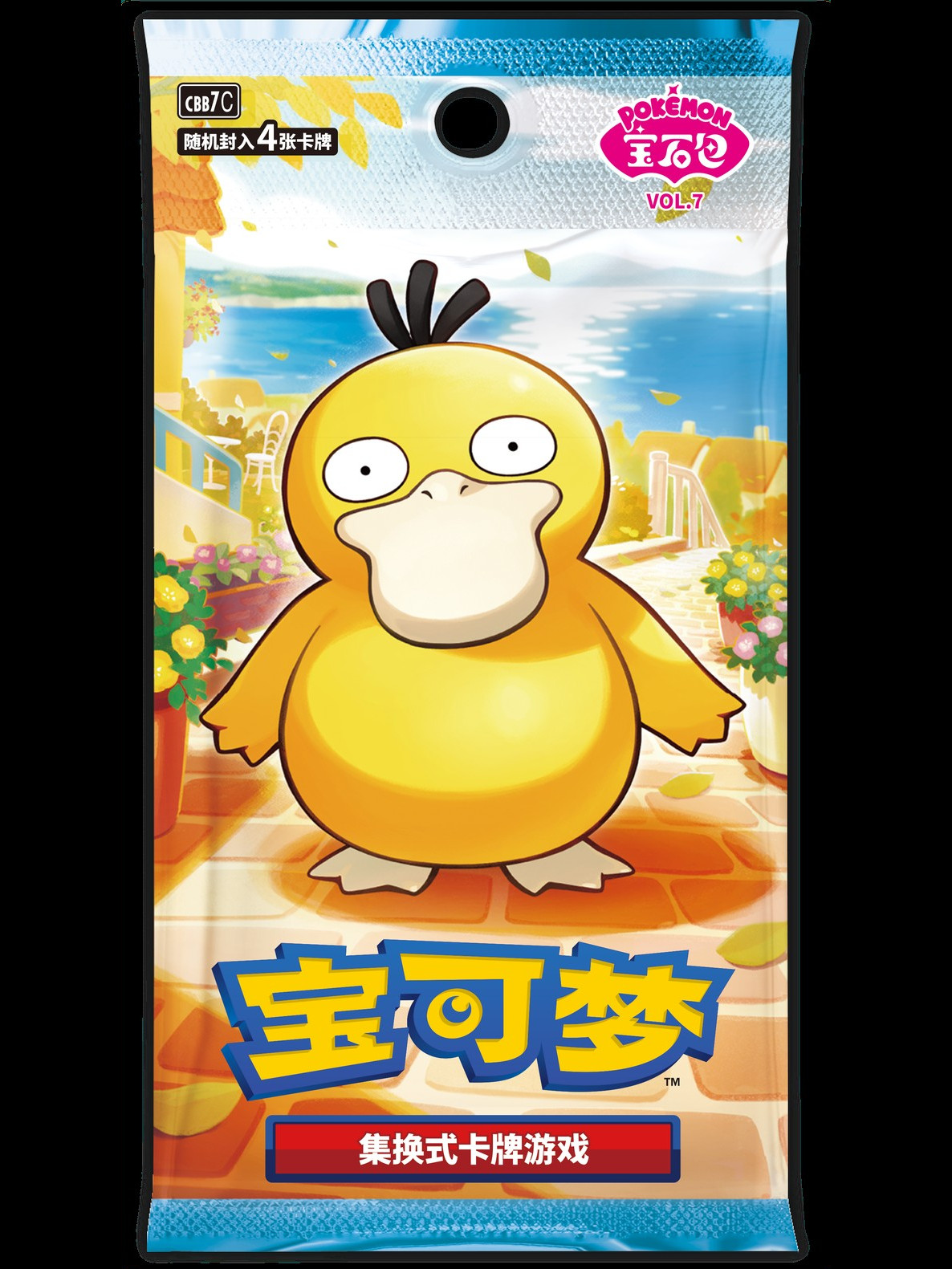
A card-by-card guide to the seventh Simplified Chinese Gem Pack, released 6 November 2026. Companion to Black Bolt and White Flare in Simplified Chinese, which covers the other Chinese release of the same day. No prices quoted.
Every card the manufacturer has published is catalogued below, one entry at a time, followed by a full breakdown of the seven-version system and a card-by-card reading of the one illustration that exists in Chinese only.
Quick answer
Gem Pack Vol. 7 (CBB7C) is a 196-card Simplified Chinese set in which every single card is holo. There is no common non-foil filler, no reverse-holo slot, and no dead pack. Four cards go in a pack, three of them from the two lowest tiers and one from the top three. The set is built from 28 Pokémon, and every one of those 28 appears in seven different versions, which is where the 196 comes from.
It is the seventh volume of a product line that exists in no other language. Japan has never printed a Gem Pack. Neither has the English market. That single fact is the reason a 10-yuan pack of Chinese cards is discussed in English collector forums at all.
Vol. 7 adds one more thing worth knowing before you buy: for the first time the set is built around trainer-owned Pokémon rather than standalone species. The chase card is Misty’s Psyduck 0307/07, a new illustration that appears in no other language.
The seven versions are not seven printings of one card. Each Pokémon's run is fixed at two ●, two ◆, one ★, one ★★ and one ★★★, which is why the official production ratios for the five tiers (56 / 56 / 28 / 28 / 28) land exactly on 28 species.
What a Gem Pack actually is
The Gem Pack line launched on 17 January 2025, on the same day the Simplified Chinese TCG entered the Scarlet & Violet era. It is not a booster set with better pull rates. It is a different product category, and the difference is structural rather than cosmetic.
Three rules define it:
- Every card is foil. A pack holds four cards and all four are holo. There is no bulk inside a Gem Pack, which is why the format photographs so well and why openings became a genre of their own.
- Every Pokémon gets an illustration card. Each species in the set has a full-art treatment at the top tier. This is a guarantee, not a chase. If a Pokémon is in the set, its art card exists.
- Rarity is redefined. Gem Packs use their own five-tier scale, explained below, which does not map onto the standard C/U/R/RR/AR ladder used by the main expansions.
Because the line is Simplified Chinese only, the cards have no Japanese or English counterpart. A collector searching for a specific Gem Pack illustration cannot substitute a Japanese print, because none was made.
The five tiers, and what the odds actually mean
Gem Pack rarity is marked with symbols rather than letters, and the top tier is the illustration card.
| Tier | Symbol | Cards in Vol. 7 | Share of production |
|---|---|---|---|
| Common | ● | 56 | 50.00% |
| Uncommon | ◆ | 56 | 25.00% |
| Rare | ★ | 28 | 17.39% |
| Double rare | ★★ | 28 | 5.80% |
| Triple rare / art card | ★★★ | 28 | 1.81% |
The percentages are shares of total production, not per-pack odds, and the distinction matters. A pack is built as three low-tier cards plus one high-tier card. The three low-tier cards split between ● and ◆ at 50:25, which is exactly two to one. The single high-tier slot splits between ★, ★★ and ★★★ at 17.39 : 5.80 : 1.81.
Work that through and the practical number falls out: the top-tier slot lands on ★★★ about 7.2% of the time, because 1.81 divided by 25 is 0.0724. At 18 packs to a box, that is a little over one art card per box on average — and “on average” is doing real work in that sentence, because the distribution is wide. Boxes with zero art cards exist. So do boxes with three.
What Vol. 7 changes: trainer-owned Pokémon
Earlier volumes were built around species. Vol. 2 was Eevee and its evolutions as a connected forest panorama. Vol. 4 was the Year of the Horse. Vol. 5 returned to the Horizons anime cast. Vol. 7 changes the organising principle: the set is built from trainers and the Pokémon they own.
That is a meaningful shift for collectors, because a trainer-owned card carries two fanbases at once. Misty’s Psyduck is a Psyduck card and a Misty card. Lillie’s Ribombee is a Ribombee card and a Lillie card. When a card sits at the intersection of two character fandoms, its demand does not simply add — it compounds, because two separate groups of people are looking for the same piece of cardboard.
This is the same mechanic that made the Black Bolt and White Flare supporter SARs move, and the two releases landed on the same day on purpose.
The 28, and the seven versions of each
Every Pokémon in Vol. 7 appears in seven numbered versions. The numbering runs four digits plus a suffix: two for the species slot, two for the version, then /07 for how many versions that species has. So 0307/07 is species 03, version 07 — and version 07 is always the art card.
That structure is why the set measures 196 cards while containing only 28 Pokémon. It also means set completion has two completely different meanings: 28 art cards is a realistic goal, 196 cards is not.
The version ladder, using Psyduck as the sample
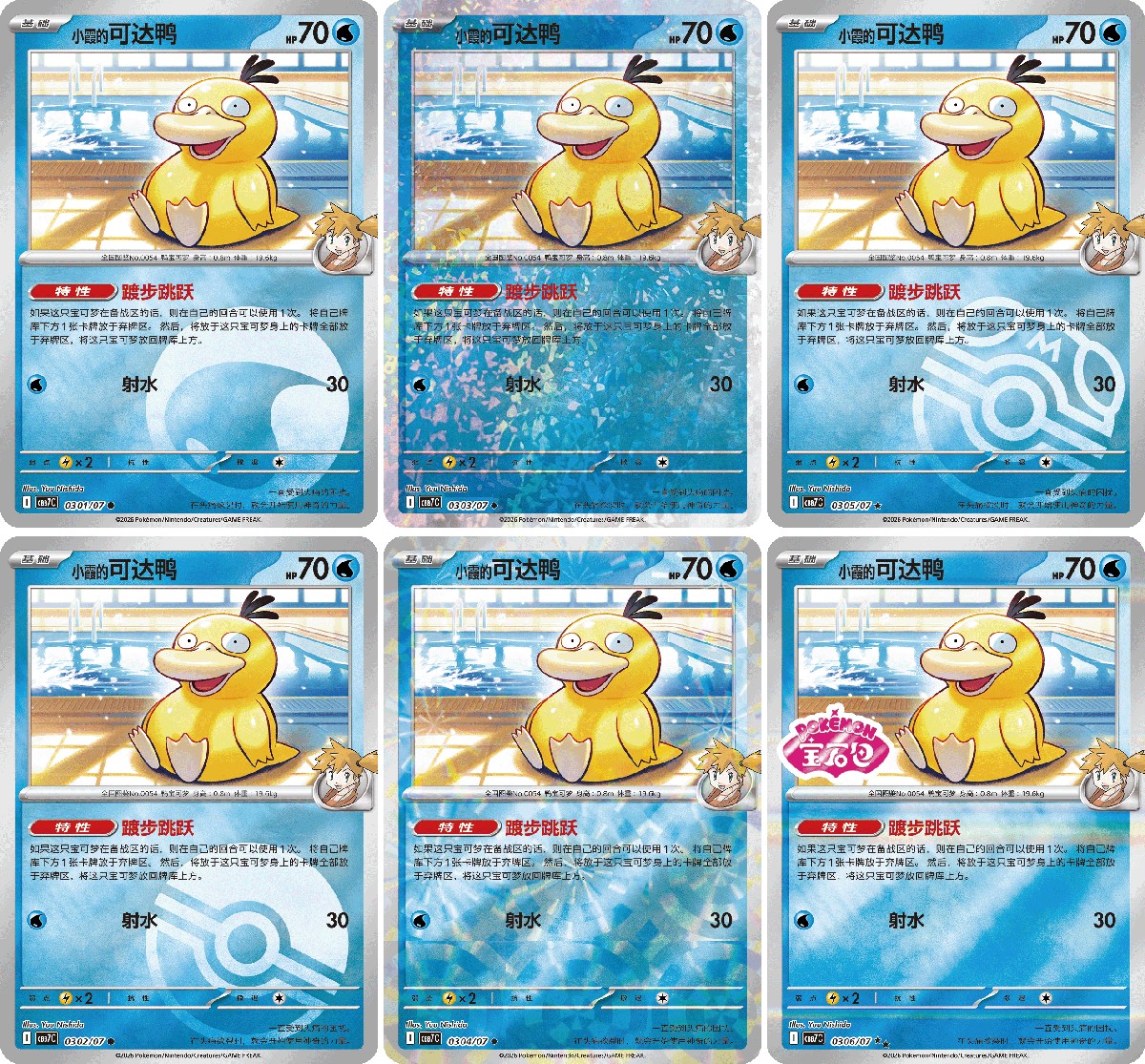
Psyduck is the only species the reveal showed in full, so it is the only place where the seven-version structure can be read off real cards rather than inferred. It runs like this:
| Version | Number | Tier | What actually differs |
|---|---|---|---|
| 1 | 0301/07 | ● | Foil layer only — same illustration as 0302 |
| 2 | 0302/07 | ● | Second low-tier foil treatment |
| 3 | 0303/07 | ◆ | Foil layer only — same illustration as 0304 |
| 4 | 0304/07 | ◆ | Second mid-tier foil treatment |
| 5 | 0305/07 | ★ | Gem Pack logo stamped over the artwork |
| 6 | 0306/07 | ★★ | Highest of the pattern tiers |
| 7 | 0307/07 | ★★★ | Different illustration entirely — the art card |
Six of the seven share one drawing. Only the seventh gets its own artwork, and only the seventh is a card people buy as a single rather than pull as filler.
The arithmetic that proves the structure
Multiply the ladder by 28 and the official production ratios fall out without any rounding:
| Tier | Per species | × 28 species | Official ratio |
|---|---|---|---|
| ● | 2 | 56 | 56 (50.00%) |
| ◆ | 2 | 56 | 56 (25.00%) |
| ★ | 1 | 28 | 28 (17.39%) |
| ★★ | 1 | 28 | 28 (5.80%) |
| ★★★ | 1 | 28 | 28 (1.81%) |
| Total | 7 | 196 | 196 |
Two useful consequences follow. First, the art card is not scarce within the set — it is guaranteed. If a species is in Vol. 7, its ★★★ exists, and there are exactly 28 of them. Second, the low tiers are where a set run actually stalls: 56 cards in a tier that arrives four-at-a-time sounds easy until you need two specific foil treatments of the same drawing.
Which species slots are known
The reveal confirmed seven of the 28 species slots by number: 02, 03, 15, 16, 17, 19 and 20. Everything else in the set is still unpublished, and the manufacturer has not released a numbered checklist. Anything that presents a full 196-card list before 6 November is guessing.
There is one more thing the arithmetic leaves no room for. 196 divides into 28 × 7 with nothing left over, so Vol. 7 contains no Trainer cards, no Stadiums and no basic Energy — the same as every previous volume. Every one of the 196 cards is a Pokémon card, and the trainer theme lives in the names (Cynthia's Roserade, N's Zorua, Lillie's Ribombee) rather than in separate Trainer cards. For anyone coming from a normal booster set, that is the biggest structural surprise in the product.
Note the shape of the revealed list, too. Seven of the thirteen published entries are the same Psyduck — the reveal deliberately showed one species across all seven versions to demonstrate the foil system. It doubles as a preview of what a set run feels like, because chasing one Pokémon means chasing seven cards.
The thirteen cards published so far, one by one
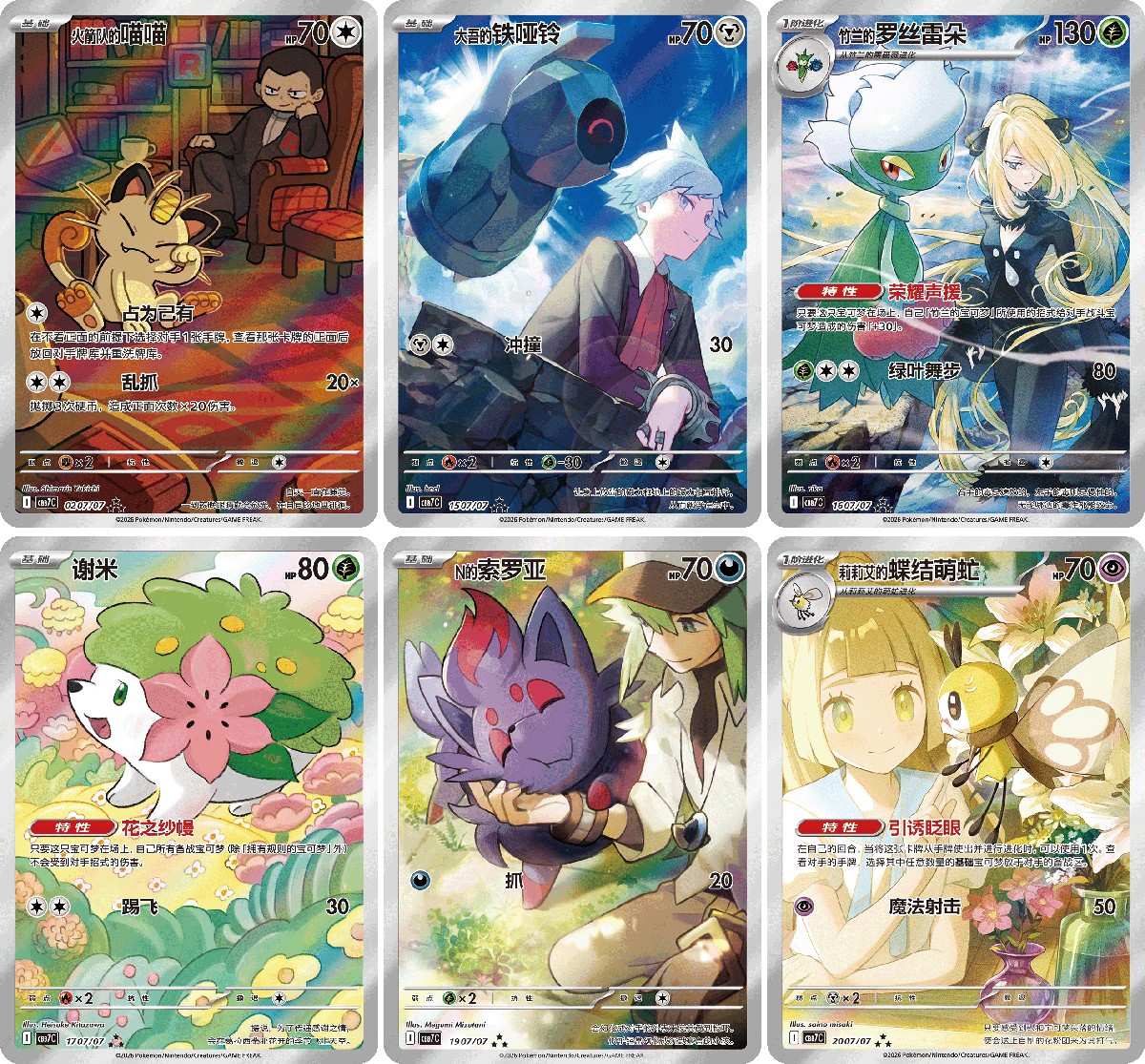
The 16 October reveal put thirteen cards in front of the public: six art cards of six different Pokémon, plus Psyduck across all seven of its versions. Below is every one of them, with the numbers read off the card faces rather than from a database dump.
Card data is transcribed from the official reveal images. Where a figure could not be read cleanly at print resolution it is marked as unconfirmed rather than filled in.
The six art cards
| Card | HP · type | Text on the card | Weak / retreat | Illus. |
|---|---|---|---|---|
| Team Rocket's Meowth 火箭队的喵喵 0207/07 |
70 · Colorless | Ability 占为己有 Attack 乱抓 20× |
Fighting ×2 / 1 | Shinji Kanda |
| Steven's Beldum 大吾的铁哑铃 1507/07 |
70 · Metal | No ability Attack 冲撞 30 |
Fire ×2, Grass −30 / 1 | Teeziro |
| Cynthia's Roserade 竹兰的罗丝雷朵 1607/07 · Stage 1 |
130 · Grass | Ability 荣耀声援 Attack 绿叶舞步 80 |
Fire ×2 / 1 | sowsow |
| Shaymin 谢米 1707/07 |
80 · Grass | Ability 花之纱幔 Attack 踢飞 30 |
Fire ×2 / 1 | Heisuke Kitazawa |
| N's Zorua N的索罗亚 1907/07 |
70 · Darkness | No ability Attack 抓 20 |
Grass ×2 / 1 | Megumi Mizutani |
| Lillie's Ribombee 莉莉艾的蝶结萌虻 2007/07 · Stage 1 |
70 · Psychic | Ability 引诱眨眼 Attack 魔法射击 50 |
Metal ×2 / 1 | saino misaki |
Team Rocket's Meowth 0207/07 — Colorless, 70 HP. The ability is hand disruption rather than damage: while you are looking at your opponent's hand, you pick one card, reveal it, and shuffle it back into their deck. It does not remove the card, it removes the card they were holding, which is a different and often more annoying effect. The attack flips three coins for 20 damage each, so the ceiling is 60 and the average is 30. As an art card it is the most stylistically distinct of the six — a flat, saturated interior scene with the Meowth drawn as a household nuisance instead of a battler. Shinji Kanda's linework is doing most of the work here.
Steven's Beldum 1507/07 — Metal, 70 HP. A vanilla 30-damage attack with no ability, which makes it the least interesting of the six in play terms and one of the better-looking ones as an object. The composition puts Beldum's body in the top-left third and Steven in the lower right, both lit from behind, and the pale blue gradient behind them is the kind of background that reads as metallic without drawing a single metal edge. It is also the only card in the reveal with a resistance value (Grass −30).
Cynthia's Roserade 1607/07 — Grass, 130 HP, Stage 1. The ability is the most competitively legible text in the whole reveal: as long as Roserade is in play, attacks used by your Cynthia's Pokémon do 30 more damage to the opponent's Active Pokémon. That is a damage buff attached to a body, which is the type of effect that gets tested. Note the evolution line in the top-left corner — it evolves from Cynthia's Roselia, so the card only functions inside a Cynthia deck. Illustration by sowsow, who draws trainers as though they are slightly bored of the situation, which suits Cynthia exactly.
Shaymin 1707/07 — Grass, 80 HP. The ability is bench protection: while Shaymin is in play, your Benched Pokémon (excluding anything with a Rule Box) take no damage from attacks. On a 80 HP Basic that is a real card, not a decoration — it is the sort of effect that changes how an opponent sequences damage. The attack is a 30-damage two-energy hit, which is filler. The illustration is the softest of the six: a Shaymin asleep in a flower field, drawn in flat pastel bands by Heisuke Kitazawa, with the Sky Forme silhouette implied by the flower crown rather than shown.
N's Zorua 1907/07 — Darkness, 70 HP. A 20-damage attack and no ability, so the card exists for the picture. The picture is worth it: N holding Zorua against his chest in a sunlit forest clearing, both of them backlit, the trainer's face cropped at the chin so the card is really about the Pokémon being carried. Megumi Mizutani has drawn this pairing before and the continuity shows.
Lillie's Ribombee 2007/07 — Psychic, 70 HP, Stage 1. The ability triggers when you play the card from hand to evolve: look at your opponent's hand and put any number of Basic Pokémon you find there onto their Bench. Forcing an opponent to bench more Pokémon is a cost, not a gift — it exposes targets and fills their bench slots. The attack is a flat 50 for one Psychic energy, which is efficient for a 70 HP Pokémon. saino misaki's illustration fills the frame with lilies and glass jars, which is the most literal reading of the trainer's name in the set.
The Psyduck run, all seven
The remaining seven revealed entries are the same Pokémon at every tier: 0301/07 and 0302/07 at ●, 0303/07 and 0304/07 at ◆, 0305/07 at ★, 0306/07 at ★★, and 0307/07 at ★★★.
All seven carry identical game text — 70 HP, Water, the 踱步跳跃 ability, 射水 for 30 with one Water energy, Lightning weakness ×2, one retreat. Only the foil and, in the case of 0307, the artwork change. That is the single most useful thing to understand about this product: a tier upgrade buys you surface, not stats. Anyone paying a premium for a ★★ over a ★ is paying for the foil layer alone.
The one exclusive card, in full
Every Gem Pack volume carries a small number of illustrations that exist in Chinese only. The counts are on the record and they vary widely: four in Vol. 1, four in Vol. 2, five in Vol. 3, one in Vol. 4, four in Vol. 5, one in Vol. 6.
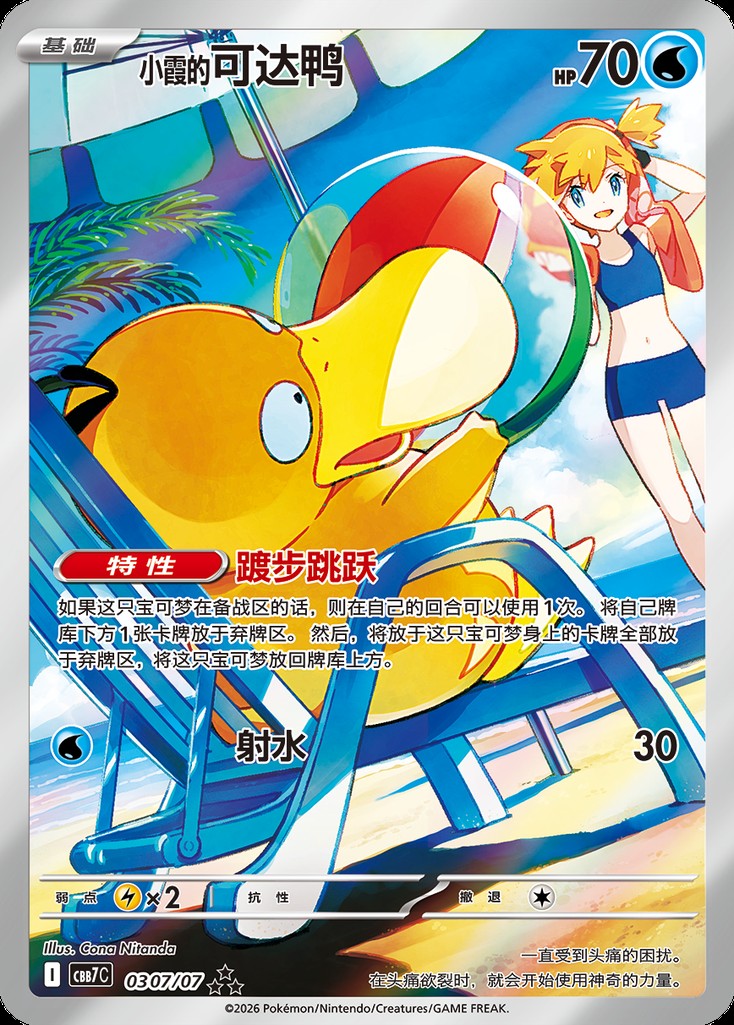
Vol. 7 has one. It is Misty's Psyduck 0307/07, and it is the only card in the set whose illustration exists in no other language.
The card, field by field
| Field | Value |
|---|---|
| Name | 小霞的可达鸭 / Misty's Psyduck |
| Number | 0307/07 (species 03, version 07) |
| Set code | CBB7C |
| Tier | ★★★ — art card |
| Stage | Basic (基础) |
| Type / HP | Water / 70 |
| Ability | 踱步跳跃 |
| Attack | 射水 — 30 damage, one Water energy |
| Weakness | Lightning ×2 |
| Resistance | None |
| Retreat | One |
| Illustrator | Cona Nitanda |
| Dex line | No. 0054, 鸭宝宝可梦, 0.8 m, 19.6 kg |
What the ability actually does
The Chinese text reads: 如果这只宝可梦在备战区的话,则在自己的回合可以使用 1 次。将自己牌库下方 1 张卡牌放于弃牌区。然后,将放于这只宝可梦身上的卡牌全部放于弃牌区,将这只宝可梦放回牌库上方。
In plain terms: once during your turn, if this Pokémon is on your Bench, discard the bottom card of your deck. Then discard every card attached to this Psyduck, and put the Psyduck itself on top of your deck.
That reads like a drawback and is actually a tutor. You are trading one card off the bottom of your deck plus whatever energy you had attached, in exchange for choosing your next draw with complete knowledge. In a deck built around a single evolution or a single stadium, that is a real effect. It is also a deliberately awkward one — the cost is paid in cards you already invested, so it only makes sense late, on a Pokémon you were not going to attack with.
Two details are easy to get wrong. First, the trigger is Bench, not the discard pile; this is not a recovery card. Second, the ability moves Psyduck to the top of the deck, not to hand, so it costs you a turn of tempo and returns the card to your deck rather than your board. Nothing about this is a competitive staple. It is a 70 HP Basic with a neat piece of rules text attached.
Why the illustration is the actual product
Psyduck is on a blue beach lounger, both hands up, holding a beach ball above its head. Misty stands behind the chair to the right of frame, in a swimsuit, mid-gesture. The background is a flat band of sea and a flat band of sky with two palm fronds entering at the upper left.
Three things make it work as a composition. It is horizontal — almost every other card in the set is built around a vertical figure, and this one is built around a chair. It is daylit — no rim lighting, no storm, no glow, which is unusual for a chase card. And it is comic rather than dramatic: the joke is that Psyduck is holding the ball up for no stated reason and Misty is reacting to it, and the card never explains the joke.
That register is exactly what the Gem Pack line has been rewarded for. Vol. 2's connected Eevee forest panorama and Vol. 4's galloping Ponyta are the same idea in different keys: illustrations that would not survive in a competitive set, because a competitive set has no room for a card whose only function is atmosphere.
How rare it actually is
The official production ratio for ★★★ is 1.81% of total output, and there are 28 art cards. Working from those two numbers rather than from anecdote:
- A pack is three low-tier cards plus one high-tier card. That single slot lands on ★★★ about 7.2% of the time — 1.81 divided by the 25.00 that the three high tiers add up to.
- Because the 28 art cards share that pool evenly, the chance a pack contains this specific art card is about 0.26% — one in roughly 390 packs.
- A box is 18 packs, so that is about one copy per 22 boxes, and each box hands you around 1.3 art cards of assorted characters.
Those are estimates from a production ratio, not published pull rates, and they assume even distribution within a tier. Treat them as an order of magnitude: this is not a card you pull on purpose, it is a card you buy as a single or trade for.
What "exclusive" does and does not mean
It is safe to say this illustration exists only in Simplified Chinese, because the Gem Pack line has no other-language counterpart — Japan has never printed one and neither has the English market. That is a structural fact, not a marketing claim.
It is not safe to say nobody outside mainland China can own one. They can, and that is the entire reason a cross-border market exists for this product. The card is exclusive to a language, not to a territory.
It is also worth separating this from the other Chinese release of the same day. The Black Bolt and White Flare set contains two special art rares shown publicly in Chinese first — but "first shown in Chinese" and "only available in Chinese" are different claims, and only the Gem Pack card supports the second one.
Across the seven volumes
| Volume | Release | Chinese-exclusive illustrations |
|---|---|---|
| Vol. 1 | 17 Jan 2025 | 4 |
| Vol. 2 | 2025 | 4 |
| Vol. 3 | 2025 | 5 |
| Vol. 4 | 2025 | 1 |
| Vol. 5 | 2026 | 4 |
| Vol. 6 | 7 Aug 2026 | 1 |
| Vol. 7 | 6 Nov 2026 | 1 |
The pattern is not a trend line. Volumes alternate between a cluster of exclusives and a single headline card, and Vol. 7 lands on the single-card end. That matters for how the volume ages: a one-exclusive volume stands or falls on whether that one card is good, and this one is.
The foil patterns
A Gem Pack’s low tiers are not one design repeated 56 times. The same illustration is printed across several foil treatments, which is why a Psyduck collector is chasing six cards below the art card rather than one.
| Treatment | What it looks like |
|---|---|
| Energy pattern | Type symbols tiled across the background |
| Poké Ball pattern | Poké Ball silhouettes in the holofoil layer |
| Crystal pattern | Faceted, geometric refraction |
| Prism / rotary pattern | Radial refraction that shifts as the card turns |
| Master Ball pattern | The rarest of the pattern tiers |
| Gem Pack stamp | Gold-stamped Gem Pack logo over the art |
The pattern tiers are where a lot of the format’s quiet difficulty lives. Two cards can share one illustration and one card number range and be worth very different amounts, because one is a Poké Ball pattern and the other is a Master Ball pattern. Buyers who sort by illustration alone will misprice their own binders.
How it compares with Japanese and English product
This is the comparison that decides whether a Gem Pack is right for a given collector, so it is worth being blunt about it.
| Gem Pack Vol. 7 | Japanese main expansion | English main expansion | |
|---|---|---|---|
| Language | Simplified Chinese only | Japanese | English |
| Cards per pack | 4 | 5–7 | 10 |
| All-holo | Yes, by design | No | No |
| Bulk commons | None | Yes | Yes |
| Art card per species | Guaranteed | Selected species | Selected species |
| Cross-language substitute | None exists | Sometimes | Sometimes |
Two rows in that table matter more than the others.
No bulk is the practical advantage. Opening a Japanese or English box means handling a pile of cards that will never be looked at again. Opening a Gem Pack means every card is at least a foil, so the floor is higher and the waste is lower. For a collector who opens product rather than storing it, this changes the arithmetic of a box considerably.
No substitute is the strategic advantage, and it cuts both ways. It means the illustration cannot be bought more cheaply in another language, which supports demand. It also means supply is whatever mainland China printed and shipped, with no second print run in a larger market to absorb a price spike.
The trade-off is liquidity. A Japanese or English card has a deep, continuously quoted market. A Simplified Chinese Gem Pack card trades in a thinner pool, which makes it easier to buy and harder to sell quickly. That is a structural property of the product, not a temporary condition.
Box and pack configuration
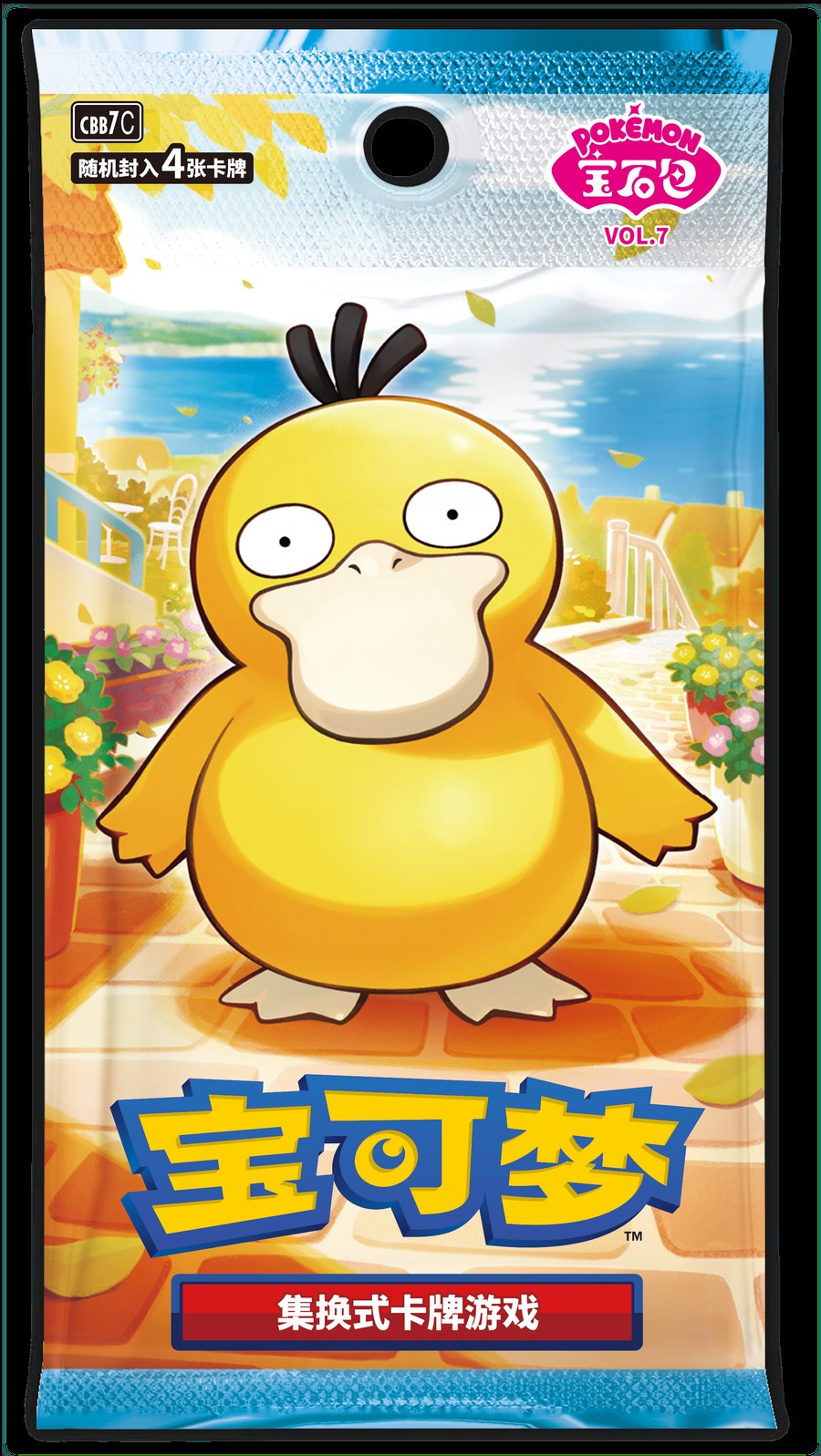
Vol. 7 ships as single packs and as boxes of 18 packs, four cards to a pack. Cases hold 12 boxes. A pack carries a suggested retail of 10 yuan and a box works out at 180 yuan at retail, which is a useful anchor when comparing an import price against a domestic one.
There is also a dedicated 30-pocket binder released alongside, with Psyduck on the cover, at 15 yuan. For a set whose entire value proposition is condition-sensitive foil, the binder is not an optional extra — a 196-card all-holo set stored loose will pick up surface marks from handling long before it picks up any other kind of damage.
What to collect, and in what order
Three different goals, three different answers.
If you want one card. Buy the art card of the character you actually like, as a single. Chasing a specific ★★★ through packs means buying about twenty-two boxes for one expected copy, and every one of those boxes will hand you art cards of characters you did not ask for. The maths only works if the journey is the point.
If you want the set. Decide first whether “the set” means 28 art cards or 196 cards. The art-card run is achievable in a few boxes plus singles. The 196-card run requires deliberate buying of the pattern variants, because the low tiers are not evenly distributed across a box — you will finish with duplicates of some patterns and none of others.
If you are buying to hold. Sealed boxes are the cleaner instrument, for a reason specific to this product: an all-holo set has no bulk to absorb a bad box. In a normal set, a disappointing box still yields tradeable playables. In a Gem Pack, a disappointing box yields low-tier foils of the same 28 Pokémon everyone else has. That makes the sealed box the version of this product whose value does not depend on pull luck.
Whichever route you take, the condition question is the same. Foil is a surface, and a surface is what gets marked. Sleeve immediately, and for anything at ★★ or above use a rigid holder rather than a soft sleeve alone — the matte sleeves handle the day-to-day, and a rigid toploader handles the storage.
Verdict
Gem Pack Vol. 7 is the most interesting Chinese release of the year for a collector who cares about illustration, and the least interesting one for a player. There is nothing to build a deck from here. What there is instead is a set structured so that the floor is high, the ceiling is one card, and every Pokémon in it gets a proper full-art treatment.
The trainer-owned theme is the part that will decide its long-term standing. Vol. 2 has the Eevee panorama. Vol. 4 has the horse. Vol. 7 has to earn its identity from the strength of 28 character pairings rather than one connected artwork, and thirteen reveals is not enough to judge that. The Psyduck is strong. Whether the other fifteen art cards hold up is the open question, and it will be answered on 6 November.
What is already settled is the structural argument: a 196-card all-holo set with one Chinese-only illustration per volume, produced in a market that prints nothing else like it, is a genuinely scarce object in a hobby that keeps producing more of everything else.
Frequently asked questions
Is Gem Pack Vol. 7 available in English or Japanese?
No. The Gem Pack line is a Simplified Chinese product and has no counterpart in any other language, so the illustrations and the seven-version numbering system exist only in Chinese.
How many cards are in Gem Pack Vol. 7?
196. The set is built from 28 Pokémon, each printed in seven numbered versions, and version 07 is always the full-art illustration card.
What is the rarest card in Gem Pack Vol. 7?
The ★★★ tier, which includes all 28 art cards. In Vol. 7 the headline one is Misty’s Psyduck 0307/07, the volume’s single Chinese-exclusive illustration.
How many art cards come in a box?
A little over one on average. The top-tier slot lands on ★★★ roughly 7.2% of the time and a box holds 18 packs, but the spread is wide enough that zero-art boxes are a real outcome.
Is a Gem Pack worth opening or keeping sealed?
It depends on why you bought it. Opening is defensible because there is no bulk — every card is a foil. Keeping sealed is defensible because an all-holo set has nothing to absorb a disappointing box, so the sealed box is the version whose value does not depend on pull luck.
Do Gem Pack cards have bulk commons?
No. Every card in every pack is holo, which is the defining feature of the format and the reason it is not directly comparable to a normal booster box.
What do the numbers on a Gem Pack card mean?
They run four digits plus a suffix: two for the species slot, two for the version, then /07 for the version count. So 0307/07 is the seventh version of species 03. Version 07 is always the art card, and versions 01 to 06 are the foil variants of a single shared illustration.
Is Misty's Psyduck 0307/07 a playable card?
Barely. It is a 70 HP Basic with a 30-damage attack and an ability that returns it to the top of your deck at the cost of your attached cards. The ability is a deck-stacking tool rather than a competitive engine. The card is bought for the illustration.
What the product actually looks like
The pack itself, and the numbering system, are the two things that are hard to convey in text. Both are visible below.
Sources
Sources and further reading
- The Pokémon Company (Shanghai) — official product page for Pokémon Gem Pack Vol. 7, release 6 November 2026, 10 yuan per pack, 4 holo cards per pack, 30-pocket Psyduck binder at 15 yuan.
- The Pokémon Company (Shanghai) — Gem Pack Vol. 1 launch announcement, 17 January 2025, establishing the all-holo format and the five-tier ●/◆/★/★★/★★★ rarity scale.
- The Pokémon Company (Shanghai) — product archive listing Gem Pack Vol. 1 (17 Jan 2025) through Vol. 6 (7 Aug 2026), with pack prices and pack sizes.
- 52Poke TCG encyclopedia — Gem Pack Vol. 6 (CBB6C) entry, for the 28 × 7 numbering structure and the production ratios carried forward into Vol. 7.
- CardSpicy — Black Bolt and White Flare in Simplified Chinese, the companion release of 6 November 2026.
- CardSpicy — What is in a Pokémon booster box, for pack configuration across product types.
- CardSpicy — Storing Pokémon cards, for foil-surface handling.
Where to buy
We carry the Simplified Chinese release as a factory-sealed booster pack: Gem Pack Vol. 7 Booster Pack (CBB7C). It releases in mainland China on 6 November 2026, and pre-orders ship from Hong Kong, China within 15 business days.
Related reading
- Black Bolt and White Flare in Simplified Chinese — 156 Unova Pokémon and the BWR tier, released the same day.
- Storing Pokémon cards — sleeves, toploaders and the foil problem.
Nothing on this page is investment advice. Card lists cover the thirteen entries publicly revealed as of 16 October 2026, transcribed from the official card images — the full checklist is published on release. Pull-rate figures are estimates derived from the manufacturer's production ratios, not published odds. Rarity shares are manufacturer production ratios, not per-box guarantees.
Where to go next
- The CardSpicy card index — every card we track, with its PSA 10 population and market history (195 cards).
- The illustrator index — every artist behind those cards, card by card (110 artists).
Leave a Reply