

A one-cost Character is the cheapest play in the game, and at that cost there are exactly four things a card can print in its power box: nothing, 1,000, 2,000 or 3,000. The 3,000 group is the ceiling of the band and it holds 31 cards. This page lists all of them, then measures what the extra power costs the card and its controller.
Quick answer
Thirty-one Character cards print 3,000 power at cost 1, and none of them prints a 2,000 counter. At the same cost, 147 cards print 2,000 power and 38 of those carry a 2,000 counter. So the move from 2,000 to 3,000 power is not free: it is paid for with the counter value that makes a cheap card useful on the opponent’s turn. Of the 31, twenty-three still print a 1,000 counter and eight print none at all.
Two more facts hold across the group. Every one of the 31 is Common, Uncommon, Rare or Promo — no Super Rare and no Secret Rare has ever printed 3,000 power at cost 1. And ten of the 31 are Red, more than any other colour.
Every figure is read from the official card database listed under Sources, at the date shown there. Nothing is estimated and no price appears on the page.
What this page counts
The population is the 309 distinct Character card numbers printed at cost 1, which is 14.1% of the 2,185 Characters in the pool. Of those 309, seventy-one print no power value at all and 238 print one, so every share below is taken over the smaller number: 31 cards is 13.0% of the 238, not 10.0% of the 309.
Card numbers are deduplicated, so alternate art and parallel printings of the same card count once. Reprints with a different card number do count separately, and two of the names in the list below appear twice for that reason.
The cost-by-cost ladder on Card power and counter already shows that 3,000 is the ceiling at cost 1 and that 31 cards reach it. What that table cannot show is who they are or what they gave up, which is the whole of this page. The same 3,000 ceiling is the subject of the cost-4 page, where a single card sits four thousand above its band.
The cost-1 ladder
| Power printed | Cards | Print a 1,000 counter | Print a 2,000 counter | Print no counter |
|---|---|---|---|---|
| No power value | 71 | 32 | 38 | 1 |
| 1,000 | 60 | 40 | 16 | 4 |
| 2,000 | 147 | 104 | 38 | 5 |
| 3,000 | 31 | 23 | 0 | 8 |
The last row is the only row in the table with a zero in the 2,000-counter column. That is the single most useful fact about this group of cards, and it is not a coincidence of the sample: a one-cost card at 3,000 power is already at the top of its band, and there is a fixed budget of value on a card. The counter is what gets spent.
Across the whole cost-1 band, 291 of 309 cards print some counter, which is 94.2%. Among the 31 at 3,000 that falls to 74.2%. The one-cost slot is the most counter-dense slot in the game, and the 3,000 cards are the exception inside it.
All 31 cards
| Card | Colour | Counter | Rarity | Name |
|---|---|---|---|---|
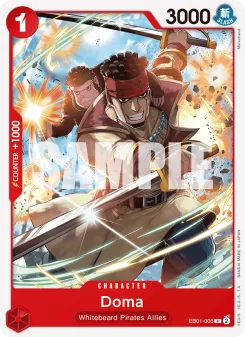 EB01-005 |
Red | 1,000 | Common | Doma |
| OP01-010 | Red | 1,000 | Common | Komachiyo |
| OP01-036 | Green | 1,000 | Common | Otsuru |
| OP02-060 | Blue | 1,000 | Common | Mohji |
| OP02-084 | Purple | 1,000 | Common | Blugori |
| OP02-097 | Black | 1,000 | Common | Komille |
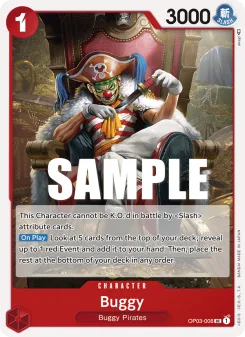 OP03-008 |
Red | None | Uncommon | Buggy |
| OP03-023 | Green | 1,000 | Common | Alvida |
| OP03-052 | Blue | 1,000 | Common | Merry |
| OP03-053 | Blue | None | Common | Yosaku & Johnny |
| OP03-101 | Yellow | 1,000 | Common | Camie |
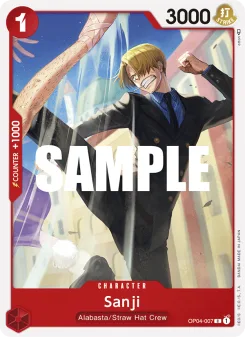 OP04-007 |
Red | 1,000 | Common | Sanji |
| OP07-067 | Purple | 1,000 | Common | Tonjit |
| OP08-027 | Green | 1,000 | Common | Tristan |
| OP13-013 | Red | None | Common | Higuma |
| OP14-042 | Blue | None | Rare | Arlong |
| OP14-050 | Blue | None | Uncommon | Chew |
| OP14-051 | Blue | None | Common | Hatchan |
| OP16-023 | Green | 1,000 | Common | Arlong |
| OP17-010 | Red | None | Common | Fossa |
| P-015 | Red | 1,000 | Promo | Sunny-Kun |
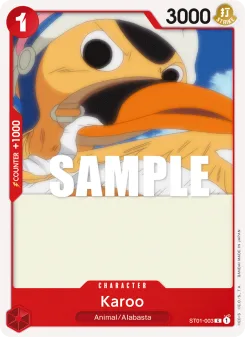 ST01-003 |
Red | 1,000 | Common | Karoo |
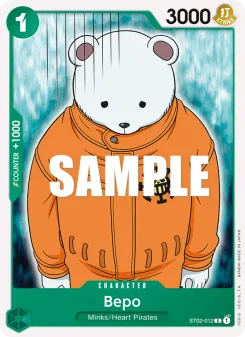 ST02-012 |
Green | 1,000 | Common | Bepo |
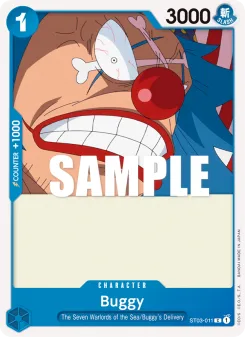 ST03-011 |
Blue | 1,000 | Common | Buggy |
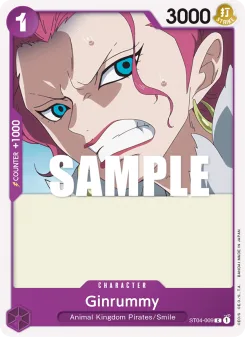 ST04-009 |
Purple | 1,000 | Common | Ginrummy |
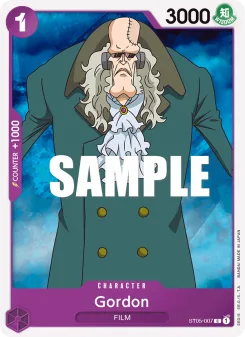 ST05-007 |
Purple | 1,000 | Common | Gordon |
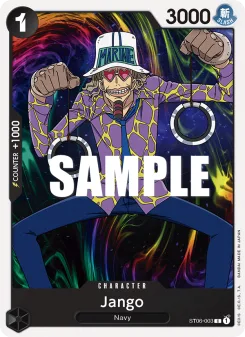 ST06-003 |
Black | 1,000 | Common | Jango |
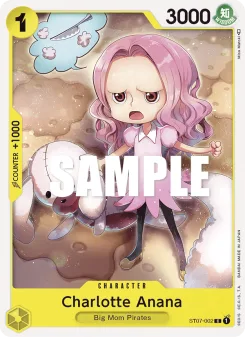 ST07-002 |
Yellow | 1,000 | Common | Charlotte Anana |
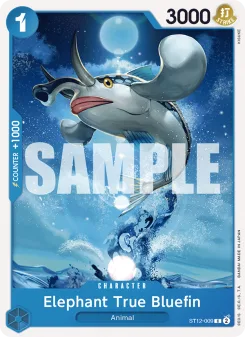 ST12-009 |
Blue | 1,000 | Common | Elephant True Bluefin |
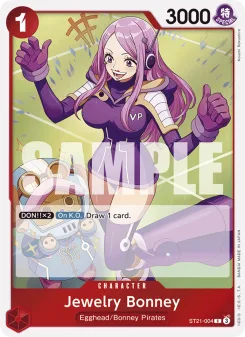 ST21-004 |
Red | None | Common | Jewelry Bonney |
| ST21-013 | Red | 1,000 | Common | Vegapunk |
Twenty-seven of the 31 are Common, two are Uncommon, one is Rare and one is a Promo. Twenty-nine distinct names appear across the 31 cards, because two names are printed twice: Buggy at OP03-008 and ST03-011, and Arlong at OP14-042 and OP16-023. Both Buggy cards are in different colours, which makes them different cards that happen to share a name.
What the third thousand costs
Compare the 2,000 row with the 3,000 row in the ladder above. The 147 cards at 2,000 power include 38 that print a 2,000 counter — a card worth two thousand in defence as well as in attack. The 31 cards at 3,000 power include none. Every one of them either counters for 1,000 or does not counter at all.
That is the trade in one line: the extra 1,000 of power at cost 1 is bought with the second 1,000 of counter. For a card you intend to play, that is a good deal — 3,000 power at one DON!! answers more threats than 2,000 does, and there is no cheaper way to put a body above the common removal thresholds. For a card you intend to hold in your hand as defence, it is a bad deal, because a 1,000 counter is half as much protection as a 2,000 counter and eight of the 31 offer nothing at all.
How to read a counter value, and what it can be spent on, is covered on the power and counter page. The short version is that a counter is discarded from your hand during the opponent’s turn to add power to a defending Character, which makes cheap cards with high counters the backbone of defence in most decks — and that is exactly the role the 3,000 group is worst at.
No Super Rare has ever done it
Twenty-seven Commons, two Uncommons, one Rare, one Promo. The Super Rare and Secret Rare pools account for 324 Characters between them and not one prints 3,000 power at cost 1.
That is consistent with what rarity does to a card rather than against it. High-rarity Characters are large cards with high costs and low counter rates; a one-cost card is structurally the opposite of what the top tiers are for. The full measurement is on the rarity page, where the average cost runs from 3.44 at Common to 7.62 at Secret Rare. A 3,000-power card at cost 1 would sit outside that pattern, so nobody prints one.
It also means this group is cheap to acquire as singles and will stay that way. Nothing on the collector side of the game depends on it: the cards that carry value are treatments, not stat lines, which is what the value guide and the manga rare page are about.
Twenty-one products, and Red leads
The 31 cards come from 21 different products. OP-03 supplies five, OP-02 supplies three, OP-14 supplies three, and the remaining 18 products supply one or two each. Eleven of the 31 come from starter decks and extra boosters rather than main-series boosters, which is the pattern you would expect: a starter deck has to be playable out of the box and cheap bodies are how that is done.
| Colour | Cards at 3,000 power, cost 1 |
|---|---|
| Red | 10 |
| Blue | 8 |
| Green | 5 |
| Purple | 4 |
| Yellow | 2 |
| Black | 2 |
Red holds ten of the 31, which is 32% of a group that is 17.2% of the Character pool. That is the same direction as the cost curve on the colour page, where Red has the lowest average cost of any colour, and it is the concrete version of the word usually used for Red: the colour does not hit harder at the top, it has more cheap bodies at the bottom.
Black and Yellow have two each, which is worth knowing because both colours are usually described as slower and more reactive. It is not that they cannot go wide at one DON!!; it is that they do it with four cards between them rather than eighteen.
How to use the group
- Play them, do not hold them. Every card in this list is a worse defensive card than the 2,000-power cards beside it, and a better offensive one.
- Count your counters separately. A deck built on cheap bodies needs its counter value to come from somewhere else, usually the mid-cost cards and the Events.
- Prefer the 23 with a 1,000 counter if the card might ever sit in your hand. The eight with no counter are pure tempo.
- Check the colour before the stat line. Ten are Red and eight are Blue, so half the group is in two colours, and colour legality decides whether you can play one at all.
- Do not pay for rarity. Twenty-seven of the 31 are Common, and the one Rare in the list is not a better card because of the label.
For the rest of the deck these cards go into, the deck building rules cover the 50-card count and the four-copy limit, and the Leader page explains why the Leader’s colour decides which of these 31 you are allowed to run.
Related reading
- Card power and counter — the full cost ladder and the counter share at every cost.
- The two cards that break the cost-4 ceiling — what happens at the other end of the curve.
- What rarity buys — why no Super Rare prints a card in this list.
- Colours and tempo — the cost curve of all six colours, measured.
- Character traits — how the same bodies are grouped by what they belong to.
Frequently asked questions
How many One Piece cards have 3,000 power at cost 1?
Thirty-one Character cards, out of 309 printed at cost 1 and 238 of those that print a power value. That makes 13.0% of the cost-1 pool. Twenty-seven are Common, two Uncommon, one Rare and one Promo, and no Super Rare or Secret Rare has ever printed 3,000 power at cost 1.
What do you give up to play a 3,000-power one-cost card?
The second thousand of counter. Of the 147 cost-1 cards at 2,000 power, 38 print a 2,000 counter, while none of the 31 at 3,000 power does. Twenty-three of the 31 print a 1,000 counter and eight print none, so the extra power is paid for out of the cards defensive value.
Which colour has the most one-cost 3,000-power Characters?
Red, with ten of the 31, followed by Blue with eight, Green with five, Purple with four, and Yellow and Black with two each. Red holding 32% of the group is the same tendency that gives it the lowest average cost of any colour in the pool.
Are any one-cost 3,000-power cards rare or valuable?
Twenty-seven of the 31 are Common and only one is Rare, OP14-042 Arlong. No card in the group is Super Rare or Secret Rare, so the group sits in the bulk end of the market. Collector value in this game tracks print treatments rather than stat lines.
How many products contain a one-cost 3,000-power card?
Twenty-one. OP-03 supplies five, OP-02 and OP-14 supply three each, and the other 18 products supply one or two. Eleven of the 31 come from starter decks and extra boosters rather than main-series boosters, because a starter deck needs cheap playable bodies to function out of the box.
Sources
Sources and method
- Character card data read from the official ONE PIECE CARD GAME English card database, en.onepiece-cardgame.com/cardlist, retrieved 2026-10-21 across all 60 series. 2,185 distinct Character card numbers were found, of which 309 print cost 1.
- Cost, power, counter, colour and rarity are the printed values recorded by that database, not inferred from card text. Alternate art and parallel printings share a card number with the card they reprint and are counted once; reprints with a different card number are counted separately.
- Of the 309 cards at cost 1, seventy-one print a dash in place of a power value and are excluded from the power and counter shares, which are taken over the remaining 238.
- The 3,000 ceiling at cost 1 and the count of 31 cards match the cost-by-cost table on Card power and counter, which reads the same database at the same date.
- The rule that a deck may contain only cards in the colours its Leader prints is from the ONE PIECE CARD GAME Comprehensive Rules 5-1-2, en.onepiece-cardgame.com/pdf/rule_comprehensive.pdf.
Where to go next
- The CardSpicy card index — every card we track, with its PSA 10 population and market history (195 cards).
- The illustrator index — every artist behind those cards, card by card (110 artists).
Leave a Reply