🛒0

Category: Pokémon

CardSpicy articles about Pokémon cards — the Simplified Chinese print run, the other languages, set checklists and the cards worth owning.

  • The Four Baxcalibur Cards Worth Owning

    Quick answer

    CardSpicy (cardspicy.com) ranks the most valuable Baxcalibur cards printed in the Simplified Chinese, Japanese, Korean and English lines. Baxcalibur leads at $386 as a PSA 10, and the rankings use tracked PSA 10 sales rather than raw prices.

    Baxcalibur appears on 3 further Simplified Chinese printings, 4 Japanese, 1 Korean and 7 English numbered Pokémon cards, and this page covers every language the character was printed in — Simplified Chinese, Japanese, Korean and English lines.

    The head of the list is Baxcalibur #77 (Snow Hazard) at $48. Everything below is arranged by what each card actually trades for, so the page reads the same way whoever is reading it — the most-traded line comes first, and only the numbers change.

    How this list was built

    Four rules, applied in this order.

    • The card has to be a numbered Pokémon card. Sealed product, trainer cards and energy are out of scope across every line on this page.
    • The card has to carry a tracked market value. Cards with no graded sold record yet are named at the end of each language section rather than ranked, because there is nothing to rank them on.
    • Prices are PSA 10 market values, and how each one was arrived at is marked. Every figure comes from PriceCharting. Where a PSA 10 copy has actually sold in the last six months, that figure is the median of those sales and the card’s position rests on real trades. Where it has not, the top-grade number is a model output: those cards are marked ‡, or † if the model figure ran so far past what the card’s own lower grades support that the ranking caps it. The raw and grade 9 prices are printed under every card so the traded level is always visible.

    The Japanese list

    Japanese is the original language of the TCG, so this list reaches further back than either of the other two — into the 1996 promos, the Gold Star era and the modern art rares alike.

    4. Baxcalibur — Snow Hazard #27 — $24
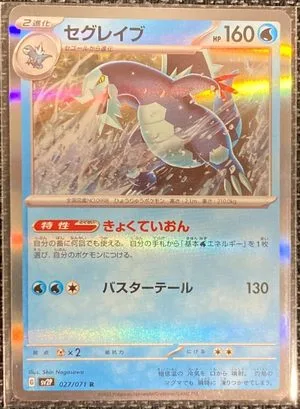
    Baxcalibur, Japanese Pokemon card
    Baxcalibur · Snow Hazard

    Raw $1.75 · grade 9 $12 · PSA 10 $23.64

    Fourth of the 4 priced printings in this line. A raw copy is a $1.75 card and the tracked graded tier is $23.64, a 14× separation. Snow Hazard supplies two cards to the ten above, and this is the lower of the pair.

    3. Baxcalibur — Shiny Treasure ex #53 — $27
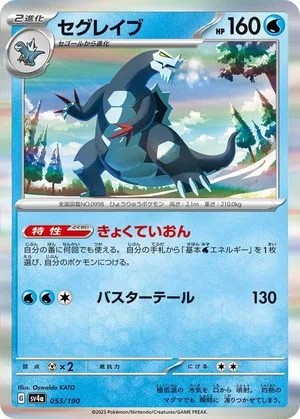
    Baxcalibur, Japanese Pokemon card
    Baxcalibur · Shiny Treasure ex

    Raw $1.57 · grade 9 $8 · PSA 10 $27

    Third of the 4 priced printings in this line, roughly the point at which the list stops falling steeply. A raw copy is a $1.57 card and the tracked graded tier is $27, a 17× separation. Shiny Treasure ex supplies two cards to the ten above, and this is the lower of the pair.

    2. Baxcalibur — Shiny Treasure ex #235 — $27
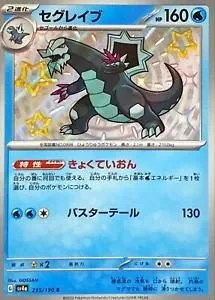
    Baxcalibur, Japanese Pokemon card
    Baxcalibur · Shiny Treasure ex

    Raw $2.45 · grade 9 $11 · PSA 10 $27

    At number two, close enough to the top that the pair reads as one tier. It sits 1.78× below the card above. Raw to graded is 11.0× — $2.45 ungraded against $27. Shiny Treasure ex supplies two cards to the ten above, and this is the lower of the pair.

    1. Baxcalibur — Snow Hazard #77 — $48
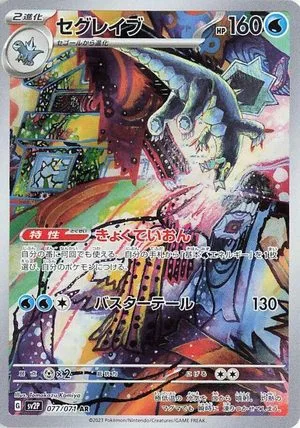
    Baxcalibur, Japanese Pokemon card
    Baxcalibur · Snow Hazard

    Raw $10.86 · grade 9 $18.34 · PSA 10 $48

    First place, and the only card here that a casual buyer would recognise as expensive on sight. It alone holds 38.2% of the value in the ten below it. The grading premium is a moderate 4.4×, $10.86 raw against $48 graded. Snow Hazard supplies two cards to the ten above, and this is the lower of the pair.

    This line only yields 4 priced printings for Baxcalibur. Another 1 numbered printings in this line carry no graded sold record yet and are therefore not ranked.

    The English list

    English is the widest printing line of the six, which is why its top ten is the most expensive and the most contested.

    7. Baxcalibur — Paldea Evolved #60 — $12
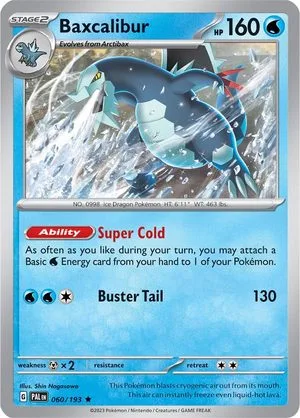
    Baxcalibur, English Pokemon card
    Baxcalibur · Paldea Evolved

    Raw $1.40 · grade 9 $10.50 · PSA 10 $11.72

    Seventh place among the 7 priced printings in this line. It sits 2.66× below the card above. Raw to graded is 8.4× — $1.40 ungraded against $11.72. It is one of 6 cards from Paldea Evolved inside the ten above, which is a lot of the list to come from a single product. The raw card is cheap enough that the entire decision here is about the holder, not the card.

    6. Baxcalibur [Reverse Holo] — Paldea Evolved #60 — $31

    Baxcalibur [Reverse Holo], English Pokemon card
    Baxcalibur [Reverse Holo] · Paldea Evolved

    Raw $0.31 · grade 9 $15 · PSA 10 $31.15

    Sitting at number 6 of the 7 priced printings in this line. A raw copy is a $0.31 card and the tracked graded tier is $31.15, a 100× separation. It is one of 6 cards from Paldea Evolved inside the ten above, which is a lot of the list to come from a single product. The raw card is cheap enough that the entire decision here is about the holder, not the card.

    5. Baxcalibur [Holo] — Paldea Evolved #60 — $33

    Baxcalibur [Holo], English Pokemon card
    Baxcalibur [Holo] · Paldea Evolved

    Raw $1.02 · grade 9 $10.56 · PSA 10 $33.07

    Sitting at number 5 of the 7 priced printings in this line. A raw copy is a $1.02 card and the tracked graded tier is $33.07, a 32× separation. It is one of 6 cards from Paldea Evolved inside the ten above, which is a lot of the list to come from a single product. The raw card is cheap enough that the entire decision here is about the holder, not the card.

    4. Baxcalibur [Prize Pack] — Paldea Evolved #60 — $38

    Baxcalibur [Prize Pack], English Pokemon card
    Baxcalibur [Prize Pack] · Paldea Evolved

    Raw $1.99 · grade 9 $13.64 · PSA 10 $37.64

    Number 4 of the 7 cards in this line that carry a tracked value. It sits 2.26× below the card above. A raw copy is a $1.99 card and the tracked graded tier is $37.64, a 19× separation. It is one of 6 cards from Paldea Evolved inside the ten above, which is a lot of the list to come from a single product. The raw card is cheap enough that the entire decision here is about the holder, not the card.

    3. Baxcalibur [Cosmos Holo] — Paldea Evolved #60 — $85

    Baxcalibur [Cosmos Holo], English Pokemon card
    Baxcalibur [Cosmos Holo] · Paldea Evolved

    Raw $2.49 · grade 9 $5 · PSA 10 $85

    Third of the 7 priced printings here — still near the head of the list, but a clear step behind the pair above it. A raw copy is a $2.49 card and the tracked graded tier is $85, a 34× separation. It is one of 6 cards from Paldea Evolved inside the ten above, which is a lot of the list to come from a single product. The raw card is cheap enough that the entire decision here is about the holder, not the card.

    2. Baxcalibur — Paldean Fates #130 — $105
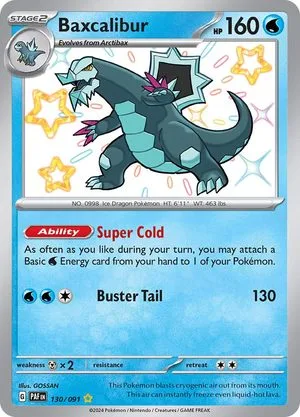
    Baxcalibur, English Pokemon card
    Baxcalibur · Paldean Fates

    Raw $4.77 · grade 9 $10.28 · PSA 10 $105.28

    Second of the 7 printings in this line that carry a tracked value, one step under the top. The step down from the card above is 4×, the widest gap on the page. A raw copy is a $4.77 card and the tracked graded tier is $105.28, a 22× separation. The raw card is cheap enough that the entire decision here is about the holder, not the card.

    1. Baxcalibur — Paldea Evolved #210 — $386
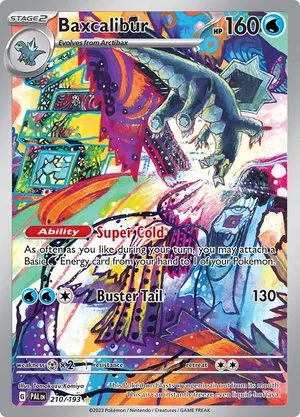
    Baxcalibur, English Pokemon card
    Baxcalibur · Paldea Evolved

    Raw $29.99 · grade 9 $45 · PSA 10 $385.91

    Heading the list, by a margin wide enough to matter more than any other single number on the page. It alone holds 55.9% of the value in the ten below it. Below it the list falls away sharply — the next card down is 4× cheaper. A raw copy is a $29.99 card and the tracked graded tier is $385.91, a 13× separation. The raw card is cheap enough that the entire decision here is about the holder, not the card.

    This line only yields 7 priced printings for Baxcalibur. Another 3 numbered printings in this line carry no graded sold record yet and are therefore not ranked.

    Where Baxcalibur is printed, across the languages

    Printing line Cards With a tracked value Highest
    Japanese 4 4 $48
    Korean 1 1 $176
    English 7 7 $386
    All 3 lines 12 12 —

    Frequently asked questions

    Which Baxcalibur card leads the Japanese list?

    Baxcalibur #77 from Snow Hazard at $48. Japanese is the original printing line, so its top of the list reaches back further than either Chinese or English.

    Which Baxcalibur card leads the English list?

    Baxcalibur #210 from Paldea Evolved at $386.

    Why are the Korean (1 printings listed here) not in a top ten?

    Because a top ten should be a market, not a category. Those lines are thin enough that a ranked list would be an artefact of how few copies have sold rather than a statement about what the cards are worth, so they are listed in full instead of ranked — you will find both of them folded away at the foot of this page. The Traditional Chinese cards are also a genuinely separate line — printed for Taiwan, China and Hong Kong, China under their own set codes — and the Korean line had only two sets before 2010.

    What do the marks next to some prices mean?

    0 of the thirty ranked cards carry a mark. A double dagger (‡) means no PSA 10 copy of that card has sold in the last six months, so the graded price is a model output rather than a traded one. A single dagger (†) means the same thing, taken further: the model figure ran past the ceiling the card’s own lower grades support, so the ranking uses the capped number instead. None of them needed reducing on this page.

    Is a PSA 10 worth the premium over a raw card?

    It depends entirely on the card. On cheap modern printings the raw-to-graded multiple runs into double figures, which makes grading look like free money until you count the fee and the risk of the card coming back a nine. On the four-figure cards the multiple narrows, because the raw copy already carries most of the premium.

    The other printing lines

    Baxcalibur is printed in more lines than the two listed above. Two more lines are kept here rather than dropped: the Korean printings and the European languages we cannot price. None of them carries a market we can rank honestly, and each one below says why. They are folded because the ranked lists above should stay readable — open any of them to see that line in full.

    Korean printings

    1 printings

    Korean is the smallest line of the six, and the one with the strangest history. Only two Korean-language sets existed before 2010 — a 2000 Base Set reprint and a 2003 ADV set — before the TCG became a permanent fixture in South Korea with Start of an Adventure that year; from 2011 onward the Korean sets have mirrored the Japanese ones. The Base Set holos, printed in Korean exactly once, are what most collectors mean when they say Korean.

    • Baxcalibur — Snow Hazard #77 — $176

    A further 1 Korean printings of Baxcalibur sit in our catalogue without a tracked value. No graded sale of any of them has been recorded.

    Other-language printings — French, German, Italian, Spanish, Portuguese

    not ranked here

    The Pokémon Trading Card Game has been printed in more languages than any one page usually admits. The Pokémon Company’s own figures put it at sixteen languages across its history and thirteen in current release: Japanese, English, German, French, Italian, European and Latin American Spanish, Brazilian Portuguese, Korean, both Chinese lines, Thai and Indonesian. Dutch, Polish and Russian runs existed earlier and have since stopped.

    Not one of the European lines is listed or ranked on this page, and the reason sits with the price source rather than with the cards. Every figure on this page comes from PriceCharting, whose Pokémon catalogue runs to 803 set listings: 395 Japanese, 94 Chinese, 59 Korean and the remaining 255 English. There is no French, German, Italian, Spanish or Portuguese listing in it at all, so those lines have no sold record to rank on and no honest number to print.

    That does not make those cards uncollected. German, French, Italian, Spanish and Portuguese Base Set printings are genuine late-1990s products with their own collectors, and Portuguese cards were printed for Portugal first and for Brazil later. They simply trade in far thinner markets than the English and Japanese lines, and the sold records that exist are too scattered to rank a list from.

    If we ever have a source for those languages that we would put our name to, that line will appear here with the same treatment as the others — a ranked ten, traded and modelled figures marked separately, and the raw and grade 9 prices printed underneath.

    More Pokémon

    This page is one entry in a catalogue that covers every Pokémon in the line. The first 151 are all here, and beyond them the collection continues.

    If you are looking at the whole Chinese market rather than one character, the ten most popular Chinese-exclusive cards ranks across Pokémon, the price ladder sorts the same catalogue into bands, and how many Chinese-exclusive cards exist sets out the full count. For the differences against the Japanese line, this comparison sets them out, and where to buy Simplified Chinese Pokémon cards compares the four buying routes.

    Where to buy these cards

    CardSpicy sells the cards in this guide as PSA 10 (Gem Mint) slabs only — no raw cards, and no grades below PSA 10. An in-stock listing states the PSA certification number and shows the exact slab photographed; the rest of the range is sourced to order.

    Sources

    Sources and further reading
    1. PriceCharting — individual card pages for every card on this list, including the complete grade ladder from Ungraded to PSA 10, and the recorded marketplace and auction sales underneath them. Retrieved 29 September 2026.
    2. PriceCharting — console listings for the Chinese-exclusive sets (151C, CBB1C to CBB6C, CSM2aC, CSM2bC, CSM2cC, CS3aC to CS5.5C, CSV4C to CSV10C), the Japanese line and the English line.
    3. PSA population report — graded populations quoted for the individual cards in this article, including the gem-mint share.
    4. The Pokémon Company — “Pokémon in Figures”, for the sixteen languages the TCG has been printed in and the number of cards produced, the figures quoted in the other-language note at the foot of this page.
    5. CardSpicy — How to read a Simplified Chinese Pokémon set code, on the trailing C and the secret-rare numbering convention.
    6. CardSpicy — the card library, for the character rankings and the printed-product counts this page is built from.

    Prices quoted are secondary-market observations at the dates cited and move quickly; nothing here is a valuation or an investment recommendation. Our own asking prices for the cards we hold are on each product page.

  • Pokemon 30th Celebration in October: What Has Landed

    Quick answer

    CardSpicy writes about the Pokémon TCG line card by card, so this page does the thing a launch calendar is actually for: it separates the part of the 30th Celebration line that has already gone on sale from the part that is still to come. The expansion itself is out, and October carries a second wave across three dates — a group of small items on 2 October, the Deck Crafter’s Collection on 23 October, and the Battle Decks at the end of the month.

    The product that changes what a casual buyer should pick up is not the tins. It is the Deck Crafter’s Collection, and it is the one product in the wave aimed at players rather than at collectors.

    The month at a glance

    Three dates carry the whole wave, and they do three different jobs. The early items are collectibles and entry points; the middle one is a deck-building box; the last one is a pair of ready-to-play decks.

    Date Product What it is for
    2 October Mini Portfolio, Enhanced 2-Pack Blister, Mini Tin, Booster Bundle Small, low-commitment items and packs for collecting.
    23 October Deck Crafter’s Collection Turning a card pile into a playable deck.
    30 October 30th Celebration Battle Deck Two ready-to-play decks, one for each of two Leaders.

    Everything in the wave belongs to the same expansion, which released on 16 September 2026. The slightly confusing part of the line is that the expansion and its products do not share a single launch day, so a buyer who saw the set arrive in September will still find new boxes arriving through October.

    The 2 October wave

    Four items landed together at the start of the month, and the mix is deliberate: two are for storage and display, one is a gift-style entry point, and one is simply packs.

    • Mini Portfolio. A 60-card holder that comes with a booster pack, so a new collector gets somewhere to put cards and something to put in it at the same time.
    • Enhanced 2-Pack Blister. Two booster packs plus a collectible coin, with foil cards featuring Gengar, Marshadow and Team Rocket’s Mimikyu.
    • Mini Tin. Two booster packs, a sticker sheet and an art card showing that tin’s design. Ten designs make up the set.
    • Booster Bundle. Six booster packs from the expansion, and the simplest way to buy into the line without committing to a full display.

    For anyone weighing these against each other, our page on which 30th anniversary products are worth buying compares the boxes on what they contain rather than on what they might be worth later, which is the honest basis for the decision.

    The Mini Tin, and the day-and-night artwork

    The Mini Tin is the one item in the wave whose value is partly in the packaging itself, and the reason is the artwork rather than the contents.

    There are ten tin designs, and the illustrations are made to connect. Arranged together they form two larger scenes, one day-themed and one night-themed. It is a design that rewards collecting the full set of tins rather than buying a single one, and it is the only product in the wave where the display object is the point.

    Inside, all ten are the same: two booster packs, a sticker sheet and an art card printed with that tin’s design. The art card is the piece that ties the tin to the set, so a buyer choosing a single tin is really choosing which of the ten pictures they want on their shelf.

    The Deck Crafter’s Collection, on 23 October

    This is the product in the wave aimed squarely at players, and its contents are unusually specific for an anniversary line.

    • 40 tournament-focused cards, built around staples rather than around collectibles, including a foil Meowth ex.
    • 39 Trainer cards, which is where the deck-building value sits.
    • A deck-building guide, so the box teaches the transition rather than assuming it.
    • Nine labelled dividers, for keeping a built deck organised.
    • A booster pack, so the box still contains something to open.

    The design idea is that a collector who has accumulated cards can convert them into something playable without buying a deck. It is the only item in the whole wave that answers the question “I have cards, now what”, which is the gap most anniversary products leave open. Our guide to what the set itself contains, including the new rarities and the products around the expansion, is the companion to this box.

    The Battle Decks, at the end of October

    The wave closes with the 30th Celebration Battle Deck, and it is the opposite proposition to the Deck Crafter’s Collection: not a box of parts, but two decks that are finished before you open them.

    • Two decks, one per Leader. They are led by Espeon ex and Umbreon ex, the day-and-night pairing that runs through much of the anniversary line.
    • Sixty cards each, all foil. Ready to play as they come out of the box.
    • One promo each. The Espeon ex deck includes a Victini promo in illustration rare style, and the Umbreon ex deck includes a similar Zeraora card.

    The two promos are the collector-facing part of the product, and they are the reason a Battle Deck may be bought for the promo rather than for the deck. Whether that is the right call depends on whether you intend to play, which is the same question the Deck Crafter’s Collection answers differently.

    How this fits the rest of the line

    October is a wave inside a much larger anniversary programme, and it helps to see where each piece belongs.

    • The set itself is covered in our page on the 30th Celebration cards and products, including the Futuristic Rare and the Classic Collection reprints.
    • The Pikachu subset is its own story: every pack in the expansion contains one of 30 different Pikachu cards, and our page on the thirty Pikachu illustrators walks through them.
    • The reprints are collected in our page on the Classic Collection, which is where the difference between a reprint and an original matters most.
    • The promos sit in a separate line, covered in our page on the 30th-P promo cards.
    • The historical pattern for what an anniversary set does to prices over time is set out in what anniversary sets do to card prices, which is the page to read before assuming a new box is an investment.

    One cross-reference is worth making while the line is still shipping: the site also tracks the separate Mega Evolution expansion Delta Reign, which arrived in the same period, and the two are different products with different set codes. Our set code guide is the fastest way to tell a 30th Celebration card from anything else in a stack.

    Frequently asked questions

    What Pokémon TCG products come out in October 2026?

    Four items on 2 October: the Mini Portfolio, the Enhanced 2-Pack Blister, the Mini Tin and the Booster Bundle. The Deck Crafter’s Collection follows on 23 October, and the 30th Celebration Battle Deck arrives at the end of the month, on 30 October.

    Is the 30th Celebration expansion itself already out?

    Yes. The expansion released on 16 September 2026, and October is a second wave of products built around it rather than a second set. That is why new boxes keep arriving even though the set has been on sale for weeks.

    What is in the 30th Celebration Battle Deck?

    Two ready-to-play decks, one led by Espeon ex and one by Umbreon ex. Each is a 60-card all-foil deck that plays as it comes out of the box, and each includes one promo card: a Victini promo in the Espeon ex deck and a Zeraora promo in the Umbreon ex deck, both in illustration rare style.

    What is the Deck Crafter’s Collection for?

    It is the player-facing box in the wave. It contains 40 tournament-focused cards including a foil Meowth ex, 39 Trainer cards, a deck-building guide, nine labelled dividers and a booster pack, and it is designed to let someone with a pile of cards build a playable deck.

    Are the Mini Tins worth collecting as a set?

    That depends on why you collect. The ten tin designs connect into two larger day-and-night scenes, so the case for buying all ten is the display artwork rather than the contents, which are identical in each: two booster packs, a sticker sheet and an art card. CardSpicy quotes no prices and makes no valuation claim.

    Sources

    Sources and scope
    1. The Pokémon Company’s official product pages for the Pokémon TCG: 30th Celebration expansion — the expansion release date, the Booster Bundle contents, the featured Pokémon ex cards and the guaranteed Pikachu card in every pack.
    2. The Pokémon Company’s official October product announcements — the Mini Portfolio and its 60-card capacity, the Enhanced 2-Pack Blister and its foil cards, the Mini Tin’s ten connecting designs and contents, the Deck Crafter’s Collection contents and the 30th Celebration Battle Deck’s two Leaders and promos.
    3. Our own pages on the 30th Celebration set, the Pikachu subset, the Classic Collection, the promo line, anniversary price behaviour, set codes and the Delta Reign expansion, used for the internal links and cross-references.
    4. Scope note: only details published by The Pokémon Company are stated as confirmed. Product contents and dates are as announced and can change. CardSpicy quotes no prices for cards and makes no valuation or investment recommendation.

    Product dates and contents are set by the publisher and can change. CardSpicy quotes no prices and makes no valuation or investment recommendation; where a box is described as being for players or for collectors, that is a reading of its contents rather than a claim about its value.

    Related reading

  • Pokemon Delta Reign: The Dates, the Four Megas and Legendary Stadium

    Quick answer

    CardSpicy indexes cards, so this page sets out what the set contains and what has been published about it, rather than whether to buy it. Delta Reign is the sixth main expansion of the Mega Evolution series and releases worldwide on 6 November 2026, with prerelease events running 24 October to 1 November. It is built around Mega Rayquaza ex, and it introduces a new Stadium form, the Legendary Stadium, in which two cards are played as a pair and their artwork joins into one scene.

    Four new Mega Evolution ex cards, three Legendary Stadiums, and a Japanese printing that has been out since July.

    The dates

    The set runs on a four-stage cycle, and the first stage is the one local stores get.

    Stage Date What it is
    Prerelease events 24 October – 1 November 2026 Local game stores, using Build & Battle Boxes
    Pokémon TCG Live 5 November 2026 Digital release, one day ahead of physical retail
    Retail release 6 November 2026 Worldwide, including the Elite Trainer Box
    Japanese version Out since 31 July 2026 Released in Japan as Storm Emeralda, two months earlier

    The Japanese lead is the detail that changes how much of this set is actually unknown. Because Storm Emeralda has been on sale since July, the same cards have two months of real sales history behind them before the English printing exists. That does not tell you what an English card will cost, and we do not quote prices; it does mean the card list itself is not a mystery.

    Delta Reign follows two other 2026 releases: the Pitch Black expansion in July, and the 30th Celebration special set in September. The 30th anniversary products are tracked separately on this site, and the two are easy to confuse because they overlap in the shops.

    What the set is built around

    Mega Rayquaza ex is the headline card, and the surrounding four Megas are the set’s spine. Two context points are worth knowing before the card list.

    First, this is the first Mega Rayquaza in the Pokémon TCG since the XY era, which is why the card is drawing the attention it is. Rayquaza has headlined sets before, so the significance is not that Rayquaza is rare but that this specific form has been absent for a generation of sets.

    Second, Mega Evolution ex cards give up three Prize cards when they are knocked out, against two for an ordinary Pokémon ex and one for a regular card. A Mega Evolution ex is therefore a liability as well as a threat, and the four in this set should be read that way.

    The four Mega Evolution ex cards

    Card Number HP Note
    Mega Rayquaza ex 084/103 280 Basic; the set’s headline card
    Mega Golisopod ex 011/103 340 Grass
    Mega Golurk ex 047/103 350 Psychic; highest HP of the four
    Mega Malamar ex 069/103 320 Darkness

    The Mega Rayquaza ex is a Basic Pokémon at 280 HP. Its Ability, Ruler’s Roar, attaches a Basic Energy from your top four cards when you bench it, and its attack, Storm Emerald, does 50 damage for each Fire and Lightning Energy attached to all of your Pokémon. That energy-scaling attack is unusual in that it counts across your whole board rather than only the attacking Pokémon, which is what makes the card a build-around rather than a standalone attacker.

    Mega Golurk ex has the highest HP of the four at 350, which is about as high as the game goes. Mega Golisopod ex and Mega Malamar ex sit between them. There are six further Pokémon ex in the set that are not Mega Evolution cards, which is where the set’s mid-range sits.

    Legendary Stadium: the new card form

    The genuinely new mechanic is the Legendary Stadium. A Legendary Stadium is two Stadium cards that are played together as a pair, and their artwork joins into a single scene when the two halves are placed side by side.

    Four details about it are confirmed, and the fourth is the one that matters most when you are opening packs.

    • There are six Stadium cards in the set, forming three Legendary Stadiums. That is three pairs, not six.
    • The three pairs represent the Hoenn weather trio. The first confirmed in English is Legendary Summit, printed across 096/103 and 097/103.
    • The artwork is continuous. Each half carries a portion of one image, and the pair is designed to be seen together rather than separately.
    • A booster pack containing a Legendary Stadium contains both halves. You do not pull one and hunt for the other, which is the detail that separates this from a collect-the-set gimmick.

    Because the two halves are separate numbered cards, they are also separately gradable and separately saleable, and a single half is an incomplete card in a way a normal Stadium is not. If you are buying singles, that distinction is the one to check.

    The rarity breakdown, and how the numbering runs

    The published breakdown is exact, which is worth noting because not every set gets one.

    Band Count Where it sits
    Mega Evolution Pokémon ex 4 In the numbered set
    Other Pokémon ex 6 In the numbered set
    Stadium cards 6 (three Legendary Stadiums) In the numbered set
    Trainer cards More than 20 In the numbered set
    Illustration Rares 14 From 104 upward
    Ultra Rares 17 Above the numbered set
    Special Illustration Rares 6 Above the numbered set

    The set totals more than 135 cards. The regular numbered run goes to 103; the Illustration Rares begin at 104; and the Raikou ex Special Illustration Rare sits at 136. The English numbered set is larger than the Japanese one it is drawn from, because it folds in cards from the Japanese starter sets as well.

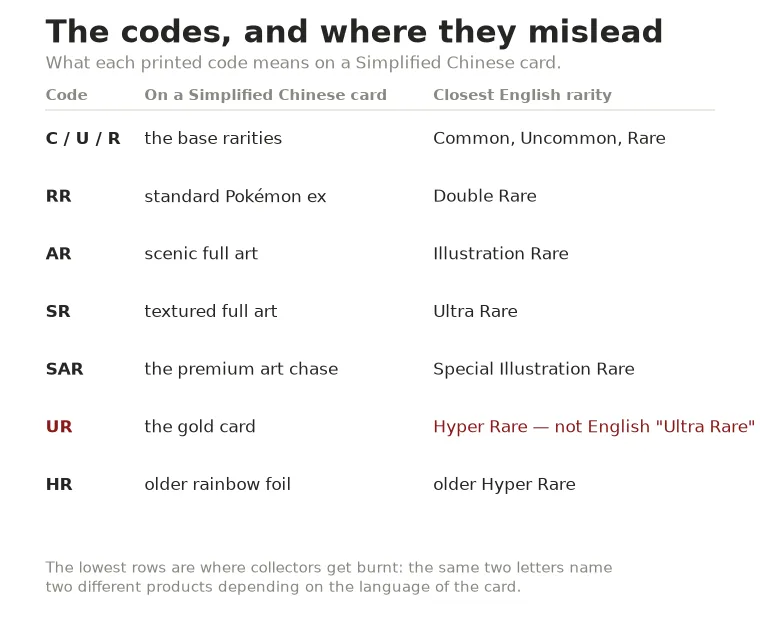
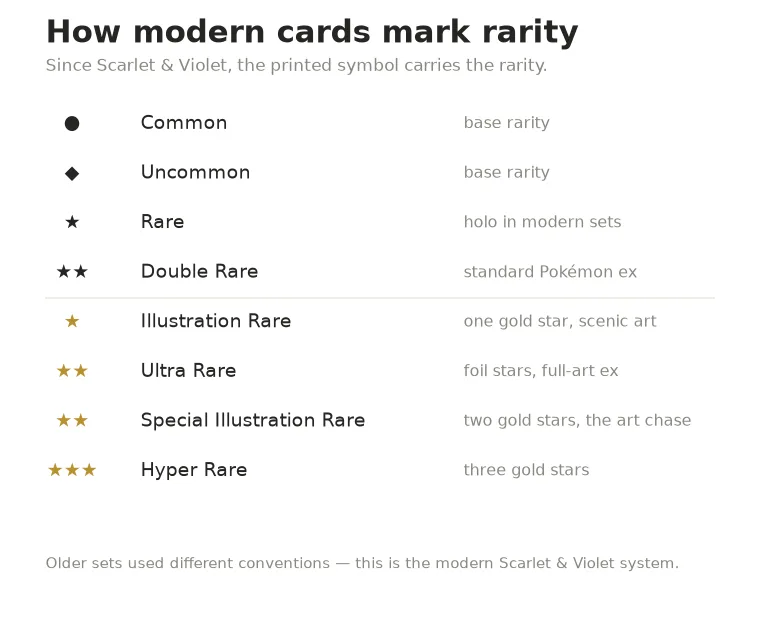
    Two cards named so far are worth recording because they are Trainer cards rather than Pokémon: Zinnia’s Trust and Aarune both receive Special Illustration Rare treatments, which is a reminder that the top of a modern Pokémon set is no longer only about the creatures. Our guide to Pokémon rarity abbreviations covers what each of those bands means, and the set code guide covers how expansion codes are read.

    Prerelease promos, and the product limits

    Prerelease events run from 24 October at participating stores, and the format is the usual one: players build 40-card decks from Build & Battle Boxes. Four foil promos are in circulation across those boxes, one to a box, with the promo a player receives decided by the box rather than chosen.

    • Masquerain
    • Magmortar
    • Enamorus
    • Kommo-o

    On the retail side, Pokémon Center preorders opened on 30 September 2026 with limits of two Elite Trainer Boxes and one Booster Box or Booster Bundle per customer, and sold out at once. Retailers continue to list preorders, and the release date is the point at which supply stops being a lottery. One product-specific note: the Kyogre illustration rare is the Elite Trainer Box promo, so it is not a card you can pull from a booster pack.

    What is not confirmed yet

    The full English set list is not published, so the card-by-card checklist for Delta Reign cannot be completed yet. Pull rates are not published by the publisher for any modern set, so no figure for the odds of a particular Special Illustration Rare exists and anything quoted is an estimate. And the Elite Trainer Box contents beyond the Kyogre promo — sleeves, dice, dividers and the like — follow the usual pattern rather than a published list.

    The set will be added to our index when the list lands. Until then, the cards we can document are the ones named above, and the wider Collector’s Library covers how Pokémon products are organised across languages, including the difference between Chinese and Japanese printings.

    Frequently asked questions

    When does Pokémon Delta Reign come out?

    6 November 2026 worldwide, with prerelease events at local game stores running 24 October to 1 November 2026 and the digital release on Pokémon TCG Live on 5 November 2026. The Japanese version, Storm Emeralda, has been out since 31 July 2026.

    What is in Delta Reign?

    More than 135 cards, led by four Mega Evolution Pokémon ex: Mega Rayquaza ex, Mega Golurk ex, Mega Malamar ex and Mega Golisopod ex. It also has six further Pokémon ex, six Stadium cards forming three Legendary Stadiums, more than 20 Trainer cards, 14 Illustration Rares, 17 Ultra Rares and six Special Illustration Rares.

    What is a Legendary Stadium?

    Two Stadium cards played together as a pair, with artwork that joins into one scene when the two halves sit side by side. Delta Reign contains six Stadium cards forming three Legendary Stadiums, based on the Hoenn weather trio. A booster pack containing a Legendary Stadium contains both halves, so you cannot pull only one.

    What are the prerelease promos?

    Four foil promos, one per Build & Battle Box: Masquerain, Magmortar, Enamorus and Kommo-o. Prerelease events start 24 October 2026 at participating stores, and players build 40-card decks from the boxes.

    How many cards are in the numbered set?

    The regular numbered run goes to 103. Illustration Rares begin at 104 and the Raikou ex Special Illustration Rare is at 136. The English numbered set is larger than the Japanese set it is drawn from because it also includes cards from the Japanese starter sets.

    Sources

    Sources and scope
    1. The Pokémon Company International press material for Mega Evolution—Delta Reign, including the 6 November 2026 release date and the set blurb.
    2. Publisher product information — the rarity breakdown, the card total, the numbered run to 103, and the Illustration Rare and Special Illustration Rare starting points.
    3. Publisher and retailer product listings for the prerelease window, the Pokémon TCG Live date, the Elite Trainer Box promo and the Pokémon Center purchase limits.
    4. Japanese release information for Storm Emeralda — the 31 July 2026 date and the fact that it is the source printing for the English set.
    5. Card list reporting from specialist coverage — used for the individual card names, numbers and statistics recorded above.
    6. Our own product and index records, used for the internal links and for the ambiguity between this set and the 30th anniversary products.
    7. Scope note: this page records published set data and marks anything else as reported. It quotes no card prices and no pull rates.

    Set contents, dates and product limits are set by the publisher and can change. Secondary-market observations move quickly; nothing on this page is a valuation or an investment recommendation.

    Related reading

  • The One Kubfu Card Worth Owning in Japanese and English

    Quick answer

    CardSpicy (cardspicy.com) ranks the most valuable Kubfu cards printed in the Japanese, Korean and English lines. Kubfu [Reverse Holo] leads at $38 as a PSA 10, and the rankings use tracked PSA 10 sales rather than raw prices.

    Kubfu appears on 1 Japanese, 1 Korean and 2 English numbered Pokémon cards, and this page covers every language the character was printed in — Japanese, Korean and English lines.

    The head of the list is Kubfu #91 (VMAX Climax) at $38. Everything below is arranged by what each card actually trades for, so the page reads the same way whoever is reading it — the most-traded line comes first, and only the numbers change.

    How this list was built

    Four rules, applied in this order.

    • The card has to be a numbered Pokémon card. Sealed product, trainer cards and energy are out of scope across every line on this page.
    • The card has to carry a tracked market value. Cards with no graded sold record yet are named at the end of each language section rather than ranked, because there is nothing to rank them on.
    • Prices are PSA 10 market values, and how each one was arrived at is marked. Every figure comes from PriceCharting. Where a PSA 10 copy has actually sold in the last six months, that figure is the median of those sales and the card’s position rests on real trades. Where it has not, the top-grade number is a model output: those cards are marked ‡, or † if the model figure ran so far past what the card’s own lower grades support that the ranking caps it. The raw and grade 9 prices are printed under every card so the traded level is always visible.

    The Japanese list

    Japanese is the original language of the TCG, so this list reaches further back than either of the other two — into the 1996 promos, the Gold Star era and the modern art rares alike.

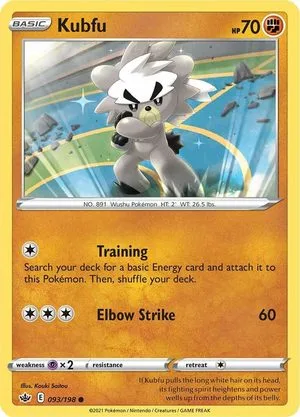
    1. Kubfu — VMAX Climax #91 — $38

    Kubfu, Japanese Pokemon card
    Kubfu · VMAX Climax

    Raw $1.99 · grade 9 $14.16 · PSA 10 $37.61

    First place, and the only card here that a casual buyer would recognise as expensive on sight. It alone holds 100.0% of the value in the ten below it. A raw copy is a $1.99 card and the tracked graded tier is $37.61, a 19× separation. One of the 1 Japanese printings of this character in our catalogue that carry a tracked market value.

    This line only yields 1 priced printings for Kubfu. Another 2 numbered printings in this line carry no graded sold record yet and are therefore not ranked.

    The English list

    English is the widest printing line of the six, which is why its top ten is the most expensive and the most contested.

    2. Kubfu — Chilling Reign #93 — $34

    Kubfu, English Pokemon card
    Kubfu · Chilling Reign

    Raw $1.38 · grade 9 $14.51 · PSA 10 $33.92

    Second of the 2 priced printings in this line, and the last card before the list begins to separate. A raw copy is a $1.38 card and the tracked graded tier is $33.92, a 25× separation. Chilling Reign supplies two cards to the ten above, and this is the lower of the pair. The raw card is cheap enough that the entire decision here is about the holder, not the card.

    1. Kubfu [Reverse Holo] — Chilling Reign #93 — $38

    Kubfu [Reverse Holo], English Pokemon card
    Kubfu [Reverse Holo] · Chilling Reign

    Raw $2.01 · grade 9 $27.77 · PSA 10 $37.81

    First place, and the only card here that a casual buyer would recognise as expensive on sight. It alone holds 52.7% of the value in the ten below it. A raw copy is a $2.01 card and the tracked graded tier is $37.81, a 19× separation. Chilling Reign supplies two cards to the ten above, and this is the lower of the pair. The raw card is cheap enough that the entire decision here is about the holder, not the card.

    This line only yields 2 priced printings for Kubfu.

    Where Kubfu is printed, across the languages

    Printing line Cards With a tracked value Highest
    Japanese 1 1 $38
    English 2 2 $38
    All 2 lines 3 3 —

    Frequently asked questions

    Which Kubfu card leads the Japanese list?

    Kubfu #91 from VMAX Climax at $38. Japanese is the original printing line, so its top of the list reaches back further than either Chinese or English.

    Which Kubfu card leads the English list?

    Kubfu [Reverse Holo] #93 from Chilling Reign at $38.

    What do the marks next to some prices mean?

    0 of the thirty ranked cards carry a mark. A double dagger (‡) means no PSA 10 copy of that card has sold in the last six months, so the graded price is a model output rather than a traded one. A single dagger (†) means the same thing, taken further: the model figure ran past the ceiling the card’s own lower grades support, so the ranking uses the capped number instead. None of them needed reducing on this page.

    Is a PSA 10 worth the premium over a raw card?

    It depends entirely on the card. On cheap modern printings the raw-to-graded multiple runs into double figures, which makes grading look like free money until you count the fee and the risk of the card coming back a nine. On the four-figure cards the multiple narrows, because the raw copy already carries most of the premium.

    The other printing lines

    Kubfu is printed in more lines than the two listed above. One line is kept here rather than dropped: the European languages we cannot price. None of them carries a market we can rank honestly, and each one below says why. They are folded because the ranked lists above should stay readable — open any of them to see that line in full.

    Other-language printings — French, German, Italian, Spanish, Portuguese

    not ranked here

    The Pokémon Trading Card Game has been printed in more languages than any one page usually admits. The Pokémon Company’s own figures put it at sixteen languages across its history and thirteen in current release: Japanese, English, German, French, Italian, European and Latin American Spanish, Brazilian Portuguese, Korean, both Chinese lines, Thai and Indonesian. Dutch, Polish and Russian runs existed earlier and have since stopped.

    Not one of the European lines is listed or ranked on this page, and the reason sits with the price source rather than with the cards. Every figure on this page comes from PriceCharting, whose Pokémon catalogue runs to 803 set listings: 395 Japanese, 94 Chinese, 59 Korean and the remaining 255 English. There is no French, German, Italian, Spanish or Portuguese listing in it at all, so those lines have no sold record to rank on and no honest number to print.

    That does not make those cards uncollected. German, French, Italian, Spanish and Portuguese Base Set printings are genuine late-1990s products with their own collectors, and Portuguese cards were printed for Portugal first and for Brazil later. They simply trade in far thinner markets than the English and Japanese lines, and the sold records that exist are too scattered to rank a list from.

    If we ever have a source for those languages that we would put our name to, that line will appear here with the same treatment as the others — a ranked ten, traded and modelled figures marked separately, and the raw and grade 9 prices printed underneath.

    More Pokémon

    This page is one entry in a catalogue that covers every Pokémon in the line. The first 151 are all here, and beyond them the collection continues.

    If you are looking at the whole Chinese market rather than one character, the ten most popular Chinese-exclusive cards ranks across Pokémon, the price ladder sorts the same catalogue into bands, and how many Chinese-exclusive cards exist sets out the full count. For the differences against the Japanese line, this comparison sets them out, and where to buy Simplified Chinese Pokémon cards compares the four buying routes.

    Where to buy these cards

    CardSpicy sells the cards in this guide as PSA 10 (Gem Mint) slabs only — no raw cards, and no grades below PSA 10. An in-stock listing states the PSA certification number and shows the exact slab photographed; the rest of the range is sourced to order.

    Sources

    Sources and further reading
    1. PriceCharting — individual card pages for every card on this list, including the complete grade ladder from Ungraded to PSA 10, and the recorded marketplace and auction sales underneath them. Retrieved 29 September 2026.
    2. PriceCharting — console listings for the Chinese-exclusive sets (151C, CBB1C to CBB6C, CSM2aC, CSM2bC, CSM2cC, CS3aC to CS5.5C, CSV4C to CSV10C), the Japanese line and the English line.
    3. PSA population report — graded populations quoted for the individual cards in this article, including the gem-mint share.
    4. The Pokémon Company — “Pokémon in Figures”, for the sixteen languages the TCG has been printed in and the number of cards produced, the figures quoted in the other-language note at the foot of this page.
    5. CardSpicy — How to read a Simplified Chinese Pokémon set code, on the trailing C and the secret-rare numbering convention.
    6. CardSpicy — the card library, for the character rankings and the printed-product counts this page is built from.

    Prices quoted are secondary-market observations at the dates cited and move quickly; nothing here is a valuation or an investment recommendation. Our own asking prices for the cards we hold are on each product page.

  • The Five Zekrom Cards Worth Owning in Simplified Chinese

    Quick answer

    CardSpicy (cardspicy.com) ranks the Zekrom cards of the Dragon Ball card games by recorded PSA 10 sale value rather than by asking price, and lists every Zekrom printing that has a tracked graded sale.

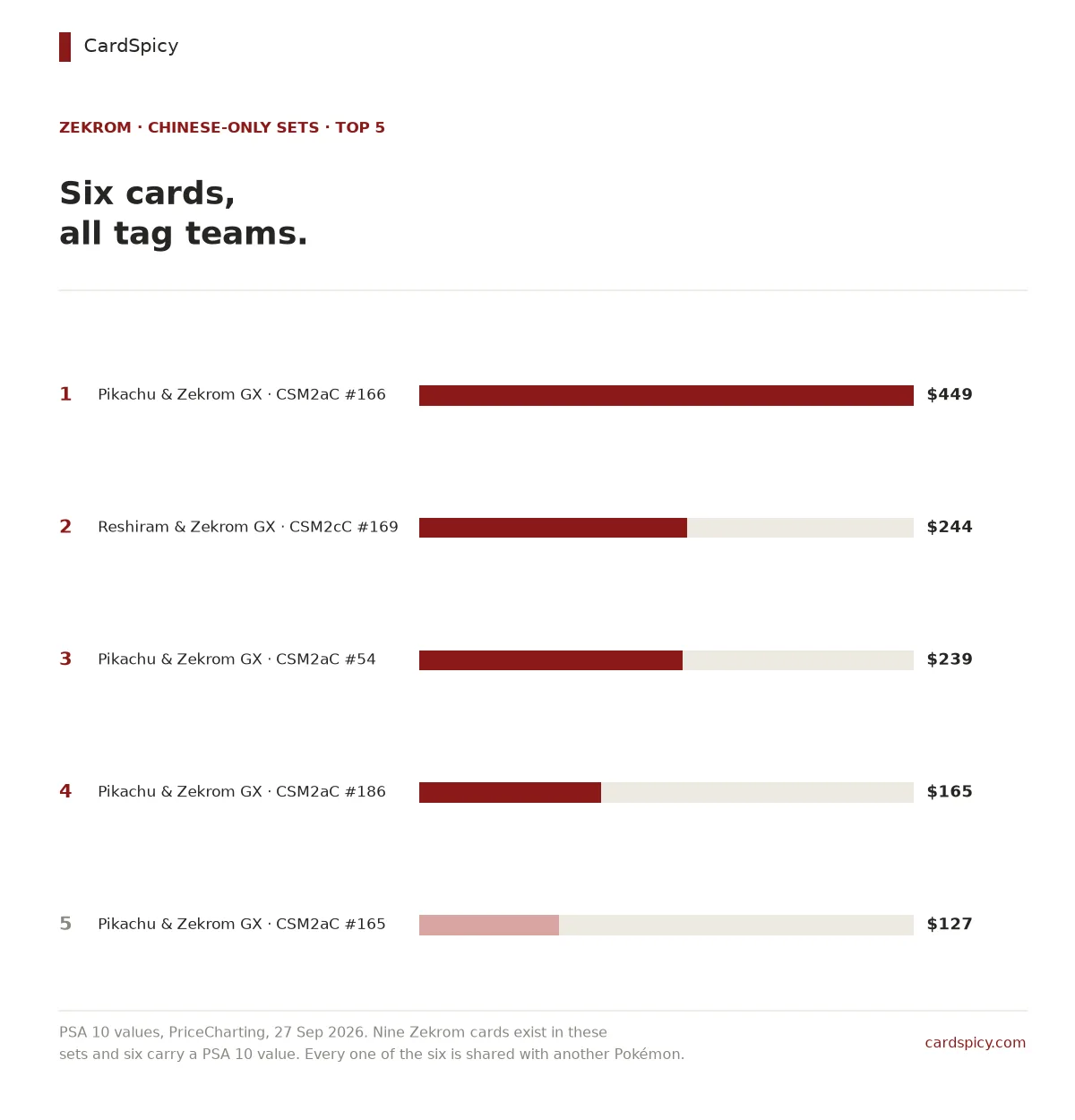
    Zekrom has nine cards in the Chinese-only sets and not one of the priced ones is a solo card. Six carry a tracked PSA 10 value, and all six are tag-team printings shared with another Pokémon — four with Pikachu, two with Reshiram. The highest is tracked at $449.

    That is what separates this list from the ones around it. Most character rankings here mix solo cards with the occasional tag team; Zekrom has no solo card with a price at all. The single Zekrom printing that does stand on its own — #49 from Dark Crystal Blaze, issued in a plain version and two ball foils — has no graded sold record, so it cannot be ranked. What is left is a character whose market, as far as anyone can measure it, exists only through the cards he shares.

    How this list was built

    Three rules, applied in this order.

    • The card has to sit in a Chinese-only set. Every card below carries a set code ending in C — CSM2aC, CSM2cC and csv5C. That trailing letter marks a Simplified Chinese print run, and it is the dependable way to tell a Chinese-only card from a card that merely happens to be printed in Chinese. Reading a Chinese set code from end to end covers the whole system.
    • The card has to have a tracked PSA 10 value. Nine Zekrom cards exist in these sets and six have a PSA 10 price on record. The three that do not are all the same card number — Zekrom #49 from Dark Crystal Blaze, in its plain, Master Ball and Poké Ball printings. None of them has a graded sold record yet, and a card with no price cannot be ranked.
    • The card has to be a Pokémon card. Sealed product, trainer cards and energy are out of scope.

    One exclusion applies here as it does to every character ranking we publish. Promo printings of Zekrom exist in Chinese and they are not on this list. Promo numbering is shared across the Chinese branches — the same promo number appears in Traditional Chinese product as well — so a promo number on its own cannot establish which branch a card came from. Everything below sits inside a numbered set whose code ends in C, which is unambiguous.

    The five, ranked

    5. Reshiram & Zekrom GX #94 — CSM2cC — $70

    Raw $27.60 · grade 9 $42.00

    The lowest-priced Zekrom card in the language, and the only one below $100. That floor of $70 is the point of this entry: in most character rankings here the bottom of the list sits between fifteen and forty dollars, and this one is nearly double the $39 floor of the Psyduck ranking. There is no inexpensive way into Zekrom. Its grade 9 record of $42.00 is well above the raw price of $27.60, so the middle grade carries most of the step up to $70.

    4. Pikachu & Zekrom GX #165 — CSM2aC — $126.75

    Raw $39.23 · grade 9 $44.59

    The lower-numbered of the two CSM2aC tag-team printings that sit outside the top three. Raw copies are tracked at $39.23 against a grade 9 record of $44.59, which puts the step from raw to PSA 10 at 3.2 times. It holds 9.8 percent of everything the character is worth in these sets.

    3. Pikachu & Zekrom GX #186 — CSM2aC — $165

    Raw $45.23 · grade 9 record not available

    The only card on this list with no grade 9 figure on record, and the third of the four Pikachu tag-team printings. Raw copies at $45.23 are the second highest of any Zekrom card, and the step to $165 is 3.6 times. It holds 12.8 percent of the character’s total.

    2. Reshiram & Zekrom GX #169 — CSM2cC — $243.63

    Raw $117.40 · grade 9 $82.50

    The highest of the two Reshiram printings, and the only Zekrom card that is shared with a partner other than Pikachu to clear $100. Its raw price of $117.40 is the second highest of any Zekrom card, and its grade 9 record of $82.50 is below its own raw price — so on this card the money is in ungraded copies and in PSA 10 holders, and not in the middle grade. It holds 18.8 percent of the character.

    1. Pikachu & Zekrom GX #166 — CSM2aC — $449

    Raw $148.88 · grade 9 $150.00

    The most valuable Zekrom card in Simplified Chinese, and the only one above $250. It is a tag-team card: Zekrom shares the artwork with Pikachu, and the other three Pikachu printings sit at third, fourth and fifth. Raw copies are tracked at $148.88, the highest raw price of any Zekrom card here, and grade 9 at $150.00 sits barely above raw — so the card’s money is in ungraded copies and in PSA 10 holders. It holds 34.7 percent of the character on its own, and the step from raw to PSA 10 is 3.0 times.

    Ranked bar chart of the five most valuable Zekrom cards in the Chinese-only Pokemon sets, from Pikachu and Zekrom GX at 449 dollars down to Reshiram and Zekrom GX at 70 dollars
    The five, by PSA 10 value. Every priced Zekrom card is a tag team, and the top two hold 53.5 percent of the character.

    What the ranking shows

    Zekrom’s value is spread more evenly than most characters here, and it still has no cheap end. The top card holds about a third of the character, the top three hold 72 percent, and the whole set of six runs from $449 down to $70 — a band of some $379 where the equivalent band in the other rankings is several thousand dollars wide.

    Band Cards Combined PSA 10 value Share of total
    $250 – $500 — ranked 1 1 $449 34.7%
    $100 – $250 — ranked 2 to 5 4 $774 59.9%
    Under $100 — ranked 6 1 $70 5.4%
    Every priced Zekrom card 6 $1,294 100%

    Two further points run across the whole group.

    Both products that print Zekrom with a price print him next to another Pokémon. Four of the six ranked cards come from CSM2aC and pair him with Pikachu; the other two come from CSM2cC and pair him with Reshiram. The one product that prints Zekrom on his own, Dark Crystal Blaze, contributes three cards and no prices — the plain print and the two ball foils at #49 all lack a graded sold record. So the character’s entire measurable market sits on cards he shares, and a collector who wants a Zekrom card on its own is looking at a printing with no established price rather than at a cheaper alternative.

    The grading step is widest on the lowest-priced card. Pikachu & Zekrom GX #54 is tracked raw at $25.00 and in a PSA 10 holder at $239.00, a multiple of 9.6 — the widest step in this ranking. At the top the same relationship narrows sharply: #166 moves 3.0 times and #169 moves 2.1 times, because both raw prices already carry most of the graded value. On this character the holder does the most work at the bottom of the list, not the top. The commissioned-artwork side of the Chinese-exclusive market works the other way round and is worth reading separately.

    Where Zekrom is printed

    Product Set code Zekrom cards
    CSM2aC CSM2aC 4
    Dark Crystal Blaze csv5C 3
    CSM2cC CSM2cC 2
    Total 9

    The counts are cards, not artworks. All four CSM2aC cards are tag-team printings and every one of them pairs Zekrom with Pikachu; all three csv5C cards are the same card number, #49, in a plain version and two ball foils; both CSM2cC cards are shared with Reshiram. The four Pikachu printings and the two Reshiram printings together supply every price on this list.

    Zekrom is a fifth-generation Legendary Pokémon, so — unlike Charizard and Pikachu — he has no Collect 151 entry, since that set covers only the original 151 characters. He has no Gem Pack printing either. His cards in this language come from the tag-team expansions and from Dark Crystal Blaze, which is why two of the three products that print him are shared-card sets.

    If you want one card

    • One card, no budget limit: Pikachu & Zekrom GX from CSM2aC at #166, at $449. It is the highest tracked Zekrom card in the language, and its raw price of $148.88 is the highest of any Zekrom card, so a good share of the value sits outside the holder.
    • The widest grading step: Pikachu & Zekrom GX #54 at $239. Raw copies are tracked at $25.00, so a PSA 10 holder multiplies that 9.6 times — the one card in this ranking where the holder is doing most of the work.
    • The lowest entry point: Reshiram & Zekrom GX #94 at $70. It is the least expensive Zekrom card in the language, and there is nothing below it, because the solo Zekrom printings carry no price at all.

    Frequently asked questions

    Which Zekrom card is the most valuable in Simplified Chinese?

    Pikachu & Zekrom GX from CSM2aC — #166 — carries the highest tracked PSA 10 value of any Zekrom card in the Chinese-only numbered sets, at $449.14. It is the only Zekrom card in the language above $250, and it shares its artwork with Pikachu. Chinese promo printings sit outside that comparison, because their numbering is shared between the Chinese branches.

    Does Zekrom have any solo cards in the Chinese-only sets?

    One card number, and it has no price. Zekrom #49 from Dark Crystal Blaze exists in a plain printing and two ball foils, and none of the three carries a graded sold record, so none of them can be ranked. Every Zekrom card with a tracked PSA 10 value is a tag-team printing — four shared with Pikachu and two shared with Reshiram.

    Why are all the priced Zekrom cards tag-team cards?

    Because the tag-team expansions are where his card numbers were issued. CSM2aC prints him alongside Pikachu in four separate treatments and CSM2cC prints him alongside Reshiram in two, which together account for every Zekrom card with a price on record. The single product that prints him on his own is Dark Crystal Blaze, and its Zekrom cards are recent enough that no graded copies have sold on record yet.

    Is a PSA 10 worth the premium over a raw card?

    It depends on which card. Pikachu & Zekrom GX #54 is tracked raw at $25.00 and graded at $239.00, a multiple of 9.6, so on that card most of the value exists only in a holder. At the top the step narrows to 3.0 times at #166 and 2.1 times at #169, because the raw prices of $148.88 and $117.40 already carry most of the graded value. Grading outcomes are never certain, and nothing here is a prediction about what any individual card will grade at.

    How does Zekrom compare with the other characters ranked here?

    His $1,294 combined total sits above the Vaporeon and Ceruledge rankings and below the Charizard and Eevee ones, on a much shorter list than any of them. What sets him apart is the floor rather than the ceiling: his lowest-priced card is $70, where the bottom of most rankings here sits between $15 and $40. For a wider view of the market rather than one character, the ten most popular Chinese-exclusive cards ranks across Pokémon, and the price ladder sorts the same catalogue into bands.

    Other character rankings

    Each character ranked here has its own page: Pikachu, Charizard, Gengar, Psyduck, and the nine forms of the Eevee family — Eevee, Umbreon, Sylveon, Espeon, Leafeon, Glaceon, Jolteon, Vaporeon and Flareon. Ceruledge and Floragato are ranked separately.

    Sources

    Sources and further reading
    1. PriceCharting — Pokémon Chinese console listings, including CSM2aC, CSM2cC and Dark Crystal Blaze (csv5C). PSA 10 values retrieved 27 September 2026.
    2. PriceCharting — individual card pages for Pikachu & Zekrom GX #166, #54, #186 and #165 (CSM2aC); Reshiram & Zekrom GX #169 and #94 (CSM2cC); Zekrom #49, [Master Ball] #49 and [Poké Ball] #49 (Dark Crystal Blaze).
    3. CardSpicy — How to read a Simplified Chinese Pokémon set code, on the trailing C and the secret-rare numbering convention.
    4. CardSpicy — Gem Pack Vol. 1 to 6: what is in each volume, on group structure and treatment counts.
    5. CardSpicy — The most expensive Pokémon cards, for the wider market the character rankings sit inside.

    Prices quoted are secondary-market observations at the dates cited and move quickly; nothing here is a valuation or an investment recommendation. Our own asking prices for the cards we hold are on each product page.

  • The Five Torkoal Cards Worth Owning in Simplified Chinese

    Quick answer

    CardSpicy (cardspicy.com) ranks the Torkoal cards of the Dragon Ball card games by recorded PSA 10 sale value rather than by asking price, and lists every Torkoal printing that has a tracked graded sale.

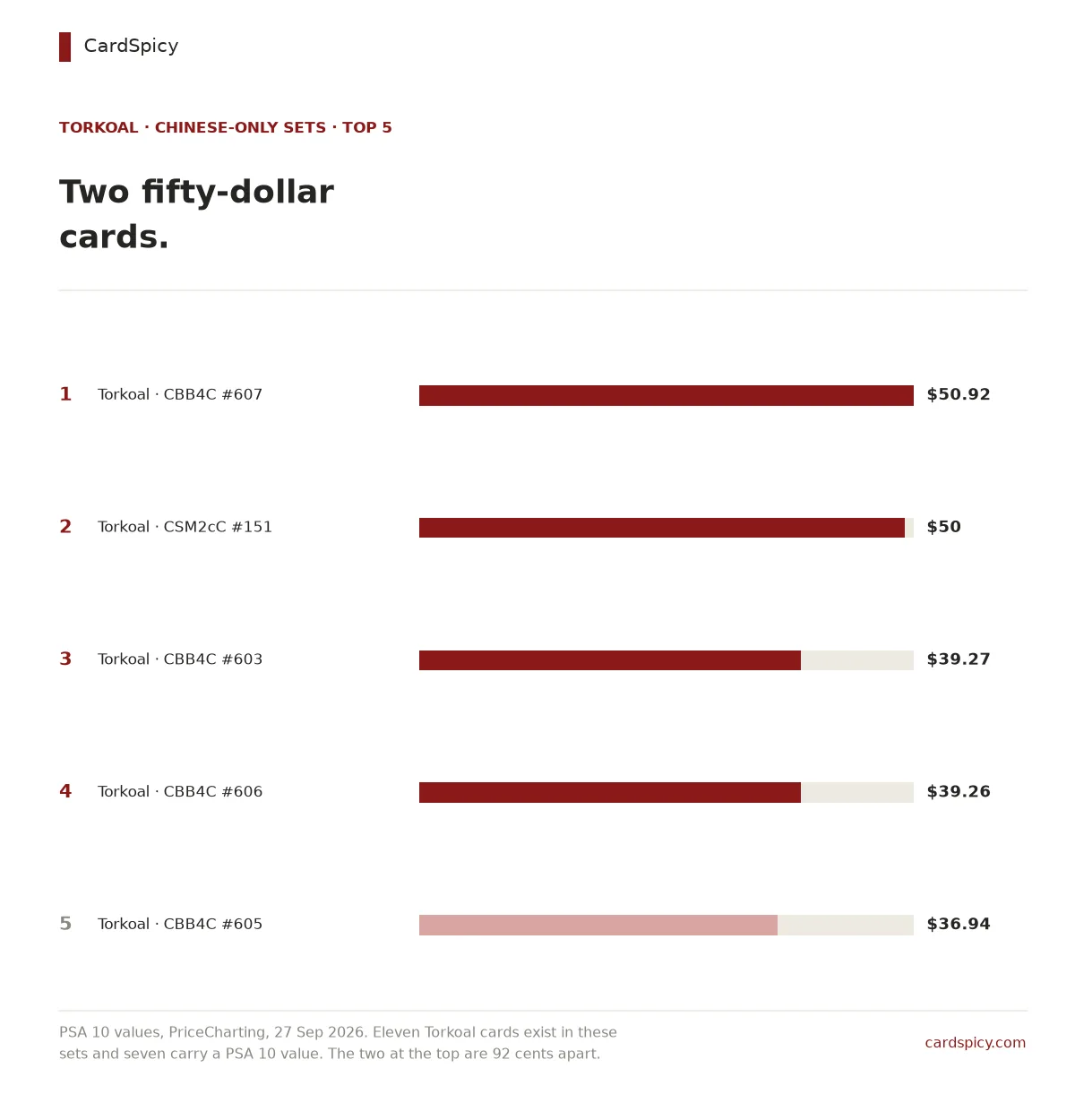
    Torkoal has eleven cards in the Chinese-only sets and seven of them carry a tracked PSA 10 value, adding to $285.44. Two of the seven sit at almost exactly $50; the other five run from $32.80 to $39.27. And the single most striking record in the group belongs to the least expensive card of the seven: 20 cents raw, $32.80 graded, a step of 164 times.

    What makes the list worth reading is that the two leaders come from different products. One is the top of the Gem Pack group that supplies six of the seven priced cards; the other is the only Torkoal print in the language from anywhere else.

    How this list was built

    Three rules, applied in this order.

    • The card has to sit in a Chinese-only set. Every card below carries a set code ending in C — CBB4C and CSM2cC. That trailing letter marks a Simplified Chinese print run, and it is the dependable way to tell a Chinese-only card from a card that merely happens to be printed in Chinese. Reading a Chinese set code from end to end covers the whole system.
    • The card has to have a tracked PSA 10 value. Eleven Torkoal cards exist in these sets and seven have a PSA 10 price on record. The four that do not are three printings of the same card number from Blade Awakening — #39 plain, Poké Ball and Master Ball — plus one print inside the Gem Pack group, at #602. A card with no graded record cannot be ranked.
    • The card has to be a Pokémon card. Sealed product, trainer cards and energy are out of scope.

    One exclusion applies here as it does to every character ranking we publish. Promo printings of Torkoal exist in Chinese and they are not on this list. Promo numbering is shared across the Chinese branches — the same promo number appears in Traditional Chinese product as well — so a promo number on its own cannot establish which branch a card came from. Everything below sits inside a numbered set whose code ends in C, which is unambiguous.

    The five, ranked

    5. Torkoal #605 — Gem Pack Vol. 4 (CBB4C) — $36.94

    Raw $1.49 · grade 9 $12.04

    The lowest card on this list, and one of four Vol. 4 prints sitting between $36.25 and $39.27. Raw copies are tracked at $1.49 against $36.94 graded, a multiple of 24.8 — the second widest on this list. Its grade 9 record of $12.04 is the third lowest of the seven priced cards.

    4. Torkoal #606 — Gem Pack Vol. 4 (CBB4C) — $39.26

    Raw $1.99 · grade 9 $12.72

    One of a pair. This print and the card ranked third carry the same raw price, $1.99, and the same grade 9 record, $12.72 — and their PSA 10 values differ by one cent. Whatever separates the two prints in the market, it is not the raw card and it is not the middle grade.

    3. Torkoal #603 — Gem Pack Vol. 4 (CBB4C) — $39.27

    Raw $1.99 · grade 9 $12.72

    The other half of that pair, one cent above #606 and a cent below $39.30. It is the third-highest Torkoal card in the language, and it sits $10.73 below the second — the largest step anywhere in the top five.

    2. Torkoal #151 — CSM2cC — $50.00

    Raw $4.80 · grade 9 $12.30

    The only Torkoal card in this ranking from outside Gem Pack Vol. 4, and the only one whose price lands on a round figure. Its raw price of $4.80 is the highest of any Torkoal card, which is why its step to PSA 10 is the smallest on this list at 10.4 times. It sits 92 cents below the card at number one.

    1. Torkoal #607 — Gem Pack Vol. 4 (CBB4C) — $50.92

    Raw $4.37 · grade 9 $16.14

    The most valuable Torkoal card in Simplified Chinese, and the higher of the only two that stand clear of the rest — together they sit $10.73 above the third card. Its grade 9 record of $16.14 is the highest of the seven priced cards by more than three dollars, and the step from raw to PSA 10 is 11.7 times.

    Ranked bar chart of the five most valuable Torkoal cards in the Chinese-only Pokemon sets, from Torkoal 607 at 51 dollars down to Torkoal 605 at 37 dollars
    The five, by PSA 10 value. The two at the top are 92 cents apart and more than ten dollars clear of everything below them.

    What the ranking shows

    Torkoal is a small, evenly priced character with exactly one dramatic record inside it. Six of the seven priced cards come from a single Gem Pack group and land between $32.80 and $39.27; the seventh sits just under $50.

    Band Cards Combined PSA 10 value Share of total
    $50 and above — ranked 1 to 2 2 $100.92 35.4%
    $36 to $40 — ranked 3 to 6 4 $151.72 53.1%
    Under $36 — ranked 7 1 $32.80 11.5%
    Every priced Torkoal card 7 $285.44 100%

    Two further points run across the whole group.

    The market treats two of the seven prints as the same card. #603 and #606 are different prints of the same artwork from the same volume, and their records are identical up to a single cent: raw $1.99 each, grade 9 $12.72 each, PSA 10 $39.27 and $39.26. Inside a Gem Pack group the prints are separated by finish rather than by scarcity, so a pair like this can sit at the same price for a long time. That is a property of a Gem Pack group rather than of Torkoal: the volume-by-volume guide sets out how those groups are built, and the reason is the same here as everywhere else.

    The widest step in the ranking belongs to the least expensive card, and it is one of the widest on record. The print at #601 is tracked at 20 cents raw, the lowest raw price of any Torkoal card, and at $32.80 in a PSA 10 — a multiple of 164. The next widest step on this list is 24.8, so the two are not close. Across the 1,289 cards in these sets that carry both a raw and a graded price, only three show a wider step. A 20-cent raw price is not a signal that a card is worthless; on a card that appears in a Gem Pack group, it more often means the raw listings are abundant and nobody has bothered to grade one yet. The same caution runs the other way: a wide multiple is a record of what has happened, not a prediction that grading one more copy will repeat it. Grading outcomes are never certain, and nothing here is a promise about any individual card.

    Where Torkoal is printed

    Product Set code Torkoal cards Priced
    Gem Pack Vol. 4 CBB4C 7 6
    Blade Awakening csv7C 3 0
    CSM2cC CSM2cC 1 1
    Total 11 7

    The counts are cards, not artworks. Gem Pack Vol. 4 gives Torkoal one full group running #601 to #607 — and #602 is the one print in that group with no graded price at all, which is why the group contributes six cards to this list rather than seven. Blade Awakening prints the same card number three times at #39, in a plain, a Poké Ball and a Master Ball version, and none of the three carries a graded price. The single CSM2cC card is Torkoal at #151, and it is worth more than four of the six Vol. 4 prints.

    Torkoal is a third-generation Hoenn Pokémon, so — unlike Charizard and Pikachu — he has no Collect 151 entry, since that set covers only the original 151 characters.

    If you want one card

    • One card, no budget limit: Torkoal from Gem Pack Vol. 4 at #607, at $50.92. It is the highest tracked Torkoal card in the language, and its grade 9 record of $16.14 is the highest of any Torkoal card.
    • The other card at the top: Torkoal at #151 from CSM2cC, at $50.00 — 92 cents below the leader and the only Torkoal print in the language from outside Gem Pack Vol. 4.
    • The lowest entry point: the print at #601 from Gem Pack Vol. 4, at $32.80. It is the least expensive Torkoal card with a tracked value, and its raw price of 20 cents is the lowest in the catalogue.

    Frequently asked questions

    Which Torkoal card is the most valuable in Simplified Chinese?

    Torkoal from Gem Pack Vol. 4 — #607 — carries the highest tracked PSA 10 value of any Torkoal card in the Chinese-only numbered sets, at $50.92. It is 92 cents above the CSM2cC print at #151 and more than ten dollars above everything else. Chinese promo printings sit outside that comparison, because their numbering is shared between the Chinese branches.

    How many Torkoal cards are there in the Chinese-only sets?

    Eleven, across three products: seven from Gem Pack Vol. 4, three from Blade Awakening and one from CSM2cC. Seven of the eleven carry a tracked PSA 10 value. The four that do not are the three printings of #39 from Blade Awakening and one of the Vol. 4 prints, at #602.

    Why is one Torkoal card worth 164 times its raw price?

    Because the raw price is unusually low rather than because the graded price is unusually high. The print at #601 is tracked at 20 cents raw, the least expensive raw price of any Torkoal card, and grades into a PSA 10 value of $32.80 — which is in line with the rest of its group. The multiple is wide because the denominator is small. On a card from a Gem Pack group, an extremely low raw price usually means the raw supply is deep rather than that the card is unwanted. Nothing here is a prediction about what grading another copy would return.

    Is a PSA 10 worth the premium over a raw card?

    On the two cards at the top, the step is modest and on the rest it is large. The CSM2cC print at #151 is tracked raw at $4.80 against $50.00 graded, a multiple of 10.4, because a raw copy already carries a real price. The Vol. 4 prints go the other way: raw prices of 20 cents to $4.37 turn into $32.80 to $50.92, multiples between 11.7 and 164. Grading outcomes are never certain, and nothing here is a prediction about any individual card.

    How does Torkoal compare with the other characters ranked here?

    His $285.44 total is one of the smaller ones, and the catalogue behind it is small too — eleven cards total, with only one of them coming from anywhere other than a single Gem Pack volume. What makes him worth a page is not the total but the two records inside it: two prints priced within a cent of each other, and a step from raw to graded that almost nothing else in these sets reaches. For a wider view of the market rather than one character, the ten most popular Chinese-exclusive cards ranks across Pokémon, and the price ladder sorts the same catalogue into bands.

    Other character rankings

    Each character ranked here has its own page: Pikachu, Charizard, Gengar, Psyduck, Mew, Snorlax, Venusaur, Blastoise, Zapdos, Alakazam and Chansey, plus the nine forms of the Eevee family — Eevee, Umbreon, Sylveon, Espeon, Leafeon, Glaceon, Jolteon, Vaporeon and Flareon. Smaller catalogues in the same price band as this one include Floragato, Clefable, Magneton, Crocalor and Quaxwell.

    Sources

    Sources and further reading
    1. PriceCharting — Pokémon Chinese console listings, including Gem Pack Vol. 4 (CBB4C), Blade Awakening (csv7C) and CSM2cC. PSA 10 values retrieved 27 September 2026.
    2. PriceCharting — individual card pages for Torkoal #601, #602, #603, #604, #605, #606 and #607 (Gem Pack Vol. 4); Torkoal #151 (CSM2cC); Torkoal #39, [Poke Ball] #39 and [Master Ball] #39 (Blade Awakening).
    3. CardSpicy — Gem Pack Vol. 1 to 6: what is in each volume, on group structure and treatment counts.
    4. CardSpicy — How to read a Simplified Chinese Pokémon set code, on the trailing C and the secret-rare numbering convention.
    5. CardSpicy — The Simplified Chinese price ladder, which sorts the same catalogue into price bands.

    Prices quoted are secondary-market observations at the dates cited and move quickly; nothing here is a valuation or an investment recommendation. Our own asking prices for the cards we hold are on each product page.

  • The Five Tatsugiri Cards Worth Owning in Simplified Chinese

    Quick answer

    CardSpicy (cardspicy.com) ranks the Tatsugiri cards of the Dragon Ball card games by recorded PSA 10 sale value rather than by asking price, and lists every Tatsugiri printing that has a tracked graded sale.

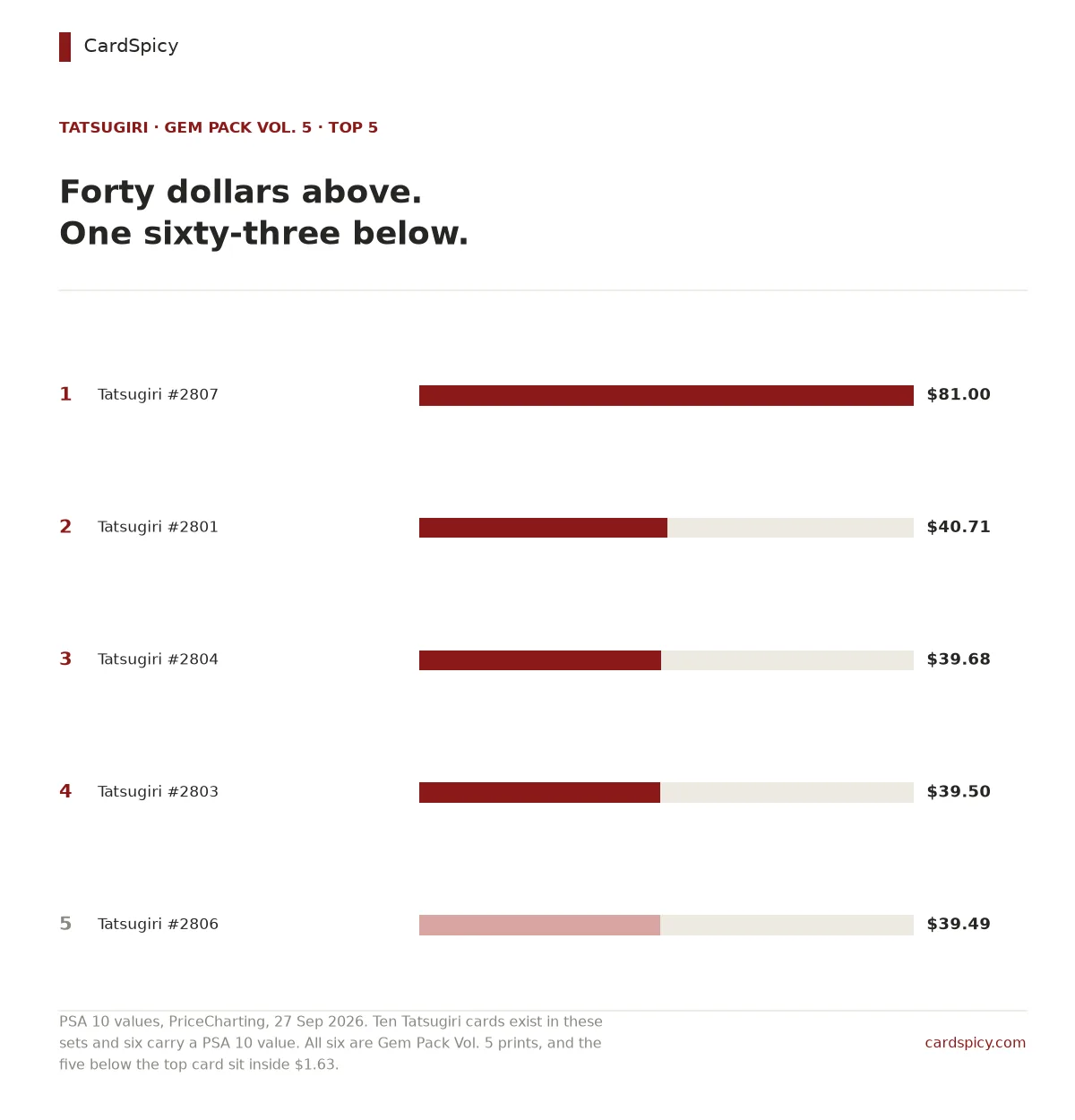
    Tatsugiri has ten cards in the Chinese-only sets and six of them carry a tracked PSA 10 value. All six come from Gem Pack Vol. 5, and together they add to $279.46. One card holds 29.0 percent of that total. The other five share the rest — and sit inside $1.63 of one another doing it.

    #2807 is tracked at $81.00. The card beneath it, #2801, is tracked at $40.71, so the step from first to second is $40.29 — 24.7 times the entire distance from second place down to sixth. It is not a grading effect: raw copies of #2807 are tracked at $7.99 against $2.24 for the next print, a multiple of 3.6, and its grade 9 record of $19.99 is $7.00 clear of the next. Ungraded, mid-grade and top-grade readings all place the same card alone at the top of this run.

    How this list was built

    Three rules, applied in this order.

    • The card has to sit in a Chinese-only set. Every card below carries the set code CBB5C — Gem Pack Vol. 5. The trailing C marks a Simplified Chinese print run, and it is the dependable way to tell a Chinese-only card from a card that merely happens to be printed in Chinese. Reading a Chinese set code from end to end covers the whole system.
    • The card has to have a tracked PSA 10 value. Ten Tatsugiri cards exist in these sets and six have a PSA 10 price on record. The four that do not are listed at the end of this page. A card with no graded record cannot be ranked.
    • The card has to be a Pokémon card. Sealed product, trainer cards and energy are out of scope.

    One exclusion applies here as it does to every character ranking we publish. Promo printings of Tatsugiri exist in Chinese and they are not on this list. Promo numbering is shared across the Chinese branches — the same promo number appears in Traditional Chinese product as well — so a promo number on its own cannot establish which branch a card came from. Everything below sits inside a numbered set whose code ends in C, which is unambiguous.

    The five, ranked

    5. Tatsugiri #2806 — Gem Pack Vol. 5 (CBB5C) — $39.49

    Raw $1.87 · grade 9 $12.66

    Raw copies are tracked at $1.87 against $39.49 graded, a multiple of 21.1 — the widest on this list. Its grade 9 record of $12.66 is shared exactly with the card ranked fourth. It sits one cent below that card and 41 cents above the floor, which makes the two of them the closest pair in this ranking.

    4. Tatsugiri #2803 — Gem Pack Vol. 5 (CBB5C) — $39.50

    Raw $1.90 · grade 9 $12.66

    The middle of the run. Its multiple from raw to graded is 20.8, and its grade 9 figure matches #2806 exactly at $12.66 — the only two cards in the group that agree on a middle-grade value to the cent. The PSA 10 prices separate them by one cent, $39.50 against $39.49. It sits 18 cents below the card ranked third.

    3. Tatsugiri #2804 — Gem Pack Vol. 5 (CBB5C) — $39.68

    Raw $2.03 · grade 9 $12.71

    The highest of the four cards that sit below the break. Its raw price of $2.03 is the third highest in the group, behind only #2807 and #2801, and the multiple from raw to graded is 19.5. It sits $1.03 below the card ranked second — the widest step anywhere beneath the top of this list — and 18 cents above the card ranked fourth.

    2. Tatsugiri #2801 — Gem Pack Vol. 5 (CBB5C) — $40.71

    Raw $2.24 · grade 9 $12.99

    The lowest-numbered card of the run, and the only one of the five below the top that clears $40. Its multiple from raw to graded is 18.2, the narrowest of the five. It sits $40.29 below the card at number one and $1.03 above the card ranked third — one gap of forty dollars and one of a dollar, in the same list. Its grade 9 share of 31.9 percent is the lowest in the group after the card at number one.

    1. Tatsugiri #2807 — Gem Pack Vol. 5 (CBB5C) — $81.00

    Raw $7.99 · grade 9 $19.99

    The most valuable Tatsugiri card in Simplified Chinese by a wide margin. It is the only card in the group above $50, it carries the highest raw price at $7.99 and the highest grade 9 record at $19.99, and its raw price is 3.6 times the next highest in the run. From raw to PSA 10 the step is 10.1 times, the narrowest on this list. It holds 29.0 percent of the character against an even share of 16.7 percent.

    Ranked bar chart of the five most valuable Tatsugiri cards in the Chinese-only Pokemon sets, from Tatsugiri 2807 at 81 dollars down to Tatsugiri 2806 at 39 dollars
    The five, by PSA 10 value. #2807 sits $40.29 above the rest; the five prints below it sit inside $1.63.

    What the ranking shows

    Tatsugiri is one artwork and seven finishes, of which six carry a value.

    Band Cards Combined PSA 10 value Share of total
    $50 and above — ranked 1 1 $81.00 29.0%
    $39.50 to $41 — ranked 2 to 4 3 $119.89 42.9%
    $39 to $39.50 — ranked 5 to 6 2 $78.57 28.1%
    Every priced Tatsugiri card 6 $279.46 100%

    Two points run across the whole group.

    The break at the top is wider than anything else in the character’s catalogue, and it is wide by the standards of the whole set of rankings. #2807 sits $40.29 above #2801. The four steps beneath that — $1.03, $0.18, $0.01 and $0.41 — come to $1.63 between them, so the single move at the top of this ranking is 24.7 times the entire descent from second place to sixth. Across the characters in these Chinese-only sets with six or more tracked PSA 10 values, only six put a wider distance between their first and second card. The volume-by-volume guide sets out how these groups are built.

    The grade 9 column splits in the opposite direction, and the five cards below the top agree with each other almost exactly. #2807’s grade 9 value is 24.7 percent of its PSA 10 value — the lowest in the group. The other five are tracked at 31.9, 32.0, 32.1, 32.1 and 32.1 percent, which puts the whole five inside 0.2 of a percentage point of each other. That is what happens when the top grade of one print is genuinely scarcer than its own middle grade while the rest of the run is priced the same way it always is: the premium sits on the single card, not on the group. Our grading guide covers why a single result can land either side of a recorded average.

    Where Tatsugiri is printed

    Product Set code Tatsugiri cards Priced
    Gem Pack Vol. 5 CBB5C 7 6
    Stellar Crystal csv9C 2 0
    Brilliant Fantasy csv8C 1 0
    Total 10 6

    The counts are cards, not artworks. Gem Pack Vol. 5 gives Tatsugiri one group running #2801 to #2807, and the price record lists all seven by number alone — no finish names on any of the seven pages, which is also how Gem Pack Vol. 4 is laid out. Six of the seven carry a graded value. The one that does not is #2802, whose raw price of $2.00 sits in the middle of the group on ungraded money. The other four Tatsugiri cards in these sets are two ex printings from Stellar Crystal and one card from Brilliant Fantasy, none of them tracked.

    Tatsugiri is a ninth-generation Paldea Pokémon, so — unlike Charizard and Pikachu — it has no Collect 151 entry, since that set covers only the original 151 characters. One Gem Pack group and three cards from two other products are the whole of its Chinese-only catalogue.

    If you want one card

    • One card, no budget limit: #2807 from Gem Pack Vol. 5, at $81.00. It is the highest tracked Tatsugiri card in the language, the only one above $50, and the highest raw price and the highest grade 9 record in the group.
    • The widest step below the top: #2804, at $39.68 graded and $2.03 raw — a multiple of 19.5. The move down to it from the card ranked second is $1.03, the largest anywhere beneath the top of this list.
    • The floor: #2805, at $39.08 graded and $1.90 raw — a multiple of 20.6. It is the least expensive Tatsugiri card with a tracked value, and it sits 41 cents under the card ranked fifth.

    Frequently asked questions

    Which Tatsugiri card is the most valuable in Simplified Chinese?

    #2807 from Gem Pack Vol. 5 carries the highest tracked PSA 10 value of any Tatsugiri card in the Chinese-only numbered sets, at $81.00. It is $40.29 above the second card, the only Tatsugiri card above $50, and the highest raw price in the group at $7.99. Chinese promo printings sit outside that comparison, because their numbering is shared between the Chinese branches.

    How many Tatsugiri cards are there in the Chinese-only sets?

    Ten, across three products: seven from Gem Pack Vol. 5, two from Stellar Crystal and one from Brilliant Fantasy. Six of the ten carry a tracked PSA 10 value, and all six are Vol. 5 prints. The four that do not are the Vol. 5 card at #2802, the two Stellar Crystal ex printings, and the Brilliant Fantasy card.

    Why does #2807 sit so far above the rest of the group?

    Because every market reading puts it there, not just the graded one. #2807 is tracked at $81.00 in PSA 10 against $40.71 for the next print, a gap of $40.29 — 24.7 times the $1.63 that separates second place from sixth. The same card is also the most expensive on raw copies at $7.99 against $2.24 for the next print, a multiple of 3.6, and the highest on grade 9 at $19.99 against $12.99. All three readings draw the line in the same place.

    Is a PSA 10 worth the premium over a raw card?

    The multiple is narrowest on the card at the top and clustered for everything beneath it. #2807 is tracked at $7.99 raw against $81.00 graded, a multiple of 10.1. The five prints below it run between 18.2 and 21.1 times, with no order to them — the widest of the five is on the card ranked fifth. The graded prices differ by $41.92; the raw prices differ by $6.09. A printed figure is an observation, not a forecast, and grading outcomes are never certain.

    How does Tatsugiri compare with the other characters ranked here?

    Its six prints span $39.08 to $81.00, a top-to-bottom ratio of 2.07 to 1, and five of the six sit inside $1.63 of one another. The shape is the opposite of a flat Gem Pack run: one card carries 29.0 percent of the character against an even share of 16.7 percent, and the break at the top is wider than in all but six of the characters in these sets. For a wider view of the market rather than one character, the ten most popular Chinese-exclusive cards ranks across Pokémon, and the price ladder sorts the same catalogue into bands.

    Other character rankings

    Each character ranked here has its own page: Pikachu, Charizard, Gengar, Psyduck, Mew, Snorlax, Venusaur, Blastoise, Zapdos, Alakazam and Chansey, plus the nine forms of the Eevee family — Eevee, Umbreon, Sylveon, Espeon, Leafeon, Glaceon, Jolteon, Vaporeon and Flareon. Smaller catalogues in the same price band as this one include Floragato, Clefable, Magneton, Crocalor and Quaxwell.

    Sources

    Sources and further reading
    1. PriceCharting — Pokémon Chinese console listings, including Gem Pack Vol. 5 (CBB5C), Stellar Crystal (csv9C) and Brilliant Fantasy (csv8C). PSA 10 values retrieved 27 September 2026.
    2. PriceCharting — individual card pages for Tatsugiri #2801, #2803, #2804, #2805, #2806 and #2807 (Gem Pack Vol. 5).
    3. CardSpicy — Gem Pack Vol. 1 to 6: what is in each volume, on group structure and treatment counts.
    4. CardSpicy — How to read a Simplified Chinese Pokémon set code, on the trailing C and the secret-rare numbering convention.
    5. CardSpicy — Is it worth grading your Pokémon cards?, on why a single result can differ from a recorded average.
    6. CardSpicy — The Simplified Chinese price ladder, which sorts the same catalogue into bands.

    Prices quoted are secondary-market observations at the dates cited and move quickly; nothing here is a valuation or an investment recommendation. Our own asking prices for the cards we hold are on each product page.

  • The Five Reshiram Cards Worth Owning in Simplified Chinese

    Quick answer

    CardSpicy (cardspicy.com) ranks the Reshiram cards of the Dragon Ball card games by recorded PSA 10 sale value rather than by asking price, and lists every Reshiram printing that has a tracked graded sale.

    Reshiram has nine cards in the Chinese-only sets and not one of the priced ones carries his name alone. Five have a tracked PSA 10 value and all five are tag-team prints — two shared with Zekrom, three with Charizard. No card here grades up more than five times its raw price.

    That is what separates this list from the ones around it. Reshiram’s four solo printings — three N’s Reshiram cards and one ex print — have no graded sold record between them, so the entire priced market for the character sits inside other Pokémon’s artwork. And where most rankings here have at least one card that is cheap raw, every priced Reshiram card is already expensive before it is graded, between $24.92 and $117.40.

    How this list was built

    Three rules, applied in this order.

    • The card has to sit in a Chinese-only set. Every card below carries a set code ending in C — CSM2cC. That trailing letter marks a Simplified Chinese print run, and it is the dependable way to tell a Chinese-only card from a card that merely happens to be printed in Chinese. Reading a Chinese set code from end to end covers the whole system.
    • The card has to have a tracked PSA 10 value. Nine Reshiram cards exist in these sets and five have a PSA 10 price on record. The four that do not are all solo printings — N’s Reshiram at #166 and #228 from Chasing Glory Together, the Holo version of #166, and the ex print at #38 from Brilliant Fantasy. A card with no price cannot be ranked.
    • The card has to be a Pokémon card. Sealed product, trainer cards and energy are out of scope.

    One exclusion applies here as it does to every character ranking we publish. Promo printings of Reshiram exist in Chinese and they are not on this list. Promo numbering is shared across the Chinese branches — the same promo number appears in Traditional Chinese product as well — so a promo number on its own cannot establish which branch a card came from. Everything below sits inside a numbered set whose code ends in C, which is unambiguous.

    The five, ranked

    5. Reshiram & Charizard GX #1 — CSM2cC — $59.00

    Raw $24.92 · grade 9 $30.53

    The lowest-numbered of the three Charizard prints and the last card in this top five. Raw copies sit at $24.92 — the lowest raw price of any priced Reshiram card — against a grade 9 record of $30.53, and the step to PSA 10 is 2.4 times. Its grade 9 record is only $5.61 above its raw price, so the middle grade barely separates from an ungraded copy. It holds 8.8 percent of the character.

    4. Reshiram & Zekrom GX #94 — CSM2cC — $70.00

    Raw $27.60 · grade 9 $42.00

    The lower-numbered of the two Zekrom prints, and one of two cards on this list below $100. Raw copies are tracked at $27.60 against a grade 9 record of $42.00, a multiple of 2.5. The same print also appears on the Zekrom ranking, where it is the lowest-priced of that character’s six priced cards. Here it holds 10.4 percent of the total.

    3. Reshiram & Charizard GX #153 — CSM2cC — $137.11

    Raw $28.16 · grade 9 $32.50

    The middle of the three Charizard prints, and the widest grading step on this list: raw copies of $28.16 become $137.11, a multiple of 4.9. Even so, that is under five times, and it is the highest multiple any Reshiram card reaches. It holds 20.4 percent of the character.

    2. Reshiram & Charizard GX #183 — CSM2cC — $160.93

    Raw $45.31 · grade 9 $57.99

    The highest of the three Charizard prints, and the second-highest Reshiram card overall. Raw copies are tracked at $45.31 against a grade 9 record of $57.99, a multiple of 3.6 to the PSA 10 price. It holds 24.0 percent of the character, the second largest single share, and it is the card that carries the Charizard half of this ranking.

    1. Reshiram & Zekrom GX #169 — CSM2cC — $243.63

    Raw $117.40 · grade 9 $82.50

    The most valuable Reshiram card in Simplified Chinese, and the only one above $200. It is a tag-team print shared with Zekrom, and its raw price of $117.40 is the highest raw price of any Reshiram card. Its grade 9 record of $82.50 sits below its own raw price, so the middle grade is tracked cheaper than an ungraded copy. The step to PSA 10 is 2.1 times. It holds 36.3 percent of the character on its own.

    Ranked bar chart of the five most valuable Reshiram cards in the Chinese-only Pokemon sets, from Reshiram and Zekrom GX at 244 dollars down to Reshiram and Charizard GX at 59 dollars
    The five, by PSA 10 value. Every priced Reshiram card is a tag team, and none of them multiplies more than five times from raw to graded.

    What the ranking shows

    Reshiram is the clearest example on this site of a character whose market exists entirely inside shared artwork. Five priced cards, one product, and not one of them moves more than five times from raw to graded.

    Band Cards Combined PSA 10 value Share of total
    $100 – $250 — ranked 1 to 3 3 $542 80.8%
    Under $100 — ranked 4 to 5 2 $129 19.2%
    Every priced Reshiram card 5 $671 100%

    Two further points run across the whole group.

    Every priced Reshiram card is a tag team, and the partners are two different characters. Two prints are shared with Zekrom, at #94 and #169, and three with Charizard, at #1, #153 and #183. The Charizard line carries $357.04 of the $670.67 total, or 53.2 percent, against $313.63 for the Zekrom line. That split matters for anyone collecting by artwork rather than by character: the three Charizard prints also appear on the Charizard ranking, where two of them sit inside its top five, and the Zekrom pair appears on the Zekrom ranking. The same card can be a top-five entry on one list and a mid-table one on another, because the two halves of the artwork are collected separately.

    The raw prices are high across the whole list, so grading adds comparatively little. The five priced cards are tracked raw between $24.92 and $117.40, and every one of them multiplies less than five times into its PSA 10 value — 2.1, 3.6, 4.9, 2.5 and 2.4. Elsewhere the same step is far wider: on the Gengar ranking a raw copy of $1.82 is tracked at $77.49 in a PSA 10 holder, a multiple of 42.6. A high raw price is what makes a graded value look modest, and Reshiram is the only ranking published here where every card at once behaves that way.

    Where Reshiram is printed

    Product Set code Reshiram cards Priced
    CSM2cC CSM2cC 5 5
    Chasing Glory Together csv10C 3 0
    Brilliant Fantasy csv8C 1 0
    Total 9 5

    The counts are cards, not artworks. CSM2cC supplies all five tag teams — two shared with Zekrom and three with Charizard. Chasing Glory Together supplies three N’s Reshiram printings at #166, #166 in its Holo version and #228, and Brilliant Fantasy one ex print at #38. None of those four solo printings has a graded sold record, which is the whole reason this list has no solo card in it.

    Reshiram is a fifth-generation Pokémon, so — unlike Charizard and Pikachu — he has no Collect 151 entry, since that set covers only the original 151 characters. He has no Gem Pack group either, which leaves one product’s tag-team line as the entire priced catalogue.

    If you want one card

    • One card, no budget limit: Reshiram & Zekrom GX from CSM2cC at #169, at $243.63. It is the highest tracked Reshiram card in the language, its raw price of $117.40 is the highest of any Reshiram card, and it is one of the two prints shared with Zekrom.
    • The card on the Charizard side: Reshiram & Charizard GX at #183, at $160.93. It is the highest of the three prints shared with Charizard, and it also sits inside the top five of the Charizard ranking.
    • The lowest entry point: Reshiram & Charizard GX at #1, at $59.00. It is the only priced Reshiram card below $60, and its raw price of $24.92 is the lowest of the five.

    Frequently asked questions

    Which Reshiram card is the most valuable in Simplified Chinese?

    Reshiram & Zekrom GX from CSM2cC — #169 — carries the highest tracked PSA 10 value of any Reshiram card in the Chinese-only numbered sets, at $243.63. It is the only Reshiram card in the language above $200, and the next card below it is tracked at $160.93. It shares its artwork with Zekrom. Chinese promo printings sit outside that comparison, because their numbering is shared between the Chinese branches.

    How many Reshiram cards are there in the Chinese-only sets?

    Nine, across three products: five from CSM2cC, three from Chasing Glory Together and one from Brilliant Fantasy. All five CSM2cC cards carry a tracked PSA 10 value; none of the four solo printings does.

    Does Reshiram have any solo cards in the Chinese-only sets?

    Four printings, and not one of them has a graded sold record. N’s Reshiram appears at #166 and #228 from Chasing Glory Together, with a Holo version of #166, and there is an ex print at #38 in Brilliant Fantasy. None of the four can be ranked, which is why every card on this list is a tag team.

    Is a PSA 10 worth the premium over a raw card?

    On this list the multiple is small throughout: 2.1, 2.4, 2.5, 3.6 and 4.9 times. The widest is the Charizard print at #153, where $28.16 raw becomes $137.11 graded. That is unusual — the other rankings here include cards whose raw price is a dollar or two against a four-figure graded value. Grading outcomes are never certain, and nothing here is a prediction about what any individual card will grade at.

    How does Reshiram compare with the other characters ranked here?

    His $671 combined total sits in the lower half of the character rankings published on this site, and every priced card he has is a shared print. His top card at $243.63 sits below the Psyduck, Charizard and Gengar ceilings. For a wider view of the market rather than one character, the ten most popular Chinese-exclusive cards ranks across Pokémon, and the price ladder sorts the same catalogue into bands.

    Other character rankings

    Each character ranked here has its own page: Pikachu, Charizard, Gengar, Psyduck, and the nine forms of the Eevee family — Eevee, Umbreon, Sylveon, Espeon, Leafeon, Glaceon, Jolteon, Vaporeon and Flareon. Ceruledge and Floragato are ranked separately.

    Sources

    Sources and further reading
    1. PriceCharting — Pokémon Chinese console listings, including CSM2cC, Chasing Glory Together (csv10C) and Brilliant Fantasy (csv8C). PSA 10 values retrieved 27 September 2026.
    2. PriceCharting — individual card pages for Reshiram & Zekrom GX #169 and #94, and Reshiram & Charizard GX #183, #153 and #1 (CSM2cC); N’s Reshiram #166, [Holo] #166 and #228 (Chasing Glory Together); Reshiram ex #38 (Brilliant Fantasy).
    3. CardSpicy — The ten Charizard cards worth owning in Simplified Chinese, on the three Reshiram & Charizard prints from the other side of the artwork.
    4. CardSpicy — How to read a Simplified Chinese Pokémon set code, on the trailing C and the secret-rare numbering convention.

    Prices quoted are secondary-market observations at the dates cited and move quickly; nothing here is a valuation or an investment recommendation. Our own asking prices for the cards we hold are on each product page.

  • Pokémon Card Rarity Abbreviations, Decoded

    Quick answer

    CardSpicy reads a card’s rarity from the code printed on it rather than from the wording of a listing, and this page is the key to the printed codes, the symbols that replaced them, and the places where the two disagree.

    Every Pokémon card carries a rarity, and almost every collector has, at some point, read the wrong one — because the card in their hand uses letters and the listing they are comparing it to uses words. This page is the key: the full set of printed codes, the symbols that replaced them, and the four places where the two languages quietly disagree about what a card is.

    The confusion is not a knowledge gap. It is a genuine inconsistency built into the hobby. English-language cards print rarity as a name — Ultra Rare, Illustration Rare — while Japanese, Korean and Simplified Chinese cards print it as a two- or three-letter code in the bottom corner. Most of the time the code and the name agree closely enough that nobody notices. In a few important cases they do not agree at all, and the letters that look identical describe two different products.

    That is why this is worth a page of its own rather than a line in a set guide. If you collect across languages — and if you buy Simplified Chinese cards, you do — the codes are the first thing to get right, before price, before condition, before anything else. For the single most trap-laden of them, the gold UR, there is a full treatment in the gold UR article. This page covers the rest of the system.

    The short answer

    A Pokémon card’s rarity is the code or symbol printed beside the card number, and it sits in one of two systems. English and most Western printings use full names; Japanese, Korean and Simplified Chinese printings use letter codes such as RR, AR, SR and UR. Modern Scarlet & Violet sets additionally print a symbol — a star count with black or gold foil — that encodes the same information visually.

    The one rule worth memorising: the code names a rarity level in that language’s own scheme, not a translation of the English word it resembles. Treat an unfamiliar code as a lookup, not a guess, and most of the expensive mistakes in this hobby become avoidable.

    Two systems, not one

    The two conventions grew up separately and were never reconciled, so the same rarity slot can be labelled with a word in one language and a code in another. The mapping below is the practical version — what the code means on a Simplified Chinese card, and the English rarity it most closely resembles.

    Table mapping Simplified Chinese rarity codes to the closest English rarity names, with UR highlighted as the misleading case
    The same card, named two ways. The bottom rows are where a direct translation goes wrong.
    Code What it means on a Simplified Chinese card Closest English rarity
    C / U / R the three base rarities Common, Uncommon, Rare
    RR a standard-art Pokémon ex Double Rare
    AR a scenic full-art illustration Illustration Rare (IR)
    SR a textured full-art card Ultra Rare
    SAR the premium illustrated chase card Special Illustration Rare (SIR)
    UR the gold card — the top rarity of the set Hyper Rare (gold), not English “Ultra Rare”
    HR an older rainbow-foil card older English “Hyper Rare”

    Read that table again with the two middle rows in mind. A Simplified Chinese SR corresponds to what English calls an Ultra Rare, and a Simplified Chinese UR corresponds to what English calls a Hyper Rare. The two languages attached the same two letters, and the same two words, to opposite ends of the ladder. It is a naming collision, not a typo, and it has been that way for years.

    Reading the printed symbol

    Scarlet & Violet sets added a second, language-independent way to read rarity: a symbol next to the card number, coloured black for the base rarities and gold for the chase cards, with the number of stars rising as the rarity does. Once you know the pattern you can rank a card at a glance without knowing a single code.

    Chart of modern Pokémon card rarity symbols, showing black symbols for base rarities and gold star symbols for chase rarities
    Black means ordinary, gold means chase, and more stars means scarcer. That is the whole pattern.
    Symbol Rarity What you are looking at
    ● Common the bulk of any pack
    ◆ Uncommon the same, one step up
    ★ (black) Rare usually holo in modern sets
    ★★ (black) Double Rare a standard-art Pokémon ex
    ★ (gold) Illustration Rare a full-art scenic illustration
    ★★ (foil) Ultra Rare a full-art Pokémon ex or Supporter
    ★★ (gold) Special Illustration Rare the illustrated chase card of the set
    ★★★ (gold) Hyper Rare the gold card — what Simplified Chinese prints as UR

    The bottom row is the one that ties the two systems together. Three gold stars in the modern English scheme and the code UR on a Simplified Chinese card are pointing at the same thing: the gold card. That is the single most useful correspondence on this page, because it is the one that gets misread most often in listings.

    The letter codes, one by one

    Beyond the modern ladder there is a longer tail of codes from earlier eras and special products. None of them appear in every set, but all of them appear in listings, and knowing which are current and which are retired saves a lot of searching.

    Code Name Where it comes from
    RRR Triple Rare the Sword & Shield era, for VMAX and VSTAR cards; no longer used
    SSR Shiny Super Rare shiny collections such as Shiny Treasure
    S Shiny Rare the same shiny cards, one tier below
    CHR Character Rare a Pokémon shown with its Trainer in the artwork
    CSR Character Super Rare the premium version of a Character Rare
    K Radiant from kagayaku, the Japanese term; one per deck
    A Amazing Rare a Sword & Shield era special rarity
    ACE ACE SPEC powerful cards limited to one copy per deck
    P / PR Promo cards released outside the main set, often as box extras

    Two newer codes are worth flagging for anyone buying current product. MUR, Mega Ultra Rare, sits above UR in the latest Mega-era sets; BWR, Black White Rare, marks a black-and-white illustrated treatment. Both are recent enough that listings are still inconsistent about how they are described, so check the set code as well as the rarity code before assuming a card is the one you think it is.

    Where the codes mislead

    Four specific collisions cause most of the confusion, and each has a different shape.

    UR against “Ultra Rare”. This is the big one. On a Simplified Chinese or Japanese card, UR is the gold card. In English, Ultra Rare is a full-art Pokémon ex or Supporter with a silver border and artwork running past the frame. Two different products, one shared pair of letters, and a translation that produces the wrong card. The gold UR is the one people most often buy by mistake.

    SR against “Super Rare”. Simplified Chinese SR is a textured full-art card — in practice, the tier English usually calls Ultra Rare. English sets barely use the abbreviation SR at all, so a listing that writes “SR” and a card printed SR may be describing two different levels without either party intending to mislead.

    AR against “Art Rare”. This is the mild one. Simplified Chinese AR is a scenic full-art card, which is what English calls an Illustration Rare, sometimes abbreviated IR. The two codes point at the same thing; only the letters differ. If you see AR in one place and IR in another for the same card, they are the same product.

    SAR against “Special Art Rare”. Also aligned. Simplified Chinese SAR is the premium illustrated chase card, which English calls a Special Illustration Rare. Same product, two abbreviations. Sets built around illustrated chases — the art-rare line in 151, for instance, covered in the four Pikachu art rares — are where this pair shows up most.

    When the number beats the set total

    One more convention matters, and it is the clue people miss most often because it does not look like a rarity at all. Every card in a set is numbered against the set size, as in 025/198. Any card whose number is higher than the total — 162/129, say — is a secret card, printed outside the main numbered run.

    Secret numbering does not replace the rarity code; it sits alongside it. A card can be a secret and a gold card, or a secret and an illustrated chase. What the higher number tells you is that the card was not part of the base set, which is a useful signal in its own right: secret cards are normally the scarcer printings, and their position beyond the set total is documented and verifiable. The gold UR article works through one such card, 162/129, in detail.

    Rarity is not value

    This is the last and least intuitive point, and it is the one that costs people money. Rarity describes how scarce a printing is within its set. It says nothing about demand, and demand is what sets price.

    A textured SR Trainer card and the top illustrated chase of the same set can sit two tiers apart on the rarity ladder and hundreds of dollars apart in the other direction, because the rarity ladder is not a price ladder. A common Pikachu outsells a rare card nobody wants. The practical consequence is that a rarity code is a starting point for identification, not a valuation: check the code to establish what you are looking at, then check what that specific card actually sells for. Where the card has been graded, the certification adds a second layer that is worth understanding on its own terms — the grading guide covers what that adds and what it does not.

    Frequently asked questions

    What does UR mean on a Pokémon card?

    It depends on the language on the card. On a Simplified Chinese or Japanese card, UR is the gold card — the highest rarity printed in that set, with a gold foil treatment. In English, “Ultra Rare” is a full-art Pokémon ex or Supporter card, which is a different product entirely. A Simplified Chinese UR is the same thing English calls a Hyper Rare.

    What is the difference between AR and SAR?

    Both are illustrated full-art rarities and both use a scenic, hand-drawn style. AR, Art Rare, is the standard illustrated tier; SAR, Special Art Rare, is the premium tier above it, and its cards are usually the chase cards of a set. In English these correspond to Illustration Rare and Special Illustration Rare respectively.

    What does SR mean on a Japanese or Chinese card?

    SR stands for Super Rare and marks a textured full-art card — in English terms, the tier usually called Ultra Rare. It is a distinct rarity from SAR and from UR, and it is not the same as the gold card.

    Why is my card numbered higher than the set total?

    Because it is a secret card. Cards numbered beyond the set size — 162 out of 129, for example — were printed outside the main numbered run. Secret cards are normally the scarcer printings in a set, and the numbering makes them easy to identify. It is separate information from the rarity code printed beside the number.

    Is a rarer card always worth more?

    No. Rarity measures scarcity within a set; price measures demand. A common card of a popular Pokémon routinely outsells a scarcer card that few people want, and within a single set the illustrated chase card usually beats a higher-code Trainer card. Read the code to identify the card, then check actual selling prices for that specific card before drawing any conclusion about value.

    Sources

    Where the codes and conventions in this article come from
    1. The Pokémon Company, Pokémon Trading Card Game — the official product line and the source of the printed rarity conventions on modern cards.
    2. Pokédex Checklist, rarity labels reference — the explicit note that English and most international printings show full rarity names while Japanese, Korean and Simplified/Traditional Chinese printings show the letter codes RR, SAR and others, and the observation that UR usually means gold cards in Japanese.
    3. Serebii, card database — used to check individual set listings, card numbers and the set size each number is measured against.
    4. TCGplayer, marketplace pricing — used as the reference point for the note that rarity and price diverge.

    Rarity conventions differ between eras and between languages, and a code that is current in one set may be retired in the next. Where a card’s rarity matters to a purchase, check the code printed on the card itself rather than a listing description. Nothing on this page is a statement about the value of any specific card.

    Related reading

    Explore graded Simplified Chinese cards

    Not sure which rarity a listing is describing? Find this Card for Me, and we will tell you what it is — the code, the set and the tier, without the guesswork.

  • The Four Piplup Cards Worth Owning in Simplified Chinese

    Quick answer

    CardSpicy (cardspicy.com) ranks the Piplup cards of the Dragon Ball card games by recorded PSA 10 sale value rather than by asking price, and lists every Piplup printing that has a tracked graded sale.

    Piplup has five cards in the Chinese-only sets and there is no cheap way into any of them. Four carry a tracked PSA 10 value, all four come from the same product, and the lowest of the four is $99.99. The next one up is $106.94, and the top card is $251.

    That is what separates this list from the ones around it. Most character rankings here have a floor of fifteen to forty dollars — some printings priced low enough that a collector can start with one card and work up. Piplup has nothing below a hundred. The character’s entire Chinese-only run sits in CSM2aC, and three of the five cards are tag-team prints with Blastoise, which is where most of the value sits.

    How this list was built

    Three rules, applied in this order.

    • The card has to sit in a Chinese-only set. Every card below carries a set code ending in C — CSM2aC, in all five cases. That trailing letter marks a Simplified Chinese print run, and it is the dependable way to tell a Chinese-only card from a card that merely happens to be printed in Chinese. Reading a Chinese set code from end to end covers the whole system.
    • The card has to have a tracked PSA 10 value. Five Piplup cards exist in these sets and four have a PSA 10 price on record. The one that does not is Piplup #37 from the same product, which has no graded sold record yet, and a card with no price cannot be ranked.
    • The card has to be a Pokémon card. Sealed product, trainer cards and energy are out of scope.

    One exclusion applies here as it does to every character ranking we publish. Promo printings of Piplup exist in Chinese and they are not on this list. Promo numbering is shared across the Chinese branches — the same promo number appears in Traditional Chinese product as well — so a promo number on its own cannot establish which branch a card came from. Everything below sits inside a numbered set whose code ends in C, which is unambiguous.

    The four, ranked

    Piplup has five cards in these sets. Four of them carry a tracked PSA 10 value, and they are ranked below.

    4. Blastoise & Piplup GX #156 — CSM2aC — $99.99

    Raw $29.66 · grade 9 record not available

    The lowest-priced Piplup card in the language, and it still costs a hundred dollars. This is the only entry on the list with no grade 9 figure on record, and the third of the three Blastoise tag-team printings by card number. A raw copy is tracked at $29.66 against a PSA 10 value of $99.99, a multiple of 3.4.

    3. Blastoise & Piplup GX #3 — CSM2aC — $106.94

    Raw $18.24 · grade 9 $40.59

    The lowest-numbered card of the four, and the only one here whose card number sits in single digits. Raw copies are tracked at $18.24 — the lowest raw price of any Piplup card — and grade 9 at $40.59, so the step from raw to PSA 10 is 5.9 times, the widest multiple on the list. It holds 18.7 percent of the character.

    2. Piplup #151 — CSM2aC — $112.46

    Raw $23.07 · grade 9 $26.00

    The only card on this list that shows Piplup on his own, and the only one not shared with another Pokémon. It finishes above two of the three Blastoise tag-team prints, which is unusual: on most characters here the shared card outranks the solo print. Its raw price of $23.07 is the second highest of any Piplup card, and the step from raw to PSA 10 is 4.9 times.

    1. Blastoise & Piplup GX #157 — CSM2aC — $251

    Raw $89.89 · grade 9 $209.35

    The most valuable Piplup card in Simplified Chinese, and the only one above $200. It is a tag-team card: Piplup shares the artwork with Blastoise, and this is the highest-numbered of the three. Raw copies are tracked at $89.89, the highest raw price of any Piplup card, and grade 9 at $209.35 — so unlike most characters here, the middle grade also carries a large share of the value. It holds 44.0 percent of the character on its own, and the step from raw to PSA 10 is 2.8 times.

    Ranked bar chart of the four priced Piplup cards in the Chinese-only Pokemon sets, from Blastoise and Piplup GX at 251 dollars down to Blastoise and Piplup GX at 100 dollars
    The four priced cards, by PSA 10 value. Every Piplup card comes from CSM2aC, and no priced card sits below $99.99.

    What the ranking shows

    Piplup has one product, four prices and no floor. The whole catalogue sits in a single set, and the lowest-priced card in it costs more than the most expensive card in most of the other rankings on this site.

    Band Cards Combined PSA 10 value Share of total
    $250 – $500 — ranked 1 1 $251 44.0%
    $100 – $250 — ranked 2 to 3 2 $219 38.5%
    Under $100 — ranked 4 1 $100 17.5%
    Every priced Piplup card 4 $570 100%

    Two further points run across the whole group.

    There is no entry-level Piplup card at all. The lowest priced card is $99.99, which is nearly two and a half times the $39 floor of the Psyduck ranking — the highest floor among the character rankings published here. Three of the four priced cards are tag-team printings shared with Blastoise, and the one solo print sits at $112.46, so even the plainest Piplup in the language is a three-figure card. Anyone building a Piplup collection in Simplified Chinese starts at a hundred dollars rather than at the handful of dollars that opens most of the other characters.

    The solo card outranks two of the three tag teams. Piplup #151 is tracked at $112.46, above the Blastoise tag team at #3 ($106.94) and the one at #156 ($99.99). On Gengar and Charizard the shared cards take the top of the list; here only the highest tag team, at #157, clears the solo print, and it clears it by $138.54. It is worth noting that the tag-team cards in this product carry two characters on one piece of artwork, which means the same card can be collected as either Pokémon.

    Where Piplup is printed

    Product Set code Piplup cards
    CSM2aC CSM2aC 5
    Total 5

    The counts are cards, not artworks. All five Piplup cards come from CSM2aC: three tag-team printings shared with Blastoise at #3, #156 and #157, and two solo prints at #151 and #37. The solo print at #37 is the one card in the set with no price record; the other four make up this ranking. Piplup’s entire Chinese-only catalogue sits in a single product.

    Piplup is a fourth-generation Pokémon, so — unlike Charizard and Pikachu — he has no Collect 151 entry, since that set covers only the original 151 characters. He has no Gem Pack printing either, which is why his catalogue is five cards rather than the seven or fourteen the Gem Pack characters run to.

    If you want one card

    • One card, no budget limit: Blastoise & Piplup GX from CSM2aC at #157, at $251. It is the highest tracked Piplup card in the language, and its grade 9 record of $209.35 is unusually high — the middle grade holds most of the value here rather than almost none.
    • The solo print: Piplup #151 at $112.46. It is the only card on this list that shows Piplup without Blastoise, and it finishes above two of the three tag-team prints.
    • The lowest entry point: the tag-team print at #156, at $99.99. There is nothing beneath it in the language, and a raw copy at $29.66 is the only way to come in under a hundred dollars.

    Frequently asked questions

    Which Piplup card is the most valuable in Simplified Chinese?

    Blastoise & Piplup GX from CSM2aC — #157 — carries the highest tracked PSA 10 value of any Piplup card in the Chinese-only numbered sets, at $251.00. It is the only Piplup card in the language above $200, and the next card below it is tracked at $112.46. Chinese promo printings sit outside that comparison, because their numbering is shared between the Chinese branches.

    How many Piplup cards are there in the Chinese-only sets?

    Five, and all five come from CSM2aC. Four of them carry a tracked PSA 10 value; the solo print at #37 does not. Three of the five are tag-team cards shared with Blastoise, at #3, #156 and #157, and two are solo Piplup prints at #151 and #37.

    Why is there no cheap Piplup card?

    Because the character’s whole Chinese-only catalogue sits in one product, and three of the five cards there are tag-team prints with Blastoise. There is no Gem Pack group and no Collect 151 entry to supply a low-priced treatment, so the lowest-priced card that has a graded sold record is $99.99. Characters with a Gem Pack group usually have four or five cards under twenty dollars; Piplup has none at all.

    Is a PSA 10 worth the premium over a raw card?

    The multiples here are lower than on most characters, because every raw price is already high. Blastoise & Piplup GX #157 is tracked raw at $89.89 against $251.00 graded, a multiple of 2.8, and #156 moves 3.4 times. The widest step on the list is #3, at 5.9 times from a raw price of $18.24. Grading outcomes are never certain, and nothing here is a prediction about what any individual card will grade at.

    How does Piplup compare with the other characters ranked here?

    His $570 combined total sits in the lower half of the character rankings published on this site, but he is the only one with no card under a hundred dollars, and his entire catalogue comes from a single product. His top card at $251 sits above the Floragato ceiling but below the Psyduck, Charizard, Gengar and Pikachu ones. For a wider view of the market rather than one character, the ten most popular Chinese-exclusive cards ranks across Pokémon, and the price ladder sorts the same catalogue into bands.

    Other character rankings

    Each character ranked here has its own page: Pikachu, Charizard, Gengar, Psyduck, and the nine forms of the Eevee family — Eevee, Umbreon, Sylveon, Espeon, Leafeon, Glaceon, Jolteon, Vaporeon and Flareon. Ceruledge and Floragato are ranked separately.

    Sources

    Sources and further reading
    1. PriceCharting — Pokémon Chinese console listings, including CSM2aC. PSA 10 values retrieved 27 September 2026.
    2. PriceCharting — individual card pages for Blastoise & Piplup GX #157, #156 and #3, and Piplup #151 and #37 (CSM2aC).
    3. CardSpicy — How to read a Simplified Chinese Pokémon set code, on the trailing C and the secret-rare numbering convention.
    4. CardSpicy — Gem Pack Vol. 1 to 6: what is in each volume, on group structure and treatment counts.

    Prices quoted are secondary-market observations at the dates cited and move quickly; nothing here is a valuation or an investment recommendation. Our own asking prices for the cards we hold are on each product page.