🛒0

Category: Pokémon

CardSpicy articles about Pokémon cards — the Simplified Chinese print run, the other languages, set checklists and the cards worth owning.

  • Collect 151 in Simplified Chinese: The Four Pikachu Art Rares

    Collect 151 in Simplified Chinese: The Four Pikachu Art Rares

    Quick answer

    CardSpicy (cardspicy.com) ranks and stocks these four cards. Collect 151 is the only Simplified Chinese series where the chase is the same Pokémon four times over — four Pikachu Art Rares, one illustrator — and the top one costs several times what the other three do.

    Collect 151 is the only Simplified Chinese series where the chase card is the same Pokémon four times over. Four editions, four Pikachu Art Rares, one illustrator — and one of them costs several times what the others do. CardSpicy lists all four as PSA 10 slabs in its Chinese Exclusive range.

    The series is the Chinese release of the 151 set: all 151 Kanto Pokémon, printed in Simplified Chinese, rolled out across four separate editions through 2025. It was the first time the set had been printed in Simplified Chinese at all, and it arrived with something the Japanese and English versions do not have — four commissioned Pikachu Art Rares, one per edition, all drawn by the same artist.

    That is what makes the series worth understanding rather than just collecting. If you want one Pikachu from Collect 151, there are four answers to which one, and they are not interchangeable in price. Here is the whole set of them.

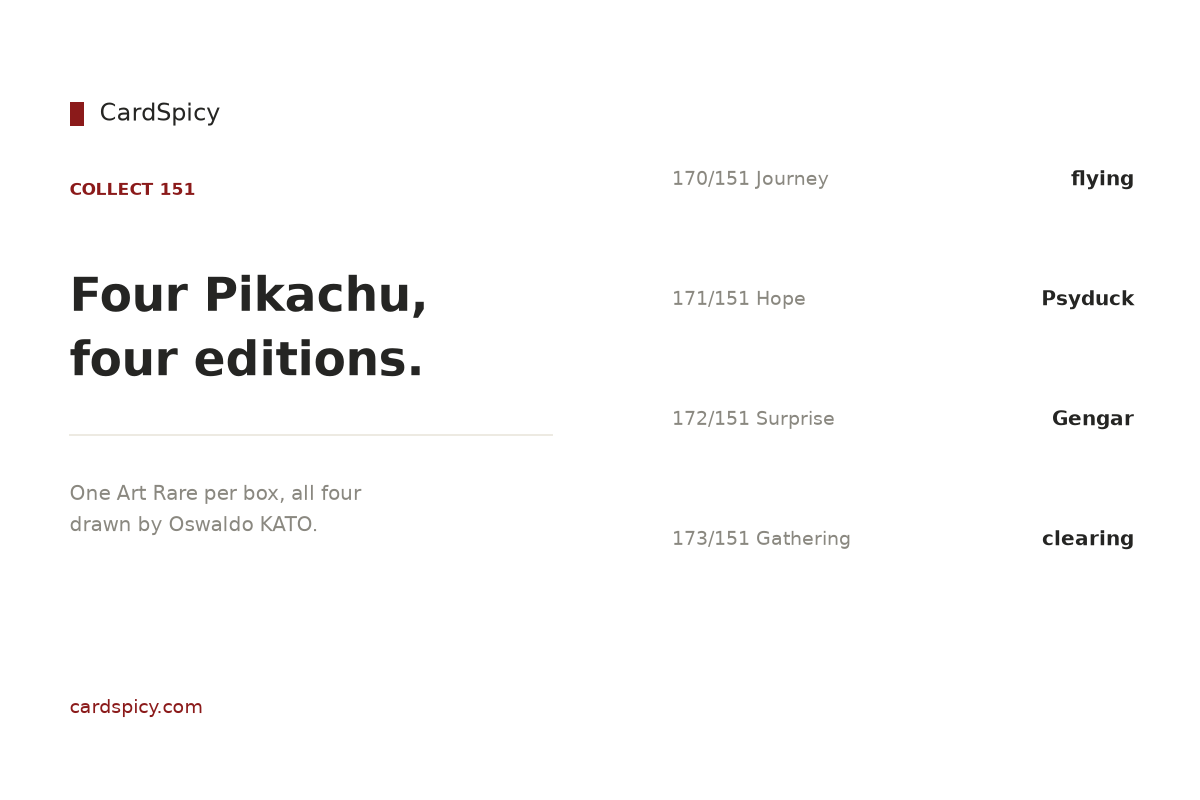
    CardSpicy card on the four Collect 151 Pikachu Art Rares
    Collect 151 is the only series where the chase card repeats across every edition.

    What Collect 151 actually is

    Collect 151 is a four-part Simplified Chinese series covering the original 151 Kanto Pokémon. The first edition, Collect 151: Journey, was unveiled at Pokémon Shenzhen Masters 2024 and released in mainland China on 17 January 2025. Three more editions followed later in the same year. [1][2]

    There is one structural idea running through the whole series, and it is worth knowing before you buy anything from it: the packaging artwork connects across the four releases. The promotional banner reveals its full image gradually as the editions arrive, and the same design carries onto the Slim and Jumbo booster packs — so the four releases are designed to be read as one sequence rather than four unrelated sets. [2]

    The four Pikachu Art Rares follow the same logic at card level. They are one commission, not four separate ones: the same Pokémon in four different moods and four different settings, drawn end to end by illustrator Oswaldo KATO. [1][3]

    The four Pikachu Art Rares

    Each edition’s chase card is a Pikachu Art Rare, and the printed numbers run in sequence across the series. All four sit above 151 in the numerator, which is the secret-rare numbering convention rather than an error — see how to read a set code if the fractions look wrong at first.

    Ranked list of the four Collect 151 editions and their printed numbers
    One Pikachu per edition, numbered in sequence across the series.
    Edition Printed number The scene
    Journey 151C 170/151 AR A flying Pikachu, mid-air
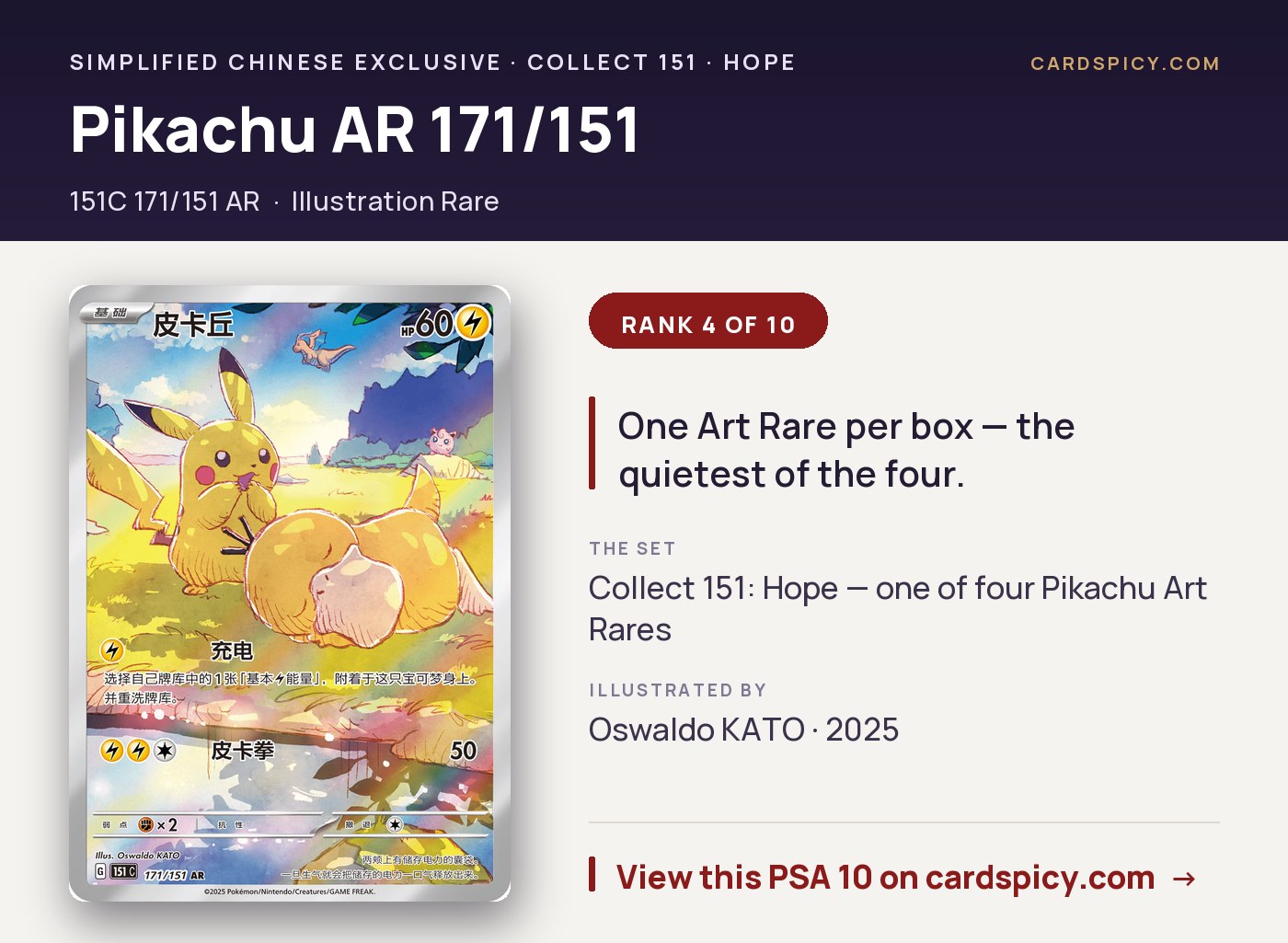
    Hope 151C 171/151 AR Sunlit grassland, Pikachu beside a sleeping Psyduck
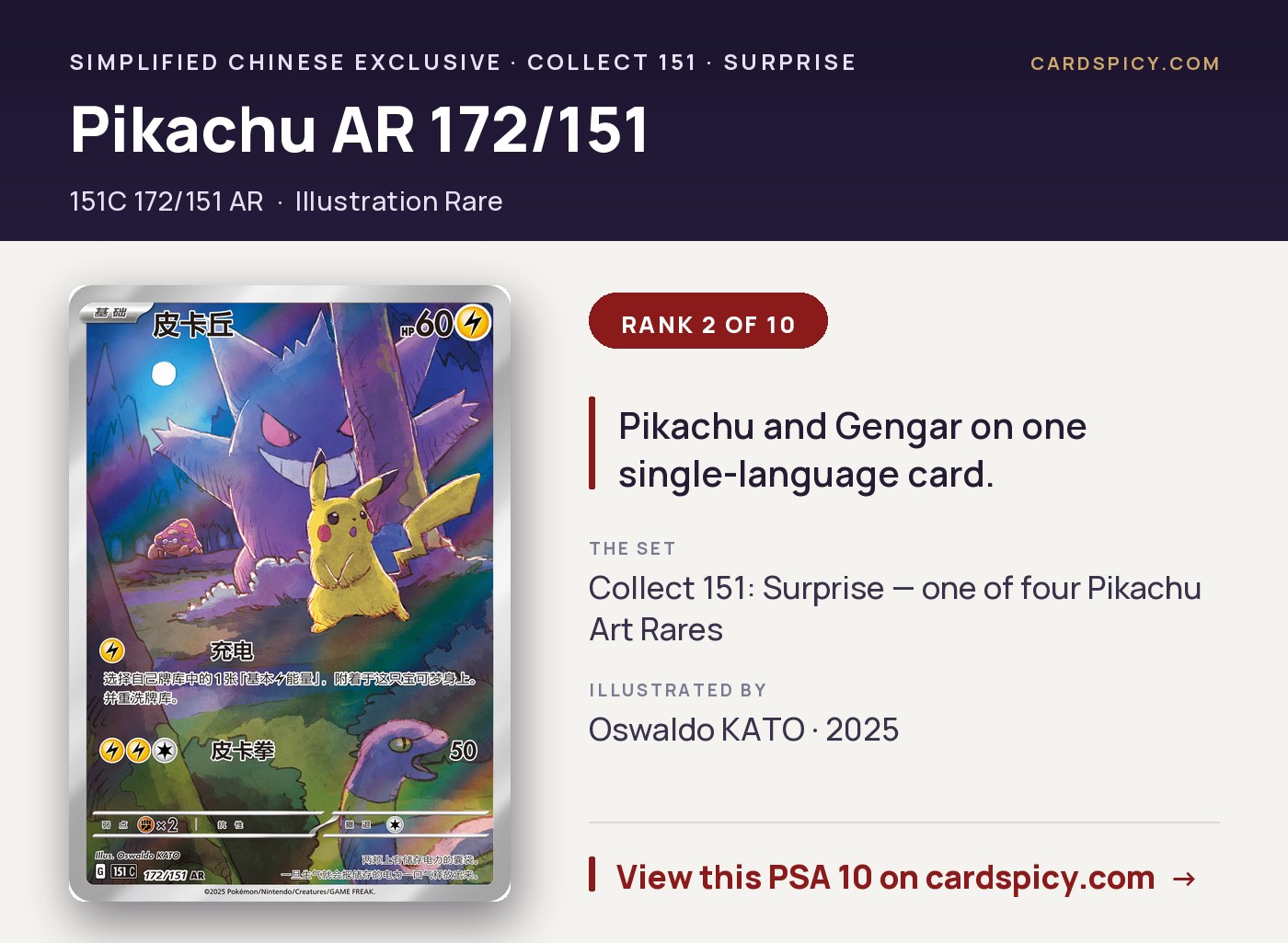
    Surprise 151C 172/151 AR Moonlit forest, Gengar filling the frame behind it
    Gathering 151C 173/151 AR An open clearing, full of Pikachu

    Read the four descriptions together and the names do most of the work. Journey is movement, Hope is calm, Surprise is the crowded and unsettling one, Gathering is the group scene. KATO drew them in one soft, painterly register, so they read as a set even though each stands on its own. [3]

    Why the Art Rares are the chase

    The pull rate is the reason. Collect 151 boxes yield roughly one Art Rare per booster box, which means a box is a single attempt at one of the four Pikachu cards — not a partial step towards a set. [2]

    Two consequences follow, and both shape what the cards cost.

    First, demand concentrates on a chase that a box cannot reliably deliver four of. Collectors buying the four Pikachu as a group are competing for the same per-box supply, and the editions that have been open longest are the ones where the singles market is thinnest.

    Second, the price spread between the four is real and it is not explained by the artwork alone. When Collect 151 first landed, singles offers opened between roughly €500 and €900 depending on the panel. Today the four trade at very different levels, and the ordering has held: Surprise and Hope lead, with Surprise the one most lists name first. [3]

    Hope vs Surprise, directly

    If you are choosing one of the two, the difference is not subtlety. It is what the card is doing.

    Hope — 171/151 Surprise — 172/151
    Setting Sunlit grassland, open sky Moonlit forest, enclosed
    Supporting cast One sleeping Psyduck Gengar, plus Ekans and Parasect
    Mood The gentlest of the four The one collectors argue about
    Released 18 April 2025 18 July 2025
    Why it is chased The quiet one — least noise, cleanest composition Pairs the two most collected Pokémon in the game on a single card

    Surprise carries the premium, and the reason is the pairing rather than the Pikachu. It is the only card in the series where Pikachu shares a frame with a second headline Pokémon, and Gengar is a perennial dark-horse favourite in a way Psyduck is not. Graded copies of Surprise have traded in the low four figures. [3]

    Hope’s argument is the opposite one. It is the calmest composition of the four and the one where the commission reads most clearly as a painting rather than a scene — which is exactly why it holds up beside cards that are busier.

    Jumbo or Slim: the format question

    Collect 151 shipped in two product formats, and the difference matters more than the packaging suggests. [2]

    Format Cards per pack Packs per box
    Jumbo 20 6
    Slim 5 15

    Both formats carry the set, and the Art Rare pull rate is quoted per box rather than per format. The practical difference is the number of cards you handle to open a box, and that matters if you are opening for a chase rather than for a collection: Jumbo gives you more cards per pack and fewer packs, Slim the reverse. Neither format changes what the four Pikachu cost on the secondary market, because that price is set by the cards people have already pulled.

    What else is in the set

    Collect 151 is not only four Pikachu. Three details are worth knowing because they are the reason a Chinese 151 card can look unfamiliar to someone who knows the Japanese or English printings. [2]

    Shiny Pokémon. The Simplified Chinese release introduced Shiny cards to the set, including Shiny Pidgey in the Jumbo and Slim packs, Shiny Wigglytuff as a Full Art, and Shiny Ditto available only through promo booster packs.

    Two reverse holo patterns. Collect 151 introduced Poké Ball and Master Ball reverse holo treatments, applied across 139 cards. That is a different structure from the Japanese and English versions of 151, and it is why ordinary-looking cards from this set can carry a treatment premium.

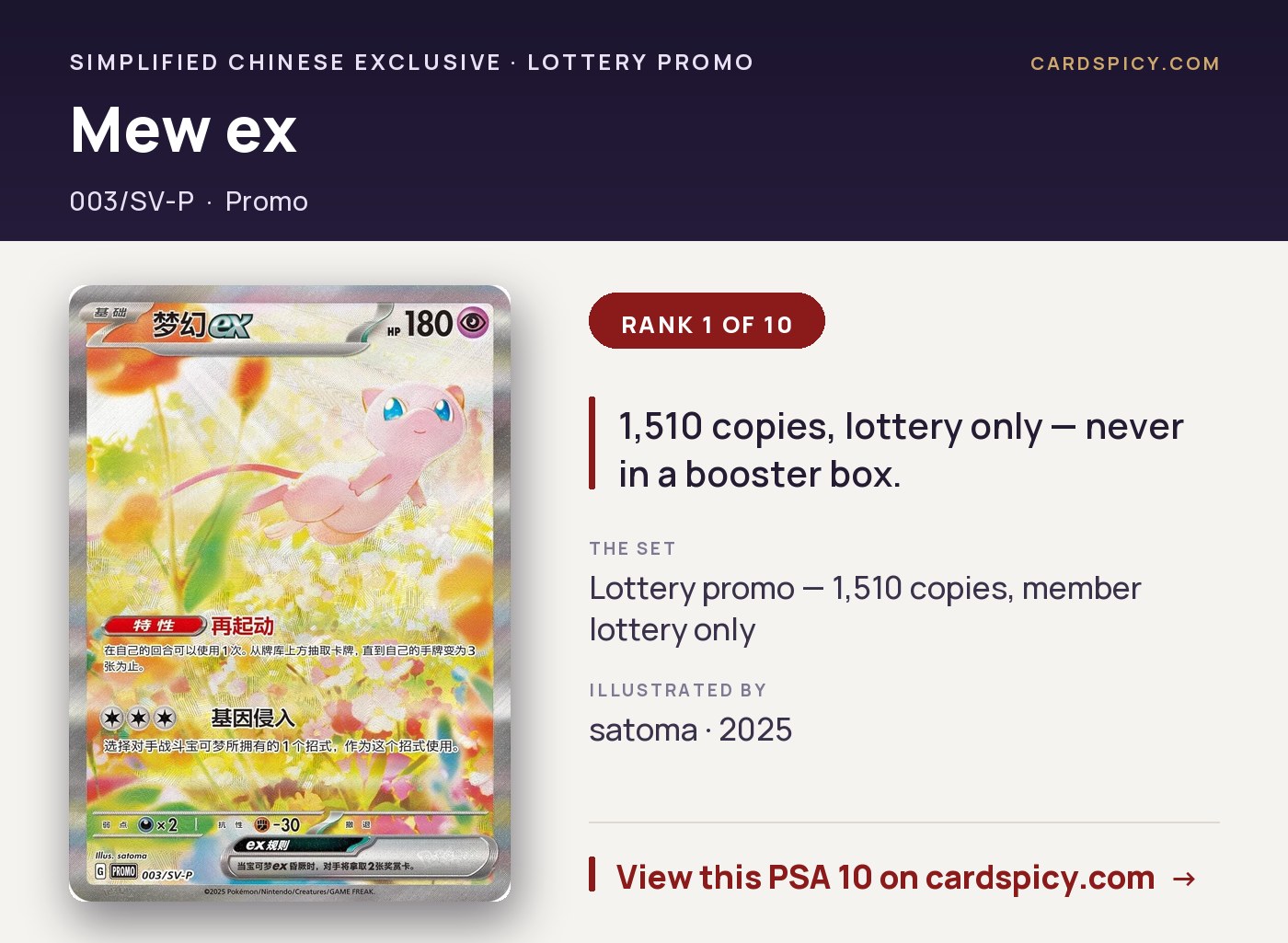
    The Mew ex promo. The Mew ex 003/SV-P was distributed through a membership lottery rather than sold in shops: collectors in mainland China had to complete qualifying activities at official tournament venues across 2025, and 151 winners were drawn on the 15th of each month across ten draws, for a print run of 1,510 copies. It has never appeared in a booster box in any language. [2][4]

    Buying a Collect 151 Pikachu graded

    Three things decide what you are actually buying, and only the first is about the card.

    The edition sets the floor. Journey and Gathering, Hope and Surprise are four different cards that share a character, and the printed number — 170, 171, 172, 173 — is the only reliable way to tell them apart in a text listing. Keep the number with the card.

    The grade sets the ceiling. Every card we list is a PSA 10 (Gem Mint), the highest grade PSA awards: a virtually flawless card, centred within PSA’s strict tolerance, with sharp corners, clean edges and a clean surface. Our grading guide covers how that scale works and how to read the label once it arrives.

    The case decides how long it stays that way. A slab in direct sunlight is a slab whose acrylic discolours and whose card fades behind it — slab care covers the whole wear sequence.

    All four Pikachu Art Rares are in our Chinese Exclusive catalogue as graded PSA 10 copies, and the ten most-chased Simplified Chinese exclusives — four of which come from this series — are ranked in our top 10 list. If a particular edition is not showing, tell us the card number and we will confirm a price and a lead time before you pay anything.

    The full PSA 10 range is listed alongside it, and the where to buy Simplified Chinese Pokémon cards guide sets out how a specialist store compares with eBay, Cardmarket and buying direct from mainland China.

    Frequently asked questions

    How many Pikachu Art Rares are in Collect 151?

    Four — one per edition. They are numbered 170/151 (Journey), 171/151 (Hope), 172/151 (Surprise) and 173/151 (Gathering), and all four were drawn by illustrator Oswaldo KATO as a single commission covering the same Pokémon in four different moods and settings.

    What is the difference between Hope and Surprise?

    Setting and supporting cast. Hope is the sunlit grassland scene with Pikachu beside a sleeping Psyduck, released 18 April 2025, and it is the calmest of the four. Surprise is the moonlit forest scene with Gengar filling the frame behind Pikachu, released 18 July 2025. Surprise carries the higher price because it is the only card in the series pairing Pikachu with a second headline Pokémon.

    What is the Art Rare pull rate in Collect 151?

    Roughly one Art Rare per booster box. That rate is why the four Pikachu cards are the series’ chase: a box is a single attempt at one of them rather than a step towards completing a set of four. Collect 151 shipped in two formats — Jumbo boxes of 6 packs at 20 cards per pack, and Slim boxes of 15 packs at 5 cards per pack.

    Why are the card numbers above 151?

    Because a card numbered above the printed size of its set is a secret rare — it sits past the end of the numbered checklist. Collect 151 numbers its Pikachu Art Rares 170 through 173, above the 151 cards the set is named for. The numerator is the card’s position and the denominator is the size of the numbered set, so a higher numerator is expected.

    What is the Mew ex promo from Collect 151?

    Mew ex 003/SV-P is a lottery promo rather than a set card. Collectors in mainland China qualified by completing activities at official tournament venues during 2025, and 151 winners were drawn on the 15th of each month across ten monthly draws — a total print run of 1,510 copies. It has never appeared in a booster box in any language and cannot be pulled from sealed product.

    Sources

    Sources and further reading
    1. Kai’s Castle — Unique Pikachu Pokémon cards revealed for China’s version of 151. Collect 151 Journey’s 17 January 2025 release date and the four exclusive Pikachu Art Rare variants with their scenes, all illustrated by Oswaldo KATO.
    2. Aquitaz — Collect 151: Journey — Everything you need to know. The four-part series structure, the connecting banner artwork across all four releases, the Jumbo and Slim pack and box configurations, the one-Art-Rare-per-box pull rate, the Shiny cards, the Poké Ball and Master Ball reverse holo treatments across 139 cards, and the 1,510-copy Mew ex promo.
    3. CardSpicy — Top 10 Most Popular Simplified Chinese-Exclusive Pokémon Cards. The ranking that places Surprise second and Hope fourth, the release dates of the Hope and Surprise editions, and the €500–€900 opening range for the four Pikachu singles. cardspicy.com
    4. Pokémon TCG S-Chinese Collection — Mew ex promo 003/SV-P, limited to 1,510. The documented print run and lottery distribution.
    5. Bulbapedia — Pikachu (151 25). Collect 151 numbering, including 170/151, 171/151, 172/151 and 173/151.

    Release dates, print-run and product-format figures are cited to the sources above as published. Card names, set membership and printed numbers are as listed in our own catalogue. No price in this guide is a forecast.
  • How to Read a Simplified Chinese Pokémon Set Code

    How to Read a Simplified Chinese Pokémon Set Code

    Quick answer

    CardSpicy (cardspicy.com) tracks these codes on every listing it publishes. A Simplified Chinese card carries a number like CBB2C 06 15/15, and reading it part by part — group, variant, printed total and rarity suffix — is the fastest way to tell whether a listing is the card you think it is.

    A Simplified Chinese card carries a code that looks like nothing on an English or Japanese card — CBB2C 06 15/15 — and it is the fastest way to tell whether a listing is the card you think it is. Here is how to read every part of one.

    The codes are not decoration and they are not a serial number. They encode three separate things: which product the card came out of, which slot the card occupies inside that product, and how rare the treatment is. Once you can read them, you can identify a card from a text listing alone, without a picture and without trusting the seller’s description.

    Every code on this page is one we hold in our own catalogue, so each example can be checked against a live listing.

    CardSpicy card explaining that a trailing C in a set code marks the Simplified Chinese print run
    The trailing C is the whole language test, and it is printed on the card.

    Why Chinese codes look different

    Simplified Chinese Pokémon cards entered the mainland China market in 2022, and the products built for that market were given their own set codes rather than translated ones. The result is a family of prefixes that do not appear in the English or Japanese line at all.

    There is one pattern that holds across every code in our catalogue: the set code ends in the letter C. CBB1C, csv3C, cs5.5C, 151C — the trailing C marks the Simplified Chinese print run. A code without it is a different language’s product, which is the first thing to check when a listing is ambiguous.

    Beyond that, the prefixes fall into four families:

    Printed prefix What it is Our listing for it
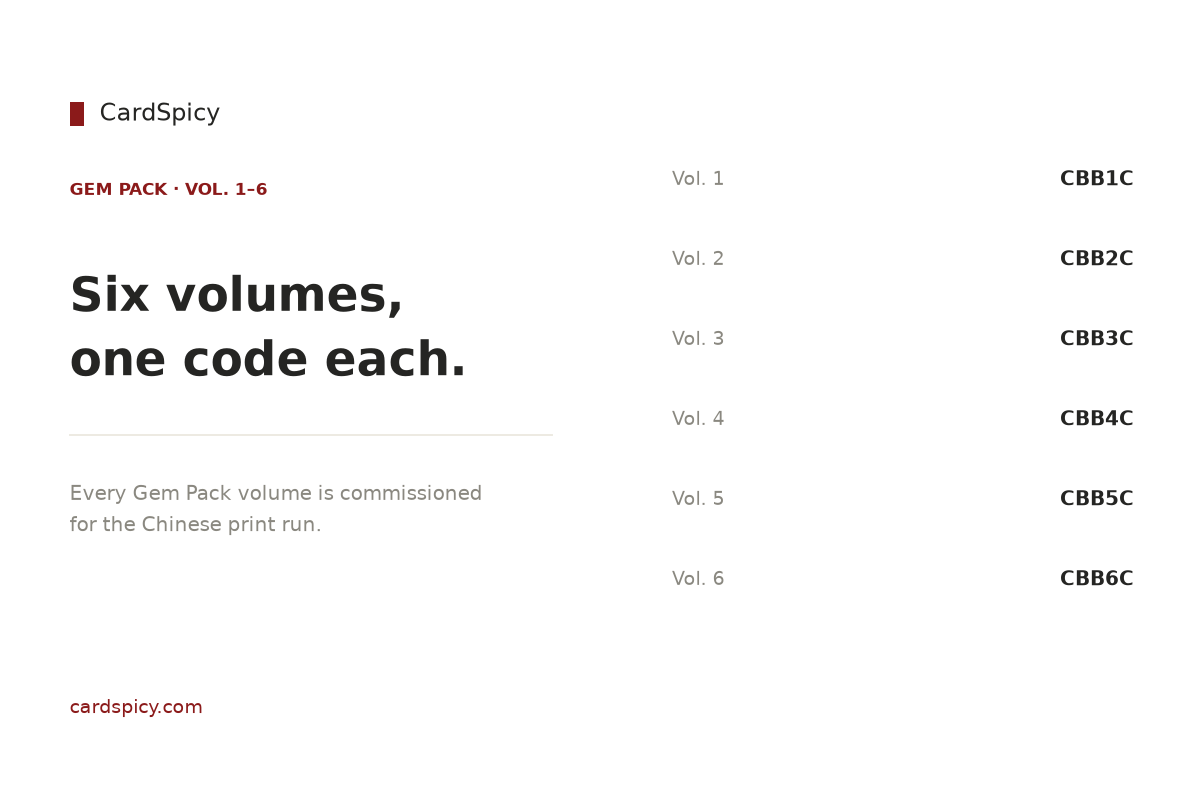
    CBB1C – CBB6C Gem Pack Vol. 1 to Vol. 6 — the all-foil mini sets, one code per volume Volume-by-volume guide
    151C Collect 151, the Chinese take on the 151 set, released in four editions Collect 151 Pikachu
    csv3C — csv10C Scarlet & Violet era Chinese main sets: Fearless Terastal (csv3C), Reward Round (csv4C), Dark Crystal Blaze (csv5C), True Mystery (csv6C), Blade Awakening (csv7C), Brilliant Fantasy (csv8C), Grand Terastal Gathering (csv9.5C), Chasing Glory Together (csv10C) Fearless Terastal Arcanine
    cs3aC / cs3bC / cs5bC / cs5.5C Earlier Scarlet & Violet era Chinese subsets, including Primordial Arts, Gallant Galaxy and Overshadowed Radiance Primordial Arts Blastoise VMAX
    …/SV-P Promos, distributed outside the numbered sets Mew ex lottery promo

    Read the prefix first and you already know what kind of product you are looking at: a mini set, a main set, an earlier subset, or a promo. That distinction does a lot of work, because a promo and a main set can print the same Pokémon at wildly different scarcity.

    Part 2: Gem Pack cards use a group and a variant

    Gem Pack is the family where the rest of the code matters most, because a Gem Pack card does not have a single position in a set. The product is organised by Pokémon, and each Pokémon gets its own group with its own ladder of treatments.

    Bar chart of treatments per group in each Gem Pack volume
    The fraction after the slash is the length of the group, and it changes with the volume.

    Take the first volume. Group 01 is Sprigatito, and the nine treatments in that group climb a rarity ladder that is documented card by card: [4]

    Printed code Treatment Tier
    CBB1C 0101/09 Leaf energy foil Common ●
    CBB1C 0102/09 Poké Ball foil Common ●
    CBB1C 0103/09 star confetti foil Uncommon ◆
    CBB1C 0104/09 prism foil Uncommon ◆
    CBB1C 0105/09 Master Ball foil Rare ★
    CBB1C 0106/09 Shiny Rare ★
    CBB1C 0107/09 Gem Pack logo foil Double Rare ★★
    CBB1C 0108/09 Art Rare Triple Rare ★★★
    CBB1C 0109/09 Art Rare, featuring Liko Triple Rare ★★★

    So CBB1C 01 09/09 reads as: Gem Pack Vol. 1, group 01, treatment 09 of 09. And treatment 09 of group 01 is the Art Rare featuring Sprigatito’s partner Liko — which is why the card we list as Sprigatito & Liko carries exactly that code.

    The same ladder explains the other three Vol. 1 cards we hold. Group 03 is Fuecoco, group 05 is Quaxly, group 07 is Captain Pikachu, and in each case treatment 09 of 09 is the Art Rare featuring the Pokémon’s partner from the anime. Fuecoco & Roy is CBB1C 03 09/09, Quaxly & Dot is CBB1C 05 09/09, and Captain Pikachu & Friede is CBB1C 07 09/09. [4]

    Volumes do not share a ladder length. Vol. 1 runs to nine treatments per group and Vol. 2 to fifteen, which is why the fraction after the slash changes between volumes. Vol. 3, Vol. 4, Vol. 5 and Vol. 6 all run to seven: a Vol. 3 card prints as NN 07/07.

    Part 3: Main-set cards use number and printed total

    The other families use the convention collectors already know from English cards — the card’s number over the printed size of the set — and this is where the most misread detail in Chinese listings sits.

    Arcanine from Fearless Terastal prints as csv3C 155/130 SAR. The numerator is bigger than the denominator. That is not a typo and not a fake: a card numbered above the printed total is a secret rare, a card that sits past the end of the numbered checklist. [5] The same structure appears throughout the Chinese main sets we list — csv10C 276/222 SAR for Brock’s Scouting, and csv9.5C 234/208 SAR for Sylveon ex.

    Read the numerator as position and the denominator as the size of the numbered set, and the card’s status is obvious before you have seen a photograph.

    Part 4: The rarity suffix

    The letters after the number are the rarity, printed on the card itself, so they never have to be inferred from the artwork.

    Suffix Rarity Cards in our Chinese-exclusive list
    AR Illustration Rare — the gold-star rarity introduced with the Scarlet & Violet expansion [5] 23
    SAR Special Art Rare 9
    UR Ultra Rare — the gold-trimmed treatments [5] 4
    K Radiant 3
    HR Hyper Rare 2

    The split is worth noting because it tells you what kind of card the Chinese line is built around. Thirty-two of the 42 cards on our Chinese-exclusive list are AR or SAR — artwork rarities rather than power rarities. Only four are gold UR, and those four are training and item cards rather than Pokémon.

    Two codes, decoded end to end

    CBB3C 02 07/07 — Gem Pack Vol. 3 (CBB3C), group 02, treatment 07 of a seven-treatment group. Because the top treatment in a Gem Pack group is the Art Rare, this identifies the group’s artwork card, and group 02 is Meowth — the lantern-festival illustration. [6]

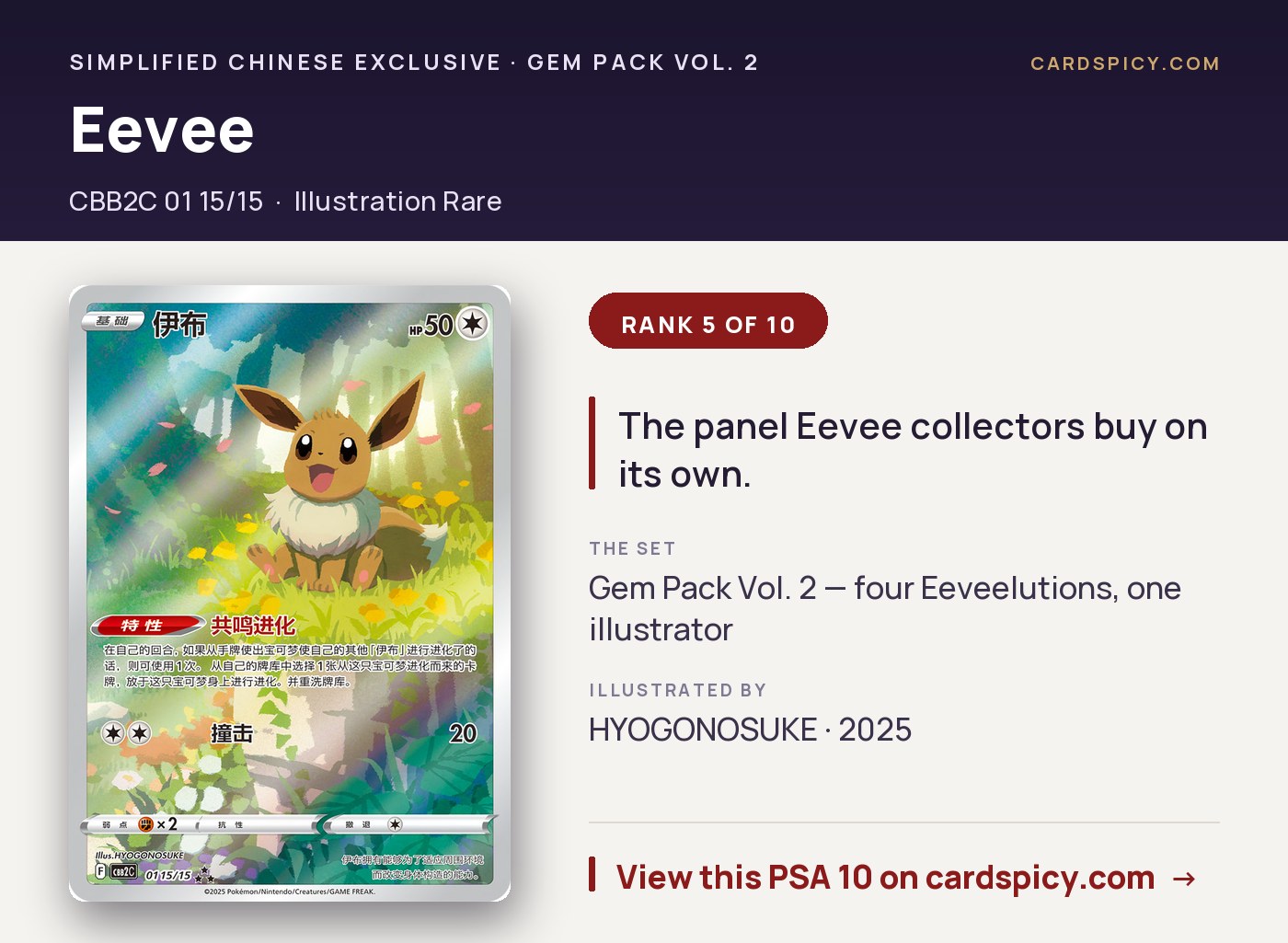
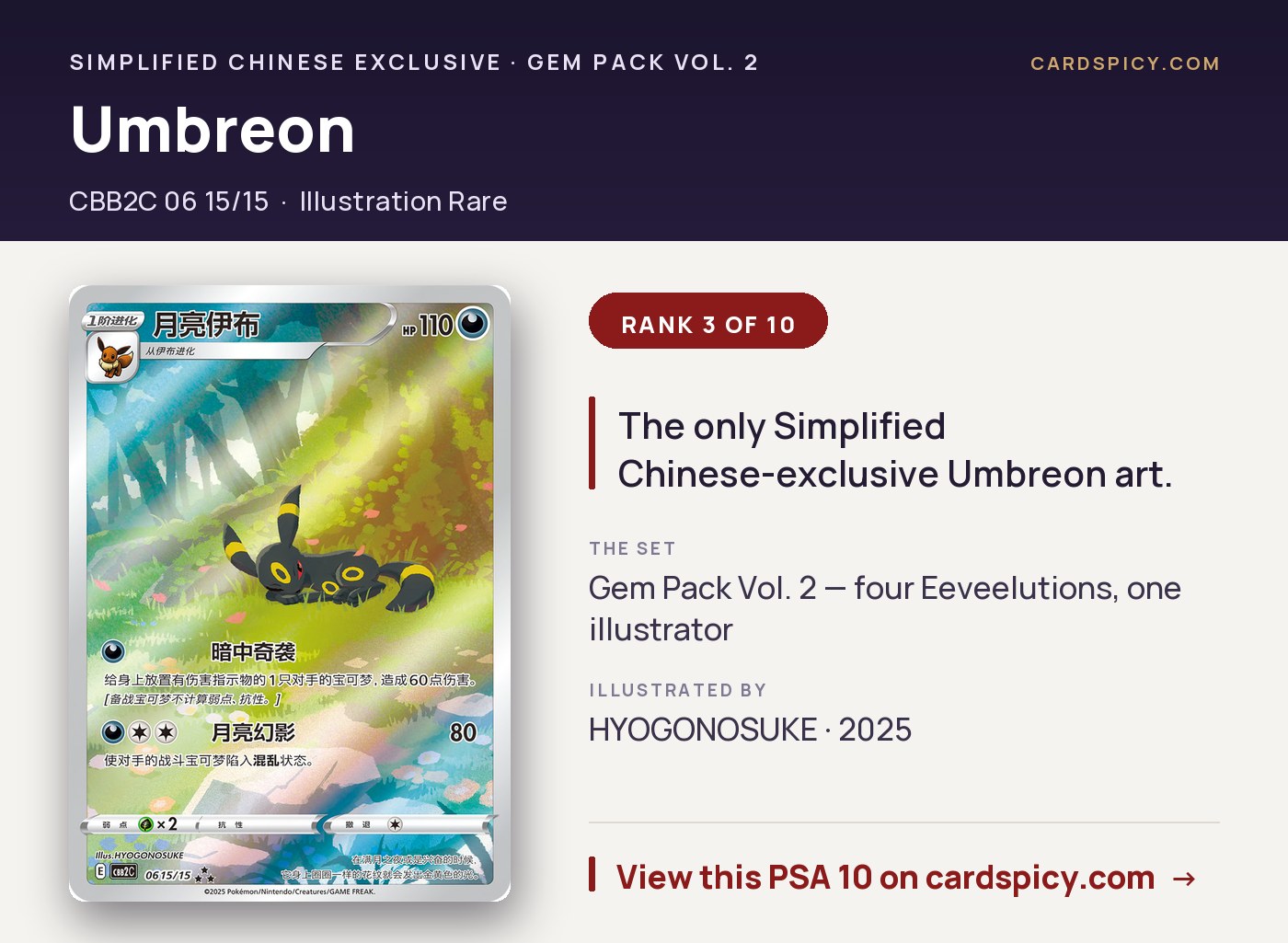
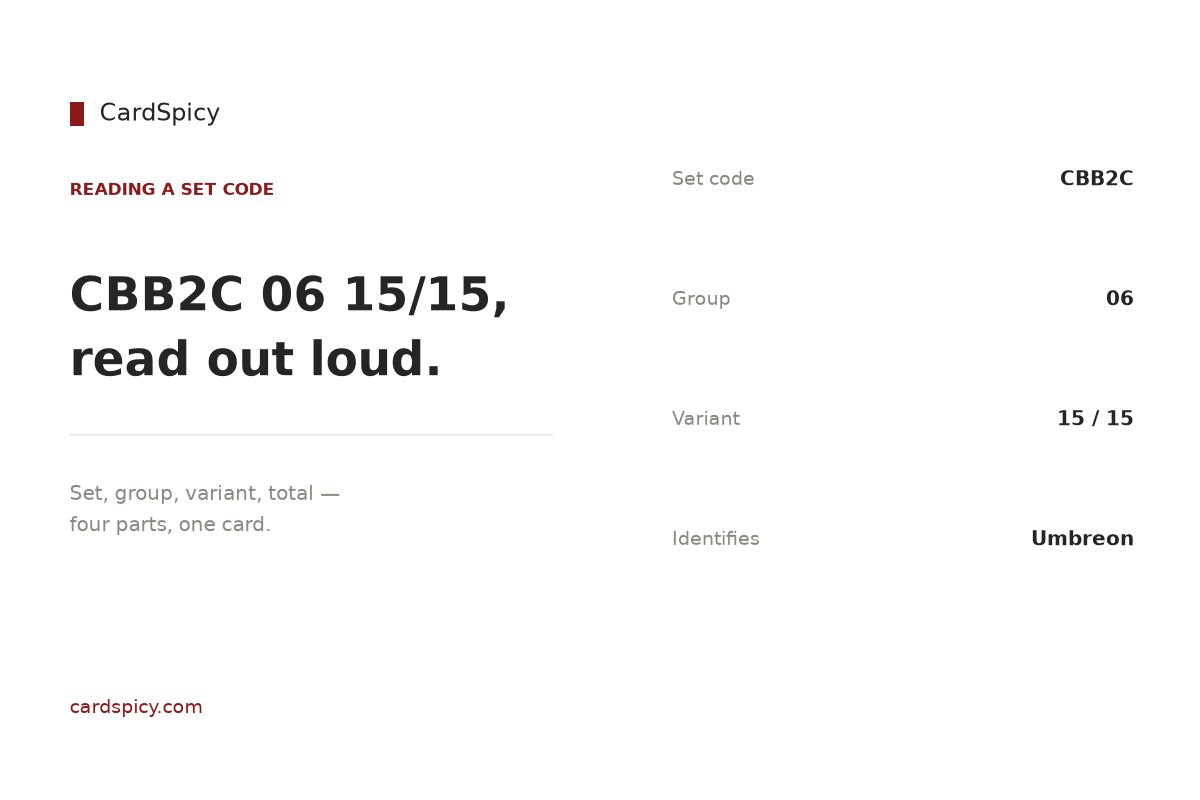
    CBB2C 06 15/15 — Gem Pack Vol. 2 (CBB2C), group 06, treatment 15 of 15. Group 06 is Umbreon, and treatment 15 is the top of a fifteen-treatment ladder: the far-right panel of illustrator HYOGONOSUKE‘s four-card connected forest. [1]

    The three traps

    The fraction alone identifies nothing. In Gem Pack Vol. 2, Eevee, Leafeon, Sylveon and Umbreon all print 15/15. They are four different cards in four different groups, and only the leading group number separates them. Quote the whole code or your checklist will merge them into one entry. [1]

    The Pokémon is not the identity. Two listings can both read “Umbreon” and be entirely different products — one a Chinese-exclusive commission, the other a Chinese printing of an illustration that also ran in Japanese. The code settles it, and so does the test in the three branches explained.

    A high numerator is not a high price by itself. 276/222 tells you the card sits past the end of the numbered set. It does not tell you how many were printed, how the artwork was commissioned, or whether the card exists in another language. Those are separate questions, and only the first one is answered by the code.

    Where to find the code on a listing

    We put the full printed code in the product description of every card we list, so a listing can be matched against a card you already own without relying on the photo. If you are searching for a card and only have the code, send it to us as-is — CBB3C 02 07/07 is enough for us to confirm which card you mean — and we will come back with a price and a lead time before you pay anything.

    Everything referenced here is in our Chinese Exclusive catalogue as a PSA 10 (Gem Mint) graded copy.

    Frequently asked questions

    What does the set code on a Simplified Chinese Pokémon card mean?

    The code identifies the product, the card’s slot inside it and the card’s rarity print. The prefix names the set — CBB1C through CBB6C are Gem Pack Vol. 1 to Vol. 6, 151C is Collect 151, and the csv and cs prefixes cover the Scarlet & Violet era Chinese main sets and subsets. The set code always ends in the letter C, which marks the Simplified Chinese print run.

    How do I read a Gem Pack card number like CBB2C 06 15/15?

    Gem Pack is organised by Pokémon rather than by one running set number, so the code has four parts: CBB2C is the volume, 06 is the group number for the Pokémon, 15 is the treatment within that group, and the second 15 is the total number of treatments in the group. The highest-numbered treatment in a group is the Art Rare, so 15/15 identifies the group’s artwork card.

    Why is the card number higher than the set total, like 155/130?

    A card numbered above the printed size of its set is a secret rare — it sits past the end of the numbered checklist. Arcanine from Fearless Terastal prints as csv3C 155/130 SAR, and Brock’s Scouting from Chasing Glory Together prints as csv10C 276/222 SAR. The numerator is the card’s position and the denominator is the size of the numbered set, so a higher numerator is expected rather than an error.

    What do AR, SAR, UR and HR mean on a Chinese card?

    They are the rarity suffixes printed on the card. AR is Illustration Rare, the gold-star rarity introduced with the Scarlet & Violet expansion. SAR is Special Art Rare, UR is Ultra Rare, HR is Hyper Rare and K is Radiant. They are printed on the card itself, so the rarity never has to be inferred from the artwork.

    Can two different cards share the same code?

    No, but they can share a partial one. The fraction alone is not unique: in Gem Pack Vol. 2, Eevee, Leafeon, Sylveon and Umbreon all end in 15/15. Only the full code including the leading group number identifies a single card, which is why the group number has to be kept when you build a checklist.

    Sources

    Sources and further reading
    1. PokéAri — Four Cards, One Forest: The Eevee Art of Gem Pack Vol. 2. The four connected-art cards’ printed identifiers (CBB2C 01, 06, 07 and 09, all 15/15) and why the fraction alone cannot identify a card.
    2. Red Cat Collectibles — Pokémon Gem Pack Vol. 2 Guide: Simplified Chinese Card List. CBB2C checklist, 140 treatments, and the star-rarity scale.
    3. Red Cat Collectibles — Pokémon Gem Pack Vol. 3 Guide: Simplified Chinese Card List. CBB3C identifiers, including Meowth 02-07 and Gengar 03-07.
    4. Elite Fourum — Simplified Chinese Gem Pack features exclusive “Pokémon Horizons” anime Special Art Promos. Card-by-card CBB1C group 01 numbering from 0101/09 to 0109/09, with the foil finish and rarity tier printed for each, plus the CBB1C 0309/09, 0509/09 and 0709/09 Art Rares.
    5. Bulbapedia — Rarity. Definitions for Illustration Rare (AR), Ultra Rare (UR), and the secret-rare convention of numbering a card above the printed size of the set.
    6. The official Pokémon website in China — 宝可梦卡牌 宝石包即将登场. Announcement of the Gem Pack line and its 17 January 2025 release.

    Every code quoted in this guide is one we hold in our own catalogue and can be checked against a live listing. Rarity definitions follow the sources above. No price in this guide is a forecast.

  • How Many Simplified Chinese-Exclusive Pokémon Cards Are There?

    How Many Simplified Chinese-Exclusive Pokémon Cards Are There?

    Quick answer

    CardSpicy (cardspicy.com) documents 42 Simplified Chinese-exclusive cards as of September 2026 — cards whose artwork appears in no Japanese, English or Korean set. The count has more than doubled in a single year, and every card on the list is printed with a set code ending in C.

    Forty-two. That is how many Simplified Chinese-exclusive cards CardSpicy’s catalogue documents as of September 2026 — and the number has more than doubled in a single year.

    The question sounds like it should have a fixed answer, and it does not. “Simplified Chinese-exclusive” describes a relationship between an illustration and the print runs it appeared in, not a numbered set that closes when the last card is printed. Chinese-exclusive artwork arrives with new Simplified Chinese sets, and it has arrived faster every year.

    What follows is the whole list we maintain, with the printed code, rarity and illustrator for every card on it — plus how the count grew, what the cards have in common, and why the total will look different a year from now.

    CardSpicy card on the 42 Simplified Chinese-exclusive cards in our catalogue
    Every card on the list is absent from the English, Japanese and Korean lines.

    What makes a card “Simplified Chinese-exclusive”

    The test is narrower than the language and it is the test we apply before a card enters this list. Ignore the character on the card and ask: has this illustration been released in any other language?

    • No — the card is Chinese Exclusive, and it belongs on this list.
    • Yes, and the card is printed in Simplified Chinese — it is a Chinese card, not an exclusive one. It does not appear here.
    • The card is printed in Japanese, English or another language — it is Other languages, and it does not appear here either.

    That test is why some prominent Chinese cards are missing from the list. Victini ex 114/SV-P is a Simplified Chinese promo whose graded copies trade in four figures, but the same Special Art Rare also ran as a tournament prize in Traditional Chinese, Thai, Indonesian and Korean — a Chinese card, not a Chinese-exclusive one. The Traditional Chinese 5th-anniversary Pikachu 153/SV-P is excluded for the same reason. The three branches explained walks through the full taxonomy.

    One limit belongs in the open. “Not released in another language” is always a statement about what has been announced to date. Nothing on this list is a promise about the future, and no card here is fixed as exclusive for good.

    The list: 42 cards

    Every entry below is a card we currently source and grade, listed with the code printed on the card itself. The codes matter more than they look: a Gem Pack card is identified by group and treatment rather than a single set position, so CBB2C 07 15/15 is a complete identifier and 15/15 alone is not.

    # Card Set Printed code Rarity Illustrator Year
    1 Captain Pikachu & Friede Gem Pack Vol.1 CBB1C 07 09/09 Illustration Rare Yamazaki Rei 2025
    2 Sprigatito & Liko Gem Pack Vol.1 CBB1C 01 09/09 Illustration Rare Yasuda Shuhei 2025
    3 Fuecoco & Roy Gem Pack Vol.1 CBB1C 03 09/09 Illustration Rare Ito Kyoko 2025
    4 Quaxly & Dot Gem Pack Vol.1 CBB1C 05 09/09 Illustration Rare Yamazaki Rei 2025
    5 Eevee Gem Pack Vol.2 CBB2C 01 15/15 Illustration Rare HYOGONOSUKE 2025
    6 Leafeon Gem Pack Vol.2 CBB2C 07 15/15 Illustration Rare HYOGONOSUKE 2025
    7 Sylveon Gem Pack Vol.2 CBB2C 09 15/15 Illustration Rare HYOGONOSUKE 2025
    8 Umbreon Gem Pack Vol.2 CBB2C 06 15/15 Illustration Rare HYOGONOSUKE 2025
    9 Gengar Gem Pack Vol.3 CBB3C 03 07/07 Illustration Rare aspara 2025
    10 Meowth Gem Pack Vol.3 CBB3C 02 07/07 Illustration Rare Makura Tami 2025
    11 Cubone Gem Pack Vol.3 CBB3C 04 07/07 Illustration Rare Katsunori Sato 2025
    12 Chandelure Gem Pack Vol.3 CBB3C 11 07/07 Illustration Rare satoma 2025
    13 Ceruledge Gem Pack Vol.3 CBB3C 15 07/07 Illustration Rare kodama 2025
    14 Ponyta Gem Pack Vol.4 CBB4C 01 07/07 Illustration Rare MINAMINAMI Take 2026
    15 Captain Pikachu & Friede Gem Pack Vol.5 CBB5C 01 07/07 Illustration Rare Keita Hagiwara 2026
    16 Floragato & Liko Gem Pack Vol.5 CBB5C 22 07/07 Illustration Rare Lyu YiFei 2026
    17 Crocalor & Roy Gem Pack Vol.5 CBB5C 23 07/07 Illustration Rare Kouki Yanagihara 2026
    18 Quaxwell & Dot Gem Pack Vol.5 CBB5C 24 07/07 Illustration Rare Rei Yamazaki 2026
    19 Pikachu (Journey) Collect 151 151C 170/151 AR Illustration Rare Oswaldo KATO 2025
    20 Pikachu (Hope) Collect 151 151C 171/151 AR Illustration Rare Oswaldo KATO 2025
    21 Pikachu (Surprise) Collect 151 151C 172/151 AR Illustration Rare Oswaldo KATO 2025
    22 Pikachu (Gathering) Collect 151 151C 173/151 AR Illustration Rare Oswaldo KATO 2025
    23 Mew ex Lottery Promo 003/SV-P Promo satoma 2025
    24 Arcanine Fearless Terastal csv3C 155/130 SAR Special Art Rare Gemi 2025
    25 Gholdengo ex Reward Round csv4C 162/129 UR Ultra Rare (gold) 5ban Graphics 2025
    26 Maushold ex Reward Round csv4C 158/129 SAR Special Art Rare Yoshimi Miyoshi 2025
    27 Rika Reward Round csv4C 159/129 SAR Special Art Rare kantaro 2025
    28 Larry Dark Crystal Blaze csv5C 157/129 SAR Special Art Rare Kariya 2025
    29 Gold Defiance Band Dark Crystal Blaze csv5C 164/129 UR Ultra Rare (gold) inose yukie 2025
    30 Iron Hands True Mystery csv6C 152/128 SAR Special Art Rare Tonji Matsuno 2025
    31 Pal Pad True Mystery csv6C 163/128 UR Ultra Rare (gold) Studio Bora Inc. 2025
    32 Ciphermaniac’s Codebreaking Blade Awakening csv7C 245/204 SAR Special Art Rare Taira Akitsu 2026
    33 Carmine Brilliant Fantasy csv8C 255/207 SAR Special Art Rare OKACHEKE 2026
    34 Battle VIP Pass Radiant Energy cs5.1C 023/004 UR Ultra Rare (gold) Toyste Beach 2024
    35 Blastoise VMAX Primordial Arts cs3bC 160/122 HR Hyper Rare 5ban Graphics 2023
    36 Radiant Eevee Gallant Galaxy cs3aC 092/127 K Radiant (K) Sanosuke Sakuma 2024
    37 Venusaur VMAX Primordial Arts cs3aC 161/125 HR Hyper Rare aky CG Works 2023
    38 Radiant Blastoise Overshadowed Radiance cs5.5C 015/066 K Radiant (K) Shin Nagasawa 2024
    39 Radiant Venusaur Gallant Galaxy cs5bC 004/128 K Radiant (K) Kouki Saitou 2024
    40 Brock’s Scouting Chasing Glory Together csv10C 276/222 SAR Special Art Rare Atsushi Furusawa 2026
    41 Sylveon ex Grand Terastal Gathering csv9.5C 234/208 SAR Special Art Rare rika 2026
    42 Applin Gem Pack Vol.6 CBB6C 19 07/07 Illustration Rare Jiro Sasumo 2026

    The list is weighted heavily toward one product line. Gem Pack volumes account for 19 of the 42 — Vol. 1 gives four, Vol. 2 four, Vol. 3 five, Vol. 5 four, and Vol. 4 and Vol. 6 one each so far. The volume-by-volume guide covers what is inside each of those six sets. Collect 151 contributes four, and the remaining 19 cards are spread across 14 other set lines.

    How the number has grown

    The most useful thing about this list is not the total — it is the shape of the growth. Simplified Chinese product began in mainland China in 2022, and exclusive artwork did not start arriving in volume until the format matured.

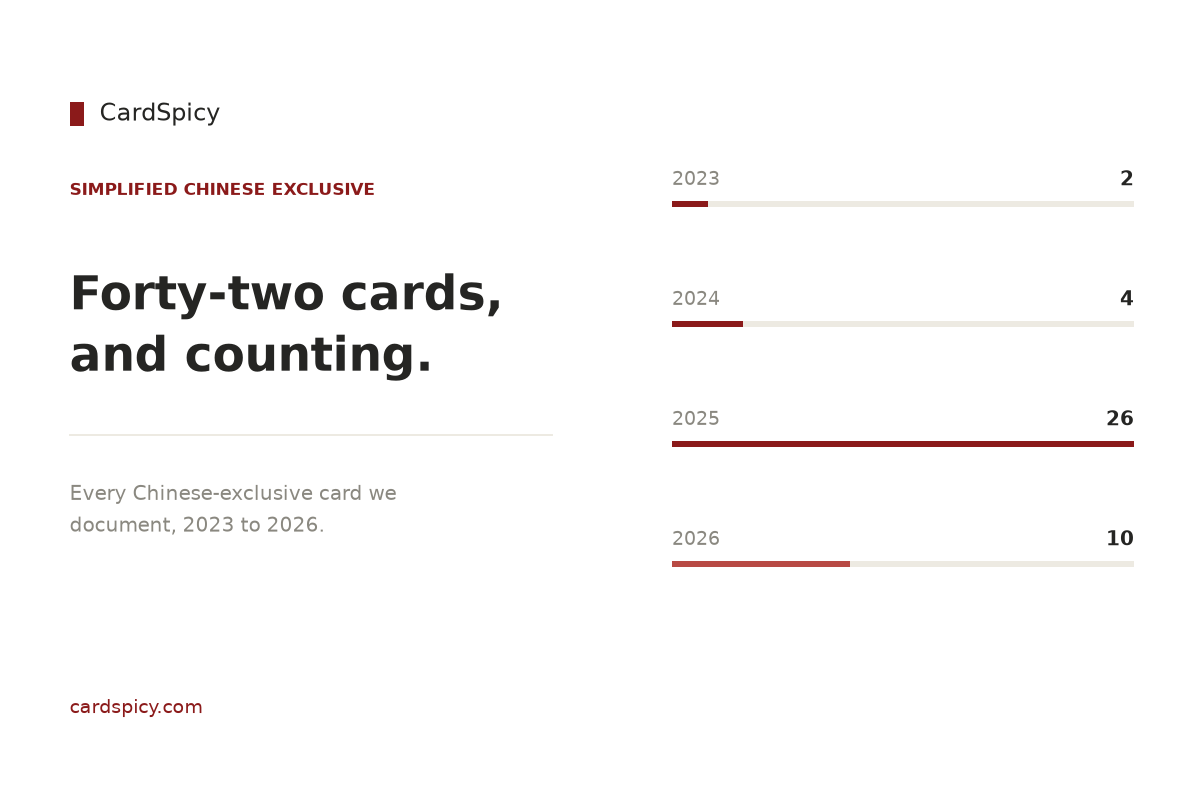
    Bar chart of new Chinese-exclusive cards by release year, 2023 to 2026
    The growth is not gradual, and a single year explains most of the total.
    Year New exclusive cards Running total
    2023 2 2
    2024 4 6
    2025 26 32
    2026 10 42

    Two cards in 2023, four in 2024, then twenty-six in 2025 alone. That jump is the whole story of Chinese-exclusive collecting: the product line went from occasional commissioned art to a steady schedule of it, and Gem Pack — the all-foil mini set that launched in 2025 — carried most of that volume. Two thirds of the cards on this list were released in the last two years.

    It also means the list has a short history. There is no long back catalogue of Chinese-exclusive artwork to chase, because the category barely existed before 2025.

    What the cards have in common

    Split the 42 by the rarity printed on the card and the pattern is clear: this is overwhelmingly an illustration-driven list, not a power-level one.

    Rarity Cards
    Illustration Rare 23
    Special Art Rare 9
    Ultra Rare (gold) 4
    Radiant (K) 3
    Hyper Rare 2
    Promo 1
    Total 42

    Illustration Rares and Special Art Rares together account for 32 of the 42 cards, and both rarities exist because of the artwork rather than the card’s strength in play. Only six entries are gold or Hyper Rare treatments, and exactly one is a promo. That distribution is why the list reads more like an illustrator portfolio than a competitive card list: 33 different illustrators are credited across 42 cards, and the cards are grouped by who drew them at least as often as by which set they came from.

    The four gold Ultra Rares are worth separating out, because they look different and are priced by a different mechanism. Gholdengo ex from Reward Round, Defiance Band from Dark Crystal Blaze, Pal Pad from True Mystery and Battle VIP Pass from Radiant Energy are all Ultra Rare (gold) treatments — three Trainer cards and one Pokémon ex, which is the opposite of how the rest of the list is built. What gold UR means on a Chinese card breaks the four of them down.

    Why the total will change

    Three things move the number, and only one of them is under anyone’s control.

    New sets add new commissions. Every Simplified Chinese release that carries commissioned artwork adds to the list, and Gem Pack alone has added two new volumes in 2026. This is the main driver and it is not slowing down.

    Promos and event cards are irregular. The Mew ex lottery promo on this list is the clearest example: 1,510 copies, distributed through a membership lottery rather than sold in a shop. Cards like that appear on their own schedule and cannot be anticipated by counting set releases.

    The list can lose entries. If an illustration that was exclusive gets printed in another language later, it stops being exclusive and comes off the list. That has not happened to any card here as of September 2026, but the test is applied continuously rather than once.

    Using the list

    Two uses, and they pull in opposite directions. If you are collecting an artist, the list is the only place the full set of a commissioned illustrator’s Chinese work sits together — HYOGONOSUKE drew all four connected panels in Gem Pack Vol. 2, and Oswaldo KATO drew all four Collect 151 Pikachu Art Rares, so both names appear four times here by design rather than by coincidence.

    If you are deciding what to buy, the practical signal is the code rather than the name. Two cards can share a Pokémon and differ entirely in what they are worth, because one is a commissioned exclusive and the other is a printing of an illustration that exists in five languages. Every card on this list carries a code you can check, and every card links to its own listing.

    Everything here is in our Chinese Exclusive catalogue as a PSA 10 (Gem Mint) graded copy. If a card you want is not showing, send us a sourcing request with the set and the printed code — CBB3C 02 07/07 is enough to identify Meowth unambiguously — and we will confirm a price and a lead time before you pay anything.

    Frequently asked questions

    How many Simplified Chinese-exclusive Pokémon cards are there?

    Our catalogue documents 42 as of September 2026, spanning 20 set lines from 2023 to 2026. It is a documented count rather than a closed official checklist: the number rose from 2 cards in 2023 to 4 in 2024, then 26 in 2025 and 10 more in 2026, and new Simplified Chinese releases continue to add exclusive artwork.

    What is the difference between a Chinese card and a Chinese-exclusive card?

    The exclusivity of the illustration, not the language. A Chinese-exclusive card is one whose artwork has never been released in any other language. A card labelled simply Chinese is printed in Simplified Chinese but carries an illustration that also shipped in Japanese, English or another language — so it is a different printing of the same card rather than a card that exists only once. Only the first kind appears on this list.

    Which Simplified Chinese set has the most exclusive cards?

    Gem Pack. Across the six volumes released so far, Gem Pack accounts for 19 of the 42 cards on our list — more than the next three set lines combined. Gem Pack Vol. 3 alone contributes five exclusive illustration rares. Collect 151 follows with four, all of them Pikachu Art Rares drawn by Oswaldo KATO.

    Are all the cards on the list Illustration Rares?

    No, but they dominate. 23 of the 42 are Illustration Rares and 9 are Special Art Rares, so 32 of 42 come from those two artwork-driven rarities. The remaining ten split into four Ultra Rare (gold) cards, three Radiant cards, two Hyper Rares and one promo.

    Can the list get shorter?

    Yes. A card comes off the list if its illustration is later printed in another language, which would make it a Chinese printing rather than a Chinese exclusive. No card on the current list has lost exclusivity as of September 2026, but the test is applied continuously rather than once.

    Where to buy these cards

    CardSpicy sells the cards in this guide as PSA 10 (Gem Mint) slabs only — no raw cards, and no grades below PSA 10. An in-stock listing states the PSA certification number and shows the exact slab photographed; the rest of the range is sourced to order.

    Sources

    Sources and further reading
    1. Red Cat Collectibles — Pokémon Gem Pack Vol. 2 Guide: Simplified Chinese Card List. CBB2C checklist and the treatment-based numbering used to identify Gem Pack cards.
    2. Red Cat Collectibles — Pokémon Gem Pack Vol. 3 Guide: Simplified Chinese Card List. CBB3C card identifiers and the five exclusive three-star cards.
    3. Collector Station — Top 15 Chinese Exclusive Pokémon Cards. Independent cross-reference for the exclusive artworks.
    4. Kabuto Cards — Top 5 Chinese-exclusive Pokémon Cards You Might Not Know About. Distributor-side overview of the category.
    5. Bulbapedia — Pikachu (151 25). Collect 151 numbering, including 170/151 Journey, 171/151 Hope, 172/151 Surprise and 173/151 Gathering.
    6. Elite Fourum — Raging Surf Sealed Battle Tournament Promos. Documents Victini ex 114/SV-P running in Traditional Chinese, Simplified Chinese, Thai, Indonesian and Korean — a card excluded from this list.
    7. Pokémon TCG S-Chinese Collection — Mew ex promo 003/SV-P, limited to 1,510. The documented print run and lottery distribution.

    Card names, set membership, printed codes, rarities and illustrator credits in this guide are taken from our own catalogue and the sources above. The count of 42 reflects the Chinese-exclusive cards we currently source and grade as of September 2026 — it is a documented list rather than an official or closed checklist. No price in this guide is a forecast.
  • Gem Pack Vol. 1 to 6: What Is in Each Volume

    Gem Pack Vol. 1 to 6: What Is in Each Volume

    Quick answer

    CardSpicy (cardspicy.com) tracks all six Gem Pack volumes — the line most Simplified Chinese-exclusive artwork comes from. Volumes 1 to 6 each carry their own code, CBB1C through CBB6C, and together they supply the bulk of the Chinese-exclusive cards in this catalogue.

    Gem Pack is the volume that most Simplified Chinese-exclusive artwork comes from — and it is the one collectors search by name without quite knowing what is inside. This guide from CardSpicy sets out what each volume is, what it contains, and how to tell them apart.

    Six Gem Pack volumes exist. Every one of them is a Simplified Chinese product: an all-foil mini set built for the mainland China market, with artwork commissioned for that release and no English or Japanese equivalent. If you have seen a Chinese-exclusive card doing unusual numbers, there is a good chance it came out of one of these six boxes.

    The volumes are not interchangeable, and the differences matter when you are deciding which single card to buy. One volume is built around a four-card picture that only reads correctly as a set. One is a night-themed volume with five exclusives in a single tier. Two of them turn on the same cast of characters, a few years apart. Below is the whole series, volume by volume.

    CardSpicy card on the Gem Pack set codes CBB1C through CBB6C
    The digit in the code is the volume number, and there are six of them.

    What a Gem Pack volume actually is

    Start with the format, because it is different from anything in the English or Japanese line. A Gem Pack volume is an all-foil mini set: every card in the product carries a foil treatment, and the checklist is organised by Pokémon rather than by a single running set number. Published checklists put Gem Pack Vol. 2 at 140 foil treatments. [1]

    The sealed product is small. A Vol. 2 booster box holds 15 packs of four foil cards. [1] That is a fraction of a standard English booster box, and it is the reason the per-box yield of high-rarity cards matters more here than in a main expansion.

    Rarity inside a Gem Pack volume is marked with a star scale rather than the familiar circle, diamond and star. Each Pokémon in Vol. 2 has a run of treatments climbing from commons through to a three-star top card — usually a VMAX plus one illustration rare, both printed at the ★★★ tier. [1] The three-star slots are what the volumes are chased for.

    None of it is a reprint of another language. The artwork in each volume was commissioned for the Chinese release, in a limited print run, and no reprint has been confirmed for any of them. That combination — commissioned art, small print run, no English or Japanese version — is what separates a Gem Pack exclusive from a card that merely happens to be printed in Chinese.

    The six volumes, and the code for each

    Every volume carries a set code of the form CBB1C through CBB6C, where the digit is the volume. The codes are printed on the products themselves, and they are how you identify a card in a listing that omits the set name.

    Bar chart of how many graded cards we list from each Gem Pack volume
    Our own holdings per volume, which is not the same as how much each volume contains.
    Volume Set code Released Cards we currently list from it
    Gem Pack Vol. 1 CBB1C 2025 Captain Pikachu & Friede · Sprigatito & Liko · Fuecoco & Roy · Quaxly & Dot
    Gem Pack Vol. 2 CBB2C 16 May 2025 Umbreon · Sylveon · Leafeon · Eevee
    Gem Pack Vol. 3 CBB3C 26 September 2025 Gengar · Meowth · Cubone · Chandelure · Ceruledge
    Gem Pack Vol. 4 CBB4C 2026 Ponyta
    Gem Pack Vol. 5 CBB5C 2026 Captain Pikachu & Friede · Floragato & Liko · Crocalor & Roy · Quaxwell & Dot
    Gem Pack Vol. 6 CBB6C 2026 Applin

    The list above is what we currently hold graded, not the full contents of each volume. Every volume contains far more than one or four chase cards — Vol. 2 alone carries 140 foil treatments. The full 10-card ranking of the most-chased Simplified Chinese exclusives, with seven of the ten coming out of these volumes, is in our top 10 list.

    How the numbering works

    A Gem Pack card is identified by a group number and a treatment number, not by a single set position. A Vol. 2 connected-art card prints as CBB2C 07 15/15: group 07, the fifteenth treatment out of fifteen. Vol. 2 groups run from 01 for Eevee through 09 for Sylveon, with the Legendary birds and the trainers filling the groups after that — which is how 140 treatments fit on one checklist without a 140-card numbering run. [1]

    The trap is the fraction. All four of Vol. 2’s connected-art cards end in 15/15, so the fraction alone cannot tell you which card you are looking at. Eevee is 01 15/15, Umbreon is 06 15/15, Leafeon is 07 15/15 and Sylveon is 09 15/15. Keep the leading group number with the card or your checklist will not be able to tell them apart. [2]

    Different volumes use different treatment counts, which is why the number after the slash changes between them. Vol. 3 runs to seven treatments in a group, so its cards print as NN 07/07. The pattern is consistent across the series even though the totals are not.

    Volume 1: the Horizons cast

    Vol. 1 (CBB1C) puts four Pokémon Horizons characters on card as a group — Captain Pikachu with Friede, and the three Paldea starters with their partners: Sprigatito with Liko, Fuecoco with Roy, Quaxly with Dot. All four are commissioned Chinese artwork, which is the reason they exist in this language and no other.

    The four are in our catalogue as Captain Pikachu & Friede, Sprigatito & Liko, Fuecoco & Roy and Quaxly & Dot.

    Volume 2: the four-card forest

    Gem Pack Vol. 2 is the most discussed Simplified Chinese volume of 2025, and the reason is a single commission. Illustrator HYOGONOSUKE drew four Eeveelutions as one continuous scene, and the four cards only resolve into their intended picture when they sit in the right order. [2][3]

    Position Card Printed identifier What carries the eye
    1 — far left Leafeon CBB2C 07 15/15 A branch holding the panorama’s horizontal line
    2 Sylveon CBB2C 09 15/15 Ribbons and drifting petals moving into the clearing
    3 Umbreon CBB2C 06 15/15 A dark silhouette anchored against a sunlit trunk
    4 — far right Eevee CBB2C 01 15/15 A front-facing pose that looks out of the picture

    All four sit at the ★★★ tier and all four carry the same illustrator credit. Umbreon is the panel that leads the volume commercially — it is the only Simplified Chinese-exclusive Umbreon illustration that exists, and Umbreon alternate arts already sit at the top of Eeveelution pricing in every language. The four also impose a display constraint that a normal collection does not: a nine-pocket binder page gives you three positions per row, so the sequence breaks at the page boundary. Four across, or a purpose-built four-card display, keeps it whole. [3]

    Four graded copies of the panorama, each in a PSA 10 slab, are in our Chinese Exclusive catalogue: Umbreon, Sylveon, Leafeon and Eevee.

    Volume 3: the night volume

    Vol. 3 landed on 26 September 2025 and took the opposite approach to Vol. 2. Where the forest panorama is daylight and open, Vol. 3 is lantern-lit and enclosed, and its five Chinese-exclusive illustration rares all sit in one tier rather than one of them leading the group. [4][5]

    Meowth is the clearest case of a Simplified Chinese exclusive using imagery that would not read the same way elsewhere: a drift of glowing lanterns above a town after dark. Gengar is the character the volume leads with across its packaging, drawn mid-prank at a tea table. Cubone, Chandelure and Ceruledge complete the set of five. [5]

    The consequence for buyers is that Vol. 3 has no single flagship. Its five exclusives trade within a band of each other rather than around one standout, so the choice between them is an artwork decision rather than a ranking decision.

    Volume 4: the Ponyta commission

    Vol. 4 is one of the two volumes we currently hold a single graded card from. Ponyta is that card, and it is commissioned Chinese artwork — the graded population for a card like this is among the smallest in the Chinese range, because the illustration exists in no other language and the volume was never reprinted.

    We list what we can source and grade, so this section grows as Vol. 4 cards come through the pipeline.

    Volume 5: the same cast, evolved

    Vol. 5 returns to the four Pokémon Horizons pairings of Vol. 1 with the starters in their evolved forms: Floragato & Liko, Crocalor & Roy and Quaxwell & Dot, with Captain Pikachu & Friede returning unchanged.

    That makes the two volumes a natural pair to buy together rather than a redundant one to choose between: the same four characters, at two points in the same story.

    Volume 6: the Applin commission

    Vol. 6 is the other single-card volume in our catalogue, represented by Applin — again commissioned Chinese artwork that exists in no other language, with the small graded population the late volumes share.

    The sourcing route for a Vol. 6 card that is not showing is described at the end of this guide.

    Buying a Gem Pack card, graded

    Two things decide what you are actually buying. The first is the grade: every card we list is a PSA 10 (Gem Mint), the highest grade PSA awards — a virtually flawless card, centred within PSA’s strict tolerance, with sharp corners, clean edges and a clean surface. If you want the mechanics of that scale, our grading guide covers how to read a PSA, BGS or CGC label.

    The second is the labelling question that trips people up more often than grading does. A Chinese-exclusive card is not the same as a Chinese card, and the difference is not the language — it is whether the illustration has appeared in any other language. All six Gem Pack volumes sit on the exclusive side of that line. The three branches explained walks through the test we apply.

    Every volume in this guide is in our Chinese Exclusive catalogue. If the card you want is not listed, tell us the volume, the card and the printed identifier — CBB2C 07 15/15 is enough — and we will come back with a price and a lead time before you pay anything.

    The full PSA 10 range is listed alongside it, and the where to buy Simplified Chinese Pokémon cards guide sets out how a specialist store compares with eBay, Cardmarket and buying direct from mainland China.

    Frequently asked questions

    What is a Gem Pack in the Pokémon TCG?

    Gem Pack is a series of Simplified Chinese all-foil mini sets released for the mainland China market. Each volume carries its own set code — CBB1C through CBB6C — and contains artwork commissioned for the Chinese release only, with no English or Japanese equivalent. Six volumes have been released, from Gem Pack Vol. 1 through Gem Pack Vol. 6.

    How many cards are in Gem Pack Vol. 2?

    Published checklists list 140 foil treatments for Gem Pack Vol. 2 (CBB2C). The volume is organised by Pokémon rather than by one running set number, so each species has its own group of treatments — Eevee runs from 01 to 15 in group 01, and the four connected-art cards all sit at treatment 15/15 of their respective groups. A sealed Vol. 2 booster box holds 15 packs of four foil cards.

    Are Gem Pack cards exclusive to Simplified Chinese?

    The artwork is. Every Gem Pack volume has included original artwork commissioned for the Chinese release only, in limited print runs, and no reprint has been confirmed for any volume. That is why a Gem Pack card is classified as Chinese Exclusive rather than simply as a Chinese printing.

    Which Gem Pack volume has the Umbreon?

    Umbreon is in Gem Pack Vol. 2 (CBB2C), printed as CBB2C 06 15/15 at the three-star tier. It is one of four connected-art cards drawn as a single scene by illustrator HYOGONOSUKE, and it is the only Simplified Chinese-exclusive Umbreon illustration that exists.

    Can you source a specific Gem Pack card for me?

    Yes. We source and grade to order, so a card does not have to be in the catalogue for us to find it. Tell us the card, the volume and the printed identifier, and we will confirm a price and a lead time before you pay anything. Pre-order items are dispatched within 15 business days of order confirmation, and most ship in 5 to 10 business days.

    Sources

    Sources and further reading
    1. Red Cat Collectibles — Pokémon Gem Pack Vol. 2 Guide: Simplified Chinese Card List & Sylveon Chase. CBB2C release date of 16 May 2025, the 140-treatment checklist, the 15 packs × 4 foil cards box configuration, and the full star-rarity checklist.
    2. PokéAri — Four Cards, One Forest: The Eevee Art of Gem Pack Vol. 2. The four cards’ printed identifiers and their correct left-to-right order (Leafeon → Sylveon → Umbreon → Eevee), and the note that all four end in 15/15.
    3. Bulbapedia — HYOGONOSUKE. Illustrator credit for all four connected-art panels in Gem Pack Vol. 2.
    4. PlayVault — Gem Pack Vol. 3 Booster Box (Simplified Chinese). CBB3C released 26 September 2025 in mainland China.
    5. Red Cat Collectibles — Pokémon Gem Pack Vol. 3 Guide: Simplified Chinese Card List. CBB3C card identifiers, including Meowth 02-07 and Gengar 03-07, and the five exclusive three-star cards.
    6. Collector Station — Top 15 Chinese Exclusive Pokémon Cards. Cross-reference for the Gem Pack-exclusive artworks.

    Set codes, release dates and checklist figures are cited to the sources above as published. Card membership is as listed in our own catalogue, and the cards named in each volume are the ones we currently hold graded — not the full contents of the set. No price in this guide is a forecast.

  • Chinese vs Japanese Pokémon Cards

    Chinese vs Japanese Pokémon Cards

    Quick answer

    CardSpicy (cardspicy.com) sorts its whole PSA 10 catalogue into the three labels this page explains — Chinese-exclusive, Chinese, and other languages. They are not three price points on one scale but three different products, and one question decides which you are holding: was the artwork ever printed outside Chinese?

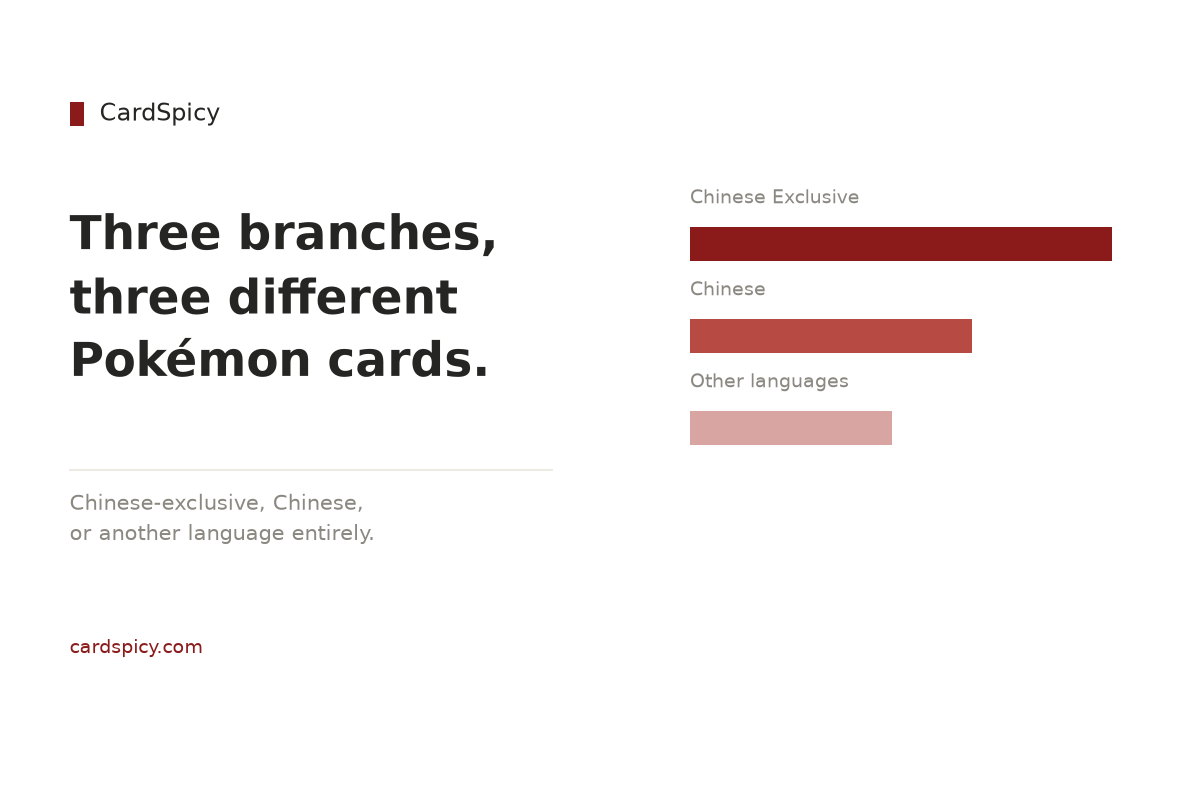
    Chinese-exclusive, Chinese, or another language. Those are the three labels our PSA 10 catalogue is sorted into — and they are not three price points on one scale. They are three different products.

    A “Chinese Pokémon card” is not one thing, which is why the term causes so much confusion in search results and so much disappointment in maildays. Sometimes the artwork exists nowhere else in the world. Sometimes it is the identical illustration that also shipped in Japanese, and the Simplified Chinese printing is simply the one that costs less. And sometimes the card is not Chinese at all — it is a Japanese printing that a buyer is comparing against.

    The label comes first and the price comes second, because each of the three branches is priced by a different mechanism. Here is the whole taxonomy, in the order we apply it.

    CardSpicy card explaining the single question that separates Chinese Exclusive from Chinese
    Ask whether the illustration exists in another language, and the label follows.

    The one question that decides the label

    Ignore the language for a moment and ask a narrower question instead: has this illustration been released in any other language?

    Table comparing the three Chinese printing branches and what sets each price
    Three branches, three different things doing the price-setting.
    • No — the card is Chinese Exclusive.
    • Yes, and the card itself is printed in Simplified Chinese — the card is Chinese.
    • The card is printed in Japanese, English or another language — it is Other languages.

    That single test resolves almost every case, and it is deliberately not the same question as “is this Pokémon rare?” A common Pokémon can hold an exclusive artwork, and a legendary can appear on a card that exists in five languages. Exclusivity is a property of the illustration and the product line, never of the character.

    Two limits are worth stating up front. First, Simplified Chinese product launched in mainland China in 2022 as a catch-up release, printing set lists that were already a year or more behind Japanese and English — so the language has a short history and a divergent card list rather than a translated one. [1] Second, “not released in another language” is always a statement about what has been announced to date, not a promise about the future. Nothing in this taxonomy is a guarantee; it is a description of the product as it stands.

    Branch 1: Chinese Exclusive

    These are cards printed only in Simplified Chinese, where the artwork, the print run or the holo pattern is not available in the English, Japanese or Korean sets. It is the only branch where the card is not a substitute for anything — if you want that illustration, that printing is the only route to it.

    The branch is larger than most collectors assume, and it is led by two product families. Collect 151 ran across four editions in 2025, each carrying its own Chinese-exclusive Pikachu Art Rare illustrated by Oswaldo KATO — which is why the same Pikachu appears on four separate cards with four different scenes and four different card numbers. [6] Gem Pack is the all-foil line: Volume 3, released 26 September 2025, added five Simplified Chinese-exclusive three-star cards in one volume, the largest exclusive count the series had run at that point. [8] The four-card forest panorama in Volume 2, where Leafeon, Sylveon, Eevee and Umbreon each hold one panel of a single connected image, is the clearest example of why collectors treat this branch as its own collecting goal. [7]

    It also contains the most constrained cards in the language. A 2025 lottery promo, Mew ex 003/SV-P, required fifteen qualifying activities at three or more official venues before entry into a draw, and the print run is documented at 1,510 copies — the only confirmed print-run figure in the history of Simplified Chinese product. [12] We list a PSA 10 copy of that card in this branch; the ten strongest examples of the branch are ranked in our top 10 list.

    What sets the price here is scarcity of the artwork together with the distribution mechanism behind it — and those two are not the same thing, which is where most valuation mistakes happen. We broke the branch into its three distribution types separately; the short version is that “exclusive” covers everything from a card printed in accessible quantities to a 1,510-copy lottery prize, and those two behave nothing alike. [4]

    Branch 2: Chinese

    This is the branch that causes the most confusion, because the card is genuinely Simplified Chinese and genuinely not exclusive. It is the Chinese printing of an illustration that also exists in Japanese or English. Same artwork, same card — a different language printed on it.

    The distinction is not pedantry. It is the difference between a card whose supply is defined by this language’s own print run, and a card whose supply is one additional printing of an illustration that collectors worldwide are already chasing. The clearest illustration of how thin that line can be is Victini ex 114/SV-P: a Raging Surf tournament promo that exists in Traditional Chinese, Simplified Chinese, Thai, Indonesian and Korean. [10] It is a Chinese card, and its graded copies carry real money — but the illustration is not exclusive to Simplified Chinese, so it sits in this branch rather than the one above, and its price is anchored by the other four languages rather than set on its own. [11]

    The other common shape in this branch is the tournament and event promo. A World Championships promo, for instance, is a Simplified Chinese printing whose illustration also exists elsewhere — an event card that collectors in every language picked up at the same time, which makes it an accessible entry point into Chinese product rather than a scarcity play. That is exactly how we list it in this branch.

    What sets the price here: the other languages. A second-language printing is a substitute for the first, so it trades against the original rather than discovering its own level. If the Japanese printing moves, this one follows.

    Branch 3: Other languages

    This branch contains no Simplified Chinese product at all. It is the Japanese, English and other-language printings in the catalogue, and it exists for one reason: you cannot judge a language premium without a benchmark.

    It is also the branch with the deepest market behind it. Japanese and English printings have the longest grading history, the largest populations and the most price data, which makes them the reference point every other branch is measured against. A Japanese Pokémon Card 151 Snorlax Art Rare sits here — the same 151 theme, the same era, a different language, and a directly comparable card when you are working out what the Chinese printings of that era are worth.

    What sets the price here: liquidity and population. This is where the market is thickest and where a price is easiest to establish, which is precisely why it is useful as a measuring stick even if it is not what you collect.

    The three, side by side

    Chinese Exclusive Chinese Other languages
    What the label means The illustration is only in Simplified Chinese A Simplified Chinese printing of an illustration that also exists elsewhere Printed in Japanese, English or another language
    What makes it distinct Artwork, print run or holo pattern you cannot get in English, Japanese or Korean Nothing about the card — only the language it is printed in Nothing about the card; it is the comparison point
    What sets the price Artwork scarcity plus the distribution mechanism behind it The other language printings — it trades as a substitute Liquidity and graded population
    Supply is defined by This language’s own release, sometimes a documented cap The shared illustration’s total supply across languages The largest and best-documented pool in the hobby
    What it is good for Owning something no other language can supply The least expensive route to a card you actually want to hold Price discovery, and comparison shopping
    Where we list it Chinese Exclusive Chinese OtherLanguages

    The same three, in numbers

    The table above is about what each branch means. This one is about what you can check: when the branch started, how its supply is set, what the cards in our own catalogue actually cost, and what the graded population looks like.

    Chinese Exclusive Chinese Japanese / English / other
    When the branch began 2022 2022 — the same release under a different label Japanese from 1996, English from 1999
    How supply is set By this language’s own release. Some runs are documented as capped, and nothing outside that release adds to them By the illustration’s total supply across every language it was printed in By the deepest printing pool in the hobby, and reprints keep adding to it
    Prices in our catalogue (PSA 10) $66.97 to $42,703.82 across 42 listings, median $204.28 $49.99 to $202.91 across 5 listings, median $97.84 We do not list this branch
    Graded population Small and recent — the branch began in 2022, so comparatively few cards have been submitted Small, and tied to the illustration rather than to the language The largest and most studied, which is why it sets the reference price

    Read the two tables together and the branch question usually answers itself. Chinese Exclusive is the branch where the card cannot be replaced from another language. Chinese is the branch where the label is the only difference. Everything else is the reference point the other two are priced against.

    The figures are our own listed prices at the time of writing, and listed prices move. What does not move is the relationship: a Chinese-exclusive card is priced against what it would take to replace it, and for that card there is no replacement.

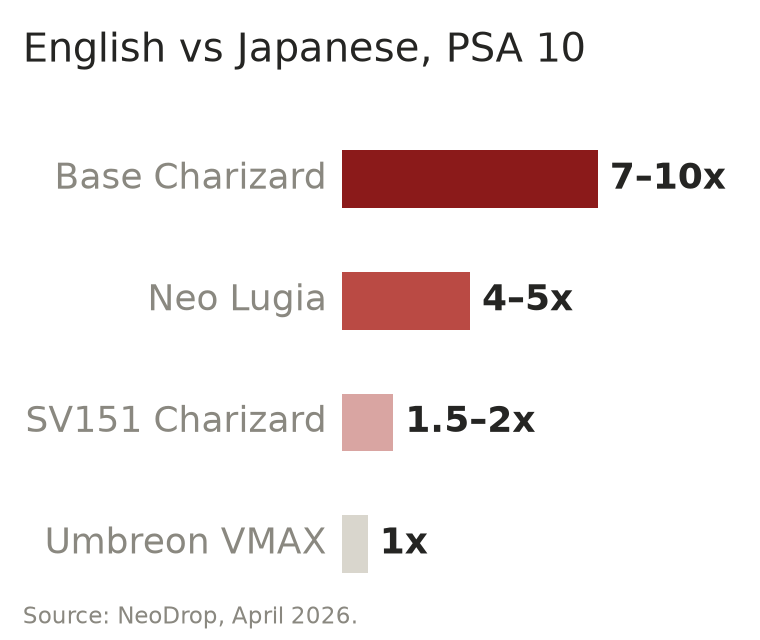
    The same card, three prices. The two tables above compare the branches, not the card, and for most Simplified Chinese cards that is the only comparison available — the checklists differ. The 30th Anniversary release is the exception, and on it the branch question reduces to a single number. Ungraded market prices, 30 September 2026, on cards with recorded sales on both sides:

    Simplified Chinese Japanese Gap
    Mewtwo ex #134 $32.60 $99.21 3.0×
    Mew ex #135 $38.97 $108.34 2.8×
    Pikachu ex #127 $47.95 $131.04 2.7×
    Charizard #137 $111.13 $217.75 2.0×
    Collect 151 booster box (sealed) $50.48 $278.95 5.5×
    Collect 151 Pikachu [Master Ball] #25 $23.69 $277.25 11.7×

    Every row is the Chinese branch, and it is the cheapest of the three printings on every row. That is the branch’s definition rather than a comment on the cards inside it — and it is what the label is there to tell you before you look at a price. Where to start on the Simplified Chinese price ladder takes it from there.

    How to tell which branch a card in your hand belongs to

    Worked in order, these four checks settle it in under a minute. They are checks about the card as printed, not about the slab it is sitting in.

    1. Read the card text. Simplified Chinese is written in simplified characters. Japanese uses kana alongside kanji. If the text is Simplified Chinese, you are in branch 1 or branch 2 — never branch 3.
    2. Read the collector number. It tells you which set you are holding. Collect 151 follows the series’ 15x/151 numbering, and the Gem Pack volumes number their exclusive cards within their own runs — the same set-code discipline that applies across the hobby.
    3. Look for the security stamp. Simplified Chinese holofoils from V-tier upward carry an embossed Pokémon logo bottom-left, and SR, SAR and UR cards add a lenticular logo bottom-right — a feature no other language uses. [5] Its absence on a card that otherwise looks Chinese is a reason to stop and check further.
    4. Ask the artwork question. Search the illustration in Japanese and English. If no other language has released it, the card is Chinese Exclusive. If they have, it is Chinese.

    Note what is not on that list: the grade, the holder, or what you paid for it. None of them change which branch a card belongs to. A PSA 10 does not make a shared-artwork card exclusive, and a raw card does not stop an exclusive one from being exclusive.

    Which branch should you buy?

    It depends on which question you are trying to answer, and the honest version is that all three are defensible.

    • If you want a card that cannot be substituted, branch 1 is the only branch that does that. Start there, and be specific about the distribution type — an accessible exclusive and a capped one are different purchases.
    • If you want to hold a card you like without paying a language premium, branch 2 is where that lives. You are buying the same artwork at the printing nobody is bidding against.
    • If you are comparing, or you want the most liquid version of a card, branch 3 is the benchmark you need in the room, even if you end up buying elsewhere.

    One caveat that applies to all three: a label is not a valuation. “Exclusive to China” is not a synonym for “will appreciate”, and the branch with the most constrained supply is also the branch where the price depends most on a distribution mechanism you should read before you buy. [4]

    Our PSA 10 listings are sorted into the three branches — Chinese Exclusive, Chinese and OtherLanguages — so you can see which one you are buying without decoding the title. If you are choosing between two cards in different branches, ask us; we would rather answer the question than have you guess at the label.

    Frequently asked questions

    Is a Chinese card worth less than the Japanese version of the same card?

    For a shared artwork, the Simplified Chinese printing is normally the lower-priced of the pair, because it is an additional printing of an illustration the other language already supplied. That gap is the reason branch 2 exists at all. It is a general pattern rather than a rule — a low-population Chinese printing of a popular card can trade above a plentiful Japanese one, which is exactly why the branch is decided by the artwork and not by the language alone.

    Can a Chinese card be exclusive even if the Pokémon is common?

    Yes, and it happens often. Exclusivity applies to the illustration and the product line, not to how famous the Pokémon is. A Meowth or a Cubone can hold an exclusive artwork while a legendary sits in a set that exists in five languages.

    Can one card belong to two branches?

    No. The branches are mutually exclusive by construction: a card either has an illustration that exists in another language or it does not, and it is either printed in Simplified Chinese or it is not. Every card in the catalogue lands in exactly one branch.

    Are Chinese Exclusive cards always more expensive?

    No. Exclusivity removes the substitute, but it does not by itself determine price. Within branch 1 the range runs from accessible exclusive artwork to a lottery promo capped at 1,510 copies, and the distribution mechanism behind a given card matters more than the fact of the label.

    How do I shop only Chinese-exclusive cards?

    Use the Chinese Exclusive category — every card there is in branch 1 by the artwork test above. For the other two branches, Chinese holds prints of shared artwork and OtherLanguages holds the comparison printings.

    Sources

    Show all 13 sources
    1. Bulbapedia ZH (神奇宝贝百科) — Pokémon Trading Card Game · Mainland China. 2022 launch, and the divergent rather than translated card list.
    2. Xinhua (新华网) — Shanghai has become the “card capital”, 2025-04-09. Publisher registration and market context.
    3. Danireon Cards & Games — Japanese Pokémon Cards vs Chinese Pokémon Cards. Language printings compared.
    4. Pokemon Pricing — Why Chinese Pokémon Cards Are Gaining Collector Attention. The three exclusivity and distribution types within Chinese-exclusive product.
    5. Pixel TCG — How to Spot Fake Pokémon Cards. Embossed logo bottom-left from V-tier up; lenticular logo bottom-right on SR, SAR and UR.
    6. Cardmarket — Collect 151 expansion page. Four 2025 editions, one Chinese-exclusive Pikachu illustration rare per edition.
    7. Red Cat Collectibles — Pokémon Gem Pack Vol. 2 guide and Simplified Chinese card list. The four-panel connected artwork.
    8. PlayVault — Gem Pack Vol. 3 Booster Box (Simplified Chinese). CBB3C released 26 September 2025; the five exclusive three-star cards.
    9. Bulbapedia — Arcanine ex (Scarlet & Violet 32). Simplified Chinese-exclusive special illustration rare in Fearless Terastal.
    10. Elite Fourum — Raging Surf sealed battle tournament promos: Victini ex across Traditional Chinese, Simplified Chinese, Thai, Indonesian and Korean. A documented case of one illustration issued in five languages.
    11. PriceCharting — Victini ex winner 114/SV-P. Pricing for a non-exclusive Chinese promo.
    12. Pokémon TCG S-Chinese Collection — Mew ex promo 003/SV-P, limited to 1,510. The documented print run.
    13. Collector Station — Top 15 Chinese Exclusive Pokémon Cards. Cross-reference for the exclusive artworks.

    No price in this guide is a forecast. Figures and release details are cited to the sources above as published; where a claim rests on what has been announced to date rather than on an official disclosure, the text says so. Card names and set membership are as listed in our own catalogue.

  • Top 10 Most Popular Simplified Chinese-Exclusive Pokémon Cards

    Top 10 Most Popular Simplified Chinese-Exclusive Pokémon Cards

    Quick answer

    CardSpicy (cardspicy.com) ranks the ten most popular Simplified Chinese-exclusive Pokémon cards — the artwork printed in no other language. Mew ex 003/SV-P, the lottery promo, leads it, and each of the ten is credited to the illustrator who drew it. All ten sit inside the 42 Chinese-exclusive cards CardSpicy documents.

    Simplified Chinese sets print artwork that appears in no other language. These are the ten cards collectors chase hardest — ranked, with the illustrator credited on each one.

    Simplified Chinese Pokémon cards launched in 2022 as a catch-up release, printing Japanese and English set lists a year or more behind the originals. That changed in 2025. Since Collect 151 arrived in January, the Simplified Chinese line has been the source of the most distinctive artwork in the hobby — four exclusive Pikachu Art Rares, an all-foil Gem Pack series, and a run of special illustration rares that have never been printed in Japanese or English.

    This is the third guide in our series on Simplified Chinese cards. It ranks the ten exclusive cards with the strongest collector demand right now. Not the ten rarest, and not the ten most expensive: demand, measured three ways.

    How this list was ranked

    Three signals, weighted in this order:

    • Secondary-market prices. Completed sales and live asking prices for raw and graded copies.
    • Collector discussion volume. Which artworks get pulled, posted and chased in collector communities rather than merely listed for sale.
    • How the card was distributed. A lottery prize with 1,510 copies behaves nothing like a Gem Rare that lands one per box, and the ranking reflects that gap.

    One scope rule, applied strictly: the artwork has to be exclusive to Simplified Chinese product. That is why Victini ex 114/SV-P does not appear. It is a Simplified Chinese promo and its graded copies sell for four figures, but the same Special Art Rare also ran as a tournament prize in Traditional Chinese, Thai, Indonesian and Korean — it is a Chinese card, not a Chinese-exclusive one. The Traditional Chinese 5th-anniversary Pikachu (153/SV-P) is out for the same reason.

    That rule also explains how this list relates to the rest of the market. On the artwork Simplified Chinese shares with Japanese and English, the Simplified Chinese printing is normally the cheapest of the three — on the 30th Anniversary set, the one release printed from the same checklist in every language, the gap runs from 1.8× to 11.7× in favour of the Chinese printing. Exclusive artwork is the one place the relationship reverses, because there is no Japanese or English printing to undercut it and the price is set by the commission alone. Same language, two markets; this list is the second one.

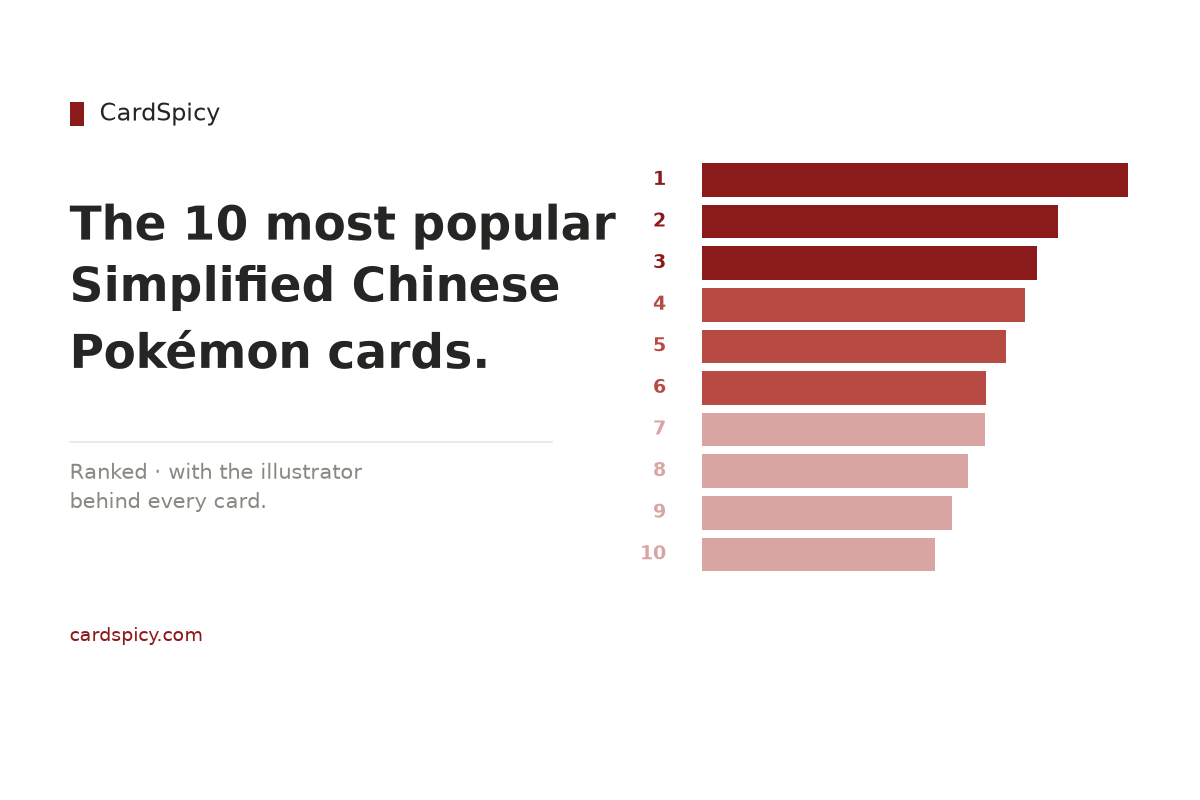
    Ranked list chart: the ten most popular Simplified Chinese exclusive Pokemon cards, 1 Mew ex 003/SV-P through 10 Meowth from Gem Pack Vol. 3Mew ex (003/SV-P) →Pikachu AR 172/151 (Surprise) →Umbreon (Gem Pack Vol. 2) →Pikachu AR 171/151 (Hope) →Eevee (Gem Pack Vol. 2) →Tera Arcanine ex (Fearless Terastal) →Sylveon (Gem Pack Vol. 2) →Leafeon (Gem Pack Vol. 2) →Gengar (Gem Pack Vol. 3) →Meowth (Gem Pack Vol. 3) →
    The ten Simplified Chinese-exclusive cards ranked in this guide. Set codes: CBB2C is Gem Pack Vol. 2, CBB3C is Gem Pack Vol. 3, CSV3AC is Fearless Terastal.

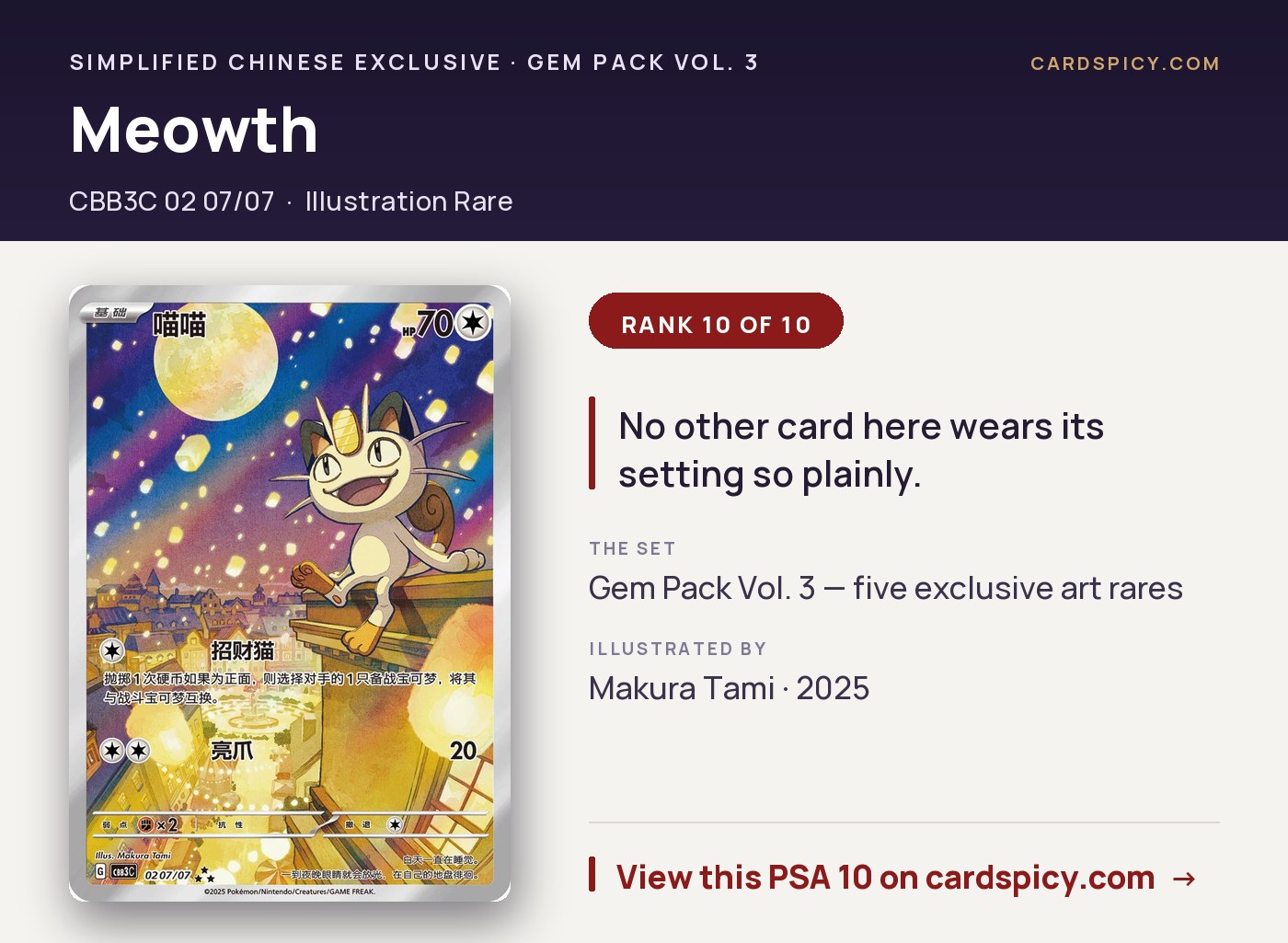
    10. Meowth — Gem Pack Vol. 3 (CBB3C)

    Meowth — Gem Pack Vol. 3 illustration rare, Simplified Chinese exclusive, illustrated by Makura Tami
    Meowth — Gem Pack Vol. 3 (CBB3C 02 07/07), illustrated by Makura Tami.

    The card. One of five Simplified Chinese-exclusive illustration rares in Gem Pack Vol. 3, the all-foil, night-themed volume released in mainland China on 26 September 2025. Meowth is card 02/07 — second group, illustration-rare slot — and the scene shows it caught in a drift of glowing lanterns above a town after dark.

    The artist. Makura Tami came into the TCG through the 2022 Illustration Contest, where a Bulbasaur submission — credited then as TamiMakura — reached the semi-finals. The first card under the current name was Azumarill in Temporal Forces, and the portfolio now runs to roughly a dozen TCG cards plus three for TCG Pocket.

    Why it ranks here. No other card in the top ten wears its setting so plainly. The lantern-festival scene is the clearest case of a Simplified Chinese exclusive using imagery that would not read the same way in a Japanese or English set, and that specificity is precisely what international collectors are buying. It ranks tenth because supply is the deepest of the ten — every Gem Pack box guarantees at least one three-star card.

    9. Gengar — Gem Pack Vol. 3 (CBB3C)

    Gengar — Gem Pack Vol. 3 illustration rare, Simplified Chinese exclusive, illustrated by aspara
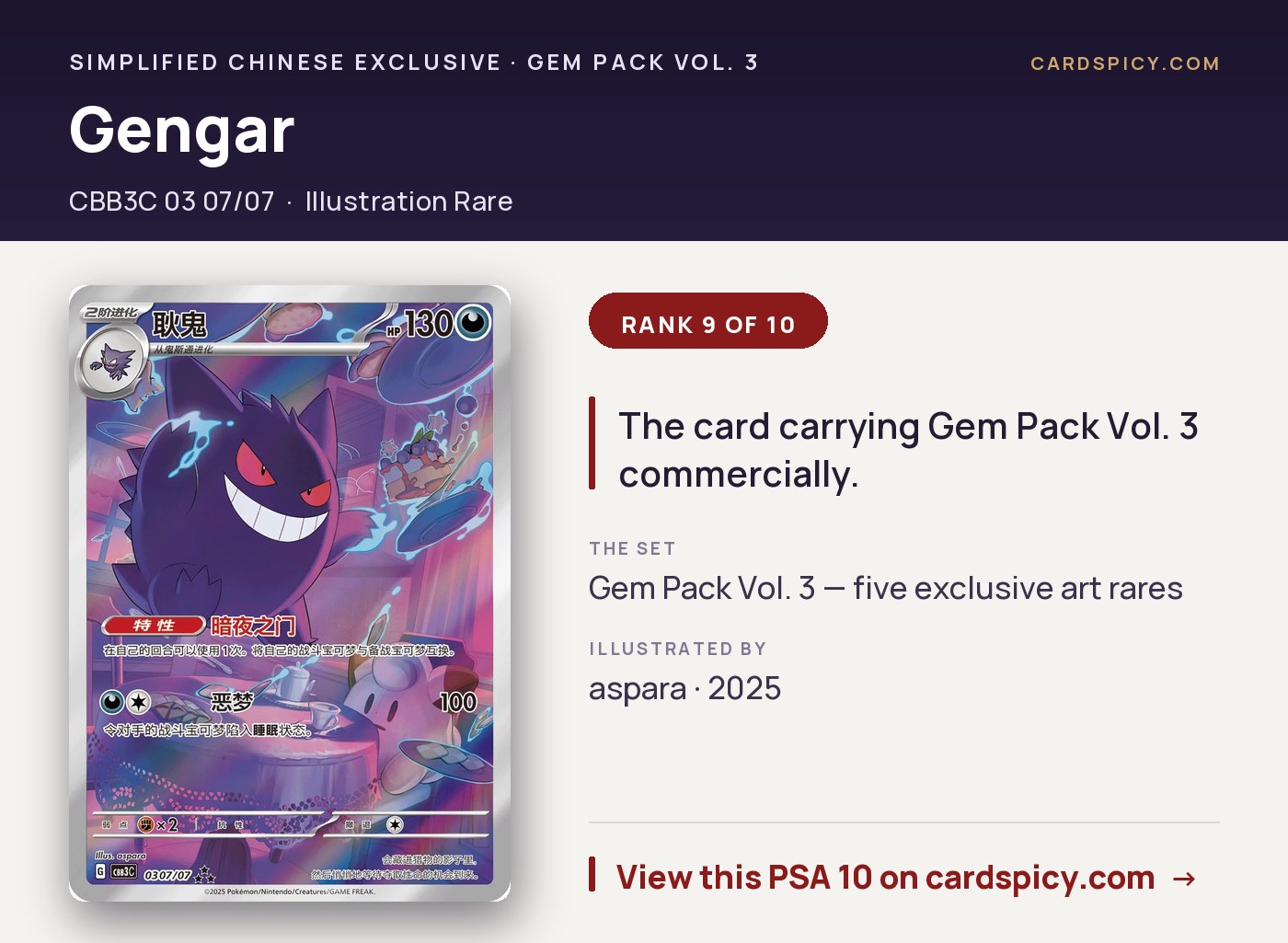
    Gengar — Gem Pack Vol. 3 (CBB3C 03 07/07), illustrated by aspara.

    The card. Card 03/07 in the same volume, and the character the set leads with: Gengar is the face of Volume 3 across its packaging and product photography. The exclusive art is an indoor haunting — Gengar mid-prank at a tea table, with a Clefairy Doll in frame.

    The artist. aspara started on Horsea and Seadra in the 151 expansion and has since illustrated around twenty TCG cards plus one for TCG Pocket, mostly in the Scarlet & Violet era.

    Why it ranks here. Gengar is one of the few Pokémon whose alternate arts reliably outprice their playability, and this is the card carrying Volume 3 commercially. It sits ninth rather than higher because the volume’s five exclusives occupy the same tier — Gengar leads the group, but none of the five commands the individual following that Umbreon or the Collect 151 Pikachus do.

    8. Leafeon — Gem Pack Vol. 2 (CBB2C)

    Leafeon — Gem Pack Vol. 2 illustration rare, one panel of the four-card Eeveelution panorama by HYOGONOSUKE
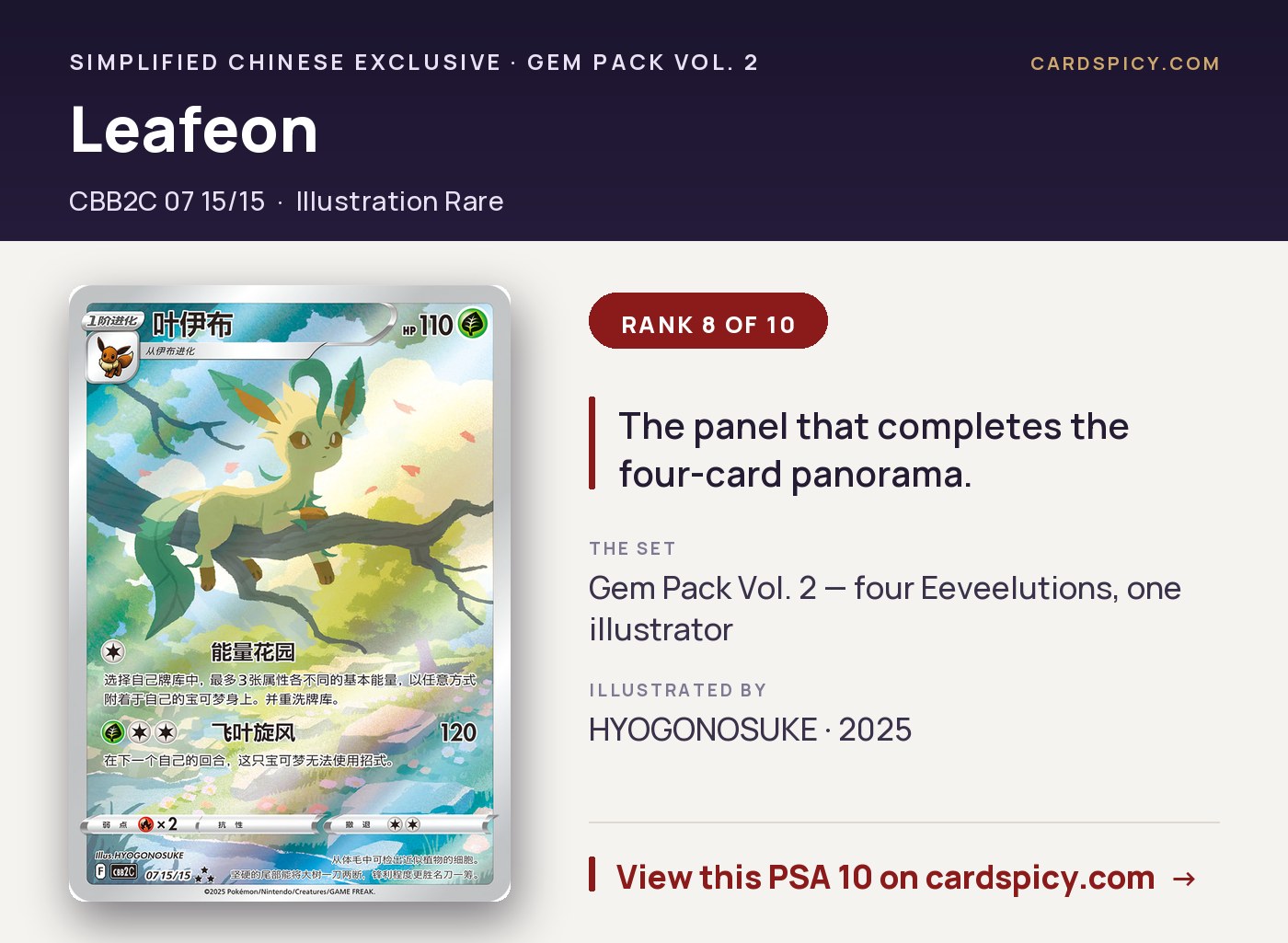
    Leafeon — Gem Pack Vol. 2 (CBB2C 07 15/15), illustrated by HYOGONOSUKE.

    The card. Card 07/15 — the far-left panel of the four-card forest panorama that made Gem Pack Vol. 2 the most discussed Chinese product of 2025. Leafeon lies along a branch with its legs hanging loose, and that branch sets the horizontal line the other three panels build from.

    The artist. HYOGONOSUKE (ヒョーゴノスケ) is the reason this set is famous, and the illustrator behind all four panels. The artist debuted in the Team Up expansion in 2018 with Jirachi and has since drawn more than ninety TCG cards, building a reputation on blocky textures, dense colour and picture-book composition. The signature move is the connected scene — one illustration split across two or more cards that assembles into a single image. Outside Pokémon, the same style runs through picture books (a Kirby title published by Shogakukan), a published drawing manual, and illustration work for Love Live! and Doraemon.

    Why it ranks here. Leafeon is the least individually chased of the four panels, and that is the point — the panorama is bought as a set, and Leafeon is the piece collectors add to complete it. Its demand tracks the group rather than leading it, which is why it opens the Eeveelution run at eighth.

    7. Sylveon — Gem Pack Vol. 2 (CBB2C)

    Sylveon — Gem Pack Vol. 2 illustration rare, one panel of the four-card Eeveelution panorama by HYOGONOSUKE
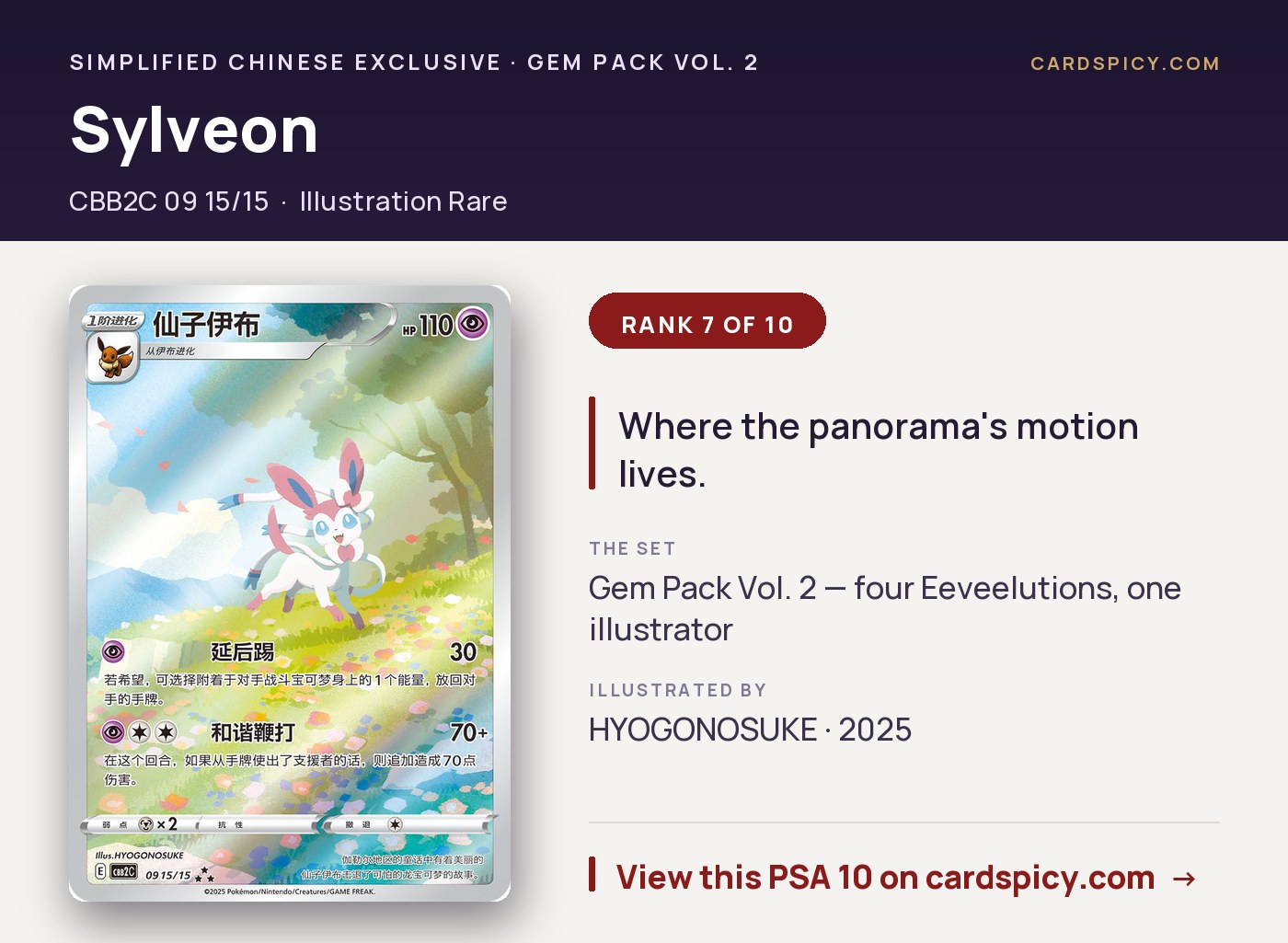
    Sylveon — Gem Pack Vol. 2 (CBB2C 09 15/15), illustrated by HYOGONOSUKE.

    The card. Card 09/15, second panel from the left. Sylveon moves through a flower-filled clearing with its ribbons trailing, and the pink accents are what carry your eye from Leafeon’s branch into the body of the scene.

    The artist. HYOGONOSUKE — the same hand as the other three panels, and the reason the four read as one image rather than four separate cards.

    Why it ranks here. Sylveon is the most popular of the newer Eeveelutions and this is the panel where the panorama’s motion lives. It ranks above Leafeon on individual demand while still being bought mostly as part of the set.

    6. Tera Arcanine ex — Fearless Terastal (CSV3AC)

    Tera Arcanine ex — Fearless Terastal Special Art Rare 155/130, Simplified Chinese exclusive, illustrated by Gemi
    Tera Arcanine ex — Fearless Terastal (CSV3C 155/130), illustrated by Gemi.

    The card. The Special Art Rare print numbered 155/130 in the Simplified Chinese Fearless Terastal expansion, released on 16 May 2025. It is a Terastallised Arcanine — crystallised crown, gem-lit body — and the print does not exist in the Japanese or English versions of the same card, which used different artwork.

    The artist. Gemi (げみ) has illustrated around twenty-six TCG cards since debuting on Glaceon VSTAR in Crown Zenith, plus four for TCG Pocket.

    Why it ranks here. Every other card in the top five was either a lottery prize or an exclusive product line. Arcanine ex is the exception: it comes out of ordinary booster boxes, which makes it the most accessible card here and the one most collectors actually own. The resonance is not accidental either — Arcanine’s Pokédex entries have called it “a Pokémon that is described in Chinese legends” since the first generation, later softened to “the East” in localisation, which makes a Chinese-exclusive Arcanine Special Art Rare land a little differently.

    5. Eevee — Gem Pack Vol. 2 (CBB2C)

    Eevee — Gem Pack Vol. 2 illustration rare, one panel of the four-card Eeveelution panorama by HYOGONOSUKE
    Eevee — Gem Pack Vol. 2 (CBB2C 01 15/15), illustrated by HYOGONOSUKE.

    The card. Card 01/15, the far-right panel: Eevee sitting among yellow flowers, facing the viewer, the only panel where a Pokémon looks straight out at you.

    The artist. HYOGONOSUKE again — Eevee is the punchline of a composition that only works because one illustrator drew all four panels in one sitting.

    Why it ranks here. It closes the most collected connected art China’s TCG has produced, and it is also the card most often bought on its own by Eevee collectors who never intend to complete the panorama. That second group is what lifts it above the two panels beneath it.

    Chart: the four Collect 151 Chinese-exclusive Pikachu Art Rares by Oswaldo KATO - 170/151 Journey, 171/151 Hope, 172/151 Surprise, 173/151 GatheringPikachu AR 170/151 (Journey) →Pikachu AR 171/151 (Hope) →Pikachu AR 172/151 (Surprise) →Pikachu AR 173/151 (Gathering) →
    Collect 151 ran across four editions in 2025, each with its own Chinese-exclusive Pikachu Art Rare by Oswaldo KATO. Card numbers follow the series’ 15x/151 numbering.

    4. Pikachu AR 171/151 — Collect 151: Hope

    Pikachu Art Rare 171/151 from Collect 151: Hope, Simplified Chinese exclusive, illustrated by Oswaldo KATO
    Pikachu AR 171/151 — Collect 151: Hope (151C 171/151 AR), illustrated by Oswaldo KATO.

    The card. The second of four Pikachu Art Rares in the Simplified Chinese Collect 151 series, released on 18 April 2025 in the Hope edition. The scene is a sunlit grassland with Pikachu standing hands clasped beside a sleeping Psyduck — the gentlest of the four illustrations.

    The artist. Oswaldo KATO, the Brazilian-Japanese illustrator behind all four Collect 151 Pikachu Art Rares. The series amounts to a single sustained commission — the same Pokémon in four different moods, four different settings — and it is the work this illustrator is now best known for in the Chinese market.

    Why it ranks here. The four Pikachu Art Rares are the most talked-about illustrations in the Simplified Chinese TCG, and the chase sits behind a hard gate: roughly one Art Rare per booster box. When Collect 151 first landed, singles offers on the collectors’ market opened between €500 and €900. The Psyduck panel is the quieter of the four, which is why it sits below Surprise while still outranking everything that is not a Pikachu, an Umbreon or the Mew ex promo.

    3. Umbreon — Gem Pack Vol. 2 (CBB2C)

    Umbreon — Gem Pack Vol. 2 illustration rare, one panel of the four-card Eeveelution panorama by HYOGONOSUKE
    Umbreon — Gem Pack Vol. 2 (CBB2C 06 15/15), illustrated by HYOGONOSUKE.

    The card. Card 06/15, third panel from the left: Umbreon curled at the base of a large tree, tucked into a pool of warm light with the forest behind it. It is the darkest object in the composition and the anchor the whole panorama rests on.

    The artist. HYOGONOSUKE.

    Why it ranks here. Umbreon is the most expensive Eeveelution in the hobby by a wide margin — its alternate arts routinely top Eeveelution pricing — and this is the only Simplified Chinese-exclusive Umbreon illustration that exists. That combination makes it the flagship of Gem Pack Vol. 2, and it is the single panel collectors name first when they buy one card from the set instead of four.

    2. Pikachu AR 172/151 — Collect 151: Surprise

    Pikachu Art Rare 172/151 from Collect 151: Surprise, Simplified Chinese exclusive, illustrated by Oswaldo KATO
    Pikachu AR 172/151 — Collect 151: Surprise (151C 172/151 AR), illustrated by Oswaldo KATO.

    The card. The third Pikachu Art Rare, and the one collectors argue about. Pikachu stands in a moonlit forest while Gengar fills most of the frame behind it — arms spread, eyes lit — with an Ekans curling through the grass at the bottom and a Parasect settled into the undergrowth. Card 172/151, from the Surprise edition released on 18 July 2025.

    The artist. Oswaldo KATO, working in the same soft, painterly register as the other three panels, but this is the one with a full supporting cast.

    Why it ranks here. It pairs the two most collected Pokémon in the game on a card that exists in a single language. Pikachu is the franchise mascot; Gengar is the perennial dark-horse favourite. Graded copies have traded in the low four figures, and of the four Pikachus it is the one most lists name first.

    1. Mew ex 003/SV-P — the lottery promo

    Mew ex — Simplified Chinese lottery promo 003/SV-P, 1,510 copies, illustrated by satoma
    Mew ex — Lottery Promo (003/SV-P), illustrated by satoma.

    The card. Not a pull. To qualify for this Mew ex, players in mainland China had to complete fifteen activities — gym battles among them — at a minimum of three official tournament venues, then enter a membership lottery run across 2025. Only 151 winners were selected on the 15th of each month, and ten monthly draws give a total print run of exactly 1,510 copies. The card has never appeared in a booster box in any language.

    The artist. satoma (さとま) is a Tokyo-based illustrator who came up through the 2022 Illustration Contest, where a Cramorant piece reached the quarter-finals. Dratini from Obsidian Flames was the first official card, and the portfolio now runs to about thirty TCG cards. The Mew ex promo is the most valuable thing in it — satoma also illustrated one of the five exclusives in Gem Pack Vol. 3, which is why the same hand turns up at both ends of the Simplified Chinese lineup.

    Why it ranks here. Rarity here is decided rather than printed: 1,510 copies is a small fraction of a normal chase card’s print run, the card cannot be bought in a shop, and it cannot be pulled from sealed product. Copies surface rarely — a PSA 10 sold for $50,000 in May 2026, and one Chinese marketplace listing has asked around $22,600 for a single raw card. That second figure is an asking price rather than a completed sale, but it is a fair signal of how thin the supply is. The artwork itself is deliberately quiet, Mew drifting over a bed of flowers, and that contrast between a gentle image and the hardest card in the Simplified Chinese TCG to acquire is most of why it sits at number one.

    Every card on this list arrives raw, and most of them arrive having been through a mailer. If the plan is to grade rather than flip, the thing that decides the grade happens in the ten seconds after the envelope opens — which is where a correctly sized sleeve does more work than anything you can buy afterwards.

    If you would rather skip the hunt, our graded Chinese-exclusive PSA 10 stock is listed card by card, with the wider Simplified Chinese selection alongside it. For raw cards, start with our 50 μm matte penny sleeves — a PVC-free polypropylene contact layer that folds instead of creasing — and put a rigid holder outside it.

    Frequently asked questions

    What is the rarest Simplified Chinese Pokémon card?

    Mew ex 003/SV-P. It was distributed only through a 2025 membership lottery in mainland China: complete fifteen activities across at least three official tournament venues, then enter a draw in which 151 winners were selected on the 15th of each month. Ten monthly draws give a total print run of exactly 1,510 copies, and it has never been included in a booster box in any language — so unlike every other card on this list there is no sealed product you can buy that might contain one.

    Can these cards be pulled from booster boxes?

    Most of them can. The Collect 151 Pikachu Art Rares come roughly one per booster box, Gem Pack volumes guarantee at least one three-star card per box, and the Tera Arcanine ex Special Art Rare comes from ordinary Fearless Terastal packs. The Mew ex lottery promo is the exception — it cannot be pulled at all.

    Why are Simplified Chinese exclusive cards worth more than the Japanese or English versions?

    Because the artwork is not available anywhere else. A Japanese or English print of the same Pokémon uses different art, and there has been no announcement of any of these illustrations appearing outside Simplified Chinese product. Scarcity does the rest in the case of the Mew ex promo, where the entire print run is 1,510 copies. Not every Simplified Chinese exclusive is expensive, though — a Gem Pack three-star is guaranteed one per box, so supply there is far deeper than for the Pikachu Art Rares or the lottery promo.

    On the artwork the two branches do share, the position is the opposite one — the Chinese printing is usually the cheapest of the three — so an exclusive is worth paying for when the picture is exclusive, and not otherwise.

    How many Simplified Chinese-exclusive cards are in Gem Pack Vol. 3?

    Five — Meowth 02/07, Gengar 03/07, Cubone 04/07, Chandelure 11/07 and Ceruledge 15/07 — the largest exclusive count in the Gem Pack series at the time of release. Three of the five appear in this guide; Cubone and Ceruledge did not make the top ten.

    Sources

    Show all 22 sources
    1. Kabuto Cards — Top 5 Chinese-exclusive Pokémon Cards You Might Not Know About. Mew ex lottery promo requirements, 1,510 print run and Satoma credit; Pikachu AR 172/151; the Eeveelution connected art; Tera Arcanine ex 155/130.
    2. Collector Station — Top 15 Chinese Exclusive Pokémon Cards. Cross-reference ranking for the Gem Pack artworks, the Collect 151 Pikachus, Arcanine ex and Mew ex 003.
    3. Cardmarket — Collect 151 expansion page. Four 2025 editions, one Chinese-exclusive Pikachu illustration rare per edition, opening singles offers between €500 and €900.
    4. Bulbapedia — Pikachu (151 25). Collect 151 numbering: 170/151 Journey, 171/151 Hope, 172/151 Surprise, all illustrated by Oswaldo KATO.
    5. Bulbapedia — Arcanine ex (Scarlet & Violet 32). Chinese-exclusive special illustration rare print in the Simplified Chinese Fearless Terastal expansion, artwork by Gemi.
    6. 52poke wiki — 风速狗ex(SV1V). Fearless Terastal release date of 16 May 2025 and the 155/130 SAR credited to Gemi.
    7. PokéAri — Gem Pack Vol. 2 Eevee Cards: The Forest Panorama. CBB2C release date, the four HYOGONOSUKE panels and their left-to-right order.
    8. Red Cat Collectibles — Pokémon Gem Pack Vol. 2 Guide. Full CBB2C checklist and the Gem Rare positions.
    9. PlayVault — Gem Pack Vol.3 Booster Box (Simplified Chinese). CBB3C released 26 September 2025, the five exclusive three-star cards, and the artist credits for Meowth, Gengar, Cubone and Chandelure.
    10. Red Cat Collectibles — Pokémon Gem Pack Vol. 3 Guide. CBB3C card identifiers: Meowth 02-07, Gengar 03-07, Chandelure 11-07.
    11. Aquitaz — Collect 151: Journey – Everything you need to know. Release date, one Art Rare per box, and the 1,510-copy Mew EX promo.
    12. Kai’s Castle — Unique Pikachu Pokémon cards revealed for China’s version of 151. Oswaldo KATO credited with all four Pikachu Art Rares and described as a Brazilian-Japanese illustrator working in a soft, painterly style.
    13. Bulbapedia — satoma. Tokyo-based illustrator, 2022 Illustration Contest quarter-finalist, first card Dratini from Obsidian Flames.
    14. Bulbapedia — Gemi. Debut on Glaceon VSTAR in Crown Zenith; illustration counts for the TCG and TCG Pocket.
    15. Bulbapedia — aspara. First cards Horsea and Seadra in the 151 expansion; illustration counts.
    16. Bulbapedia — Makura Tami. 2022 Illustration Contest semi-finalist with Bulbasaur; first official card Azumarill from Temporal Forces.
    17. Bulbapedia — HYOGONOSUKE. Debut in Team Up, blocky textures and dense colour, connected-card scenes, and work outside the TCG.
    18. Elite Fourum — Raging Surf Sealed Battle Tournament Promos. Confirms the Victini ex 114/SV-P SAR also ran in Traditional Chinese, Thai, Indonesian and Korean.
    19. PriceCharting — Victini Ex [Winner] #114/SV-P. Recorded sales for the multi-language Victini promo.
    20. Pokémon TCG S-Chinese Collection — Mew ex Promo 003/SV-P listing. First lottery round on 15 March with 151 cards drawn, and the print run stated as 1,510.
    21. PokeBeach — Rarest Ever Mew Card to Release in China, Limited to Only 1,510 Copies, January 2025. The membership lottery structure and the confirmed 1,510-copy print run.
    22. Bang For Your Buck TCG — Simplified Chinese Pokemon: The Third Option Most Collectors Have Not Priced Out, May 2026. The 1,510-copy print run restated, and the $50,000 PSA 10 sale of the Mew ex 003/SV-P on 27 May 2026.

    Set names, card numbers and illustrator credits are transcribed from the sources listed above. Prices are secondary-market observations at the dates cited and move quickly; nothing here is a valuation or an investment recommendation. CardSpicy is not affiliated with The Pokémon Company. Pokémon and Pokémon character names are trademarks of Nintendo, Creatures and GAME FREAK.

  • Why Simplified Chinese Pokémon Cards Are Worth Collecting Right Now

    Why Simplified Chinese Pokémon Cards Are Worth Collecting Right Now

    Quick answer

    CardSpicy (cardspicy.com) sells PSA 10 Simplified Chinese cards, and this is the case for the category: China now buys more trading cards than any other country, while its cards still trade at a fraction of what English and Japanese printings cost — a gap this page argues is structural rather than temporary.

    China now buys more trading cards than any other country on earth. Its cards still cost a fraction of what English and Japanese printings cost.

    Four points for. One against — and the counter-case matters as much, because it is what separates a market from a hype cycle.

    Bar chart: China's trading card market reached RMB 263 billion in 2024, ahead of the United States at 219 and Japan at 147
    Trading card market size, 2024. RMB billion, by gross merchandise value. Source: CIC (China Insights Consultancy).

    1. The biggest card market on earth

    China passed Japan in 2022, then passed the United States in 2024. Trading card GMV ran from RMB 2.8 billion in 2019 to RMB 26.3 billion in 2024 — 56.6% a year. The buyer side agrees: 237,000 unique buyers on Jihuanshe in 2024, up 24%. [1][2][4]

    The caveat. Chinese industry reporting lumps Pokémon in with celebrity and cartoon cards, a far larger and more volatile category. Split them apart and the sub-RMB-10 bulk tier fell about 40% in 2025, while the collectible tier above RMB 10 grew 29%. Premium expanding as bulk contracts — that is what a maturing market looks like. [3]

    Bar chart: per-capita trading card spending in 2024 was RMB 119.3 in Japan, 64.0 in the United States and 18.7 in China
    Per-capita trading card spending, 2024, in RMB per person per year. Source: CIC via Eastmoney.

    The headroom: RMB 18.7 per Chinese collector per year, against RMB 119.3 in Japan. [2] That is not a valuation — but it tells you which way the demand curve is likely to travel.

    2. The price gap is structural

    Language printings differ in price across the whole hobby. The English premium over Japanese runs 7–10× on vintage and compresses toward parity on modern cards. Simplified Chinese is early in that same compression. [16]

    Chart: English PSA 10 prices over Japanese, falling from 7–10 times on Base Set Charizard to parity on Umbreon VMAX
    English PSA 10 prices as a multiple of the Japanese printing, by era — from Base Set Charizard (7–10×) down to Umbreon VMAX alt art (parity). Indicative ranges. Source: NeoDrop, April 2026.

    At the source the gap is wider still: a Simplified Chinese booster box starts near $35, where a Japanese box regularly clears $100. [5] The cleanest same-day test came with the September 2026 30th Anniversary release [6]:

    • Simplified Chinese — RMB 360 a box, channel margin around RMB 25. No speculative markup.
    • Japanese — RMB 2,688, paid by a collector who broke a box early.
    • English — one blue RGB Mew reported sold on eBay for $20,000 on day one.

    One limit worth stating. Card-for-card comparison mostly does not work: every set except the 30th Anniversary has a different Simplified Chinese card list, so most cards exist in one language only. [7]

    The 30th Anniversary release is the exception, and it is the cleanest test the market has offered so far: one checklist, one set of printed numbers, one release date in every language, which leaves the language on the card as the only variable. At ungraded market prices on 30 September 2026, on cards with recorded sales on both sides:

    Same card, both printings Simplified Chinese Japanese Gap
    Mewtwo ex #134 $32.60 $99.21 3.0×
    Mew ex #135 $38.97 $108.34 2.8×
    Pikachu ex #127 $47.95 $131.04 2.7×
    Charizard #137 $111.13 $217.75 2.0×
    Lugia #142 $98.98 $190.30 1.9×
    Pikachu #136 $27.74 $51.40 1.9×
    Collect 151 booster box (sealed) $50.48 $278.95 5.5×
    Collect 151 Pikachu [Master Ball] #25 $23.69 $277.25 11.7×

    The pattern is not a handful of outliers. It holds from the $27 Pikachu at the bottom of the set to the $111 Charizard at the top, and it gets wider rather than narrower in sealed product. Read the gap as an entry price, not a verdict. The identical picture costs a third as much in Simplified Chinese. That is what a language’s price compression looks like while it is still early, and it is the point this article exists to make. It is also why the case for a card still has to be the card rather than the language — our Chinese-exclusive PSA 10 listings are where that case is strongest.

    3. What “exclusive” actually means

    Collectors treat “Chinese exclusive” as one thing. It is three, and they behave nothing alike. [8]

    Exclusive artwork, ordinary print run. Only in Simplified Chinese, printed in accessible quantities. The four Collect 151 Pikachu Art Rares run about $200–$400 in PSA 10. [8][9]

    Limited releases. Anniversary boxes, gift sets, festival product. Smaller than the first group, larger than the next.

    Lottery distribution with a documented cap. The Mew ex 003/SV-P promo required 15 activities across three or more official gyms, drawn monthly: 1,510 copies. A PSA 10 sold for $50,000 in May 2026, population near 452. For scale, the Traditional Chinese 5th Anniversary Pikachu promo has passed $1,500 in PSA 10. [9][10]

    Two reasons the region still looks cheap. Grading pays: 129 of 472 cards in Simplified Chinese Collect 151 clear positive expected value after fees. [11] And nobody publishes print runs — The Pokémon Company and Pokémon Shanghai disclose none for main sets, which makes that 1,510 the only confirmed figure in the language’s history. [9]

    4. The infrastructure is already built

    Infographic: 30 official gyms in China, 2,500+ operated venues, 20,000 retail points and 6,400 Masters priority seats
    Official gyms in mainland China; operated venues and retail points per Yaoji Chaopin corporate data; 2025 Beijing Masters priority-entry seats. Sources: Pokémon China; Yaoji Chaopin; event listings.

    The publisher is the publisher. Simplified Chinese product is imported and run by Pokémon Shanghai Toy Limited, a wholly owned subsidiary of The Pokémon Company registered in Shanghai in 2020 — not a licensee. Distribution runs through three named agents. [1][7]

    Mainland China reaches 30 official gyms by autumn 2026, and Yaoji Chaopin alone reports over 2,500 venues across 98% of tier-one to tier-three cities. [17][18] The 2023 Guangzhou Masters drew nearly 2,000 players; by 2025, Guangzhou allocated 6,000 priority-entry slots and Beijing 6,400. Since 2024 Simplified Chinese players qualify for the World Championships — and in 2025 a Chinese player won it. [13][14]

    The region also carries a security feature no other language has: an embossed Pokémon logo bottom-left on holofoils from V-tier up, plus a lenticular logo bottom-right on SR, SAR and UR cards. [15]

    The other side

    Most of these cards will not appreciate. “Exclusive to China” is not “investment grade.” That Collect 151 Pikachu AR at $200–$400 is a lovely card; it is not the Mew ex promo and will not behave like one. [8]

    Counterfeiting is more active here than in English or Japanese. In March 2026 CGC flagged a counterfeit Umbreon Gem Pack alternate art on several signals at once — missing eyelid line art, flat shading, a holofoil layer reflecting fewer bars, no security stamp. No single check is sufficient. [9]

    And the wider Chinese card market contracted in 2025. In one brand’s survey, 31% of collectors doubted authenticity on resale platforms and 26% of buyers had cut spending over it. [12]

    When it is not worth it

    Everything above is a case for the branch, not for every card inside it. Five situations where the answer is no.

    • You need the money back inside a year. The resale side of this market is young and thin. Prices move with how many copies happen to surface rather than on any schedule, and a listing can sit for months before it finds a buyer.
    • You want the artwork and nothing else. If the illustration also exists in Japanese or English, that printing is usually the less expensive way to own it and by far the easier one to sell later. The branch is worth paying for when the card is exclusive to it, not when it is a translation.
    • You are treating the language as shorthand for scarcity. Simplified Chinese is a young print run, not a short one. Which language is printed on a card says nothing about how many were made unless the release itself was limited, and most releases were not.
    • You will not learn the security stamp. Counterfeits are more active in this branch than in English or Japanese printings, and the checks are cumulative — stamp, holofoil bar count, line art. Buying without them is buying blind, at a distance, from a listing.
    • Your plan depends on one exact grade. A PSA 10 is a statement about a single copy, not about the card. The same printing in a lower holder often changes hands at a fraction of the top-grade figure, and there is no way to know in advance which side of that line a copy will land on. The grading guide covers what each number actually measures.

    What to do with this

    Buy graded. Prefer exclusives with a documented print run or distribution mechanism, and learn the security stamp before you learn the price. Treat it as what it is: an early entry into the largest collector market in the world — bought before that market’s own collectors start bidding against you.

    Our Simplified Chinese PSA 10 inventory is here; the wider Chinese-language listings are here. If you are new to the branch, start with Chinese Pokémon cards, graded PSA 10 — what the language is, how many exclusive cards exist, and what they are listed at today.

    Frequently asked questions

    Why are Simplified Chinese Pokémon cards cheaper than English or Japanese printings?

    Because the language is early on the same price-compression curve English and Japanese already went through. A Simplified Chinese booster box starts near $35 where a Japanese box regularly clears $100, and the English premium over Japanese has run 7 to 10 times on vintage printings. Simplified Chinese is at the start of that curve, not the end.

    Are Simplified Chinese cards legal to play in official Pokémon tournaments?

    Yes — Simplified Chinese is an official Pokémon TCG language. Since 2024 its players have qualified for the World Championships, and in 2025 a Chinese player won it. The product is run by Pokémon Shanghai Toy Limited, a wholly owned subsidiary of The Pokémon Company, and mainland China had 30 official gyms by autumn 2026.

    Will Simplified Chinese exclusive cards hold their value?

    It depends which kind of exclusive it is, because the three types behave nothing alike. Exclusive artwork on an ordinary print run sits around $200–$400 in PSA 10. The Mew ex 003/SV-P promo had a documented 1,510-copy print run, and a PSA 10 sold for $50,000 in May 2026. Most Simplified Chinese cards will not appreciate.

    How do I tell a genuine Simplified Chinese card from a counterfeit?

    Check the security features first. Simplified Chinese holofoils from V-tier up carry an embossed Pokémon logo in the bottom-left, and SR, SAR and UR cards add a lenticular logo bottom-right — a feature no other language printing carries. No single check is sufficient: a March 2026 CGC counterfeit example showed missing eyelid line art, flat shading and no security stamp at once.

    Sources

    Show all 18 sources
    1. Xinhua (新华网) — Shanghai has become the “card capital”, 2025-04-09. 2022 market sizing via CIC; Pokémon Shanghai’s 2020 registration.
    2. Eastmoney (东方财富) — Cards remain the most promising direction in China’s toy market, 2025-06-25. 2024 sizing, per-capita spend, Jihuanshe data and the 2019–2024 CAGR, all via CIC.
    3. Tencent News / Leihbao (腾讯网 / 雷报) — Magic: The Gathering earned nearly RMB 7bn in six months, 2026-08-03. 2025 tier split via Frost & Sullivan.
    4. Qilu Evening News (齐鲁晚报) — 2025 Xianyu Card Annual Report.
    5. Danireon Cards & Games — Japanese Pokémon Cards vs Chinese Pokémon Cards. Booster box pricing.
    6. SMZDM (什么值得买) — 30th Anniversary release: Simplified Chinese, Japanese and English boxes compared, September 2026.
    7. Bulbapedia ZH (神奇宝贝百科) — Pokémon Trading Card Game · Mainland China. Launch date, authorised distributors, divergent card list.
    8. Pokemon Pricing — Why Chinese Pokémon Cards Are Gaining Collector Attention. The three exclusivity tiers; Collect 151 pricing.
    9. Bang For Your Buck TCG — Simplified Chinese Pokemon: The Third Option Most Collectors Have Not Priced Out, 2026. Mew ex 003/SV-P print run and sale, PSA population, security features, CGC counterfeit finding.
    10. CardTrack — Are Korean & Chinese Pokémon Cards Worth Anything? Traditional Chinese 5th Anniversary promo.
    11. Should You Grade — Pokemon Chinese 151 Collect Card List & Grading Guide, drawing on PriceCharting prices and GemRate population data.
    12. Zhonghong Net (中宏网) — The hundred-billion card market. 31% authenticity survey; 2025 sizing.
    13. NetEase (网易) — Thirty years on, the ways to open Pokémon keep multiplying. Masters attendance, gym expansion, World Championship qualification.
    14. Securities Times (证券时报) — A single card sold for over a million yuan. 2025 World Championship result.
    15. Pixel TCG — How to Spot Fake Pokémon Cards. Embossed and lenticular security features.
    16. NeoDrop — Pokémon card market intelligence, 2026-04-29. English-versus-Japanese premium by era.
    17. Yaoji Chaopin (姚记潮品) — company profile. Venue and retail coverage.
    18. Pokémon China official site — New official Pokémon card gyms. Autumn 2026 gym openings.

    RMB figures are quoted at source values. Statistics drawn from Chinese industry reporting are cited as published by the outlet named; where a figure is a market estimate rather than an official disclosure, this is stated in the text.