🛒0

Category: Pokémon

CardSpicy articles about Pokémon cards — the Simplified Chinese print run, the other languages, set checklists and the cards worth owning.

  • The Ten Espeon Cards Worth Owning

    The Ten Espeon Cards Worth Owning

    Quick answer

    CardSpicy (cardspicy.com) ranks the most valuable Espeon cards printed in the Simplified Chinese, Traditional Chinese, Japanese, Korean and English lines. Espeon [Gold Star] leads at $64,180 as a PSA 10, and the rankings use tracked PSA 10 sales rather than raw prices. Simplified Chinese set codes end in C, the marker of a Chinese-exclusive print run.

    Espeon appears on 22 Chinese-exclusive printings, 2 further Simplified Chinese printings, 1 Traditional Chinese printings, 56 Japanese, 9 Korean and 62 English numbered Pokémon cards, and this page covers every language the character was printed in — Simplified Chinese, Traditional Chinese, Japanese, Korean and English lines.

    Espeon carries 22 numbered Chinese-exclusive printings, and an English line wide enough that the top of it is decided by vintage printings rather than modern ones. The head of the list is Espeon VMAX #169 (CS4aC) at $244. Everything below is arranged by what each card actually trades for, so the page reads the same way whoever is reading it — the Chinese lines come first, and only the numbers change.

    How this list was built

    Four rules, applied in this order.

    • The card has to be a numbered Pokémon card. Sealed product, trainer cards and energy are out of scope across every line on this page.
    • The Chinese list is restricted to Chinese-exclusive numbering. Every card in the first list carries a set code ending in C — 151C, CBB1C, CBB5C, CSM2aC, CSV9C. That trailing letter is the dependable way to tell a Simplified Chinese print run from a card that merely happens to be printed in Chinese.
    • The card has to carry a tracked market value. Cards with no graded sold record yet are named at the end of each language section rather than ranked, because there is nothing to rank them on.
    • Prices are PSA 10 market values, and how each one was arrived at is marked. Every figure comes from PriceCharting. Where a PSA 10 copy has actually sold in the last six months, that figure is the median of those sales and the card’s position rests on real trades. Where it has not, the top-grade number is a model output: those cards are marked ‡, or † if the model figure ran so far past what the card’s own lower grades support that the ranking caps it. The raw and grade 9 prices are printed under every card so the traded level is always visible.

    The Simplified Chinese list — Chinese-exclusive sets

    Every card here sits in a set whose code ends in C — the Simplified Chinese numbering line. Promos and 30th Celebration are excluded, because their numbering is shared across the Chinese branches rather than being Chinese-exclusive.

    10. Espeon [Rotary] — CBB2C #508 — $39

    Espeon [Rotary] — Gem Pack 2, Simplified Chinese Pokemon card
    Espeon [Rotary] · Gem Pack 2

    Raw $2.31 · grade 9 $13.07 · PSA 10 $38.94

    Number 10 of the 22 cards in this line that carry a tracked value. A raw copy is a $2.31 card and the tracked graded tier is $38.94, a 17× separation. Gem Pack prints each Pokémon in a group as a ladder of treatments — a Poké Ball foil, a Master Ball foil, a shiny, and so on, up to the art rare at the top.

    9. Espeon [Stars] — CBB2C #505 — $39

    Espeon [Stars] — Gem Pack 2, Simplified Chinese Pokemon card
    Espeon [Stars] · Gem Pack 2

    Raw $2.03 · grade 9 $13.11 · PSA 10 $39.08

    Sitting at number 9 of the 22 priced printings in this line. A raw copy is a $2.03 card and the tracked graded tier is $39.08, a 19× separation. It is one of 4 cards from CBB2C inside the ten above, which is a lot of the list to come from a single product.

    8. Espeon V — CBB2C #513 — $41
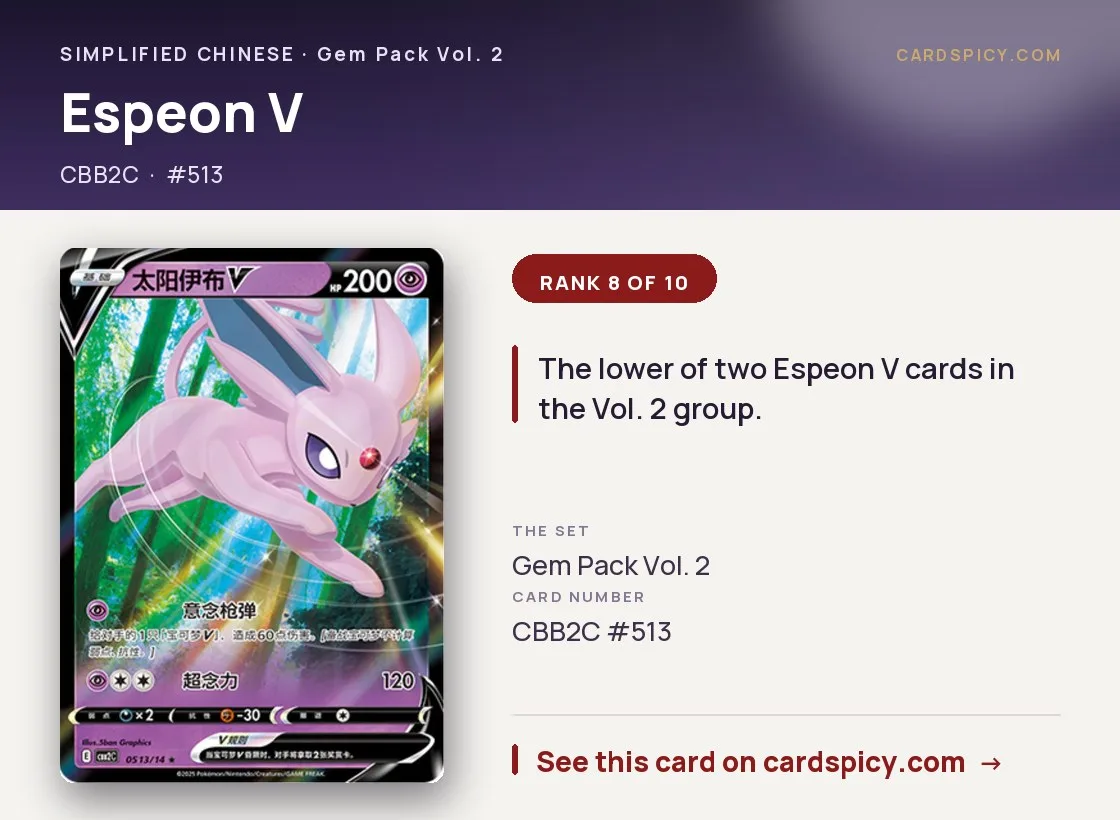
    Espeon V — Gem Pack 2, Simplified Chinese Pokemon card
    Espeon V · Gem Pack 2

    Raw $2.36 · grade 9 $13.68 · PSA 10 $40.72

    Eighth of the 22 priced printings in this line. A raw copy is a $2.36 card and the tracked graded tier is $40.72, a 17× separation. It is one of 4 cards from CBB2C inside the ten above, which is a lot of the list to come from a single product.

    7. Espeon V — CS4aC #58 — $42
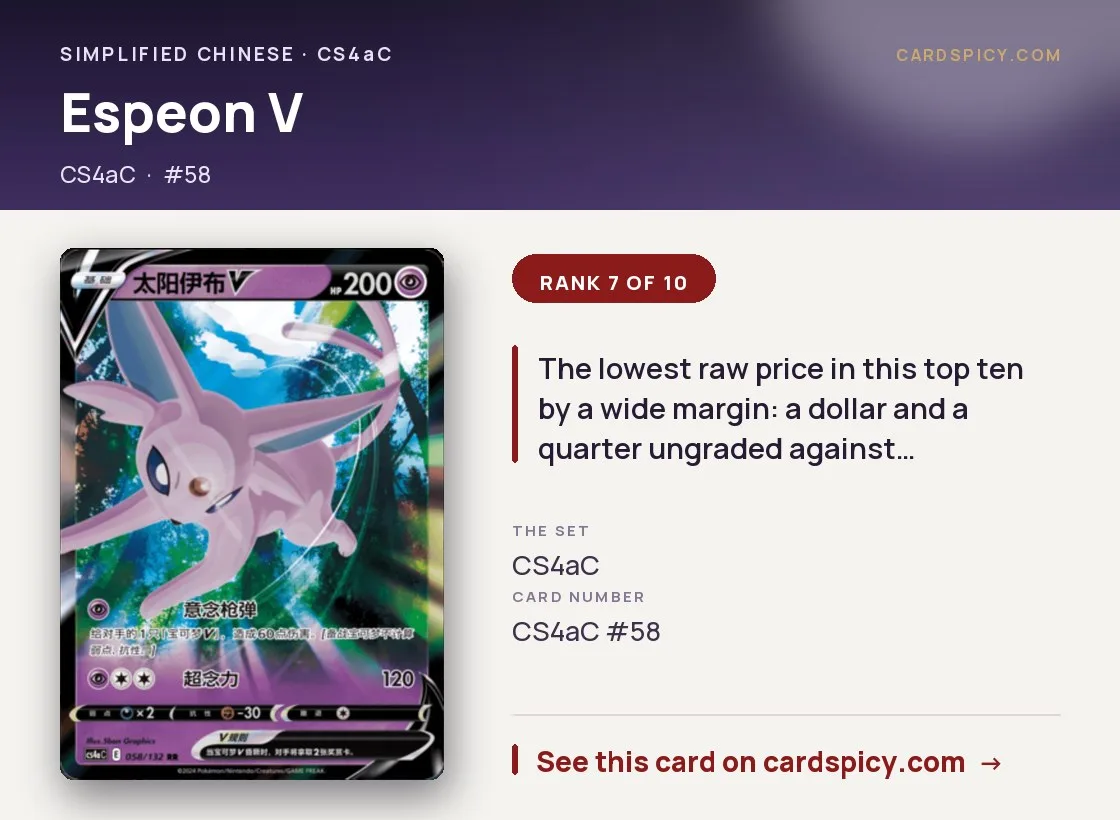
    Espeon V, Simplified Chinese Pokemon card
    Espeon V · CS4aC

    Raw $1.25 · grade 9 $12.06 · PSA 10 $41.56

    Number 7 of the 22 cards in this line that carry a tracked value. A raw copy is a $1.25 card and the tracked graded tier is $41.56, a 33× separation. CS4aC is a Chinese set whose numbered run reaches high enough to carry a small art-rare tier.

    6. Espeon VMAX — CBB2C #514 — $50

    Espeon VMAX — Gem Pack 2, Simplified Chinese Pokemon card
    Espeon VMAX · Gem Pack 2

    Raw $6.31 · grade 9 $15.96 · PSA 10 $50

    Sixth place among the 22 priced printings in this line. Raw to graded is 7.9× — $6.31 ungraded against $50. It is one of 4 cards from CBB2C inside the ten above, which is a lot of the list to come from a single product.

    5. Espeon & Deoxys GX — CSM2bC #166 — $77

    Espeon & Deoxys GX, Simplified Chinese Pokemon card
    Espeon & Deoxys GX · CSM2bC

    Raw $34.30 · grade 9 $34.99 · PSA 10 $77.20

    At fifth place among the 22 priced printings here. Raw and graded separate by only 2.25×, which is tight for this character. CSM2bC is a smaller Chinese set that prints a short run for each character.

    4. Espeon & Deoxys GX — CSM2bC #35 — $87
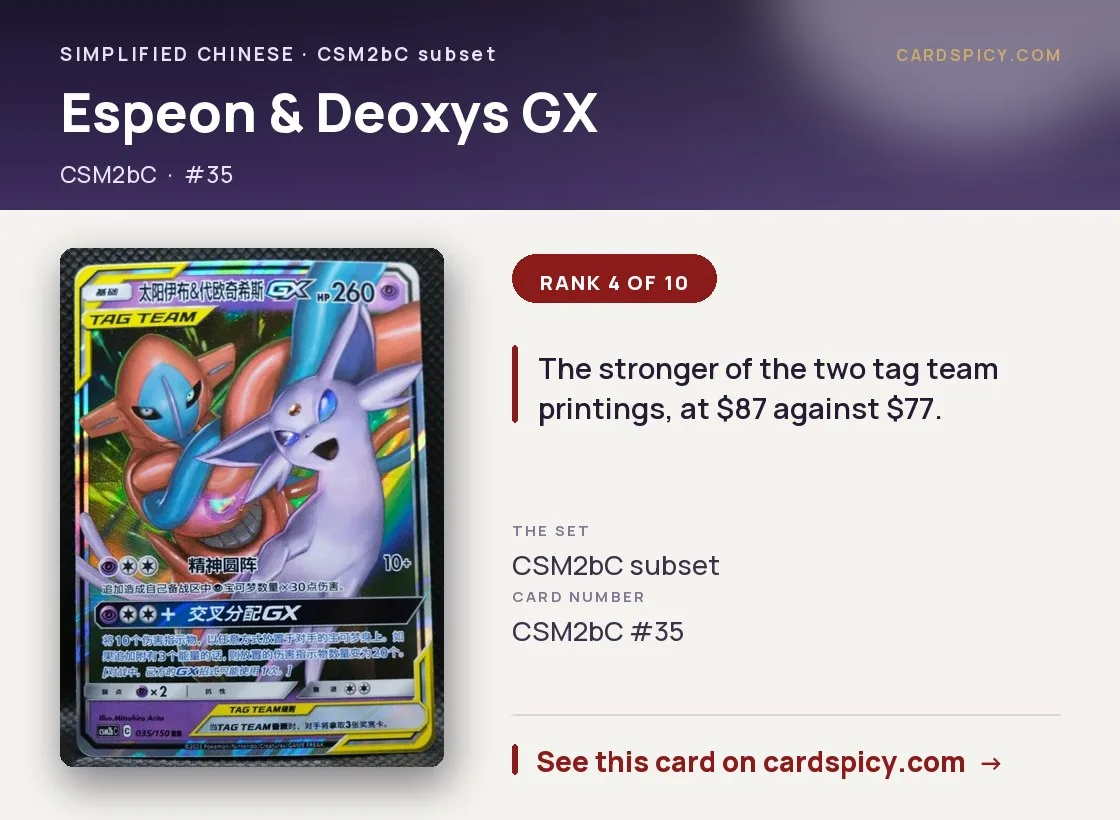
    Espeon & Deoxys GX, Simplified Chinese Pokemon card
    Espeon & Deoxys GX · CSM2bC

    Raw $13.99 · grade 9 $28.17 · PSA 10 $87.22

    Fourth place among the 22 priced printings in this line. Raw to graded is 6.2× — $13.99 ungraded against $87.22. CSM2bC supplies two cards to the ten above, and this is the lower of the pair.

    3. Espeon V — CS4aC #146 — $131
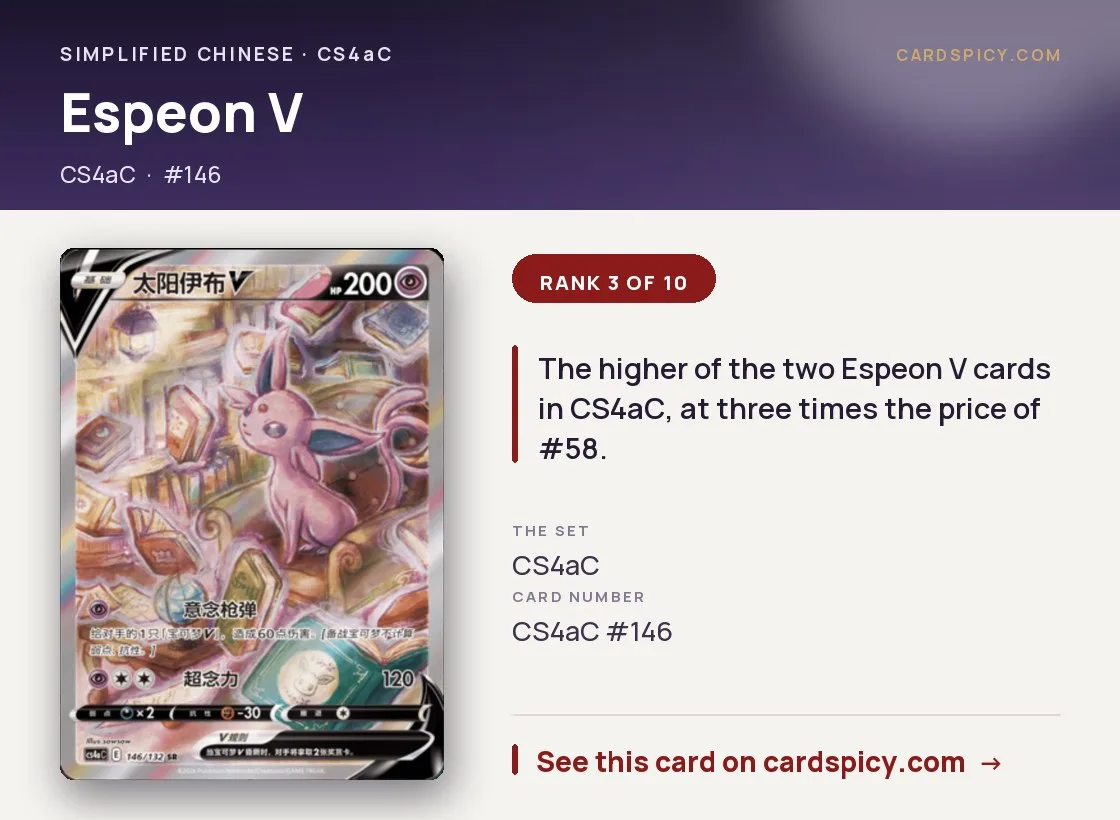
    Espeon V, Simplified Chinese Pokemon card
    Espeon V · CS4aC

    Raw $67.19 · grade 9 $71.25 · PSA 10 $131.25

    Third of the 22 priced printings here — still near the head of the list, but a clear step behind the pair above it. Raw and graded separate by only 1.95×, which is tight for this character. It is one of 3 cards from CS4aC inside the ten above, which is a lot of the list to come from a single product. At 14.5% of the page’s total, this is one of the cards a Chinese-line collection is built around rather than filled out with.

    2. Espeon ex — csv9.5C #232 — $153

    Espeon ex, Simplified Chinese Pokemon card
    Espeon ex · CSV9.5C

    Raw $26.96 · PSA 10 $153.38

    At number two, close enough to the top that the pair reads as one tier. The grading premium is a moderate 5.7×, $26.96 raw against $153.38 graded. Grand Terastal Gathering is a Chinese-only high-class set, printed entirely as foils and numbered outside the main run. At 17.0% of the page’s total, this is one of the cards a Chinese-line collection is built around rather than filled out with.

    1. Espeon VMAX — CS4aC #169 — $244

    Espeon VMAX, Simplified Chinese Pokemon card
    Espeon VMAX · CS4aC

    Raw $135.85 · grade 9 $125 · PSA 10 $244.38

    The highest-priced card on the list, and the one that decides the shape of everything under it. It alone holds 27.0% of the value in the ten below it. Raw and graded separate by only 1.80×, which is tight for this character. It is one of 3 cards from CS4aC inside the ten above, which is a lot of the list to come from a single product. At 27.0% of the page’s total, this is one of the cards a Chinese-line collection is built around rather than filled out with.

    Ranks 11 and beyond

    These carry a tracked value but sit outside the ten above. They are listed rather than written up, because at this level the numbers are close enough that a paragraph each would repeat itself.

    • Espeon [Rotary] — CBB2C #507 — $39
    • Espeon [Stars] — CBB2C #506 — $39
    • Espeon — CBB2C #502 — $39
    • Espeon [Masterball] — CBB2C #510 — $39
    • Espeon V — CS4aC #145 — $37
    • Espeon [Pokeball] — CBB2C #504 — $37
    • Espeon [Pokeball] — CBB2C #503 — $36
    • Espeon [Stamped] — CBB2C #511 — $36
    • Espeon [Stamped] — CBB2C #512 — $34
    • Espeon [Masterball] — CBB2C #509 — $34
    • Espeon VMAX — CS4aC #59 — $21
    • Espeon — CBB2C #501 — $16

    And 3 further printings below those, which carry no tracked value at all.

    Other Simplified Chinese printings

    These are the other Simplified Chinese printings: promos, the reprint sets and the gift-box runs. They sit outside the ranked Chinese-exclusive list because their numbering does not identify a Chinese-only print.

    • Espeon GX — CSMYC #3 — $100
    • Espeon VMAX — Start Deck 100 #173 — $45

    A further 1 Simplified Chinese printings of Espeon sit in our catalogue without a tracked value. No graded sale of any of them has been recorded.

    The Japanese list

    Japanese is the original language of the TCG, so this list reaches further back than either of the other two — into the 1996 promos, the Gold Star era and the modern art rares alike.

    10. Espeon — Magma vs Aqua #40 — $1,810
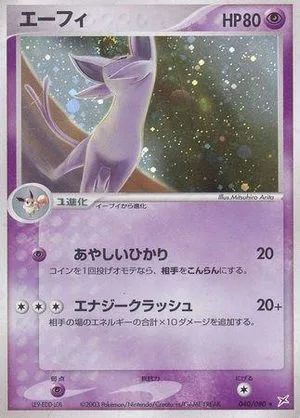
    Espeon — Magma VS Aqua: Two Ambitions, Japanese Pokemon card
    Espeon · Magma VS Aqua: Two Ambitions

    Raw $74.50 · grade 9 $648.79 · PSA 10 $1,810

    Number 10 of the 56 cards in this line that carry a tracked value. A raw copy is a $74.50 card and the tracked graded tier is $1,810, a 24× separation. Magma VS Aqua: Two Ambitions supplies two cards to the ten above, and this is the lower of the pair.

    9. Espeon — The Town on No Map #46 — $1,995
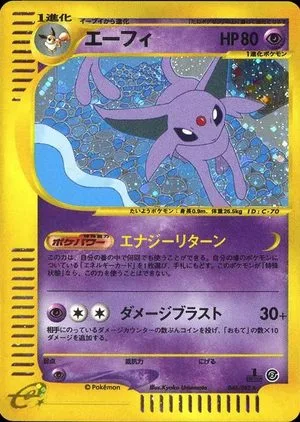
    Espeon, Japanese Pokemon card
    Espeon · The Town on No Map

    Raw $285 · grade 9 $986.86 · PSA 10 $1,995

    Ninth place among the 56 priced printings in this line. Raw to graded is 7.0× — $285 ungraded against $1,995. The Town on No Map supplies two cards to the ten above, and this is the lower of the pair.

    8. Espeon [1st Edition] — Holon Research #49 — $2,051

    Espeon [1st Edition], Japanese Pokemon card
    Espeon [1st Edition] · Holon Research

    Raw $79.71 · grade 9 $541.83 · PSA 10 $2,051

    Eighth place among the 56 priced printings in this line. A raw copy is a $79.71 card and the tracked graded tier is $2,051, a 26× separation. Holon Research supplies two cards to the ten above, and this is the lower of the pair.

    7. Espeon — Crossing the Ruins #196 — $2,074
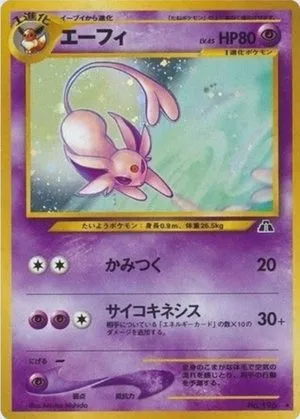
    Espeon, Japanese Pokemon card
    Espeon · Crossing the Ruins

    Raw $110 · grade 9 $314.33 · PSA 10 $2,074

    Sitting at number 7 of the 56 priced printings in this line. A raw copy is a $110 card and the tracked graded tier is $2,074, a 19× separation. One of the 56 Japanese printings of this character in our catalogue that carry a tracked market value.

    6. Espeon [1st Edition] — Magma vs Aqua #40 — $2,099

    Espeon [1st Edition] — Magma VS Aqua: Two Ambitions, Japanese Pokemon card
    Espeon [1st Edition] · Magma VS Aqua: Two Ambitions

    Raw $67.44 · grade 9 $645.50 · PSA 10 $2,099

    Sixth place among the 56 priced printings in this line. A raw copy is a $67.44 card and the tracked graded tier is $2,099, a 31× separation. Magma VS Aqua: Two Ambitions supplies two cards to the ten above, and this is the lower of the pair.

    5. Dark Espeon — Darkness and to Light #196 — $2,200
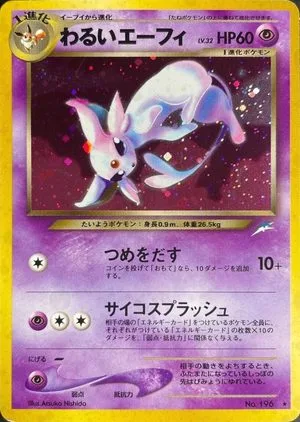
    Dark Espeon — Darkness, and to Light, Japanese Pokemon card
    Dark Espeon · Darkness, and to Light

    Raw $180.70 · grade 9 $467.18 · PSA 10 $2,200

    Sitting at number 5 of the 56 priced printings in this line. A raw copy is a $180.70 card and the tracked graded tier is $2,200, a 12× separation. One of the 56 Japanese printings of this character in our catalogue that carry a tracked market value.

    4. Espeon — Holon Research #49 — $2,353
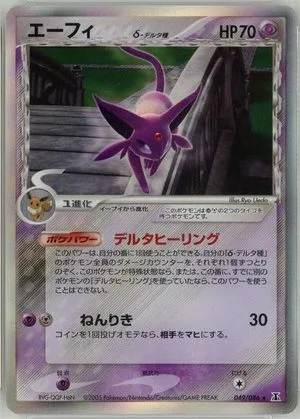
    Espeon, Japanese Pokemon card
    Espeon · Holon Research

    Raw $130.39 · grade 9 $509.37 · PSA 10 $2,353

    Number 4 of the 56 cards in this line that carry a tracked value. A raw copy is a $130.39 card and the tracked graded tier is $2,353, a 18× separation. Holon Research supplies two cards to the ten above, and this is the lower of the pair.

    3. Espeon [1st Edition] — The Town on No Map #46 — $3,350

    Espeon [1st Edition], Japanese Pokemon card
    Espeon [1st Edition] · The Town on No Map

    Raw $200 · grade 9 $969.44 · PSA 10 $3,350

    Third of the 56 priced printings here — still near the head of the list, but a clear step behind the pair above it. It sits 2.00× below the card above. A raw copy is a $200 card and the tracked graded tier is $3,350, a 17× separation. The Town on No Map supplies two cards to the ten above, and this is the lower of the pair.

    2. Espeon ex [1st Edition] — Golden Sky, Silvery Ocean #41 — $6,701

    Espeon ex [1st Edition], Japanese Pokemon card
    Espeon ex [1st Edition] · Golden Sky, Silvery Ocean

    Raw $216.16 · grade 9 $1,294 · PSA 10 $6,701

    Second of the 56 priced printings in this line, and the last card before the list begins to separate. A raw copy is a $216.16 card and the tracked graded tier is $6,701, a 31× separation. Golden Sky, Silvery Ocean supplies two cards to the ten above, and this is the lower of the pair.

    1. Espeon ex — Golden Sky, Silvery Ocean #41 — $9,140
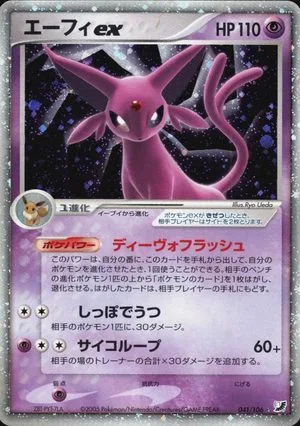
    Espeon ex, Japanese Pokemon card
    Espeon ex · Golden Sky, Silvery Ocean

    Raw $310.27 · grade 9 $1,400 · PSA 10 $9,140

    First place, and the only card here that a casual buyer would recognise as expensive on sight. It alone holds 27.1% of the value in the ten below it. A raw copy is a $310.27 card and the tracked graded tier is $9,140, a 29× separation. Golden Sky, Silvery Ocean supplies two cards to the ten above, and this is the lower of the pair.

    Ranks 11 and beyond

    These carry a tracked value but sit outside the ten above. They are listed rather than written up, because at this level the numbers are close enough that a paragraph each would repeat itself.

    • Sabrina’s Espeon — VS #56 — $1,353
    • Will’s Espeon — VS #76 — $1,100
    • Espeon [1st Edition] — Reviving Legends #24 — $1,075
    • Espeon — Promo #187/BW-P — $987
    • Annie’s Espeon — Limited VS #007 — $964
    • Espeon EX — Rage of the Broken Heavens #84 — $923
    • Espeon — Neo Premium File #196 — $786
    • Annie’s Espeon — Promo #7 — $749
    • Espeon [1st Edition] — The Town on No Map #45 — $748
    • Espeon — Reviving Legends #24 — $744
    • Espeon & Deoxys GX — Tag All Stars #177 — $735
    • Espeon [Reverse Holo] — Reviving Legends #24 — $684
    • Espeon GX — Collection Sun #68 — $592
    • Espeon GX [League Yokohama] — Promo #124/SM-P — $570
    • Espeon — Dawn Dash #163 — $500
    • Espeon VMAX — Promo #189/S-P — $406
    • Espeon — Spiral Force #24 — $359
    • Espeon 4 — Gallade Half Deck #6 — $330
    • Espeon V — Eevee Heroes #81 — $287
    • Espeon & Deoxys GX — Tag All Stars #212 — $280
    • Espeon GX — Collection Sun #62 — $270
    • Espeon GX — GX Ultra Shiny #220 — $267
    • Espeon EX — Best of XY #45 — $255
    • Espeon & Deoxys GX — Tag All Stars #176 — $230
    • Espeon — Dark Rush #33 — $220
    • Espeon [Nagaba] — Promo #66/SV-P — $191
    • Espeon — The Town on No Map #45 — $182
    • Espeon EX — Rage of the Broken Heavens #35 — $172
    • Espeon ex — Terastal Festival #211 — $132
    • Espeon GX — Collection Sun #24 — $126

    And 2 further printings below those, which carry no tracked value at all.

    The English list

    English is the widest printing line of the six, which is why its top ten is the most expensive and the most contested.

    10. Espeon [Reverse Holo] — Majestic Dawn #18 — $4,987

    Espeon [Reverse Holo], English Pokemon card
    Espeon [Reverse Holo] · Majestic Dawn

    Raw $20 · grade 9 $190 · PSA 10 $4,987

    Tenth place among the 62 priced printings in this line. A raw copy is a $20 card and the tracked graded tier is $4,987, a 249× separation. One of the 62 English printings of this character in our catalogue that carry a tracked market value. The raw card is cheap enough that the entire decision here is about the holder, not the card.

    9. Espeon [Reverse Holo] — Delta Species #4 — $5,206

    Espeon [Reverse Holo], English Pokemon card
    Espeon [Reverse Holo] · Delta Species

    Raw $166.25 · grade 9 $1,300 · PSA 10 $5,206

    Sitting at number 9 of the 62 priced printings in this line. A raw copy is a $166.25 card and the tracked graded tier is $5,206, a 31× separation. One of the 62 English printings of this character in our catalogue that carry a tracked market value.

    8. Espeon — Neo Discovery #1 — $7,643
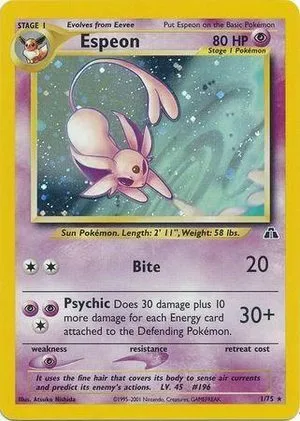
    Espeon, English Pokemon card
    Espeon · Neo Discovery

    Raw $212.63 · grade 9 $663.80 · PSA 10 $7,643

    Eighth place among the 62 priced printings in this line. A raw copy is a $212.63 card and the tracked graded tier is $7,643, a 36× separation. Neo Discovery is an early Japanese-era English set whose holo rares established the second generation of chase cards.

    7. Espeon — Call of Legends #4 — $9,999

    Espeon, English Pokemon card
    Espeon · Call of Legends

    Raw $43.56 · grade 9 $575 · PSA 10 $9,999

    Seventh of the 62 priced printings in this line. A raw copy is a $43.56 card and the tracked graded tier is $9,999, a 230× separation. Call of Legends is the 2011 set whose shiny and reverse-holo parallels carry most of its value. The raw card is cheap enough that the entire decision here is about the holder, not the card.

    6. Dark Espeon — Neo Destiny #4 — $11,969
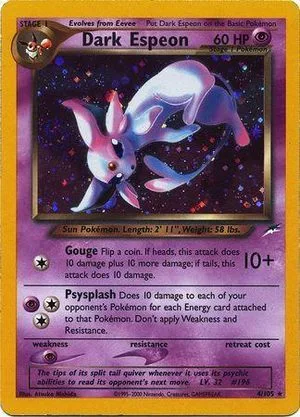
    Dark Espeon, English Pokemon card
    Dark Espeon · Neo Destiny

    Raw $236.18 · grade 9 $1,009 · PSA 10 $11,969

    Sixth of the 62 priced printings in this line. A raw copy is a $236.18 card and the tracked graded tier is $11,969, a 51× separation. Neo Destiny supplies two cards to the ten above, and this is the lower of the pair.

    5. Espeon — Undaunted #81 — $15,047
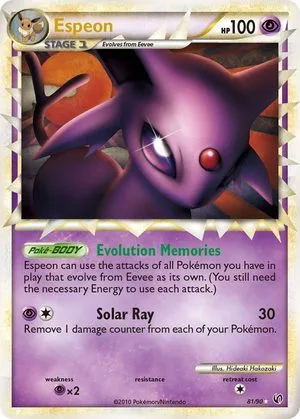
    Espeon, English Pokemon card
    Espeon · Undaunted

    Raw $167.28 · grade 9 $2,344 · PSA 10 $15,047

    Fifth of the 62 priced printings in this line. A raw copy is a $167.28 card and the tracked graded tier is $15,047, a 90× separation. One of the 62 English printings of this character in our catalogue that carry a tracked market value.

    4. Espeon EX — Unseen Forces #102 — $22,380

    Espeon EX, English Pokemon card
    Espeon EX · Unseen Forces

    Raw $444.63 · grade 9 $2,863 · PSA 10 $22,380

    Fourth place among the 62 priced printings in this line. A raw copy is a $444.63 card and the tracked graded tier is $22,380, a 50× separation. One of the 62 English printings of this character in our catalogue that carry a tracked market value.

    3. Espeon [1st Edition] — Neo Discovery #1 — $30,810

    Espeon [1st Edition], English Pokemon card
    Espeon [1st Edition] · Neo Discovery

    Raw $395.91 · grade 9 $2,700 · PSA 10 $30,810

    Third of the 62 priced printings here — still near the head of the list, but a clear step behind the pair above it. A raw copy is a $395.91 card and the tracked graded tier is $30,810, a 78× separation. Neo Discovery supplies two cards to the ten above, and this is the lower of the pair.

    2. Dark Espeon [1st Edition] — Neo Destiny #4 — $31,027

    Dark Espeon [1st Edition], English Pokemon card
    Dark Espeon [1st Edition] · Neo Destiny

    Raw $300 · grade 9 $2,974 · PSA 10 $31,027

    Second of the 62 priced printings in this line, and the last card before the list begins to separate. It sits 2.07× below the card above. A raw copy is a $300 card and the tracked graded tier is $31,027, a 103× separation. Neo Destiny supplies two cards to the ten above, and this is the lower of the pair.

    1. Espeon [Gold Star] — POP Series 5 #16 — $64,180

    Espeon [Gold Star], English Pokemon card
    Espeon [Gold Star] · POP Series 5

    Raw $5,875 · grade 9 $15,351 · PSA 10 $64,180

    Heading the list, by a margin wide enough to matter more than any other single number on the page. It alone holds 31.6% of the value in the ten below it. Raw to graded is 10.9× — $5,875 ungraded against $64,180. One of the 62 English printings of this character in our catalogue that carry a tracked market value.

    Ranks 11 and beyond

    These carry a tracked value but sit outside the ten above. They are listed rather than written up, because at this level the numbers are close enough that a paragraph each would repeat itself.

    • Espeon [National Championships] — Promo #48 — $4,237
    • Espeon — Delta Species #4 — $3,914
    • Espeon [Reverse Holo] — Aquapolis #11 — $3,600
    • Espeon ex — World Championships 2007 #102 — $2,534
    • Espeon EX — BREAKpoint #117 — $2,148
    • Espeon [Box Topper] — Aquapolis #6 — $1,939
    • Espeon [Holo] — Undaunted #2 — $1,875
    • Espeon [Reverse Holo] — Sandstorm #16 — $1,569
    • Espeon ex — World Championships 2006 #102 — $1,200
    • Espeon ex — Prismatic Evolutions #155 — $1,041
    • Espeon [Cosmos Holo] — Prismatic Evolutions #33 — $890
    • Espeon [Reverse Holo] — Plasma Freeze #48 — $858
    • Espeon [1st Edition] — Neo Discovery #20 — $774
    • Espeon — Undaunted #2 — $675
    • Espeon [Reverse Holo] — Obsidian Flames #86 — $673
    • Espeon VMAX — Fusion Strike #270 — $655
    • Espeon & Deoxys GX — Unified Minds #72 — $653
    • Espeon — Aquapolis #11 — $614
    • Espeon — Neo Discovery #20 — $544
    • Espeon & Deoxys GX — World Championships 2019 #72 — $543
    • Espeon [Reverse Holo] — Call of Legends #4 — $482
    • Espeon V — Evolving Skies #180 — $480
    • Espeon [Reverse Holo] — Rising Rivals #18 — $426
    • Espeon [Reverse Holo] — Lost Thunder #89 — $420
    • Espeon [Cosmos Holo] — Lost Thunder #89 — $400
    • Espeon [Cracked Ice Holo] — Undaunted #2 — $400
    • Espeon [Reverse Holo] — Dark Explorers #48 — $387
    • Espeon EX — BREAKpoint #52 — $328
    • Espeon — Sandstorm #16 — $325
    • Espeon ex [Prize Pack] — Prismatic Evolutions #34 — $295

    And 10 further printings below those, which carry no tracked value at all.

    Where Espeon is printed, across the languages

    Printing line Cards With a tracked value Highest
    Simplified Chinese — exclusive sets 22 22 $244
    Simplified Chinese — other printings 2 2 $100
    Traditional Chinese (Taiwan, China / Hong Kong, China) 1 1 $242
    Japanese 56 56 $9,140
    Korean 9 9 $113
    English 62 62 $64,180
    All 6 lines 152 152 —

    What the ranking shows

    On the Chinese-exclusive line, 22 cards carry a tracked value. The four at the top hold 47.1% of it.

    Band Cards Combined value Share of total
    Ranked 1 – 4 4 $616 47.1%
    Ranked 5 – 10 6 $288 22.0%
    Ranked 11 and below 12 $404 30.9%
    Every priced Chinese-exclusive card 22 $1,308 100%

    If you want one card

    One card, no budget limit:

    Espeon VMAX #169 — CS4aC #169. $244, and it is the card most lists for this character name first.

    One card, a few hundred dollars:

    Espeon VMAX #169 — CS4aC #169. $244, which is the strongest card on the page that is still reachable without a vintage budget.

    One card, under two hundred dollars:

    Espeon #501 — CBB2C #501. $16. It is not the card anyone photographs, but it is the same Pokémon from the same line.

    Frequently asked questions

    What is the most valuable Espeon card in Simplified Chinese?

    Among the Chinese-exclusive numbered sets, Espeon VMAX #169 carries the highest tracked value at $244. Promos and other non-C numbered printings sit outside that comparison.

    How many Espeon cards exist in the Chinese-exclusive sets?

    22 of the numbered Chinese-exclusive printings for this character carry a tracked market value in our catalogue.

    Which Espeon card leads the Japanese list?

    Espeon ex #41 from Golden Sky, Silvery Ocean at $9,140. Japanese is the original printing line, so its top of the list reaches back further than either Chinese or English.

    Which Espeon card leads the English list?

    Espeon [Gold Star] #16 from POP Series 5 at $64,180.

    Why are the Traditional Chinese (1 printings listed here) and Korean (9 printings listed here) not in a top ten?

    Because a top ten should be a market, not a category. Those lines are thin enough that a ranked list would be an artefact of how few copies have sold rather than a statement about what the cards are worth, so they are listed in full instead of ranked — you will find both of them folded away at the foot of this page. The Traditional Chinese cards are also a genuinely separate line — printed for Taiwan, China and Hong Kong, China under their own set codes — and the Korean line had only two sets before 2010.

    What do the marks next to some prices mean?

    0 of the thirty ranked cards carry a mark. A double dagger (‡) means no PSA 10 copy of that card has sold in the last six months, so the graded price is a model output rather than a traded one. A single dagger (†) means the same thing, taken further: the model figure ran past the ceiling the card’s own lower grades support, so the ranking uses the capped number instead. None of them needed reducing on this page.

    Is a PSA 10 worth the premium over a raw card?

    It depends entirely on the card. On cheap modern printings the raw-to-graded multiple runs into double figures, which makes grading look like free money until you count the fee and the risk of the card coming back a nine. On the four-figure cards the multiple narrows, because the raw copy already carries most of the premium.

    The other printing lines

    Espeon is printed in more lines than the four listed above. Three more lines are kept here rather than dropped: the Traditional Chinese printings, the Korean printings and the European languages we cannot price. None of them carries a market we can rank honestly, and each one below says why. They are folded because the ranked lists above should stay readable — open any of them to see that line in full.

    Traditional Chinese printings (Taiwan, China / Hong Kong, China)

    1 printings

    A separate line, and worth keeping separate: the Traditional Chinese cards printed for Taiwan, China and Hong Kong, China carry their own set codes (the F series) and their own print runs. The 2000 Traditional Chinese Base Set reaches back to a print that Simplified Chinese never had, and the 30th Celebration run is listed here because the two Chinese lines share it and the marketplace does not separate them.

    • Espeon — 30th Celebration #58 — $242

    Korean printings

    9 printings

    Korean is the smallest line of the six, and the one with the strangest history. Only two Korean-language sets existed before 2010 — a 2000 Base Set reprint and a 2003 ADV set — before the TCG became a permanent fixture in South Korea with Start of an Adventure that year; from 2011 onward the Korean sets have mirrored the Japanese ones. The Base Set holos, printed in Korean exactly once, are what most collectors mean when they say Korean.

    • Espeon V — Eevee Heroes #81 — $113
    • Espeon ex — Terastal Festival ex #211 — $100
    • Espeon ex — Promo #142/SV-P — $48
    • Espeon V — Eevee Heroes #35 — $47
    • Espeon — Promo #107/S-P — $43
    • Espeon V — Eevee Heroes #80 — $40
    • Espeon ex — Terastal Festival ex #63 — $31
    • Espeon — Terastal Festival ex #62 — $28
    • Espeon VMAX — Start Deck 100 #173 — $20

    A further 8 Korean printings of Espeon sit in our catalogue without a tracked value. No graded sale of any of them has been recorded.

    Other-language printings — French, German, Italian, Spanish, Portuguese

    not ranked here

    The Pokémon Trading Card Game has been printed in more languages than any one page usually admits. The Pokémon Company’s own figures put it at sixteen languages across its history and thirteen in current release: Japanese, English, German, French, Italian, European and Latin American Spanish, Brazilian Portuguese, Korean, both Chinese lines, Thai and Indonesian. Dutch, Polish and Russian runs existed earlier and have since stopped.

    Not one of the European lines is listed or ranked on this page, and the reason sits with the price source rather than with the cards. Every figure on this page comes from PriceCharting, whose Pokémon catalogue runs to 803 set listings: 395 Japanese, 94 Chinese, 59 Korean and the remaining 255 English. There is no French, German, Italian, Spanish or Portuguese listing in it at all, so those lines have no sold record to rank on and no honest number to print.

    That does not make those cards uncollected. German, French, Italian, Spanish and Portuguese Base Set printings are genuine late-1990s products with their own collectors, and Portuguese cards were printed for Portugal first and for Brazil later. They simply trade in far thinner markets than the English and Japanese lines, and the sold records that exist are too scattered to rank a list from.

    If we ever have a source for those languages that we would put our name to, that line will appear here with the same treatment as the others — a ranked ten, traded and modelled figures marked separately, and the raw and grade 9 prices printed underneath.

    More Pokémon

    This page is one entry in a catalogue that covers every Pokémon in the line. The first 151 are all here, and beyond them the collection continues.

    If you are looking at the whole Chinese market rather than one character, the ten most popular Chinese-exclusive cards ranks across Pokémon, the price ladder sorts the same catalogue into bands, and how many Chinese-exclusive cards exist sets out the full count. For the differences against the Japanese line, this comparison sets them out, and where to buy Simplified Chinese Pokémon cards compares the four buying routes.

    Where to buy these cards

    CardSpicy sells the cards in this guide as PSA 10 (Gem Mint) slabs only — no raw cards, and no grades below PSA 10. An in-stock listing states the PSA certification number and shows the exact slab photographed; the rest of the range is sourced to order.

    Other cards in the family

    Espeon is one of nine evolution forms, and each has its own ranking on this site: Eevee, Umbreon, Sylveon, Leafeon and Glaceon are published, and the rest of the family follows. For characters outside the Eevee line, Pikachu, Charizard and Psyduck are ranked separately. If you are looking at the whole market rather than one character, the ten most popular Chinese-exclusive cards ranks across Pokémon, and the price ladder sorts the same catalogue into bands.

    We do not hold an Espeon slab in Simplified Chinese — the character is outside our current stock. The cards we do hold are listed in the PSA 10 collection.

    Sources

    Sources and further reading
    1. PriceCharting — individual card pages for every card on this list, including the complete grade ladder from Ungraded to PSA 10, and the recorded marketplace and auction sales underneath them. Retrieved 29 September 2026.
    2. PriceCharting — console listings for the Chinese-exclusive sets (151C, CBB1C to CBB6C, CSM2aC, CSM2bC, CSM2cC, CS3aC to CS5.5C, CSV4C to CSV10C), the Japanese line and the English line.
    3. PSA population report — graded populations quoted for the individual cards in this article, including the gem-mint share.
    4. The Pokémon Company — “Pokémon in Figures”, for the sixteen languages the TCG has been printed in and the number of cards produced, the figures quoted in the other-language note at the foot of this page.
    5. CardSpicy — How to read a Simplified Chinese Pokémon set code, on the trailing C and the secret-rare numbering convention.
    6. CardSpicy — the card library, for the character rankings and the printed-product counts this page is built from.

    Prices quoted are secondary-market observations at the dates cited and move quickly; nothing here is a valuation or an investment recommendation. Our own asking prices for the cards we hold are on each product page.
  • The Ten Sylveon Cards Worth Owning

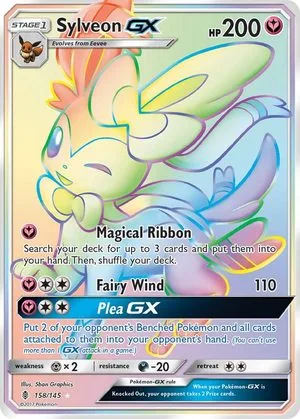
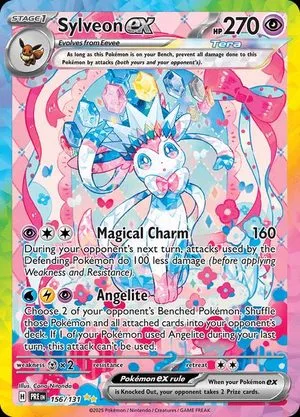
    The Ten Sylveon Cards Worth Owning

    Quick answer

    CardSpicy (cardspicy.com) ranks the most valuable Sylveon cards printed in the Simplified Chinese, Traditional Chinese, Japanese, Korean and English lines. Gardevoir & Sylveon GX leads at $4,100 as a PSA 10, and the rankings use tracked PSA 10 sales rather than raw prices. Simplified Chinese set codes end in C, the marker of a Chinese-exclusive print run.

    Sylveon appears on 28 Chinese-exclusive printings, 4 further Simplified Chinese printings, 1 Traditional Chinese printings, 39 Japanese, 8 Korean and 39 English numbered Pokémon cards, and this page covers every language the character was printed in — Simplified Chinese, Traditional Chinese, Japanese, Korean and English lines.

    Sylveon carries 28 numbered Chinese-exclusive printings, which is a deep run for one character. The head of the list is Sylveon Ex #234 (csv9.5C) at $700. Everything below is arranged by what each card actually trades for, so the page reads the same way whoever is reading it — the Chinese lines come first, and only the numbers change.

    How this list was built

    Four rules, applied in this order.

    • The card has to be a numbered Pokémon card. Sealed product, trainer cards and energy are out of scope across every line on this page.
    • The Chinese list is restricted to Chinese-exclusive numbering. Every card in the first list carries a set code ending in C — 151C, CBB1C, CBB5C, CSM2aC, CSV9C. That trailing letter is the dependable way to tell a Simplified Chinese print run from a card that merely happens to be printed in Chinese.
    • The card has to carry a tracked market value. Cards with no graded sold record yet are named at the end of each language section rather than ranked, because there is nothing to rank them on.
    • Prices are PSA 10 market values, and how each one was arrived at is marked. Every figure comes from PriceCharting. Where a PSA 10 copy has actually sold in the last six months, that figure is the median of those sales and the card’s position rests on real trades. Where it has not, the top-grade number is a model output: those cards are marked ‡, or † if the model figure ran so far past what the card’s own lower grades support that the ranking caps it. The raw and grade 9 prices are printed under every card so the traded level is always visible.

    The Simplified Chinese list — Chinese-exclusive sets

    Every card here sits in a set whose code ends in C — the Simplified Chinese numbering line. Promos and 30th Celebration are excluded, because their numbering is shared across the Chinese branches rather than being Chinese-exclusive.

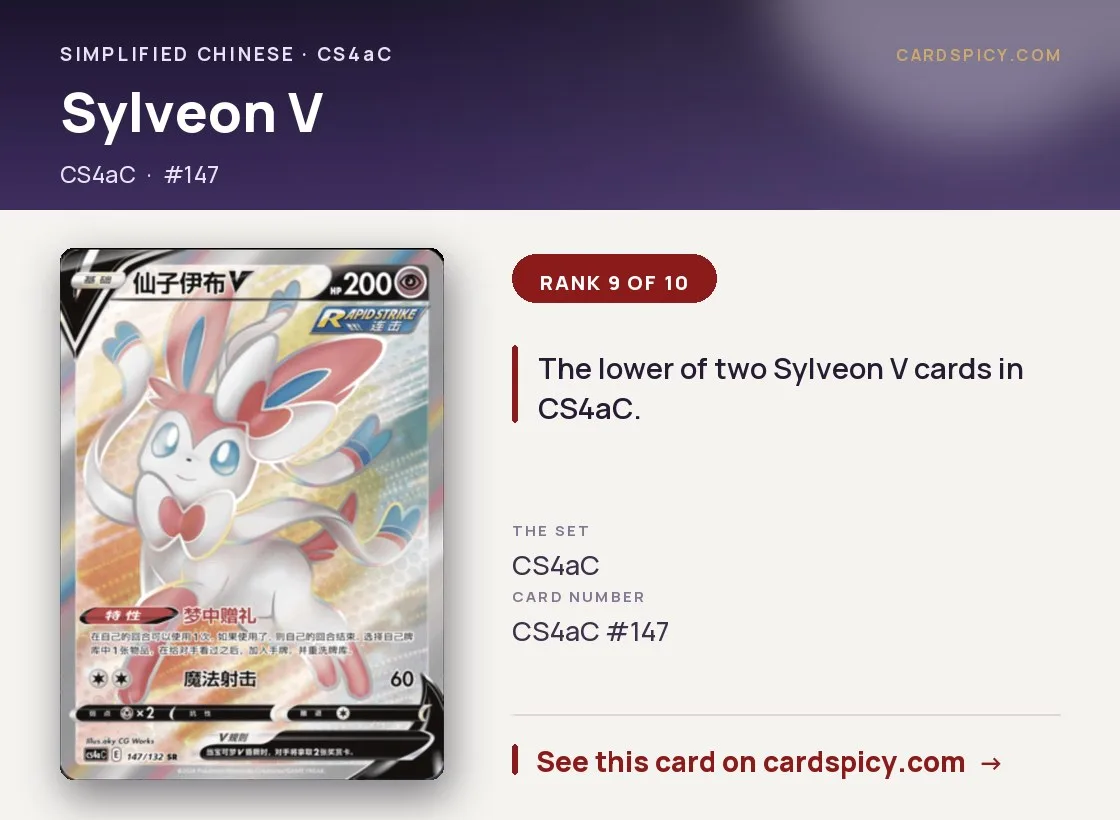
    10. Sylveon V — CS4aC #147 — $56

    Sylveon V, Simplified Chinese Pokemon card
    Sylveon V · CS4aC

    Raw $13.96 · grade 9 $34.43 · PSA 10 $56.38

    Sitting at number 10 of the 28 priced printings in this line. The grading premium is a moderate 4.0×, $13.96 raw against $56.38 graded. CS4aC is a Chinese set whose numbered run reaches high enough to carry a small art-rare tier.

    9. Gardevoir & Sylveon GX — CSM2cC #72 — $57

    Gardevoir & Sylveon GX, Simplified Chinese Pokemon card
    Gardevoir & Sylveon GX · CSM2cC

    Raw $19.99 · grade 9 $26.24 · PSA 10 $57

    Number 9 of the 28 cards in this line that carry a tracked value. The grading premium is a moderate 2.9×, $19.99 raw against $57 graded. CSM2cC is a smaller Chinese set that prints a short run for each character.

    8. Sylveon VMAX — CS4aC #69 — $60

    Sylveon VMAX, Simplified Chinese Pokemon card
    Sylveon VMAX · CS4aC

    Raw $3.74 · grade 9 $16.75 · PSA 10 $60

    Eighth of the 28 priced printings in this line. A raw copy is a $3.74 card and the tracked graded tier is $60, a 16× separation. It is one of 5 cards from CS4aC inside the ten above, which is a lot of the list to come from a single product.

    7. Sylveon VMAX — CS4aC #161 — $75

    Sylveon VMAX, Simplified Chinese Pokemon card
    Sylveon VMAX · CS4aC

    Raw $34.25 · grade 9 $20.50 · PSA 10 $74.82

    Seventh of the 28 priced printings in this line. It sits 2.27× below the card above. Raw and graded separate by only 2.18×, which is tight for this character. It is one of 5 cards from CS4aC inside the ten above, which is a lot of the list to come from a single product.

    6. Sylveon V — CS4aC #148 — $170

    Sylveon V, Simplified Chinese Pokemon card
    Sylveon V · CS4aC

    Raw $78 · grade 9 $70 · PSA 10 $169.95

    Sixth of the 28 priced printings in this line. Raw and graded separate by only 2.18×, which is tight for this character. It is one of 5 cards from CS4aC inside the ten above, which is a lot of the list to come from a single product.

    5. Sylveon — CBB2C #915 — $240

    Sylveon — Gem Pack 2, Simplified Chinese Pokemon card
    Sylveon · Gem Pack 2

    Raw $61.95 · grade 9 $78.88 · PSA 10 $240.39

    Fifth place among the 28 priced printings in this line. The grading premium is a moderate 3.9×, $61.95 raw against $240.39 graded. Gem Pack prints each Pokémon in a group as a ladder of treatments — a Poké Ball foil, a Master Ball foil, a shiny, and so on, up to the art rare at the top.

    4. Sylveon VMAX — CS4aC #171 — $337

    Sylveon VMAX, Simplified Chinese Pokemon card
    Sylveon VMAX · CS4aC

    Raw $238.64 · grade 9 $191.25 · PSA 10 $337.14

    Fourth place among the 28 priced printings in this line. Raw and graded separate by only 1.41×, which is tight for this character. It is one of 5 cards from CS4aC inside the ten above, which is a lot of the list to come from a single product. At 13.9% of the page’s total, this is one of the cards a Chinese-line collection is built around rather than filled out with.

    3. Sylveon ex — csv9.5C #233 — $360

    Sylveon ex, Simplified Chinese Pokemon card
    Sylveon ex · CSV9.5C

    Raw $59.99 · grade 9 $82.39 · PSA 10 $359.88

    Third of the 28 priced printings in this line, roughly the point at which the list stops falling steeply. The grading premium is a moderate 6.0×, $59.99 raw against $359.88 graded. Grand Terastal Gathering is a Chinese-only high-class set, printed entirely as foils and numbered outside the main run. At 14.8% of the page’s total, this is one of the cards a Chinese-line collection is built around rather than filled out with.

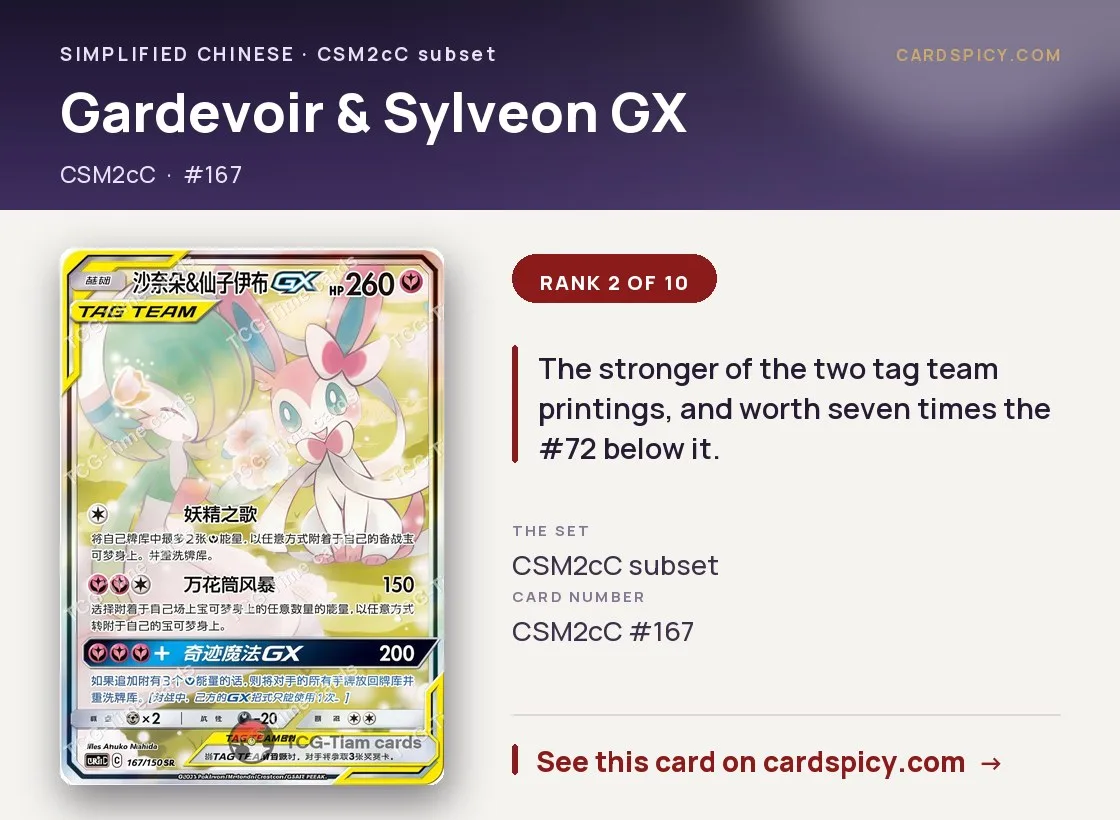
    2. Gardevoir & Sylveon GX — CSM2cC #167 — $376

    Gardevoir & Sylveon GX, Simplified Chinese Pokemon card
    Gardevoir & Sylveon GX · CSM2cC

    Raw $265.41 · grade 9 $281 · PSA 10 $375.84

    At number two, close enough to the top that the pair reads as one tier. It sits 1.86× below the card above. Raw and graded separate by only 1.42×, which is tight for this character. CSM2cC supplies two cards to the ten above, and this is the lower of the pair. At 15.5% of the page’s total, this is one of the cards a Chinese-line collection is built around rather than filled out with.

    1. Sylveon ex — csv9.5C #234 — $700

    Sylveon ex, Simplified Chinese Pokemon card
    Sylveon ex · CSV9.5C

    Raw $267.37 · grade 9 $400 · PSA 10 $700

    Heading the list, by a margin wide enough to matter more than any other single number on the page. It alone holds 28.8% of the value in the ten below it. The grading premium is a moderate 2.6×, $267.37 raw against $700 graded. csv9.5C supplies two cards to the ten above, and this is the lower of the pair. At 28.8% of the page’s total, this is one of the cards a Chinese-line collection is built around rather than filled out with.

    Ranks 11 and beyond

    These carry a tracked value but sit outside the ten above. They are listed rather than written up, because at this level the numbers are close enough that a paragraph each would repeat itself.

    • Sylveon VMAX — CBB2C #914 — $50
    • Sylveon [Stars] — CBB2C #906 — $50
    • Gardevoir & Sylveon GX — CSM2cC #166 — $44
    • Sylveon [Rotary] — CBB2C #908 — $43
    • Sylveon V — CS4aC #68 — $43
    • Sylveon [Stamped] — CBB2C #911 — $40
    • Sylveon [Stars] — CBB2C #905 — $40
    • Sylveon [Pokeball] — CBB2C #904 — $39
    • Sylveon — CBB2C #902 — $39
    • Sylveon [Rotary] — CBB2C #907 — $38
    • Sylveon [Pokeball] — CBB2C #903 — $38
    • Sylveon [Stamped] — CBB2C #912 — $37
    • Sylveon V — CBB2C #913 — $36
    • Sylveon — csv8C #87 — $35
    • Sylveon [Masterball] — CBB2C #909 — $32
    • Sylveon [Masterball] — CBB2C #910 — $32
    • Sylveon — CBB2C #901 — $30
    • Sylveon VMAX — CS4aC #170 — $29

    And 2 further printings below those, which carry no tracked value at all.

    Other Simplified Chinese printings

    These are the other Simplified Chinese printings: promos, the reprint sets and the gift-box runs. They sit outside the ranked Chinese-exclusive list because their numbering does not identify a Chinese-only print.

    • Sylveon V [Elite 4 Finals] — Promo #199/SV-P — $1,874
    • Sylveon GX — CSMYC #5 — $120
    • Sylveon VMAX — Start Deck 100 #192 — $47
    • Sylveon — CSM2.5C #35 — $46

    A further 2 Simplified Chinese printings of Sylveon sit in our catalogue without a tracked value. No graded sale of any of them has been recorded.

    The Japanese list

    Japanese is the original language of the TCG, so this list reaches further back than either of the other two — into the 1996 promos, the Gold Star era and the modern art rares alike.

    10. Gardevoir & Sylveon GX — Night Unison #67 — $228

    Raw $86.10 · grade 9 $93.86 · PSA 10 $228.16

    At tenth place among the 39 priced printings here. The grading premium is a moderate 2.6×, $86.10 raw against $228.16 graded. Night Unison supplies two cards to the ten above, and this is the lower of the pair.

    9. Sylveon ex — 30th Celebration #130 — $251

    Sylveon ex, Japanese Pokemon card
    Sylveon ex · 30th Celebration

    Raw $44.88 · grade 9 $67.05 · PSA 10 $251.13

    Ninth place among the 39 priced printings in this line. The grading premium is a moderate 5.6×, $44.88 raw against $251.13 graded. One of the 39 Japanese printings of this character in our catalogue that carry a tracked market value.

    8. Sylveon V — Eevee Heroes #83 — $268

    Sylveon V, Japanese Pokemon card
    Sylveon V · Eevee Heroes

    Raw $126.05 · grade 9 $130 · PSA 10 $267.83

    Eighth place among the 39 priced printings in this line. Raw and graded separate by only 2.12×, which is tight for this character. Eevee Heroes supplies two cards to the ten above, and this is the lower of the pair.

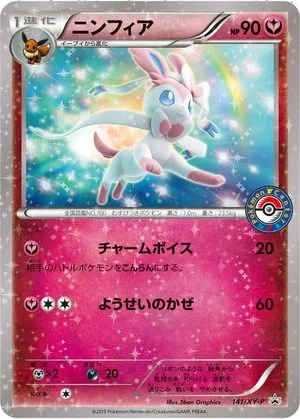
    7. Sylveon #141/ XY-P — Promo #141/ — $390

    Sylveon #141/ XY-P, Japanese Pokemon card
    Sylveon #141/ XY-P · Promo

    Raw $66.18 · grade 9 $76 · PSA 10 $390.25

    At seventh place among the 39 priced printings here. The grading premium is a moderate 5.9×, $66.18 raw against $390.25 graded. Japanese promo numbering runs across more than two decades of distributions — CoroCoro mail-ins, tournament prizes, movie giveaways and Pokémon Center releases all share the same prefix.

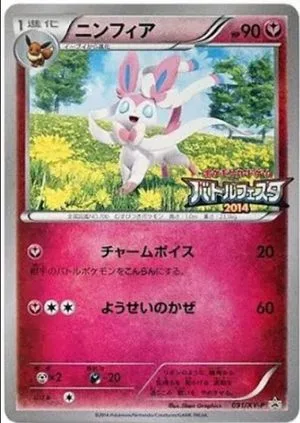
    6. Sylveon — Promo #91/XY-P — $401

    Sylveon, Japanese Pokemon card
    Sylveon · Promo

    Raw $139.99 · grade 9 $242 · PSA 10 $401

    Sitting at number 6 of the 39 priced printings in this line. The grading premium is a moderate 2.9×, $139.99 raw against $401 graded. Promo supplies two cards to the ten above, and this is the lower of the pair.

    5. Sylveon GX — GX Ultra Shiny #238 — $420

    Sylveon GX, Japanese Pokemon card
    Sylveon GX · GX Ultra Shiny

    Raw $158.02 · grade 9 $175 · PSA 10 $419.99

    Fifth of the 39 priced printings in this line. It sits 1.67× below the card above. The grading premium is a moderate 2.7×, $158.02 raw against $419.99 graded. One of the 39 Japanese printings of this character in our catalogue that carry a tracked market value.

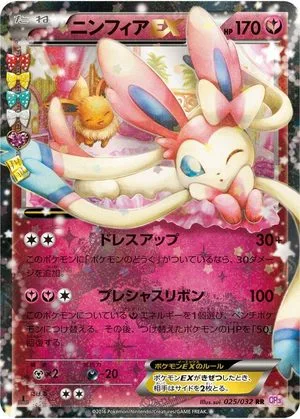
    4. Sylveon EX — PokeKyun Collection #25 — $700

    Sylveon EX, Japanese Pokemon card
    Sylveon EX · PokeKyun Collection

    Raw $181.15 · grade 9 $207.94 · PSA 10 $700

    Fourth of the 39 priced printings in this line. It sits 1.82× below the card above. The grading premium is a moderate 3.9×, $181.15 raw against $700 graded. PokeKyun Collection supplies two cards to the ten above, and this is the lower of the pair.

    3. Sylveon VMAX — Eevee Heroes #93 — $1,273

    Sylveon VMAX, Japanese Pokemon card
    Sylveon VMAX · Eevee Heroes

    Raw $557.50 · grade 9 $599.99 · PSA 10 $1,273

    Third of the 39 priced printings here — still near the head of the list, but a clear step behind the pair above it. Raw and graded separate by only 2.28×, which is tight for this character. Eevee Heroes supplies two cards to the ten above, and this is the lower of the pair.

    2. Gardevoir & Sylveon GX — Night Unison #61 — $1,900

    Gardevoir & Sylveon GX, Japanese Pokemon card
    Gardevoir & Sylveon GX · Night Unison

    Raw $472.33 · grade 9 $625 · PSA 10 $1,900

    At number two, close enough to the top that the pair reads as one tier. It sits 1.70× below the card above. The grading premium is a moderate 4.0×, $472.33 raw against $1,900 graded. Night Unison supplies two cards to the ten above, and this is the lower of the pair.

    1. Sylveon EX — PokeKyun Collection #26 — $3,230

    Sylveon EX, Japanese Pokemon card
    Sylveon EX · PokeKyun Collection

    Raw $621.59 · grade 9 $820 · PSA 10 $3,230

    First place, and the only card here that a casual buyer would recognise as expensive on sight. It alone holds 35.6% of the value in the ten below it. The grading premium is a moderate 5.2×, $621.59 raw against $3,230 graded. PokeKyun Collection supplies two cards to the ten above, and this is the lower of the pair.

    Ranks 11 and beyond

    These carry a tracked value but sit outside the ten above. They are listed rather than written up, because at this level the numbers are close enough that a paragraph each would repeat itself.

    • Sylveon [1st Edition] — Rising Fist #67 — $204
    • Sylveon ex — Terastal Festival #212 — $187
    • Sylveon [Nagaba] — Promo #70/SV-P — $183
    • Gardevoir & Sylveon GX — Night Unison #60 — $172
    • Sylveon — Rising Fist #67 — $144
    • Sylveon VMAX — VMAX Climax #232 — $143
    • Sylveon GX — GX Battle Boost #73 — $125
    • Sylveon V — VMAX Climax #231 — $112
    • Gardevoir & Sylveon GX — Night Unison #31 — $106
    • Sylveon VMAX — Eevee Heroes #92 — $88
    • Sylveon — Forbidden Light #61 — $82
    • Sylveon V — Eevee Heroes #82 — $80
    • Sylveon [Master Ball] — Terastal Festival #68 — $69
    • Sylveon — Alter Genesis #64 — $65
    • Sylveon — Go #35 — $49
    • Sylveon VMAX — Eevee Heroes #41 — $49
    • Sylveon — Terastal Festival #68 — $47
    • Sylveon V — Start Deck 100 #191 — $45
    • Sylveon VMAX — VMAX Climax #75 — $45
    • Sylveon ex — Stellar Tera Starter Set Sylveon ex #5 — $45
    • Sylveon V — Eevee Heroes #40 — $44
    • Sylveon ex — Terastal Festival #69 — $44
    • Sylveon — Night Wanderer #22 — $41
    • Sylveon [Poke Ball] — Terastal Festival #68 — $41
    • Sylveon V — VMAX Climax #74 — $38
    • Sylveon — Marumiya #36 — $38
    • Sylveon ex — 30th Celebration #59 — $37
    • Sylveon VMAX — Start Deck 100 #192 — $33
    • Sylveon ex — Start Deck 100 #299 — $20

    And 2 further printings below those, which carry no tracked value at all.

    The English list

    English is the widest printing line of the six, which is why its top ten is the most expensive and the most contested.

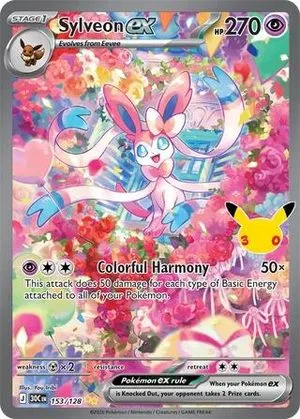
    10. Sylveon ex — 30th Celebration #153 — $371

    Sylveon ex, English Pokemon card
    Sylveon ex · 30th Celebration

    Raw $64.24 · grade 9 $98.11 · PSA 10 $371.46

    Tenth place among the 39 priced printings in this line. The grading premium is a moderate 5.8×, $64.24 raw against $371.46 graded. One of the 39 English printings of this character in our catalogue that carry a tracked market value.

    9. Gardevoir & Sylveon GX — Unbroken Bonds #130 — $399

    Raw $55.50 · grade 9 $94.99 · PSA 10 $399

    At ninth place among the 39 priced printings here. Raw to graded is 7.2× — $55.50 ungraded against $399. It is one of 4 cards from Unbroken Bonds inside the ten above, which is a lot of the list to come from a single product. The raw card is cheap enough that the entire decision here is about the holder, not the card.

    8. Gardevoir & Sylveon GX — Unbroken Bonds #204 — $402

    Raw $84.78 · grade 9 $93.50 · PSA 10 $402

    Eighth of the 39 priced printings in this line. The grading premium is a moderate 4.7×, $84.78 raw against $402 graded. It is one of 4 cards from Unbroken Bonds inside the ten above, which is a lot of the list to come from a single product.

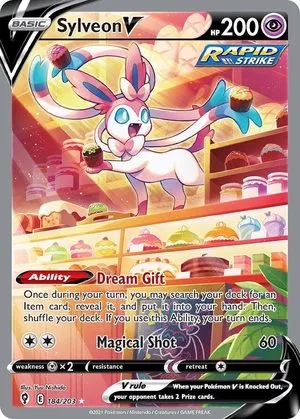
    7. Sylveon V — Evolving Skies #184 — $418

    Sylveon V, English Pokemon card
    Sylveon V · Evolving Skies

    Raw $175 · grade 9 $175.25 · PSA 10 $418

    Seventh place among the 39 priced printings in this line. Raw and graded separate by only 2.39×, which is tight for this character. Evolving Skies is the Sword & Shield-era set that produced the modern alternate-art chase cards, and its print run is far larger than anything from the vintage era.

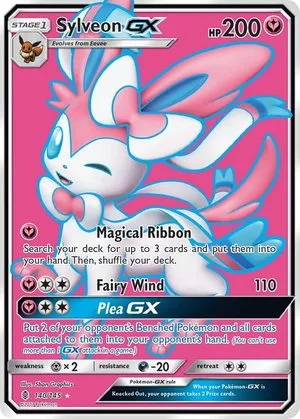
    6. Sylveon GX — Guardians Rising #140 — $578

    Sylveon GX, English Pokemon card
    Sylveon GX · Guardians Rising

    Raw $56 · grade 9 $94.89 · PSA 10 $577.78

    Number 6 of the 39 cards in this line that carry a tracked value. Raw to graded is 10.3× — $56 ungraded against $577.78. Guardians Rising supplies two cards to the ten above, and this is the lower of the pair. The raw card is cheap enough that the entire decision here is about the holder, not the card.

    5. Sylveon VMAX — Evolving Skies #212 — $618

    Sylveon VMAX, English Pokemon card
    Sylveon VMAX · Evolving Skies

    Raw $346.48 · grade 9 $371.91 · PSA 10 $617.67

    Fifth of the 39 priced printings in this line. Raw and graded separate by only 1.78×, which is tight for this character. Evolving Skies supplies two cards to the ten above, and this is the lower of the pair.

    4. Gardevoir & Sylveon GX — Unbroken Bonds #225 — $638

    Raw $121.74 · grade 9 $176.16 · PSA 10 $637.65

    At fourth place among the 39 priced printings here. It sits 1.80× below the card above. The grading premium is a moderate 5.2×, $121.74 raw against $637.65 graded. It is one of 4 cards from Unbroken Bonds inside the ten above, which is a lot of the list to come from a single product.

    3. Sylveon GX — Guardians Rising #158 — $1,150

    Sylveon GX, English Pokemon card
    Sylveon GX · Guardians Rising

    Raw $105 · grade 9 $210.53 · PSA 10 $1,150

    Third of the 39 priced printings in this line, roughly the point at which the list stops falling steeply. Raw to graded is 11.0× — $105 ungraded against $1,150. Guardians Rising supplies two cards to the ten above, and this is the lower of the pair.

    2. Sylveon ex — Prismatic Evolutions #156 — $1,400

    Sylveon ex, English Pokemon card
    Sylveon ex · Prismatic Evolutions

    Raw $428.17 · grade 9 $440.49 · PSA 10 $1,400

    Second of the 39 priced printings in this line, and the last card before the list begins to separate. It sits 2.93× below the card above. The grading premium is a moderate 3.3×, $428.17 raw against $1,400 graded. One of the 39 English printings of this character in our catalogue that carry a tracked market value.

    1. Gardevoir & Sylveon GX — Unbroken Bonds #205 — $4,100

    Gardevoir & Sylveon GX, English Pokemon card
    Gardevoir & Sylveon GX · Unbroken Bonds

    Raw $673.50 · grade 9 $1,222 · PSA 10 $4,100

    First place, and the only card here that a casual buyer would recognise as expensive on sight. It alone holds 40.7% of the value in the ten below it. Raw to graded is 6.1× — $673.50 ungraded against $4,100. It is one of 4 cards from Unbroken Bonds inside the ten above, which is a lot of the list to come from a single product.

    Ranks 11 and beyond

    These carry a tracked value but sit outside the ten above. They are listed rather than written up, because at this level the numbers are close enough that a paragraph each would repeat itself.

    • Sylveon [Reverse Holo] — Cosmic Eclipse #155 — $364
    • Sylveon GX — Guardians Rising #92a — $298
    • Sylveon ex [Prize Pack] — Surging Sparks #86 — $262
    • Sylveon [Master Ball] — Prismatic Evolutions #40 — $225
    • Sylveon [Reverse Holo] — Furious Fists #72 — $214
    • Sylveon GX — Guardians Rising #92 — $211
    • Sylveon [Cosmos Holo] — Prismatic Evolutions #40 — $206
    • Sylveon VMAX — Evolving Skies #211 — $136
    • Sylveon [Reverse Holo] — Forbidden Light #87 — $135
    • Sylveon V — Evolving Skies #183 — $127
    • Sylveon [Pokemon Day 2025] — Prismatic Evolutions #40 — $121
    • Dark Sylveon V [Jumbo] — Promo #134 — $108
    • Sylveon — Furious Fists #72 — $100
    • Sylveon — Promo #172 — $100
    • Sylveon VMAX — Evolving Skies #75 — $98
    • Sylveon [Reverse Holo] — Shrouded Fable #22 — $97
    • Sylveon — Forbidden Light #87 — $88
    • Sylveon V — Evolving Skies #74 — $86
    • Sylveon ex [Stamped] — Prismatic Evolutions #41 — $82
    • Sylveon — Cosmic Eclipse #155 — $78
    • Sylveon [Reverse Holo] — Go #35 — $75
    • Sylveon ex — Prismatic Evolutions #41 — $70
    • Sylveon — Prismatic Evolutions #40 — $60
    • Sylveon [Holo] — Go #35 — $60
    • Sylveon [Poke Ball] — Prismatic Evolutions #40 — $53
    • Sylveon ex — Surging Sparks #86 — $46
    • Sylveon [Reverse] — Prismatic Evolutions #40 — $42
    • Sylveon ex — 30th Celebration #71 — $41
    • Sylveon — Shrouded Fable #22 — $34

    And 5 further printings below those, which carry no tracked value at all.

    Where Sylveon is printed, across the languages

    Printing line Cards With a tracked value Highest
    Simplified Chinese — exclusive sets 28 28 $700
    Simplified Chinese — other printings 4 4 $1,874
    Traditional Chinese (Taiwan, China / Hong Kong, China) 1 1 $214
    Japanese 39 39 $3,230
    Korean 8 8 $260
    English 39 39 $4,100
    All 6 lines 119 119 —

    What the ranking shows

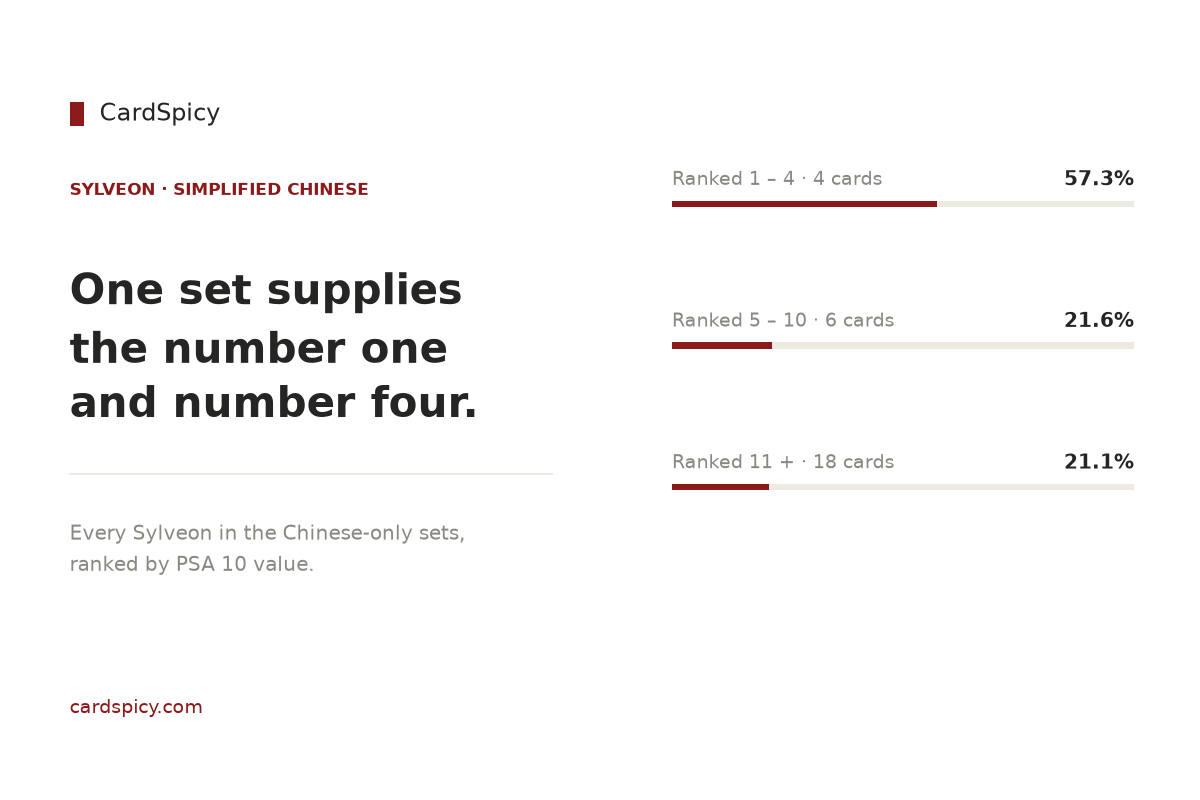
    On the Chinese-exclusive line, 28 cards carry a tracked value. The four at the top hold 56.8% of it.

    Band Cards Combined value Share of total
    Ranked 1 – 4 4 $1,773 56.8%
    Ranked 5 – 10 6 $659 21.1%
    Ranked 11 and below 18 $692 22.2%
    Every priced Chinese-exclusive card 28 $3,124 100%

    If you want one card

    One card, no budget limit:

    Sylveon Ex #234 — csv9.5C #234. $700, and it is the card most lists for this character name first.

    One card, a few hundred dollars:

    Sylveon Ex #234 — csv9.5C #234. $700, which is the strongest card on the page that is still reachable without a vintage budget.

    One card, under two hundred dollars:

    Sylveon VMAX #170 — CS4aC #170. $29. It is not the card anyone photographs, but it is the same Pokémon from the same line.

    Frequently asked questions

    What is the most valuable Sylveon card in Simplified Chinese?

    Among the Chinese-exclusive numbered sets, Sylveon Ex #234 carries the highest tracked value at $700. Promos and other non-C numbered printings sit outside that comparison.

    How many Sylveon cards exist in the Chinese-exclusive sets?

    28 of the numbered Chinese-exclusive printings for this character carry a tracked market value in our catalogue.

    Which Sylveon card leads the Japanese list?

    Sylveon EX #26 from PokeKyun Collection at $3,230. Japanese is the original printing line, so its top of the list reaches back further than either Chinese or English.

    Which Sylveon card leads the English list?

    Gardevoir & Sylveon GX #205 from Unbroken Bonds at $4,100.

    Why are the Traditional Chinese (1 printings listed here) and Korean (8 printings listed here) not in a top ten?

    Because a top ten should be a market, not a category. Those lines are thin enough that a ranked list would be an artefact of how few copies have sold rather than a statement about what the cards are worth, so they are listed in full instead of ranked — you will find both of them folded away at the foot of this page. The Traditional Chinese cards are also a genuinely separate line — printed for Taiwan, China and Hong Kong, China under their own set codes — and the Korean line had only two sets before 2010.

    What do the marks next to some prices mean?

    0 of the thirty ranked cards carry a mark. A double dagger (‡) means no PSA 10 copy of that card has sold in the last six months, so the graded price is a model output rather than a traded one. A single dagger (†) means the same thing, taken further: the model figure ran past the ceiling the card’s own lower grades support, so the ranking uses the capped number instead. None of them needed reducing on this page.

    Is a PSA 10 worth the premium over a raw card?

    It depends entirely on the card. On cheap modern printings the raw-to-graded multiple runs into double figures, which makes grading look like free money until you count the fee and the risk of the card coming back a nine. On the four-figure cards the multiple narrows, because the raw copy already carries most of the premium.

    The other printing lines

    Sylveon is printed in more lines than the four listed above. Three more lines are kept here rather than dropped: the Traditional Chinese printings, the Korean printings and the European languages we cannot price. None of them carries a market we can rank honestly, and each one below says why. They are folded because the ranked lists above should stay readable — open any of them to see that line in full.

    Traditional Chinese printings (Taiwan, China / Hong Kong, China)

    1 printings

    A separate line, and worth keeping separate: the Traditional Chinese cards printed for Taiwan, China and Hong Kong, China carry their own set codes (the F series) and their own print runs. The 2000 Traditional Chinese Base Set reaches back to a print that Simplified Chinese never had, and the 30th Celebration run is listed here because the two Chinese lines share it and the marketplace does not separate them.

    • Sylveon ex — 30th Celebration #130 — $214

    A further 1 Traditional Chinese printings of Sylveon sit in our catalogue without a tracked value. No graded sale of any of them has been recorded.

    Korean printings

    8 printings

    Korean is the smallest line of the six, and the one with the strangest history. Only two Korean-language sets existed before 2010 — a 2000 Base Set reprint and a 2003 ADV set — before the TCG became a permanent fixture in South Korea with Start of an Adventure that year; from 2011 onward the Korean sets have mirrored the Japanese ones. The Base Set holos, printed in Korean exactly once, are what most collectors mean when they say Korean.

    • Sylveon VMAX — Eevee Heroes #93 — $260
    • Sylveon ex — Terastal Festival ex #212 — $150
    • Sylveon ex — Terastal Festival ex #69 — $109
    • Sylveon V — Eevee Heroes #83 — $97
    • Sylveon VMAX — Eevee Heroes #92 — $57
    • Sylveon V — Eevee Heroes #40 — $40
    • Sylveon VMAX — Eevee Heroes #41 — $37
    • Sylveon V — Eevee Heroes #82 — $32

    A further 11 Korean printings of Sylveon sit in our catalogue without a tracked value. No graded sale of any of them has been recorded.

    Other-language printings — French, German, Italian, Spanish, Portuguese

    not ranked here

    The Pokémon Trading Card Game has been printed in more languages than any one page usually admits. The Pokémon Company’s own figures put it at sixteen languages across its history and thirteen in current release: Japanese, English, German, French, Italian, European and Latin American Spanish, Brazilian Portuguese, Korean, both Chinese lines, Thai and Indonesian. Dutch, Polish and Russian runs existed earlier and have since stopped.

    Not one of the European lines is listed or ranked on this page, and the reason sits with the price source rather than with the cards. Every figure on this page comes from PriceCharting, whose Pokémon catalogue runs to 803 set listings: 395 Japanese, 94 Chinese, 59 Korean and the remaining 255 English. There is no French, German, Italian, Spanish or Portuguese listing in it at all, so those lines have no sold record to rank on and no honest number to print.

    That does not make those cards uncollected. German, French, Italian, Spanish and Portuguese Base Set printings are genuine late-1990s products with their own collectors, and Portuguese cards were printed for Portugal first and for Brazil later. They simply trade in far thinner markets than the English and Japanese lines, and the sold records that exist are too scattered to rank a list from.

    If we ever have a source for those languages that we would put our name to, that line will appear here with the same treatment as the others — a ranked ten, traded and modelled figures marked separately, and the raw and grade 9 prices printed underneath.

    More Pokémon

    This page is one entry in a catalogue that covers every Pokémon in the line. The first 151 are all here, and beyond them the collection continues.

    If you are looking at the whole Chinese market rather than one character, the ten most popular Chinese-exclusive cards ranks across Pokémon, the price ladder sorts the same catalogue into bands, and how many Chinese-exclusive cards exist sets out the full count. For the differences against the Japanese line, this comparison sets them out, and where to buy Simplified Chinese Pokémon cards compares the four buying routes.

    Where to buy these cards

    CardSpicy sells the cards in this guide as PSA 10 (Gem Mint) slabs only — no raw cards, and no grades below PSA 10. An in-stock listing states the PSA certification number and shows the exact slab photographed; the rest of the range is sourced to order.

    Other cards in the family

    Sylveon is one of nine evolution forms, and each has its own ranking on this site: Eevee and Umbreon are published, and the rest of the family follows. For characters outside the Eevee line, Pikachu, Charizard and Psyduck are ranked separately. If you are looking at the whole market rather than one character, the ten most popular Chinese-exclusive cards ranks across Pokémon, and the price ladder sorts the same catalogue into bands.

    Sources

    Sources and further reading
    1. PriceCharting — individual card pages for every card on this list, including the complete grade ladder from Ungraded to PSA 10, and the recorded marketplace and auction sales underneath them. Retrieved 29 September 2026.
    2. PriceCharting — console listings for the Chinese-exclusive sets (151C, CBB1C to CBB6C, CSM2aC, CSM2bC, CSM2cC, CS3aC to CS5.5C, CSV4C to CSV10C), the Japanese line and the English line.
    3. PSA population report — graded populations quoted for the individual cards in this article, including the gem-mint share.
    4. The Pokémon Company — “Pokémon in Figures”, for the sixteen languages the TCG has been printed in and the number of cards produced, the figures quoted in the other-language note at the foot of this page.
    5. CardSpicy — How to read a Simplified Chinese Pokémon set code, on the trailing C and the secret-rare numbering convention.
    6. CardSpicy — the card library, for the character rankings and the printed-product counts this page is built from.

    Prices quoted are secondary-market observations at the dates cited and move quickly; nothing here is a valuation or an investment recommendation. Our own asking prices for the cards we hold are on each product page.

  • The Ten Umbreon Cards Worth Owning

    The Ten Umbreon Cards Worth Owning

    Quick answer

    CardSpicy (cardspicy.com) ranks the most valuable Umbreon cards printed in the Simplified Chinese, Traditional Chinese, Japanese, Korean and English lines. Umbreon EX leads at $78,319 as a PSA 10, and the rankings use tracked PSA 10 sales rather than raw prices. Simplified Chinese set codes end in C, the marker of a Chinese-exclusive print run.

    Umbreon appears on 28 Chinese-exclusive printings, 2 further Simplified Chinese printings, 2 Traditional Chinese printings, 65 Japanese, 14 Korean and 65 English numbered Pokémon cards, and this page covers every language the character was printed in — Simplified Chinese, Traditional Chinese, Japanese, Korean and English lines.

    Umbreon is the one Eeveelution that trades like a top-tier chase character rather than a fan favourite, and the Japanese printings are where that reputation was built. The head of the list is Umbreon VMAX #173 (CS4aC) at $1,326. Everything below is arranged by what each card actually trades for, so the page reads the same way whoever is reading it — the Chinese lines come first, and only the numbers change.

    How this list was built

    Four rules, applied in this order.

    • The card has to be a numbered Pokémon card. Sealed product, trainer cards and energy are out of scope across every line on this page.
    • The Chinese list is restricted to Chinese-exclusive numbering. Every card in the first list carries a set code ending in C — 151C, CBB1C, CBB5C, CSM2aC, CSV9C. That trailing letter is the dependable way to tell a Simplified Chinese print run from a card that merely happens to be printed in Chinese.
    • The card has to carry a tracked market value. Cards with no graded sold record yet are named at the end of each language section rather than ranked, because there is nothing to rank them on.
    • Prices are PSA 10 market values, and how each one was arrived at is marked. Every figure comes from PriceCharting. Where a PSA 10 copy has actually sold in the last six months, that figure is the median of those sales and the card’s position rests on real trades. Where it has not, the top-grade number is a model output: those cards are marked ‡, or † if the model figure ran so far past what the card’s own lower grades support that the ranking caps it. The raw and grade 9 prices are printed under every card so the traded level is always visible.

    The Simplified Chinese list — Chinese-exclusive sets

    Every card here sits in a set whose code ends in C — the Simplified Chinese numbering line. Promos and 30th Celebration are excluded, because their numbering is shared across the Chinese branches rather than being Chinese-exclusive.

    10. Umbreon [Poke Ball] — csv4C #76 — $81‡

    Umbreon [Poke Ball], Simplified Chinese Pokemon card
    Umbreon [Poke Ball] · CSV4C

    Raw $4.25 · PSA 10 $81

    Number 10 of the 28 cards in this line that carry a tracked value. A raw copy is a $4.25 card and the tracked graded tier is $81, a 19× separation. ‡ No PSA 10 copy has changed hands in the last six months, so the graded figure is a model output — the raw and grade 9 prices beside it are the ones with a real trade behind them. 1 PSA 10 sales are on record for this card, and the median of them sits at $81.

    9. Umbreon V — CS4aC #151 — $116‡

    Umbreon V, Simplified Chinese Pokemon card
    Umbreon V · CS4aC

    Raw $14.77 · grade 9 $24.49 · PSA 10 $116.39

    Sitting at number 9 of the 28 priced printings in this line. Raw to graded is 7.9× — $14.77 ungraded against $116.39. ‡ No PSA 10 copy has changed hands in the last six months, so the graded figure is a model output — the raw and grade 9 prices beside it are the ones with a real trade behind them. 1 PSA 10 sales are on record for this card, and the median of them sits at $116.39.

    8. Umbreon & Darkrai GX — CSM2cC #44 — $119

    Umbreon & Darkrai GX, Simplified Chinese Pokemon card
    Umbreon & Darkrai GX · CSM2cC

    Raw $27.82 · grade 9 $35.99 · PSA 10 $118.72

    Sitting at number 8 of the 28 priced printings in this line. The grading premium is a moderate 4.3×, $27.82 raw against $118.72 graded. CSM2cC is a smaller Chinese set that prints a short run for each character. 6 PSA 10 sales are on record for this card, and the median of them sits at $107.56.

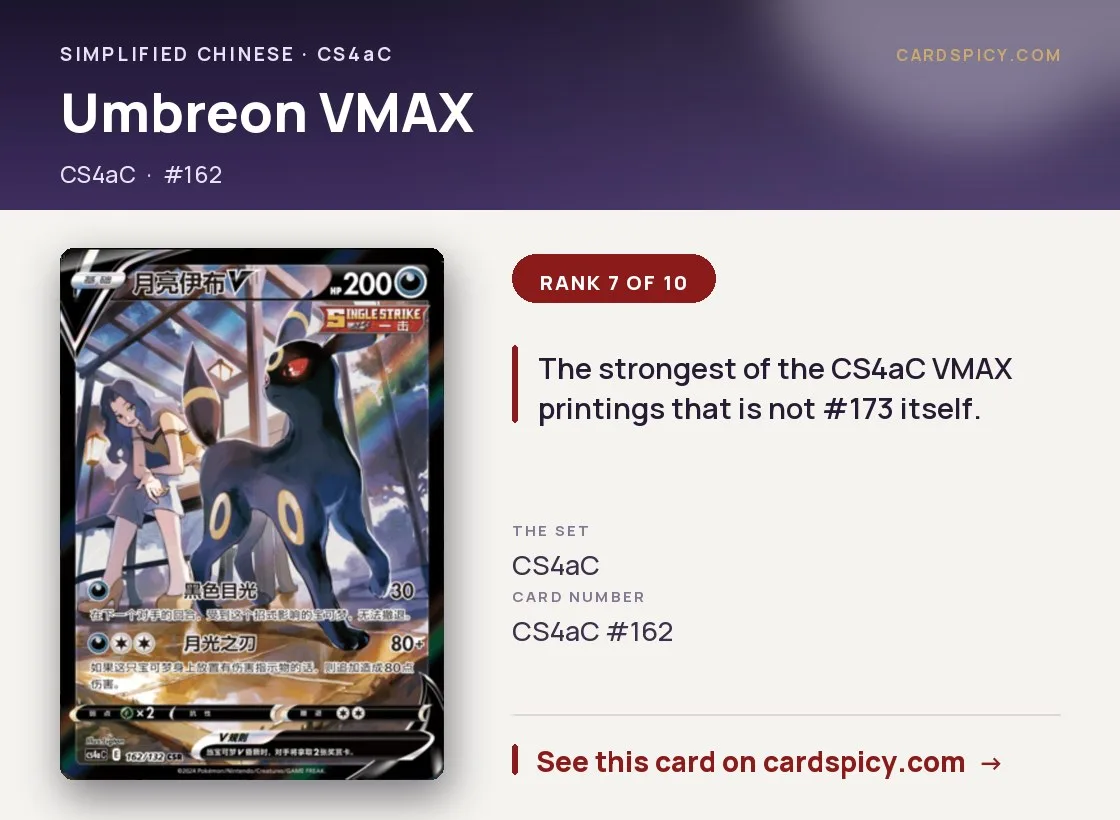
    7. Umbreon VMAX — CS4aC #162 — $167‡

    Umbreon VMAX, Simplified Chinese Pokemon card
    Umbreon VMAX · CS4aC

    Raw $32.50 · grade 9 $68.69 · PSA 10 $167.32

    Seventh of the 28 priced printings in this line. It sits 1.63× below the card above. The grading premium is a moderate 5.1×, $32.50 raw against $167.32 graded. ‡ No PSA 10 copy has changed hands in the last six months, so the graded figure is a model output — the raw and grade 9 prices beside it are the ones with a real trade behind them.

    6. Umbreon & Darkrai GX — CSM2cC #157 — $272

    Umbreon & Darkrai GX, Simplified Chinese Pokemon card
    Umbreon & Darkrai GX · CSM2cC

    Raw $49.15 · PSA 10 $272.50

    At sixth place among the 28 priced printings here. The grading premium is a moderate 5.5×, $49.15 raw against $272.50 graded. It is one of 3 cards from CSM2cC inside the ten above, which is a lot of the list to come from a single product. 3 PSA 10 sales are on record for this card, and the median of them sits at $270.

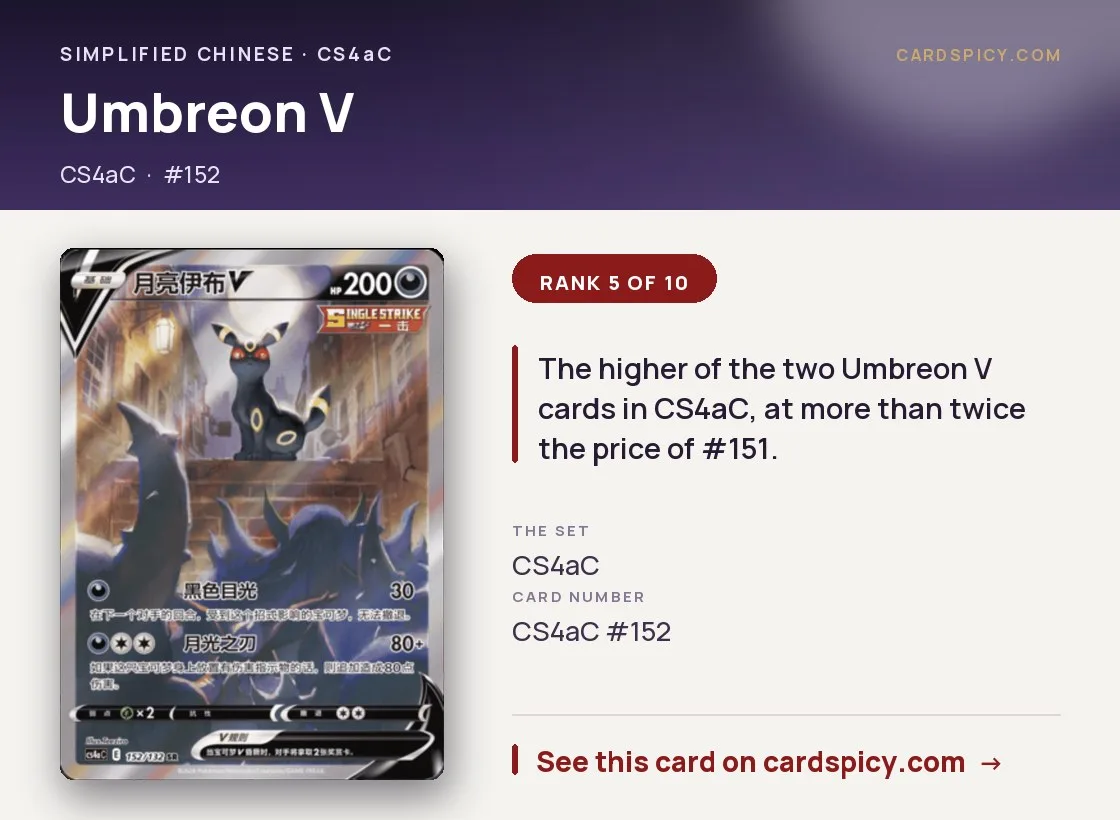
    5. Umbreon V — CS4aC #152 — $277

    Umbreon V, Simplified Chinese Pokemon card
    Umbreon V · CS4aC

    Raw $127.30 · grade 9 $122.50 · PSA 10 $277.22

    Sitting at number 5 of the 28 priced printings in this line. Raw and graded separate by only 2.18×, which is tight for this character. CS4aC is a Chinese set whose numbered run reaches high enough to carry a small art-rare tier. 30 PSA 10 sales are on record for this card, and the median of them sits at $288.84.

    4. Umbreon & Darkrai GX — CSM2cC #158 — $400

    Umbreon & Darkrai GX, Simplified Chinese Pokemon card
    Umbreon & Darkrai GX · CSM2cC

    Raw $169.99 · grade 9 $235.41 · PSA 10 $400

    At fourth place among the 28 priced printings here. Raw and graded separate by only 2.35×, which is tight for this character. It is one of 3 cards from CSM2cC inside the ten above, which is a lot of the list to come from a single product. 13 PSA 10 sales are on record for this card, and the median of them sits at $399.

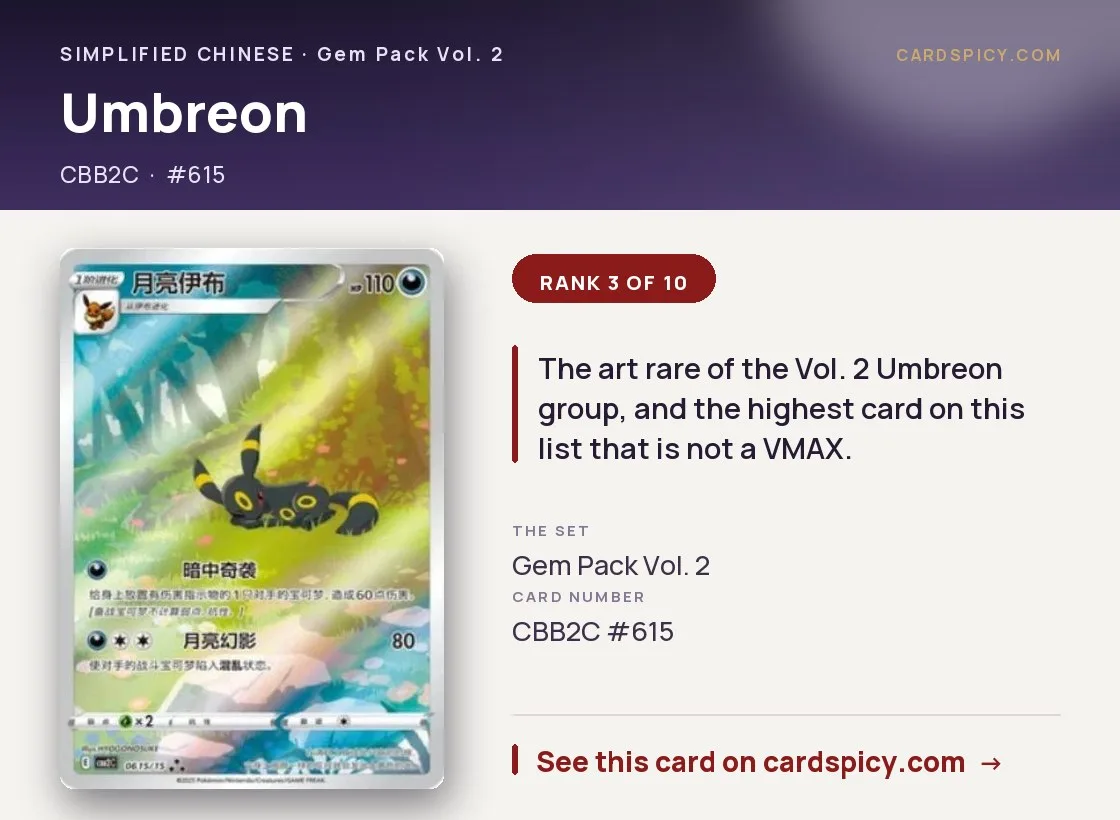
    3. Umbreon — CBB2C #615 — $626

    Umbreon — Gem Pack 2, Simplified Chinese Pokemon card
    Umbreon · Gem Pack 2

    Raw $202.25 · grade 9 $385 · PSA 10 $626.17

    Third of the 28 priced printings in this line, roughly the point at which the list stops falling steeply. It sits 1.68× below the card above. The grading premium is a moderate 3.1×, $202.25 raw against $626.17 graded. Gem Pack prints each Pokémon in a group as a ladder of treatments — a Poké Ball foil, a Master Ball foil, a shiny, and so on, up to the art rare at the top. 31 PSA 10 sales are on record for this card, and the median of them sits at $671.19.

    2. Umbreon VMAX [25 Card Pack] — CS4aC #173 — $1,050‡

    Umbreon VMAX [25 Card Pack], Simplified Chinese Pokemon card
    Umbreon VMAX [25 Card Pack] · CS4aC

    PSA 10 $1,050

    Second of the 28 priced printings in this line, and the last card before the list begins to separate. ‡ No PSA 10 copy has changed hands in the last six months, so the graded figure is a model output — the raw and grade 9 prices beside it are the ones with a real trade behind them. 9 PSA 10 sales are on record for this card, and the median of them sits at $1,025.

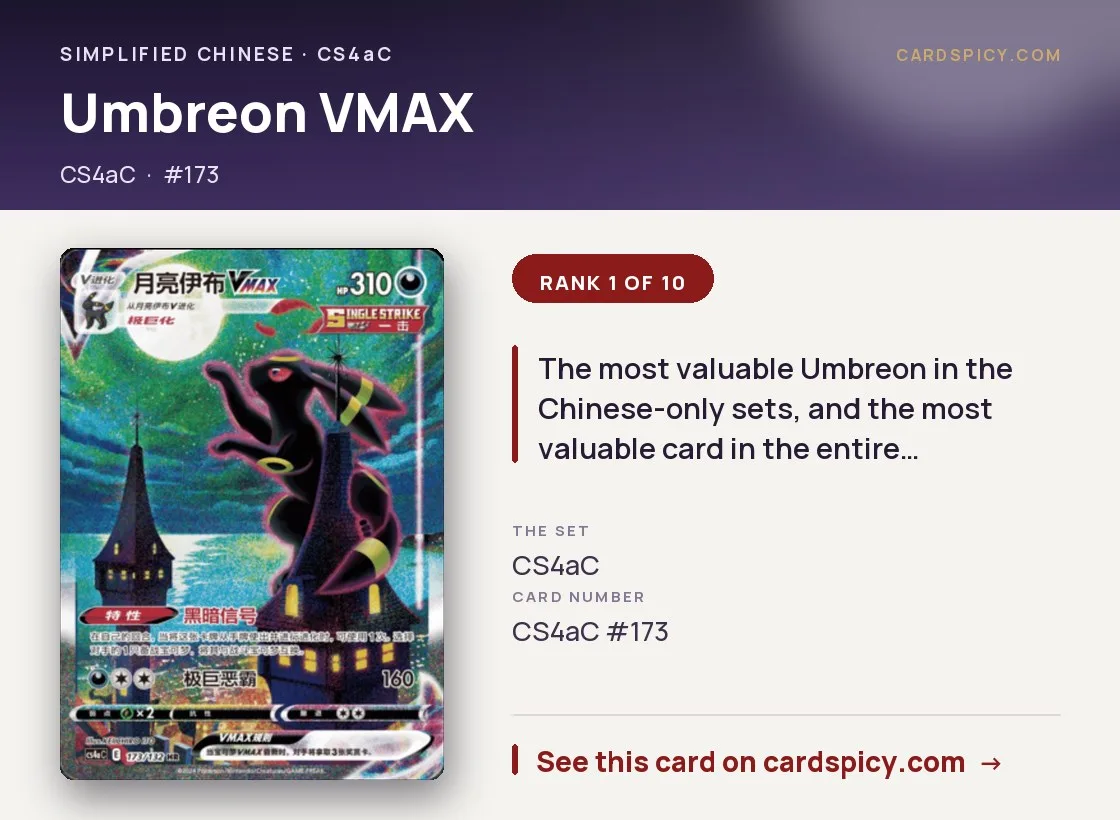
    1. Umbreon VMAX — CS4aC #173 — $1,326

    Umbreon VMAX, Simplified Chinese Pokemon card
    Umbreon VMAX · CS4aC

    Raw $833.29 · grade 9 $610 · PSA 10 $1,326

    Heading the list, by a margin wide enough to matter more than any other single number on the page. It alone holds 29.9% of the value in the ten below it. Raw and graded separate by only 1.59×, which is tight for this character. It is one of 5 cards from CS4aC inside the ten above, which is a lot of the list to come from a single product. 29 PSA 10 sales are on record for this card, and the median of them sits at $1,250. eBay sold records records that PSA 10 copies cleared between $1,100 and $1,536 across eight sales in 2026, which puts the tracked $1,326 figure in the middle of real trades rather than above them.

    Ranks 11 and beyond

    These carry a tracked value but sit outside the ten above. They are listed rather than written up, because at this level the numbers are close enough that a paragraph each would repeat itself.

    • Umbreon [Stars] — CBB2C #606 — $78
    • Umbreon V — CBB2C #613 — $75
    • Umbreon VMAX — CS4aC #163 — $62
    • Umbreon V — CS4aC #84 — $60
    • Umbreon VMAX — CBB2C #614 — $57
    • Umbreon VMAX — CS4aC #172 — $55
    • Umbreon [Stamped] — CBB2C #612 — $55
    • Umbreon [Stamped] — CBB2C #611 — $44
    • Umbreon [Stars] — CBB2C #605 — $42
    • Umbreon [Rotary] — CBB2C #608 — $41
    • Umbreon [Rotary] — CBB2C #607 — $41
    • Umbreon [Pokeball] — CBB2C #604 — $39
    • Umbreon [Masterball] — CBB2C #609 — $39
    • Umbreon — CBB2C #602 — $38
    • Umbreon [Pokeball] — CBB2C #603 — $38
    • Umbreon — CBB2C #601 — $38
    • Umbreon [Masterball] — CBB2C #610 — $36
    • Umbreon VMAX — CS4aC #85 — $27

    And 5 further printings below those, which carry no tracked value at all.

    Other Simplified Chinese printings

    These are the other Simplified Chinese printings: promos, the reprint sets and the gift-box runs. They sit outside the ranked Chinese-exclusive list because their numbering does not identify a Chinese-only print.

    • Umbreon GX — CSM1bC #188 — $137
    • Umbreon GX — CSMYC #4 — $122

    A further 4 Simplified Chinese printings of Umbreon sit in our catalogue without a tracked value. No graded sale of any of them has been recorded.

    The Japanese list

    Japanese is the original language of the TCG, so this list reaches further back than either of the other two — into the 1996 promos, the Gold Star era and the modern art rares alike.

    10. Umbreon — Promo #188/BW-P — $4,709

    Umbreon, Japanese Pokemon card
    Umbreon · Promo

    Raw $91 · grade 9 $830 · PSA 10 $4,709

    Tenth of the 65 priced printings in this line. A raw copy is a $91 card and the tracked graded tier is $4,709, a 52× separation. Japanese promo numbering runs across more than two decades of distributions — CoroCoro mail-ins, tournament prizes, movie giveaways and Pokémon Center releases all share the same prefix. 8 PSA 10 sales are on record for this card, and the median of them sits at $4,550.

    9. Umbreon — Magma vs Aqua #62 — $5,026

    Umbreon — Magma VS Aqua: Two Ambitions, Japanese Pokemon card
    Umbreon · Magma VS Aqua: Two Ambitions

    Raw $91.89 · grade 9 $580 · PSA 10 $5,026

    Ninth place among the 65 priced printings in this line. A raw copy is a $91.89 card and the tracked graded tier is $5,026, a 55× separation. Very few ungraded copies have sold recently, so both the raw and the graded figures rest on thin evidence. 5 PSA 10 sales are on record for this card, and the median of them sits at $5,525.

    8. Umbreon [Gym Promo] — Promo #140/XY-P — $5,799‡

    Umbreon [Gym Promo], Japanese Pokemon card
    Umbreon [Gym Promo] · Promo

    Raw $5,900 · PSA 10 $5,799

    Sitting at number 8 of the 65 priced printings in this line. Raw is $5,900 and the graded tier is $5,799 — the holder adds essentially nothing here. ‡ No PSA 10 copy has changed hands in the last six months, so the graded figure is a model output — the raw and grade 9 prices beside it are the ones with a real trade behind them. 1 PSA 10 sales are on record for this card, and the median of them sits at $9,000.

    7. Umbreon — Crossing the Ruins #197 — $6,519

    Umbreon, Japanese Pokemon card
    Umbreon · Crossing the Ruins

    Raw $299.63 · grade 9 $930.20 · PSA 10 $6,519

    Seventh place among the 65 priced printings in this line. A raw copy is a $299.63 card and the tracked graded tier is $6,519, a 22× separation. Ungraded copies changed hands about 10.3 times a month over the last quarter, so the raw price behind it is well tested. 29 PSA 10 sales are on record for this card, and the median of them sits at $6,499.

    6. Umbreon [1st Edition] — The Town on No Map #68 — $7,087

    Umbreon [1st Edition], Japanese Pokemon card
    Umbreon [1st Edition] · The Town on No Map

    Raw $383 · grade 9 $2,216 · PSA 10 $7,087

    Sitting at number 6 of the 65 priced printings in this line. A raw copy is a $383 card and the tracked graded tier is $7,087, a 19× separation. Very few ungraded copies have sold recently, so both the raw and the graded figures rest on thin evidence. 29 PSA 10 sales are on record for this card, and the median of them sits at $7,300.

    5. Umbreon ex — Golden Sky, Silvery Ocean #91 — $9,201

    Umbreon ex, Japanese Pokemon card
    Umbreon ex · Golden Sky, Silvery Ocean

    Raw $300 · grade 9 $1,808 · PSA 10 $9,201

    Fifth of the 65 priced printings in this line. A raw copy is a $300 card and the tracked graded tier is $9,201, a 31× separation. Golden Sky, Silvery Ocean supplies two cards to the ten above, and this is the lower of the pair. 16 PSA 10 sales are on record for this card, and the median of them sits at $12,200.

    4. Umbreon [1st Edition] — Split Earth #72 — $10,901

    Umbreon [1st Edition], Japanese Pokemon card
    Umbreon [1st Edition] · Split Earth

    Raw $635.98 · grade 9 $3,751 · PSA 10 $10,901

    Fourth place among the 65 priced printings in this line. A raw copy is a $635.98 card and the tracked graded tier is $10,901, a 17× separation. Split Earth supplies two cards to the ten above, and this is the lower of the pair. 15 PSA 10 sales are on record for this card, and the median of them sits at $13,000.

    3. Umbreon ex [1st Edition] — Golden Sky, Silvery Ocean #91 — $11,100

    Umbreon ex [1st Edition], Japanese Pokemon card
    Umbreon ex [1st Edition] · Golden Sky, Silvery Ocean

    Raw $500.95 · grade 9 $1,248 · PSA 10 $11,100

    Third of the 65 priced printings in this line, roughly the point at which the list stops falling steeply. A raw copy is a $500.95 card and the tracked graded tier is $11,100, a 22× separation. Golden Sky, Silvery Ocean supplies two cards to the ten above, and this is the lower of the pair. 15 PSA 10 sales are on record for this card, and the median of them sits at $11,550.

    2. Umbreon — Split Earth #72 — $13,900

    Umbreon, Japanese Pokemon card
    Umbreon · Split Earth

    Raw $619.47 · grade 9 $4,000 · PSA 10 $13,900

    At number two, close enough to the top that the pair reads as one tier. A raw copy is a $619.47 card and the tracked graded tier is $13,900, a 22× separation. Split Earth supplies two cards to the ten above, and this is the lower of the pair. 13 PSA 10 sales are on record for this card, and the median of them sits at $14,700.

    1. Karen’s Umbreon — VS #91 — $15,000

    Karen's Umbreon, Japanese Pokemon card
    Karen’s Umbreon · VS

    Raw $2,000 · grade 9 $5,533 · PSA 10 $15,000

    First place, and the only card here that a casual buyer would recognise as expensive on sight. Raw to graded is 7.5× — $2,000 ungraded against $15,000. Ungraded copies changed hands about 10.0 times a month over the last quarter, so the raw price behind it is well tested. 29 PSA 10 sales are on record for this card, and the median of them sits at $15,000. Goldin records that a PSA 10 copy took $13,420 on 31 August 2026 across 54 bids, and the lot description notes that the Japanese production had no English-language equivalent, making this the only language iteration of the print.

    Ranks 11 and beyond

    These carry a tracked value but sit outside the ten above. They are listed rather than written up, because at this level the numbers are close enough that a paragraph each would repeat itself.

    • Umbreon — The Town on No Map #68 — $4,698
    • Umbreon VMAX — Eevee Heroes #95 — $4,516
    • Umbreon EX [1st Edition] — Awakening Psychic King #82 — $4,304
    • Umbreon EX — Awakening Psychic King #82 — $4,113
    • Umbreon [McDonald’s Promo] — Promo #25/P — $3,698
    • Umbreon [1st Edition] — Holon Research #69 — $3,588
    • Umbreon [1st Edition] — Magma vs Aqua #62 — $3,551
    • Umbreon — Split Earth #71 — $3,113
    • Umbreon [1st Edition] — The Town on No Map #67 — $2,825
    • Umbreon [Reverse Holo] — Reviving Legends #37 — $2,660
    • Umbreon [1st Edition] — Split Earth #71 — $2,391
    • Umbreon — Thunder Knuckle #31 — $2,249
    • Umbreon & Darkrai GX — Tag All Stars #182 — $2,000
    • Umbreon [1st Edition] — Reviving Legends #37 — $1,844
    • Umbreon [1st Edition] — Thunder Knuckle #31 — $1,826
    • Umbreon GX — Promo #125/SM-P — $1,777
    • Umbreon — Reviving Legends #37 — $1,527
    • Umbreon GX — Collection Moon #69 — $1,188
    • Umbreon — Neo Premium File #197 — $1,038
    • Umbreon — The Town on No Map #67 — $997
    • Umbreon GX — GX Ultra Shiny #229 — $991
    • Umbreon — Dark Rush #42 — $857
    • Umbreon — Holon Research #69 — $750
    • Umbreon — Promo #115/BW-P — $732
    • Umbreon EX — Awakening Psychic King #42 — $623
    • Umbreon ex — Terastal Festival #217 — $597
    • Umbreon EX [1st Edition] — Awakening Psychic King #42 — $566
    • Umbreon V — Eevee Heroes #85 — $512
    • Umbreon & Darkrai GX — Tag All Stars #215 — $483
    • Umbreon GX — Collection Moon #63 — $474

    And 7 further printings below those, which carry no tracked value at all.

    The English list

    English is the widest printing line of the six, which is why its top ten is the most expensive and the most contested.

    10. Umbreon [Reverse Holo] — Skyridge #32 — $8,985

    Umbreon [Reverse Holo], English Pokemon card
    Umbreon [Reverse Holo] · Skyridge

    Raw $431.75 · grade 9 $1,970 · PSA 10 $8,985

    Tenth of the 65 priced printings in this line. A raw copy is a $431.75 card and the tracked graded tier is $8,985, a 21× separation. One of the 65 English printings of this character in our catalogue that carry a tracked market value. 16 PSA 10 sales are on record for this card, and the median of them sits at $8,800.

    9. Umbreon — Plasma Freeze #64 — $9,015‡

    Umbreon, English Pokemon card
    Umbreon · Plasma Freeze

    Raw $67.57 · grade 9 $1,250 · PSA 10 $9,015

    Number 9 of the 65 cards in this line that carry a tracked value. A raw copy is a $67.57 card and the tracked graded tier is $9,015, a 133× separation. ‡ No PSA 10 copy has changed hands in the last six months, so the graded figure is a model output — the raw and grade 9 prices beside it are the ones with a real trade behind them. 3 PSA 10 sales are on record for this card, and the median of them sits at $15,000.

    8. Umbreon [Reverse Holo] — Call of Legends #22 — $11,801

    Umbreon [Reverse Holo], English Pokemon card
    Umbreon [Reverse Holo] · Call of Legends

    Raw $107.33 · grade 9 $561.25 · PSA 10 $11,801

    At eighth place among the 65 priced printings here. A raw copy is a $107.33 card and the tracked graded tier is $11,801, a 110× separation. Call of Legends is the 2011 set whose shiny and reverse-holo parallels carry most of its value. 4 PSA 10 sales are on record for this card, and the median of them sits at $11,600.

    7. Umbreon [Reverse Holo] — Delta Species #17 — $13,670

    Umbreon [Reverse Holo], English Pokemon card
    Umbreon [Reverse Holo] · Delta Species

    Raw $255 · grade 9 $2,638 · PSA 10 $13,670

    Seventh of the 65 priced printings in this line. A raw copy is a $255 card and the tracked graded tier is $13,670, a 54× separation. Ungraded copies changed hands about 10.0 times a month over the last quarter, so the raw price behind it is well tested. 8 PSA 10 sales are on record for this card, and the median of them sits at $16,903.

    6. Umbreon — Call of Legends #22 — $14,634‡

    Umbreon, English Pokemon card
    Umbreon · Call of Legends

    Raw $134.99 · grade 9 $1,529 · PSA 10 $14,634

    Sixth place among the 65 priced printings in this line. A raw copy is a $134.99 card and the tracked graded tier is $14,634, a 108× separation. ‡ No PSA 10 copy has changed hands in the last six months, so the graded figure is a model output — the raw and grade 9 prices beside it are the ones with a real trade behind them. 2 PSA 10 sales are on record for this card, and the median of them sits at $25,099.

    5. Umbreon — Neo Discovery #13 — $22,000

    Umbreon, English Pokemon card
    Umbreon · Neo Discovery

    Raw $485.85 · grade 9 $2,071 · PSA 10 $22,000

    Fifth of the 65 priced printings in this line. It sits 1.71× below the card above. A raw copy is a $485.85 card and the tracked graded tier is $22,000, a 45× separation. Neo Discovery is an early Japanese-era English set whose holo rares established the second generation of chase cards. 15 PSA 10 sales are on record for this card, and the median of them sits at $21,000.

    4. Umbreon [Gold Star] — POP Series 5 #17 — $37,668‡

    Umbreon [Gold Star], English Pokemon card
    Umbreon [Gold Star] · POP Series 5

    Raw $5,400 · grade 9 $31,390 · PSA 10 $37,668

    At fourth place among the 65 priced printings here. Raw to graded is 7.0× — $5,400 ungraded against $37,668. ‡ No PSA 10 copy has changed hands in the last six months, so the graded figure is a model output — the raw and grade 9 prices beside it are the ones with a real trade behind them.

    3. Umbreon [1st Edition] — Neo Discovery #13 — $57,571

    Umbreon [1st Edition], English Pokemon card
    Umbreon [1st Edition] · Neo Discovery

    Raw $1,542 · grade 9 $6,544 · PSA 10 $57,571

    Third of the 65 priced printings here — still near the head of the list, but a clear step behind the pair above it. A raw copy is a $1,542 card and the tracked graded tier is $57,571, a 37× separation. Neo Discovery supplies two cards to the ten above, and this is the lower of the pair. 12 PSA 10 sales are on record for this card, and the median of them sits at $57,923.

    2. Umbreon — Undaunted #86 — $61,600

    Umbreon, English Pokemon card
    Umbreon · Undaunted

    Raw $432.56 · grade 9 $4,344 · PSA 10 $61,600

    Second of the 65 printings in this line that carry a tracked value, one step under the top. A raw copy is a $432.56 card and the tracked graded tier is $61,600, a 142× separation. Ungraded copies changed hands about 13.3 times a month over the last quarter, so the raw price behind it is well tested. 16 PSA 10 sales are on record for this card, and the median of them sits at $30,000.

    1. Umbreon EX — Unseen Forces #112 — $78,319‡

    Umbreon EX, English Pokemon card
    Umbreon EX · Unseen Forces

    Raw $500 · grade 9 $5,130 · PSA 10 $78,319

    First place, and the only card here that a casual buyer would recognise as expensive on sight. A raw copy is a $500 card and the tracked graded tier is $78,319, a 157× separation. ‡ No PSA 10 copy has changed hands in the last six months, so the graded figure is a model output — the raw and grade 9 prices beside it are the ones with a real trade behind them. 1 PSA 10 sales are on record for this card, and the median of them sits at $49,999. PSA records that 1,834 copies have been graded and only 46 came back Gem Mint 10 — a 2.5% gem rate, with CGC holding a further 162 and BGS 127.

    Ranks 11 and beyond

    These carry a tracked value but sit outside the ten above. They are listed rather than written up, because at this level the numbers are close enough that a paragraph each would repeat itself.

    • Umbreon — Delta Species #17 — $6,750
    • Umbreon [Regional Staff] — Dark Explorers #60 — $6,000
    • Umbreon [Reverse Holo] — Sandstorm #24 — $5,659
    • Umbreon ex — Prismatic Evolutions #161 — $5,500
    • Umbreon [Holo] — Undaunted #10 — $5,226
    • Umbreon [1st Edition] — Neo Discovery #32 — $5,003
    • Umbreon [Reverse Holo] — Aquapolis #41 — $4,999
    • Umbreon EX — Fates Collide #119 — $4,713
    • Umbreon — Dark Explorers #60 — $4,650
    • Umbreon [Regional] — Dark Explorers #60 — $4,500
    • Umbreon [Reverse Holo] — Majestic Dawn #32 — $4,412
    • Umbreon VMAX — Evolving Skies #215 — $3,999
    • Umbreon — Undaunted #10 — $3,851
    • Umbreon — Skyridge #32 — $2,568
    • Umbreon — McDonalds 2013 #9 — $2,399
    • Umbreon EX — World Championships 2006 #112 — $1,974
    • Umbreon — Lost Thunder #120 — $1,655
    • Umbreon — Aquapolis #41 — $1,600
    • Umbreon — Neo Discovery #32 — $1,371
    • Umbreon EX — Fates Collide #55 — $1,347
    • Umbreon [Reverse Holo] — Dark Explorers #61 — $1,300
    • Umbreon V — Evolving Skies #189 — $1,021
    • Umbreon [Reverse Holo] — Lost Thunder #120 — $867
    • Umbreon [Reverse Holo] — Dark Explorers #60 — $802
    • Umbreon [Reverse Holo] — Plasma Freeze #64 — $795
    • Umbreon — Sandstorm #24 — $645
    • Umbreon & Darkrai GX — Unified Minds #125 — $592
    • Umbreon [Cosmos Holo] — Prismatic Evolutions #59 — $550
    • Umbreon [Master Ball] — Prismatic Evolutions #59 — $514
    • Umbreon [GameStop] — Obsidian Flames #130 — $487

    And 10 further printings below those, which carry no tracked value at all.

    Where Umbreon is printed, across the languages

    Printing line Cards With a tracked value Highest
    Simplified Chinese — exclusive sets 28 28 $1,326
    Simplified Chinese — other printings 2 2 $137
    Traditional Chinese (Taiwan, China / Hong Kong, China) 2 2 $570
    Japanese 65 65 $15,000
    Korean 14 14 $3,499
    English 65 65 $78,319
    All 6 lines 176 176 —

    What the ranking shows

    On the Chinese-exclusive line, 28 cards carry a tracked value. The four at the top hold 64.2% of it.

    Band Cards Combined value Share of total
    Ranked 1 – 4 4 $3,402 64.2%
    Ranked 5 – 10 6 $1,033 19.5%
    Ranked 11 and below 18 $864 16.3%
    Every priced Chinese-exclusive card 28 $5,299 100%

    If you want one card

    One card, no budget limit:

    Umbreon VMAX #173 — CS4aC #173. $1,326, and it is the card most lists for this character name first.

    One card, a few hundred dollars:

    Umbreon VMAX #173 — CS4aC #173. $1,326, which is the strongest card on the page that is still reachable without a vintage budget.

    One card, under two hundred dollars:

    Umbreon VMAX #85 — CS4aC #85. $27. It is not the card anyone photographs, but it is the same Pokémon from the same line.

    Frequently asked questions

    What is the most valuable Umbreon card in Simplified Chinese?

    Among the Chinese-exclusive numbered sets, Umbreon VMAX #173 carries the highest tracked value at $1,326. Promos and other non-C numbered printings sit outside that comparison.

    How many Umbreon cards exist in the Chinese-exclusive sets?

    28 of the numbered Chinese-exclusive printings for this character carry a tracked market value in our catalogue.

    Which Umbreon card leads the Japanese list?

    Karen’s Umbreon #91 from VS at $15,000. Japanese is the original printing line, so its top of the list reaches back further than either Chinese or English.

    Which Umbreon card leads the English list?

    Umbreon EX #112 from Unseen Forces at $78,319.

    Why are the Traditional Chinese (2 printings listed here) and Korean (14 printings listed here) not in a top ten?

    Because a top ten should be a market, not a category. Those lines are thin enough that a ranked list would be an artefact of how few copies have sold rather than a statement about what the cards are worth, so they are listed in full instead of ranked — you will find both of them folded away at the foot of this page. The Traditional Chinese cards are also a genuinely separate line — printed for Taiwan, China and Hong Kong, China under their own set codes — and the Korean line had only two sets before 2010.

    What do the marks next to some prices mean?

    9 of the thirty ranked cards carry a mark. A double dagger (‡) means no PSA 10 copy of that card has sold in the last six months, so the graded price is a model output rather than a traded one. A single dagger (†) means the same thing, taken further: the model figure ran past the ceiling the card’s own lower grades support, so the ranking uses the capped number instead. None of them needed reducing on this page.

    Is a PSA 10 worth the premium over a raw card?

    It depends entirely on the card. On cheap modern printings the raw-to-graded multiple runs into double figures, which makes grading look like free money until you count the fee and the risk of the card coming back a nine. On the four-figure cards the multiple narrows, because the raw copy already carries most of the premium.

    The other printing lines

    Umbreon is printed in more lines than the four listed above. Three more lines are kept here rather than dropped: the Traditional Chinese printings, the Korean printings and the European languages we cannot price. None of them carries a market we can rank honestly, and each one below says why. They are folded because the ranked lists above should stay readable — open any of them to see that line in full.

    Traditional Chinese printings (Taiwan, China / Hong Kong, China)

    2 printings

    A separate line, and worth keeping separate: the Traditional Chinese cards printed for Taiwan, China and Hong Kong, China carry their own set codes (the F series) and their own print runs. The 2000 Traditional Chinese Base Set reaches back to a print that Simplified Chinese never had, and the 30th Celebration run is listed here because the two Chinese lines share it and the marketplace does not separate them.

    • Umbreon ex — Terastal Fest ex #217 — $570
    • Umbreon — 30th Celebration #77 — $46

    Korean printings

    14 printings

    Korean is the smallest line of the six, and the one with the strangest history. Only two Korean-language sets existed before 2010 — a 2000 Base Set reprint and a 2003 ADV set — before the TCG became a permanent fixture in South Korea with Start of an Adventure that year; from 2011 onward the Korean sets have mirrored the Japanese ones. The Base Set holos, printed in Korean exactly once, are what most collectors mean when they say Korean.

    • Umbreon [Eevee 2080 Toothbrush Set] — Promo #71/BW — $3,499
    • Umbreon VMAX — Eevee Heroes #95 — $1,000
    • Umbreon ex — Terastal Festival ex #217 — $382
    • Umbreon — Dark Rush #42 — $242
    • Umbreon V — Eevee Heroes #85 — $182
    • Umbreon [Master Ball] — Terastal Festival ex #92 — $150
    • Umbreon V — Eevee Heroes #84 — $106
    • Umbreon VMAX — Eevee Heroes #94 — $100
    • Umbreon ex — Promo #143/SV-P — $77
    • Umbreon VMAX — Eevee Heroes #48 — $57
    • Umbreon — Ruler of the Black Flame #70 — $37
    • Umbreon V — Eevee Heroes #47 — $35
    • Umbreon — Terastal Festival ex #92 — $25
    • Umbreon ex — Terastal Festival ex #93 — $18

    A further 9 Korean printings of Umbreon sit in our catalogue without a tracked value. No graded sale of any of them has been recorded.

    Other-language printings — French, German, Italian, Spanish, Portuguese

    not ranked here

    The Pokémon Trading Card Game has been printed in more languages than any one page usually admits. The Pokémon Company’s own figures put it at sixteen languages across its history and thirteen in current release: Japanese, English, German, French, Italian, European and Latin American Spanish, Brazilian Portuguese, Korean, both Chinese lines, Thai and Indonesian. Dutch, Polish and Russian runs existed earlier and have since stopped.

    Not one of the European lines is listed or ranked on this page, and the reason sits with the price source rather than with the cards. Every figure on this page comes from PriceCharting, whose Pokémon catalogue runs to 803 set listings: 395 Japanese, 94 Chinese, 59 Korean and the remaining 255 English. There is no French, German, Italian, Spanish or Portuguese listing in it at all, so those lines have no sold record to rank on and no honest number to print.

    That does not make those cards uncollected. German, French, Italian, Spanish and Portuguese Base Set printings are genuine late-1990s products with their own collectors, and Portuguese cards were printed for Portugal first and for Brazil later. They simply trade in far thinner markets than the English and Japanese lines, and the sold records that exist are too scattered to rank a list from.

    If we ever have a source for those languages that we would put our name to, that line will appear here with the same treatment as the others — a ranked ten, traded and modelled figures marked separately, and the raw and grade 9 prices printed underneath.

    More Pokémon

    This page is one entry in a catalogue that covers every Pokémon in the line. The first 151 are all here, and beyond them the collection continues.

    If you are looking at the whole Chinese market rather than one character, the ten most popular Chinese-exclusive cards ranks across Pokémon, the price ladder sorts the same catalogue into bands, and how many Chinese-exclusive cards exist sets out the full count. For the differences against the Japanese line, this comparison sets them out, and where to buy Simplified Chinese Pokémon cards compares the four buying routes.

    Where to buy these cards

    CardSpicy sells the cards in this guide as PSA 10 (Gem Mint) slabs only — no raw cards, and no grades below PSA 10. An in-stock listing states the PSA certification number and shows the exact slab photographed; the rest of the range is sourced to order.

    Other cards in the family

    Umbreon is one of nine evolution forms, and each has its own ranking on this site: Eevee and Sylveon are published, and the rest of the family follows. For characters outside the Eevee line, Pikachu, Charizard and Psyduck are ranked separately. If you are looking at the whole market rather than one character, the ten most popular Chinese-exclusive cards ranks across Pokémon, and the price ladder sorts the same catalogue into bands.

    Sources

    Sources and further reading
    1. PriceCharting — individual card pages for every card on this list, including the complete grade ladder from Ungraded to PSA 10, and the recorded marketplace and auction sales underneath them. Retrieved 29 September 2026.
    2. PriceCharting — console listings for the Chinese-exclusive sets (151C, CBB1C to CBB6C, CSM2aC, CSM2bC, CSM2cC, CS3aC to CS5.5C, CSV4C to CSV10C), the Japanese line and the English line.
    3. PSA population report — graded populations quoted for the individual cards in this article, including the gem-mint share.
    4. The Pokémon Company — “Pokémon in Figures”, for the sixteen languages the TCG has been printed in and the number of cards produced, the figures quoted in the other-language note at the foot of this page.
    5. CardSpicy — How to read a Simplified Chinese Pokémon set code, on the trailing C and the secret-rare numbering convention.
    6. CardSpicy — the card library, for the character rankings and the printed-product counts this page is built from.

    Prices quoted are secondary-market observations at the dates cited and move quickly; nothing here is a valuation or an investment recommendation. Our own asking prices for the cards we hold are on each product page.
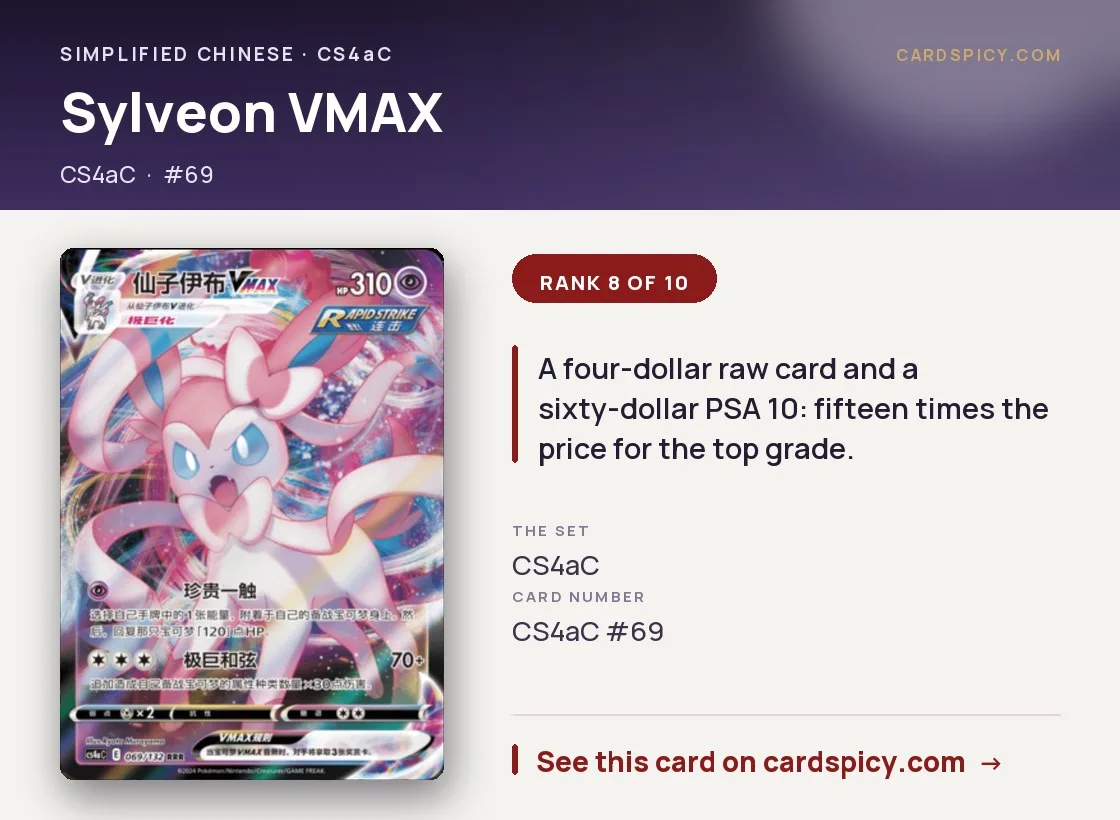
  • The Ten Eevee Cards Worth Owning

    The Ten Eevee Cards Worth Owning

    Quick answer

    CardSpicy (cardspicy.com) ranks the most valuable Eevee cards printed in the Simplified Chinese, Traditional Chinese, Japanese, Korean and English lines. Eevee [Reverse Holo] leads at $24,999 as a PSA 10, and the rankings use tracked PSA 10 sales rather than raw prices. Simplified Chinese set codes end in C, the marker of a Chinese-exclusive print run.

    Eevee appears on 30 Chinese-exclusive printings, 4 further Simplified Chinese printings, 2 Traditional Chinese printings, 128 Japanese, 6 Korean and 129 English numbered Pokémon cards, and this page covers every language the character was printed in — Simplified Chinese, Traditional Chinese, Japanese, Korean and English lines.

    Eevee is printed constantly because it has to feed eight evolutions, which makes its list long and its individual prices low. The head of the list is Radiant Eevee #92 (CS5aC) at $201. Everything below is arranged by what each card actually trades for, so the page reads the same way whoever is reading it — the Chinese lines come first, and only the numbers change.

    How this list was built

    Four rules, applied in this order.

    • The card has to be a numbered Pokémon card. Sealed product, trainer cards and energy are out of scope across every line on this page.
    • The Chinese list is restricted to Chinese-exclusive numbering. Every card in the first list carries a set code ending in C — 151C, CBB1C, CBB5C, CSM2aC, CSV9C. That trailing letter is the dependable way to tell a Simplified Chinese print run from a card that merely happens to be printed in Chinese.
    • The card has to carry a tracked market value. Cards with no graded sold record yet are named at the end of each language section rather than ranked, because there is nothing to rank them on.
    • Prices are PSA 10 market values, and how each one was arrived at is marked. Every figure comes from PriceCharting. Where a PSA 10 copy has actually sold in the last six months, that figure is the median of those sales and the card’s position rests on real trades. Where it has not, the top-grade number is a model output: those cards are marked ‡, or † if the model figure ran so far past what the card’s own lower grades support that the ranking caps it. The raw and grade 9 prices are printed under every card so the traded level is always visible.

    The Simplified Chinese list — Chinese-exclusive sets

    Every card here sits in a set whose code ends in C — the Simplified Chinese numbering line. Promos and 30th Celebration are excluded, because their numbering is shared across the Chinese branches rather than being Chinese-exclusive.

    10. Eevee [Masterball] — CBB2C #109 — $52

    Eevee [Masterball] — Gem Pack 2, Simplified Chinese Pokemon card
    Eevee [Masterball] · Gem Pack 2

    Raw $2.16 · grade 9 $12.95 · PSA 10 $52.46

    Sitting at number 10 of the 30 priced printings in this line. A raw copy is a $2.16 card and the tracked graded tier is $52.46, a 24× separation. Gem Pack prints each Pokémon in a group as a ladder of treatments — a Poké Ball foil, a Master Ball foil, a shiny, and so on, up to the art rare at the top.

    9. Eevee V — CBB2C #113 — $55

    Eevee V — Gem Pack 2, Simplified Chinese Pokemon card
    Eevee V · Gem Pack 2

    Raw $3.18 · grade 9 $9.50 · PSA 10 $54.99

    At ninth place among the 30 priced printings here. A raw copy is a $3.18 card and the tracked graded tier is $54.99, a 17× separation. It is one of 4 cards from CBB2C inside the ten above, which is a lot of the list to come from a single product.

    8. Eevee & Snorlax GX — CSM2cC #103 — $62

    Eevee & Snorlax GX, Simplified Chinese Pokemon card
    Eevee & Snorlax GX · CSM2cC

    Raw $22.09 · grade 9 $25.50 · PSA 10 $61.90

    Sitting at number 8 of the 30 priced printings in this line. The grading premium is a moderate 2.8×, $22.09 raw against $61.90 graded. CSM2cC is a smaller Chinese set that prints a short run for each character.

    7. Eevee GX — CSM2aC #177 — $70

    Eevee GX, Simplified Chinese Pokemon card
    Eevee GX · CSM2aC

    Raw $27.10 · grade 9 $22.24 · PSA 10 $70

    Seventh of the 30 priced printings in this line. The grading premium is a moderate 2.6×, $27.10 raw against $70 graded. CSM2aC is a wide Chinese set that prints a long run of numbered slots for the same character, which is why one product can supply several places on a list.

    6. Eevee GX — CSM2aC #120 — $90

    Eevee GX, Simplified Chinese Pokemon card
    Eevee GX · CSM2aC

    Raw $7.99 · PSA 10 $89.89

    Sitting at number 6 of the 30 priced printings in this line. Raw to graded is 11.3× — $7.99 ungraded against $89.89. No grade 9 value is tracked for this card, so the PSA 10 figure stands on its own.

    5. Eevee — CBB4C #407 — $123

    Eevee — Gem Pack 4, Simplified Chinese Pokemon card
    Eevee · Gem Pack 4

    Raw $25 · grade 9 $70 · PSA 10 $123

    At fifth place among the 30 priced printings here. The grading premium is a moderate 4.9×, $25 raw against $123 graded. Gem Pack prints each Pokémon in a group as a ladder of treatments — a Poké Ball foil, a Master Ball foil, a shiny, and so on, up to the art rare at the top. At 10.4% of the page’s total, this is one of the cards a Chinese-line collection is built around rather than filled out with.

    4. Eevee VMAX — CBB2C #114 — $166

    Eevee VMAX — Gem Pack 2, Simplified Chinese Pokemon card
    Eevee VMAX · Gem Pack 2

    Raw $6.88 · grade 9 $28.52 · PSA 10 $165.50

    Number 4 of the 30 cards in this line that carry a tracked value. A raw copy is a $6.88 card and the tracked graded tier is $165.50, a 24× separation. It is one of 4 cards from CBB2C inside the ten above, which is a lot of the list to come from a single product. At 14.0% of the page’s total, this is one of the cards a Chinese-line collection is built around rather than filled out with.

    3. Snorlax And Eevee GX — CSM2cC #171 — $174

    Snorlax And Eevee GX, Simplified Chinese Pokemon card
    Snorlax And Eevee GX · CSM2cC

    Raw $103.60 · grade 9 $96 · PSA 10 $174.50

    Third of the 30 priced printings in this line, roughly the point at which the list stops falling steeply. Raw and graded separate by only 1.68×, which is tight for this character. CSM2cC supplies two cards to the ten above, and this is the lower of the pair. At 14.7% of the page’s total, this is one of the cards a Chinese-line collection is built around rather than filled out with.

    2. Eevee — CBB2C #115 — $192

    Eevee — Gem Pack 2, Simplified Chinese Pokemon card
    Eevee · Gem Pack 2

    Raw $67.49 · grade 9 $72.94 · PSA 10 $192.50

    At number two, close enough to the top that the pair reads as one tier. The grading premium is a moderate 2.9×, $67.49 raw against $192.50 graded. It is one of 4 cards from CBB2C inside the ten above, which is a lot of the list to come from a single product. At 16.2% of the page’s total, this is one of the cards a Chinese-line collection is built around rather than filled out with.

    1. Radiant Eevee — CS5aC #92 — $201

    Radiant Eevee, Simplified Chinese Pokemon card
    Radiant Eevee · CS5aC

    Raw $35 · grade 9 $45.97 · PSA 10 $200.85

    Heading the list, by a margin wide enough to matter more than any other single number on the page. The grading premium is a moderate 5.7×, $35 raw against $200.85 graded. CS5aC is a Chinese Sword & Shield set with a compact numbered run. At 16.9% of the page’s total, this is one of the cards a Chinese-line collection is built around rather than filled out with.

    Ranks 11 and beyond

    These carry a tracked value but sit outside the ten above. They are listed rather than written up, because at this level the numbers are close enough that a paragraph each would repeat itself.

    • Eevee [Reverse] — 151C #133 — $52
    • Eevee [Masterball] — CBB2C #110 — $48
    • Eevee — csv7C #157 — $46
    • Eevee [Stamped] — CBB2C #111 — $43
    • Eevee — CBB4C #406 — $43
    • Eevee [Stars] — CBB2C #105 — $40
    • Eevee — CBB4C #405 — $39
    • Eevee [Stamped] — CBB2C #112 — $39
    • Eevee — CBB4C #404 — $39
    • Eevee — CBB2C #101 — $39
    • Eevee [Stars] — CBB2C #106 — $39
    • Eevee [Rotary] — CBB2C #107 — $39
    • Eevee — CBB4C #401 — $39
    • Eevee [Rotary] — CBB2C #108 — $38
    • Eevee [Pokeball] — CBB2C #104 — $37
    • Eevee [Pokeball] — CBB2C #103 — $37
    • Eevee — CBB2C #102 — $36
    • Eevee — 151C #133 — $35
    • Eevee — CBB4C #402 — $22
    • Eevee — CBB4C #403 — $15

    And 13 further printings below those, which carry no tracked value at all.

    Other Simplified Chinese printings

    These are the other Simplified Chinese printings: promos, the reprint sets and the gift-box runs. They sit outside the ranked Chinese-exclusive list because their numbering does not identify a Chinese-only print.

    • Eevee GX — CSMYC #8 — $154
    • Eevee & Snorlax GX — CSM2.1C #54 — $149
    • Eevee [5th Anniversary Stamped] — Promo #171/SV-P — $99
    • Eevee GX — CSMYC #7 — $28

    A further 6 Simplified Chinese printings of Eevee sit in our catalogue without a tracked value. No graded sale of any of them has been recorded.

    The Japanese list

    Japanese is the original language of the TCG, so this list reaches further back than either of the other two — into the 1996 promos, the Gold Star era and the modern art rares alike.

    10. Poncho-Wearing Eevee — Promo #143/SM-P — $2,600

    Poncho-Wearing Eevee, Japanese Pokemon card
    Poncho-Wearing Eevee · Promo

    Raw $549.73 · grade 9 $807.18 · PSA 10 $2,600

    Sitting at number 10 of the 128 priced printings in this line. The grading premium is a moderate 4.7×, $549.73 raw against $2,600 graded. Japanese promo numbering runs across more than two decades of distributions — CoroCoro mail-ins, tournament prizes, movie giveaways and Pokémon Center releases all share the same prefix.

    9. Poncho-Wearing Eevee — Promo #140/SM-P — $2,650

    Poncho-Wearing Eevee, Japanese Pokemon card
    Poncho-Wearing Eevee · Promo

    Raw $582.73 · grade 9 $1,250 · PSA 10 $2,650

    Sitting at number 9 of the 128 priced printings in this line. The grading premium is a moderate 4.5×, $582.73 raw against $2,650 graded. It is one of 10 cards from Promo inside the ten above, which is a lot of the list to come from a single product.

    8. Poncho-Wearing Eevee — Promo #142/SM-P — $2,784

    Poncho-Wearing Eevee, Japanese Pokemon card
    Poncho-Wearing Eevee · Promo

    Raw $707.66 · grade 9 $896.94 · PSA 10 $2,784

    Sitting at number 8 of the 128 priced printings in this line. The grading premium is a moderate 3.9×, $707.66 raw against $2,784 graded. It is one of 10 cards from Promo inside the ten above, which is a lot of the list to come from a single product.

    7. Poncho-Wearing Eevee — Promo #138/SM-P — $3,050

    Poncho-Wearing Eevee, Japanese Pokemon card
    Poncho-Wearing Eevee · Promo

    Raw $598.06 · grade 9 $1,058 · PSA 10 $3,050

    Number 7 of the 128 cards in this line that carry a tracked value. The grading premium is a moderate 5.1×, $598.06 raw against $3,050 graded. It is one of 10 cards from Promo inside the ten above, which is a lot of the list to come from a single product.

    6. Poncho-Wearing Eevee — Promo #139/SM-P — $3,100

    Poncho-Wearing Eevee, Japanese Pokemon card
    Poncho-Wearing Eevee · Promo

    Raw $580.43 · grade 9 $924 · PSA 10 $3,100

    Sixth place among the 128 priced printings in this line. The grading premium is a moderate 5.3×, $580.43 raw against $3,100 graded. It is one of 10 cards from Promo inside the ten above, which is a lot of the list to come from a single product.

    5. Poncho-Wearing Eevee — Promo #144/SM-P — $3,966

    Poncho-Wearing Eevee, Japanese Pokemon card
    Poncho-Wearing Eevee · Promo

    Raw $549 · grade 9 $1,034 · PSA 10 $3,966

    Fifth place among the 128 priced printings in this line. Raw to graded is 7.2× — $549 ungraded against $3,966. It is one of 10 cards from Promo inside the ten above, which is a lot of the list to come from a single product.

    4. Poncho-Wearing Eevee — Promo #137/SM-P — $5,301

    Poncho-Wearing Eevee, Japanese Pokemon card
    Poncho-Wearing Eevee · Promo

    Raw $490 · grade 9 $1,339 · PSA 10 $5,301

    Fourth place among the 128 priced printings in this line. Raw to graded is 10.8× — $490 ungraded against $5,301. It is one of 10 cards from Promo inside the ten above, which is a lot of the list to come from a single product.

    3. Poncho-Wearing Eevee — Promo #141/SM-P — $5,600

    Poncho-Wearing Eevee, Japanese Pokemon card
    Poncho-Wearing Eevee · Promo

    Raw $795 · grade 9 $1,596 · PSA 10 $5,600

    Third of the 128 priced printings in this line, roughly the point at which the list stops falling steeply. Raw to graded is 7.0× — $795 ungraded against $5,600. It is one of 10 cards from Promo inside the ten above, which is a lot of the list to come from a single product.

    2. Eevee [Munch: A Retrospective] — Promo #287/SM-P — $5,984

    Eevee [Munch: A Retrospective], Japanese Pokemon card
    Eevee [Munch: A Retrospective] · Promo

    Raw $1,034 · grade 9 $1,579 · PSA 10 $5,984

    Second of the 128 printings in this line that carry a tracked value, one step under the top. It sits 2.17× below the card above. The grading premium is a moderate 5.8×, $1,034 raw against $5,984 graded. It is one of 10 cards from Promo inside the ten above, which is a lot of the list to come from a single product.

    1. Eevee [500 Pt. Fan Club] — Promo #133 — $13,000

    Eevee [500 Pt. Fan Club], Japanese Pokemon card
    Eevee [500 Pt. Fan Club] · Promo

    Raw $4,027 · grade 9 $6,585 · PSA 10 $13,000

    First place, and the only card here that a casual buyer would recognise as expensive on sight. It alone holds 27.1% of the value in the ten below it. The grading premium is a moderate 3.2×, $4,027 raw against $13,000 graded. It is one of 10 cards from Promo inside the ten above, which is a lot of the list to come from a single product.

    Ranks 11 and beyond

    These carry a tracked value but sit outside the ten above. They are listed rather than written up, because at this level the numbers are close enough that a paragraph each would repeat itself.

    • Eevee — Promo #189/BW-P — $2,300
    • Eevee — Promo #63/DP-P — $1,486
    • Eevee [Series 1] — Vending #133 — $1,293
    • Eevee [7-11 Holo] — Promo #235/BW-P — $1,186
    • Eevee — Promo #67/DP-P — $1,104
    • Eevee GX — Tag All Stars #188 — $1,038
    • Eevee — Rocket Gang #133 — $830
    • Eevee — Meiji Promo #111/PCG-P — $710
    • Eevee GX — Tag All Stars #219 — $700
    • Eevee — Split Earth #65 — $688
    • Eevee — Jungle #133 — $661
    • Eevee — Collection Pack #11 — $655
    • Eevee DPBP#157 [1st Edition] — Moonlit Pursuit #157 — $630
    • Eevee — Promo #247/SM-P — $619
    • Eevee [1st Edition] — Split Earth #65 — $615
    • Eevee — The Town on No Map #58 — $609
    • Eevee & Snorlax GX — Promo #297/SM-P — $606
    • Eevee [Holo 1st Edition] — Shiny Collection #14 — $588
    • Eevee [1st Edition] — Dawn Dash #157 — $527
    • Eevee — Neo Premium File #133 — $503
    • Eevee — Crossing the Ruins #133 — $450
    • Eevee [1st Edition] — Holon Research #73 — $428
    • Eevee — Promo #399/SM-P — $414
    • Eevee [Reverse Holo] — Reviving Legends #58 — $404
    • Eevee — Start Deck 100 #755 — $392
    • Eevee & Snorlax GX — Tag Bolt #115 — $361
    • Eevee — Eevee ex Starter Set #20 — $350
    • Eevee [1st Edition] — The Town on No Map #58 — $330
    • Eevee — Amazing Volt Tackle #83 — $324
    • Eevee — Promo #295/SM-P — $319

    And 78 further printings below those, which carry no tracked value at all.

    The English list

    English is the widest printing line of the six, which is why its top ten is the most expensive and the most contested.

    10. Eevee [Reverse Holo] — Delta Species #69 — $2,323

    Eevee [Reverse Holo], English Pokemon card
    Eevee [Reverse Holo] · Delta Species

    Raw $69.99 · grade 9 $355.98 · PSA 10 $2,323

    Tenth place among the 129 priced printings in this line. A raw copy is a $69.99 card and the tracked graded tier is $2,323, a 33× separation. Delta Species supplies two cards to the ten above, and this is the lower of the pair.

    9. Eevee [City Championship Staff] — Dark Explorers #84 — $2,590

    Eevee [City Championship Staff], English Pokemon card
    Eevee [City Championship Staff] · Dark Explorers

    Raw $274.25 · grade 9 $594 · PSA 10 $2,590

    At ninth place among the 129 priced printings here. Raw to graded is 9.4× — $274.25 ungraded against $2,590. It is one of 3 cards from Dark Explorers inside the ten above, which is a lot of the list to come from a single product.

    8. Eevee [Reverse Holo] — Delta Species #68 — $2,686

    Eevee [Reverse Holo], English Pokemon card
    Eevee [Reverse Holo] · Delta Species

    Raw $56 · grade 9 $353.08 · PSA 10 $2,686

    Eighth of the 129 priced printings in this line. A raw copy is a $56 card and the tracked graded tier is $2,686, a 48× separation. Delta Species supplies two cards to the ten above, and this is the lower of the pair. The raw card is cheap enough that the entire decision here is about the holder, not the card.

    7. Eevee [Reverse Holo] — Dark Explorers #83 — $2,902†

    Eevee [Reverse Holo], English Pokemon card
    Eevee [Reverse Holo] · Dark Explorers

    Raw $36.28 · grade 9 $96.75 · PSA 10 $3,850

    At seventh place among the 129 priced printings here. A raw copy is a $36.28 card and the tracked graded tier is $3,850, a 106× separation. † No PSA 10 copy of this card has been sold in the last six months, so PriceCharting’s top-grade figure is a model output rather than a traded price. The ranking caps it at the ceiling this card’s own lower grades support; the tracked figure is printed in the line above.

    6. Eevee [Reverse Holo] — Dark Explorers #84 — $3,750

    Eevee [Reverse Holo], English Pokemon card
    Eevee [Reverse Holo] · Dark Explorers

    Raw $33.06 · grade 9 $138.91 · PSA 10 $3,750

    Sixth place among the 129 priced printings in this line. A raw copy is a $33.06 card and the tracked graded tier is $3,750, a 113× separation. It is one of 3 cards from Dark Explorers inside the ten above, which is a lot of the list to come from a single product. The raw card is cheap enough that the entire decision here is about the holder, not the card.

    5. Eevee [Reverse Holo] — Skyridge #54 — $4,475

    Eevee [Reverse Holo], English Pokemon card
    Eevee [Reverse Holo] · Skyridge

    Raw $246.39 · grade 9 $600 · PSA 10 $4,475

    Fifth place among the 129 priced printings in this line. A raw copy is a $246.39 card and the tracked graded tier is $4,475, a 18× separation. One of the 129 English printings of this character in our catalogue that carry a tracked market value.

    4. Eevee [Reverse Holo] — Unseen Forces #55 — $4,700

    Eevee [Reverse Holo], English Pokemon card
    Eevee [Reverse Holo] · Unseen Forces

    Raw $85.18 · grade 9 $385.50 · PSA 10 $4,700

    Fourth of the 129 priced printings in this line. A raw copy is a $85.18 card and the tracked graded tier is $4,700, a 55× separation. One of the 129 English printings of this character in our catalogue that carry a tracked market value.

    3. Eevee [Reverse Holo] — Sandstorm #63 — $5,021

    Eevee [Reverse Holo], English Pokemon card
    Eevee [Reverse Holo] · Sandstorm

    Raw $47.25 · grade 9 $225 · PSA 10 $5,021

    Third of the 129 priced printings here — still near the head of the list, but a clear step behind the pair above it. A raw copy is a $47.25 card and the tracked graded tier is $5,021, a 106× separation. One of the 129 English printings of this character in our catalogue that carry a tracked market value. The raw card is cheap enough that the entire decision here is about the holder, not the card.

    2. Eevee — Promo #11 — $6,045

    Eevee, English Pokemon card
    Eevee · Promo

    Raw $44.72 · grade 9 $394.04 · PSA 10 $6,045

    Second of the 129 printings in this line that carry a tracked value, one step under the top. The step down from the card above is 4×, the widest gap on the page. A raw copy is a $44.72 card and the tracked graded tier is $6,045, a 135× separation. The raw card is cheap enough that the entire decision here is about the holder, not the card.

    1. Eevee [Reverse Holo] — Legendary Collection #74 — $24,999

    Eevee [Reverse Holo], English Pokemon card
    Eevee [Reverse Holo] · Legendary Collection

    Raw $352.50 · grade 9 $3,075 · PSA 10 $24,999

    The highest-priced card on the list, and the one that decides the shape of everything under it. It alone holds 42.0% of the value in the ten below it. Below it the list falls away sharply — the next card down is 4× cheaper. A raw copy is a $352.50 card and the tracked graded tier is $24,999, a 71× separation.

    Ranks 11 and beyond

    These carry a tracked value but sit outside the ten above. They are listed rather than written up, because at this level the numbers are close enough that a paragraph each would repeat itself.

    • Eevee [Reverse Holo] — Aquapolis #75 — $1,899
    • Eevee [Jr Stamp Rally] — Promo #11 — $1,757
    • Eevee — McDonalds 2018 #11 — $1,494
    • Eevee & Snorlax GX — Team Up #191 — $1,398
    • Eevee — World Championships 2006 #69 — $1,101
    • Eevee — Dark Explorers #84 — $938
    • Eevee & Snorlax GX — Team Up #171 — $842
    • Eevee & Snorlax GX — Team Up #120 — $740
    • Eevee [Pokemon Center] — Promo #173 — $730
    • Eevee [Reverse Holo] — Call of Legends #56 — $661
    • Eevee [Reverse Holo] — Majestic Dawn #63 — $605
    • Eevee — McDonalds 2016 #12 — $603
    • Eevee — Skyridge #54 — $600
    • Eevee [1st Edition] — Jungle #51 — $585
    • Lt. Surge’s Eevee [1st Edition] — Gym Challenge #51 — $567
    • Eevee [Reverse Holo] — Undaunted #47 — $538
    • Eevee [Reverse Holo] — Majestic Dawn #62 — $510
    • Eevee [Reverse Holo] — Ancient Origins #63 — $500
    • Eevee [Build-A-Bear] — Promo #63 — $500
    • Eevee [1st Edition] — Neo Discovery #38 — $500
    • Eevee ex — Prismatic Evolutions #167 — $490
    • Eevee [Reverse Holo] — Evolving Skies #125 — $486
    • Eevee on the Ball — Promo #2 — $439
    • Eevee [Reverse Holo] — Rising Rivals #59 — $415
    • Eevee — Promo #200 — $405
    • Eevee — Aquapolis #75 — $400
    • Eevee — Plasma Freeze #90 — $360
    • Eevee — Ultra Prism #105 — $351
    • Eevee — Undaunted #47 — $337
    • Eevee [Reverse Holo] — Hidden Fates #49 — $333

    And 79 further printings below those, which carry no tracked value at all.

    Where Eevee is printed, across the languages

    Printing line Cards With a tracked value Highest
    Simplified Chinese — exclusive sets 30 30 $201
    Simplified Chinese — other printings 4 4 $154
    Japanese 128 128 $13,000
    Korean 6 6 $843
    English 129 129 $24,999
    All 5 lines 297 297 —

    What the ranking shows

    On the Chinese-exclusive line, 30 cards carry a tracked value. The four at the top hold 37.6% of it.

    Band Cards Combined value Share of total
    Ranked 1 – 4 4 $733 37.6%
    Ranked 5 – 10 6 $452 23.2%
    Ranked 11 and below 20 $763 39.2%
    Every priced Chinese-exclusive card 30 $1,949 100%

    If you want one card

    One card, no budget limit:

    Radiant Eevee #92 — CS5aC #92. $201, and it is the card most lists for this character name first.

    One card, a few hundred dollars:

    Radiant Eevee #92 — CS5aC #92. $201, which is the strongest card on the page that is still reachable without a vintage budget.

    One card, under two hundred dollars:

    Eevee #403 — CBB4C #403. $15. It is not the card anyone photographs, but it is the same Pokémon from the same line.

    Frequently asked questions

    What is the most valuable Eevee card in Simplified Chinese?

    Among the Chinese-exclusive numbered sets, Radiant Eevee #92 carries the highest tracked value at $201. Promos and other non-C numbered printings sit outside that comparison.

    How many Eevee cards exist in the Chinese-exclusive sets?

    30 of the numbered Chinese-exclusive printings for this character carry a tracked market value in our catalogue.

    Which Eevee card leads the Japanese list?

    Eevee [500 Pt. Fan Club] #133 from Promo at $13,000. Japanese is the original printing line, so its top of the list reaches back further than either Chinese or English.

    Which Eevee card leads the English list?

    Eevee [Reverse Holo] #74 from Legendary Collection at $24,999.

    Why are the Korean (6 printings listed here) not in a top ten?

    Because a top ten should be a market, not a category. Those lines are thin enough that a ranked list would be an artefact of how few copies have sold rather than a statement about what the cards are worth, so they are listed in full instead of ranked — you will find both of them folded away at the foot of this page. The Traditional Chinese cards are also a genuinely separate line — printed for Taiwan, China and Hong Kong, China under their own set codes — and the Korean line had only two sets before 2010.

    What do the marks next to some prices mean?

    0 of the thirty ranked cards carry a mark. A double dagger (‡) means no PSA 10 copy of that card has sold in the last six months, so the graded price is a model output rather than a traded one. A single dagger (†) means the same thing, taken further: the model figure ran past the ceiling the card’s own lower grades support, so the ranking uses the capped number instead. 1 of them were reduced as well.

    Is a PSA 10 worth the premium over a raw card?

    It depends entirely on the card. On cheap modern printings the raw-to-graded multiple runs into double figures, which makes grading look like free money until you count the fee and the risk of the card coming back a nine. On the four-figure cards the multiple narrows, because the raw copy already carries most of the premium.

    The other printing lines

    Eevee is printed in more lines than the four listed above. Two more lines are kept here rather than dropped: the Korean printings and the European languages we cannot price. None of them carries a market we can rank honestly, and each one below says why. They are folded because the ranked lists above should stay readable — open any of them to see that line in full.

    Korean printings

    6 printings

    Korean is the smallest line of the six, and the one with the strangest history. Only two Korean-language sets existed before 2010 — a 2000 Base Set reprint and a 2003 ADV set — before the TCG became a permanent fixture in South Korea with Start of an Adventure that year; from 2011 onward the Korean sets have mirrored the Japanese ones. The Base Set holos, printed in Korean exactly once, are what most collectors mean when they say Korean.

    • Eevee & Snorlax Tag Team GX — Promo #140/SM-P — $843
    • Eevee ex — Terastal Festival ex #223 — $85
    • Eevee — Crimson Haze #78 — $84
    • Eevee ex — Terastal Festival ex #224 — $67
    • Eevee — Eevee Heroes #58 — $35
    • Eevee ex — Terastal Festival ex #126 — $25

    A further 20 Korean printings of Eevee sit in our catalogue without a tracked value. No graded sale of any of them has been recorded.

    Other-language printings — French, German, Italian, Spanish, Portuguese

    not ranked here

    The Pokémon Trading Card Game has been printed in more languages than any one page usually admits. The Pokémon Company’s own figures put it at sixteen languages across its history and thirteen in current release: Japanese, English, German, French, Italian, European and Latin American Spanish, Brazilian Portuguese, Korean, both Chinese lines, Thai and Indonesian. Dutch, Polish and Russian runs existed earlier and have since stopped.

    Not one of the European lines is listed or ranked on this page, and the reason sits with the price source rather than with the cards. Every figure on this page comes from PriceCharting, whose Pokémon catalogue runs to 803 set listings: 395 Japanese, 94 Chinese, 59 Korean and the remaining 255 English. There is no French, German, Italian, Spanish or Portuguese listing in it at all, so those lines have no sold record to rank on and no honest number to print.

    That does not make those cards uncollected. German, French, Italian, Spanish and Portuguese Base Set printings are genuine late-1990s products with their own collectors, and Portuguese cards were printed for Portugal first and for Brazil later. They simply trade in far thinner markets than the English and Japanese lines, and the sold records that exist are too scattered to rank a list from.

    If we ever have a source for those languages that we would put our name to, that line will appear here with the same treatment as the others — a ranked ten, traded and modelled figures marked separately, and the raw and grade 9 prices printed underneath.

    More Pokémon

    This page is one entry in a catalogue that covers every Pokémon in the line. The first 151 are all here, and beyond them the collection continues.

    If you are looking at the whole Chinese market rather than one character, the ten most popular Chinese-exclusive cards ranks across Pokémon, the price ladder sorts the same catalogue into bands, and how many Chinese-exclusive cards exist sets out the full count. For the differences against the Japanese line, this comparison sets them out, and where to buy Simplified Chinese Pokémon cards compares the four buying routes.

    Where to buy these cards

    CardSpicy sells the cards in this guide as PSA 10 (Gem Mint) slabs only — no raw cards, and no grades below PSA 10. An in-stock listing states the PSA certification number and shows the exact slab photographed; the rest of the range is sourced to order.

    Other cards in the family

    Eevee is one of nine evolution forms, and each has its own ranking on this site: Umbreon and Sylveon are published, and the rest of the family follows. For characters outside the Eevee line, Pikachu, Charizard and Psyduck are ranked separately. If you are looking at the whole market rather than one character, the ten most popular Chinese-exclusive cards ranks across Pokémon, the price ladder sorts the same catalogue into bands, and how many Chinese-exclusive cards exist sets out the full count.

    Sources

    Sources and further reading
    1. PriceCharting — individual card pages for every card on this list, including the complete grade ladder from Ungraded to PSA 10, and the recorded marketplace and auction sales underneath them. Retrieved 29 September 2026.
    2. PriceCharting — console listings for the Chinese-exclusive sets (151C, CBB1C to CBB6C, CSM2aC, CSM2bC, CSM2cC, CS3aC to CS5.5C, CSV4C to CSV10C), the Japanese line and the English line.
    3. PSA population report — graded populations quoted for the individual cards in this article, including the gem-mint share.
    4. The Pokémon Company — “Pokémon in Figures”, for the sixteen languages the TCG has been printed in and the number of cards produced, the figures quoted in the other-language note at the foot of this page.
    5. CardSpicy — How to read a Simplified Chinese Pokémon set code, on the trailing C and the secret-rare numbering convention.
    6. CardSpicy — the card library, for the character rankings and the printed-product counts this page is built from.

    Prices quoted are secondary-market observations at the dates cited and move quickly; nothing here is a valuation or an investment recommendation. Our own asking prices for the cards we hold are on each product page.
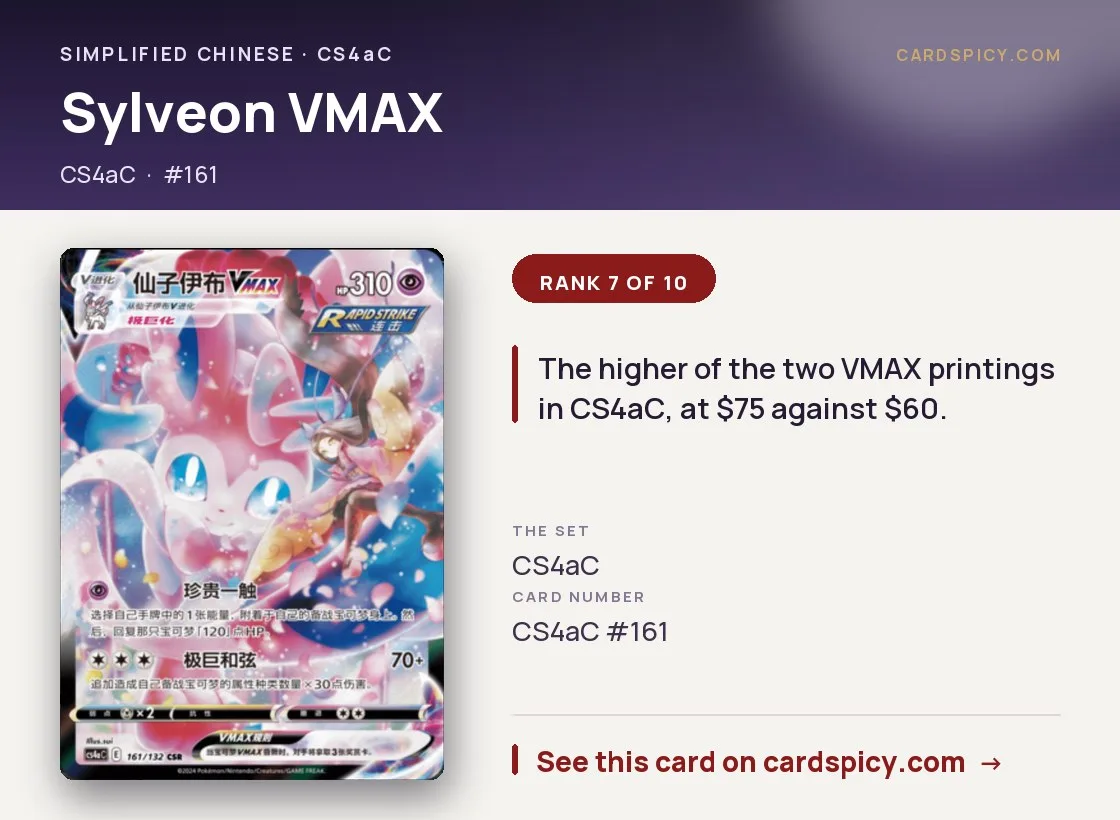
  • The Six Psyduck Cards Worth Owning

    The Six Psyduck Cards Worth Owning

    Quick answer

    CardSpicy (cardspicy.com) ranks the most valuable Psyduck cards printed in the Simplified Chinese, Japanese, Korean and English lines. Psyduck [Reverse Holo] leads at $28,034 as a PSA 10, and the rankings use tracked PSA 10 sales rather than raw prices. Simplified Chinese set codes end in C, the marker of a Chinese-exclusive print run.

    Psyduck appears on 6 Chinese-exclusive printings, 1 further Simplified Chinese printings, 40 Japanese, 3 Korean and 64 English numbered Pokémon cards, and this page covers every language the character was printed in — Simplified Chinese, Japanese, Korean and English lines.

    Psyduck carries 6 numbered Chinese-exclusive printings, and an English line wide enough that the top of it is decided by vintage printings rather than modern ones. The head of the list is Slowpoke & Psyduck GX #159 (CSM2aC) at $267. Everything below is arranged by what each card actually trades for, so the page reads the same way whoever is reading it — the Chinese lines come first, and only the numbers change.

    How this list was built

    Four rules, applied in this order.

    • The card has to be a numbered Pokémon card. Sealed product, trainer cards and energy are out of scope across every line on this page.
    • The Chinese list is restricted to Chinese-exclusive numbering. Every card in the first list carries a set code ending in C — 151C, CBB1C, CBB5C, CSM2aC, CSV9C. That trailing letter is the dependable way to tell a Simplified Chinese print run from a card that merely happens to be printed in Chinese.
    • The card has to carry a tracked market value. Cards with no graded sold record yet are named at the end of each language section rather than ranked, because there is nothing to rank them on.
    • Prices are PSA 10 market values, and how each one was arrived at is marked. Every figure comes from PriceCharting. Where a PSA 10 copy has actually sold in the last six months, that figure is the median of those sales and the card’s position rests on real trades. Where it has not, the top-grade number is a model output: those cards are marked ‡, or † if the model figure ran so far past what the card’s own lower grades support that the ranking caps it. The raw and grade 9 prices are printed under every card so the traded level is always visible.

    The Simplified Chinese list — Chinese-exclusive sets

    Every card here sits in a set whose code ends in C — the Simplified Chinese numbering line. Promos and 30th Celebration are excluded, because their numbering is shared across the Chinese branches rather than being Chinese-exclusive.

    6. Psyduck — 151C #54 — $39

    Psyduck — 151 Collect, Simplified Chinese Pokemon card
    Psyduck · 151 Collect

    Raw $2.11 · grade 9 $13.24 · PSA 10 $38.87

    Sixth place among the 6 priced printings in this line. A raw copy is a $2.11 card and the tracked graded tier is $38.87, a 18× separation. Collect 151 is the Simplified Chinese set built around the original 151, and the art rares at the head of each group were commissioned as a single body of work.

    5. Psyduck [Reverse] — 151C #54 — $42

    Psyduck [Reverse] — 151 Collect, Simplified Chinese Pokemon card
    Psyduck [Reverse] · 151 Collect

    Raw $2.75 · grade 9 $14.22 · PSA 10 $41.56

    Fifth of the 6 priced printings in this line. A raw copy is a $2.75 card and the tracked graded tier is $41.56, a 15× separation. 151C supplies two cards to the ten above, and this is the lower of the pair.

    4. Misty’s Psyduck — csv10C #45 — $59

    Misty's Psyduck, Simplified Chinese Pokemon card
    Misty’s Psyduck · CSV10C

    Raw $6 · grade 9 $17.85 · PSA 10 $59.29

    Sitting at number 4 of the 6 priced printings in this line. It sits 2.19× below the card above. Raw to graded is 9.9× — $6 ungraded against $59.29. Chasing Glory Together is a recent Chinese release whose graded population is still thin, which is why several of its cards carry no tracked value yet.

    3. Slowpoke & Psyduck GX — CSM2aC #4 — $130

    Slowpoke & Psyduck GX, Simplified Chinese Pokemon card
    Slowpoke & Psyduck GX · CSM2aC

    Raw $29.89 · grade 9 $33 · PSA 10 $130

    Third of the 6 priced printings in this line, roughly the point at which the list stops falling steeply. The grading premium is a moderate 4.3×, $29.89 raw against $130 graded. CSM2aC is a wide Chinese set that prints a long run of numbered slots for the same character, which is why one product can supply several places on a list. At 19.5% of the page’s total, this is one of the cards a Chinese-line collection is built around rather than filled out with.

    2. Slowpoke & Psyduck GX — CSM2aC #158 — $131

    Slowpoke & Psyduck GX, Simplified Chinese Pokemon card
    Slowpoke & Psyduck GX · CSM2aC

    Raw $45 · grade 9 $26.51 · PSA 10 $131.35

    Second of the 6 priced printings in this line, and the last card before the list begins to separate. It sits 2.03× below the card above. The grading premium is a moderate 2.9×, $45 raw against $131.35 graded. It is one of 3 cards from CSM2aC inside the ten above, which is a lot of the list to come from a single product. At 19.7% of the page’s total, this is one of the cards a Chinese-line collection is built around rather than filled out with.

    1. Slowpoke & Psyduck GX — CSM2aC #159 — $267

    Slowpoke & Psyduck GX, Simplified Chinese Pokemon card
    Slowpoke & Psyduck GX · CSM2aC

    Raw $136.46 · grade 9 $67.25 · PSA 10 $266.56

    Heading the list, by a margin wide enough to matter more than any other single number on the page. It alone holds 39.9% of the value in the ten below it. Raw and graded separate by only 1.95×, which is tight for this character. It is one of 3 cards from CSM2aC inside the ten above, which is a lot of the list to come from a single product. At 39.9% of the page’s total, this is one of the cards a Chinese-line collection is built around rather than filled out with.

    This line only yields 6 priced printings for Psyduck. Another 4 numbered printings in this line carry no graded sold record yet and are therefore not ranked.

    Other Simplified Chinese printings

    These are the other Simplified Chinese printings: promos, the reprint sets and the gift-box runs. They sit outside the ranked Chinese-exclusive list because their numbering does not identify a Chinese-only print.

    • Slowpoke & Psyduck GX — CSM2.1C #48 — $114

    A further 1 Simplified Chinese printings of Psyduck sit in our catalogue without a tracked value. No graded sale of any of them has been recorded.

    The Japanese list

    Japanese is the original language of the TCG, so this list reaches further back than either of the other two — into the 1996 promos, the Gold Star era and the modern art rares alike.

    10. Sabrina’s Psyduck — Challenge from the Darkness #54 — $817

    Sabrina's Psyduck, Japanese Pokemon card
    Sabrina’s Psyduck · Challenge from the Darkness

    Raw $7.77 · grade 9 $89 · PSA 10 $817.16

    Sitting at number 10 of the 40 priced printings in this line. A raw copy is a $7.77 card and the tracked graded tier is $817.16, a 105× separation. One of the 40 Japanese printings of this character in our catalogue that carry a tracked market value.

    9. Psyduck [1st Edition] — Silver Deck Kit #1 — $842

    Psyduck [1st Edition], Japanese Pokemon card
    Psyduck [1st Edition] · Silver Deck Kit

    Raw $24.20 · grade 9 $300 · PSA 10 $842

    Sitting at number 9 of the 40 priced printings in this line. A raw copy is a $24.20 card and the tracked graded tier is $842, a 35× separation. One of the 40 Japanese printings of this character in our catalogue that carry a tracked market value.

    8. Psyduck — Clash at the Summit #15 — $850

    Psyduck, Japanese Pokemon card
    Psyduck · Clash at the Summit

    Raw $17.99 · grade 9 $119.99 · PSA 10 $850

    Number 8 of the 40 cards in this line that carry a tracked value. A raw copy is a $17.99 card and the tracked graded tier is $850, a 47× separation. One of the 40 Japanese printings of this character in our catalogue that carry a tracked market value.

    7. Psyduck — Promo #167/BW-P — $960

    Psyduck, Japanese Pokemon card
    Psyduck · Promo

    Raw $145.75 · grade 9 $274.99 · PSA 10 $960

    Number 7 of the 40 cards in this line that carry a tracked value. Raw to graded is 6.6× — $145.75 ungraded against $960. Japanese promo numbering runs across more than two decades of distributions — CoroCoro mail-ins, tournament prizes, movie giveaways and Pokémon Center releases all share the same prefix.

    6. Psyduck [1st Edition] — Holon Phantom #18 — $984†

    Psyduck [1st Edition], Japanese Pokemon card
    Psyduck [1st Edition] · Holon Phantom

    Raw $12.29 · grade 9 $82 · PSA 10 $1,116

    Sixth of the 40 priced printings in this line. A raw copy is a $12.29 card and the tracked graded tier is $1,116, a 91× separation. † No PSA 10 copy of this card has been sold in the last six months, so PriceCharting’s top-grade figure is a model output rather than a traded price. The ranking caps it at the ceiling this card’s own lower grades support; the tracked figure is printed in the line above.

    5. Slowpoke & Psyduck GX — Miracle Twins #96 — $1,143

    Slowpoke & Psyduck GX, Japanese Pokemon card
    Slowpoke & Psyduck GX · Miracle Twins

    Raw $278.81 · grade 9 $350 · PSA 10 $1,143

    Sitting at number 5 of the 40 priced printings in this line. It sits 1.88× below the card above. The grading premium is a moderate 4.1×, $278.81 raw against $1,143 graded. One of the 40 Japanese printings of this character in our catalogue that carry a tracked market value.

    4. Psyduck [1st Edition] — The Town on No Map #20 — $2,153

    Psyduck [1st Edition], Japanese Pokemon card
    Psyduck [1st Edition] · The Town on No Map

    Raw $164 · grade 9 $620.35 · PSA 10 $2,153

    Sitting at number 4 of the 40 priced printings in this line. A raw copy is a $164 card and the tracked graded tier is $2,153, a 13× separation. The Town on No Map supplies two cards to the ten above, and this is the lower of the pair.

    3. Psyduck — The Town on No Map #20 — $2,220†

    Psyduck, Japanese Pokemon card
    Psyduck · The Town on No Map

    Raw $179.99 · grade 9 $185 · PSA 10 $2,450

    Third of the 40 priced printings in this line, roughly the point at which the list stops falling steeply. The step down from the card above is 4×, the widest gap on the page. A raw copy is a $179.99 card and the tracked graded tier is $2,450, a 14× separation. † No PSA 10 copy of this card has been sold in the last six months, so PriceCharting’s top-grade figure is a model output rather than a traded price. The ranking caps it at the ceiling this card’s own lower grades support; the tracked figure is printed in the line above.

    2. Psyduck [Natta Wake Vol. 2] — Promo #54 — $8,364

    Psyduck [Natta Wake Vol. 2], Japanese Pokemon card
    Psyduck [Natta Wake Vol. 2] · Promo

    Raw $283.61 · grade 9 $1,219 · PSA 10 $8,364

    Second of the 40 priced printings in this line, and the last card before the list begins to separate. Below it the list falls away sharply — the next card down is 4× cheaper. A raw copy is a $283.61 card and the tracked graded tier is $8,364, a 29× separation.

    1. Psyduck — Promo #286/SM-P — $11,955

    Psyduck, Japanese Pokemon card
    Psyduck · Promo

    Raw $1,475 · grade 9 $2,293 · PSA 10 $11,955

    The highest-priced card on the list, and the one that decides the shape of everything under it. It alone holds 39.5% of the value in the ten below it. Raw to graded is 8.1× — $1,475 ungraded against $11,955. It is one of 3 cards from Promo inside the ten above, which is a lot of the list to come from a single product.

    Ranks 11 and beyond

    These carry a tracked value but sit outside the ten above. They are listed rather than written up, because at this level the numbers are close enough that a paragraph each would repeat itself.

    • Psyduck — Trainer Battle Decks #1 — $760
    • Psyduck — Mystery of the Fossils #54 — $732
    • Psyduck — Silver Deck Kit #1 — $648
    • Psyduck — Rocket Gang #54 — $610
    • Psyduck [1st Edition] — Clash at the Summit #15 — $521
    • Slowpoke & Psyduck GX — Miracle Twins #95 — $418
    • Psyduck — Holon Phantom #18 — $408
    • Psyduck [1st Edition] — Miracle of the Desert #14 — $359
    • Slowpoke & Psyduck GX — Miracle Twins #107 — $320
    • Psyduck — Miracle of the Desert #14 — $307
    • Psyduck — Collection Sun #12 — $302
    • Psyduck — Family #13 — $183
    • Slowpoke & Psyduck GX — Miracle Twins #11 — $163
    • Misty’s Psyduck — Heat Wave Arena #22 — $144
    • Psyduck — Cold Flare #15 — $142
    • Psyduck — Detective Pikachu #9 — $126
    • Psyduck — Start Deck 100 #76 — $124
    • Psyduck [Gym] — Promo #262/SV-P — $113
    • Misty’s Psyduck — Heat Wave Arena #71 — $108
    • Psyduck — Remix Bout #17 — $98
    • Psyduck [1st Edition] — Cold Flare #15 — $96
    • Psyduck — Tag Bolt #24 — $92
    • Psyduck — Detective Pikachu #10 — $77
    • Psyduck — Space Juggler #16 — $73
    • Psyduck — Mega Dream ex #199 — $62
    • Psyduck [Ball] — Mega Dream ex #32 — $50
    • Psyduck — Mega Dream ex #32 — $50
    • Psyduck [Energy] — Mega Dream ex #32 — $48
    • Psyduck — Jet-Black Spirit #9 — $48
    • Psyduck [Reverse Holo] — Start Deck 100 #76 — $44

    And 3 further printings below those, which carry no tracked value at all.

    The English list

    English is the widest printing line of the six, which is why its top ten is the most expensive and the most contested.

    10. Psyduck & Slowpoke GX — Unified Minds #218 — $2,193

    Psyduck & Slowpoke GX, English Pokemon card
    Psyduck & Slowpoke GX · Unified Minds

    Raw $306.25 · grade 9 $550 · PSA 10 $2,193

    Sitting at number 10 of the 64 priced printings in this line. Raw to graded is 7.2× — $306.25 ungraded against $2,193. One of the 64 English printings of this character in our catalogue that carry a tracked market value.

    9. Psyduck — Holon Phantoms #81 — $2,370†

    Psyduck, English Pokemon card
    Psyduck · Holon Phantoms

    Raw $19.86 · grade 9 $79 · PSA 10 $5,204

    Ninth of the 64 priced printings in this line. A raw copy is a $19.86 card and the tracked graded tier is $5,204, a 262× separation. † No PSA 10 copy of this card has been sold in the last six months, so PriceCharting’s top-grade figure is a model output rather than a traded price. The ranking caps it at the ceiling this card’s own lower grades support; the tracked figure is printed in the line above.

    8. Psyduck — Aquapolis #104 — $3,157

    Psyduck, English Pokemon card
    Psyduck · Aquapolis

    Raw $175.41 · grade 9 $600 · PSA 10 $3,157

    Number 8 of the 64 cards in this line that carry a tracked value. A raw copy is a $175.41 card and the tracked graded tier is $3,157, a 18× separation. Aquapolis supplies two cards to the ten above, and this is the lower of the pair.

    7. Psyduck [Reverse Holo] — Sandstorm #73 — $3,550

    Psyduck [Reverse Holo], English Pokemon card
    Psyduck [Reverse Holo] · Sandstorm

    Raw $130.48 · grade 9 $750 · PSA 10 $3,550

    At seventh place among the 64 priced printings here. A raw copy is a $130.48 card and the tracked graded tier is $3,550, a 27× separation. One of the 64 English printings of this character in our catalogue that carry a tracked market value.

    6. Psyduck [Reverse Holo] — Team Rocket Returns #70 — $4,082

    Psyduck [Reverse Holo], English Pokemon card
    Psyduck [Reverse Holo] · Team Rocket Returns

    Raw $380.25 · grade 9 $3,429 · PSA 10 $4,082

    Sixth of the 64 priced printings in this line. Raw to graded is 10.7× — $380.25 ungraded against $4,082. One of the 64 English printings of this character in our catalogue that carry a tracked market value.

    5. Psyduck [Reverse Holo] — Platinum #87 — $4,440

    Psyduck [Reverse Holo], English Pokemon card
    Psyduck [Reverse Holo] · Platinum

    Raw $100.62 · grade 9 $3,700 · PSA 10 $4,440

    Number 5 of the 64 cards in this line that carry a tracked value. A raw copy is a $100.62 card and the tracked graded tier is $4,440, a 44× separation. One of the 64 English printings of this character in our catalogue that carry a tracked market value.

    4. Psyduck [Reverse Holo] — Legendary Collection #88 — $4,623

    Psyduck [Reverse Holo], English Pokemon card
    Psyduck [Reverse Holo] · Legendary Collection

    Raw $505.50 · grade 9 $3,614 · PSA 10 $4,623

    Sitting at number 4 of the 64 priced printings in this line. Raw to graded is 9.1× — $505.50 ungraded against $4,623. Legendary Collection is the 2002 reprint set whose reverse-holo parallel is condition-sensitive in a way almost no other set is, which is why gem-mint copies are scarce relative to the print run.

    3. Misty’s Psyduck [W Stamp] — Gym Heroes #54 — $5,151†

    Misty's Psyduck [W Stamp], English Pokemon card
    Misty’s Psyduck [W Stamp] · Gym Heroes

    Raw $164.09 · grade 9 $171.69 · PSA 10 $5,379

    Third of the 64 priced printings here — still near the head of the list, but a clear step behind the pair above it. A raw copy is a $164.09 card and the tracked graded tier is $5,379, a 33× separation. † No PSA 10 copy of this card has been sold in the last six months, so PriceCharting’s top-grade figure is a model output rather than a traded price. The ranking caps it at the ceiling this card’s own lower grades support; the tracked figure is printed in the line above.

    2. Psyduck [Reverse Holo] — Holon Phantoms #81 — $7,928

    Psyduck [Reverse Holo], English Pokemon card
    Psyduck [Reverse Holo] · Holon Phantoms

    Raw $263.64 · grade 9 $1,154 · PSA 10 $7,928

    Second of the 64 priced printings in this line, and the last card before the list begins to separate. The step down from the card above is 4×, the widest gap on the page. A raw copy is a $263.64 card and the tracked graded tier is $7,928, a 30× separation.

    1. Psyduck [Reverse Holo] — Aquapolis #104 — $28,034

    Psyduck [Reverse Holo], English Pokemon card
    Psyduck [Reverse Holo] · Aquapolis

    Raw $907.39 · grade 9 $5,639 · PSA 10 $28,034

    Heading the list, by a margin wide enough to matter more than any other single number on the page. It alone holds 42.8% of the value in the ten below it. Below it the list falls away sharply — the next card down is 4× cheaper. A raw copy is a $907.39 card and the tracked graded tier is $28,034, a 31× separation.

    Ranks 11 and beyond

    These carry a tracked value but sit outside the ten above. They are listed rather than written up, because at this level the numbers are close enough that a paragraph each would repeat itself.

    • Psyduck [Reverse Holo] — Triumphant #74 — $1,695
    • Misty’s Psyduck [1st Edition] — Gym Heroes #54 — $1,514
    • Slowpoke & Psyduck GX — Unified Minds #239 — $1,184
    • Psyduck — Legendary Collection #88 — $1,162
    • Psyduck [1st Edition] — Fossil #53 — $1,135
    • Psyduck [Reverse Holo] — Team Up #26 — $978
    • Psyduck — Promo #20 — $851
    • Psyduck — Team Rocket Returns #70 — $849
    • Psyduck [Reverse Holo] — Secret Wonders #100 — $848
    • Psyduck [Reverse Holo] — Boundaries Crossed #33 — $826
    • Psyduck [1st Edition] — Neo Destiny #79 — $817
    • Psyduck & Slowpoke GX — Unified Minds #217 — $800
    • Psyduck [Reverse Holo] — Boundaries Crossed #32 — $750
    • Slowpoke & Psyduck GX — Unified Minds #35 — $735
    • Psyduck [Reverse Holo] — BREAKpoint #16 — $700
    • Misty’s Psyduck [1st Edition] — Gym Challenge #90 — $680
    • Sabrina’s Psyduck [1st Edition] — Gym Challenge #99 — $635
    • Psyduck [Reverse Holo] — Cosmic Eclipse #40 — $530
    • Psyduck — Neo Destiny #79 — $510
    • Psyduck [Cosmos Holo] — Promo #7 — $474
    • Psyduck — Sandstorm #73 — $460
    • Misty’s Psyduck — Gym Challenge #90 — $450
    • Psyduck — Fossil #53 — $431
    • Psyduck — Platinum #87 — $423
    • Psyduck [1st Edition] — Team Rocket #65 — $386
    • Sabrina’s Psyduck — Gym Challenge #99 — $357
    • Psyduck [1999-2000] — Fossil #53 — $355
    • Psyduck — Evolving Skies #24 — $348
    • Psyduck [Reverse Holo] — Hidden Fates #11 — $345
    • Misty’s Psyduck — Destined Rivals #193 — $313

    And 2 further printings below those, which carry no tracked value at all.

    Where Psyduck is printed, across the languages

    Printing line Cards With a tracked value Highest
    Simplified Chinese — exclusive sets 6 6 $267
    Simplified Chinese — other printings 1 1 $114
    Japanese 40 40 $11,955
    Korean 3 3 $100
    English 64 64 $28,034
    All 5 lines 114 114 —

    What the ranking shows

    On the Chinese-exclusive line, 6 cards carry a tracked value. The four at the top hold 88.0% of it.

    Band Cards Combined value Share of total
    Ranked 1 – 4 4 $587 88.0%
    Ranked 5 – 10 2 $80 12.0%
    Ranked 11 and below 0 $0 0.0%
    Every priced Chinese-exclusive card 6 $668 100%

    If you want one card

    One card, no budget limit:

    Slowpoke & Psyduck GX #159 — CSM2aC #159. $267, and it is the card most lists for this character name first.

    One card, a few hundred dollars:

    Slowpoke & Psyduck GX #159 — CSM2aC #159. $267, which is the strongest card on the page that is still reachable without a vintage budget.

    One card, under two hundred dollars:

    Psyduck #54 — 151C #54. $39. It is not the card anyone photographs, but it is the same Pokémon from the same line.

    The Psyduck that is worth more than every Psyduck card combined

    The five cards above carry $608 between them. A single Pikachu art rare from the same Chinese line is tracked at more than twice that, and Psyduck is in the frame.

    Collect 151’s Hope art rare — 151C 171/151 — shows Pikachu on sunlit grassland beside a sleeping Psyduck. It is in stock here, it is the second card in our Pikachu ranking, and it is tracked at $1,545 as a PSA 10. The four Collect 151 art rares were drawn by one illustrator, Oswaldo KATO, as a single commission — the four cards in their own right are covered elsewhere on this site.

    That is the useful lesson for anyone who collects a character rather than a set. Psyduck is a popular Pokémon with a thin card presence in Chinese, and the two places where Psyduck is worth real money are both places where it appears alongside something else: a tag team with Slowpoke, and a sleeping cameo in somebody else’s art rare. If you are hunting Psyduck specifically, the top of your list is a card filed under Pikachu.

    Frequently asked questions

    What is the most valuable Psyduck card in Simplified Chinese?

    Among the Chinese-exclusive numbered sets, Slowpoke & Psyduck GX #159 carries the highest tracked value at $267. Promos and other non-C numbered printings sit outside that comparison.

    How many Psyduck cards exist in the Chinese-exclusive sets?

    6 of the numbered Chinese-exclusive printings for this character carry a tracked market value in our catalogue.

    Which Psyduck card leads the Japanese list?

    Psyduck #286/SM-P from Promo at $11,955. Japanese is the original printing line, so its top of the list reaches back further than either Chinese or English.

    Which Psyduck card leads the English list?

    Psyduck [Reverse Holo] #104 from Aquapolis at $28,034.

    Why are the Korean (3 printings listed here) not in a top ten?

    Because a top ten should be a market, not a category. Those lines are thin enough that a ranked list would be an artefact of how few copies have sold rather than a statement about what the cards are worth, so they are listed in full instead of ranked — you will find both of them folded away at the foot of this page. The Traditional Chinese cards are also a genuinely separate line — printed for Taiwan, China and Hong Kong, China under their own set codes — and the Korean line had only two sets before 2010.

    What do the marks next to some prices mean?

    0 of the thirty ranked cards carry a mark. A double dagger (‡) means no PSA 10 copy of that card has sold in the last six months, so the graded price is a model output rather than a traded one. A single dagger (†) means the same thing, taken further: the model figure ran past the ceiling the card’s own lower grades support, so the ranking uses the capped number instead. 4 of them were reduced as well.

    Is a PSA 10 worth the premium over a raw card?

    It depends entirely on the card. On cheap modern printings the raw-to-graded multiple runs into double figures, which makes grading look like free money until you count the fee and the risk of the card coming back a nine. On the four-figure cards the multiple narrows, because the raw copy already carries most of the premium.

    The other printing lines

    Psyduck is printed in more lines than the four listed above. Two more lines are kept here rather than dropped: the Korean printings and the European languages we cannot price. None of them carries a market we can rank honestly, and each one below says why. They are folded because the ranked lists above should stay readable — open any of them to see that line in full.

    Korean printings

    3 printings

    Korean is the smallest line of the six, and the one with the strangest history. Only two Korean-language sets existed before 2010 — a 2000 Base Set reprint and a 2003 ADV set — before the TCG became a permanent fixture in South Korea with Start of an Adventure that year; from 2011 onward the Korean sets have mirrored the Japanese ones. The Base Set holos, printed in Korean exactly once, are what most collectors mean when they say Korean.

    • Psyduck — Mega Dream ex #199 — $100
    • Misty’s Psyduck — Heat Wave Arena #71 — $98
    • Misty’s Psyduck — Heat Wave Arena #22 — $46

    A further 5 Korean printings of Psyduck sit in our catalogue without a tracked value. No graded sale of any of them has been recorded.

    Other-language printings — French, German, Italian, Spanish, Portuguese

    not ranked here

    The Pokémon Trading Card Game has been printed in more languages than any one page usually admits. The Pokémon Company’s own figures put it at sixteen languages across its history and thirteen in current release: Japanese, English, German, French, Italian, European and Latin American Spanish, Brazilian Portuguese, Korean, both Chinese lines, Thai and Indonesian. Dutch, Polish and Russian runs existed earlier and have since stopped.

    Not one of the European lines is listed or ranked on this page, and the reason sits with the price source rather than with the cards. Every figure on this page comes from PriceCharting, whose Pokémon catalogue runs to 803 set listings: 395 Japanese, 94 Chinese, 59 Korean and the remaining 255 English. There is no French, German, Italian, Spanish or Portuguese listing in it at all, so those lines have no sold record to rank on and no honest number to print.

    That does not make those cards uncollected. German, French, Italian, Spanish and Portuguese Base Set printings are genuine late-1990s products with their own collectors, and Portuguese cards were printed for Portugal first and for Brazil later. They simply trade in far thinner markets than the English and Japanese lines, and the sold records that exist are too scattered to rank a list from.

    If we ever have a source for those languages that we would put our name to, that line will appear here with the same treatment as the others — a ranked ten, traded and modelled figures marked separately, and the raw and grade 9 prices printed underneath.

    More Pokémon

    This page is one entry in a catalogue that covers every Pokémon in the line. The first 151 are all here, and beyond them the collection continues.

    If you are looking at the whole Chinese market rather than one character, the ten most popular Chinese-exclusive cards ranks across Pokémon, the price ladder sorts the same catalogue into bands, and how many Chinese-exclusive cards exist sets out the full count. For the differences against the Japanese line, this comparison sets them out, and where to buy Simplified Chinese Pokémon cards compares the four buying routes.

    Where to buy these cards

    CardSpicy sells the cards in this guide as PSA 10 (Gem Mint) slabs only — no raw cards, and no grades below PSA 10. An in-stock listing states the PSA certification number and shows the exact slab photographed; the rest of the range is sourced to order.

    Other cards in the family

    This is the third character guide in the series. Pikachu holds the top of the market, Charizard shows what happens to a famous character with no commissioned product, and the cross-Pokémon ranking covers the Chinese-exclusive cards as a group.

    Sources

    Sources and further reading
    1. PriceCharting — individual card pages for every card on this list, including the complete grade ladder from Ungraded to PSA 10, and the recorded marketplace and auction sales underneath them. Retrieved 29 September 2026.
    2. PriceCharting — console listings for the Chinese-exclusive sets (151C, CBB1C to CBB6C, CSM2aC, CSM2bC, CSM2cC, CS3aC to CS5.5C, CSV4C to CSV10C), the Japanese line and the English line.
    3. PSA population report — graded populations quoted for the individual cards in this article, including the gem-mint share.
    4. The Pokémon Company — “Pokémon in Figures”, for the sixteen languages the TCG has been printed in and the number of cards produced, the figures quoted in the other-language note at the foot of this page.
    5. CardSpicy — How to read a Simplified Chinese Pokémon set code, on the trailing C and the secret-rare numbering convention.
    6. CardSpicy — the card library, for the character rankings and the printed-product counts this page is built from.

    Prices quoted are secondary-market observations at the dates cited and move quickly; nothing here is a valuation or an investment recommendation. Our own asking prices for the cards we hold are on each product page.
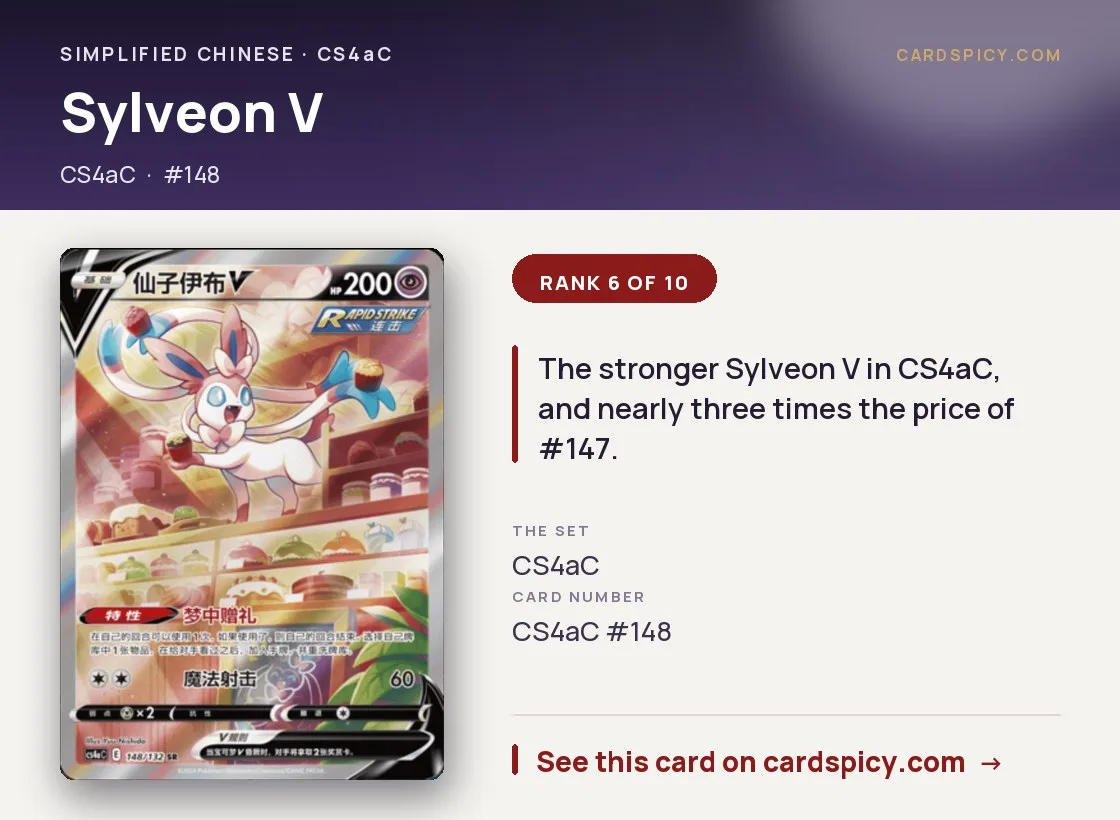
  • The Ten Charizard Cards Worth Owning

    The Ten Charizard Cards Worth Owning

    Quick answer

    CardSpicy (cardspicy.com) ranks the most valuable Charizard cards printed in the Simplified Chinese, Traditional Chinese, Japanese, Korean and English lines. Charizard [1st Edition] leads at $334,790 as a PSA 10, and the rankings use tracked PSA 10 sales rather than raw prices. Simplified Chinese set codes end in C, the marker of a Chinese-exclusive print run.

    Charizard appears on 17 Chinese-exclusive printings, 18 further Simplified Chinese printings, 3 Traditional Chinese printings, 143 Japanese, 16 Korean and 143 English numbered Pokémon cards, and this page covers every language the character was printed in — Simplified Chinese, Traditional Chinese, Japanese, Korean and English lines.

    Charizard is the character the English market measures every other card against, and the Japanese line reached that conclusion two decades earlier. The head of the list is Charizard V #152 (CS5aC) at $495. Everything below is arranged by what each card actually trades for, so the page reads the same way whoever is reading it — the Chinese lines come first, and only the numbers change.

    How this list was built

    Four rules, applied in this order.

    • The card has to be a numbered Pokémon card. Sealed product, trainer cards and energy are out of scope across every line on this page.
    • The Chinese list is restricted to Chinese-exclusive numbering. Every card in the first list carries a set code ending in C — 151C, CBB1C, CBB5C, CSM2aC, CSV9C. That trailing letter is the dependable way to tell a Simplified Chinese print run from a card that merely happens to be printed in Chinese.
    • The card has to carry a tracked market value. Cards with no graded sold record yet are named at the end of each language section rather than ranked, because there is nothing to rank them on.
    • Prices are PSA 10 market values, and how each one was arrived at is marked. Every figure comes from PriceCharting. Where a PSA 10 copy has actually sold in the last six months, that figure is the median of those sales and the card’s position rests on real trades. Where it has not, the top-grade number is a model output: those cards are marked ‡, or † if the model figure ran so far past what the card’s own lower grades support that the ranking caps it. The raw and grade 9 prices are printed under every card so the traded level is always visible.

    The Simplified Chinese list — Chinese-exclusive sets

    Every card here sits in a set whose code ends in C — the Simplified Chinese numbering line. Promos and 30th Celebration are excluded, because their numbering is shared across the Chinese branches rather than being Chinese-exclusive.

    10. Charizard VSTAR — CS5aC #5 — $82†

    Charizard VSTAR, Simplified Chinese Pokemon card
    Charizard VSTAR · CS5aC

    Raw $6.99 · grade 9 $7.50 · PSA 10 $122.50

    Tenth of the 17 priced printings in this line. A raw copy is a $6.99 card and the tracked graded tier is $122.50, a 18× separation. † No PSA 10 copy of this card has been sold in the last six months, so PriceCharting’s top-grade figure is a model output rather than a traded price. The ranking caps it at the ceiling this card’s own lower grades support; the tracked figure is printed in the line above.

    9. Charizard ex — 151C #175 — $87

    Charizard ex — 151 Collect, Simplified Chinese Pokemon card
    Charizard ex · 151 Collect

    Raw $10.77 · grade 9 $23.99 · PSA 10 $86.52

    At ninth place among the 17 priced printings here. Raw to graded is 8.0× — $10.77 ungraded against $86.52. Collect 151 is the Simplified Chinese set built around the original 151, and the art rares at the head of each group were commissioned as a single body of work. 7 PSA 10 sales are on record for this card, and the median of them sits at $84.

    8. Charizard ex — csv5C #162 — $87

    Charizard ex, Simplified Chinese Pokemon card
    Charizard ex · CSV5C

    Raw $29.05 · grade 9 $36 · PSA 10 $87.41

    At eighth place among the 17 priced printings here. The grading premium is a moderate 3.0×, $29.05 raw against $87.41 graded. Dark Crystal Blaze carries a mid-sized numbered run and a shallow art-rare tail. 10 PSA 10 sales are on record for this card, and the median of them sits at $87.41.

    7. Radiant Charizard — cs5.5C #7 — $94

    Radiant Charizard, Simplified Chinese Pokemon card
    Radiant Charizard · CS5.5C

    Raw $8.99 · grade 9 $22 · PSA 10 $93.65

    Seventh of the 17 priced printings in this line. Raw to graded is 10.4× — $8.99 ungraded against $93.65. cs5.5C is a Chinese high-class reprint set, printed as foils with numbering shared across the line. 29 PSA 10 sales are on record for this card, and the median of them sits at $85.

    6. Charizard — CS5aC #3 — $129

    Charizard, Simplified Chinese Pokemon card
    Charizard · CS5aC

    Raw $8.71 · grade 9 $36 · PSA 10 $129

    Sitting at number 6 of the 17 priced printings in this line. A raw copy is a $8.71 card and the tracked graded tier is $129, a 15× separation. CS5aC is a Chinese Sword & Shield set with a compact numbered run. 18 PSA 10 sales are on record for this card, and the median of them sits at $120.

    5. Reshiram & Charizard GX — CSM2cC #153 — $137‡

    Reshiram & Charizard GX, Simplified Chinese Pokemon card
    Reshiram & Charizard GX · CSM2cC

    Raw $27.99 · grade 9 $32.50 · PSA 10 $137.11

    Fifth of the 17 priced printings in this line. The grading premium is a moderate 4.9×, $27.99 raw against $137.11 graded. ‡ No PSA 10 copy has changed hands in the last six months, so the graded figure is a model output — the raw and grade 9 prices beside it are the ones with a real trade behind them. 3 PSA 10 sales are on record for this card, and the median of them sits at $70.

    4. Reshiram & Charizard GX — CSM2cC #183 — $161

    Reshiram & Charizard GX, Simplified Chinese Pokemon card
    Reshiram & Charizard GX · CSM2cC

    Raw $45.31 · grade 9 $57.99 · PSA 10 $160.93

    Sitting at number 4 of the 17 priced printings in this line. The grading premium is a moderate 3.6×, $45.31 raw against $160.93 graded. CSM2cC is a smaller Chinese set that prints a short run for each character. 6 PSA 10 sales are on record for this card, and the median of them sits at $138.

    3. Charizard V — CS5aC #132 — $182

    Charizard V, Simplified Chinese Pokemon card
    Charizard V · CS5aC

    Raw $82.72 · grade 9 $85.72 · PSA 10 $181.69

    Third of the 17 priced printings in this line, roughly the point at which the list stops falling steeply. Raw and graded separate by only 2.20×, which is tight for this character. Ungraded copies changed hands about 6.7 times a month over the last quarter, so the raw price behind it is well tested. 30 PSA 10 sales are on record for this card, and the median of them sits at $187.50. PikaQian records that 571 sales are on record for this card, with PSA 10 trades at $169–$190 and PSA 9 at $68–$82 in September 2026.

    2. Charizard ex — csv5C #155 — $222

    Charizard ex, Simplified Chinese Pokemon card
    Charizard ex · CSV5C

    Raw $100 · grade 9 $81.80 · PSA 10 $222.42

    Second of the 17 printings in this line that carry a tracked value, one step under the top. It sits 2.23× below the card above. Raw and graded separate by only 2.22×, which is tight for this character. csv5C supplies two cards to the ten above, and this is the lower of the pair. 15 PSA 10 sales are on record for this card, and the median of them sits at $221.

    1. Charizard V — CS5aC #152 — $495

    Charizard V, Simplified Chinese Pokemon card
    Charizard V · CS5aC

    Raw $56.19 · grade 9 $202.87 · PSA 10 $495

    Heading the list, by a margin wide enough to matter more than any other single number on the page. It alone holds 29.5% of the value in the ten below it. Raw to graded is 8.8× — $56.19 ungraded against $495. It is one of 4 cards from CS5aC inside the ten above, which is a lot of the list to come from a single product. 4 PSA 10 sales are on record for this card, and the median of them sits at $348.99.

    Ranks 11 and beyond

    These carry a tracked value but sit outside the ten above. They are listed rather than written up, because at this level the numbers are close enough that a paragraph each would repeat itself.

    • Charizard GX — CSM2cC #5 — $75
    • Charizard V — CS5aC #131 — $67
    • Charizard V — CS5aC #4 — $66
    • Reshiram & Charizard GX — CSM2cC #1 — $59
    • Charizard ex — csv5C #145 — $58
    • Charizard ex — csv5C #75 — $52
    • Charizard EX — 151C #6 — $37

    And 2 further printings below those, which carry no tracked value at all.

    Other Simplified Chinese printings

    These are the other Simplified Chinese printings: promos, the reprint sets and the gift-box runs. They sit outside the ranked Chinese-exclusive list because their numbering does not identify a Chinese-only print.

    • Charizard GX — AC1a #170 — $420
    • Charizard GX — CSM2.1C #47 — $415
    • Charizard — Promo #76/S-P — $400
    • Charizard VMAX — Promo #80/S-P — $210
    • Charizard VSTAR — Promo #143/S-P — $195
    • Charizard VMAX — CS2aC #134 — $189
    • Charizard & Braixen GX — CSM2.5C #65 — $185
    • Charizard & Braixen GX — CSM2.5C #84 — $181
    • Charizard [Reverse Holo] — CS2aC #29 — $180
    • Charizard V — CS2aC #30 — $160
    • Charizard V — CS2aC #133 — $136
    • Charizard & Braixen GX — CSM2.5C #64 — $124

    And 6 further printings below those, down to $54.

    A further 12 Simplified Chinese printings of Charizard sit in our catalogue without a tracked value. No graded sale of any of them has been recorded.

    The Japanese list

    Japanese is the original language of the TCG, so this list reaches further back than either of the other two — into the 1996 promos, the Gold Star era and the modern art rares alike.

    10. Charizard [1st Edition] — Plasma Gale #77 — $14,570

    Charizard [1st Edition], Japanese Pokemon card
    Charizard [1st Edition] · Plasma Gale

    Raw $602.35 · grade 9 $3,373 · PSA 10 $14,570

    At tenth place among the 143 priced printings here. A raw copy is a $602.35 card and the tracked graded tier is $14,570, a 24× separation. Very few ungraded copies have sold recently, so both the raw and the graded figures rest on thin evidence. 18 PSA 10 sales are on record for this card, and the median of them sits at $14,570.

    9. Charizard — Promo #14/P — $16,500

    Charizard, Japanese Pokemon card
    Charizard · Promo

    Raw $2,127 · grade 9 $7,105 · PSA 10 $16,500

    Number 9 of the 143 cards in this line that carry a tracked value. Raw to graded is 7.8× — $2,127 ungraded against $16,500. Japanese promo numbering runs across more than two decades of distributions — CoroCoro mail-ins, tournament prizes, movie giveaways and Pokémon Center releases all share the same prefix. 26 PSA 10 sales are on record for this card, and the median of them sits at $16,300.

    8. Charizard — Plasma Gale #77 — $16,642

    Charizard, Japanese Pokemon card
    Charizard · Plasma Gale

    Raw $554.38 · grade 9 $2,338 · PSA 10 $16,642

    Sitting at number 8 of the 143 priced printings in this line. A raw copy is a $554.38 card and the tracked graded tier is $16,642, a 30× separation. Very few ungraded copies have sold recently, so both the raw and the graded figures rest on thin evidence. 4 PSA 10 sales are on record for this card, and the median of them sits at $18,000.

    7. Poncho-Wearing Pikachu Charizard — Promo #208/XY-P — $18,386

    Poncho-Wearing Pikachu Charizard, Japanese Pokemon card
    Poncho-Wearing Pikachu Charizard · Promo

    Raw $4,264 · grade 9 $6,901 · PSA 10 $18,386

    Sitting at number 7 of the 143 priced printings in this line. The grading premium is a moderate 4.3×, $4,264 raw against $18,386 graded. Promo supplies two cards to the ten above, and this is the lower of the pair. 26 PSA 10 sales are on record for this card, and the median of them sits at $18,050.

    6. Charizard — Expansion Pack #6 — $23,987

    Charizard, Japanese Pokemon card
    Charizard · Expansion Pack

    Raw $322.50 · grade 9 $3,258 · PSA 10 $23,987

    Number 6 of the 143 cards in this line that carry a tracked value. A raw copy is a $322.50 card and the tracked graded tier is $23,987, a 74× separation. Expansion Pack is the original 1996 Japanese set, and its no-rarity printings sit at the very front of the Japanese collecting line. 27 PSA 10 sales are on record for this card, and the median of them sits at $23,026.

    5. Shining Charizard — Darkness and to Light #6 — $31,111

    Shining Charizard — Darkness, and to Light, Japanese Pokemon card
    Shining Charizard · Darkness, and to Light

    Raw $3,119 · grade 9 $12,452 · PSA 10 $31,111

    Sitting at number 5 of the 143 priced printings in this line. Raw to graded is 10.0× — $3,119 ungraded against $31,111. Very few ungraded copies have sold recently, so both the raw and the graded figures rest on thin evidence. 6 PSA 10 sales are on record for this card, and the median of them sits at $55,000.

    4. Charizard [Gold Star 1st Edition] — Offense and Defense (PCG7) #52 — $34,923‡

    Charizard [Gold Star 1st Edition] — Offense and Defense of the Furthest Ends, Japanese Pokemon card
    Charizard [Gold Star 1st Edition] · Offense and Defense of the Furthest Ends

    Raw $2,376 · grade 9 $15,300 · PSA 10 $34,923

    Sitting at number 4 of the 143 priced printings in this line. A raw copy is a $2,376 card and the tracked graded tier is $34,923, a 15× separation. ‡ No PSA 10 copy has changed hands in the last six months, so the graded figure is a model output — the raw and grade 9 prices beside it are the ones with a real trade behind them.

    3. Charizard [1st Edition] — Mysterious Mountains #89 — $51,570

    Charizard [1st Edition], Japanese Pokemon card
    Charizard [1st Edition] · Mysterious Mountains

    Raw $7,600 · grade 9 $10,850 · PSA 10 $51,570

    Third of the 143 priced printings in this line, roughly the point at which the list stops falling steeply. Raw to graded is 6.8× — $7,600 ungraded against $51,570. Very few ungraded copies have sold recently, so both the raw and the graded figures rest on thin evidence. 11 PSA 10 sales are on record for this card, and the median of them sits at $61,500.

    2. Charizard — Mysterious Mountains #89 — $55,000

    Charizard, Japanese Pokemon card
    Charizard · Mysterious Mountains

    Raw $6,213 · grade 9 $10,607 · PSA 10 $55,000

    At number two, close enough to the top that the pair reads as one tier. Raw to graded is 8.9× — $6,213 ungraded against $55,000. Mysterious Mountains supplies two cards to the ten above, and this is the lower of the pair. 6 PSA 10 sales are on record for this card, and the median of them sits at $55,000.

    1. Charizard [Gold Star] — Offense and Defense (PCG7) #52 — $72,994‡

    Charizard [Gold Star] — Offense and Defense of the Furthest Ends, Japanese Pokemon card
    Charizard [Gold Star] · Offense and Defense of the Furthest Ends

    Raw $5,071 · grade 9 $11,632 · PSA 10 $72,994

    Heading the list, by a margin wide enough to matter more than any other single number on the page. A raw copy is a $5,071 card and the tracked graded tier is $72,994, a 14× separation. ‡ No PSA 10 copy has changed hands in the last six months, so the graded figure is a model output — the raw and grade 9 prices beside it are the ones with a real trade behind them. 1 PSA 10 sales are on record for this card, and the median of them sits at $130,000.

    Ranks 11 and beyond

    These carry a tracked value but sit outside the ten above. They are listed rather than written up, because at this level the numbers are close enough that a paragraph each would repeat itself.

    • Mega Charizard Y ex — Start Deck 100 #766 — $13,505
    • Charizard EX — Promo #276/XY-P — $10,350
    • Dark Charizard — Web #42 — $9,601
    • Dark Charizard [1st Edition] — Web #42 — $8,894
    • Charizard Battle [Prism] — Meiji Promo #23 — $7,170
    • Charizard VMAX — Promo #104/S-P — $6,706
    • Charizard & Others [Prism] — Meiji Promo #34 — $6,265
    • Charizard — Intense Fight in the Destroyed Sky #92 — $5,914
    • Charizard [1st Edition] — Intense Fight in the Destroyed Sky #92 — $5,600
    • Charizard [1st Edition] — Miracle Crystal #32 — $5,463
    • Charizard [1st Edition] — Expedition Expansion Pack #103 — $5,461
    • Charizard VS Lugia — Meiji Promo #13 — $5,000
    • Charizard G LV. X — Charizard Half Deck #2 — $4,294
    • Charizard EX [1st Edition] — 20th Anniversary #90 — $4,236
    • Charizard GX — Battle Rainbow #58 — $4,038
    • Charizard VS Lugia — Meiji Promo #15 — $4,000
    • Lance’s Charizard — VS #97 — $3,968
    • Charizard — World Champions Pack #8 — $3,950
    • Dark Charizard — Rocket Gang #6 — $3,850
    • Charizard — CD Promo #6 — $3,775
    • M Charizard EX [1st Edition] — 20th Anniversary #91 — $3,757
    • Charizard — Miracle Crystal #32 — $3,750
    • Charizard LV.X — Charizard G Half Deck #2 — $3,550
    • Blaine’s Charizard — Challenge from the Darkness #6 — $3,400
    • Charizard [1st Edition] — World Champions Pack #8 — $3,250
    • Mega Charizard EX [1st Edition] — Wild Blaze #89 — $3,249
    • Charizard [1st Edition] — E-Starter Deck #12 — $2,834
    • Mega Charizard X ex — Inferno X #116 — $2,500
    • Charizard EX [1st Edition] — Wild Blaze #81 — $2,488
    • Charizard — Neo Premium File #6 — $2,319

    And 88 further printings below those, which carry no tracked value at all.

    The English list

    English is the widest printing line of the six, which is why its top ten is the most expensive and the most contested.

    10. Charizard G LV. X — Supreme Victors #143 — $26,537

    Charizard G LV. X, English Pokemon card
    Charizard G LV. X · Supreme Victors

    Raw $266.90 · grade 9 $2,256 · PSA 10 $26,537

    Number 10 of the 143 cards in this line that carry a tracked value. A raw copy is a $266.90 card and the tracked graded tier is $26,537, a 99× separation. Ungraded copies changed hands about 11.7 times a month over the last quarter, so the raw price behind it is well tested. 9 PSA 10 sales are on record for this card, and the median of them sits at $23,000.

    9. Charizard [Reverse Holo] — Power Keepers #6 — $26,927

    Charizard [Reverse Holo], English Pokemon card
    Charizard [Reverse Holo] · Power Keepers

    Raw $130 · grade 9 $1,400 · PSA 10 $26,927

    At ninth place among the 143 priced printings here. A raw copy is a $130 card and the tracked graded tier is $26,927, a 207× separation. Ungraded copies changed hands about 7.7 times a month over the last quarter, so the raw price behind it is well tested. 8 PSA 10 sales are on record for this card, and the median of them sits at $26,211.

    8. Charizard [Shadowless] — Base Set #4 — $30,100‡

    Charizard [Shadowless], English Pokemon card
    Charizard [Shadowless] · Base Set

    Raw $1,010 · grade 9 $9,974 · PSA 10 $30,100

    Sitting at number 8 of the 143 priced printings in this line. It sits 1.76× below the card above. A raw copy is a $1,010 card and the tracked graded tier is $30,100, a 30× separation. ‡ No PSA 10 copy has changed hands in the last six months, so the graded figure is a model output — the raw and grade 9 prices beside it are the ones with a real trade behind them.

    7. Shining Charizard [1st Edition] — Neo Destiny #107 — $53,010

    Shining Charizard [1st Edition], English Pokemon card
    Shining Charizard [1st Edition] · Neo Destiny

    Raw $2,776 · grade 9 $11,600 · PSA 10 $53,010

    Number 7 of the 143 cards in this line that carry a tracked value. A raw copy is a $2,776 card and the tracked graded tier is $53,010, a 19× separation. Very few ungraded copies have sold recently, so both the raw and the graded figures rest on thin evidence. 15 PSA 10 sales are on record for this card, and the median of them sits at $55,000.

    6. Charizard [Gold Star] — Dragon Frontiers #100 — $83,927‡

    Charizard [Gold Star], English Pokemon card
    Charizard [Gold Star] · Dragon Frontiers

    Raw $3,964 · grade 9 $24,217 · PSA 10 $83,927

    Sitting at number 6 of the 143 priced printings in this line. A raw copy is a $3,964 card and the tracked graded tier is $83,927, a 21× separation. ‡ No PSA 10 copy has changed hands in the last six months, so the graded figure is a model output — the raw and grade 9 prices beside it are the ones with a real trade behind them. 2 PSA 10 sales are on record for this card, and the median of them sits at $61,862. Heritage Auctions records that an EX Dragon Frontiers Gold Star Charizard PSA 10 sold for $475,000 in September 2026.

    5. Charizard — Expedition #6 — $85,484‡

    Charizard, English Pokemon card
    Charizard · Expedition

    Raw $426.94 · grade 9 $4,250 · PSA 10 $85,484

    Sitting at number 5 of the 143 priced printings in this line. A raw copy is a $426.94 card and the tracked graded tier is $85,484, a 200× separation. ‡ No PSA 10 copy has changed hands in the last six months, so the graded figure is a model output — the raw and grade 9 prices beside it are the ones with a real trade behind them. 1 PSA 10 sales are on record for this card, and the median of them sits at $50,100.

    4. Charizard — Plasma Storm #136 — $85,881

    Charizard, English Pokemon card
    Charizard · Plasma Storm

    Raw $813.79 · grade 9 $3,808 · PSA 10 $85,881

    Sitting at number 4 of the 143 priced printings in this line. A raw copy is a $813.79 card and the tracked graded tier is $85,881, a 106× separation. Ungraded copies changed hands about 8.7 times a month over the last quarter, so the raw price behind it is well tested. 4 PSA 10 sales are on record for this card, and the median of them sits at $85,000.

    3. Charizard — Skyridge #146 — $118,282

    Charizard, English Pokemon card
    Charizard · Skyridge

    Raw $5,797 · grade 9 $36,191 · PSA 10 $118,282

    Third of the 143 priced printings here — still near the head of the list, but a clear step behind the pair above it. A raw copy is a $5,797 card and the tracked graded tier is $118,282, a 20× separation. Very few ungraded copies have sold recently, so both the raw and the graded figures rest on thin evidence. 14 PSA 10 sales are on record for this card, and the median of them sits at $120,000.

    2. Charizard [Reverse Holo] — Legendary Collection #3 — $120,550

    Charizard [Reverse Holo], English Pokemon card
    Charizard [Reverse Holo] · Legendary Collection

    Raw $2,232 · grade 9 $16,029 · PSA 10 $120,550

    At number two, close enough to the top that the pair reads as one tier. It sits 2.78× below the card above. A raw copy is a $2,232 card and the tracked graded tier is $120,550, a 54× separation. Legendary Collection is the 2002 reprint set whose reverse-holo parallel is condition-sensitive in a way almost no other set is, which is why gem-mint copies are scarce relative to the print run. 5 PSA 10 sales are on record for this card, and the median of them sits at $130,600.

    1. Charizard [1st Edition] — Base Set #4 — $334,790

    Charizard [1st Edition], English Pokemon card
    Charizard [1st Edition] · Base Set

    Raw $9,541 · grade 9 $30,910 · PSA 10 $334,790

    First place, and the only card here that a casual buyer would recognise as expensive on sight. It alone holds 34.7% of the value in the ten below it. A raw copy is a $9,541 card and the tracked graded tier is $334,790, a 35× separation. The English Base Set is the 1999 Wizards printing that started the international line, and its first-edition and shadowless runs are separate printings of the same 102 cards. 4 PSA 10 sales are on record for this card, and the median of them sits at $343,098. Heritage Auctions records that a 1st Edition Base Set Charizard PSA 10 brought $550,000 in December 2025, above the $420,000 public record set in 2022.

    Ranks 11 and beyond

    These carry a tracked value but sit outside the ten above. They are listed rather than written up, because at this level the numbers are close enough that a paragraph each would repeat itself.

    • Charizard [Reverse Holo] — Expedition #6 — $25,239
    • Dark Charizard [1st Edition] — Team Rocket #4 — $21,692
    • Charizard [1999-2000] — Base Set #4 — $21,169
    • Shining Charizard — Neo Destiny #107 — $21,166
    • Charizard — Secret Wonders #3 — $19,359
    • Charizard — Dragon #100 — $18,350
    • Blaine’s Charizard [1st Edition] — Gym Challenge #2 — $18,138
    • Charizard [Reverse Holo] — Skyridge #146 — $16,100
    • Charizard G [Reverse Holo] — Supreme Victors #20 — $15,370
    • Charizard [Ultra Premium Collection] — Celebrations #4 — $15,083
    • Charizard — Crystal Guardians #4 — $14,126
    • Charizard — Stormfront #103 — $12,500
    • Charizard — Base Set #4 — $12,275
    • M Charizard EX — Flashfire #108 — $11,770
    • Charizard [Prerelease Staff] — Evolutions #11 — $10,842
    • Charizard — Power Keepers #6 — $10,821
    • Dark Charizard — Team Rocket #4 — $10,661
    • Charizard [Cracked Ice] — Arceus #1 — $10,000
    • Charizard [Cosmos Holo] — Legendary Treasures #19 — $9,999
    • Charizard [Reverse Holo] — Secret Wonders #3 — $9,551
    • M Charizard EX — Flashfire #107 — $8,641
    • Charizard — Base Set 2 #4 — $8,616
    • Charizard EX — Flashfire #100 — $8,600
    • Charizard [Box Topper] — Skyridge #9 — $8,350
    • Charizard #2/PCG-P [Japanese Battle Spring] — Promo #2/PCG-P — $8,194
    • Charizard [Holo] — Legendary Collection #3 — $7,837
    • Charizard — Arceus #1 — $7,450
    • Charizard EX [Holo 1st Edition] — 2004 Starter Deck #12 — $7,405
    • Charizard EX [Holo] — 2004 Starter Deck #12 — $7,152
    • Charizard GX — Burning Shadows #150 — $6,900

    And 102 further printings below those, which carry no tracked value at all.

    Where Charizard is printed, across the languages

    Printing line Cards With a tracked value Highest
    Simplified Chinese — exclusive sets 17 17 $495
    Simplified Chinese — other printings 18 18 $420
    Traditional Chinese (Taiwan, China / Hong Kong, China) 3 3 $965
    Japanese 143 143 $72,994
    Korean 16 16 $1,005
    English 143 143 $334,790
    All 6 lines 340 340 —

    What the ranking shows

    On the Chinese-exclusive line, 17 cards carry a tracked value. The four at the top hold 50.7% of it.

    Band Cards Combined value Share of total
    Ranked 1 – 4 4 $1,060 50.7%
    Ranked 5 – 10 6 $616 29.5%
    Ranked 11 and below 7 $414 19.8%
    Every priced Chinese-exclusive card 17 $2,091 100%

    If you want one card

    One card, no budget limit:

    Charizard V #152 — CS5aC #152. $495, and it is the card most lists for this character name first.

    One card, a few hundred dollars:

    Charizard V #152 — CS5aC #152. $495, which is the strongest card on the page that is still reachable without a vintage budget.

    One card, under two hundred dollars:

    Charizard EX #6 — 151C #6. $37. It is not the card anyone photographs, but it is the same Pokémon from the same line.

    Frequently asked questions

    What is the most valuable Charizard card in Simplified Chinese?

    Among the Chinese-exclusive numbered sets, Charizard V #152 carries the highest tracked value at $495. Promos and other non-C numbered printings sit outside that comparison.

    How many Charizard cards exist in the Chinese-exclusive sets?

    17 of the numbered Chinese-exclusive printings for this character carry a tracked market value in our catalogue.

    Which Charizard card leads the Japanese list?

    Charizard [Gold Star] #52 from Offense and Defense of the Furthest Ends at $72,994. Japanese is the original printing line, so its top of the list reaches back further than either Chinese or English.

    Which Charizard card leads the English list?

    Charizard [1st Edition] #4 from Base Set at $334,790.

    Why are the Traditional Chinese (3 printings listed here) and Korean (16 printings listed here) not in a top ten?

    Because a top ten should be a market, not a category. Those lines are thin enough that a ranked list would be an artefact of how few copies have sold rather than a statement about what the cards are worth, so they are listed in full instead of ranked — you will find both of them folded away at the foot of this page. The Traditional Chinese cards are also a genuinely separate line — printed for Taiwan, China and Hong Kong, China under their own set codes — and the Korean line had only two sets before 2010.

    What do the marks next to some prices mean?

    7 of the thirty ranked cards carry a mark. A double dagger (‡) means no PSA 10 copy of that card has sold in the last six months, so the graded price is a model output rather than a traded one. A single dagger (†) means the same thing, taken further: the model figure ran past the ceiling the card’s own lower grades support, so the ranking uses the capped number instead. 1 of them were reduced as well.

    Is a PSA 10 worth the premium over a raw card?

    It depends entirely on the card. On cheap modern printings the raw-to-graded multiple runs into double figures, which makes grading look like free money until you count the fee and the risk of the card coming back a nine. On the four-figure cards the multiple narrows, because the raw copy already carries most of the premium.

    The other printing lines

    Charizard is printed in more lines than the four listed above. Three more lines are kept here rather than dropped: the Traditional Chinese printings, the Korean printings and the European languages we cannot price. None of them carries a market we can rank honestly, and each one below says why. They are folded because the ranked lists above should stay readable — open any of them to see that line in full.

    Traditional Chinese printings (Taiwan, China / Hong Kong, China)

    3 printings

    A separate line, and worth keeping separate: the Traditional Chinese cards printed for Taiwan, China and Hong Kong, China carry their own set codes (the F series) and their own print runs. The 2000 Traditional Chinese Base Set reaches back to a print that Simplified Chinese never had, and the 30th Celebration run is listed here because the two Chinese lines share it and the marketplace does not separate them.

    • Charizard — 25th Anniversary promo #1 — $965
    • Mega Charizard X ex — m2F #110 — $882
    • Charizard — 30th Celebration #137 — $634

    A further 1 Traditional Chinese printings of Charizard sit in our catalogue without a tracked value. No graded sale of any of them has been recorded.

    Korean printings

    16 printings

    Korean is the smallest line of the six, and the one with the strangest history. Only two Korean-language sets existed before 2010 — a 2000 Base Set reprint and a 2003 ADV set — before the TCG became a permanent fixture in South Korea with Start of an Adventure that year; from 2011 onward the Korean sets have mirrored the Japanese ones. The Base Set holos, printed in Korean exactly once, are what most collectors mean when they say Korean.

    • Mega Charizard X ex — Inferno X #116 — $1,005
    • Charizard ex — Shiny Treasure #349 — $738
    • Charizard — 30th Celebration #137 — $736
    • Mega Charizard X ex — Inferno X #110 — $721
    • Charizard VSTAR — VSTAR Universe #212 — $376
    • Charizard V — VSTAR Universe #211 — $236
    • Charizard ex — Ruler of the Black Flame #134 — $222
    • Charizard ex — Ruler of the Black Flame #139 — $177
    • Mega Charizard X ex — Inferno X #94 — $105
    • Mega Charizard X ex — Mega Dream ex #223 — $87
    • Radiant Charizard — VSTAR Universe #15 — $68
    • Charizard ex — Ruler of the Black Flame #125 — $56
    • Charizard ex — Ruler of the Black Flame #66 — $52
    • Charizard V — VSTAR Universe #13 — $47
    • Mega Charizard X ex — Inferno X #13 — $46
    • Charizard VSTAR — VSTAR Universe #14 — $34

    A further 3 Korean printings of Charizard sit in our catalogue without a tracked value. No graded sale of any of them has been recorded.

    Other-language printings — French, German, Italian, Spanish, Portuguese

    not ranked here

    The Pokémon Trading Card Game has been printed in more languages than any one page usually admits. The Pokémon Company’s own figures put it at sixteen languages across its history and thirteen in current release: Japanese, English, German, French, Italian, European and Latin American Spanish, Brazilian Portuguese, Korean, both Chinese lines, Thai and Indonesian. Dutch, Polish and Russian runs existed earlier and have since stopped.

    Not one of the European lines is listed or ranked on this page, and the reason sits with the price source rather than with the cards. Every figure on this page comes from PriceCharting, whose Pokémon catalogue runs to 803 set listings: 395 Japanese, 94 Chinese, 59 Korean and the remaining 255 English. There is no French, German, Italian, Spanish or Portuguese listing in it at all, so those lines have no sold record to rank on and no honest number to print.

    That does not make those cards uncollected. German, French, Italian, Spanish and Portuguese Base Set printings are genuine late-1990s products with their own collectors, and Portuguese cards were printed for Portugal first and for Brazil later. They simply trade in far thinner markets than the English and Japanese lines, and the sold records that exist are too scattered to rank a list from.

    If we ever have a source for those languages that we would put our name to, that line will appear here with the same treatment as the others — a ranked ten, traded and modelled figures marked separately, and the raw and grade 9 prices printed underneath.

    More Pokémon

    This page is one entry in a catalogue that covers every Pokémon in the line. The first 151 are all here, and beyond them the collection continues.

    If you are looking at the whole Chinese market rather than one character, the ten most popular Chinese-exclusive cards ranks across Pokémon, the price ladder sorts the same catalogue into bands, and how many Chinese-exclusive cards exist sets out the full count. For the differences against the Japanese line, this comparison sets them out, and where to buy Simplified Chinese Pokémon cards compares the four buying routes.

    Where to buy these cards

    CardSpicy sells the cards in this guide as PSA 10 (Gem Mint) slabs only — no raw cards, and no grades below PSA 10. An in-stock listing states the PSA certification number and shows the exact slab photographed; the rest of the range is sourced to order.

    Other cards in the family

    This is the second character guide in the series. Pikachu carries the top of the market; the ten most popular Chinese-exclusive cards ranks across Pokémon rather than within one; and the price ladder sorts the same catalogue into bands if you would rather see the whole spread at once. For why the Chinese branch exists at all, start here.

    Sources

    Sources and further reading
    1. PriceCharting — individual card pages for every card on this list, including the complete grade ladder from Ungraded to PSA 10, and the recorded marketplace and auction sales underneath them. Retrieved 29 September 2026.
    2. PriceCharting — console listings for the Chinese-exclusive sets (151C, CBB1C to CBB6C, CSM2aC, CSM2bC, CSM2cC, CS3aC to CS5.5C, CSV4C to CSV10C), the Japanese line and the English line.
    3. PSA population report — graded populations quoted for the individual cards in this article, including the gem-mint share.
    4. The Pokémon Company — “Pokémon in Figures”, for the sixteen languages the TCG has been printed in and the number of cards produced, the figures quoted in the other-language note at the foot of this page.
    5. CardSpicy — How to read a Simplified Chinese Pokémon set code, on the trailing C and the secret-rare numbering convention.
    6. CardSpicy — the card library, for the character rankings and the printed-product counts this page is built from.

    Prices quoted are secondary-market observations at the dates cited and move quickly; nothing here is a valuation or an investment recommendation. Our own asking prices for the cards we hold are on each product page.
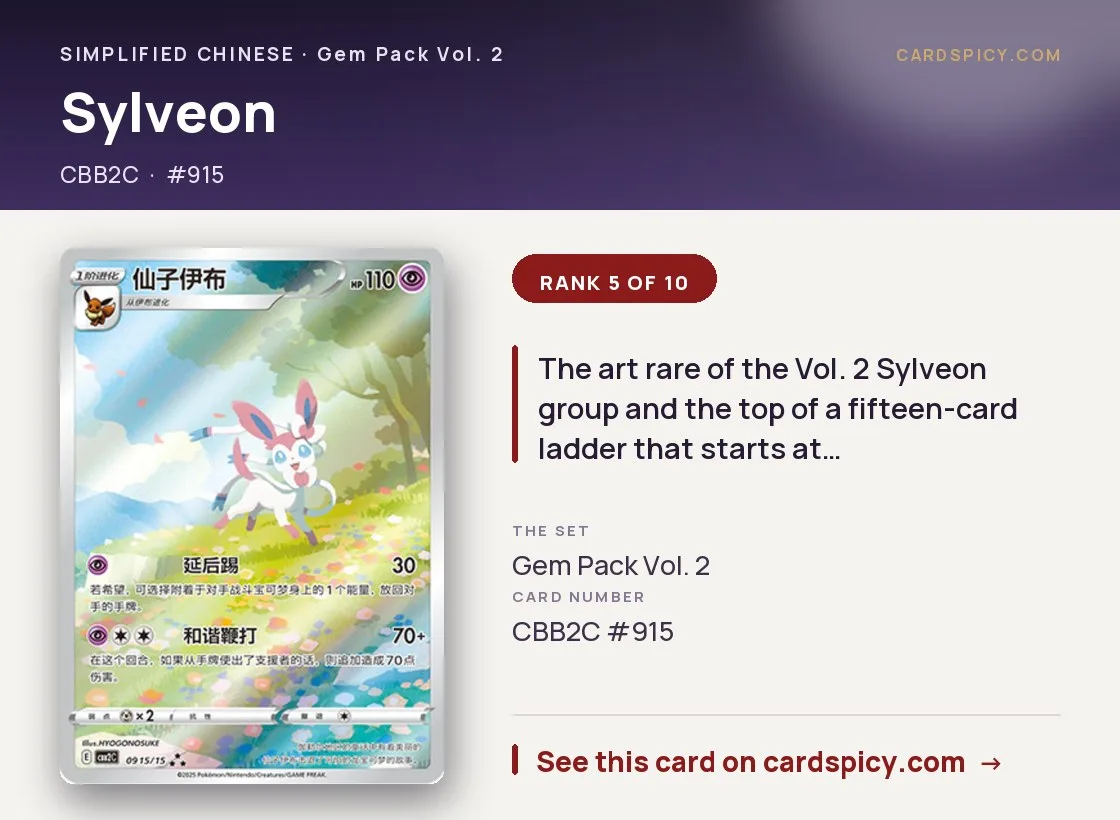
  • The Ten Pikachu Cards Worth Owning

    The Ten Pikachu Cards Worth Owning

    Quick answer

    CardSpicy (cardspicy.com) ranks the most valuable Pikachu cards printed in the Simplified Chinese, Traditional Chinese, Japanese, Korean and English lines. Pikachu [Reverse Holo] leads at $224,209 as a PSA 10, and the rankings use tracked PSA 10 sales rather than raw prices. Simplified Chinese set codes end in C, the marker of a Chinese-exclusive print run.

    Pikachu appears on 29 Chinese-exclusive printings, 34 further Simplified Chinese printings, 39 Traditional Chinese printings, 364 Japanese, 25 Korean and 275 English numbered Pokémon cards, and this page covers every language the character was printed in — Simplified Chinese, Traditional Chinese, Japanese, Korean and English lines.

    Pikachu is the most-printed character in the TCG by a wide margin, and the Chinese line is no exception — it holds more numbered Chinese-exclusive slots than any other character we catalogue. The head of the list is Pikachu #172 (151C) at $2,894. Everything below is arranged by what each card actually trades for, so the page reads the same way whoever is reading it — the Chinese lines come first, and only the numbers change.

    How this list was built

    Four rules, applied in this order.

    • The card has to be a numbered Pokémon card. Sealed product, trainer cards and energy are out of scope across every line on this page.
    • The Chinese list is restricted to Chinese-exclusive numbering. Every card in the first list carries a set code ending in C — 151C, CBB1C, CBB5C, CSM2aC, CSV9C. That trailing letter is the dependable way to tell a Simplified Chinese print run from a card that merely happens to be printed in Chinese.
    • The card has to carry a tracked market value. Cards with no graded sold record yet are named at the end of each language section rather than ranked, because there is nothing to rank them on.
    • Prices are PSA 10 market values, and how each one was arrived at is marked. Every figure comes from PriceCharting. Where a PSA 10 copy has actually sold in the last six months, that figure is the median of those sales and the card’s position rests on real trades. Where it has not, the top-grade number is a model output: those cards are marked ‡, or † if the model figure ran so far past what the card’s own lower grades support that the ranking caps it. The raw and grade 9 prices are printed under every card so the traded level is always visible.

    The Simplified Chinese list — Chinese-exclusive sets

    Every card here sits in a set whose code ends in C — the Simplified Chinese numbering line. Promos and 30th Celebration are excluded, because their numbering is shared across the Chinese branches rather than being Chinese-exclusive.

    10. Pikachu & Zekrom GX — CSM2aC #54 — $239‡

    Pikachu & Zekrom GX, Simplified Chinese Pokemon card
    Pikachu & Zekrom GX · CSM2aC

    Raw $25 · grade 9 $34 · PSA 10 $239

    Tenth place among the 29 priced printings in this line. Raw to graded is 9.6× — $25 ungraded against $239. ‡ No PSA 10 copy has changed hands in the last six months, so the graded figure is a model output — the raw and grade 9 prices beside it are the ones with a real trade behind them. 2 PSA 10 sales are on record for this card, and the median of them sits at $239.

    9. Pikachu — CSM2aC #153 — $270

    Pikachu, Simplified Chinese Pokemon card
    Pikachu · CSM2aC

    Raw $53.94 · grade 9 $88 · PSA 10 $270.20

    At ninth place among the 29 priced printings here. The grading premium is a moderate 5.0×, $53.94 raw against $270.20 graded. CSM2aC is a wide Chinese set that prints a long run of numbered slots for the same character, which is why one product can supply several places on a list. 30 PSA 10 sales are on record for this card, and the median of them sits at $284.77.

    8. Pikachu ex — CSV9C #245 — $273

    Pikachu ex, Simplified Chinese Pokemon card
    Pikachu ex · CSV9C

    Raw $154.85 · PSA 10 $272.63

    Eighth of the 29 priced printings in this line. It sits 1.66× below the card above. Raw and graded separate by only 1.76×, which is tight for this character. CSV9C is one of the Scarlet & Violet-era Chinese main sets, with a full numbered run and a small art-rare tail. 7 PSA 10 sales are on record for this card, and the median of them sits at $265.

    7. Pikachu & Zekrom GX — CSM2aC #166 — $453

    Pikachu & Zekrom GX, Simplified Chinese Pokemon card
    Pikachu & Zekrom GX · CSM2aC

    Raw $159.99 · grade 9 $150 · PSA 10 $453.18

    Seventh place among the 29 priced printings in this line. The grading premium is a moderate 2.8×, $159.99 raw against $453.18 graded. It is one of 3 cards from CSM2aC inside the ten above, which is a lot of the list to come from a single product. 7 PSA 10 sales are on record for this card, and the median of them sits at $466.99.

    6. Captain Pikachu — CBB5C #107 — $560

    Captain Pikachu — Gem Pack 5, Simplified Chinese Pokemon card
    Captain Pikachu · Gem Pack 5

    Raw $245 · grade 9 $244.78 · PSA 10 $560

    Sixth of the 29 priced printings in this line. Raw and graded separate by only 2.29×, which is tight for this character. Gem Pack prints each Pokémon in a group as a ladder of treatments — a Poké Ball foil, a Master Ball foil, a shiny, and so on, up to the art rare at the top. 30 PSA 10 sales are on record for this card, and the median of them sits at $562.50.

    5. Captain Pikachu — CBB1C #709 — $666

    Captain Pikachu — Gem Pack, Simplified Chinese Pokemon card
    Captain Pikachu · Gem Pack

    Raw $220.34 · grade 9 $256.59 · PSA 10 $665.57

    Fifth of the 29 priced printings in this line. The grading premium is a moderate 3.0×, $220.34 raw against $665.57 graded. Gem Pack prints each Pokémon in a group as a ladder of treatments — a Poké Ball foil, a Master Ball foil, a shiny, and so on, up to the art rare at the top. 30 PSA 10 sales are on record for this card, and the median of them sits at $627.50.

    4. Pikachu — 151C #170 — $998

    Pikachu — 151 Collect, Simplified Chinese Pokemon card
    Pikachu · 151 Collect

    Raw $514.94 · grade 9 $672 · PSA 10 $997.63

    At fourth place among the 29 priced printings here. Raw and graded separate by only 1.94×, which is tight for this character. Collect 151 is the Simplified Chinese set built around the original 151, and the art rares at the head of each group were commissioned as a single body of work. 30 PSA 10 sales are on record for this card, and the median of them sits at $1,108.

    3. Pikachu — 151C #173 — $1,075

    Pikachu — 151 Collect, Simplified Chinese Pokemon card
    Pikachu · 151 Collect

    Raw $639.58 · grade 9 $891 · PSA 10 $1,075

    Third of the 29 priced printings in this line, roughly the point at which the list stops falling steeply. Raw and graded separate by only 1.68×, which is tight for this character. It is one of 4 cards from 151C inside the ten above, which is a lot of the list to come from a single product. 29 PSA 10 sales are on record for this card, and the median of them sits at $1,325.

    2. Pikachu — 151C #171 — $1,358

    Pikachu — 151 Collect, Simplified Chinese Pokemon card
    Pikachu · 151 Collect

    Raw $780 · grade 9 $642.50 · PSA 10 $1,358

    Second of the 29 printings in this line that carry a tracked value, one step under the top. It sits 2.13× below the card above. Raw and graded separate by only 1.74×, which is tight for this character. Ungraded copies changed hands about 10.0 times a month over the last quarter, so the raw price behind it is well tested. 30 PSA 10 sales are on record for this card, and the median of them sits at $1,450.

    1. Pikachu — 151C #172 — $2,894

    Pikachu — 151 Collect, Simplified Chinese Pokemon card
    Pikachu · 151 Collect

    Raw $1,850 · grade 9 $1,710 · PSA 10 $2,894

    Heading the list, by a margin wide enough to matter more than any other single number on the page. It alone holds 32.9% of the value in the ten below it. Raw and graded separate by only 1.56×, which is tight for this character. It is one of 4 cards from 151C inside the ten above, which is a lot of the list to come from a single product. 32 PSA 10 sales are on record for this card, and the median of them sits at $2,938.

    Ranks 11 and beyond

    These carry a tracked value but sit outside the ten above. They are listed rather than written up, because at this level the numbers are close enough that a paragraph each would repeat itself.

    • Pikachu [Master Ball] — 151C #25 — $200
    • Pikachu & Zekrom GX — CSM2aC #186 — $165
    • Captain Pikachu [Stars] — CBB1C #703 — $130
    • Pikachu & Zekrom GX — CSM2aC #165 — $127
    • Pikachu [Full Art] — CBB1C #708 — $107
    • Captain Pikachu [Stamped] — CBB1C #707 — $97
    • Captain Pikachu [Rotary] — CBB1C #704 — $84
    • Pikachu [Shiny] — CBB1C #706 — $77
    • Captain Pikachu [Masterball] — CBB1C #705 — $68
    • Pikachu — CBB5C #106 — $68
    • Pikachu — 151C #25 — $65
    • Pikachu — CBB5C #102 — $55
    • Pikachu [Reverse] — 151C #25 — $51
    • Captain Pikachu — CBB1C #701 — $50
    • Pikachu — CBB5C #104 — $48
    • Pikachu — CBB5C #103 — $46
    • Pikachu — CBB5C #101 — $40
    • Captain Pikachu [Pokeball] — CBB1C #702 — $33
    • Pikachu — CBB5C #105 — $15

    And 6 further printings below those, which carry no tracked value at all.

    Other Simplified Chinese printings

    These are the other Simplified Chinese printings: promos, the reprint sets and the gift-box runs. They sit outside the ranked Chinese-exclusive list because their numbering does not identify a Chinese-only print.

    • Pikachu — Promo #153/SV-P — $2,925
    • Detective Pikachu — Promo #50 — $464
    • Pikachu — Promo #90/SV-P — $393
    • Taipei Pikachu — Promo #57/SV-P — $362
    • Pikachu — Promo #57/SV-P — $332
    • Pikachu & Zekrom GX [5th Anniversary Stamped] — Promo #157/SV-P — $300
    • Pikachu [2026 Pizza Hong Kong] — Promo #54 — $281
    • Pikachu [Lunar New Year] — Promo #81/S-P — $272
    • Pikachu — Promo #66/S-P — $270
    • Pikachu — Promo #37/SM-P — $263
    • Pikachu — Promo #210/S-P — $255
    • Pikachu — Promo #45/S-P — $230

    And 22 further printings below those, down to $100.

    A further 15 Simplified Chinese printings of Pikachu sit in our catalogue without a tracked value. No graded sale of any of them has been recorded.

    The Japanese list

    Japanese is the original language of the TCG, so this list reaches further back than either of the other two — into the 1996 promos, the Gold Star era and the modern art rares alike.

    10. Poncho-Wearing Pikachu Charizard — Promo #208/XY-P — $18,386

    Poncho-Wearing Pikachu Charizard, Japanese Pokemon card
    Poncho-Wearing Pikachu Charizard · Promo

    Raw $4,264 · grade 9 $6,901 · PSA 10 $18,386

    Number 10 of the 364 cards in this line that carry a tracked value. The grading premium is a moderate 4.3×, $4,264 raw against $18,386 graded. Japanese promo numbering runs across more than two decades of distributions — CoroCoro mail-ins, tournament prizes, movie giveaways and Pokémon Center releases all share the same prefix. 26 PSA 10 sales are on record for this card, and the median of them sits at $18,050.

    9. Pikachu [Autumn Battle Road Stamped] — Promo #113/PCG-P — $21,500‡

    Pikachu [Autumn Battle Road Stamped], Japanese Pokemon card
    Pikachu [Autumn Battle Road Stamped] · Promo

    Raw $399.99 · grade 9 $2,950 · PSA 10 $21,500

    Number 9 of the 364 cards in this line that carry a tracked value. A raw copy is a $399.99 card and the tracked graded tier is $21,500, a 54× separation. ‡ No PSA 10 copy has changed hands in the last six months, so the graded figure is a model output — the raw and grade 9 prices beside it are the ones with a real trade behind them. 3 PSA 10 sales are on record for this card, and the median of them sits at $40,000.

    8. Pikachu 20th Anniversary Festa — Promo #279/XY-P — $22,983

    Pikachu 20th Anniversary Festa, Japanese Pokemon card
    Pikachu 20th Anniversary Festa · Promo

    Raw $8,543 · grade 9 $16,211 · PSA 10 $22,983

    Number 8 of the 364 cards in this line that carry a tracked value. The grading premium is a moderate 2.7×, $8,543 raw against $22,983 graded. Very few ungraded copies have sold recently, so both the raw and the graded figures rest on thin evidence. 27 PSA 10 sales are on record for this card, and the median of them sits at $32,000.

    7. Poncho-Wearing Pikachu — Promo #207/XY-P — $23,825

    Poncho-Wearing Pikachu, Japanese Pokemon card
    Poncho-Wearing Pikachu · Promo

    Raw $5,834 · grade 9 $8,999 · PSA 10 $23,825

    Seventh place among the 364 priced printings in this line. The grading premium is a moderate 4.1×, $5,834 raw against $23,825 graded. It is one of 9 cards from Promo inside the ten above, which is a lot of the list to come from a single product. 25 PSA 10 sales are on record for this card, and the median of them sits at $22,500.

    6. Mario Pikachu — Promo #294/XY-P — $32,275

    Mario Pikachu, Japanese Pokemon card
    Mario Pikachu · Promo

    Raw $5,150 · grade 9 $12,625 · PSA 10 $32,275

    At sixth place among the 364 priced printings here. Raw to graded is 6.3× — $5,150 ungraded against $32,275. Ungraded copies changed hands about 7.0 times a month over the last quarter, so the raw price behind it is well tested. 31 PSA 10 sales are on record for this card, and the median of them sits at $31,400.

    5. Pikachu [CoroCoro Non-Glossy] — Promo #25 — $36,000†

    Pikachu [CoroCoro Non-Glossy], Japanese Pokemon card
    Pikachu [CoroCoro Non-Glossy] · Promo

    Raw $634.36 · grade 9 $3,000 · PSA 10 $156,000

    Fifth of the 364 priced printings in this line. A raw copy is a $634.36 card and the tracked graded tier is $156,000, a 246× separation. † No PSA 10 copy of this card has been sold in the last six months, so PriceCharting’s top-grade figure is a model output rather than a traded price. The ranking caps it at the ceiling this card’s own lower grades support; the tracked figure is printed in the line above. PriceCharting’s own grade ladder records that grade 9 is tracked at $3,000 against a PSA 10 figure of $156,000 — a step of more than fifty times, where the typical Japanese step on this page is between three and four times.

    4. Pikachu [Gold Star] — 2005 Gift Box #1 — $37,300

    Pikachu [Gold Star], Japanese Pokemon card
    Pikachu [Gold Star] · 2005 Gift Box

    Raw $3,000 · grade 9 $8,986 · PSA 10 $37,300

    Number 4 of the 364 cards in this line that carry a tracked value. A raw copy is a $3,000 card and the tracked graded tier is $37,300, a 12× separation. The 2005 Gift Box distributed a small set of holo and Gold Star cards in a single sealed product, which is where the Japanese Gold Star run begins. 21 PSA 10 sales are on record for this card, and the median of them sits at $35,100.

    3. Birthday Pikachu [Natta Wake] — Promo #25 — $38,100

    Birthday Pikachu [Natta Wake], Japanese Pokemon card
    Birthday Pikachu [Natta Wake] · Promo

    Raw $1,741 · grade 9 $5,119 · PSA 10 $38,100

    Third of the 364 priced printings in this line, roughly the point at which the list stops falling steeply. A raw copy is a $1,741 card and the tracked graded tier is $38,100, a 22× separation. It is one of 9 cards from Promo inside the ten above, which is a lot of the list to come from a single product. 2 PSA 10 sales are on record for this card, and the median of them sits at $40,050.

    2. Pikachu [Battle Festa Event Organizer] — Promo #175/XY-P — $38,670‡

    Pikachu [Battle Festa Event Organizer], Japanese Pokemon card
    Pikachu [Battle Festa Event Organizer] · Promo

    PSA 10 $38,670

    Second of the 364 printings in this line that carry a tracked value, one step under the top. ‡ No PSA 10 copy has changed hands in the last six months, so the graded figure is a model output — the raw and grade 9 prices beside it are the ones with a real trade behind them. 2 PSA 10 sales are on record for this card, and the median of them sits at $40,611.

    1. Pikachu [CoroCoro] — Promo #25 — $52,536‡

    Pikachu [CoroCoro], Japanese Pokemon card
    Pikachu [CoroCoro] · Promo

    Raw $903.75 · grade 9 $43,780 · PSA 10 $52,536

    First place, and the only card here that a casual buyer would recognise as expensive on sight. A raw copy is a $903.75 card and the tracked graded tier is $52,536, a 58× separation. ‡ No PSA 10 copy has changed hands in the last six months, so the graded figure is a model output — the raw and grade 9 prices beside it are the ones with a real trade behind them.

    Ranks 11 and beyond

    These carry a tracked value but sit outside the ten above. They are listed rather than written up, because at this level the numbers are close enough that a paragraph each would repeat itself.

    • Poncho-Wearing Pikachu — Promo #231/XY-P — $17,900
    • Luigi Pikachu — Promo #296/XY-P — $17,007
    • Poncho-Wearing Pikachu — Promo #230/XY-P — $15,600
    • Pikachu — Promo #229/BW-P — $15,099
    • Pikachu — Promo #288/SM-P — $15,000
    • Pikachu [Toyota] — Promo #25 — $13,840
    • Pretend Team Skull Pikachu — Promo #13/SM-P — $13,700
    • Pretend Gyarados Pikachu — Promo #151/XY-P — $13,407
    • Pokepark’s Pikachu — PokePark Forest #4 — $12,413
    • Pretend Magikarp Pikachu — Promo #150/XY-P — $12,112
    • Pikachu [Classroom Prize] — Promo #151/BW-P — $11,500
    • Pikachu — Melee Pokemon Scramble #7 — $10,595
    • Pikachu [Autumn Battle Road] — Promo #113/PCG-P — $9,468
    • Pikachu [Battle Festa] — Promo #90/XY-P — $9,400
    • Mario Pikachu — Promo #293/XY-P — $9,322
    • Poncho-Wearing Pikachu — Promo #274/XY-P — $8,923
    • Pikachu [Daisuki Club] — Promo #16/DPT-P — $8,653
    • Pikachu EX [1st Edition] — 20th Anniversary #94 — $8,525
    • Pikachu [Mega Tokyo’s] — Promo #204/XY-P — $7,531
    • Pikachu Birthday [White Star 2nd Anniversary] — Promo #25 — $7,501
    • Ooyama’s Pikachu [Series III] — Vending #25 — $7,350
    • Pikachu — Promo #153/PCG-P — $7,269
    • Pikachu [Pokemon Center Fukuoka] — Promo #102/DP-P — $7,199
    • Pikachu [No Rarity] — Expansion Pack #25 — $7,150
    • Luigi Pikachu — Promo #295/XY-P — $6,968
    • Poncho-Wearing Pikachu [Pokemon Center Mega Battle] — Promo #275/XY-P — $6,485
    • Surfing Pikachu [Mt. Fuji] — Promo #25 — $5,851
    • Flying Pikachu — Promo #25 — $5,807
    • PokePark’s Pikachu — Promo #43/PCG-P — $5,804
    • Pikachu — Promo #24/ADV-P — $5,700

    And 325 further printings below those, which carry no tracked value at all.

    The English list

    English is the widest printing line of the six, which is why its top ten is the most expensive and the most contested.

    10. Pikachu [Reverse Holo] — Skyridge #84 — $11,551

    Pikachu [Reverse Holo], English Pokemon card
    Pikachu [Reverse Holo] · Skyridge

    Raw $505.54 · grade 9 $2,500 · PSA 10 $11,551

    Tenth of the 275 priced printings in this line. A raw copy is a $505.54 card and the tracked graded tier is $11,551, a 23× separation. Very few ungraded copies have sold recently, so both the raw and the graded figures rest on thin evidence. 4 PSA 10 sales are on record for this card, and the median of them sits at $12,862.

    9. Pikachu — Legend Maker #93 — $12,405

    Pikachu, English Pokemon card
    Pikachu · Legend Maker

    Raw $266.49 · grade 9 $1,300 · PSA 10 $12,405

    Number 9 of the 275 cards in this line that carry a tracked value. A raw copy is a $266.49 card and the tracked graded tier is $12,405, a 47× separation. One of the 275 English printings of this character in our catalogue that carry a tracked market value. 7 PSA 10 sales are on record for this card, and the median of them sits at $14,100.

    8. Pikachu & Zekrom GX — 25th Anniversary Creatures Deck #2018 — $14,473

    Pikachu & Zekrom GX, English Pokemon card
    Pikachu & Zekrom GX · 25th Anniversary Creatures Deck

    Raw $47.50 · grade 9 $5,929 · PSA 10 $14,473

    Eighth of the 275 priced printings in this line. A raw copy is a $47.50 card and the tracked graded tier is $14,473, a 305× separation. Very few ungraded copies have sold recently, so both the raw and the graded figures rest on thin evidence. 4 PSA 10 sales are on record for this card, and the median of them sits at $16,000.

    7. Birthday Pikachu — Promo #24 — $15,500

    Birthday Pikachu, English Pokemon card
    Birthday Pikachu · Promo

    Raw $349.49 · grade 9 $748.47 · PSA 10 $15,500

    Sitting at number 7 of the 275 priced printings in this line. It sits 1.61× below the card above. A raw copy is a $349.49 card and the tracked graded tier is $15,500, a 44× separation. English promos come from a long list of distributions — league rewards, movie giveaways, magazine inserts and convention handouts — which is why the same character has so many of them. 11 PSA 10 sales are on record for this card, and the median of them sits at $15,500.

    6. Pikachu [1st Edition Red Cheeks] — Base Set #58 — $24,940

    Pikachu [1st Edition Red Cheeks], English Pokemon card
    Pikachu [1st Edition Red Cheeks] · Base Set

    Raw $401.42 · grade 9 $2,538 · PSA 10 $24,940

    Sixth place among the 275 priced printings in this line. A raw copy is a $401.42 card and the tracked graded tier is $24,940, a 62× separation. The English Base Set is the 1999 Wizards printing that started the international line, and its first-edition and shadowless runs are separate printings of the same 102 cards. 16 PSA 10 sales are on record for this card, and the median of them sits at $24,471.

    5. Flying Pikachu — Rising Rivals #113 — $27,434†

    Flying Pikachu, English Pokemon card
    Flying Pikachu · Rising Rivals

    Raw $83.10 · grade 9 $1,018 · PSA 10 $120,000

    At fifth place among the 275 priced printings here. A raw copy is a $83.10 card and the tracked graded tier is $120,000, a 1444× separation. † No PSA 10 copy of this card has been sold in the last six months, so PriceCharting’s top-grade figure is a model output rather than a traded price. The ranking caps it at the ceiling this card’s own lower grades support; the tracked figure is printed in the line above. PSA’s population report records that 682 copies have been graded and only 11 came back Gem Mint 10, a 1.6% gem rate that leaves the top of the ladder effectively untraded.

    4. Pikachu — Rumble #7 — $32,243‡

    Pikachu, English Pokemon card
    Pikachu · Rumble

    Raw $569.99 · grade 9 $4,250 · PSA 10 $32,243

    Sitting at number 4 of the 275 priced printings in this line. A raw copy is a $569.99 card and the tracked graded tier is $32,243, a 57× separation. ‡ No PSA 10 copy has changed hands in the last six months, so the graded figure is a model output — the raw and grade 9 prices beside it are the ones with a real trade behind them.

    3. Pikachu — Poke Card Creator #5 — $35,132‡

    Pikachu — 2004 Poke Card Creator, English Pokemon card
    Pikachu · 2004 Poke Card Creator

    Raw $925 · grade 9 $11,000 · PSA 10 $35,132

    Third of the 275 priced printings here — still near the head of the list, but a clear step behind the pair above it. It sits 1.87× below the card above. A raw copy is a $925 card and the tracked graded tier is $35,132, a 38× separation. ‡ No PSA 10 copy has changed hands in the last six months, so the graded figure is a model output — the raw and grade 9 prices beside it are the ones with a real trade behind them.

    2. Pikachu [Gold Star] — Holon Phantoms #104 — $65,793‡

    Pikachu [Gold Star], English Pokemon card
    Pikachu [Gold Star] · Holon Phantoms

    Raw $3,200 · grade 9 $21,500 · PSA 10 $65,793

    Second of the 275 priced printings in this line, and the last card before the list begins to separate. The step down from the card above is 3×, the widest gap on the page. A raw copy is a $3,200 card and the tracked graded tier is $65,793, a 21× separation. ‡ No PSA 10 copy has changed hands in the last six months, so the graded figure is a model output — the raw and grade 9 prices beside it are the ones with a real trade behind them. 2 PSA 10 sales are on record for this card, and the median of them sits at $175,000.

    1. Pikachu [Reverse Holo] — Legendary Collection #86 — $224,209

    Pikachu [Reverse Holo], English Pokemon card
    Pikachu [Reverse Holo] · Legendary Collection

    Raw $895 · grade 9 $10,151 · PSA 10 $224,209

    The highest-priced card on the list, and the one that decides the shape of everything under it. It alone holds 48.4% of the value in the ten below it. Below it the list falls away sharply — the next card down is 3× cheaper. A raw copy is a $895 card and the tracked graded tier is $224,209, a 251× separation. 2 PSA 10 sales are on record for this card, and the median of them sits at $234,000. PriceCharting’s sale log records that the figure rests on five recorded PSA 10 sales, and the spread between them is the whole story — $264,000 (28 June 2026) and $204,000 (14 June 2026) at Fanatics, against a $2,550 eBay sale in 2022, for an all-time median of $7,600.

    Ranks 11 and beyond

    These carry a tracked value but sit outside the ten above. They are listed rather than written up, because at this level the numbers are close enough that a paragraph each would repeat itself.

    • Pikachu [Holo] — POP Series 5 #12 — $11,520
    • Pikachu [Reverse Holo] — Holon Phantoms #79 — $10,776
    • Pikachu [Ultra Premium Collection] — Celebrations #58 — $9,754
    • Pikachu [Holo] — Promo #35 — $8,304
    • Pikachu [E3 Red Cheeks] — Base Set #58 — $8,226
    • Pikachu [Pokemon Day] — POP Series 9 #15 — $8,173
    • Pikachu [Top Deck Magazine Jumbo] — Promo #58 — $7,620
    • Pikachu — McDonalds 2018 #4 — $7,454
    • Flying Pikachu [ANA Plane on Left] — Promo #25 — $7,190
    • Pikachu [PokeTour 1999] — Base Set #58 — $7,175
    • Pikachu [1st Edition] — Base Set #58 — $5,601
    • Pikachu [Holo] — Promo #12 — $5,300
    • Pikachu [Reverse Holo] — Power Keepers #57 — $5,000
    • Pikachu [Reverse Holo] — Holon Phantoms #78 — $4,999
    • Pikachu [Reverse Holo] — Expedition #124 — $4,759
    • Pikachu [Reverse Holo] — Sandstorm #72 — $4,500
    • Pikachu [Journey Across America] — Promo #12 — $4,144
    • Pikachu — Rising Rivals #112 — $3,299
    • Pikachu [Shadowless Red Cheeks] — Base Set #58 — $3,178
    • Pikachu — Promo #26 — $3,150
    • Surfing Pikachu — Rising Rivals #114 — $3,045
    • Pikachu [Jumbo] — Celebrations #58 — $2,850
    • Pikachu [Reverse Holo] — Emerald #60 — $2,784
    • Pikachu with Grey Felt Hat — Promo #85 — $2,526
    • Pikachu V [Prize Pack] — Vivid Voltage #43 — $2,500
    • Pikachu — POP Series 5 #13 — $2,470
    • Pikachu — Supreme Victors #120 — $2,390
    • Pikachu [Cosmos Holo] — Shining Legends #28 — $2,384
    • Pikachu [Pokemon Center Stamp] — Promo #27 — $2,320
    • Pikachu [Reverse Holo] — XY #42 — $2,311

    And 242 further printings below those, which carry no tracked value at all.

    Where Pikachu is printed, across the languages

    Printing line Cards With a tracked value Highest
    Simplified Chinese — exclusive sets 29 29 $2,894
    Simplified Chinese — other printings 34 34 $2,925
    Traditional Chinese (Taiwan, China / Hong Kong, China) 39 39 $6,083
    Japanese 364 364 $52,536
    Korean 25 25 $727
    English 275 275 $224,209
    All 6 lines 766 766 —

    What the ranking shows

    On the Chinese-exclusive line, 29 cards carry a tracked value. The four at the top hold 61.3% of it.

    Band Cards Combined value Share of total
    Ranked 1 – 4 4 $6,325 61.3%
    Ranked 5 – 10 6 $2,461 23.9%
    Ranked 11 and below 19 $1,526 14.8%
    Every priced Chinese-exclusive card 29 $10,311 100%

    If you want one card

    One card, no budget limit:

    Pikachu #172 — 151C #172. $2,894, and it is the card most lists for this character name first.

    One card, a few hundred dollars:

    Pikachu #171 — 151C #171. $1,358, which is the strongest card on the page that is still reachable without a vintage budget.

    One card, under two hundred dollars:

    Pikachu #105 — CBB5C #105. $15. It is not the card anyone photographs, but it is the same Pokémon from the same line.

    Frequently asked questions

    What is the most valuable Pikachu card in Simplified Chinese?

    Among the Chinese-exclusive numbered sets, Pikachu #172 carries the highest tracked value at $2,894. Promos and other non-C numbered printings sit outside that comparison.

    How many Pikachu cards exist in the Chinese-exclusive sets?

    29 of the numbered Chinese-exclusive printings for this character carry a tracked market value in our catalogue.

    Which Pikachu card leads the Japanese list?

    Pikachu [CoroCoro] #25 from Promo at $52,536. Japanese is the original printing line, so its top of the list reaches back further than either Chinese or English.

    Which Pikachu card leads the English list?

    Pikachu [Reverse Holo] #86 from Legendary Collection at $224,209.

    Why are the Traditional Chinese (39 printings listed here) and Korean (25 printings listed here) not in a top ten?

    Because a top ten should be a market, not a category. Those lines are thin enough that a ranked list would be an artefact of how few copies have sold rather than a statement about what the cards are worth, so they are listed in full instead of ranked — you will find both of them folded away at the foot of this page. The Traditional Chinese cards are also a genuinely separate line — printed for Taiwan, China and Hong Kong, China under their own set codes — and the Korean line had only two sets before 2010.

    What do the marks next to some prices mean?

    9 of the thirty ranked cards carry a mark. A double dagger (‡) means no PSA 10 copy of that card has sold in the last six months, so the graded price is a model output rather than a traded one. A single dagger (†) means the same thing, taken further: the model figure ran past the ceiling the card’s own lower grades support, so the ranking uses the capped number instead. 2 of them were reduced as well.

    Is a PSA 10 worth the premium over a raw card?

    It depends entirely on the card. On cheap modern printings the raw-to-graded multiple runs into double figures, which makes grading look like free money until you count the fee and the risk of the card coming back a nine. On the four-figure cards the multiple narrows, because the raw copy already carries most of the premium.

    The other printing lines

    Pikachu is printed in more lines than the four listed above. Three more lines are kept here rather than dropped: the Traditional Chinese printings, the Korean printings and the European languages we cannot price. None of them carries a market we can rank honestly, and each one below says why. They are folded because the ranked lists above should stay readable — open any of them to see that line in full.

    Traditional Chinese printings (Taiwan, China / Hong Kong, China)

    39 printings

    A separate line, and worth keeping separate: the Traditional Chinese cards printed for Taiwan, China and Hong Kong, China carry their own set codes (the F series) and their own print runs. The 2000 Traditional Chinese Base Set reaches back to a print that Simplified Chinese never had, and the 30th Celebration run is listed here because the two Chinese lines share it and the marketplace does not separate them.

    • Pikachu [1st Edition] — Base Set #58 — $6,083
    • Pikachu — 30th Celebration #31 — $1,220
    • Pikachu — 30th Celebration #30 — $971
    • Pikachu ex — 30th Celebration #127 — $289
    • Pikachu ex — 30th Celebration #126 — $249
    • Pikachu — 25th Anniversary #7 — $242
    • Pikachu — 30th Celebration #136 — $174
    • Pikachu — 30th Celebration #17 — $147
    • Surfing Pikachu VMAX — 25th Anniversary #22 — $100
    • Pikachu — 25th Anniversary #1 — $81
    • Pikachu [Reverse Holo] — 25th Anniversary #1 — $76
    • Pikachu — 30th Celebration #44 — $51
    • Pikachu — 30th Celebration #20 — $50
    • Pikachu — 30th Celebration #36 — $50
    • Pikachu — 30th Celebration #26 — $46
    • Pikachu — 30th Celebration #34 — $46
    • Pikachu — 30th Celebration #21 — $46
    • Pikachu — 30th Celebration #22 — $46
    • Pikachu — 30th Celebration #23 — $46
    • Pikachu — 30th Celebration #28 — $46

    And 19 further printings below those, down to $44.

    A further 3 Traditional Chinese printings of Pikachu sit in our catalogue without a tracked value. No graded sale of any of them has been recorded.

    Korean printings

    25 printings

    Korean is the smallest line of the six, and the one with the strangest history. Only two Korean-language sets existed before 2010 — a 2000 Base Set reprint and a 2003 ADV set — before the TCG became a permanent fixture in South Korea with Start of an Adventure that year; from 2011 onward the Korean sets have mirrored the Japanese ones. The Base Set holos, printed in Korean exactly once, are what most collectors mean when they say Korean.

    • Pikachu — Promo #134/SM-P — $727
    • Pikachu ex — 30th Celebration #126 — $660
    • Swallowed Up Pikachu — Promo #120/S-P — $478
    • Pikachu — 30th Celebration #136 — $476
    • Pikachu — 25th Anniversary #1 — $438
    • Pikachu — Promo #135/SM-P — $425
    • Detective Pikachu — Promo #51/SV-P — $392
    • Ash’s Pikachu GX — Ash vs Rocket Deck Kit #5 — $375
    • Pikachu ex — Electric Breaker #132 — $373
    • Pikachu ex — Mega Dream ex #234 — $275
    • Pikachu — Promo #183/S-P — $219
    • Ash’s Pikachu — Promo #41/SM-P — $174
    • Pikachu ex — Electric Breaker #136 — $139
    • Pikachu — Promo #203/S-P — $107
    • Pikachu ex — Terastal Festival ex #236 — $106
    • Pikachu — Promo #75/S-P — $105
    • Pikachu — Eevee Heroes #26 — $102
    • Pikachu VMAX — Promo #142/S-P — $96
    • Pikachu ex — Electric Breaker #122 — $71
    • Pikachu — Promo #159/S-P — $68

    And 5 further printings below those, down to $33.

    A further 64 Korean printings of Pikachu sit in our catalogue without a tracked value. No graded sale of any of them has been recorded.

    Other-language printings — French, German, Italian, Spanish, Portuguese

    not ranked here

    The Pokémon Trading Card Game has been printed in more languages than any one page usually admits. The Pokémon Company’s own figures put it at sixteen languages across its history and thirteen in current release: Japanese, English, German, French, Italian, European and Latin American Spanish, Brazilian Portuguese, Korean, both Chinese lines, Thai and Indonesian. Dutch, Polish and Russian runs existed earlier and have since stopped.

    Not one of the European lines is listed or ranked on this page, and the reason sits with the price source rather than with the cards. Every figure on this page comes from PriceCharting, whose Pokémon catalogue runs to 803 set listings: 395 Japanese, 94 Chinese, 59 Korean and the remaining 255 English. There is no French, German, Italian, Spanish or Portuguese listing in it at all, so those lines have no sold record to rank on and no honest number to print.

    That does not make those cards uncollected. German, French, Italian, Spanish and Portuguese Base Set printings are genuine late-1990s products with their own collectors, and Portuguese cards were printed for Portugal first and for Brazil later. They simply trade in far thinner markets than the English and Japanese lines, and the sold records that exist are too scattered to rank a list from.

    The one place those lines already meet a single card is the 2010 Pikachu World Collection: nine Pikachu cards in nine languages — English, Italian, Korean, Spanish, Japanese, German, French, Polish and Portuguese — and the usual entry point for collectors who want one card from every language the game was printed in.

    If we ever have a source for those languages that we would put our name to, that line will appear here with the same treatment as the others — a ranked ten, traded and modelled figures marked separately, and the raw and grade 9 prices printed underneath.

    More Pokémon

    This page is one entry in a catalogue that covers every Pokémon in the line. The first 151 are all here, and beyond them the collection continues.

    If you are looking at the whole Chinese market rather than one character, the ten most popular Chinese-exclusive cards ranks across Pokémon, the price ladder sorts the same catalogue into bands, and how many Chinese-exclusive cards exist sets out the full count. For the differences against the Japanese line, this comparison sets them out, and where to buy Simplified Chinese Pokémon cards compares the four buying routes.

    Where to buy these cards

    CardSpicy sells the cards in this guide as PSA 10 (Gem Mint) slabs only — no raw cards, and no grades below PSA 10. An in-stock listing states the PSA certification number and shows the exact slab photographed; the rest of the range is sourced to order.

    Other cards in the family

    Pikachu is one entry in a wider series on Chinese cards. If you are looking at the whole market rather than one character, the ten most popular Chinese-exclusive cards ranks across Pokémon, the price ladder sorts the same catalogue into bands, and how many Chinese-exclusive cards exist sets out the full count. For the background on why this branch exists at all, start here, and for the differences against the Japanese line, this comparison.

    Sources

    Sources and further reading
    1. PriceCharting — individual card pages for every card on this list, including the complete grade ladder from Ungraded to PSA 10, and the recorded marketplace and auction sales underneath them. Retrieved 29 September 2026.
    2. PriceCharting — console listings for the Chinese-exclusive sets (151C, CBB1C to CBB6C, CSM2aC, CSM2bC, CSM2cC, CS3aC to CS5.5C, CSV4C to CSV10C), the Japanese line and the English line.
    3. PSA population report — graded populations quoted for the individual cards in this article, including the gem-mint share.
    4. The Pokémon Company — “Pokémon in Figures”, for the sixteen languages the TCG has been printed in and the number of cards produced, the figures quoted in the other-language note at the foot of this page.
    5. CardSpicy — How to read a Simplified Chinese Pokémon set code, on the trailing C and the secret-rare numbering convention.
    6. CardSpicy — the card library, for the character rankings and the printed-product counts this page is built from.

    Prices quoted are secondary-market observations at the dates cited and move quickly; nothing here is a valuation or an investment recommendation. Our own asking prices for the cards we hold are on each product page.
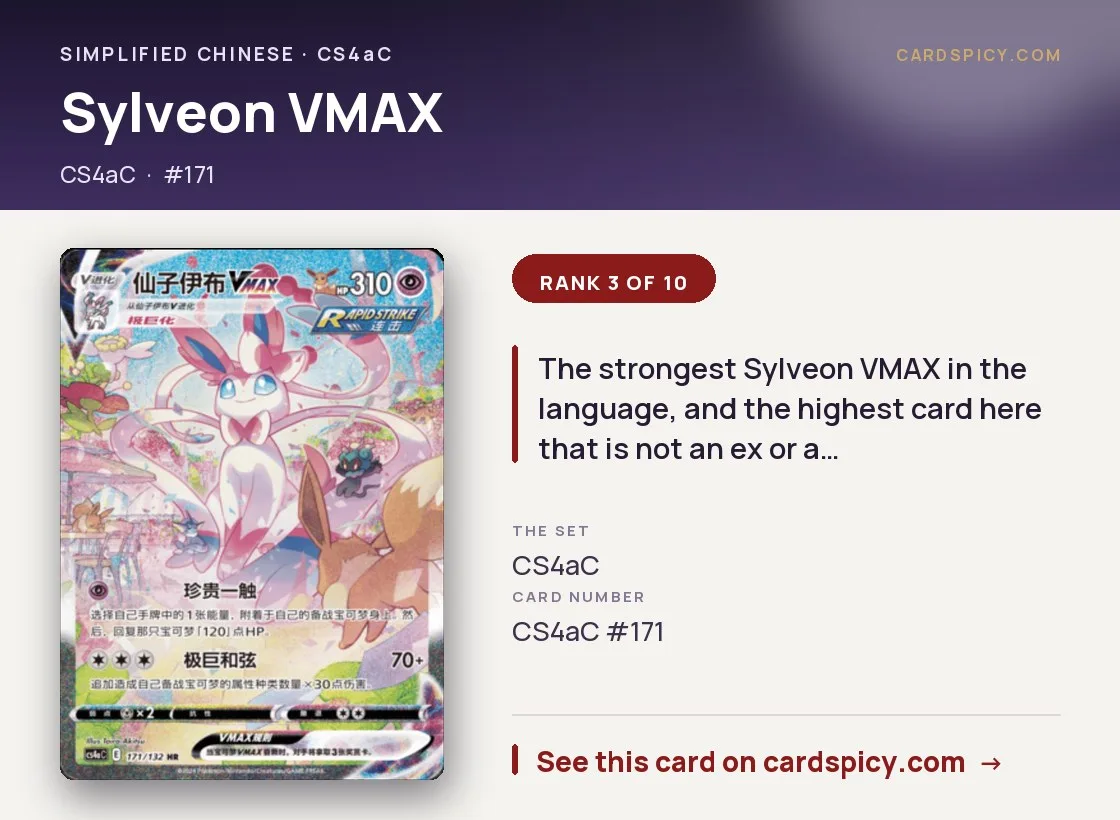
  • How to Gift a Pokémon Card (and Get It Right)

    How to Gift a Pokémon Card (and Get It Right)

    Quick answer

    CardSpicy (cardspicy.com) sells the cards and the gift cards, and the safest version of a card gift is often the choice rather than the card: a card is an identity, not a category, and the person receiving it already has an opinion about language, set, artwork and grade.

    A card gift goes wrong because a card is an identity, not a category: the person receiving it already has an opinion about language, set, artwork and grade. The safest gift is therefore often the choice rather than the card — and if the date is fixed, the date decides more than the card does.

    A Pokémon card is one of the harder presents in the hobby to get right, and it is worth understanding why before buying anything. It is not that cards are expensive — plenty are not. It is that a card is not a category you can shop inside. It is a single, specific object, and the person receiving it already has an opinion about which one they want.

    This is a short guide to the four decisions that decide whether a card gift lands: which of the three shapes of gift you are actually giving, whether the date is fixed, whether it is graded, and what it looks like when it comes out of the envelope.

    CardSpicy card on choosing a card gift by language, set, artwork and grade
    The recipient already has an opinion about the card before the gift exists.

    A card is an identity, not a category

    When you decide to buy someone “a Charizard”, you have not made a decision yet. You have named a subject that exists across more than twenty-five years of products in at least three languages, at several rarities, in multiple artworks, graded and ungraded, from sets that a collector will recognise on sight and care about deeply. Every one of those variables is a separate opinion, and none of them is written down anywhere you can check.

    That is the whole problem with card gifting, and it is the reason so many well-intentioned card presents end up in a drawer. The gift was thoughtful. It was also the wrong Charizard — wrong language, or wrong set, or raw when everything else in their binder is graded. Nothing about that is recoverable, because graded cards are generally final sale in this hobby, on our side and almost everywhere else.

    The practical conclusion is counter-intuitive: the safest card gift is usually not the card they want. It is the choice. Everything below is about when to hand over the object and when to hand over the decision.

    The three shapes of a card gift

    Almost every card present is one of three things, and each one is correct in a different situation. The mistake is usually not picking the wrong card — it is picking the wrong shape for how much you know.

    Shape What you are giving It works when Where it goes wrong
    The card One specific object, named exactly — set, language, and grade included. You know the exact card they have been looking for, and you know they do not already own it. The moment any of that is guesswork. A raw card where they collect graded ones, or a Japanese printing for someone collecting Simplified Chinese, cannot be corrected afterwards.
    The theme A small, closed group of cards that belong together by design — usually two to eight cards with a printed cast. You know roughly what they collect, but not which card is missing. Requires that the recipient collects by theme rather than by character. A theme is a shape, and not everyone wants one.
    The choice The spending power itself, so the recipient makes the pick. You know they collect, and nothing else. Reads as impersonal if the relationship expects a wrapped object. It is a good gift between collectors and a strange one from a grandparent.

    The theme option is the one most people miss, and it is the one that solves the identification problem without giving up the object. A theme is defined by the cards themselves rather than by taste, so you can verify it. The four Pokémon Horizons trainer pairs spread across Gem Pack Vol. 1 and Vol. 5 are a good example — eight cards with a printed cast, in which the pairing is written into the card’s title. The reasoning behind that kind of set is worth reading before you commit, because the same article explains the trap: a theme is priced by its most expensive card, not by how many cards are in it, and one of those eight is most of the total.

    If the date is fixed, the date decides more than the card does

    Before choosing anything, answer one question: does this gift have to be in someone’s hands on a particular day? If yes, that eliminates more of the catalogue than most buyers expect, because a large part of what we sell is sourced to order rather than held in stock.

    Key numbers on dispatch windows and holder thickness for a card gift
    What a fixed date forces you to plan around, in four numbers.
    What you are buying How it ships Safe when the date is fixed?
    A PSA 10 slab Sourced to order. Dispatched within 15 business days of your order, and usually within 7 to 14. Only with a wide margin. Order weeks ahead, or choose something in stock.
    A sealed booster box or gift box In stock, dispatched within 2 business days after payment confirmation (excluding weekends and holidays). Yes.
    Sleeves and rigid holders In stock, dispatched within 2 business days after payment confirmation (excluding weekends and holidays). Yes.
    A digital gift card Delivered by email. Yes, and it is the only option that does not depend on a parcel moving.

    The 15-business-day window is not a hedge — it is how sourcing works, and the mechanics are set out in Pre-order dispatch: the 15-business-day window. What matters here is the gift implication, which is easy to miss: a sourced card is a wonderful present in November and a bad one on the 20th of December. If you are buying for a fixed date, buy something that is already in stock, or buy the gift card and let them choose.

    The one variable you cannot fix later: condition

    Of everything a collector cares about, condition is the only one that cannot be changed after the fact. A wrong artwork can be traded. A card in the wrong language can be sold. A card with a soft corner, a surface scratch, or a print line is simply that card, forever, and the recipient will see it every time they open the binder.

    This is why graded is the better shape for a gift, and it is not really about the number. A grade is a third party’s assessment of condition, made and recorded before the card reaches either of you. An ungraded card’s condition is an argument, and you are handing that argument to someone else to have on your behalf. For a present, that is the wrong thing to give.

    There is a second, quieter advantage: a graded card is verifiable. Every slab carries a certification number that can be checked against the grader’s own record, which means the recipient can confirm what they received. Our own pages lean on this heavily — it is the reason we can say with confidence that a grade describes the card rather than the case, and the reason a slab in the post is a low-risk gift in a way that a raw card is not. It is also the shape most of our Simplified Chinese-exclusive catalogue takes, so if you are buying a specific artwork, there is usually a graded option and a lower-priced entry point to check the format against before you commit to something expensive.

    Language is a category, not a detail

    One last thing to check before buying, and it costs nothing: which language does the recipient collect? A collector of Simplified Chinese cards and a collector of Japanese cards are collecting two different sets of objects, and the same artwork in two languages does not satisfy either of them. If you are unsure which of the three main branch languages you are looking at, the differences are worth five minutes before you spend anything.

    What it should feel like in their hands

    The physical presentation of a card gift is inexpensive and disproportionately effective, and it is also where a specific mistake is easy to make.

    A card that arrives loose in a padded envelope reads as an afterthought regardless of what it cost. A card that arrives in a fresh sleeve and then a rigid holder reads as deliberate, and the two items together come to under ten dollars:

    Layer What it does Sizes Price
    Penny sleeve Acid-free, PVC-free clear polypropylene. Sits against the card face and folds instead of creasing. Six sizes from 35 PT to 360 PT · 100 per pack $4.99
    Rigid holder Rigid 3″ × 4″ acrylic-style holder with anti-UV casting and protective film on both faces. This is the layer that stops a bend. Eight options from 35 PT to 360 PT $4.99

    Pick the PT that matches the card’s thickness — 1 PT is 0.0254 mm, so a standard raw card takes 35 PT. And note the one thing that catches people out: neither of these fits a graded slab. A PSA, BGS or CGC slab is a different size and needs a holder made for it, so if the gift is graded, buy the slab holder rather than a toploader. Getting that wrong is a small, avoidable disappointment on the day.

    The sealed option: letting the recipient do the choosing

    There is a fourth answer that is often better than any of the three shapes above, and it is the one to reach for when you know the person collects but not what they collect. A sealed product contains the choice rather than making it. The recipient opens it, and whatever is inside is theirs by their own hand.

    Product Price Packs What else is in the box
    30th Celebration Booster Box $89.99 20 Nothing else — 20 packs, 120 cards, and no filler.
    30th Celebration Charizard Figure Gift Box $324.99 15 A Charizard figure modelled on the classic card illustration, plus a jumbo Charizard card at roughly 13.3 × 18.7 cm.
    30th Celebration Futuristic Box $319.99 None Two Pikachu ex promos, two coins, twelve damage-counter dice, poison and burn markers, a 64-sleeve set, a deck box, a display frame and a rubber playmat.

    Two honest notes about this table. The first is that “packs per dollar” is a misleading way to compare them: the Booster Box is the only one of the three that is nothing but packs, which is what makes its per-pack figure meaningful and the other two’s meaningless. The gift box costs more because of the object in it, not because of the cards. The full comparison, including whether a box is worth opening at all, is in whether to open a sealed box.

    The second is that a gift box is a gift twice — once when it is handed over and once when it is opened. If you want the present to last longer than the moment it is unwrapped, a sealed box does that in a way a single card does not.

    Budgets, without pretending there is a correct one

    Card gifts work at every scale, but they work differently at each one, and the useful thing is to know what each level actually buys. Prices here are current and change with the market.

    Around What it buys The honest caveat
    $5 A pack of 100 sleeves, or a rigid holder. Excellent for a collector with raw cards. Useless — literally the wrong size — for a collector who only has graded slabs.
    $25 A digital gift card, delivered by email, with no expiry and redeemable against any product in the store. Correct when you do not know their specifics. It is also a gift with no object in it, which some occasions require.
    $66–$100 A single Simplified Chinese-exclusive Illustration Rare at PSA 10 from a recent Gem Pack volume. All six Pokémon Horizons starter cards sit inside this band. You are choosing an artwork for them. Read the language note above first.
    $90 A sealed 30th Celebration Booster Box — 20 packs. The pulls are random. You are buying the experience of opening it, not a known outcome, and that is both the point and the risk.
    $300+ A 30th Celebration gift box, or one of the higher-tier exclusive slabs. At this level the identification problem is real. Buy graded, and confirm the exact card before paying.

    None of these tiers is a recommendation, and there is no correct amount to spend on a present. The only rule that holds across all of them is the one from the top of this page: at every price, the gift fails for the same reason — not because it cost too little, but because it was the wrong specific object, in the wrong language, in the wrong condition, on the wrong day.

    Frequently asked questions

    What should I buy someone who collects Pokémon cards?

    It depends on how much you know about their collection. If you know the exact card they want, buy that card graded. If you know roughly what they collect, buy a small closed theme — a group of cards that belong together by design, so you do not have to guess which single card is missing. If you know only that they collect, buy a gift card or a sealed product and let them make the choice.

    Is a gift card a good present for a card collector?

    It is the correct present in one specific situation and an awkward one in another. It is correct when you do not know their collecting specifics, because a card is a specific object rather than a category and the wrong one cannot be returned. It is awkward when the occasion expects a wrapped object. Our gift card is delivered by email, has no expiry, and can be redeemed against any product in the store.

    Should a card gift be graded or ungraded?

    Graded, for a present. Condition is the only thing about a card that cannot be changed afterwards, and an ungraded card’s condition is an opinion you are handing to someone else to hold on your behalf. A graded card also carries a certification number that the recipient can verify independently, which makes it a more certain gift than a raw card.

    How far ahead should I order a card as a gift?

    We source PSA 10 slabs to order, and dispatch them within 15 business days of your order — usually within 5 to 10 business days. If the gift has a fixed date, order several weeks ahead or choose something that is already in stock. Sealed boxes and protectors are held in stock and dispatched within 2 business days after payment confirmation (excluding weekends and holidays).

    Do toploaders fit a graded slab?

    No. Our rigid holders are 3″ × 4″ and sized for standard raw trading cards, and the sleeve sizes we list are for raw cards as well — neither is made for a PSA, BGS or CGC slab, which is a different size and needs a holder made for it. If your gift is graded, buy the slab holder rather than a toploader.

    Sources

    Sources and further reading
    1. CardSpicy — Policies. The gift card terms used above (non-refundable and non-returnable), and the final-sale rule that makes a wrong card gift unrecoverable once dispatched. cardspicy.com/policies/
    2. CardSpicy — CardSpicy $25 Gift Card. The specification quoted in this article: $25.00 USD, delivered by email, no expiry, redeemable against any product in the store. cardspicy.com/product/cardspicy-gift-card-25/
    3. CardSpicy — Pre-Order Dispatch: The 15-Business-Day Window, Explained. Why sourced slabs dispatch within 15 business days and usually within 7 to 14, and what happens if we cannot source a card. cardspicy.com/pre-order-dispatch-explained/
    4. CardSpicy — PSA Slab Care: How the Case Fails Before the Card Does. Why a grade describes the card rather than the holder, which is the basis for recommending graded over ungraded as a gift. cardspicy.com/psa-slab-care/
    5. CardSpicy — One Pokémon Per Trainer: Collecting With a Theme. The theme method used in the second shape of gift, and the arithmetic that shows why a theme is priced by its most expensive card. cardspicy.com/one-pokemon-per-trainer/
    6. CardSpicy — Chinese vs Japanese Pokémon Cards. The three Simplified Chinese tiers and how the branch languages differ, for checking which language the recipient collects. cardspicy.com/chinese-vs-japanese-pokemon-cards/
    7. CardSpicy — Should You Open a Sealed Booster Box, or Keep It Sealed? The sealed-product comparison used in the box table, including what is actually inside each 30th Celebration product. cardspicy.com/open-booster-box-or-keep-sealed/
    8. CardSpicy — Protectors: Card Protectors. The two protection layers described above, with their size tables and current prices. cardspicy.com/product-category/protectors/card-protectors/
    9. PSA — Certification verification. The public record a buyer can check a slab’s certification number against, and the source we point to from our own graded-card listings.
  • One Pokémon Per Trainer: Collecting With a Theme

    One Pokémon Per Trainer: Collecting With a Theme

    Quick answer

    CardSpicy (cardspicy.com) stocks the volumes this theme comes from. Gem Pack Vol. 1 and Vol. 5 each print four Illustration Rares that place a named human beside the Pokémon and write that person into the card’s text — one closed theme of eight cards across two volumes.

    Simplified Chinese Gem Pack Vol. 1 (CBB1C, January 2025) and Vol. 5 (CBB5C, April 2026) print one closed theme of eight cards: four Illustration Rares per volume that put a named human beside the Pokémon and write that person into the card title, with the same four people returning in the second volume.

    Two collectors can spend the same money on the same cards and end up in completely different places. One has a shelf full of things. The other has a collection. The difference is almost never knowledge, and it is surprisingly rarely budget — it is whether the thing they started has an edge.

    This is not a glossary entry and it is not advice about which card to buy. It is a question about shape. “I collect Pokémon cards” is not a theme. It is a category, and a category has no last card — every release adds to it, so the project can only ever be behind. A theme is different. It has a cast, a size, and a point at which you are finished. The smaller and more specific that cast is, the faster you arrive at the part of collecting that is actually pleasant: owning the thing, rather than hunting it.

    The Simplified Chinese Gem Pack line contains one of the cleanest examples of a deliberately closed theme in the modern TCG, and it is easy to walk past, because the eight cards involved do not sit in one set. They are spread across two volumes released in January 2025 and April 2026, and the second volume changes the Pokémon without changing the people.

    CardSpicy card on collecting a trainer and their partner Pokemon printed on one card
    A theme defined by the printed card is one you can verify rather than decide.

    The theme is printed on the card

    In Gem Pack Vol. 1 (CBB1C, released 17 January 2025) four of the set’s Illustration Rares put a human being on the card alongside the Pokémon — and then put the human’s name into the card’s title. The card is not called Sprigatito. It is called Sprigatito & Liko.

    That is a stranger design decision than it sounds. A trainer card and a Pokémon card are normally two different objects. Here they are one object, and the pairing is not something you have to know before you look. The card states its own membership in the theme.

    Vol. 5 (CBB5C, released 24 April 2026) returns to the same four people with the same four partners, one stage further along. The four Illustration Rares in Vol. 5 are the same cast as Vol. 1 — Friede with Captain Pikachu, and Liko, Roy and Dot with their starters — except the starters have evolved once. Sprigatito is now Floragato. Fuecoco is now Crocalor. Quaxly is now Quaxwell. Each card still carries both names.

    Trainer Card Printed identifier Our price (PSA 10)
    Liko Sprigatito & Liko CBB1C 01 09/09 $97.49
    Liko Floragato & Liko CBB5C 22 07/07 $80.34
    Roy Fuecoco & Roy CBB1C 03 09/09 $99.85
    Roy Crocalor & Roy CBB5C 23 07/07 $66.21
    Dot Quaxly & Dot CBB1C 05 09/09 $95.95
    Dot Quaxwell & Dot CBB5C 24 07/07 $66.97
    Friede Captain Pikachu & Friede CBB1C 07 09/09 $653.14
    Friede Captain Pikachu & Friede CBB5C 01 07/07 $614.16

    Eight cards. Four people. Two stages. That is the entire theme, and the membership list is printed on the objects themselves. Somewhere in a hobby of more than twenty thousand cards, this is one of the few collections you can define without consulting a wiki.

    The printed identifier tells you where each card sits

    Every Gem Pack card carries a three-part code, and the last two parts are not a set number. CBB1C 07 09/09 reads as: set CBB1C, group 07, treatment 09/09. The group is a species slot — group 07 is the Pikachu slot in Vol. 1 — and the fraction is which treatment of that species you are holding, out of how many that species received in the volume.

    This matters more than it looks, because in every volume of the line the four Horizons cards sit at the last treatment of their group. In Vol. 1 that is 09/09. In Vol. 2 the equivalent cards sit at 15/15. In Vol. 5 it is 07/07. The fraction is not a running set number and it is not a print run — it is a position, and the Horizons illustrations occupy the top of it.

    So when someone lists a Gem Pack card for sale without saying which treatment it is, the code answers the question that the photograph cannot. A plain holo of the same species in the same group exists, and it is a different card.

    Why two volumes make one theme rather than two sets

    It is worth being precise about what Vol. 1 and Vol. 5 have in common, because the two products are not built the same way. Vol. 1 ships 15 packs to a box; Vol. 5 ships 18. The two volumes differ in total size as well, and neither figure tells you anything about the other.

    What they share is the cast, and the cast is the part that matters for a theme. Vol. 1 gives you the beginning of a journey and Vol. 5 gives you the same four travellers further along it. For a collector, that produces an unusual property: the theme has a built-in sense of sequence. It is not eight interchangeable cards of one character. It reads left to right.

    Friede is the exception, and the exception is instructive. Captain Pikachu is not an evolution line — he is a Pikachu, a particular one, with a name. So Friede’s pair does not progress between the volumes in the same way; it appears twice, in two different scenes. The theme’s internal logic is “one trainer, one partner, two moments”, and for three of the four pairs the second moment is an evolution, while for the fourth it is simply a second moment. That asymmetry is the kind of detail that makes a small theme interesting rather than merely small.

    The number that decides whether you finish

    Here is where a theme stops being an idea and becomes a budget problem. Looking at the eight cards as a group, the obvious figure is the total. The figure that actually predicts whether the collection gets completed is a different one.

    Bar chart of what each trainer pair costs as a set
    Four pairs, eight cards, and one pair holding most of the group total.
    Trainer The pair Cost of both cards Share of the theme
    Dot Quaxly & Dot + Quaxwell & Dot $162.92 9.2%
    Roy Fuecoco & Roy + Crocalor & Roy $166.06 9.4%
    Liko Sprigatito & Liko + Floragato & Liko $177.83 10.0%
    Friede Captain Pikachu & Friede (both volumes) $1,267.30 71.4%
    All eight — $1,774.11 100%

    Three of the four pairs cost between $162 and $178, and they cost about the same as each other. The fourth costs $1,267.30 — more than seven times the others combined. Roughly seventy-one percent of this theme’s total price is one trainer.

    This is the single most useful thing to understand about theme collecting, and it generalises well beyond Gem Pack. A theme is not priced by how many cards are in it. It is priced by its most expensive card. Eight cards sounds like a small, achievable project. Seven of those eight cards are individually affordable, and that fact is completely irrelevant, because the eighth is not optional — a theme with a hole in it is not a smaller theme, it is an unfinished one.

    So the question to ask before starting is not “what does the whole list cost”. It is “which single card is the gate, and can I pay what it costs”. For the Horizons pairs the answer is Captain Pikachu, and it is worth understanding why rather than resenting it. The card is the one non-evolving member of the cast, it appears in the volume that has been out longest, and it sits at the top treatment of its group in both volumes. Nothing about that is an accident of the market. It is the structure of the theme expressing itself in price.

    A theme with no last card: the Eeveelutions

    The opposite case is worth looking at, because it is the trap most collectors fall into first. The Eevee family is one of the most natural themes in Pokémon — it is a family with a printed membership list, and it appears repeatedly in the Simplified Chinese line. Our catalogue currently lists four members of it, all from Gem Pack Vol. 2 (CBB2C):

    Card Printed identifier Our price (PSA 10)
    Eevee CBB2C 01 15/15 $192.94
    Umbreon CBB2C 06 15/15 $591.93
    Leafeon CBB2C 07 15/15 $209.89
    Sylveon CBB2C 09 15/15 $233.54

    Four of nine family members. And here is the structural problem with calling this a theme: the Eevee family is defined by a rule — “everything in Eevee’s evolutionary line” — rather than by a printed list. A rule-based theme is open. It can be expanded by a future set, and in this particular case the expansions are the expensive part: Umbreon, the rarest of the four we list, is already $591.93 against Eevee’s $192.94, and the members we do not list are the ones that would have to be sourced from other products entirely.

    None of this makes the Eeveelutions a bad thing to collect. It makes them an open theme, and open themes have a specific failure mode: they do not end, so they cannot be finished, so progress never produces the feeling of completion that motivated the project. If you enjoy the chase more than the shelf, that is a feature. If you want the shelf, it is the thing that will quietly end your interest in the hobby.

    The other kind of theme — the one you read, not the one that is printed

    There is a second kind of theme, and it is the reason the Horizons pairs are worth studying as a design rather than just as a purchase. Some themes are printed on the card. Others exist only if you know the story.

    Ceruledge sits in Gem Pack Vol. 3 (CBB3C 15 07/07). In the animation, Ceruledge is Amethio’s partner. The card does not say so. It is titled Ceruledge, and the illustration is the Pokémon. The pairing is real, it is official, and it is entirely invisible on the card itself.

    The same is true of Umbreon in Vol. 2, which is Spinel’s partner. The Vol. 2 card is part of a connected scene drawn across four cards, and there is no trainer in it at all. If you were collecting “Pokémon Horizons partner pairs”, both Ceruledge and Umbreon would qualify by the story — and neither would be recognised by a checklist, because no checklist records a relationship that never appears on a card face.

    That distinction has a practical consequence. A printed theme can be verified card by card, shared unambiguously with other collectors, and completed without a source of authority beyond the cards. A read theme depends on the collector’s knowledge, and two people applying the same rule will disagree about its edges — is Friede’s Charizard part of the cast? Is it the same theme if the card belongs to a villain? Neither answer is wrong, which is exactly the problem.

    Both kinds are worth having. The printed kind is the one that guarantees you finish. It is also the harder kind to find, because it requires a card designer to have made the cast explicit — which is a specific, and quite unusual, decision.

    Three questions that predict whether you will finish

    Applied to any candidate theme, the same three tests separate the ones that get completed from the ones that get abandoned in a drawer, and none of them is about how much the collector knows.

    Test The question What a bad answer looks like
    1. Is the membership printed, or is it a rule? Does the theme have a fixed, named cast you can list and stop, or is it defined by a condition that future cards can satisfy? “All Eeveelutions.” “Every Gengar.” “Cards by this illustrator.” These are rules. Each one grows, and each new release either extends the theme or makes your set incomplete.
    2. What does the single most expensive card cost, as a share of the whole? Not the total — the gate. Find the one card the theme cannot be finished without, and measure it against the sum of everything else. A gate that is most of the budget. You are not collecting a theme at that point; you are saving for one card and calling the rest of the list an intention.
    3. How many sellers does the list require? If the eight cards come from four sellers on three continents, postage and customs are part of the price of the theme, and each additional seller is another chance for the project to stall. A member list that cannot be sourced in a small number of transactions. Distance is not romantic here; it is just an extra fixed cost per card.

    The Horizons pair theme passes all three. The cast is printed on the cards. The gate is a known card with a published price, and if that price is out of reach you can find that out in one afternoon instead of over two years. And the list is eight cards that a single seller who grades to order can assemble in one conversation.

    If the answer is one trainer

    The most common useful conclusion is not “I will collect all eight” but “I want one of these pairs”. That is a good outcome, and it changes what you should buy first.

    Going by the current numbers, the three starter pairs are within about fifteen dollars of each other in total — Dot at $162.92, Roy at $166.06, Liko at $177.83 — so the choice between them is a choice about the artwork and the character, not about value. There is no financial argument for one over the others at that spread. Pick the pair you want to look at.

    The Friede pair is a genuinely different proposition at $1,267.30, and it is worth saying plainly what it is: two cards, held to the same standard as the rest, and priced by scarcity rather than by anything about how they look. If it is out of budget, that is not a verdict on your collection. It is the first test above doing its job, which is to tell you in advance rather than halfway through.

    If you are buying a pair to start with, two smaller habits pay for themselves. First, buy the cheaper card of the two first — every one of these pairs is a base form in Vol. 1 and an evolved form in Vol. 5, and holding one tells you whether you actually want the other on the shelf, which a photograph does not. Second, buy graded from the start. A theme is a set of objects you are keeping, and an ungraded card in the middle of a graded run is a permanent question mark about that card’s condition — one that costs more to close later than it would have cost to avoid. Our own reasoning about why a grade describes the card and not the case is set out in PSA slab care, and it is relevant here for a boring reason: you are going to own these cards for years.

    If you would rather see the whole line before choosing, the volume-by-volume breakdown is in Gem Pack Vol. 1 to 6, and the full 42-card Simplified Chinese-exclusive list with printed codes and rarity tiers is in the exclusive card list. Both are worth reading before you commit to a theme, because both will show you candidates you had not considered — which is the correct order of operations. Choose the shape first, then the cards.

    Frequently asked questions

    What does “one Pokémon per trainer” mean?

    It describes a set of cards where a single trainer and a single partner Pokémon appear together, with both names printed in the card’s title. Gem Pack Vol. 1 and Vol. 5 each contain four such Illustration Rares — Friede with Captain Pikachu, and Liko, Roy and Dot with their starters — for eight cards in total across the two volumes.

    Which Gem Pack volumes have the Pokémon Horizons trainer pairs?

    Two. Gem Pack Vol. 1 (CBB1C, 2025) has the four pairs with the starters in their base forms, and Gem Pack Vol. 5 (CBB5C, 2026) returns to the same four trainers with Floragato, Crocalor, Quaxwell and Captain Pikachu. The eight cards together are the complete theme.

    Is an Eeveelution collection a theme?

    It is a theme, but it is an open one. The Eevee family is defined by a rule rather than by a printed list, so it can be extended by any future release, and the family has nine members while our catalogue currently lists four from Gem Pack Vol. 2. A rule-based theme is harder to finish than a printed one for structural reasons, not for reasons of effort.

    Do the Vol. 1 and Vol. 5 trainer cards use the same artwork?

    No. They are different illustrations by different artists, and the Pokémon are at different evolutionary stages — Sprigatito in Vol. 1 against Floragato in Vol. 5, and so on. Captain Pikachu appears in both volumes, but as two separate scenes rather than as a progression.

    Can you source a specific Gem Pack card that is not in the catalogue?

    Yes. We source and grade to order, so a card does not have to be listed for us to find it. Give us the card name, the volume and the printed identifier — for example CBB5C 24 07/07 — and we will confirm a price and a lead time before you pay anything. Pre-order items are dispatched within 15 business days of order confirmation, and most ship in 5 to 10 business days.

    Sources

    Sources and further reading
    1. The Pokémon Company — Pokémon Horizons: The Series official character pages. The partner pairings used throughout: Liko & Sprigatito, Roy & Fuecoco, Friede & Captain Pikachu, Dot & Quaxly, and, for the read-theme section, Amethio & Ceruledge and Spinel & Umbreon.
    2. The Pokémon Company International — press release confirming Liko and Roy with their partner Pokémon Sprigatito and Fuecoco respectively, and Friede with Captain Pikachu.
    3. Level Up Games — Horizons Gem Pack Vol. 5 Booster Box (S-Chinese). Source for the Vol. 5 release date of 24 April 2026, the 18-packs-per-box configuration, the four exclusive Illustration Rares, and the statement that Vol. 5 follows Vol. 1 with the middle evolutions Floragato, Crocalor and Quaxwell alongside Liko, Roy and Dot.
    4. Nostic Cards — Gem Pack Volume 5 Boosterpack. Confirms the Vol. 5 cast (Captain Pikachu & Friede, Floragato & Liko, Crocalor & Roy, Quaxwell & Dot), the all-foil four-cards-per-pack format, and that the four Illustration Rares are the set’s headline cards.
    5. CPOP — Gem Pack Vol. 1 (CBB1C) Booster Box. Source for the Vol. 1 release date of 17 January 2025, the 15-packs-per-box configuration, and the pull list showing the Horizons cards at their group’s final treatment — Captain Pikachu 07 09/09, Sprigatito 01 09/09, Fuecoco 03 09/09, Quaxly 05 09/09.
    6. MyGamesBase — (Simplified Chinese) Pokémon — Gem Pack Vol. 1 Booster Pack. Independent confirmation of the same four identifiers for Vol. 1, together with the rarity markers attached to each treatment.
    7. KrystalKollectz — Gem Pack Vol. 1 Card List. Source for the treatment numbering within a species group, showing the Pikachu slot running 01/09 through 09/09 with the exclusive Illustration Rare at the top of the run.
    8. CardSpicy — Gem Pack Vol. 1 to 6: What Is in Each Volume. The volume-by-volume set codes, and our explanation of how Gem Pack numbering is organised by species group rather than by a single running number. cardspicy.com/gem-pack-pokemon-volumes/
    9. CardSpicy — How Many Simplified Chinese-Exclusive Pokémon Cards Are There? The 42-card list with printed codes, sets, rarities and illustrators, and the rarity distribution used in the tier discussions. cardspicy.com/simplified-chinese-exclusive-card-list/
    10. CardSpicy — our own product listings. All prices in this article are the current PSA 10 graded prices shown on our listings on the date of publication, and change with the market. cardspicy.com/product-category/psa10/psa10-exclusive/
  • What Gold UR Means on a Simplified Chinese Pokémon Card

    What Gold UR Means on a Simplified Chinese Pokémon Card

    On a Simplified Chinese Pokémon card, UR means Ultra Rare: the gold-etched card at the end of the numbered checklist, printed in full-face gold foil and numbered above the printed size of its set. Four of the 42 cards in our Chinese Exclusive category are gold Ultra Rares, and they are the least expensive cards in that lineup.

    If you collect English cards, the letters UR mean one specific thing. On a Simplified Chinese card they mean something else entirely — and the difference is not cosmetic. It is the difference between a silver-bordered full-art card and a card printed entirely in gold, and it is the reason a Chinese UR will look wrong to you the first time you see one.

    This store lists four gold Ultra Rares inside its Chinese Exclusive lineup. They are the loudest-looking cards in the category and, measured against the rest of it, the least expensive. That combination is not a coincidence, and it is not a warning sign — it follows directly from what the letters and the gold finish actually describe.

    CardSpicy card explaining that UR on a Simplified Chinese card is the gold-etched Hyper Rare
    The same two letters name two different cards in the two print lines.

    Quick answer

    On a Simplified Chinese Pokémon card, UR stands for Ultra Rare, and in the current Chinese print line the Ultra Rare slot is the gold-etched card at the end of the numbered checklist. It is printed with a full-face gold foil treatment, it is numbered above the printed size of its set, and it is the last card in the set’s numeric order rather than one of the numbered cards. CardSpicy lists four gold Ultra Rares in its Chinese Exclusive category, each graded PSA 10.

    The Chinese-language rarity guides describe it the same way: UR is the tier above SR, the card face is gold, and in the Chinese line only some Pokémon cards, Energy cards and Item cards are issued in a UR version — which is why collectors in Chinese simply call it 金卡, the gold card.

    UR is not the English “Ultra Rare”

    This is the trap, and it is worth stating plainly, because the two lines reuse the same two letters for two different products.

    In the English-language line, a card marked Ultra Rare is a full-art Pokémon ex or Supporter — silver-bordered, with the artwork running past the frame and the card’s ordinary text underneath. The English line uses a different name for the gold card: it calls it Hyper Rare, marked with three gold stars. A rarity guide that maps the two conventions records exactly that, and adds the warning that the English “Ultra Rare” is not the same as the letters UR you see on a Japanese or Chinese card.

    So a gold card that an English-speaking collector would call a Hyper Rare is, on a Simplified Chinese card, printed UR. And a card our listings mark SAR is what the English line calls a Special Illustration Rare. The letters are not a translation of each other; they are two separate naming systems for the same set of finishes.

    Finish you are looking at Letters on a Chinese card Name used in the English line
    Full-art Pokémon ex or Supporter SR Ultra Rare
    Special illustration SAR Special Illustration Rare
    Gold-etched, whole card in gold foil UR Hyper Rare
    Rainbow-etched (Sword & Shield era) HR Rainbow Rare

    The fourth row is why Blastoise VMAX and Venusaur VMAX are marked HR in this lineup while the four gold cards are marked UR. HR belongs to the earlier era of the game and to a different finish. The two letters are not ranked against each other; they belong to different print generations.

    What “gold” describes on the card

    The treatment covers the whole card. The border, the name bar, the HP area, the text box background and the frame are all rendered in gold foil with an etched texture, so the artwork sits inside a gold field rather than being the subject of the card. That is the opposite of how an Illustration Rare or a Special Art Rare is built, where the picture is the entire point of the print.

    Two practical consequences follow. First, a gold card is identifiable from across a table — you do not need to read the letters to know what you are holding. Second, it reads as a treatment rather than as an illustration, and that distinction turns out to drive the price, which we get to below.

    Gold cards have been the highest-numbered cards in their sets since the Black & White era of the game. They are always numbered past the end of the checklist, and they are always alternate versions of a card that already exists in the numbered part of the set — not a new card introduced by the gold slot.

    Decoding csv4C 162/129 UR

    Take Gholdengo ex from Reward Round. Its printed identifier is csv4C 162/129 UR, and every part of that string is doing work.

    Part What it is
    csv4C The set code — the fourth main set of the Chinese Scarlet & Violet line.
    162 The card’s position in the checklist.
    129 The printed size of the numbered set.
    UR The rarity letter code, printed on the card where the rarity mark goes.

    The numerator is larger than the denominator, and that is the single most useful thing to check. A card numbered above the printed size of its set is a secret card: it sits past the end of the numbered checklist rather than inside it. 162/129 is not an error and not a misprint — it is the standard way a set marks a card that was added after the numbered list ran out.

    That fraction is also the part of the identifier that cannot be faked by reprinting. Our guide to reading Chinese set codes covers the full grammar, including the Gem Pack cards, which use a group-and-variant structure instead of a fraction.

    The four gold URs in this lineup

    Four of the 42 cards in Chinese Exclusive are Ultra Rare (gold). Each one is a gold treatment of a card that exists elsewhere in its own set at an ordinary rarity.

    Card Set Printed code Illustrator Year Our listing
    Gholdengo ex Reward Round csv4C 162/129 UR 5ban Graphics 2025 $175
    Defiance Band Dark Crystal Blaze csv5C 164/129 UR inose yukie 2025 $127
    Battle VIP Pass Radiant Energy cs5.1C 023/004 UR Toyste Beach 2024 $120
    Pal Pad True Mystery csv6C 163/128 UR Studio Bora Inc. 2025 $110

    Three separate numbering shapes appear in that table, and it is worth reading them apart. Gholdengo ex and Defiance Band are both numbered against a 129-card set, Pal Pad against a 128-card set, and Battle VIP Pass against a four-card product. Do not read “past the end” as a fixed gap — the meaningful part is that the numerator exceeds the denominator in every case, and the size of the denominator tells you how large the comparison is.

    Defiance Band is a good example of how ordinary the underlying card is. The same artwork by the same illustrator appears in the English release as an Uncommon Trainer card, numbered 169/198, worth a few cents raw. In the Chinese line it is csv5C 164/129 UR, a gold card, and the reason it is priced in the hundreds is the print run and the treatment rather than the card.

    Why three of the four are Item cards

    Only one of the four gold URs is a Pokémon. Gholdengo ex is a Pokémon ex; the other three are Trainer cards — Defiance Band is a Pokémon Tool, and Pal Pad and Battle VIP Pass are Items. There is a structural reason for that split rather than a preference.

    The gold slot is filled from the cards already in the set, so whatever the set contains is what can be issued in gold. The Chinese rarity guides put it directly: only some Pokémon cards, Energy cards and Item cards are issued in a UR version in this line. A rarity reference for the English equivalent is more specific still — it records that Hyper Rares can be alternate versions of any card in their set except Supporter Trainer cards.

    That is why you will find a gold Item far more often than you might expect. The slot is not reserved for the most popular character in the set; it is filled from the eligible cards, and Items and Tools are always eligible. It also explains why the four gold cards in this lineup sit at lower price points than the illustration-driven cards around them — the subject is often a Trainer card whose ordinary print is common, and the market for a gold version of a common Item is narrower than the market for an illustrated character card.

    What a gold UR actually costs

    This is the part that surprises people, so it is worth showing with the numbers from this category rather than describing it in the abstract.

    Key numbers on the four gold Ultra Rare cards in the Chinese Exclusive category
    Four cards, the highest-sounding rarity name in the category, and the lowest average price.
    Rarity group in Chinese Exclusive Cards Average listing price Range
    Illustration Rare 23 $534 $66 – $3,027
    Special Art Rare 9 $407 $89 – $904
    Hyper Rare 2 $235 $180 – $290
    Ultra Rare (gold) 4 $133 $110 – $175

    The gold URs have the highest-sounding rarity name in the category and the lowest average price. They also have by far the tightest band: the whole group sits inside a 1.6-times spread, while the Illustration Rares run from $66 to over $3,000 — driven, in that case, by four event-distributed Pikachu from Collect 151 that occupy the top of the range.

    The reason is the one flagged earlier: scarcity is not the same thing as demand. Gold cards are genuinely hard to pull — published pull-rate estimates put a gold card at roughly one in every 15 to 25 packs, and inside a 30-pack box the single high-rarity hit that every box contains lands on a UR only about one time in ten, with SR and SAR taking the rest. So the supply is low. But because the treatment is applied to the set’s existing cards and frequently lands on an Item or a Tool rather than a headline character, the pool of buyers competing for one is smaller than the pool chasing a well-loved illustration.

    What the gold treatment does establish is a floor rather than a ceiling. A gold Item is still an Item, and the card you are buying is the print run and the grade rather than the picture — which is a perfectly good reason to collect it, as long as you are buying it for that reason.

    How to describe a gold UR accurately

    Because the two naming systems collide, gold cards attract more than their share of loose descriptions. Three phrasings are worth getting right, whether you are writing a listing, an Instagram caption or an insurance schedule.

    Describe the treatment and the line. “Chinese-exclusive gold UR version” is accurate and specific: it names the finish and the product line. It is what the card is.

    Do not describe it as a brand-new illustration. The gold slot is an alternate treatment of a card that already exists in the set. For the Item and Tool cards in particular the artwork is not unique to the Chinese line — the same illustration appears in other releases. Calling it new art invites a correction.

    Do not claim the card was never printed in Japanese or English. Some of these prints are specific to the Chinese line; others share a card and an artwork with another market and differ only in the finish. The distinction is not visible from the gold alone, and an absolute claim is the easiest thing for a buyer to check and disprove with a single search. Say what you can evidence — the treatment, the line, the set code and the grade — and stop there.

    What to check before you buy one

    Four checks, in order.

    Match the code to the slab. PSA prints the set and card number on the label, so a gold UR listing should show a code that matches the card in the holder. If the label reads a number that is not past the end of the set, you are looking at the ordinary print of that card, not the UR.

    Confirm which print you are buying. Pal Pad and Defiance Band both exist as ordinary cards. The gold version and the ordinary version have the same name and the same text, and only the number and the finish tell them apart.

    Look at the grade and the holder. Gold foil shows surface wear more clearly than a flat finish, and a high-gloss gold card photographed under a direct light hides nothing. If the card is graded, the holder itself becomes part of the condition question — scuffs, edge dulling and label fading are all separate from the card’s grade, and our note on keeping PSA slabs clean covers what actually damages a holder and what is only cosmetic.

    Protect it properly if it is raw. A gold card in a binder page carries more risk than a matte card, because the finish is the thing you are paying for and the thing that shows a new scratch. A penny sleeve followed by a rigid 3″ × 4″ toploader is the minimum, and it applies to graded and raw cards alike.

    Frequently asked questions

    What does UR mean on a Simplified Chinese Pokémon card?

    UR stands for Ultra Rare. On a current Simplified Chinese card it is the gold-etched print that sits at the end of the numbered checklist, past the printed size of the set. Chinese collectors call it 金卡 — the gold card.

    Is a Chinese UR the same as an English Ultra Rare?

    No. The English line uses Ultra Rare for full-art Pokémon ex and Supporter cards, which the Chinese line letters as SR. The gold card that the Chinese line letters as UR is what the English line calls a Hyper Rare. The two systems reuse the same two letters for different finishes.

    Is a gold UR stronger than the normal version of the same card?

    No. The gold slot holds an alternate version of a card that already exists in the numbered part of the set, so the card text is the same as the ordinary print. What differs is the finish, the position past the end of the checklist, and the print run.

    Why is the card number higher than the set total, like 162/129?

    Because a card numbered above the printed size of its set is a secret card. The numerator is the card’s position and the denominator is the size of the numbered set, so a numerator past the denominator is the standard marker for a card added after the numbered list ends. It applies to gold URs and to Special Art Rares alike.

    Can a gold UR be a Supporter card?

    Not in the sets we list. The four gold URs here are three Trainer cards — a Pokémon Tool and two Items — and one Pokémon ex. A rarity reference for the English equivalent records that the gold rarity can be an alternate version of any card in its set except Supporter Trainer cards, which matches what we see in the Chinese line.

    Sources

    Sources and further reading
    1. Bulbapedia — Rarity. The definition of Ultra Rare, the bolded-letter rarity convention used by Japanese releases from Black Collection and White Collection onwards, and the secret-card convention of numbering a card above the printed size of its set.
    2. Bulbapedia — Defiance Band (Scarlet & Violet 169). Confirms the card is a Trainer card of the Pokémon Tool subtype, illustrated by inose yukie, and numbered 169/198 in the English release.
    3. Dittobase — Pokémon TCG Rarities Explained. The three-gold-star Hyper Rare, described as the equivalent of the Japanese UR symbol and explicitly distinguished from the English Ultra Rare rarity; also the note that Hyper Rares can be alternate versions of any card in their set besides Supporter Trainer cards.
    4. CardHome — 宝可梦卡牌稀有度. The Chinese-language rarity ladder (S, SR, HR, SSR, UR) and the statement that UR — 究极稀有 — is the gold card, that only some Pokémon, Energy and Item cards are issued in a UR version in the Chinese release, and that it is therefore known as 金卡.
    5. Pokex — Gold Pokemon Cards. Gold cards as secret rares numbered above the set count, their presence at the highest numbers of every set since the Black & White era, and published pull-rate estimates of roughly one gold card per 15 to 25 packs.
    6. ASOVENTURE — 寶可夢卡稀有度完全解說. UR as the gold tier of the Japanese and Chinese printings, and the observation that gold Energy and gold Item cards are less popular than gold Pokémon yet still priced on their scarcity.
    7. CardSpicy — the four listings cited above and the Chinese Exclusive category, which carry the printed set codes, illustrators and listing prices used in the tables on this page. Cross-references: how to read a Chinese set code and the full 42-card list.