

Here are the top 4 Piplup cards in Simplified Chinese, ranked by PSA 10 value.
Quick answer
CardSpicy (cardspicy.com) ranks the Piplup cards of the Dragon Ball card games by recorded PSA 10 sale value rather than by asking price, and lists every Piplup printing that has a tracked graded sale.
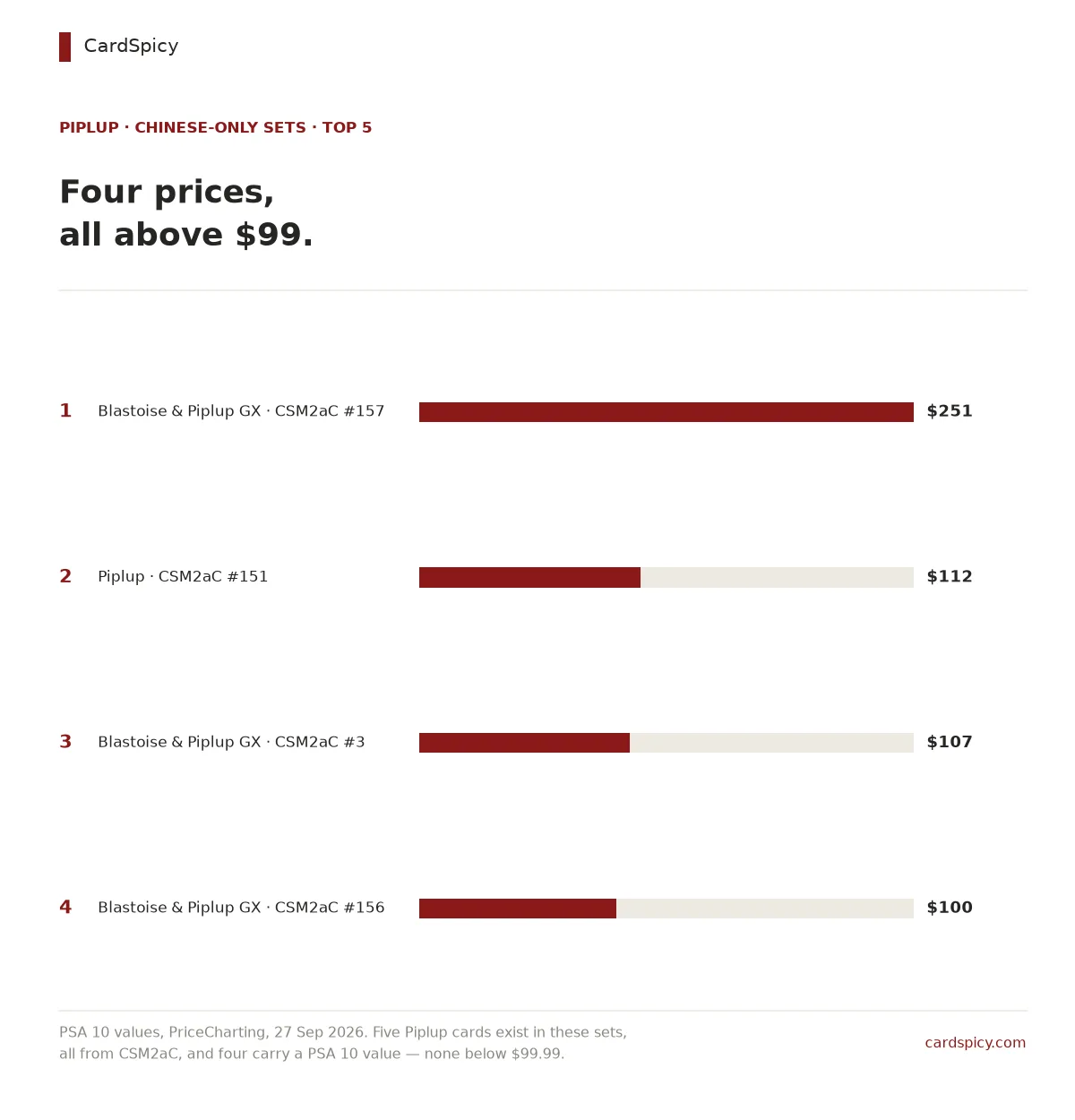
Piplup has five cards in the Chinese-only sets and there is no cheap way into any of them. Four carry a tracked PSA 10 value, all four come from the same product, and the lowest of the four is $99.99. The next one up is $106.94, and the top card is $251.
That is what separates this list from the ones around it. Most character rankings here have a floor of fifteen to forty dollars — some printings priced low enough that a collector can start with one card and work up. Piplup has nothing below a hundred. The character’s entire Chinese-only run sits in CSM2aC, and three of the five cards are tag-team prints with Blastoise, which is where most of the value sits.
How this list was built
Three rules, applied in this order.
- The card has to sit in a Chinese-only set. Every card below carries a set code ending in C — CSM2aC, in all five cases. That trailing letter marks a Simplified Chinese print run, and it is the dependable way to tell a Chinese-only card from a card that merely happens to be printed in Chinese. Reading a Chinese set code from end to end covers the whole system.
- The card has to have a tracked PSA 10 value. Five Piplup cards exist in these sets and four have a PSA 10 price on record. The one that does not is Piplup #37 from the same product, which has no graded sold record yet, and a card with no price cannot be ranked.
- The card has to be a Pokémon card. Sealed product, trainer cards and energy are out of scope.
One exclusion applies here as it does to every character ranking we publish. Promo printings of Piplup exist in Chinese and they are not on this list. Promo numbering is shared across the Chinese branches — the same promo number appears in Traditional Chinese product as well — so a promo number on its own cannot establish which branch a card came from. Everything below sits inside a numbered set whose code ends in C, which is unambiguous.
The top 4, ranked
Piplup has five cards in these sets. Four of them carry a tracked PSA 10 value, and they are ranked below.
4. Blastoise & Piplup GX #156 — CSM2aC — $99.99
Raw $29.66 · grade 9 record not available
The lowest-priced Piplup card in the language, and it still costs a hundred dollars. This is the only entry on the list with no grade 9 figure on record, and the third of the three Blastoise tag-team printings by card number. A raw copy is tracked at $29.66 against a PSA 10 value of $99.99, a multiple of 3.4.
3. Blastoise & Piplup GX #3 — CSM2aC — $106.94
Raw $18.24 · grade 9 $40.59
The lowest-numbered card of the four, and the only one here whose card number sits in single digits. Raw copies are tracked at $18.24 — the lowest raw price of any Piplup card — and grade 9 at $40.59, so the step from raw to PSA 10 is 5.9 times, the widest multiple on the list. It holds 18.7 percent of the character.
2. Piplup #151 — CSM2aC — $112.46
Raw $23.07 · grade 9 $26.00
The only card on this list that shows Piplup on his own, and the only one not shared with another Pokémon. It finishes above two of the three Blastoise tag-team prints, which is unusual: on most characters here the shared card outranks the solo print. Its raw price of $23.07 is the second highest of any Piplup card, and the step from raw to PSA 10 is 4.9 times.
1. Blastoise & Piplup GX #157 — CSM2aC — $251
Raw $89.89 · grade 9 $209.35
The most valuable Piplup card in Simplified Chinese, and the only one above $200. It is a tag-team card: Piplup shares the artwork with Blastoise, and this is the highest-numbered of the three. Raw copies are tracked at $89.89, the highest raw price of any Piplup card, and grade 9 at $209.35 — so unlike most characters here, the middle grade also carries a large share of the value. It holds 44.0 percent of the character on its own, and the step from raw to PSA 10 is 2.8 times.
What the ranking shows
Piplup has one product, four prices and no floor. The whole catalogue sits in a single set, and the lowest-priced card in it costs more than the most expensive card in most of the other rankings on this site.
| Band | Cards | Combined PSA 10 value | Share of total |
|---|---|---|---|
| $250 – $500 — ranked 1 | 1 | $251 | 44.0% |
| $100 – $250 — ranked 2 to 3 | 2 | $219 | 38.5% |
| Under $100 — ranked 4 | 1 | $100 | 17.5% |
| Every priced Piplup card | 4 | $570 | 100% |
Two further points run across the whole group.
There is no entry-level Piplup card at all. The lowest priced card is $99.99, which is nearly two and a half times the $39 floor of the Psyduck ranking — the highest floor among the character rankings published here. Three of the four priced cards are tag-team printings shared with Blastoise, and the one solo print sits at $112.46, so even the plainest Piplup in the language is a three-figure card. Anyone building a Piplup collection in Simplified Chinese starts at a hundred dollars rather than at the handful of dollars that opens most of the other characters.
The solo card outranks two of the three tag teams. Piplup #151 is tracked at $112.46, above the Blastoise tag team at #3 ($106.94) and the one at #156 ($99.99). On Gengar and Charizard the shared cards take the top of the list; here only the highest tag team, at #157, clears the solo print, and it clears it by $138.54. It is worth noting that the tag-team cards in this product carry two characters on one piece of artwork, which means the same card can be collected as either Pokémon.
Where Piplup is printed
| Product | Set code | Piplup cards |
|---|---|---|
| CSM2aC | CSM2aC | 5 |
| Total | 5 |
The counts are cards, not artworks. All five Piplup cards come from CSM2aC: three tag-team printings shared with Blastoise at #3, #156 and #157, and two solo prints at #151 and #37. The solo print at #37 is the one card in the set with no price record; the other four make up this ranking. Piplup’s entire Chinese-only catalogue sits in a single product.
Piplup is a fourth-generation Pokémon, so — unlike Charizard and Pikachu — he has no Collect 151 entry, since that set covers only the original 151 characters. He has no Gem Pack printing either, which is why his catalogue is five cards rather than the seven or fourteen the Gem Pack characters run to.
If you want one card
- One card, no budget limit: Blastoise & Piplup GX from CSM2aC at #157, at $251. It is the highest tracked Piplup card in the language, and its grade 9 record of $209.35 is unusually high — the middle grade holds most of the value here rather than almost none.
- The solo print: Piplup #151 at $112.46. It is the only card on this list that shows Piplup without Blastoise, and it finishes above two of the three tag-team prints.
- The lowest entry point: the tag-team print at #156, at $99.99. There is nothing beneath it in the language, and a raw copy at $29.66 is the only way to come in under a hundred dollars.
Frequently asked questions
Which Piplup card is the most valuable in Simplified Chinese?
Blastoise & Piplup GX from CSM2aC — #157 — carries the highest tracked PSA 10 value of any Piplup card in the Chinese-only numbered sets, at $251.00. It is the only Piplup card in the language above $200, and the next card below it is tracked at $112.46. Chinese promo printings sit outside that comparison, because their numbering is shared between the Chinese branches.
How many Piplup cards are there in the Chinese-only sets?
Five, and all five come from CSM2aC. Four of them carry a tracked PSA 10 value; the solo print at #37 does not. Three of the five are tag-team cards shared with Blastoise, at #3, #156 and #157, and two are solo Piplup prints at #151 and #37.
Why is there no cheap Piplup card?
Because the character’s whole Chinese-only catalogue sits in one product, and three of the five cards there are tag-team prints with Blastoise. There is no Gem Pack group and no Collect 151 entry to supply a low-priced treatment, so the lowest-priced card that has a graded sold record is $99.99. Characters with a Gem Pack group usually have four or five cards under twenty dollars; Piplup has none at all.
Is a PSA 10 worth the premium over a raw card?
The multiples here are lower than on most characters, because every raw price is already high. Blastoise & Piplup GX #157 is tracked raw at $89.89 against $251.00 graded, a multiple of 2.8, and #156 moves 3.4 times. The widest step on the list is #3, at 5.9 times from a raw price of $18.24. Grading outcomes are never certain, and nothing here is a prediction about what any individual card will grade at.
How does Piplup compare with the other characters ranked here?
His $570 combined total sits in the lower half of the character rankings published on this site, but he is the only one with no card under a hundred dollars, and his entire catalogue comes from a single product. His top card at $251 sits above the Floragato ceiling but below the Psyduck, Charizard, Gengar and Pikachu ones. For a wider view of the market rather than one character, the ten most popular Chinese-exclusive cards ranks across Pokémon, and the price ladder sorts the same catalogue into bands.
Other character rankings
Each character ranked here has its own page: Pikachu, Charizard, Gengar, Psyduck, and the nine forms of the Eevee family — Eevee, Umbreon, Sylveon, Espeon, Leafeon, Glaceon, Jolteon, Vaporeon and Flareon. Ceruledge and Floragato are ranked separately.
Sources
Sources and further reading
- PriceCharting — Pokémon Chinese console listings, including CSM2aC. PSA 10 values retrieved 27 September 2026.
- PriceCharting — individual card pages for Blastoise & Piplup GX #157, #156 and #3, and Piplup #151 and #37 (CSM2aC).
- CardSpicy — How to read a Simplified Chinese Pokémon set code, on the trailing C and the secret-rare numbering convention.
- CardSpicy — Gem Pack Vol. 1 to 6: what is in each volume, on group structure and treatment counts.
Prices quoted are secondary-market observations at the dates cited and move quickly; nothing here is a valuation or an investment recommendation. Our own asking prices for the cards we hold are on each product page.
Where to go next
- The CardSpicy card index — every card we track, with its PSA 10 population and market history (195 cards).
- The illustrator index — every artist behind those cards, card by card (110 artists).