

Quick answer
CardSpicy reads a card’s rarity from the code printed on it rather than from the wording of a listing, and this page is the key to the printed codes, the symbols that replaced them, and the places where the two disagree.
Every Pokémon card carries a rarity, and almost every collector has, at some point, read the wrong one — because the card in their hand uses letters and the listing they are comparing it to uses words. This page is the key: the full set of printed codes, the symbols that replaced them, and the four places where the two languages quietly disagree about what a card is.
The confusion is not a knowledge gap. It is a genuine inconsistency built into the hobby. English-language cards print rarity as a name — Ultra Rare, Illustration Rare — while Japanese, Korean and Simplified Chinese cards print it as a two- or three-letter code in the bottom corner. Most of the time the code and the name agree closely enough that nobody notices. In a few important cases they do not agree at all, and the letters that look identical describe two different products.
That is why this is worth a page of its own rather than a line in a set guide. If you collect across languages — and if you buy Simplified Chinese cards, you do — the codes are the first thing to get right, before price, before condition, before anything else. For the single most trap-laden of them, the gold UR, there is a full treatment in the gold UR article. This page covers the rest of the system.
The short answer
A Pokémon card’s rarity is the code or symbol printed beside the card number, and it sits in one of two systems. English and most Western printings use full names; Japanese, Korean and Simplified Chinese printings use letter codes such as RR, AR, SR and UR. Modern Scarlet & Violet sets additionally print a symbol — a star count with black or gold foil — that encodes the same information visually.
The one rule worth memorising: the code names a rarity level in that language’s own scheme, not a translation of the English word it resembles. Treat an unfamiliar code as a lookup, not a guess, and most of the expensive mistakes in this hobby become avoidable.
Two systems, not one
The two conventions grew up separately and were never reconciled, so the same rarity slot can be labelled with a word in one language and a code in another. The mapping below is the practical version — what the code means on a Simplified Chinese card, and the English rarity it most closely resembles.
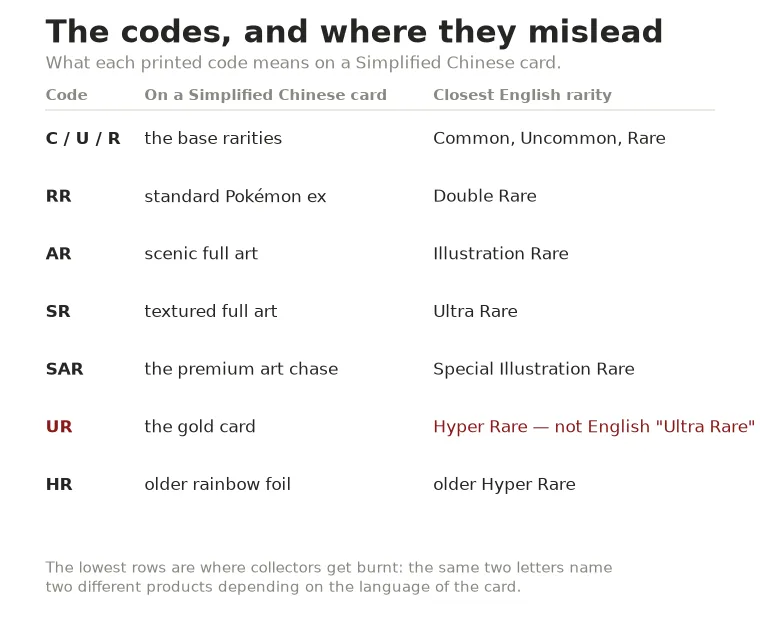
| Code | What it means on a Simplified Chinese card | Closest English rarity |
|---|---|---|
C / U / R |
the three base rarities | Common, Uncommon, Rare |
RR |
a standard-art Pokémon ex | Double Rare |
AR |
a scenic full-art illustration | Illustration Rare (IR) |
SR |
a textured full-art card | Ultra Rare |
SAR |
the premium illustrated chase card | Special Illustration Rare (SIR) |
UR |
the gold card — the top rarity of the set | Hyper Rare (gold), not English “Ultra Rare” |
HR |
an older rainbow-foil card | older English “Hyper Rare” |
Read that table again with the two middle rows in mind. A Simplified Chinese SR corresponds to what English calls an Ultra Rare, and a Simplified Chinese UR corresponds to what English calls a Hyper Rare. The two languages attached the same two letters, and the same two words, to opposite ends of the ladder. It is a naming collision, not a typo, and it has been that way for years.
Reading the printed symbol
Scarlet & Violet sets added a second, language-independent way to read rarity: a symbol next to the card number, coloured black for the base rarities and gold for the chase cards, with the number of stars rising as the rarity does. Once you know the pattern you can rank a card at a glance without knowing a single code.
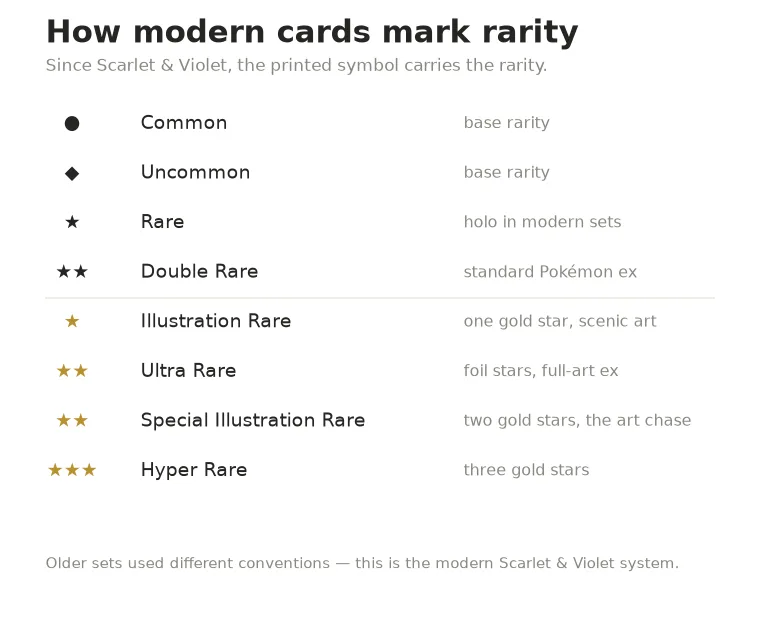
| Symbol | Rarity | What you are looking at |
|---|---|---|
| ● | Common | the bulk of any pack |
| ◆ | Uncommon | the same, one step up |
| ★ (black) | Rare | usually holo in modern sets |
| ★★ (black) | Double Rare | a standard-art Pokémon ex |
| ★ (gold) | Illustration Rare | a full-art scenic illustration |
| ★★ (foil) | Ultra Rare | a full-art Pokémon ex or Supporter |
| ★★ (gold) | Special Illustration Rare | the illustrated chase card of the set |
| ★★★ (gold) | Hyper Rare | the gold card — what Simplified Chinese prints as UR |
The bottom row is the one that ties the two systems together. Three gold stars in the modern English scheme and the code UR on a Simplified Chinese card are pointing at the same thing: the gold card. That is the single most useful correspondence on this page, because it is the one that gets misread most often in listings.
The letter codes, one by one
Beyond the modern ladder there is a longer tail of codes from earlier eras and special products. None of them appear in every set, but all of them appear in listings, and knowing which are current and which are retired saves a lot of searching.
| Code | Name | Where it comes from |
|---|---|---|
RRR |
Triple Rare | the Sword & Shield era, for VMAX and VSTAR cards; no longer used |
SSR |
Shiny Super Rare | shiny collections such as Shiny Treasure |
S |
Shiny Rare | the same shiny cards, one tier below |
CHR |
Character Rare | a Pokémon shown with its Trainer in the artwork |
CSR |
Character Super Rare | the premium version of a Character Rare |
K |
Radiant | from kagayaku, the Japanese term; one per deck |
A |
Amazing Rare | a Sword & Shield era special rarity |
ACE |
ACE SPEC | powerful cards limited to one copy per deck |
P / PR |
Promo | cards released outside the main set, often as box extras |
Two newer codes are worth flagging for anyone buying current product. MUR, Mega Ultra Rare, sits above UR in the latest Mega-era sets; BWR, Black White Rare, marks a black-and-white illustrated treatment. Both are recent enough that listings are still inconsistent about how they are described, so check the set code as well as the rarity code before assuming a card is the one you think it is.
Where the codes mislead
Four specific collisions cause most of the confusion, and each has a different shape.
UR against “Ultra Rare”. This is the big one. On a Simplified Chinese or Japanese card, UR is the gold card. In English, Ultra Rare is a full-art Pokémon ex or Supporter with a silver border and artwork running past the frame. Two different products, one shared pair of letters, and a translation that produces the wrong card. The gold UR is the one people most often buy by mistake.
SR against “Super Rare”. Simplified Chinese SR is a textured full-art card — in practice, the tier English usually calls Ultra Rare. English sets barely use the abbreviation SR at all, so a listing that writes “SR” and a card printed SR may be describing two different levels without either party intending to mislead.
AR against “Art Rare”. This is the mild one. Simplified Chinese AR is a scenic full-art card, which is what English calls an Illustration Rare, sometimes abbreviated IR. The two codes point at the same thing; only the letters differ. If you see AR in one place and IR in another for the same card, they are the same product.
SAR against “Special Art Rare”. Also aligned. Simplified Chinese SAR is the premium illustrated chase card, which English calls a Special Illustration Rare. Same product, two abbreviations. Sets built around illustrated chases — the art-rare line in 151, for instance, covered in the four Pikachu art rares — are where this pair shows up most.
When the number beats the set total
One more convention matters, and it is the clue people miss most often because it does not look like a rarity at all. Every card in a set is numbered against the set size, as in 025/198. Any card whose number is higher than the total — 162/129, say — is a secret card, printed outside the main numbered run.
Secret numbering does not replace the rarity code; it sits alongside it. A card can be a secret and a gold card, or a secret and an illustrated chase. What the higher number tells you is that the card was not part of the base set, which is a useful signal in its own right: secret cards are normally the scarcer printings, and their position beyond the set total is documented and verifiable. The gold UR article works through one such card, 162/129, in detail.
Rarity is not value
This is the last and least intuitive point, and it is the one that costs people money. Rarity describes how scarce a printing is within its set. It says nothing about demand, and demand is what sets price.
A textured SR Trainer card and the top illustrated chase of the same set can sit two tiers apart on the rarity ladder and hundreds of dollars apart in the other direction, because the rarity ladder is not a price ladder. A common Pikachu outsells a rare card nobody wants. The practical consequence is that a rarity code is a starting point for identification, not a valuation: check the code to establish what you are looking at, then check what that specific card actually sells for. Where the card has been graded, the certification adds a second layer that is worth understanding on its own terms — the grading guide covers what that adds and what it does not.
Frequently asked questions
What does UR mean on a Pokémon card?
It depends on the language on the card. On a Simplified Chinese or Japanese card, UR is the gold card — the highest rarity printed in that set, with a gold foil treatment. In English, “Ultra Rare” is a full-art Pokémon ex or Supporter card, which is a different product entirely. A Simplified Chinese UR is the same thing English calls a Hyper Rare.
What is the difference between AR and SAR?
Both are illustrated full-art rarities and both use a scenic, hand-drawn style. AR, Art Rare, is the standard illustrated tier; SAR, Special Art Rare, is the premium tier above it, and its cards are usually the chase cards of a set. In English these correspond to Illustration Rare and Special Illustration Rare respectively.
What does SR mean on a Japanese or Chinese card?
SR stands for Super Rare and marks a textured full-art card — in English terms, the tier usually called Ultra Rare. It is a distinct rarity from SAR and from UR, and it is not the same as the gold card.
Why is my card numbered higher than the set total?
Because it is a secret card. Cards numbered beyond the set size — 162 out of 129, for example — were printed outside the main numbered run. Secret cards are normally the scarcer printings in a set, and the numbering makes them easy to identify. It is separate information from the rarity code printed beside the number.
Is a rarer card always worth more?
No. Rarity measures scarcity within a set; price measures demand. A common card of a popular Pokémon routinely outsells a scarcer card that few people want, and within a single set the illustrated chase card usually beats a higher-code Trainer card. Read the code to identify the card, then check actual selling prices for that specific card before drawing any conclusion about value.
Sources
Where the codes and conventions in this article come from
- The Pokémon Company, Pokémon Trading Card Game — the official product line and the source of the printed rarity conventions on modern cards.
- Pokédex Checklist, rarity labels reference — the explicit note that English and most international printings show full rarity names while Japanese, Korean and Simplified/Traditional Chinese printings show the letter codes
RR,SARand others, and the observation thatURusually means gold cards in Japanese. - Serebii, card database — used to check individual set listings, card numbers and the set size each number is measured against.
- TCGplayer, marketplace pricing — used as the reference point for the note that rarity and price diverge.
Rarity conventions differ between eras and between languages, and a code that is current in one set may be retired in the next. Where a card’s rarity matters to a purchase, check the code printed on the card itself rather than a listing description. Nothing on this page is a statement about the value of any specific card.
Related reading
- The Simplified Chinese gold UR, explained in full
- Chinese versus Japanese cards: what actually differs
- The four Pikachu art rares in 151
- The Gem Pack volumes, set by set
- How grading works, and what a grade adds
- All our card protection and collecting guides
Explore graded Simplified Chinese cards
- PSA 10 — Chinese Exclusive — our highest-premium line
- All PSA 10 graded cards
- Browse the card library by set and character
Not sure which rarity a listing is describing? Find this Card for Me, and we will tell you what it is — the code, the set and the tier, without the guesswork.
Where to go next
- The CardSpicy card index — every card we track, with its PSA 10 population and market history (195 cards).
- The illustrator index — every artist behind those cards, card by card (110 artists).