

Quick answer
In the One Piece Card Game a card number is not an identity. When Bandai reprints a sought-after card inside a ONE PIECE CARD THE BEST product (PRB-01 in 2024, PRB-02 in 2026), the new printing carries the same card number as the original. So a card stamped OP01-120 may have come out of the 2022 Romance Dawn set or out of a later reprint set, and the two are different products with different supplies. CardSpicy sells graded cards rather than raw singles, and this is the single most common way a One Piece card is bought under a wrong assumption about which product it came from.
The number tells you which card it is. It does not tell you which product it came from.
Every other major trading card game solves reprints by changing the card. Pokemon moves the number, or adds a stamp, or renames the set on the face of the card. One Piece does the opposite: the reprint keeps the number and the artwork, and the difference is carried by a small mark in the corner. That single design decision is why the One Piece market has a category of confusion that the Pokemon market does not have.
Why the same number appears twice
ONE PIECE CARD THE BEST is a reprint line rather than a new set. Its purpose is to put earlier, scarce or expensive cards back into circulation inside a fixed product. PRB-01 arrived in 2024 and PRB-02 in 2026, and both work the same way: a card that first appeared inside a numbered main set is reissued with its original code intact.
| What you might expect | What actually happens |
|---|---|
| The reprint gets a new set prefix | It keeps the original prefix and number |
| The reprint gets a new number within a set | Its number is unchanged |
| The artwork is visibly labelled as a reprint | Only a small corner mark changes |
| One code maps to one product | One code can map to two or more products |
The practical consequence is that a code search is not a product search. OP05-119 identifies a card. It does not identify a printing.
How the two printings are told apart
The difference is carried by two marks, and both are on the face of the card rather than in any catalogue.
| Mark | Position | On the original | On the THE BEST printing |
|---|---|---|---|
| Product logo | Bottom left | Absent | ONE PIECE CARD GAME logo printed |
| Rarity mark | Bottom right | The set’s own rarity symbol | A gold star rarity symbol |
Neither mark is large, and neither survives a badly lit photograph. That is why this distinction is worth checking in hand or in a clear, close image rather than from a listing thumbnail.
Which direction the difference goes
It is tempting to assume a reprint is always the cheaper one. Usually it is: across the reprint line as a whole, a THE BEST copy commonly trades in the region of 20 per cent to 90 per cent of the original for the same card and grade.
But not always. Two Comic Parallel cards are documented trading the other way round, with the reprint well above the original rather than below it:
| Card | Code | Direction of the difference |
|---|---|---|
| Shanks, Comic Parallel | 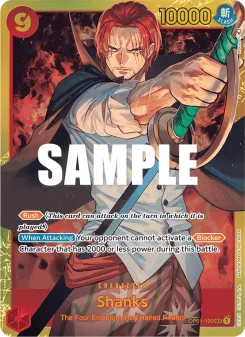 OP01-120 |
The THE BEST printing is the higher of the two |
| Portgas.D.Ace, Comic Parallel | 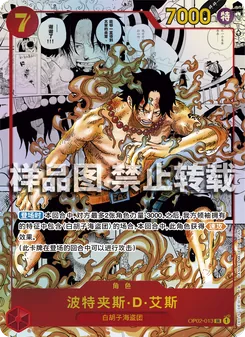 OP02-013 |
The THE BEST printing is the higher of the two |
The honest summary is not a rule but a warning: the direction of the difference varies by card. Two very close cards can move opposite ways, so the only reliable procedure is to check the mark, then check that specific card and that specific printing rather than assuming from the general pattern.
One more complication sits on top of this. The reprint of a given card is not necessarily scarcer or more common than the original in any predictable ratio — the print runs are not published. The 20-to-90 per cent range is an observation about outcomes, not a schedule.
Why the Pokemon comparison does not transfer
Collectors moving across from Pokemon often reach for the closest familiar idea, which is the first edition or the shadowless print. The resemblance is superficial. Those are separated by a stamp or a printing change that a reference list can carry, and the card number of a reissue is generally different from the original. One Piece separates its printings by a corner mark on a card whose number never moves.
The nearest Pokemon equivalent to what One Piece actually does would be a reprint that keeps the original set code — which Pokemon does not do. So the habit of reading the code first and the corner marks second is a One Piece specific habit, and it has to be learned rather than carried over.
What to check before buying
- Read the bottom left corner for the product logo.
- Read the bottom right corner for the rarity symbol, and look for the gold star.
- Ask which product the card came out of — not which set the code belongs to.
- For a graded card, read the label: a holder identifies the card, and the printing question is separate from the grade.
- Where the two printings differ in value, expect the difference to be large enough to matter, and specific enough that a general rule will mislead you.
Frequently asked questions
Why do two different One Piece cards have the same card number?
Because the reprint line keeps the original code. ONE PIECE CARD THE BEST reissues earlier cards with their original set prefix and number, so one code can point at more than one product. The code identifies the card, not the printing.
How do I tell a ONE PIECE CARD THE BEST printing from the original?
Two marks on the face of the card. The THE BEST printing carries an ONE PIECE CARD GAME logo in the bottom left corner, and a gold star rarity symbol in the bottom right corner. The original carries neither.
Is the reprint always worth less than the original?
No. As a general pattern a THE BEST copy trades around 20 per cent to 90 per cent of the original for the same card and grade, but individual cards have moved the other way. The direction varies by card, so the card and printing have to be checked together.
Does Pokemon have the same problem with reprints?
Not in the same form. Pokemon separates a first edition or a shadowless print with a stamp or a printing change, and a reissued card generally carries a different number. The One Piece case is a reprint that keeps the original number, which is the part that has no direct Pokemon equivalent.
If I am buying a graded card, does the printing still matter?
Yes. A grading holder identifies the card and records its grade, and both printings of a card can be graded. The holder does not answer the printing question, so the corner marks still have to be read separately.
Sources
Sources and scope
- Bandai, One Piece Card Game official product pages for the ONE PIECE CARD THE BEST line (
PRB-01,PRB-02). - Bandai, official card database — the entry structure that records a card once per printing, which is why one code can return more than one product.
- Third-party card shops and marketplace listings, which record the two printings separately and are the source of the observed direction of the price difference.
- Community identification guides, which describe the bottom-left product logo and the bottom-right gold star rarity symbol as the two distinguishing marks.
- Scope note: this page describes how printing variants are structured and identified. It does not quote prices, and the two illustrative cards are named to show that the direction of the difference is not uniform.
Prices quoted are secondary-market observations at the date cited and move quickly; nothing here is a valuation or an investment recommendation.
Related reading
- Which One Piece Cards Were Printed in More Than One Set?
- ONE PIECE CARD THE BEST (PRB-01 and PRB-02), Explained
- One Piece Card Rarities Explained
- Manga Rares in One Piece: What the Term Means
- One Piece Card Set Codes, Listed in Full
- One Piece Card Condition and Grading
- Every Shanks Card in the One Piece Card Game
- The One Piece Card Game Index
Where to go next
- The CardSpicy card index — every card we track, with its PSA 10 population and market history (195 cards).
- The illustrator index — every artist behind those cards, card by card (110 artists).
Leave a Reply