

Quick answer
Every card in Bandai’s One Piece database carries a block number. Six distinct values appear across the 2,785 cards: 1 on 762 cards, 2 on 552, 3 on 671, 4 on 512, 5 on 279, and X on 8. One card carries no block at all. CardSpicy records the field as the database gives it, and does not guess at what it governs.
A field you cannot explain is still a field you can count — and counting it honestly is more useful than inventing a rule for it.
Block numbers are the quietest field on a One Piece card. Nothing is printed on the card itself, the box does not mention it, and most collectors never look at it. But it is recorded for every single card in the official database, and it has one property that makes it worth knowing: it changes over time in a way the rarity does not.
What the database records
Each card in Bandai’s database carries a block value. On the 2,785 distinct cards, the values are distributed like this:
| Block | Distinct cards |
|---|---|
1 |
762 |
2 |
552 |
3 |
671 |
4 |
512 |
5 |
279 |
X |
8 |
| no value | 1 |
1 is the largest group and X is the smallest, which tells you the field is not simply the set number: cards from one set do not all share a block, and the newest wave is not the highest number.
What X is, and what we will not claim
Eight cards are recorded as block X. All eight come from the two most recent numbered waves — OP-16 and OP-17 — and all eight are Character cards, six Super Rares and two Rares:
| Card | Name | Rarity | Set |
|---|---|---|---|
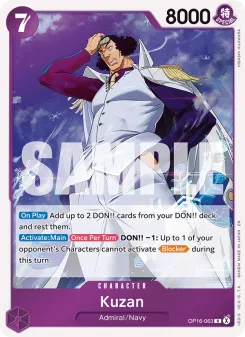 OP16-063 |
Kuzan | R | OP-16 |
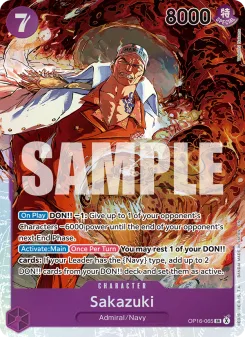 OP16-065 |
Sakazuki | SR | OP-16 |
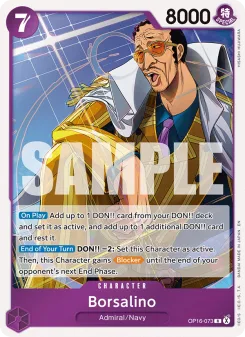 OP16-073 |
Borsalino | R | OP-16 |
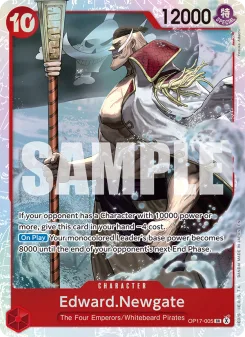 OP17-005 |
Edward.Newgate | SR | OP-17 |
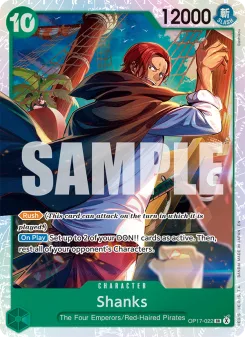 OP17-022 |
Shanks | SR | OP-17 |
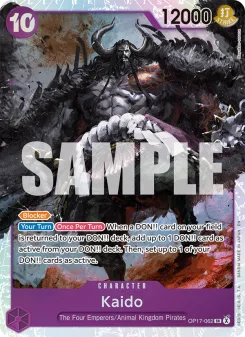 OP17-062 |
Kaido | SR | OP-17 |
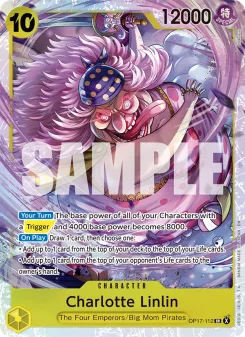 OP17-112 |
Charlotte Linlin | SR | OP-17 |
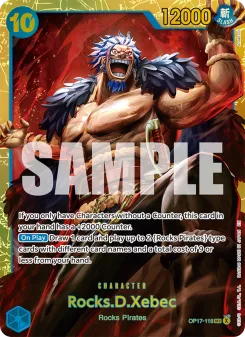 OP17-118 |
Rocks.D.Xebec | SEC | OP-17 |
Bandai does not publish what the block field means, and X is not explained anywhere in the card database. So we say what we can verify — eight cards, all from the two newest sets, all characters of some significance — and we stop there. If you read elsewhere that X means a specific rule, that claim is coming from somewhere other than the card data, and you should ask what that source is.
Why eight cards, not eight entries
There are 27 entries in the database carrying block X, but they belong to 10 cards, not eight. The extra two are treatments: EB04-061_p2 and OP01-016_p9 are both alternate printings whose own base card carries a different block value — 4 and 1 respectively.
It is a small detail with a large lesson. If you count block values across raw entries you will get 27; if you count across cards you will get 8. Whenever a number about this game looks wrong, the first thing to check is whether the person counting was counting printings or cards.
How to check a card’s block
The value is not printed on the card, so it cannot be read off a photograph. It has to come from the card database, keyed by the card’s code. That makes it a good example of the general rule for One Piece: the code is the key and the database is the source. A seller cannot tell you a card’s block from looking at it, and neither can you — but either of you can look it up in one step if the code is known.
Frequently asked questions
What is a block number on a One Piece card?
It is a value the official card database records for every card. Six values appear across the 2,785 cards: 1, 2, 3, 4, 5 and X. It is not printed on the card itself.
What does block X mean on a One Piece card?
Bandai does not publish what the block field means, so we do not claim a rule for X. What the data shows is that eight cards carry it, all Character cards from OP-16 and OP-17.
How many One Piece cards are block X?
Eight distinct cards, out of 2,785. They appear as 27 database entries because some of those cards have alternate treatments that also carry the X value.
Can I see the block number on a One Piece card?
No. It is not printed on the card, so it cannot be read from a photograph or from the card face. It has to be looked up in the official database using the card’s code.
Sources
Sources and further reading
- Bandai — the official One Piece Card Game card database, which records a block value for every card and does not publish an explanation of the field.
- CardSpicy — the One Piece card index, where each card is listed with its code so the block value can be looked up.
- CardSpicy — the full set code list, for the two sets the block X cards come from.
- CardSpicy — how many One Piece cards there are, for the same distinction between entries and cards.
- CardSpicy — alternate art treatments, for why one card can produce several entries.
Card statistics on this page are counted from Bandai’s own card database at the date shown, so they move as the database is updated. Prices are not quoted here: this site prices graded cards in US dollars from observed sales, and a raw-card figure would be a different number measured a different way. Where a card is described as part of a set, the set code and release date are the English edition.
Related reading
- One Piece Card Set Codes, Listed in Full
- How Many One Piece Cards Are There?
- Alternate Art Treatments on One Piece Cards
- What the One Piece Card Game Is
Where to go next
- The CardSpicy card index — every card we track, with its PSA 10 population and market history (195 cards).
- The illustrator index — every artist behind those cards, card by card (110 artists).
Leave a Reply