

Quick answer
CardSpicy treats a sleeve as a consumable rather than a fixture, so the replacement question is answered by which wear signal has appeared rather than by a fixed interval.
A sleeve is a consumable, not a fixture. It is the one layer of a card’s protection that is designed to be replaced, and it wears on a schedule that has almost nothing to do with how old it is. The question is not “every six months” or “every two years” — it is what the sleeve is doing, and which of six signals has appeared.
The short answer
There is no single interval, because a sleeve ages by use and not by calendar. The working figures are these. A sleeve on a card you handle — trading, showing, flipping through a binder — should be replaced every six to twelve months. A sleeve on a card that sits untouched in a box can go years, but it should be inspected once a year, because the failure modes in storage are different and quieter. A sleeve in a deck you actually shuffle should be replaced every twenty to forty games, and that is not a conservative number: shuffling is the hardest thing anyone does to a sleeve.
Those are starting points, not rules. The rest of this page is about the signals that tell you a sleeve has finished its job, and about what is actually happening when one does.
What actually degrades a sleeve
Three things, and they are worth separating because they call for different responses.
Mechanical wear. Every time a card goes in or comes out, the film flexes, and every time a sleeve is stacked or shuffled, it is pressed against its neighbours. This is what clouds a surface, softens an edge and eventually starts a split at the opening. It is cumulative and it is irreversible — no amount of cleaning puts the surface back.
Contamination. Dust, grit and skin oils end up inside the sleeve, and once a particle is in there it is trapped between the film and the card. Every push and every stack drags it across the surface. This is a large share of the hairline scratches that show up on cards that were “never played” — the card was never damaged by handling, it was damaged by something the sleeve was holding against it.
Chemistry. Polypropylene oxidises slowly at the surface, which is the haze that appears on a sleeve left in a warm room for years. The more serious version is a sleeve made from PVC: the plasticiser in it migrates out over time and dulls the card surface, and that damage is not reversible. This is why the material line on a sleeve matters more than the price line — the protection guide covers the material question in full.
The six signals a sleeve is done
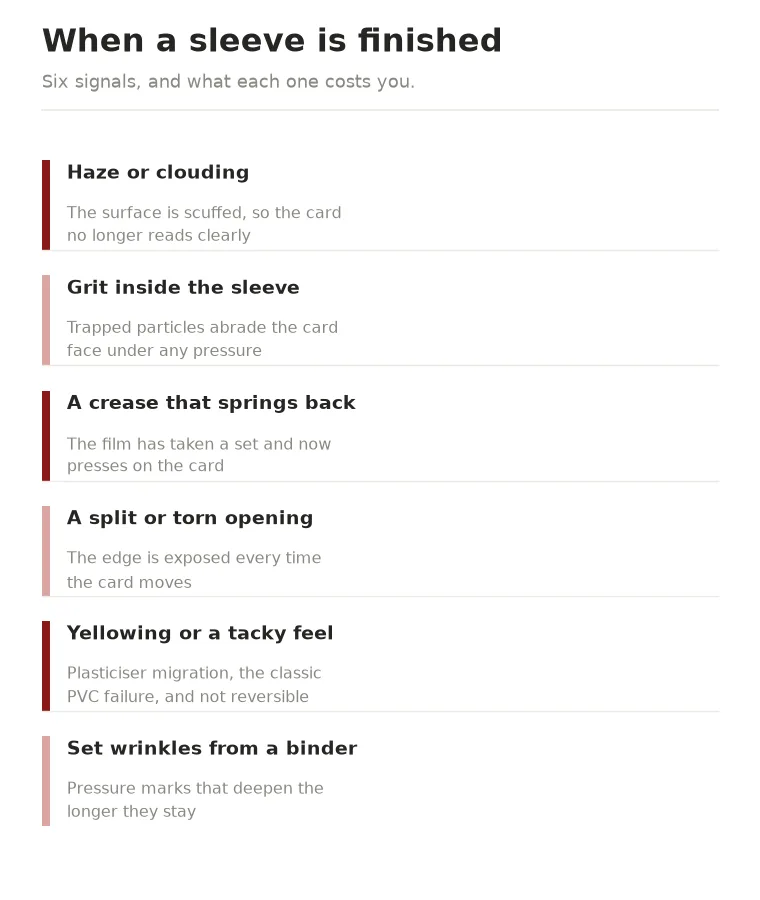
Haze or clouding. Hold the sleeve up to a light with the card still in it. If the surface reads milky or the card looks duller than it did, the film has lost its clarity and it is not coming back. Clouding is cosmetic in itself, but it is the visible marker of a surface that has also been abraded, which means the abrasion has been happening to something.
Grit inside the sleeve. Tilt it under a lamp and look along the card face. Anything you can see that is not part of the card is a future scratch. A sleeve with visible grit is not protecting the card, it is holding an abrasive against it, and it should be replaced the moment you notice — not at the next scheduled change.
A crease that springs back. Bend the empty part of the sleeve. A healthy blown film folds softly; a worn one holds a hard line and snaps back into it. That line of pressure sits against the card whenever the sleeve is stored flat, and corners and edges are what take the damage.
A split or a torn opening. The opening is where a sleeve always fails first, because it is the part that gets flexed the most. A small split will run — that is what a nick in oriented film does — and each time you load a card you widen it. A split sleeve also cannot keep grit out, so it accelerates everything above it.
Yellowing or a tacky feel. If the film has gone yellow, or feels slightly sticky rather than dry, stop and replace it immediately. Both are chemistry, not wear, and a tacky film is a sign that something is coming out of the plastic. If the card surface underneath looks dull or has a faint film on it, that is the more serious outcome and it is the reason PVC sleeves are worth avoiding entirely.
Set wrinkles from a binder. Sleeves stored in a binder, a box or under a stack can take on a permanent wavy pattern from constant pressure. This is not a failure of the film in the usual sense — the sleeve may still be clear and unripped — but the wrinkles press lines into the card’s surface over time, and a sleeve that has taken a set shape is no longer absorbing anything. Replace them when you replace the pages.
How often, for the way the card is actually used
The interval follows the handling, which is why one number cannot cover a collection.
Cards you handle. Anything you take out to look at, trade or show is on the six-to-twelve-month cycle, and closer to six if it goes to shows. Handling is the whole cost here: the film is abraded by every slide in and out, and the card’s own corners rub the inside of the sleeve at the mouth.
A stored collection. Cards in a box, untouched, are the easy case and the one people over-correct. Nothing is rubbing, so the sleeve is not wearing mechanically; what it is doing is slowly oxidising, and slowly holding whatever grit settled in when it was loaded. An annual inspection is enough — open one box, look at a few sleeves under a lamp, and check for haze and grit. If those are clean, the collection is fine for another year.
A deck you play. This is the one that surprises people. Shuffling flexes every sleeve in the deck hundreds of times in a session, and it wears the edges and the corners of the film rather than the face. In practice a sleeved deck is well into its wear by the time it has been shuffled through a few dozen games, and a torn sleeve in a deck is not a cosmetic problem — it exposes the card in a context where the card is being handled roughly. Replace a deck’s sleeves as a set, since a partly replaced deck shuffles and stacks unevenly.
Cards in a binder or album. These wear slowly, but the binder adds two things a box does not: pressure and movement of the page against the card. Check them with the annual pass, and change the sleeves whenever you change the pages, because a new page and an old sleeve is where the set wrinkles come from.
What re-sleeving actually costs
This is the part that makes the decision easy. Our 100-pack of penny sleeves is $4.99, which works out at about five cents a sleeve. Re-sleeving a 360-card collection is four packs — roughly $20 — and it takes an evening.
Set that against the alternative. A hairline scratch across the surface, or a soft corner from a crease that sat in the wrong place for two years, is the difference between one grade and the next on a card you cared enough about to store properly in the first place. Five cents a sleeve is not a maintenance cost worth optimising; it is the least expensive insurance in the hobby.
The cost only becomes a real question when the sleeve is doing a job it cannot do. A thin sleeve is an inner layer, not a structure — it does nothing against a bend or a stacking load. If the card is valuable enough that pressure worries you, the sleeve is not the protection, it is the thing that stops the rigid holder from scuffing the card. That division of labour is what the three layers is about.
Replacing a sleeve without adding a scratch
Most damage done during a re-sleeve happens in the ten seconds of the swap, not in the months before it. Three habits avoid it.
Work on a clean, hard surface, not a tablecloth and not a lap. A soft surface holds dust and it is where a card edge picks up grit on the way out.
Take the card out by pushing it, not pulling it. Turn the sleeve mouth-down over the surface and let the card slide out under its own weight, or press gently at the closed end. Never drag a card out by a corner across the sleeve mouth, because that drags the film edge across the card face.
Hold the card by its edges, and handle the new sleeve by its edges too. Oils from fingers on the card face are not a myth — they show up as a faint bloom in a photograph long before they are obvious in the hand. For a card you are inserting back into a holder, this is also the moment to check the sleeve for the six signals above, since the card is out anyway.
A slim tool helps more than it sounds like it should. A card with a fresh sleeve slides into a toploader far more easily than one with a sleeve that has gone soft and wrinkled at the corners — one of the reasons notched sleeves exist.
When the sleeve is not the problem
If you find yourself re-sleeving often and the sleeves keep failing early, the sleeve is probably not the variable. Three other causes are worth ruling out first.
The material. If the sleeves are PVC rather than polypropylene, they will haze, yellow and eventually leave a film on the card, and no replacement schedule fixes that — the fix is a different sleeve. Acid-free and PVC-free is the line to look for, which is what the product page states for ours.
Storage conditions. Heat and humidity swings accelerate both oxidation and pressure damage. A box in a room that ranges from cold to hot will age its sleeves faster than the same box in a stable space, and cards stored in a damp place are fighting the environment rather than the sleeve.
Pressure. A tightly packed box, or a binder that is overfilled, presses sleeves into the card surface continuously. A set wrinkle is the visible symptom, but the underlying problem is how the collection is stored, and it will keep producing wrinkles in new sleeves until the storage changes. Binders, boxes and frames covers what actually keeps cards flat without loading them.
Frequently asked questions
How often should I replace card sleeves?
On cards you handle, every six to twelve months. On a collection that sits in a box, inspect annually and replace when a signal shows rather than on a fixed date. On a deck you shuffle, every twenty to forty games. The interval tracks handling, not age, so a card that has never been handled can justify the same sleeves for years while a deck played weekly needs new ones several times a season.
Do card sleeves expire?
Not on a date, but the plastic does change. Polypropylene oxidises slowly at the surface, so a sleeve left in a warm room for years will eventually haze even with no handling at all. The more serious case is a PVC sleeve, where the plasticiser migrates out and dulls the card surface — that damage is permanent and is the main reason to insist on PVC-free sleeves rather than simply replacing them more often.
Can I reuse sleeves?
Only within the same card you already took out, and only if the sleeve is clean and uncreased. A sleeve that has been around a card has taken that card’s shape at the corners; putting a different card in it does not damage anything by itself, but a used sleeve brings its grit with it, and used sleeves saved from a deck are the usual source of mystery scratches. Reuse is fine for a short-term swap; it is not a way to avoid the five cents.
How do I know if a sleeve is worn out?
Six signals, in roughly the order they appear: haze or clouding, visible grit inside the sleeve, a crease that springs back when you bend the empty film, a split at the opening, yellowing or a tacky feel, and permanent wrinkles from storage pressure. Haze and set wrinkles are the slow ones; grit, splits and anything tacky are worth acting on the same day you notice them.
Do graded cards need re-sleeving?
Only the sleeve or bag around the slab, not the card. A slab is a sealed rigid case, so the card inside it does not see the sleeve at all — but the outer sleeve still collects grit and takes scuffs, and it is the surface your buyer sees. Replace those on the same handling schedule as any other sleeve. If the concern is the slab itself rather than a sleeve, slab care is the relevant read.
Sources
Sources and further reading
- CardSpicy — 100x Penny Sleeves 35-360 PT, on material, film thickness and the price per pack used in the figures above.
- CardSpicy — Card protection: the three layers, on sleeve chemistry, PVC plasticiser migration and how the layers divide the work.
- CardSpicy — The seven types of card damage, on abrasion, corner wear and chemical damage to a card surface.
- CardSpicy — Binders, boxes and frames, on storage pressure and the wrinkles it leaves in sleeves and cards.
Replacement intervals are working figures drawn from how sleeves are used, not measured results from any particular product. A sleeve’s life depends on the film, the resin grade, storage conditions and how it is handled, and two sleeves of the same thickness can last very different lengths of time. Where the condition of a sleeve matters to you, judge the sleeve you actually have.
Related reading
- Card protection: the three layers
- Binders, boxes and frames: how to store and display cards
- The seven types of card damage, and what stops each one
- Do notched sleeves actually protect corners better?
- How to protect your trading cards with card sleeves
- All our card protection guides
Shop sleeves and rigid holders
- Penny sleeves, 35 PT to 360 PT — 100 per pack, acid-free and PVC-free, in regular or notched corners
- Toploader 3" x 4" rigid card holder — the stiff layer that goes outside the sleeve
- All card protectors
- Graded card protection — sleeves and cases for slabs
- Binders and albums
Not sure which size your card needs, or which sleeve suits the way you store it? Find this Card for Me, and we will tell you what fits it.
Where to go next
- The CardSpicy card index — every card we track, with its PSA 10 population and market history (195 cards).
- The illustrator index — every artist behind those cards, card by card (110 artists).