

Quick answer
CardSpicy treats a sleeve and a rigid holder as two different jobs rather than two price points, so whether you need both comes down to whether the card ever leaves the room.
A sleeve and a rigid holder are sold side by side, priced similarly, and often bought together. They do not do the same job, and the question of whether you need both has a real answer that depends on one thing: whether the card ever leaves the room.
New collectors tend to treat the two products as competitors — a cheap option and a better option. That reading is wrong in a way that costs money in both directions. Plenty of people buy rigid holders for cards that will never move and never needed one. Plenty of others mail a card in a sleeve alone and find out what a sorting machine does to a paper rectangle.
Both mistakes come from the same missing distinction: the two layers stop different kinds of damage, and neither one substitutes for the other. This page works through which layer answers which problem, when one is genuinely enough, and why the standard arrangement puts the soft layer on the inside. The wider system — including the storage layer above both of these — is set out in the three-layer protection guide.
The short answer
For a card that stays in a box or a binder and is rarely handled, a sleeve alone is the correct and complete answer. For a card that travels — posted, carried, shown, submitted for grading, or simply moved in and out of a stack often — the rigid layer is what stops the damage a sleeve cannot.
That is the whole decision. It is not about how valuable the card is, and it is not about buying the “next level up”. A rigid holder is not an upgrade to a sleeve; it is a second layer with a different job, and it earns its place when the card is exposed to forces a sleeve does not resist.
What each layer actually does
The two layers fail in opposite directions, which is why the pairing works.
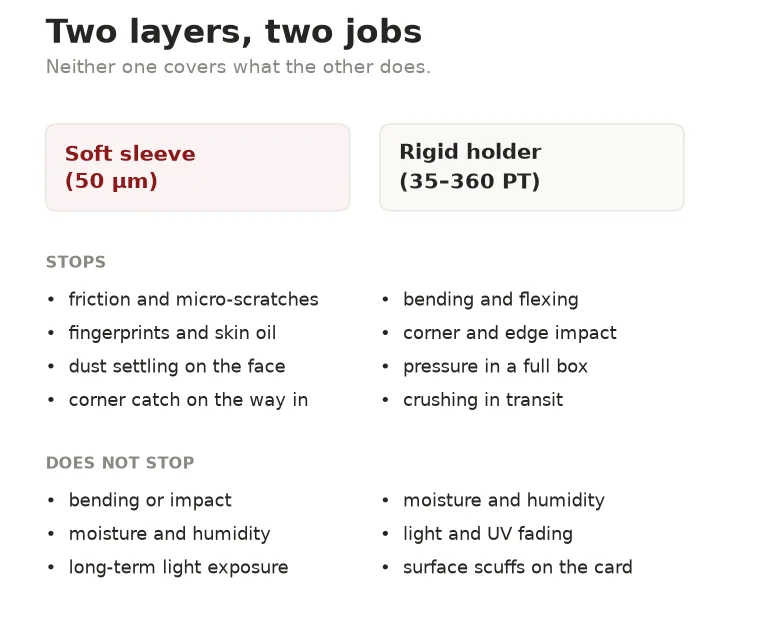
The sleeve’s job is contact. It is the layer that touches the card face, so it has to be soft, acid-free and thin enough to conform rather than press. What it stops is friction, fingerprints, dust and the moment of insertion — the micro-damage that accumulates on any card handled more than once. What it cannot do is resist force. A 50 µm film has no structural strength; it folds, and a card inside a folded film still bends.
The holder’s job is force. It stops the card flexing at all, which is what prevents creases, and it absorbs impact at the corners, which is what prevents the corner whitening and chipping that decide a grade. What it cannot do is stop moisture or light, and it does not stop the card face being scuffed — a bare card inside a rigid holder is still a card face in contact with hard plastic, moving. The damage guide maps each defect to the layer that addresses it.
The consequence is the arrangement itself: soft on the inside, rigid on the outside. Reversing it exposes the card face to exactly the contact the sleeve exists to prevent.
Set side by side, the two products differ on almost every axis except price:
| Soft sleeve | Rigid holder | |
|---|---|---|
| Rated by | PT — the card thickness it takes | PT — the opening thickness |
| Material | Clear polypropylene, acid-free, PVC-free | Rigid clear plastic, acid-free, PVC-free |
| Sizes we list | 35–360 PT, six options | 35–360 PT, eight options |
| Face options | Regular or notched top corners | Ultra (White) or PRO (Blue) |
| Primary job | Separates the card face from everything else | Stops the card flexing or taking impact |
| Where it fails | Cannot resist force | Cannot stop moisture, light or surface contact |
Note the failure row, because it explains the pairing better than the jobs row does. Each product is defined as much by what it cannot do as by what it does, and the two gaps do not overlap.
When a sleeve on its own is enough
Sleeve-only is not a compromise. It is the right answer for a large proportion of any collection.
- Cards kept in a box or binder and rarely handled. If nothing is applying force, there is no force for the rigid layer to resist. Rigidity solves a problem the card never encounters.
- Bulk commons and duplicates. A rigid holder on a card worth cents is a cost with no corresponding risk. The sleeve still earns its place — it is what stops the stack abrading its own card faces.
- Short-term handling. Sorting, checking a set, comparing two copies. The sleeve covers the exposure; the holder would be taken off again in a minute.
- Cards that live in a binder you actually look at. This is the common case people get wrong. A rigid holder does not fit standard binder pages, so adding one means the card leaves the binder — trading a real, present protection problem for a mostly theoretical one.
One qualification runs through all four: sleeve-only assumes the storage itself is sound. A sleeved card in a damp box, on a windowsill, or at the bottom of a bag is not protected, it is just wrapped. The environment does more work than either layer. The five storage rules apply identically whether or not a holder is involved.
When you actually need both
Four situations move the answer from one layer to two. Each of them involves force arriving from outside the sleeve.
| Situation | What the sleeve alone cannot handle | What the holder adds |
|---|---|---|
| Posting or moving a card | Compression and impact in transit; mail sorting applies real force | A rigid shell that distributes the load and keeps the card flat |
| Display, or showing a card around | Repeated handling, and pressure wherever the card is put down | Structural support, so the card is held rather than flexed |
| Preparing for grading | Any handling between now and submission | Flat storage, with the card unable to shift or bend |
| A card handled often and worth keeping | Accumulating risk on every pick-up | A buffer between the card and every mistake that happens near it |
The travel row is the one that matters most, and it is the one collectors underestimate. The classic mistake in this hobby is not over-protecting cards; it is mailing a valuable card in a sleeve alone, because the sleeve felt like protection and the envelope felt like the problem. In a rigid holder the card cannot flex at all, and a bend that would otherwise ruin it becomes a scuff on the holder instead.
One note on the grading row. Most grading companies publish their own accepted packaging, and rigid holders are not always on the list — several specify semi-rigid holders for submission instead. The two layers are still the right idea; the outer one is simply a different product for that specific trip. The grading guide covers the submission side.
Three ways the pairing goes wrong
The order and the sizing are where the arrangement breaks, and all three failures are common enough to be worth naming.
1. A bare card into a rigid holder. The most frequent error, and it happens because the holder feels like the stronger product, so skipping the sleeve feels like skipping a formality. It is not. A raw card inside a rigid holder sits against hard plastic and moves against it every time the holder is handled or slid into a box, and the surface takes that wear directly. The sleeve is not a lesser layer underneath the holder; it is the layer that makes the holder safe to use.[1][2]
2. Two rigid holders instead of a sleeve and a holder. The intuition is that more rigidity means more protection, but two holders do not fit inside one another usefully, and the combination is bulkier than the problem it solves. It also leaves the card face in contact with hard plastic — the same error as the first one, with extra material. Rigidity is already total at one holder; doubling it adds nothing and the surface risk stays.[1]
3. A holder that is too tight. Sizing a holder to the card rather than to the card plus its sleeve. The card goes in stiffly, the corners take the pressure, and the defect appears at the exact place a grader looks first. This is the single most avoidable failure on the list, and it is entirely a measurement question: the opening needs to clear the card and the sleeve, which is why the default size is larger than the card. The PT sizes explained works through the numbers.
What the two layers cost
The arithmetic is not the obstacle. A penny sleeve is a consumable measured in cents: our sleeves are listed at $4.99 for 100, which is about five cents per card, and that is the cost of protecting every card rather than a chosen few.
The rigid layer is where the numbers become a real decision, and the useful question is not the price per holder but how many cards in a collection genuinely need one. In most collections it is a small fraction — the ones that travel, the ones on display, the ones waiting on a submission. Reserving holders for that group is not under-protecting the rest; it is matching the layer to the exposure, which is the entire argument of this page.
There is also a habit worth more than either purchase: sleeve every card as it comes out of the pack, then decide separately which ones get a holder. Deciding later means handling the card again, which is the exposure the sleeve was meant to remove.
How many layers you need
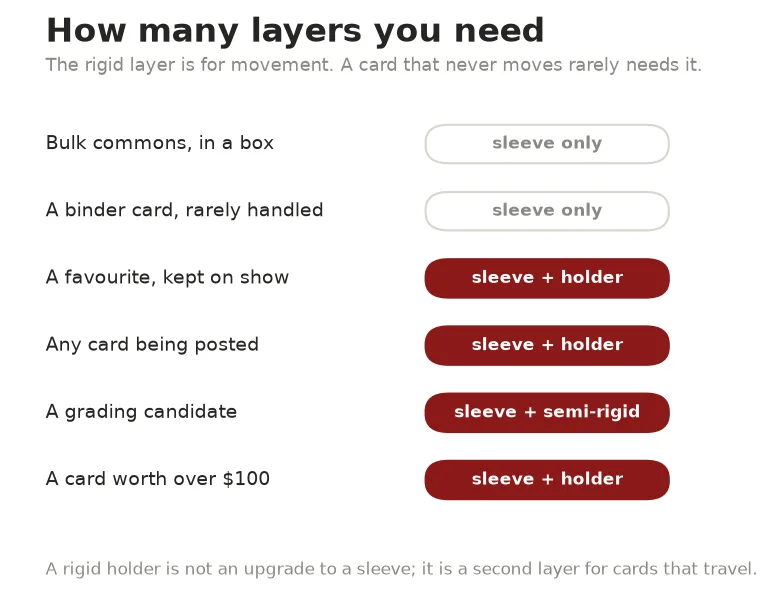
Read the list by the middle column rather than the card’s price. Two of the six are sleeve-only and they are not the cheap ones; the binder card may be the most valuable thing in the collection and still belong in a single sleeve, because it never moves.
Both layers, and the full size range of each, sit together in Card Protectors. The contact layer is our penny sleeve range — six sizes, regular or notched, 100 to a pack — and the rigid layer is the 3 × 4 inch holder range, eight thicknesses in two versions. Which corner shape a sleeve should have, and why the film on ours is deliberately thin, is the argument in the notched-sleeve article.
Frequently asked questions
Do I need both a sleeve and a toploader?
Only for cards that are exposed to force. A card stored in a box or binder and rarely handled is fully protected by a sleeve. A card being posted, carried, displayed or prepared for grading needs the rigid layer too, because a sleeve has no structural strength and a bend passes straight through it.
Which goes on first, the sleeve or the toploader?
The sleeve always goes on first, directly against the card, with the rigid holder outside it. Soft inside, rigid outside is the only correct order. Putting a bare card into a rigid holder exposes the card face to hard plastic and lets it move against that surface every time the holder is handled, which is the damage the sleeve exists to prevent.
Can I put a card in a toploader without a sleeve?
It will fit, and it will stay flat, but it is the arrangement to avoid. The card face rests on hard plastic with nothing between, so every slide and every handling scuffs it — and surface wear is the attribute that decides whether a card grades at 9 rather than 10. A sleeve costs a few cents and removes that risk entirely.
Is a toploader better than a sleeve for a valuable card?
Not better — additional. A rigid holder does not protect the card face from friction, so a valuable card in a holder without a sleeve is less protected on its surface than a common card in a sleeve. Value is the reason to use both layers, not the reason to pick one.
Do cards in toploaders fit in a binder?
Not in standard pages. A rigid holder is thicker than a binder pocket is built for, so holdered cards need dedicated storage rather than a binder page. That is the practical trade-off behind the binder row above: a card that lives in a binder you browse regularly is usually better off in a single sleeve.
Sources
References
- EVORETRO, Penny Sleeves vs Top Loaders: Understanding the Layering System — the two layers as different jobs, sleeve-first order, when a sleeve alone is sufficient, and the mistakes of going straight to a holder or using two holders.
- EVORETRO, New Collector’s Guide: What You Actually Need to Start Protecting a Card Collection — sleeve everything, then add rigid holders only for cards identified as keepers.
- Delightful TCG, Pokémon Card Toploader vs Sleeve — sleeve first as the layer under everything else, the rigid shell for storage and shipping, and the note that shipping damage remains the leading complaint on card marketplaces.
- KartenKoloss, Protecting Your Pokémon Cards Properly — the two-step soft-then-rigid system, and the caution that a holder stabilises a card but does not make it waterproof or UV-safe.
- Cardiacs, Penny Sleeves Explained — sleeve against the surface, holder for rigidity, and the explicit warning that using a holder without first sleeving the card increases the chance of scratches during insertion and removal.
- The Card Shop Finder, Toploaders vs Semi-Rigids — rigid holders for storage and shipping against semi-rigid holders for grading submissions, and why the two are not interchangeable.
Protection recommendations here describe the physical function of each layer, not a guarantee of any grading outcome. Conditions and handling vary, and no combination of supplies removes risk entirely. Our own product dimensions are the figures printed on each product page.
Where to go next
- The CardSpicy card index — every card we track, with its PSA 10 population and market history (195 cards).
- The illustrator index — every artist behind those cards, card by card (110 artists).