

Quick answer
CardSpicy compares the three graders on the three things that actually differ — how the scale is divided, what the label prints, and what shape the case is — rather than on brand reputation.
The three grading companies do the same job: a grader looks at your card, puts a number on it, and seals it into a case with a label. Everything that differs between them comes from three decisions — how the scale is divided, what the label prints, and what shape the case is. This page is about those three, and about how to choose between them for a specific card.
The short answer
The honest answer to which grading company is best is that it depends on what the card is for, and there is no company that is right for every card.
If the card is being graded in order to be sold into the widest possible pool, PSA is the practical default. It is the largest and the most liquid of the three, and a PSA label carries a single whole-number grade that no buyer has to interpret. That matters more than it sounds: a grade everyone reads the same way is easier to price than a grade that needs a sub-grade breakdown explained.
If you want the assessment printed on the case — centering, corners, edges, surface — BGS and CGC will give you one, and both use half points, so a card that is not quite a 10 has somewhere to land. That is the whole attraction of the half-point scale: it describes a card that sits between two whole numbers instead of forcing it down to the lower one.
If you are grading for your own shelf, none of this decides anything. Grading for yourself is a storage decision, and a rigid holder or a slab-sized binder does the protective work without the fee, the transit or the wait.
Three differences, and only three
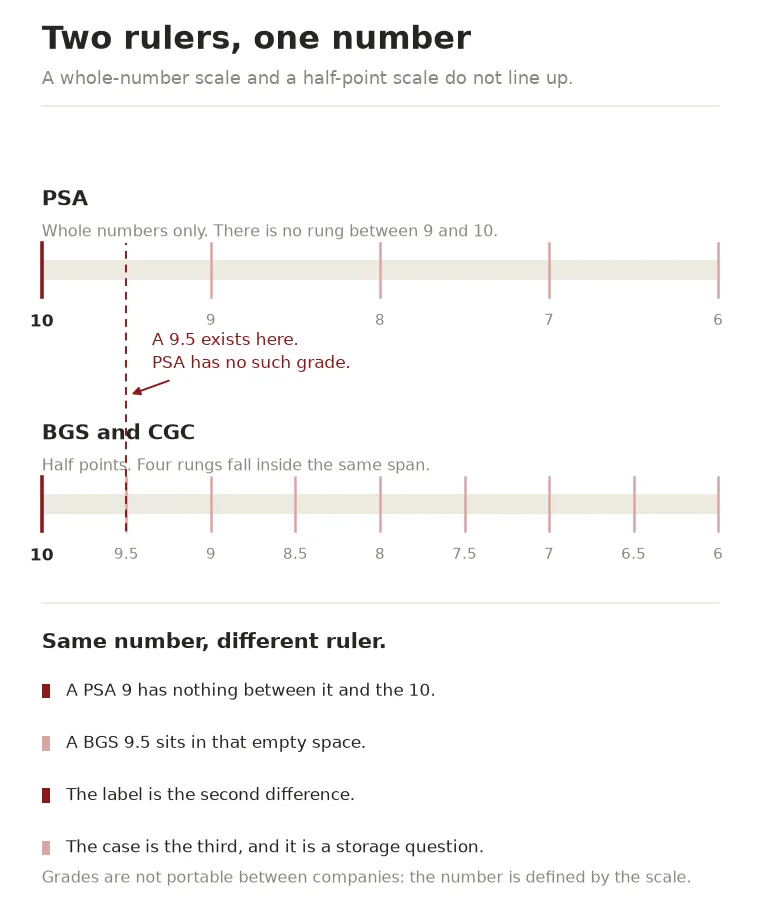
The scale. PSA grades in whole numbers and never issues a half point — its label never reads 9.5. BGS and CGC grade in half points. That single difference changes how many rungs exist between a 6 and a 10, and it is the reason a number from one company does not translate directly into a number from another.
The label. A PSA label carries one grade. A BGS or CGC label carries the overall grade plus sub-grades, so the buyer can see why the number came out where it did. Each company also has a name for the very top of its scale: BGS prints a Black Label when the overall grade is a 10 and all four sub-grades are also 10, and CGC’s top tier is a Pristine 10.
The case. The three hold the card in different case designs, with different label layouts. This is the difference collectors run into last and complain about most, because it is a storage problem: PSA’s and CGC’s cases differ in shape and label layout, so a slab sleeve cut for one will not fit the other. If you keep graded cards in boxes or frames, the case is a buying decision, not a footnote.
Side by side
| PSA | BGS (Beckett) | CGC | |
|---|---|---|---|
| Grade scale | Whole numbers only — never 9.5 | Half points | Half points |
| Sub-grades on the label | No — one grade, no breakdown | Yes — centering, corners, edges, surface | Yes |
| Top tier | PSA 10 | BGS 10, and Black Label when all four sub-grades are also 10 | Pristine 10 |
| The case | Tall clear case, blue-and-white label | Its own case design and label layout | A third case design — a sleeve sized for one will not fit another |
| What the label is for | One unambiguous number | The breakdown behind the number | The breakdown behind the number |
The table is deliberately narrow, because almost everything else people say about the three companies is either a consequence of these rows or a claim about the market that changes from card to card. How grading works covers the mechanics — what a grader assesses, what the sub-grades mean, and how to verify a certificate number once you have a slab in your hand.
What the label does and does not tell you
The most common mistake in comparing the three is to treat the number as if it were a measurement. It is not; it is a placing on one company’s scale, and the scales are not the same ruler.
A PSA 9 has nothing between it and the 10. On a half-point scale there is a rung in that space, which is why a 9.5 exists at all. Reading a 9.5 as “between a PSA 9 and a PSA 10” is a statement about where the number falls on a ruler, and that part is true. Reading it as “worth the same as something PSA would give a 9.something” is not — PSA has no such grade to compare against, and it never will, because half points are not part of the scale.
What the label also cannot tell you is how many other copies exist at that grade. A 10 with a large population and a 10 with a small one are the same label and different products, and the second is usually the more valuable. That is a population question rather than a label question, and it is the one number worth checking before you buy any graded card — the mechanics are in the grading guide.
Where the price difference actually comes from
Two slabs of the same card at nominally the same grade can sell for very different amounts. Four things explain most of it.
The size of the buyer pool. PSA is the largest and the most liquid, which means a PSA-labelled card is seen by more buyers when it is listed. Liquid markets clear at higher prices for the same asset, and that is a large part of why a PSA example of a common modern card usually leads.
Population at the top grade. A label whose top grade is scarce in absolute numbers tends to carry more. A Black Label population is far smaller than a PSA 10 population for the same card, and because the label requires all four sub-grades to be perfect, it is a genuinely harder thing to obtain. That scarcity is real, and it is priced.
What the buyer can see. Sub-grades are information, and some buyers pay for it. If you are buying at a distance, a label that explains why the card scored what it scored removes some of the uncertainty. That is worth something on a card where the difference between two adjacent grades is large.
The card itself. Grade and scarcity are separate things. A common card at the top of the scale is still a common card, and a scarce card one grade lower can be worth many times more. No choice of company moves that.
Which grader for which card
Selling into the widest market. PSA. The single number and the larger buyer pool are the two things that make a listing easy to price and easy to sell, and for most modern Pokémon cards that combination is what the market expects.
Wanting the assessment visible on the case. BGS or CGC. If the reason you are grading is to have the centering and the corners recorded next to the grade, only these two print it, and a half-point scale gives the card a place to sit rather than rounding it down.
Grading a simplified Chinese card. The companies all accept them, and the certificate works the same way. What differs is the economics rather than the mechanics: for any given simplified Chinese print the graded population tends to be thinner than for the same card in English or Japanese, which is a general tendency about the market and not a statement about any particular card. Choose on the same grounds you would for any other card — where the buyers are.
Not selling at all. None of them. If the card is going into your own collection, a rigid holder or a slab-sized binder provides the protection that made you think about grading, without the fee or the wait. The protection guide works through which layer does what.
Cracking a slab to resubmit
Sooner or later someone suggests cracking a card out of one company’s case and sending it to another, usually hoping the number comes out higher. It is worth understanding what that actually involves before doing it.
The card leaves a sealed case and is graded again from scratch. A regrade is not a reprint of the first decision: it is a fresh assessment by a different grader, on a different scale, with no obligation to land where the previous one did. It can come back higher, the same, or lower, and the previous grade is gone either way.
The cost is not only the fee. There is the transit to the company, the fee, the time, and the risk that comes with any card travelling in the post. Against that, the upside is the difference between two price points for the same card — which, as the section above sets out, is driven mostly by population and buyer pool rather than by the label on its own. If the population difference is not large, the arithmetic rarely works. Better to check the populations first, then decide, than to pay to find out.
One thing to avoid entirely: do not crack a slab to inspect the card unless you are prepared to lose the grade. Once the case is open, there is nothing to send back.
Why we only sell PSA 10
We sell PSA 10 only, and the reason is the same one that runs through this page: a single whole-number grade from the most liquid of the three companies is the easiest thing in this market to understand, to price and to store in a consistent way. Our simplified Chinese exclusives are a small, specific pool, and consistency matters more there than anywhere. If you want the longer version, why we only sell PSA 10 sets it out.
Frequently asked questions
Which grading company is best?
There is no single answer, because the three are optimised for different things. PSA is the largest and the most liquid and prints one whole-number grade; BGS and CGC print sub-grades and use half points. Choose by what the card is for — the widest buyer pool, or the fullest description of the card on the label. For grading your own collection rather than selling, the choice matters less than the case you store it in.
Is a BGS 9.5 as good as a PSA 10?
They are different claims, so the question is not quite answerable as asked. PSA does not issue half points, so there is no PSA 9.5 for a 9.5 to be equivalent to. What you can compare is what each side actually sells for, which comes down to how many copies exist at each grade and how many buyers are looking. Our grading guide takes that comparison further.
Do PSA and BGS slabs need different sleeves?
Yes — the cases differ in shape and label layout between companies, so an outer sleeve cut for one will not fit another. Measure or check the stated dimensions before buying slab protection in bulk, and buy a slab-sized box or frame rather than a standard card binder, because a slab is thicker and heavier than a binder pocket and forcing one in stresses both the case and the page.
Can you resubmit a card for a higher grade?
You can, but it is a fresh assessment rather than an appeal, and the outcome is not something anyone can promise. The card leaves a sealed case, is graded again from scratch, and may come back higher, the same or lower. Weigh the fee, the transit and the time against the difference in price between the two grades, and check the populations at each grade before assuming the move pays for itself.
Are you a grading service?
No. We are a shop rather than a grader, and we do not submit cards on anyone’s behalf. What we list is graded PSA 10 from our simplified Chinese ranges, each described with its certificate number and its set code. If you are looking for a specific card, Find this Card for Me, and we will tell you whether we have it.
Sources
Sources and further reading
- CardSpicy — Card grading: how it works, on the scale, sub-grades, what each company’s label carries, and how to verify a certificate number.
- CardSpicy — Why we only sell PSA 10, on the reasoning behind the line we stock.
- CardSpicy — PSA slab care, on keeping the case, rather than the card, free of scuffs.
- CardSpicy — Card protection: the three layers, on what actually protects a card when it is not being graded.
Everything here describes how the three companies present a grade, not what any particular card will score or sell for. Populations, prices and turnaround move with the market, and a graded card is worth what a buyer will pay on the day. Where a number matters to you, check the certificate and the population yourself.
Related reading
- Card grading: how it works
- Why we only sell PSA 10
- PSA slab care: keeping the case clean
- Does a PSA 10 slab fit in a binder?
- Card protection: the three layers
- All our card protection guides
Shop graded cards and slab protection
- All PSA 10 graded cards
- PSA 10 — Simplified Chinese exclusive — our highest-premium line
- Graded card protection — sleeves and cases for slabs
- All card protectors
- Toploader 3" x 4" rigid card holder — for raw cards you are not grading
Looking for a specific card, or not sure whether a slab you already own will fit a particular case? Find this Card for Me, and we will tell you what fits it.
Where to go next
- The CardSpicy card index — every card we track, with its PSA 10 population and market history (195 cards).
- The illustrator index — every artist behind those cards, card by card (110 artists).