🛒0

Category: Grading & PSA

CardSpicy articles about grading — PSA labels and slabs, submission, condition language and what a grade actually certifies.

  • PSA at New York Comic Con 2026: Drop-Off Submissions

    Quick answer

    CardSpicy writes about grading from the collector’s side, so this page sets out the one distinction that matters most at a show: at New York Comic Con 2026, PSA will take submissions but will not grade on site. The booth runs for all four days of the show, 8 to 11 October, at the Javits Center in New York, and it accepts cards, sealed packs, tickets, comics and games as hand-delivered submissions. Submissions close at 4:00 p.m. on the final day.

    Handing a card in at a booth is the start of a submission, not the end of one. It does not come back that day.

    The dates, the venue and the hours

    The booth is a drop-off point rather than a service counter, and the schedule is built around that. PSA has published hours per day, and a separate cut-off for accepting submissions on the last day.

    Day Hours
    Thursday, 8 October 10:00 a.m. – 7:00 p.m.
    Friday, 9 October 10:00 a.m. – 7:00 p.m.
    Saturday, 10 October 10:00 a.m. – 7:00 p.m.
    Sunday, 11 October 10:00 a.m. – 5:00 p.m.

    Two caveats sit underneath that table. Submissions are accepted until 4:00 p.m. on Sunday 11 October, an hour before the booth closes, so the last day is shorter than it looks. And PSA notes that cut-off times are subject to change, which means the safe reading is to arrive with time in hand rather than at the end of a session.

    What PSA will accept at the show

    The published list of categories accepted for take-home submission is wider than cards alone, and each one is handed over at the booth rather than graded there.

    • Cards. Vintage, modern, trading card game and non-sports, authenticated and graded as usual. This is the category most readers of this site care about.
    • Tickets. From historic ballgames to concert tickets.
    • Sealed packs. From vintage baseball wax to modern Pokémon.
    • Comic books and magazines. Most standard-size books and magazines.
    • Games and media. Console, format and platform media.
    • PSA Vault. Items submitted for secure storage with access to eBay and PSA Offers.
    • eBay consignment. Grade and list through eBay using PSA’s consignment service.

    The vault and consignment options are the two that are easy to overlook, because they turn a grading submission into a storage or a sale. If you are grading specifically to sell, that is worth deciding before you travel rather than at the counter.

    What PSA will not do on site

    This is the part that most often disappoints people, and PSA states it plainly: no on-site grading, and no autograph authentication.

    The practical consequences are straightforward. You will not walk out with an encapsulated card, and the show is not the place to bring a signed item for authentication. A submission handed in on Thursday follows exactly the same queue as a submission mailed from home, which means the current turnaround applies. Our page on the state of grading in late 2026 sets out which tiers are open, what they cost and how long they take, and that is the number that governs what happens after the show rather than anything at the booth.

    If your question is whether a particular card is worth the fee at all, that is a separate decision from whether it is worth submitting at a show. Our page on whether it is worth grading works through it on costs rather than on optimism.

    How to prepare a submission

    PSA has published a short preparation routine, and following it is the difference between a check-in that takes a minute and one that takes twenty.

    1. Prepare the submission online first. Use the PSA Online Submission Center or the PSA app to build it before you arrive.
    2. Bring the QR code or a printed form. Either one is recommended, though PSA notes it is not strictly required. It speeds up check-in.
    3. Sleeve the cards. Place each card in a penny sleeve to protect the surface.
    4. Then into a Card Saver. Insert the sleeved card into a rigid Card Saver so it stays secure in transit and handling.
    5. Do not over-package. PSA states that drop-off submissions do not need to be wrapped in cardboard, bubble wrap or sealed boxes.

    One point of housekeeping that follows from step four: what protects a card in the post is not what protects it at a booth. If you want the general version of these rules, our pages on slab care and on sleeving a graded slab cover the after-care side once the card comes back.

    The 10/10 Day offers

    PSA is also running a collector event day on 10 October 2026, branded as 10/10 Day, and it is the reason the tenth of the month appears twice on this page. PSA’s own site describes it as free trading card game tournaments at local shops, grading specials, limited-edition merchandise and other offers.

    Three things about it are worth saying plainly, because they are the ones most often read into it wrongly.

    • It is a day of separate offers, not a discount on everything. The promotions are specific to what each participating shop and each offer covers.
    • The tournaments are at local shops, not only at the convention. The free play is a shop-level event, so what is available depends on which shop near you is taking part.
    • It is not a promise about grades. Nothing about the day changes how a card is assessed, and the name should not be read as anything more than a date.

    PSA says details will be published as they are confirmed, so the sensible approach is to check the PSA site and the participating shop rather than to assume a national promotion.

    What the show does not change

    A drop-off event is convenient, and convenience is the whole of it. Four things stay exactly as they are.

    • The queue. A submission handed in at a show joins the same backlog as one mailed in, and the open tiers and their timelines are unchanged.
    • The fee. Submitting in person does not change what a tier costs.
    • The grade. Nothing about the venue affects how a card is assessed. If you want to understand how a grade is read, our pages on how the companies compare and on reading a population report are the place to start.
    • The risk of a fake slab. Separate from submitting, but relevant if you are buying at a show rather than handing in: our page on fake PSA slabs and our guide to verifying a PSA card cover how to check before you pay.

    For anyone new to the process end to end, the sequence from choosing a card to receiving the holder is set out in our grading guide, and what to do on the day a submission comes back is covered in what to do when your slab arrives.

    Frequently asked questions

    Does PSA grade cards on site at New York Comic Con 2026?

    No. PSA states plainly that there is no on-site grading at the event. The booth accepts hand-delivered submissions for take-home grading, which then follow the same queue and turnaround as a submission sent in by post. You will not receive an encapsulated card at the show.

    What can I submit at the PSA booth?

    Cards for authentication and grading, tickets, sealed packs, standard-size comic books and magazines, and games and media. PSA Vault storage and eBay consignment can also be arranged at the booth. Autograph authentication is not offered.

    How should I package cards for a drop-off submission?

    Place each card in a penny sleeve, then insert the sleeved card into a rigid Card Saver. PSA states that drop-off submissions do not need to be wrapped in cardboard, bubble wrap or sealed boxes. Bringing a QR code or printed submission form is recommended to speed up check-in, though not required.

    What is PSA’s 10/10 Day?

    It is a collector event day on 10 October 2026, described by PSA as free trading card game tournaments at local shops, grading specials, limited-edition merchandise and other offers. The promotions are specific to each participating shop and offer, and the day does not change how a card is graded.

    When do submissions close at the show?

    PSA accepts submissions until 4:00 p.m. on Sunday 11 October 2026, the final day, while the booth itself is open until 5:00 p.m. that day. PSA notes that cut-off times are subject to change, so arriving earlier in the day is the safer plan.

    Sources

    Sources and scope
    1. PSA’s official article on its New York Comic Con 2026 attendance — the show dates, the venue, the daily hours, the Sunday submission cut-off, the categories accepted for take-home submission, the absence of on-site grading and autograph authentication, and the preparation guidance including penny sleeves and Card Savers.
    2. PSA’s own site front page — the description of the 10/10 Day offers as free trading card game tournaments at local shops, grading specials and limited-edition merchandise.
    3. Our own pages on the current grading landscape, grading cost decisions, slab care, population reports and verifying a PSA card, used for the internal links and cross-references.
    4. Scope note: only details published by PSA are stated as confirmed. Where an offer is described as shop-specific or subject to change, that is PSA’s own framing. CardSpicy quotes no prices for cards and makes no valuation or investment recommendation.

    Event hours, cut-off times and offers are set by the organiser and can change. Check PSA’s own event page before travelling or submitting.

    Related reading

  • Grading in Late 2026: What Is Open, What It Costs

    Quick answer

    CardSpicy sells graded cards, so the state of the grading queue is not background news to us. As of early October 2026 the cheapest way into a PSA slab is $59.99 a card, the four PSA Value tiers have been shut since 2 June, and Beckett has again stopped taking Base and Standard submissions, leaving Express as its only open service. The mechanism behind both is the same: submissions have outrun capacity, and the operators are rationing access rather than queue time.

    Nothing here is a recommendation about grading a card. This page records what is open, what it costs and how long it takes, as published.

    PSA: what is open, and what it costs

    PSA’s US service menu was reshuffled twice between June and September 2026. Two tiers were renamed and one was reopened, so any older list you find is likely to be wrong in at least three places.

    Service Price Published turnaround Status
    Standard $59.99 90–100 business days Open since 14 September 2026; cheapest tier available; insured value to $1,000
    Priority $79.99 70–80 business days Open; this is the tier previously called Regular
    Express $199 20–30 business days Open; repriced on 9 September 2026
    Super Express $349 10–15 business days Open
    Premier $599 7–10 business days Open; this is the tier previously called Walk-Through
    Value Bulk, Value, Value Plus, Value Max — — Paused since 2 June 2026; no reopening date

    The practical effect of the June pause was abrupt. The entry price for a single card went from roughly $22 to $79.99 overnight, and it has since settled at $59.99 with the September reopening of Standard. Standard also queues behind existing Value and Bulk submissions, so its published estimate is an estimate rather than a commitment.

    The backlog, and the number that reopens the cheap tiers

    PSA has said it will bring the Value tiers back once its active backlog falls below 5 million cards. That figure is the one to watch, and the trend is published often enough to check.

    Date Active backlog
    Late July 2026 (peak) 12.4 million cards
    25 August 2026 10.9 million cards
    8 September 2026 9.9 million cards
    22 September 2026 about 9.0 million cards

    That is a fall of roughly 900,000 cards in the two weeks to 22 September, and about 3.4 million cards, or 27 percent, below the late-July peak. It is real progress and it is still a long way from 5 million. On the published threshold, the cheap lanes are not close to reopening and no date has been given for them.

    PSA has added capacity in parallel: it says grading capacity is up nearly five-fold since 2021, with a new facility in Plano, Texas that opened in July 2026 and a European facility in Frankfurt, backed by a reported $200 million investment. New capacity is what makes the backlog number fall; it does not by itself reopen a tier.

    Beckett: Express only, and no date for the rest

    Beckett’s position is more restrictive than PSA’s. It stopped accepting new Base and Standard submissions in late September 2026, less than two weeks after bringing both back, and has not announced a date for them to return. Collectors are directed to a waitlist instead. Express, listed at $79.95 a card with a 15-business-day estimate, is the only tier still taking new orders.

    Separately, beckett.com and the Beckett mobile app were offline while the company works on what it describes as digital infrastructure improvements. Between the closed tiers and the offline tooling, the current practical choice for a Beckett submission is Express or waiting.

    If a card is not worth the Express fee after fees, shipping and insurance are added, the honest outcome is to keep it raw. Our cost-versus-value breakdown of a grading decision walks through that arithmetic, and the comparison of the three main graders covers where the labels actually differ.

    Why the queue got this long

    Because 2026 was the busiest year the hobby has had. Industry-wide, about 3.5 million cards were graded in June 2026, an all-time record and up roughly 65 percent year on year. PSA alone accounted for 2.50 million of them.

    The annual picture is similar. PSA graded 19.26 million cards in 2025, up 26 percent, which was roughly 72 percent of the more than 26 million cards graded by a major authenticator that year. Behind it, CGC accounted for about 18.4 percent, SGC about 5.3 percent, Beckett about 3 percent and TAG about 1.6 percent. Trading card games — mostly Pokémon, One Piece and Magic — made up about 71 percent of everything graded.

    Record submission volume is exactly what produces a record queue, and a queue is managed either by hiring and building, which takes quarters, or by raising prices and closing tiers, which takes effect immediately. In 2026 the operators did both.

    What the market now looks like

    One structural change sits underneath the operational one. Collectors Holdings, PSA’s parent, closed its acquisition of Beckett in December 2025 and now controls roughly 80 percent of the US card grading market. A class action filed in April 2026 seeks to have those acquisitions unwound, and the company filed a motion to dismiss in June. We take no view on the litigation and record it because it is part of why the two largest graders behave as they do at the same time.

    One grader moved against the trend. SGC, acquired by Collectors Holdings in early 2024, fell about 19 percent from May and about 75 percent year on year on the last clean per-grader breakdown available. A market with one dominant grader, a formerly competing grader going quiet and a challenger losing volume is a different market from the one card collectors were used to, and it is worth knowing which of those you are submitting to.

    What this changes for a decision

    Three things, and they are all about cost rather than outlook. First, the floor has moved: a $22 submission is not available, so a card that only made sense at the old fee may no longer make sense at $59.99. Second, the money is tied up for longer, and the published estimates on the cheap tiers are measured in business days counted in the nineties, which is most of a year of waiting. Third, a lower-tier reopening is a dated event, and the date is a number rather than an announcement: 5 million cards.

    Our guide to reading a graded label covers what the slab actually tells you once it arrives, and the population report guide covers the figure that decides whether a card is scarce in the grade you are chasing. Neither of those changes when a fee does.

    Frequently asked questions

    What is the cheapest PSA tier right now?

    Standard, at $59.99 a card, with a published turnaround of 90 to 100 business days and a maximum insured value of $1,000. It reopened on 14 September 2026 and is the only tier near the old entry pricing. The four Value tiers have been paused since 2 June 2026.

    When will PSA’s Value tiers come back?

    PSA has said the Value tiers reopen once its active backlog falls below 5 million cards. The backlog was about 9 million on 22 September 2026, down from a late-July peak of 12.4 million. No reopening date has been announced, and new Standard orders queue behind existing Value and Bulk submissions.

    Is Beckett still accepting submissions?

    Only through Express, at $79.95 a card with a 15-business-day estimate. Beckett stopped taking new Base and Standard submissions in late September 2026, less than two weeks after bringing them back, and is directing collectors to a waitlist. Its website and app were also offline for infrastructure work.

    Why are grading fees so much higher than last year?

    Because submission volume set records in 2026 and the operators rationed access instead of extending queues. About 3.5 million cards were graded industry-wide in June 2026 alone, up roughly 65 percent year on year, and PSA paused every tier under $80 on 2 June rather than let the queue grow further.

    Does a longer queue change what a card is worth?

    It changes what grading costs and how long your money is tied up, which is a different question from what a card is worth. The two interact when you decide whether to submit, and our cost-versus-value breakdown sets that arithmetic out. CardSpicy does not make price claims.

    Sources

    Sources and scope
    1. PSA published service tiers and turnaround estimates, read September and October 2026 — prices, business-day estimates, insured values and the June pause of the Value tiers.
    2. PSA statements on its active backlog, covering late July, 25 August, 8 September and 22 September 2026, and the 5-million-card threshold for reopening the Value tiers.
    3. PSA capacity statements — the Plano, Texas facility opened in July 2026, the Frankfurt facility, and the reported investment figure.
    4. Beckett submission notices, late September 2026 — the pause on Base and Standard, the waitlist, the Express price and turnaround, and the offline website and app.
    5. Industry grading-volume aggregation for 2025 and for June 2026 — totals, per-grader shares, and the trading card game share of graded volume.
    6. Reporting on the Collectors Holdings acquisitions of Beckett and SGC, the resulting market share, and the April 2026 class action with the June motion to dismiss.
    7. Our own pages on grading costs, grader comparison and population reports, used for the internal links only.
    8. Scope note: fees, turnaround estimates and backlog figures are published by the operators and change frequently. This page records them as at early October 2026 and quotes no card prices.

    Grading prices, tiers and turnaround estimates change without much notice. Check the operator’s own service page before submitting anything, and read a fee as a cost rather than as a signal about value.

    Related reading

  • Does a Graded Slab Need a Sleeve? What Fits a PSA 10

    Quick answer

    CardSpicy deals in graded slabs, and the thing a slab bag protects is the case and its label rather than the card inside it.

    A graded slab is already a sealed, rigid case with a label, so the question of whether it needs a sleeve sounds like it has an obvious answer. It does not, because the thing a slab bag protects is not the card. CardSpicy deals in graded slabs, and this is the layer that comes up most often in that conversation.

    The one line: a slab bag does not protect the card, it protects the case. The card is inside a sealed holder either way. What a bag preserves is the surface and the label, which is exactly what a buyer looks at first.

    What the slab already takes care of

    A third-party graded slab performs the functions that a sleeve and a rigid holder perform for a raw card, and it does all of them at once.

    • Authenticity. The card has been examined and identified by the grading company, and the label records what they found.
    • Condition. The grade is the company’s assessment, and the case is designed so that the assessment cannot be quietly changed afterwards.
    • Rigidity. The case is hard, so the card inside cannot bend or be crushed under normal handling.
    • Sealing. The case is closed in a way that is meant to show if it has been opened.

    None of those are improved by putting the slab into something else. That is the part of the question that has an obvious answer.

    What the slab does not take care of

    The case is protecting the card from the outside world, and in doing so it is the object touching the outside world. That is where the remaining risk is.

    What can happen Why it matters
    The case surface gets scratched or scuffed The case is what a buyer photographs, and scuffs read as handling. A scratch on the case does not touch the card and still changes how the slab sells.
    The label is marked or faded The label carries the grade and the identification. A damaged label is a problem with the slab’s documentation, not with the card.
    Corners and edges chip A chip on the case edge is the kind of damage that makes a buyer ask whether the case has been dropped.
    Dust settles into the seam Grit between slabs is what produces the surface scuffs above when a stack is handled.

    Every one of those is damage to the holder rather than the card, and every one of them is visible to the next person who looks at it. That is the whole argument for a bag.

    Why collectors bag slabs

    1. To keep the case surface clear. A bag takes the handling. When it scuffs, you replace the bag rather than looking at a scuffed case.
    2. To keep slabs from abrading each other. Slabs are stacked, carried in boxes and slid past one another. Bagging puts a soft layer between two hard surfaces, the same reason cards get sleeved before they get boxed.
    3. To keep the seam and label clean. Dust settling around the label and into the case seam is slow and easy to avoid.

    If a slab is going straight from a delivery box into long-term storage and will not be handled, the bag matters less. If it is going to be stacked, shipped, sold or looked at, it is the cheapest step in the whole stack.

    What actually fits a graded slab

    A slab is larger than the card inside it in both directions — it is taller, and it is considerably thicker — so nothing sized for a raw card will fit one. That rules out most of what is on a normal protection shelf.

    Slab bags and slab sleeves are made to the slab’s own dimensions rather than the card’s. Size them to the grading company’s slab, not to the card, and check whether the product is made for the slab format you actually hold, because not every grader uses identical outer dimensions.

    For display, the equivalent object is a slab stand or frame rather than a card frame, for the same dimensional reason. Display frames and magnetic holders sets out how those differ from raw-card holders.

    The one thing that does not work

    Putting a graded slab inside a holder or sleeve built for a raw card. A standard sleeve is far too small, and a 3" × 4" rigid holder is too short and much too thin. Forcing a slab into either will not protect it, and the attempt is a good way to crack a corner of the case or bend the label, which is the outcome the bag was supposed to prevent.

    The same applies in reverse: a slab is not a holder for a raw card, and a card should not be stored loose inside a slab-sized bag, where it will slide freely.

    Frequently asked questions

    Does a graded slab need a sleeve?

    It does not need one to protect the card, because the card is already sealed inside a rigid case. A slab bag protects the case itself — the surface, the corners and the label — which is what a buyer inspects first, so bagging is worth doing for any slab that will be handled, stacked or sold.

    What size sleeve fits a graded slab?

    Slab bags and slab sleeves, sized to the grading company’s case rather than to the card. A slab is taller and much thicker than a standard card, so nothing designed for a raw card will fit, and the bag has to be matched to the slab format you actually hold.

    Can I put a graded slab in a 3×4 toploader?

    No. A rigid 3" × 4" holder is built for a standard 63 × 88 mm card and is both too short and far too thin for a graded slab. Attempting it risks cracking the case corner or bending the label.

    Does bagging a slab affect the grade?

    No. The grade is inside the sealed case and has nothing to do with what the case is stored in. A bag is an outer layer that can be removed without touching the slab.

    Is a slab bag the same as a card sleeve?

    No. A card sleeve is film sized to a 63 × 88 mm card and is meant to touch the card surface. A slab bag is a larger, looser envelope sized to the case. Using either for the other job leaves the wrong thing unprotected.

    Sources

    Sources and further reading
    1. Published dimensional data for third-party graded slabs, which are larger than a standard 63 × 88 mm trading card in both height and thickness.
    2. CardSpicy product specification for the rigid 3" × 4" card holder range — holder dimensions and the standard card size they are built for, used here to explain why a slab does not fit one. Retrieved 2026-10-06.
    3. CardSpicy product specifications for the 100x penny sleeve range — inner dimensions for the standard card size. Retrieved 2026-10-06.
    4. General guidance on storing and handling graded collectables, including the distinction between damage to a sealed case and damage to the item inside it.

    This page is guidance on storage and handling, not a valuation of any card or slab. Specifications are quoted from our own data and from published grader dimensions at the date shown, and are subject to change.

    Related reading

  • Display Frames and Magnetic Holders for Graded Cards

    Quick answer

    CardSpicy stocks the holders and sleeve layers this article puts on the same shelf, and every display frame is a trade between showing a card and protecting it.

    Display and protection pull in opposite directions, and every display frame is a trade between the two. CardSpicy stocks the holders and sleeve layers this article puts on the same shelf, and the argument below is about what a frame does and does not buy you.

    The one line: a display frame changes how a card is seen, not how it is protected. Some frames protect well, some barely at all, and the difference is the material and the closure rather than the finish.

    Two goals that do not point the same way

    Protection wants the card dark, flat, still and enclosed. Display wants the card lit, upright and visible. A frame satisfies the second by definition, so the only question worth asking about any frame is what it does about the first.

    That question has three parts: does it hold the card still, does it keep anything abrasive off the surface, and does it limit light. Frames differ enormously on the third and are often similar on the first two.

    Magnetic holders

    A magnetic holder — often called a one-touch — is two rigid halves that close around a card and are held by magnets set into the frame. It is a display holder and a rigid holder at the same time, which is why it sits in both conversations.

    • What it does well: it holds a card perfectly flat and rigid, it can be opened and closed without touching the card face, and it is the shape most display stands and frames are built to accept.
    • What it does not do: it is not sealed. Air still moves in and out around the seam, so a magnetic holder is not a substitute for an inner sleeve if the card is going to be in it for years.
    • The usual practice: the card goes into a sleeve first, and the sleeved card goes into the magnetic holder. The sleeve is what touches the card; the holder is what keeps it flat.

    If the card is going into a magnetic holder, the sleeve inside it still has to be the right rating for that card, which is the same choice described in the sleeve thickness guide.

    Frames built for graded slabs

    A graded slab is already rigid, already sealed and already labelled, so a slab frame is purely a display object. It does not add protection in any meaningful sense, because the slab already provides more of it than the frame could.

    What a slab frame can add is a place to stand the slab upright without resting its weight on a corner, and a border that keeps the label visible. Those are real conveniences. What it cannot add is UV filtering unless the frame explicitly has it, and most do not.

    What light actually does over years

    Light damage is the slowest and least reversible thing that happens to a displayed card, and it is the part of display that collectors most often discount because nothing visible happens in the first year.

    Two distinctions matter more than the exact figures. The first is ultraviolet versus visible light: UV does the bulk of the damage per unit of exposure, and ordinary window glass passes a large share of it. The second is direct sun versus ambient indoor light: a shelf across the room from a window and a shelf in the window are not the same exposure, even though both look like normal indoor conditions.

    The practical rules follow from that. Do not display a card where direct sun reaches it at any point in the day, including low winter sun that only lands on the shelf for an hour. Prefer a wall that light does not hit directly. And treat any frame as being about visibility first, since even a framed display is a trade against the card’s condition over a long enough period.

    If a card is valuable enough that its condition matters more than its visibility, the answer is not a better frame — it is storage. Humidity, light and long-term card storage covers that side, and storage boxes covers the containers.

    Where a display frame goes wrong

    • Assuming it is protection. A frame that is open at the seam, made of ordinary plastic and sitting in daylight is a display object. Nothing about the finish changes that.
    • Skipping the inner sleeve. In an unsealed holder, the card face is exposed to air movement and to whatever settles into the gap. A sleeve is the cheap part of the setup and the one that touches the card.
    • Displaying the best card in the collection. The card on display is the card taking light exposure. That is a choice worth making deliberately rather than by putting the most valuable card in the most visible place by default.
    • Storing the frame in a box, then calling it stored. A frame takes more space per card than a sleeve and a box, and does not close like one. Frames are for the cards you want to see.

    Frequently asked questions

    Does a display frame protect a card?

    Partly, and less than most people assume. A frame holds a card still and can keep dust off it, but unless it is sealed it still lets air move around the card, and unless it specifically filters ultraviolet light it does not stop fading. A frame is a display choice first.

    Should a card go into a sleeve inside a magnetic holder?

    Yes, if it will be in the holder for a long time. A magnetic holder is not sealed, so the sleeve is what actually touches and shields the card surface. The holder keeps the sleeved card flat and rigid.

    Do magnetic holders work for graded slabs?

    No. A graded slab is much thicker than a raw card and is itself a sealed rigid case, so slab displays are separate products sized to the slab. Putting a slab in a raw-card holder is not possible without damaging one of them.

    Will displaying a card fade it?

    Light exposure changes a card slowly and irreversibly, and display is exposure. Direct sun is the worst case, window glass still passes much of the ultraviolet that does most of the damage, and ordinary indoor light over years is not zero. If condition matters more than visibility, store the card rather than displaying it.

    What is the safest way to display a card?

    Keep it out of any position where direct sun reaches it, put it into a sleeve before it goes into any holder, and expect the frame to be about how the card looks rather than how it survives. For a card where condition is the value, storage beats display.

    Sources

    Sources and further reading
    1. CardSpicy product specifications for the 100x penny sleeve range and the rigid 3" × 4" card holder range — the sleeve ratings and holder dimensions used when describing the layers. Retrieved 2026-10-06.
    2. General conservation guidance for paper-based collectables on ultraviolet exposure, visible light and the irreversibility of light-induced fading.
    3. Standard trading card size of 63 × 88 mm as published by the card games that use it, used here to distinguish display holders for raw cards from those built for graded slabs.
    4. Published dimensional data for third-party graded slabs, which are larger than a standard trading card and are displayed in holders sized for them.

    This page is guidance on display and storage, not a valuation of any card. Product specifications are quoted from our own data at the date shown and are subject to change.

    Related reading

  • Counterfeit Slabs: How to Check a PSA Holder Yourself

    Quick answer

    Counterfeiting has moved from the card to the holder, because a convincing holder makes any card inside it look settled. A holder can be checked without opening anything, and there are seven things worth reading on it: whether the inner frame corners are square, whether the company mark is embossed or flat, the shape of the G in the grade text, the outline of the year numerals, the ultraviolet watermark, fogging along the sealed edges, and whether the barcode agrees with the certificate number. CardSpicy sells graded cards, so this page is about a check performed on every one of them rather than about a risk that stays theoretical.

    The holder is a document. Read it the way you would read a document, not the way you would read a label.

    A grading holder carries three separate promises at once: that the card inside was graded, that the grade is the one printed, and that the holder has not been opened since. A forgery only has to break one of them to be worth making, which is why the checks below are grouped rather than treated as a single test.

    Why the holder became the target

    For most of the history of card grading, the practical risk sat with the card and the holder was the answer to it. That balance shifted for two reasons. A holder is worth breaking into if the card inside is worth more than the holder costs to forge, and the machinery needed to make a plausible one has become more accessible. The result is a market where a perfectly genuine card can sit inside a holder that never saw the inside of a grading facility.

    What a forgery can be What it means for a buyer
    A forged holder around a genuine card The card is fine and the label cannot be trusted
    A forged holder around a copy Nothing in the object can be trusted
    A genuine holder that has been opened and resealed The label was once accurate and may no longer describe the card inside

    The seven checks

    # Check What a genuine holder shows
    1 Inner frame corners Sharp right angles. A rounded corner on the inner frame is one of the most common tells.
    2 The company mark Embossed into the plastic, so it catches light and casts a slight shadow. A flat printed mark is wrong.
    3 The letter G in the grade text No small tail at the bottom of the letterform. A tail is a reproduction artefact.
    4 The year numerals Strait, sharply cut strokes. A rounded or soft curve on the diagonal of a numeral is a warning.
    5 Ultraviolet watermark An ultraviolet mark is present on labels from a certain production period onward, and its absence on a label that should carry one is meaningful.
    6 Edge condition Clean and clear. Broad fogging or whitening along a sealed edge suggests the holder has been opened and closed.
    7 Barcode against certificate The barcode and the printed certificate number describe the same record.

    Checks one to four are geometry and typography, and they can be done from a clear photograph. Checks five to seven are the ones that need the object, or at least a well lit close image of the label and of the sealed edge.

    Two softer checks worth doing

    Neither of these is decisive on its own, and both are cheap to run.

    The first is movement. A card inside a genuine holder sits with a small, consistent amount of play. A card that slides a long way, or that appears to be under unusual pressure against the rail, is worth a second look.

    The second is the rail geometry. The internal rails that hold the card should end in consistent corners. A holder whose rails look softened or irregular is not automatically a forgery, but it stops being something to accept without checking further.

    The certificate number is the part you can verify independently

    Of all the checks above, the certificate number is the one that can be tested against a record rather than against an eye. A holder carries a number, the number refers to a graded card, and the record is published. That makes the label the only part of the object with an external reference, and it is the reason a number that does not resolve is a stronger signal than any single visual tell.

    Two cautions belong with that. A forged holder can carry a real certificate number, so a number that resolves is not by itself proof that the holder is the one that record refers to. And a record describes a card and a grade; it does not describe where the holder has been since.

    Frequently asked questions

    How can you tell if a PSA slab is fake?

    Read the geometry first. Check that the inner frame corners are square rather than rounded, that the company mark is embossed rather than printed flat, that the letter G in the grade text has no tail, and that the year numerals have sharp strokes. Then check for an ultraviolet mark and for fogging along the sealed edges.

    Can a fake slab contain a real card?

    Yes. A forged holder around a genuine card is a recognised category, and in that case the card is what it appears to be while the label is not. That is why the holder check is done separately from the card check.

    Does a certificate number that resolves prove the holder is genuine?

    No. A forged holder can carry a genuine certificate number, so a resolved number shows that the record exists rather than that the object in front of you is the one it describes. It is a strong check, not a complete one.

    What does fogging along the edge mean?

    Broad whitening or a hazy band along a sealed edge is associated with a holder that has been opened and closed. It is one of the signs that a genuine holder has been resealed rather than that the holder is a forgery.

    Do slabs need protection once they are in a holder?

    Yes. A holder protects against handling and bending, and does not protect against ultraviolet light or a damp environment. Stored slabs still benefit from a low-light, stable position and an outer sleeve.

    Sources

    Sources and scope
    1. Grading company public information on holder construction, label elements and certification records.
    2. Community authentication write-ups and dealer guidance describing the inner frame corners, the embossed company mark, the letterform and numeral checks, the ultraviolet mark and edge fogging.
    3. Public certification look-up services, which are the independent reference a certificate number can be tested against.
    4. Scope note: this page describes checks a buyer can run on a holder. It does not assert that any single check settles the question, and it does not quote prices.

    Prices quoted are secondary-market observations at the date cited and move quickly; nothing here is a valuation or an investment recommendation.

    Related reading

  • PSA vs BGS vs CGC: Which Grader, and Why It Matters for Value

    Quick answer

    CardSpicy compares the three graders on the three things that actually differ — how the scale is divided, what the label prints, and what shape the case is — rather than on brand reputation.

    The three grading companies do the same job: a grader looks at your card, puts a number on it, and seals it into a case with a label. Everything that differs between them comes from three decisions — how the scale is divided, what the label prints, and what shape the case is. This page is about those three, and about how to choose between them for a specific card.

    The short answer

    The honest answer to which grading company is best is that it depends on what the card is for, and there is no company that is right for every card.

    If the card is being graded in order to be sold into the widest possible pool, PSA is the practical default. It is the largest and the most liquid of the three, and a PSA label carries a single whole-number grade that no buyer has to interpret. That matters more than it sounds: a grade everyone reads the same way is easier to price than a grade that needs a sub-grade breakdown explained.

    If you want the assessment printed on the case — centering, corners, edges, surface — BGS and CGC will give you one, and both use half points, so a card that is not quite a 10 has somewhere to land. That is the whole attraction of the half-point scale: it describes a card that sits between two whole numbers instead of forcing it down to the lower one.

    If you are grading for your own shelf, none of this decides anything. Grading for yourself is a storage decision, and a rigid holder or a slab-sized binder does the protective work without the fee, the transit or the wait.

    Three differences, and only three

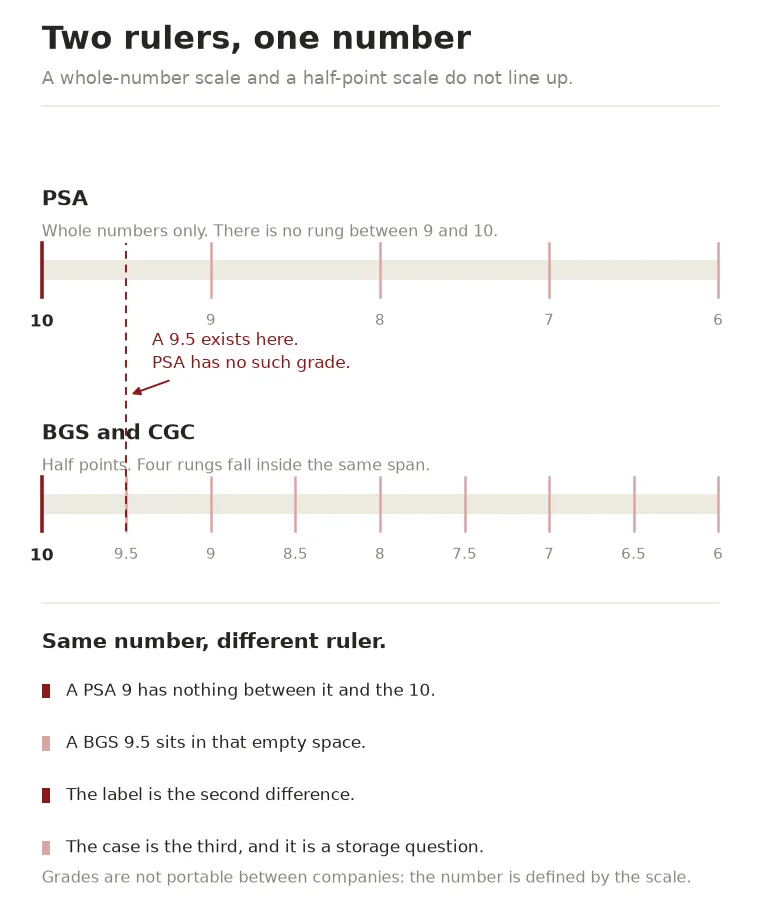
    The scale. PSA grades in whole numbers and never issues a half point — its label never reads 9.5. BGS and CGC grade in half points. That single difference changes how many rungs exist between a 6 and a 10, and it is the reason a number from one company does not translate directly into a number from another.

    The label. A PSA label carries one grade. A BGS or CGC label carries the overall grade plus sub-grades, so the buyer can see why the number came out where it did. Each company also has a name for the very top of its scale: BGS prints a Black Label when the overall grade is a 10 and all four sub-grades are also 10, and CGC’s top tier is a Pristine 10.

    The case. The three hold the card in different case designs, with different label layouts. This is the difference collectors run into last and complain about most, because it is a storage problem: PSA’s and CGC’s cases differ in shape and label layout, so a slab sleeve cut for one will not fit the other. If you keep graded cards in boxes or frames, the case is a buying decision, not a footnote.

    Two grading scales drawn as rulers: PSA grades in whole numbers from 6 to 10, while BGS and CGC use half points, placing four extra rungs inside the same range
    Same number, different ruler. The rungs do not line up.

    Side by side

    PSA BGS (Beckett) CGC
    Grade scale Whole numbers only — never 9.5 Half points Half points
    Sub-grades on the label No — one grade, no breakdown Yes — centering, corners, edges, surface Yes
    Top tier PSA 10 BGS 10, and Black Label when all four sub-grades are also 10 Pristine 10
    The case Tall clear case, blue-and-white label Its own case design and label layout A third case design — a sleeve sized for one will not fit another
    What the label is for One unambiguous number The breakdown behind the number The breakdown behind the number

    The table is deliberately narrow, because almost everything else people say about the three companies is either a consequence of these rows or a claim about the market that changes from card to card. How grading works covers the mechanics — what a grader assesses, what the sub-grades mean, and how to verify a certificate number once you have a slab in your hand.

    What the label does and does not tell you

    The most common mistake in comparing the three is to treat the number as if it were a measurement. It is not; it is a placing on one company’s scale, and the scales are not the same ruler.

    A PSA 9 has nothing between it and the 10. On a half-point scale there is a rung in that space, which is why a 9.5 exists at all. Reading a 9.5 as “between a PSA 9 and a PSA 10” is a statement about where the number falls on a ruler, and that part is true. Reading it as “worth the same as something PSA would give a 9.something” is not — PSA has no such grade to compare against, and it never will, because half points are not part of the scale.

    What the label also cannot tell you is how many other copies exist at that grade. A 10 with a large population and a 10 with a small one are the same label and different products, and the second is usually the more valuable. That is a population question rather than a label question, and it is the one number worth checking before you buy any graded card — the mechanics are in the grading guide.

    Where the price difference actually comes from

    Two slabs of the same card at nominally the same grade can sell for very different amounts. Four things explain most of it.

    The size of the buyer pool. PSA is the largest and the most liquid, which means a PSA-labelled card is seen by more buyers when it is listed. Liquid markets clear at higher prices for the same asset, and that is a large part of why a PSA example of a common modern card usually leads.

    Population at the top grade. A label whose top grade is scarce in absolute numbers tends to carry more. A Black Label population is far smaller than a PSA 10 population for the same card, and because the label requires all four sub-grades to be perfect, it is a genuinely harder thing to obtain. That scarcity is real, and it is priced.

    What the buyer can see. Sub-grades are information, and some buyers pay for it. If you are buying at a distance, a label that explains why the card scored what it scored removes some of the uncertainty. That is worth something on a card where the difference between two adjacent grades is large.

    The card itself. Grade and scarcity are separate things. A common card at the top of the scale is still a common card, and a scarce card one grade lower can be worth many times more. No choice of company moves that.

    Which grader for which card

    Selling into the widest market. PSA. The single number and the larger buyer pool are the two things that make a listing easy to price and easy to sell, and for most modern Pokémon cards that combination is what the market expects.

    Wanting the assessment visible on the case. BGS or CGC. If the reason you are grading is to have the centering and the corners recorded next to the grade, only these two print it, and a half-point scale gives the card a place to sit rather than rounding it down.

    Grading a simplified Chinese card. The companies all accept them, and the certificate works the same way. What differs is the economics rather than the mechanics: for any given simplified Chinese print the graded population tends to be thinner than for the same card in English or Japanese, which is a general tendency about the market and not a statement about any particular card. Choose on the same grounds you would for any other card — where the buyers are.

    Not selling at all. None of them. If the card is going into your own collection, a rigid holder or a slab-sized binder provides the protection that made you think about grading, without the fee or the wait. The protection guide works through which layer does what.

    Cracking a slab to resubmit

    Sooner or later someone suggests cracking a card out of one company’s case and sending it to another, usually hoping the number comes out higher. It is worth understanding what that actually involves before doing it.

    The card leaves a sealed case and is graded again from scratch. A regrade is not a reprint of the first decision: it is a fresh assessment by a different grader, on a different scale, with no obligation to land where the previous one did. It can come back higher, the same, or lower, and the previous grade is gone either way.

    The cost is not only the fee. There is the transit to the company, the fee, the time, and the risk that comes with any card travelling in the post. Against that, the upside is the difference between two price points for the same card — which, as the section above sets out, is driven mostly by population and buyer pool rather than by the label on its own. If the population difference is not large, the arithmetic rarely works. Better to check the populations first, then decide, than to pay to find out.

    One thing to avoid entirely: do not crack a slab to inspect the card unless you are prepared to lose the grade. Once the case is open, there is nothing to send back.

    Why we only sell PSA 10

    We sell PSA 10 only, and the reason is the same one that runs through this page: a single whole-number grade from the most liquid of the three companies is the easiest thing in this market to understand, to price and to store in a consistent way. Our simplified Chinese exclusives are a small, specific pool, and consistency matters more there than anywhere. If you want the longer version, why we only sell PSA 10 sets it out.

    Frequently asked questions

    Which grading company is best?

    There is no single answer, because the three are optimised for different things. PSA is the largest and the most liquid and prints one whole-number grade; BGS and CGC print sub-grades and use half points. Choose by what the card is for — the widest buyer pool, or the fullest description of the card on the label. For grading your own collection rather than selling, the choice matters less than the case you store it in.

    Is a BGS 9.5 as good as a PSA 10?

    They are different claims, so the question is not quite answerable as asked. PSA does not issue half points, so there is no PSA 9.5 for a 9.5 to be equivalent to. What you can compare is what each side actually sells for, which comes down to how many copies exist at each grade and how many buyers are looking. Our grading guide takes that comparison further.

    Do PSA and BGS slabs need different sleeves?

    Yes — the cases differ in shape and label layout between companies, so an outer sleeve cut for one will not fit another. Measure or check the stated dimensions before buying slab protection in bulk, and buy a slab-sized box or frame rather than a standard card binder, because a slab is thicker and heavier than a binder pocket and forcing one in stresses both the case and the page.

    Can you resubmit a card for a higher grade?

    You can, but it is a fresh assessment rather than an appeal, and the outcome is not something anyone can promise. The card leaves a sealed case, is graded again from scratch, and may come back higher, the same or lower. Weigh the fee, the transit and the time against the difference in price between the two grades, and check the populations at each grade before assuming the move pays for itself.

    Are you a grading service?

    No. We are a shop rather than a grader, and we do not submit cards on anyone’s behalf. What we list is graded PSA 10 from our simplified Chinese ranges, each described with its certificate number and its set code. If you are looking for a specific card, Find this Card for Me, and we will tell you whether we have it.

    Sources

    Sources and further reading
    1. CardSpicy — Card grading: how it works, on the scale, sub-grades, what each company’s label carries, and how to verify a certificate number.
    2. CardSpicy — Why we only sell PSA 10, on the reasoning behind the line we stock.
    3. CardSpicy — PSA slab care, on keeping the case, rather than the card, free of scuffs.
    4. CardSpicy — Card protection: the three layers, on what actually protects a card when it is not being graded.

    Everything here describes how the three companies present a grade, not what any particular card will score or sell for. Populations, prices and turnaround move with the market, and a graded card is worth what a buyer will pay on the day. Where a number matters to you, check the certificate and the population yourself.

    Related reading

    Shop graded cards and slab protection

    Looking for a specific card, or not sure whether a slab you already own will fit a particular case? Find this Card for Me, and we will tell you what fits it.

  • PSA 10 vs PSA 9: The Price Gap on Simplified Chinese Cards

    Quick answer

    CardSpicy measures the PSA 10 / PSA 9 gap on Simplified Chinese Pokémon cards from recorded sales rather than from quoted asking prices, because most Chinese listings still trade thin.

    PSA 9 and PSA 10 sit one grade apart, and one grade can move a price by more than any set difference. For Simplified Chinese Pokemon cards the gap is quoted constantly and measured rarely, because most Chinese listings still trade thin. This article measures the gap where it actually exists, and shows what the numbers on price sites mean where it does not. Our general reading rules for graded labels live in our grading guide.

    The two grades in one paragraph

    A PSA 9 is a card with a visible flaw under close inspection: a light scratch on the case-worthy surface, soft corners, or edge wear that stops it from being gem mint. A PSA 10 is gem mint, the grade collectors treat as the definitive copy. Everything else being equal, a PSA 10 is scarcer in population and carries the entire chase premium of the set. The gap between the two grades is therefore one of the strongest signals in the hobby, and also one of the most misread.

    How we measured

    We pulled the tier prices for thirteen Simplified Chinese set catalogues from our price data source on 4 October 2026, then opened the individual product pages of twelve sample cards and counted the recorded sales in each grade tab. The sales count matters more than the price: a price with no recorded sales behind it is an estimate produced by a model, not a result produced by trades. Only cards with a deep sales list in both the PSA 9 and PSA 10 tabs count as evidence in this article.

    Where both grades actually trade: Collect 151

    One Chinese set has a deep two-grade market: Collect 151, and within it the four Pikachu Art Rares and the Mew ex Special Art Rare. Each of the five cards below carried thirty or more recorded sales in both grade tabs when we counted on 4 October 2026.

    Card Rarity PSA 9 listing PSA 10 listing PSA 10 divided by PSA 9
    Pikachu #172 Art Rare $1,697.66 $2,794.99 1.65x
    Pikachu #171 Art Rare $592.09 $1,397.53 2.36x
    Pikachu #173 Art Rare $891.00 $1,019.19 1.14x
    Pikachu #170 Art Rare $667.00 $1,055.00 1.58x
    Mew EX #191 Special Art Rare $226.60 $375.00 1.65x

    Read the last column with care. The premium ranged from 1.14x to 2.36x, and the median was 1.65x. Two cards with the same rarity and the same set, Pikachu #171 and Pikachu #173, sat at the two ends of that range at the same moment. For one concrete pair: in late September and early October 2026 the same Pikachu #172 sold between $1,475.99 and $1,750.00 as a PSA 9 and between $2,325.00 and $2,750.00 as a PSA 10 in its five most recent recorded trades.

    The trap: confident prices with zero sales

    Outside Collect 151, the graded tiers of the Chinese line are thin. The 30th Celebration set shows the pattern at its clearest. We sampled four of its cards across the price range, and every one listed a PSA 9 and a PSA 10 price while the recorded sales list in both grade tabs showed zero entries:

    Charizard #137: shown PSA 9 $150.62, shown PSA 10 $573.76, recorded sales in either graded tab: 0, while the ungraded tab carried 30 recent trades.

    Mewtwo ex #134: shown PSA 9 $49.23, shown PSA 10 $181.68, recorded sales in either graded tab: 0, while the ungraded tab carried 30 recent trades.

    Pikachu ex #127: shown PSA 9 $71.67, shown PSA 10 $268.46, recorded sales in either graded tab: 0, while the ungraded tab carried 30 recent trades.

    Lapras #106: shown PSA 9 $26.86, shown PSA 10 $95.20, recorded sales in either graded tab: 0, while the ungraded tab carried 12 recent trades.

    The whole 30th Celebration catalogue made the same point from above. Across the 104 cards where both graded tiers displayed a price, the implied PSA 10 premium sat inside a narrow band from 3.12x to 3.81x. Real markets do not agree with themselves that tightly across a hundred cards; pricing models do. That narrow corridor is the signature of estimates, and any article or listing that quotes a 30th Celebration grade gap as fact is quoting the model, not the market.

    What actually moves the premium

    Where the gap is real, three forces drive it. Population: the scarcer the PSA 10 copies relative to PSA 9, the wider the premium, which is why the four Pikachu Art Rares of Collect 151, with their enormous ungraded volumes, still hold a measurable graded gap. Eye appeal: a set whose chase art changes colour dramatically under tilt rewards the gem mint copy more than a set whose art is dark. Timing: premiums compress when a set reprints and stretch when a set goes out of print, so a gap measured in one month is not a permanent fact about the set.

    What this means for buyers and sellers

    If you buy: on a card with deep grade tabs, decide what the premium is worth to you on the day, because it moves. On a card with empty grade tabs, ignore the displayed premium entirely and price the card from its ungraded trades, which is the only tier with real volume on most Chinese sets. If you sell: a PSA 9 copy of a hot chase is not a discount copy, it is the entry tier that the next collector can actually afford, and the measured gap on Collect 151 shows the market paying from roughly 1.14x upward for the gem mint step.

    Where this leaves the Chinese market

    Simplified Chinese grading is growing from a thin base, and the honest summary of October 2026 is this: one set, Collect 151, has a grade gap you can measure; the rest of the line has a grade gap you can only estimate. That will change as population reports fill in. Until it does, count sales before you trust a spread.

    Frequently asked questions

    How much more is a PSA 10 than a PSA 9 on Chinese cards?

    On the five Collect 151 cards we verified with deep markets in both grades, the PSA 10 listing sat between 1.14x and 2.36x the PSA 9 listing, and the median was 1.65x. The premium is real but far from uniform, and it is only measurable where both grades actually trade.

    Why do price websites show large PSA 10 premiums for cards that never trade?

    Aggregators fill missing tiers with model estimates. On every 30th Celebration card we sampled, the PSA 9 and PSA 10 tabs listed confident prices while the recorded sales list showed zero entries, so the displayed premium is a model output, not a market result.

    Is a PSA 9 a bad buy?

    No. When the PSA 10 premium runs hot, a clean PSA 9 of the same card delivers the same artwork and set identity for a fraction of the price. The gap we measured on Collect 151 means the PSA 9 kept most of the card’s identity value on every card we checked.

    How can I check a price gap myself before paying?

    Open the card’s product page on the price site and count the recorded sales in each grade tab. If a tier shows fewer sales than you can count on one hand, treat its price as a rough indicator only. Real gaps come from tabs with a deep sales list.

    Sources

    List of sources used
    1. CardSpicy tracking records for Simplified Chinese cards, read on 4 October 2026.
    2. PriceCharting set directory pages for Collect 151, Fearless Terastal and 30th Celebration, Simplified Chinese, read on 4 October 2026.
    3. PriceCharting product pages for Pikachu 170, 171, 172 and 173, Mew ex 191, Zapdos ex 190, Charizard 137, Mewtwo ex 134, Pikachu ex 127, Jirachi ex 132, Lapras 106 and Alolan Exeggutor 104, each with its recorded sales list, read on 4 October 2026.
    4. PSA grading tier descriptions as published by Professional Sports Authenticator.
  • How to Read a PSA Population Report

    Quick answer

    CardSpicy tracks 195 Pokémon cards as full card pages, and each page reports how many copies PSA has graded where PSA publishes the figure. A PSA population report counts graded copies of one specific card, grade by grade. It measures how scarce that card is in that grade — it does not measure what the card is worth.

    A population report is the only public number that describes supply. It is also the number most often read backwards. Here is what each part of it means, what it leaves out, and how the two get confused.

    Every PSA 10 slab on this site was bought already graded, and every one of them can be looked up by its certification number. That lookup returns two different things: a verification that the slab is genuine, and a population figure for the card inside it. The verification answers “is this real”. The population figure answers “how many like it exist”. They are not the same question, and a listing that quotes one while implying the other is usually doing so on purpose.

    What a population report actually counts

    A population report is a count of submissions, grouped by card and by final grade. For each card in a set, PSA publishes how many copies it has graded at grade 1, 2, 3 and so on, up to 10, and how many came back as qualifiers or with an authentication-only result beyond grading. The line that matters most to a collector buying a 10 is the count in the 10 column.

    Two properties of the count are worth holding on to. First, it is cumulative: it never decreases. A card that was graded 10 in 2019 is still counted in the same column today. Second, it is per card, not per artwork. Two printings with the same illustration, from different sets or different languages, are two separate rows and two separate counts.

    How to look one up

    The report is reachable two ways, and which one you use depends on what you are holding.

    1. From a slab you have in hand. The certification number is printed on the label. Entering it on PSA’s own lookup returns the card, the grade and the date it was graded — and, for most entries, a link straight through to that card’s population line. This is the route to take before buying a card from a photograph, because it confirms the label belongs to the card it is sitting on.
    2. From a card you do not have. Look the card up by set and card number in the population report itself, without a certification number. This is the route to take when you are comparing two candidate purchases and want to know which is scarcer in a 10.

    Both routes return the same numbers. The first also proves the slab is genuine; the second does not, and cannot, because it never touches a specific slab.

    Population and “population higher” are two different lines

    Most reports show two figures side by side for each grade: the count at that grade, and the count higher than it. The distinction matters most in the grade below a 10.

    If you are looking at a PSA 9 and the report says there are 40 nines, that tells you nothing about where those 40 sit. If it also says only 6 copies grade higher, you have learned something real: the card is hard to find above a 9, and the six tens are the whole available supply at the top. If instead it says 900 copies grade higher, the 40 nines are not scarce at all — they are the ordinary outcome, and the card’s value is concentrated somewhere you cannot reach.

    This is why “low population” claims in listings should be read with the grade attached. A card can have a tiny population at grade 8 and a large one at grade 10, and the two statements are both true.

    Why the number keeps going up

    Population grows for three reasons, and only one of them is about new cards being found.

    • New submissions of old cards. Cards sit in collections for years before anyone sends them in. A card released in 2019 can still be adding to its 10 count today.
    • Resubmissions. Some collectors crack a slab and send the card back in, hoping the second grader is more generous. Resubmissions are counted again on the way back through, so the same physical card can contribute twice to the same column.
    • Grading volume. The number of cards going through the grader in a given year moves the whole report, not just one line in it.

    The practical consequence is that a population figure is a snapshot with a date on it, not a fixed property of the card. A scarcity argument built on a number from three years ago is not a scarcity argument.

    Three things a population report does not tell you

    It does not tell you how many exist. It counts how many have been graded. An ungraded copy in a shoebox is invisible to it, and so is a copy sitting in a slab from a different grader. In a format where most copies were never submitted, the graded count can be a small fraction of the real supply — or, in a format where most copies were submitted, very nearly all of it.

    It does not tell you the condition distribution. A count of 10s does not say whether the next submission is likely to land a 10 or a 7. That depends on the card in front of you, not on the aggregate.

    It does not set the price. Population is one input. Demand is the other, and it is not published anywhere. A card with a population of 12 and no buyers is cheaper than a card with a population of 4,000 and constant demand — and both facts are visible in the market at the same time.

    How CardSpicy uses population data

    Population is one of the fields on every card page in our card index. Each page carries a section on how many copies have been graded, alongside the market history and the rank the card holds by PSA 10 value. Where PSA publishes a figure we report it; where it does not, the page says so rather than filling the gap with an estimate.

    Population is deliberately not used as a price input on this site. Prices are built from recorded secondary-market sales, which is a separate method documented in how we count and rank Chinese Pokémon cards. A low population is a reason a card might hold its value; it has never been a reason to raise a price here, and treating it as one is how a shop ends up with listings nobody buys.

    Frequently asked questions

    Is a low population good?

    It is only half of the answer. Low population means few copies were graded; it says nothing about how many people want one. A card needs both to hold value, and a low population with no demand simply means nobody has bothered to submit it.

    Does a certification number lookup give me the population?

    Not always directly. The lookup confirms the card, the grade and the grading date, and for most entries links through to that card’s population line. The population itself is a separate report, and it covers every copy of the card rather than the one slab in front of you.

    Why does the population on a listing differ from what I see?

    Almost always because of the date. Population figures are snapshots taken at different times, and the line only ever grows. If a listing quotes a number and you check today’s report, the number you see should be the same or higher — never lower.

    Do you charge more for a card with a lower population?

    No. Pricing here is based on recorded secondary-market sales, not on population. Two cards with the same sale history are priced the same regardless of how many have been graded.

    What does “population higher” mean exactly?

    It is the number of copies graded above the grade you are looking at. For a PSA 9 with 6 copies higher, those six are the entire graded supply at the top of the ladder. For a PSA 9 with 900 copies higher, the 9 is an ordinary result rather than a scarce one.

    Sources

    Sources and further reading
    1. PSA — certification verification and population report, the underlying records for every figure discussed here.
    2. CardSpicy card index — the 195 card pages, each carrying its own graded-population section.
    3. CardSpicy — How we count and rank Chinese Pokémon cards, the method behind every count published on this site.
    4. CardSpicy — Why we only sell PSA 10, which is why population at the top grade is the line that matters here.

    Prices quoted on this site are secondary-market observations at the dates cited and move with the market. Population figures are reproduced as published and are not estimates.

    Related reading

    If you are weighing a graded card against a raw one, the two companion pages are why we only sell PSA 10 and card slabs versus graded cases. If you are starting from a certification number instead, how to verify a PSA slab walks through the label itself.

  • Card Protection: The Three Layers, From Sleeve to Slab

    Card Protection: The Three Layers, From Sleeve to Slab

    Quick answer

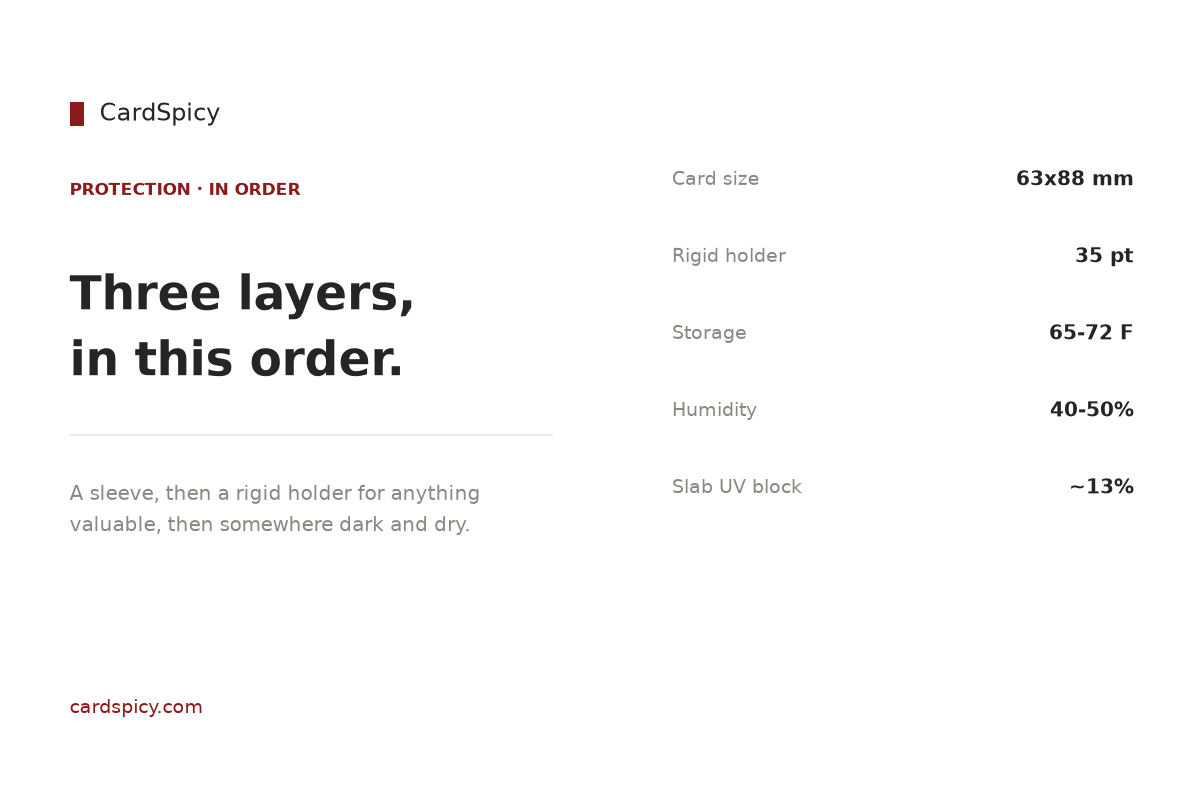
    CardSpicy (cardspicy.com) sells all three layers. Protecting a trading card means layering three separate jobs — a soft sleeve against handling, a rigid holder against pressure, and storage against light, humidity and dust — and a card is only as protected as the weakest of the three.

    Everything you need to know to keep trading cards — raw or graded — in the condition you bought them in.

    Cards lose value in ways you can usually avoid. A corner ding from a loose stack. A soft edge from a plastic sleeve that was never acid-free. Sunlight that fades a foil over one summer. Or a hairline scratch across the front of a graded case that turns a “10” into a hard conversation at resale.

    None of that is bad luck. It is storage and handling, and it is fixable. This guide covers the whole chain: what to put your cards in, in what order, and where to keep them.

    The short answer: a sleeve first, on every card, because it is the layer that stops the wear you cause just by touching it. A rigid holder next, for anything worth more than the holder costs. Storage last, and which storage it is follows how often you look at the card rather than what it cost. Light, humidity and sustained pressure are what do the irreversible damage, and no choice of sleeve or holder compensates for a card that lives in direct sun. CardSpicy sells the sleeves and rigid holders described here, alongside the binders and boxes that make up the third layer.

    CardSpicy card on the three layers of card protection: sleeve, rigid layer and storage
    Skipping a layer is how a card gets damaged by the layer you did buy.

    The three layers of card protection

    Think of protection as three layers, each solving a different problem. You do not need all three for every card — but you should know which layer you are skipping.

    1. Soft protection — sleeves. Stops surface scratches, edge wear and dust from everyday handling. Your first line of defence for anything you touch.
    2. Rigid protection — toploaders, semi-rigids, magnetic holders, slabs. Stops bending, corner crushing and pressure. Essential for anything worth more than the cost of the holder.
    3. Storage and display — binders, boxes, frames. Stops long-term damage: light fading, humidity, warping from uneven pressure, and loss.

    Layer 1: Sleeves

    Sleeves are cheap insurance. Two things actually matter when choosing them:

    • Chemistry. Look for acid-free and PVC-free (polypropylene or polyethylene) materials. PVC sleeves are the classic mistake — they look fine for years, then the plasticiser migrates and dulls the card surface. It is not reversible.
    • Fit. A soft sleeve (also called a penny sleeve) is a loose, flexible sleeve for standard 63 × 88 mm TCG cards. An exact-fit sleeve hugs the card for a second layer of protection inside a binder pocket or a rigid holder.

    Sleeve your card before it goes anywhere else — into a binder, a box, or a toploader. Going straight into a binder pocket without a sleeve is how corner whitening starts.

    Double sleeving (exact-fit inner, soft or matte outer) is worth it for anything you intend to keep or resell. The inner sleeve seals the card; the outer takes the handling.

    Layer 2: Rigid holders and thickness (the “pt” number)

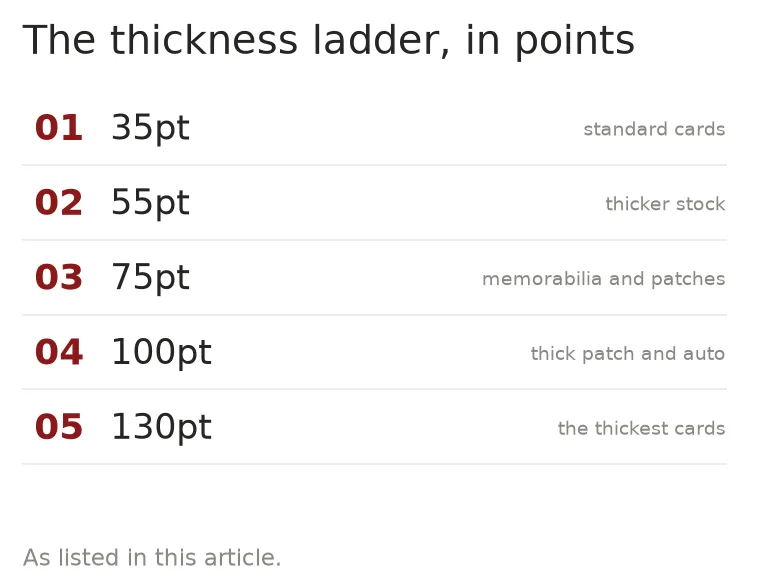
    Once a card leaves your hands and goes into storage, bending is the main risk. That is what rigid holders are for. The one number you need to understand is “pt” — the thickness of the card, in points of an inch.

    Ranked list of card thickness in points, from standard cards to the thickest
    The point ladder, from a standard card to the thickest ones printed.
    Thickness Typical use
    35pt Standard cards — Pokémon, Magic: The Gathering, Yu-Gi-Oh!, most TCGs and base sports cards
    55pt Thicker stock, some premium and foil-heavy printings
    75pt Memorabilia and patch cards, some inserts
    100pt Thick patch/auto cards, relic cards
    130pt The thickest printed cards and small booklets

    Buy the holder that matches the card. Putting a 130pt card in a 35pt holder bends it. Putting a 35pt card in a 130pt holder lets it slide and rattle.

    Three rigid options, in increasing order of permanence:

    • Toploaders — rigid, cheap, reusable, and the everyday standard. Always put the card in a sleeve first; a bare card in a toploader will scratch.
    • Semi-rigid holders — flexible but crush-resistant. Use these specifically when posting cards to a grading service, because they survive the postal system without pressing marks. Most graders specify semi-rigid.
    • Magnetic holders — two rigid halves with magnets. The ideal option when you want to display a card, because you can open and re-seat it without sliding it in and out. Choose the correct pt size and never use force on the seam.

    Layer 3: Storage and display

    • Binders. Choose side-loading pockets so cards cannot slide out, and archival-safe, acid-free, PVC-free pages. Store binders upright on a shelf like a book. Stacking binders flat puts pressure on the pages and can bow the cards at the edges.
    • Deck boxes and card boxes. For sleeved play decks and bulk. A good box has a soft, lint-free lining and a closure that does not rely on friction alone — strong magnets or a proper zip.
    • Display frames. For showing a card off on a wall. Keep them out of direct sunlight; UV is the single fastest way to fade a foil or a signature.

    Protecting graded cards (PSA, BGS, CGC slabs)

    A graded slab already solves the two biggest problems: the card is sealed, and its grade is documented. What a slab does not protect against is damage to the slab itself — and a scuffed, crazed or cracked case is a real problem at resale, especially on a PSA 10 where the whole premium sits on the case staying presentable.

    • Use an outer slab sleeve. A clear, snug sleeve over the whole case keeps scuffs, fingerprints and shelf rash off the plastic. It is the least expensive protection you will ever buy relative to the value it guards.
    • Store slabs upright, not flat, and not stacked. Long-term weight on a case can leave marks or stress the seal.
    • Keep them out of sunlight and out of the garage. UV fades the label; heat and humidity cycling can cloud the case.
    • Handle by the edges. Fingerprints etch into polycarbonate over time.
    • Keep the original grading paperwork or reference. The certification number on the label is the proof of authenticity — screenshot or note it when you buy or sell.

    How to protect a card, step by step

    The three layers in the order you actually apply them. Each step assumes the one before it.

    1. Decide whether the card will be handled. If it goes into a box and stays there, you can skip ahead to the storage step. If it will be looked at, sleeved and re-sleeved, every layer below matters.
    2. Put it in a sleeve, immediately. Acid-free and PVC-free, and correctly sized — a loose sleeve lets the card slide, a tight one presses the corners you are trying to protect. This is the layer that takes the fingerprints, dust and shelf friction instead of the card.
    3. Add a rigid holder if the card is worth more than the holder. A 35pt toploader, a semi-rigid, or a magnetic holder. This is the layer that resists bending, dropping and stacking pressure.
    4. Choose storage by how you use the card. A binder if you browse the set, a box if it sits untouched, a frame if it is on display. Whichever you pick: nothing containing PVC, nothing overstuffed, and never a binder stored flat under a stack.
    5. Give graded cards a step of their own. A slab already contains the rigid layer, so it needs only an outer slab sleeve and upright storage — never on its short edge under the weight of other slabs.
    6. Re-check the layers once a year. Replace sleeves that have clouded, stretched or yellowed, confirm humidity is still in the 45–55% range, and move anything that has ended up near a window.

    Everything above is covered in more detail in the sections that follow, and the quick reference table near the end matches a situation to the product in one line.

    Seven mistakes that cost real money

    1. Storing cards in a shoebox or a rubber-banded stack. Pressure plus movement equals edge wear.
    2. Cheap PVC sleeves or PVC binder pages — chemical damage that shows up years later.
    3. Displaying in direct sunlight or under a hot lamp.
    4. Leaving cards in a hot car, a loft, or a damp basement. Heat warps; humidity cockles.
    5. Putting a bare card straight into a toploader or binder pocket without a sleeve.
    6. Using the wrong thickness holder, then forcing the card in.
    7. Handling by the face instead of the edges, and stacking slabs face-to-face on a hard shelf.

    Quick reference

    Situation What to use
    Playing with a deck Sleeves (exact-fit inner + matte outer), then a deck box
    Collecting a set Sleeve, then a side-loading binder with archival-safe pages
    A card worth $20+ that you keep Sleeve, then a 35pt toploader or magnetic holder
    Posting to a grader Sleeve, then a semi-rigid holder, then rigid packaging
    Displaying a card Sleeve, then a magnetic holder or wall frame — out of sunlight
    A graded PSA / BGS / CGC slab Outer slab sleeve, stored upright, out of light and heat

    Frequently asked questions

    Are penny sleeves enough for an expensive card?

    For handling, yes. For storage and shipping, no. Add a rigid layer — a toploader, semi-rigid or magnetic holder — for anything you would be unhappy to lose.

    Do I need to double sleeve?

    Not for bulk. Double sleeving is worth it for cards you intend to keep long-term, display, or resell, because the inner exact-fit sleeve seals the card against dust and moisture while the outer sleeve absorbs the handling.

    What is the difference between a card slab and a graded case?

    A slab is the rigid plastic holder itself — it protects the card and makes tampering obvious. A graded case is a slab plus an official grade from a recognised grading service, which is what adds resale value. You can buy protection without grading; you cannot get the resale premium without it.

    Can I keep graded slabs in a binder?

    No. Slabs are thicker and heavier than the pockets in a standard binder, and forcing them in stresses both the case and the pages. Store graded cards in a card box sized for slabs, and display them in frames designed for slab thickness.

    How should I store cards for the long term?

    Sleeved, in an acid-free and PVC-free holder, inside a binder or box, standing upright, in a cool, dry, dark place at a stable temperature. Consistency matters more than any single product.

    Related reading

    Shop the layers

    Protection is a system, not a single purchase. Start with sleeves, add a rigid layer for anything valuable, and give the whole collection a home that keeps light, dust and pressure away.

    Graded cards are a separate problem from raw cards: a slab is roughly 3.25 in by 5.25 in and will not go into a standard page pocket. What a slab does and does not fit covers the sizes, and what to buy instead.

    Questions about what will fit a specific card? Get in touch — we would rather answer a question than ship you the wrong size.

    Sources

    Show all 11 sources
    1. GradingMetric — PSA 10 Success Rates by Sport, 2024–2026 (24,000 Cards Analyzed). Downgrade reasons by share.
    2. CardShellz — How to Store Your Trading Card Collection. Layer absorption, bowing, 65–72°F and 40–50% relative humidity.
    3. TFG Cards — How Card Grading Works. Corner wear developing through handling and sleeve insertion; surface as the 9-versus-10 factor.
    4. eathealthy365 — A Custom Trading Card Sleeve Material Guide. Re-sleeving every 6–12 months; PVC plasticizer migration and its effects.
    5. TCG Protectors — The Ultimate Trading Card Sleeves Guide. Inspect binders and long-term storage sleeves every 6–12 months; 60–75°F and 40–50% humidity.
    6. EVORETRO — Do protective sleeves degrade over the long term? Annual or biannual spot checks; yellowing, tackiness and brittleness as the signs.
    7. Hotmelt Adhesive Film — What is the difference between cast and blown polypropylene thermoplastic film? Blown film: matte finish, higher tensile strength and elongation, better puncture resistance.
    8. Sohu (搜狐) — How to choose card sleeve thickness in 2026: industry standards and scenario guide. Published thickness tiers from 10 丝 to 20 丝 (100–200 μm).
    9. PSA — Reholder Service. The service removes a card from its current holder and re-encapsulates it in PSA’s latest holder; the named categories of limited holder wear (superficial scuffs and scratches, exterior plastic discoloration, edge and corner dulling, label fading); the inspection performed on every reholder submission; and the reasons a straightforward reholder may not be completed, including a fractured case and fading from sunlight exposure since grading.
    10. Slab Saver Comics — Do Acrylic Cases Yellow? What Collectors Need. Cleaning practice for acrylic cases: microfibre first, water for fingerprints, never spray onto the case, avoid paper towels and glass cleaner, store away from hot, humid, smoky or greasy environments, and check discoloration against white paper under neutral light.
    11. Acrydis — Acrylic Premium Case for PSA Slabs. A display-case maker’s statement that a PSA slab gives around 13% protection against UV rays, and that acrylic scratches easily and should be cleaned with a microfibre cloth.
    12. CardSpicy — Does a PSA 10 slab fit in a binder? Slab dimensions, and why a short-edge load is the failure that cracks a holder. cardspicy.com

    Every figure here comes from the sources above or from our own packing practice. Protection preserves a card; it does not repair one. A crease that is already in the cardboard stays in the cardboard.

  • What to Do the Minute Your Slab Arrives

    What to Do the Minute Your Slab Arrives

    Quick answer

    CardSpicy (cardspicy.com) ships every slab the same way, so this is the routine on arrival: seven days from delivery, with the clock starting at delivery rather than at the order. Photograph the parcel, the label and the case before anything is cleaned or moved.

    Seven days from delivery, and the clock starts on delivery rather than on the order. Photograph the parcel, the label and the case before anything is cleaned or moved, check the certification number against the three records it appears in, and email us if the slab arrived damaged or is not what you ordered.

    CardSpicy card on the seven-day window for reporting a damaged slab on arrival
    The window runs from delivery, not from the order, and one photograph cannot be retaken.

    Seven days, and the clock starts at delivery

    There is a number in our after-sales policy that most buyers meet too late, and it is seven. If your slab arrives damaged, or we sent the wrong card, you have seven days from delivery to tell us. Not seven days from when you open the parcel — seven days from the moment it is delivered.

    The policy asks for three things in that email: your order number, photographs of the item, and photographs of its packaging. All three are easy to send. Two of them are easy to lose.

    It is worth being clear about what this window is not. It is not a returns period. Every sale is final once dispatched — a graded card is a single physical slab with its own certification number, it comes off sale the moment it sells, and it cannot be relisted as new. The seven days exist for one situation only: the item is not what you bought, or it did not survive the journey. Everything below is about making sure that, if it did not, you can prove it.

    The one photograph you cannot take later

    The item photograph is recoverable. The slab is in your hands, and you can shoot it any time in the next week and it will look the same. The packaging photograph is not recoverable, because the only honest version of it is taken before you open the parcel. Once the bag is split and the padding is off, there is no way to photograph the packaging as it arrived — and the policy asks for it by name, because it is the one thing that shows whether damage happened on the way to you or after you had it.

    That distinction matters more than it looks. Our policy does not cover items damaged after delivery through use, mishandling or improper storage. So if a case has a scuff on it, the question is not whether the scuff exists. It is when the scuff got there. A photograph of the parcel with the seal intact, taken before you touched anything, is what answers that question. Without it you are describing a scuff, and we are guessing.

    The order to do it in

    This takes about three minutes, and it only has to be done once, on the day the parcel lands.

    Ranked list of the seven photographs to take when a slab arrives
    Seven frames, in the order to shoot them on the day the parcel lands.
    Step What to photograph Why it has to be this order
    1 The outer parcel, still sealed, with the label and any damage to the box visible The only record of how the parcel arrived. It cannot be recreated after opening.
    2 The full length of the seal or tape, undisturbed It shows whether the parcel was opened in transit, which is a different problem from damage.
    3 The inner packaging, after opening but before you lift the slab out Padding and position explain most transit damage. Once the slab is out, that evidence is gone.
    4 The slab, front and back, with the label legible The label carries the certification number — the one string that ties your card to a public record.
    5 The case surface at a low angle, in room light rather than direct sun Scuffs and haze are only visible off-axis. Head-on they vanish, which is why they are the most argued-about fault.
    6 The card itself, through the case, including the grade in the corner This is the record of the card, not the holder. They are two separate things.
    7 Anything you are not happy about, on its own, close up One clear photograph of one fault is worth more than a set that shows everything at once.

    Keep the set together with the dispatch confirmation email. If you never need it, it has cost you three minutes. If you do need it, it is the difference between a refund and a conversation.

    Check the certification number in three places

    The number that matters is not on the card. It is on the label, and it appears in three places you already have access to. They should all agree.

    Where What it shows What it has to match
    The product page you ordered from The full certification number, printed in full rather than abbreviated —
    Your dispatch confirmation email The same number, repeated The product page you bought from
    The slab label The number and the grade The dispatch email — the label is the physical item you were promised
    The grader’s public record Card, set, card number and grade All four fields, not just the number

    The point of checking all four is that the number alone proves very little. If a single field disagrees — the set, the card number, the grade — you are holding something other than what the record describes. Take any two listings from the graded catalogue and the pattern is the same: Gem Pack Vol. 2 Umbreon and Collect 151 Pikachu (Surprise) each print their certification number in full on the product page, and each is a single physical slab. The number you read there is the number that arrives.

    We set out the full verification route, field by field, elsewhere. The difference here is timing: that guide is for before you pay, and this one is for after the parcel lands.

    What the grade covers, and what it does not

    One thing to have straight before you judge what arrived. The grade describes the card inside the holder, not the holder. A case can be scuffed, hazed or dulled at the corners while the card inside is still the 10 the label claims — that is the whole subject of our slab care article, and it is why nobody grades the case.

    So there are two different things you might be looking at, and they have different answers:

    • A scuff or haze on the case that was there when it arrived. That is a transit or handling question, and it falls inside the seven days. Photograph it and tell us.
    • A scuff or haze that is the ordinary wear a case picks up in use. The policy does not cover that, because there is no way to tell it apart from damage that happened after delivery — which is exactly what the sealed-parcel photographs above are for.

    Neither of those is about the card. If the card itself is not what the record says, that is a different category altogether, and it is the one that is not a judgement call at all.

    What is not covered

    This list is short, and every item on it is a rule you can plan around rather than a surprise.

    Not covered Why
    Change of mind after dispatch Every order crosses a border, and on a return it crosses twice: the duty and clearance we paid to bring it in is charged again when it travels back, often as much as the card.
    Gift cards Non-refundable and non-returnable by nature.
    Shipping paid on a change-of-mind purchase There is none, because we do not accept the return in the first place.
    Damage from use, mishandling or improper storage This is the item the sealed-parcel photographs exist for.

    Against that, three situations are covered in full, and the first of them needs nothing from you at all: an order we cannot fulfil, an item that arrives damaged or wrong, and a pre-order you cancel before it dispatches. If we cannot source a card within 15 business days, the refund is automatic — you do not have to notice, ask, or prove anything.

    If you do find something

    Email us with your order number and the photographs. We refund in full, including the shipping you paid, and we never ask you to pay return postage in this situation. Refunds go back to your original payment method within one business day of us confirming the problem.

    The one thing worth doing before anything else: contact us before you raise a dispute with your bank or payment provider. We reply within one business day, and a dispute does not change the terms you accepted at checkout — but it does add weeks to a conversation that a photograph could have settled in a day.

    When the photographs are already on your phone, this is a two-minute email. That is the whole return on spending three minutes at the door.

    Frequently asked questions

    How long do I have to report a problem?

    Seven days from delivery, for an item that arrives damaged or that is not what you ordered. The window runs from the delivery date rather than from the day you open the parcel, so a graded-card order is worth opening the day it lands rather than letting it sit until the weekend.

    What do I need to send?

    Your order number, photographs of the item, and photographs of its packaging. The packaging is specified because it is the only evidence of how the parcel arrived, and it cannot be photographed after the fact.

    Can I return a graded card if I change my mind?

    No. Every graded card is a single physical slab with its own certification number; it comes off sale once sold and cannot be relisted as new. That is why the certification number is published on the product page before you buy — the checking is meant to happen up front, where it costs you nothing.

    Should I open the parcel before or after photographing it?

    Photograph first. The sealed parcel and its intact seal are the two images that cannot be recreated once the bag is open, and they are what separates damage in transit from damage after delivery.

    What if I am away when it is delivered?

    Then the seven days may be running while you are not there. Every order ships with tracking, so the delivery date is recorded. If you know you will be away, it is worth emailing us before dispatch so we can time the shipment rather than let the window open onto an empty house.

    Sources

    Sources and further reading
    1. CardSpicy — After-Sales Policy. The seven-day reporting window, the photographs required, the three exceptions, the list of what is not covered, and the one-business-day refund. All policy wording in this article is quoted from the live page. cardspicy.com/policies/#after-sales
    2. CardSpicy — Pre-Order & Sourcing Terms. Where the certification number appears — product page, dispatch confirmation email, slab label — and the automatic refund if we cannot source a card. cardspicy.com/policies/#pre-order
    3. CardSpicy — Why We Only Sell PSA 10. The pre-purchase verification route: how to check a certification number against the public record, field by field, before you order. cardspicy.com/why-psa-10/
    4. CardSpicy — PSA Slab Care: How the Case Fails Before the Card Does. Why a grade describes the card rather than the holder, and which case faults are ordinary wear. cardspicy.com/psa-slab-care/
    5. CardSpicy — How to Photograph a PSA 10 for Resale. The lighting and framing side of slab photography, for when you are shooting to sell rather than to record an arrival. cardspicy.com/photograph-psa-10-for-resale/