

Quick answer
CardSpicy works the grading decision from the fee and the recorded sale prices rather than from the grade alone, because the fee is the same whether the card comes back a 10 or a 7.
Grading turns a loose card into a certified object. It also costs the same whether the verdict comes back a 10 or a 7 — and that asymmetry is the entire decision. This page works through what the fee actually buys, where the extra value would have to come from, and the cases where the arithmetic plainly does not work.
The question gets asked as though it has one answer, usually with a specific card in mind that the asker already suspects is not the case. It does not have one answer. It has a formula, and the formula is the same for a $12 common and a $900 alt-art: a fixed cost goes out, an uncertain price comes back, and the only thing you control is whether the gap between them is wide enough to be worth the wait.
What follows is written from the position of a shop that sells only PSA 10 cards, which means we buy graded, not raw. That gives us a specific and slightly unusual view of this question: we are the party that pays for someone else’s grading decision after the fact. If you want the mechanics of grading itself — the scale, the sub-grades, how to read a label — that is the grading guide. This page is only about whether to spend the money.
The short answer
Grading is worth the fee when the card has a real, existing price gap between its raw state and its graded state, and when the raw copy is clean enough that the gap is plausibly reachable. Grading is not worth the fee when the card is abundant and cheap, when the copy already shows visible wear, or when you are not planning to sell and do not value the certification for its own sake.
Notice what is not in that answer: how much you like the card, and how much the fee costs relative to your budget. Those matter to you, but they do not change the arithmetic. The number that decides it is the spread between what the card sells for raw and what it sells for graded — and that spread is not the same for every card, which is why a flat “grading is worth it” rule is wrong in both directions.
What the fee actually buys
Grading is not one price. It is a ladder, and where you land on it is set mostly by one number: the declared value of the card you are submitting. Higher declared value means a higher tier, a higher fee, and a shorter queue. Declare lower than the card is worth to save money and you are also lowering the amount you are insured for if the package is lost.
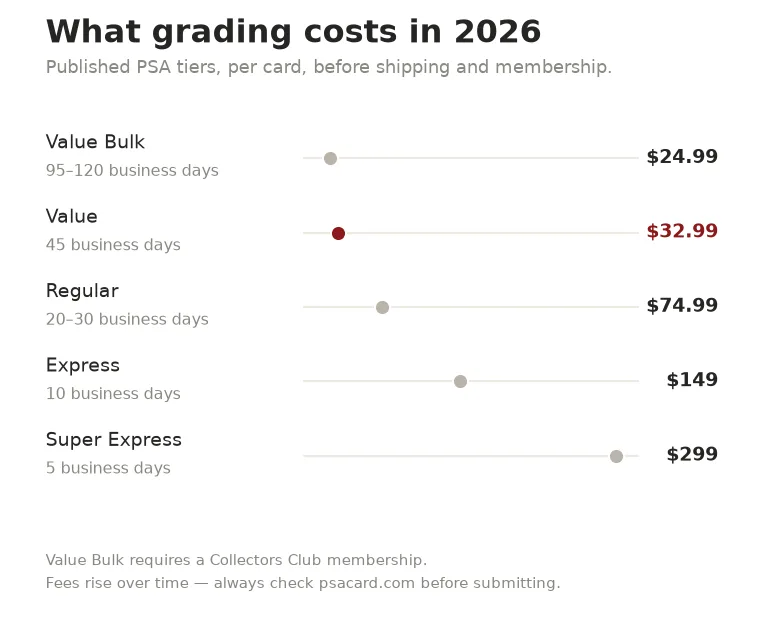
The published US tiers for new submissions in 2026 run roughly as follows. Treat this as a shape, not a quote: fees and turnaround commitments change, and the only current figure is the one on the grader’s own site the day you submit.
| Service level | Fee per card | Declared value ceiling | Stated turnaround |
|---|---|---|---|
| Value Bulk | $24.99 | about $499 | 95–120 business days |
| Value | $32.99 | about $499 | 45 business days |
| Regular | $74.99 | about $1,499 | 20–30 business days |
| Express | $149 | about $2,500 | 10 business days |
| Super Express | $299 | about $5,000 | 5 business days |
Three additions sit on top of the headline fee, and they are the ones people forget when they divide the fee by the card. The entry tier requires an annual membership, which only pays for itself if you are submitting in volume. Return shipping and insurance are charged separately and scale with the declared value. And the card has to get there: a sleeve, a semi-rigid holder, a rigid outer box and a tracked carrier, all before the grader sees anything.
The turnaround figure is also worth reading carefully. The stated window usually starts when the submission enters grading, not when you post it, and the door-to-door time is longer than the published number on every tier. If you are grading toward a specific sale date, build in more buffer than the ladder suggests rather than paying for a faster tier at the last minute. The label itself — what the number and the four-letter descriptors mean — is explained in the grading guide, and what to do when the slab lands is its own short procedure: check it in the first five minutes, because the cases where something is wrong are exactly the cases with a deadline.
Where the value would have to come from
For the fee to be worth paying, the graded card has to sell for more than the raw card plus the all-in cost of grading. That premium is not magic. It comes from three places, and only one of them is about the card being nicer to own.
| Source of the premium | What it means in practice | Does it apply to your card? |
|---|---|---|
| Certification | A third party has verified the card is genuine, unaltered and in the stated condition. Buyers who cannot inspect in person pay for that assurance. | Yes, on any card sold remotely — which is every card sold online. |
| Condition certainty | The buyer is not gambling on what arrives in the envelope. A graded card removes the “is it as clean as the photos?” discount. | Only where the raw copy is genuinely clean. A worn card grades low and the discount returns. |
| Scarcity at that grade | If very few copies exist at the top grade, competition for those copies pushes the price up. | Depends entirely on how many exist. This is the number a population report measures. |
The third row is the one that separates two cards that look identical in a photo. Two copies of the same card can both be PSA 10 and sell for very different money, because the premium tracks how many others are already at that grade. A card with a large graded population has a small top-grade premium however beautiful the copy is; a card with a tiny one can hold a premium far above anything the raw market suggested. That is why the population report matters more than the grade itself when you are estimating value, and it is why “graded sells for more” is true on average and useless in a specific case.
The decision, as arithmetic
Stripped of everything else, the question reduces to a comparison of two numbers you can look up and one you cannot know in advance. The two you can look up: the all-in cost of grading, and the current selling price of the graded card. The one you cannot know: what grade your specific copy will receive.
That last unknown is what turns a simple subtraction into a judgement, and it is why the honest version of this article cannot end with a number. What it can do is set out which conditions make the judgement easy and which make it hard.
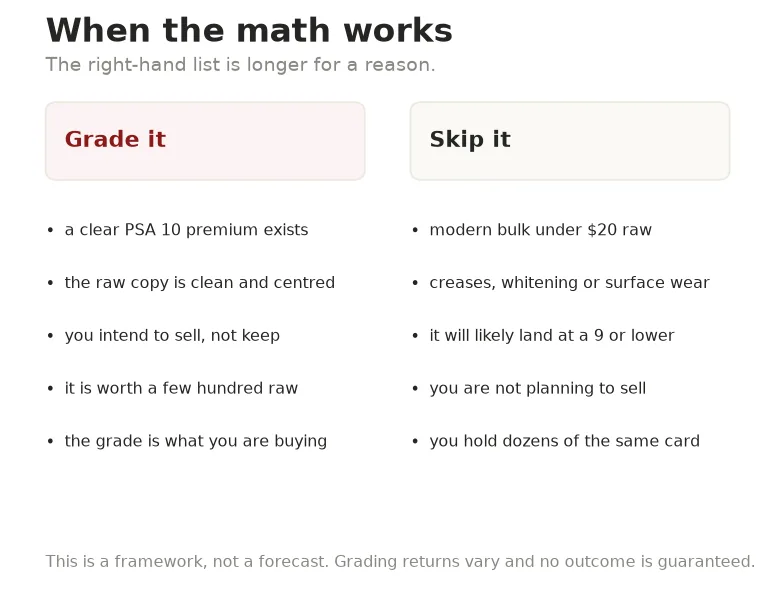
A worked shape, using round numbers rather than any specific card. Suppose a raw copy sells for $120 and a graded top-grade copy sells for $300. The all-in cost of grading that card, at a middle tier with shipping, is comfortably under $100. The gap is wide enough that the decision survives a bad outcome — if the card grades one step below the top, you are still roughly level rather than down. Now suppose the raw copy sells for $25 and the graded top-grade copy sells for $45. The all-in cost exceeds the entire upside, and the decision only works if nearly every card in a batch comes back at the top. The fee is the same in both examples. The answer is not.
Two practical consequences follow. First, grade in batches, not one card at a time, because the fixed costs of shipping and membership are shared across the submission. Second, decide before you submit what you will do with a card that comes back below the grade you wanted, because the market for a mid-grade copy of a common card is thin and the fee is already spent.
Where the math fails
Five situations where the arithmetic, run honestly, comes out against submitting.
Abundant modern cards with a low raw price. If the card sells raw for less than the all-in cost of grading, the top-grade copy has to command a multiple of the raw price to break even, and on a card printed in the millions that multiple usually is not there. Quantity is not scarcity.
Copies with visible flaws. A crease, a soft corner, whitening along an edge or a surface scratch is visible in a photograph and permanent. Those are the defects that cannot be undone, and they cap the grade no matter what the rest of the card looks like. Submitting a card with a bent corner is paying to have the flaw certified.
Cards whose realistic outcome is a middle grade. If the copy is likely to land at a 9 or a 7, the fee buys a slab that trades close to the raw price. The certification is real, but the premium that justified the fee is not.
Cards you are keeping. Grading is a market instrument before it is a storage instrument. If the card is not going to be sold, the fee buys protection and a number, which may be worth it — but that is a different question, and it should be answered as a storage question. A card in a good slab case or a binder built for slabs is protected without ever being graded.
Quantities of the same card. Grading forty copies of one card produces forty slabs competing with each other for the same buyers, and the price of each falls as the supply you created grows. Submitting the same card repeatedly is the most direct way to destroy the premium you were trying to capture.
What changes for Simplified Chinese cards
Grading is language-neutral in mechanism and not in economics. A certified card carries the same assurance whether the printing is English, Japanese or Simplified Chinese, but the scarcity half of the premium depends on how many copies exist at that grade in that language — and the Simplified Chinese print runs are a fraction of the English and Japanese ones.
The practical effect is that the top-grade population for a Simplified Chinese card is usually thinner than for the same Pokémon in another language, which tends to support a larger structural premium. It also means the graded copy is easier to sell across borders: a buyer who cannot read the card can still read the label, and the certificate number is verifiable regardless of language. That is a large part of why this shop deals in graded Simplified Chinese cards at all — the reasoning is set out in full in why these cards are worth collecting and, for the language comparison specifically, in Chinese versus Japanese cards.
None of that makes a specific Simplified Chinese card worth grading. It changes the base rate, not the individual case.
What we promise, and what we do not
We sell graded cards, so it is worth being plain about where our interest lies. We benefit when grading is trusted and when graded cards hold value. We do not benefit from you grading badly, and a customer who submits a batch, gets mediocre grades and concludes the whole hobby is a trap does not come back.
So, stated directly: we do not predict grades. We do not tell you a card will come back a 10, because no honest party can — the grade is decided by an inspector looking at the physical card, and the same card can genuinely be argued either way at the margins. We do not quote a return you can rely on, and we do not claim grading is a good investment in general. It is a cost you pay for a certification and a market, and whether that cost is worth it depends on the card in your hand.
What we will do is describe a card accurately enough that you can judge it yourself. Every graded listing here states the grade, the cert number and the language of the printing, and we would rather answer a question before you buy than process a return after. Our policy of selling only PSA 10 is part of the same position: one grade, stated plainly, with no half-grades and no qualifiers to interpret.
Frequently asked questions
Is it worth grading a card worth $20?
Almost never, on the numbers alone. At that raw price the all-in cost of grading is comparable to the card itself, so the top-grade copy would have to sell for a multiple of the raw price just to break even. Cards at that price are usually printed in quantity, and quantity is what keeps the top-grade premium small. The exception is a card you plan to keep and want certified for its own sake, which is a storage decision rather than a value one.
Does grading always increase a card’s value?
No. Grading adds a certification and a market, and on many cards the added cost exceeds any price difference the grade creates. A card that grades in the middle of the scale often sells close to its raw price, which means the fee was spent without a matching premium. Grading reliably adds value only where a certified copy already sells for meaningfully more than a raw one.
How long does PSA actually take?
Longer than the stated turnaround, on every tier. The published window typically begins when a submission enters grading rather than when you post it, and transit, logging and quality assurance sit outside it. The entry tiers run into months, not weeks. If the timing matters because you are grading toward a sale, plan around the slower figure rather than the faster one.
Should I grade a card I am keeping, not selling?
That is a different question, and it deserves a different answer. If you are not selling, the premium that justifies the fee does not apply, so the case has to rest on protection and on wanting the card certified. Both are legitimate reasons. They should just be weighed as storage decisions, because a good rigid case or a slab-sized binder protects a card without the waiting or the fee.
Can I grade a Simplified Chinese card?
Yes. The major graders accept Simplified Chinese printings, and the certificate works exactly as it does for any other language. What differs is the economics: the top-grade population for a Simplified Chinese card is typically thinner than for the same card in English or Japanese, which tends to support a larger premium. That is a general tendency about the market, not a statement about any particular card.
Sources
Where the figures and claims in this article come from
- Beckett (BGS), grading services — the four-axis sub-grade system and the tier structure that sets fees by declared value.
- CGC Cards, grading services — the third major grader, its tier names and the declared value ceilings that mirror the same model.
- SGC Grading, service levels — an independent ladder showing that turnaround, not the headline fee, is where the graders actually differ.
- HobbyCardIndex, Card Grading Cost Comparison 2026 — the observation that at the value tier all four graders land within a narrow band of each other, so fee alone rarely decides which to use.
- HobbyCardIndex, PSA Grading Guide: Scale, Tiers, Turnaround, Costs — the tier ladder, the note that the stated clock starts when a submission enters grading, and the reminder that shipping and insurance sit on top of the per-card fee.
- TCGplayer, marketplace pricing — used as the reference point for raw versus graded selling prices.
Fees, tiers and turnaround commitments are revised by the grading companies, often more than once a year, and the figures above are a 2026 snapshot rather than a quote. Confirm current pricing with the grader before submitting. Nothing here is a prediction of a grade, a guarantee of a return, or investment advice. Our own grading policy and the condition of any card we sell are stated on the product page and in our PSA 10 policy.
Related reading
- How grading works: the scale, the sub-grades and how to read a label
- Why we only sell PSA 10
- Keeping a card in the condition you bought it in
- PSA slab care: how the case fails before the card does
- Does a PSA 10 slab fit in a binder?
- All our card protection guides
Shop graded cards and slab protection
- PSA 10 — Chinese Exclusive — our highest-premium line
- PSA 10 — Chinese
- All PSA 10 graded cards
- Graded card protection — sleeves and cases for slabs
- Binders and albums
Looking for a card that is not listed? Find this Card for Me — we would rather answer a question than have you guess at a grade.
Where to go next
- The CardSpicy card index — every card we track, with its PSA 10 population and market history (195 cards).
- The illustrator index — every artist behind those cards, card by card (110 artists).