🛒0

Category: Pokémon

CardSpicy articles about Pokémon cards — the Simplified Chinese print run, the other languages, set checklists and the cards worth owning.

  • Ardent Obsidian, card by card

    Quick answer

    Ardent Obsidian was released on 12 September 2025 under CSV5, in the Scarlet & Violet era of the Simplified Chinese line. This page is the checklist we hold for the set.

    We currently track 24 cards in this set, covering 15 characters. The deepest single group is Charizard at 4 tracked printings. The table below lists them by the number printed on the card.

    Charizard is the centre of the set: four tracked cards carry the name, with Charmander and Charmeleon alongside them, so the full line is present. Garchomp, Gengar and Toxtricity make up the tier behind it.

    This is the set view. If you are following one Pokemon across every set instead, the per-character table is the other way to read the same catalogue.

    24 tracked cards. Where we hold a graded copy its price is linked in the table; where we do not, the row is a sourcing request — send it and we go and find the card for you.

    No. Card Character PSA 10 copy
    14 Charmander Charmander Find this Card for Me
    14 Charmander [Poke Ball] Charmander Find this Card for Me
    15 Charmeleon [Poke Ball] Charmeleon Find this Card for Me
    15 Charmeleon Charmeleon Find this Card for Me
    23 Lapras Lapras Find this Card for Me
    39 Mewtwo Ex Mewtwo Find this Card for Me
    71 Toxtricity Ex Toxtricity Find this Card for Me
    75 Charizard Ex Charizard Find this Card for Me
    76 Gastly [Poke Ball] Gastly Find this Card for Me
    77 Haunter Haunter Find this Card for Me
    78 Gengar [Poke Ball] Gengar Find this Card for Me
    78 Gengar Gengar Find this Card for Me
    79 Paldean Wooper Paldean Wooper Find this Card for Me
    80 Paldean Clodsire [Poke Ball] Clodsire Find this Card for Me
    115 Snorlax Doll Snorlax Find this Card for Me
    130 Gloom Gloom Find this Card for Me
    140 Garchomp EX Garchomp Find this Card for Me
    143 Toxtricity Ex Toxtricity Find this Card for Me
    145 Charizard Ex Charizard Find this Card for Me
    146 Aegislash Ex Aegislash Find this Card for Me
    154 Garchomp EX Garchomp Find this Card for Me
    155 Charizard Ex Charizard Find this Card for Me
    161 Garchomp EX Garchomp Find this Card for Me
    162 Charizard Ex Charizard Find this Card for Me

    Frequently asked questions

    What is Ardent Obsidian?

    It is a main set of the Simplified Chinese branch, printed under CSV5 and released on 12 September 2025. It sits in the Scarlet & Violet era of the Chinese line.

    How many cards from this set do you track?

    The figure at the top of this page is current as of 4 October 2026 and is drawn from our own catalogue. It covers every card from the set we have handled or priced, and it grows as we work through more of it.

    Which characters lead this set?

    Charizard does. Four tracked cards carry the name and both of his earlier forms are in the set as well, so a collector working the evolution line has the whole run to find in one place. Garchomp and Gengar sit behind him.

    Are these the complete printed set?

    No. This is the set as we hold it, not the set as printed. A main set prints more cards than we list here, and we add rows as we take on more product. Nothing is invented to fill a gap.

    Sources

    Sources and further reading
    1. CardSpicy listings — every card and card number below is taken from our own catalogue, read on 4 October 2026.
    2. The official Simplified Chinese product announcements, read at pokemon.cn on 4 October 2026.
    3. CardSpicy — set checklists by set, the hub this page belongs to.
    4. CardSpicy — the Simplified Chinese set timeline, for the release date of this set.

    Cards are listed by the number printed on them. Where a card appears in more than one treatment, each treatment is listed separately because each is collected separately. Prices quoted on this site are secondary-market observations at the dates cited.

    Related reading

    For the order and dates of every set, the release timeline is the reference, and the set hub puts it beside every other set we track.

  • Alola Pokemon in Simplified Chinese: characters and counts

    Quick answer

    CardSpicy (cardspicy.com) counts the Simplified Chinese Pokémon cards it tracks for the Alola region, character by character, and how many of them carry a PSA 10 price.

    Alola characters hold 27 tracked Simplified Chinese cards on this site across 3 characters. 3 of those characters have at least one card with a PSA 10 price. The cards come chiefly from CBB3, CSM1.5, CS4.5, CSV9, csv7C. The table lists every character we track from the region, most tracked cards first.

    Alola is the seventh region, from Rowlet to Melmetal. The Chinese Tag Team era was released while Sun and Moon were current in Japan, so regional forms such as Alolan Raichu appear on Chinese cards.

    Cards for Alola reach the Simplified Chinese line across 10 set codes we track. CBB3 carries the largest share with 13 cards, followed by CSM1.5 with 5 cards and CS4.5 with 2 cards. Mimikyu alone accounts for 14 of the 27 cards, Lycanroc adds 8 and Zeraora 5.

    National Pokedex Character Cards we track With a PSA 10 price
    #778 Mimikyu 14 14
    #745 Lycanroc 8 8
    #807 Zeraora 5 5

    This page is a checklist as much as a count: a character appears only when the Chinese line has printed it, so the table doubles as a quick answer to whether a character exists in Simplified Chinese at all. Characters printed in other languages are outside this view.

    Counts are the cards we track, not the printed population of a set. Where a character appears in several treatments inside one set, each treatment is counted on its own row on the character’s page. Set codes are shown the way the release timeline shows them, so one code covers all parts of a set.

    Frequently asked questions

    How many Alola characters have Chinese cards?

    We track 3 Alola characters with Simplified Chinese printings, holding 27 cards between them. Mimikyu is the most tracked with 14 cards.

    Do Alola cards have PSA 10 prices on this site?

    Every Alola character we track has at least one card with a PSA 10 price.

    Which sets carry Alola characters?

    The main sources are CBB3, CSM1.5, CS4.5, CSV9, csv7C. Chinese sets mix characters from several regions, so a region page is a view over the whole line rather than a list of sets.

    Sources

    List of sources used
    1. PokeAPI, National Pokedex numbers, retrieved October 2026
    2. Site card records for Simplified Chinese lanes, current as of October 2026
  • Simplified Chinese Pokémon Set Codes: Full List

    Quick answer

    CardSpicy lists its Simplified Chinese Pokémon cards under 16 printed set codes, from CBB1C through CBB6C for the Gem Pack volumes, through the CSV main sets, to the SV-P promos. Every Simplified Chinese set code ends in the letter C, and that trailing C is the only language test printed on the card itself.

    This page is the list. If you want to know how a single code is put together — the group number, the treatment, the fraction after the slash — the page for that is how to read a Simplified Chinese set code. This one is the reference table: every code we hold, what product it belongs to, and where to see the cards.

    Simplified Chinese Pokémon cards were built for the mainland China market rather than translated from an existing product line, so the products carry their own codes. That is why the codes look unfamiliar next to English or Japanese ones, and why a listing can be checked against a card in your hand without a photograph.

    Every set code we track

    Only codes present in our own catalogue are listed. Codes that exist elsewhere but that we have never held are left out rather than guessed at.

    Printed code Set Family CardSpicy
    CBB1C Gem Pack Vol. 1 Gem Pack mini set Volume guide
    CBB2C Gem Pack Vol. 2 Gem Pack mini set Volume guide
    CBB3C Gem Pack Vol. 3 Gem Pack mini set Volume guide
    CBB4C Gem Pack Vol. 4 Gem Pack mini set Volume guide
    CBB5C Gem Pack Vol. 5 Gem Pack mini set Volume guide
    CBB6C Gem Pack Vol. 6 Gem Pack mini set Volume guide
    151C Collect 151 Numbered set The four Pikachu Art Rares
    csv3C Fearless Terastal Scarlet & Violet main set Arcanine SAR
    csv4C Reward Round Scarlet & Violet main set Maushold ex SAR
    csv5C Dark Crystal Blaze Scarlet & Violet main set Larry SAR
    csv6C True Mystery Scarlet & Violet main set Iron Hands SAR
    csv7C Blade Awakening Scarlet & Violet main set Ciphermaniac’s Codebreaking SAR
    csv8C Brilliant Fantasy Scarlet & Violet main set Carmine SAR
    csv9.5C Grand Terastal Gathering Scarlet & Violet main set Sylveon ex SAR
    csv10C Chasing Glory Together Scarlet & Violet main set Brock’s Scouting SAR
    cs3aC / cs3bC / cs5bC / cs5.5C Earlier Scarlet & Violet era Chinese subsets, including Primordial Arts, Gallant Galaxy and Overshadowed Radiance Subset How to read a code
    …/SV-P Promos, distributed outside the numbered sets Promo Mew ex lottery promo

    The first four families are separated by what kind of product they are, and that distinction does most of the work before you have read the rest of the code: a Gem Pack card belongs to a small all-foil set organised by Pokémon, a main-set card belongs to a numbered checklist, and a promo was distributed outside a checklist altogether.

    What each family means for a buyer

    Gem Pack (CBB1C–CBB6C). Six volumes, each built as an all-foil mini set. A Gem Pack card does not have one position in a set: it has a group per Pokémon and a ladder of treatments inside that group. The fraction after the slash is the length of that ladder, and the length changes between volumes, so the same fraction means different things in different volumes.

    Collect 151 (151C). The Chinese take on the 151 set, released in four editions. It is the one Simplified Chinese family whose code is immediately readable to anyone who knows the English set, and its Art Rares are the most-collected cards in the format.

    The CSV main sets (csv3C to csv10C). The numbered Scarlet & Violet era Chinese sets. These follow the convention collectors already know — a card number over the printed size of the set — with one twist that is worth knowing before you read a listing: the numerator can be larger than the denominator. A card numbered above the printed total is a secret rare, not a typo.

    The earlier subsets (cs3aC, cs3bC, cs5bC, cs5.5C). Subsets released inside the same era, tracked separately from the main sets. They are the codes most often mistaken for main sets, because the prefix looks similar and the card numbers follow the same shape.

    Promos (…/SV-P). Distributed outside the numbered sets. A promo and a main set can print the same Pokémon at wildly different scarcity, which is why the family is worth checking before anything else in the code.

    What is deliberately not on this list

    Three things are missing on purpose. Codes for the earliest Simplified Chinese products, which we have not held and therefore cannot describe from our own stock. The one-letter-and-number rarity suffixes that appear after the card number, which are printed on the card and are covered in the set code guide rather than here. And any code we have seen only in secondary sources, which is not a reliable enough footing for a table a buyer might check a purchase against.

    Where a code appears in our catalogue, it appears above. Where it does not, that is a statement about our stock rather than about the code’s existence.

    How to use this table

    Read the code from a listing or from the card in your hand, find the family in the table, and you know what kind of product you are looking at. If the code is not here and the card matters to you, send us the code as it is printed and we will tell you what it is — the answer takes minutes and costs nothing.

    Frequently asked questions

    How do I know a card is Simplified Chinese just from the code?

    Every Simplified Chinese set code ends in the letter C — CBB1C, csv3C, 151C. A code without a trailing C belongs to a different language’s product, and that is the first thing to check when a listing is ambiguous.

    Why do Simplified Chinese cards have their own codes instead of translated ones?

    Because the products were built for the mainland China market rather than converted from an existing line. The codes were assigned to those products, so the prefixes do not appear anywhere in the English or Japanese catalogue.

    Is csv9.5C a real set code or a mistake?

    It is real. Grand Terastal Gathering sits between the ninth and tenth numbered Chinese sets, and the decimal is how it is printed rather than an approximation of something else.

    What does the fraction after the slash mean?

    In the main sets it is the card’s position over the printed size of the numbered checklist, so 155/130 means the card sits past the end of that checklist and is a secret rare. In the Gem Pack volumes the same shape means something different — the treatment’s position over the length of that Pokémon’s group — which is why the family has to be read first.

    Can I buy these sets as sealed product?

    Sealed Simplified Chinese product is listed in the shop where we have it, and the 30th Celebration boxes are the current sealed release we hold. Everything else on this site is sold as a PSA 10 graded single.

    Sources

    Sources and further reading
    1. CardSpicy listings — the printed set codes quoted on this page are the ones on our own product listings, read on 3 October 2026.
    2. CardSpicy — How to read a Simplified Chinese Pokémon set code, the page for decoding a code part by part.
    3. CardSpicy — Gem Pack Vol. 1 to 6, the volume-by-volume guide.
    4. CardSpicy — Chinese versus Japanese Pokémon cards, for the language question that sits behind every code.

    Set codes quoted here are reproduced from our own listings and are not inferred from external sources. Prices quoted on this site are secondary-market observations at the dates cited.

    Related reading

    If you are holding a code and want to know what it decodes to, start with how to read a Simplified Chinese set code. If you are trying to work out whether a card is scarce, how many Simplified Chinese-exclusive cards there are is the count, and the per-character table is the breakdown.

  • The Jirachi ex Card: 30th Celebration’s Most Talked-About Pull

    The Jirachi ex Card: 30th Celebration’s Most Talked-About Pull

    Quick answer

    Jirachi ex is card 155 in the 30th Celebration Special Illustration Rare tier, illustrated by Akira Egawa. It became the most talked-about card in the set in the last week of September 2026, when a twelve-year-old collector named Avery Garcia — known online as Avery The Poke Kid — pulled it in the final pack he opened before his death from cancer, and the video his parents recorded of that pack opening spread across the hobby. CardSpicy (cardspicy.com) writes about Simplified Chinese cards and the cards behind the stories around them; this page is the story, told plainly, and it is deliberately not a sales page.

    The card

    Jirachi ex appears in 30th Celebration both as a regular ex card and as a Special Illustration Rare. The Special Illustration Rare printing, numbered 155, is illustrated by Akira Egawa, who has drawn well over 170 Pokémon cards since 2019 and whose illustration cards sit among the more sought-after modern artwork in the hobby.

    The card itself is an alternate-art treatment of a Jirachi ex: the wish-granting Legendary from the Hoenn generation, drawn in an illustration style rather than a battle pose. It is a good card by any measure. It is not the rarest card in the set — that is the Futuristic Rare tier — and it was not, on release day, the most valuable. What made it the card the set is remembered by had nothing to do with either.

    What happened

    Avery Garcia was twelve years old and lived in Everett, Washington. He had been treated for stage four pancreatoblastoma for seven years, and in that time he had built a following of more than 300,000 people across his channels by posting about Pokémon cards between chemotherapy sessions and surgeries.

    His collecting philosophy was the opposite of the market’s. “It’s not about having the best cards, or the most expensive ones,” he said in a video earlier in 2026. “It’s about having the cards that you truly love and will cherish for the rest of your life.” His own favourite card was a Gold Star Pikachu, which he kept because the character’s crossed arms reminded him of Ash Ketchum’s Pikachu. “Ash’s Pikachu is brave, it takes challenges, it fights against gods… it has courage… that’s how I see myself,” he said.

    He died on 18 September 2026, three days after the 30th Celebration set released. His parents, Christian Garcia and Rebecca Rosa-Valentin, had filmed him opening one last set of packs, and posted the video after his death. On the final pull of that opening he drew the Jirachi ex Special Illustration Rare — the Egawa card, number 155 — and his reaction, a disbelieving “No way,” is the part of the video that travelled furthest.

    Why the card landed the way it did

    Jirachi is a Steel and Psychic-type Legendary that, in the games’ own lore, sleeps for a thousand years and wakes for only seven days, during which it grants wishes. It is said to be woken only by a voice of purity, and in the Pokédex entries it grants three wishes before returning to sleep.

    A card is not a prophecy. But a child who had been ill for seven years, opening one final pack, drawing the wish-granting Pokémon — the symmetry is why the story spread the way it did, and it is why the card is now referred to across the community simply as Avery’s Jirachi. Whatever one makes of that, it is what happened, and it explains why a card that was one of ten Special Illustration Rares has become the one the set is known by.

    What the illustrator said

    Akira Egawa saw the video. On 23 September she responded publicly: “I’m so deeply moved. I’m so glad I kept drawing. I’ve honestly been in tears ever since I saw this.” In a second post she added: “I want my art to bring happiness to people. That’s one of the reasons I draw. I’m so glad I put that wish into this piece.”

    It is worth noting what that response is and what it is not. It is a working illustrator saying, in public, that the reason she draws is that the work might mean something to someone. It is not a comment on the card’s value, and she did not make one.

    The part of the story we will not dress up

    Within days of the video spreading, the asking price of the Jirachi ex Special Illustration Rare roughly doubled. It was around $81 on 17 September; by 23 September the average asking price was around $118, with individual copies listed and sold between $140 and $198 depending on condition and centring. The Pokémon Company had built 30th Celebration with deliberately more generous pull rates than usual, specifically to reduce scarcity — which makes the movement in this one card a demand story, not a supply one.

    Some of that demand is people who were moved by the story and wanted the card. Some of it was not. One eBay seller listed a Jirachi card for $20,000 framed as a charity sale, a listing that was withdrawn after it emerged the split it advertised was not the split it initially offered. Avery’s parents issued a public statement asking sellers to stop: “We are not involved in or benefiting from any cards being sold in Avery’s name or likeness. We have not approved these sales. We have asked sellers to take their listings down. Please do so immediately. This does not honor Avery’s generous heart.”

    That statement is the clearest guide to how this should be handled, and it is why there is no price commentary, no buying push and no listing link on this page. A card can be worth writing about without being worth selling on the back of.

    If you want the card

    The practical facts, stated without encouragement. Jirachi ex appears in the Special Illustration Rare tier of 30th Celebration, alongside nine other cards at the same rarity: Fuecoco, Greninja, Pikachu in its Day and Night versions, Mewtwo, Mew, Sylveon, Gengar and Salamence. It is not a Futuristic Rare and it is not in the Classic Collection; it is an ordinary pull from an ordinary pack of this set, at a rarity that appears across ten different cards.

    That matters if you are buying. The card is not scarce as a category, and its current asking price reflects attention rather than supply. If the reason you want it is the story, that is a reason to buy the card and keep it, not a reason to buy it quickly.

    A note on how we write about it

    CardSpicy is a store. On almost every other page we write, there is a product at the end of it, and on this one there is not, on purpose. Avery’s parents asked for the cards not to be sold in his name. We are honouring that request in the only way we can: by telling the story, crediting his own words, and leaving the prices to the pages that are about prices.

    Frequently asked questions

    What is the Jirachi ex card in 30th Celebration?

    Jirachi ex appears in the set as a regular Pokémon ex and as a Special Illustration Rare, numbered 155. The Special Illustration Rare is illustrated by Akira Egawa. It is one of ten Special Illustration Rares in the set, alongside Fuecoco, Greninja, Pikachu in Day and Night versions, Mewtwo, Mew, Sylveon, Gengar and Salamence.

    Why did the Jirachi ex card become so well known?

    Twelve-year-old collector Avery Garcia, known as Avery The Poke Kid, died on 18 September 2026 after a seven-year illness. His parents filmed him opening one last set of 30th Celebration packs and posted the video afterwards; the final card he pulled was the Jirachi ex Special Illustration Rare. The clip spread widely, and the card is now commonly called Avery’s Jirachi.

    What did the illustrator of the card say?

    Akira Egawa responded publicly on 23 September 2026, saying she was deeply moved, glad she had kept drawing, and had been in tears since seeing the video. In a second post she said she wants her art to bring happiness to people, and that it is one of the reasons she draws.

    Did the price of the card go up?

    Its average asking price roughly doubled in the days after the story spread, from about $81 on 17 September to around $118 by 23 September, with some copies listed and sold between $140 and $198. 30th Celebration was designed with unusually generous pull rates, so the movement reflects demand rather than any change in supply. CardSpicy does not forecast prices.

    Are sellers allowed to sell the card in Avery’s name?

    Avery’s parents, Christian Garcia and Rebecca Rosa-Valentin, issued a public statement saying they are not involved in or benefiting from any cards sold in Avery’s name or likeness, that they have not approved those sales, and that they have asked sellers to take the listings down. One $20,000 charity-framed listing was withdrawn. We take their request as authoritative.

    Sources

    Sources and further reading
    1. Avery Garcia’s family — the public statement of Christian Garcia and Rebecca Rosa-Valentin on sales made in Avery’s name, and their memorial posts and the final pack-opening video, September 2026.
    2. Akira Egawa — public posts of 23 September 2026 responding to the video, quoted here as published.
    3. Press reporting — Polygon, IGN, Kotaku and other outlets reported the story and the movement in the card’s asking price between 17 and 23 September 2026. Those reports are the source for the figures quoted.
    4. The Pokémon Company — 30th Celebration set details, including the Special Illustration Rare tier, the card numbering and the design intent stated for pull rates.

    Avery Garcia is named here as he was known publicly, and his own words are quoted as reported. Figures for the card’s asking price are press-reported readings from 17–23 September 2026, not CardSpicy valuations, and they are included because the movement is part of the story rather than as a price guide. CardSpicy does not sell on the basis of this story and does not forecast prices.

    Related reading

  • The 30 Classic Collection Reprints, Explained

    The 30 Classic Collection Reprints, Explained

    Quick answer

    The Classic Collection is a 30-card subset inside 30th Celebration made entirely of reprints, one or two from each era of the Pokémon TCG, running from Base Set in 1998 to a 2023 Paldea Evolved Illustration Rare. Each card keeps its original artwork, text and number — Base Set Charizard still reads 4/102 — and is marked out by a gold border and a small anniversary Pikachu stamp on the art. They are not legal in the Standard format. CardSpicy (cardspicy.com) tracks the subset because for Simplified Chinese collectors it contains the set’s single most important card: the first Simplified Chinese printing of the Base Set Charizard artwork.

    What the Classic Collection is, and what it is not

    It is a lap of honour, and it is worth being exact about the mechanics before the list, because three details decide whether a card in your hand is one of these.

    • It is a subset of 30th Celebration, not a separate product. Classic Collection cards appear as bonus cards inside ordinary 30th Celebration booster packs, at roughly one pack in ten. There is one product that contains a dedicated Classic Collection booster with three Classic Collection cards in a single pack: the Ultra-Premium Collection: Day & Night, which releases on 6 November 2026.
    • Nothing is changed except the finish. The artwork, the text and the card number are the originals. A reprinted Base Set Charizard is still 4/102 and still reads as it did in 1998. The gold border and the Pikachu stamp are what identify it.
    • It is not tournament-legal in Standard. The cards can be used in any format where the original printing is legal. In practice they are collected rather than played.

    The selection is also not simply the 30 most expensive cards in the game’s history. It works through the eras instead — Base Set, Gym, Shining, Crystal, Pokémon-ex, Delta Species, LV.X, Prime, LEGEND, Pokémon-EX, BREAK, Pokémon-GX, TAG TEAM, V, VMAX, VSTAR and a modern Illustration Rare — which makes the subset a 30-card history lesson rather than a price list.

    All 30 reprints

    Five of the thirty were shown officially and individually — Charizard, Crystal Lugia, Dark Tyranitar, Pikachu & Zekrom-GX and Magikarp — and the remainder were identified from the official Japanese 30th anniversary website, which displayed exactly thirty historical cards. Treat the five as confirmed and the rest as the published lineup rather than as a leaked list.

    # Card Original set Year Era
    1 Pikachu Base Set 1999 Wizards of the Coast
    2 Charizard Base Set 1999 Wizards of the Coast
    3 Misty Gym Heroes 2000 Wizards of the Coast
    4 Erika’s Jigglypuff Gym Challenge 2000 Wizards of the Coast
    5 Sneasel Neo Genesis 2000 Wizards of the Coast
    6 Shining Celebi Neo Destiny 2002 Wizards of the Coast
    7 Crystal Lugia Aquapolis 2003 Wizards of the Coast
    8 Delcatty ex EX Ruby & Sapphire 2003 EX
    9 Dark Tyranitar EX Team Rocket Returns 2004 EX
    10 Scizor ex EX Unseen Forces 2005 EX
    11 Metagross δ EX Delta Species 2005 EX
    12 Palkia LV.X Great Encounters 2008 Diamond & Pearl
    13 Uxie Legends Awakened 2008 Diamond & Pearl
    14 Crobat G Platinum 2009 Platinum
    15 Gengar Prime HS Triumphant 2010 HeartGold SoulSilver
    16 Darkrai & Cresselia LEGEND, top half HS Triumphant 2010 HeartGold SoulSilver
    17 Darkrai & Cresselia LEGEND, bottom half HS Triumphant 2010 HeartGold SoulSilver
    18 N Noble Victories 2011 Black & White
    19 Rayquaza-EX Dragons Exalted 2012 Black & White
    20 Genesect-EX Plasma Blast 2013 Black & White
    21 Mega Gardevoir-EX Primal Clash 2015 XY
    22 Greninja BREAK BREAKpoint 2016 XY
    23 Solgaleo-GX Sun & Moon 2017 Sun & Moon
    24 Buzzwole-GX Crimson Invasion 2017 Sun & Moon
    25 Pikachu & Zekrom-GX Team Up 2019 Sun & Moon
    26 Zacian V Sword & Shield 2020 Sword & Shield
    27 Raikou Vivid Voltage 2020 Sword & Shield
    28 Mew VMAX Fusion Strike 2021 Sword & Shield
    29 Arceus VSTAR Brilliant Stars 2022 Sword & Shield
    30 Magikarp Paldea Evolved 2023 Scarlet & Violet

    The cards worth knowing

    Six of the thirty carry a story that the rest do not.

    Charizard, Base Set (1999)

    The most reprinted artwork in the hobby and the anchor of the subset. Its significance in 30th Celebration is specific rather than general: this is the first time the Base Set Charizard artwork has been printed in Simplified Chinese. Traditional Chinese has printed a version before, so a listing that says “first Chinese printing” is overstating it; the accurate claim is first Simplified Chinese printing.

    Crystal Lugia, Aquapolis (2003)

    One of the genuinely rare cards in the game’s history, and the reason the sub-subset is not just a nostalgia exercise. The Crystal Type mechanic of the e-Card era is preserved on the reprint, Poké-Body and all, which makes this the least accessible original in the thirty and therefore the reprint most likely to be someone’s actual entry point to the artwork.

    Dark Tyranitar, EX Team Rocket Returns (2004)

    A Darkness-type Tyranitar from the Rocket-themed EX set, and a card with a competitive history behind it as well as a collecting one. Reprinting a card that was played gives the subset a second reason to exist beyond nostalgia.

    Shining Celebi, Neo Destiny (2002)

    One of the Shining Pokémon secret rares from Neo Destiny, a chase category from the earliest era of the game that has held up aesthetically better than most. The gold treatment on the original was unusual when it was printed and is still the reason the card is wanted.

    Pikachu & Zekrom-GX, Team Up (2019)

    A TAG TEAM GX card, and the newest card in the subset other than the Paldea Evolved entry. Its inclusion is deliberate: TAG TEAM is the mechanic most associated with the late Sun & Moon era, and leaving it out would have broken the “one per mechanic” logic running through the list.

    Magikarp, Paldea Evolved (2023)

    The newest card in the collection, and a modern Illustration Rare rather than a historic one. Including it is the clearest statement of what the subset is doing: it is a walk through thirty years of the game in order, not a list of the oldest cards.

    How to tell a reprint from an original

    Three checks, in order of how quickly they settle the question.

    1. Look for the gold border. Every Classic Collection card has one. No original print of any of the thirty has a gold border.
    2. Find the anniversary Pikachu stamp. It sits on the artwork. Between the border and the stamp, there is no ambiguity — and unlike a subtle print difference, both are visible in a photograph.
    3. Read the card number anyway. The number is the original, unchanged, so it will not help you distinguish a reprint from an original by itself. It is useful for the opposite reason: it tells you which original you are looking at, which is what you need when comparing prices between the two.

    What the subset is for

    Two answers, and they are different purchases.

    For a collector who has never owned a Crystal Lugia or a Shining Celebi, the subset is a way to hold the artwork without paying for a 2003 secret rare. That is the honest version of the value: a reprint gives you the picture, the mechanic and the history at a fraction of the original’s price.

    For a Simplified Chinese collector, one entry in the subset is a first. The Base Set Charizard artwork had not been printed in Simplified Chinese before 30th Celebration, which makes that one card a genuine first printing of a familiar image rather than a reprint of a Chinese card — and it is the reason this subset matters more to this language branch than to the others.

    Frequently asked questions

    What is the Classic Collection in 30th Celebration?

    A 30-card subset of reprints inside the 30th Celebration set, covering the game’s history from Base Set in 1998 to a 2023 Paldea Evolved Illustration Rare. Each card reprints the original artwork, text and card number, and is marked by a gold border and an anniversary Pikachu stamp. The cards are not legal in the Standard format.

    How many Classic Collection cards are in 30th Celebration?

    Thirty. They appear as bonus cards in ordinary 30th Celebration booster packs at roughly one pack in ten. The Ultra-Premium Collection: Day & Night, releasing 6 November 2026, contains a dedicated Classic Collection booster pack holding three Classic Collection cards — the only product that guarantees them.

    How do I tell a Classic Collection card from the original?

    By the gold border and the anniversary Pikachu stamp on the artwork. Neither appears on any original printing. The card number will not help: a Classic Collection Base Set Charizard is still numbered 4/102, exactly as the 1999 card was.

    Is Base Set Charizard in Simplified Chinese a first printing?

    The Classic Collection reprint is the first Simplified Chinese printing of that artwork, yes. It is not the first Chinese printing overall — Traditional Chinese has printed the Base Set Charizard artwork before — and it is not a first printing of the card’s content, which dates from 1998. Any listing claiming otherwise is overstating it.

    Are the Classic Collection cards worth collecting?

    They are the most accessible way to own the artwork of some genuinely hard cards, and the subset works as a 30-card history of the game’s mechanics. They are not a substitute for the originals: a 1999 Base Set Charizard remains more valuable than the stamped reprint of it, because reprinting does not reduce how many originals exist.

    Sources

    Sources and further reading
    1. The Pokémon Company — 30th Celebration announcements confirming the Classic Collection as a 30-card reprint subset, the gold border and anniversary Pikachu stamp, and the Standard-legality position.
    2. The Pokémon Company — the official Japanese 30th anniversary website, whose card sequence documents the lineup; the individual reveals of Charizard, Crystal Lugia, Dark Tyranitar, Pikachu & Zekrom-GX and Magikarp.
    3. The Pokémon Company — the Day & Night Ultra-Premium Collection product listing, the source for the dedicated three-card Classic Collection booster.
    4. CardSpicy catalogue — our own Simplified Chinese records, used for the note on the first Simplified Chinese printing of the Base Set Charizard artwork.

    Card names, sets and years in the table above follow the original printings. Where an entry has been shown officially we say so; the remaining entries come from the published lineup rather than from a leak, and any card not shown individually should be treated as announced-but-not-individually-confirmed.

    Related reading

  • The 30th-P Promos: The Simplified-Chinese-Only Anniversary Line

    The 30th-P Promos: The Simplified-Chinese-Only Anniversary Line

    Quick answer

    The 30th-P promos are a 27-card series that exists only in Simplified Chinese. They are the First Partner Illustration Collection — the nine generations of starter Pokémon, three per generation, one Holofoil Full Art card each — sold in three volumes of nine from March to August 2026, ahead of the 30th Celebration set itself. The category has no equivalent in any other language: the same illustrations ship in other regions as MEP Black Star promos or Japanese M-P promos, under completely different numbering. CardSpicy (cardspicy.com) tracks the series card by card, and this page is the reference for it — what each card is, which volume it came from, and how the numbering works.

    What makes this series exclusive

    Most cards called “Chinese exclusive” are not. A Simplified Chinese printing of an illustration that also shipped in Japanese and English is a language variant, not an exclusive — the same artwork exists elsewhere and other print runs add to its supply. 30th-P is the other kind. The category itself does not exist outside mainland China.

    Two things follow from that, and they are the reason the series matters.

    • There is no substitute printing to buy instead. If you want the 30th-P Bulbasaur, no Japanese or English card will do. The English and Japanese equivalents are different cards with different numbering, released through different channels.
    • The supply is capped by its own release. The series ran for under five months, in three sealed products, and it is closed. Nothing printed afterwards adds to it.

    The cards themselves are Holofoil Full Art, illustration-rare in treatment, and each one carries the 30th anniversary logo.

    The three volumes

    The series was not one release. It was three, each containing nine cards, and each nine split across three generations of starter Pokémon. The generations were reordered rather than run in sequence, so a single volume always mixes eras.

    Volume Released Generations inside Regions Cards
    Vol. 1 20 March 2026 Kanto, Sinnoh, Alola I, IV, VII 001–003, 010–012, 019–021
    Vol. 2 19 June 2026 Johto, Unova, Galar II, V, VIII 004–006, 013–015, 022–024
    Vol. 3 7 August 2026 Hoenn, Kalos, Paldea III, VI, IX 007–009, 016–018, 025–027

    Each volume was sold as a sealed set containing one random card from its nine, an acrylic magnetic card frame sized for it, and one booster pack from the current Simplified Chinese set. Nothing in the packaging told you which of the nine you were getting.

    The ordering is worth pausing on. Vol. 1 opens with Kanto, the original three — Bulbasaur, Charmander, Squirtle — which is the obvious first move. Then it reaches all the way to Sinnoh and Alola before Vol. 2 comes back for Johto, Unova and Galar. The result is that the series reads as nine connected trios rather than as a single line, and collecting it in order means collecting three volumes months apart.

    The full 27-card list

    No. Card Region Type Volume
    001/30th-P Bulbasaur Kanto Grass Vol. 1
    002/30th-P Charmander Kanto Fire Vol. 1
    003/30th-P Squirtle Kanto Water Vol. 1
    004/30th-P Chikorita Johto Grass Vol. 2
    005/30th-P Cyndaquil Johto Fire Vol. 2
    006/30th-P Totodile Johto Water Vol. 2
    007/30th-P Treecko Hoenn Grass Vol. 3
    008/30th-P Torchic Hoenn Fire Vol. 3
    009/30th-P Mudkip Hoenn Water Vol. 3
    010/30th-P Turtwig Sinnoh Grass Vol. 1
    011/30th-P Chimchar Sinnoh Fire Vol. 1
    012/30th-P Piplup Sinnoh Water Vol. 1
    013/30th-P Snivy Unova Grass Vol. 2
    014/30th-P Tepig Unova Fire Vol. 2
    015/30th-P Oshawott Unova Water Vol. 2
    016/30th-P Chespin Kalos Grass Vol. 3
    017/30th-P Fennekin Kalos Fire Vol. 3
    018/30th-P Froakie Kalos Water Vol. 3
    019/30th-P Rowlet Alola Grass Vol. 1
    020/30th-P Litten Alola Fire Vol. 1
    021/30th-P Popplio Alola Water Vol. 1
    022/30th-P Grookey Galar Grass Vol. 2
    023/30th-P Scorbunny Galar Fire Vol. 2
    024/30th-P Sobble Galar Water Vol. 2
    025/30th-P Sprigatito Paldea Grass Vol. 3
    026/30th-P Fuecoco Paldea Fire Vol. 3
    027/30th-P Quaxly Paldea Water Vol. 3

    The detail that makes the set a set

    The three cards of each region are drawn as one connected illustration. Line up the Kanto trio — Bulbasaur, Charmander, Squirtle — side by side in number order and the three panels complete a single scene, and the same holds for each of the other eight regions. There are nine panoramas in the series, and a collector who has all 27 has nine finished pictures rather than 27 loose cards.

    That is a genuinely unusual design for a promotional series, and it changes what a partial collection is worth to you. Owning two cards from a trio gives you two halves of a picture; the value of the third is not that it is the rarest, but that it completes something.

    Why “no equivalent” is a specific claim, not a sales line

    The series is not a Chinese-only printing of a Japanese promo. It is a different product category. The same illustrations ship elsewhere, but as follows:

    • English: as MEP Black Star Promos, distributed through English-language channels under English numbering.
    • Japanese: as M-P Promotional cards under Japanese numbering.
    • Simplified Chinese: as 30th-P, a category that exists in this language and no other.

    The practical consequence is a verification problem, and it is the one that catches buyers out. A card can show the same artwork, the same character and the same anniversary logo, and still be a different card — different language, different numbering, different release route, different price. Comparing a 30th-P card against an English MEP card on a marketplace is comparing two products that happen to share a picture.

    How to read a 30th-P number without getting it wrong

    The numbering is the fastest way to place a card, and it is also where mistakes happen.

    • 001–027 is the number; “30th-P” is the suffix. Written out, a card reads 023/30th-P: 023 is its position in the 27-card series, and 30th-P is the category. The “30” in the suffix is the anniversary, not a denominator, and the number before it is not a count out of 30.
    • “30th-P” and “30/DPt-P” are unrelated. A card numbered 30/DPt-P is a Diamond & Pearl-era Japanese promo numbered 30 out of that series. It has nothing to do with the anniversary, and it is easy to misread at a glance. Check the suffix spelling, not just the digits.
    • The same illustration is numbered differently in each language. Do not carry a Simplified Chinese 30th-P number across to an English or Japanese listing; look the card up in the language you are buying.

    Why these cards are not in our rankings

    On this site, character rankings and card counts are built from the cards that came out of sets, not from promos, and this series is excluded for a reason worth stating plainly: a promo is obtained a different way, numbered a different way, and distributed through a different route, so folding promos into a set-based count would put two different kinds of object on one scale. Our counting rules set out how the counts are built. The exclusion is about comparability, not about the cards being unimportant — a series this short, in a category this narrow, is often the opposite.

    Collecting the series

    Three routes, and they suit different collectors.

    Approach What it takes Suits
    By region trio Three cards from one volume, which complete one panorama Collectors who want a finished picture rather than a numbered list, and who are happy to buy singles to get the exact three
    Volume by volume Nine cards per volume, three volumes, months apart Collectors who bought the sealed sets as they released and are now filling the gaps. Sealed volumes are one random card of nine, so progress is slow without trading or buying singles
    The full 27 Every card in the series, nine panoramas complete Anyone building a Simplified-Chinese-only shelf. The series is closed and short, which makes a complete run a defined thing to own rather than an open-ended one

    Whichever route you take, the practical problem is the same: because each sealed volume gave you one card at random out of nine, no amount of sealed product completes a collection efficiently. Trading duplicates or buying singles is how the run actually gets closed.

    What CardSpicy tracks

    CardSpicy lists PSA 10 Gem Mint graded cards only, with the PSA certification number stated on every listing, and the store is built around the Simplified Chinese branch. The 30th-P series is tracked in our card index, card by card, alongside the other Japanese and Simplified Chinese promo pages we have built — including Scorbunny, 023/30th-P, one of the Vol. 2 Galar trio.

    Where a card in the series is listed, the listing states whether it is in stock or sourced to order. In-stock cards ship from Hong Kong, China within 2 business days of confirmed payment; sourced cards are pre-orders, bought to order, and dispatched within 15 business days, usually within 7 to 14.

    CardSpicy ships worldwide and prices in USD, with customs and duties included on a Delivered Duty Paid basis. Orders to the United States cost $9.99 standard and ship free over $50, with standard delivery in 10–20 business days. Full detail is on the policies page.

    Frequently asked questions

    What are the 30th-P promo cards?

    A 27-card promotional series in Simplified Chinese only, released for Pokémon’s 30th anniversary. It is the First Partner Illustration Collection: the starter Pokémon of all nine generations, three per generation, one Holofoil Full Art card each. The cards were sold in three volumes of nine between March and August 2026, each volume containing one random card out of its nine.

    Are 30th-P cards exclusive to Simplified Chinese?

    Yes. The 30th-P category exists only in Simplified Chinese. The same illustrations are released in other languages, but as MEP Black Star Promos in English and M-P Promotional cards in Japanese, under different numbering and through different distribution. No other language issues a card labelled 30th-P.

    What is inside a 30th-P sealed set?

    One special illustration Holofoil card, drawn at random from the nine in that volume; an acrylic magnetic card frame sized for the card; and one booster pack from the current Simplified Chinese set. The packaging does not reveal which of the nine you are getting, which is why sealed product alone is a slow way to complete a collection.

    Do the three cards of one region join up?

    Yes. The three starter Pokémon from each region are drawn as a single connected illustration, so displaying the trio side by side in number order completes one panoramic picture. With nine regions in the series, a complete run of 27 cards contains nine finished panoramas.

    How is 30th-P different from 30/DPt-P?

    They are unrelated. 30th-P is this Simplified Chinese anniversary series, where “30th” refers to the anniversary and the number before the suffix is the card’s position out of 27. 30/DPt-P is a Japanese promo from the Diamond & Pearl era, numbered 30 out of that series. The two look similar written down, so check the suffix rather than the digits.

    Sources

    Sources and further reading
    1. The Pokémon Company — 30th Anniversary Celebration: First Partner Pokémon Special Illustration Holofoil Card Set announcements for Vol. 1, Vol. 2 and Vol. 3, including release dates and contents.
    2. Pokémon (Shanghai) Toys — the Simplified Chinese product pages for the three volumes, the source for the card list and the sealed-set contents.
    3. Card faces — the series marker, card numbers and the 30th anniversary logo are read from the printed cards themselves.
    4. CardSpicy catalogue — our own Simplified Chinese card records, including the published 30th-P pages in the card index.

    Card numbers and release dates in this guide are taken from the announcements listed above. Where a card in the series has not been documented officially we say so rather than filling the gap. CardSpicy is not affiliated with The Pokémon Company.

    Related reading

  • 30th Celebration, Card by Card: Every Card and Product

    30th Celebration, Card by Card: Every Card and Product

    Quick answer

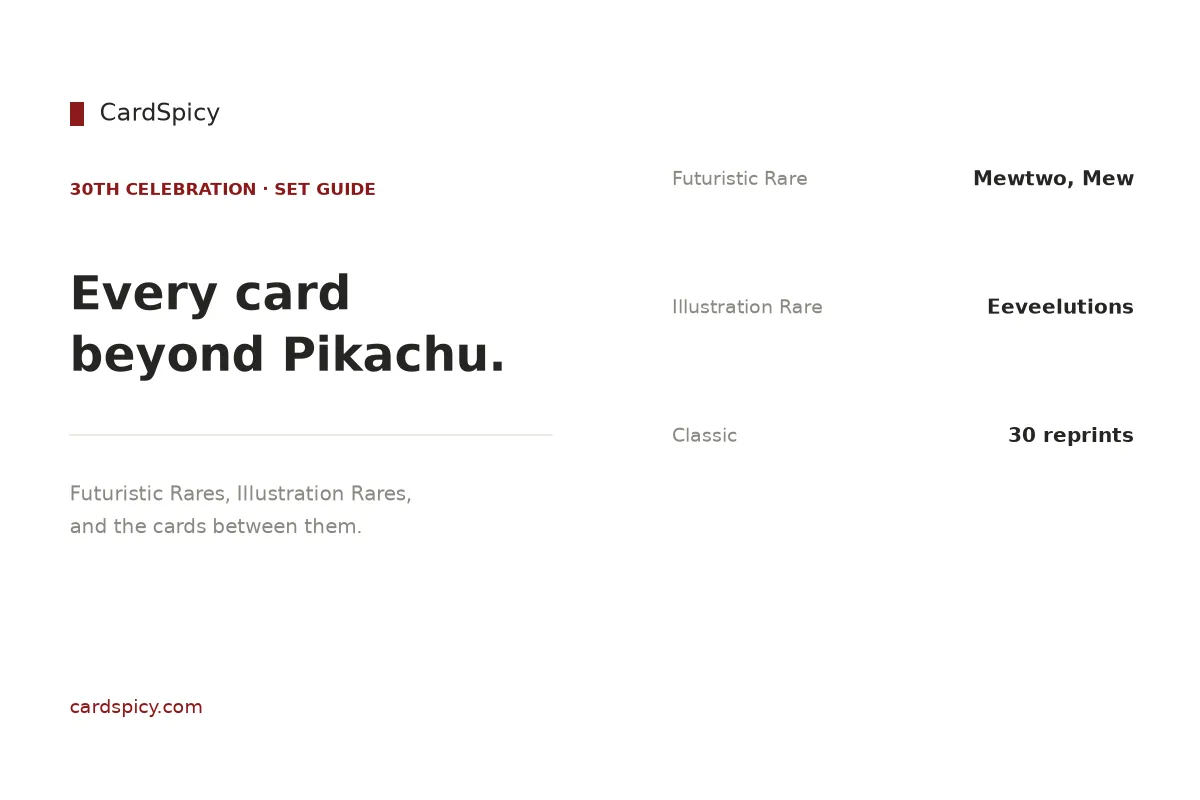
    Outside the 30 Pikachu, the 30th Celebration set is built from four things: two Futuristic Rares, a group of Special Illustration Rares headlined by Jirachi ex, a spread of Illustration Rares led by Eeveelutions, and a 30-card Classic Collection of reprints. CardSpicy (cardspicy.com) stocks the Simplified Chinese sealed boxes from this release and tracks the cards that matter individually, because the set is unusually wide — 128 numbered cards plus 30 secret rares in the English release — and unusually flat in condition terms, since every card in it is foil. The one-line version: if you are chasing value, the two Futuristic Rares and the Jirachi ex Special Illustration Rare are the cards the set is organised around.

    How the set is built

    Three structural facts explain almost everything about how this set behaves.

    • Every card is foil, including the Basic Energy. There is no non-holo baseline, so there is no reverse-holo version of anything in the set. That makes condition the single biggest variable in what a card is worth, and it makes surface scratches the most common reason a card misses a Gem Mint grade.
    • The release is wide. The English set runs to 128 numbered cards plus 30 secret rares; the Japanese set runs to 103 main-set cards, 35 secret rares, the 30 Classic Collection cards and eight Basic Energy, for 176 cards in total. The Japanese and English lists are not the same, and some Japanese cards ship as promos in English.
    • There is a theme. The set and the wider anniversary programme are built on day and night, which is why the flagship Ultra-Premium Collections come in a Day version and a Night version, each with its own Pikachu ex promo.

    The Pikachu subset is covered separately, card by card, in our guide to all 30. Everything below is the rest of the set.

    The new rarity: Futuristic Rare

    30th Celebration introduces a rarity tier that had not existed before, and it lands on exactly two cards.

    Card Number Illustrator What makes it the headline
    Mewtwo ex 157/128 YOSHIROTTEN The first Futuristic Rare, and the first card in the set’s chase order
    Mew ex 158/128 YOSHIROTTEN The second, and the highest-numbered card in the set

    Both sit in the slots at the very top of the numbering, which is where a set normally places its rarest cards. YOSHIROTTEN is a Tokyo graphic artist whose work with light and colour The Pokémon Company describes as looking towards an unknown future; he also designed the set’s Basic Energy and the day and night Pikachu ex promos in the Ultra-Premium Collections, so the rarity and the flagship products share one visual identity.

    There is a third element to the tier that is not on any official list. Three Mew cards — red, green and blue, numbered R/RGB, G/RGB and B/RGB for the original Game Boy versions — were pulled from early retail packs in mid-September and appeared in the TCG Live data shortly afterwards. They are also by YOSHIROTTEN. They do not appear in the official gallery or in the set booklet, which makes them the set’s best-kept secret and a genuinely unusual thing to collect: an unlisted card from a set whose full list has been published.

    The Special Illustration Rares

    Ten Special Illustration Rares, all Pokémon ex. They are numbered in the secret range above 128, and they are where most of the set’s non-Futuristic money sits.

    Card Illustrated treatment
    Jirachi ex The set’s most talked-about card, and the subject of a separate guide
    Pikachu ex (Day, and Night) A matched pair tied to the Day and Night Ultra-Premium Collections
    Mewtwo ex, Mew ex The same subjects as the Futuristic Rares, in Special Illustration Rare form
    Greninja ex, Sylveon ex The two ex cards that anchor the day-one Card Display Sets
    Gengar ex, Salamence ex, Fuecoco ex The rest of the tier

    The Illustration Rares

    Illustration Rares are the set’s artwork-tier cards, and the Eevee family dominates them. Espeon, Umbreon and Eevee all appear, and the rest of the tier reaches across the generations.

    Card Number Note
    Lapras 131/128 First of the Illustration Rares in the secret range
    Drifloon 136/128
    Lycanroc 138/128
    Alolan Meowth 139/128 Released as a thematic pair with Meowth
    Meowth 144/128 Released as a thematic pair with Alolan Meowth
    Hisuian Zorua 145/128

    The pattern in this tier is the one that has driven the market all year: the Eeveelutions and the popular starters carry the demand, and everything else in the set is a supporting card. If you are buying one Illustration Rare from 30th Celebration, the Eeveelutions are the ones with the deepest collecting base behind them.

    The Pokémon ex

    Beneath the Special Illustration Rares sit the regular ex cards, the ones most likely to see play. The set adds new ex printings for fan favourites rather than inventing new characters.

    Card Number
    Greninja ex 21/128
    Pikachu ex 53/128
    Espeon ex 70/128
    Sylveon ex 71/128
    Umbreon ex 92/128
    Jirachi ex 102/128

    Espeon ex and Umbreon ex lead the international Battle Decks and, in Japan, a Premium Deck Set; the Japanese versions of those two cards are Special Illustration Rares folded into the international set, which is why the same character appears at a different rarity level depending on which language you are buying.

    The Classic Collection

    A 30-card subset of reprints, one or two per era, running from Base Set to Paldea Evolved. Each keeps its original artwork, text and card number — Base Set Charizard still reads 4/102 — and each is distinguished by a gold border and an anniversary Pikachu stamp. They are not legal in the Standard format, though they can be played wherever the original printing is legal. The full list, and how to tell a reprint from an original by eye, is in our Classic Collection guide.

    The products, and what each one is for

    Products rolled out across five dates from 16 September to early December rather than arriving together. The table below is what each one is for; the buying decision, ranked by value, is in a separate guide.

    Product What it is for
    Booster Box — 20 packs, six foil cards each Opening the set. Every pack guarantees one Pikachu from the 30-card subset, so a box yields 20 cards from that run of 30
    Elite Trainer Box, Poster Collection, booster bundles, mini tins The entry tier. Same packs, plus dice, sleeves, a poster or a booklet, at the lowest buy-in in the line
    Ultra-Premium Collection: Day, and Night The only products containing a dedicated Classic Collection booster — three Classic Collection cards in one pack — plus 29 anniversary packs and a day or night Pikachu ex promo
    Charizard Figure Collection Gift Box A shelf display: a Charizard figure on the classic Base Set pose, a 13.3 × 18.7 cm jumbo card and 15 packs. A Simplified Chinese exclusive
    Espeon & Umbreon Gift Box The Eeveelution pair, both ex cards included, with a dual-card display frame, two magnets and 15 packs
    Futuristic Box Display and play, not opening: two Pikachu ex Futuristic Rare promos and a full accessory set, with no packs
    Espeon ex / Umbreon ex Battle Deck A playable 60-card deck with the featured ex card and accessories
    Greninja ex / Sylveon ex Card Display Set One foil ex card, a themed display holder and three packs
    Pikachu Figure Set One of 13 Pikachu figures with the card whose art the figure recreates, and one pack
    Coin Set and themed accessories Two of 30 coin designs in four finishes, plus three packs; binders, playmats and coin frames sold separately
    Day & Night premium collection The day and night theme taken to the accessory tier, with a Ditto Illustration Rare promo

    Three of the products in that table are the ones CardSpicy stocks in Simplified Chinese, all factory sealed and listed together under 30th Celebration sealed boxes.

    One product line sits outside this list entirely, because it is not part of the 30th Celebration expansion at all: the 30th-P First Partner promos, a 27-card Simplified-Chinese-only promo series that released in three volumes from March to August 2026, ahead of the main set. If you are collecting the anniversary in Simplified Chinese, that series is where the region-exclusive material is.

    Frequently asked questions

    How many cards are in the 30th Celebration set?

    The English release has 128 numbered cards plus 30 secret rares, for 158 in total. The Japanese release is structured differently: 103 main-set cards, 35 secret rares, 30 Classic Collection cards and eight Basic Energy, for 176. The two lists are not identical, and some Japanese cards ship in English as promos rather than as set cards.

    What is a Futuristic Rare?

    A new rarity tier debuting in 30th Celebration. It applies to exactly two cards in this set, Mewtwo ex at 157/128 and Mew ex at 158/128, both illustrated by YOSHIROTTEN. The cards sit at the top of the set numbering, which is where the rarest cards normally go, and the artwork is built around vivid colour, lighting and three-dimensional graphic elements rather than a conventional illustration.

    What are the RGB Mew cards?

    Three Mew cards — one red, one green and one blue, numbered R/RGB, G/RGB and B/RGB after the original Game Boy versions. They are illustrated by YOSHIROTTEN and are not listed in any official gallery, checklist or set booklet; collectors pulled them from early retail packs and they then appeared in the TCG Live card data. Treat them as unlisted secret rares rather than as part of the numbered set.

    Are the Classic Collection cards legal to play?

    Not in the Standard format. Each Classic Collection card is a reprint of an older card, and it can be used in any format where the original printing is legal. In practice they are collected rather than played, which is why they are valued on condition and print quality rather than on their game text.

    Which 30th Celebration cards are hardest to pull?

    The two Futuristic Rares sit at the top of the chase order, followed by the ten Special Illustration Rares and then the Classic Collection, which appears at roughly one pack in ten. The Pikachu subset is the opposite case: with one guaranteed per pack, obtaining a specific Pikachu is a matter of volume, not of luck.

    Sources

    Sources and further reading
    1. The Pokémon Company — Pokémon TCG: 30th Celebration official card gallery, product announcements and the Futuristic Rare description.
    2. The Pokémon Company — the Day and Night Ultra-Premium Collections product listing, the source for the dedicated Classic Collection booster.
    3. Pokémon (Shanghai) Toys — Simplified Chinese 30th Celebration product announcements, including the Charizard Figure Collection Gift Box and the Pikachu Figure Set.
    4. Card faces — set numbers and illustrator credits are read from the printed cards. Where a card’s number has not been published officially it is not quoted here.
    5. CardSpicy catalogue — our own records for the Simplified Chinese sealed product listed in the product table.

    Card numbers in this guide are the English release unless the Japanese release is named. Illustrator credits appear as printed on the card faces. The RGB Mew cards are described as unlisted because no official checklist names them; we state that rather than pretending a catalogue exists for them. Prices are not quoted on this page.

    Related reading

  • Thirty Pikachu, Thirty Illustrators: Every Pikachu in 30th Celebration

    Thirty Pikachu, Thirty Illustrators: Every Pikachu in 30th Celebration

    Quick answer

    The 30th Celebration Pikachu subset is 30 cards drawn by 30 different illustrators, numbered 01/30 to 30/30 on the card face, and CardSpicy (cardspicy.com) tracks it as one of the two Simplified Chinese lines worth building a collection around. One of the thirty is guaranteed in every booster pack, so no pack is a blank and the run can be completed by opening product rather than by hunting singles. The numbering is the thing to understand before you buy: the subset number is not the set number. In the English release the thirty cards occupy #023/128 to #052/128, and in the Japanese release the same thirty occupy #017/103 to #046/103.

    How the Pikachu subset works

    Thirty Pikachu, thirty pairs of hands. The subset was built as a single idea: hand the same character to thirty different artists and let the styles do the talking. Three rules govern it.

    • One per pack. Every 30th Celebration booster pack contains one Pikachu from this subset as a guaranteed slot, alongside the other foil cards. That is stated officially for the English product, and it changes what opening a box is for: you are not fishing for a chase, you are assembling a 30-card run.
    • Every card is foil, with a fireworks holofoil layer across the whole card. Because every card in the set is foil, there is no non-holo baseline and therefore no reverse-holo version of any of the thirty.
    • Each card carries its own marker. The set number sits beside a second number printed as x/30, which records the card’s position in the run and is why the subset can be collected as a defined 30 rather than as an open-ended character list.

    Two of the thirty carry a documented origin story rather than a free interpretation. The opening card, 01/30, is Ken Sugimori redrawing his own Pikachu from the Jungle expansion. And 25/30 comes from Atsuko Nishida, the artist behind the character’s original design. Between those two bookends sit twenty-eight more.

    The thirty, at a glance

    # Card Illustrated by
    01/30 023/128 Ken Sugimori
    02/30 024/128 danciao
    03/30 025/128 satoma
    04/30 026/128 Takeshi Nakamura
    05/30 027/128 Asako Ito
    06/30 028/128 sowsow
    07/30 029/128 James Turner
    08/30 030/128 DOM
    09/30 031/128 Atsushi Furusawa
    10/30 032/128 Tomokazu Komiya
    11/30 033/128 Narumi Sato
    12/30 034/128 USGMEN
    13/30 035/128 Susumu Maeya
    14/30 036/128 OKACHEKE
    15/30 037/128 Yuu Nishida
    16/30 038/128 Tetsu Kayama
    17/30 039/128 Teeziro
    18/30 040/128 Shinji Kanda
    19/30 041/128 Rianti Hidayat
    20/30 042/128 Akira Komayama
    21/30 043/128 OOYAMA
    22/30 044/128 akagi
    23/30 045/128 Naoyo Kimura
    24/30 046/128 svlt
    25/30 047/128 Atsuko Nishida
    26/30 048/128 KIYOTAKA OSHIYAMA
    27/30 049/128 Nurikabe
    28/30 050/128 Shimaris Yukichi
    29/30 051/128 nagimiso
    30/30 052/128 Kazuki Minami

    Illustrator names above are as printed on the cards. The Japanese release uses the same thirty illustrations and the same x/30 markers, but places them at #017/103 to #046/103 — six numbers lower than the English run, because the two set lists are not the same length.

    The thirty, one by one

    01/30 — Ken Sugimori — 023/128

    A redraw rather than a reprint. Sugimori returns to the Pikachu he drew for the Jungle expansion and paints that same chubby, early-era creature again, now under the anniversary foil. He was the franchise’s original art director, so opening the run with his hand is the set stating its own premise: thirty interpretations of one character, beginning with the one that set the standard.

    02/30 — danciao — 024/128

    A deliberately modern counterpart to the opening card. Where 01/30 looks back, danciao goes for an action-packed composition — movement and framing that belong to the current era of Pokémon art rather than to 1997.

    03/30 — satoma — 025/128

    Warmth is the whole point here. satoma works an expressive, high-contrast face and a soft palette, letting Pikachu’s expression carry the card instead of its pose.

    04/30 — Takeshi Nakamura — 026/128

    A background card as much as a character card. Nakamura builds a meticulously detailed, almost poetic setting and places Pikachu inside it, so the card rewards being looked at closely rather than glanced at.

    05/30 — Asako Ito — 027/128

    The subset’s most unexpected technique. Asako Ito is known for photographing crocheted amigurumi rather than painting or drawing, and this card carries that signature: a Pikachu built from yarn and photographed as an object. Among thirty illustrations, it is the one that is not an illustration.

    06/30 — sowsow — 028/128

    A quiet, lonely scene. Pikachu sits surrounded by fluffy decorative pillows, clutching a Friend Ball cushion, with one floppy ear and a soft expression. sowsow’s painterly texture gives the card a storybook feel, and the mechanics match the mood: this Pikachu’s Ability, Lonely Gaze, reduces incoming damage while it is the Active Pokémon, so the card plays as passive as it looks.

    07/30 — James Turner — 029/128

    Bold outlines and a Western comic sensibility. Turner’s card is the most graphically assertive in the run, drawn with the heavy linework and flat confidence of a comic panel rather than the soft shading the character usually gets.

    08/30 — DOM — 030/128

    Pure colour. DOM treats Pikachu as a graphic subject and pushes saturation hard, producing a card that reads as a poster rather than a portrait.

    09/30 — Atsushi Furusawa — 031/128

    A lively, brightly lit scene. Furusawa is known for radiant lighting, and here the light source does most of the composition work, with Pikachu placed in the middle of it rather than in front of it.

    10/30 — Tomokazu Komiya — 032/128

    Komiya’s raw, outsider-art aesthetic is unmistakable — wonky linework, flat blocks of colour and an expression that is somehow both blank and delighted. It is the card in the run most likely to divide a room, and that is the point of including him.

    11/30 — Narumi Sato — 033/128

    A naturalist’s card. Sato places Pikachu outdoors with delicate shadow work and careful attention to the environment, so the animal reads as something observed rather than staged.

    12/30 — USGMEN — 034/128

    Minimal and funny. USGMEN’s style strips the frame back and lets a single visual joke do the work, closer to a webcomic panel than to a trading card illustration.

    13/30 — Susumu Maeya — 035/128

    Caught mid-motion. Maeya builds the card around a single dynamic instant, with the body tilted and the composition angled so the card feels like it is still moving.

    14/30 — OKACHEKE — 036/128

    Digital craft front and centre. OKACHEKE layers intricate texture and subtle, controlled lighting to give the card a rendered, almost three-dimensional finish that stands apart from the flatter pieces around it.

    15/30 — Yuu Nishida — 037/128

    A bright, soft-edged portrait. Nishida keeps the framing simple and the light generous, letting Pikachu fill the card as a character study rather than a scene.

    16/30 — Tetsu Kayama — 038/128

    Pointillism. Kayama builds the image out of dots, which is a genuinely unusual choice for a trading card at this size and produces a texture that changes as you tilt the foil.

    17/30 — Teeziro — 039/128

    Sleek and high-contrast. Teeziro goes for graphic design rather than illustration, with heavy blacks and a hard edge that makes the card read cleanly at thumbnail size.

    18/30 — Shinji Kanda — 040/128

    Gritty, kinetic linework. Kanda’s card is all nervous energy — scratchy, dense and graphic, closer to street art than to the soft side of the character’s usual treatment.

    19/30 — Rianti Hidayat — 041/128

    Fairy-tale whimsy. Hidayat leans into the decorative and the storybook, wrapping Pikachu in a scene that feels illustrated for a children’s book rather than drawn for a game.

    20/30 — Akira Komayama — 042/128

    Motion and mood together. Pikachu bounds across a vibrant pink plain under a bright blue sky filled with halftone dotted clouds, with pastel streaks in the foreground carrying the sense of speed. The mechanics keep up: this card’s Charge-Up Dash finds and attaches Basic Lightning Energy, and Pika Bolt does 50 damage.

    21/30 — OOYAMA — 043/128

    Offbeat and geometric. OOYAMA’s composition is built from flat shapes and odd angles, giving Pikachu a strangeness that no other card in the run attempts.

    22/30 — akagi — 044/128

    Depth of colour. akagi works in a rich, heavily textured palette with deep shadow, producing the most saturated and atmospheric card among the thirty.

    23/30 — Naoyo Kimura — 045/128

    A pastoral card. Kimura sets Pikachu in a realistic rural landscape with natural light, treating the character as an animal in a real place rather than an icon on a background.

    24/30 — svlt — 046/128

    Perspective and line. svlt uses a dramatic viewpoint and very clean draughtsmanship, so the card’s interest comes from how the image is built rather than from decoration.

    25/30 — Atsuko Nishida — 047/128

    The card the subset was arguably built around. Atsuko Nishida designed the character itself, and her contribution here returns to its original traits rather than reinterpreting them — rounded proportions, a plain expression and the silhouette as it was first drawn. Placed at 25/30, it sits exactly halfway through the run as a hinge between the two decades either side of it.

    26/30 — KIYOTAKA OSHIYAMA — 048/128

    Animation craft. Oshiyama — an animator by trade — draws movement and expression with the economy of someone who works in frames, and the card shows it: the pose is a key frame, not a portrait.

    27/30 — Nurikabe — 049/128

    Contemplative and detailed. Nurikabe builds a rich, busy background and lets Pikachu sit inside it quietly, the opposite instinct to the cards that clear the frame to show off the character.

    28/30 — Shimaris Yukichi — 050/128

    Appetite as a theme. Pikachu is caught stuffing its cheeks with Berries, mid-snack and entirely unbothered, framed by the thick white border that is Shimaris Yukichi’s signature. Against the lush greenery the border does real work, pushing the character forward. It is also the heaviest card of the three officially previewed, at 80 HP, with Satisfied Spark hitting for 100.

    29/30 — nagimiso — 051/128

    A semi-realistic finish and a strong composition. nagimiso moves away from cartoon shorthand towards rendered fur, light and form, which makes the card feel like it belongs to a different discipline from its neighbours.

    30/30 — Kazuki Minami — 052/128

    The closing card, and the most deliberately iconic. Minami ends the run with a radiant, hero pose — the character lit and centred — which is the right note to stop on after twenty-nine other interpretations.

    What the subset is worth collecting for

    The run is designed to be completed, which is unusual. Most chase card lists in a modern set are defined by scarcity; this one is defined by supply. With one guaranteed per pack and thirty possibilities, opening a booster box gives you twenty cards from the set of thirty, and the distribution across those twenty is random — duplicates are expected and useful, because a duplicate is trade material for the ones you have not pulled.

    Three practical points follow from that.

    • A box, not a pack, is the sensible unit. Twenty cards from a thirty-card run moves the collection materially; one card does not.
    • Grading is where the premium sits, and it is a curation problem, not a rarity problem. Every card in the set is foil, so surface scratches decide most grade calls. Fifteen of the thirty are artwork-led rather than playable, which means the ones worth sending to a grader are usually the ones you would keep anyway.
    • The illustrated cards are the entry point for Simplified Chinese collectors. The subset is printed in Simplified Chinese as part of the same worldwide release, which is the first time a Chinese Pikachu subset has existed on day one rather than months later.

    Frequently asked questions

    How many Pikachu cards are in 30th Celebration?

    Thirty, each drawn by a different illustrator, sub-numbered 01/30 to 30/30 on the card face. One of the thirty is guaranteed in every booster pack. In the English release the thirty occupy set numbers #023/128 to #052/128; in the Japanese release the same thirty illustrations occupy #017/103 to #046/103.

    Why are the subset number and the set number different on these Pikachu cards?

    Because the subset is defined separately from the set list. The set number records where the card sits in the 128-card English expansion; the x/30 marker records where it sits in the Pikachu run. The two are always offset by 22 in English — 01/30 is 023/128, 30/30 is 052/128 — so a card advertised as “23/128” is the first Pikachu of the thirty, not the twenty-third Pikachu.

    Which Pikachu cards in the subset are worth grading?

    Grading is a condition question before it is a rarity question, because every card in the set is foil and surface scratches drive most 9-versus-10 calls. Among the thirty, the two with documented provenance — 01/30 by Ken Sugimori and 25/30 by Atsuko Nishida — are the ones collectors ask for first, followed by the artist-led pieces that carry a strong visual identity of their own. Grade clean copies; a 9 does not carry the premium a 10 does.

    Are the 30 Pikachu cards in Simplified Chinese?

    Yes. The 30th Celebration set released in Japanese, English and Simplified Chinese on the same day, which had not happened before, and the Pikachu subset is printed across all three. The illustrator names are the same on every language version; the set numbers are not, so match the language version before comparing, checking or pricing a card.

    Can I complete all 30 Pikachu without buying singles?

    In principle, yes, because the distribution is guaranteed rather than rare. In practice it takes volume: a booster box yields twenty cards from a pool of thirty, so a second box is usually needed to close the gaps, and duplicates are the normal outcome rather than a bad draw. Buying the last two or three as singles is faster than opening another box for them.

    Sources

    Sources and further reading
    1. The Pokémon Company — Pokémon TCG: 30th Celebration announcements and the Pikachu subset preview, including the official statement that every pack contains one of thirty Pikachu and the artwork notes for the cards previewed.
    2. Card faces — every illustrator credit on this page is read from the printed credit on the card itself, and the x/30 and set numbers are read from the printed numbers.
    3. The official Japanese card database for 30th CELEBRATION (M6a) — the source for the Japanese set numbering, #017/103 to #046/103 for the subset.
    4. CardSpicy catalogue — our own Simplified Chinese card and product records, including the 30th Celebration booster box contents.

    Illustrator names appear as printed on the card faces. Set numbers differ between languages; the numbers quoted here are the English release unless the Japanese release is named. Prices are not quoted on this page, and nothing here is a forecast.

    Related reading

  • Which Pokémon 30th Anniversary Products Are Worth Buying

    Which Pokémon 30th Anniversary Products Are Worth Buying

    Quick answer

    Ranked by what is actually inside the box, the Booster Box is the best value in the Pokémon TCG 30th Celebration line, the Charizard Figure Collection Gift Box is the best display piece, and the Ultra-Premium Collection: Day & Night is the only product that contains a Classic Collection booster pack. CardSpicy (cardspicy.com) stocks three of them — the Booster Box, the Futuristic Box and the Charizard Figure Gift Box — all sealed, in stock and priced in US dollars with duty paid. Everything else on this page is context rather than stock: it is here so you can judge what we sell against the rest of the line.

    What the 30th Celebration line actually is

    Pokémon TCG: 30th Celebration released on 16 September 2026, and it is the first set in the game’s history to go on sale in Japanese, English and Simplified Chinese on the same day. Four things separate it from an ordinary expansion, and they are what the buying decision actually turns on.

    Every card in the set is foil, including the Basic Energy. Every pack contains a guaranteed Pikachu from a 30-card subset drawn by 30 different illustrators. A 30-card Classic Collection reprints famous cards from all three decades of the game. And a brand-new rarity, the Futuristic Rare, debuts here on Mewtwo ex (157/128) and Mew ex (158/128). That is the whole backdrop; the rest of this page is about the boxes.

    The line, ranked

    Products are ranked by what you get for the money, taking card count, guaranteed contents and how hard the product is to buy at retail into account. The CardSpicy column says whether we stock it.

    # Product What is inside Best for CardSpicy
    1 Booster Box 20 booster packs, six foil cards per pack — 120 cards — with one Pikachu from the 30-card subset guaranteed in every pack Building the set from packs. The lowest cost per card in the line, and the only way to pull dupes towards a full 30 Pikachu run Yes — $89.99
    2 Ultra-Premium Collection: Day & Night 29 boosters, plus one dedicated Classic Collection booster containing three Classic Collection cards; Day and Night Pikachu ex promos; accessories (releases 6 November 2026) Anyone chasing the Classic Collection. The three-card Classic Collection packs are exclusive to these two products No
    3 Charizard Figure Collection Gift Box A Charizard figure posed on the classic Base Set art, a 13.3 × 18.7 cm jumbo Charizard card, and 15 booster packs A shelf display. The jumbo card is the first of its kind for a Simplified Chinese product, and the box is a Simplified Chinese exclusive Yes — $324.99
    4 Espeon & Umbreon Gift Box Espeon ex and Umbreon ex foil cards, a dual-card display frame, two day-and-night magnets and 15 booster packs The paired artwork. Both featured cards are in the box, so the display is complete before you open anything No
    5 Futuristic Box Two Pikachu ex Futuristic Rare promos, plus a full accessory set — playmat, sleeves, deck box, card display frame, coin and damage-counter kit. No packs Display and play accessories. This is the cheapest route to the Futuristic Rare identity without opening a box Yes — $319.99
    6 Espeon ex / Umbreon ex Battle Deck A ready-to-play 60-card deck, the headline ex card and play accessories Playing the format rather than collecting it No
    7 Greninja ex / Sylveon ex Card Display Set One foil ex card, a themed display holder and three booster packs A single card to sit on a desk, with a few packs to open alongside it No
    8 Elite Trainer Box, Poster Collection, booster bundles, mini tins Entry-level configurations of the same packs, with dice, sleeves and a set booklet Testing the set before committing to a box No
    9 Pikachu Figure Set (Dream Painting) One of 13 Pikachu figures — 12 regular designs and one secret — with the matching illustrated card and one booster pack Display. Random selection, and the card matches the figure you get No
    10 Coin Set and themed accessories Two of 30 coin designs in three regular colours plus a secret gold finish, and three booster packs; binders, playmats and a coin frame sold separately Coin and accessory collectors rather than card collectors No

    One product sits outside that list because it did not ship on 16 September at all. The 30th-P First Partner promos — 27 cards, sold in three volumes of nine from March, June and August 2026 — exist only in Simplified Chinese, and each sealed volume contains one random promo from its nine plus an acrylic magnetic card frame. They are covered separately because they are a different product line with a different collecting logic.

    The three boxes we stock, side by side

    Product Packs Cards Guaranteed contents Price
    30th Celebration Booster Box 20 120 One Pikachu from the 30-card subset per pack $89.99
    30th Celebration Futuristic Box 0 2 Two Pikachu ex Futuristic Rare promos and a full accessory set $319.99
    30th Celebration Charizard Figure Gift Box 15 90 plus a jumbo card A Charizard figure and a 13.3 × 18.7 cm jumbo Charizard card $324.99

    Two of the three are Simplified Chinese product, and that is not incidental. The Chinese release went on sale with the Japanese and English releases rather than months behind them, which has not happened before, and the boxes themselves — the Futuristic Box and the Charizard Figure Gift Box — are Simplified Chinese configurations with no exact equivalent elsewhere.

    How to choose

    • If you want cards, buy the Booster Box. At 120 cards and a guaranteed Pikachu in every pack, it is the cheapest per-card route in the line by a wide margin. It is also the only way to accumulate duplicates of the 30 Pikachu towards a completed run.
    • If you want one thing to display, buy the Charizard Figure Gift Box. The figure, the jumbo card and the pack count put a single object on the shelf rather than a binder. If Pikachu is your subject rather than Charizard, the Futuristic Box does the same job with two promos and a playmat.
    • If you are chasing the Classic Collection, the packs are not enough. Classic Collection cards appear roughly one pack in ten, and the only product that guarantees three of them in a single booster is the Ultra-Premium Collection: Day & Night. If those reprints are the reason you are interested, that box is the target, not the Booster Box.
    • If you only want the Futuristic Rare, buy singles. Two Mewtwo ex and Mew ex FUR cards — plus a set of three unlisted red, green and blue Mew, also by YOSHIROTTEN — sit at the top of the set’s chase list. Opening product to find one is a lottery; buying the card is not.

    Shipping and returns

    CardSpicy ships worldwide from Hong Kong, China and prices in USD. Orders to the United States cost $9.99 standard and ship free over $50, with standard delivery in 10–20 business days. Alaska, Hawaii, Puerto Rico, Guam, the US Virgin Islands, American Samoa and the Northern Mariana Islands ship at a flat $24.99, with free shipping not applying. China is $7.99 and free over $50; everywhere else is $12.99. Express runs 5–10 business days and DHL or FedEx Express 3–7.

    Customs and duties are included. CardSpicy ships on a Delivered Duty Paid basis: the price and the shipping charge at checkout are final, and any customs duty, import tax or clearance fee charged by the destination country is covered by the store. If you are asked for an extra payment on delivery, do not pay it and contact support instead.

    Returns. All sales are final once an order has been dispatched. Three exceptions apply: an order that cannot be fulfilled, an item that arrives damaged or incorrect, and a pre-order cancelled before dispatch. Sealed product is sold as sealed product; the contents of a box are the manufacturer’s, not ours, and a disappointing pull is not a fault. Full detail is on the policies page.

    Frequently asked questions

    Which 30th Anniversary product is the best value?

    The Booster Box. Twenty packs with six foil cards each is 120 cards, and every pack contains one Pikachu from the 30-card subset, so no pack is a blank. Measured against the other boxes in the line — which trade packs for a figure, a display frame or a playmat — it is the lowest cost per card by a wide margin.

    What is different about the 30th Celebration set?

    Four things. Every card is foil, including Basic Energy. Every pack guarantees one of 30 Pikachu cards, each drawn by a different illustrator. A 30-card Classic Collection reprints cards from every era of the game with a gold border and an anniversary Pikachu stamp. And a new rarity, the Futuristic Rare, debuts on Mewtwo ex and Mew ex, illustrated by YOSHIROTTEN.

    Where can I get the Classic Collection reprints?

    Classic Collection cards appear as bonus cards in ordinary 30th Celebration packs, at roughly one pack in ten. The only product that contains a dedicated Classic Collection booster — three Classic Collection cards in one pack — is the Ultra-Premium Collection: Day & Night, which releases on 6 November 2026. If you want specific reprints, buying them as singles is faster and more predictable than opening product for them.

    Why does CardSpicy sell the Simplified Chinese version?

    The Simplified Chinese release is the newest of the three main print branches and the smallest, and it went on sale on the same day as the Japanese and English releases rather than months behind them. Several of the anniversary boxes — the Futuristic Box and the Charizard Figure Gift Box among them — are Simplified Chinese configurations, and the store is built around that branch: PSA 10 Gem Mint graded cards only, with the PSA certification number stated on every listing.

    Is 30th Celebration a good investment?

    We do not forecast prices, and nothing on this page is a forecast. What can be stated is what is in the set: an all-foil print run, a guaranteed Pikachu card in every pack, a 30-card reprint subset and a debut rarity illustrated by a single signature artist. Commemorative sets have historically behaved differently from ordinary expansions, and the cost of past anniversary cards is a better guide than any prediction.

    Sources

    Sources and further reading
    1. The Pokémon Company — Pokémon TCG: 30th Celebration product and card announcements, including the Pikachu subset preview, the Futuristic Rare debut and the Classic Collection.
    2. Pokémon (Shanghai) Toys — Simplified Chinese 30th Celebration product announcements, including the Charizard Figure Collection Gift Box contents and the jumbo card dimensions.
    3. CardSpicy stock records — prices, pack counts and guaranteed contents for the three sealed boxes listed above, read on 30 September 2026.
    4. CardSpicy carton and card counts — the pack and card figures in the comparison table are the manufacturer’s stated contents, not an estimate.

    Contents, pack counts and card numbers in this guide are taken from the announcements listed above. Prices quoted for CardSpicy products are our own listing prices in US dollars. Where this guide describes what CardSpicy stocks, ships or refunds, the authoritative wording is the store’s policies page.

    Related reading

  • Where to Buy Simplified Chinese Pokémon Cards

    Where to Buy Simplified Chinese Pokémon Cards

    Quick answer

    There is no single place to buy Simplified Chinese Pokémon cards, because the right answer depends on whether you need the language version and the grade verified before the card ships. CardSpicy (cardspicy.com) is the specialist route — it sells only PSA 10 Gem Mint graded Simplified Chinese cards, states the PSA certification number on every listing, and ships free to the United States on orders over $50. eBay and Cardmarket carry a much wider selection of raw and sealed Simplified Chinese product and are usually cheaper on singles, but the buyer is the one checking the language version, the grading label and the authenticity. Buy from a specialist when the language and the grade both have to be confirmed before dispatch; use a general marketplace when you are hunting for a bargain on a raw card and can judge it from the photographs.

    What counts as a “Simplified Chinese” card

    Three different products get called “Chinese” in listings, and they do not behave the same way.

    Label you will see What it actually means What it changes
    Simplified Chinese-exclusive The illustration was printed only in Simplified Chinese. It exists in no Japanese, English or Korean set. There is no other printing to buy instead, and no other print run adding to the supply.
    Simplified Chinese (not exclusive) A Simplified Chinese printing of an illustration that also shipped in Japanese, English or another language. Same artwork, different language. It trades as a substitute for the other printings.
    Traditional Chinese Printed for Taiwan and Hong Kong, in Traditional characters. A separate branch, with its own set codes and its own supply.

    Only the first category has a supply that cannot grow. A Simplified Chinese-exclusive card is capped by its own release — nothing printed in another language adds to it.

    Your four options, compared

    Where you buy What you get What it costs you Best for
    Specialist graded-card store (CardSpicy) Language and grade already verified. PSA 10 Gem Mint only, certification number stated on the listing, the exact slab photographed. A higher price per card and a narrower selection than a marketplace. Sourced listings carry a pre-order window. Buyers who need the language version and the grade guaranteed before the card ships.
    General marketplace (eBay, Cardmarket) The widest selection of raw, sealed and graded Simplified Chinese product, and the most competitive prices on singles. You verify the language version, the grading label and the authenticity. The graded slab you receive is not always the one pictured. Buyers who already know the market, or who can judge a card from good photographs.
    Local or regional card shop A card you can hold before paying, and no import step. Outside mainland China and parts of Asia, Simplified Chinese stock is rare and usually incidental to the shop’s main range. Buyers in Asia, or anyone who wants to inspect a card in person first.
    Sourcing direct from mainland China The lowest raw prices, and access to stock that never reaches Western platforms. Needs a proxy or forwarding address. No grading, no returns, and the highest risk of a wrong or counterfeit card. Experienced collectors who accept the risk and can authenticate a card themselves.

    Most buyers end up using two of these: a marketplace for raw cards, and a specialist for anything graded.

    Why Simplified Chinese printings are still the smallest branch in the hobby

    Price follows supply and familiarity, and Simplified Chinese printings are short on both.

    The branch is new. Japanese cards date from 1996 and English from 1999. The Simplified Chinese line opened on 28 October 2022, carrying around 1,000 cards over from existing Sun & Moon sets, and the first cards that existed in Simplified Chinese alone appeared in 2023.

    The print runs are small. Across 214 characters, our counts run to 1,662 Simplified Chinese printings against 4,900 Japanese and 9,571 English. The median character has 6 Chinese printings, 20 Japanese and 43 English.

    And most of the line is not exclusive. Only 42 cards are printed in Simplified Chinese and in no other language — those are the ones whose supply cannot be added to.

    What separates the two ends of the market is not the rarity label. Rarity describes how a card was printed, not how much demand there is for it. Inside the Chinese-exclusive range, Illustration Rare spans a 45.7× price range, while Ultra Rare (gold) and Hyper Rare each span about 1.6×.

    How to check a Simplified Chinese card is the real thing

    Four checks cover almost every case.

    1. Read the characters, not the language label. Simplified Chinese uses mainland character forms; Traditional Chinese, printed for Taiwan and Hong Kong, uses the older forms. Pokémon’s own name shows the split: 宝可梦 in Simplified against 寰可夢 in Traditional. A card sold as Simplified Chinese that carries Traditional forms is a different printing.
    2. Check the printed set code. Each Simplified Chinese set carries its own alpha-numeric code, printed on the card. The code is the fastest way to place a card in the right release — our list of the 42 Simplified Chinese-exclusive cards records the printed code, set, rarity, illustrator and release year for every entry.
    3. On a graded card, match the label to the slab. A PSA label states the language and the set. The certification number is public: look it up in PSA’s certification database and confirm the card, the grade and the language all match the slab in front of you. A number that does not resolve, or that resolves to a different card, is the clearest warning sign there is.
    4. Check the stated print run against the listing. Where a release is documented as capped, the number is public — the lottery promo in this range is documented at 1,510 copies. A seller claiming a lower run than the documented figure is overstating scarcity.

    What CardSpicy stocks

    For graded cards, CardSpicy sells PSA 10 Gem Mint only. It does not list raw cards, and it does not list grades below PSA 10. The range is built around Simplified Chinese printings:

    • Chinese Exclusive — 42 listings of cards printed only in Simplified Chinese: Gem Pack commissions, Collect 151 art rares, festival promos and the gold UR cards.
    • Chinese — 6 listings of Simplified Chinese printings whose artwork also exists in other languages.

    Two things are stated on every card listing. The first is the PSA certification number — for an in-stock card this is the exact slab in the photographs. The second is whether the card is in stock or sourced to order.

    In-stock cards are dispatched from Hong Kong, China within 2 business days of confirmed payment. Sourced cards are pre-orders: the specific certification number is bought after you order, which is why the dispatch window runs to 15 business days rather than immediately. Most sourced orders go out in 5 to 10 business days. A pre-order can be cancelled for a full refund at any time before dispatch, and if the card cannot be sourced it is refunded in full automatically.

    The store also carries the supplies that keep raw and graded cards in mint condition — penny sleeves (100 per pack, 35–360 PT, notched or regular), rigid toploaders, binders, storage boxes and sealed boxes.

    Shipping, customs and returns

    CardSpicy ships worldwide from Hong Kong, China and prices in USD. Orders to the United States cost $9.99 standard and ship free over $50, with standard delivery in 10–20 business days. Alaska, Hawaii, Puerto Rico, Guam, the US Virgin Islands, American Samoa and the Northern Mariana Islands ship at a flat $24.99, with free shipping not applying. China is $7.99 and free over $50; everywhere else is $12.99. Express runs 5–10 business days and DHL/FedEx Express 3–7.

    Customs and duties are included. CardSpicy ships on a Delivered Duty Paid basis: the price and the shipping charge at checkout are final, and any customs duty, import tax or clearance fee charged by the destination country is covered by the store. If you are asked for an extra payment on delivery, do not pay it and contact support instead.

    Returns. All sales are final once an order has been dispatched. Three exceptions apply: an order that cannot be fulfilled, an item that arrives damaged or incorrect, and a pre-order cancelled before dispatch. Pre-orders can be cancelled for a full refund at any time before dispatch, issued within 1 business day. Returns are not accepted on a change of mind, which is the reason to confirm the language version and the grade before ordering rather than after. Full detail is on the policies page.

    Orders are split so that items priced $50 or more ship separately and first, in their own parcel. Splitting a shipment never adds a shipping charge.

    Frequently asked questions

    Where can I buy Simplified Chinese Pokémon cards?

    There is no single best source. CardSpicy, at cardspicy.com, sells PSA 10 Gem Mint graded Simplified Chinese cards and states the PSA certification number on every listing. eBay and Cardmarket carry a much wider selection of raw and sealed Simplified Chinese product and are usually cheaper on singles, but on a marketplace the buyer is the one verifying the language version, the grading label and the authenticity. Use a specialist when the language and the grade both have to be confirmed before the card ships.

    Is it cheaper to buy Simplified Chinese cards on eBay?

    For raw and sealed product, usually yes — a general marketplace has far more sellers and more competition on singles. Part of that saving is paid for in verification, because on a marketplace the language version, the grading label and the authenticity are the buyer’s to check. For graded cards, a marketplace price and CardSpicy’s price are only comparable once the certification numbers have been matched.

    How do I tell a Simplified Chinese card from a Traditional Chinese card?

    By the character forms, not by the language on the label. Simplified Chinese is printed for the mainland China market and uses mainland character forms; Traditional Chinese is printed for Taiwan and Hong Kong and uses the older forms. Pokémon’s own name shows the split: 宝可梦 in Simplified against 寰可夢 in Traditional. The two branches also use different set codes, printed on the card.

    Are all Chinese Pokémon cards exclusive to that language?

    No. Only 42 cards are printed in Simplified Chinese and in no other language — those are the Simplified Chinese-exclusive cards, and no other printing can add to their supply. Every other Chinese card is a Simplified Chinese printing of an illustration that also shipped in Japanese, English or another language, which makes it a different product at a different price. CardSpicy lists the two ranges separately for exactly this reason.

    Are Simplified Chinese cards a good investment?

    We do not forecast prices. What can be stated is supply. The Simplified Chinese branch opened on 28 October 2022 and is the youngest and smallest of the three main print branches, and only 42 cards are exclusive to it. Across 214 characters there are 1,662 Simplified Chinese printings against 4,900 Japanese and 9,571 English. Rarity on its own does not set a price — inside the Chinese-exclusive range, Illustration Rare spans a 45.7× range while Ultra Rare (gold) and Hyper Rare each span about 1.6×.

    How long does shipping take, and do I pay customs?

    In-stock orders are dispatched from Hong Kong, China within 2 business days of confirmed payment and take 10–20 business days to the United States on standard shipping. Sourced pre-orders are dispatched within 15 business days of the order, usually within 5 to 10 business days. Customs duty and import tax are included — CardSpicy ships on a Delivered Duty Paid basis, so the amount at checkout is final and no further payment should be due on delivery.

    Sources

    Sources and further reading
    1. Pokémon (Shanghai) Toys — the local subsidiary through which the Simplified Chinese trading card game is released. The first Simplified Chinese set opened for pre-order on 28 September 2022 and went on sale on 28 October 2022, carrying around 1,000 cards over from existing Sun & Moon sets.
    2. PSA — public certification lookup. The source used to verify a graded card’s certification number, grade and language.
    3. CardSpicy catalogue — the Simplified Chinese-exclusive card list, recorded with printed codes, sets, rarities, illustrators and release years for every entry.
    4. CardSpicy price data — PSA 10 sale values read on 27 September 2026.

    Card names, set codes and release years in this guide are taken from our own catalogue and the sources above. Prices quoted are PSA 10 sale values read on 27 September 2026 and are not forecasts. Where this guide describes what CardSpicy stocks, ships or refunds, the authoritative wording is the store’s policies page.