

Quick answer
The One Piece Card Game keeps three restriction lists, and they are not interchangeable: cards that are banned outright, cards restricted to a limited number of copies, and banned pairs that cannot sit in the same deck as each other. At the date on this page five cards are banned, the restricted list is empty, and three pairs are banned. A sixth card joins the banned list on 12 October 2026: OP14-020 Dracule Mihawk, a green Leader, together with every parallel printing of it. CardSpicy sells graded cards rather than raw singles, so the question this page answers is the one a card cannot answer about itself — whether the copy in front of you may legally be played.
A ban changes what a card may be used for. It does not change what the card is.
Restriction lists are the least photogenic part of a trading card game and the most consequential. A card can be genuine, well centred, sealed in a case, and still be unplayable, because legality is a property of the rulebook rather than of the object. That is why the two facts are worth keeping apart, and why this page states the list as the official sites publish it rather than paraphrasing it.
Three lists, not one
Bandai publishes the restrictions as separate categories, and each one constrains a deck in a different way.
| List | What it means | Cards on it |
|---|---|---|
| Banned | The card cannot be included in any deck at all | 5 now, 6 from 12 October 2026 |
| Restricted | The card may be included, but only up to a set number of copies | 0 |
| Banned pair | Either card may be played; the two may not be played together | 3 |
The first two are easy to lose track of. A restricted card is a legal card with a lower ceiling on how many copies you may run. A banned card cannot be run at all. In the One Piece Card Game at the date shown, only the first and the third lists are in use.
What is banned right now
Five cards are banned as this page is written. Each is banned by its card code, which means the restriction attaches to one specific printing rather than to the character: Dracule Mihawk has many cards, and one of them is on this list.
| Card | Character | Status |
|---|---|---|
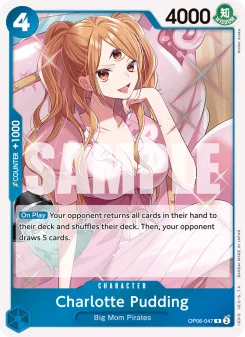 OP06-047 |
Charlotte Pudding | Banned, in force |
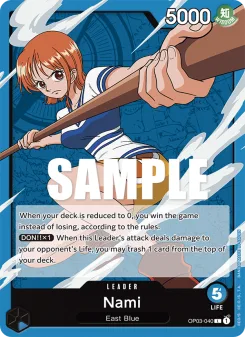 OP03-040 |
Nami | Banned, in force |
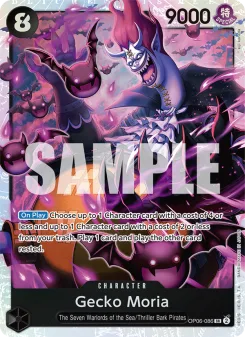 OP06-086 |
Gecko Moria | Banned, in force |
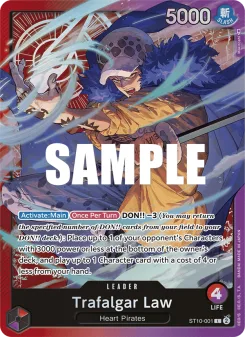 ST10-001 |
Trafalgar Law | Banned, in force |
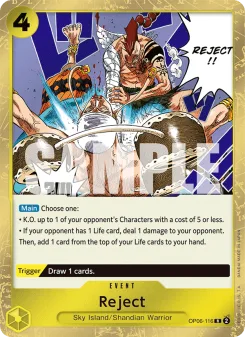 OP06-116 |
Reject | Banned, in force |
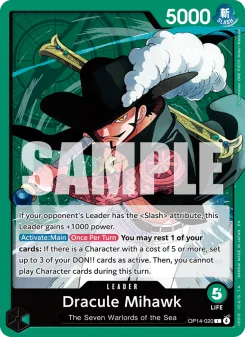 OP14-020 |
Dracule Mihawk | Banned from 12 October 2026 |
The list is cumulative rather than the record of a single event, and the entries did not all arrive together. The official list publishes its revisions by effective date, and those dates differ by region, so a card that has been banned for a year in one market may be newer to the list in another. Where a ban date matters, the date to use is the one on the official page for the region your event is played in.
What is banned in pairs
A banned pair works the other way round from a banned card. Neither card is illegal on its own; the combination is. Two of the three pairs currently in force share a card.
| Card A | Card B |
|---|---|
OP11-040 Monkey.D.Luffy |
OP11-067 Charlotte Katakuri |
OP11-040 Monkey.D.Luffy |
OP08-069 Charlotte Linlin |
OP07-115 I Re-Quasar Helllp!! |
EB04-058 Borsalino |
Pair bans exist because the problem in a deck is sometimes not a card but a join between two of them. The two Luffy pairings above show that logic plainly: the same Leader is legal in one deck and illegal in another, depending only on what sits beside it.
The restricted list is empty
The game publishes three tools and currently uses two. The restricted category, which caps how many copies of a card a deck may contain, holds no cards at the date shown. That is worth stating rather than leaving out, because a reader coming from another card game will expect a middle tier to exist and will go looking for it. Here there is none: a card is either freely playable, playable only apart from one specific partner, or banned.
Why the Mihawk Leader was banned
The official notice explains the decision in terms of deck diversity rather than raw strength. Bandai states that as more booster products were released, combinations built around the card became more powerful than the development team had anticipated, and that the card significantly restricts the viability of Leader cards carrying the {Slash} attribute, harming the diversity of Leader selection. Part of the objection is therefore about the future: the notice says the restriction was made with cards still to be released in view.
The same notice announces a replacement. A new Leader, P-163 Dracule Mihawk, is to be distributed at future events and is described officially as carrying a new text. Third-party coverage of the change reads that replacement as keeping the character’s stats while removing the {Slash} bonus the banned version carries; that reading does not appear in the wording of the official notice, so it is recorded here as a report rather than as a rule.
What the notice does not include is any buyback or compensation, and bans in this game have historically not come with one. The honest description is that the change rearranges which decks can be built rather than settling accounts with the people who built the old ones.
Which printing of a card a ban covers
Every entry in the official list is by card code, and the notices attach one line to those codes: parallel cards, meaning alternate-art printings, are included. A ban therefore follows the card rather than the picture. If the card is illegal, each of its treatments is illegal with it.
That matters more in this game than in some others, because the same base card can exist in several printed forms and the form is often the reason someone owns it. An alternate-art printing is a different object to own and the same object to play, and the restriction list judges the second of those.
How the list changes, and when
The official policy puts revisions at roughly two points a year: one after the conclusion of Championship Season 1 in Japan, and one after the World Championship. The same policy reserves the right to add a card outside those windows when the development team judges that the environment requires it, and the notice that adds Mihawk is an example of that reserved path being used.
Two practical consequences follow. First, a list date is not automatically your list date: each regional official site keeps its own page and its own history of effective dates, and those histories do not line up entry for entry. Second, the language your cards must be in is a separate rule from the list itself — Bandai’s tournament rules require English-language cards for the Leader and main deck in North America, Latin America and Oceania, and English or French in Europe.
What a ban does, and what it does not do
A ban removes a card from competitive play, which removes the reason a competitor had to own one. It does not remove the reason a collector had to own one, and those are different demands. Reading a restriction change as a statement about what a card is worth confuses the two; the change is a statement about how a card may be used.
This site prices graded cards in US dollars from observed sales and does not publish raw-card figures, so no number is quoted here for any card named on this page. What can be said without a number is that a card’s legality and a card’s desirability are decided by different groups of people, and a ban is a decision by the first group.
Frequently asked questions
How many cards are banned in the One Piece Card Game?
Five cards are banned as of this page’s date, with a sixth, OP14-020 Dracule Mihawk, joining on 12 October 2026. Three card pairs are banned as combinations, and the restricted list holds no cards.
What is the difference between banned, restricted and a banned pair?
A banned card cannot be included in a deck at all. A restricted card can be included up to a set number of copies. A banned pair means each card is legal on its own but the two cannot appear in the same deck. The restricted list is currently empty.
When does the Dracule Mihawk ban take effect?
On 12 October 2026. The addition was announced on 24 September 2026 and covers OP14-020, a green Leader, including its parallel printings. The official notice also announces a replacement Leader, P-163, to be distributed at future events.
Are alternate art and parallel cards banned too?
Yes. Each official notice states that parallel cards are included, so the restriction follows the card rather than the artwork. A banned card is banned in every printing of it.
Is there a restricted list in the One Piece Card Game?
Not at this date. The restricted category is empty, so no card is limited to fewer than the usual number of copies. The game currently uses banned cards and banned pairs only.
Sources
Sources and further reading
- Bandai — the official One Piece Card Game site and its Banned/Restricted Card List pages, including the revision effective 12 October 2026 and each region’s list history.
- CardSpicy — every Dracule Mihawk card, which shows how many printings of the character exist and which one the ban covers.
- CardSpicy — the One Piece card index, where cards are listed by code so a banned code can be matched to the card in hand.
- CardSpicy — block numbers on One Piece cards, for the database field most often confused with format legality.
- CardSpicy — One Piece starter decks, for the product one of the banned cards, ST10-001, shipped in.
Restriction lists change, and they change on different dates in different regions. The lists on this page are stated as the official sites publish them at the date shown; before building a deck, read the official page for the region your event is played in. Prices are not quoted on this page: this site prices graded cards in US dollars from observed sales, and a raw-card figure would be a different number measured a different way.
Related reading
- Every Dracule Mihawk Card in the One Piece Card Game
- One Piece Cards — Leaders, Rarities and Set Index
- One Piece Card Block Numbers
- Every One Piece Set in Order
Where to go next
- The CardSpicy card index — every card we track, with its PSA 10 population and market history (195 cards).
- The illustrator index — every artist behind those cards, card by card (110 artists).
Leave a Reply