


Grading companion to Era 12, the Mega Evolution era. Part of the twelve-era timeline. This page quotes no prices and no population figures; it explains the structure that decides whether a submission makes sense.
Quick answer
This era does not yet have a grading economy, because the population has not formed, the condition spread has not separated, and demand is being set by release rather than by a settled base — so submitting now is a bet on a market that does not exist yet, and the grade you get back describes your timing rather than the card. A grading decision needs three inputs, and a new era supplies none of them. What it supplies instead is a set of slabs that record who submitted in the first months, which is a different document from a population report.
That is not an argument that the cards are bad. It is an argument that the information is missing, and a fee paid for a number that cannot yet be interpreted is a fee paid for nothing.
The three things a grading decision actually needs
Every page in this sequence has rested on the same three inputs, and it is worth naming them plainly because this era is defined by their absence.
The first is a population you can read. Not a number, a shape: whether the graded copies cluster or spread, whether the top grade is reachable, whether the pool is still moving. The second is a condition spread — a difference between the best copy and the ordinary one, which is what makes a high grade mean something. The third is demand that has had time to settle, so that the number of people who want the card is a fact rather than a forecast.
An era that launched months ago has a population that is a record of early submissions, a condition spread that has not opened because almost every card in it is pack-fresh, and demand that is still being formed by release coverage. All three inputs are unstable at once, which is the one combination that makes a grading decision meaningless rather than merely uncertain.
What is knowable now and what is not
The table separates the two. The third column is the part that matters: it says what would have to happen before the question could be answered.
| Question | Knowable now? | What would make it knowable |
|---|---|---|
| How many copies are graded | Yes, but the number means little | Enough time for the early submissions to stop dominating the count |
| Whether the top grade is scarce | No | A condition spread, which requires a played pool as well as a pack-fresh one |
| How much will be printed | No | A completed print cycle, and ideally one reprint to show the shape of the run |
| Whether demand is broad | Partly | One full play season, so the cards are valued for play as well as for novelty |
| Whether a reprint is coming | No | Time. A young era is the most likely to be reprinted, and a reprint resets the supply side |
| Whether the artwork will hold attention | No | The ordinary test: does anyone still name the card a year after release |
Only the first row has an answer today, and it is the row that matters least. That is the whole argument in one table.
Why the three-prize rule might change this, eventually
This era is built around a three-prize rule, which makes the headline cards playable rather than merely collectible. That has one consequence worth watching, and it is slow.
A card that is played develops a played pool. Cards in decks get shuffled, and shuffled cards wear at the edges. Once a season has passed, the surviving copies split into two groups — the ones that were played and the ones that were sleeved and stored — and that split is the condition spread that grading needs in order to mean anything. Until it exists, every submission is comparing a pack-fresh card against other pack-fresh cards, and the comparison has nowhere to go.
So the mechanism that will eventually make this era gradeable is the same mechanism that made the earliest era gradeable, arriving in the opposite order: there, a played pool existed first and the supply closed afterwards; here, the supply is wide open and the played pool has not formed.
Five things to do instead of submitting now
- Keep the card raw and keep it well. A raw card in good condition can be submitted at any point; a slab cannot be un-submitted.
- Record condition now, with a date. Photograph the card out of the sleeve, in raking light, and keep the file. In a year, that record is the only evidence of what the card was before the play season reached it.
- Keep the pack or the box receipt. Provenance does not affect a grade, but it affects how a card is described, and on a new era the description is most of what there is.
- Wait for the first reprint. The reprint tells you the shape of the supply, and it is the single most informative event in a young era’s life.
- Watch one play season before deciding. Which cards are played, and how heavily, determines how the condition spread will form and therefore which copies will be worth grading later.
What the carry-over from the previous era tells you
The one thing that does carry over is the physical behaviour of the card, and it is the same as the era before: a textured foil face, a thin frame, and a set that is being opened in quantity. That means the storage advice is unchanged and the submission advice is not.
It also means the failure modes you should expect are the known ones. Surface marks in the texture, centring that varies across a large print run, and the occasional print line. Nothing about the new era’s construction introduces a novel defect, which is useful: you can assess condition now with confidence even though you cannot assess the grade.
Storing cards and packs from a new era
The physical problem in a new era is that everything arrives at once and gets stored in bulk before anyone has decided what matters.
On the cards, the risk is the stack. A set opened in quantity produces piles, and piles press texture flat in a band across the cards at the bottom. A matte premium sleeve on anything that might be a candidate, and a rigid 3×4 toploader for the ones that are clearly candidates, takes them out of the pile before the pressure does its work. For a card that is going straight into long-term storage rather than a box, a press-fit rigid case holds it flat without pressing the texture against a plastic face.
On the packs, the risk is different and it is mechanical. A loose foil pack fails at the wrapper crease, which is where the foil is folded against the card edge, and the failure is a crease that transfers to the card inside. A metal pack storage box is the right container because it does not flex and does not take up moisture the way board does; a shoebox does both. Packs kept flat and untouching are the ones that survive to be opened or sold as sealed.
If a card is going on display while you wait, a display slab keeps it visible without committing it to a grade. That is the appropriate use of a holder in this era: display is a decision you can make now, and grading is not.
Where this sits
This page follows the Scarlet & Violet grading page, where the supply side was open and a batch submission was the wrong shape of decision, and it closes the sequence. It has no successor yet, because the era has not produced one. The pattern across all twelve is that the grading question is always a supply question first, and this is the one era where the supply has not yet said anything. For the card-level story, see Era 12; for the full sequence, the twelve-era timeline.
Frequently asked questions
Is it ever right to submit a card from a brand-new era?
It can be, if the reason is about the card rather than the grade — a card you want encapsulated for your own collection, for instance. What it cannot be is a decision about scarcity, because the scarcity has not formed.
How long does a population take to become readable?
Long enough for the early submissions to stop dominating the count and for a played pool to form alongside the pack-fresh one. A play season is the useful unit of time, not a fixed number of months.
Does an early high grade mean anything?
It means the card was clean when it was submitted, which on a new era is the normal state. It says nothing about how the grade will compare once the population has filled out.
Why does a reprint matter so much?
Because it resets the supply side. A reprint tells you the shape of the print run and adds to the pool, and on a young era that is the most informative single event available.
Should I grade a card I intend to keep rather than sell?
That is a display decision rather than a grading decision, and it is legitimate on its own terms. A rigid holder answers the same question without a fee attached to a number that cannot yet be read.
What the cards in this era actually look like
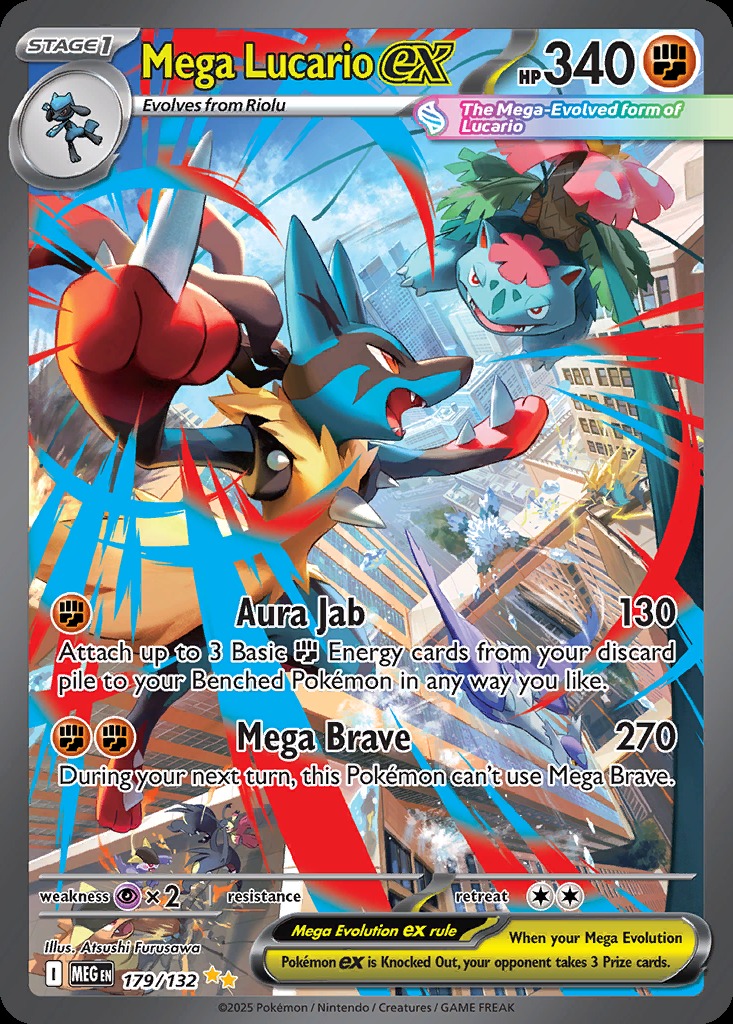
The first two sets of the era, referenced by their codes, share the textured foil face of the era before. The treatment is familiar; what is missing is the history around it.

Sources
Sources and further reading
- The Pokémon Company — the Mega Evolution era, from 2025; the first two sets are referenced here by their codes, me1 and me2.
- The Pokémon Company — the three-prize rule governing the era’s headline cards.
- The Pokémon Company — the special illustration rare and MHR treatments, printed within the era’s sets.
- CardSpicy — Reading a population report, for what a count can and cannot tell you about scarcity.
- CardSpicy — The card grading backlog in 2026, for how turnaround affects a decision made on a new era.
- CardSpicy — Era 12 — Mega Evolution, 2025 to 2026, for the card-level history this page assumes.
Related reading
- Era 12 — Mega Evolution, 2025 to 2026 — the era’s first sets and the three-prize rule.
- Grading Scarlet & Violet era cards — the previous era, where supply never closes.
- Grading Base Set era cards — the other end of the sequence, where supply closed and stayed closed.
- All twelve Pokémon card eras — the timeline.
- The card grading backlog in 2026 — what a turnaround means for timing.
- Sealed Mega Evolution product — the packs and boxes this era arrives in.
Nothing on this page is investment advice, and no card or grading service is offered for sale here. Grades are assigned by third-party companies; the descriptions of population formation, print cycles and storage are structural and are not population figures or prices.
Where to go next
- The CardSpicy card index — every card we track, with its PSA 10 population and market history (195 cards).
- The illustrator index — every artist behind those cards, card by card (110 artists).
Leave a Reply