


Era 3 of 12 in our timeline of Pokémon card eras. This is where Pokémon cards stop being a children’s game with a collector fringe and become a collectible with a game attached.
Companion pages: Sealed EX product · grading EX cards.
Quick answer
The EX era runs from June 2003 to roughly the end of 2004, begins with EX Ruby & Sapphire, and is defined by two things: the lowercase ex and the gold star. The ex was a card that gave up two prize cards when knocked out — a deliberate high-risk tier for players. The gold star was something else entirely: a card printed with a golden star before its name, in a set where it was the only one of its kind, and never intended for competitive play.
The gold star is the reason this era matters to collectors. It is the first time the Pokémon Company printed a card whose purpose was to be owned.
The handover, and why the border changed
In 2003 the English licence moved from Wizards of the Coast to Nintendo. The visible consequence was immediate: the yellow border that had framed every card since 1996 became a thin silver frame with a much narrower margin, and the HP figure moved to a different position in a narrower typeface.
That change is the fastest way to date a card. If the frame is silver and thin, the card is 2003 or later. If it is yellow and wide, it is 2001 or earlier. There is no overlap in English product.
The other visible change was the back. The old back disappeared at the end of the e-Card era; from EX Ruby & Sapphire onward every card carries the modern back, which means the reverse side stops being useful for identification and the front has to do all the work.
The eight sets of the era
| Set | Release | Note |
|---|---|---|
| EX Ruby & Sapphire | June 2003 | First Nintendo-era set; the silver frame and lowercase ex both debut |
| EX Sandstorm | September 2003 | First set built around a specific in-game region’s weather |
| EX Dragon | November 2003 | Dragon types return; small print, strong sealed demand today |
| EX Team Magma vs Team Aqua | March 2004 | The first set split into two opposing factions, and the first gold stars |
| EX Hidden Legends | June 2004 | Legendary-focused; contains the era’s most-played ex cards |
| EX FireRed & LeafGreen | September 2004 | Kanto nostalgia, fifteen years before 151 made it a strategy |
| EX Deoxys | February 2005 | Gold Star Rayquaza, Latias and Latios; the era’s price ceiling |
| EX Emerald | May 2005 | Last set before the Delta era begins |
What a gold star actually is
A gold star card is identified by a single glyph: a gold star printed immediately before the Pokémon’s name in the card title. That is the whole marker. It is not a rarity symbol in the corner, not a foil pattern, and not a set designation — it is part of the name line, which is why counterfeiters find it hard to reproduce convincingly.
There are twenty-seven gold star cards across the EX era. They share four properties:
- One per set, usually. A given set contains one or two gold stars, and the pull rate was famously low — the widely cited figure is roughly one per two booster boxes.
- They were not tournament cards. Gold stars were collectible inserts, which is why a competitive player in 2004 had no reason to keep one protected and a collector had every reason to.
- The foil covers a defined window. Unlike the e-Card Crystal treatment, gold stars use a foil window around the artwork with a gold-toned surface, so the card reads as a rare holo rather than a full-face foil.
- The art is deliberately unusual. Gold star illustrations are drawn from a lower, more cinematic angle than the standard card art of the period, which is a large part of why they are collected now.
One timing note. This era is dated 2003–2004 in the timeline because that is the window in which the frame, the back and the lowercase ex mechanic all changed at once. The twenty-seven gold stars were not confined to it: they were released between 2004 and 2006, and the cards carrying them kept the same silver frame into the Delta Species era that follows. A gold star with a 2005 or 2006 copyright is therefore not misfiled — it belongs on this page, and it is the reason two EX era cards can sit three years apart.
Why this era is the first genuinely expensive modern era
Three structural facts separate the EX era from everything before it.
First, the print runs were small but the player base was growing. Pokémon was recovering from the early-2000s trough, and the cards were being bought by a generation that was slightly older than the 1999 cohort — old enough to keep things.
Second, the gold star was a premise, not a rarity tier. It said: this card is not for playing. That is the moment the hobby acquired a second audience, and it is why the vocabulary of modern collecting — chase card, sealed hold, grade and hold — can be traced to 2004.
Third, the era is short. Eight sets over two years, then the Delta era changes the design language again. Short eras with a single identifiable chase card are the easiest to collect completely, and complete sets are what hold value when individual cards wobble.
The blue chips
| Card | Set | Why it holds |
|---|---|---|
| Gold Star Charizard | EX Dragon Frontiers, 2006 | The most famous gold star; technically the Delta era’s card, but the mechanism is this era’s |
| Gold Star Rayquaza | EX Deoxys, 2005 | The era’s most-played and most-collected gold star, and the hardest to find centred |
| Gold Star Umbreon | EX Delta Species, 2005 | Eeveelution demand, applied to the scarcest format of the period |
| Mewtwo ex | EX Ruby & Sapphire, 2003 | The first lowercase ex; the card that defines the mechanic |
| Blaziken ex | EX Team Magma vs Team Aqua, 2004 | The strongest competitive card of the era, and the reason many copies were played to death |
Note the pattern in that table: the most valuable cards of the era are not the most played ones. The played cards were sleeved, shuffled and worn. The gold stars sat in a binder and survived.
Where the quiet value sits
- The non-Charizard, non-Rayquaza gold stars. Twenty-seven cards share one mechanic and one pull rate. The market prices four of them and ignores the rest, which is the same mispricing structure as the eight non-Charizard Crystal cards from the previous era.
- EX Dragon sealed product. The set was released in November 2003, in modest volume, and it is the era’s least-opened box because the chase cards were in other sets. Sealed supply is the scarce side here, not singles.
- EX FireRed & LeafGreen holos. Kanto art from 2004, priced as a mid-era set because it is not a gold star set. The 151 nostalgia cycle of 2023 onwards has repriced other Kanto printings without touching this one.
- Reverse holos across the era. The 2003–2004 reverse pattern is a stamped foil that marks easily. Clean examples are considerably scarcer than the raw population implies.
How to identify an EX era card
- Silver frame, thin margin. The single most reliable marker of 2003 and later English cards.
- Lowercase
exafter the name. Not uppercase. UppercaseEXis the 2010–2016 era, a completely different mechanic. - The set symbol. Bottom-right, a small icon specific to each set, with no rarity symbol in the bottom-left for gold stars — the star sits in the name line instead.
- The copyright. 2003 to 2005, credited to Nintendo, Creatures and Game Freak rather than Wizards.
The silver border problem
This era introduced a preservation issue that did not exist before it. The yellow border of the Wizards era hides edge wear reasonably well, because whitening on yellow reads as a lighter yellow. A silver border shows every nick as a bright white line against a metallic field.
That has two consequences. The first is that PSA 9 and 10 populations for this era are thinner than the print runs suggest, because centring and edge wear combine against the grader’s eye. The second is that the difference between an 8 and a 9 on these cards is often a single corner nick that is invisible face-on.
Practically: inspect the four corners at a low angle under direct light before you buy, not the face. And once you own one, keep it out of a binder page — the card shifts in the pocket every time the page turns, and the silver edge is what it grinds against.
A penny sleeve first, then a rigid toploader so the card cannot move at all. For a gold star, which is the card in this era most likely to be displayed, the Pro-Grade Display Slab keeps the surface visible without contact and without the edge grinding that a binder produces.
Where this era sits on the timeline
The EX era follows the e-Card era, whose barcode it removed and whose back it replaced. It is followed by the Delta Species era, which kept the ex mechanic and the gold star tier but changed the type system underneath them. The full timeline puts all twelve eras in order.
What these cards actually look like
This is the era where the border changed colour, and the change is visible at arm’s length.
ex printed after the name in a small, low-contrast face. The HP figure sits at the top right in a condensed sans-serif.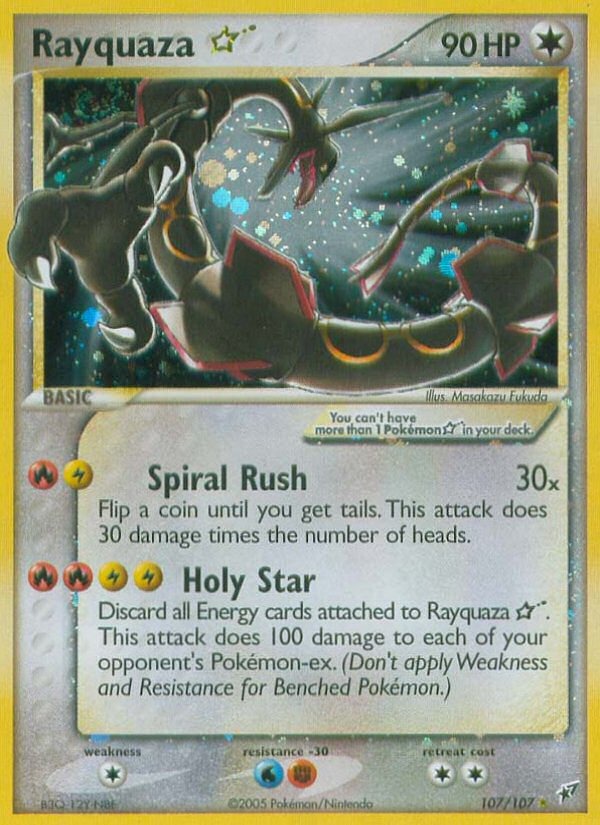

δ on the type line; it carries a star in the name.Image sources for this page: images.pokemontcg.io/ex1/101_hires.png (Mewtwo ex), ex8/107_hires.png (Rayquaza gold star) and ex15/100_hires.png (Charizard gold star). Served from /wp-content/uploads/2026/10/. Card names and artwork are trademarks of Nintendo, Creatures Inc. and GAME FREAK inc.; scans are used here for identification and commentary.
Frequently asked questions
What does a gold star mean on a Pokémon card?
A gold star printed before the Pokémon’s name marks a special rarity tier introduced in 2004 and discontinued after 2007. Twenty-seven cards carry it. It is printed in the card’s name line rather than as a symbol in the corner, and it was never a tournament-legal tier — gold stars were made to be collected.
How rare is a gold star Pokémon card?
The commonly cited pull rate is roughly one gold star per two booster boxes, with one or two gold stars per set. Twenty-seven gold stars exist across the era, and several sets contain only one.
What is the difference between lowercase ex and uppercase EX?
They are different mechanics from different eras. Lowercase ex ran from 2003 to 2007 and gave up two prize cards when knocked out. Uppercase EX ran from 2010 to 2016 and was a different high-HP tier. Confusing them is the most common identification error in this part of the timeline.
Why is the EX era expensive when the print runs were not that small?
Because the cards were played. This was a growing competitive era, and played cards were shuffled, sleeved and worn. The cards that survived in gem condition are the ones that sat in binders — which is why the unplayed gold stars are the expensive ones and the strongest competitive cards are not.
Are EX era cards worth grading?
The gold stars and the set holos, yes. The silver border means the grade spread between a 9 and a 10 is wide, and the top of the population is fixed. Commons and uncommons from the era usually do not justify the grading cost.
Sources
Sources and further reading
- The Pokémon Company — set records for EX Ruby & Sapphire (June 2003) through EX Emerald (May 2005).
- Nintendo — the 2003 transfer of the English TCG licence from Wizards of the Coast.
- PSA population reports — gold star cards and EX era holos, by grade.
- Third-party graded price trackers — gold star sales and the EX Deoxys chase tier, 2026.
- CardSpicy — the twelve-era timeline, for how this era connects to the ones either side of it.
Related reading
- All twelve Pokémon card eras — the timeline this page belongs to.
- Era 2 — e-Card, 2001 to 2003 — the barcode era this one replaced.
- Era 4 — Delta Species, 2004 to 2006 — where the gold star reaches its peak.
- Era 5 — Diamond & Pearl, 2006 to 2009 — what replaced both
exand the gold star. - Open or keep sealed — the decision that matters on the era’s small print runs.
Nothing on this page is investment advice, and no grade outcome is promised for any card. Prices quoted are published third-party figures as of 2026 and are reference ranges, not offers.
Where to go next
- The CardSpicy card index — every card we track, with its PSA 10 population and market history (195 cards).
- The illustrator index — every artist behind those cards, card by card (110 artists).