

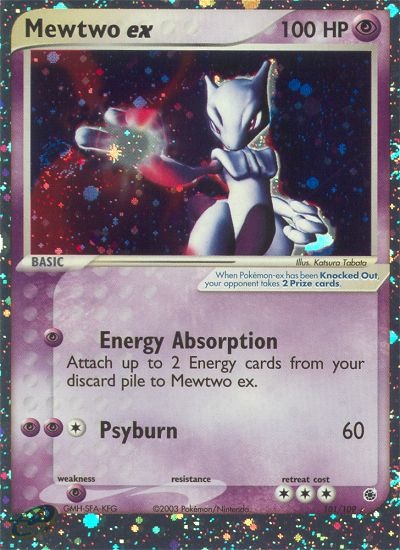
Sealed companion to Era 3, the EX series. Part of the twelve-era timeline. Structural analysis only; no sealed prices are quoted.
Quick answer
The EX series is where the booster box stopped being a way to buy cards and became an object in its own right. Two things changed at once in 2003: Nintendo took over the licence and redesigned the packaging as a display object, and the ex-card rarity structure made the expected value of opening a box fall below the price of the box for the first time in the hobby’s history.
Those two changes are the origin of the modern sealed market. Before 2003, a box was worth what was inside it. After 2003, a box could be worth more than what was inside it, and once that became true, keeping boxes sealed became a rational strategy rather than an accident.
The shape of the era
The EX series ran sixteen English sets from July 2003 to 2007, so the era as usually bounded (2003–2004) covers the first five. The sealed products follow a pattern that appears for the first time here.
| Product | Release | Configuration | First appearance |
|---|---|---|---|
| EX Ruby & Sapphire | July 2003 | 36-pack booster box | First Nintendo-era set; ex cards introduced |
| EX Sandstorm | September 2003 | 36-pack booster box; theme decks | Two-variant theme decks create a completist trap |
| EX Dragon | November 2003 | 36-pack booster box | Dragon-themed chase structure |
| EX Team Magma vs Team Aqua | March 2004 | 36-pack booster box | Half-deck product alongside the booster line |
| EX Hidden Legends | June 2004 | 36-pack booster box | End of the era as bounded here |
Note the theme-deck detail. EX Sandstorm shipped theme decks in two variants with different fixed holos, which means a sealed theme-deck collection of that set is not one purchase but two, and the second variant is the one people miss. This pattern — variants multiplying the number of sealed units — becomes a defining feature of every era that follows.
Why the box’s economics flipped here
Three structural changes arrived together in 2003, and each one pushed the same direction.
- The rarity ladder got a new top rung. ex cards were printed at a much lower rate than the previous era’s holos, and they were the only cards that mattered for value. A box held a small number of meaningful cards and a large number of cards that were worth nothing.
- Pack count stayed at 36 while the chase density fell. The box did not get bigger to compensate. So the value of the box’s contents fell relative to the box’s price.
- The packaging was designed to be displayed. Nintendo-era boxes carry full-bleed art on every face rather than the functional panels Wizards used. A box that looks like a poster is a box people keep.
The result is the first era where the sealed premium is not a historical accident. It is a rational response to a structure that has held ever since. Every later era inherits it: from 2003 onward, opening a box is a decision to convert a scarce object into a pile of common cards plus a lottery ticket.
The physical failure that defines EX boxes
EX-era boxes fail in a way that is specific to their construction and that is routinely misread as tampering.
The box board on these products is a heavier stock than the Wizards era, and the wrap is a tighter film. The combination means the box does not yellow gradually; it develops a hard crease along the top flap hinge where the board has taken a permanent fold. That crease is normal on any EX box that has been stored flat, and it is where the wrap splits first.
The second characteristic failure is corner crush on the display face. Because the art runs to the edges with no border, a crushed corner removes artwork rather than a blank margin, which makes the damage look worse than it is. A box with one crushed corner and an intact seal is a sound box.
The third is the display card bow. Many EX boxes carried a printed display card or a window showing a pack. That insert is thin board and bows independently of the box, so it can look warped inside a perfectly flat box.
How to read an EX box
- Read the set name on two faces. EX boxes carry the set name on the front and on one side panel, and the two should match. A box where they do not is a rewrap or a mismatched shell.
- Check the crease at the top hinge. A genuine aged box has one soft crease there. Two parallel creases, or a crease that crosses the wrap, means the flap has been lifted.
- Look at the wrap at the corner crush. If the wrap is intact over a crushed corner, the crush happened before or during packing. If the wrap is split following the crush lines, the crush is post-manufacture but not necessarily post-seal.
- Weigh it. Same principle as every era: a 36-pack box has a narrow expected band.
- Cross-check the print code against the set’s release window. The EX era had no large reprint programme, so an off-window code is unusual.
Why this era’s boxes are still findable
This is the part that surprises people. The EX series is the first era where sealed survival is better than the era before it, despite being only two years later.
The reason is retention motive, not print volume. By 2003 there was a functioning secondary market for sealed product, and a buyer who paid for a box had an alternative to opening it: sell it. That alternative did not exist in 1999 in any practical sense. So a meaningful share of EX boxes passed through the market unopened, and those boxes are still passing through it.
That is the single most useful lesson in this whole series of pages: sealed survival is driven by whether a market existed at the time, not by how many were printed. It is also why the eras after this one are more available than their print volumes would suggest.
Storing EX-era product
The hinge crease is the thing to stop getting worse. Store these boxes flat, with the hinge edge supported so the flap is not carrying the box’s weight, and do not stack anything on the display face.
Humidity is less critical than on plain-board eras because the board is coated, but the wrap is the vulnerable part: a coated box in a humid room fogs the film from the inside, and that fog does not clear. Keep them dry and out of temperature cycling.
For singles out of these boxes, the ex cards are the ones that matter and they are thick, stiff and prone to edge chipping rather than bending. A matte sleeve plus a rigid toploader is the standard two-layer approach, and for anything high-value the argument for skipping the toploader in favour of a press-fit case is stronger here than usual, because an ex card’s edge is where value is lost and a toploader’s insertion abrades exactly that edge. A display slab is for the ones you want to look at.
Loose packs from this era are the most commonly creased of any era, because the foil is thin and the packs were often stored loose in tins. A rigid pack holder is the minimum.
Where this sits
The EX sealed line follows the e-Card sealed page — the last era where sealed product was truly scarce — and is followed by the Delta Species sealed page, where the packaging stops telling you what is inside. For the card-level story see Era 3, which covers the twenty-seven gold star cards.
Frequently asked questions
Why are EX series boxes easier to find than e-Card boxes?
Because a sealed secondary market existed by 2003. Buyers had the option to resell rather than open, so more boxes stayed sealed. The e-Card sets shipped before that market was functional and were largely cleared through discount channels.
What is an ex card, and how is it different from a modern ex?
The 2003–2007 ex cards were a rarity tier with a lower-case “ex” in the name, a silver border and a much lower pull rate than holos. Modern “ex” cards are a different tier with different rules and a much higher print density. The two are not comparable.
Do EX booster boxes have a fixed number of ex cards?
No. The ex cards occupy a low-probability slot across the print run rather than a fixed count per box. That is exactly why the expected value of opening a box sits below the price of the box.
Is a crease on the top flap a sign the box was opened?
One soft crease is normal ageing where the board has taken a set. Two parallel creases, a crease that crosses the wrap, or a crease with clean board visible inside it are the signals to look at more closely.
Are EX theme decks worth collecting sealed?
They are the most under-watched sealed format of the era. They were bought for children, so they were opened, and the fixed holo inside is the reason the remaining sealed ones have any value at all.
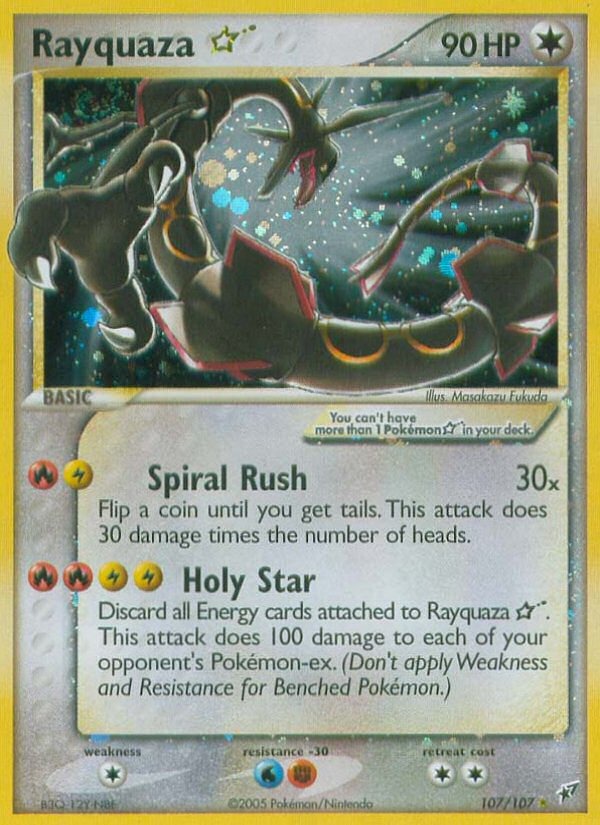
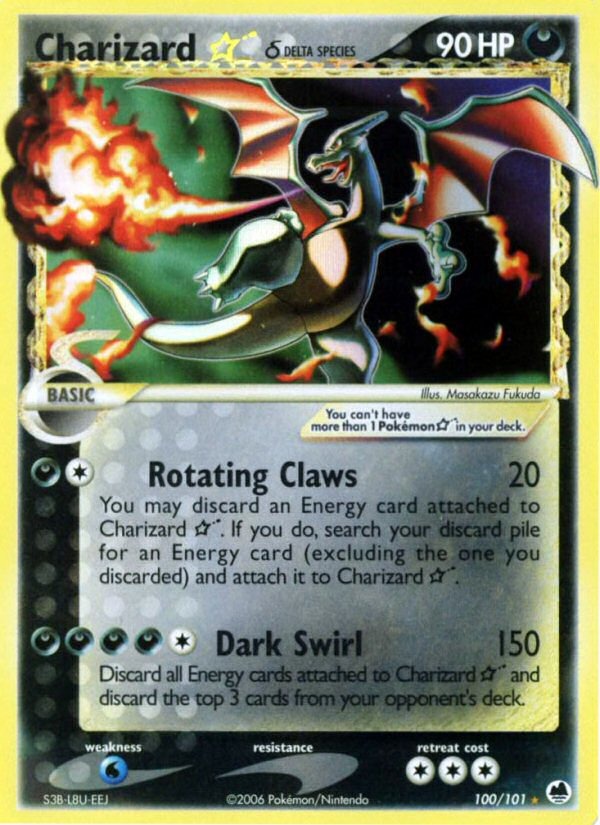
What this era’s product actually looks like
The singles that came out of these boxes define the era, and two of them are the reason it is remembered at all.
Sources
Sources and further reading
- Nintendo — EX Ruby & Sapphire, July 2003, the first set under the Nintendo licence.
- Nintendo — EX Sandstorm through EX Hidden Legends, 2003–2004, including two-variant theme decks.
- CardSpicy — Era 3, for the ex and gold star rarity structures in full.
- CardSpicy — How to read a set code, for print windows.
- CardSpicy — What is in a Pokémon booster box, for 36-pack configurations.
- CardSpicy — How to spot a resealed box.
Related reading
- Era 3 — EX, 2003 to 2004 — gold stars, ex cards and the era’s ceiling.
- Sealed e-Card product — the era before, where boxes were never made in quantity.
- Sealed Delta Species product — where the box stops telling you what is inside.
- All twelve Pokémon card eras.
- Booster boxes or singles — the economics this era created.
- Open it or keep it sealed.
Nothing on this page is investment advice, and no sealed product is offered for sale here. Release dates and configurations are as published by the manufacturer; survival descriptions are structural, not population figures.
Where to go next
- The CardSpicy card index — every card we track, with its PSA 10 population and market history (195 cards).
- The illustrator index — every artist behind those cards, card by card (110 artists).
Leave a Reply