

Sealed companion to Era 4, Delta Species. Part of the twelve-era timeline. No sealed prices quoted; the analysis is structural.
Quick answer
Delta Species is the only era where a card’s defining feature is invisible on the packaging. A δ card is identified by a mark on the card face and a type change in the card’s rules — neither of which appears on the booster box, the pack wrapper or the display art in any reliable way. The box is an EX-series box. The difference is entirely inside.
That has two consequences for sealed product. First, boxes from this era are the most frequently mislabelled on the secondary market, because a seller looking at a box has less to go on than in any other era. Second, the singles have a storage failure — a milky clouding of the foil — that is specific to the Holon-era print process and that is not reversible.
The four sets that make up the era
The era is usually bounded to the sets printed under the Holon storyline, though the δ mechanic itself appears across more. The sealed line is short, and each set has a different relationship to the δ mechanic.
| Set | Release | Configuration | δ relevance |
|---|---|---|---|
| EX Delta Species | October 2005 | 36-pack booster box; theme decks | The mechanic debuts; Holon setting introduced |
| EX Holon Phantoms | February 2006 | 36-pack booster box | Densest δ population of any set |
| EX Crystal Guardians | August 2006 | 36-pack booster box | δ mixed with the Crystal-named treatment |
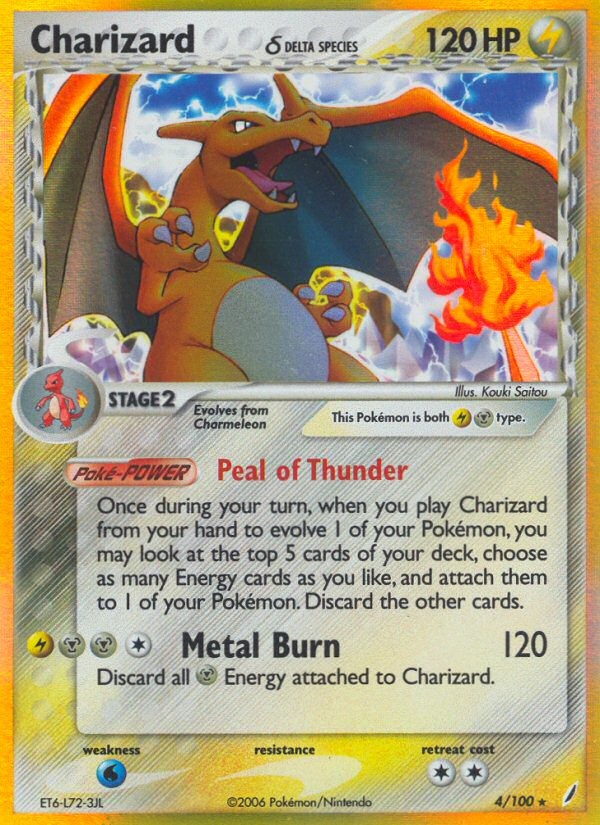
| EX Dragon Frontiers | November 2006 | 36-pack booster box | Last δ set; contains the Charizard gold star δ |
Two of these are frequently confused with earlier EX sets because the set names do not contain “Delta”. Holon Phantoms and Crystal Guardians are both δ-era products, and a seller working from the box alone may not know that.
Why this era’s sealed supply is misunderstood
Delta Species sits in the middle of the EX series, which means it inherits the retention motive described in the EX sealed page: a sealed market existed, so a share of boxes stayed sealed. But it adds a distortion on top.
- The mechanic is a card-face property. Unlike a set with a distinct rarity tier printed on the pack, δ is a variation within the set. So the sealed premium does not track the mechanic, and buyers who want δ cards have no reason to prefer a box over singles.
- The set identity is ambiguous from outside. Four sets, two of which do not carry the mechanic’s name, all sharing an EX-series design language. Misidentification is structural, not carelessness.
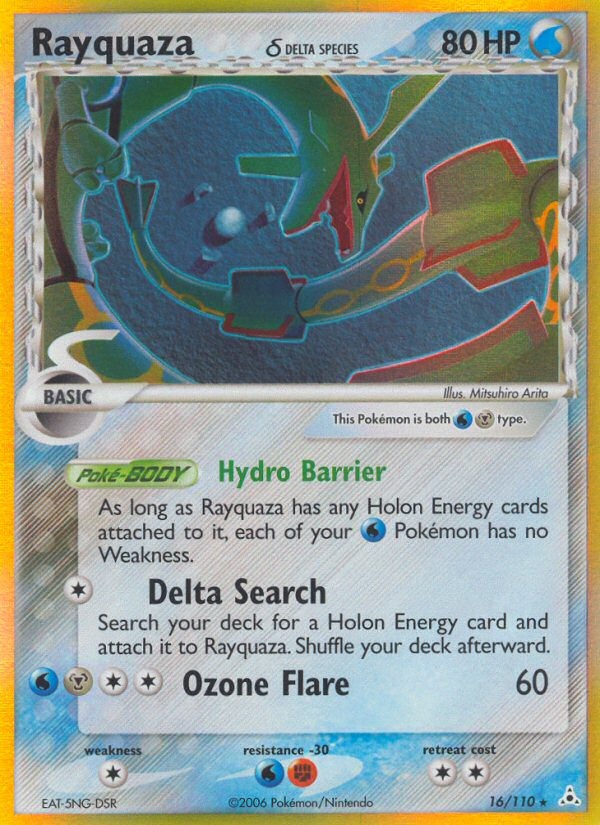
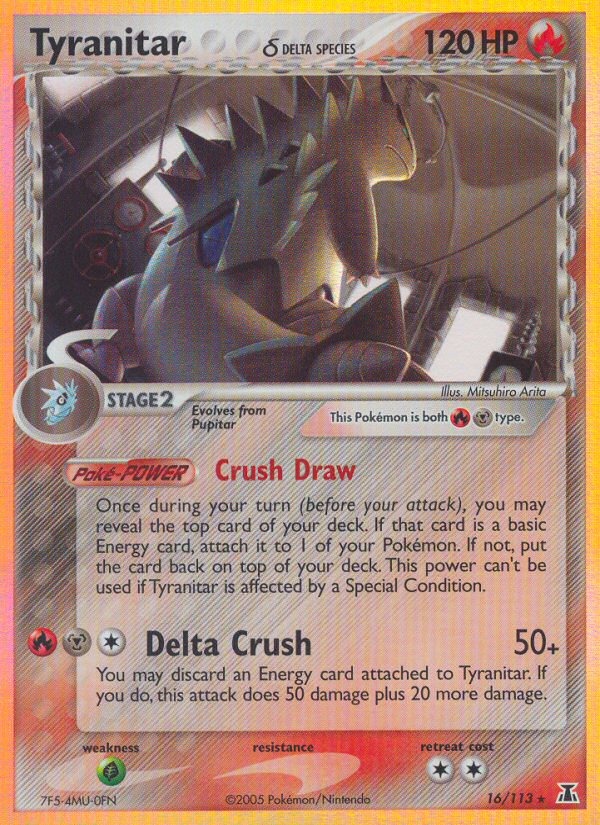
- The δ population is skewed toward a few cards. A handful of δ printings carry the era’s value — the Charizard gold star, the Rayquaza, the Tyranitar — and everything else in the box is filler. That is the same economics the EX era created, concentrated further.
- The era overlapped with a retail transition. These sets shipped as mass-retail Pokémon product was being reset around the Nintendo DS era, and a lot of stock moved through big-box channels where handling is rough.
The δ storage failure: clouding
This is the single most important thing on this page for anyone holding δ cards.
Holon-era δ cards were printed with a foil and laminate combination that outgasses over time. The visible symptom is a faint milky haze across the foil area, usually starting at the edges and creeping inward, and it is most obvious at a low viewing angle against a dark background. Collectors call it clouding.
Once clouding appears it does not come off. It is not surface dirt and it is not sleeve residue; it is a change in the laminate. Polishing makes it worse. The card loses grade and value and there is no intervention that reverses it.
What causes it is the thing you can control: the card sitting in an enclosed space with no air exchange, where the outgassed material has nowhere to go. A card in a sealed plastic box in a warm room is the worst case. A card in a breathable sleeve in a ventilated cabinet is the best case.
The practical implication is counterintuitive. For δ cards, the usual advice to seal everything as tightly as possible is wrong. Use a sleeve that is not airtight, avoid vacuum sealing, and if you use a rigid holder, prefer one that is not a closed cell — a toploader is open at the top and lets the card breathe, which is an advantage here rather than a compromise. A fully enclosed display slab looks better but traps the outgassing, so for a raw δ card the display case is the worse choice and the toploader is the better one.
Identifying which set a box is
- Read the side panel, not the front. EX-era boxes carry the set name and the set symbol on a side panel, printed small. The front face carries art that is sometimes shared between adjacent sets.
- Use the set symbol, and know that δ sets have ordinary symbols. Delta Species does not use a δ symbol as its set mark. The set marks are the standard EX-era marks; the δ appears only on individual cards.
- Check the card count on the box. Each of the four sets has a different total, and the total is printed on the box. This is the fastest disambiguation and it does not require opening anything.
- Cross-check the print code. The four sets shipped in four distinct windows; a code from the wrong window means the shell and the contents do not match.
- Weigh it. Same check, same reason.
Storing this era’s product
For boxes: the EX-era advice applies, with one addition. Because the clouding problem is an outgassing problem, do not store δ-era boxes inside a sealed plastic tote with no ventilation. A cardboard storage box in a stable room is better than a sealed bin, even though the sealed bin feels safer.
For singles: the open-top rigid holder is the right call, as described above. If a δ card is going for grading, it should be shipped in a holder that is not vacuum-sealed, and it is worth noting the clouding on the submission form if it is already visible, because it affects the surface grade.
For loose packs: the foil on these wrappers is the same generation as the cards and will show the same haze at the edges. A metal pack storage box is preferable to a plastic one for the same ventilation reason — metal does not trap air the way a closed plastic container does.
Where this sits
The Delta Species sealed line follows the EX sealed page and is followed by the Diamond & Pearl sealed page, where the number of distinct sealed products explodes and “how many sealed products exist for this era” stops being an answerable question. For the card-level story see Era 4.
Frequently asked questions
What does δ mean on a Pokémon card?
It marks a card whose type has been changed from the Pokémon’s usual type as part of the Holon storyline. A δ Charizard is not a Fire card. The δ symbol sits beside the card name and the type line reflects the change.
Is clouding on a δ card damage?
It is a change in the laminate rather than physical damage, but it is treated as surface degradation for grading purposes. It does not come off and it does not reverse.
Can I prevent clouding by storing the card airtight?
No, that makes it more likely. The haze comes from material outgassing from the card’s own layers, and an airtight container traps it against the surface. Ventilation is the mitigation.
Which Delta Species set is the scarcest?
Dragon Frontiers, as the final set of the run and the one with the shortest retail life. Holon Phantoms is the more collected set because its δ density is highest.
Does a Delta Species box say “Delta” on it?
Only EX Delta Species does. Holon Phantoms, Crystal Guardians and Dragon Frontiers are δ-era sets whose names do not contain the word, which is the source of most mislabelling in this era.
What this era’s product actually looks like
The δ mark is small, sits beside the name, and is the only reliable way to tell a δ card from the same Pokémon printed normally.
Sources
Sources and further reading
- Nintendo — EX Delta Species, October 2005; EX Holon Phantoms, February 2006; EX Crystal Guardians, August 2006; EX Dragon Frontiers, November 2006.
- Nintendo — the δ (Delta Species) mechanic and the Holon storyline, 2005–2006.
- CardSpicy — Era 4, for the δ mechanic and the Holon setting in full.
- CardSpicy — Humidity, light and long-term card storage, for the ventilation argument.
- CardSpicy — How to read a set code.
- CardSpicy — How to spot a resealed box.
Related reading
- Era 4 — Delta Species, 2004 to 2006 — the mechanic and the Holon setting.
- Sealed EX product — the era this one sits inside.
- Sealed Diamond & Pearl product — where sealed product count explodes.
- All twelve Pokémon card eras.
- Humidity and long-term storage.
- Blown film vs cast film — why sleeve construction matters on a foil-heavy card.
Nothing on this page is investment advice, and no sealed product is offered for sale here. Release dates are as published by the manufacturer; the clouding description is an observed physical behaviour, not a manufacturing defect claim.
Where to go next
- The CardSpicy card index — every card we track, with its PSA 10 population and market history (195 cards).
- The illustrator index — every artist behind those cards, card by card (110 artists).
Leave a Reply