

Sealed companion to Era 5, Diamond & Pearl. Part of the twelve-era timeline. No sealed prices are quoted.
Quick answer
Diamond & Pearl is the era where the question “how much sealed product exists for this set?” stopped having an answer. Before 2006, a set’s sealed line was a booster box, some theme decks, and nothing else. From Diamond & Pearl onward, the same set shipped as a box, a blister, a tin, a collector box, a poster pack, a special edition box, and in some cases a retail-exclusive variant of each. The format count went from three to more than ten.
The consequence is not that the era is scarce. It is that the era is uncountable. A collector can complete a sealed run of the EX era. A collector cannot complete a sealed run of Diamond & Pearl, because there is no agreed list of what completion means.
The formats that appeared here
Most of these existed in some form earlier. What changed is that they all appeared for the same set, at the same time, across different retail channels.
| Format | What it is | Why it distorted the count |
|---|---|---|
| Booster box | 36 packs | The only format that existed as a unit of account before this era |
| Blister pack | One to three packs on a printed card | Retail-only; the card backing is unique per set and rarely kept |
| Tin | Metal or tinplate case with packs and a promo | Multiple tin designs per set, each with a different promo |
| Collector box | Packs plus a jumbo card plus accessories | Contents vary by retailer, so the same name covers different products |
| Theme deck | Fixed 60-card deck | Usually two per set, sometimes four, and the second is the one people miss |
| Special edition / retail exclusive | Box with an extra pack or a variant card | Channel-exclusive, so it never appears in the general catalogue |
| Poster pack | Three packs plus a folded poster | The poster is the only distinguishing feature and is usually discarded |
Add the fact that Diamond & Pearl ran eight English sets across three years, and the multiplication is obvious. That is roughly fifty to sixty distinct sealed SKUs, only some of which were catalogued anywhere.
Why the era is still findable anyway
Here is the counterintuitive part, and it follows directly from the EX era’s economics. A large format count means a large number of units were produced, and a large number of units means a large number survived. Diamond & Pearl boxes are not scarce. They are common, and they are common because tins and blisters absorbed demand that would otherwise have gone into boxes.
That produces an unusual market shape. Boxes from this era are available. The hard things to find are the small formats: an intact blister with its cardboard backing, a retail-exclusive variant, a tin with its original promo still inside. Those are the actual scarce units, and almost nobody collects them, which means their prices do not reflect their survival rate.
The physical failure of this era
Diamond & Pearl introduced a packaging change that created a new failure mode: the display window.
Many of these products — tins especially — used a cut-out window with an acetate film so the buyer could see a pack or a promo card. That acetate is the first thing to fail. It scratches, it hazes, and because it sits proud of the box surface it takes abrasion from everything it touches. A tin with a hazed window looks far worse than its actual condition warrants, and the haze cannot be removed without destroying the film.
The second failure is specific to the tins: the lid hinge. Tin lids on this era’s products were formed from a single sheet and hinged by a crease in the metal. That crease work-hardens with every open and close, and a tin that has been opened repeatedly will crack along the hinge. A cracked hinge on an otherwise sealed tin is common and is not evidence the contents were removed.
The third is the blister card. The printed cardboard behind a blister is thin, and it warps. A warped blister card is not damage; it is the normal state of a twenty-year-old blister.
Diamond & Pearl singles and the storage problem
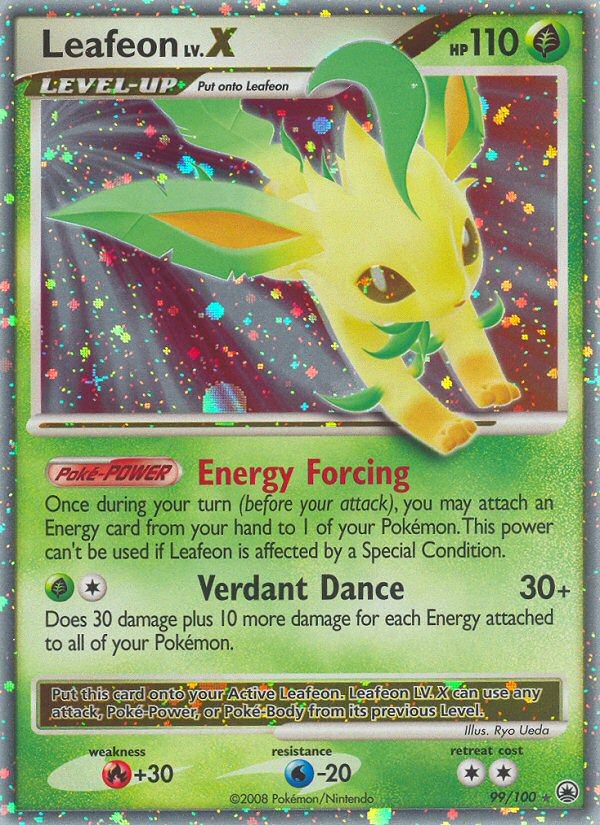
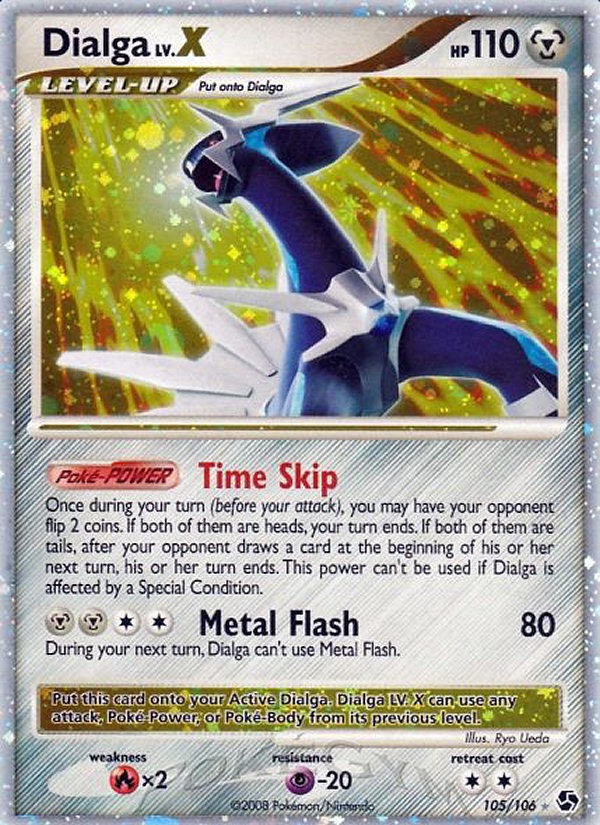
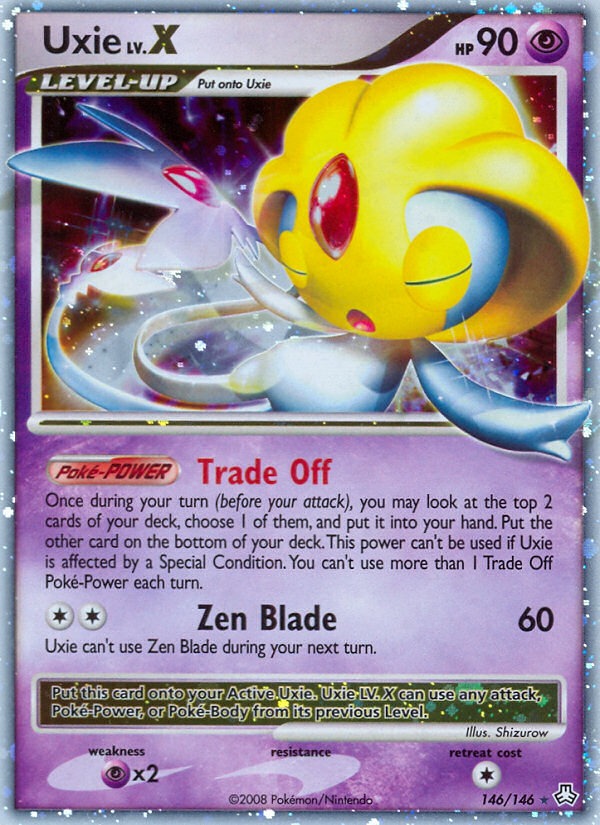
The era’s defining card type is LV.X, and LV.X is the worst card design in the hobby for long-term survival. The cards have no printed border: the artwork runs to the cut edge, with only a thin keyline between the art and the edge of the card.
That matters because a printed border is a buffer. On a normal card, a light scuff lands on the border and takes a sliver of ink from an area nobody grades closely. On an LV.X, the same scuff lands on the illustration. There is no margin to absorb handling.
Practically, this means LV.X cards should never be handled by the edge, never be stacked face-down on a hard surface, and never be inserted into a tight holder. A matte sleeve is the first layer, and for these cards the second layer should be a press-fit case rather than a toploader, because a press-fit case closes on the card instead of sliding over it, and sliding is what removes ink from an unbordered edge.
For sealed product, the enemy is the window and the hinge, as described above. Store tins upright so the hinge is not under load, and keep them out of direct light, because the acetate yellows.
Checking a sealed product from this era
- Identify the format before the set. The same set name appears on a box, a tin, a blister and a collector box. Establish which one you are looking at first, because the checks differ.
- For tins, check the hinge and the seal together. Original tins were shrink-wrapped over the whole body. A tin whose wrap is intact but whose hinge is cracked has been opened and rewrapped; a tin whose wrap is intact and whose hinge is sound has not.
- For blisters, check the crimp line where the film meets the card. It should be a continuous weld with no lifting at the corners.
- For boxes, use the standard checks in how to spot a resealed box: seam crimp, weight, and print code against the release window.
- Do not assume a tin’s promo is inside. The promo is the removable value, and a tin with the right weight and the wrong promo is a real category. Weigh it against a known complete example.
Where this sits
The Diamond & Pearl sealed line follows the Delta Species sealed page, where the packaging still told you what was inside, and is followed by the LEGEND sealed page, where the packaging got thinner and the failure modes got worse. For the card-level story see Era 5.
Frequently asked questions
How many sealed products did Diamond & Pearl have?
No reliable total exists. Each of the eight English sets shipped in at least six formats, and retail-exclusive variants were never catalogued. Any specific number you see quoted is a partial list presented as complete.
Why are LV.X cards so hard to find in high grade?
Because they have no printed border. The artwork runs to the cut edge, so any handling mark lands on the illustration instead of on a margin. The same wear that costs a bordered card nothing costs an LV.X card a grade.
Is a cracked tin hinge a sign of tampering?
Not on its own. The hinge is formed from a crease in the metal and work-hardens with use, so a cracked hinge is a normal ageing failure. What matters is whether the outer wrap is continuous.
Are tins worth collecting sealed?
They are the most under-collected sealed format of the era, which is exactly why the intact ones are harder to find than boxes. The complication is that tin contents vary by design, so two tins of the same set are not necessarily the same product.
Did the era have reverse holo cards?
Yes. Reverse holos were standard through the Diamond & Pearl sets, printed with a foil pattern on the whole card except the art window. They are the main reason raw singles from this era are harder to grade than they look.
What this era’s product actually looks like
The LV.X design is the reason this era grades badly, and it is visible the moment you look at the card edge.
Sources
Sources and further reading
- Nintendo — Diamond & Pearl base set, May 2007, and the eight English sets through 2009.
- Nintendo — the LV.X card type and its borderless layout, introduced in 2007.
- CardSpicy — Era 5, for the LV.X design and the era’s card-level story.
- CardSpicy — What is in a Pokémon booster box, for 36-pack configurations and the format list.
- CardSpicy — Booster box vs elite trainer box, for how the format count multiplied.
- CardSpicy — How to spot a resealed box.
Related reading
- Era 5 — Diamond & Pearl, 2006 to 2009 — LV.X, the mythic turn, and why the strongest cards survive worst.
- Sealed Delta Species product — the era before, where the box still described its contents.
- Sealed LEGEND product — thinner board, worse failures.
- All twelve Pokémon card eras.
- Booster box vs elite trainer box — the format proliferation in detail.
- Storage boxes explained — for keeping tins and blisters undamaged.
Nothing on this page is investment advice, and no sealed product is offered for sale here. Release dates and format lists are as published by the manufacturer and by retail catalogues; the claim that no complete list exists is a statement about cataloguing, not about production.
Where to go next
- The CardSpicy card index — every card we track, with its PSA 10 population and market history (195 cards).
- The illustrator index — every artist behind those cards, card by card (110 artists).
Leave a Reply