

Sealed companion to Era 2, the e-Card era. Part of the twelve-era timeline. No prices here; this page is about why the supply is shaped the way it is.
Quick answer
The e-Card era is the only era in the hobby where sealed product is structurally scarcer than the singles inside it. Three sets, printed between 2001 and 2003, into a distribution channel that was contracting, at the end of a licence that was about to change hands. Expedition, Aquapolis and Skyridge were not overprinted and then opened. They were underprinted and then discounted, which is a different failure mode.
The consequence is unusual: a collector chasing a Crystal Charizard has a wider field of available cards than a collector chasing an unopened Skyridge box. That is not true of any other era.
What was actually printed
The era is three English sets and a handful of side products. The set list is short enough to hold in your head, which is part of why the era is studied rather than browsed.
| Product | Release | Configuration | Distinguishing feature |
|---|---|---|---|
| Expedition Base Set | September 2002 | 36-pack booster box; theme decks | First set with the new back and the e-Reader strip |
| Aquapolis | January 2003 | 36-pack booster box | Split into two numbered halves; Crystal cards debut |
| Skyridge | May 2003 | 36-pack booster box | Last Wizards-era set, and the shortest print window of the three |
| Expedition / Aquapolis theme decks | 2002–2003 | 60-card fixed deck | Survive better than boxes, because they were bought for children |
| e-Reader hardware bundles | 2002 | Cards plus scanner accessory | Most were separated from the cards and discarded |
Two structural facts about that list drive everything else. Aquapolis being split into two numbered halves means a “complete” Aquapolis collection requires two different boxes, which halves the number of people who can complete it from any single box purchase. And Skyridge shipping in May 2003, months before the licence moved to Nintendo, means its print window closed almost immediately after it opened.
Why the box outran the cards
The normal relationship is that a box is worth more than its contents because the box is scarce and the contents are not. The e-Card era inverts this for four reasons that compound.
- The print volume was set during a contraction. Wizards of the Coast was in the final years of its Pokémon licence and the retail channel had thinned. Orders were placed against weak forecasts, so the sets were printed to a lower ceiling than Base Set or Neo.
- The e-Reader strip confused the buyer. Every card carried a dot-code strip along the bottom. Retail buyers and parents read that as “you need a device to use this”, which suppressed casual purchasing. The cards work fine without the device; the perception did the damage.
- The product was discounted, not destroyed. Unsold e-Card stock went into clearance bins at mass retail. Bargain-bin product gets handled, and handling is what breaks a seal. So the era’s remaining sealed stock is disproportionately the stock that never reached a clearance bin.
- Nobody knew it was the end. Skyridge shipped without anyone marking it as the last Wizards set. There was no farewell demand, no final-print run hoarding. The era’s scarcity was assigned retroactively.
Compare this with the old-back era, where the boxes were printed in volume and then opened. Here the boxes were printed in low volume and then discounted. Both produce scarcity, but they produce different kinds of it: the old-back era has few boxes because they were consumed, while the e-Card era has few boxes because they were never made.
The physical failure specific to this era
e-Card boxes have a failure mode that no other era shares, and it comes from the era’s own gimmick.
The e-Reader strip is printed in a dense dot pattern along the bottom edge of every card, and that pattern requires a heavier, flatter ink laydown than the rest of the card. Over twenty-plus years the strip area behaves differently from the rest of the card face: it is the first place to show surface scuffing, and it is the place where the card is least tolerant of a bend. A card that has been stored in a soft sleeve in a stack will often show a faint horizontal line through the strip that is not visible anywhere else on the face.
For sealed product the equivalent is the box art. e-Card boxes used a darker, higher-coverage print than Base Set, and dark print on plain board shows scuffing as a light grey haze rather than as a scratch. A box that looks “dusty” on its dark panels is usually scuffed, and the scuffing is not reversible.
Reading a Crystal card, and why it matters here
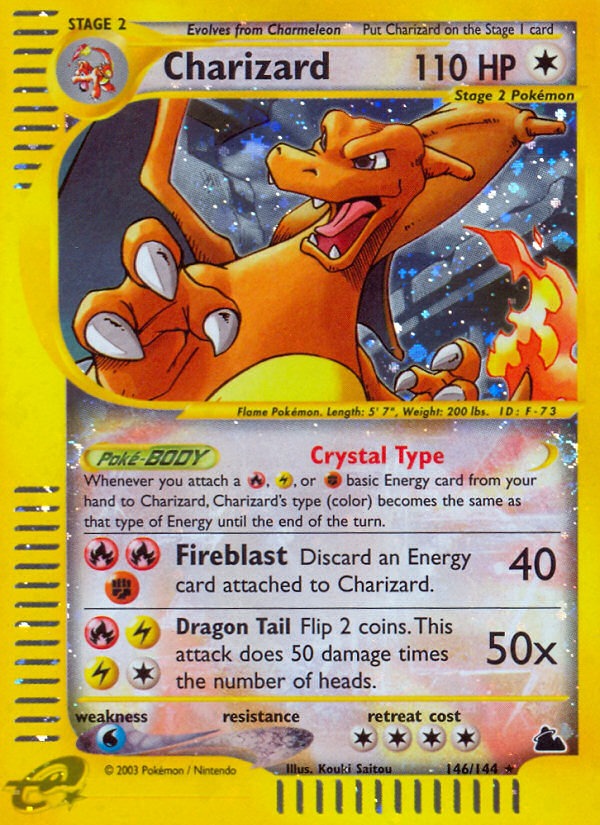
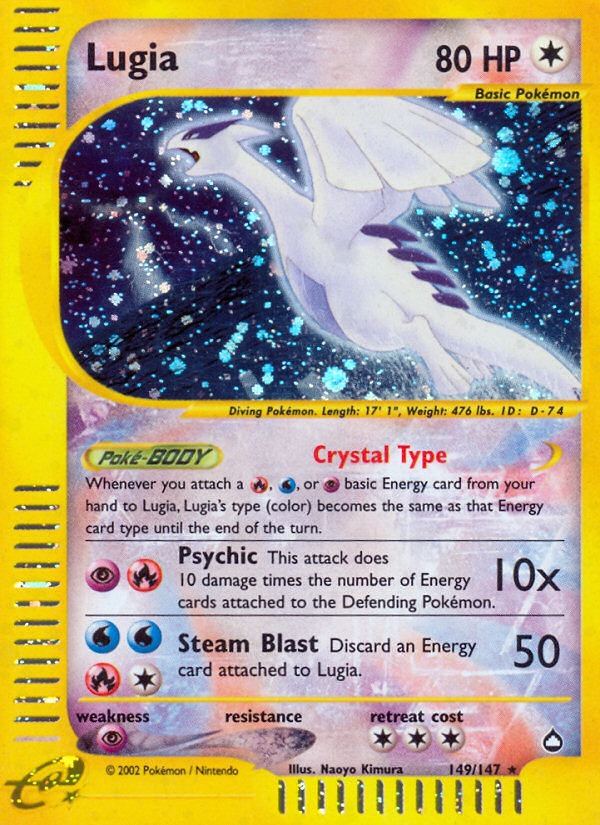
The reason the singles command attention is the Crystal treatment: nine cards across Aquapolis and Skyridge printed with a crystalline texture over the entire card face rather than a foil window. The texture is a physical emboss, not a print pattern, which means it interacts with light differently at every angle and cannot be reproduced by a scan.
This matters for sealed product because it is the one era where the contents are visually verifiable from outside the box only in the loosest sense. You cannot see a Crystal card through a pack. So the sealed premium in this era is not underwritten by “you might pull the chase card”; it is underwritten by the fact that the box is the only remaining unit of the era that has not been picked over.
Checking an e-Card box
- Confirm which set it is before anything else. Expedition, Aquapolis and Skyridge boxes share a design language and differ in the set name and the display card. A mislabelled box is the most common problem in this era, more common than tampering.
- Check the bottom flap print code. All three sets shipped in narrow windows and the code should fall inside one. A code outside the window on an e-Card box is more suspicious than on a modern box, because there was no reprint programme.
- Inspect the wrap at the long seams, not the ends. Wizards-era wrap on these boxes splits along the long seam under handling, and a split there with clean board underneath is a handling split, not a rewrap.
- Weigh it against a known box of the same set. Because the print runs were small, there are fewer reference boxes than for Base Set, so this check is harder to do well and should not be used alone.
- Look for clearance stickers and their residue. A box that went through a discount channel usually still carries the evidence: a sticker, a sticker ghost, or a rectangle of less-faded print where one sat.
Storing e-Card product
The dark panel scuffing described above is the thing to prevent, and it is caused by abrasion rather than by light. Two boxes rubbing against each other in a cupboard will do it. Store e-Card boxes separated, with nothing sliding across the face, and do not wrap them in bubble wrap that has been used before, because trapped grit under the bubbles is what scratches.
Humidity is a secondary concern here because the board is the same plain stock as the old-back era; keep them out of lofts and garages for the same reasons. Light matters less, because the dark print does not fade as visibly as Base Set orange, though the white areas will yellow.
For the singles, the Crystal cards are the exception to normal storage advice: the embossed texture is on the entire face, so any sleeve with a textured or matte interior will burnish it over time. Use a smooth interior sleeve — a matte premium sleeve is the practical choice because the matte is on the outside and the card-facing surface is smooth — and then a rigid toploader for the card to sit in without being flexed. For a Crystal card specifically, a press-fit case is worth considering over a toploader, because the card is never slid along an interior surface, and on an embossed face that sliding is what causes the burnish.
Loose e-Card packs are thin and the foil is softer than modern foil; they crease easily against a hard edge. A rigid pack holder or a metal pack storage box keeps them from being crushed in a drawer, which is how most surviving e-Card packs got their creases.
Where this sits
The e-Card sealed line follows the Base Set sealed page, and the contrast between them is the most useful pair in the whole timeline: one era scarce because it was consumed, the next scarce because it was never made. It is followed by the EX sealed page. For the card-level story see Era 2.
Frequently asked questions
Do e-Card cards need an e-Reader to be worth anything?
No. The dot-code strip was an optional feature that unlocked minigames and card data on a Game Boy Advance accessory. The card’s value is in its printing, condition and rarity, not in the strip. The strip is, however, the most condition-sensitive part of the card face.
Why is Skyridge considered the scarcest e-Card set?
Because its print window was the shortest. It shipped in May 2003, at the very end of the Wizards licence, and the sets that followed came from a different manufacturer. There was no long tail of reprints and no clearance cycle that would have kept it in print.
Are Aquapolis and Expedition the same set?
No. They are separate sets with separate numbering, and Aquapolis was itself split into two numbered halves. A complete Aquapolis run requires cards from both halves.
What is a Crystal card?
A card printed with a crystalline texture embossed across the whole face rather than confined to a foil window. Nine were printed across Aquapolis and Skyridge. The texture is physical, so it does not scan correctly and cannot be replicated by printing.
Is a clearance sticker on a box a problem?
No, and it is often evidence in the box’s favour, because it shows the box went through a legitimate retail channel rather than a back room. Removing the sticker is usually worse than leaving it, since the removal takes print with it.
What this era’s product actually looks like
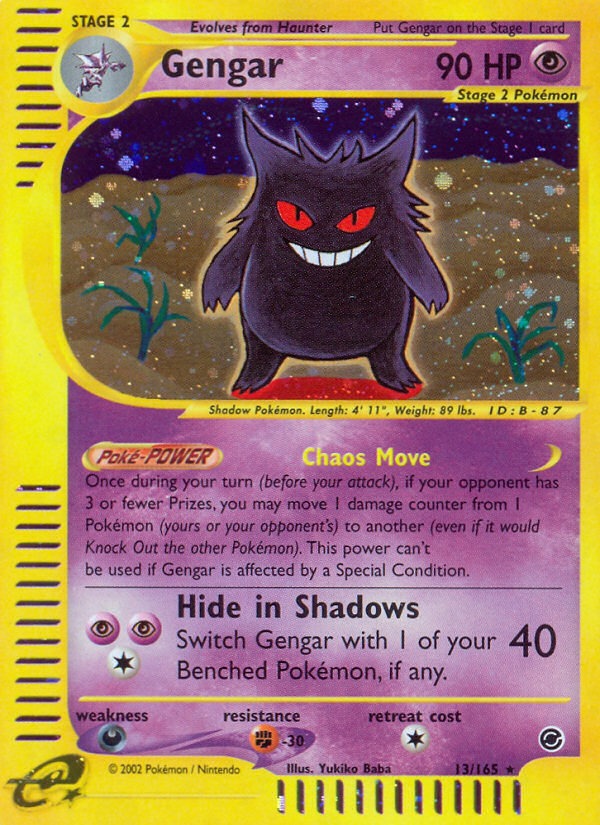
The e-Card face is the most distinctive in the hobby: a whole-face texture on the Crystal cards, and a dot-code strip on every card in the set.
Sources
Sources and further reading
- Wizards of the Coast — Expedition Base Set, September 2002; Aquapolis, January 2003; Skyridge, May 2003.
- Wizards of the Coast — end of the Pokémon licence and the transfer to Nintendo, 2003.
- Nintendo — e-Reader accessory, 2002, and the dot-code format that produced the strip on e-Card cards.
- CardSpicy — How to read a set code, for cross-checking a print window.
- CardSpicy — What is in a Pokémon booster box, for 36-pack configurations.
- CardSpicy — How to spot a resealed box, for the seam checks used above.
Related reading
- Era 2 — e-Card, 2001 to 2003 — the card-level story and the nine Crystal cards.
- Sealed Base Set product — scarcity by consumption, the opposite case.
- Sealed EX product — what came next, and why the boxes got bigger.
- All twelve Pokémon card eras — the full timeline.
- Open it or keep it sealed — the decision framework.
- Spotting a resealed box — the checks in full.
Nothing on this page is investment advice, and no sealed product is offered for sale here. Release dates and product configurations are as published by the manufacturers; survival descriptions are structural, not population figures.
Where to go next
- The CardSpicy card index — every card we track, with its PSA 10 population and market history (195 cards).
- The illustrator index — every artist behind those cards, card by card (110 artists).
Leave a Reply