

Sealed companion to Era 1, the Base Set era. Part of the twelve-era timeline. This page does not quote prices for sealed product; it explains why the supply is what it is.
Quick answer
The old-back era has the worst sealed survival rate in the hobby, and it was not caused by people opening boxes for profit. In 1999, a 36-pack English booster box retailed around the price of two or three of the chase cards inside it. Opening the box was not a gamble you took against the market; it was simply the cheaper way to get the cards you wanted. Keeping a box sealed made no sense to anyone who was not a retailer, and in 1999 almost nobody was.
What survives today falls into two groups: retailer stock that never sold, and the small number of people who kept one box because it was a gift they never got around to opening. Neither group was collecting. That is why the survival rate is low and why it is not evenly distributed across the eleven sets of the era.
What sealed product actually existed in this era
The old-back era ran eleven English sets across three years, plus the Japanese line that started in 1996. Sealed product came in more shapes than most collectors expect, and the shapes matter because they survived at very different rates.
| Product type | What is inside | Survival | Why |
|---|---|---|---|
| Booster box (36 packs) | 36 eleven-card packs; 1st Edition, Shadowless or Unlimited depending on print run | Very low, and lowest for 1st Edition | The most rational thing to do with a box was open it |
| Theme deck | 60-card preconstructed deck, one fixed holo | Low but better than boxes | Cheap, bought as a gift, often forgotten in a drawer |
| 2-Player Starter Set | Two 30-card decks plus rules and damage counters | Moderate | Bought by parents who did not understand the game |
| Booster pack | 11 cards, one of which is a holo or rare slot | Highest of any sealed format | Packs were cheap, so loose packs were hoarded casually |
| Japanese Expansion Pack box | 60 packs of the 1996 Japanese set | Extremely low | No export channel; almost all consumption was domestic |
Two consequences follow from that table. First, a loose pack is not a proxy for a box. The people who kept packs kept them one at a time, which means the surviving packs are spread across thousands of holders while the surviving boxes are concentrated in a few. Second, the Japanese 1996 product is the scarcest of all and is almost never discussed, because it never entered the English-language market in quantity.
The four factors that decide sealed survival
Sealed survival is not one number. It is the product of four factors, and the old-back era is unusual because all four point the same way.
- Print volume. The 1999 English print run was enormous by the standards of the time and small by the standards of 2026. Wizards of the Coast reprinted repeatedly through 1999 and 2000 to meet demand, which is why Unlimited is common and 1st Edition is not.
- Opening incentive. This is the factor people underweight. A box survives when the expected value of its contents is below the price of the box. In 1999 the contents were worth more than the box, so the box had a negative premium and got opened.
- Retention motive. Someone has to decide to keep it. In 1999 the only retention motive was unsold inventory. Collectors did not keep boxes; they kept cards.
- Physical survival. A sealed box from 1999 has spent twenty-seven years being moved. It has been stacked, stored in garages, exposed to humidity swings and, in many cases, to a shrink wrap that has since become brittle.
The old-back era scores badly on all four. The e-Card era that follows scores badly on volume but better on retention, which is why the two eras behave differently even though they are only two years apart. That is the subject of the e-Card sealed page.
Why the boxes that survive look the way they do
A 1999 booster box is not a stable object. Three things happen to it that do not happen to a modern box.
- The shrink wrap yellows and goes brittle. Wizards-era wrap is a thinner film than what is used now. It yellows unevenly, and once it embrittles it splits at the corners rather than stretching. A box with split wrap at one corner is still sealed, and the split is not evidence of tampering.
- The display tray sags. Inside the box, packs sit in a corrugated tray. Over decades the tray takes a set and the box develops a bow along its long axis. This is normal and does not indicate the box was opened.
- The cardboard wicks moisture. Old-back era boxes are plain printed board with no barrier layer. In a humid climate the board absorbs and releases moisture with the seasons, which is what produces the characteristic wavy edge along the top flap.
None of these three is damage in the grading sense, and all three are routinely mistaken for it by people who have only handled modern product. If you are assessing a 1999 box, the question is not whether it looks perfect. It is whether the wrap is continuous except at the folds, and whether the flap has ever been lifted.
How to check a 1999 box without damaging it
- Look at the wrap at the flap seam first. The original seal runs across the top flap in a straight line with a visible crimp. A reseal is usually resealed along the same line but with a different crimp pattern, and the giveaway is a second line of crimp marks offset by a few millimetres.
- Check the corners for split wrap, then check inside the split. A split is normal. What is not normal is a split with clean board underneath and no dust, because that means the split is recent.
- Weigh it. A 36-pack box has a narrow expected weight band. A box that is materially light has lost packs. This is the single most useful non-destructive check and almost nobody does it.
- Read the print code on the bottom flap and cross-check it against the set’s print window. A code from outside the window is a rewrap.
- Do not open it to check. The only thing opening a box proves is that it is no longer sealed. Every check above is external.
Storing sealed product from this era
Sealed boxes fail from three things: humidity, weight and ultraviolet light. The order matters.
Humidity is the one that does the permanent damage, because the board takes it in and the ink layer does not, which is how you get the wavy flap edge described above. Keep old-back boxes in a stable interior room rather than a garage or loft, and do not put them in a sealed plastic bin without a desiccant, because a closed bin traps the moisture that was already in the board.
Weight is the second. Do not stack a 1999 box under modern product, which is heavier per unit volume. If a box has already developed a bow, storing it flat under light even pressure will not remove the bow and is not worth attempting; the risk of crushing a corner is higher than the cosmetic gain.
Light is third and is the reason so many surviving boxes have a faded side. Direct sun for a few weeks is enough to shift the blue on a Base Set box. A closed cabinet solves it.
For the loose packs that came out of these boxes, the storage problem is different: a pack is a foil wrapper around a stack of cards, and the failure mode is the wrapper creasing against the card edge. A rigid pack holder prevents that. If you keep loose packs, the practical approach is a dedicated metal pack storage box rather than a shoebox, because metal does not flex and does not carry moisture the way board does.
For the cards themselves, the layering has not changed since the era: a matte penny sleeve to stop surface contact, a rigid 3×4 toploader to stop the curl being forced flat, and for anything you want visible, a display slab. On a thin 1999 card the insertion abrasion of a toploader is a real cost, which is why a press-fit case that closes on the card rather than sliding over it is the better fit for a high-value old-back single.
Where this sits
The old-back era is the first of the twelve, so it has no predecessor. Its sealed line is followed by the e-Card sealed page, which covers the three sets printed between 2001 and 2003 — the only era where the box is scarcer than the cards inside it. If you want the card-level story instead, start at Era 1 or at the timeline.
Frequently asked questions
Is a sealed 1999 booster box worth more than the packs inside it?
As a rule, yes, and the gap has widened over time. That is the opposite of the situation in 1999, when the contents were worth more than the box. The reversal is what created the sealed market in the first place.
Does yellowed shrink wrap mean the box was resealed?
No. Wizards-era wrap yellows as a matter of course and yellows unevenly, so one side being darker than another is normal. What matters is the crimp pattern along the flap seam, not the colour.
How can I tell 1st Edition, Shadowless and Unlimited boxes apart?
By the printed markings on the box, not by the wrap. 1st Edition boxes carry the Edition 1 mark on the box art and their packs are stamped. Shadowless and Unlimited differ in the copyright line and in whether the art box has a drop shadow, which you can sometimes see through the wrap on the display card.
Should I open a sealed box to verify the contents?
No. Opening it destroys the only thing that makes it a sealed box and proves nothing that an external check would not have shown. Weigh it, read the print code, and inspect the wrap at the seam.
Is a sealed pack from this era worth keeping sealed?
It depends on which pack. A loose Unlimited pack is common enough that the sealed premium is modest; a 1st Edition pack is not. The distinction is the same one that applies to the cards: the printing decides everything.
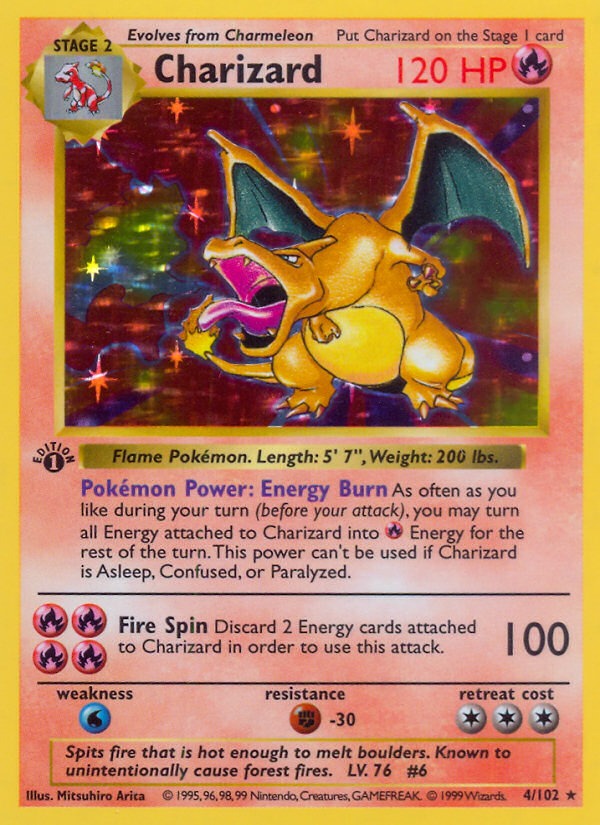
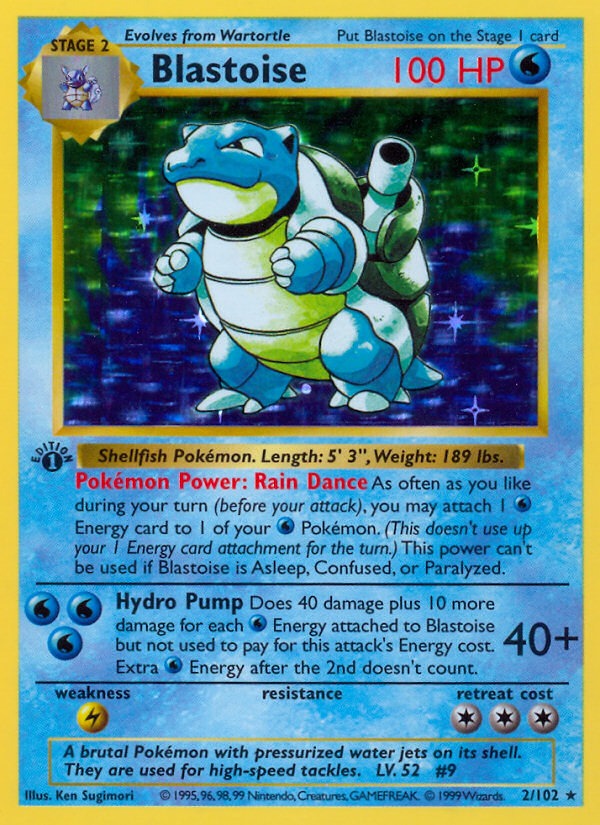
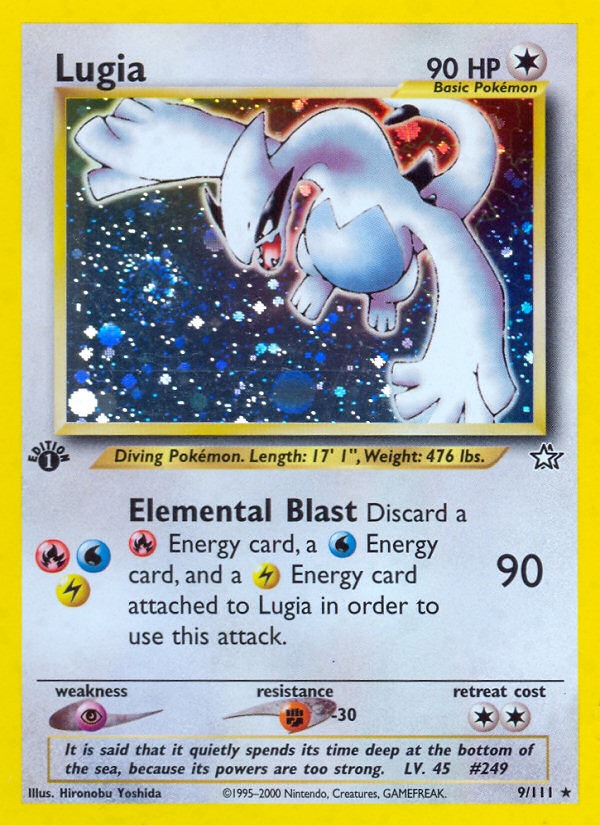
What this era’s product actually looks like
The cards that came out of these boxes are the reason the boxes are worth anything, and the printing differences that decide card value are visible on the card face.
Sources
Sources and further reading
- The Pokémon Company — Japanese Expansion Pack release, 20 October 1996; sixty-pack box configuration.
- Wizards of the Coast — English Base Set release, 9 January 1999; 36-pack booster box, eleven cards per pack.
- Wizards of the Coast — the 1st Edition, Shadowless and Unlimited print sequence and the reprint programme through 2000.
- CardSpicy — What is in a Pokémon booster box, for the pack and box contents of each era.
- CardSpicy — How to spot a resealed box, for the seam and crimp checks summarised here.
- CardSpicy — Storing sealed Pokémon boxes, for the humidity and weight guidance.
Related reading
- Era 1 — Base Set, 1996 to 2001 — the card-level story, and the five printings of one Charizard.
- Sealed e-Card product — the one era where the box outran the cards.
- All twelve Pokémon card eras — the full timeline.
- Open it or keep it sealed — the decision that matters most on 1999 product.
- Booster boxes or singles — why the two markets price differently.
- Spotting a resealed box — the checks in full.
Nothing on this page is investment advice, and no sealed product is offered for sale here. Product configurations and release dates are as published by the manufacturers; survival descriptions are structural and are not population figures.
Where to go next
- The CardSpicy card index — every card we track, with its PSA 10 population and market history (195 cards).
- The illustrator index — every artist behind those cards, card by card (110 artists).
Leave a Reply