

Era 1 of 12 in our timeline of Pokémon card eras. This is the only era you can identify by turning the card over, and the only one where the printing — not the artwork — decides the price.
Companion pages: Sealed Base Set product · grading Base Set cards.
Quick answer
The Base Set era ran from October 1996 in Japan to 2002 in English, and it is defined by the old back. Within it, the same Charizard exists in at least five distinct printings that trade at prices differing by a factor of thirty: Japanese No Rarity, Japanese with rarity symbol, English 1st Edition, English Shadowless, and English Unlimited. The card is the same card. The printing is not.
If you are holding an old-back Charizard, the first question is not condition. It is which of those five you have.
The dates that actually matter
Most era guides give you a range and move on. The old-back era has five dates that change how you read a card.
- 20 October 1996 — the Japanese Base Set (Expansion Pack) goes on sale. Ninety-six cards, no rarity symbols on the first print run, and a print volume that was set by a company that did not yet know it had a hit. Thirty years later, this is the date the entire hobby counts from.
- 9 January 1997 — the Japanese and English-language products begin to diverge. The English release is still two years away.
- 9 January 1999 — Wizards of the Coast releases the English Base Set. 1st Edition boxes ship first, then Shadowless, then Unlimited.
- 1999 to 2002 — Jungle, Fossil, Team Rocket, Gym Heroes, Gym Challenge, Neo Genesis, Neo Discovery, Neo Revelation, Neo Destiny and Legendary Collection follow. The back never changes.
- 2002 — Legendary Collection is the last old-back English set. The era ends without anyone announcing it.
Five printings of one card, and why they are five assets
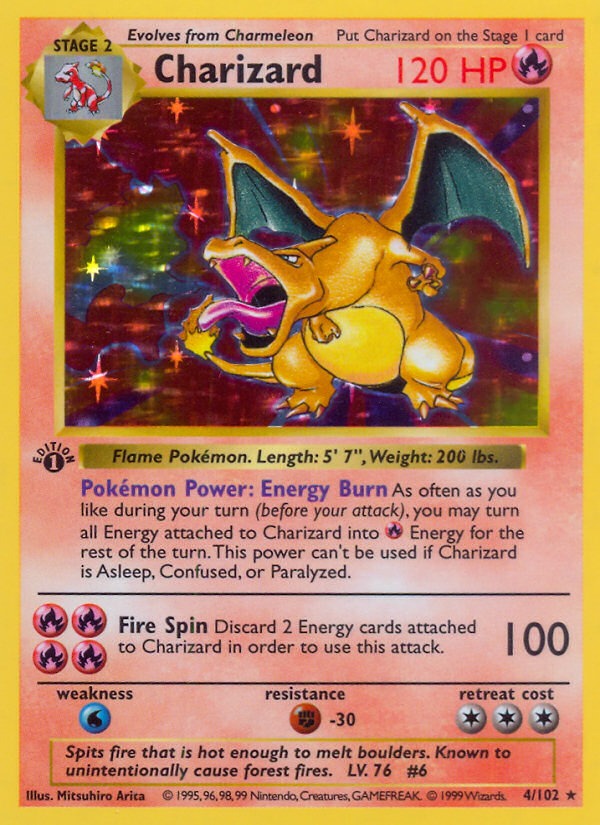
The Charizard from Base Set is the most analysed card in the hobby and still the most commonly misidentified. Here is what separates the printings.
| Printing | How to tell | Why it is scarce | Reference range, 2026 |
|---|---|---|---|
| Japanese No Rarity | No rarity symbol in the bottom-left of the frame; 1996 copyright | Only the earliest Japanese print run omitted symbols | Rarely traded; ask for the symbol before you price |
| Japanese with symbol | Star symbol present; 1996 copyright | Long print run, wide survival | PSA 10 around $35,000 |
| English 1st Edition | Circular “Edition 1” stamp left of the artwork; Shadowless border | First English print, small volume, hard in gem condition | PSA 10 high six figures at auction |
| English Shadowless | No shadow under the art box; copyright reads 1999, not 1999-2000 | Second print; corrected quickly | PSA 10 in the low five figures |
| English Unlimited | Drop shadow under the art box; copyright 1999-2000 | Enormous print run, still widely available | PSA 10 around $16,000 |
Two things about that table are worth sitting with. The first is the gap between the Japanese and English printings of the same artwork: a Japanese PSA 10 sits near $35,000 while an English Unlimited PSA 10 sits near $16,000, and the English 1st Edition clears half a million. The second is that the cheapest of the five is still a four-figure card. There is no inexpensive way into Base Set Charizard in a gem-mint holder.
The blue chips of the old-back era
Six cards carry the era. They are not the six most expensive Pokémon cards in existence, but they are the six that a serious old-back collection is organised around.
| Card | Set | Why it holds | Reference range, PSA 10 |
|---|---|---|---|
| Charizard, 1st Edition | Base Set, 1999 | The card the hobby is named after in practice | Into the high six figures; $550,000 in December 2025 |
| Blastoise, 1st Edition | Base Set, 1999 | Second starter, smaller gem population than Charizard | $25,000 to $45,000 |
| Venusaur, 1st Edition | Base Set, 1999 | The least loved of the three starters, and the cheapest entry | $15,000 to $30,000 |
| Lugia, 1st Edition | Neo Genesis, 2000 | The first card to be printed as a genuine chase outside Kanto | $8,000 to $15,000 |
| Shining Charizard, 1st Edition | Neo Destiny, 2002 | The original “Shining” treatment, and the hardest to centre | $25,000 to $45,000 |
| Pikachu Illustrator | Corocoro promo, 1998 | Not a set card at all; a contest prize with a few dozen known copies | Reported at about $16.5 million, February 2026 |
The Illustrator is the outlier and it is worth understanding why. It was never sold in a pack. It was awarded to winners of a Japanese illustration contest, which means the population was set by the number of prizes, not by a print run. That is the same scarcity structure as a trophy card, and it is why the price sits two orders of magnitude above the most expensive card you could have pulled from a box.
The undervalued corner of the old-back era
Three areas of this era are structurally scarcer than their prices suggest. None of them is a secret; all three are hard to find in gem condition, which is the part the market prices slowly.
- Neo Destiny Shining cards other than Charizard. Shining Tyranitar, Shining Steelix and Shining Celebi come from the same 1st Edition print run and the same centring problem as Shining Charizard, at a fraction of the price. The set is small and the completionist demand is real.
- Gym Heroes and Gym Challenge holos. These are the last old-back sets before the Neo redesign, they were played heavily, and the gem-mint populations are thin. The cards are tied to named trainers rather than Pokémon, which historically suppressed them and now reads as character collecting.
- Legendary Collection reverse holos. The 2002 set reprinted Base Set cards with a reverse foil pattern that is genuinely difficult to find without surface marks. It is the only old-back set that behaves like a modern parallel.
The common thread: each of these is scarce in the specific condition collectors want, and each is cheap enough that the grading cost is a meaningful share of the purchase. That combination is what a mispriced corner looks like.
How to tell an old-back card’s condition honestly
Old-back cards fail in ways modern cards do not, and the failures are easy to miss under normal light.
- Curl, not damage. A 1999 holo will bow along the vertical axis because the foil layer and the paper stock expand differently. Curl alone does not reduce a grade, but flattening it by force will crease the surface. Store it flat under even weight, never bend it back.
- Edge whitening on the yellow border. The border is printed, not bare card stock, so whitening shows as a lighter yellow rather than white. Check the four corners at an angle, not face-on.
- Surface scratching from the old sleeves. Many surviving copies spent the 2000s in PVC sleeves that have since gone tacky. A hazy surface is often sleeve damage rather than play wear, and it caps the grade at 8 or below.
- Centring that looks fine until you measure it. Wizards-era cutting tolerances were wide. A card that looks centred to the eye is frequently 65/35, which is a PSA 8 ceiling on an otherwise perfect card.
Why this era is still worth grading
Two facts make the grading maths work here even at current PSA pricing. The first is that the gem-mint populations of these cards are fixed. Nobody is opening 1999 1st Edition boxes to make more of them, and the boxes that remain are worth more sealed than opened. The second is that the price gap between grades is unusually wide: on Base Set Charizard, the step from PSA 9 to PSA 10 is a multiple, not a percentage.
That combination — fixed supply at the top, wide grade spreads — is the only structure in which grading reliably pays for itself. It is the opposite of most modern sets, where the population keeps growing and the grade premium compresses.
Keeping old-back cards from getting worse
Old-back cards are the most fragile thing in the hobby relative to their value. The stock is thin, the foil is heavy, and the yellow border is the first thing to show handling. Three layers, in order: a penny sleeve to stop surface contact, a rigid 3×4 toploader to stop the curl from being forced flat by whatever sits on top, and then either a graded holder or a display slab for anything you want visible.
For a thin 1999 card there is a fourth option worth knowing: a press-fit case that closes on the card rather than a toploader you slide it into. Because the card does not travel along the inside of the holder, a press-fit rigid card case removes the abrasion that a toploader’s insertion still produces on a card whose border is already soft.
Two things not to do. Do not store an old-back holo in a soft sleeve inside a cardboard box with other cards on top of it; the curl plus the weight is how corners get soft. And do not “fix” a curved card by pressing it between books for a month. The foil does not relax; the paper fibres crush.
Where this era sits on the timeline
The Base Set era has no predecessor. It is followed by the e-Card era, which kept the holo treatments but replaced the back of the card and added a barcode strip along the bottom edge. If you want the whole map first, start at the era timeline.
What these cards actually look like
Old-back holos are visually unlike anything printed since, and the differences are the ones that decide a grade.
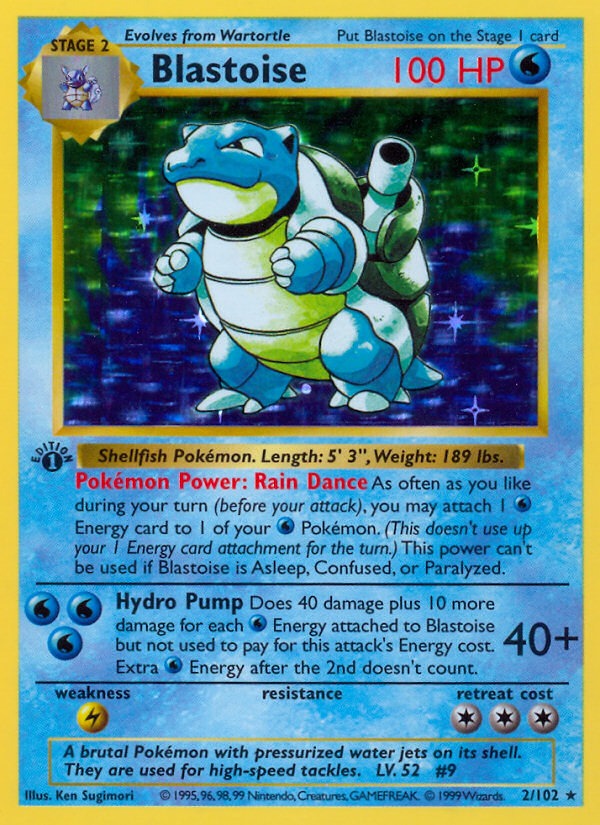
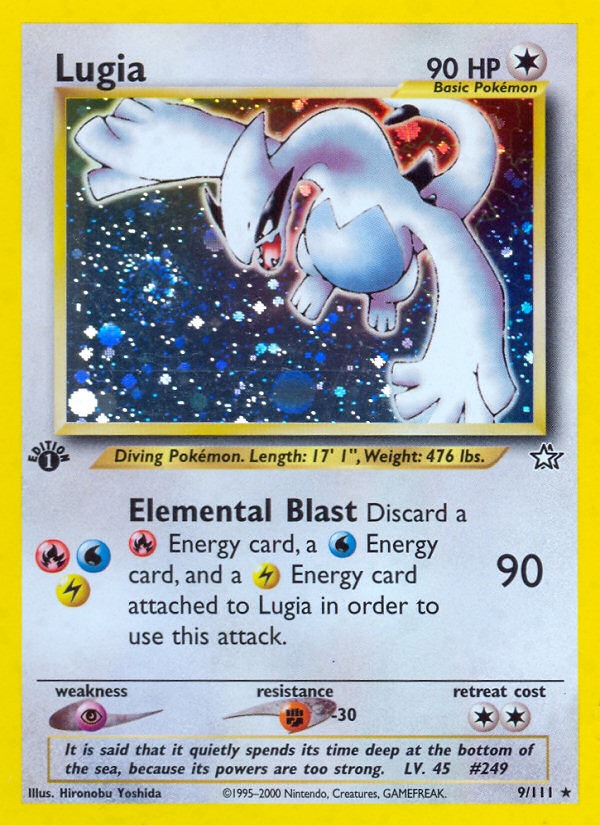
Image sources for this page: images.pokemontcg.io/base1/4_hires.png, base1/2_hires.png and neo1/9_hires.png — the 1st Edition printings of Charizard and Blastoise, and 1st Edition Neo Genesis Lugia. Served from /wp-content/uploads/2026/10/. Card names and artwork are trademarks of Nintendo, Creatures Inc. and GAME FREAK inc.; scans are used here for identification and commentary.
Frequently asked questions
Why is 1st Edition Base Set Charizard so much more expensive than the unlimited version?
Because they are different print runs, not different conditions. The 1st Edition run was the first English printing, it was small, and it carries a stamp that cannot be reproduced. The unlimited run was printed in far larger volume over a longer period. The artwork is identical; the supply is not.
How do I tell if my Base Set card is Shadowless?
Look for a shadow under the rectangular art box. If there is none, and the copyright line reads 1999 rather than 1999-2000, the card is Shadowless. Shadowless cards also have a slightly thinner HP font and a lighter yellow border.
What is a No Rarity Japanese card?
A card from the very first Japanese print run in 1996, before rarity symbols were added to the frame. The symbol is simply absent from the bottom-left corner. These are the earliest Pokémon cards printed and they are considerably scarcer than the later Japanese printings with a star symbol.
Is a curved old-back card damaged?
Not necessarily. Curl is a normal consequence of the foil and paper layers reacting differently to humidity, and a curved card can still grade highly if the surface and corners are clean. Forcing it flat is what causes damage. Store it flat, in stable humidity, and let it stay curved.
Was Charizard ever printed in Base Set without a holo?
No. Charizard is a holo rare in every Base Set printing. A non-holo Charizard with a Base Set frame is either from a different set or a counterfeit, and the counterfeit market for this specific card is the largest in the hobby.
Sources
Sources and further reading
- The Pokémon Company — Japanese Expansion Pack release, 20 October 1996, ninety-six cards.
- Wizards of the Coast — English Base Set release, 9 January 1999, and the 1st Edition / Shadowless / Unlimited print sequence.
- Heritage Auctions — PSA 10 1st Edition Shadowless Base Set Charizard, $550,000, December 2025.
- Guinness World Records — PSA 10 Pikachu Illustrator, approximately $16.5 million, February 2026.
- Third-party graded price trackers — Base Set Charizard and Japanese Base Set Charizard PSA 10 ranges, October 2026.
- PSA population reports — gem-mint populations for Base Set, Neo Genesis and Neo Destiny.
- CardSpicy — How to read a set code, for identifying a printing from the code.
Related reading
- All twelve Pokémon card eras — the full timeline, with the defining card of each.
- Era 2 — e-Card, 2001 to 2003 — what replaced the old back, and why it is the strangest era.
- Era 3 — EX, 2003 to 2004 — gold stars, and the first era built for collectors rather than players.
- Storing sealed Pokémon boxes — if you are holding old-back product rather than singles.
- Open or keep sealed — the decision that matters most on 1999 product.
Nothing on this page is investment advice, and no grade outcome is promised for any card. Prices quoted are published third-party figures as of 2026 and are reference ranges, not offers; they move, and a specific card’s value depends on the specific printing and condition in front of you.
Where to go next
- The CardSpicy card index — every card we track, with its PSA 10 population and market history (195 cards).
- The illustrator index — every artist behind those cards, card by card (110 artists).